




Abstract
As the hydrocarbon vertical migration pathway, fault and its relationship with reservoir extremely affect the distribution and accumulation of oil and gas in the non-hydrocarbon generating layers. On both sides of the fault, there are frequently various sand bodies with different oil and gas enrichment. However, previous researches on this differential charging are mostly based on empirical formulas or physical simulation experiments instead of fluid seepage mechanism. This paper proposed a quantitative evaluation method on the basis of Darcy's law to analyze the difference in hydrocarbon lateral diversion capacity through the oil-source fault. It can be seen that in the process of hydrocarbon migrate along the oil-source fault, hydrocarbons could divert laterally into sand bodies through the fault when there is a downward pressure gradient. Conversely, hydrocarbons can only migrate upward along the fault. Furthermore, among the four normal fault-sand body configuration types, the opposite fastigium type is most favorable for hydrocarbons laterally charging whereas the fastigium type is the least beneficial. The ratio of resistance in the sand body to in the fault was proposed as the evaluation index (Fs) to quantitatively evaluate the hydrocarbon lateral diversion migration capacity, on the assumption that hydrocarbons in different sand bodies are sourced from the same source rocks. The index (Fs) is directly proportional to the lateral diversion capacity of hydrocarbon, and is complex controlled by many geological factors including the reservoir permeability, fault-sand body contact length and dip angles of sand body and fault. And the higher the value of Fs, the stronger the hydrocarbons laterally divert ability of the sand body. In addition, the calculation result of well GG16102 in the Beidagang buried hill coincide well with the oil and gas interpretation result indicating that the method is practical to quantitatively evaluate the laterally diverting hydrocarbons of sand bodies under the condition of fault-sandstone configuration.
Keywords
Introduction
Oil and gas migration is the key to hydrocarbon accumulation (Fu et al., 2014a) and a hot issue in the petroleum geology area meanwhile. As an important part of hydrocarbon transportation system (Chen, 1995; Sun et al., 2009), fault can be the vertical channel for oil and gas migrating from deep over-pressured source rock to shallow reservoir (Losh et al., 1999; Liu et al., 2009; Chen et al., 2009; Hooper, 2010; Guo et al., 2010; Fu et al., 2014a). Especially in the oil-rich depressions in the rift basin, faults extremely affect the formation and distribution of shallow non-hydrocarbon generating reservoirs (Jiang et al., 2015; Jiang et al., 2021). However, previous researches are mostly concentrated on evaluating the transporting ability (Sun et al., 2006; Liu et al., 2008; Sun et al., 2013) and sealing ability (Fu and Zhao, 1999; Fu et al., 2013; Fu et al., 2014b; Lyu et al., 2016; Wang et al., 2017) of faults. Moreover, during the vertical migration process from the deep source rocks along faults, hydrocarbons should be accumulated to be an effective pool only when they are laterally charged into the sand-bodies contact with the fault (Fu et al., 2014a; Liu et al., 2014; Sun et al., 2017). And hydrocarbon migration and accumulation are affected by the relationship between fault and sand body. However, previous study did not pay enough attention to the influence of fault and its coupling relationship with sand body (Sun et al., 2013).
In the field of petroleum geology, hydrocarbon migration mechanism has attracted more and more attention. Some scholars have carried out physical simulation and preliminary theoretical analysis on the lateral diversion of hydrocarbons, considering the configuration relationship between fault and sand-body, as well as the physical property differences (Jiang et al., 2005; Guo et al., 2010; Ma et al., 2012). And point out that hydrocarbon lateral diversion ability is mainly controlled by numerous factors, including the configuration relationship between fault and sand-body, reservoir physical properties and reservoir thickness. Some scholars judge whether hydrocarbons can be laterally diverted by comparing the displacement pressure between the fault rocks and the sand bodies on both sides, and point out only when the resistance to vertical migration is greater than that to lateral migration to the reservoir, hydrocarbon can be laterally diverted (Wang et al., 2016; Fu et al., 2016; Fu and Zhan, 2017). Some other scholars analyzed hydrocarbon migration dynamic and resistance force, and they believe that hydrocarbon lateral diversion can occur when the dynamic is greater than the resistance of reservoir sand body (Sun et al., 2012; Zhang et al., 2017; Liu et al., 2017). In addition, some scholars have established quantitative evaluation parameters of hydrocarbon lateral diversion capacity taking the fault-sand body configuration type, reservoir thickness, physical properties and upper overburden quality into consideration (Sun et al., 2013; Fu et al., 2014a; Wang et al., 2016; Sun et al., 2017).
It can be seen that the current research focus on the hydrocarbon lateral diversion capacity can be summarized into three categories. The physical simulation experiment is intuitive to evaluate the effect of many geological factors on hydrocarbon differential charging using the control variable method. But simple physical simulation cannot represent the real formation conditions because of the complex underground geological conditions. In addition, there is a large pressure difference between the inlet and outlet of sand body in the experiment, leading to a spontaneous downward migration of oil and gas the sand body connected with the fault (Zeng et al., 2002; Guo et al., 2010; Wei et al., 2007), which is not easy to occur under actual formation conditions. The displacement pressure difference method can be conveniently used to judge whether the hydrocarbon lateral diversion occurs. And if the displacement pressure of the sand body is less than that of the fault rocks, hydrocarbons can be laterally transported into sand bodies on the both sides of the fault. Otherwise, hydrocarbon will migrate vertically along the fault. Nevertheless, it cannot quantitatively evaluate the hydrocarbon diversion capacity using this method. Moreover, the force conditions of hydrocarbons in the fault zone are obviously different from those in the sand body, which means that it is ineffective to judge whether lateral charging happens solely by comparing their displacement pressures. Whereas the force analysis method can be used to study hydrocarbon diversion capacity through analyzing the acting force of the oil-gas column, comprehensively considering the buoyancy, overpressure and other driving forces, as well as capillary force, friction and other resistance. When the driving force is greater than the resistance, the oil-gas can laterally diverse to the sand body, otherwise, hydrocarbons cannot migrate laterally. However, the resultant force direction of the object is the direction of acceleration instead of velocity. In addition, the hydrocarbon vertical migration in the fault zone is similar to the pressurized pipe flow with inertial force as resistance in fluid mechanics (Zhuang et al., 2008), meaning that simple force analysis is not applicable considering the viscoelasticity of oil and gas.
Therefore, it is of enormous theoretical importance to establish a method based on the charging mechanism to quantitatively evaluate the hydrocarbon diversion capability. This paper discussed the hydrocarbon diversion mechanism on the basis of fluid seepage mechanics, and proposed a quantitative method to evaluate the hydrocarbon diversion capacity. Which can provide guidance for the study of differential charging mechanisms in the process of hydrocarbon vertical migration along fault.
Methods
Theoretical basis
According to Darcy's law, when a single-phase fluid flows under the pressure difference ΔP in layers through a section of porous medium with length L and cross-sectional area A (Figure 1), the total amount of fluid passing through the rock pores per unit time is directly proportional to the size of pressure difference and cross-sectional area, and inversely proportional to the length of liquid passing through the rock and the viscosity of fluid which can be expressed as follows (Muskat and Meres, 1936).

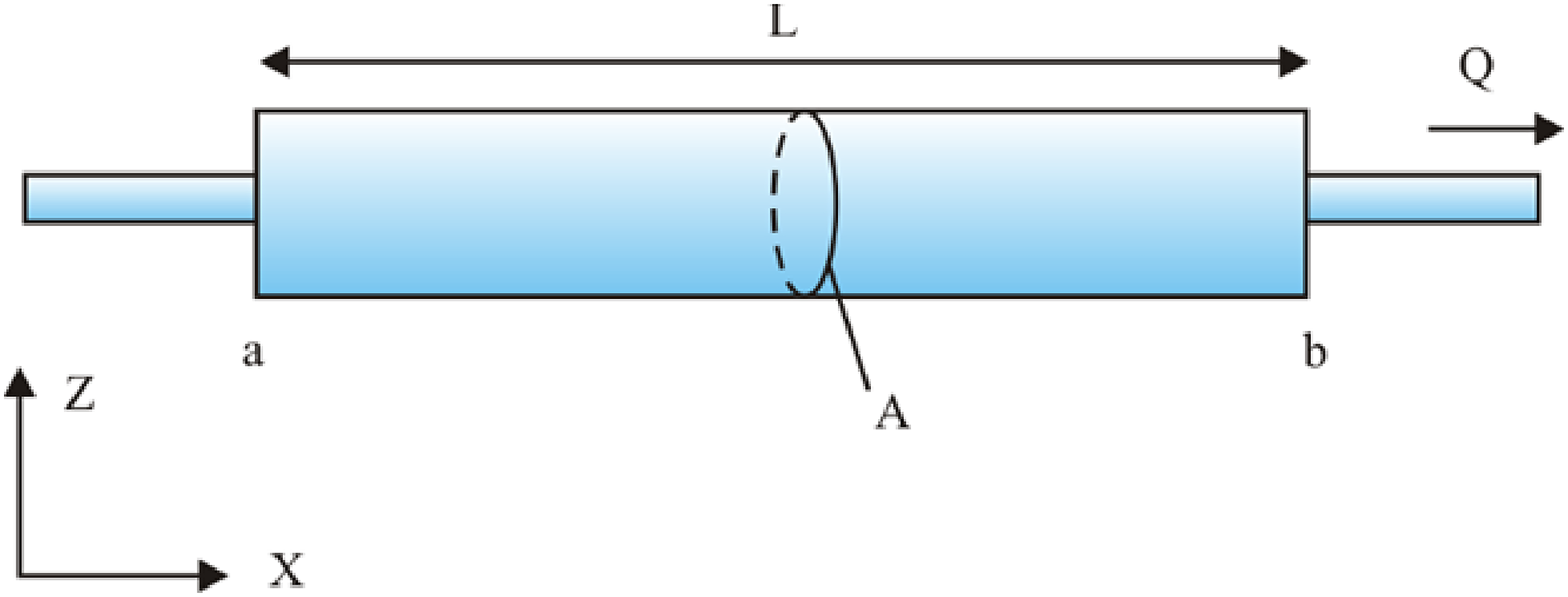
Schematic diagram of darcy's law.
Where, Q is the flow of fluid through rock in unit time (cm3/s), A is the cross-sectional area of the rock (cm2), μ is the viscosity of the fluid (mPa·s), L is the length of the core (cm), ΔP is the converted pressure difference before and after the fluid passes through the rock (10−1MPa) and K is the inherent permeability of the rock (μm2).
Darcy’s law does apply in specific circumstances only when the fluid seepage velocity is modest and the pressure differential is linear with the flow rate according to the fluid seepage mechanic theory (Zeng and Grigg, 2006). And it can be considered that the fluid seepage obeys Darcy's law when the Reynolds number (Re) is less than or equal to the critical value of 0.2–0.3.
The Reynolds number (Re) can be calculated using formula (2).

Fault episodic actives can be divided into active period and intermittent period (Yu and Zeng, 2005). The fault zone and reservoirs around contain relatively good physical properties during the episodic active period because fractures internal will open under the action of overpressure and seismic pump. While the physical properties become worse in the intermittent period. According to the simulation experiments (Fu et al., 2005), it can be seen that the oil seepage velocity ranges from 0.01 mm/s to 0.06 mm/s, and its migration velocity is between 3.6 cm/s and 21.6 cm/s (Zhuang et al., 2008) during the hydrocarbon episodic expulsion period. Crude oil has a common density of 0.75 g/cm3 to 0.95 g/cm3 and the viscosity of 50 mPa·s to 1500 mPa·s. Statistics results show that the porosity of fault rock ranges from 0.2% to 36% (Duan et al., 2014), and the permeability order is between 10−8 and 10−2 μm2 (Chen and Yang, 2012). Then the Re can be calculated using the formula (2). The calculation result shows that Re is ranging from 6.03 × 10⁻⁵ to 0.021, which is far less than the critical value of linear seepage, illustrating that hydrocarbon seepage in the fault zone follows Darcy's law.
Hydrocarbon lateral diversion model along fault is shown in Figure 2. According to Darcy's law, the total flow of fluid through the reservoir Qs and the total flow through the fault Qf in unit time can be expressed using formula (3) and (4) respectively.


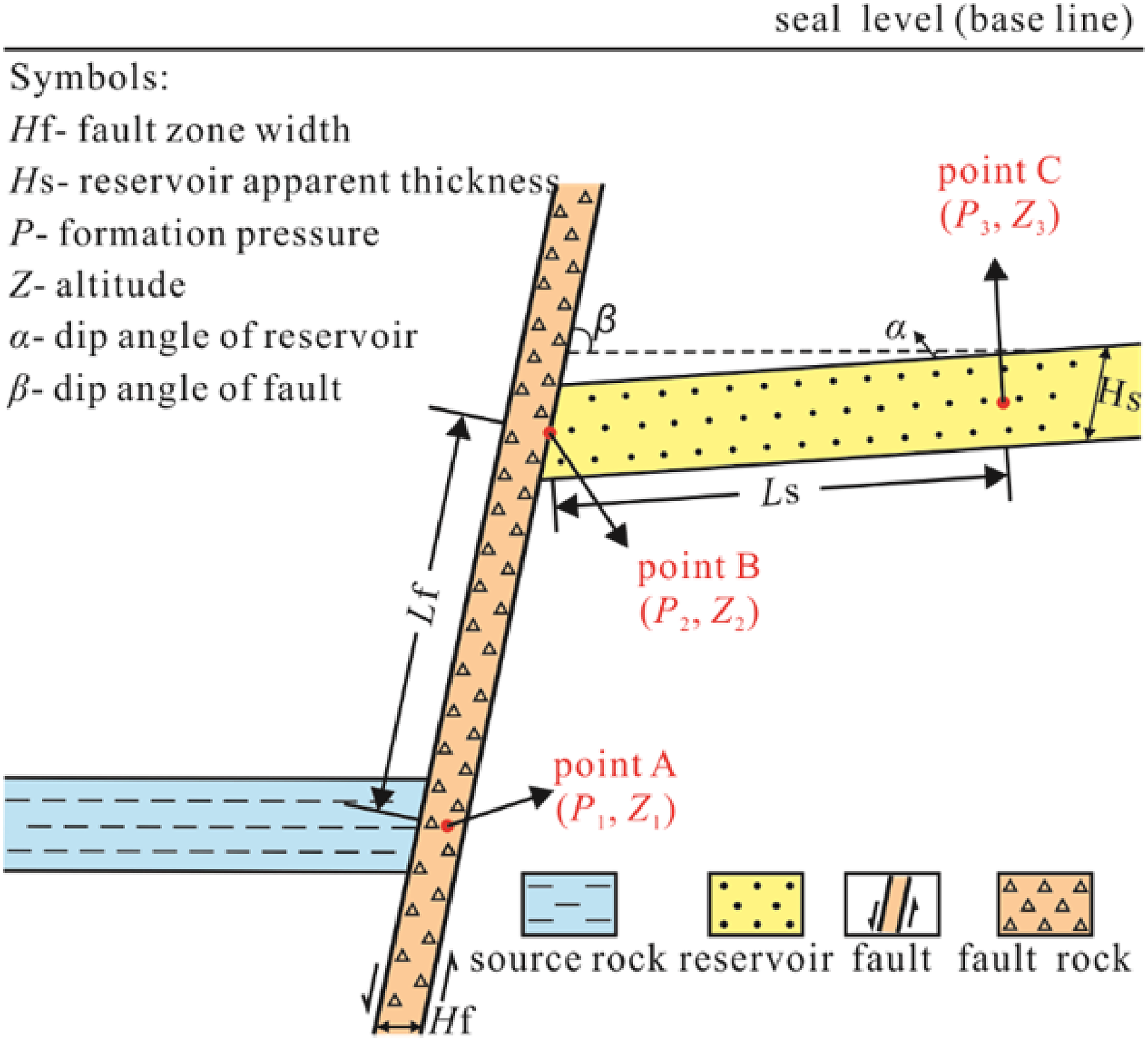
Hydrocarbon lateral diversion model along fault with one set of sand-body.
Where, Qs and Qf are the flow of fluid through sand-body and fault in unit time (cm3/s), As and Af are the cross-sectional area of sand-body and fault respectively (cm2), μ is the viscosity of the fluid (mPa·s), Ls and Lf are the length of fluid passing through sand-body and fault respectively (cm), ΔPs and ΔPf are the converted pressure difference before and after the fluid passes through the sand-body and fault respectively (10−1MPa), and Ks and Kf are the permeability of the sand-body and fault rock (μm2).
According to Darcy's law, the fluid can flow only when there is a pressure difference at both ends of the porous medium. Corresponding to the actual formation conditions, a pressure drop gradient should exist along the extension direction of the reservoir. In other words, hydrocarbons can laterally charge into updip sand bodies connected with the fault. On the section, the configuration relationship between sand-body and fault can be divided into four types based on the dip of fault and sand-body, including the synthetic fault, antithetic fault, opposite fastigium fault and fastigium fault (Fu et al., 2014a; Sun et al., 2017). Therefore, among the four types of fault-sand configuration shown in Figure 3, the sand bodies on both sides of type I are updip, which is most conducive for lateral diversion of hydrocarbons. In Type II and type III, only one side of the sand-body is updip, allowing for lateral hydrocarbons diversion. The sand bodies on both sides of type IV are downdip, and there is no pressure drop gradient along the sand body direction, hydrocarbons are unlikely to divert laterally, and the fault can act as a good shielding layer.
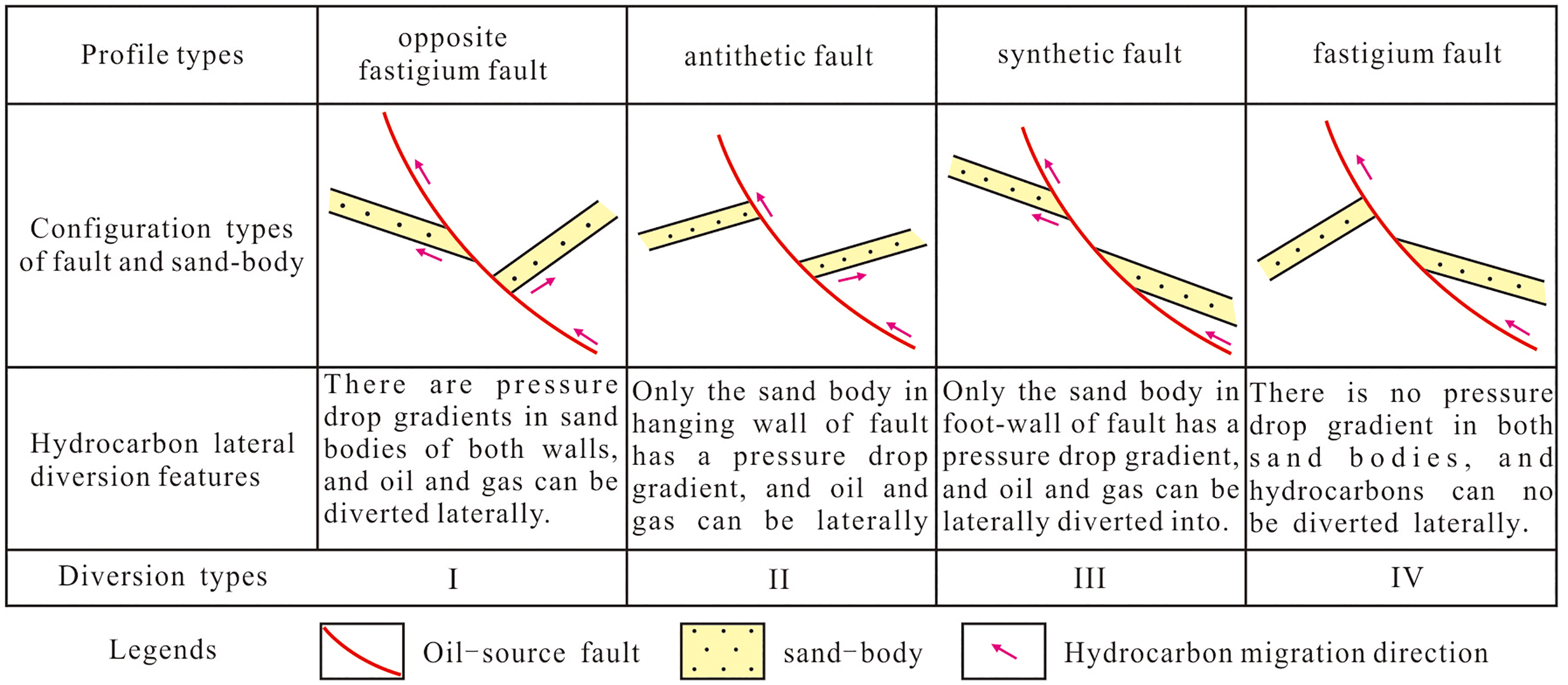
Fault-sandbody configuration relationship (modified from Fu et al., 2014a; Sun et al., 2017).
Evaluation method establishment
Form formulas (1) to (4) it can be seen that numerous parameters influence the lateral diversion capability of hydrocarbons in the sand bodies connected to the fault, including the permeability of the fault and sand-body, pressure difference at both ends, length and cross-sectional area. And the hydrocarbon diversion capacity can be quantitively evaluated while these parameters are known or can be calculated.
However, it is difficult to directly calculate the hydrocarbon seepage flow using formulas (3) and (4) under actual formation conditions. Firstly, the fault rock permeability can hardly be accurately obtained under the actual formation conditions. Secondly, the pressure difference between the two sections of the reservoir cannot be calculated accurately. As shown in Figure 2, the pressure P3 at one end of the reservoir can be approximated by the formation pressure, but the formation pressure P2 at point B of the charging point of the fault zone cannot be obtained accurately. Although there are documents that deduce the pressure drop model of hydrocarbon transportation along the fault in the fault zone based on the Bernoulli equation and Manning equation in fluid mechanics (Zhuang et al., 2008), this formula involves many parameters that are either unable or difficult to obtain, which directly affects the calculation of the hydrocarbon diversion flow. Last but not least, the above theoretical model is only used to quantitatively evaluate the lateral diversion capacity when there is one set of sand-body, making it difficult to simply compare the lateral diversion capacity between different sand-bodies under the actual formation conditions, where there are often multiple sets of sand bodies.
Therefore, an evaluation method is required that is simple to operate, easy to obtain parameters and can directly compare the diversion capacity of different reservoirs. The diversion model is shown in Figure 4.
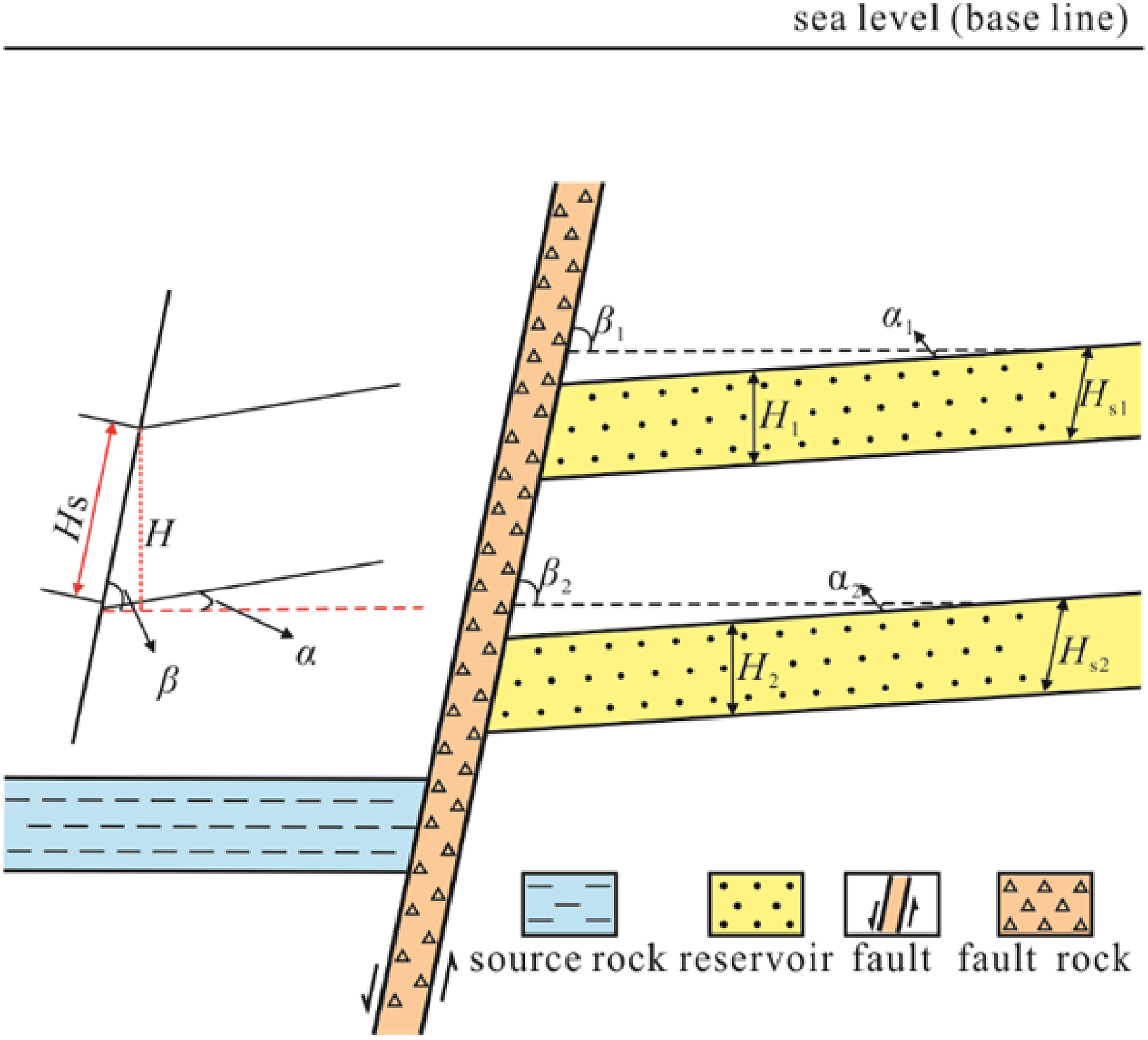
Lateral hydrocarbon diversion model in the configuration relationship between fault and sand-body.
According to Darcy's law, formula (1) can be deformed as follows.

Three assumptions are made in this paper to compare the diversion capacity of different reservoirs. Firstly, hydrocarbons are generated from the same set of source rocks and then the viscosity of the oil or gas can be regarded as consistent. Secondly, the pressure gradients at both ends of the sand-body are the same on one side of the same fault, and then the dynamic force in formula (5) are the same for different sand-bodies. Thirdly, the contact area between sand-body and the fault is directly proportional to their contact length. On this basis, the resistance force in formula (5) can be considered as the parameter to measure the hydrocarbon diversion capacity. And the smaller the charging resistance in the sand body indicates the stronger the lateral diversion capacity. Moreover, the quantitative evaluation index of hydrocarbon lateral diversion capacity (Fs) is defined as the resistance force ratio of in fault and in sand-body, and can be expressed as follows. And the greater the Fs, the stronger the lateral diversion capacity.

From Figure 4, it can be seen that there is the following relationship between the apparent thickness (Hs) of sand layer and its vertical thickness (H) for the synthetic fault.


It can be seen that the quantitative evaluation index Fs is a function of the permeability, vertical thickness, dip angle and fault dip angle of each set of reservoirs. The larger the Fs, the smaller the hydrocarbon seepage resistance and the stronger the hydrocarbon lateral diversion capacity through the oil source fault.
Example application
This paper takes well GG16102 in the Beidagang buried hill in the Huanghua Sub-basin as an example to verify the above evaluation method. The well is located in the footwall of Gangxi Fault, which has been acting since the sedimentary period of the third member Shahejie Formation (Es3) and stopped at the end sedimentary period of Minghuazhen Formation (Nm) in Neogene. The fault activity rate is between 10 m/Ma and 15 m/Ma in Neogene-Quaternary period, indicating that the fault vertically opened and had strong transportation capacity (Jiang et al., 2015). The oil-source correlation result shows that the Permian oil and gas are mainly sourced from the Es3 source rocks in the Qikou Depression (Lyu et al., 2019) and were accumulated during Neogene-Quaternary period (Jiang et al., 2019). Therefore, the Gangxi Fault can be acted as an effective migration pathway for oil and gas migration. Combined with the geological background, the oil and gas generated from the Paleogene source rocks in the hanging wall of the Gangxi Fault transported and migrated to the Permian reservoir in the footwall through the fault (Figure 5).
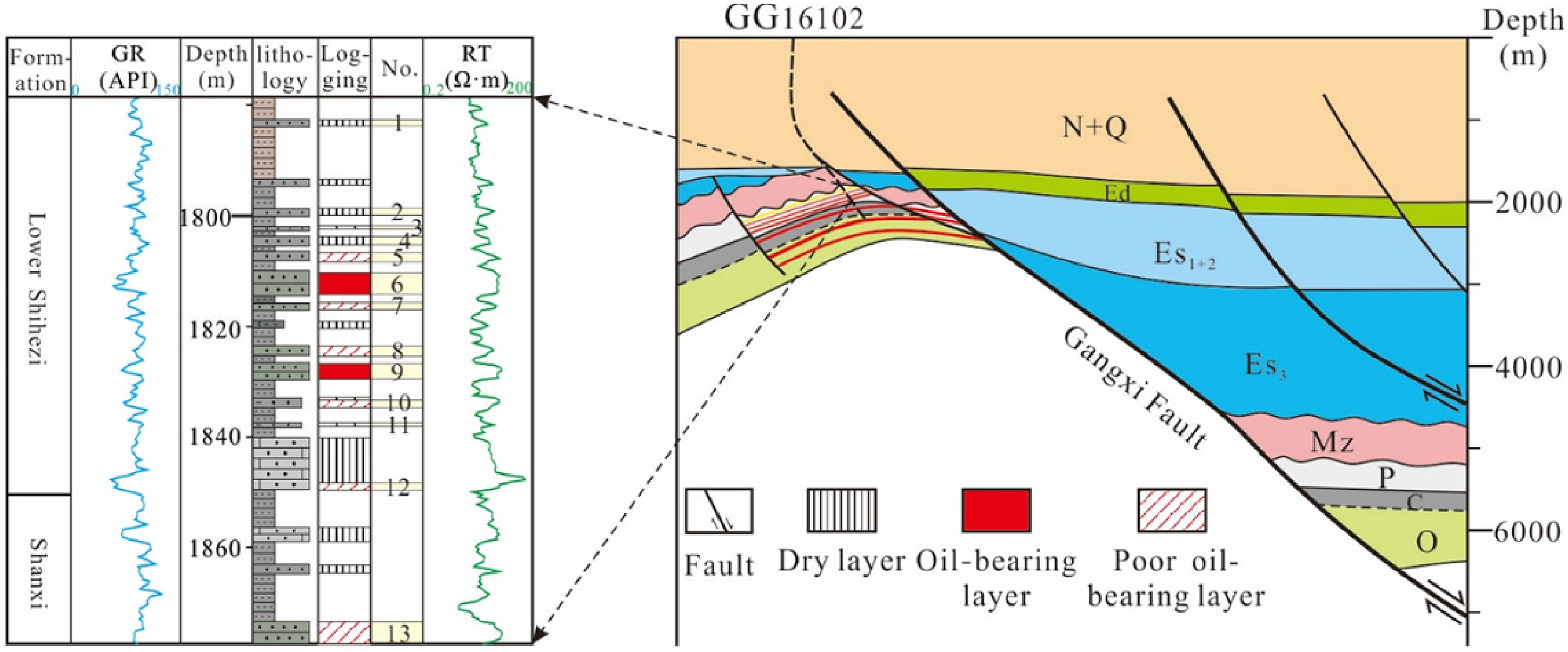
Reservoir profile and comprehensive column of well GG16102.
In this paper, the Lower Shihezi Formation of Permian system is selected as the evaluation object. The comprehensive logging interpretation results of each set of sand body in the target layer are collected, including oil and gas display, oil saturation, reservoir permeability. The dip angles of sand body and fault are obtained from seismic data. The quantitative assessment index Fs of 13 Shihezi Formation sand layers is calculated using the given parameters and formula (8). The evaluation results are shown in Table 1.
Evaluation of hydrocarbon lateral diversion capacity in different sand layers of well GG16102.
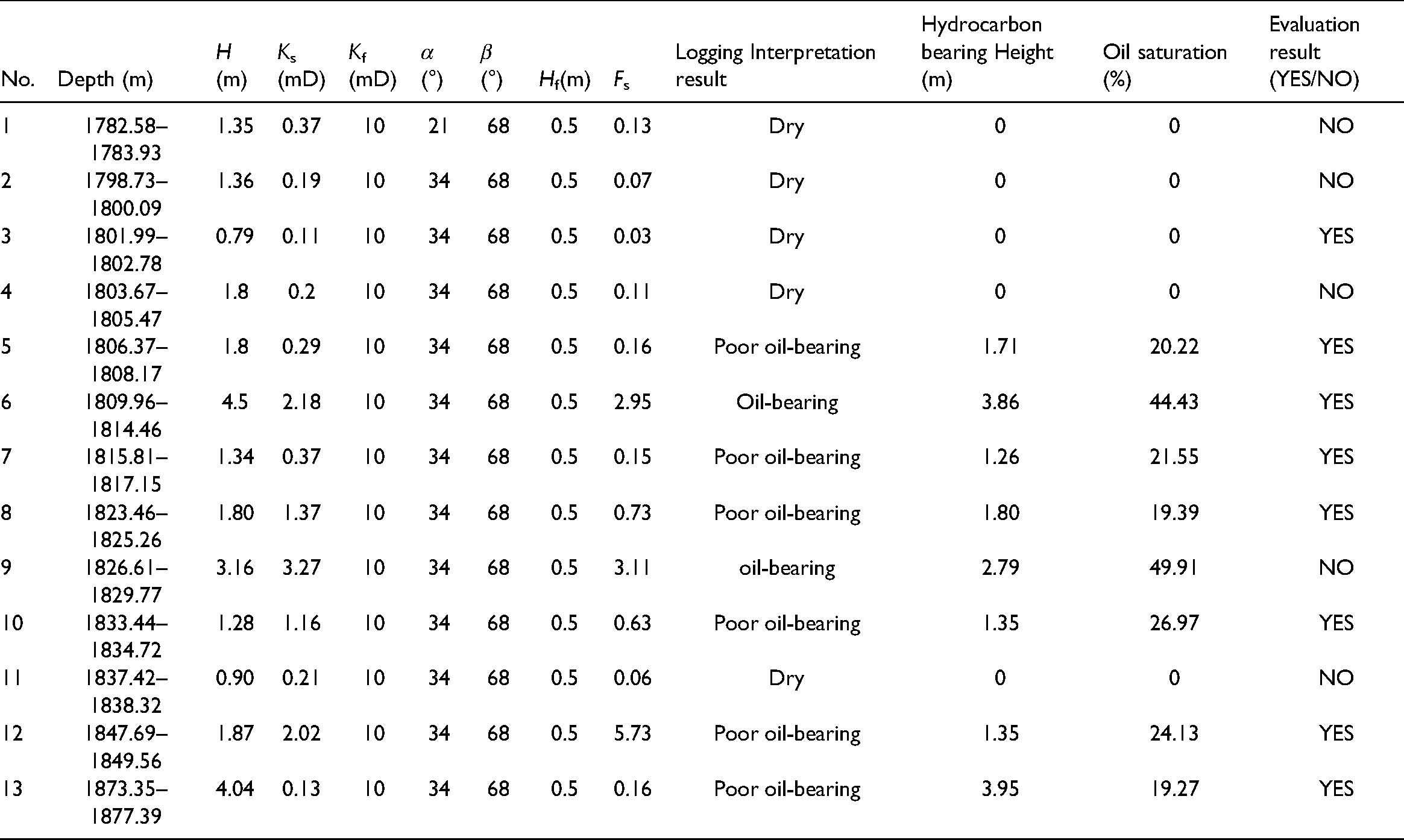
The calculated results show that Fs of 13 sand layers ranges from 0.07 to 5.73. Among them, the logging interpretation results show that No. 5 to No. 10 and No. 12 to No.13 sand layers are oil bearing layers, indicating that hydrocarbons can divert into these 8 sand layers laterally. In addition, the quantitative evaluation index Fs of these 8 sand layers is generally greater than 0.15, indicating that Fs of 0.15 can be used as the critical value in the study area. In addition, the oil saturation (So) increases obviously with the increase of the evaluation index Fs (Figure 6), which further verifies the feasibility of this evaluation method. It can be demonstrated that the evaluation method of hydrocarbon lateral diversion for oil source faults established in this paper can quantitatively and accurately evaluate the lateral diversion capacity.
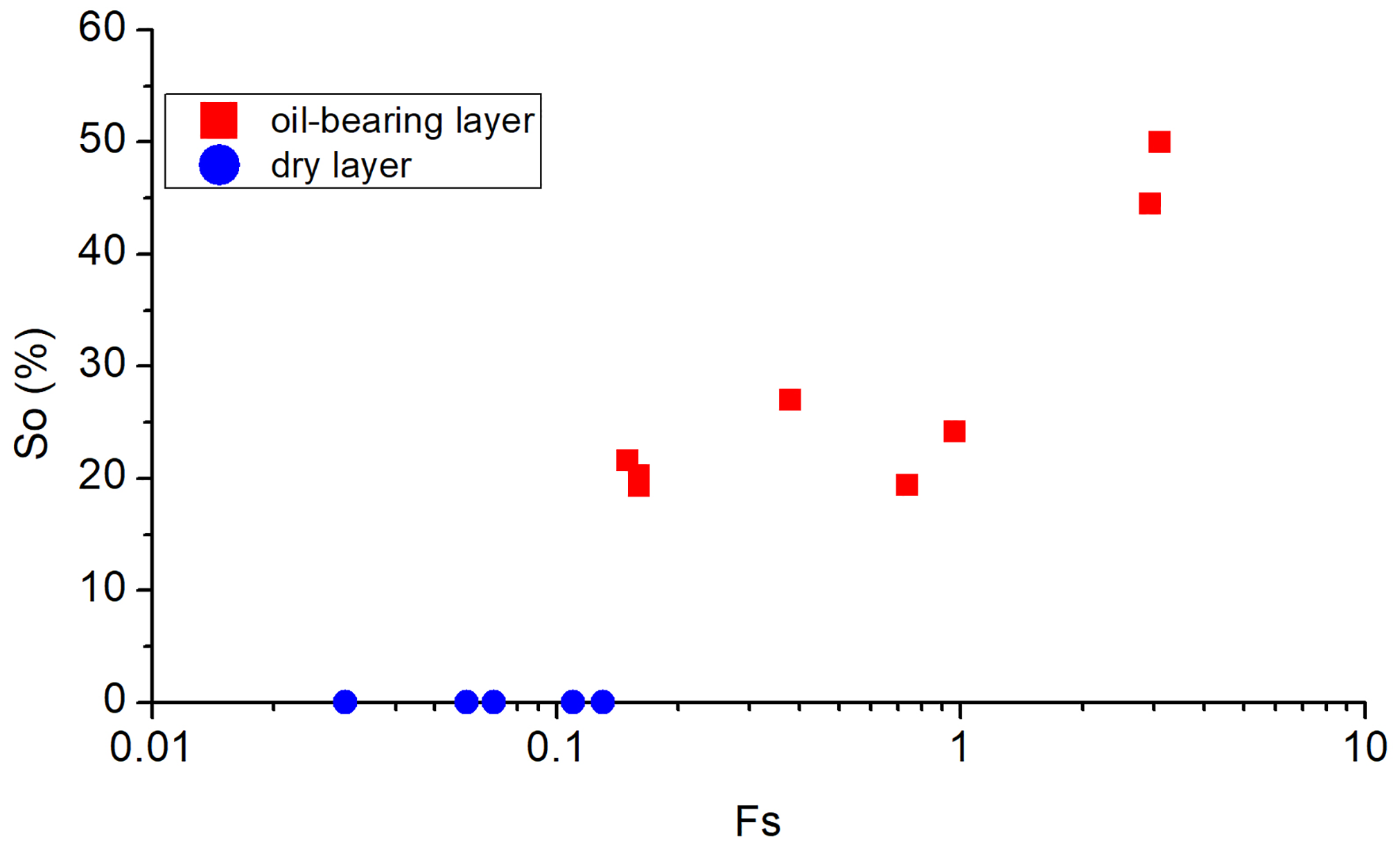
Fs versus oil saturation (So) of well GG16102.
Compared with other methods using parameters according to the experience in previous study (Fu et al., 2014a; Fu et al., 2019), the method was established in this paper on the basis of Daycy's Law, taking the dynamics and resistance of fluid seepage into account. Moreover, the method proposed in this paper can be also extended to other research areas.
Conclusions
This study mainly focuses on the shallow non-hydrocarbon generating strata in the faulted basin. Where the formation pressure is mainly atmospheric, and hydrocarbons can only migrate upward along the oil-source fault from deep hydrocarbon generating strata.
A quantitative evaluation method for hydrocarbon lateral diversion capacity is established based on Darcy's law and fluid seepage theory in this paper. Whether the reservoir can laterally divert hydrocarbons is fundamentally controlled by the pressure gradient in the reservoir. Hydrocarbons can only laterally charge into reservoir if there is a pressure drop gradient in the reservoir. On the contrary, hydrocarbons can only continue to migrate upward along the fault. In addition, the lateral diversion capacity is also affected by numerous factors, including the permeability and dip angle of fault and its configured reservoir, fault zone width and reservoir thickness. Among the four normal fault-sandstone configuration types, opposite fastigium fault is the most favorable type for hydrocarbons laterally charging, followed by the synthetic fault (footwall) and antithetic fault (hanging wall), while the fastigium fault is the most unfavorable type. The dimensionless quantitative evaluation index Fs established in this paper can be utilised to quantitatively evaluate hydrocarbon lateral diversion capacity. Furthermore, it can be seen that the hydrocarbon lateral diversion capacity is related to reservoir permeability, fault-reservoir contact length, dip angles of fault and reservoir. Taking well GG1612 in the Beidagang buried hill as an example, the evaluation method established in this paper is verified. The evaluation results suggest that the sand bodies with good reservoir physical properties and large fault-reservoir contact thickness have strong hydrocarbon lateral diversion ability. According to the comprehensive interpretation results of 13 sand layers, the critical value of hydrocarbon lateral diversion ability coefficient Fs is 0.15. When Fs of a sand layer is greater than 0.15, hydrocarbons can laterally divert. On the contrary, hydrocarbons cannot diverse laterally.
Footnotes
Acknowledgements
We are grateful to Shengmin Su for his help on editing the English language.
Declaration of Conflicting Interests
The author(s) declared no potential conflicts of interest with respect to the research, authorship, and/or publication of this article.
Funding
The author(s) disclosed receipt of the following financial support for the research, authorship, and/or publication of this article: This work was supported by the Youth project of science and technology research program of Chongqing Education Commission of China (No. KJQN202001516), the Natural Science Foundation of Chongqing in China (No. cstc2021jcyj-msxmX0843; No. cstc2020jcyj-msxmX0163) and the Research Foundation of Chongqing University of Science and Technology (No. ckrc2020003).
