




Abstract
Radiant floor cooling systems are increasingly used in practice. The temperature distribution on the floor surface and inside the floor structure, especially the minimum and average temperature of floor surface, determines the thermal performance of radiant floor systems. A good temperature distribution of the floor structure is very important to prevent occupant discomfort and avoid possible condensation in summer cooling. In this study, based on the heat transfer model of the single-layer homogeneous floor structure when there is no internal heat radiation in the room, this paper proposes a heat transfer model of single-layer floor radiant cooling systems when the room has internal heat radiation. Using separation variable methods, an analytical solution was developed to estimate temperature distribution of typical radiant floor cooling systems with internal heat radiation, which can be used to calculate the minimum temperature and the average temperature of typical composite floor structure. The analytical solution was validated by experiments. The values of the measured experiments are in a good agreement with the calculations. The absolute error between the calculated and the measured floor surface temperatures was within 0.45°C. The maximum relative error was within 2.31%. Prove that this model can be accepted. The proposed method can be utilized to calculate the cooling capacity of a typical multi-layer composite floor and will be developed in the future study for design of a typical radiant floor cooling system.
Introduction
In recent years, radiant floor cooling systems are increasingly used in many eastern Asian and European countries, which have the advantages of energy saving, sustainable development and green health (Hu and Niu, 2012; Rhee and Kim, 2015; Srivastava et al., 2018). Radiant floor cooling systems are also widely used in large space buildings, such as airports and greenhouses (Zhao et al., 2016). These applications can effectively use natural cold sources. Nowadays, more and more office buildings in northern China try to use the floor radiant heating systems in winter as cooling systems in summer (Werner-Juszczuk, 2019).
The most key parameter of a radiant floor cooling system is the temperature distribution of floor surface, which can represent the thermal performance of the floor, and also determines the cooling capacity of a radiant floor. In order to estimate the floor surface temperature, many relevant researches have been carried out. Li et al. (2014, 2021) propose the concept of equivalent thermal resistance, and get the average and minimum temperature expressions of the floor surface, then propose a new method to estimate thermal performance of multilayer radiant floor. Wu et al. (2015) propose a simplified method named the shape coefficient method to calculate the floor surface mean temperature. Zhang et al. (2012) provide analytical solutions for the floor surface temperature distribution under heating and cooling conditions respectively and simplify the equations.
Due to the complexity of the coupling of radiation and convection, many experts and scholars use numerical simulations and experimental methods to obtain the temperature distribution law of the floor surface. Numerical simulation can be used to obtain the discrete temperature distribution of floor surface (Larsen et al., 2010; Li et al., 2017; Liu et al., 2011; Wang et al., 2014). Fernández-Gutiérrez et al. (2015) combine experimental and numerical methods to study the radiant floor cooling systems. Pantelic et al. (2018) conduct full scale laboratory experiment to research the cooling capacity of a radiant floor system.
The researches of the thermal performance of radiant floors with other disturbances like solar radiation has been performed in recent years. Feng et al. (2016) take the solar radiation into account and propose a new design method for radiant floor cooling systems. Tang et al. (2020) propose a new approximate method for the dynamic cooling capacity prediction of radiant floors with time variable solar radiation. Zhao et al. (2015) take the airport as a typical research case, in which the cooling capacity of a radiant floor of large spaces with longwave radiant is calculated.
Scholars do excellent works on the radiant floor systems, but researches are mostly concentrated on heating in winter, and mostly use CFD and TRYSNS simulation methods to study radiant floor systems. Few studies focus on the use of radiant floor systems for cooling in summer. Few studies focus on the temperature distribution on the floor surface and inside. Few studies focus on the analytical methods to study the heat transfer problems of a typical multi-layer composite floor. Based on heat transfer analysis of coupling of convection and radiation, this study put forward an analytical method adapted to a typical two-layer composite floor structure that can provide accurate temperature distribution models inside the floor structure. By the analytical solutions, internal heat source terms such as sunlight and light are considered, and the analytical solutions are corrected. Using the modified equations, it can quickly estimate the whole surface temperature of floor, and get the thermal performance of radiant floor cooling systems. This method provides new ideas and methods to optimize design parameters of floor structure in a radiant floor cooling system.
Heat transfer process with internal heat radiation on floor surface
The heat transfer process between floor surface and indoor environment
The floor surface exchanges heat with the indoor environment through radiation and convection. The total heat flux

As shown in Figure 1, the floor surface exchanges heat with the indoor air by convection and exchanges heat with the inner surfaces of envelopes by radiation. The floor surface also accepts heat radiation from internal heat sources such as lights and solar.
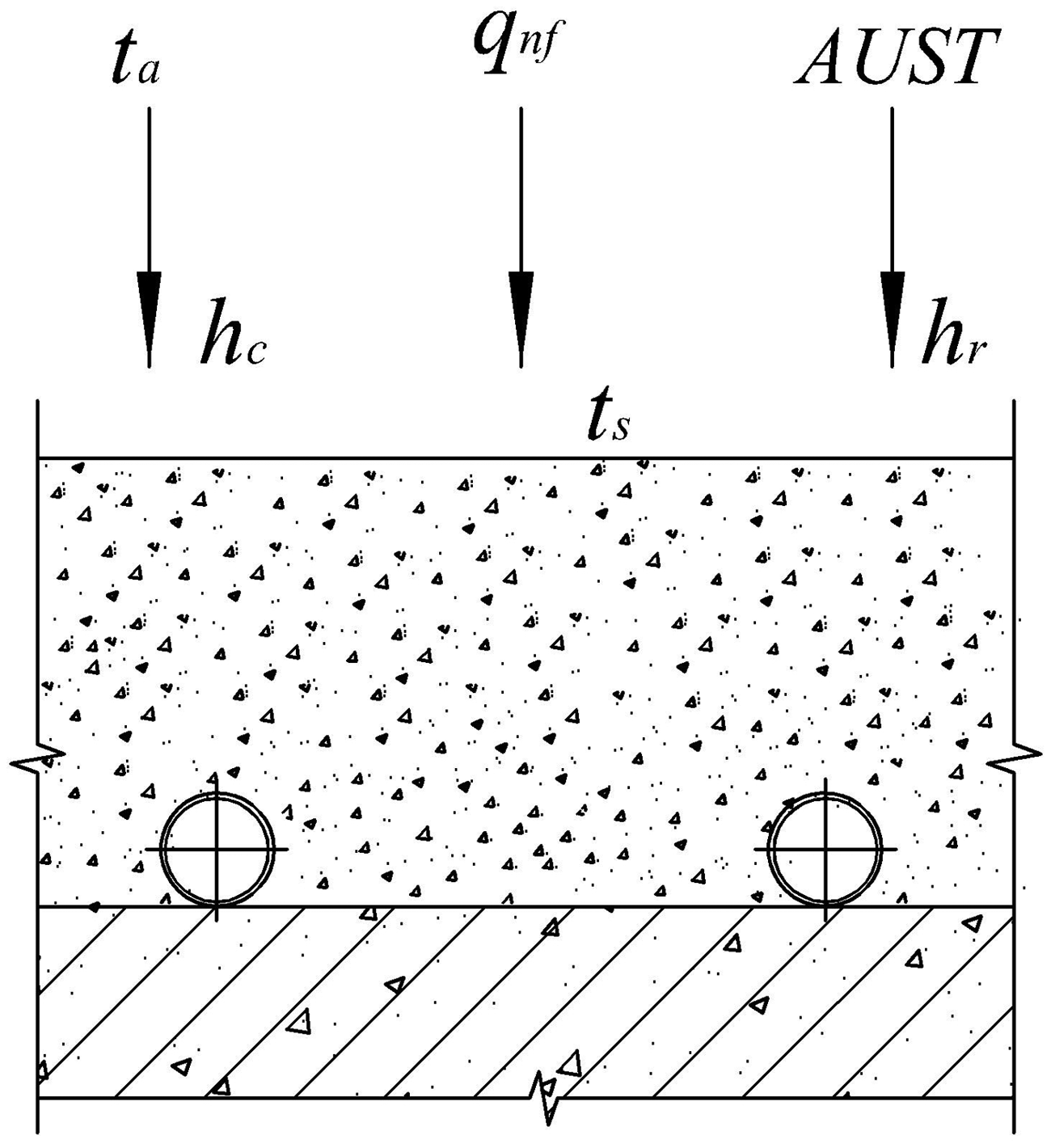
Heat exchange between floor surface and indoor environment.
The floor surface make radiant heat exchange with the inner surfaces of envelopes. The inner surfaces of room are assumed to be a closed system consisting of two gray surfaces: the floor surface and an imaginary surface composed of other inner surfaces of envelopes. The radiation between the two surfaces can be calculated as


We define

Radiant heat exchange with inner surfaces of envelopes can be calculated as

The value of
Convective heat transfer occurs between the floor surface and indoor air. The heat flux

Based on the radiant heat transfer coefficient and convective heat transfer coefficient, we fit the average radiant temperature and the indoor air temperature at operative temperature

Therefore, choose the operating temperature

The internal heat radiation taken away by per unit floor surface area is
The heat transfer process below floor surface
The homogeneous floor structure used in this section is shown in Figure 2. The filling layer consists of fine stone concrete with thickness
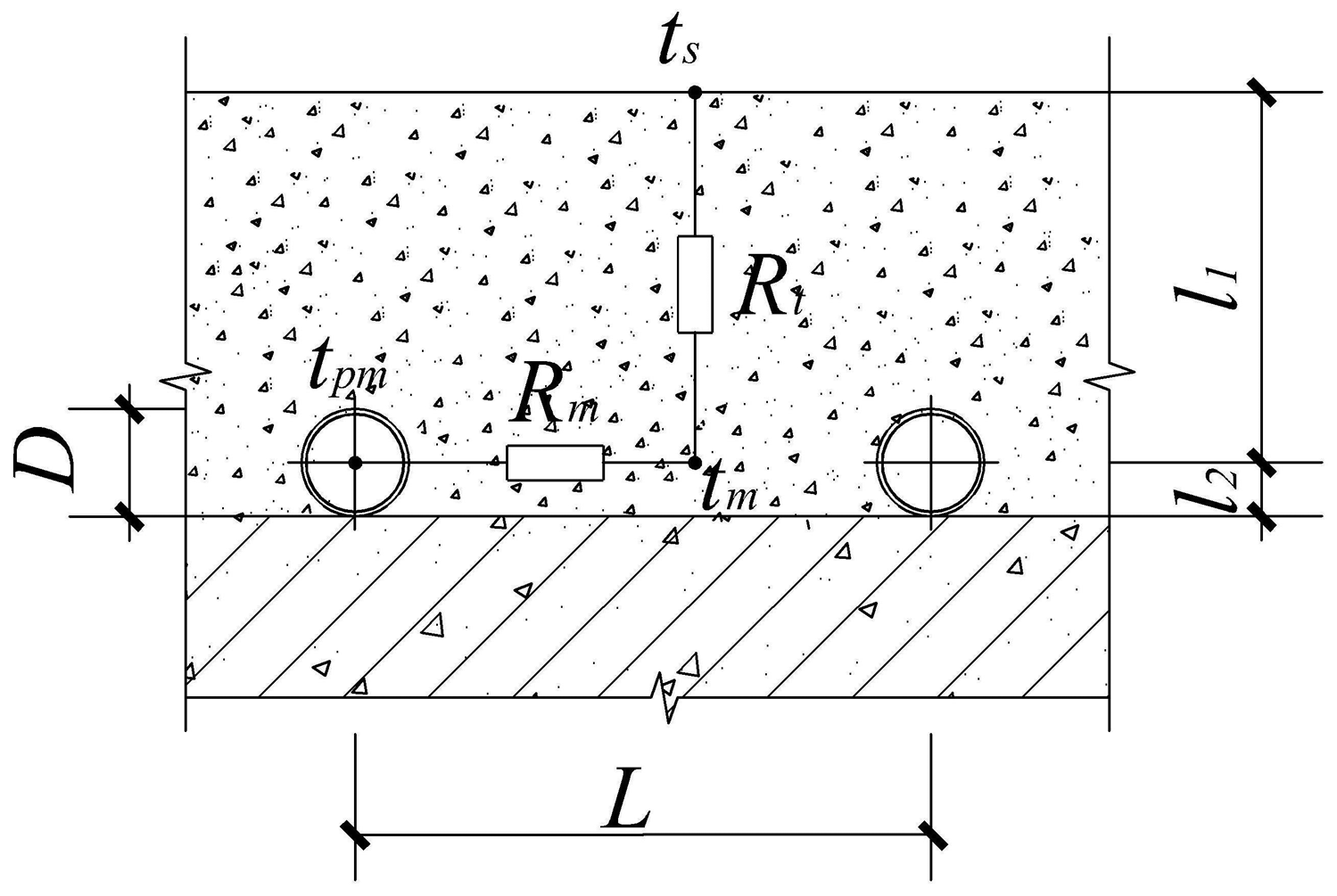
Heat transfer process under the floor surface.
The heat transfer process below the floor surface is shown in Figure 2. First, convective heat transfer occurs from the chilled water to the inner pipes’ wall. Second, heat is transferred in the pipe wall and layer of floor by conduction. Finally, heat transfer to the floor surface. To simplify the model, some resistances can be ignored (Jin et al., 2010), such as convective heat transfer resistance between water and the inner pipe wall, the thermal resistance of the pipes’ wall and the contact thermal resistance between the outer pipes’ wall and the filling layer. So, the temperature of outer pipes’ wall equals the average temperature

Thermal resistance analysis
The overall heat transfer process is shown in Figure 3.
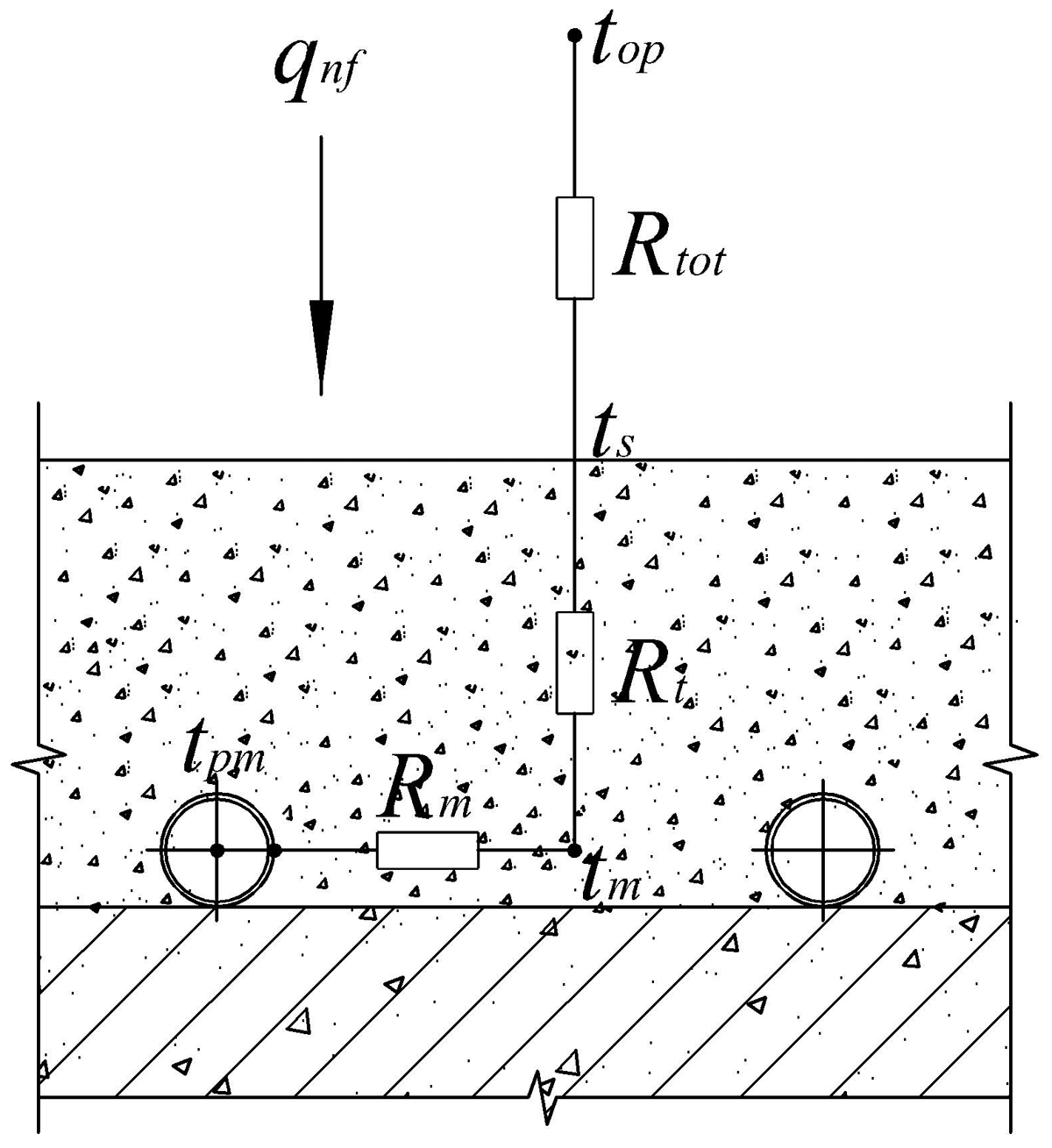
Total heat transfer process.
The heat transfer above the floor surface and the heat transfer below the floor surface are connected in series. According to the principle of thermal resistance in series, the total thermal resistance

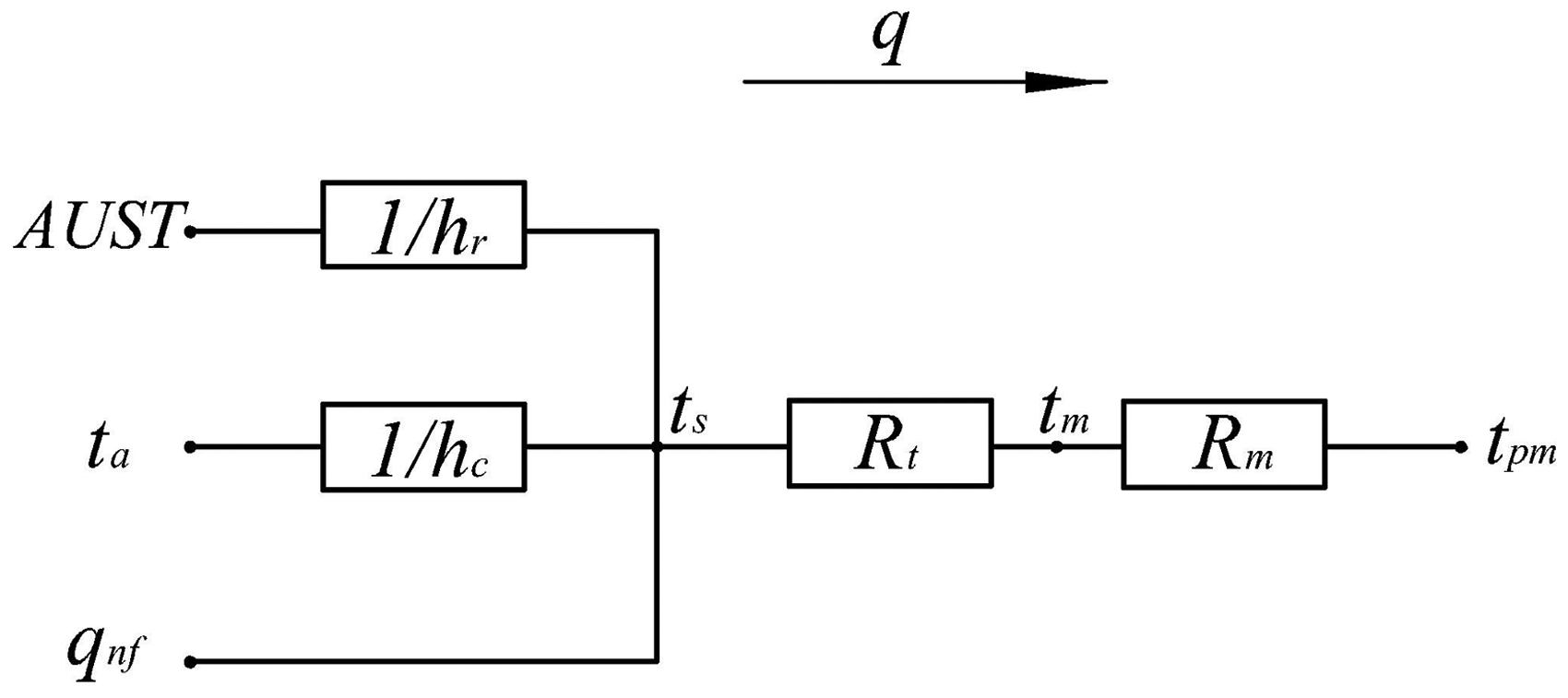
Thermal resistances and heat flux analysis of the overall heat transfer process.
Models
The model without internal heat radiation on floor surface
In this section, to facilitate analysis, we assume that there is no internal heat radiation in room, which is

Based on this assumption, the two-dimensional heat transfer model is shown in Figure 5. The center of pipe is taken as the zero point of the coordinate system.
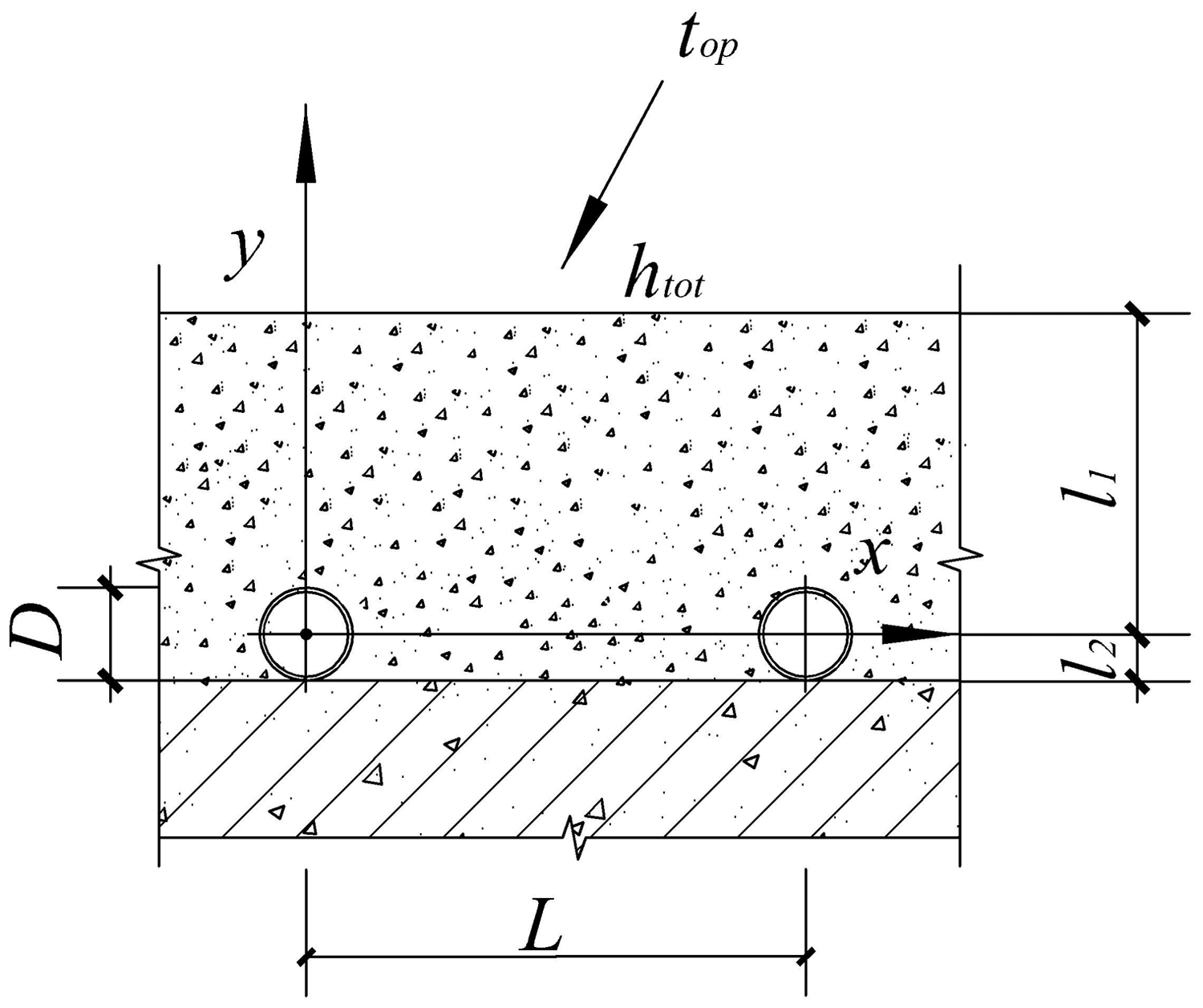
A homogeneous floor heat transfer model without internal heat radiation.
The governing equation of this heat transfer process is

The boundary conditions are summarized as follows:
In


In


At the pipes’ wall

According to Koschenz and Dorer (1999), the analytical solution of temperature distribution of single-layer homogeneous floor structure can be obtained, as follows
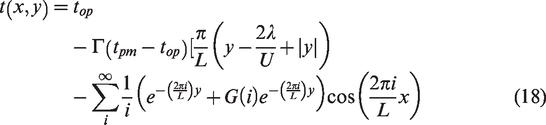




The model with internal heat radiation on floor surface
When there is internal heat radiation such as lights and sunlight on the floor, we assume that the solar radiation is evenly distributed on the floor surface. So
Based on all above assumptions, the heat transfer diagram is shown in Figure 6.
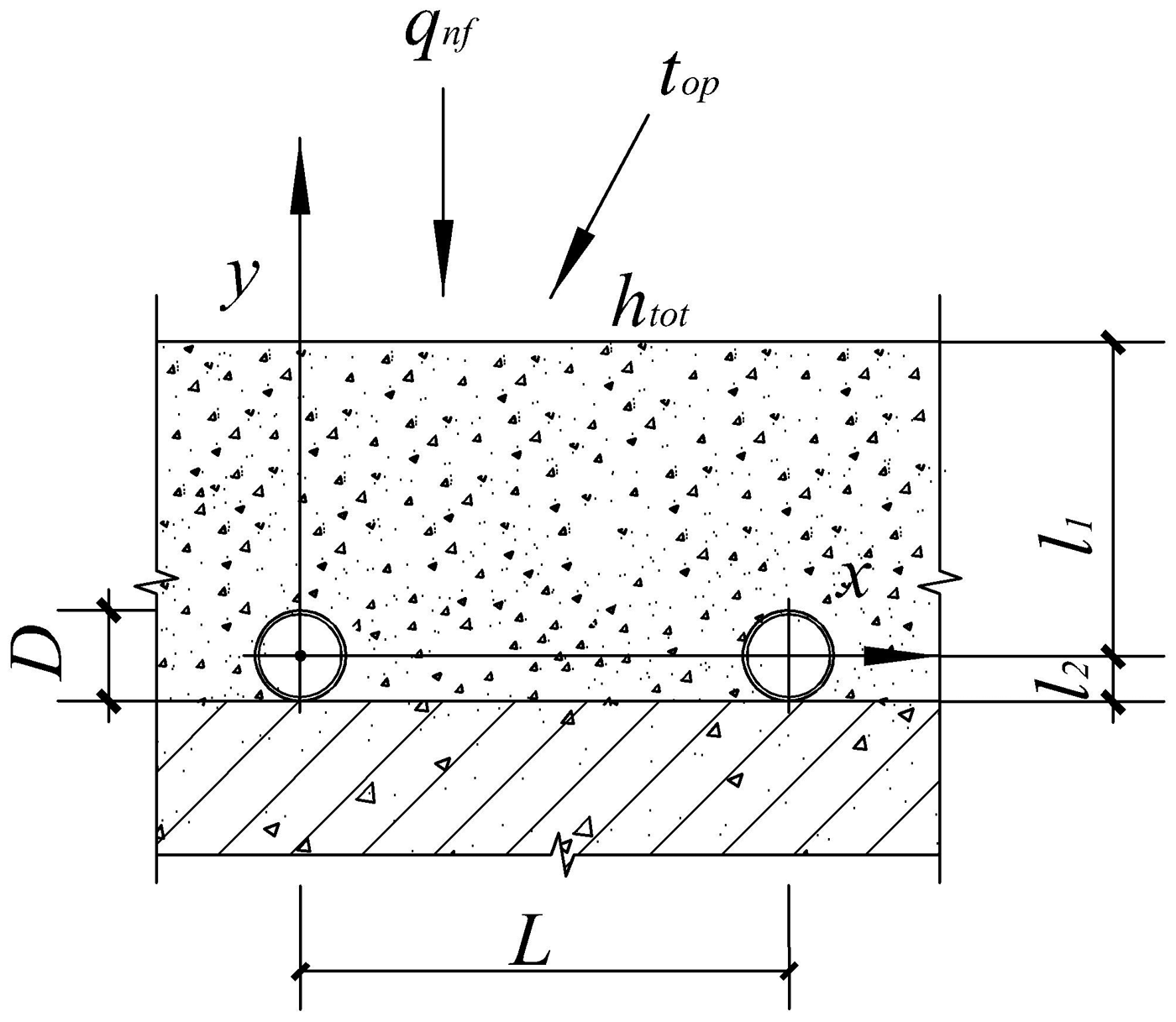
A homogeneous floor heat transfer model with internal heat radiation.
The mathematical description of the two-dimensional heat transfer model is as follows:
The governing equation is

The boundary conditions are:
In


In


At the pipes’ wall

For the boundary condition of

Then, we make

The boundary condition at

According to Koschenz and Dorer (1999), combined with the solution process of Equation (18), the analytical solution of the above mathematical description is


Temperature distribution in a typical floor structure with internal heat radiation
Description of a typical multi-layer composite floor structure
In practice, a typical radiant floor system is mostly a multi-layer composite floor structure. In China, a typical radiant floor structure is shown in Figure 7.
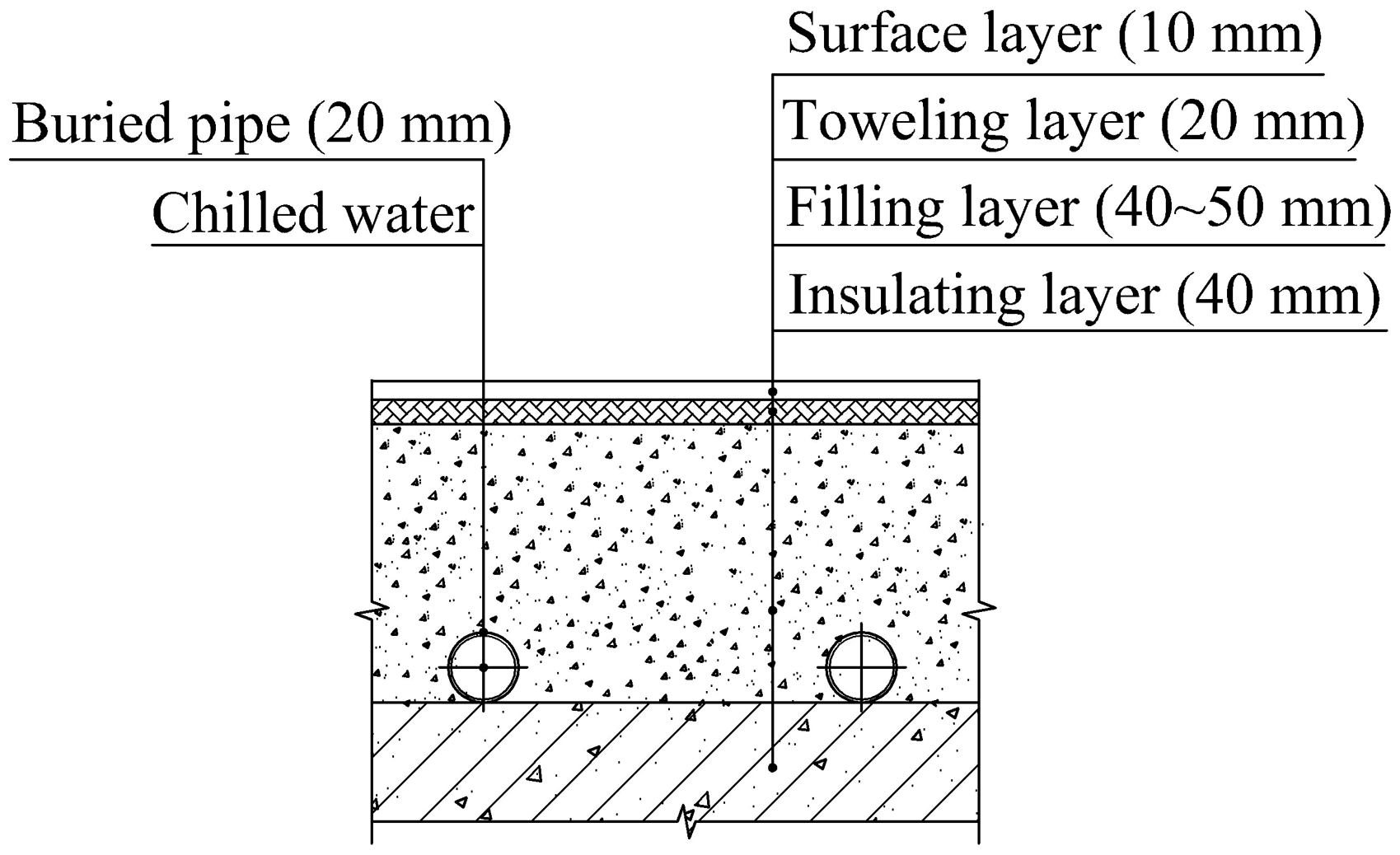
A typical multi-layer composite floor structure used in China.
In most applications, the surface layer is granite. The toweling layer is cement mortar which thermal conductivity is close to the surface layer. For calculation convenience, we consider these two layers as one homogeneous layer. In this way, the typical multi-layer composite floor structure is simplified into a two-layer composite floor structure, as shown in the Figure 8.
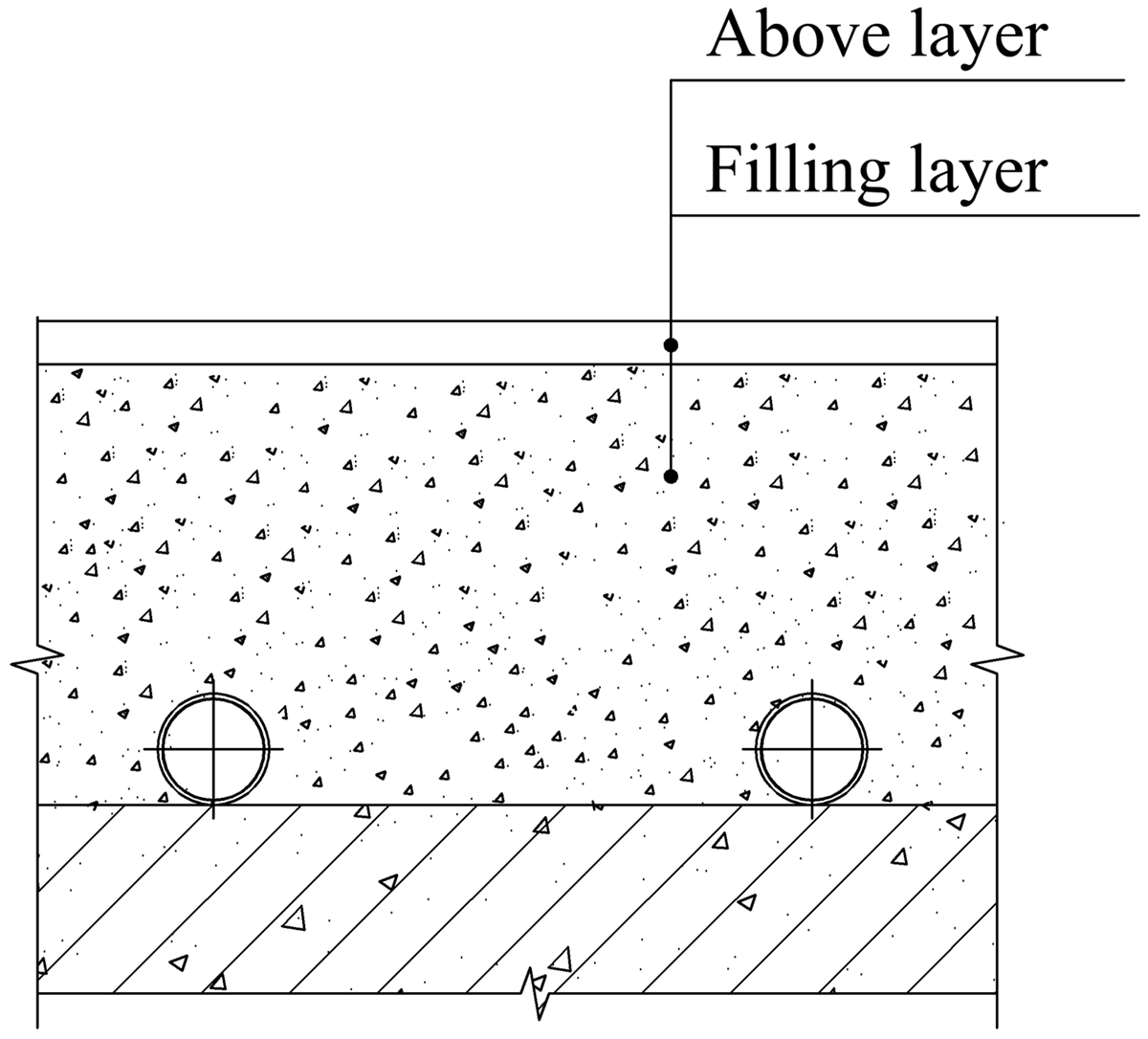
Two-layer composite floor structure.
The above layer and the filling layer are homogeneous materials respectively. The thickness of above layer is
There is continuous flowing chilled water in the buried pipes of filling layer. The temperature of the pipes wall is

According to Jin et al. (2010), the thermal resistance between the chilled water and the outer pipes’ wall can be ignored, which is

Calculation of temperature distribution in the two-layer floor structure with internal heat radiation
Mathematical description of the two-layer floor structure
Because of the periodicity of buried pipes installation, the temperature distribution of the floor structure also has periodicity. The area between any two pipes only to be studied to get the temperature distribution law.
Variable separation methods are often used to solve the heat conduction problems in the regions with regular geometric shapes. Because the cut face of floor is usually a horizontal regular rectangle as shown in Figure 9, this paper selects rectangular coordinate system and rectangular calculation regions for research easily. Therefore, the region enclosed by a–b–c–d–a in Figure 9 is selected as research regions. The rectangular coordinate system is established as shown in Figure 10. The
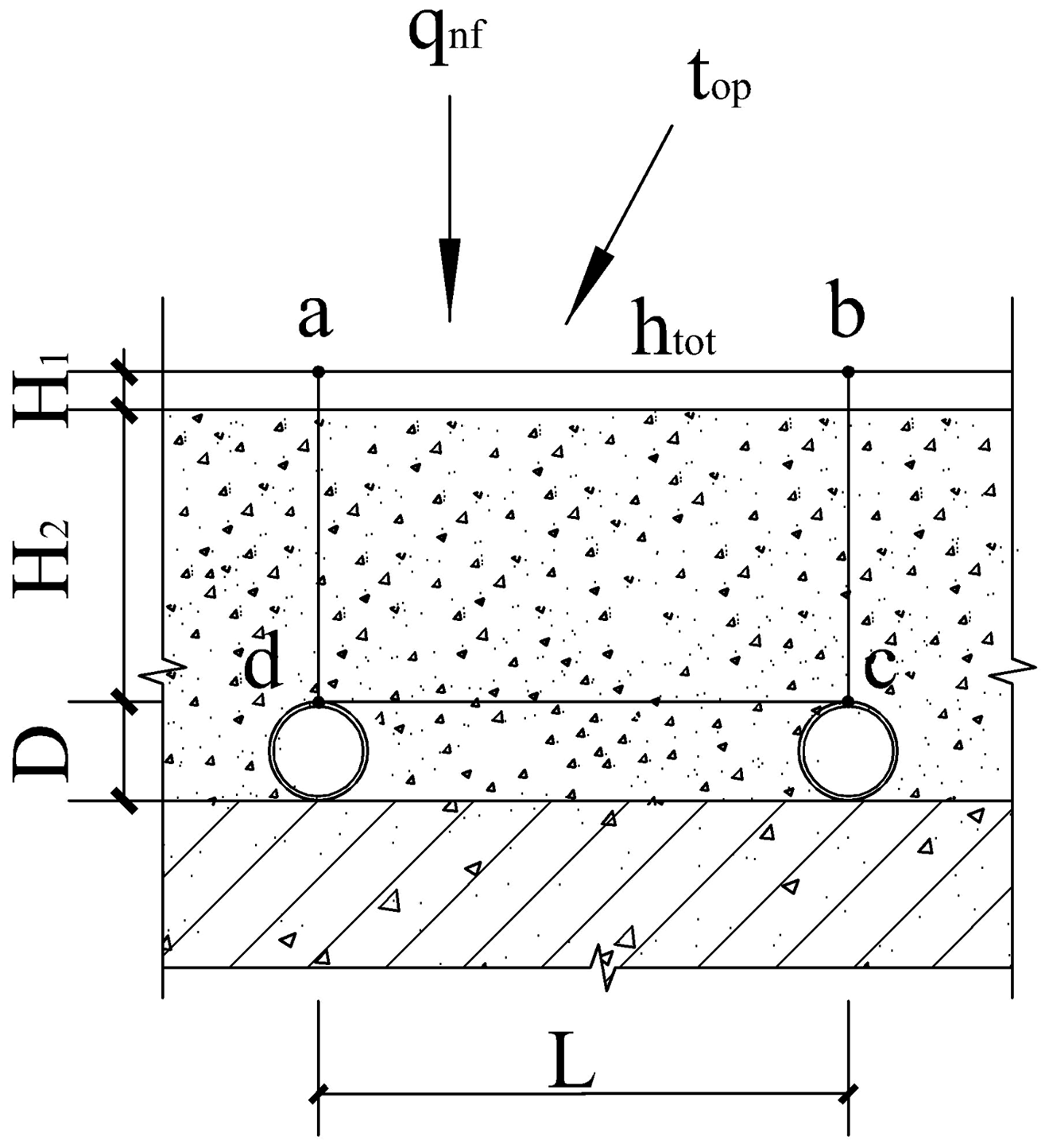
Schematic of heat exchange.
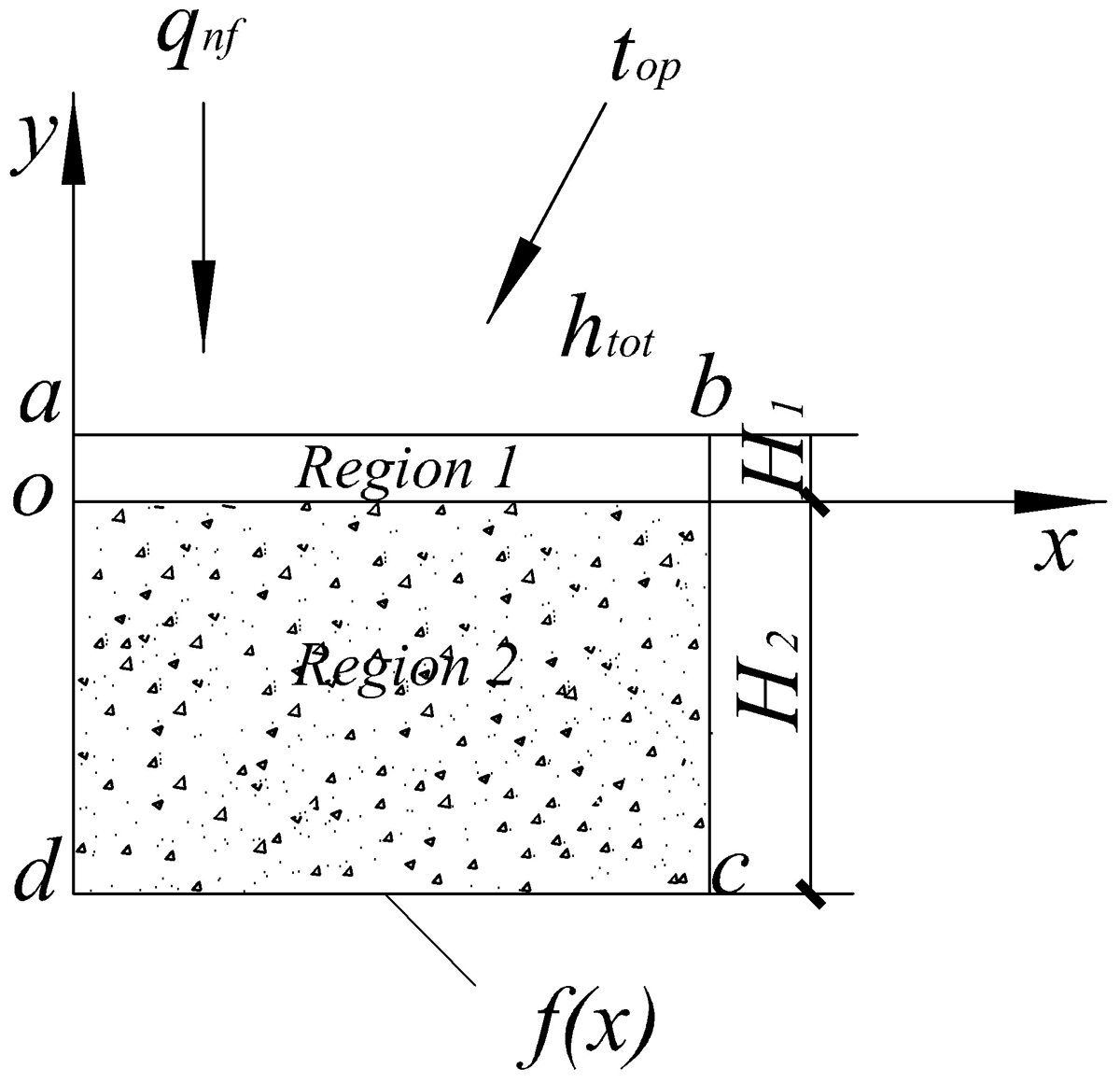
Calculation region, coordinate system and boundary conditions.
Governing equations and boundary conditions of the two calculation regions
Calculation regions are shown in Figure 10. We set the function
We make

The governing equations for regions 1 and 2 are the following forms


Based on the principle of symmetry, the boundary conditions in the


For the
When

There is no contact thermal resistance between Region 1 and Region 2. So, the boundary condition at


At

In previous section, we obtained the expression of the temperature distribution of the single-layer homogeneous floor structure when there is solar radiation on the floor surface. According to the equivalent thermal resistance method (Li et al., 2014), we can convert the two-layer floor structure into a single-layer homogeneous floor structure, and then we can obtain the temperature distribution expression
According to equation (30) and (32), the temperature distribution of the tangent line at the upper end of pipes along the
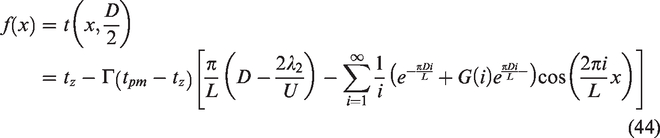
Where (Li et al., 2014)


Solutions
Separation of variables
With the above two governing equations and closed boundary conditions, we can solve the temperature distribution expression of the two regions by the methods of separation variables.
In Regions 1 and 2 respectively, it is assumed that


Substituting equations (47)–(48) to equations (36)–(37), we can get


The boundary conditions can be written as




When

The general solution of function
and
Because the two function values at


According to the boundary conditions at
We can get

For the function

The general solutions in the




General solution
According to equations (57) (58) (60) (61) (62) (63)
We get the general solutions of regions 1 and 2 as


Calculation of coefficients
In the analysis of the boundary conditions, we choose the order from top to bottom.
At



We use the boundary conditions at




From these, we get the following relationships


According to the boundary conditions at

From the above relationship, we can get the relationships between


According to all the above relational expressions, we can solve and get the coefficients as follows








where


The temperature distribution models in region 1 and 2
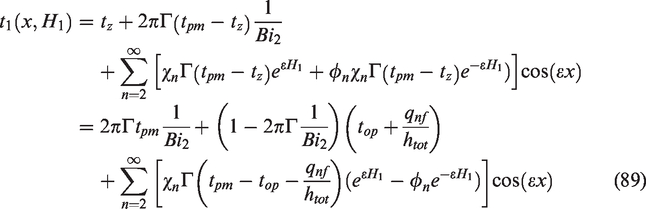
The expressions of temperature distribution in Region 1 as follows

The temperature distribution of the floor surface is that
The expression of temperature distribution in Region 2 as follows
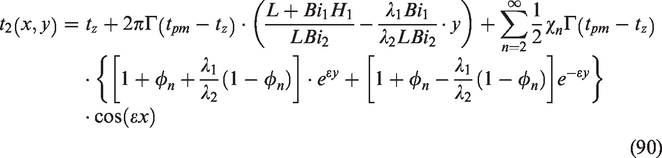
After the analytical solutions of temperature distribution in Regions 1 and 2 being obtained respectively. We use Paraview software to visualize the temperature distribution of a real case, as shown in Figure 11.
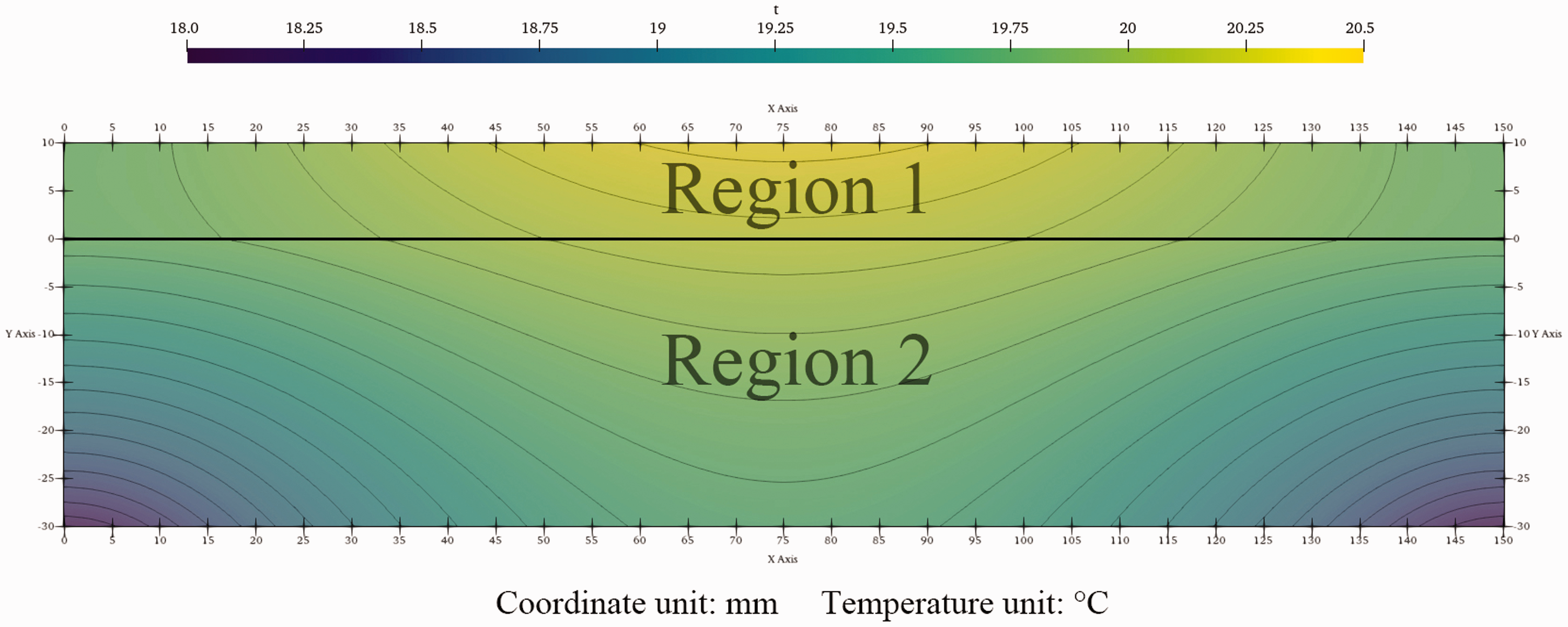
An example of temperature distribution visualization.
It can be seen that the temperature near the two buried pipes is the lowest, and the isotherms are in circular distribution. At the junction of Region 1 and Region 2, the temperature values of the two regions are the same. The maximum temperature appears at the symmetrical center of the two pipes. All these are in accordance with the basic law of heat transfer (Zhang et al., 2007), and basically verify the correctness of the model.
For a radiant floor cooling system, the most important parameters are mean floor surface temperature and the lowest temperature in floor surface. With the equation (89), we can obtain the mean floor surface temperature as follows

As can be seen from Figure 11, the lowest surface temperature is located at

Validation of the models
In this section, certain experiments are conducted to verify the above results.
Experimental conditions
In the cold regions of China, many office buildings use radiant floor heating systems for heating in winter. We select two office rooms with radiant floor heating system as the experimental platform. The Room 1 is located on the basement one of buildings. The test Room 2 is located on the top floor of buildings. The dimensions of Room 1 are 4
Parameters of the experimental floor structures.
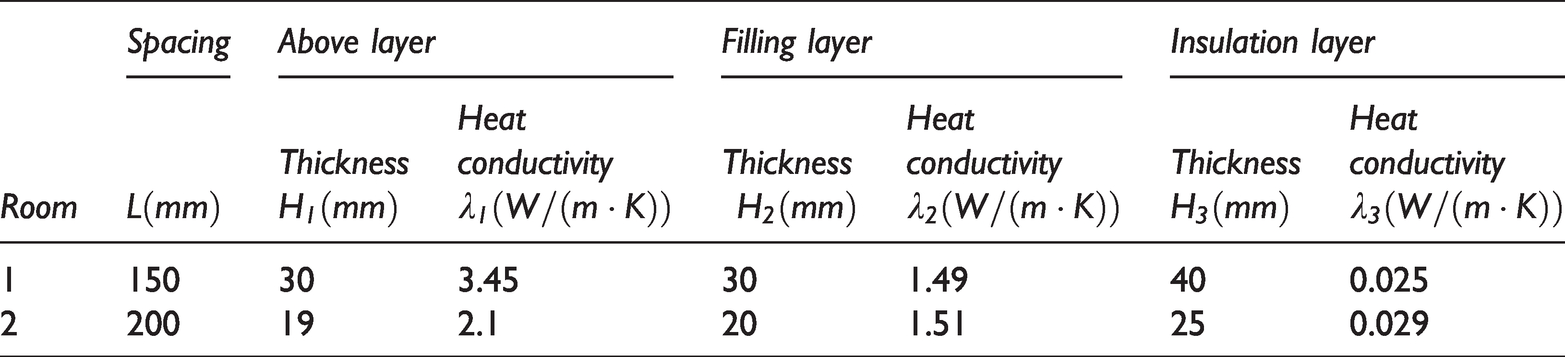
In this paper, the fold-back type layout and in-line type of buried pipes are selected to experiment respectively in order to eliminate the influence of different layout types on the experimental results. The layout types of buried pipes in Room 1–2 are shown in Figure 12.
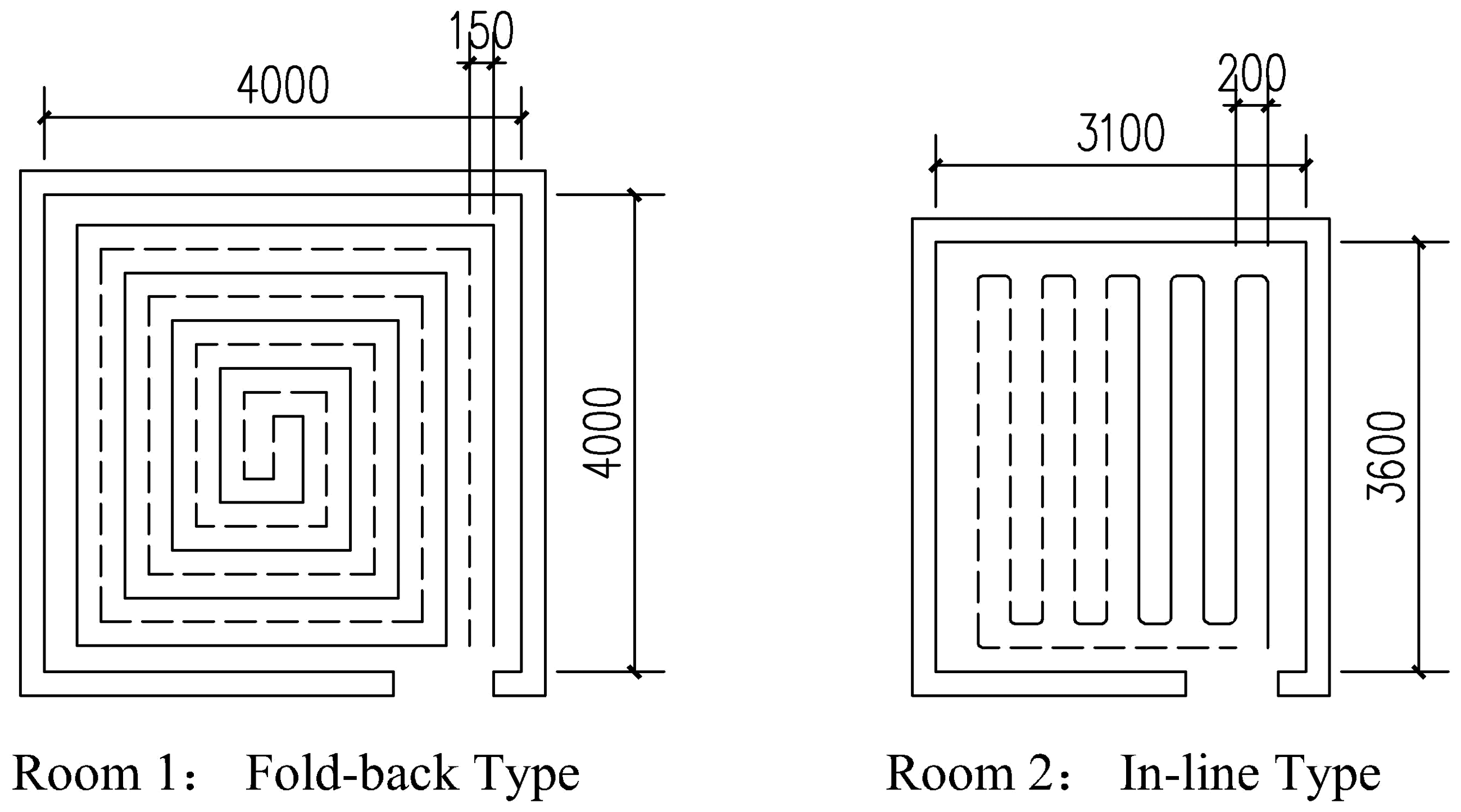
Layout of buried pipes in Room 1 and Room 2.
An infrared radiation board is used as indoor heat sources to simulate internal heat radiation. The infrared radiation board uses 220 V power supply and has 3 power levels. Heat flux densitometers are used to measure the heat flux density of the radiant board to the floor surface, which is
During the experiments in summer, floor and fresh air can achieve combined cooling. Chilled water is passed into the buried pipes to real floor cooling. 13 temperature measuring points are set to measure the temperature of floor surface in each room as shown in Figure 13. Each envelope has 4 temperature measuring points on the inner surface. Sticking thermometer are used to record the temperature of solid surfaces. In the vertical direction of the indoor space, 4 temperature measuring points are set from top to bottom which can measure the temperature of indoor air.
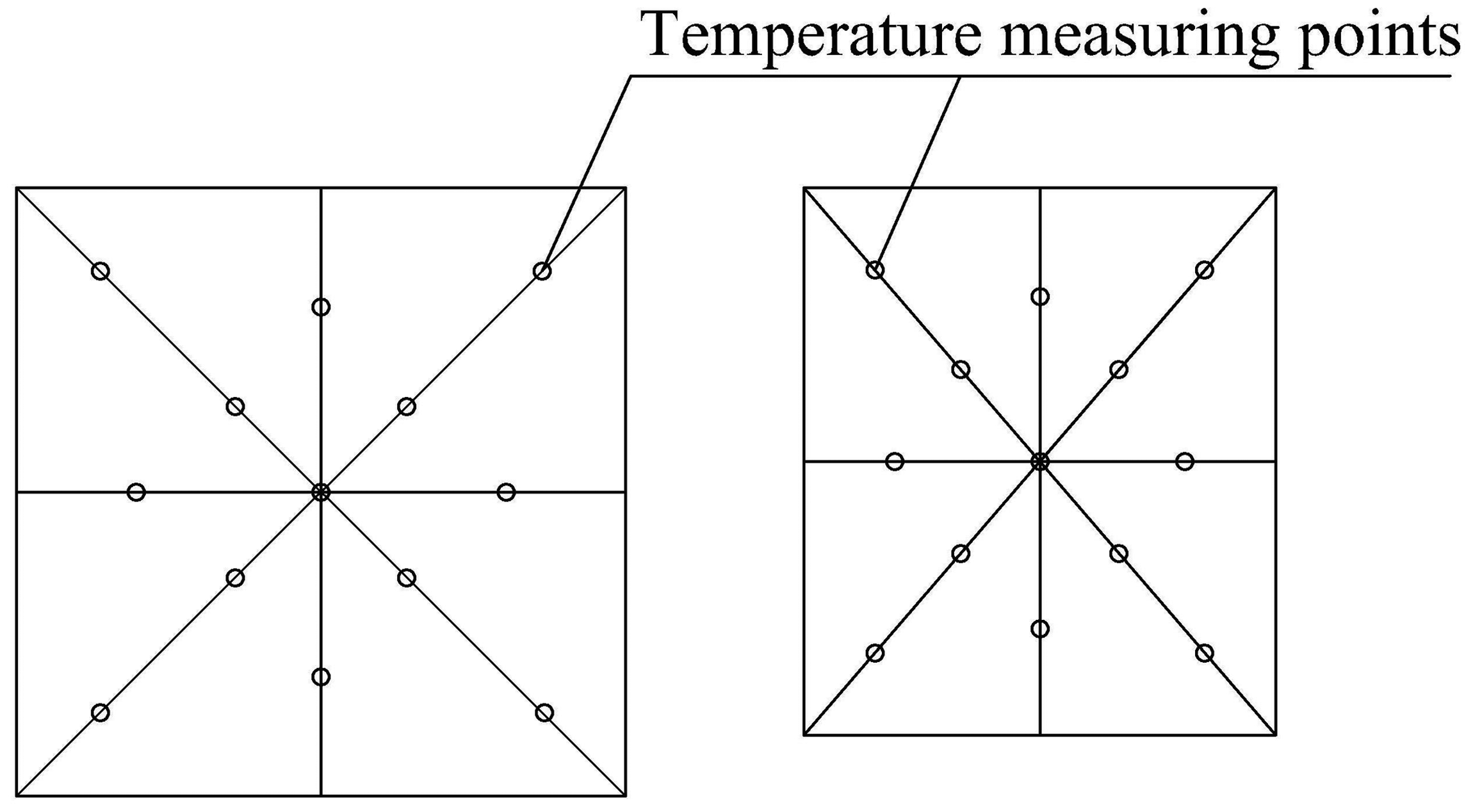
Temperature measuring points of floor surface in Room 1 and Room 2.
Comparison of results
Both the experimental measurement results and calculation results are show in Table 2.
Comparison of calculations with experimental results.
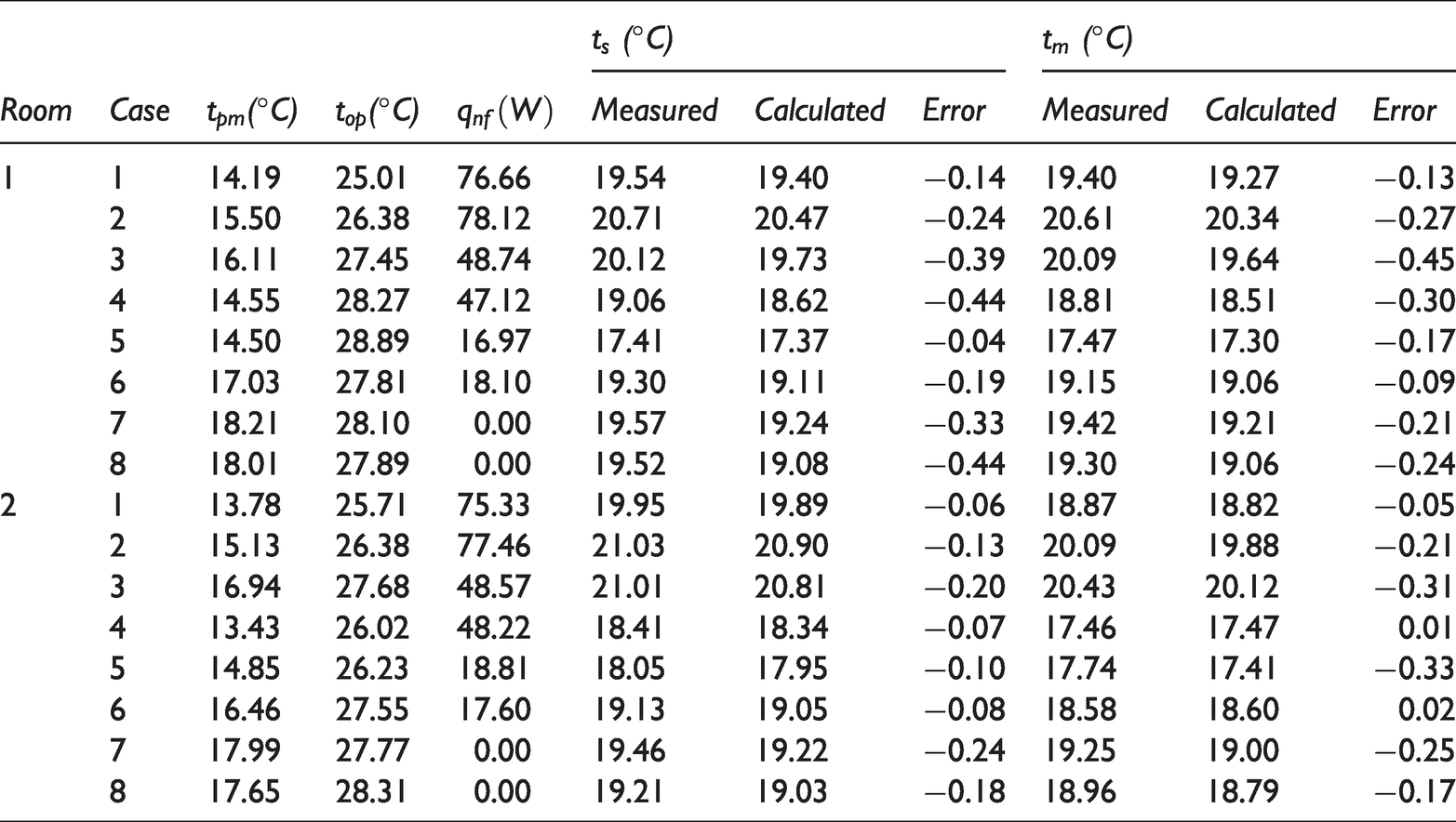
We can find that the calculated values agree well with the corresponding experimental values. The maximum absolute error is 0.45°C. The maximum relative error is 2.31%. As can be seen from the Table 2, almost all the calculated values are smaller than the corresponding measured values. Few calculated values are greater than measured data. This is because the measured value of solar radiation is too small or the thermal inertia of the floor structure is too large. The verified experiments reveal that the analytical models are in excellent agreement with the measured experiments. Analytical models of temperature distribution can be accepted.
Conclusions
This paper studies the floor radiation cooling systems. Using the equivalent thermal resistance methods and separate variable methods, this paper proposes a novel analytical calculation methods to solve the problem of temperature distribution inside floor structure and on the floor surface. The main conclusions of this paper are as follows:
Based on the floor surface temperature distribution model without solar radiation on floor surface. This paper proposes a calculation model that can calculate temperature distribution of floor structure when any solar radiation on the floor surface. The distribution of surface temperature for a homogeneous floor structure can be conveniently calculated, when internal heat radiation hits on the floor. Based on the model for the homogeneous floor structure with internal heat radiation, this paper also proposes a model to calculate temperature distribution for typical multi-layer floor structure. Using this model, temperature distribution of the two-layer floor structure can be calculated easily, when there is internal heat radiation on floor surface. This model also can be used to calculate the minimum temperature and the average temperature of typical composite floor structure. This paper selects two actual cases for experimental researches and compares the calculated values with the measured values, and find that the calculated values agree well with the corresponding experimental values. The maximum absolute error is 0.45°C. The maximum relative error is 2.31%.
This paper supplies the calculation method of floor surface temperature for radiant floor cooling systems. The research results can be applied to the floor cooling system of large space buildings with glass curtain walls and ceilings such as Beijing Daxing International Airport. The results in this paper also can be used in agriculture to estimate soil surface temperature in greenhouses and calculate the temperature distribution inside the soil. The calculation models can also effectively prevent condensation inside the floor structure of the radiant floor cooling systems and guide the design.
Footnotes
Declaration of conflicting interests
The author(s) declared no potential conflicts of interest with respect to the research, authorship, and/or publication of this article.
Funding
The author(s) disclosed receipt of the following financial support for the research, authorship, and/or publication of this article: This study was funded by the Plan of Guidance and Cultivation for Young Innovative Talents of Shandong Provincial Colleges and Universities, and was funded by both the Natural Science Foundation of China (Grant Number 51908333) and Doctoral Scientific Fund Project of Shandong Jianzhu University (Grant Number XNBS1605).
