




Abstract
The study examines nexuses between carbon dioxide (CO2) emissions, renewable energy consumption and inequality in 39 Sub-Saharan African countries for the period 2004–2014. The empirical evidence is based on Quantile regressions. First, in the 25th quantile of the inequality distributions, as long as CO2 emissions metric tons per capita are kept below 4.700 (4.100), the Gini coefficient (Atkinson index) will not increase. These are avoidable CO2 emissions thresholds. Second, renewable energy consumption should be complemented with other policies to: (i) reduce the Gini coefficient when renewable energy consumption is at 50.00% of total final energy consumption and (ii) mitigate the Atkinson index when renewable energy consumption is at 62.500% of total final energy consumption in the bottom quantiles of the Atkinson index distribution and at 50.00% of total final energy consumption in the 75th quantile of the Atkinson index distribution. These are renewable energy consumption thresholds for complementary policies. The novelty of this study in the light of extant literature is fundamentally premised on providing policy makers with avoidable thresholds of CO2 emissions as well as corresponding thresholds of renewable energy consumption for complementary policies, in the nexus between the green economy and inequality.
Introduction
There is a growing importance of fossil fuels and renewable energy consumption surrounding policy and scholarly issues in the sustainable development agenda of most countries (Ivanovski et al., 2020; Wang et al., 2019; Yang et al., 2019). This study investigates nexuses between environmental quality and income inequality in Sub-Saharan Africa (SSA) and provides actionable policy thresholds underlying the nexuses that can be leveraged by policy makers to promote inclusive and sustainable development in the sub-region in the post-2015 development agenda. Interactions between policy variables and policy syndromes in the economic development literature can engender cut-off points or thresholds which represent actionable critical masses that policymakers can leverage upon to influence the outcome variable in one direction or the other. 1 This can be the case in the nexus between environmental quality and income inequality in a sub-region where concerns about income inequality and environmental degradation are comparatively more concerning. 2 The sub-region is SSA and the two underlying concerns are critically engaged in what follows in order to clearly articulate the problem statement within the context of extant literature as well as the attendant policy and scholarly concerns pertaining to the issues.
First, on the front of income distribution and by extension income inequality, it is worthwhile to emphasize that the over two decades of economic growth resurgence in SSA has not moved hand-in-glove with inclusive development in terms of equal distribution of the fruits of economic prosperity across the population. Contemporary studies supporting this perspective include Meniago and Asongu (2018), Tchamyou et al. (2019a) and Asongu and Odhiambo (2019a, 2020a). The attendant literature also maintains that close to half of countries in SSA did not reach the millennium development goal (MDG) extreme poverty target because the fruits of the over two decades of economic growth resurgence did not trickle down to the poor fractions of societies. Moreover, current projections posit that unless the glaring concern of income inequality is addressed by means of more inclusive growth, the sustainable development goal (SDG) target of mitigating extreme poverty to a threshold of below 3% would not be achieved (Bicaba et al., 2017). It follows from this narrative that inequality which is the outcome variable in this study remains a critical concern for both scholars and policy makers in the sub-region. The underlying concern can be compounded or mitigated by environmental degradation or the green economy as established by the attendant literature on the nexus between inequality and environmental quality (Demir et al., 2019; Grunewald et al., 2017; Liu et al., 2019; Uzar and Eyuboglu, 2019).
Second, concerns surrounding environmental degradation are comparatively more apparent in SSA because despite being the continent that emits the least carbon dioxide (CO2) emissions, it is projected that the consequences of global warming would be most detrimental in the sub-region compared to other continents and regions of the world (Asongu et al., 2017, 2018). Moreover, the post-2015 policy and scholarly literature is consistent on the need to promote renewable consumption of energy in order to limit the potential unfavorable consequences of environmental degradation on economic and human developments in the sub-region (Asongu and Odhiambo, 2020b, 2020c; Bekun et al., 2019; Nathaniel and Bekun, 2020; Niranjan, 2019; O’Ryan et al., 2020; Samour et al., 2019). In the light of these underlying policy and scholarly concerns, the focus of this study is to assess how environmental degradation (in terms of CO2 emissions) and renewable energy consumption affect inequality: a positioning that is both consistent with policy requirements and a gap in the literature.
Third, the literature on the nexus between income equality and environmental degradation has largely focused on how income inequality affects environmental outcomes. However, this study focuses on how environmental quality affects inequality outcomes. Some of the extant studies focusing on the underlying opposite nexus include, inter alia: Grunewald et al. (2017) which has examined the trade-off between CO2 emissions and income inequality to establish that higher income inequality in lower and middle-income countries is associated with lower CO2 emissions whereas in high-income and upper-middle income countries, per capita emissions is increased by higher levels of income inequality. Liu et al. (2019) have established that inequality in the distribution of income, especially within the remit of spatial income distribution, increases CO2 emissions. Uzar and Eyuboglu (2019) have shown that CO2 emissions are positively affected by income inequality. Conversely, Demir et al. (2019) conclude that income inequality mitigates environmental degradation.
A common denominator of the above studies is that the attendant research focuses on the effect of inequality on environmental degradation. However, this study is positioned on the reverse nexus (i.e. the incidences of environmental pollution and renewable energy consumption on income inequality variables). In other words, instead of focusing on how inequality affects the green economy, the present study departs from the extant studies by focusing on how dynamics of the green economy (i.e. CO2 emissions and renewable energy consumption) affect income inequality throughout the conditional distribution of income inequality. Moreover, beyond establishing nexuses among the macroeconomic variables, the present study also departs from the underlying strand of research by providing actionable critical masses or thresholds that policy makers can leverage upon in order to reduce income inequality, in the light of challenges of inclusive development in the post-2015 agenda. Hence, the policy-relevant thresholds this study aims to provide in view of informing policy makers on environmental quality measures that can contribute towards mitigating income inequality are: (i) avoidable CO2 emissions thresholds and (ii) renewable energy consumption thresholds for complementary policies. The novelty of this study in the light of extant literature is fundamentally premised on providing policy makers with avoidable thresholds of CO2 emissions as well as corresponding thresholds of renewable energy consumption for complementary policies, in the nexus between the green economy and inequality.
The theoretical underpinnings motivating this study are broadly consistent with those surrounding the “Environmental Kuznets Curve” (EKC), the Kuznets hypothesis (Grossman and Krueger, 1995; Kuznets, 1955; Selden and Song, 1994) and “Carbon Kuznets Curve” (CKC) (Xu and Song, 2011) because, for the most part, the adopted outcome variable in the study is income inequality, whereas renewable energy consumption is an independent variable of interest. Hence, a nexus being considered, inter alia, is how enhancing renewable energy consumption affects inequality. The remainder of this study is structured in the following manner. This introduction is followed by a data and methodology section before another section on empirical results. The last section concludes with implications and future research directions.
Data and methodology
Data
To examine the problem statement discussed in the previous section, the present study uses a panel of 39 countries in SSA with data from 2004 to 2014. 3 The selection of countries and corresponding periodicity is motivated by constraints in the availability of the relevant information at the time of the study. The data is obtained from four principal sources, namely: (i) the World Development Indicators (WDI) of the World Bank; (ii) the World Bank’s Financial Development and Structure Database (FDSD); (iii) the Global Consumption and Income Project (GCIP) and (iv) the World Bank’s World Governance Indicators (WGI).
The outcome inequality variables are sourced from the GCIP, namely: the Gini coefficient and the Atkinson index. The Gini coefficient represents the distribution of income across the population while the Atkinson index denotes the percentage of total income that a specific society is prepared to sacrifice in order to improve the distribution of income in the attendant society. The choice of the Atkinson index to complement the Gini coefficient is motivated by the fact that the latter has been documented not to emphasize the tails or extreme points of the inequality distribution (Meniago and Asongu, 2018; Naceur and Zhang, 2016; Tchamyou et al., 2019a, 2019b). Hence, it is for the purpose of robustness that the Atkinson index is used to complement the Gini coefficient.
The independent variables of interest are obtained from WDI of the World Bank, notably: (i) CO2emissions (metric tons per capita) and (ii) renewable energy consumption (% of total final energy consumption). 4 The latter is a positive environmental signal while the former is a negative environmental signal. Both are used for the purpose of robustness. The choice of the environmental quality indicators is also informed by contemporary literature on the subject (Akinyemi et al., 2019; Asongu, 2018; Asongu et al., 2019a; Asongu and Odhiambo, 2020c; Nathaniel and Iheonu, 2019).
In order to control for variable omission bias, five non-dummy and two dummy variables are used in the estimation exercise. The non-dummy variables are: financial access, mobile phones, regulation quality, trade openness and urban population while the dummy variables are middle-income countries and petroleum-exporting countries. The variables which are from WDI, FDSD and WGI of the Bank and Asongu et al. (2019b), as apparent in Appendix 1, are informed by contemporary inclusive development literature (Asongu and Asongu, 2018; Asongu and Nwachukwu, 2016; Asongu and Odhiambo, 2018, 2019b; Demirgüc-Kunt and Klapper, 2012; Demirgüç-Kunt et al., 2015; Murendo et al., 2018; Tchamyou, 2019a, 2019b, 2020). With the exception of urban population and the middle-income countries dummy that are expected to increase income inequality, the other variables are anticipated to have the opposite effect. However, it is important to note that the expected signs can also be influenced by two more dynamics. On the one hand, given that quadratic terms are involved in the regression exercise, the quadratic terms can be correlated with the independent variables of interest and hence, some expected signs of variables in the conditioning information set can be affected. However, the concern of multicollinearity does not affect the main independent variables of interest because according to Brambor et al. (2006), quadratic regressions are not interpreted as linear additive models. For this purpose, net effects and thresholds underlying the quadratic specifications are computed in the empirical results section.
On the other hand, since the nexuses are assessed throughout the conditional distribution of the inequality variables, the attendant effects can vary depending on initial levels of income inequality. It follows from the above narrative that this study focuses on the quadratic estimated variables to compute the attendant thresholds and net effects. The study is also only concerned about the significance of estimated coefficients of variables in the conditioning information set because the study makes abstraction of the expected signs in the light of the concerns discussed above. The definitions of variables and sources of data are disclosed in Appendix 1, the corresponding summary statistics and correlation matrix are provided respectively in Appendix 2 and Appendix 3.
Methodology
In accordance with the narrative in the previous section, the quantile regression approach is adopted for this study because it enables us to assess the investigated nexuses through the conditional distribution of the inequality outcome variables. Hence, the adopted estimation approach is such that, low, intermediate and high initial levels of income inequality are articulated. Accordingly, by accounting for existing levels of income inequality, there is an assumption that a modeling approach based on mean values of the outcome variable is unlikely to produce robust and policy-relevant estimates, unless the initial levels of income inequality are taken on board in order to avoid blanket policy implications.
Following the attendant literature on the subject matter (i.e. contemporary and non-contemporary sources), the quantile estimates are obtained by solving the optimization problem presented in equation (1) below without subscripts to enhance readability and flow (Asongu and Odhiambo, 2019c; Hao and Naiman, 2007; Koenker, 2005; Koenker and Bassett, 1978; Okada and Samreth, 2012; Tchamyou and Asongu, 2017):


Empirical results
The empirical results are provided in this section in Tables 1 and 2. While Table 1 presents linkages between the Gini coefficient, CO2 emissions and renewable energy consumption, Table 2 discloses the corresponding findings for the Atkinson index, CO2 emissions and renewable energy consumption. Each of the tables is divided into two main categories of quantile specifications: one corresponding to CO2 emissions and the other to renewable energy consumption. It is important to note that from the left-hand side to the right-hand side of both tables, the inequality levels of increase. It follows that in the 10th (90th) quantile, the level of inequality is lowest (highest).
The Gini Coefficient, CO2 emissions and renewable energy consumption.
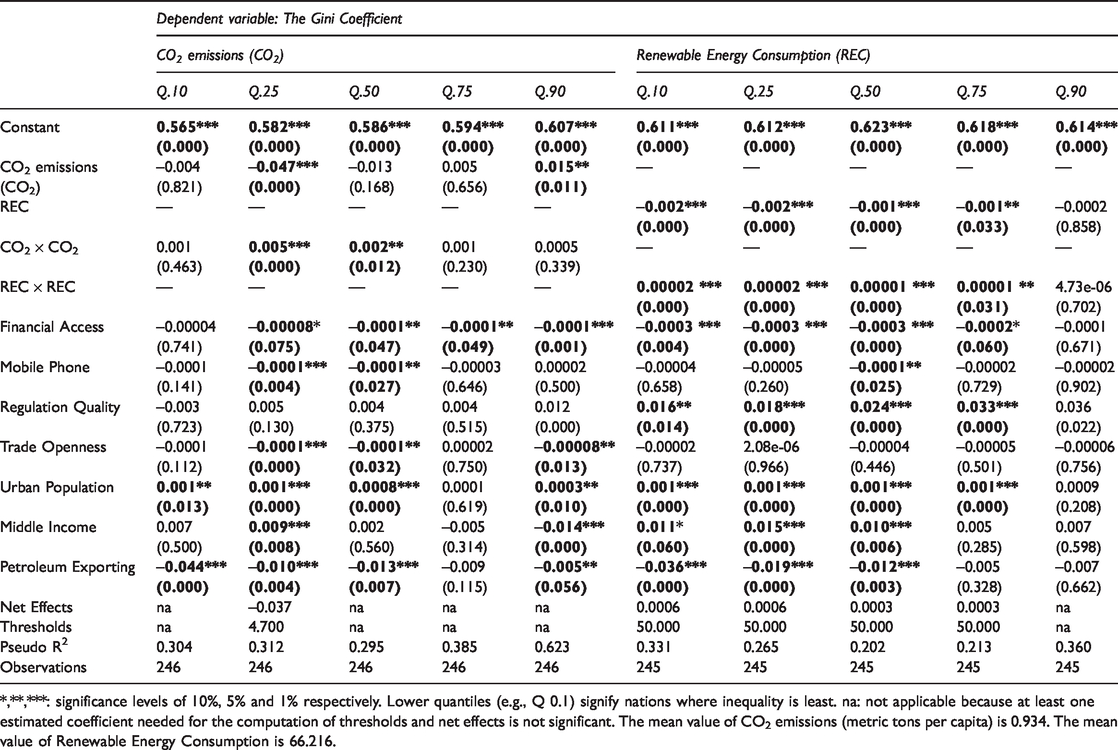
*,**,***: significance levels of 10%, 5% and 1% respectively. Lower quantiles (e.g., Q 0.1) signify nations where inequality is least. na: not applicable because at least one estimated coefficient needed for the computation of thresholds and net effects is not significant. The mean value of CO2 emissions (metric tons per capita) is 0.934. The mean value of Renewable Energy Consumption is 66.216.
The Atkinson index, CO2 emissions and renewable energy consumption.
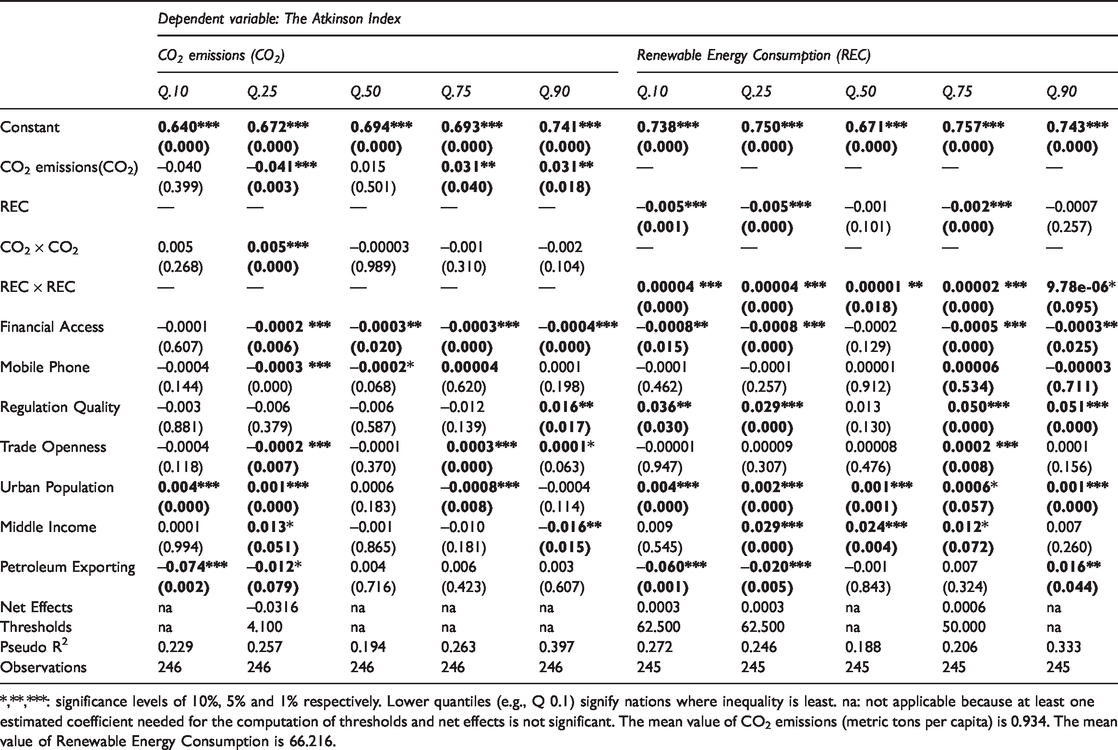
*,**,***: significance levels of 10%, 5% and 1% respectively. Lower quantiles (e.g., Q 0.1) signify nations where inequality is least. na: not applicable because at least one estimated coefficient needed for the computation of thresholds and net effects is not significant. The mean value of CO2 emissions (metric tons per capita) is 0.934. The mean value of Renewable Energy Consumption is 66.216.
The following findings can be established from Table 1. First, CO2 emissions unconditionally (conditionally) decrease (increase) inequality in the 25th quantile of the conditional distribution of the Gini coefficient. The corresponding overall net effect of growing CO2 emissions on the Gini coefficient is −0.037 while the threshold at which the negative unconditional effect changes to positive is 4.700.
It is worthwhile to clarify that net effects and attendant thresholds are computed because, as documented by Brambor et al. (2006), in order to avoid the pitfalls of quadratic specifications, corresponding estimates from the independent variables of interest should not be interpreted as in linear additive models. The procedure for understanding and interpreting quadratic specifications is consistent with contemporary literature based on quadratic regressions (Asongu and Odhiambo, 2020d, 2020e). Hence, this study clarifies the computation of net effects and corresponding thresholds used to assess the overall effects and tendencies of enhancing environmental quality dynamics on income inequality. From the third column of Table 1, the net effect of enhancing CO2 emissions on the Gini coefficient is −0.037 (2×[0.934 × 0.005] + [−0.047]). In the computation of the underlying net effect, it is important to note that −0.047 is the unconditional effect of CO2 emissions on the Gini coefficient, 0.934 is mean value of CO2 emissions per capita, 0.005 is the marginal impact of CO2 emissions per capita on the Gini coefficient whereas the leading 2 term is from the quadratic derivation. The CO2 emission threshold at which the overall effect of CO2 emissions on inequality changes from negative to positive is 4.700 =[−0.047/(2 × 0.005)]. It follows that at a critical mass of 4.700 CO2 emissions per capita, the overall net effect is 0 (2×[4.700 × 0.005] + [−0.047]). Hence, above the 4.700 threshold of CO2 emission per capita, the net effect on inequality becomes positive. It follows that in the 25th quantile of the inequality distribution, as long as CO2 emissions are kept below the 4.7 per capita critical limits, inequality would decrease.The same analytical scope is employed to understand estimation techniques on the right-hand side of Table 1 as well as corresponding estimations on both the right-hand and left-hand sides of Table 2.
The following findings are apparent on the right-hand side of Table 1. With the exception of the highest quantile (i.e. 90th quantile), the estimations are significant throughout the conditional distribution of the Gini coefficient. Second, renewable energy consumption unconditionally (conditionally) decreases (increases) the Gini coefficient and in order to maintain the dampening role of renewable energy consumption on inequality, renewable energy consumption should be complemented with other policies to reduce inequality when renewable energy consumption is at 50.00% of total final energy consumption. This threshold of renewable energy consumption for complementary policies is the same throughout the conditional distribution of the Gini coefficient.
The following findings can be established from Table 2. First, CO2 emissions unconditionally (conditionally) decrease (increase) the inequality in the 25th quantile of the conditional distribution of the Atkinson index. The corresponding overall net incidence of growing CO2 emissions on the Atkinson index is −0.0316 while the threshold at which the negative unconditional effect changes to positive is 4.100. Hence, above the 4.100 threshold of CO2 emission per capita, the net effect on inequality becomes positive. It follows that in the 25th quantile of the inequality distribution, as long as CO2 emissions are kept below the 4.100 per capita critical limits, inequality would decrease.
Second, with the exception of the highest quantile (i.e. 90th quantile) and the median (i.e. 50th quantile), the estimations are significant throughout the conditional distribution of the Atkinson index. Renewable energy consumption unconditionally (conditionally) decreases (increases) the Atkinson and in order to maintain the dampening role of renewable energy consumption on inequality renewable energy consumption should be complemented with other policies to reduce inequality when renewable energy consumption is at 62.500% of total final energy consumption in the bottom quantiles of the Atkinson index distribution and at 50.00% of total final energy consumption in the 75th quantile of the Atkinson index distribution.
The presented findings are novel in the light of extant literature because policy makers have been provided with avoidable thresholds of CO2 emissions as well as corresponding thresholds for complementary policies in renewable energy consumption, in the nexus between the green economy and inequality. It follows that the non-linear tendency of the findings support the perspective that contrary to the attendant literature discussed in the introduction, the present study provides avenues along which policy shifts can be formulated and implemented in view of mitigating income inequality. This corresponding literature include, inter alia: Li et al. (2019) on the perilous role of gender inequality in the consumption of green households; Liu et al. (2019) and Uzar and Eyuboglu (2019) on the relationship between CO2 emissions and income inequality; the conclusions of Demir, Cergibozan and Gok (2019) on the linkage between environmental degradation and income inequality as well as the plethora of studies on the nexus between the distribution of income and renewable energy consumption (Bai et al., 2020; McGee and Greiner, 2019; Uzar, 2020).
In the light of the above, it follows that, as opposed to the underlying studies on the inequality-“green economy” nexus which for the most part provide blanket policy implications based on mean values of the outcome variable, the dynamic nature of the present findings can be articulated on two fronts. On the one hand, the fact that the inequality variables are assessed throughout their conditional distributions in order to articulate initial levels of income inequality portrays aspects of non-linearity. On the other hand, thresholds of the independent variables of interest also reflect some non-monotonic features given that quadratic specifications have been adopted for the study.
Concluding implications and future research directions
The study has examined nexuses between CO2 emissions, renewable energy consumption and inequality dynamics in terms of the Gini coefficient and the Atkinson index. It has focused on 39 countries in Sub-Saharan Africa using data from 2004–2014. Quantile regressions are adopted as estimation strategy in order to articulate conditional distributions of the inequality dynamics. The following findings are established. First, CO2 emissions unconditionally (conditionally) decrease (increase) inequality at the 25th quantile of the conditional distributions of the Gini coefficient and the Atkinson index. The corresponding overall net effect of growing CO2 emissions on the Gini coefficient (Atkinson index) is −0.037 (−0.0316) while the threshold at which the negative unconditional effect changes to positive is 4.700 (4.100). Hence, in the 25th quantile of the inequality distributions, as long as CO2 emissions metric tons per capita are kept below 4.700 (4.100), the Gini coefficient (Atkinson index) will not increase.
Second, with the exception (s) of the highest quantile (median and 90th quantile) of the Gini coefficient (Atkinson index), renewable energy consumption unconditionally (conditionally) decreases (increases) income inequality and in order to maintain the dampening role of renewable energy consumption on inequality, renewable energy consumption should be complemented with other policies to: (i) reduce Gini coefficient when renewable energy consumption is at 50.00% of total final energy consumption and (ii) mitigate the Atkinson index when renewable energy consumption is at 62.500% of total final energy consumption in the bottom quantiles of the Atkinson index distribution and at 50.00% of total final energy consumption in the 75th quantile of the Atkinson index distribution.
It follows from the above findings that avoidable CO2 emission thresholds have been provided as well as renewable energy consumption thresholds for complementary policies. The thresholds make economic sense and have policy relevance because they are within their respective statistical ranges disclosed in the summary statistics. Hence, the policy implications of this study are straight forward and directly apparent. The novelty of this study in the light of extant literature is fundamentally premised on providing policy makers with avoidable thresholds of CO2 emissions as well as corresponding thresholds of renewable energy consumption for complementary policies, in the nexus between the green economy and inequality.
Future studies can examine how the established findings are relevant to country-specific frameworks in order to provide findings with country-specific policy options. It would also be worthwhile to assess complementarities between renewable energy consumption and other policy variables that can mitigate income inequality, especially at established thresholds for complementary policies.
Footnotes
Declaration of conflicting interests
The author(s) declared no potential conflicts of interest with respect to the research, authorship, and/or publication of this article.
Funding
The author(s) received no financial support for the research, authorship, and/or publication of this article.

Notes
Appendix 1. Definitions of variables
Appendix 2. Summary statistics (2004–2014)
Appendix 3. Correlation matrix (uniform sample: 245)