




Abstract
This paper analyzes the small cosmopolitan and stability of the industrial coupling symbiotic network of eco-industrial parks of oil and gas resource-based cities. Taking Daqing A Ecological Industrial Park as an example, we constructed the characteristic index system and calculated the topological parameters such as the agglomeration coefficient and the average shortest path length of the industrial coupling symbiotic network. Based on the complex network theory we analyzed the characteristics of the scaled world, constructed the adjacency matrix of material and information transfers between enterprises, drew the network topology diagram. We simulated the system analysis and analyzed the stability of the industrial coupling symbiotic network of the eco-industrial park using the network efficiency and node load and maximum connected subgraph. The analysis results are as follows: the small world degree δ of Daqing A Eco-industrial Park is 0.891, which indicates that the industrial coupled symbiotic network has strong small world characteristics; the average path is 1.268, and the agglomeration coefficient is 0.631. The probability of edge connection between two nodes in a symbiotic network is 63.1%, which has a relatively high degree of aggregation, indicating that energy and material exchanges are frequent among all enterprises in the network, the degree of network aggregation is high, and the dependence between nodes is high; when the tolerance parameter is 0 to 0.3, the network efficiency and the maximum connected subgraphs show a sharp change trend, indicating that the topology of the industrial coupling symbiotic network of the eco-industrial park changes drastically when the network is subjected to deliberate attacks. It is easy to cause the breakage of material flow and energy flow in the industrial park, which leads to the decline of the stability of the industrial coupling symbiotic network of the eco-industrial park.
Keywords
Introduction
Oil and gas resources are an important energy base for modern human society to survive, and are therefore known as the “blood” of industry. At present, oil and gas resources are difficult to mine and there are pollution problems. Humans need to examine the relationship between industrial development and economy, society, technology, resources and environment from a new perspective. Due to the special mode of production and management activities of the eco-industrial parks in oil and gas resource-based cities, they face more severe environmental pressures than other eco-industrial parks, and their resource exhaustion is also particularly prominent. It is more difficult to establish an eco-industrial park in oil and gas-resource cities than other types of eco-industrial parks. Based on this background, a new circular economy development model centered on “industrial coupling symbiosis” came into being. The industrial coupling symbiotic development model based on “ecological industrial park” has attracted extensive attention from all countries in the world. To strengthen the construction of industrial coupling symbiotic network system of urban eco-industrial park in oil and gas-resource cities is of great significance to promote the transformation of resource-based cities and the construction of new industrialized cities.
The coupling symbiosis problem of eco-industrial parks has been studied. Wedekind (2004) for example, studied the process and guarantee of the construction and operation of symbiosis network in eco-industrial parks. Lydia (2003) considered the eco-industrial park as a closed-loop flow system. The system consists of various members who are responsible for the construction and development of the park. Mirata (2004) also studied an industry composed of eco-industrial parks and industrial symbiosis networks. Olli (2007) provided the definition of industrial symbiosis network, and analyzed the problem of symbiotic benefits through case studies. Parish (1998) believes that increasing the diversity and redundancy of ecological industry chain in industrial symbiosis system can improve the stability of the system. Lowe (1997) believe that the dependence of inter-enterprise chain in the eco-industrial park will increase the dependence between enterprises. When the shortage or collapse of a company's products happens it will lead another company to face the risk of insufficient raw materials or bankruptcy. Lowitt (2010) found that economic instruments, information, financing, etc. were the factors affecting the stability of the industrial symbiosis of eco-industrial parks. Anja-Katrin conducted the study of the risk of industrial symbiosis network of EIP and found that the greater inter-dependence of enterprises in the park, the worse the stability of the symbiotic network, the greater the risk factor. Sumita (2001) analyzed the factors affecting the stability of industrial symbiosis network in eco-industrial parks. Ma Junjie (2004) pointed out that there are three levels of coupling relationships in eco-industrial parks, within enterprises, between enterprises, between enterprises and regions. Qi Zhenhong and Pecheng (2010) explored the connotation of eco-industrial chain coupling, and summarized the studies on the coupling of current eco-industrial chains using different research methods. Huang Anding studied the contribution rate of eco-industrial park coupling symbiosis to carbon emission reduction, and proposed the relationship between enterprises of the industrial symbiosis. Wang Jinfu (2017) studied the current situation of symbiotic coupling relationship of automobile eco-industrial chain in Xi'an High-tech Zone, and proposed an effective mechanism for relationship establishment to promote symbiotic coupling; Wang et al. (2019a, 2019b) believes that the industrial coupling symbiosis network refers to the “industrial ecological chain network” between enterprises or between enterprises and their environment through establishing “producer-consumer-decomposer” relationship to enable enterprises in the chain to promote each other, mutual benefit, make full use of materials and energy between enterprises and the region, and increase the overall resources to achieve an advanced and sustainable chain mesh coupling system.
The small world and stability of complex networks have received little attention in the literature as far as we are concerned. The small world network refers to the symbiotic network with high agglomeration coefficient and low average path length in the industrial coupling symbiotic network of the eco-industrial park. Huang Xingjiang used small-world cosmology for symbiosis between autonomous entities and complex entities. Li Xiangmei responded to small-world characteristics by solving network topology parameters. Watts and Strogatz (1998) called a system that can be highly clustered like a rule with a small feature path length and a random graph as a “small world” network. Amaral (2000) proposed the evidence of emergence of three types of small world networks: scale-free networks, large-scale networks, single-scale networks. Latora V et al. (2012) viewed small-world networks as systems with both global and local efficiencies, and performed accurate quantitative analysis of weighted and unweighted networks. Amaral et al. (2000) believe that small world networks as a framework for studying interactive systems of complex systems overcome many limitations of random networks and ruled spaces. S. J. A et al. (2000) studied the characteristics of small world networks by explicitly considering the probability of random ramblers appearing at the origin. Xiao Zhongdong (2016) provided the definition that the industrial symbiosis network maintains its stability when the internal and external environments change to varying degrees. Li Xiaopeng defined the ability of the industrial park symbiosis network of the eco-industrial park to maintain its original stable state when it receives internal and external interferences. Noel Brings Jacobsen (2010) pointed out that economic instruments, financing channels, procedures, information disclosure and other factors will have an impact on the stability of eco-industrial parks. Xiao Z et al. (2016) used complex network theory to describe the stability index of eco-industrial system and establish the system's cascade failure model. Guohong W et al. (2011) believe that the instability of the eco-industrial park is a process in which an enterprise exhibits instability and then passes it through a certain transmission path to other companies. Hua S(2012) believes that the stability of eco-industrial parks is an important part of eco-industrial park construction and development, and the level of environmental management is significantly related to the stability of the park. Zhu L et al. (2010) pointed out that the member companies have a crucial impact on the stability and system efficiency of eco-industrial parks. Yanqiu Wang et al. (2019a, 2019b) defined the stability of the industrial coupling symbiosis of eco-industrial parks as during the operation process of eco-industrial parks when the network is subjected to various external disturbances it is the maintenance and resilience of the entire eco-industrial park industrial coupling symbiosis network. Many scholars have focused their research on ecological industrial parks and industrial symbiosis networks in the macro-level and policy-level while not enough studies on the micro-level and network stability quantitative models. This paper explores new ideas for the construction of oil and gas resource-based urban eco-industrial parks, and closely integrates theories and practical activities through the study of the stability of industrial coupling symbiotic networks in oil and gas resources-based urban eco-industrial parks. When the industrial coupling symbiosis network system of the eco-industrial park faces changes of varying degrees in the internal and external environments, the ability of the enterprises in the industrial coupling symbiotic network system maintains a stable state of coupling and symbiosis.
Eco-industrial park industry coupling symbiotic network model
The eco-industrial coupling symbiosis network is a collection of inter-enterprise relationships formed by each node enterprise in pursuit of maximizing economic, social and environmental benefits driven by specific interests. The industrial coupling symbiotic network of eco-industrial parks is complex. According to the research results of complex networks, small-world features are common in real networks.
Industry coupling symbiosis network
The industrial coupling symbiotic network of the eco-industrial park can be represented by G = (V, E). Among them, V = (v1, v2,,, vn) is the collection of nodes in the industrial coupling symbiotic network of the eco-industrial park, representing all enterprises participating in the industrial coupling symbiosis network of the eco-industrial park, and other forms of organizational entities. E = (e1, e2,,, en) is the collection of the industrial coupling symbiosis network of the eco-industrial park, and represents the symbiotic relationship among all enterprises or entities in the industrial coupling symbiosis network of the eco-industrial park. n = |V|, m = |E| are respectively the number and symbiotic relationship of all enterprises or other organizational entities in the industrial coupling symbiosis network of the eco-industrial park. aij represents the symbiotic relationship between all enterprises or other organizational entity nodes in the industrial coupling symbiosis network of the eco-industrial park. If there is a symbiotic relationship between node i and node j, then aij = 1. If there is no symbiotic relationship between node i and node j, then aij = 0. Therefore, the industrial coupling symbiosis network of the eco-industrial park is a network of similar rights.
Node degree and network average
The degree of node i in the network refers to the number of nodes directly adjacent to node i. The greater the amount of degrees, the more enterprises that are directly adjacent to it, indicating that the node plays more roles in the entire network, and the more Importantly, the network averaging is the arithmetic mean of all degrees in the network.
The number
There are two types of mediators, node number and edge number. The number of nodes in all the shortest paths in the industrial coupling symbiosis network of the eco-industrial park is the node number. This is similar to the definition of the node number. The edge number refers to the number of passes through the edge of all the shortest paths in the industrial coupling symbiosis network of the eco-industrial park. Both the edge number and the node number reflect the influence and importance of the node or edge in the entire industry coupled symbiotic network.
Network aggregation coefficient
The network aggregation coefficient is a parameter used to indicate the degree of tightness between network nodes (the strength of the symbiotic relationship). The network aggregation coefficient of node i is a ratio, Ci. Ki is the node directly connected to this node. The ratio of the number of edges actually present to the number of edges that may exist between nodes, Ei and Ki is expressed as:

The average agglomeration coefficient of the industrial coupling symbiosis network of the eco-industrial park is the average value of the agglomeration coefficients of all nodes in the symbiotic network. The calculation formula is:

Average path length of the network
The distance between nodes is not a common real distance. It refers to the number of edges included in the shortest path connecting two nodes. The average path length of the industrial coupling symbiosis network in the eco-industrial park is between all pairs of nodes in the symbiotic network. The average of the distances is used to indicate the degree of separation between nodes in the symbiotic network. The calculation formula is:

Where dij is the shortest distance between two node i and node j.
Small-world judgment of industrial coupling symbiotic network in eco-industrial park
For a random network, it has n nodes and the average node degree of the network is < k >. The network aggregation coefficient and the average path length of the random network are:


However, if it is a rule network, it has n nodes and the average node degree of the network is
< k >. The network aggregation coefficient of the rule network and its average path length are:


The small world network refers to a symbiotic network with a high agglomeration coefficient and a low average path length in an industrial coupling symbiotic network of an eco-industrial park. The ideal small-world network is a clustering coefficient with a regular network and an average path length of a random network. According to the Euclidean distance formula between two points in space, the small cosmopolitan degree of the industrial coupling symbiotic network of any eco-industrial park can be expressed as:

The larger θ, the higher the degree of small world of the eco-industrial park industry-coupled symbiosis network.
Construction of the topological structure of the industrial coupling symbiotic network of the eco-industrial park
Basic situation of a ecological industrial park in Daqing City
This study applied the theory of complex networks to the case of Daqing A Eco-industrial Park. After many investigations and studies to understand the operation of the park, the flow of materials, energy flow and technology management between enterprises, we empowered the influence of the enterprise, constructed the topology map of the industrial coupling symbiosis network of the park eco-industrial park, and analyzed the topological property. The system simulation method was used to analyze the stability of the industrial coupling symbiotic network of the eco-industrial park when the node with large load is attacked.
Daqing A Eco-industrial Park is a comprehensive industrial park with the merger of the former Hongwei Industrial Park, Linyuan Industrial Park and Xinghua Industrial Park. It is a specialized eco-industrial park built on the resources of Daqing Refinery and Daqing Oilfield Co., Ltd. There are 74 enterprises (including 29 enterprises above designated size). The formation process of its industrial coupling symbiosis network is essentially the process of coordinated development of upstream and downstream enterprises in the eco-industrial park. The upstream enterprises provide downstream enterprises with raw materials for processing by processing certain amounts of funds and related industrial processes such as by-products and wastes. Of course, upstream enterprises can also handle waste in an extensive manner when handling by-products and wastes. Downstream companies can also choose to use by-products and waste from upstream companies or choose to source their own materials. The industrial park chain is intertwined and coupled with each other through the sharing and flow of matter, energy and information, which makes the industrial coupling symbiosis of the entire eco-industrial park form a complex network structure.
Data collection
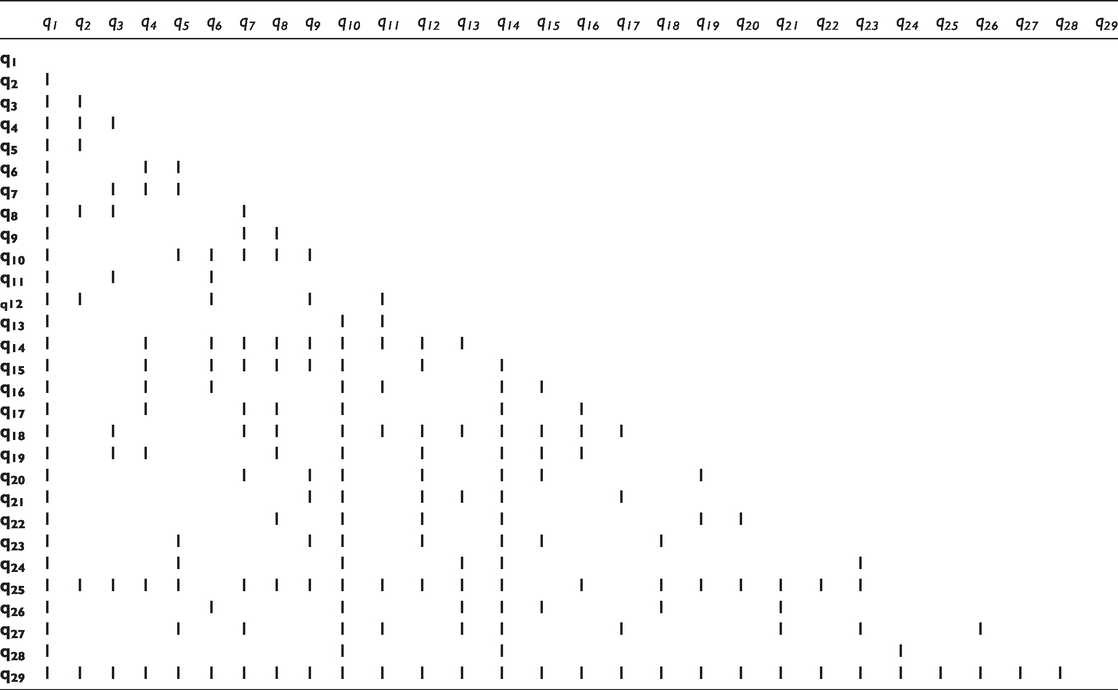
In order to analyze the correlation between the nodes and enterprises, we had to determine the relationship between the enterprises by sorting out the by-products, waste exchange tables and power balance sheets of 29 representative enterprises out of the 74 enterprises in the Daqing City A Eco-industrial Park in 2018. We adopted the binary method to assign the material and energy flows between enterprises. That is, if there is no flow of matter, energy and information between node i and node j, we recorded the symbiotic relationship between the nodes Xij = 0. If there is the flow of matter, energy, and information between node i and node j, we recorded the symbiotic relationship between the nodes Xij = 1. In Table 1, the enterprise q1 is a power plant, the enterprise q2 is a Qinghua petrochemical company, the enterprise q3 is Huaying Chemical, the enterprise q4 is Dechuang Petrochemical, the enterprise q5 is Ceda Petrochemical, the enterprise q6 is Hongqing Cement, enterprise q7 Is Yixin Chemical, Enterprise q8 is Daqing Oilfield Chemical, Enterprise q9 is Daqing Oilfield Cement, Enterprise q10 is Oilfield Automation Instrument, Enterprise q11 is Daqing Zhifei Biochemical, Enterprise q12 is Pegasus Chemical, Enterprise q13 is Commas Pharmaceutical Enterprise q14 is Mingwei electrical machinery manufacturing, enterprise q15 is Dongtai Pipe Industry Co., Ltd., enterprise q16 is Shengdelite Chemical Co., Ltd., enterprise q17 is Zunjue Woollen Co., Ltd., enterprise q18 is Fengqi Chemical Technology Co., Ltd. Enterprise q19 is Hualongxiang Chemical Co., Ltd., enterprise q20 is Rishengchang Petrochemical Technology Co., Ltd., enterprise q21 is Huaxing Chemical Co., Ltd., enterprise q22 Xuelong Petrochemical Technology Development Co., Ltd., enterprise q23 is Fujie Chemical Co., Ltd., enterprise q24 is Huake Co., Ltd., enterprise q25 is Huaruixin Chemical Additive Co., Ltd., enterprise q26 is Lulang Run Technology Co., Ltd., enterprise q27 is Maohongsheng Technology Ltd., enterprise q28 is Ming oil drilling equipment, company q29 is a sewage treatment plant. The adjacency matrix is drawn by the above information, as shown in Table 1.
Daqing A eco-industrial park adjacency matrix.
Building a network topology diagram
To analyze the stability of the industrial coupling symbiosis network of the eco-industrial park, it is necessary to establish the network relationship of the industrial coupling symbiosis network of the eco-industrial park. The nodes of this research network are enterprises in the eco-industrial park. The edge of the network is the material energy exchange between the nodes. According to the data in Table 1, the topology of the industrial coupling symbiosis network of the eco-industrial park is drawn by the netdraw function of ucinet 6.0. (see Figure 1).
Small world analysis of industrial coupling symbiosis network
The industrial coupling symbiosis network of the eco-industrial park shows the complex network form. The analysis of the topological nature of the industrial coupling symbiotic network of the eco-industrial park can lay a foundation for further study on the stability of the industrial coupling symbiotic network of the eco-industrial park. The main parameters used in this study are the number of nodes, node average, network aggregation coefficient, average shortest path length, and small world degree. The calculation results are shown in Table 2.
Characteristic indicator value of A eco-industrial park in Daqing City.

It can be known from equation (8) that the value range of the small world is from 0 to 1 while the small world degree δ of Daqing A Ecological Industrial Park is 0.891, indicating that the industrial coupling symbiotic network of Daqing A Eco-industrial Park has strong small world characteristics. The average shortest path length of the industrial park is very similar to the average shortest path length of the random network. The agglomeration coefficient is much larger than the random network agglomeration coefficient, and the δ is extremely large. It can also be judged that the industrial park symbiosis network has strong small world characteristics. As can be seen from Table 2, the average path is 1.268, and it can be considered that the shortest relationship chain between the two nodes can be connected by 1 to 2 enterprises. The agglomeration coefficient is 0.631. It can be considered that the probability of edge connection between two nodes in the network is 63.1%, which has a relatively high degree of aggregation. The energy and material exchange between all enterprises in the network are frequent and the dependence between nodes is high.
Stability analysis of industrial coupling symbiosis network
The Daqing A Eco-Industrial Park is a small-world network with hubs and high clustering coefficients. Therefore, the security and stability of the largest load node have a great impact on the stability of the network. Based on the network topology, this paper analyzes the stability of the complex network by using network efficiency and maximum connected subgraphs to measure the maintenance and resilience of the entire network after the node fails.
Network efficiency, node load and maximum connected subgraph
Network efficiency is a physical quantity that describes the ability of information transmission between networks. Based on the evaluation results of this physical indicator, we can try to change the network topology so that the network can increase the ability to withstand emergencies, which makes the network more stable proposed the definition of network efficiency and established the following model:

In equation (9), H is a collection of points and M is a collection of edges.Assume that the efficiency of communication between node i and node j, eij is inversely proportional to dij in the shortest path, that is, eij=1/dij for any node. If there is no connectivity between the two nodes, then dij goes to infinite and eij goes to 0. The calculation formula for network efficiency33–34 is

In equation (10), E(G) is the network efficiency and its value range is from 0 to 1, N is the number of nodes in the industrial coupling symbiotic network of the eco-industrial park. eij is the connection efficiency between nodes, and dij is the shortest path between nodes. In addition, the load of the node has an impact on network efficiency. The energy and information exchange between non-adjacent nodes in the network mainly depend on the nodes i and j through which the paths connecting the nodes. If a node passes by many paths, it indicates that the node has a large load on the network. The dot median can be used to quantitatively describe the load of a node in the network,35 and the formula is as follows:

In equation (11), σ
ij
is the total number of shortest paths between nodes i and j. σ
ij
(v) is the number of passing node v in the shortest path between nodes i and j, where v ≠ i, i ≠ j, j ≠ v. Node capacity refers to the maximum load that a node can handle in an industrial coupling symbiosis network of an eco-industrial park. In an actual symbiotic network, node capabilities are limited by cost. Assuming that the node v's capabilities are proportional to its initial load,36 it is expressed as follows:

In equation (12), Av is the ability of node v, a is a tolerance parameter ranging from 0 to 1.
The maximum connected subgraph is a graph that connects all the nodes in the network graph with the least number of edges, that is, the nodes contained in the subgraph are more than other graphs of the network, and the connection exists between any two nodes. Some researchers have shown that there is always a maximum connected subgraph in a network.37 After a node in the network is attacked, the destructiveness of the network is measured by the maximum connected subgraph size. The specific expression is

In equation (13), N′ is the symbiotic network node suffers from the number of nodes in the maximum connected subgraph after the attack; N is the total number of nodes in the symbiotic network. For the initial state without attack, the maximum connected subgraph size S is 1, indicating the start of the network is a fully connected undirected graph. When S is 0, the network is near collapse. Therefore, it is important to analyze the variation of the maximum connected subgraph size after the attack on the industrial coupling symbiotic network of the eco-industrial park, which is important for studying the stability of the industrial coupling symbiosis network of the eco-industrial park.
System simulation analysis
The industrial coupling symbiosis network of the eco-industrial park is a typical complex network. There are two kinds of attacks, random attacks and deliberate attacks. It is assumed that when a node enterprise in an eco-industrial park is attacked and its connected edge breaks, its load is redistributed at its neighboring nodes, and the load redistribution also has various rules. The purpose of this study is to look at the proportion of the load of the neighboring nodes of the failed node is allocated.38 A failure occurs when the new load of the node adjacent to it is greater than the node capacity of the node, and the cascading failure ends only when the new load of the node is less than or equal to the node capacity of the node. According to previous research, complex networks are robust to random attacks (simplely understood as resistance to change or relative stability), and are very unstable for deliberate attacks (such as the largest attack load node).39–40 Therefore, this study only considers deliberate attacks. What needs to be specially stated here is that the load of the network has two kinds of load: the structural load and the actual physical load. In the case that the physical load of the network is not determined, the structural load is used to study the stability of the complex network, which has a significant meaning to future research. The structure load is the load determined by the network topology. This study uses the dot median indicator to represent the structural load.
Changes in network efficiency
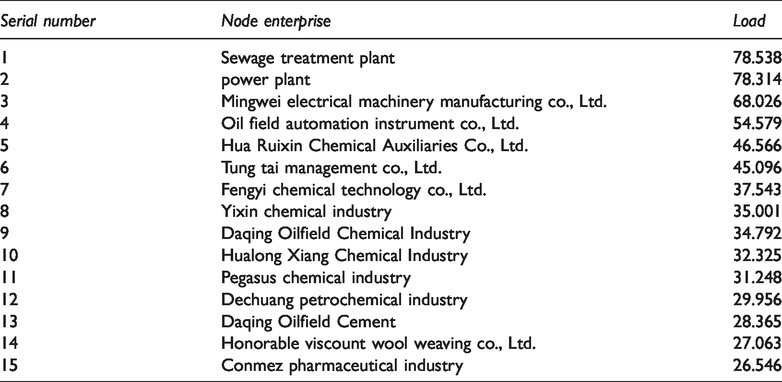
In this study, the MATLAB programming software was used to obtain the load order of 15 nodes in the eco-industrial park (see Table 3). Among them, the sewage treatment plant (node number 29) has the largest load. In turn, the top 15 nodes with the largest load of the industrial coupling symbiosis network in the eco-industrial park are attacked, and the curve of network efficiency is obtained (see Figure 2). The network efficiency of node load sorting 16–29 is very small. We only studied the top 15 node enterprises. As can be seen from Figure 2, when attacking the top 6 nodes (sewage treatment plant, power plant, Mingwei Machinery Manufacturing Company, Oilfield Automation Instrument Company, Huaruixin Chemical Additive Co., Ltd., Dongtai Pipe Industry Co., Ltd.) the network efficiency dropped the fastest, and the network efficiency decreased slowly after several nodes. When the attack load was ranked as the seventh node (Daqing Fengqi Chemical Technology Co., Ltd.), the network efficiency remained basically unchanged. This indicates that when the node with the largest load in the network is attacked, the network efficiency is drastically reduced, the flexibility of the network is also reduced, and the stability of the network is reduced. Therefore, in the planning and construction of the coupled symbiotic network in the eco-industrial park, it is necessary to pay attention to protect nodes with higher median. If the sewage treatment plant fails to operate normally, the sewage treatment of the entire eco-industrial park will have big problems. In addition to not meeting the sewage discharge targets of the eco-industrial park, it will also pose a threat to the health of the surrounding residents.
Node structure load ordering.
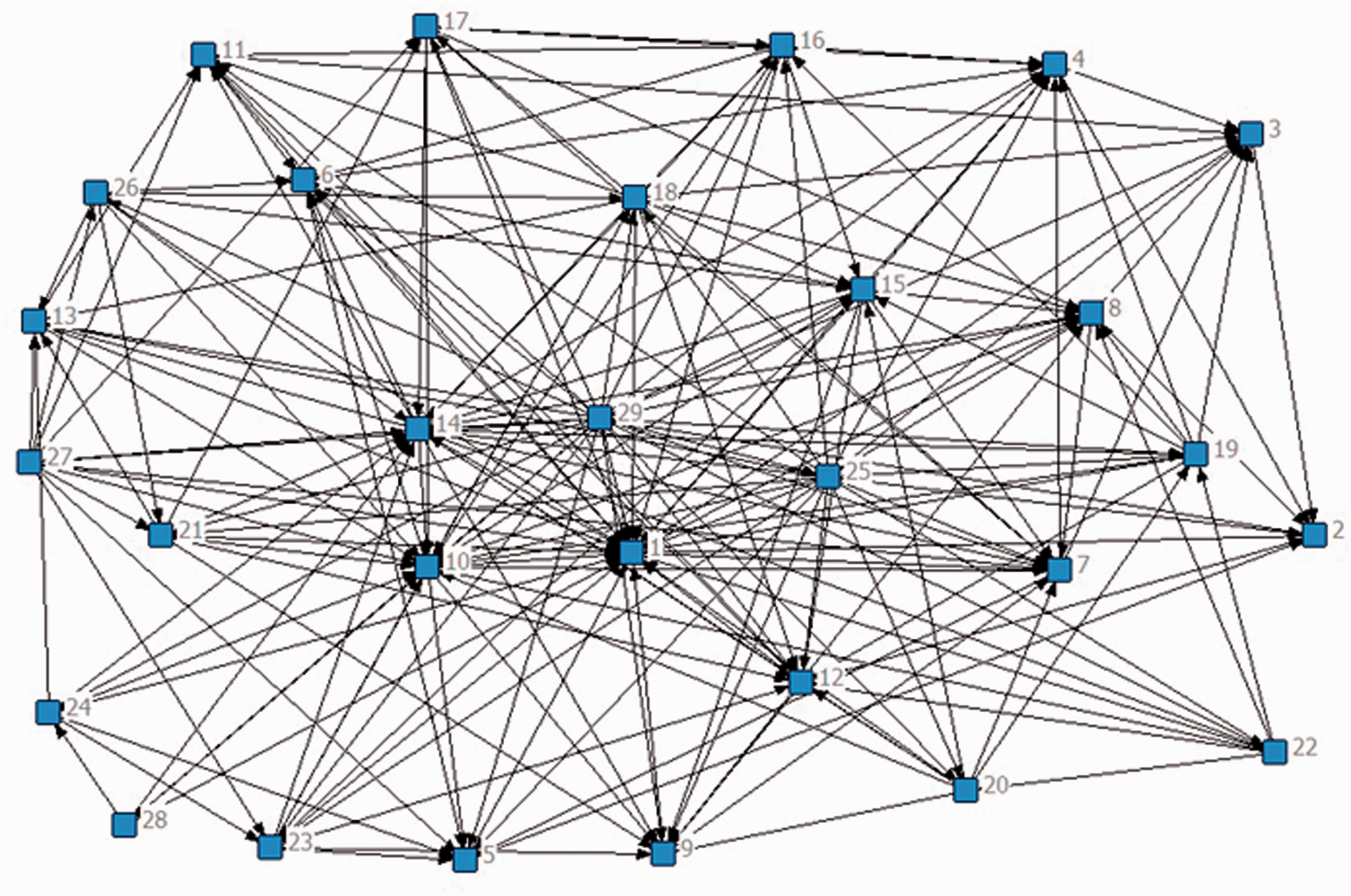
Topological structure of industrial coupling symbiotic network in A ecological industrial park in Daqing City.
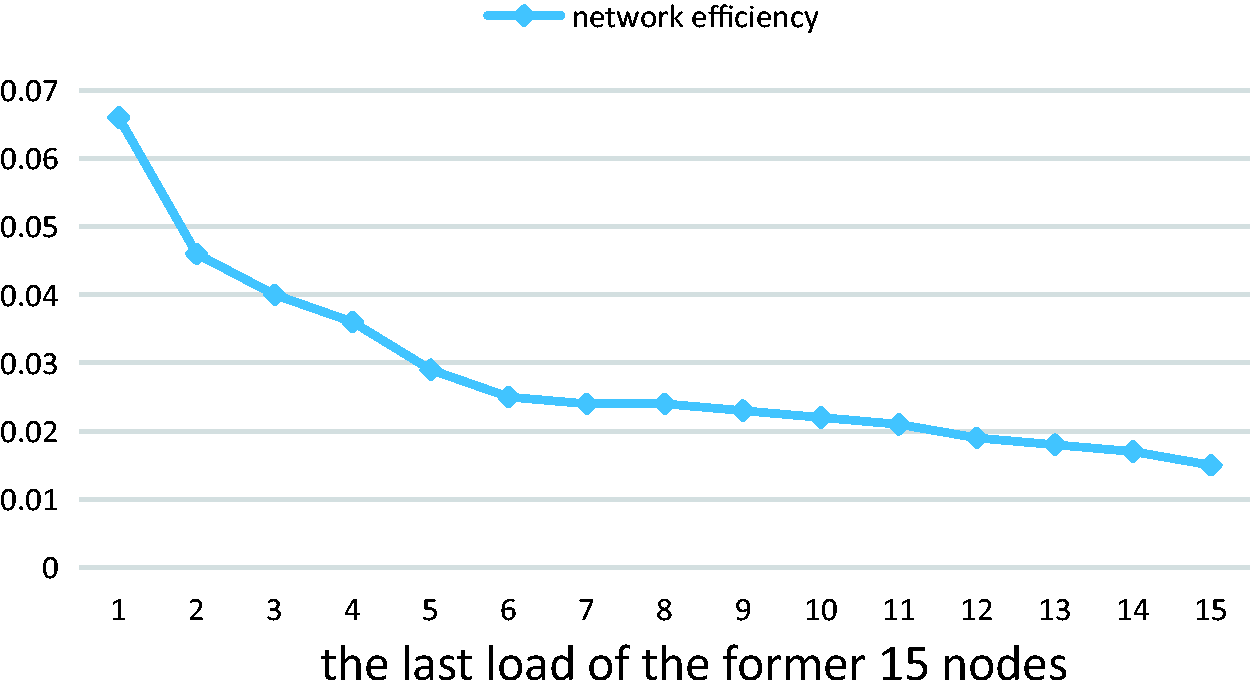
The network efficiency curve of the top 15 nodes with the highest load on the node.
Kinney et al. used the average efficiency of the network to measure the network performance after the cascade effect. The structural vulnerability analysis of the North American power grid showed that the consequences of the cascading failure caused by the maximum median attack were more serious than the random attacks.41 This study introduces tolerance parameter, α to study the trend of symbiotic network efficiency when attacking the largest load node in the symbiotic network, and to reflect the transmission of information in the industrial coupling symbiosis network of the eco-industrial park.
Considering the characteristics of the Daqing A eco-industrial park, this study takes parameter a as a node enterprise to resist attack capabilities. When a = 0, it indicated that the node enterprise completely lost its production capacity. When a = 1, it indicated that after the company was deliberately attacked, it could maintain most of the production capacity without cost constraints. When a = 0.3, after the company was deliberately attacked, the node enterprise was under the cost constraint and was able to maintain a certain proportion of production capacity. When Eij = 0, all the nodes in the symbiotic network are isolated and have no relationship. Figure 3 shows the variation of network efficiency under different tolerance parameters. When a = 0, the network efficiency of the node with the largest mediation was minimized, which was 0.021. As the tolerance parameter, a, a∈(0,1) increase, the network efficiency will continue to rise. When a = 1, the network efficiency increased to 0.0758. This indicates that the network has the vulnerability to deliberate attacks. When the node enterprises with the largest number of attacks are the most important, it has an extremely important impact on the connectivity of the industrial coupling symbiosis network of the eco-industrial park. In reality, due to cost constraints, a is usually less than or equal to 0.3. When a = 0.3, network efficiency is E = 0.0471.
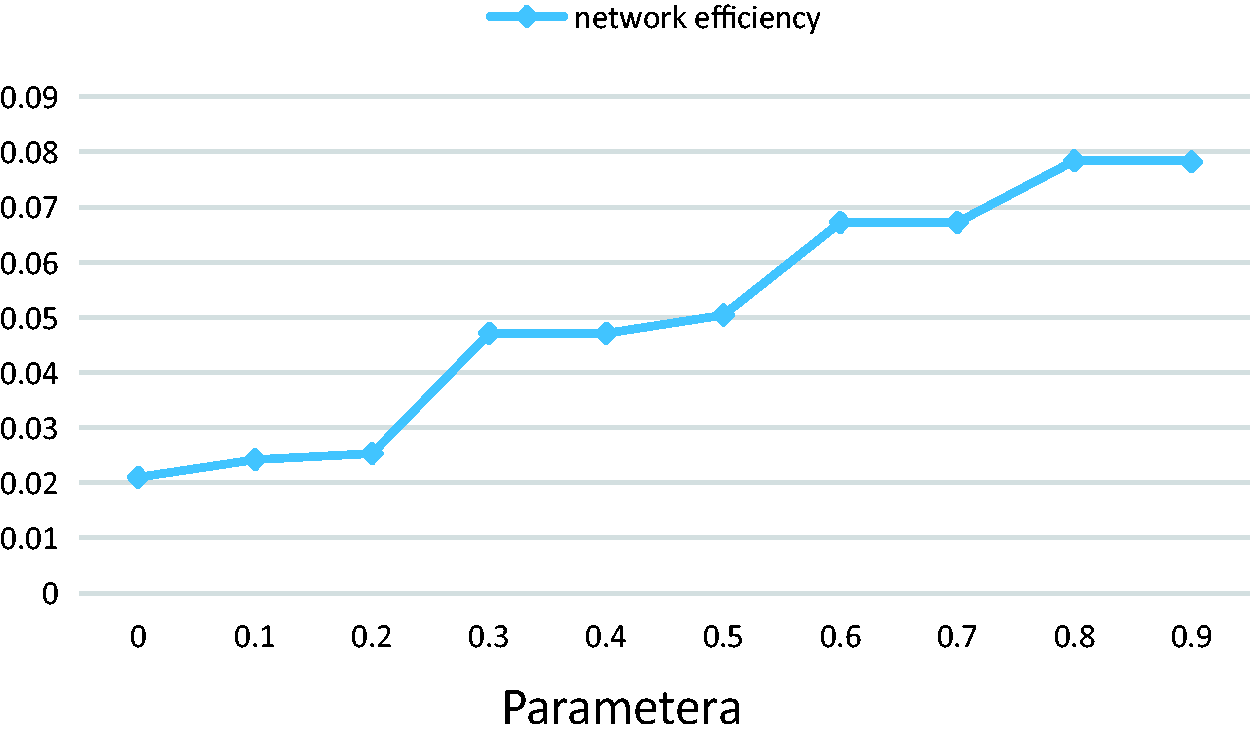
The network efficiency curve under different tolerance parameters.
Maximum connected subgraph size
The maximum connected subgraph size is the physical quantity used to measure the degree of network damage. It can be seen from the trend of network efficiency that in the industrial eco-coupled symbiosis network of the entire eco-industrial park, the node with the largest load has the greatest impact on the invulnerability and stability of the network after the attack. Therefore, when measuring the stability of the symbiotic network with the maximum connected subgraph size, the main consideration is to attack the node enterprises with the largest network load (the node order is 1), and analyze the changes of the maximum connected subgraph size of the network under different tolerance parameters (Figure 4). When a = 0, the node with the largest number of nodes was attacked, leading to the lowest S of the network (S = 0.375). When a increases, S also increases. When a = 1, the connectivity of the network remained at a low level, with a drop of up to 17%, which is lower than 20% of the scale-free network . This also shows that node enterprises with large dot media are in a very critical position in the symbiotic network, and the transmission of cascading failures is more important. Due to cost constraints, a usually less than 0.3, the maximum connected subgraph size is generally less than about 0.65. Here, for example, Mingwei Electric Machinery Manufacturing Co., Ltd., when it was attacked and stopped production (a = 0), its upstream and downstream nodes were affected to varying degrees, and downstream companies such as Comex Pharmaceuticals will stop production. Then Comex Pharmaceutical Co., Ltd. and Mingwei Electrical Machinery Manufacturing Co., Ltd. connection was broken and there is no connection between them. The power plant adjusts the production capacity, but can still maintain production and maintain the connected relationship with related enterprises. It can be seen that under this condition, the maximum connected subgraph size will be minimized. When Mingwei Electric Machinery Manufacturing Co., Ltd. can maintain most of its production capacity (a = 1), because the upstream and downstream enterprises are closely related to each other at different degrees, then the degree of influence will be different. Under normal circumstances, the most closely related and less economical node enterprises are most likely to have a broken link, and the corresponding maximum connected subgraph size will also be affected.
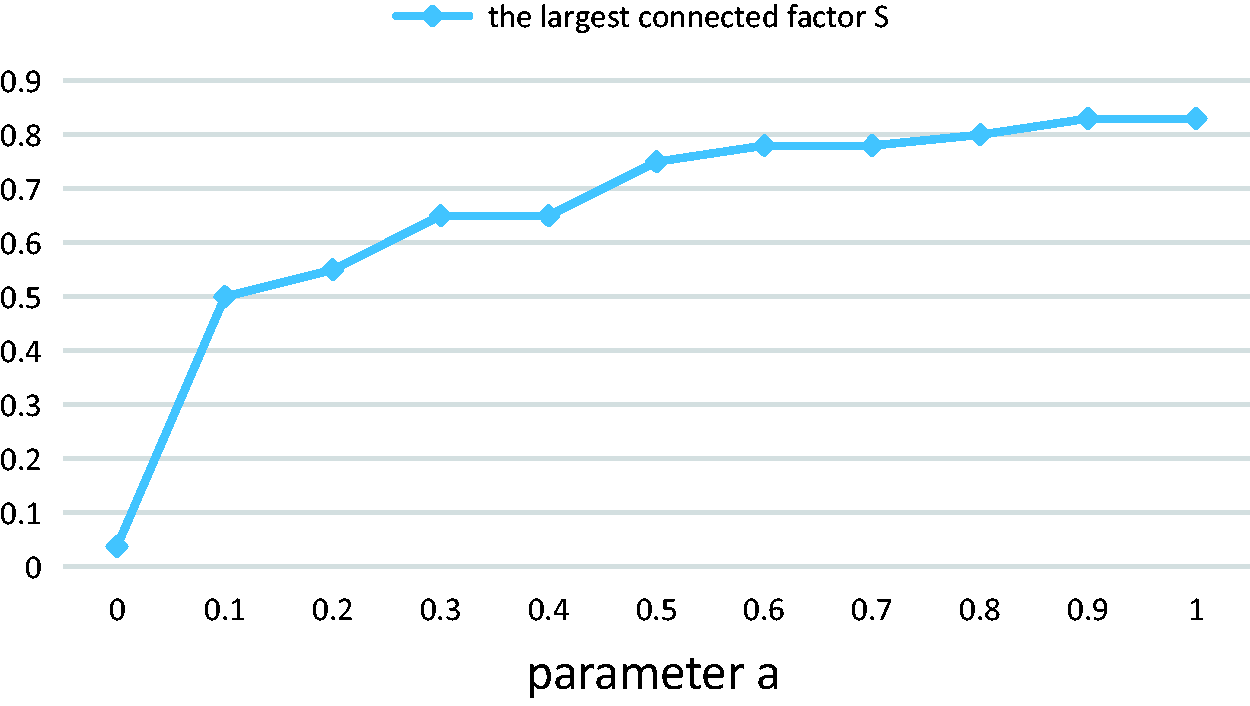
Maximum connected subgraph size under different tolerance parameters.
According to the network efficiency curve and the maximum connected subgraph scale curve under different tolerance parameters, it can be seen that the network efficiency and the maximum connected subgraph show a sharp change trend when the tolerance parameter, α is in a range of 0 to 0.3. This indicates that when the network is subjected to deliberate attacks, that is, the node enterprises with the largest load, the topological structure of the industrial coupling symbiosis network of the eco-industrial park has undergone drastic changes, which easily causes the material flow and energy flow in the industrial park to break, resulting in the decline in the stability of eco-industrial parks.
Conclusion
This study uses the Ucinet and Matlab software to construct the adjacency matrix of the interaction between the nodes in the Daqing A eco-industrial park, and draws the coupled symbiotic network topology structure. Through the node interface, network efficiency, and maximum connected subgraph, the network topology parameters were analyzed by system simulation, and the important node enterprises of the industrial park were found. Using the node number, network efficiency, eij and maximum connected subgraph size s to study the stability of the coupled symbiotic network, attacking the nodes with larger load in turn, the network efficiency shows a downward trend. When the tolerance parameter is 0 to 0.30, both network efficiency and maximum connected subgraphs show a sharp trend. When the node with the largest load in the coupled symbiosis network is attacked, the topological structure of the industrial coupling symbiotic network in the eco-industrial park will also change drastically, which will easily cause the material flow and energy flow in the park to break, thus leading to the stability of the entire ecological industrial park to decline.
Highlights
Evaluation of relative ecological efficiency
Regression analysis on the influencing factors of ecological efficiency
Improving the target value of ecological efficiency
Ecological efficiency is a dynamic process.
Footnotes
Declaration of conflicting interests
The author(s) declared no potential conflicts of interest with respect to the research, authorship, and/or publication of this article.
Funding
The author(s) disclosed the following financial support for the research, authorship, and publication of this article: This study was supported by the National Social Science Foundation of China, Grant/Award Number: 19BJY068.
