




Abstract
Poor energy conservation behaviors among off-campus students are a form of irrational behavior that often results in erratic power supply within the students' village. The present study, therefore, explored the effectiveness of energy conservation awareness package (ECAP) on energy conservation behaviors of off-campus students residing within students' villages of Nigerian Universities. A pretest-posttest experimental and waitlist control group which involved 328 participants were quantitatively assessed. Findings of the posttest depict that poor energy conservation behavior of off-campus students momentously weaken compared to a waitlist control group. This is evident where the mean difference of 33.35 on level of engaging in energy conservation behavior for students exposed to ECAP is greater than 1.20 for those not exposed to the therapy. Also, 27.97 mean difference on likelihood of engaging in energy conservation behavior is greater than 0.54 for those not exposed to the therapy. In extension, results of 2 and 4-months follow-up appraisal proved that the momentous decline in negative energy conservation behavior of ECAP participants was upheld. By implication, when off-campus students subscribe to the use of energy-saving bulbs instead of incandescent bulbs and switching off the unnecessary lightings among others as evident in this study would go a long way in conserving energy.
Keywords
Introduction
Energy is inevitable in the life of students. It is described as the “golden thread” that bonds economic growth, social equity, and environmental sustainability (Ki-moon, 2012; World Energy Council, 2013). In recent years, energy efficiency and energy saving strategies have become priorities for energy policy in most countries, and green energy saving buildings has attracted more attention worldwide (Hou et al., 2020). Thus, the inadequacy or lack of energy would tremendously hamper the smooth running of students' social activities, growth, and development of business organizations, nations, and the world economy at large (Birol, 2006; Sovacool et al., 2015). Without it, modern life would cease to exist since electrical/electronic appliances in our homes mostly depend on electricity. Energy according to Ogbuanya (2001), exists in various forms including; mechanical, thermal, chemical, electrical, and atomic energy. The modern energy refers to electricity and liquid fuels. See Table 1 by ( Nuhu and Ogbuanya, 2020).
This study concerns the study of the conservation of electrical energy by off-campus students in the students' village within the Universities of Nigeria. As it concerns this study, off-campus students are a group of students who for one reason or the other chose to reside in a community where the universities are located commonly known as “students' Village”. Banerjee (2015) argue that off-campus students consume more electrical energy because they feel that the Landlords have compelled them to pay light bill hence, they can use it to their test. They resort to using heavy-duty appliances such as boiling rings, electric cookers, electric kettles, refrigerators, and the like. They also consider purchasing low cost but energy-consuming incandescent bulbs e.g. 60 w or 100 w as against compact fluorescence lights (3 w or 4 w) that consume less energy.
Energy needs to be conserved in other to avoid energy wastage, overloading of load lines, burning of fuses and distribution board, burning of transformers (Banerjee, 2015), the setting of the house ablaze, and damaging of electrical accessories. In extension, it will enable off-campus students to save their money especially when there is no constant replacement of burnt electrical appliances as the result of overload or short circuits (JICA, 2005) and Adjei-twum (2017). Off-campus students need to have energy conservation knowledge since it provided them with education about ways to reduce energy use and increase energy efficiency in the home (Kirby et al., 2009). Liu et al. (2020) postulated that the education level positively affects household energy-saving intention. To attain high energy conservation status in Nigeria, off-campus' students have to imbibe the culture of positive energy conservation behavior.
Energy Conservation Behaviour (ECB) would best be observed by off-campus students in Nigeria through improving or changing behavior towards energy and its conservation. The initial step towards correcting negative energy conservation behavior is raising awareness. ECB is explained by Team (2011) as a series of activities performed by consumers that could lead to a reduction in energy wastage, energy consumption, overloading of load lines, and avoidance of energy scarcity. These activities are referred to as negative energy conservation behaviors in this research. As explained by Ting et al. (2011); Wang et al. (2014) and Adjei-twum (2017), behavioral change is a change in the activities of a person or organization that affects the level of energy conservation, either positively (turning off lights when not in use) or negatively (e.g using an electric dryer to replace a clothesline). Energy conservation is an inescapable responsibility for humanity which can be achieved through energy consciousness (Lee et al., 2013).
Energy consciousness (EC) is the first step in achieving energy efficiency and energy conservation by creating awareness for off-campus' students. This assertion agrees with the findings of JICA (2005); Ting et al. (2011); Davis and Hayes (2011) where the seed for tomorrow’s changes was seen as awareness. One obstacle in the adoption of residential energy-efficient practices as affirmed by Kirby et al. (2014) is the lack of credible information for consumers. One must understand that the ultimate purpose of raising awareness (Davis and Hayes, 2011) is to improve energy-use patterns and recently supported by Mansor and Sheau-Tingi (2019). In this case, behavioral improvement is needed by off-campus students through the application of an energy conservation awareness package.
The energy conservation awareness package (ECAP) is intended to create energy conservation awareness and to correct the negative energy conservation behavior of the off-campus undergraduate students to rational energy conservation behavior. It is a package designed for positive behavior change towards energy conservation as affirmed by Bird and Legault, (2018). It is postulated that off-campus students would learn how to reduce energy consumption at the course of attaining the energy conservation program. Specifically, the intervention package is hoped to; raise overall energy awareness among participating off-campus students; encourage students to conserve energy now and in the future as well as reaching other students and household members through participating students.
It has been estimated that around 1.6 million people in the study areas lack access to adequate energy services due to the exhibition of negative energy conservation behavior according to (Fabiyi et al. 2016). Around half of all people including off-campus students in these study areas according to (Olaniyan et al., 2018) are depending on wood, charcoal, animal dung, and crop residue, collectively known as traditional fuel for inability to access electrical energy. Therefore, students desire to engage in energy conservation practices. The level of engagement in behaviors indicates how often the students perform each of the energy-saving behavior. For instance, when students resort to the use of energy-saving bulbs (Banerjee, 2015; Mcclaren, 2015; Seebauer et al., 2017) instead of incandescent bulbs, switching off the unnecessary lightings among others would go a long way in conserving energy. Ohajianya et al. (2014) explained that a 10 W LED electric bulb can give the same illumination as a 100 W incandescent bulb. This means 90% energy saving. The likelihood of students to engage in energy conservation practices influences the supply of electricity in the study area.
The likelihood of engaging in energy conservation behavior denotes the possibility that off-campus students may or may not participate in conserving the energy. Adjei-twum (2015) affirmed that the study of the probability regarding the respective students’ behaviors is an effort towards determining the best behaviors to be targeted for improvement. Positive statements such as ‘I am most likely to turn off room lights when the room is not occupied and unplug electric appliances from socket after use is a great assurance to energy consumption reduction. Unless negative energy conservation behavior of off-campus students is changed to rational energy conservation behavior, off-campus students within Nigerian Universities would continue to be threatened with potential energy-related social and economic problems.
Quite worrisome is the scenario where off-campus students fail to ascent to exhibiting a positive attitude towards energy conservation in the students' dormitories. This singular act culminates in a serious problem to Landlords. Fabiyi et al. (2016), described the faulty wiring of residential building, theft, and Vandalization of PHCN equipment, and illegal connection of electricity as a negative attitude of students towards energy conservation. It was reported by Transmission Company of Nigeria (TCN) according to Olaniyan et al. (2018) that their marketers receive a daily case of energy wastage, overloading of load lines, burning of fuses in the distribution board, burning of transformers, fire outbreak due to short-circuits and damages of electrical accessories. A similar case is replicated in other parts of the off-campus students' dormitories all over the students' village in the Nigerian Universities (Fabiyi et al., 2016). Similarly, many areas of the students' dormitory in Nigerian Universities have lot of illegal connections of wires according to (Chatta, 2015) which have greatly affected the proper transmission of power to the appropriate areas and consequently resulted in the damages of some transformers due to overloads from students. Also, it has led to the loss of lives and properties.
This research is timely considering the high rate of illegal connection of electricity wires by off-campus students and business people like the welders, barbing saloon as well as viewing centers that show football at night in the student village. These poor attitudes towards energy conservation are likely to trigger erratic power supply, damages to electrical/electronic appliances, and total blackouts in such students' community for some time as the result of overloads on the load-lines. The effects of erratic power supply on students due to poor energy conservative behaviors can be catastrophic Fabiyi et al. (2016) lamented. Enjoyment of basic social amenities such as quality health care, adequate water supply, telecommunication service, etc becomes limited or even impossible due to long term electrical power outage. The huge revenue loss, business disruptions, loss of very important records at data centers, wastage of perishable foods, destruction of home appliances, etc are some of the effects of dwindling electrical power supply. The problem of overloading on individual transformers can also lead to voltage and current surges which can be averted by improved energy conservation behavior of the off-campus students.
Similar studies investigated the energy conservation behavior of University students in the hostel and households but the current study duel on the energy conservation behavior of Off-campus students. To the best of our knowledge, none of these studies have been conducted in Nigeria and Africa as a whole that concerns off-campus students. None of such studies considered the use of a structured method of selecting participants as in Figure 1 of this study. Most of the previous studies conducted on energy conservation were more of survey but the present study employed the quasi-experimental research design Finally, ECAP was first used in this study to unravel the behavior of the off-campus students that undermine energy conservation measures in their host communities in the Universities in Nigeria. The effect of ECAP will act as a knowledge conduit to subsequent research on similar topics across the world. Therefore, the study objectively determined the effect of the energy conservation intervention package on energy conservation behaviors among Off-Campus Undergraduate students that are residence in students’ Village in Universities of Nigeria. Specifically, the study investigated the;
Effect of energy conservation intervention package (ECAP) on level of off-campus students engaging in energy conservation behavior of off-campus students Effect of energy conservation intervention package (ECAP) on the likelihood of off-campus students engaging in energy conservation behavior
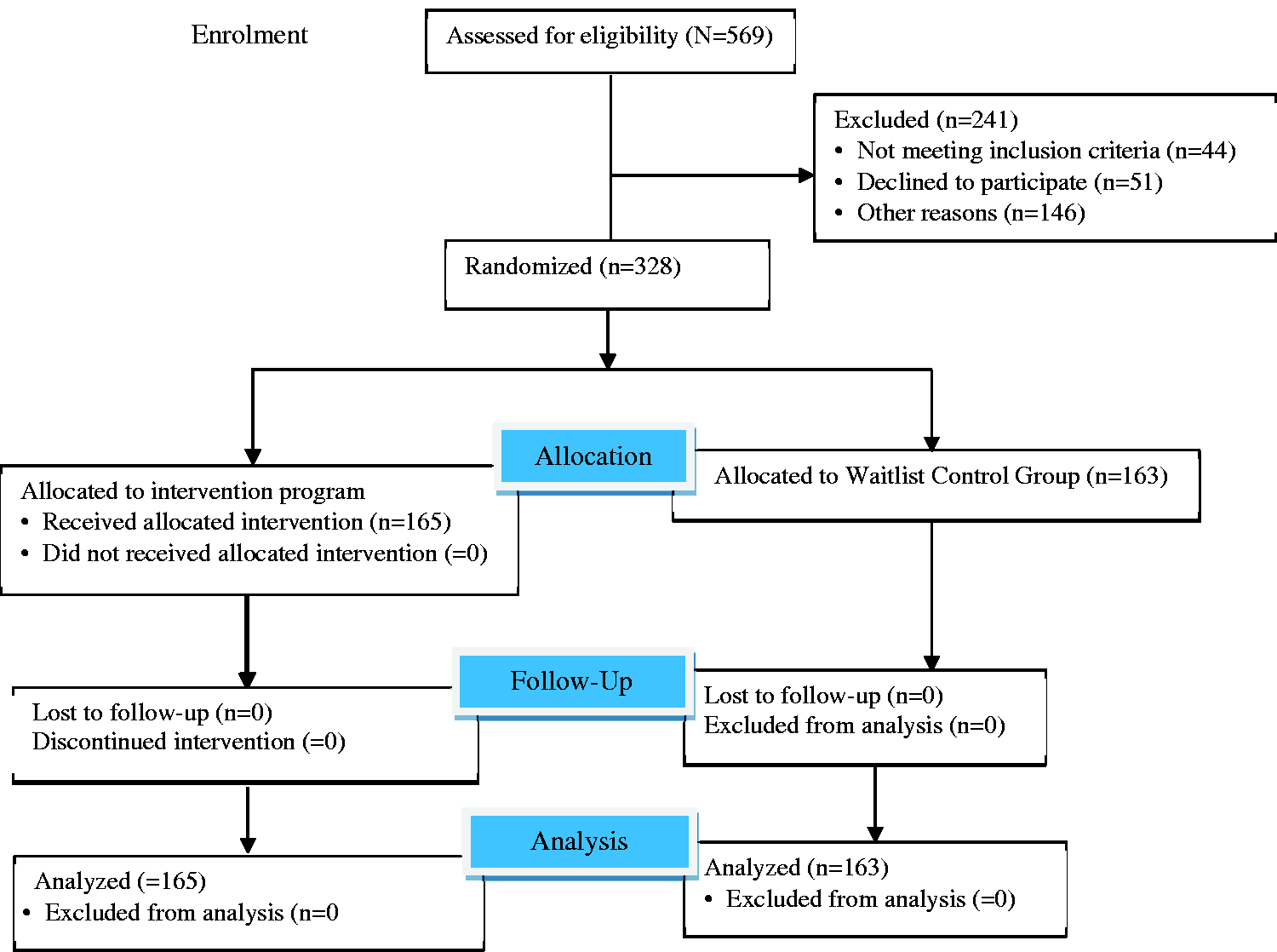
Participant eligibility criteria by (Nuhu and Ogbuanya, 2020).
The researchers in effect hypothesized that ECAP would significantly reduce the negative energy conservation behavior of the off-campus students exposed to ECAP on the level of engagement in energy conservation compared to counterparts in the waitlist control group. Secondly, there would be a significant decline in the negative energy conservation behavior of off-campus students exposed to ECAP and those not exposed to the therapy on the likelihood of engagement in energy conservation as compared to their counterparts in the control group. In conclusion, these gains were hypothesized to be momentously upheld at the 2-months and 4-months follow-up.
Method
Ethical approval
The researchers conducted the study in conformity with the American Psychological Association's (2010) ethical principles of research with human participants. Landlords, Parents, and heads of departments assented to the research through written informed consent. The Head of Department of Industrial Technical Education, University of Nigeria Nsukka, verbally supported and encouraged the need for this research. Other ethical approvals included written informed consent, participants’ informed verbal consent, participants residing at students’ village (off-campus) around the Universities, and participants being available throughout the study period.
Measures
Demographic Variables: the researcher centered on the following major demographic variables of the participants: gender, levels, and institution.
Energy conservation questionnaire:
In the construction of the level of engagement in energy conservation behavior questionnaire (LEECB) 1 and 2, elements of the categorizations in the work of Stragier et al. (2012); Pierce et al. (2010) (cutting, trimming, switching, upgrading, and shifting) were used. In extension, the elements in the categorization of Linden et al. (2006) (the distinction between warming and lighting of the house, cleanliness, and entertainment and information) are also employed as the underlying framework of the measurement tool. However, the aspect of monitoring which has three items was ignored while the aspect of timing which also had three items was reframed but maintained the original idea to suit the purpose of this study. These two categorizations were chosen as axes of our framework for their strong empirical base and practical relevance. The values of the fit indices confirm a good fit of the observed data to the expected factor structure with their initial 21 items. (df = 55; ϰ2 = 82.64; ϰ2/df = 1.50; TLI = 0.976; CFI = 0.983; RMSEA= 0.027). In this study values of the fit indices also confirmed a good fit of the observed data to the expected factor structure with addition of 6 items (df = 62; ϰ2 = 88.10; ϰ2/df = 1.72; TLI = 0.89; CFI = 0.91; RMSEA= 0.031). LEECB 1 contained 9 items on Likert's type scale of strongly disagree (1), somewhat disagree (2), somewhat agree (3), and strongly agree (4). LEECB 2 had 9 items each rated on a four-point Likert type scale. The response option for the level of engaging in energy conservation was; never (1), rarely (2), sometimes (3), quite often (4), and always (5). The response options for the probability of engaging in energy conservation were; not at all (1), less likely (2), somehow likely (3), more Likely (4), and most likely (5).
Participants
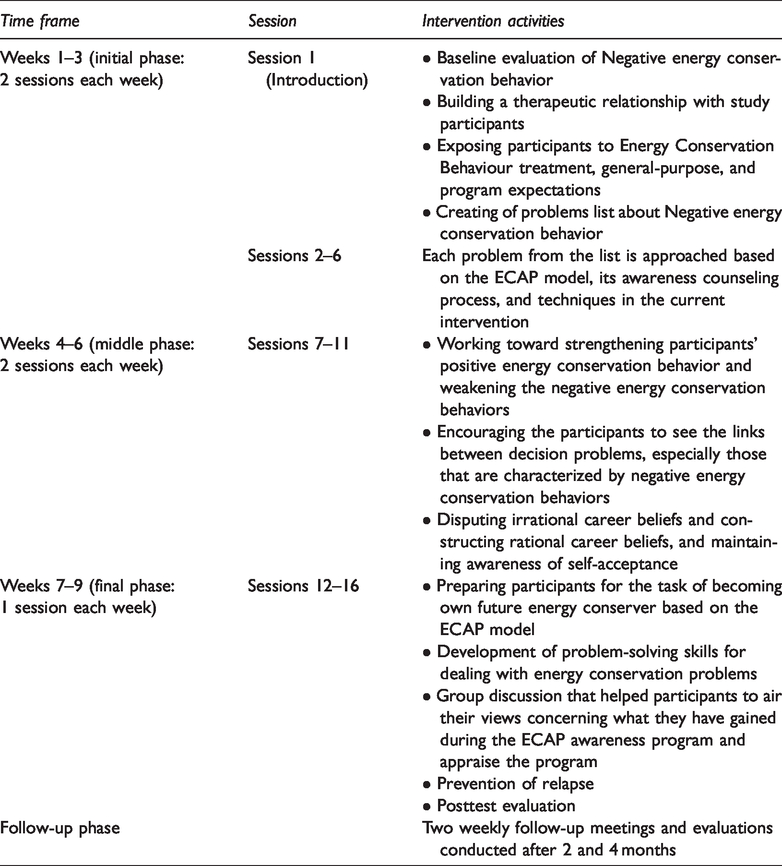
Participants were randomly allocated to one of two groups: 165 participants were allocated to the ECAP treatment group, and 163 participants were allocated to the waitlist control group using simple randomization (see Figure 1). The simple randomization allowed the participants to pick an envelope from a container as in Ogbuanya et al. (2017). Each of the envelopes contained a pressure-sensitive paper with either a “T'' or “WC'' caption on it. The “T'' mean treatment group and “WC'' waitlist control group. The captions on each paper were created from a computer-generated random list obtained from random allocation software, version 1.0 by Saghaei (2004). Participants' attendance in group sessions occurred after regular school hours. The Energy Conservation Awareness (ECA) program which consisted of 45 min per session was implemented for ECA participants for 9 weeks. The ECA participants were organized as a large group consisting of all 328 participants in a school auditorium. Participants in both groups completed the LEECB-1 and LEECB-2 at posttest evaluation. Finally, follow-up evaluations were conducted at two and 4 months later for the treatment group participants. After each evaluation, the participants returned the questionnaires straight to the researchers. The waitlisted group was scheduled to begin their intervention immediately after the last follow-up evaluation.
Procedure
Data was collected from the ECA participants and waitlist control groups at four-time points, namely, pretest, posttest, 2-month follow-up, and 4-month follow-up. For up to 3 months in 2019, this study was advertised across the students' village (off-campus) and Universities in the area of study, and schools were encouraged to inform their students about the study through notice boards and class visitations. To collect baseline data, a total of 569 off-campus students who responded to the notices were screened for eligibility using the LEECB1 and LEECB2. A total of 328 students who first met the study criteria were selected as the study participants. A participant who did not meet these criteria for inclusion was excluded.
Intervention
Energy conservation awareness package
The energy conservation awareness package (ECAP) is intended to create energy conservation awareness (Sanduleac et al., 2017) and to correct the negative energy conservation behavior of the off-campus undergraduate students to rational energy conservation behavior. It is a package designed for positive behavior change towards energy conservation as affirmed by Bird and Legault (2018). The researchers postulated in this study that off-campus students would learn how to reduce energy consumption at the course of attaining the energy conservation program. Specifically, the intervention package is hoped to raise overall energy awareness (Borner et al., 2012) among participating off-campus students. Encouraging students to conserve energy now and in the future as well as reaching other students and household members through participating students.
Results
Result in Table 2 shows that on the level of engagement in energy conservation behavior, off-campus students exposed to ECAP treatment had a mean score of (
Summary of the ECAP program sessions in the intervention manual.
Pretest and Post-test Mean scores of off-campus students on the level of engagement in energy conservation behavior.

Result in Table 3 shows that on the likelihood of engagement in energy conservation behavior, the off-campus students' treatment group had a mean score of (
Pretest and post-test mean scores of off-campus students on the likelihood of engagement in energy conservation behavior.

Result in Table 4 shows that an F-ratio of (F (1, 316) = 1140.656, p < .05,
Analysis of covariance (ANCOVA) of the effect of ECAP on the level of engagement in energy conservation behavior.
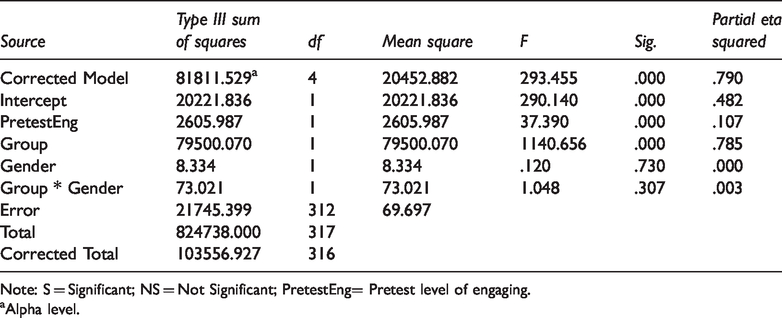
Note: S = Significant; NS = Not Significant; PretestEng= Pretest level of engaging.aAlpha level.
Result in Table 5 shows that an F-ratio of (F (1, 316) = 1038.392, p < .05,
Analysis of covariance (ANCOVA) of the effect of ECAP on the likelihood of engagement in energy conservation behavior.
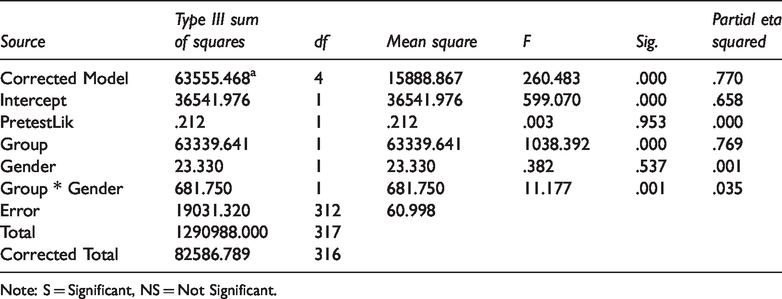
Note: S = Significant, NS = Not Significant.
Discussion
From the findings of this study, the mean difference of 33.35 for off-campus students exposed to ECAP is greater than 1.20 for those not exposed to the therapy, this implies that energy conservation intervention package (ECAP) leads to improvement of off-campus students’ level of engagement in energy conservation behavior. This finding supports the study by Kaplowitz et al. (2012) involving laboratory workers and Wang et al. (2014) that involves household electricity-saving behavior. These findings imply that providing students with appropriate energy information would encourage them to practice energy-saving behavior. The findings from the study of Adjei-Twum et al. (2016) affirmed that energy management is an untapped potential to reduce electricity costs in higher education institutions in Ghana. While Adjei-Twum (2017) supported that adoption of energy-saving practices by students would improve the level of engagement in energy conservation in the campus, the need to target the sources of the attitudinal factors such as concern for convenience, comfort, apathy, and other underlying beliefs should be considered. These factors were though not considered in the present study since our study is quasi-experimental while the former was survey research.
Findings of the present study show that ECAP improves off-campus students' likelihood of engagement in energy conservation behavior in the future where a mean difference of 27.97 for off-campus students exposed to ECAP is greater than 0.54 for those not exposed to the therapy. This finding is in line with the findings of Black et al. (2009) on facilitating energy-saving behaviors among university student. The energy consumption data reveals a generally consistent pattern of lower energy consumption (both gas and electricity) in the intervention groups than in the control group. Across the different phases, the reduction in electricity varied from 17% to 28% less than the control group.
In the present study findings regarding the first hypothesis revealed that ECAP proved effective in improving off-campus students’ level of engagement in energy conservation behavior. The effect size (
The findings of the present study also showed that ECAP proved effective in enhancing the off-campus students’ likelihood of engagement in energy conservation behavior. This supports the finding of Black et al. (2009) which provided evidence that the facilitation of intrinsically motivated behaviors of students can result in reduced energy use and greenhouse gas emissions. This finding also agrees with the findings of Twumasi et al. (2017) who out of 872 students, 68.46% were of the view that incentives have to be provided to students for them to engage in energy-saving awareness. However, 31.54% did not find the provision of incentives necessary. The results show that authorities and Landlords may have to put in place some incentives to encourage off-campus students to get actively involved in efforts towards the minimization of energy wastage. The effect size (
Therefore, off-campus students need to be further supported with intrinsic motivation for disengagement in negative energy conservation behavior. In a similar study, Bekker et al. (2010) found that energy usage decreased in the intervention hall, but energy usage did not change appreciably in the control hall. In the intervention hall, mean daytime and nighttime savings were 16.2% and 10.7%, respectively, compared to savings of 3.8% (day) and 6.5% (night) in the control hall. This study conforms with the present study particularly in the aspect of the effect of the energy intervention strategies which lead to a reduction in negative energy conservation behavior of treatment groups in both studies.
Conclusion
Since the aftermath of poor attitudes towards energy conservation is likely to trigger erratic power supply and damages to electrical/electronic appliances, off-campus students are advice to shunt negative energy conservation behaviors. Findings of the posttest depict that negative energy conservation behavior of off-campus students significantly declined compared to a waitlist control group. By implication, when off-campus students subscribe to the use of energy-saving bulbs instead of incandescent bulbs and switching off the unnecessary lightings among others as evident in this study would go a long way in conserving energy. In summary, the energy conservation intervention package (ECAP) leads to the improvement of off-campus students' level and the likelihood of engaging in energy conservation behavior now and in the future. The effect of rational emotive behavior therapy (REBT) on negative energy conservation behavior among off-campus students is highly recommended in future research.
Contribution to knowledge
This study is of great significance since it provided the off-campus students with adequate education about ways to reduce energy use and increase energy efficiency in the home. The findings of this study are hoping to reduce the conflict between landlords, students, and electricity distribution companies as regards energy wastage, overloading, and power outages within the University communities in Nigeria and allied University communities in the world. The energy conservation awareness package (ECAP) created energy conservation awareness and corrected the negative energy conservation behavior of the off-campus undergraduate students to rational energy conservation behavior. It is a package designed for positive behavior change towards energy conservation. Specifically, the intervention package raised overall energy awareness among participating off-campus students. It encourages students to conserve energy now and in the future. This study will serve as reference material for future studies on the energy conservation behavior of Off-campus students globally.
Footnotes
Acknowledgements
The authors appreciatively acknowledge Professor James E. Conable of Lund University who is as well a visiting Professor in the school of postgraduate studies of the University of Nigeria and other anonymous reviewers for their constructive comments and suggestions. We are highly grateful to Grammarly app which improved the vocabulary of this piece of work.
Declaration of conflicting interests
The author(s) declared no potential conflicts of interest with respect to the research, authorship, and/or publication of this article.
Funding
The author(s) received no financial support for the research, authorship, and/or publication of this article.
