




Abstract
In the context of electricity generation in the oil and gas producing countries, it has become implicit to develop new, clean, and renewable sources of energy to supplement the fossil fuel based power generation. With this single aim, one can hit two targets, conservation of fixed fossil fuel resources and combat the adverse climatic changes to safeguard our planet. In regional context, solar photovoltaic, solar thermal, wind power, geothermal, and hydro power are alternative sources for power mitigation. Of these renewables, wind, solar photovoltaic (PV), diesel, and energy storage in hybrid combinations are the possible ways to supply continuous energy for all sizes of applications. This paper provides a review of the existing hybrid power systems and the theoretical studies around the globe in varied climatological conditions to identify the best combinations of hybrid systems for Saudi Arabia to supplement the existing energy portfolio. The wind/solar-pv, wind/solar-pv/diesel, and solar-pv/diesel with and without battery backup are most commonly used systems with respective popularity of 28, 22, and 21%. Among users, remote communities are the highest while islands and communication towers are the next common applications. Average costs of energy of wind/solar-pv, wind/solar-pv/diesel, and solar-pv/diesel are around 0.458, 0.355, and 0.349 US$/kWh.
Keywords
Introduction
In this era of fast technological development and industrialization, the task of providing clean and cost effective electricity to each individual, remains a challenge. With more than a billion people lacking access to electricity, local power-generation solutions are essential to provide sustainable energy to all but particularly to those users who are expected to remain isolated from national or regional grids for the near future. However, the number of people, not having access to electricity, has improved a bit after dedicated efforts over several years and gone below one billion mark 2016 (IRENA, 2019). The global electrification rate reached 87% due to universal access to electricity efforts in 2016. Furthermore, the electricity availability rates in rural areas have improved at faster pace and today stand at about 76%. Renewable power generation provides low-cost solutions to bring reliable electricity to rural households or island communities off the main grid. The off-grid renewable energy systems are expanding rapidly on the ground.
Renewable sources of energy such as wind, solar thermal, solar photovoltaic, biomass, small and large hydro and geothermal can provide sustainable and cost effective energy to all populations irrespective of their geographical locations. These sources are clean and available everywhere and have no political or geographical boundaries and are freely available. Due to distributive nature of these sources of energy, small and large grid connected power systems, both hybrid and single source, can be designed and deployed. The HPS optimization sizing methodologies assure power reliability and less system cost.
Hybrid power systems (HPS) assure continuous power supply to the end users. These systems consist of more than one energy source like wind-diesel, solar photovoltaic-diesel, wind-photovoltaic, and wind-photovoltaic-diesel, with and without battery backup. According to the report on global HPS market (Zion Market Research, 2019), the market size was US$477.71 million in 2017 and is expected to touch US$836.92 million by 2024. This simply means that the HPS are being employed globally though at a slow pace. The HPS are reliable, efficient, low cost, and have minimal greenhouse gases emissions. Taylor (2001) presented a comprehensive overview of off-grid applications (such as health clinics, schools, water pumping, meteorological and communication towers, water purification, rural telephony, home systems, grain grinding, carpentry, refrigeration, lighting, etc.) of hybrid systems around the globe. The hybrid systems discussed included a large number configurations based on wind, solar photovoltaics (PV), biomass, micro-hydro, fuel cell, and diesel generation with or without battery backup. The countries covered in this presentations included Russia, Kazakhstan, Nepal, India, Bangladesh, Indonesia, Philippines, China, Korea, Mongolia, Morocco, Egypt, Ghana, 14 SADC Countries, South Africa, Mozambique, Mexico, Central America, Chile, Argentina, Brazil, and Dominican Republic, Taylor (2001).
Saudi Arabia is diversifying its existing energy mix by supplementing it through renewable sources of energy like solar and wind for grid connected and off-grid power systems. Saudi Arabia observes high intensities of solar radiations throughout the year and long hours of sunshine durations and it is available in all parts of the country. Additionally, the nation has good wind power resources distributed in different regions of the country. These two resources can be combined with diesel and battery backup option for developing HPS in remotely located areas which are being supplied power through diesel only system in the present framework. There are more than 40 locations where only diesel power systems are deployed and could be supplemented through wind and solar power systems. The deployment of hybrid power systems will help in reducing the greenhouse gases (GHG) emissions in these localities, tend to reduce health and electricity bills, and will create new jobs for the local youths. This paper aims at studying the existing HPS technologies, sizes, efficiencies, costs, and popularity with respect to the regions and find out the best possible options for Saudi Arabian conditions.
A statistical overview of the existing HPS around the globe
The present study collected around 100 research papers published and presented in journals and conference proceedings from around the globe and categorized statistically these in terms number of publications from different continents, on a yearly basis, and tools used for studying the HPS. The annual distribution of the paper published in the literature shows a little appearance of HPS from 1997 until 2004 (Figure 1). In fact, there were only few published works between 1997 and 2000 and nothing from 2001 until 2004. From 2005 onwards, the HPS started appearing in the literature and 2010 year saw the maximum number of studies reported in the literature. With respect to continental popularity of HPS, maximum number of studies (53) are reported from ASIA followed by Africa, Europe, and North America, as depicted in Figure 2.
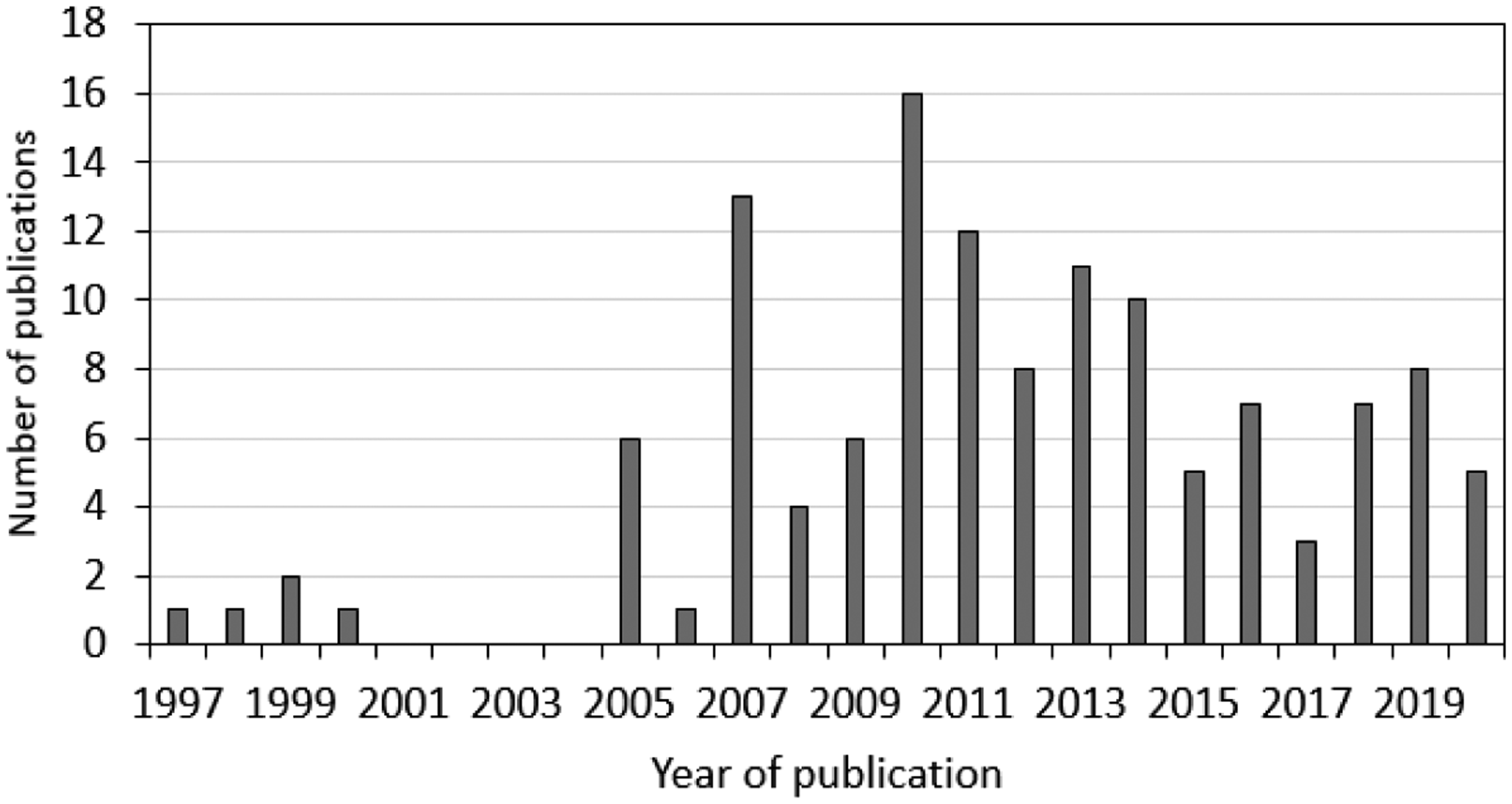
Number of HPS studies reported in the literature annually from the selected samples.
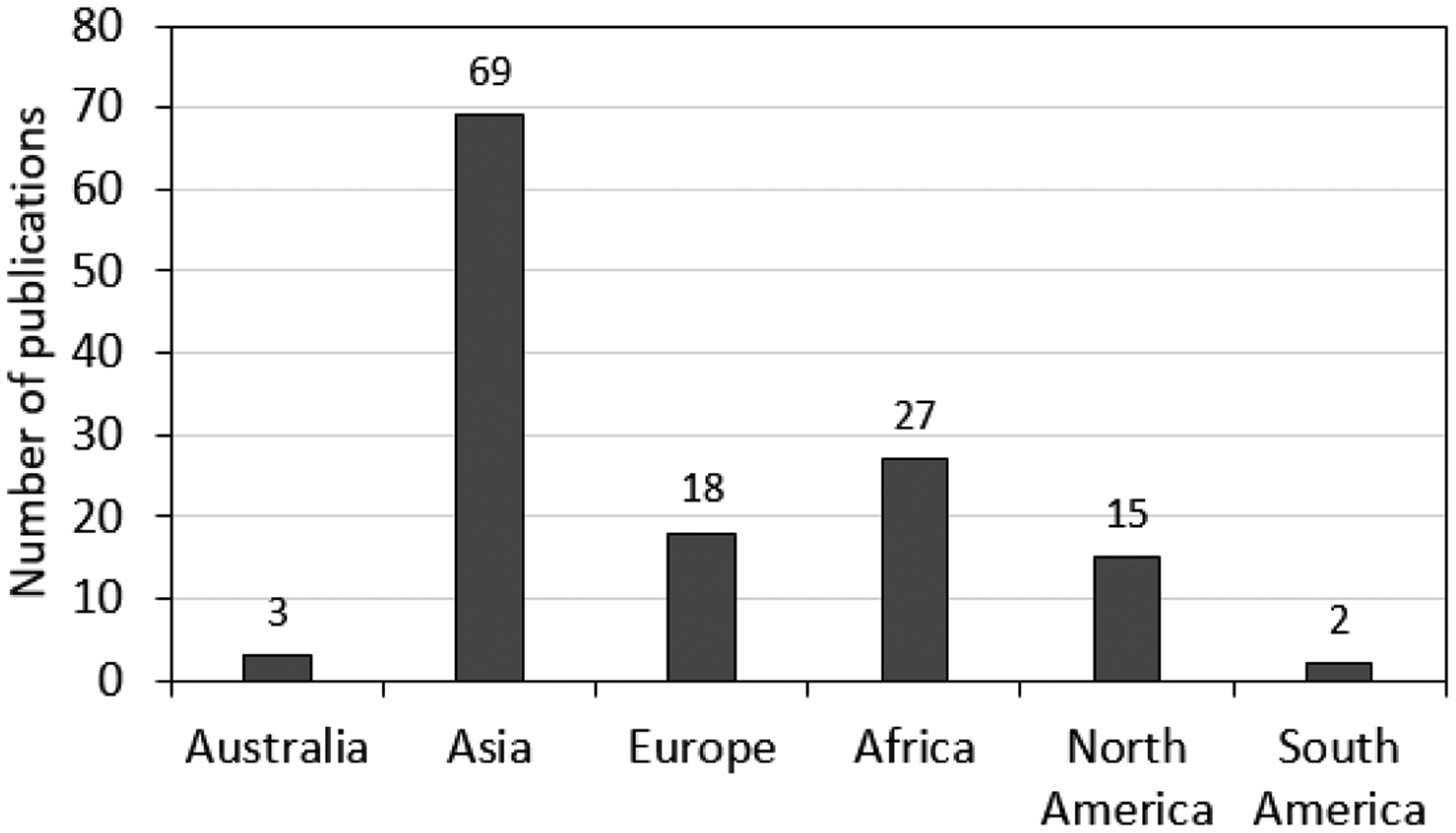
Continental distribution of the HPS studies from the selected samples.
The HPS are designed usually using HOMER Pro, HOGA, MATLAB and other category of software. Of these, HOMER and HOMER Pro software are most popular and are used globally by researchers, consultants, and utility developers. As seen from Figure 3, the maximum number (70, 82%) of published papers used HOMER and HOMER Pro software for the design and optimization of HPS. HOGA, MATLAB and other software are rarely used as seen from the selected samples of reported studies. Lambert et al. (2005) described the capabilities of HOMER in details and discussed its benefits, economic analysis, optimization, GHG emission quantification, and other useful features of the software for end users with examples.
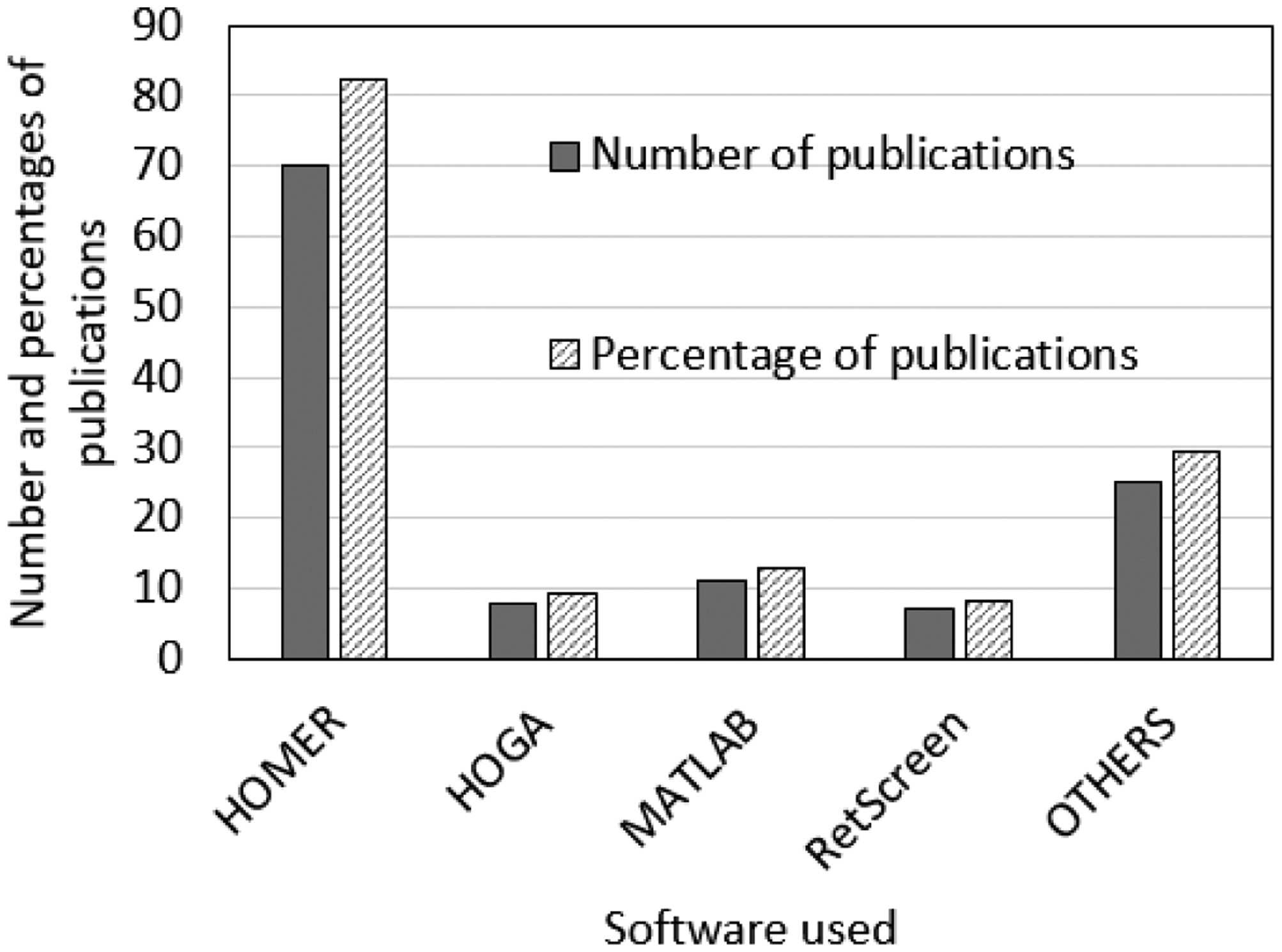
Distribution of the HPS studies based on software tools used.
Wind-diesel (WND-DSL) hybrid power systems with and without battery
A wind-diesel hybrid power system consists of wind turbines and diesel generators depending on the overall load requirement of the application. These hybrid systems (Figure 4) may include battery backup or connected with the grid to assure continuous power supply. These hybrid systems can be classified as low (<50% instantaneous or <20% annual average), medium (50–100% instantaneous or <20–50% annual average), and high (100–400% instantaneous or <250–150 annual average) wind penetration systems. In low penetration systems, wind acts as a negative load, requires little controls or integration of wind turbines into the power system. The medium wind penetration systems mainly rely on wind power but diesel generators still run and provide much of the system power. In such hybrid power system, additional components but minimal supervisory control is required to assist diesel generators in maintaining power quality. In case of hybrid systems with high wind penetration, advanced control for complete integration of power system is required. Under this scenario, diesel generators shut off when not needed and minimal operational control is required.
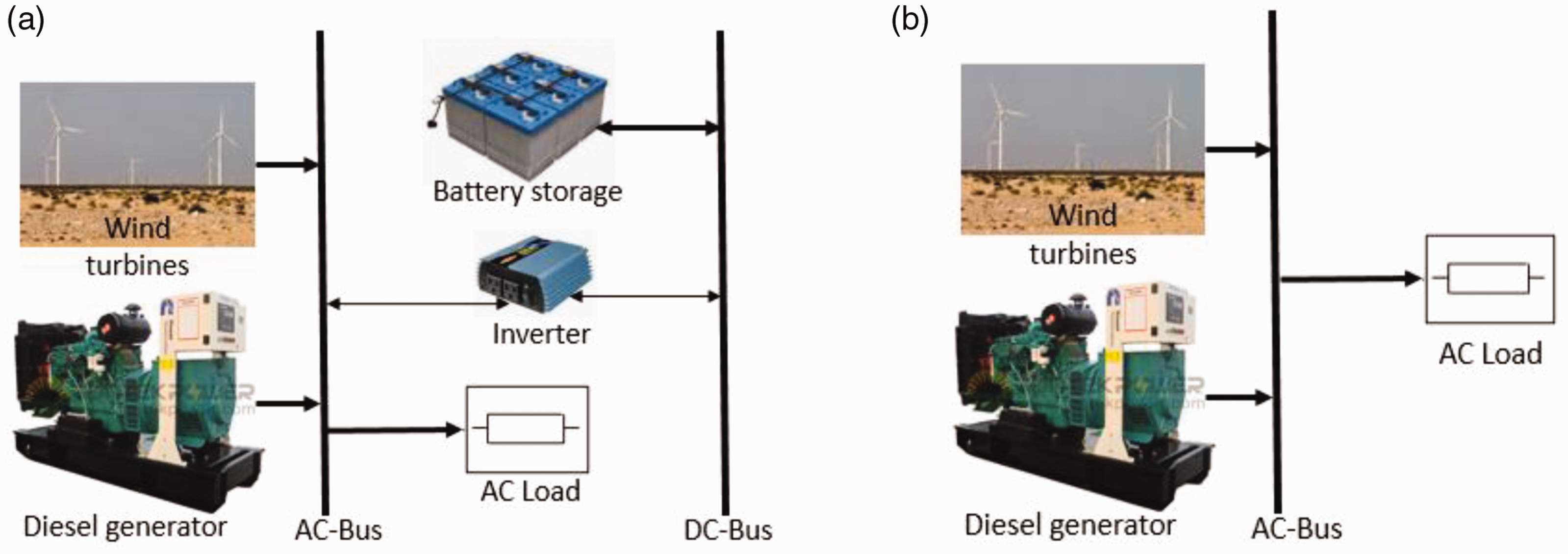
Wind-diesel hybrid power systems (a) with and (b) without battery backup.
Back in 1997, Corbus and Bergey (1997) retrofitted the existing diesel generator to WND-DSL-BAT HPS in Costa de Cocos, Quintana Roo, Mexico. The proposed HPS was consisted of 7 kW capacity of wind turbines, 15 kW of diesel generators, and a battery backup of 5 kWh capacity. The retrofitted HPS was able to meet around 95% of the resort’s load with reduced diesel fuel consumption. Drouilhet (1999) introduced a control algorithm to address some of the challenges faced by developers of the high wind penetration HPSs in the United States. The proposed control algorithm was implemented in a WND-DSL-BAT HPS installed in a village in Wales, Alaska in year 2000 with respective capacities of 130 kW, 360 kW, 130 kWh. Rehman and Sahin (2014) analysed wind power only system for feeding energy to water pumping stations at five climatically distinct locations at COEs of 0.224 to 1.379 US$/kWh which was relatively better than the diesel only systems.
Kamel and Dahl (2005), with an objective of reducing diesel consumption and finding an economic and alternative solution to power supply in agriculture sector, proposed two optimal HPSs (i) WND-DSL-BAT (200.0–100.0–70.0 kW) at a COE of 0.10 US$/kWh and (ii) WND-PV-DSL-BAT (200.0–1.0–100.0–80.0 kW) at a COE of 0.11 US$/kWh. Both of these HPSs were able reduce the GHG emissions by 119.0 and 120.0 tons annually, (Kamel and Dahl, 2005). Kaldellis et al. (2006) developed a sizing model based on long-term minimum COE for stand-alone WND-DSL HPSs suitable for remotely located consumers. The results showed that that the recommended HPS guarantees energy autonomy for one complete year with cost advantage compared to diesel or wind only power systems. Kaldellis (2007) presented a mathematical model to describe the operational behavior of hybrid power system components. The proposed integrated numerical algorithm was able to estimate the energy autonomy configuration of WND-DSL-BAT HPS. The study recommended a workable HPS with 6.0 kW WND, 5.0 DSL, and 5000.0 Ah of BAT storage. The feasibility study, Nandi and Ghosh (2010a, 2010b), showed that with 0% annual capacity shortage (ACS), a WND-PV-DSL system was suitable Kutubdia island community in Bangladesh while a WND-DSL HPS with 5% ACS. These HPSs were expected to reduce the GHG emissions by 44% annually. Anwari et al. (2012) analyzed the potential of implementing WND-DSL-BAT HPS in Pemanggil Island in Malaysia using HOMER software and suggested a 60.0 kW wind, 45.0 kW diesel and 163.6 kWh batteries. The proposed system was able reduce GHG by 44,751 tons annually at a COE of 0.72 US$/kWh.
Rehman et al. (2007) conducted techno-economic feasibility study of retrofitting the existing diesel power station (4480.0 kW) through wind power penetration (WND-DSL) and suggested a 25% RF by adding 3600.0 kW of wind at a COE of 0.051 US$/kWh. The proposed retrofitting allowed a 21% reduction in GHG emissions as an additional advantage. Ayodele (2014) simulated a WND-DSL-BAT HPS with wind energy as the primary to provide clean and economical energy to Ala-Ajagbusi community in Nigeria. Simulation results recommended an optimal system with 300.0 kW of WND, 300.0 kW of DSL, and a battery backup of 480.0 kWh to supply electricity to the above community at a COE of 0.373 US$/kWh. The power system was able to displace GHG by 1,186.0 tons annually. Fazelpour et al. (2014) examined the feasibility of off-grid power system for a hotel of 125 rooms (Figure 5) with total electrical energy consumption of 26,28,000 kWh in Kish Island, Iran. The optimization result recommended a 100.0 kW WND, 600.0 kW DSL, and 242.76 kWh BAT capacity WND-DSL-BAT HPS with COE of 0.318$/kWh cost and a reduction of 64,000 metric tons of GHG annually.
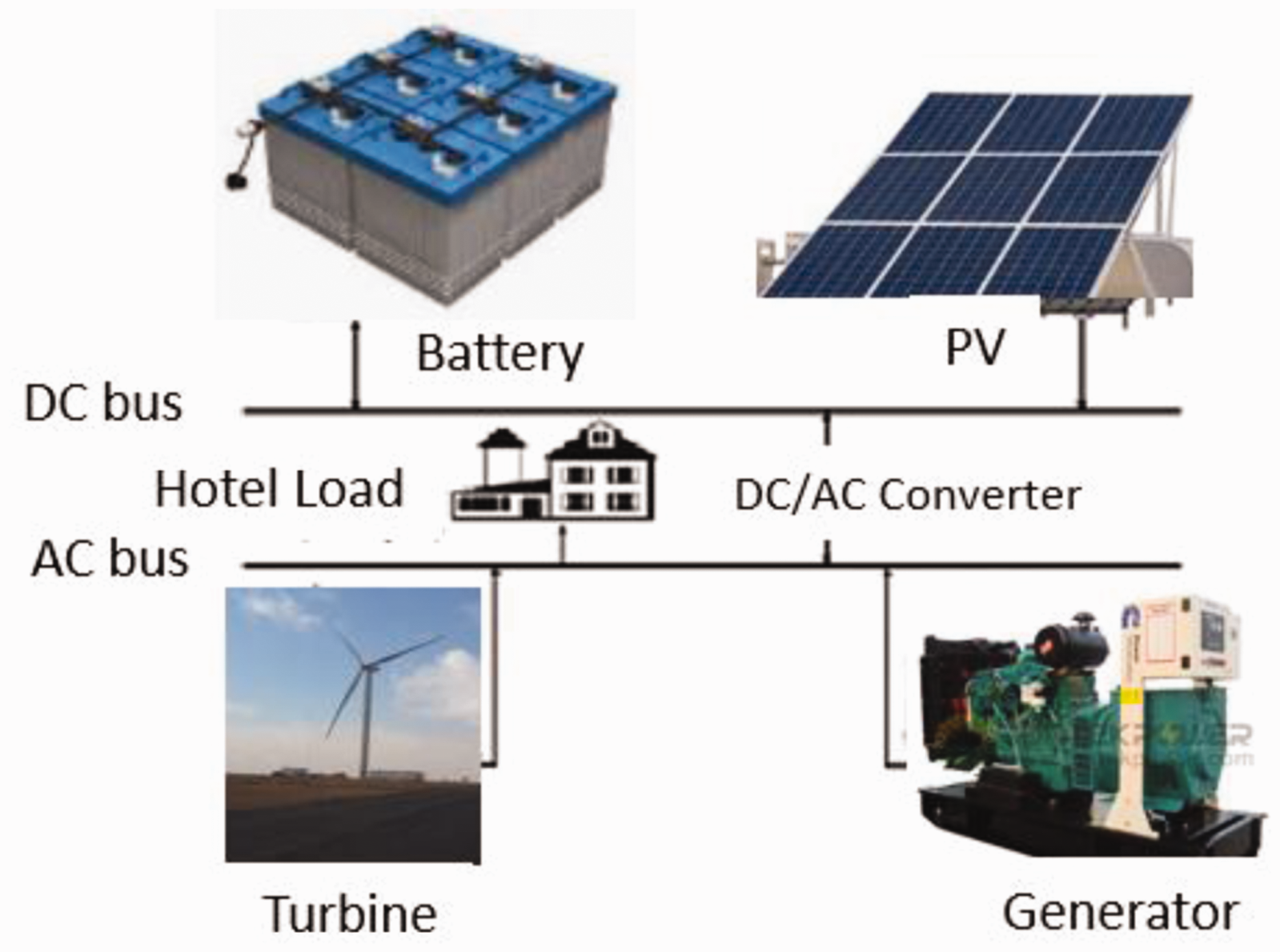
Energy flow of the proposed HPS for a hotel in Iran (Fazelpour et al., 2014).
Photovoltaic (PV)-diesel (PV-DSL) hybrid power systems with and without battery
A Photovoltaic-Diesel (PV-DSL) hybrid power system (HPS) consists of PV panels, diesel generator/s, inverters, battery bank, AC and DC buses, and smart control system to ensure that the amount of hybrid energy matches the demand. A conceptual PV-Diesel hybrid power system configuration is shown in Figure 6. The basic operation of PV-DSL HPS can be classified as low, medium, and peak load systems. Under low load conditions, the diesel generator is turned off and the energy is supplied by the PV system. However, under medium load conditions, the diesel generator is allowed to operate at optimal loading conditions to meet the load. During operation, it stores the excess energy, if any. Under peak load conditions, diesel generator and PV systems both supply the power to meet the required load. Based on automation, these hybrid systems are also classified as fully-automatic, semi-automatic, and manual mode.
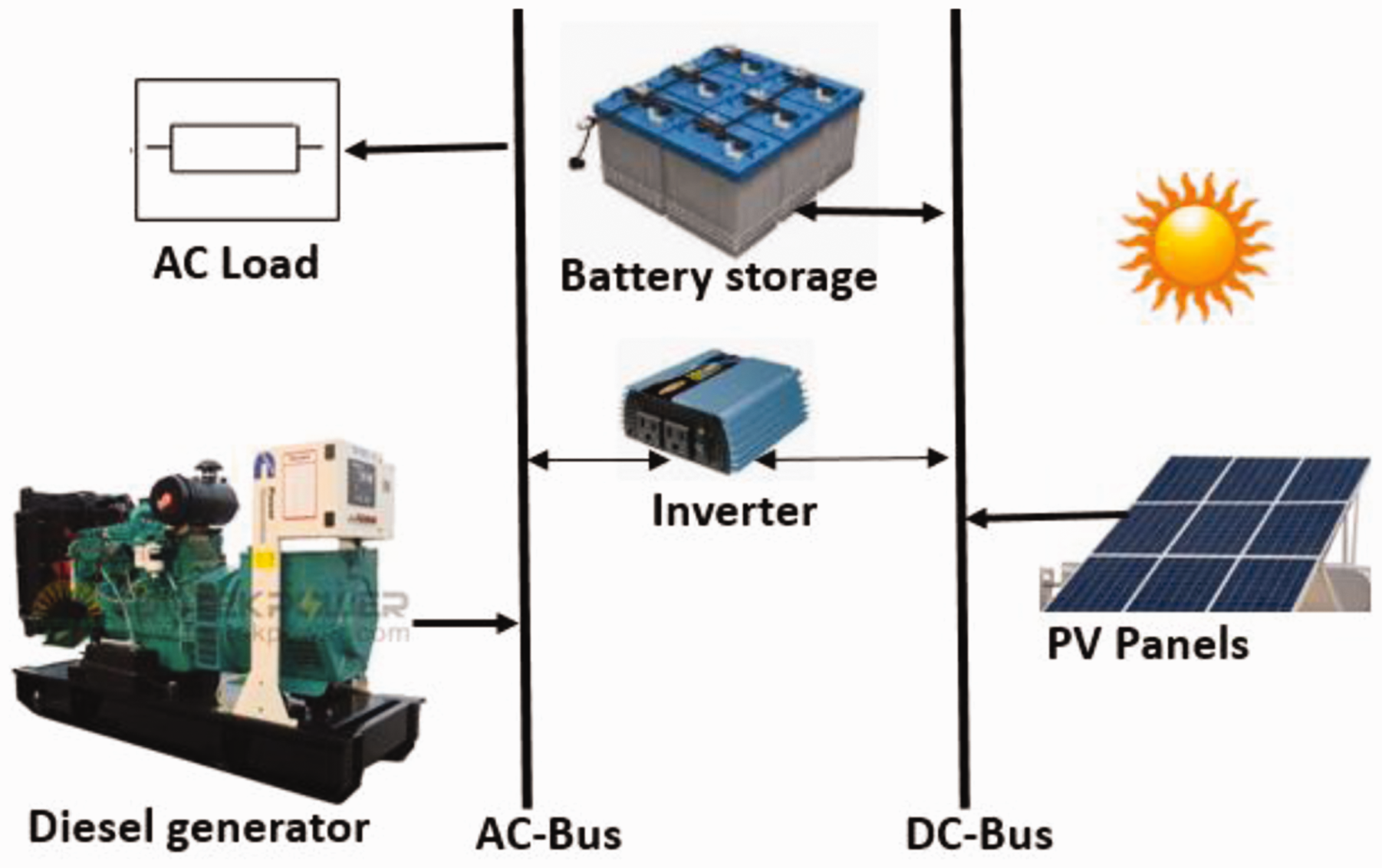
Solar PV-diesel with battery backup (PV-DSL-BAT) HPS.
The control of the PV-DSL HPS is generally set in fully automatic mode. In this mode, the operator starts the generator after getting go ahead signal from the control unit. The load is met directly by PV arrays during day time with good solar radiation availability and excess energy, if any, is stored in batteries. This stored energy is used to partially meet the required load during low radiation condition or night time aided by diesel generator/s. Under semi-automatic mode, the generator is operated by the operator on the instructions of the control unit when to start and stop the generator to address the required load. In manual mode, the operator checks the available energy and the required load and accordingly switches on or off the diesel generator/s.
Ruther et al. (2000) reported retrofitting of an existing diesel system of 54 kW capacity through 20 kWp of solar PV generation penetration in a remote small village in Northern Brazil. The resulting PV-DSL HPS was found to be technically, economically, and ecologically a workable solution without any battery backup. Loads above this threshold were best served by PV-DSL-BAT HPSs. For example, a 20.0 kW PV and 75.0 kW diesel HPS was sufficient to meet daily energy needs of 75 kWh for a village of 1000 people in Gaize, Tibet (Givler and Lilienthal, 2005). Nfah et al. (2007) modelled PV-DSL-BAT HPSs for providing electricity to typical rural households (70–300 kWh/y) and schools in remote areas of the far north province of Cameroon. HPSs with 0.35 kW PV, 2.5 kW DSL, and 5.40 kWh of BAT and 1.44 kW PV, 5.0 kW DSL, and 5.40 kWh of BAT were able to meet the maximum household and school loads; respectively. Using HOMER software, Shaahid and El-Amin (2009) conducted a techno-economic feasibility evaluation for a PV-DSL-BAT HPS comprising of 2500 kWp of PV and 4500 kW of diesel capacities with battery backup of 1-hour immunity. The authors reported the COE of USD 0.170/kWh.
Lau et al. (2010) proposed an optimal PV-DSL-BAT HPS system with 60 kW PV, two units of 50 kW diesel, and 83.4 kWh of battery for remotely located residents in Malaysia with COE of 0.796$/kWh. The proposed system with 22% PV penetration resulted in 342.25 tons of GHG reduction annually. For rural areas in southern Iraq, Al-Karaghouli and Kazmerski (2010) studied a PV-DSL-BAT system to power a health clinic with a total load of 31.6 kWh. The analysis showed that a PV-BAT with 6.0 kW PV and 108.0 kWh of battery backup was the best choice with a COE of 0.238 US$/kWh while PV-DSL-BAT with 8.0 PV, 2.0 kW DSL, and 108.0 kWh of battery was the second best choice with a COE of 0.272 US$/kWh to meet the load of the clinic. Moghavvemi et al. (2013) suggested a PV-DSL-BAT HPS to supply 13,432 kWh of energy to remotely located six commercial scale FM transmitters in Malaysia with respective capacities of PV, DSL, and BAT as 10.7 kW, 4.0 kW, and 29.4 kWh. The installed systems were able to produce energy at a COE of 0.259 US$/kWh and reduce the GHG emissions by 10.96 tons annually compared to diesel only system. Lee et al. (2013) evaluated the performance of a prototype, (called Green Ship), PV-DSL-BAT HPS (3.2 kW PV and 20.0 kW DSL, Figure 7), which could operate in stand-alone and smart-grid connected modes, to meet the power requirements of Geoje island in South Korea. The implemented HPS was able to displace 4.889 tons of GHG annually. Mamaghani et al. (2016) suggested optimal PV-DSL-BAT HPSs for Unguia and Jerico sites in Columbia at respective COEs of 0.444 US$/kWh and 0.448 US$/kWh and a RF of 0.98%.
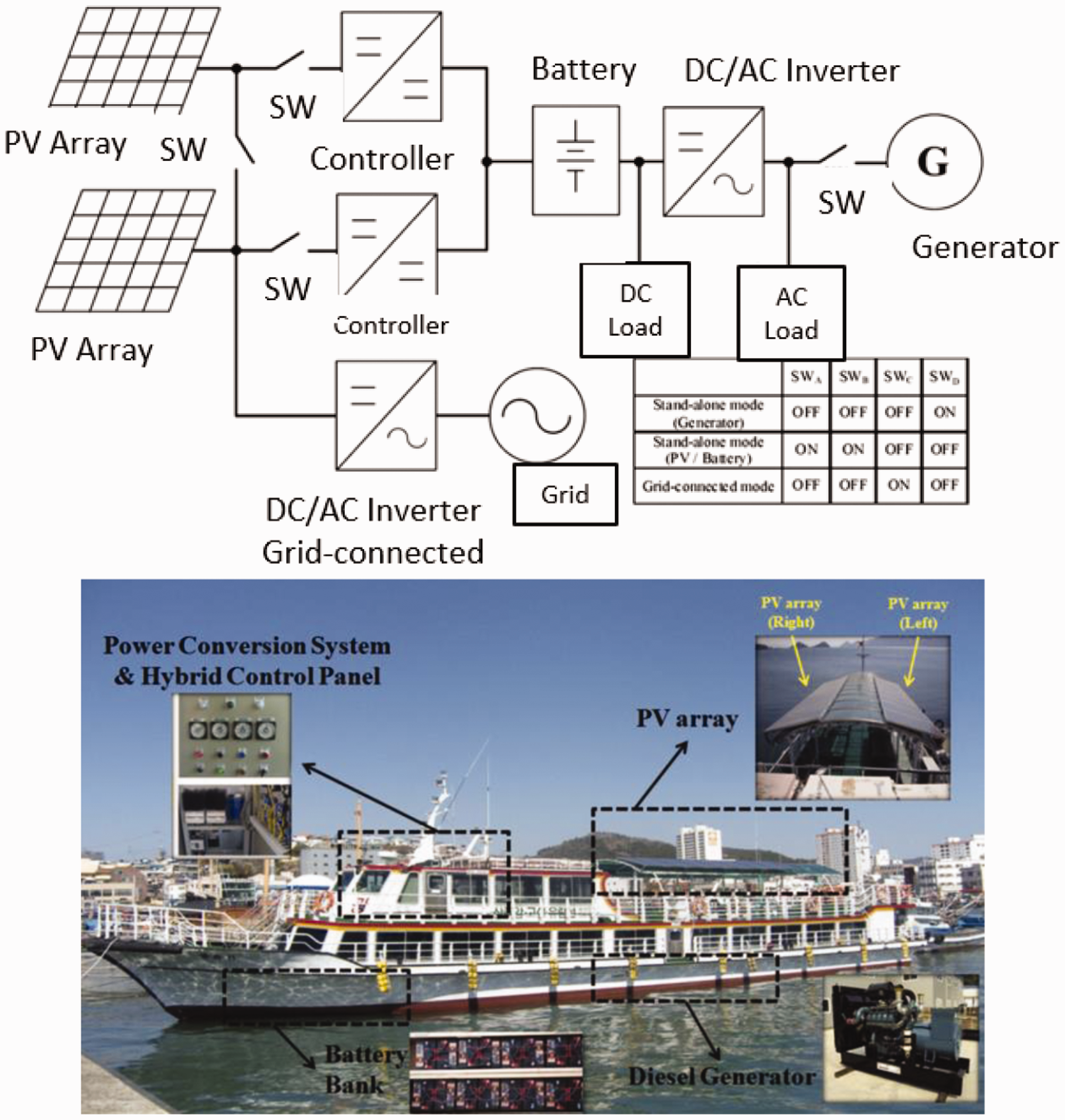
Smart grid model (Green Ship) of a PV-DSL-BAT HPS (Lee et al., 2013).
Ismail et al. (2003) designed and installed a stand-alone PV-DSL-BAT HPS (PV = 10.0 kW, DSL = 12.5 kVA, and BAT = 150.0 kWh) for the residents of at Kampung Denai village in Malaysia. Shaahid and Elhadidy (2007) presented simulation results of a PV-DSL-BAT HPS for commercial building having a load of 6,20,000 kWh in the Eastern region of Saudi Arabia. The study proposed an optimal system with 80.0 kW of PV, 175.0 kW of DSL, and a battery backup of three hours’ immunity at a COE of 0.149 US$/kWh. The designed system was able to reduce the GHG by 44.0 tons/year. Rehman and Al-Hadhrami (2010) recommended a PV-DSL-BAT HPS with 200.0 kW of PV, 4500.0 kW of DSL and 2280.0 kWh of BAT, to fulfill the power needs of Rowdat Ben Habbas village in Saudi Arabia, to be almost compatible economically with DSL only system but had an added social advantage of displacing 3220 tons of GHG annually for 21% RF. Phuangpornpitak and Kumar (2011) studied the performance of PV-DSL-BAT (7.5 kW-60.0 kW-2100.0 Ah) HPS installed on Kohjig island in Thailand (Figure 8). This system was able to provide electricity during nighttime as well which was not possible before due to high consumption of diesel fuel. Furthermore, the PV addition also reduced the GHG emissions by 0.2 tons annually. Dekker et al. (2012) reported economic feasibly study of PV-DSL-BAT HPS for typical residential loads for the rural community in various climatic zones within South Africa. As an example (Figure 9), the study suggested a HPS with 5.0 kW PV, 5.5 kW DSL, and 43.2 kWh of BAT resulting in 11.854 ton of annual reduction of GHG emissions in East London.
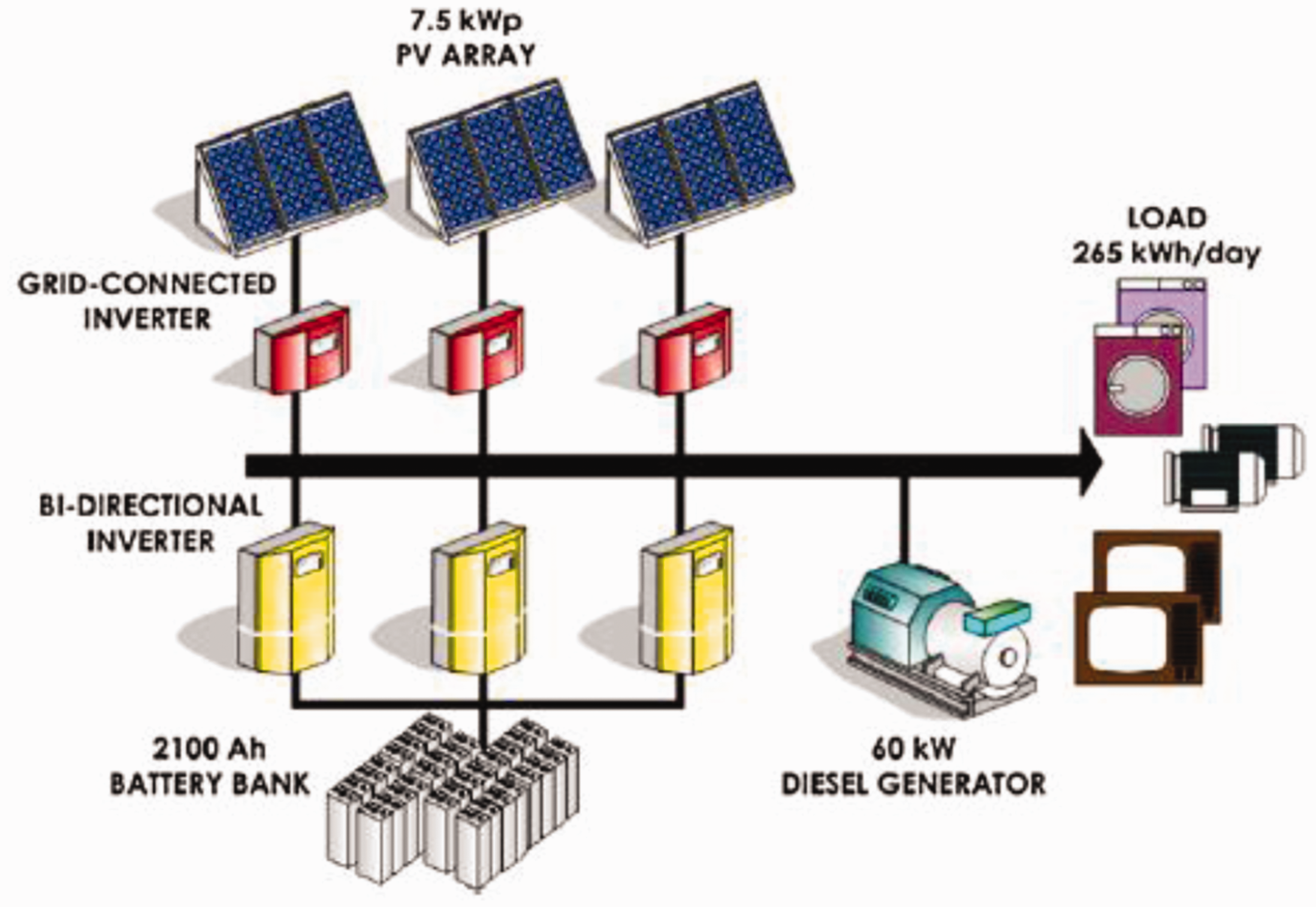
Schematic diagram of the PV hybrid system installed at Kohjig Island, Thailand (Phuangpornpitak and Kumar, 2011).
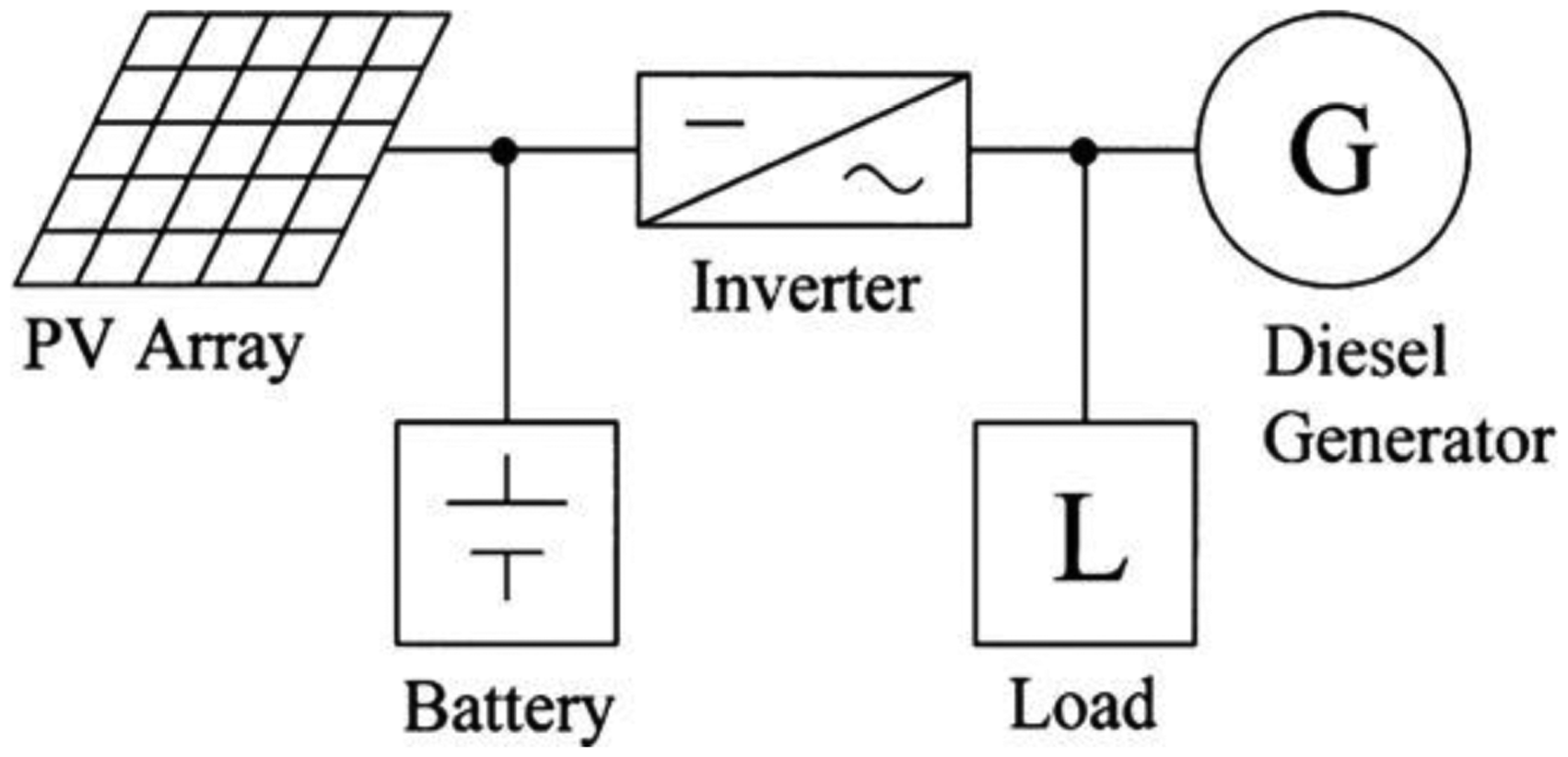
A simple HPS model for rural communities in South Africa (Dekker et al., 2012).
Ray et al. (2013) conducted economic analysis and optimization of PV-DSL, PV-BAT, and PV-DSL-BAT HPSs to find the optimal system to supply quality power to the rural communities in the north-eastern state of India. The study suggested a HPS (PV-DSL-BAT) with 165.0 kW PV, 45.0 kW DSL, and 2880.0 kWh of BAT storage to fulfill the load requirement of such communities, an average COE of 0.188 US$/kWh. Kumar and Manoharan (2014) conducted economic feasibility study of utilizing PV-DSL-BAT HPS for six climatic zones in Tamil Nadu, India. Authors recommended the best HPS with 35.0 and 34.0 kW of PV and DSL and 108.0 kWh of BAT capacities for Kanyakumari. The proposed system was able to displace 4352 tons of GHG annually. Different combinations of PV-DSL-BAT HPS were analyzed by Li and Yu (2016) using RETScreen Clean Energy Project Analysis tool to find optimal feasible power system (Figure 10) for typical households (daily energy requirement = 10.275 kWh with peak load = 5.7 kW) in Urumqi area in China. Of the analyzed HPSs, PV-DSL-BAT option was found to be the best considering the economic and clean option point of view for the studied area.
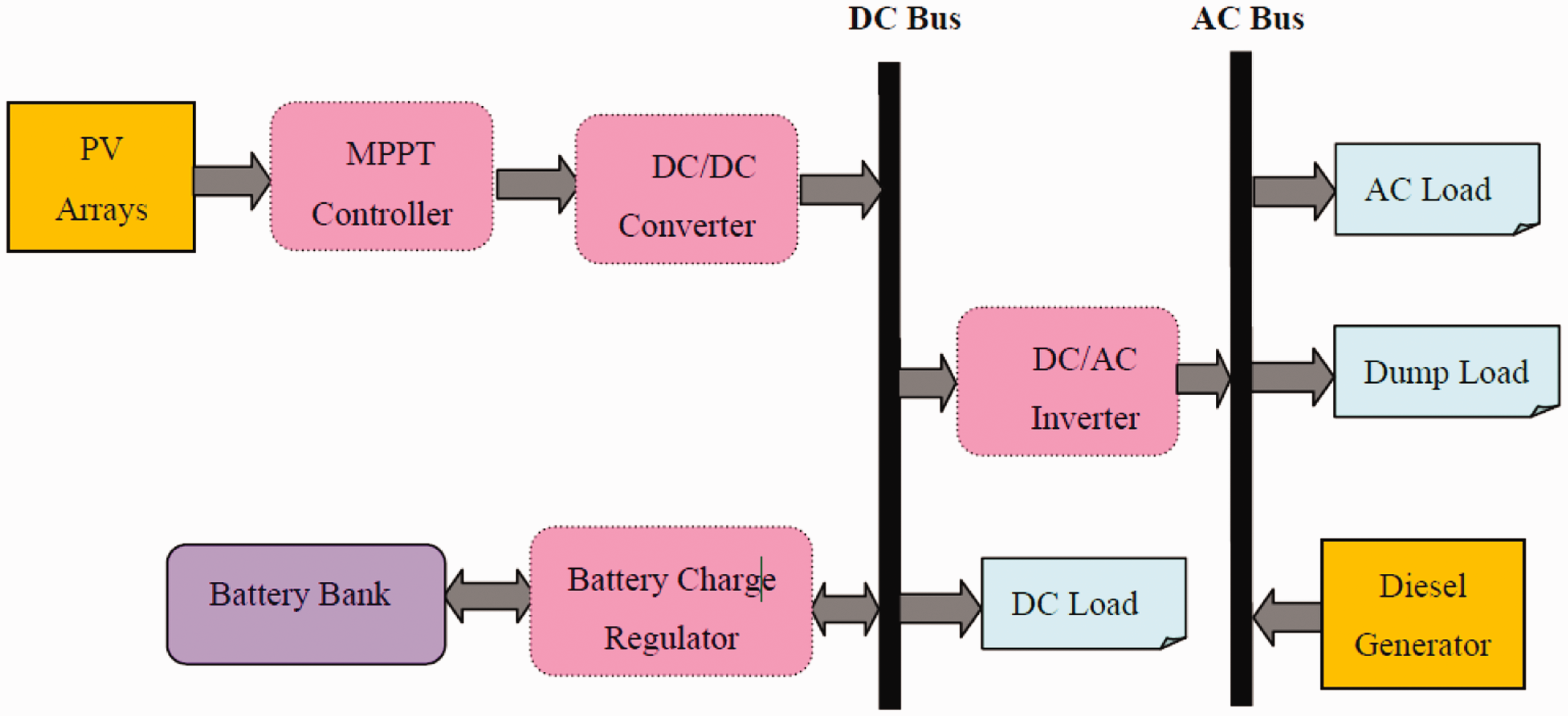
A simple block diagram of an off-grid PV-DSL-BAT HPS for Urumqi area in China (Li and Yu, 2016).
Adaramola et al. (2014) investigated the possibility of using (PV-DSL-BAT) HPS for electricity generation in five areas in semi-urban areas in the Northern part of Nigeria (Figure 11). The study found a HPS with 175.0 kW PV, 260.0 kW DSL, and 693.6 kWh of BAT to be economical (COE = 0.364 US$/kWh) and can reduce GHG by 311.0 tons annually for the study area. Lau et al. (2015) used HOMER to analyze the effects of annual interest rates, diesel prices, and load sizes on the economic feasibility and thereof implementation of PV systems in Malaysian islands. Study reported that interest rate dictated the decision on deciding the optimal HPS configuration i.e. to use DSL only or PV-DSL-BAT or PV-BAT power system. Low interest rates were recommended to encourage the end users to implement HPS. However, at higher diesel prices, PV-DSL-BAT system was found to be most favourable. Salameh et al. (2020) analysed a PV-DSL HPS for Khorfakkan a city of Sharjah having daily energy consumption of 37.75 MWh and reported the best optimal system that could meet the load at a COE of 0.25 US$/kWh.
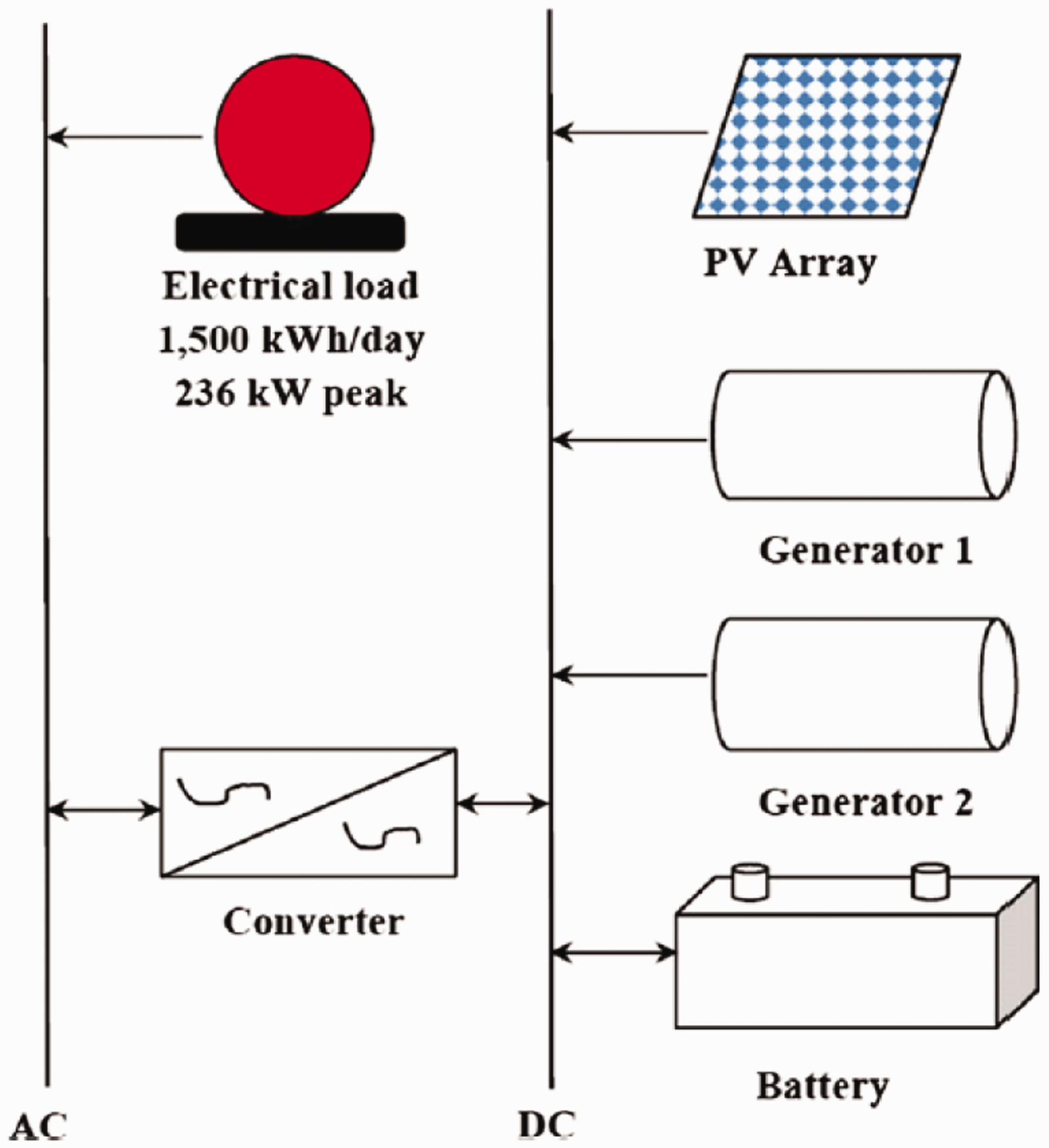
A simple schematic model of HPS used in northern Nigeria, Adaramola et al. (2014).
Said et al. (2012) analyzed long-term solar radiation data to find economically feasible PV-BAT power system for rural areas in Adrar province of Algeria. The study suggested an optimal power system with 8.0 kW of PV and 37.5 hours of battery immunity at a COE of 0.46 US$/kWh and reduction of 11.0 tons of GHG annually. PV-BAT systems were reported to be most cost-effective for electrical loads ranging from 3 kWh/d to 13 kWh/d depending on the reliability, available solar resources, and diesel fuel prices, Givler and Lilienthal (2005). El-Houari et al. (2019) proposed a PV-BAT power system with 1080 kW of PV with 79.1% RF and COE of 0.57 US$/kWh to meet partial load of a rural house in Tazouta community in Morocco. Delano et al. (2020) analysed techno-economic feasibility of HPS for sustainable power supply in Fouay village in Benin and showed that a PV-DSL-BAT system with 212.5 kW total hybrid power capacity was optimal for the selected community. The proposed system ensured reliable power supply, reduced the battery backup by 70% compared to PV-BAT system and achieved 97% reduction in GHG emissions. Li et al. (2019) assessed the techno-economic feasibility of a PV-DSL-BAT HPS for a housing estate, Harbin, Heilongjiang, China and recommended a system with 500.0 kW of PV, 1250.0 kW of DSL, and 1656.0 MWh BAT backup with 57% RF and a COE of 0.48 US$/kWh.
Al-Nabulsi et al. (2018) presented the feasibility of PV-DSL based water pumping system to determine its suitability for irrigating a 4900 m2 farming area with 100 apple trees in six distinct geographical locations in Saudi Arabia. A schematic of the proposed scheme is shown in Figure 12. The study revealed that the proposed system was suitable in meeting the water demands of 12.0 and 36.0 m3/d and larger PV installations were found economically more attractive. In order to find an economical HPS for northern areas in Saudi Arabia, Rehman and El-Amin (2015) conducted a comparative study of DSL only, WND-DSL, PV-DSL, and WND-PV-DSL system to recommend the most economical option. Authors found PV-DSL HPS to be the best with COE of 0.038 US$/kWh with total installed capacity of 5980.0 kW.
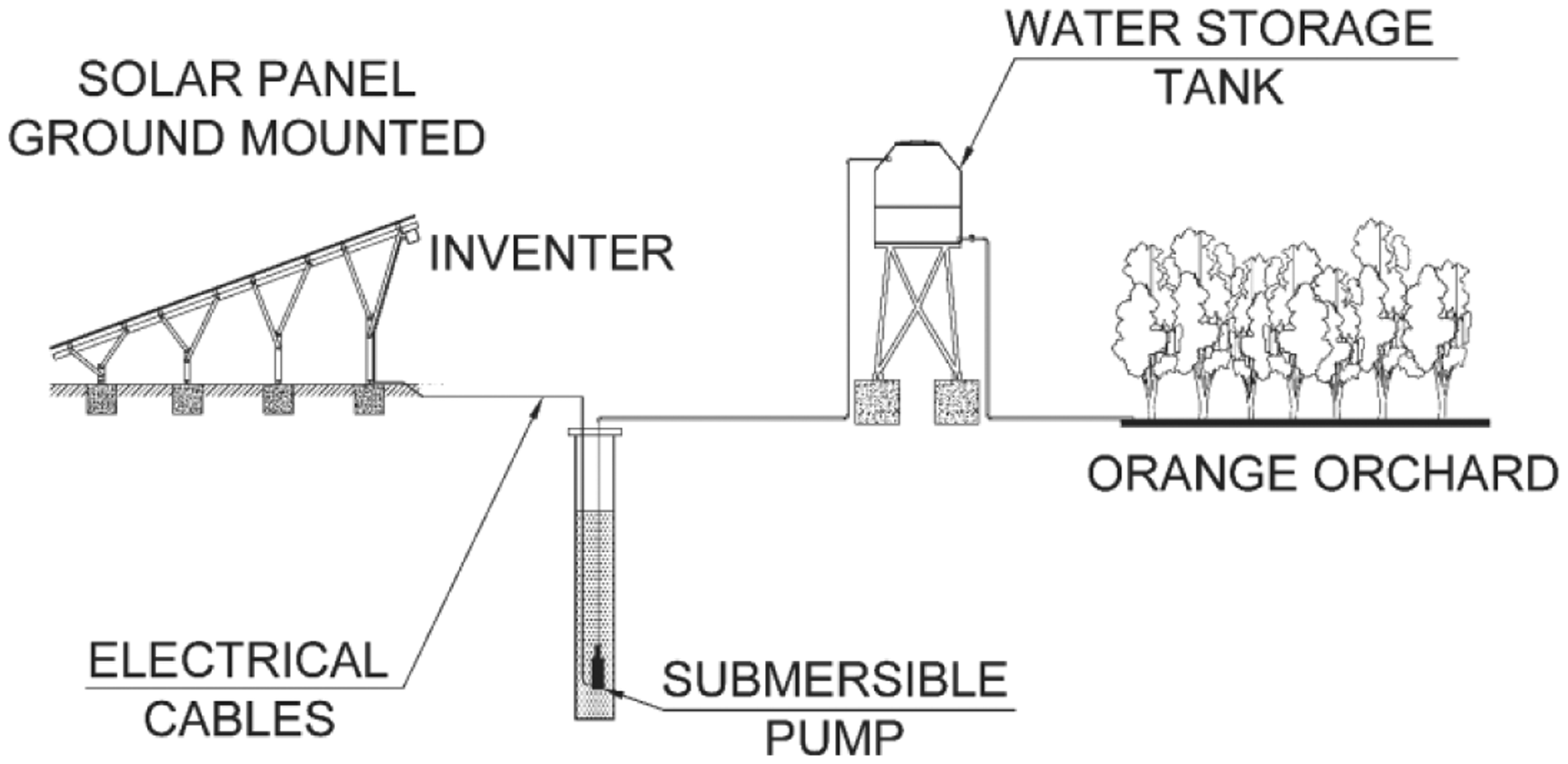
Schematic of PV system for irrigation purpose in Saudi Arabia (Al-Nabulsi et al., 2018).
Wind-photovoltaic (WND-PV) hybrid power systems with and without battery
Askari and Ameri (2012) conducted feasibility analysis of different (PV-BAT, WND-BAT, WND-PV-BAT) HPS to supply electricity to a community with 50 households in Kerman, Iran to find the technically and economically (least COE) best system. Based on optimization results, PV-BAT was recommended for the rural community under consideration. To determine the optimal configurations of renewable energy based hybrid power systems for four locations in Malaysia. Haidar et al. (2011) compared WND-PV-DSL and WND-PV HPSs using HOMER and local meteorological and load data. The study found PV-DSL HPS to be most economical for all the locations. Kellogg et al. (1998) investigated wind-alone, solar-alone, and WND-PV HPSs for a residential house in USA as stand-alone application using a numerical algorithm to find the optimum component sizes. The study identified an optimal HPS with 72 kW of PV, 10 kW of wind and a battery of 11 kWh capacity. The analyses showed potential benefits of deciding to install hybrid WND-PV generation system at the site.
Giraud and Salameh (2001) studied the performance of a 4.0 kW (1.5 kW wind and 2.5 kW PV) capacity residential WND-PV-BAT HPS with battery backup and reported the cost of energy as 0.19 US$/kWh. Furthermore, the HPS met the load and produced excess energy around noon-time which was stored in batteries for later use. Based on meteorological data, Yang et al. (2003) stated that wind and solar power can compensate for each other and can result in good utilization of renewable sources of energy in WND-PV-BAT HPS with battery backup. The study revealed that loss of power supply probability (LPSP) of 1% and 0% of a WND-PV-BAT HPS can be achieved with battery backup of 3 and 5 days’ immunity; respectively. Daming et al. (2005) optimized the component sizes of a standalone WND-PV HPS and stated that the cost of energy was minimized subject to loss of power supply probability (LPSP) constraint. Prasad and Natarajan (2006) employed a new method for optimizing the WND-PV-BAT HPS based on loss of power supply probability (LPSP), excess and unused energy, life cycle cost, levelized cost of energy, and life cycle unit cost with battery backup. The study proposed a HPS with 20 kW wind turbines, 40 kW of PV panels and a battery backup of 200 kWh for climatic conditions of Tamil Nadu in India.
The study (Diaf et al., 2007) found an optimal HPS (WND-PV-BAT) with 600 W of wind turbine, 125 W of PV panel, and a battery storage of 253 Ah for a desired LPSP of zero and minimum COE for Corsiaca Island in Algeria. Furthermore, for Cape Corse, Ajaccio and Calvi sites; the study found optimal systems (WND-PV) as 400 kW Wind and 400 kW PV, 400 kW wind and 1500 kW PV, and 1000 kW Wind and 850 kW PV; respectively. Muralikrishna and Lakshminarayana (2008) used Life Cycle Cost methodology for economic evaluation of stand-alone photovoltaic system, stand-alone wind system and WND-PV HPS. The study reported that an optimum WND-PV hybrid system lied between 0.70 and 0.75 of solar or wind energy to load ratio with minimum Life Cycle Cost. Yang et al. (2007) reported optimal sizes of a WND-PV HPS (0.5 and 1 kW of wind and PV) considering loss of power supply probability and levelised cost of energy constraints for Guangdong in China. A hybrid power system (1 kW each of wind and PV and 50 fuel cells connected in series to provide 1.25 kW rated power output) was simulated to supply continuous quality power to meet the load (2 kW) of a communication tower, Ahmed et al. (2008). The simulation results proved the accuracy of the controller scheme proposed by the proponents.
Nandi and Ghosh (2009) reported the performance (cost of energy of US$0.363/kWh) of an optimal WND-PV HPS with battery backup (3.0, 1.0, and 1.35 kW of wind, PV and battery) for a typical community peak load of 61 kW and daily energy need of 169 kWh/day. For this location and the load, the study indicated that WND-PV HPS are economically feasible and can mitigate 25 tons of CO2 equivalent greenhouse gases (GHG) as an additional advantage. A pre-feasibility study of a WND-PV HPS with battery back was conducted by Nandi and Ghosh (2010a, 2010b) for a small remote community (with annual energy consumption of 53,317 kWh) in South-Eastern part of Bangladesh. The analysis reported a COE of 0.47 US$/kWh with 10% capacity shortages and annual energy generation of 89,151 kWh (53% from wind and 47% from PV). The proposed HPS (14 kW of wind, 25 kW of PV, and 64,125 Ah of battery capacities) was expected to reduce around 25 tons of GHG annually.
Laidi et al. (2012) recommended an optimal WND-PV-BAT HPS with 1.4 kW of wind, 1.0 kW of PV, and 125 Ah of battery storage capacity for electricity generation to meet the load small applications in Sahara region in Algeria. The study utilized the HOMER software for optimization purpose and reported COE of 0.533 US$/kWh and annual GHG reduction of 7.46 tons. A similar WND-PV HPS study with 7.5 kW and 5 kWp existing wind and solar PV facility at Soria in Spain was conducted, Arribas et al. (2010). Homer simulation for an isolated grid application resulted in an optimal WND-PV-BAT HPS consisting of 0.8 kW each of wind and PV and 1600 Ah of battery storage for a remote site (Taleghan) in Iran; Shiroudi et al. (2012). The study reported a very high COE of 1.655 US$/kWh. With an aim of maximum and minimum utilization of renewables and fossil fuel; respectively; Bakić et al. (2012) used transient system simulation program TRNSYS 16 to analyze a WND-PV HPS and suggested an optimal system with 5.0 and 3.0 kW capacities of wind and PV; respectively; for Belgrade in Serbia. Gokcol and Dursun (2013) investigated various HPSs with minimum renewable penetration rates (RPR) for Kirklareli University campus in Pinarhisar, Turkey found an optimal configuration of WND-PV-BAT with 7.5 kW, 2.0 kW, and 83.28 kWh of wind, PV and battery storage. The study reported a COE of 0.323 US$/kWh for the proposed optimal HPS. Durusu et al. (2016) discussed the reliability of different HPSs such as WND-PV-BAT, WND-BAT, and PV-BAT installed at Yildiz Technical University (YTU), campus in Davutpasa, Turkey based on LOLE and LOEE. The analysis reported the values of LOLE and LOEE as 3.67 hours and 4760 kWh.
Hiendro et al. (2013) used HOMER software to analyze the WND-PV-BAT HPS and found optimal capacities of 2.0 kW, 1.0 kW, and 5400 Ah of wind, PV, and battery storage; respectively with COE of 0.751 US$/kWh. Maleki et al. (2015) suggested optimal sizes of WND-PV-BAT HPS for three cities in Iran (Rafsanjan [7.0 and 1.3 kW of wind and PV and 12.6 kWh of battery storage], Davarzan [0.0 and 7.28 kW of wind and PV and 1,176 kWh of battery storage], and Namin [2.0 and 6.24 kW of wind and PV and 1365 kWh of battery storage]) using PSO algorithm. Bhattacharjee and Acharya (2015) recommended WND-PV-BAT HPS with optimal sizes of 1.0 kW of wind, 1.2 kW of PV, and a battery backup capacity of 2.76 kWh for small application in Tripura in India. For 90% renewable fraction, the COE was reported as 0.488 US$/kWh. Tudu et al. (2019) presented a design approach for hybrid WND-PV-BAT HPS to acculturate the renewable technology into Indian society by field-on-laboratory demonstration. The study indicated that for a microgrid, the HPS consisted of a 3 kWp wind turbine, 2.16 kWp solar PV, a 1.44 kW inverter, and 24 kWh battery storage. This system was able produce the energy at a COE of 0.635 US$/kWh.
Ahadi et al. (2016) proposed an optimal HPS (30 and 60 kW of wind and PV and 3,80,016 Ah of battery storage) WND-PV-BAT for isolated grid to satisfy the load of eight islands in South Korea to achieve maximum possible renewable energy penetration with minimum COE. Park et al. (2004) suggested a (WND-PV-ESE) HPS (0.4 kW WND, 0.5 kW PV) with an elastic (spiral energy) storage to supply the quality supply power to a small application. For proper and efficient power flow, coordination of HPSs depends on the effectiveness of the chosen energy management strategy (EMS). Rehman et al. (2020) carried out a techno-economic analysis to find an optimal WND-PV-DSL-BAT HPS and renewable energy system (HRES) to meet the residential load demand of a specific area in Pakistan. The simulation results showed that WND-PV-BAT HPS was the most suitable power system with COE of 0.309 US$/kWh for the location under consideration. The optimal system resulted in 81.7% reduction in overall cost compared to diesel only system and 100% reduction in GHG while satisfying 100% energy needs with 63.9% access energy.
Baseer et al. (2019) explored the possibility of using WND-PV-DSL and WND-PV-BAT HPSs for meeting the energy requirements of three residential compounds with one, two, and three bed rooms with daily energy requirements of 11,160.0, 4865.0, and 3288 kWh and peak loads of 685.0, 463.0, and 270.0 kW; respectively; in Jubail Industrial City, Saudi Arabia (Figure 13). The minimum COE was found to be 0.183, 0.224 and 0.244 US$/kWh, for WND-PV-DSL-BAT option for the three compounds. Additionally, a WND-PV-BAT HPS with 100% was found feasible for the three buildings with COE of 0.25 US$/kWh. Pumping water in remote areas for agriculture and animals beside human needs is essential and present study (Rehman and Sahin, 2016) is a step towards assuring continuous power supply and meeting water needs. Rehman and Sahin (2016) designed and optimized a WND-PV-BAT HPS with 100% RF for five locations in Saudi Arabia and reported COE varying from 0.212 to 0.509 US$/kWh depending on the climatic conditions.
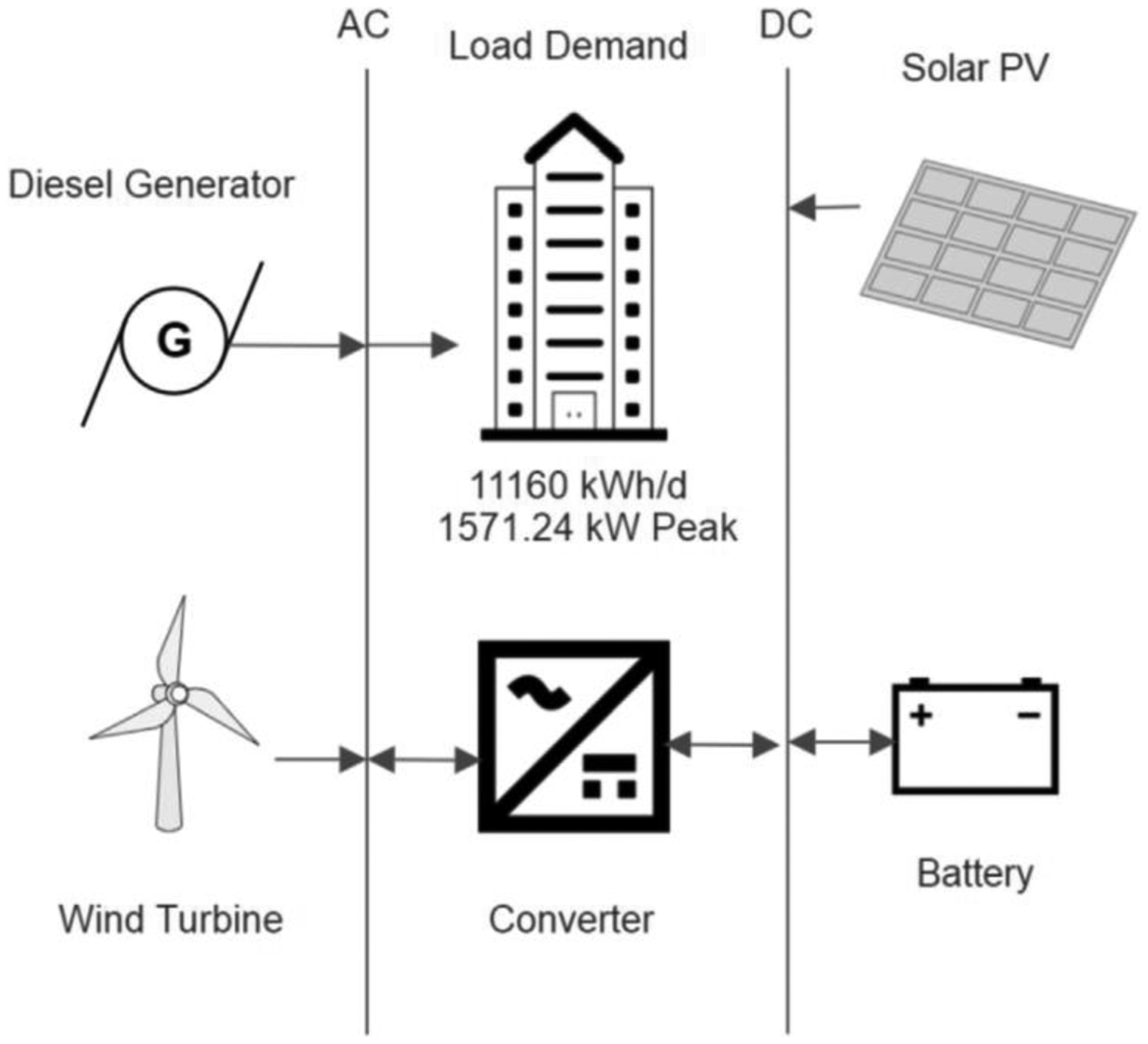
HPS configuration used for the optimization in this study (Baseer et al., 2019).
Wind-photovoltaic-diesel (WND-PV-DSL) hybrid power systems with and without battery
A Wind-PV-Diesel (WND-PV-DSL) hybrid power system comprises of wind turbine/s, PV panel/s, diesel generator/s, battery bank, inverter/s, and off course the load to be supplied uninterrupted energy (Figure 14). This HPS has two intermittent sources of energy and hence require comprehensive control system to coordinate between the energy supply, excess energy, energy storage, and energy generation. These HPS are more reliable and economic when it comes to power supply on the long run but have high initial cost and complicated control system.
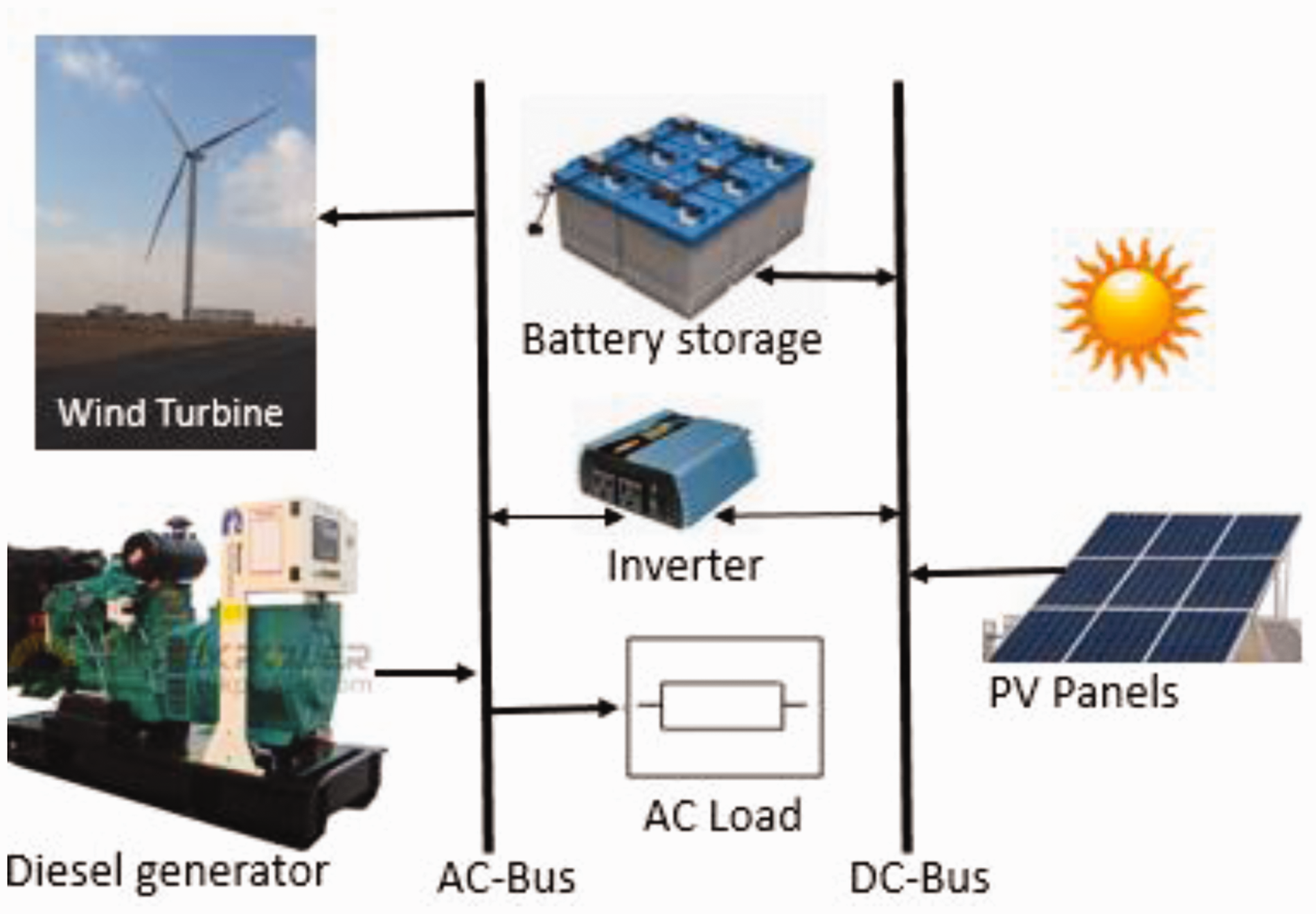
Wind-PV-Diesel with battery backup (WND-PV-DSL-BAT) HPS.
In 1999, McGowan and Manwell (1999) presented a summary of WND-PV-DSL HPS progress in the United States. The author discussed hybrid power systems hardware configuration, modeling and software tools used. For instance, the authors described the analytical and experimental approaches for WND-DSL HPS development with and without battery backup of a 15 kW rated power system at the University of Massachusetts. At that early stage, the study recommended that development was needed areas like system and component reliability, monitoring of system performance, and economic aspects. Nema et al. (2010) optimized a WND-PV-DSL HPS with battery backup using HOMER for GSM/CDMA applications in central part of India, Bhopal and reported a reduction of about 70%-80% in fuel expenses and GHG emissions. The study suggested an optimal HPS consisting of 15.0 kW, 5.0 kWp, 2.0 kW, 1.83 kWh of wind, PV, diesel generator, and battery storage capacities; respectively; with ultimate COE of 0.942 US$/kWh. Sharma et al. (2013) used HOMER tool to optimize a WND-PV-DSL-BAT HPS for a mobile telephone tower in Imaliya village in Bhanpur, India and obtained a feasible system with 15.0, 5.0, 1.5 kW, and 36,000 Ah sizes of wind, PV, diesel generator, and battery storage components; respectively with a COE of 0.692 US$/kWh. A comparative techno-economic analysis of PV-DSL-BAT and WND-PV-DSL-BAT HPSs was conducted by Olatomiwa et al. (2015a, 2015b) to fulfil the power requirements of a remotely located mobile base transceiver station (BTS) in Nigeria. The study suggested an optimal configuration with 10.0 and 5.5 kW of PV and diesel generator respectively with a battery backup of 23,040 Ah at a COE of 0.409 US$/kWh. Furthermore, the proposed HPS will reduce GHG emissions by 16.4 tons annually compared to diesel only system.
Phuangpornpitak and Kumar (2007) presented the economic and technical performance of WND-PV, PV-DSL, and WND-PV-DSL HPSs; mostly installed at Wildlife sanctuary, national parks, and remote islands in Thailand. The study revealed that WND-PV-DSL HPSs (with 10 kW wind, 7.5 kW PV, and 40 to 70 kW diesel) were found to be most suitable, both technically and economically, for above mentioned applications in Thailand and recommended its expansion in the country. Al-Badi (2011) assessed techno-economic feasibility of a WND-PV-DSL HPS to meet the load of Al Hallaniyat Island in Oman and proposed an optimal system with 60, 70, 324.8 kW of wind, PV, and diesel capacities at a COE of 0.222 US$/kWh. Rehman et al. (2012) designed and optimized WND-PV-DSL HPS for Rowdat Ben Habbas village in Saudi Arabia and came up with 600 kW, 1000 kW PV, and 1120 kW diesel capacities at a COE of 0.212 US$/kWh. The proposed system resulted in annual reduction of 4977 tons CO2 equivalent of GHG.
Kaabeche and Ibtiouen (2014) developed a methodology for optimal sizing of components and the minimum COE of WND-PV-DSL-BAT HPS for Ghardaia, Algeria. The study suggested an optimal system with 1.0 kW of wind, 8.5 kW of PV, 4.2 kVA of diesel generator, and 86.4 kWh of battery storage and COE of 1.30 US$/kWh. The proposed HPS was able to limit the GHG emissions to 390 kg annually instead of 18,358 kg from diesel only system. Ashok and Balamurugan (2007) developed a HPS (WND-PV-DSL-BAT) based on biomass gasifier proposed an optimal operating strategy using meteorological and load data collected from a village in Tamil Nadu, India. The optimal HPS, obtained using HOMER, was consisted of 83, 20, and 200 kW of wind, PV, and diesel capacities; respectively; and 21,600 Ah of battery storage. Karasavvas (2008) studied the dynamic behavior of an isolated HPS consisting of conventional and renewable energy sources under MATLAB environment. The study utilized a HPS (WND-PV-DSL-BAT) consisting of 50 kW, 30 kW, 170 kW, and 30 kVAR of wind, PV, diesel, and capacitor capacities for Kavala site in St. Lucas. Darus et al. (2009) implemented a WND-PV-DSL-BAT HPS as part of Terengganu state government project consisting of 200 kW, 100 kW, 100 kW, and 480 kWh of Wind, PV, diesel, and battery backup at Perhentian Island in Malaysia. The study concluded that the combination of wind turbines, solar PV, diesel generator, and suitable battery backup can ensure a continuous low electricity no matter what the weather conditions are. The result of technical–economic optimization for hybrid photovoltaic/wind/diesel with battery storage was presented by Saheb-Koussa et al. (Saheb-Koussa et al., 2009) for six locations in Algeria. They found that WND-PV-DSL-BAT HPS consisting of 3.5 kW Wind, 2.0 kW PV, and 5.5 kW diesel with battery storage was an appropriate system that can supply energy to the remote consumers at low cost.
Ngan and Tan (2012) compared the performance of DSL only, PV-DSL, WND-DSL, and WND-PV-DSL HPSs with and without battery storage for possible implementation in Southern Peninsular Malaysian region. The study suggested two possible HPSs viz., PV-DSL-BAT (80.0 kW each of PV and diesel and 277.6 kW) and WND-PV-DSL-BAT (80.0 kW wind, PV, diesel; and 347.0 kW of batter storage) for the geographical region under discussion though having higher COE compared to DSL only power generation system but HPSs can reduce the GHG emissions. The proposed two HPSs (PV-DSL-BAT and WND-PV-DSL-BAT) were expected to produce power at a COE of 0.31 and 0.36 US$/kWh. Adaramola et al. (2012) recommended HPSs (WND-PV-DSL-BAT) with varying respective capacities to supply power to seven remotely located dwellings in south-west Nigeria at a COE ranging from $0.437/kWh to $0.606/kWh depending on the cost of diesel fuel. Adaramola et al. (2014) carried an economic analysis for the feasibility of using a hybrid power system consisting of WND-PV-DSL-BAT (100.0 kW-80.0 kW-100.0 kW-456.96 kWh) HPS for remote areas of southern Ghana for minimum LCOE of 0.281 US$/kWh using HOMER. Rohani and Nour (2014) modeled HPSs (WND-PV-DSL-BAT) to meet the loads, 500 kW, 1.0 MW, and 5.0 MW to power localities with 250, 500, and 2500 households in a remote area in Ras Musherib, Abu Dhabi. The simulation results suggested a WND-PV HPS with 30% and 15% respective penetrations of wind solar PV to be optimal to provide electricity to a community load of 500 kW with 250 households at a COE of 0.26 US$/kWh.
Smith et al. (2015) used Life Cycle Assessment (LCA) to estimate the environmental impact of a WND-PV-DSL hybrid microgrid, (Figure 15), on Koh Jig island in Thailand. The study used acidification, global warming, human toxicity, and abiotic resource depletion potentials as possible impact categories for evaluation purpose. Among all categories, except acidification potential, the impacts from the home diesel generators were the largest. Mohamed and Khatib (2013) designed an optimal microgrid WND-PV-DSL-BAT HPS using mathematical models for Kuala Terengganu in Malaysia and suggested ratios between each source and the load as 0.46, 0.737, 0.22, and 0.17 equivalent to 18.0 kW of wind, 30.0 kWp of PV, 5.0 kVA of diesel, and 33.6 kWh of battery backup capacities at a COE of 0.17 US$/kWh. Malheiro et al. (2015) recommended an optimal WND-PV-DSL-BAT HPS with 20.0, 0.25, and 17.6 kW of wind, PV, and diesel capacities and COE of 0.24 US$/kWh. Maatallah et al. (2016) investigated the potential of developing WND-PV-DSL-BAT HPS for Bizerte in Tunisia and suggested an optimal system with 4.0 kW of wind, 0.1 kW of PV, 4.0 kW of diesel, and 12.72 kWh of energy storage. The proposed HPS was able to produce energy at a COE of 0.26 US$/kWh.
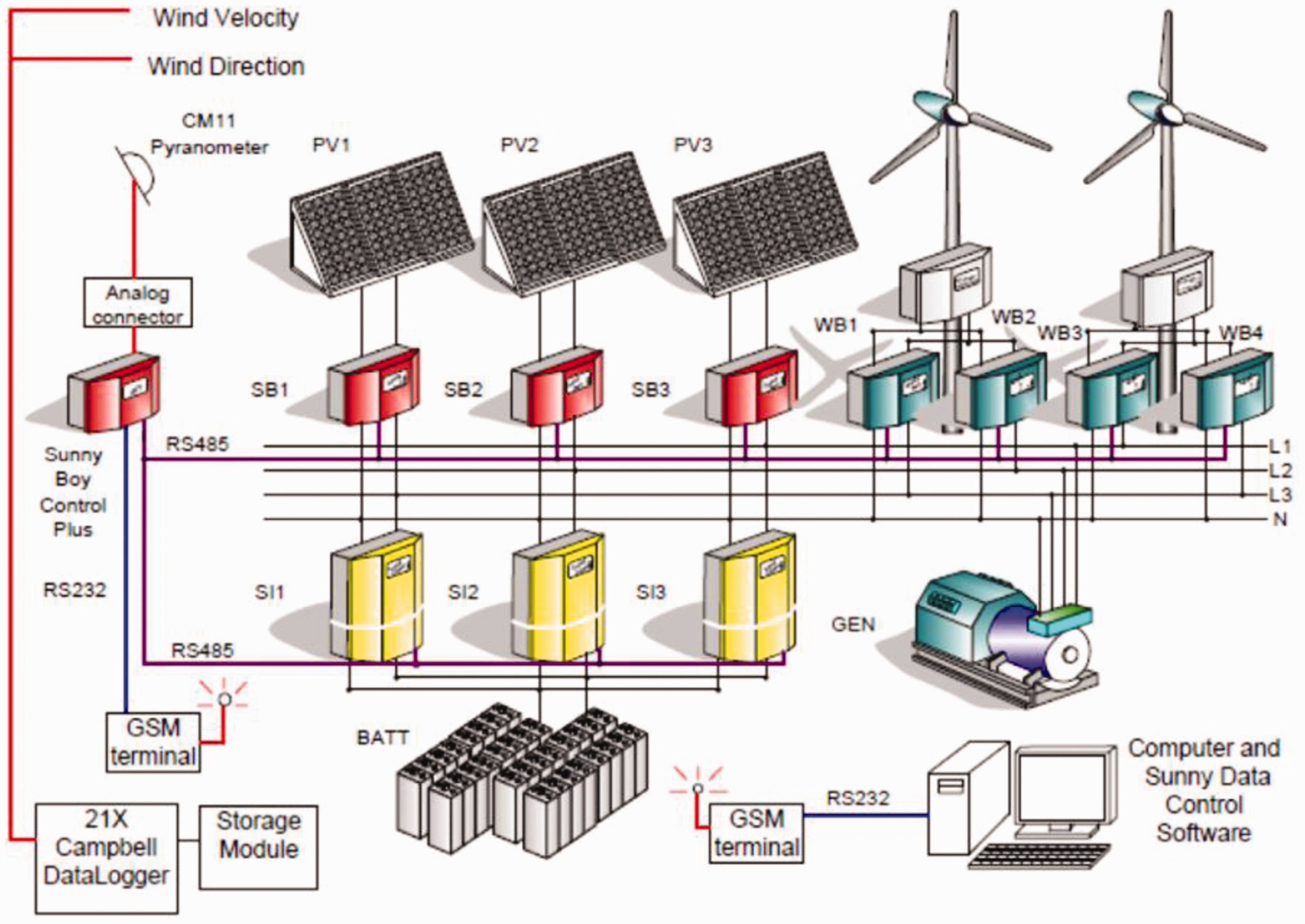
Schematic diagram of an optimized microgrid system (Smith et al., 2015).
Padrón et al. (2019) used HOMER to search optimal HPSs (WND-PV-DSL-BAT) to supply continuous power to Reverse Osmosis Desalination Plants with daily water production of 50 m3 in two Canary Islands. Authors suggested two HPSs with total capacities of 45.0 and 50 kW and battery storage of 172.0 and 215.0 MWh at COEs of 0.404 and 0.478 US$/kWh; respectively. A feasibility study of off-grid WND-PV-DSL-BAT and WND-PV-BAT for Nooriabad in Pakistan (Rehman et al., 2016) suggested two options with 84% and 100% RF at COEs of 0.45 and 0.733 US$/kWh to satisfy the required load of the community. Salisu et al. (2019) conducted the techno-economic and environmental analysis based on minimum COE and maximum RF for proposing a WND-PV-DSL-BAT HPS for Giri village, Nigeria. The study recommended a HPS with COE of 0.11 US$/kWh, 98.3% RF, and annual reduction of 2.89 tons of GHG annually
Mamaghani et al. (2016) used HOMER software to find optimal standalone HPSs for three locations in Colombia from different combinations of wind, solar, diesel, and battery storage combinations. The study recommended a WND-PV-DSL-BAT, (10.0–160.0–25.0 kW and 1500 kWh) power system at a COE of 0.473 US$/kWh and 0.98% RF for Puerto Estrella. In Egypt and elsewhere, usually the diesel generators are used in agriculture sector to pump water and meet other requirements in the farming fields. Al-Busaidi et al. (2016) recommended WND-PV-DSL-BAT HPSs for Masirah and Al-Hallaniyat Islands in Oman to provide continuous power to these islands at a COE of 0.182 US$/kWh and 0.222 US$/kWh; respectively. Kazem et al. (2017) studied a DSL only power system and PV-DSL-BAT, WND-DSL-BAT, and WND-PV-DSL-BAT HPSs to find out an economically suitable HPS to meet the power requirements of Masirah Island in Oman. The respective COE’s of the above four power systems were 0.222, 0.206, 0.192, and 0.061 US$/kWh. The proposed HPSs were able to reduce the GHG emissions by 10.2%, 21.2%, and 25.2% compared to DSL only power system in Masirah Island in Oman. Olatomiwa et al. (2015a, 2015b) illustrated optimization of WND-PV-DSL-BAT HPSs for six climatic zones in Nigeria. Of various options of HPSs, study recommended an economically feasible PV-DSL-BAT HPS with 10.0 kW PV, 5.5 kW DSL, and 138.24 kWh BAT backup at a COE of 0.547 US$/kWh and GHG reduction of 15.312 tons annually compared to DSL only power system.
Grid (GRD) connected hybrid power systems
A WND-PV-GRD grid connected HPS with 1000 kW of wind and 50 kWp of PV was proposed for grid-connected applications in Iraq, Dihrab and Sopian (2010). The study suggested some guidelines on how to monitor the performance of such a system in the local environment of Spain. Caballero et al. (2013) presented an optimal HPS (WND-PV-GRD) small grid-connected system for a community with 15 households in Hanga Roa City in Easter Island based on minimum LCC. The HPS comprising of 16 kW wind and 8.7 kWp of PV was reported to be optimal for this application with a COE of 0.235 US$/kWh. Asrari et al. (2012) investigated the possibility of integrating the renewables with existing diesel generators and grid extension to be economically feasible and environmental friendly and at the same time to meet the load of the village (Sheikh Abolhassan, Binalood region, Iran). Findings indicated that integration of renewables (10 kW wind and 5 kW PV) before and after grid extension to be more economical (COE = 0.214 US$/kWh) and can result in reduction of 17,533 tons of GHG annually.
United Nations Environment Program (Perera et al., 2003) published a guide to empower the clean energy business using HPSs in the tourism industry. The reports also listed the benefits of different HPSs consisting of varied combination of renewable energy sources. Liqun and Chunxia (2013) presented the feasibility of a WND-PV-BAT-GRD HPS for a remote village located in Dongwangsha, Shanghai, China respective capacities of 72, kW, 25 kW, 60 kW, and 35 kW of wind, PV, battery, and grid capacities. The suggested HPS could save around 2116 tons of GHG annually entering the local environment. Liu et al. (2013) constructed a grid-connected WND-PV-BAT-GRD HPS in Yantai, China with optimal capacities of wind, PV, battery storage as 2100.0 kW, 42.0 kW, and 5,75,000 Ah; respectively and ended up with a COE of 0.224 US$/kWh and annual reduction of GHG by 990 g/kWh. HOMER tool was used to examine the case of meeting the load requirements of a hotel with four different HPS options, Güler et al. (2013) and proposed an optimal WND-PV-BAT-GRD system with 3,000 kW wind and 930 kW PV. Annually, the proposed HPS was able to sale 56,28,984 kWh of energy to the grid.
Dalton et al. (2009b) used HOMER modeling software to assess the technical and financial viability GRD-ONLY, RES-ONLY, and GRD-RES HPS to supply power to a 100-bed grid-connected hotel located in Queensland in Australia. Assessment criteria was comprised NPC, RF, and PBP. The analysis showed that RES is techno-economically feasible as an addition to grid-connected supply for large-scale tourist operations. Furthermore, such systems should become more cost attractive for hotels and resorts in the coming times. An optimal and reliable PV power system for unreliable grid-tied option for a household in Larkana, Pakistan was devised using HOMER Pro software Rehman et al. (2019). The impact of scheduled and unscheduled power outages, ambient temperature, and PV module tilt angle were considered on the economics of the proposed system. Results indicated that the COE of standalone unreliable grid with battery storage was 48% more costly than unreliable PV-GRD system. With an aim of encouraging the government and the people to develop zero energy communities to achieve sustainable energy, Rafique et al. (2018) performed feasibility of a grid-connected PV (PV-GRD) power system for a rural community located in Toba Tek Singh, Pakistan. The results indicated that the proposed PV plant can provide energy at relatively better rates than the grid electricity.
Miscellaneous hybrid power systems
Sanchez et al. (2014) found optimal sizes of wind, PV, and fuel cell (FC) as 4, 3.06, and 3 kW for a WND-PV-FC HPS with a total annualized cost of US$3654.8 for a plant life of 20 years and cost of energy (COE) of 0.55 US$/kWh for Chetumal city in Mexico. Maleki et al. (2016) introduced an optimization approach considering three decision parameters (swept area WT rotor, PV array area, and number of ELR storage tanks) to find a most suitable HPS among from WND-PV-ELR-FC, WND-ELR-FC, and PV-ELR-FC options to supply power to a cluster of remotely located five households in Namin, Ardabil, Iran. The optimization criteria were based on minimization of LCC and maximization of allowable loss of power supply probability. Authors found simulated annealing-based harmony search (SAHS) to be the best algorithm to optimize the HPS and consequently reported WND-PV-ELR-FC (Figure 16) to be the optimal solution among all combinations considered. A simulation study by Lacko et al. (2014) resulted in an optimal WND-PV-ELR-FC-HGN HPS with 12.0 kW of wind, 17.0 kW of PV, 4.0 kW of electrolyser, 4.0 kW of fuel cell, and 30 kg of hydrogen tank to meet the electrical load (3.8 kW) of a household in Slovenia’s coastal region. The study stated that a 100% renewable energy system is possible in this area to meet the domestic electrical loads. An off-grid WND-PV-HGN-FC-ELR-BAT HPS with 1.50, 1.62, 1.20, 0.48 kW of wind, PV, FC, ELR, and 8.91 kWh of battery storage was presented by Torreglosa et al. (2015) to meet the power requirements of small loads considering the power limitations of the sources.
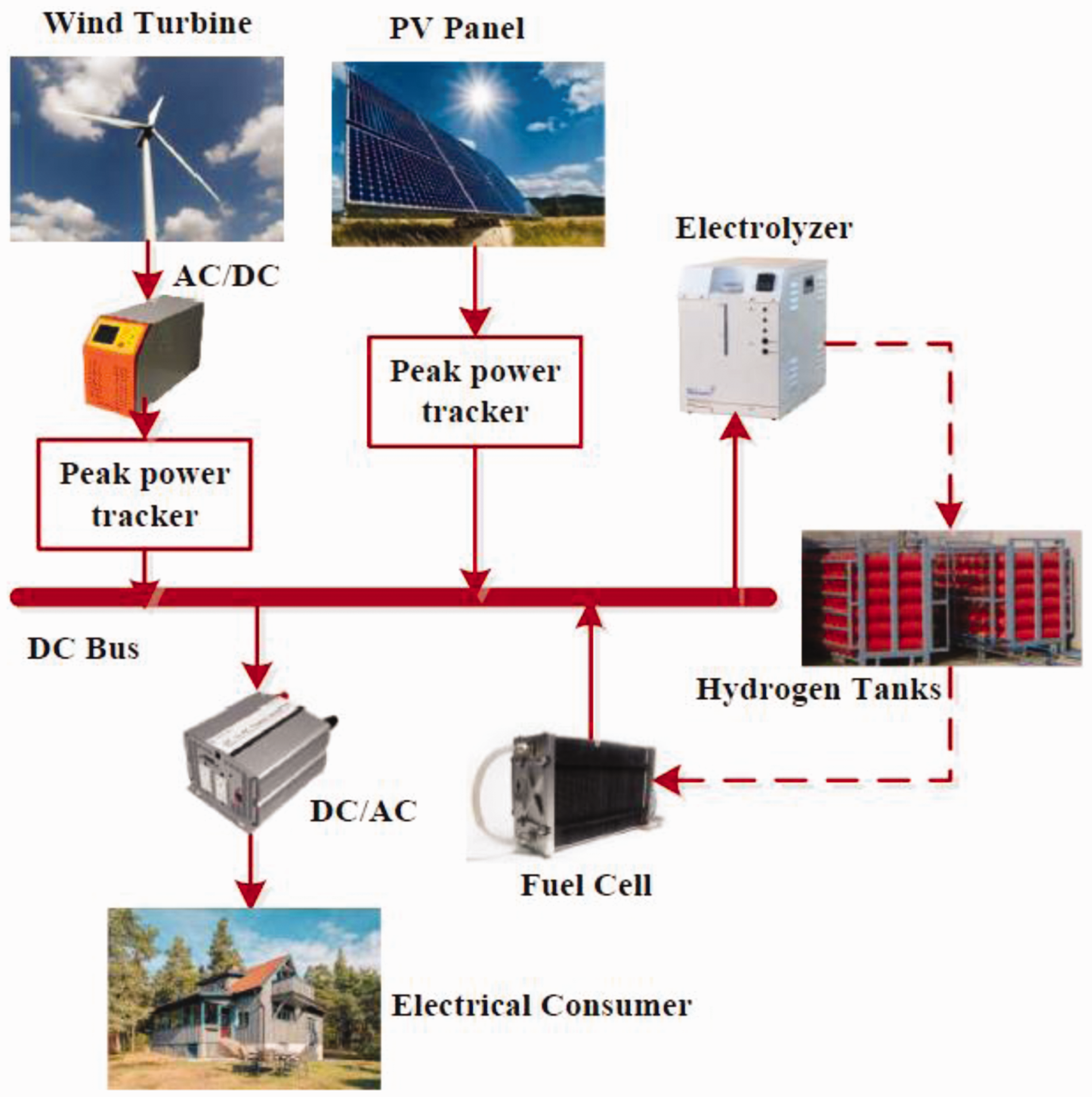
A block diagram of a WND-PV-ELR-FC HPS (Maleki et al., 2016).
Kalantar and Mousavi (2010) analyzed the performance of a HPS, (WND-PV-MCT-BAT), consisting of wind (195 kW), photovoltaic (85 kWp), microturbine (230 kW), and battery backup (2.14 kAh) based on minimum cost of energy. The study mentioned that the proposed systems can be best utilized for isolated rural and mountainous regions for power generation. Optimum configurations of WND-PV-BAT HPS were determined for 12 low windy sites in western Himalayas regions in India with objective of formulating a policy for the renewable energy based hybrid systems in the region Sinha and Chandel (2017). The study analyzed 7 micro turbines ranging from 1 kWp to 5 kWp to find optimal solution suitable for all the locations.
Ab. Razak et al. (2009) optimized a WND-PV-HYD-DSL-BAT HPS by minimizing the COE and excess energy using HOMER and suggested a system with 0.6, 0.075, 1.0, and 1.0 kW of wind, PV, hydro, and diesel; respectively; with 12.0 kWh of battery storage. Bekele and Tadesse (2012) studied the possibility of using WND-PV-HYD-DSL-BAT HPSs for six sites in Ethiopia to meet the basic load of households consisting of lighting, radio, television, electric baker, water pumps, and flour mills. The study recommended a workable HPS, with 95% renewable penetration at a COE of 1.08 US$/kWh, consisting 10.0 kW WND, 5.0 kW PV, 34.2 kW HYD, 22.0 kW DSL and 67,360 Ah of BAT storage. Relying on hydro sources alone power all year long cannot satisfy the required demand for power in Cameroon in particular and other places in general. Accordingly, Kenfack et al. (2009) suggested a PV-HYD-DSL-BAT HPS with respective optimal sizes of 5.0 kW, 2.12 kW, 1.0 kW, and 36.0 kWh. The suggested system was able to provide electricity at a COE of 0.278 US$/kWh. Xu et al. (2019) used Matlab/Simulink to establish a WND-PV-HYD HPS and showed the pumped storage station can be integrated with HPS under steady and fault scenarios.
The microbial fuel cell (MFC) technology relies on electroactive bacteria to degrade organic molecules for bioelectricity and is a potentially useful approach for wastewater treatment with electricity cogeneration. Zhang et al. (2019) conducted a comprehensive review of HPSs coupled with MFCs and discussed the effects on the performance of bio-electro-Fenton-MFC, microbial desalination cell, MFC-electro-sorption cell, microbial solar cell, microbial reverse-electro-dialysis cell, plant-MFC and constructed wetland-MFC of using different working principles, reactor designs, operating conditions. Bizon (2019) reviewed HPSs for space applications, reliable technologies for energy sources, and ESS suitable in extreme environments and under dynamic load demand and compared their reliability based on power and energy density, efficiency, and lifetime. Eras-Almeida and Egido-Aguilera (2019) presented the status of HRMGs on non-interconnected small islands by comparative analysis of islands located in the Atlantic and Arctic, Pacific and Indian Oceans, and the Caribbean and Mediterranean Seas. The review highlighted the targeted renewable achievements of the developed islands and also pointed out that the least developed islands from the Pacific and Indian Oceans need to strengthen their weak regulatory frameworks.
Kumaravel and Ashok (2012) presented techno-economic feasibility study of a PV-HYD-BGG-BAT HPS, (Figure 17), to supply quality power to the Forest Department located in Kakkavayal, Kerala, India. An optimal HPS with 2.0, 15.0, 5.0, and 120.0 kW each of PV, hydro, biomass gasifier generator, and battery storage capacities respectively was recommended at an affordable COE of 0.164 US$/kWh. Sigarchian et al. (2015) proposed a WND-PV-BGE-BAT HPS consisting of 10.0, 20.0, and 10.0 kW of wind, solar, biogas, and 111.0 kWh of battery installed capacities; respectively; to supply electricity to Kenyan villages having average and peak loads of 8.0 kW and 16.5 kW, Figure 18. The above HPS was able to produce energy at a COE of 0.25 US$/kWh and was able to displace 17.0 tons of CO2 equivalent GHG annually. With an aim of zero fossil fuel initiative for Galapagos Islands, Llerena-Pizarro et al. (2019) proposed a (PV-BGE-BAT) HPS (shown in Figure 19) in addition to existing WND-DSL system to achieve the set goal. The study suggested HPSs for Floreana (2.4 kW PV, 1.9 kW BGE, 20.0 kWh BAT), Isabela (405.0 kW PV, 475.0 kW BGE, 2988.0 kWh BAT), San Cristobal (97.0 kW PV, 300.0 kW BGE, 1586.0 kWh BAT), and Santa Cruz (2858.0 kW PV, 4500.0 kW BGE, 21469.0 kWh BAT). The proposed model will be able to meet the annual energy requirements of 19.4, 3959.5, 1968.6, and 15255.7 MWh by producing 20.4, 4910.4, 2089.0, and 17340.1 MWh of electricity of the four respective islands in above order. Kumar et al. (2019) used design space approach with multiple combinations of biomass gasifier engines and battery systems for a known load to size the major components of PV-BGG-BAT HPS and stated that the proposed system in intermittent operation mode had the lowest COE.
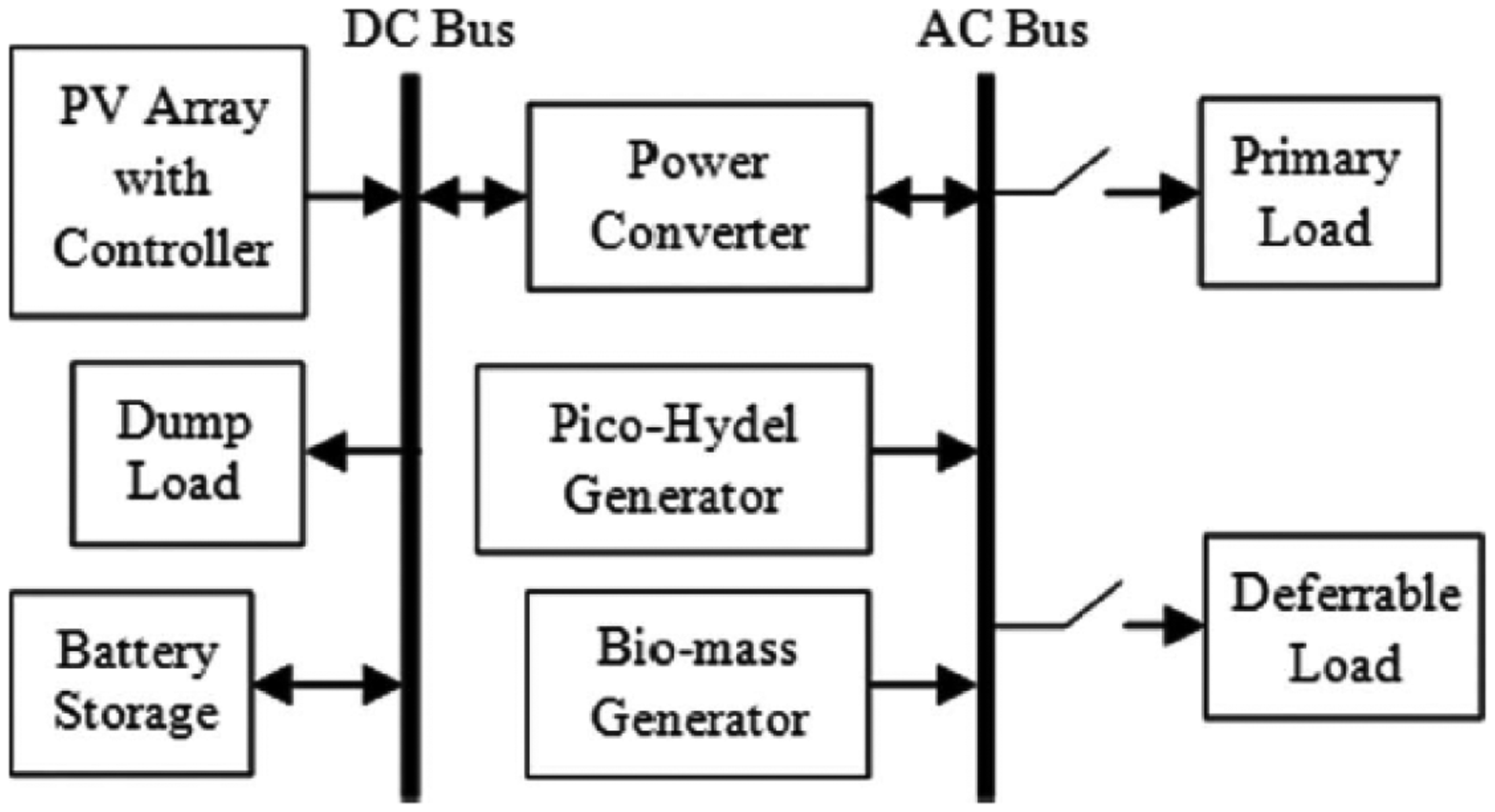
Schematic of PV-HYD-BGG-BAT HPS (Kumaravel and Ashok, 2012).
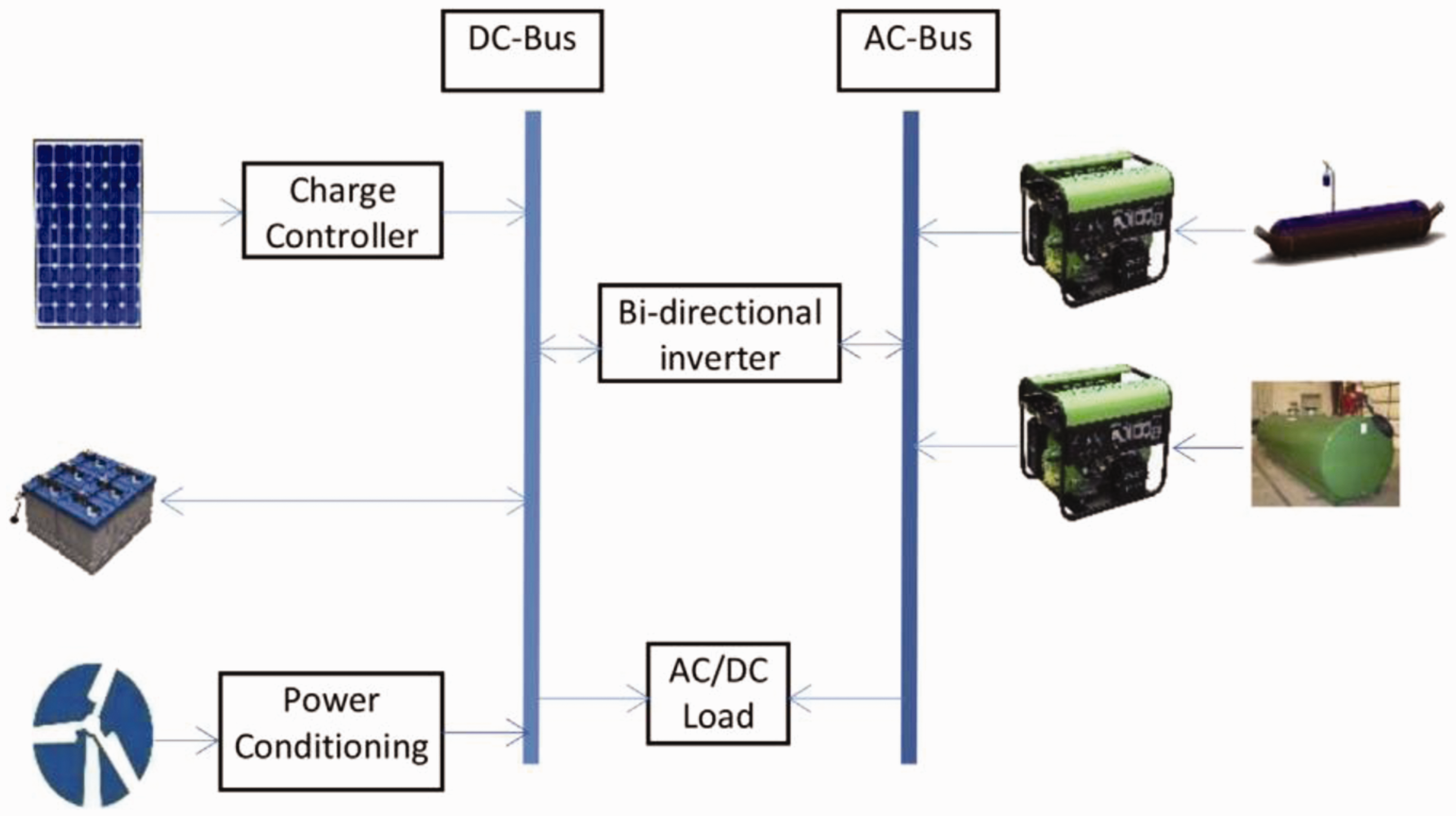
Schematic of WND-PV-BGE-BAT HPS (Sigarchian et al., 2015).
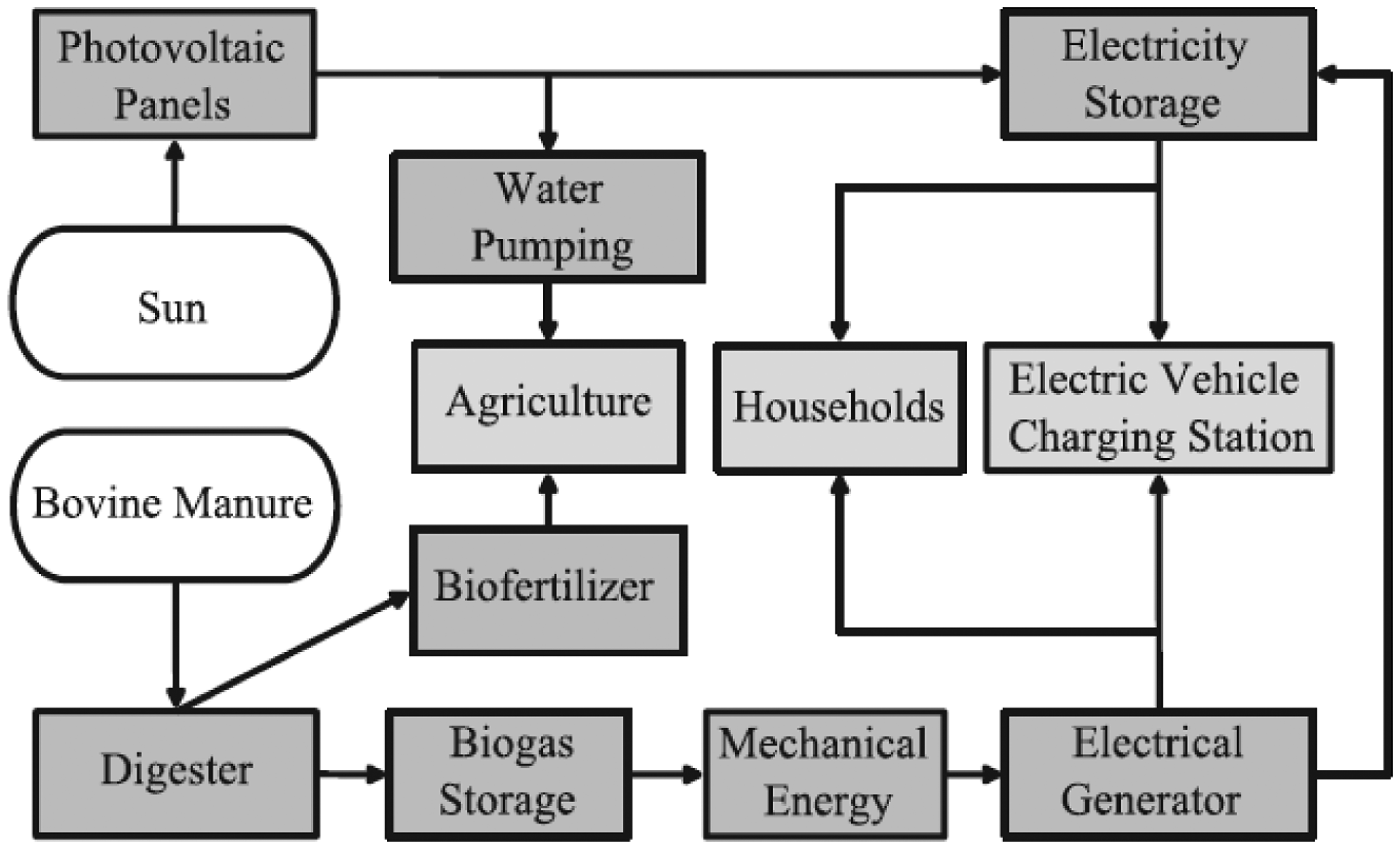
Proposed HPS for Power Generation for the Galapagos Islands (Llerena-Pizarro et al., 2019).
The first demonstration HPS (WND-PV-BAT/FC/GRD) was installed by Bahrain Petroleum Company (Figure 20) to partially meet the load of the reception hall of the company’s park in 2011 in Bahrain, Haji et al. (2019). The system was tested for three energy storage options viz., batteries/hydrogen FC/grid. The installed system consisted of 1.7 kW of wind, 4.0 kWp of PV, 12.48 kWh of battery storage, 1.2 kW of FC, and two hydrogen generators. The study concluded that the system was not economically feasible but served the community by creating public awareness of renewable energy and providing an opportunity for researchers to gain hands-on experience of different renewable energy technologies (Haji et al., 2019). Maleki and Pourfayaz (2015b) compared the performance of WND-PV-DSL-FC and WND-PV-DSL-BAT HPSs and concluded that a 6.0 kW, 2.0 kW, 6.125 kW, and 159.6 kWh sized conventional system with battery storage was more cost effective than the FC based energy storage option. The performance simulation of a PV-FC-DSL HPS for a university building showed that the system provided 73% of the total energy from PV, 24% from FC and the remaining 3% from the DSL, (Ghenai and Bettayeb, 2019), at a COE of 0.092 US$/kWh and without power shortage.
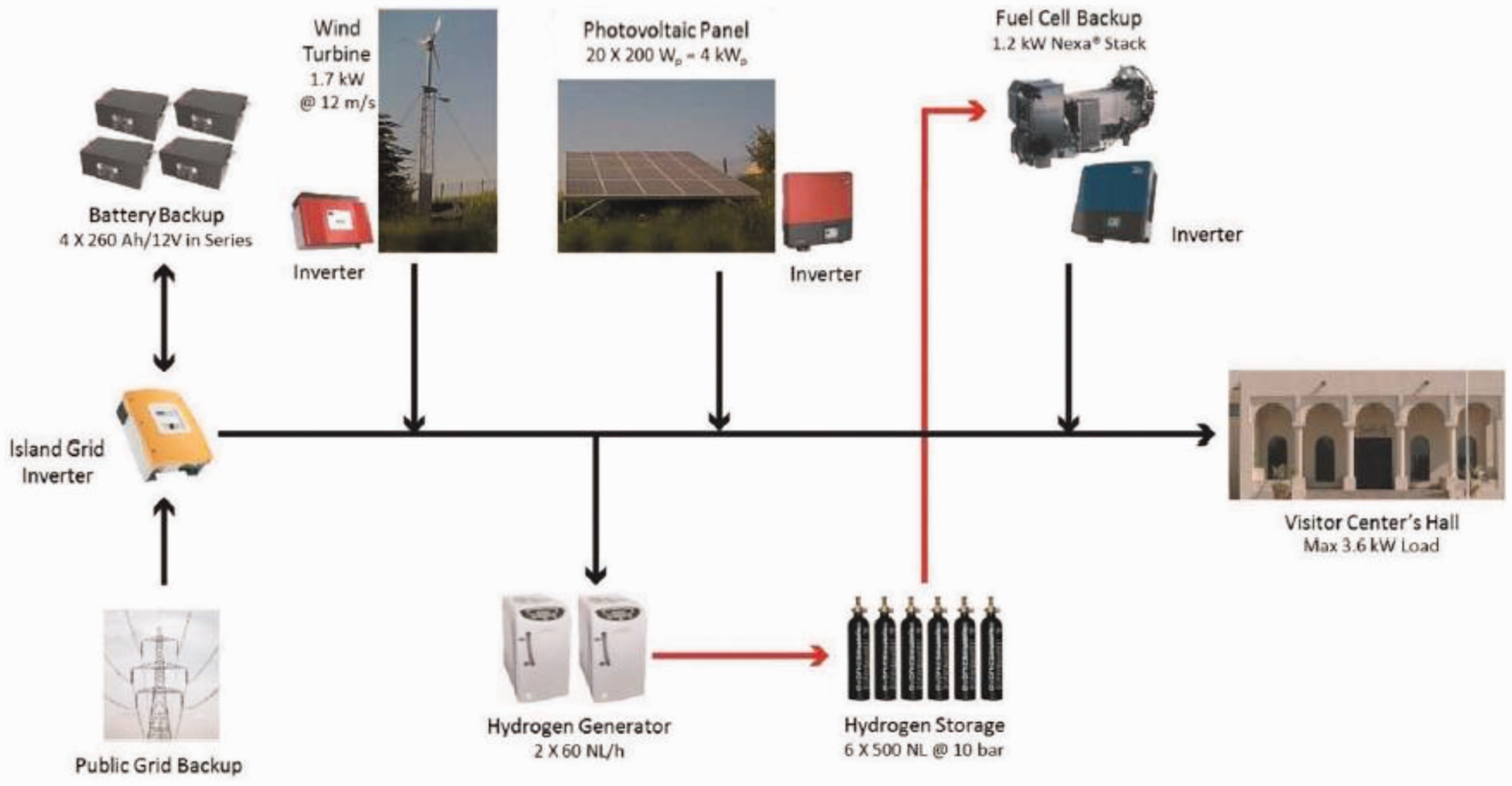
A schematic diagram of Bahrain Petroleum Company’s Green Energy Station (Haji et al., 2019).
Iglesias et al. (2000) studied WND-DSL-FWL HPS with flywheel based energy storage. The study revealed that the diesel generator has to run full time without storage but inclusion of flywheel storage significantly reduced the generator usage and hence the fuel as well. The introduction of flywheel, though designed to supply the rated power for 1.8 minutes only, was enough to compensate wind fluctuations and minimized number of diesel generator startups.
HPS control systems and optimization techniques
Reliable coordination among different renewable energy based power systems, generators, loads, and storages in a standalone HPS is a complicated and challenging task. This task has to be dealt with caution and is the lifeline of proper running of a HPS. Anoune et al. (2018), recently summarized the existing and most applied techniques for sizing and optimizing the WND-PV HPS for isolated areas and discussed the commonly used topologies for the implementation of such systems. Authors recommended that AIT and heuristic approaches are more popular and accurate, due to their ability to search local and global, compared to traditional methods of optimization.
Indragandhi et al. (2017) discussed the role of power electronics in converters and operation in HPS, global status of such successful systems deployed around the globe, future vision, and challenges associated with the integration of such projects. Daming et al. (2005) proposed optimal sizes (10 kW Wind and 50 kW PV) of a WND-PV HPS using genetic algorithm and concluded that it is suitable for conducting such type of optimization studies. Diaf et al. (2007) presented an accurate mathematical model for characterizing and optimizing the energy components of a WND-PV HPS with battery backup storage based on loss of power supply probability and minimum levelized COE. Simulated Annealing Algorithm (SAA) was reported to be better than Response Surface Methodology (RSM) for optimal sizing of HPS using ARENA software. Pang et al. (2019) used a frequency-based method for sizing the hybrid energy storage system (wind, super-capacitor, and battery) to smoothen wind power fluctuations for minimum total cost. Results indicated that the hybrid energy storage system offered the best performance of the wind power system in terms of cost and lifetime.
Sanchez et al. (2014) recommended particle swarm optimization (PSO) algorithm for searching the sizes of the major components of a WND-PV HPS with fuel cell for minimal overall cost of the plant. The study found that the performance of PSO was faster than the differential evolution technique (DET). Maleki et al. (2015) studied the performance of PSO and its variants (modified PSO, PSO based on repulsion factor, PSO with restriction factor, and PSO with adaptive inertia weight) to accurately describe the optimal sizes of a WND-PV-BAT HPS components using the meteorological data for small applications in Iran. The study recommended PSO with constriction factor over other variants of PSO for the said objective. In another similar study, Maleki and Pourfayaz (2015a) conducted the performance evaluation heuristic [particle swarm optimization (PSO), tabu search (TS), and simulated annealing (SA) and metaheuristic (improved particle swarm optimization (IPSO), improved harmony search (HIS), improved harmony search-based simulated annealing (IHSBSAA), and artificial bee swarm optimization (ABSO)] algorithms for optimization of WND-PV-BAT HPS by considering the maximum allowable loss of power supply probability for various cities in Iran. The study suggested ABSO as the best algorithm among all considered in this study for the optimization of HPS components. Yahiaoui et al. (2016) developed PSO based Matlab code to establish an optimal configuration for PV-DSL-BAT HPS in southern part of Algeria. The optimal architecture proposed, consisted of 5.0 kW PV, 7.8 kW DSL, and 180.0 kWh BAT backup at a COE of 0.896 US$/kWh.
Genetic algorithm (GA) was successfully used for HPS’s component sizing by Kalantar and Mousavi 92010) for off-grid applications in Iran. Torreglosa et al. (2015) presented an energy dispatching strategy using Model Predictive Control (MPC) in MATLAB-Simulink for an off-grid WND-PV-HGN-FC-ELR-BAT HPS with an objective of tracking the power demands and keeping charging levels within target limits. Kabalci (2013) designed a HPS controlled either by regular proportional integral PI or extended PI controllers based on PSO algorithm to connect 2.0 kW wind (PMSG) and 1.7 kW PV (MPPT) plant for power generation. The generated phase voltages verified the modelled distributed generation system draws an efficient conversion with total harmonic ratio of voltage at 0.69%. The proposed model can be extended for fuel cell and other energy storage options. Salah (2013) developed a fuzzy logic (FL) using MATLAB to control and manage the PV-DSL-BAT HPS to meet the load of household apparatus efficiently during daytime and part of nighttime. The developed FL system allows to supply the required power and store the excess energy in batteries and at the same time directs the diesel generator, if needed, to provide power in case when PV systems was unable to meet the load. The application of WND-PV HPS can reduce the storage capacity of batteries and total cost of the system compared to stand-alone PV plants in areas where solar and wind energy are available, Meiqin et al. (2008). Authors presented a cost-effective control strategies and design schemes for 1, 3, and 5 kW WND-PV standalone HPSs with low DC voltage (24 and 48 VDC) input and high output AC sine wave voltage (220 VAC). The simulation and experimental results showed that the proposed control and design schemes enhanced and prolonged the cycle rate (Meiqin et al., 2008).
Bialasiewicz et al. (1998) developed a modular simulation tool to study the system dynamics of WND-DSL HPSs for village load. The proposed tool can be used to develop control strategies to balance the system power flows under varied generation and load conditions. The modeling, simulation, and optimization study, Lal et al. (2011) concluded that renewable energy sources can replace the conventional energy sources while remaining feasible for power distribution for standalone, remotely located applications in India and elsewhere for similar climatic conditions. Shin et al. (2015) used linear programming approach to designed and optimize an appropriate HPS for Deokjeok Island and recommended a hybrid generation system rather than a conventional diesel only system due to high fuel cost. A Mixed-Integer Linear Programming (MILP) formulation was applied to study the behavior of HPSs over a period of 12 months considering load following (LF) strategy, Malheiro et al. (2015). Maleki and Pourfayaz (2015b) introduced mathematical model for cost analysis of each component using discrete version of harmony search (HS) algorithm to satisfy the load demand and optimally sized the main system components of HPSs. Gan et al. (2016) developed a novel control algorithm to optimize the operation of a diesel generator by utilizing a genetic algorithm and at the same time maximize wind energy utilization with limited battery storage. Authors verified their model on an existing WND-DSL-BAT HPS with 11.0 kW WND, 8.0 kW DSL, and 45.0 kWh BAT capacities (Figure 21).
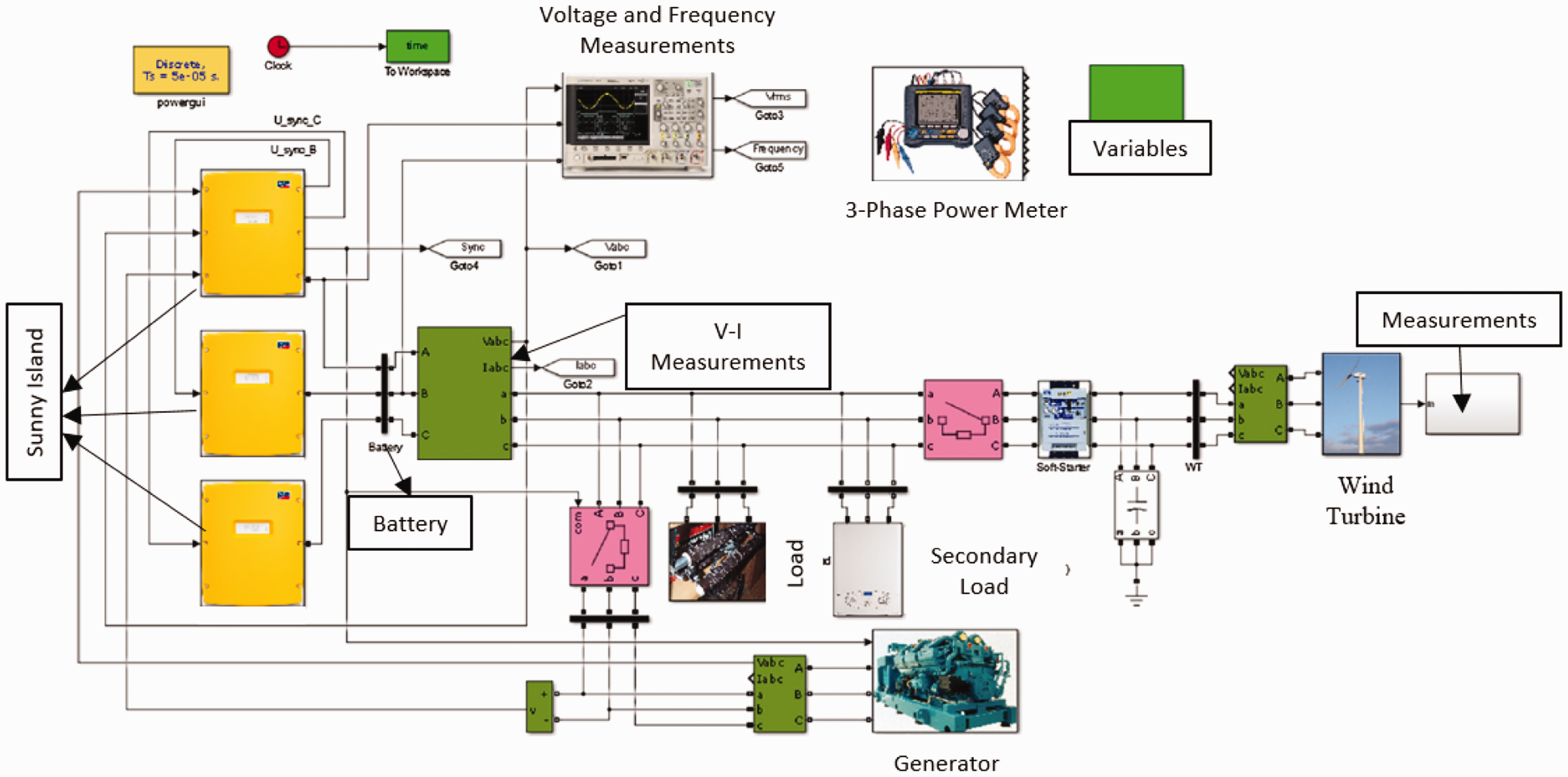
HPS Simulink model used to run for 24 h simulation time (Gan et al., 2016).
Al-Busaidi et al. (2016) presented a review of various methodologies being used for sizing the major components (Annual Monthly Average Sizing Technique-AMAST, Most Favorable Month Technique-MFMT, and Loss of Power Supply Probability Technique-LPSP) and optimization (Graphic Construction Technique-GCT, Probability Technique-PT, Iterative Technique-IT, and Artificial Intelligence Technique-AIT) of HPS in different regions of the globe. Solano-Peralta et al. (2009) introduced the concept of ‘tropicalization’ of the Feed-in Tariff (FIT) scheme to promote usage of HPSs for geographically isolated communities by providing a reward for each kWh of RE produced during a specified period of time. To attain sustainability, the renewable energy premier tariff (REPT) of 0.70–1.20 US$/kWh was applied for 20 years for largest share of RF in HPS. As a solution, PV-DSL mini-grid systems (MGSs) were found to be beneficial to remotely located inhabitants both, financially and socially.
Dalton et al. (2009a) conducted feasibility analysis (based on NPC, RF, and PBP) of three HPSs already installed in small to medium-sized tourist resorts (less than 100 beds) to supply power to these facilities located in Australia with varied geographical and climatological conditions. Analysis demonstrated that renewables can adequately and reliably met the power demands of stand-alone small to medium-scale tourist accommodations. Furthermore, the wind HPS were more economical compared to PV HPS with 3–4 and 6–7 years of payback periods; respectively.
Xu et al. (2020a) showed that if coke oven gas is used as the fuel, the NOx concentration reduced by almost 35%. Xu et al. (2020b) analyzed five types of nanofluids to obtain single and hybrid nanofluids with the best heat transfer performance. Their results showed that with the usage of hybrid nanofluid 25% Al2O3 + 75% TiO2H2O and the single nanofluid TiO2H2O, best heat transfer performance was obtained. In another study, Xu et al. (2019) designed an M-type radiant tube and then based on traditional M-type structure, a new type of radiant tube was designed with a subsonic burner and flue gas reflux channel to improve the overall performance. The results showed that the speed of the flue gas in the new type of radiant tube was about 5.55 times that of the traditional M-type radiant tube because of the self-circulating gas structure.
Analysis of the review
Hybrid power systems are efficient, economical, reliable off-grid power systems and assure continuous power supply to end users. These systems are getting popular among remotely located communities in developing countries, especially in Asia and Africa. The applications of such hybrid systems include buildings, individual houses, villages, islands, hotels and resorts, communication and meteorological towers, schools and clinics in villages, alpine huts, industrial fencing, water desalination, and recently are being studied for space applications. This section provides an overview of existing hybrid power systems related studies in the literature and international practices.
The present overview resulted that maximum applications are utilizing WND-PV (28%) while WND-BAT and PV-GRD are a few from the lot reported in this paper (Figure 22). Among other HPSs, PV-DSL and WND-PV-DSL are also quite common, 21% and 22%; respectively. Other combinations of renewable sources like biomass gasification, small hydro, biogas, fuel cell, etc. are also found (8%) in the literature, Figure 22.
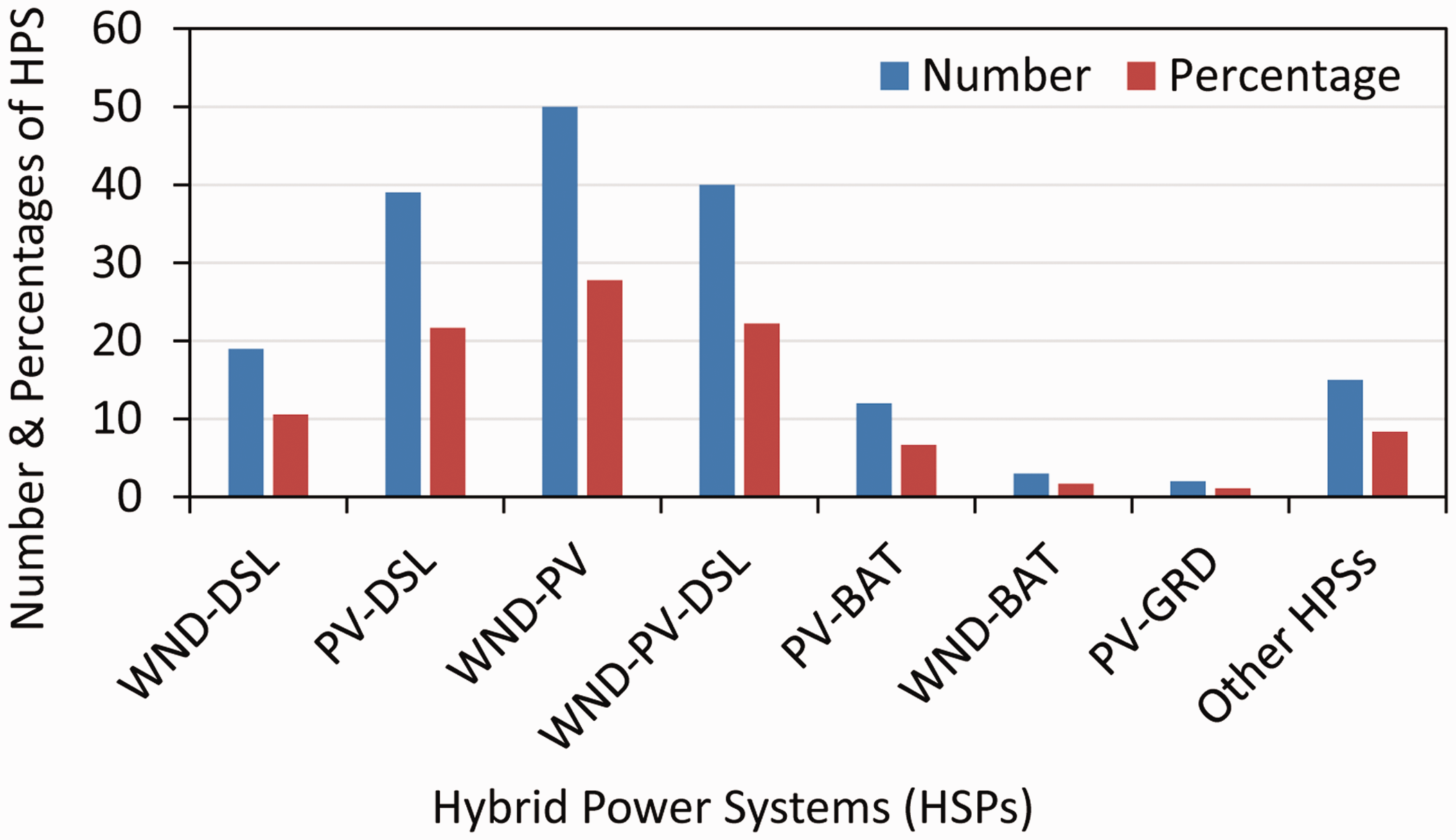
Popularity of HPSs.
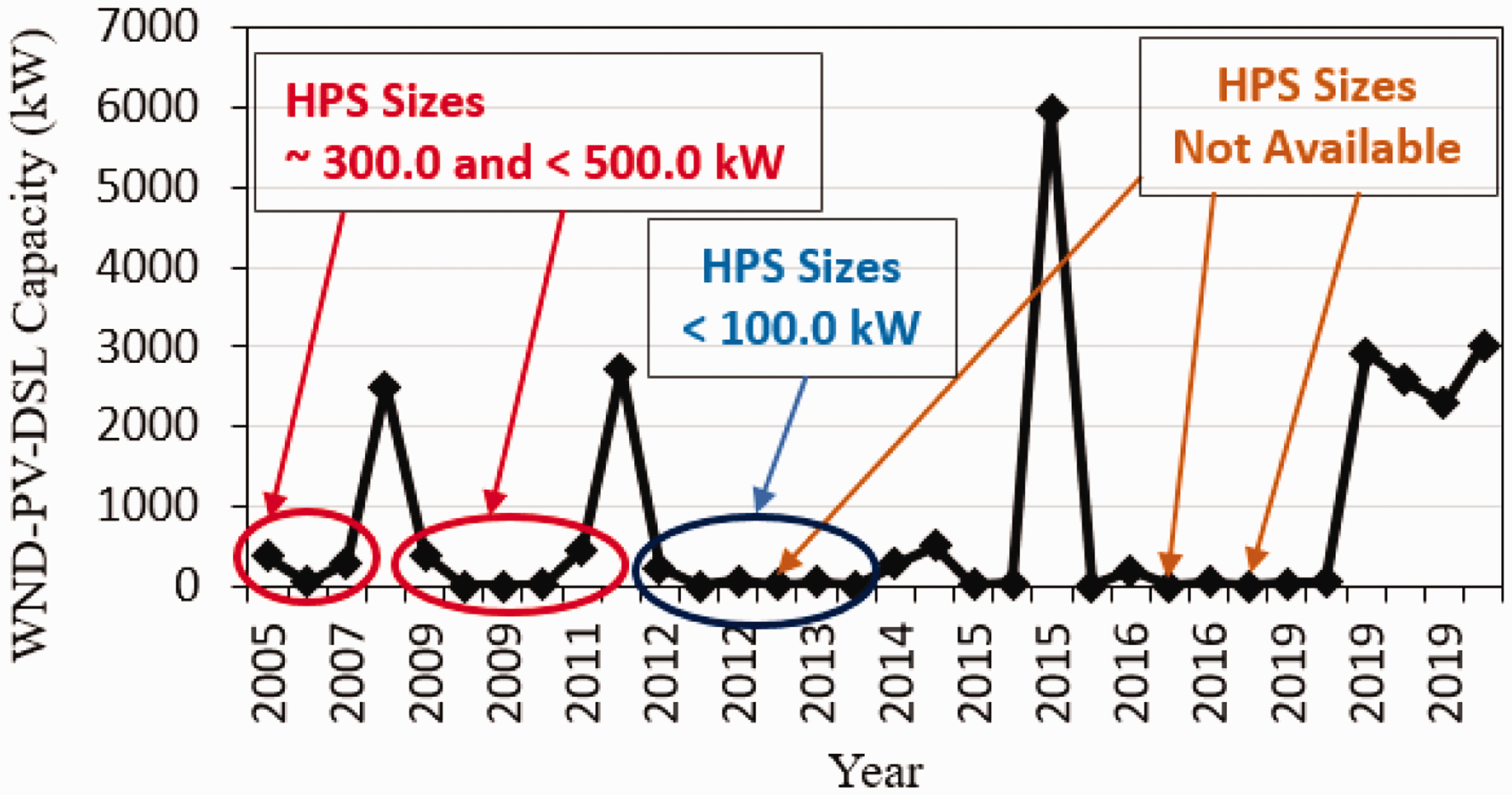
Annual trends of WND-PV-DSL HPS capacities from 2005 to 2019.
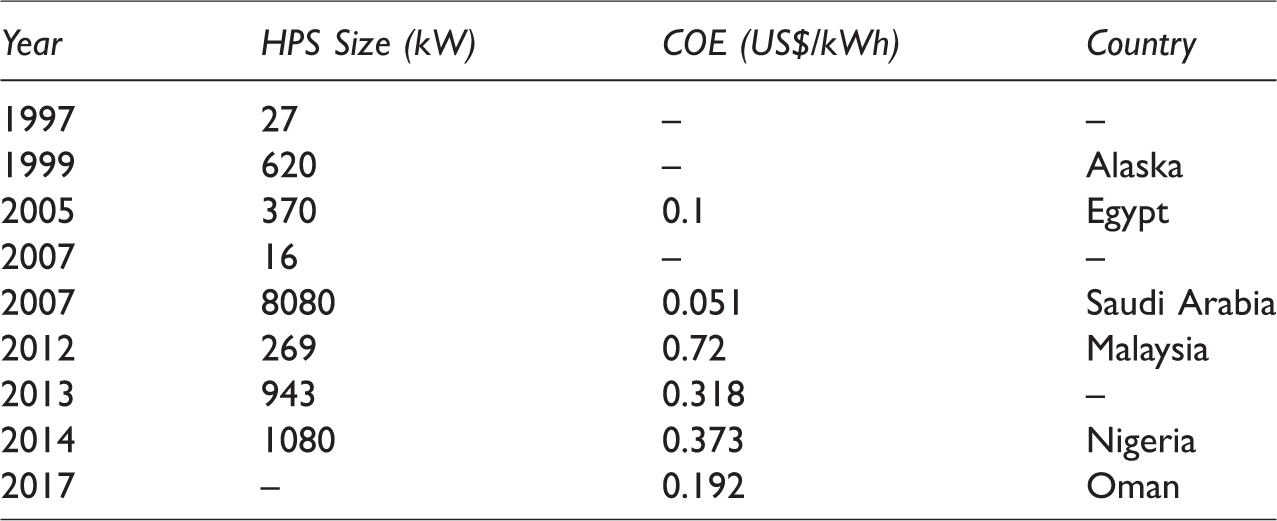
An attempt is made to look into the fact that how the hybrid installed capacities have progressed over time. Over the years, no specific increasing or decreasing trend is observed in the installed and theoretically analyzed WND-PV-DSL, PV-DSL, WND-PV HPS, and WND-DSL (Figures 23 to 25 and Table 1). During the reporting period in this study, only 7 HPSs (WND-PV-DSL) of few thousand kW combined capacities are found in the covered literature. On the other hand, only 5 PV-DSL HPS of combined capacities of more than 1000.0 kW are noticed (Figure 24). However, WND-PV HPSs are still found around 100.0 kW sizes all around. From this analysis, one can say that, as of now, small HPSs are popular and that too for off-grid applications.
Summary of WND-DSL HPSs.
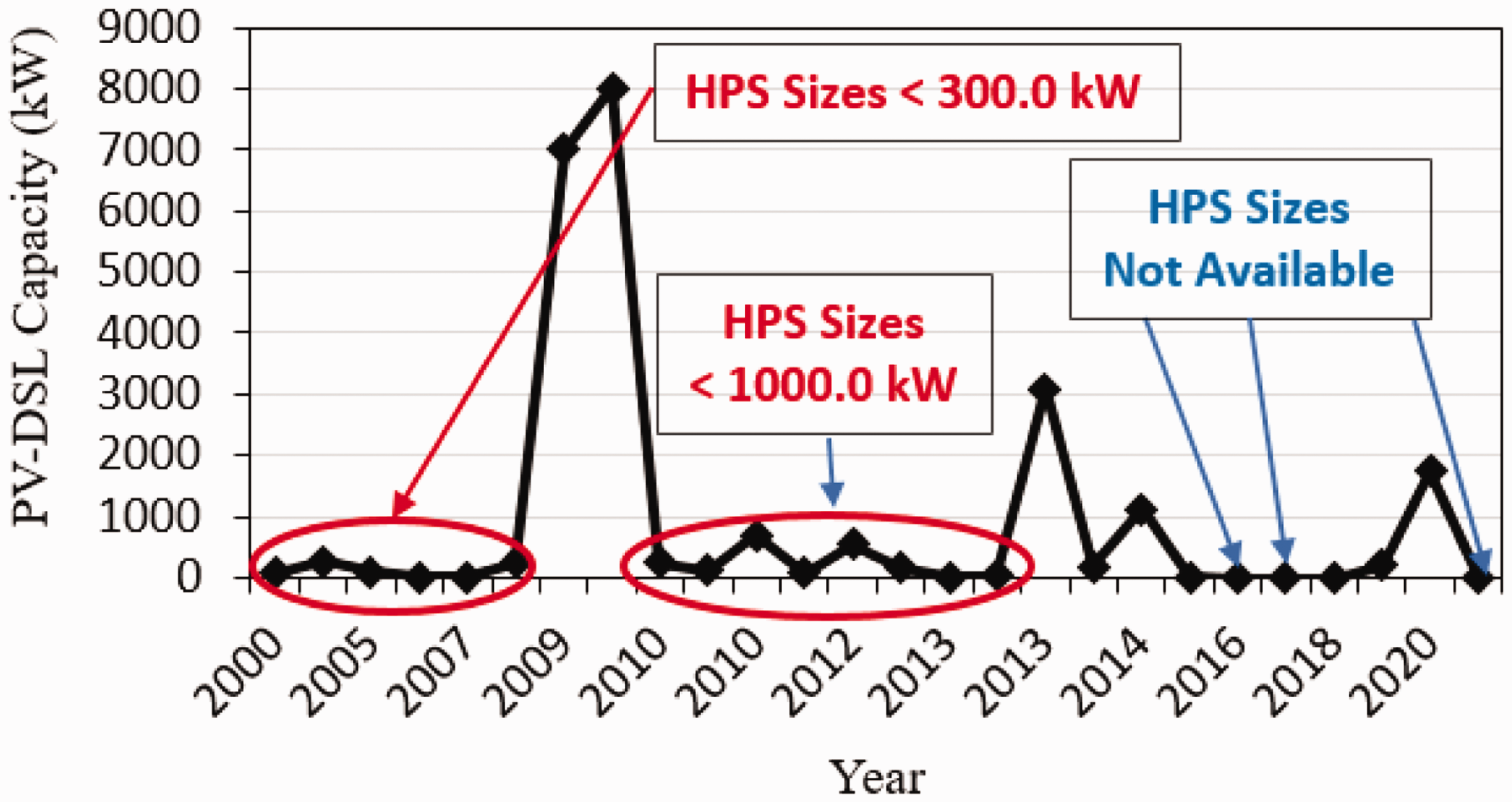
Annual trends of PV-DSL HPS capacities from 2000 to 2020.
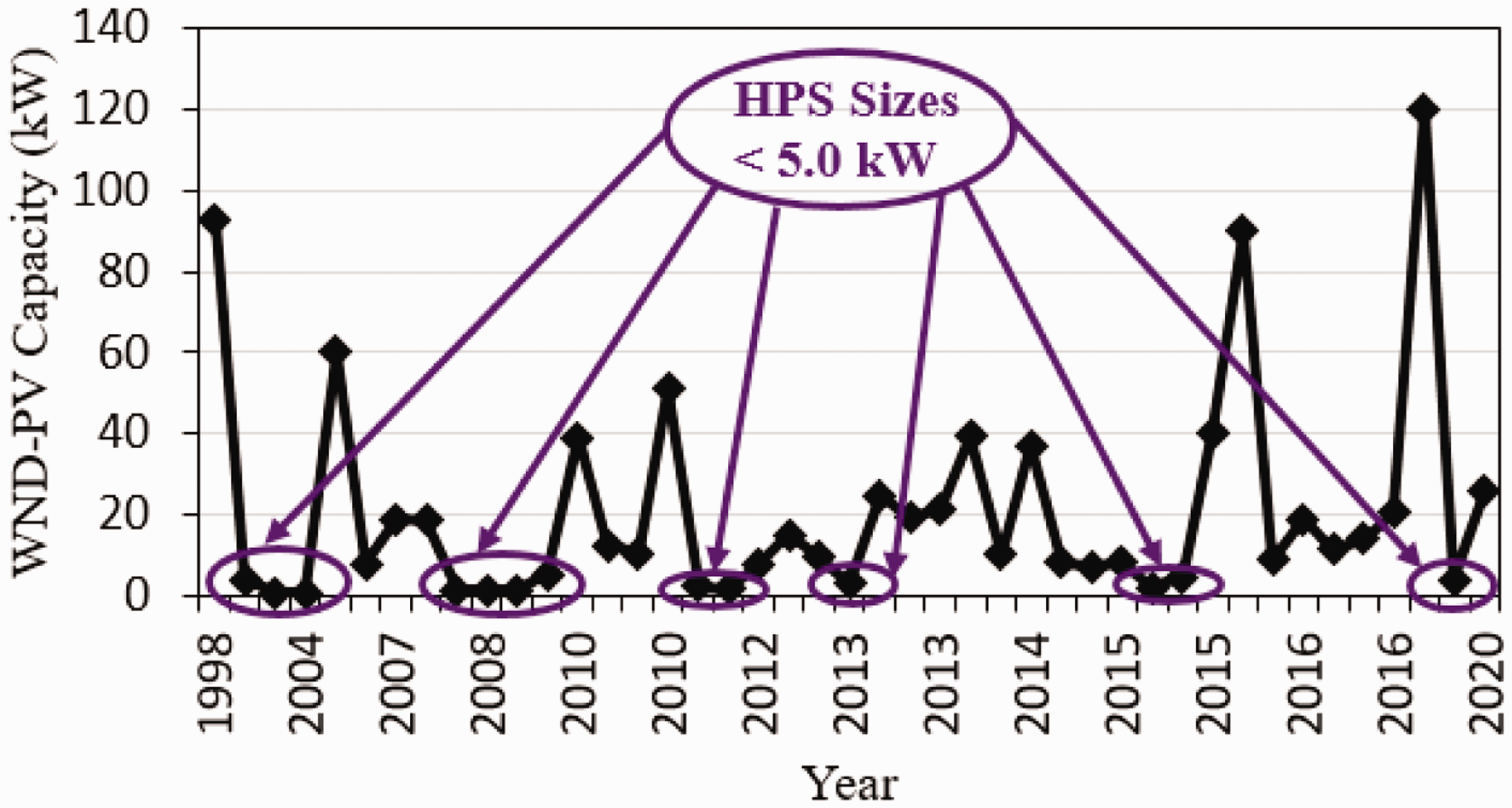
Annual trends of PV-DSL HPS capacities from 1998 to 2020.
In terms of global trends of the COEs of WND-PV-DSL, WND-DSL, PV-DSL, and WND-PV HPSs, slightly increasing patterns are observed but usually these values fluctuate around 0.15 US$/kWh to 0.40 US$/kWh as can be observed from Figures 26 to 28. Sometimes, the data is not available in the reported literature and has to be taken as missing, as indicated in these figures. The study also attempted at finding out some sort of relationship between the sizes of HPSs and the respective COEs but could not establish any trend, see Figures 29 to 31. However, in case of WND-PV-DSL HPSs, a slightly decreasing pattern is observed in the values of COESs with increasing capacities of the HPSs (Figure 29).
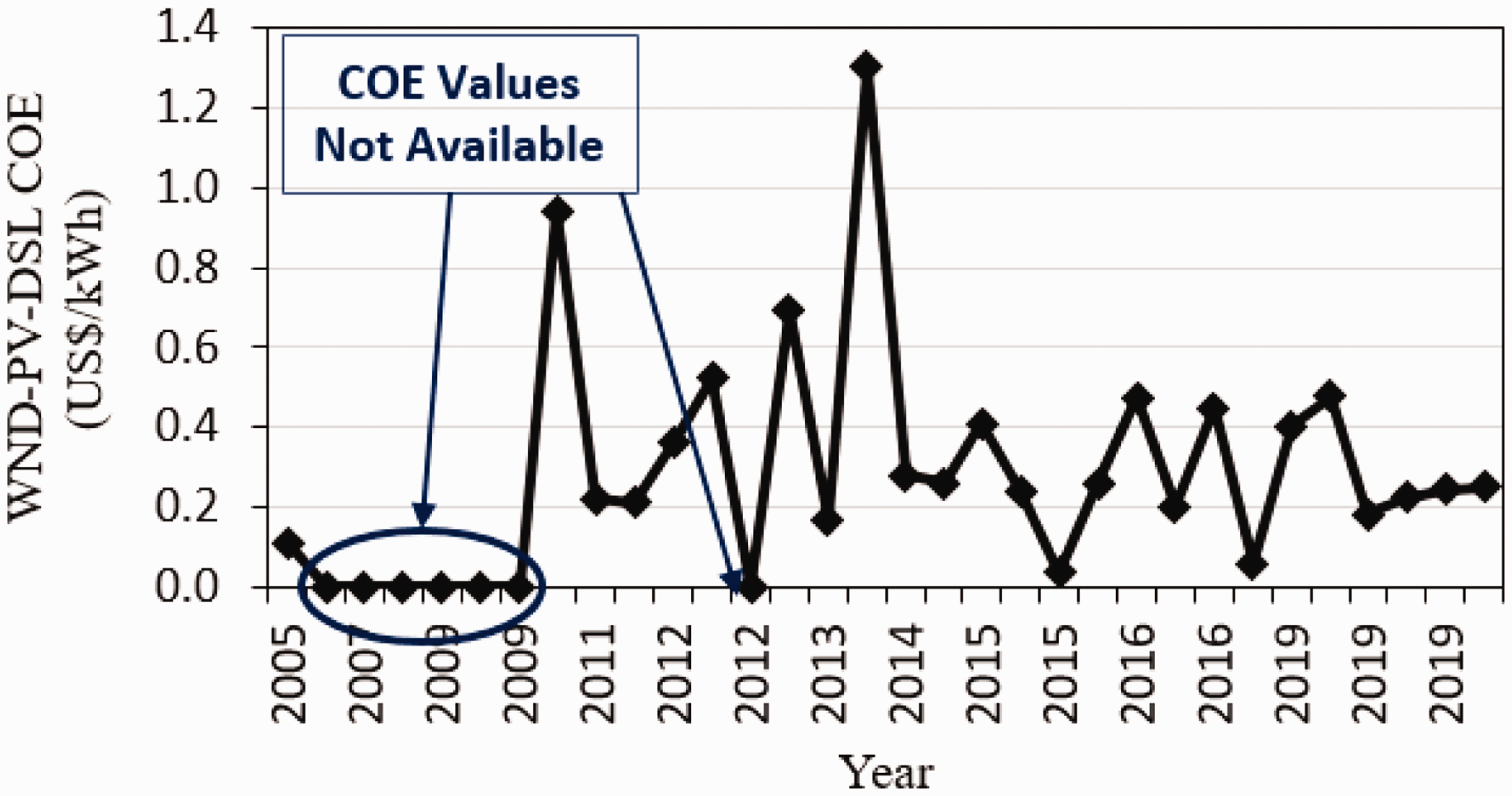
Annual trends of COE of WND-PV-DSL HPS from 2005 to 2019.
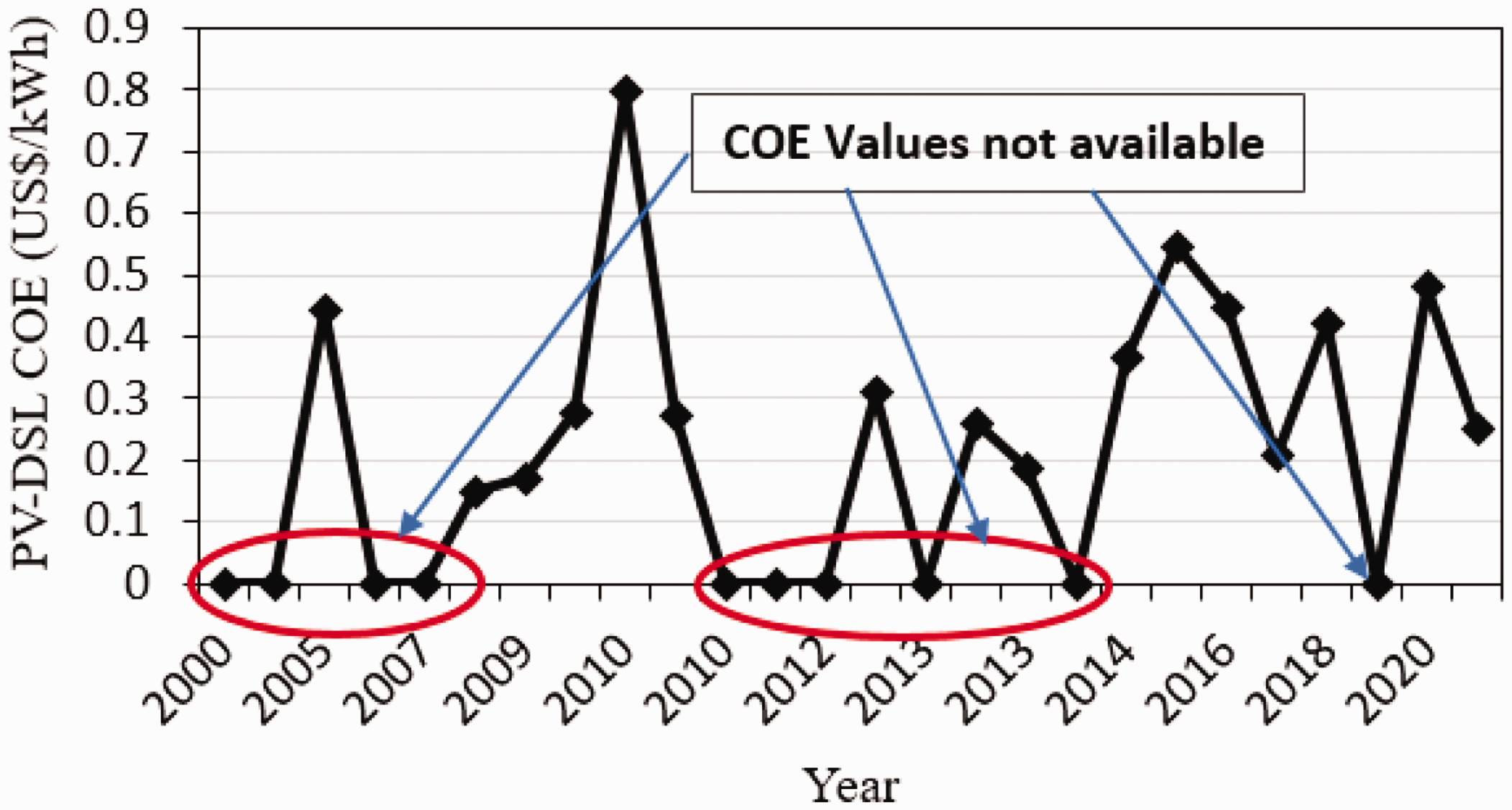
Annual trends of COE of PV-DSL HPS from 2000 to 2020.
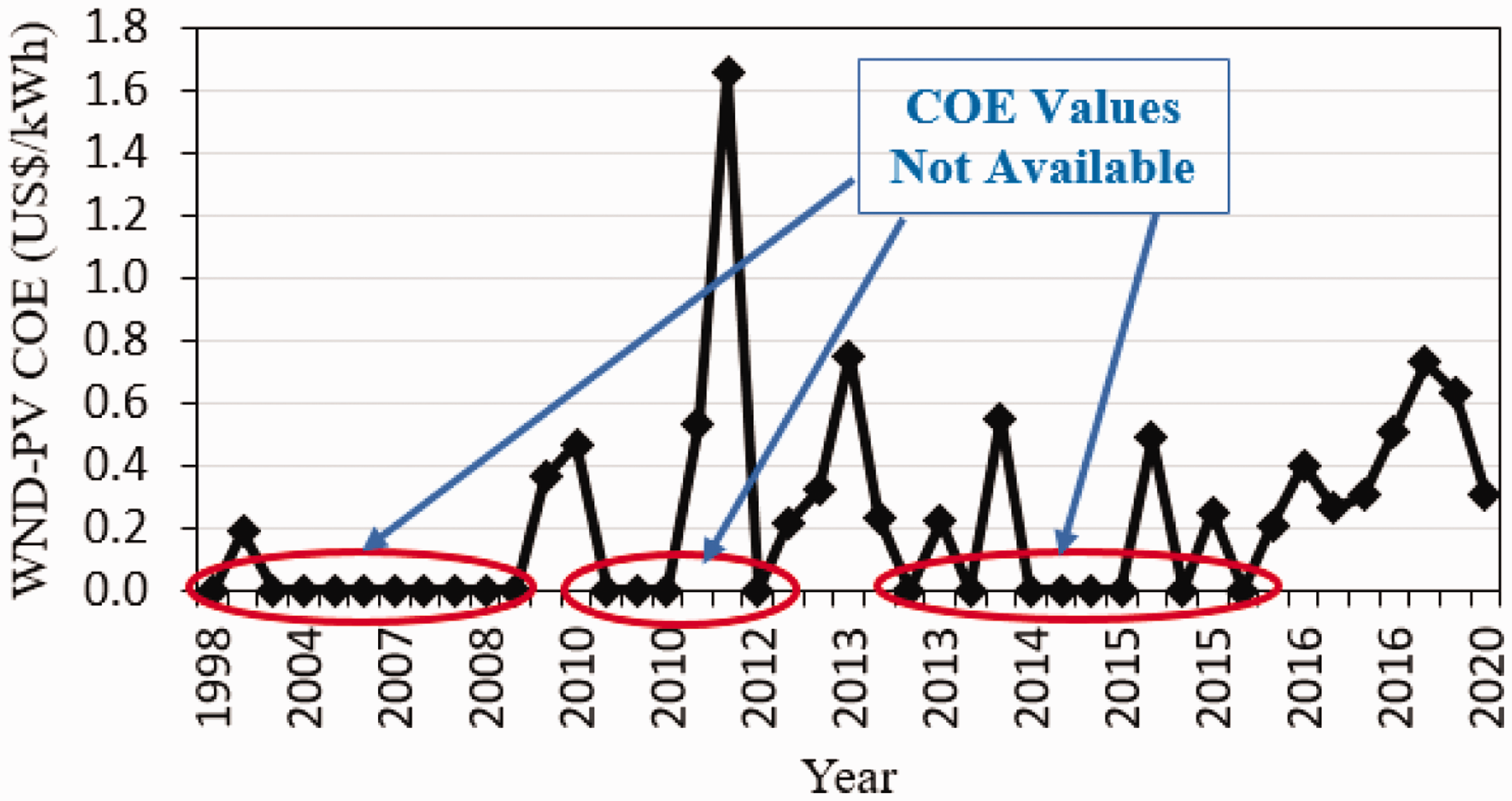
Annual trends of COE of WND-PV HPS from 2005 to 2020.
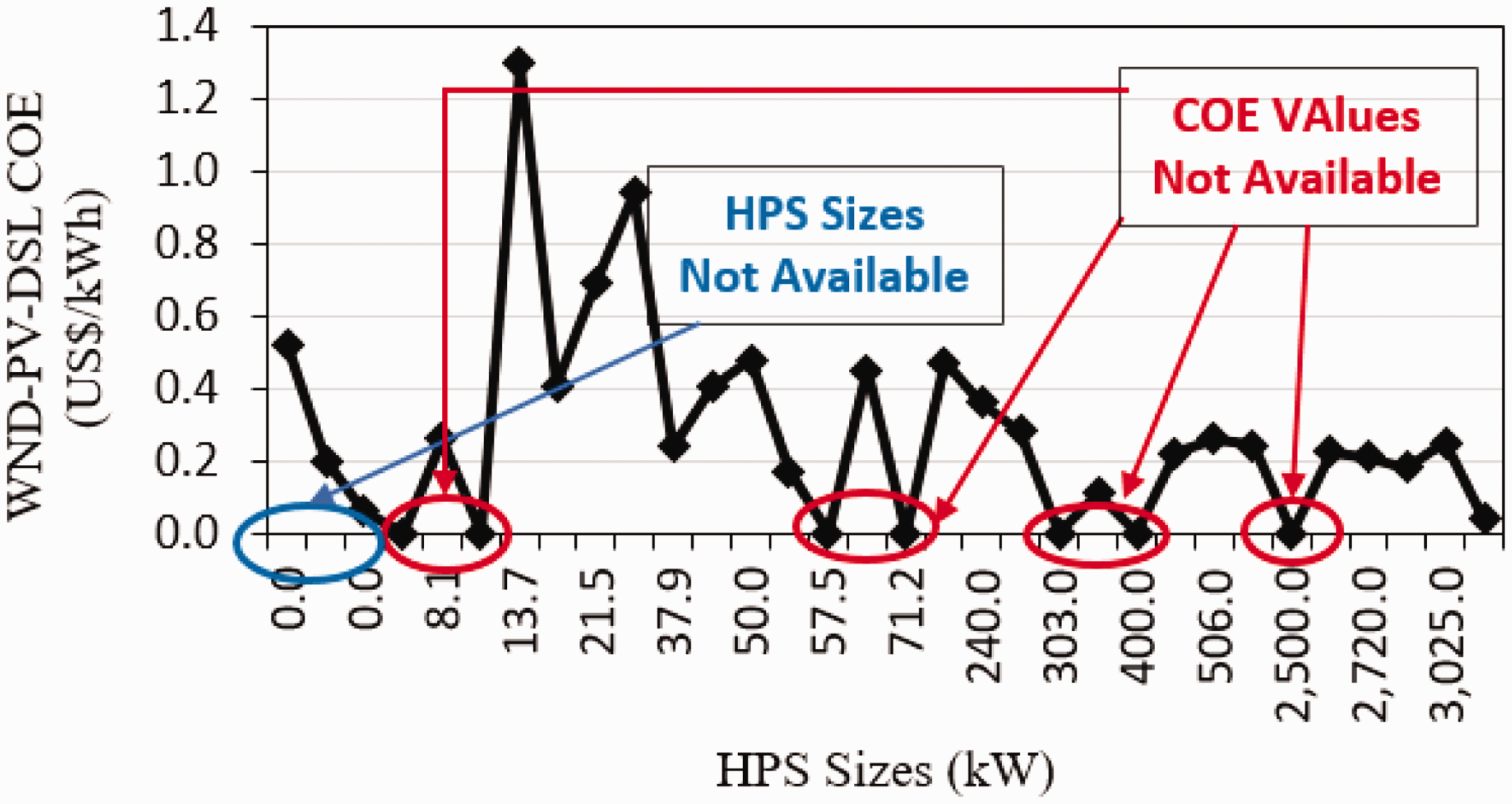
Variation of COE with capacities of WND-PV-DSL HPSs.
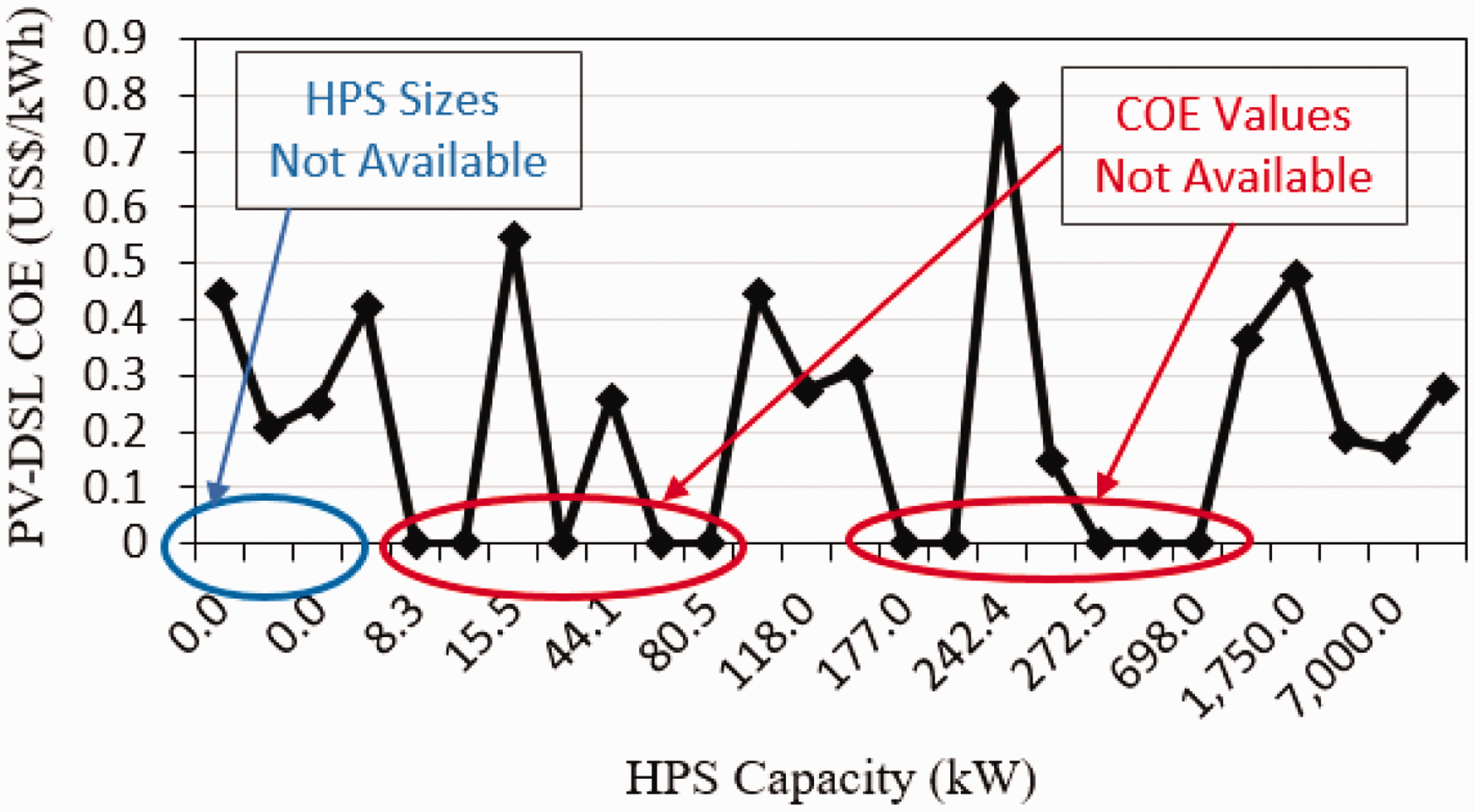
Variation of COE with capacities of PV-DSL HPSs.
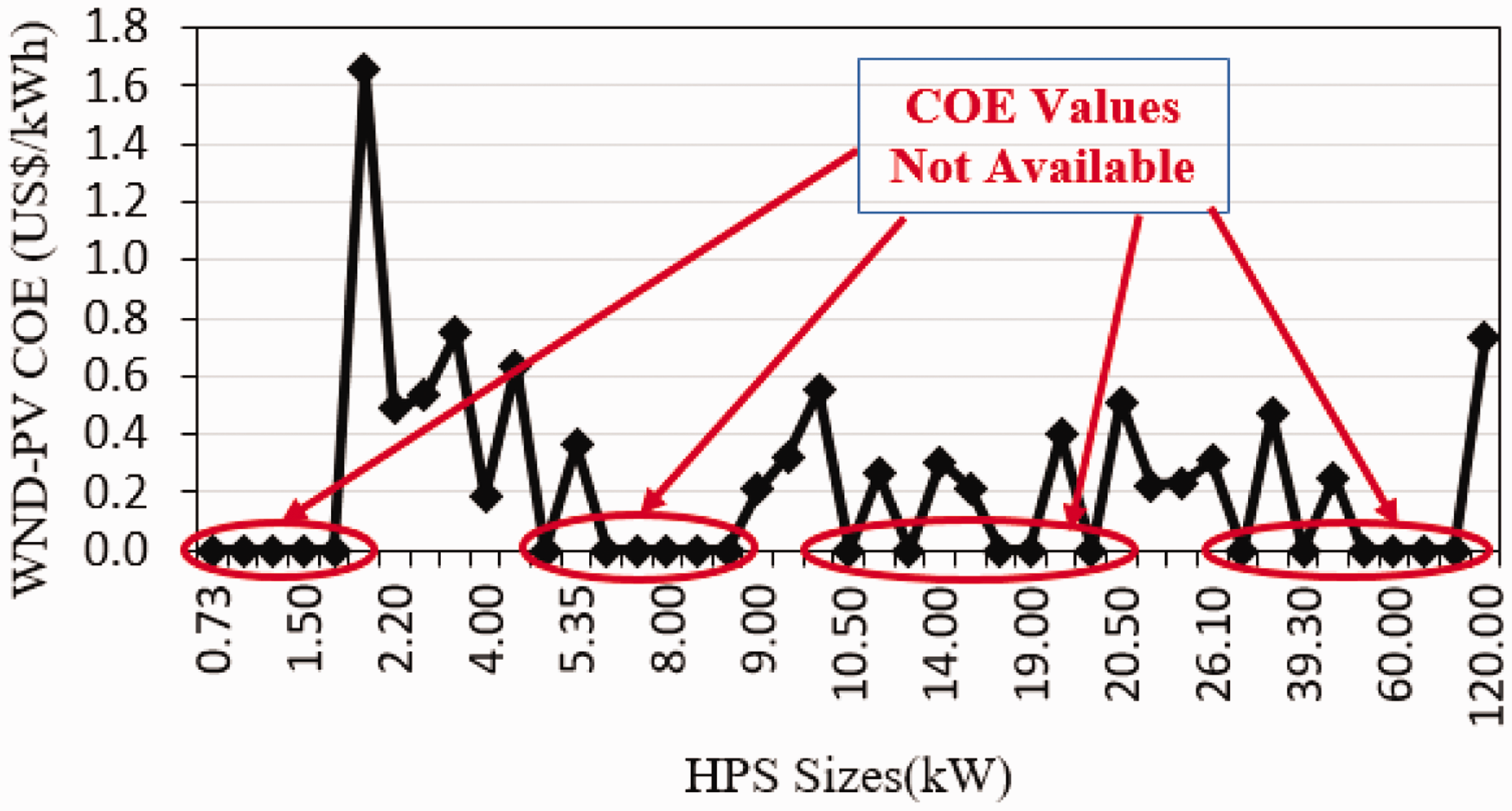
Variation of COE with capacities of WND-PV HPSs.
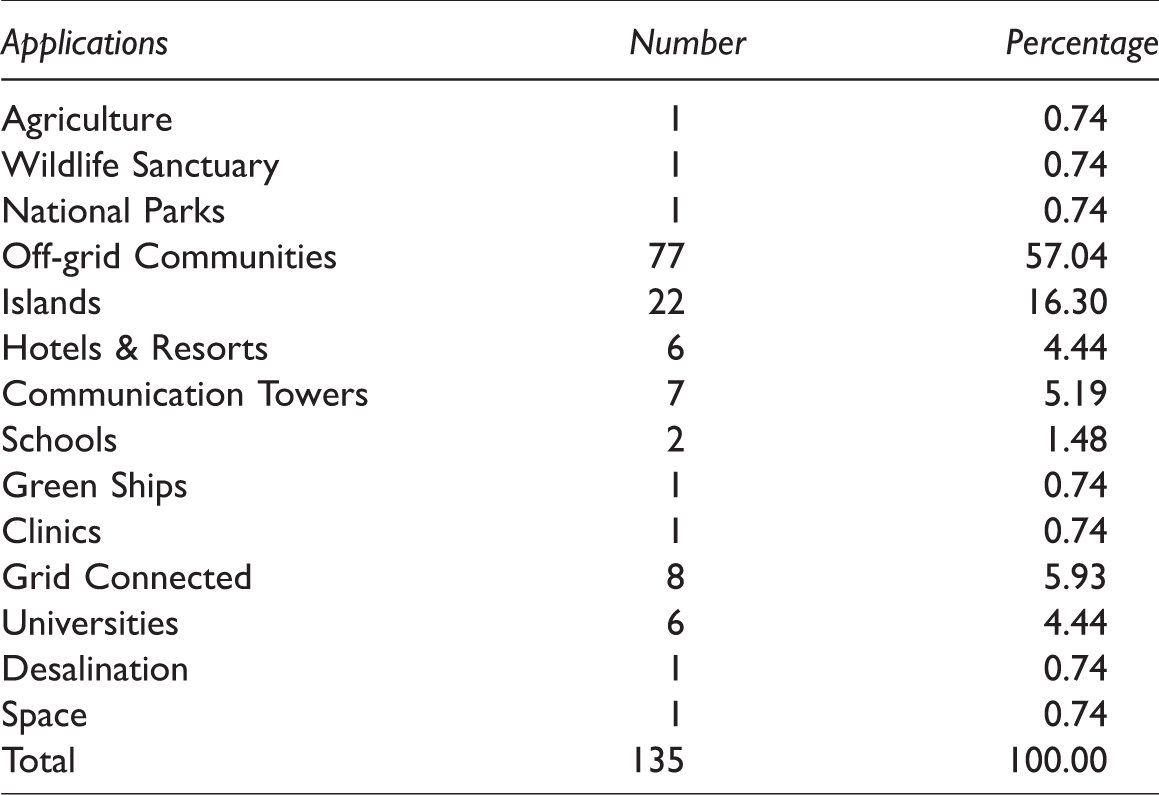
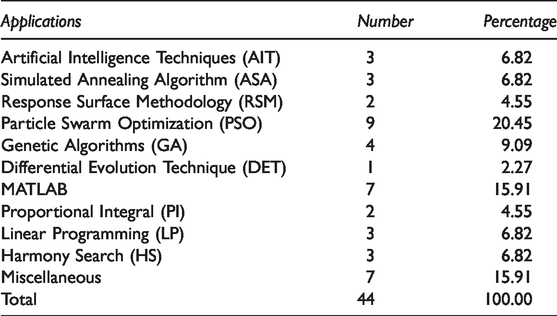
During this survey, authors also tries to compile the type of applications which are common targets of hybrid power systems. List of types of applications, number, and percentages are summarized in Table 2. It is obvious from the data in Table 2 that maximum applications of HPSs are found for off-grid remotely located communities (57%). These communities include small villages, group of houses, individual houses, and apartment buildings as well. The respective HPSs applications are also seen to be popular in Islands (16.3%), small hotels and resorts (4.5%), and communication towers (5.2%). These systems are also getting popular in universities (4.5%) to supply power partially to buildings which are grid connected. With passage of time, the hybrid power systems control techniques and methodologies are improving (Table 3). New and hybrid techniques like artificial intelligence (7%), particle swarm optimization (20%), genetic algorithm (9%), etc. are being used for designing and developing efficient and fast response models and algorithms for control systems.
Distribution of HPS applications.
HPS control and optimal search techniques reported in the literature.
Concluding remarks
Presently, HPSs are being used for power supply to communities, communication tower, islands, alpine huts, industrial fencing, etc. and help in load sharing and mitigation of the GHG emissions. Here, it is an attempt towards providing some guide lines for the people in Saudi Arabia and the region to select appropriate HPS for their application. Specifically, following highlights should be useful for the addressed communities:
The present survey covered WND-PV-DSL, WND-DSL, PV-DSL, and WND-PV hybrid power systems with and without energy storage using batteries, pico-hydro, and other technologies by reviewing around 140 research papers and many other reports and website material.
Of the HPSs surveyed, most widely studied and used are the WND-PV systems (28%) with and without storage while WND-PV-DSL and PV-DSL with 22%and 21% are the second and third best options. The WND-PV total capacities vary between 1.6 and 120.0 kW with an average size of 21.0 kW and an average COE of 0.458 US$/kWh. The average sizes of WND-PV-DSL and PV-DSL are 790.0 kW and 295.0 kW with mean COE of 0.355 and 0.349 US$/kWh. The study recommends these HPSSs for deployment in Saudi Arabia and the region due to its global, commercial, and technological acceptance. WIND-PV HPS with battery storage is the best option for island communities.
The other applications, are the communication and meteorological towers, hotels and resorts, universities, and grid connected.
Hybrid power systems constitute more than one energy sources, which are usually intermittent in nature and hence require sophisticated, efficient, and comprehensive control systems to operate them smoothly under variable conditions. Artificial Intelligence Techniques (AIT), Simulated Annealing Algorithm (ASA), Particle Swarm Optimization (PSO), Proportional Integral (PI), and Linear Programming (LP) are the commonly used methods and techniques for control systems.
Footnotes
Declaration of conflicting interests
The author(s) declared no potential conflicts of interest with respect to the research, authorship, and/or publication of this article.
Funding
The author(s) disclosed receipt of the following financial support for the research, authorship, and/or publication of this article: The author would like to thank Deanship of Research (DSR) at King Fahd University of Petroleum & Minerals for supporting this research under project no. DF191024.
