




Abstract
Pyrolysis and gasification are considered as a means of producing renewable energy and improving energy sustainability, which has become attractive renewable technologies to many countries. Unlike other studies that are conducted in small scale, this study aims to aggregate the economic and environmental effects such as agricultural benefits, energy sale, and carbon sequestration to provide more detailed information to decision-makers before these projects are widely employed. This study first employs a lifecycle assessment to investigate the feasibility, profitability, and emission reduction of four major pyrolysis and gasification technologies using crop residuals, and then conducts a sensitive analysis to examine the most influential factors. The results indicate that the intermediate pyrolysis with rice straw and slow pyrolysis from corn stover could offset the carbon dioxide the most. However, the pyrolysis value is also sensitive to production of the feedstock used. Value adding of stover-based biochar under fast pyrolysis improves profitability but other technologies do not have such patterns. Additionally, while gasification can generate considerable amount of renewable electricity, it yields almost zero percent of biochar that can be used as a soil amendment, and thus its contribution to agricultural sector is trivial.
Introduction
China has become the largest importer of crude oil and natural gas. Its dependence on foreign energy peaks at over 72% and 45% in 2018, respectively (Cheng, 2019). The intensive use of fossil fuel is beneficial to economic growth but emitted unprecedented amount of greenhouse gases (GHG) would make the environment unsustainable and possibly hamper the future growth of economy. For this reason, China has been seeking sustainable energy sources that are considered as clean (or green) and renewable. Under such a consideration, development of renewable energy in China is one of the most urgent issues discussed by various parties among decision-makers, industries, and academics.
Renewable energy production from the utilization of agricultural resources has been considered as the primary solution. First, more than 800 million people who engaged in agricultural and related sectors receive relatively low income stream. Development of bioenergy thus effectively alleviates such a situation and improves distribution of total social welfare. Second, land resource is sufficient that can insure the feedstock supply to bioenergy production. Third, the byproduct produced from bioenergy development such as biochar may be used as a soil amendment to improve environmental quality and land fertility (Lehmann, 2007; McCarl et al., 2009).
This study investigates four types of pyrolysis (i.e. fast, intermediate, slow pyrolysis and gasification) to explore the economic and environmental effects such as potential benefits received by farmers, energy sales, and emission reductions. Gasification is a competitive pyrolysis technology that primarily focuses on gaseous product to generate electricity (Calvo et al., 2012; Hornung, 2013; Park et al., 2014), and this technology is also investigated and compared with conventional pyrolysis technologies so that a comprehensive understanding on various technologies can be obtained. In this study, Jiangxi province of China will be used as an example for the investigation of the large-scale development of pyrolysis and gasification technologies. This study area is determined because it is a typical agricultural-based province that has been undergoing the stages of accelerated industrialization and urbanization, low urban and rural living standard, and the rapid growth of energy consumption.
This study makes contributions in several ways. First, the potential source and technology that increase the supply of biopower can be explored. With this knowledge the decision makers would be able to see to what extent and at what cost the energy security can be improved and the energy structure can be adjusted. Second, this study investigates the regional agro-economic effects and depicts a more efficient way to subsidize farmers and fallow land, both of which are important in welfare analysis. Third, the environmental consequences such as improvement of regional land quality, nearby watershed protection, and potential influences on climate change mitigation are presented and discussed. With such an aggregate framework, the government officers would be able to design or reform existing renewable energy and environmental policies.
Literature review
Pyrolysis and gasification are a promising thermochemical technology to produce renewable energy, and various organic matters such as agricultural commodities and wastes, woody residuals, animal manures, sludge, and municipal solid wastes can be fed as inputs in the pyrolysis reactors (Joshi et al., 2017; Perkins et al., 2018; Rathore et al., 2016).
Feedstocks processed during pyrolysis and gasification generally are decomposed into a range of mixed gaseous, liquid, and solid products such as bio-oil, biogas, and biochar, along with a small amount of ash (Bridgwater and Peacocke, 2000). Depending on the selection of feedstocks and the types of pyrolysis, the combination of outputs may vary significantly (Park et al., 2008). For example, Wright et al. (2008) show that about 15% biochar, 70% bio-oil and 13% syngas of input can be obtained from fast pyrolysis, and Ringer et al. (2006) indicate that 30% as bio-oil, 35% as biogas, and the 35% of feedstock carbon would end up as biochar under slow pyrolysis. However, during gasification process, the heating rate is much higher and the heating duration is much longer, and the feedstocks only end up as biochar and biogas (Calvo et al., 2012). Table 1 presents the general information about the most common types of pyrolysis and gasification technologies under the most popular fluidized-bed reactor.
Reacting temperature and heating duration.
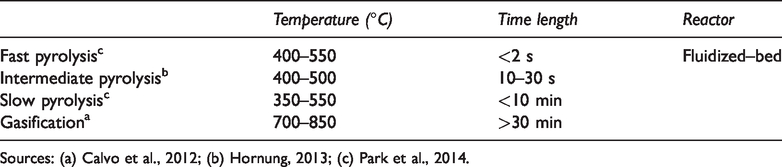
Sources: (a) Calvo et al., 2012; (b) Hornung, 2013; (c) Park et al., 2014.
Studies point out that with pyrolysis technologies, 10 EJ/year to 270 EJ/year of the energy may be generated (Beringer et al., 2011; Gronowska et al., 2008; Searle and Malins, 2015), implying that pyrolysis might be an effective approach to increase the supply of renewable energy world widely. Various gains from pyrolysis application may occur. Studies have pointed out that the conjunctive application of pyrolysis and its solid byproduct (i.e., the biochar) are probably the most efficient method to combat climate change in the sense of carbon sequestration (Lehmann, 2007), along with other economic and environmental benefits (Gaunt and Lehmann, 2008; Lehmann et al., 2006; McCarl et al., 2009).
For example, the field experiments show that with appropriate biochar application, crop yields can be enahnced (Nehls, 2002; Steiner et al., 2007), and saving on irrigation and improvement of feed efficiency can be achieved (Agblevor et al., 2010; Jeffery et al., 2011; Vaccari et al., 2011). Moreover, Woolf et al. (2010) and Smith (2004) suggest that the process and the production of pyrolysis can reduce GHG emissions effectively, while other studies explore that carbon can be captured from the atmosphere and stored in a more stable form via pyrolysis and biochar application (Chan et al., 2007; Lehmann et al., 2003; Qambrani et al., 2017; Qian et al., 2015). These studies implicitly point out that we also need to integrate the co-benefit of biochar application in agricultural sector to achieve a more robust conclusion to these competing pyrolysis technologies.
However, none of the above pyrolysis technologies has been successfully applied in China (Cao, 2019), primarily due to the lack of information of requirement on subsidy, benefits from economic and environmental sectors, and potential influencing factors such as market energy price, plant construction and maintenance costs, and stability of input supply. This study uncovers such information by estimating these issues under the framework of the life cycle assessment (LCA).
Analytical framework
Methods
Life cycle assessment (LCA) is generally used for evaluating environmental effects of a product, process, or activity throughout its life cycle or lifetime, which is known as a ‘from cradle to grave’ analysis (ISO, 2006). It has also been intensively applied in the field of renewable energy analysis to explore the net economic and environmental consequences (Wang, 2008). For example, McCarl et al. (2009) adopt LCA to analyze the profitability of pyrolysis in the United States, while Kung et al. (2013) apply this approach to examine the potential emission reduction of pyrolysis and biochar application. Although this technique is not as complicate as mathematical programming and econometrics, the system boundary must be properly designed to illustrate the general flows of the production.
System boundary
To evaluate the net economic and environmental potential of pyrolysis and gasification in China, it is necessary to understand that there exist heterogeneities across provinces and the estimated values may alter considerably in different regions. This study focuses on the illustrations of the general framework and assumptions for a specific province. The central and local governments can then determine the general effects based on the geographic characteristics, consequently deciding the optimal production path.
Figure 1 presents the system boundary of the economic and environmental components associated with LCA process. The economic components contain the costs of crop production, transportation, processing, plant construction and maintenance, and output applications. Since emission from energy consumption and carbon sequestration would occur, it is also necessary to estimate the net environmental effects to explore the overall consequence from renewable energy technologies. That is, only by systematically measuring and evaluating the energy consumption and environmental emissions in the whole process of feedstock collection and biochar application, we are able to assess actual environmental impact.
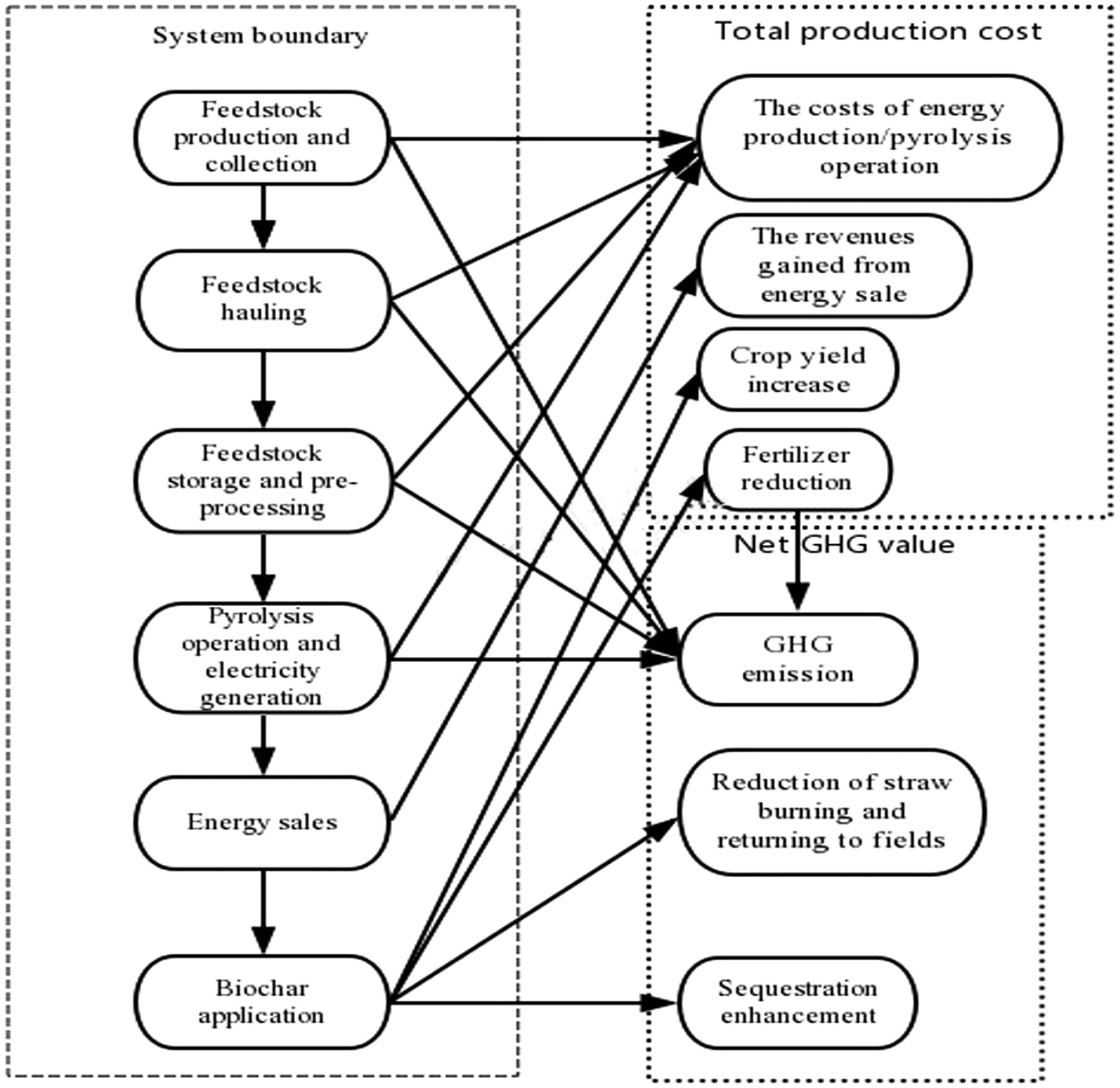
System boundary of pyrolysis and gasification in China.
Pyrolysis output
Jiangxi, one of the agricultural provinces of China, is relatively under-developed and its residents have been suffering from low incomes and low living standard for decades. Rice and corn are the major commodities produced and thus we would utilize rice straw and corn stover to investigate the energy, economic, and environmental potential from pyrolysis and gasification technologies in this area.
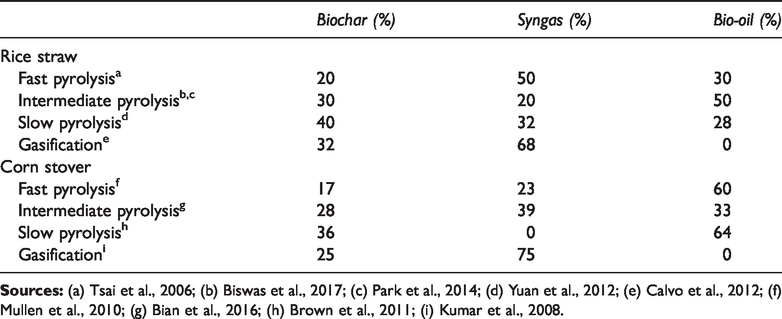
Table 2 indicates the output ratios of the rice straw and corn stover. While slow pyrolysis generally yields the maximum amount of biochar per unit of input, fast pyrolysis yields the most liquid components (Park et al., 2014). On the contrary, gasification yields 0% of bio-oil and most of the input will be decomposed into a mixture of gases such as carbon monoxide, hydrogen and light hydrocarbons, along with a small portion of carbon dioxide and nitrogen (Calvo et al., 2012). This gas mixture is also called syngas that contains high calorific value that can replace fossil fuels in high efficiency power generation, heat, and combined heat and power applications.
Pyrolysis and gasification outputs.
Economic analysis of pyrolysis and gasification
Feedstock production and collection
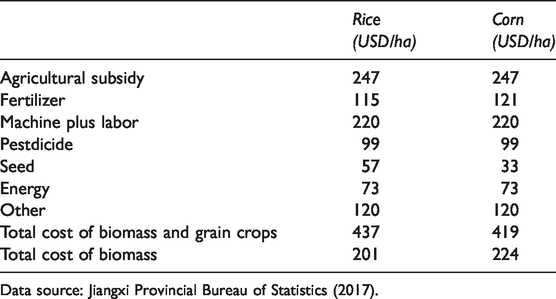
Since 2016, an agricultural subsidy of USD247 per hectare (USD/ha) has been implemented. Based on the Analysis about the Changing Efficiency of the Major Crops in China (Li and Zhang, 2010), we then estimate the fertilizer cost proportionally to crop residues. The result is displayed in Table 3.
The amount of fertilization use.
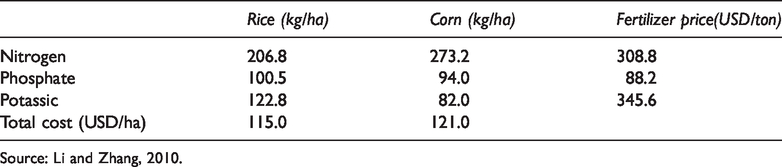
Source: Li and Zhang, 2010.
The average seeding rates for rice and corn are 150 kg/ha and 111 kg/ha, with the respective 2017 market prices of USD382.4/t and USD294/t. By adding all components, we estimate the total cost of USD 437/ha for rice and USD419/ha for corn. However, since the total cost should be allocated to crop and its residual, we calculate the weight of “residue to biomass” to obtain the costs of the crop residues. Table 4 presents the results.
Feedstock production and collection cost.
Data source: Jiangxi Provincial Bureau of Statistics (2017).
Feedstock hauling and storage
To estimate the transportation cost of feedstocks from cropland to plant, we assume that the pyrolysis plant with 75,000 capacity is located in the center of a square surrounded by a square grid layout of roads, and thus the average hauling distance (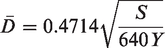

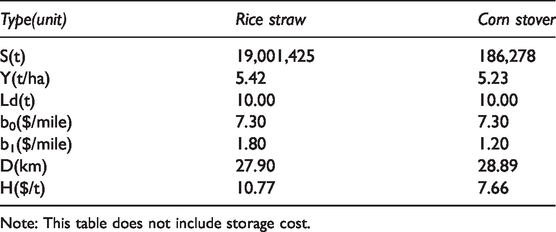
We use a 10 ton grain elevator truck that can automatically convey crops into the carriage to reduce the loading charge from USD58.2 to USD7.3 per mile. Because rice could be harvested twice a year and corn is harvested only once a year, the hauling charge including maintenance labor cost is USD1.8 for rice straw and USD1.2 for corn stover. The results are presented in Table 5.
Estimated transport cost and hauling distance of feedstocks.
Note: This table does not include storage cost.
The feedstock should be stored before being processed, storage costs should be estimated. The assumed storage fee is USD17.6 per ton of feedstock based on the Statistics of National Reserved Storage Fee. Altogether the per ton hauling and storage cost are USD28.37 for rice straw and USD25.26 for corn stover.
Cost of plant operation
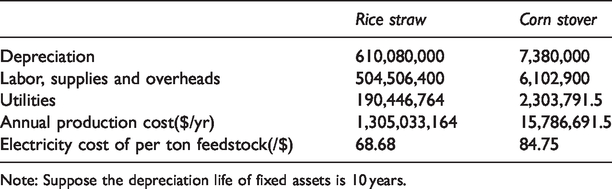
Most gasification and pyrolysis processes have four stages such as preprocessing the feedstocks, conveying the feedstocks to the pyrolysis plant, scrubbing the gases to remove the particulates and water and hydrocarbons and soluble matters, and using the outputs to generate electricity. For a plant that consumes 200 tons of biomass per day, its capital investment is approximately USD24.6 million (including the purchase and installation of all equipment), and labor expenses, supplies and overheads costs, and utilities are about USD 203,430 and USD767,930 for rice straw and corn stover, respectively (Pourhashem et al., 2013). For the plant with processing biomass capacity of 75,000t per year, we need 248 plants for rice straw and 3 plants for corn stover. The result in Table 6 shows that rice straw can generate electricity at a lower cost.
Annual cost of electricity production of alternative feedstock.
Note: Suppose the depreciation life of fixed assets is 10 years.
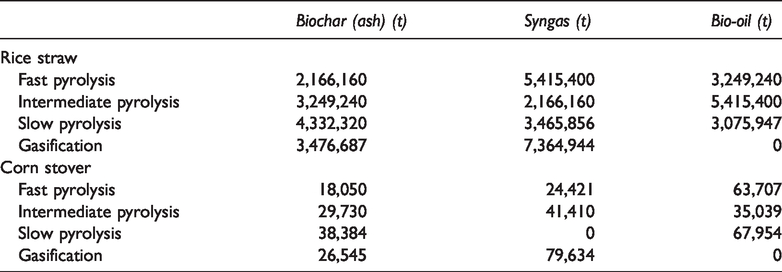
During stages 1 and 2, the moisture contained in the feedstocks is removed, and the production of each output is displayed in Table 6.
The biochar is applied as a soil additive to sequester carbon, while bio-oil and syngas are used for power generation. We then adopt the estimates from Pourhashem et al., (2013) to obtain the heating value of bio-oil, biochar and coal of 22.1 MJ/kg, 21 MJ/kg and 30.15 MJ/kg, respectively, and the heating value of syngas of 3.98 MJ/kg from Calvo et al. (2012).
Table 7 shows the generating capacity under various technologies. For rice straw, biomass produced by intermediate pyrolysis could yield 33,281,119 MWh, while corn stover under fast pyrolysis generates the most. Although the generating capacity of slow pyrolysis and gasification is relatively low, they produce considerable amount of biochar that significantly benefits the agricultural sector.
The output from various pyrolysis and gasification technologies.
Generating capacity of various feedstocks.
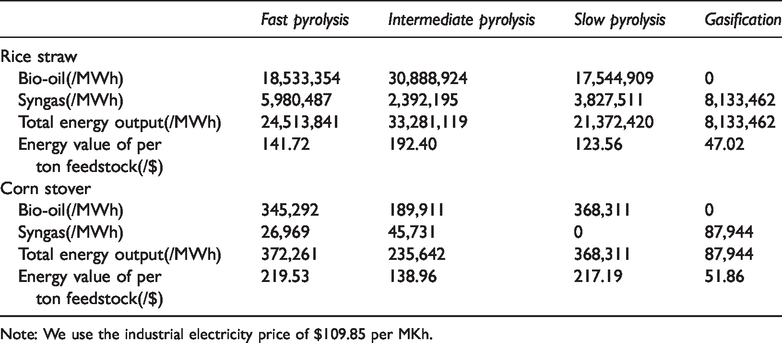
Note: We use the industrial electricity price of $109.85 per MKh.
Value of biochar
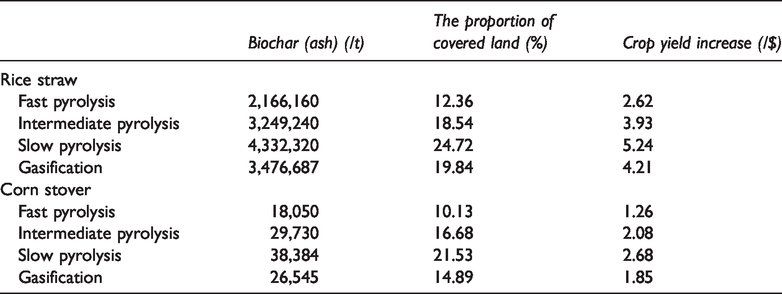
Lehmann et al. (2003) found that the application of biochar to soil results in a 60% reduction in nitrogen leaching. Xu et al. (2016) studied the effect of biochar additions to soil on nitrogen leaching and came up with the result that biochar could significantly reduce the cumulative amount of total N leached by 18.8%, 19.5% and 20.2% in the 2%, 4% and 8% treatment, respectively. Their results point out that increasing amount of biochar applied on soil would reduce N leaching. Hence, we assume that the reduction in N leaching is 20 wt.%, which is equivalent to a 20% saving of fertilizer. Biochar could also increase crop yield. Vaccari et al. (2011) investigate the large volume application of biochar (30 and 60 t ha−1) on durum wheat in the Mediterranean climate condition and the result shows that with biochar application up to an 30% increase on biomass production may be achieved. Major et al. (2010) also point out that the maize yield could be improved ranging from 40% to 200% during the next three years. To be conservative, we assume that the crop production would increase by 5% with the application of 5 t per hectare of biochar in this study. The estimates are shown in Table 8.
The current rice and corn price are $378.79/t and $301.52/t, respectively. Thus, the benefit from crop yield is USD21.21 for rice and USD12.45 for corn per ton of biomass. However, only a portion of cropland can be applied with limited amount of biochar, and rice seems to be a more attractive feedstock as its production is much larger than corn. The results are shown in Table 9.
Crop yield increase.
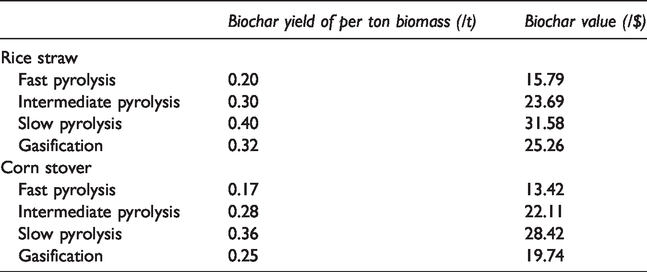
So far there exists no standardized biochar market, and we estimate the biochar value using its energy content relative to coal. Since the heating value of biochar is 67% of coal, along with the current coal price of $117.12/t in China, the biochar price is assumed to be $78.95 per ton. Table 10 shows the value of biochar under different pyrolysis and gasification technologies. We find that the combustion value of biochar far exceeds its added value as a soil additive, implying its economic benefits under energy source is more attractive. In area where results show that biochar combustion value is greater than its environmental value, people would find the alternative use of biochar and make it as a fuel source rather than as a soil additive.
Biochar value of combustion.
Environmental analysis of biochar application
Since the biochar-compost-based soil management can improve soil organic carbon, soil nutrient status, and soil water content, and may mitigate greenhouse gas emissions in certain systems (Agegnehu et al., 2016), to explore the net environmental consequence from pyrolysis and gasification, it is necessary to take the alternative biochar application into account.
Production and hauling
In this study, the GHG offset of feedstock production refers to the direct and indirect carbon emissions caused by human carbon input in the crop production. The direct carbon emissions from crop production refer to the greenhouse gas emissions caused by the carbon input directly affecting the whole production process, including the consumption of agricultural machinery fuel and direct carbon emission increase in soil due to the application of fertilizer. Indirect carbon emission from production refers to the transportation of production materials such as fertilizers and pesticides, production process, and carbon emissions from upstream sectors. The system boundary of the carbon footprint starts from sowing and ends at harvest. The boundary is defined within the crop production and planting process.
The carbon footprint per hectare of rice is 0.35 t CO2e in Jiangxi (Luo, 2014), while Yu et al. (2019) indicate that the greenhouse gas emission from corn production is 0.55 t CO2e per hectare. We estimate the GHG emission of per ton of biomass is 0.065 t CO2e for rice straw and 0.105 t CO2e for corn stover.
Collected feedstock will be transported to the plant, and produced biochar will be conveyed to the field. The average hauling distance per ton of biomass is 27.90 km for rice straw and 29.89 km for corn stover, and the average hauling distance for straw-based biochar and stover-based biochar is 21.63 km and 22.39 km, respectively. A truck with a 10-ton capacity consumes 22.6 liters of gasoline per 100 km with CO2 emission of 2.7 kg/liter (Zeng and Nie, 2016), and thus the CO2 emission from transportation is estimated to be 0.61 kg/km. With these estimates, the CO2 emission in the hauling process is 0.002 t CO2e regardless of what feedstock is transported, and during production and hauling stage, the emissions per ton of biomass are estimated to be 0.067 t for rice straw and 0.107 t for corn stover.
Plant operation
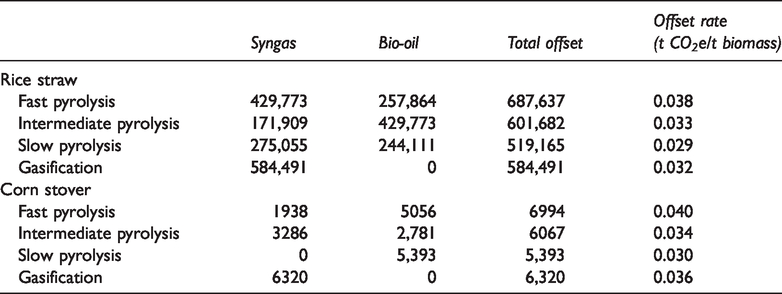
Rogers and Brammer (2012) showed that to produce bio-oil containing 1 GJ heating value requires energy input of 20 KWh. Based on the average emission factors of regional power grids, we use the carbon emission factor of 0.997 t CO2e/MWh. The CO2 offset from pyrolysis and gasification is presented in Table 11. Regardless of the types of feedstock, the fast pyrolysis offsets the most emission, while the slow pyrolysis offsets the least.
CO2 offset from plant operation.
Offset from electricity generation
From the perspective of power generation, China's total thermal power generation reached 4979 billion KWh in 2018, accounting for about 73.23% of the total power generation. We assume that the energy generated from bio-oil and syngas is to substitute the electricity generated from coal and the results of emission offset from electricity are shown in Table 12.
CO2 offset from electricity generation.
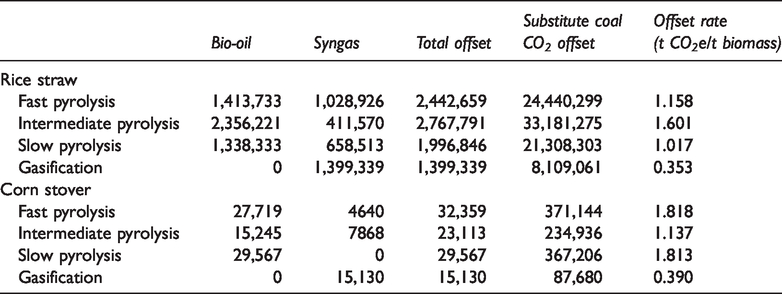
The maximum CO2 reduction from rice straw utilization is 1.601 t under intermediate pyrolysis, while the maximum CO2 reduction per ton of corn stover is 1.818 t under fast pyrolysis. Gasification is the least competitive technology compared to other pyrolysis modes.
Offset from reduced inputs and irrigation
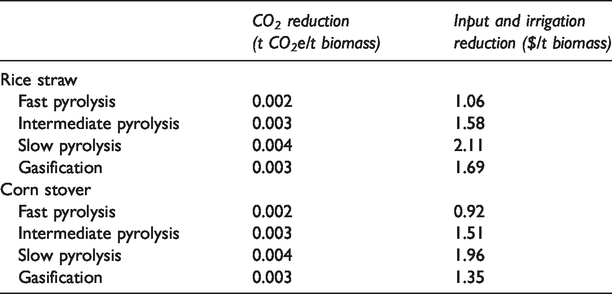
Biochar improves nitrogen and water retention, and thus less amount of fertilizer and irrigation is required. This eventually reduces NO2 emission from the application of fertilizer machinery and fertilizer itself, and CO2 emission from fossil fuel consumption associated with irrigation. With the 20% nutrient saving and the emission factor from IPCC (2006) and Dubey and Lal (2009), NO2 emission from Nitrogen, Phosphorus, and Potassium is equivalent to 1.4 kg CO2, 0.73 kg CO2, and 0.55 kg CO2, respectively. Collectively, the per hectare CO2e emission is 86.2 kg for rice straw and 99.2 kg for corn stover.
Meanwhile, the fertilizer reduction per hectare amounts to USD23 for rice and USD24.2 for corn, and the reduction on associated machine, labor, and energy use is USD23.3 per hectare. The results are shown in Table 13.
Offset from reduced inputs and irrigation.
Carbon sequestration from biochar
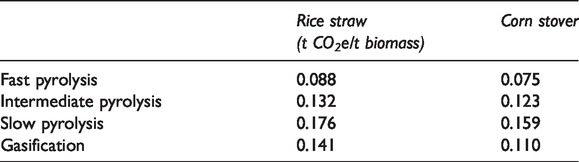
The average organic carbon content in Jiangxi province is approximately 100t/ha and the carbon density of the surface layer of dry land is 1/3 relatively to the world average, implying that the soil system in China has great potential for carbon sequestration and emission reduction (Xu et al., 2016). In terms of carbon sequestration, 60% of carbon contained in biochar of which 2% escaping in the form of CO2, and the remaining 58% would retain in the form of stable C, resulting in the carbon sequestration of 2.9 t CO2e per hectare.
Besides this, there are about 1/3 straw burned directly in China (Jiang et al., 2013; Li and Wang 2013). If the conventionally burned straws are to be used in biochar application, it will offset 0.957 t CO2e per hectare, resulting in an emission reduction of 3.857t CO2e from biochar application. The results are presented in Table 14.
Carbon sequestration from biochar application.
Net GHG balance
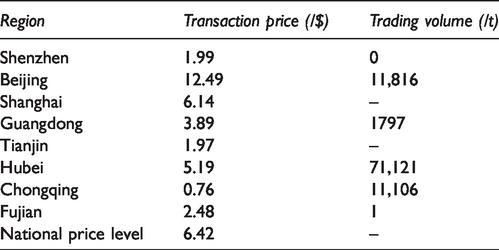
Since May 2013, the implementation of trading on carbon emission is launched. Based on the prices released from national emission trading exchanges (Table 15), we use a weighted average price of $6.4 per ton CO2e to measure the total value of reduced CO2 emission.
Trading volume and price of carbon emission.
The GHG value ranges from USD2 to USD12 of per ton biomass, and corn stover is considered as a more suitable feedstock in terms of profitability. Although the amount of corn stover received in Jiangxi is relatively less than that of the rice straw, the result implies that in regions where the corn is the primary commodity may obtain significant emission reduction. The results are displayed in Table 16.
Net environmental benefits from pyrolysis and gasification.
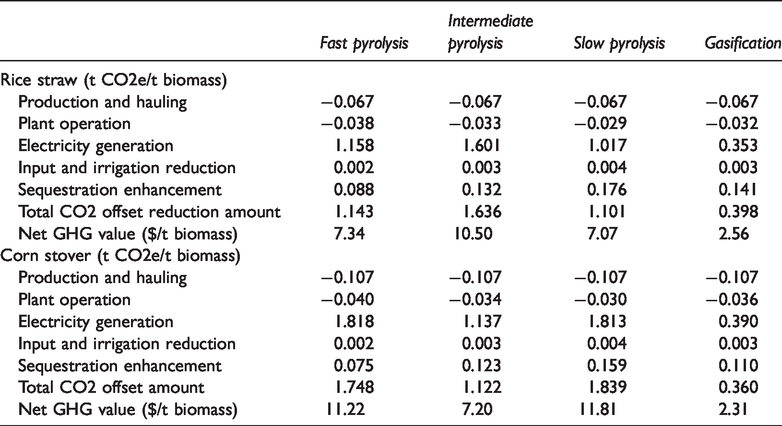
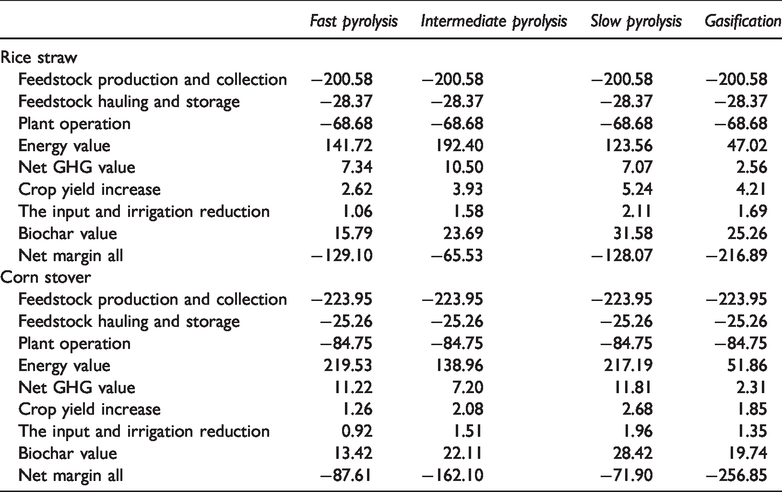
Table 17 summarizes the net benefits from pyrolysis and gasification using corn stover and rice straw.
Totality of value ($/t biomass).
Sensitivity analysis
For rice straw, only if the electricity price is higher than USD146.26/MWh, intermediate pyrolysis could be profitable. Slow pyrolysis can be profitable as long as the electricity price increases to USD145.21/MWh. When the biomass is corn stover, this result is close to intermediate pyrolysis.
Regardless the feedstock used, gasification is the least competitive to other production module. Gasification can be profitable unless total costs from production, hauling, and plant operation can be reduced by 75%. Since this great reduction is hardly to achieve in the short run, gasification is less attractive.
When environmental consideration is more emphasized by the government, the GHG price may rise substantially and improve profitability. The study shows that if the GHG price rise to about USD40 per ton, then both slow and intermediate pyrolysis could be economically feasible. However, as international GHG price has been continuing falling and the highest domestic price level is only USD12.49 in Beijing, such an application may not be as attractive as other renewable technologies.
Conclusion
The benefits of pyrolysis primarily come from greenhouse gas offset, carbon sequestration enhancement, and increased crop output. The profitability of fast, intermediate, slow pyrolysis and gasification using rice straw and corn stover as feedstock in Jiangxi is examined to explore their economic and environmental potential. The results show that gasification technology is not competitive to other pyrolysis patterns. The most competent pyrolysis patterns using different feedstock are intermediate pyrolysis using rice straw and slow pyrolysis using corn stover. The benefit from pyrolysis application is also sensitive to feedstock selection and subsequent pyrolysis output. Value adding of stover-based biochar under fast pyrolysis improves profitability but other technologies do not have such patterns.
Footnotes
Declaration of conflicting interests
The author(s) declared no potential conflicts of interest with respect to the research, authorship, and/or publication of this article.
Funding
The author(s) disclosed receipt of the following financial support for the research, authorship, and/or publication of this article: The authors thank for the support from the National Natural Science Foundation (41861042; 71864013; 71663025), Distinguished Young Scholar Program of Jiangxi Province (20171BCB23047), Science Program of Jiangxi Bureau of Education (GJJ190275), and University Social Science Foundation of Jiangxi (JC17205).
