




Abstract
Coal seams 41 and 42 of the Heshan Coalfield belong to superhigh-organic-sulfur coals. In order to study the geochemical characteristics of the coals, 15 coal samples and 6 rock samples were collected from both coal seams and the roof/floor rocks. The samples were investigated by using conventional microscopy, inductively coupled plasma mass spectroscopy, X-ray diffraction, X-ray fluorescence, and scanning electron microscopy with an energy-dispersive X-ray spectroscopy. The results show that minerals in the coals are dominated by kaolinite and a mixed layer illite/smectite and illite; small ratios of pyrite, quartz, chlorite, smectite, calcite, and dolomite are also present. Under the microscope, these pyrites occur as framboidal, euhedral, homogeneous, anhedral, nodular, and fine dissemination shapes. In Shicun Mine, the trace elements Li, Y, Zr, Sn, Sm, and Tb are enriched; Zn and Ba are depleted. However, in the Heliluoshan Mine, Mo is significantly enriched; Li, Zr, Cs, and U are enriched; and Co and Ba are depleted. The occurrence of Li and Ga is associated mainly with organic matter and sulfate minerals. U and Mo occur in silicate minerals, carbonate minerals, illite, I/S, and pyrite. A reducing environment is beneficial for the enrichment of V, Cr, Mn, Ni, Mo, Cd, and U. The abundances of sulfur in Heshan were controlled mainly by the degree of seawater influence and hydrothermal activities.
Introduction
Emissions of hazardous elements such as S, As, F, Cr, Pb, Hg, Cd, and Cl during coal mining, transportation, and combustion have caused severe environmental problems (Dinelli et al., 2001). Moreover, cases of endemic fluorosis, arseniasis, selenosis, and lung cancer have been linked to indoor combustion of coal in China (Zheng et al., 1999; Luo et al., 2011; Zhang, 2015). On the contrary, several valuable elements occur as coal by-products, with high concentrations of Al, Li, and Ga as well as rare earth elements and yttrium reported (Dai et al., 2012, 2013, 2015; Qin et al., 2015a,b; Seredin et al., 2013; Sun et al., 2010, 2012a, 2012b, 2013a, 2013b; Sun, 2015; Wang, 2019a; Zhao et al., 2017).
According to the Ministry of Ecology and Environment of the People’s Republic of China, coal consumption in China accounted for 59.0% of the total energy consumption in 2018. Both hazardous and valuable elements have been reported in various types of Chinese coal (Seredin et al., 2013; Wang et al., 2013, 2019b; Xu et al., 2019; Zheng et al., 1999). One such type is referred to as superhigh-organic-sulfur (SHOS) coals owing to its organic sulfur content in the coal is more than 4% (Chou, 2012); such a high sulfur content makes SHOS coals more hazardous to the environment. Heshan coal belongs to this type. Several previous studies have focused on the depositional environment (Huang et al., 1994; Li et al., 1986; Shao et al., 2003a; Wang et al., 1995), the trace element geochemistry, and the mineralogical compositions of this coal (Dai et al., 2013; Shao et al., 2003b; Zeng et al., 2005). Dai et al. (2013) concluded that the high organic sulfur in the coal was derived from both seawater and hydrothermal fluids and that the elements V, Mo, U, and Se in the coals were derived from hydrothermal solutions during peat accumulation or at the early diagenetic stage. Factors controlling the mineralogical and geochemical composition include material input from the sediment source region (Yunkai Upland); the influence of seawater during deposition; and hydrothermal fluids. Shao et al. (2003b) reported that coal-forming environments are in low-lying, marine-influenced palaeomires and are developed on carbonate platforms. The occurrence modes of the elements were deduced by applying Person’s correlation coefficients between pairs of elements or the between element and ash yield (Shao et al., 2003b; Zeng et al., 2005).
The purpose of the present study is to examine the occurrence of partly valuable and hazardous elements in Heshan coal. Additionally, pyrite is described less frequently in previous studies. Therefore, we focus on the occurrence characteristics of pyrite combinations with trace elements to reveal useful information for clean utilization of these coals.
Geological setting
The geological setting of the Heshan Coalfield has been studied in detail by many geologists (Dai et al., 2013; Shao et al., 2003a). Here, aspects concerning only the particular geology of coal seams in the areas of this Coalfield are discussed.
Heshan Coalfield is located in central Guangxi and has an area of 360 km2 (Figure 1). The coal-bearing strata are included in the Heshan Formation of the Upper Permian, which is composed mainly of mudstone, limestone, carbonaceous limestone, granophyric limestone, and coal seams (Figure 1). This formation, with a thickness of about 160 m, contains the Nos. 2, 31, 32, 33, 41, 42, 43, and 5 coal beds, of which the Nos. 41 and 42 coal seams are minable (Figure 1). The No. 41 coal overlies a thin layer of limestone and is overlain by bioclastic limestone. The roof of the No. 42 is a thin limestone, and its floor is a thick limestone, overlain by thin carboniferous mudstone. The roof and floor rocks indicate that the coal-bearing strata were formed in tidal flat environments on a restricted carbonate platform (Dai et al., 2013).
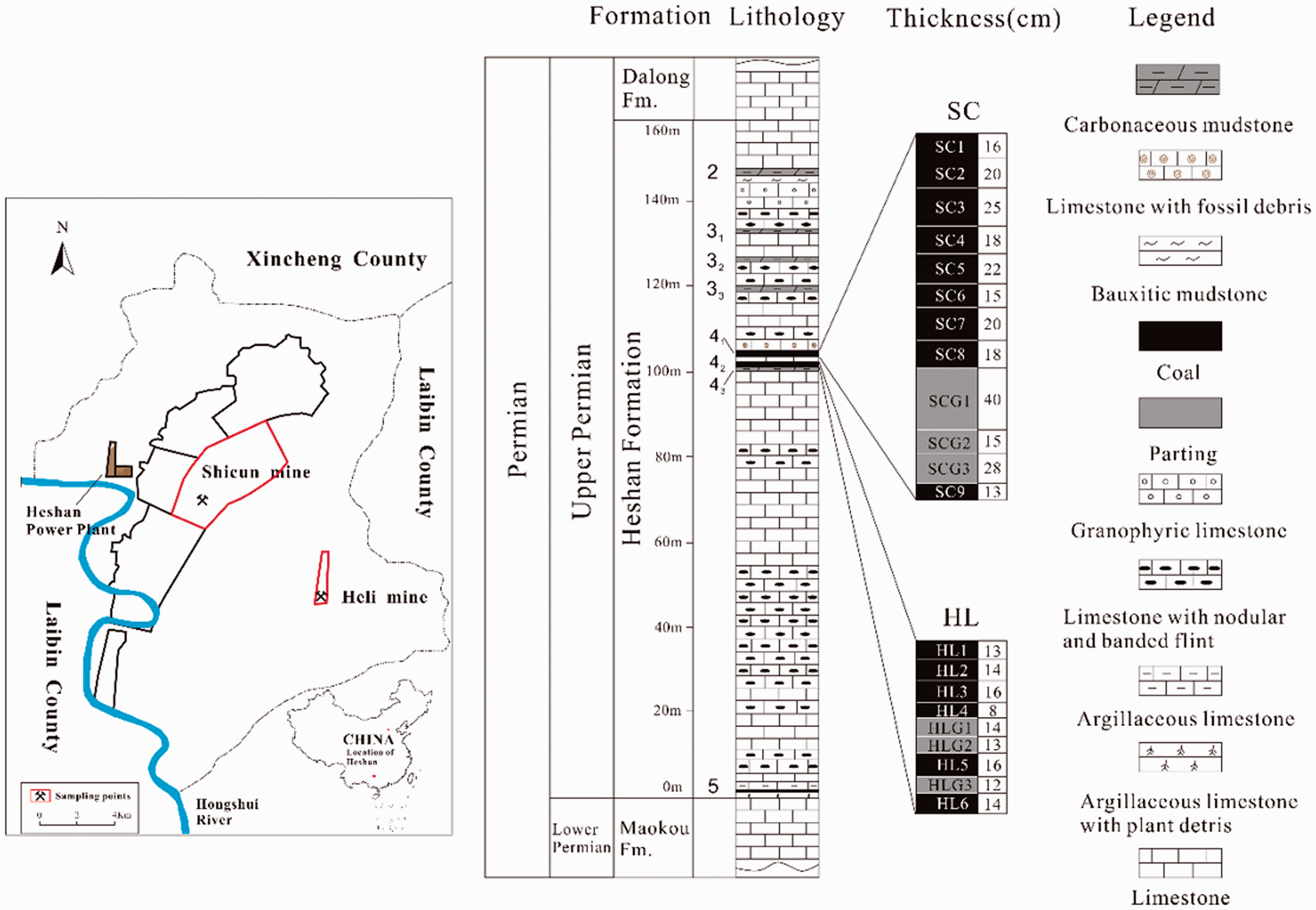
Stratigraphic column of coal-bearing strata in the Heshan Coalfield and sampling location.
Sampling and analytical methods
Sampling
The samples were collected from the mined coalfaces of the Heshan Coalfield. Nine coal bench samples and three parting samples were collected from the No. 41 bed in Shicun Mine 3, whereas six coal bench samples and three parting samples were collected from the No. 42 bed in Heliluoshan Mine following the Chinese Standard Method GB482-2008. From top to bottom, the bench samples are identified as SC1 to SC9 and HL1 to HL6, respectively, and the parting samples are identified as SCG1 to SCG3 and HLG1 to HLG3, respectively (Figure 1). The samples were wrapped in aluminum foil, placed in a plastic bag, and transported immediately to the laboratory to avoid contamination and oxidation. For the petrographic and geochemical analysis, all samples were crushed to 80 and 200 mesh sizes, respectively.
Analytical methods
The 80-mesh-sized samples were used for proximate analysis, total sulfur, petrography, and mineralogical composition. The proximate analysis was conducted using ASTM Standards D3173-03, D3175-02, and D3174-04 (2005b, 2005c, 2005d). The total sulfur and forms of sulfur were determined according to ASTM D3177-02 and D2492-02 (2005a, 2005e), respectively. The petrologic composition was investigated using a Leica DM2500P reflected light microscope equipped with a Craic QDI 302TM spectrophotometer. The morphological characteristics and the mineral composition were studied by scanning electron microscope (Hitachi UHR FE-SEM, SU8220) equipped with an energy-dispersive X-ray spectrometer (SEM–EDS) at the Key Laboratory of Resource Exploration Research of Hebei Province.
The 200-mesh-sized samples were used for geochemistry analysis. The oxide contents of the major elements including Si, Al, Fe, Ca, S, Mg, K, Ti, Na, P, and Mn were determined using X-ray fluorescence spectrometry (XRF; ARL PERFORM’X) with Cu–Ka source at the Key Laboratory of Resource Exploration Research of Hebei Province. The coal and parting samples were ashed at 815°C for 8 h. For the XRF analysis, 1 g of the pulverized sample was used. First, the loss on ignition (LOI) was determined at 1030°C. If the LOI was <25%, 5 g LiBO2 was added; if the LOI was >25%, 2.5 g of LiBO2 + 2.4 g Li2B4O7 was used. Then, the mixture was fused at a temperature of 1200°C for 20 min.
The mineralogical composition was determined by X-ray diffraction (XRD). Low-temperature ashes (LTA) analysis of the samples was performed on an EMITECH K1050X plasma Asher with the temperature maintained below 200 °C. The resultant low-temperature ashes of the coal and parting samples were analyzed by XRD performed on a D/max-2500/PC powder diffractometer with Ni-filtered Cu–Kα radiation and a scintillation detector. The XRD patterns were recorded over a 2θ interval of 5–70° with a step size of 0.01° at a voltage of 40 kV.
The trace elements were identified using inductively coupled plasma mass spectrometry (ICP-MS, USA).
Results
Proximate analysis
Proximate analysis results and total sulfur of the coal benches from the Heliluoshan and Shicun mines are given in Table 1. According to the Chinese Classification for Coal Quality GB/T 15224.1–2018, MT/T 849–2000, and GB/T 15224.2–2010 as well as Chou (2012), the Shicun coal is a medium–high-ash, low-volatile, and high-sulfur coal. In comparison, the Heliluoshan coal is a high-ash, medium-volatile, and high-sulfur coal. The sulfur content in the Shicun coal varies from 4.75 to 6.94%, with an average of 6.01%, and that in the Heliluoshan coal varies from 4.2 to 9.77%, with an average of 6.55%. The percentage of organic sulfur is mostly above 80%.
Parameters of proximate analysis for coal samples from Heshan Coalfield.
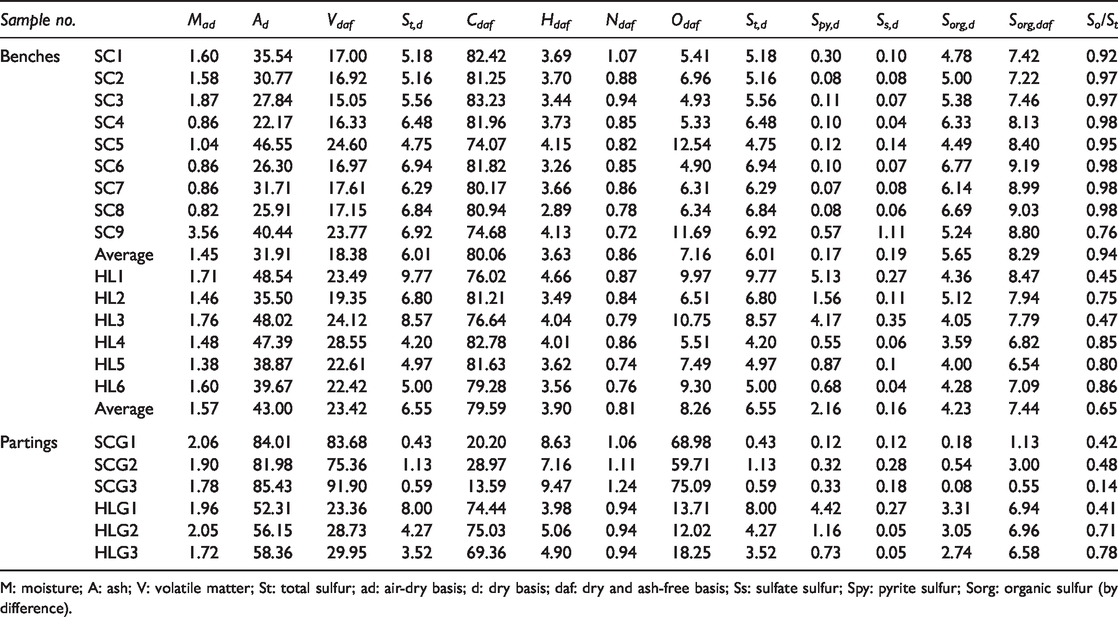
M: moisture; A: ash; V: volatile matter; St: total sulfur; ad: air-dry basis; d: dry basis; daf: dry and ash-free basis; Ss: sulfate sulfur; Spy: pyrite sulfur; Sorg: organic sulfur (by difference).
Minerals
The mineral percentages of the LTA of the coal samples and partings are presented in Table 2. The mineral matter in the LTA of the samples is dominated by kaolinite at 12.5–78.0%; mixed-layer illite/smectite (I/S) at 11.0–48.6%; and illite at 2.0–13.8%. Other minerals occurring in small proportions are pyrite at 0–26.0%; quartz at 0–11.0%; chlorite at 1.6–10.9%; calcite at 0–7.0%; and dolomite at 0–8.0%. Trace contents of smectite and mixed-layer chlorite/smectite (C/S) were found in only three samples of Heliluoshan coal.
Mineralogical compositions of coal by XRD (wt%).
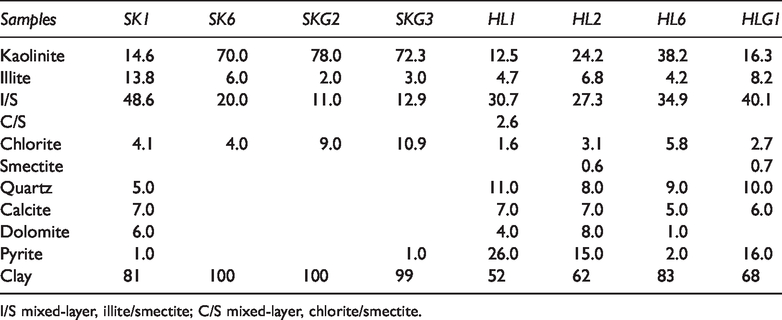
I/S mixed-layer, illite/smectite; C/S mixed-layer, chlorite/smectite.
Major element oxides
The SiO2 content in the Shicun and Heliluoshan coals ranges from 11.30 to 23.76%, with an average of 16.09%, and from 16.81 to 24.51%, with an average of 21.21%, respectively (Table 3), which is two to three times higher than that in Chinese coal at 8.47%. The content of Al2O3 in the Shicun and Heliluoshan coals is 9.11–20.31%, with an average of 13.05 and 11.07%–17.89%, with an average of 14.63%, respectively, which is also two to three times higher than that in Chinese coals at 5.98%.
Analyses of major elements in the samples (%).
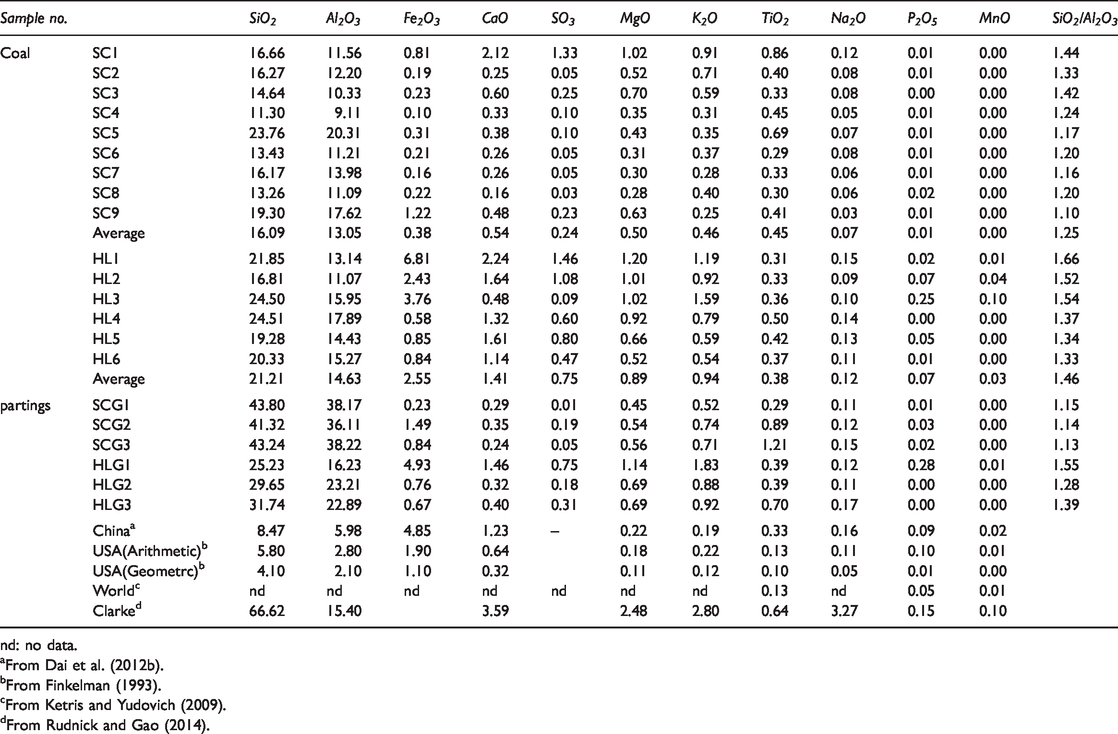
nd: no data.
aFrom Dai et al. (2012b).
bFrom Finkelman (1993).
cFrom Ketris and Yudovich (2009).
dFrom Rudnick and Gao (2014).
Trace elements
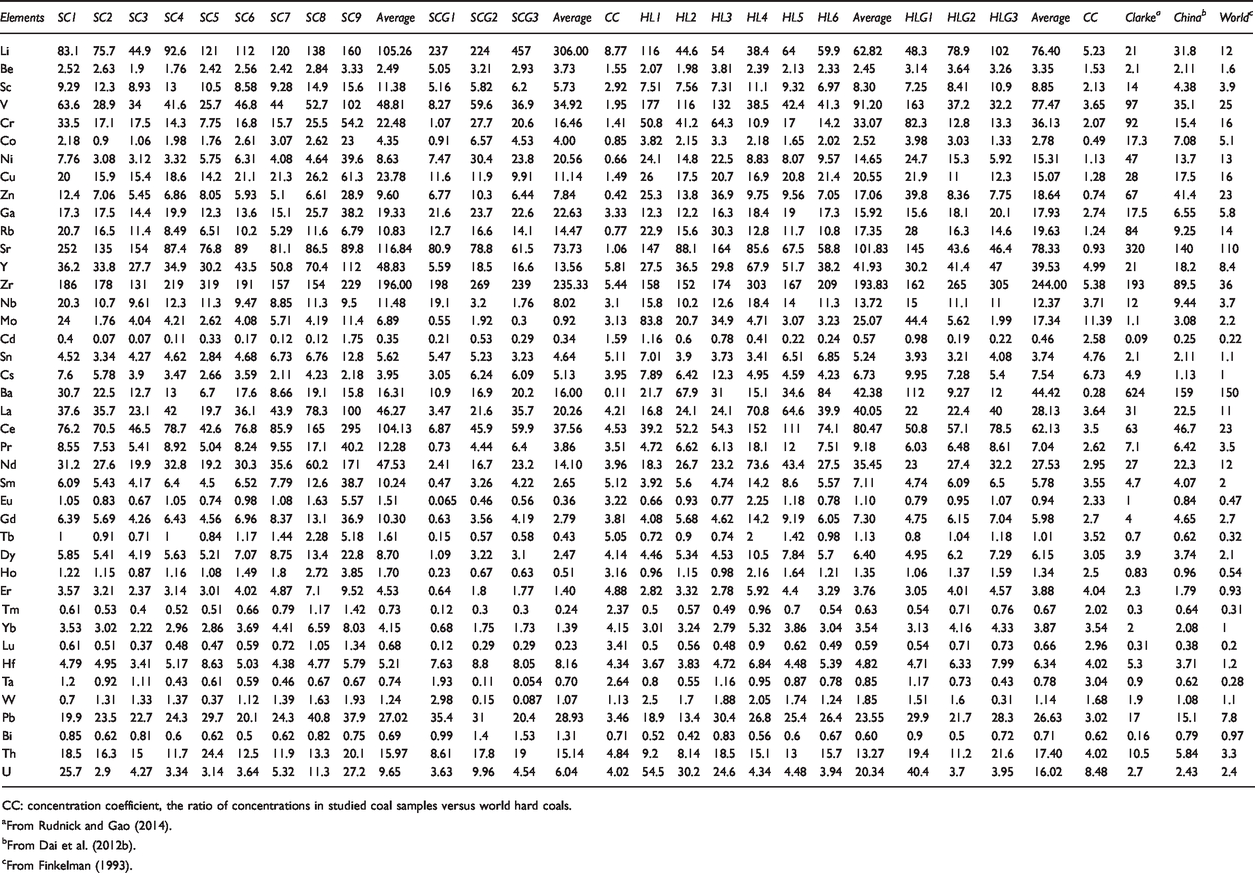
According to the concentration coefficients CCs, provided by Dai et al. (2015), elements Li, Y, Zr, Sn, Sm, and Tb are enriched in the coal from Shicun Mine; Be, Cr, Co, Ni, Cu, Rb, Sr, Cd, W, and Bi are close to the average values for world hard coals; Zn and Ba are depleted; and the remaining elements are slightly enriched. In the Heliluoshan Mine coal, however, Mo is significantly enriched; Co and Ba are depleted; Li, Zr, Cs, and U are enriched; Be, Ni, Cu, Zn, Rb, Sr, W, and Bi are close to the average values for world hard coals, and the remaining elements are slightly enriched (Table 4).
Trace elements contents (μg/g) in the coal samples of the Heshan Coalfield (on a coal basis).
CC: concentration coefficient, the ratio of concentrations in studied coal samples versus world hard coals.
aFrom Rudnick and Gao (2014).
bFrom Dai et al. (2012b).
cFrom Finkelman (1993).
Discussion
Valuable elements
According to the CC values (Table 4), both coals are enriched in Li, Zr, Mo, and U (Dai et al., 2015). The average Li content in the coal samples and the parting samples of Shicun Mine was 105.26 and 306 mg/kg, respectively. Sun et al. (2012a, 2014) studied the Li concentrations in many Chinese coals. They suggested that it was reasonable to take 80 mg/kg Li as the minimum mining grade and 120 mg/kg as the economic grade or industrial grade for potentially economic Li beneficiation. According to the demarcation, the Li concentration in the Shicun Mine coal has reached the level of minimum mining grade; that in the Heliluoshan Mine coal has not reached this level. However, the Guangxi Coal Geology Bureau (private communication) has reported an average Li content of 338 mg/kg in this area. Therefore, the Li content in these coals should be further determined in the future.
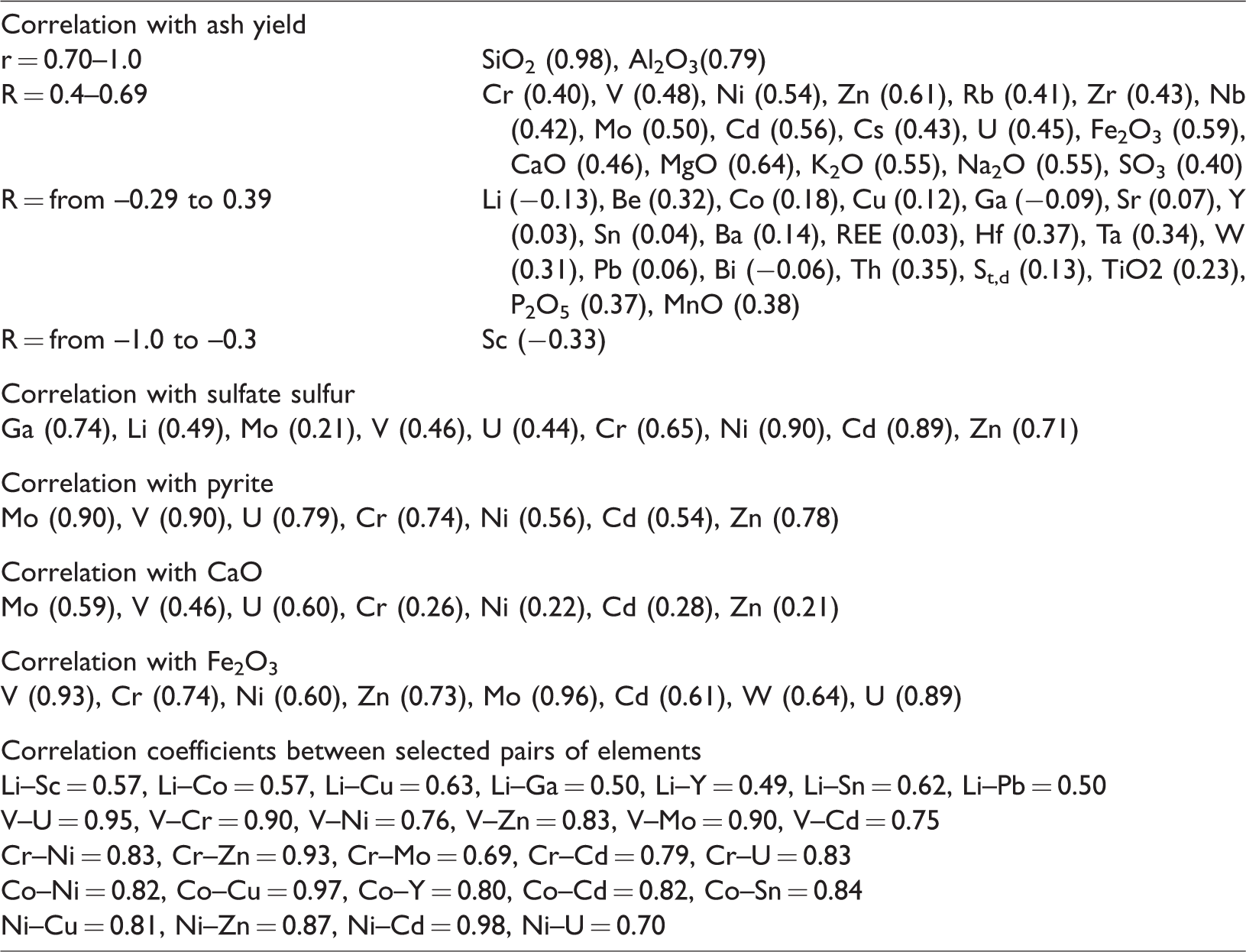
The occurrence and enrichment mechanism of Li in coals has been studied by many authors. Karayigit et al. (2006) attributed the affinity of Li to aluminosilicates in coal. Lewińska-Preis et al. (2009) indicated that although Li in Kaffioyra coal is bound to minerals, that in Longyearbyen coal shows strong affinity with organic matter. Sun et al. (2012b, 2013a, 2013b) reported that the Li in Jungar coal is associated mainly with inorganic fractions, particularly silicates. Wang (2019a) reported that Li is present mainly in aluminosilicate minerals and that clay minerals are the major carriers of Li. In our samples, Li showed negative correlations with the ash content, CaO, and SiO2 at r = –0.13, –0.35, and –0.21, respectively, but positive correlations with sulfate and organic sulfur at r = 0.49 and 0.52, respectively (Table 5). The correlation coefficient is only 0.13 between Li and Al2O3 (Table 5). In summary, Li in the coals is mainly associated with organic matter and sulfate minerals. In addition, Li showed positive correlations with Sc, Co, Cu, Ga, Y, Sn, and Pb, which may indicate formation of relationships.
Element affinities based on the calculation of Pearson correlation coefficients between the concentrations of each element in coal and ash yield or selected major elements.
In both civilian and military applications, Ga is widely used for its strategic value (Sun et al., 2016). According to the Geology and Ore Deposit Standard Specifications for Rare Metal Mineral Exploration of the People’s Republic of China (DZ/T, 0203–2002, 2003), the Ga content has not reached the level of mining grade, 30 mg/kg, in either Shicun or Heliluoshan coal mines. The presence of Ga in coal is generally related to clay minerals (Chou, 1997). Dai et al. (2008) concluded that Ga in Haerwusu coal occurs mainly in boehmite and organic matter, with the former serving as the main carrier. Sun et al. (2012b, 2016) reported that the main minerals containing Ga are boehmite and kaolinite.
In our samples, Ga showed negative correlation with the ash yield and positive correlation with sulphate sulfur, at r = –0.09 and r = 0.74 (Table 5), respectively, which indicates that the Ga was derived from both organic and inorganic sources. According to Zhou and Ren (1982), coal tends to be more enriched in Ga compared with other sedimentary rocks. Similar results were found in our samples. The ratios of Ga × 104/Al in the coals and the partings were 2.29–8.75 and 2.14–3.63, with averages of 5.15 and 2.79, respectively. These results also indicate that the Ga has an organic matter affinity. Zou et al. (1999) proved that humic acid has a strong adsorption capacity for Ga. Bennett and Czechowski (1980) isolated Ga porphyrins from a British bituminous coal, which provided direct evidence of its organic matter affinity. It is widely accepted that the geochemical characteristics of Ga and Al are similar; thus, Ga can substitute for Al in Al-bearing minerals in the right environment. The correlation between Ga and Al is poor at r = 0.13. This could be attributed to the pH value and the existence of sulfate reducing bacteria (SRB) because Ga and Al separate with an increase in the pH value, and the range in precipitation pH values of Al is extended in the presence of SRB (Zhou and Ren, 1982).
Sun et al. (2016) suggested that the economic grade for Al2O3 deposits is 40% in coal ash. The analyzed coal from the two mines has attained this level; in particular, the Al2O3 content in these coals is about three and seven times higher than that in general Chinese and American coals (Table 3). Therefore, the Al2O3 contents of Heshan coal may have economic value. Aluminum oxide showed positive correlation with ash and SiO2, which indicates that the Al2O3 likely originated from clay minerals (Tables 1 and 3).
Hazardous elements
V, Cr, and Zn
Generally, Cr in coal has three carriers: detrital material of terrigenous origin, clay minerals, and organic matter (Sun et al., 2007). Some reports have shown that V occurs in both clay minerals and organic matter (Huggins and Huffman, 1996; Palmer and Filby, 1984; Sun et al., 2007). Vanadium, Cr, and Zn all showed positive correlations with ash, Fe2O3, MnO, K2O, MgO, and pyrite, which indicate that sulfide matter and illite were likely carriers of Cr and Zn. In addition, Cr and Zn have high correlation coefficients with P2O5 and sulfate (Table 5). Furthermore, silicate minerals can also be considered as carriers of Zn owing to the correlation with SiO2 (r = 0.54). In summary, these elements are combined with clay minerals, phosphate minerals, and sulfide in coals.
Ni and Cd
Nickel occurs in organic matter, pyrite, clay minerals, and Ni-bearing minerals (Xu et al., 1999). Cadmium is both a lithophile and thiophilic element that does not easily form independent minerals owing to its dispersibility. In specific conditions, however, Cd could serve as an isomorphous substitute for Zn. In this study, a strong correlation was indicated between Ni and Zn at r = 0.87 (Table 5). Swaine (1990) reported that Cd can occur in pyrite, and Mukhopadhyay et al. (1998) concluded that Cd is associated with sulfide and organic matter. Singh et al. (2015b) showed that Cd has an inorganic origin. However, Ni has shown a strong affinity with organic matter (Singh et al., 2015a). In the studied samples, Ni and Cd showed positive correlation with the ash yield, which indicates mainly inorganic affinity. In addition, Ni and Cd displayed slight positive correlation with Al2O3 and SiO2, indicating that kaolinite may contain low contents of Ni and Cd. Moreover, Ni and Cd showed high positive correlations with Fe2O3, sulfate, and pyrite, which suggest that Ni and Cd are associated mainly with sulfide minerals and, to a lesser extent, kaolinite.
U and Mo
The contents of U and Mo in the Shicun coal are 9.65 and 6.89 μg/g, respectively. In Heliluoshan Mine, the values have reached 20.34 and 25.07 μg/g, respectively; these levels are 11 and 8 times higher than that of the world coals (Table 4). Although the contents are enriched, the levels are not as high as those reported by other geologists (Dai et al., 2013; Shao et al., 2003b; Zeng et al., 2005). A strong correlation was noted between U and Mo at r = 0.91 (Table 5), indicating similar geochemistry. The enrichment of U in coals has been attributed to episodic inundation of the coal depositional environment by marine waters (Van der Flier and Fyfe, 1985). U and Mo mainly occur in clay minerals, pyrite, and organic matter (Bouška et al., 2000; Finkelman, 1994; Swaine, 2000). The results of SEM–EDX and statistical methods indicate that U and Mo in the coals occur in silicate minerals, carbonate minerals, illite, and mixed-layer I/S as well as sulfide minerals, as expressed by high positive correlation with CaO, K2O, Fe2O3, and pyrite (Table 5). In this study, the elements Mo and U, which are enriched in high-sulfur coal, probably are derived from seawater that flooded the swamp and terminated peat accumulation, because concentrations of these elements are much higher in seawater than river water (Chou, 2012).
U, Cd, and Zn were all negatively correlated with organic sulfur at r = –0.22, –0.29, and –0.39, respectively, indicating no affinity with organic sulfur. Additionally, the SRB reduction rate decreases gradually with increases in the concentrations of U, Cu, Cd, Zn, and Pb (Tan et al., 2007).
The geochemical properties of U and Th are similar in reducing environments but are very different in oxidation environments; thus, the ratio of U/Th can reflect the redox conditions of sedimentary palaeoenvironments (Adams et al., 1959). This ratio has a strong positive correlation with V, Cr, Ni, Cd, Mo, and U, with r = 0.89, 0.65, 0.53, 0.58, 0.90, and 0.94, respectively (Table 5). These results show that reducing conditions are beneficial for the enrichment of these elements.
Formation of sulfate and sulfide minerals in SHOS coals
Clay, quartz, and carbonate minerals in this coalfield have been discussed in previous research (Dai et al., 2013). In the present study, only sulfate and sulfide minerals are discussed.
Gypsum minerals
Gypsum minerals were observed under SEM in this study (Figure 2), occurring as fracture filling in the samples. These minerals might have been produced by reactions between calcite and the sulfuric acid produced by oxidation of pyrite in the coal (Dai et al., 2015; Rao and Gluskoter, 1973; Ward, 2002). In some low-rank coals, however, gypsum can form by evaporation of the pore water in fractures and on exposed coal surfaces (Kemezys and Taylor, 1964; Ward, 2002).
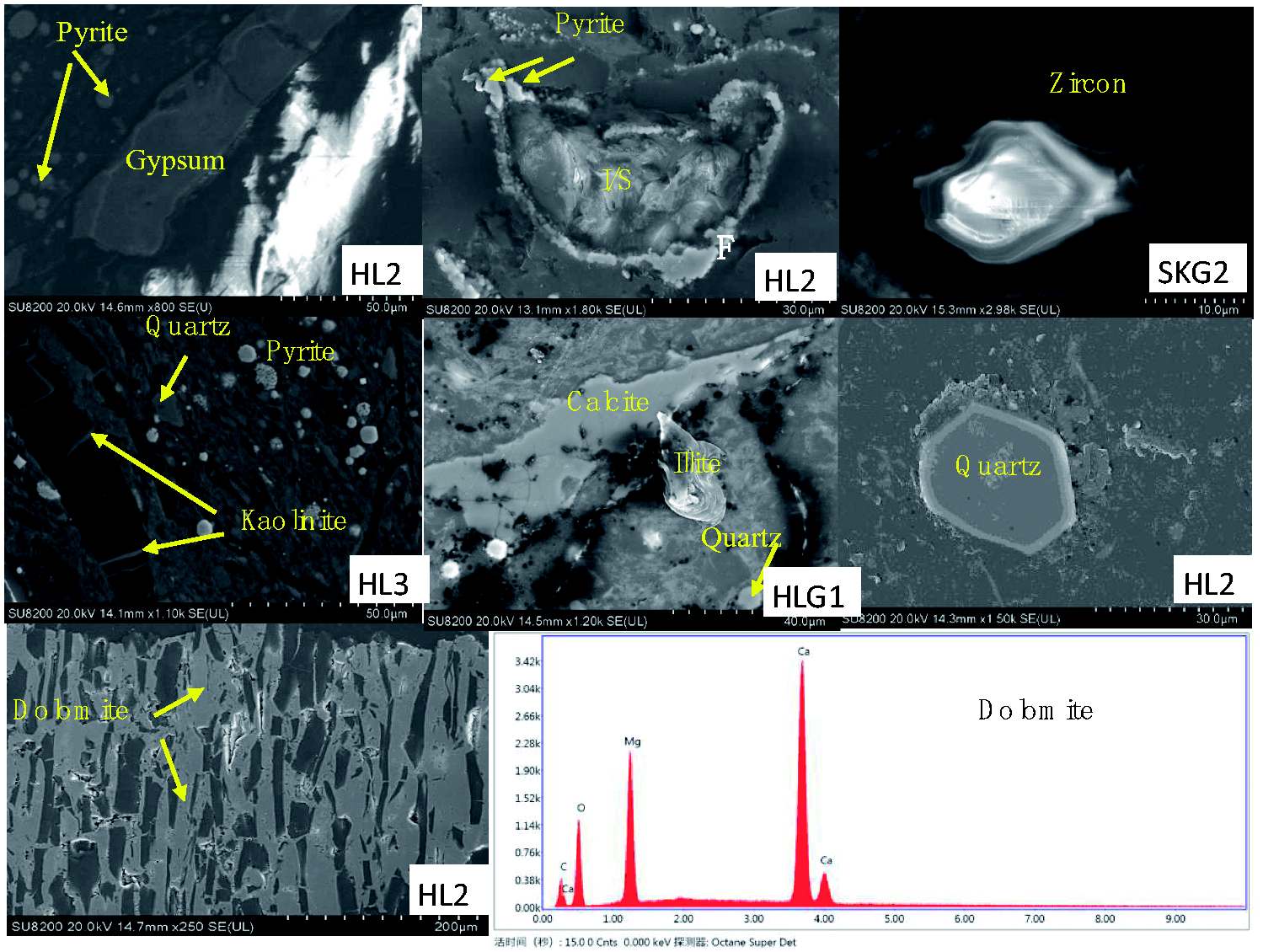
SEM photomicrographs of clay minerals, quartz, pyrite, dolomite, calcite, and gypsum in Heshan coals.
Framboidal pyrite
Pyrite with framboidal morphology is found in water columns of modern anoxic basins (e.g. Muramoto et al., 1991; Singh et al., 2013, 2017), hydrothermal veins, and other ore deposit types (e.g. Allen and Hahn, 1994; Darling, 1987; Halbach et al., 1993). Wilkin and Barnes (1996) studied the formation processes of framboidal pyrite.
The framboidal pyrite is present as spherical particles in sizes of 10–30 μm (Figure 3(a) and (f)). Some framboidal pyrites display oolitic structures, and some of them are aggregates of pyrite microcrystalline cubes and octahedrons less than 10 μm in size (Figure 3(f)). These framboidal pyrites are mainly in vitrinite group macerals, particularly collodetrinite. Foraminifera were observed in parting sample SCG2, with the chambers filled by pyrite. Generally, foraminifera lived in shallow marine environments. Those with well-preserved shapes in the samples had an important role in the depositional environment. SHOS coals form in lagoonal environments (Shao et al., 2003a). The presence of foraminifera in the parting sample indicates a transgression occurrence.
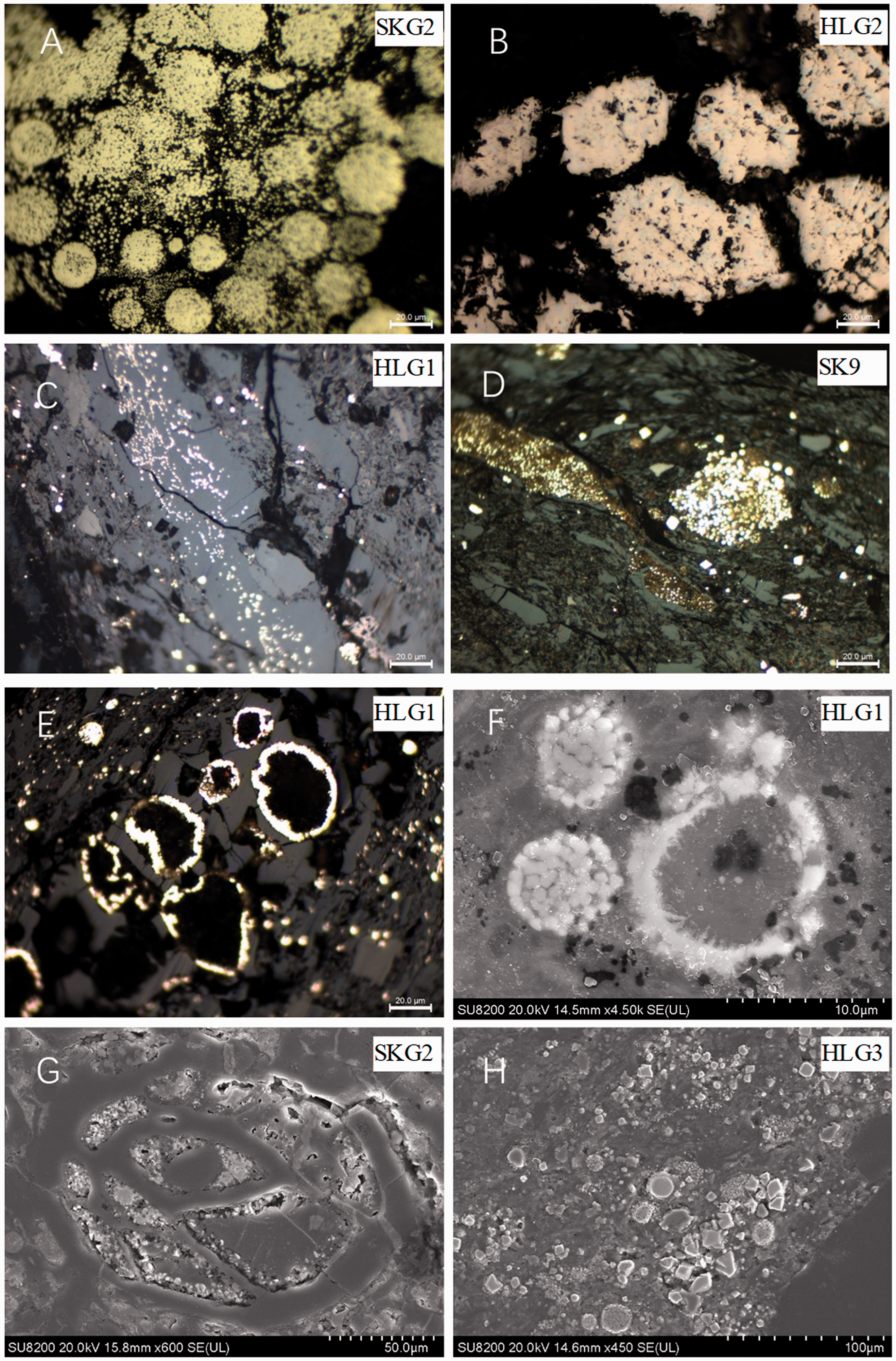
Micromorphological forms of pyrite present in Heshan Coalfield. (A) framboids of pyrite (A-E: polished surface, oil immersion, Reflected light microscopy), (B) nodular pyrite, reflected light, (C) disseminated grains of pyrite, reflected light, (D) infilling anhedral pyrite, reflected light, (E) replacement anhedral pyrite, reflected light, (F) framboids of pyrite, (G) foraminifera in SK4-G2 and (H) pyrite aggregates of microcrystalline cubes and octahedrons (F-H: SEM).
The origin of framboidal pyrite has been discussed by many researchers, particularly studies about framboidal pyrite in coals, assuming that this type of pyrite was consisted of pyritized sulfur bacteria (Kizilstein and Minaeva, 1972; Skripchenko and Berberian, 1975). Others assumed that pyrite is formed by mineral solutions in inorganic material (Farrand, 1970; Wiese and Fyfe, 1986). Framboids showing well-shaped crystals of generally consistent sizes (Figure 3(f)) are likely the result of crystallization of a mineral solution in the organic matter in the diagenesis stage. This form was described by Renton and Bird (1991). In almost all cases, inorganic framboidal pyrite is associated with clay minerals as well as isolated crystals or aggregates of euhedral pyrite (Kortenski and Kostova, 1994).
Euhedral pyrite
Well-shaped euhedral pyrite crystals are also present in the samples (Figure 3(f)). In most cases, these crystals are small in size, ranging from 1 to 15 μm, with some individuals larger than 30 μm. The crystal forms are cubic, octahedral, and pentagonal dodecahedral. Isolated anhedral crystals and aggregates of dihedral crystals are observed in the coal samples, particularly in the collodetrinite. The aggregates of euhedral pyrite are lenticular or irregular in shape and are generally associated with clay minerals and sometimes with inorganic framboidal pyrite (Figure 3(a) and (d)). Mo was detected in the pyrite in HLG2 and HL3 (Figure 4).
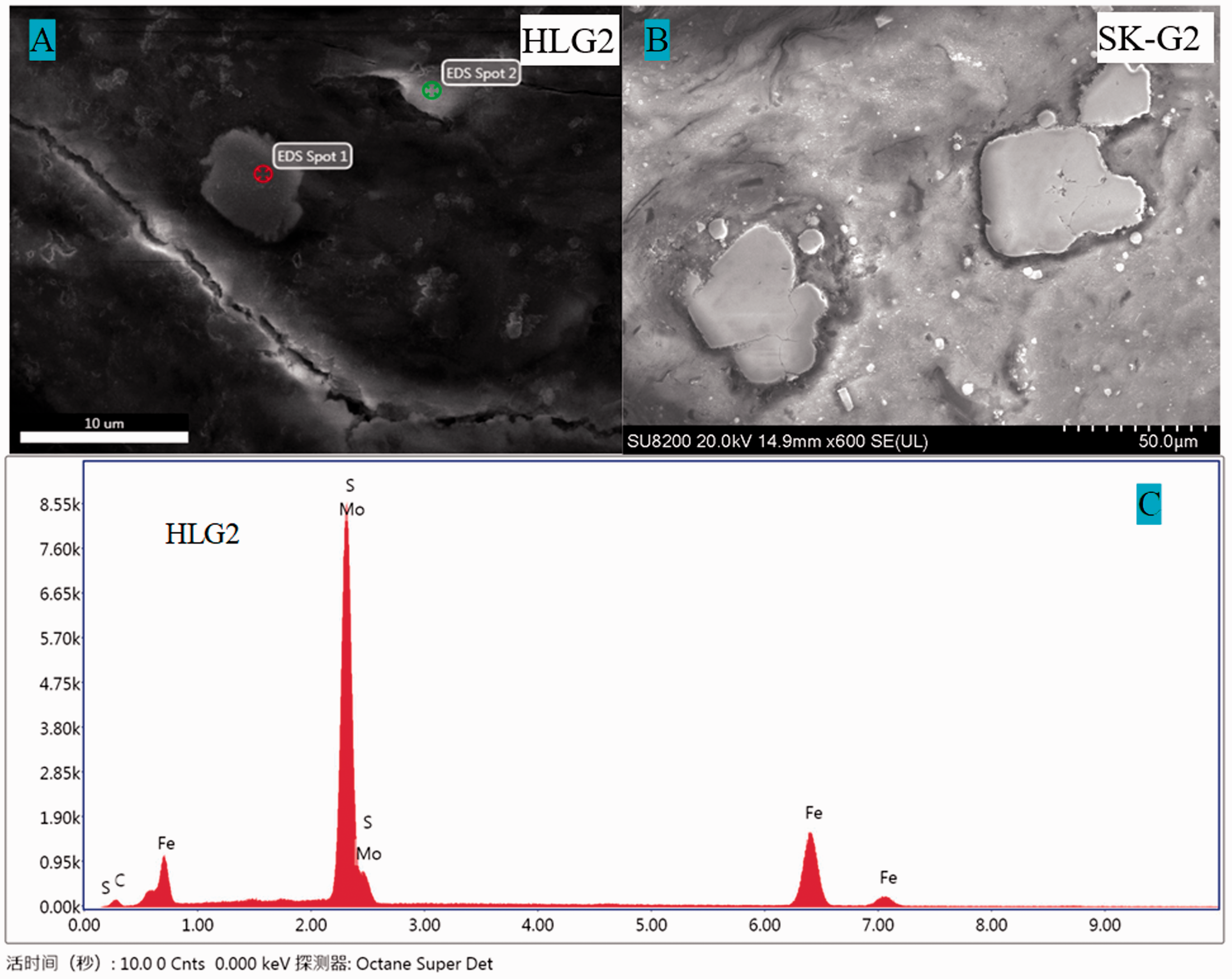
Occurrence of pyrite: (A) anhedral pyrite, SEM, (B) homogeneous pyrite, SEM and (C) Energy spectrum of spot 1 of A diagram.
Other shapes of pyrite
Irregularly shaped homogeneous pyrite was found occasionally in the coal samples in sizes of 30–50 μm with distribution usually in the vitrinite group (Figure 4(b)). This term corresponds to pyrite forms that assume the shapes the plant debris in which they were deposited, as described by Singh et al. (2012). Two types of anhedral pyrite were recognized as replacement in the cell walls of telinite and infilling in cell lumens (Figure 3(d), (e), and (g)). Rounded nodular pyrite is coated with quartz and clay minerals (Figure 3(b)) and occurs in sizes of 20–50 μm. Aggregates of fine disseminations united by clay or organic matter are designated as cluster-like pyrite in this study (Figure 3(c) and (h)) and occur mostly in small sizes.
Depositional environment
The Sr/Ba ratio can reflect changes in the salinity of seawater. A ratio of Sr/Ba > 1 indicates a significant seawater influence. In the studied area, the ratio is 4.53–12.13 with an average of 7.68 in Shicun Mine and 0.70–9.64 with an average of 4.47 in Heliluoshan Mine. The high Sr/Ba ratio indicates that the coal was heavily influenced by seawater. This point is supported by the appearance of pyritized foraminifera because they are marine protozoans. The studied area is located in a stable low-energy, shallow sea and restricted carbonate platform (Wang et al., 1995), which is beneficial for the preservation of foraminifera.
According to Qian et al. (2012), the U/Th ratio is higher than 1.25 in an anoxic environment, less than 0.75 in an oxidizing environment, and between 0.75 and 1.25 in a weak oxidizing environment. The ratios of U/Th in SC1, SC9, HL1, HL2, and HL3 are higher than 1.25, indicating an anoxic environment; however, those in the remaining samples were lower than 0.75 except for SC8, indicating an oxidizing environment; that of SC8 was 0.85, indicating a weak oxidizing environment. Even so, the concentration of organic sulfur is still high. It is widely accepted that the SHOS coals were formed in an anoxic environment. A geochemical model of the formation of organic sulfur in SHOS coals proposed by Li and Tang (2014) suggests that a cycle model consisting of sulfur reduction, reoxidation, and disproportionation can convert more sulfate to non-oxidized sulfur, which is easily absorbed by peat or coal seams. Such a model can result in the enrichment of organic sulfur.
The U/Th showed positive correlation with V, Cr, Mn, Ni, Mo, Cd, and U, at r = 0.89, 0.65, 0.68, 0.53, 0.90, 0.58, and 0.94, respectively, which indicates that the reducing environment was beneficial for the enrichment of these elements.
The Al2O3/TiO2 weight ratio increases from 3 to 8 for mafic igneous rocks, 8 to 21 for intermediate igneous rocks, and 21 to 70 for felsic igneous rocks (Hayashi et al., 1997). The Al2O3/TiO2 ratios for the partings ranged from 31.59 to 131.62; SCG1 showed the maximum value, indicating a felsic igneous rock origin. The β-quartz occurrence in the samples is considered to be a product of high temperature formed by acidic volcanic ashes that fell into a swamp during peat accumulation.
Conclusions
According to the coal petrology and the geochemistry of minor and trace elements in the Heshan coals, the following preliminary conclusions can be drawn. (1) The aluminum oxide content in the Heshan coal may have economic value. The content of Li in Shicun Mine has reached the level of minimum mining grade. (2) The occurrence of Li and Ga in the coals is associated mainly with organic matter and sulfide minerals. Strong correlation was noted between these elements, Mo, U, Cr, Ni, Cd, Zn, and V, indicating similar geochemical properties. Pyrite served as a carrier of U, Mo, V, Ni, Cd, Cr, and Zn in the coal. Moreover, a reducing environment was found to be beneficial for enrichment of these elements. (3) The coal was formed in a reducing environment that included intermittent oxidation processes.
Footnotes
Acknowledgements
The authors are grateful to Mr Zhixiang Shi for providing assistance with the laboratory work.
Declaration of conflicting interests
The author(s) declared no potential conflicts of interest with respect to the research, authorship, and/or publication of this article.
Funding
The author(s) disclosed receipt of the following financial support for the research, authorship, and/or publication of this article: This research was financially supported by the Natural Science Foundation of Hebei (No. D2017402121).