




Abstract
This paper presents an improved flowing material balance method for unconventional gas reservoirs. The flowing material balance method is widely used to estimate geological reserves. However, in the case of the unconventional gas reservoirs, such as coalbed methane reservoirs and shale gas reservoirs, the conventional method is inapplicable due to the gas adsorption on the organic pore surface. In this study, a material balance equation considering adsorption phase volume is presented and a new total compressibility is defined. A pseudo-gas reservoir is simulated and the results were compared with the existing formulations. The results show that the proposed formulation can accurately get the geological reserves of adsorbed gas reservoirs. Furthermore, the results also show that the volume of the adsorbed phase has a significant influence on the analysis, and it can only be ignored when the Langmuir volume is negligible.
Keywords
Introduction
The flowing material balance method uses daily production data to estimate geological reserves by linear regressions. It is one of the most used rate transient analysis methods in oil fields, as it does not require any specialized testing and shut in (Agarwal et al., 1999; Mattar et al., 2006; Mattar and McNeil, 1998; Sun, 2013). Unlike conventional gas reservoirs, the traditionally used flowing material balance method cannot be applied in unconventional gas reservoirs, such as gas shale and coalbed methane, due to the gas adsorption on the organic pore surface (Shen et al., 2018, 2019). Material balance equations (MBEs) are the foundation of flowing material balance methods. King (1993) proposed an MBE for coalbed methane by modifying the deviation factor of gas. Subsequently, other researchers also proposed various forms of MBEs with adsorbed gas, but these equations did not consider the influence of the adsorbed phase volume (Ahmed et al., 2006; Clarkson and Mcgoverm, 2001; Firanda, 2011; Moghadam et al., 2010; Ross and Bustin, 2007). Later, Williams-Kovacs et al. (2012) established an MBE considering adsorbed phase volume. Their studies indicate that the adsorbed phase volume has significant influences on the evaluation results of geological reserves (Zhang et al., 2017).
Based on the MBE considering gas adsorption, some rate transient analysis methods are proposed for gas shale and coalbed methane reservoirs (Clarkson et al., 2007; Clarkson and Salmachi, 2017; Dou et al., 2015; Lewis and Hughes, 2008; Mengal and Wattenbarger, 2011). However, all these methods are based on the King’s MBE and do not involve the influence of adsorbed phase volume.
The MBE developed in this study involving adsorbed phase volume is validated from synthetic data. In the first part, a new total compressibility is defined, and the corresponding flowing material balance method considering adsorbed phase volume is proposed. In the second part, case studies have been used to verify the accuracy of this method.
The MBE considering adsorbed phase volume
The following assumptions are made in this paper: (1) the temperature is constant in the gas reservoir production process; (2) the gas dissolved in formation water is neglected; (3) the shrink of matrix by gas desorption is also neglected; (4) gas adsorption satisfies the single component Langmuir equation; (5) the reservoir output does not contain water and is only single-phase gas; (6) the reservoir is up to the saturation of adsorption capacity. The coalbed methane or shale gas is composed of free gas in fractures and adsorption gas in the matrix. The cumulative output of the gas is equal to the difference between the original and remaining reserves of the gas, therefore (Seidle, 2011)




The adsorbed phase apparent porosity is

Considering the equation of state for real gas, equation (1) can be rewritten as follows


Defining


It also can be written as

Flowing MBE considering adsorbed phase volume
Taking a derivative with respect to time on both sides of equation (10), one gets



Therefore, equation (13) can be written as


With the normalized material balance pseudo-time (Blasingame and Lee, 1988)


The flowing material balance method ignoring gas adsorption, i.e. the conventional method, can be obtained when the Langmuir volume (VL) is zero in equations (5), (8), (15) and (17). If the adsorbed phase apparent porosity ϕa = 0 in equations (8), (15) and (17), it becomes the King’s method, which considers gas adsorption but ignores the adsorbed phase volume.
With the normalized pseudo-pressure (Meunier et al., 1987)


The mass conservation equation for unit volume gas is (Kong, 2010)


The seepage velocity obeys Darcy’s law, as (Kong, 2010)

Therefore, the seepage governing equation is

When a well is under constant production rate, according to equations (21) and (10) and provided with the equation of state for real gas, the right side of equation (23) can be written as

The left side of equation (23) is

The seepage governing equation can be derived by equations (23) to (25) as follows

Method validation
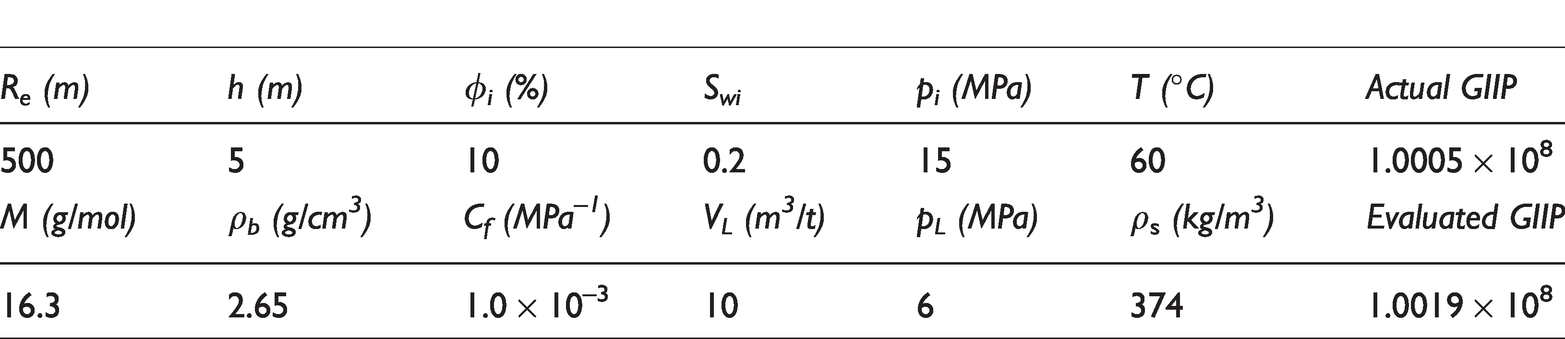
In order to validate the new method presented in this paper, synthetic data of a well production is simulated. The simulation parameters are listed in Table 1. The GIIP calculated by volumetric method is 1.0005 × 10⁸ m3. Figure 1 shows the simulated production process. In the simulation, Bg, cg and Z were obtained by the Dranchuk–Purvis–Robinson correlation (Dranchuk et al., 1973), and μ was obtained by the Lee correlation (Lee et al., 1966). The simulation method was explained in Appendix 1.
The simulation parameters and GIIPs.
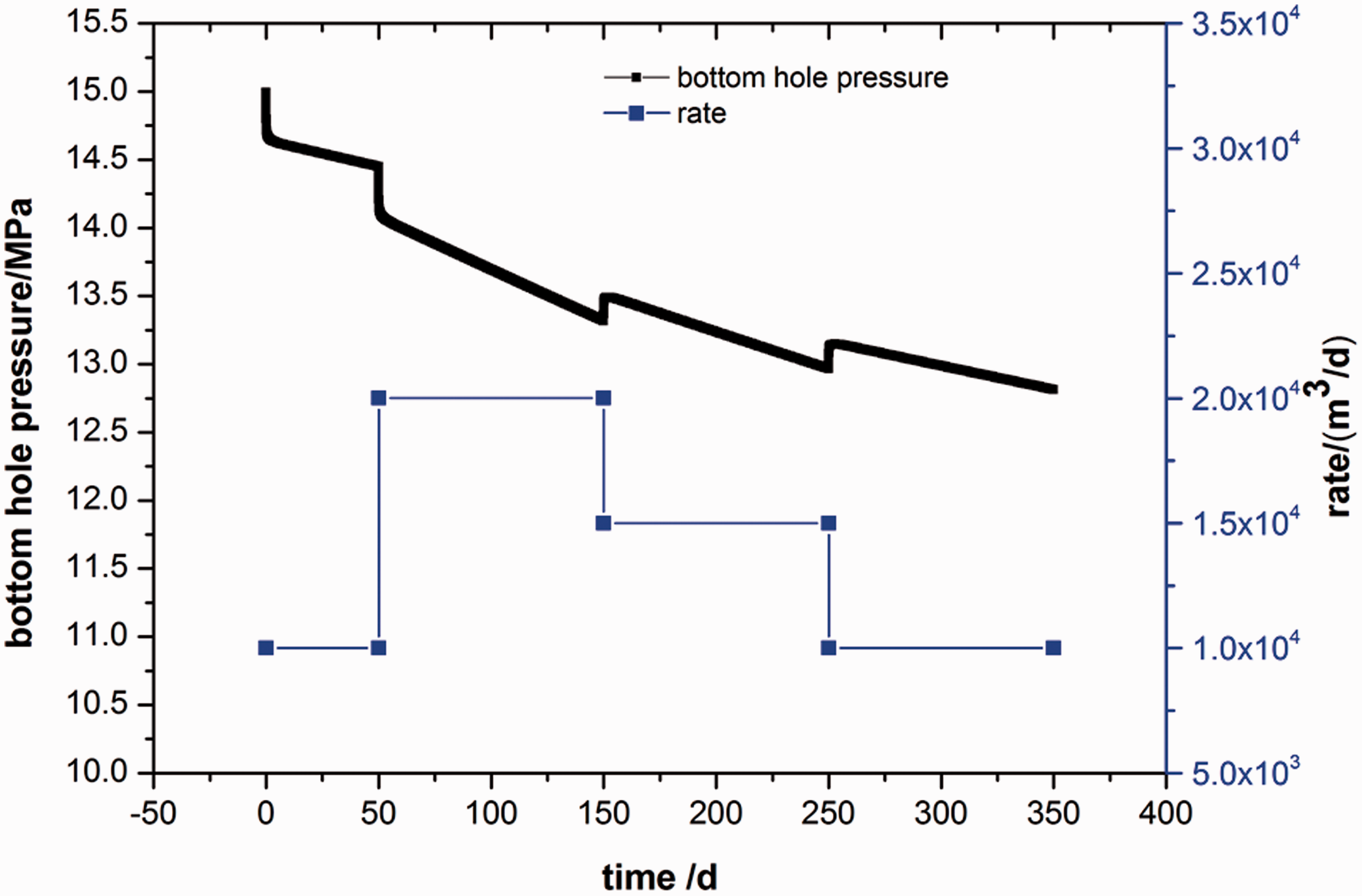
The simulated production – case study.
The results fitted by the flowing material balance method is G*=5.6362 × 10⁷ m3, shown in Figure 2. According to equation (17), the GIIP determined by the new flowing material balance method is G = G*Zi/Z*=5.6362 × 107×0.908892/0.511311 ≈ 1.0019 × 10⁸ m3. It can be concluded that the GIIP obtained by the new flowing material balance method is much close to the real reserve. Thus, the proposed new method is feasible.
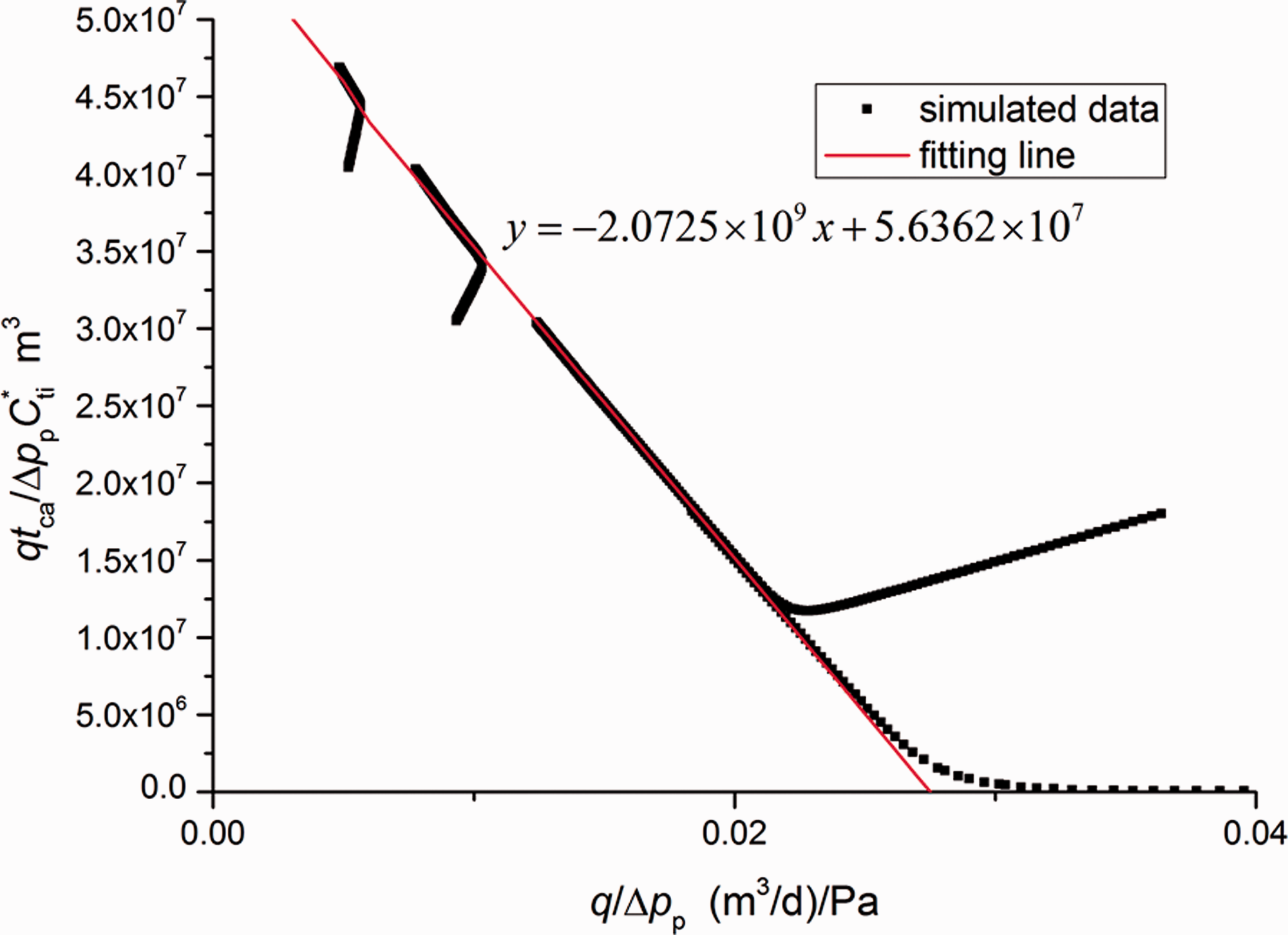
The fitting by the new flowing material balance method.
It is more reasonable to use the field data to validate the proposed model. But at that moment we have encountered some difficulties in using the field data to validate the model. On the one hand, the error of many filed data is large, which will affect the verification of the proposed model. On the other hand, when using the field data to verify the proposed model, the GIIP calculated by other methods are required to compare with that obtained by the proposed method. Currently, calculation of GIIP mainly uses the volumetric method, but its accuracy is low. The error caused by these two aspects is likely to be greater than the improvement of the accuracy by the proposed method. Therefore, the conditions for validating the proposed model using field data are not currently available. We will further verify the proposed model with the field data in future research.
Discussion
To test the sensitivity of the developed equation changing one parameter and keeping the other parameters constant in every computation condition, gas well productions are simulated under different reservoir pressures, Langmuir volumes and pressures. The production process used in the simulation is shown in Figure 1. The simulated production data were analyzed by the new method, the conventional method and King’s method, and the comparison between the different methods is presented in Figures 3 through 5. The results indicate that errors of the new method are usually below 2%, which is mainly caused by the computation errors.
In the first case, the formation pressure was varied and the corresponding error for different methods was calculated (Figure 3). Error in the estimation of gas reserve for the present formulation is around 2%. It is clear from Figure 3 that ignoring gas adsorption can cause an error of approximately 60%. The errors increase marginally with the increase of reservoir pressure, and then decrease a bit. The errors of King’s method increase with the increase of reservoir pressure, and the increasing rate tends to be slow as the formation pressure increases. With an increase of the formation pressure from 10 MPa to 30 MPa, the errors increase from about 20% to 33%.
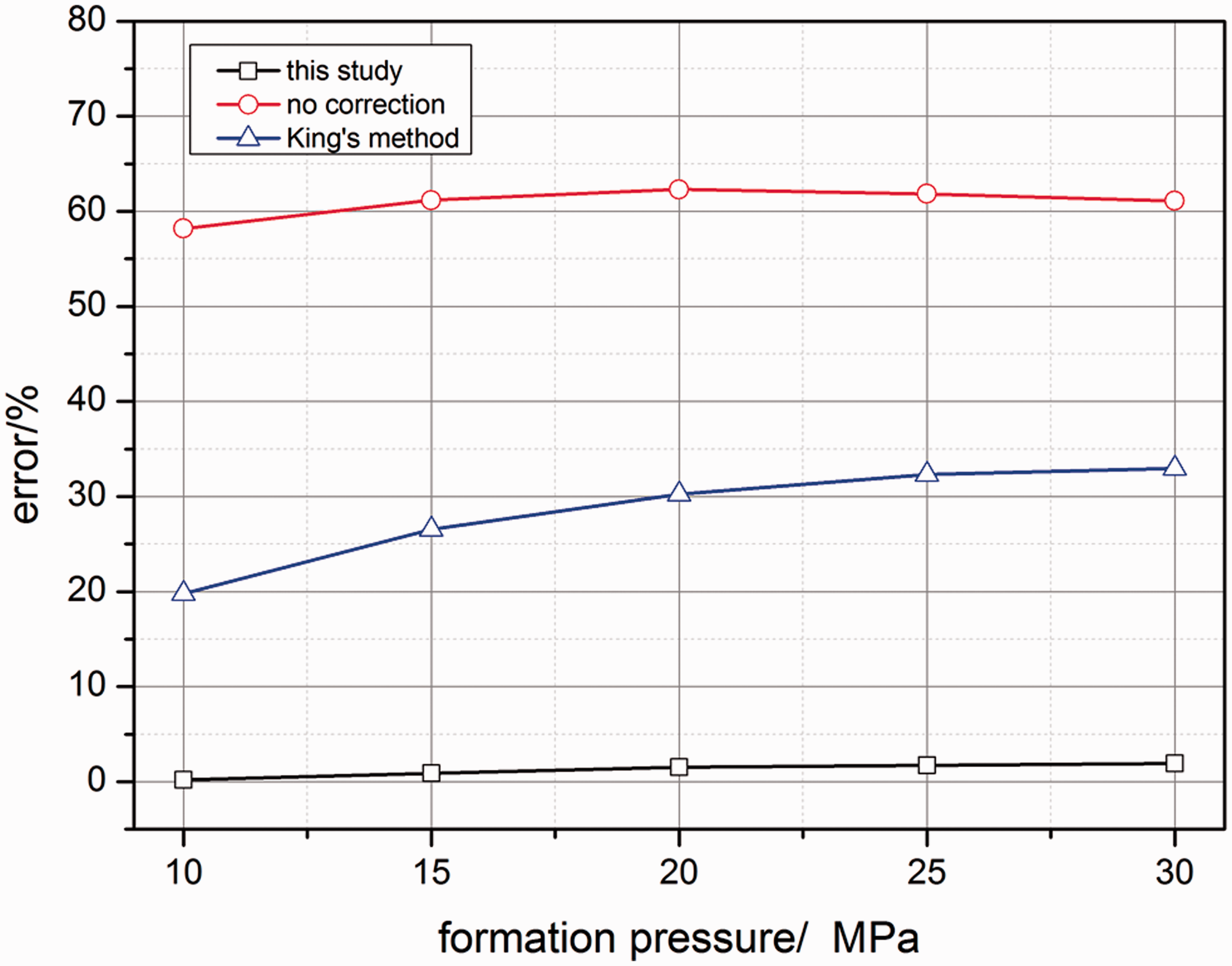
The influence of reservoir pressures on the error.
In the second case, the Langmuir pressure was varied and the corresponding error for different methods was calculated (Figure 4). Error in the estimation of gas reserve for the present formulation is around 2%. It is clear from Figure 4 that the errors in the conventional method and King’s method decrease with the increase of Langmuir pressure, and the decreasing rate tends to be slow. When the Langmuir pressure increases from 2 MPa to 6 MPa, the errors of ignoring gas adsorption decrease from 73% to 58%, and that of King’s method decrease from 35% to 25%.
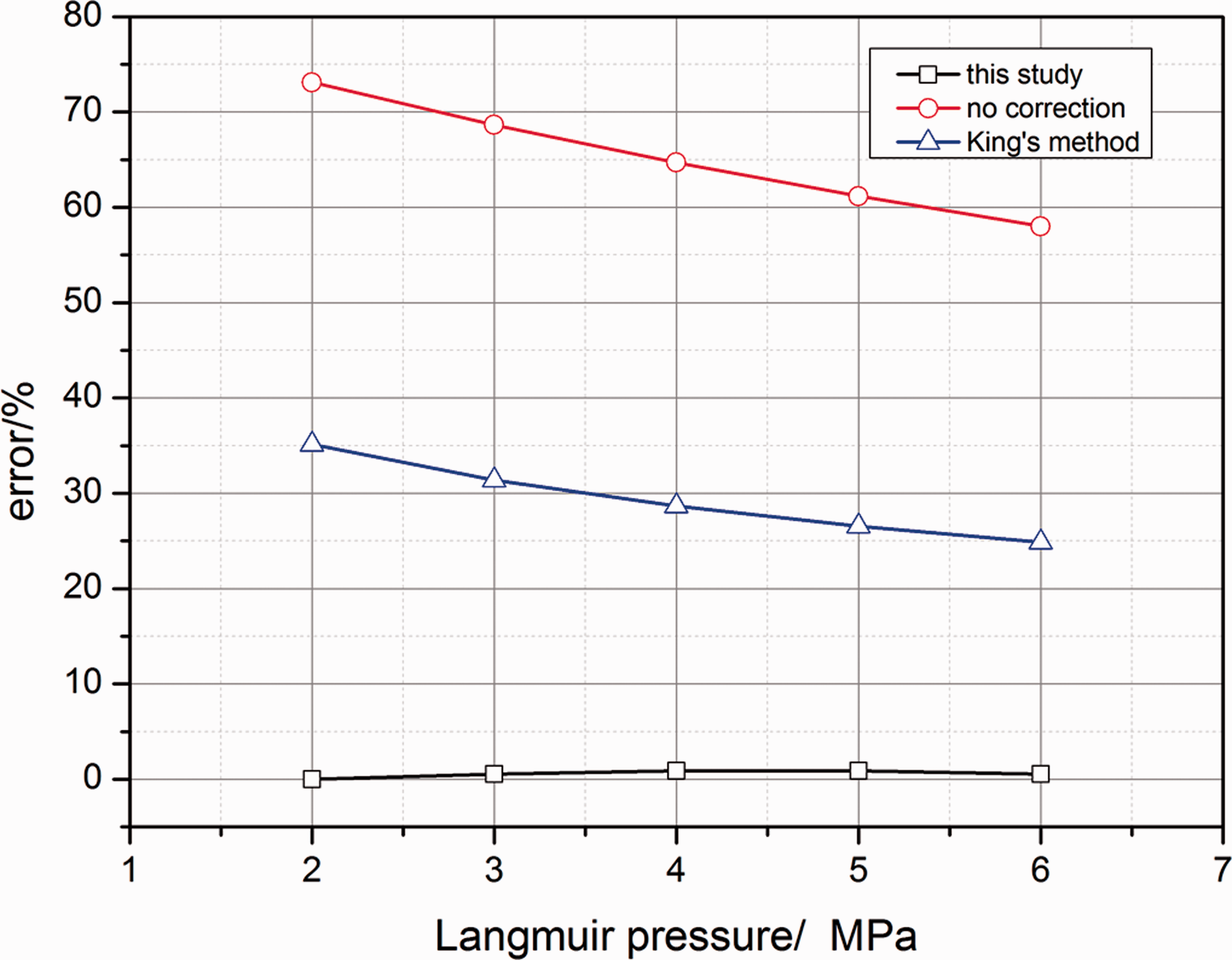
The influence of Langmuir pressures on the error.
In the third case, the Langmuir volume was varied and the corresponding error for different methods was calculated (Figure 5). Error in the estimation of gas reserve for the present formulation is around 2%. It is clear from Figure 5 that the errors of ignoring gas adsorption increase with the increase of Langmuir volumes. When the Langmuir volume increases from 2 m3/t to 20 m3/t, the errors of ignoring gas adsorption increase from 24% to 77%. And when King’s method is used, the errors increase from 6% to 47%. Ignoring the gas adsorption could cause very large errors, even wrong results. Therefore, the adsorbed phase volume can cause distinct influences. Only when the Langmuir volume is very small, it can be neglected.
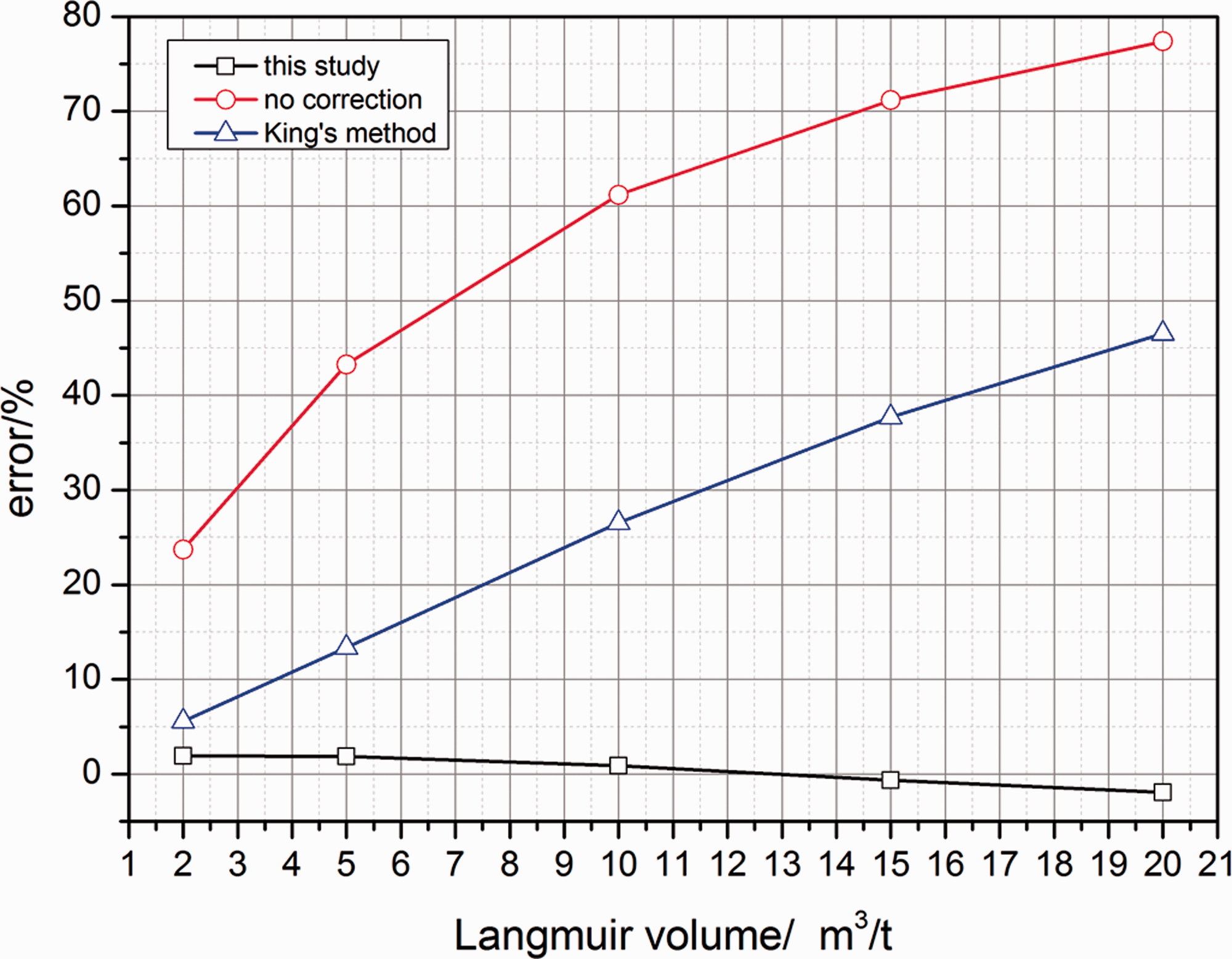
The influence of Langmuir volumes on the error.
The adsorbed phase methane densities obtained by researchers have some differences. The results by Dubinin (1960), Haydel and Kobayashi (1967), Ambrose et al. (2012), Mavor et al. (2004) are 0.371, 0.374, 0.34, 0.4223 g/cm3, respectively. In the fourth case, the adsorbed phase densities were varied and the corresponding error for different methods was calculated (Figure 6). Errors in the estimation of gas reserve for the present formulation are around 2%. It can be found that the errors of the King’s method and ignoring gas adsorption decrease with the adsorbed phase density. The errors of ignoring gas adsorption are above 50%. The errors of King’s method are not less than 20%, based on those researcher’s data. The errors of the new method are below 2%.
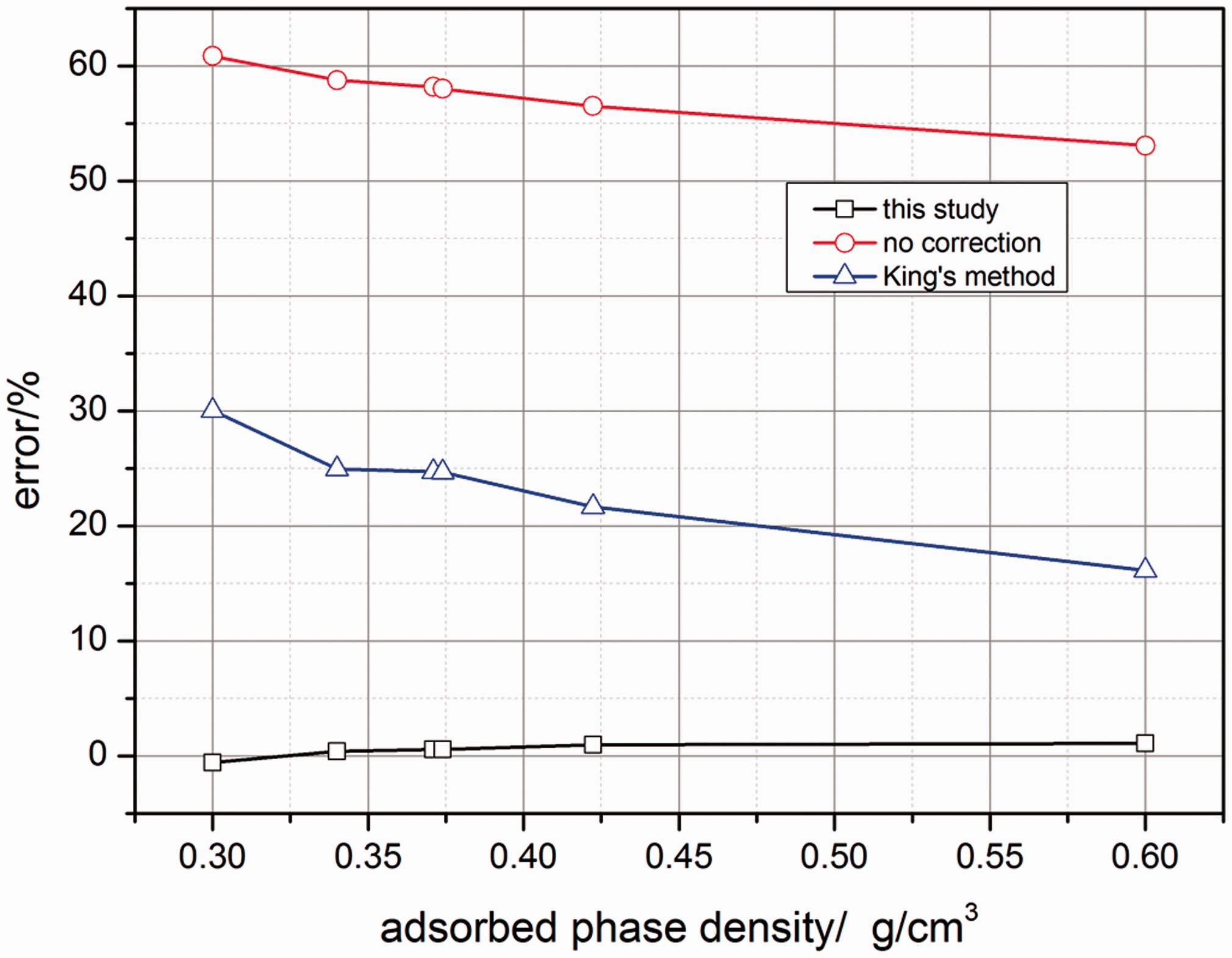
The influence of adsorbed phase densities on the error.
The theory of the FMB method shows that when the flow of the reservoirs is in the pseudo-steady state, the plots of q/Δpp–qtca/Δppc* ti of different production rates are on the same line. Figure 2 proves this. When adopting King’s method or the conventional no correction method, it only needs to replace c* ti with the corresponding total compressibility. It is easy to find that these do not change the nature of plots of q/Δpp–qtca/Δppc* ti for different production rates on the same straight line. Therefore, it can be concluded that the analysis error is independent of the production rate. In order to solve the effects of the unsteady production rate, Blasingame proposed the concept of material balance pseudo-time to replace real physical time. (It can be obtained by replacing c* ti in equation (16) with a total compressibility.) This can greatly reduce the impact of changes in production rates. Especially, when the reservoir flow is close to the pseudo-steady state, the gradual change in production rate has almost no effect on the plots of q/Δpp–qtca/Δppc* ti .
Hypotheses (1), (2) and (6) are suitable for various gas reservoirs. Therefore, their influence can be ignored. If the gas well produces water, the downhole pressure will decrease faster than that of the hypothetical case that no water is produced with the same gas production rate. The GIIP assessed by the proposed method would be smaller than the actual one. The rock shrinkage due to gas desorption increases the pore volume, thereby reducing the reservoir pressure. In the same production situation, the downhole pressure will decrease faster than that of the hypothetical case that the gas desorption is not considered. Therefore, the GIIP will be underestimated by the proposed method.
Conclusion
An improved flowing material balance for unconventional gas reservoirs was presented in this study to estimate their storage. Based on the unconventional gas reservoir MBE considering adsorbed phase volume, (1) a new total compressibility is defined and (2) a flowing material method considering adsorbed phase volume for unconventional gas reservoirs is proposed. Major conclusions based on the case study are as follows:
The cases study indicated that the new flowing material balance method developed in the present study can determine the GIIP correctly. Analysis results under different reservoir pressures, Langmuir volumes and pressures demonstrate that ignoring gas adsorption can make large errors. The adsorbed phase volume has a significant influence on the results, and only when the Langmuir volume is small and reservoir pressure is large, it can be neglected.
Footnotes
Declaration of conflicting interests
The author(s) declared no potential conflicts of interest with respect to the research, authorship, and/or publication of this article.
Funding
The author(s) disclosed receipt of the following financial support for the research, authorship, and/or publication of this article: This work was supported by the National Natural Science Foundation of China (No. 11602276).