




Abstract
This study investigates the relevance of government quality in moderating the incidence of environmental degradation on inclusive human development in 44 sub-Saharan African countries for the period 2000–2012. Environmental degradation is measured with CO2 emissions and the governance dynamics include: political stability, voice and accountability, government effectiveness, regulation quality, the rule of law and corruption-control. The empirical evidence is based on the generalised method of moments. Regulation quality modulates CO2 emissions to exert a net negative effect on inclusive development. Institutional governance (consisting of corruption-control and the rule of law) modulates CO2 emissions to also exert a net negative effect on inclusive human development. Fortunately, the corresponding interactive effects are positive, which indicates that good governance needs to be enhanced to achieve positive net effects. A policy threshold of institutional governance at which institutional governance completely dampens the unfavourable effect of CO2 emissions on inclusive human development is established. Other policy implications are discussed.
Keywords
Introduction
This research on the relevance of governance in moderating the effect of environmental degradation on inclusive human development builds on four main factors in scholarly circles, namely: (i) the growing challenge (or policy syndrome) of exclusive economic growth because economic growth should be pro-poor in the post-2015 era in which shared economic prosperity is fundamental for the achievement of most sustainable development goals (SDGs), 1 (ii) issues surrounding the degradation of the environment, (iii) concerns of poor governance when it comes to addressing environmental degradation issues and (iv) gaps in the attendant literature.
First, as recently documented by Asongu and Odhiambo (2018a, 2019), inclusive human development is a central theme in SDGs. This importance of inclusive development is even more crucial in sub-Saharan Africa (SSA) because in spite of the sub-region achieving more than two decades of resurgence in economic growth, the population living in extreme poverty has been consistently increasing and hence close to half of the countries in the sub-region failed to achieve the millennium development goal target of reducing extreme poverty by half (Tchamyou, 2019a, 2019b). The nexus between poverty, economic growth and inclusive development can be understood from the perspective that the fruits of economic prosperity have not been trickling to the poor factions of the population (Asongu and Kodila-Tedika, 2017; Asongu and le Roux, 2018; Fosu, 2015).
The underlying policy syndrome of exclusive growth is an important policy issue because the objective of completely eradicating poverty in the sub-region by 2030 (i.e. in the light of the SDGs) is very less likely to be reached unless inclusive human development is fostered across SSA: This paper examines its feasibility for Sub-Saharan Africa (SSA), the world’s poorest but growing region. It finds that under plausible assumptions extreme poverty will not be eradicated in SSA by 2030, but it can be reduced to low levels through high growth and income redistribution towards the poor segments of the society. (Bicaba et al., 2017: 93)
Second, another important concern in the SDG agenda is the sustainability of the environment (Akpan et al., 2015; Asongu et al., 2016; Asongu et al., 2017; Mbah and Nzeadibe, 2016). This concern in SSA is premised on at least two factors, namely: (i) the startling evidence of the energy crisis across the sub-region and (ii) consequences of global environmental degradation. These points are expanded in the same order as they are highlighted. (i) About two-thirds of the African population (i.e. approximately 620 million inhabitants) does not have access to “affordable, reliable, sustainable and modern electricity”, which is crucial to achieve SDGs (Akinyemi et al., 2015; Jarrett, 2017; Shurig, 2015).
(ii) As documented in recent literature, the ramifications of fossil fuel consumption would be most detrimental in SSA (Asongu et al., 2017; Huxster et al., 2015; Kifle, 2008). This is essentially because, inter alia: carbon dioxide emissions (CO2) constitute about 75% of greenhouse gas emissions in the world (Akpan and Akpan, 2012; Asongu et al., 2018). Moreover, as maintained by Jarrett (2017), the unreliable supply of power is a principal hurdle for corporations in Africa. According to the author, about 30 countries on the continent experience regular blackouts and shortages which cost their economies approximately between 2% and 5% of GDP. In summary, the energy deficit on the continent continues to retard economic prosperity, agricultural transformation, job creation, education and improvement of health facilities. It is further acknowledged that in order to achieve SDGs, it is crucial for the leaders on the continent to improve governance standards, especially in relation to how policies can be tailored to increase socio-economic development by making energy access clean, reliable and affordable for all (Jarrett, 2017). The outcome variable of this study (i.e. inclusive human development) and policy variables (i.e. good governance dynamics) are consistent with the underlying narratives and recommendations.
Third, good governance is important in understanding the energy crisis because decades of mismanagement and neglect in SSA have led to some of the worst functioning grid systems in the world. In essence, according to the attendant literature, not enough political will has been garnered to effectively manage energy and environmental issues (Afful-Koomson, 2012; Akinyemi et al., 2015, 2018; Akpan and Akpan, 2012; Anyangwe, 2014; Asongu, 2018a; Asongu et al., 2018; Chemutai, 2009; Efobi et al., 2018; Hongwu, 2013; Jarrett, 2017; Jones, 2003; Odhiambo, 2010; Odhiambo, 2014a, 2014b).
Fourth, this study is positioned on assessing how good governance can modulate the effect of CO2 emissions on inclusive development because of an apparent gap in the literature. Accordingly, the attendant literature has largely focused on nexuses between economic development, environmental degradation and energy consumption. The first stream of this attendant literature has investigated the Environmental Kuznets Curve (EKC) hypothesis (Akbostanci et al., 2009; Diao et al., 2009; He and Richard, 2010). 2 This stream therefore focuses on the nexus between environmental degradation and economic growth. The second stream has two main branches: (i) connections between the consumption of energy and environmental pollution (Ang, 2007; Apergis and Payne, 2009; Begum et al., 2015; Bölük and Mehmet, 2015; Cui et al., 2018; Jumbe, 2004; Le Van and Chon, 2017; Menyah and Wolde-Rufael, 2010; Odhiambo, 2009a, 2009b; Ozturk and Acaravci, 2010; Rui et al., 2018) and (ii) linkages between energy consumption and economic growth (see Esso, 2010; Mehrara, 2007). 3
Noticeably, a common shortcoming in the engaged literature is the fact that providing nexuses between indicators of macroeconomic development are not enough to effectively inform policy makers. This research argues that such nexuses should be tailored such that they assess how policy variables moderate policy syndromes in order to affect targeted outcomes. In the light of the challenging policy imperative of inclusive development regarding SDG, this research extends the underlying literature by assessing how good governance modulates environmental degradation to affect inclusive human development in SSA. Hence, the corresponding research question is the following: how does good governance modulate the effect of environmental degradation on inclusive human development in SSA?
While the preceding paragraph has substantiated the connection between governance and environmental degradation, it is also worthwhile to articulate the nexus between environmental pollution and inclusive human development. Therefore, in line with Asongu and Odhiambo (2018b), we argue that the degradation of the environment affects constituents of the inequality-adjusted human development index (IHDI) used in this study as the outcome variables, namely: education, health and long life. First, environmental pollution can affect the income of a family by influencing the capacity of workers within a household to work effectively and search for jobs (Zivin and Neidell, 2012). Second, it is reasonable to argue that the degradation of the environment directly influences parents’ ability to have their children go to school (Currie et al., 2009). This is more apparent in the presence of pollution in the atmosphere and lack of adequate facilities of transport. Furthermore, such pollution of the atmosphere can also influence the ability of students and pupils to study effectively in class (Clark et al., 2012; Sunyer et al., 2015). Third, still building from intuition, environmental pollution and degradation also affect healthy living and by extension, the life expectancy of the population (Boogaard et al., 2017; Rich, 2017).
Given that this study is motivated by SDGs, it is also relevant to discuss the linkages between inclusive development and sustainable development. According to Amavilah et al. (2017), inclusive development is related to sustainable development in the perspective that in order for inclusive development to be sustainable, it should be sustained and for sustained development to be sustainable, it must be inclusive. This research is also positioned as a theory-building empirical study because applied econometrics is not exclusively based on the rejection and acceptance of existing theories. Hence, we are consistent with a recent strand of the literature in arguing that an empirical study motivated by sound intuition is a relevant scientific activity (Asongu and Nwachukwu, 2016a; Narayan et al., 2011), especially in the light of challenges to SDGs.
The remainder of the study is organised as follows. The data and methodology are covered in the next section. Then, the empirical results are presented. The final section concludes with implications and future research directions.
Data and methodology
Data
This research focuses on 44 countries in SSA with data for the period 2000–2012. 4 The data are from four main sources, namely: (i) the United Nations Development Programme for the outcome variable (i.e. the IHDI); (ii) the World Governance indicators of the World Bank for six governance indicators (political stability/no violence, voice and accountability, regulation quality, government effectiveness, corruption-control and the rule of law); (iii) the Financial Development and Structure Database of the World Bank for a control variable (i.e. credit access) and (iv) the World Development indicators of the World Bank for the policy syndrome variable (i.e. environmental degradation) and two control variables (i.e. education quality and foreign aid). The adopted periodicity and number of countries are contingent on the constraints in data availability at the time of the study.
In the light of the motivation of the study, the adopted outcome indicator is the IHDI: the human development index (HDI) that is adjusted for the prevalence of inequality among the population. This indicator has been used in recent literature on environmental sustainability. In the light of the attendant literature, The human development index (HDI) denotes a national mean of results in three principal dimensions, notably: health and long life, knowledge and basic living standards. The IHDI goes a step further by adjusting the HDI to prevalent levels of inequality in the aforementioned three dimensions. In other words, the IHDI also takes into consideration the manner in which the three underlying achievements are distributed within the population. (Asongu et al., 2017: 355) The first concept is about the process by which those in authority are selected and replaced (Political Governance): voice and accountability and political stability. The second has to do with the capacity of government to formulate and implement policies, and to deliver services (Economic Governance): regulatory quality and government effectiveness. The last, but by no means least, regards the respect for citizens and the state of institutions that govern the interactions among them (Institutional Governance): rule of law and control of corruption. (Andrés et al., 2015: 1041)
The education quality indicator is the pupil–teacher ratio such that an increasing ratio is associated with poor education quality because more pupils have to be accommodated by a smaller teaching staff. Hence, in terms of measurement, the indicator appreciates poor education quality. This primary education indicator is preferred to higher levels of education because it has been documented to be more associated with socio-economic development when economies are at initial stages of industrialisation (Asiedu, 2014; Asongu and Odhiambo, 2018a; Petrakis and Stamatakis, 2002). The expected negative sign from poor education quality is consistent with the established positive nexus between education and inclusive development (Dunlap-Hinkler et al., 2010). Furthermore, education is a component of the IHDI.
It is important to note that the motivation for limiting indicators of the conditioning information set to three variables (in order to avoid concerns of instrument proliferation) is consistent with the attendant empirical literature based on generalised method of moments (GMM) that has used a zero control variable (Asongu and Nwachukwu, 2017c; Osabuohien and Efobi, 2013) or less than three control variables (Bruno et al., 2012). The definitions and sources of the variables are provided in Appendix 1, while the summary statistics are disclosed in Appendix 2. Appendix 3 presents the correlation matrix.
Methodology
GMM: Specification, identification and exclusion restrictions
Consistent with the underlying literature, the adoption of the GMM as an empirical strategy is motivated by four main factors (Tchamyou, 2019a, 2019b). First, the primary condition of having the number of cross-sections exceed the number of periods within each cross-section is fulfilled because the study is dealing with 44 countries over a span of 13 years (i.e. from 2000 to 2012). Second, the outcome variable is persistent because its correlation with its first lag is greater than 0.800, which is the rule of thumb for establishing persistence in a variable (Tchamyou et al., 2019). Third, cross-country differences are taken on board given the panel nature of the dataset. Fourth, endogeneity is addressed because: (i) simultaneity or reverse causality are tackled with an instrumentation process and (ii) time invariant variables are used to account for the unobserved heterogeneity.
The research adopts the Roodman (2009a, 2009b) extension of Arellano and Bover (1995) essentially because it has been established in the attendant literature to limit the proliferation of instruments (Asongu and Nwachukwu, 2016b; Boateng et al., 2018; Tchamyou et al., 2019).
The following equations in level (1) and first difference (2) summarise the standard system GMM estimation procedure


Identification and exclusion restrictions
In order to ensure robustness in the estimation approach, it is worthwhile to articulate identification and exclusion restrictions that are paramount for a tight GMM specification. In line with contemporary empirical literature (Asongu and Nwachukwu, 2016c; Boateng et al., 2018; Tchamyou and Asongu, 2017; Tchamyou et al., 2019), the identification strategy is such that the time invariant variables are considered as strictly exogenous, whereas the endogenous explaining variables are defined as predetermined. This strategy of identification is supported by Roodman (2009b) who has argued that it is not feasible for time invariant indicators to be first-differenced endogenous. 5
In the light of the identification framework, the assumption of exclusion restriction is confirmed if the null hypothesis corresponding to the difference in Hansen test for instrument exogeneity is not rejected. The null hypothesis is the position that the identified strictly exogenous variables elucidate the outcome variable exclusively via the predetermined variables. This process is not dissimilar to the standard procedure of employing classic instruments in which, the null hypothesis corresponding to the Sargan test should not be rejected in order for selected instruments to be valid (Asongu and Nwachukwu, 2016d; Beck et al., 2003).
Presentation of results
Empirical results
The empirical results are disclosed in this section in Table 1. The findings are presented in three main groups pertaining to indicators of political governance (consisting of political stability and “voice and accountability”), economic governance (entailing government effectiveness and regulation quality) and institutional governance (encompassing corruption-control and the rule of law), respectively. Each of the governance dynamic entails two indicators of governance in the light of definitions and classifications provided in the data section. Four main criteria are used to investigate the post-estimation validity of the GMM findings. 6 In the light of these criteria, the models on government effectiveness and corruption-control do not pass all post-estimation diagnostic tests because the null hypothesis of the Hansen test is rejected. This null hypothesis is the position that instruments are valid. It is relevant to note that the Hansen test is robust but weakened by instrument proliferation, whereas the Sargan test is not robust but not weakened by instrument proliferation. Hence, a measure of dealing with the conflicting criteria is to adopt the Hansen test and control for instrument proliferation by ensuring that in each specification, the number of cross-sections is higher than the number of instruments. This approach is adopted for the study.
Governance, CO2 emissions and inclusive development.
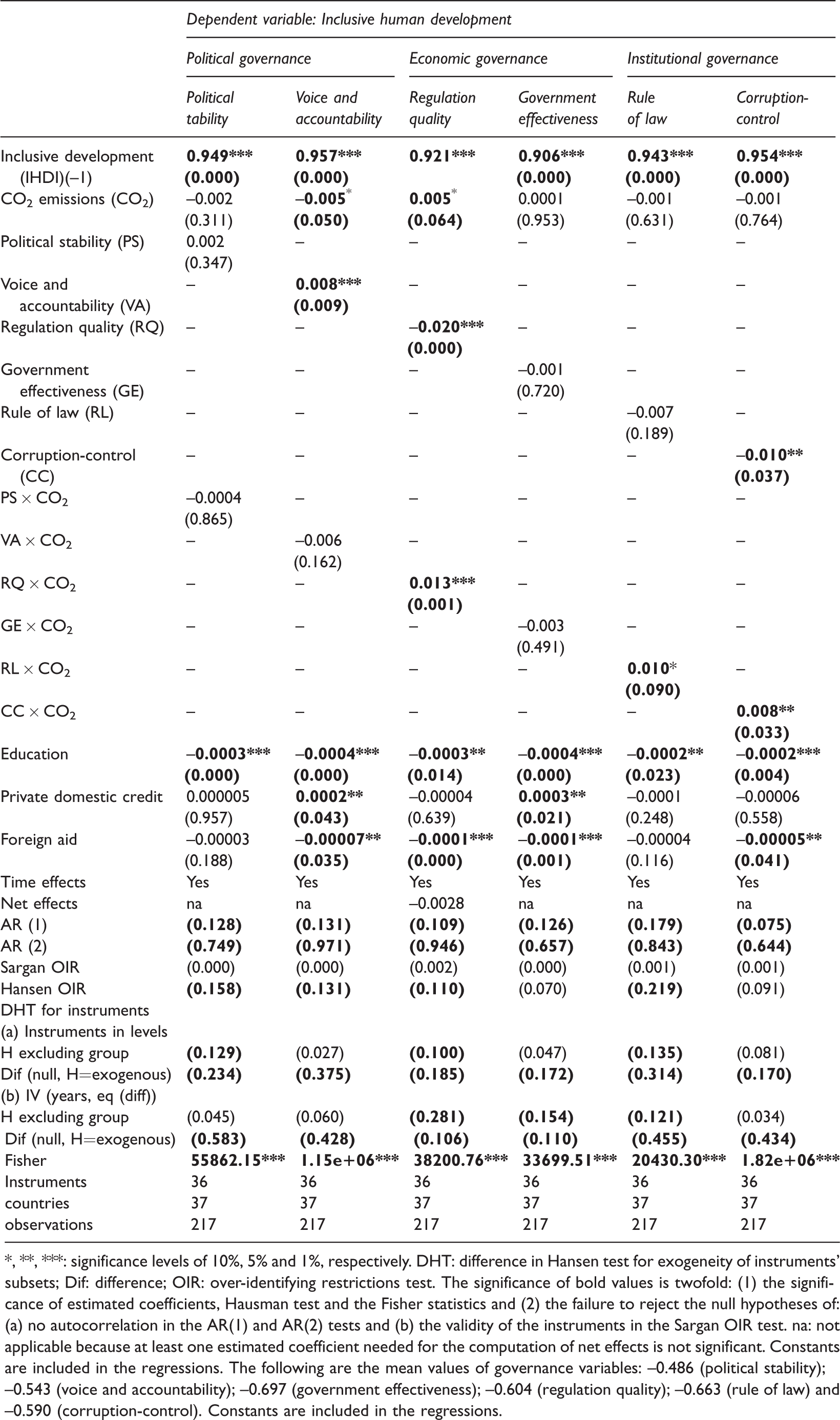
*, **, ***: significance levels of 10%, 5% and 1%, respectively. DHT: difference in Hansen test for exogeneity of instruments’ subsets; Dif: difference; OIR: over-identifying restrictions test. The significance of bold values is twofold: (1) the significance of estimated coefficients, Hausman test and the Fisher statistics and (2) the failure to reject the null hypotheses of: (a) no autocorrelation in the AR(1) and AR(2) tests and (b) the validity of the instruments in the Sargan OIR test. na: not applicable because at least one estimated coefficient needed for the computation of net effects is not significant. Constants are included in the regressions. The following are the mean values of governance variables: –0.486 (political stability); –0.543 (voice and accountability); –0.697 (government effectiveness); –0.604 (regulation quality); –0.663 (rule of law) and –0.590 (corruption-control). Constants are included in the regressions.
In order to assess the research question or the overall effect of government quality in modulating the effect of CO2 emissions on inclusive human development net effects are computed from the unconditional effect of CO2 emissions on inclusive human development and the corresponding conditional effect from the interaction between CO2 emissions and government quality dynamics. For instance, in the fourth column of Table 1, in the regressions pertaining to regulation quality, the net effect of regulation quality in moderating the effect of CO2 emissions on inclusive human development is –0.0028 ([0.013× –0.604] + [0.005]). In the computation, –0.604 is the mean value of regulation quality; the unconditional effect of CO2 emissions per capita is 0.005, whereas the conditional impact from the interaction between CO2 emissions per capita and regulation quality is 0.013. This approach to establishing an overall incidence based on net effects is consistent with contemporary interactive regressions literature (Agoba et al., 2019; Tchamyou and Asongu, 2017).
The main finding in Table 1 is that regulation quality modulates CO2 emissions to exert a net negative effect on inclusive development. Net effects pertaining to the other governance dynamics cannot be computed because either the model does not pass post-estimation diagnostics tests or at least one estimated coefficient needed for the computation of net effects is not significant. The significant control variables have the expected signs.
Robustness checks
In order to assess whether the established findings in Table 1 withstand further empirical scrutiny, the six governance indicators are bundled into four other governance dynamics, namely: political governance (consisting of political stability and voice and accountability), economic governance (entailing government effectiveness and regulation quality), institutional governance (represented with the rule of law and corruption-control) and general governance (i.e. encompassing political, economic and institutional dynamics of governance). The approach used for the retention of common factors is the Kaiser (1974) and Jolliffe (2002) criterion for the selection of principal components in principal component analysis. According to the criterion, only principal components with an eigenvalue greater than the mean should be retained (Asongu et al., 2019). This criterion is adopted in the retention of composite governance indicators in this study. The approach to bundling governance variables for robustness purposes by means of principal component analysis is consistent with recent literature (Asongu and Odhiambo, 2018c; Tchamyou, 2017).
In Table 2, results pertaining to economic governance and general governance do not pass post-estimation diagnostic tests because the null hypothesis of the Hansen test is rejected. The main finding from the table is a net negative effect from the role of institutional governance in modulating the effect of CO2 emissions on inclusive human development. The significant control variables have the expected signs.
Robustness checks.
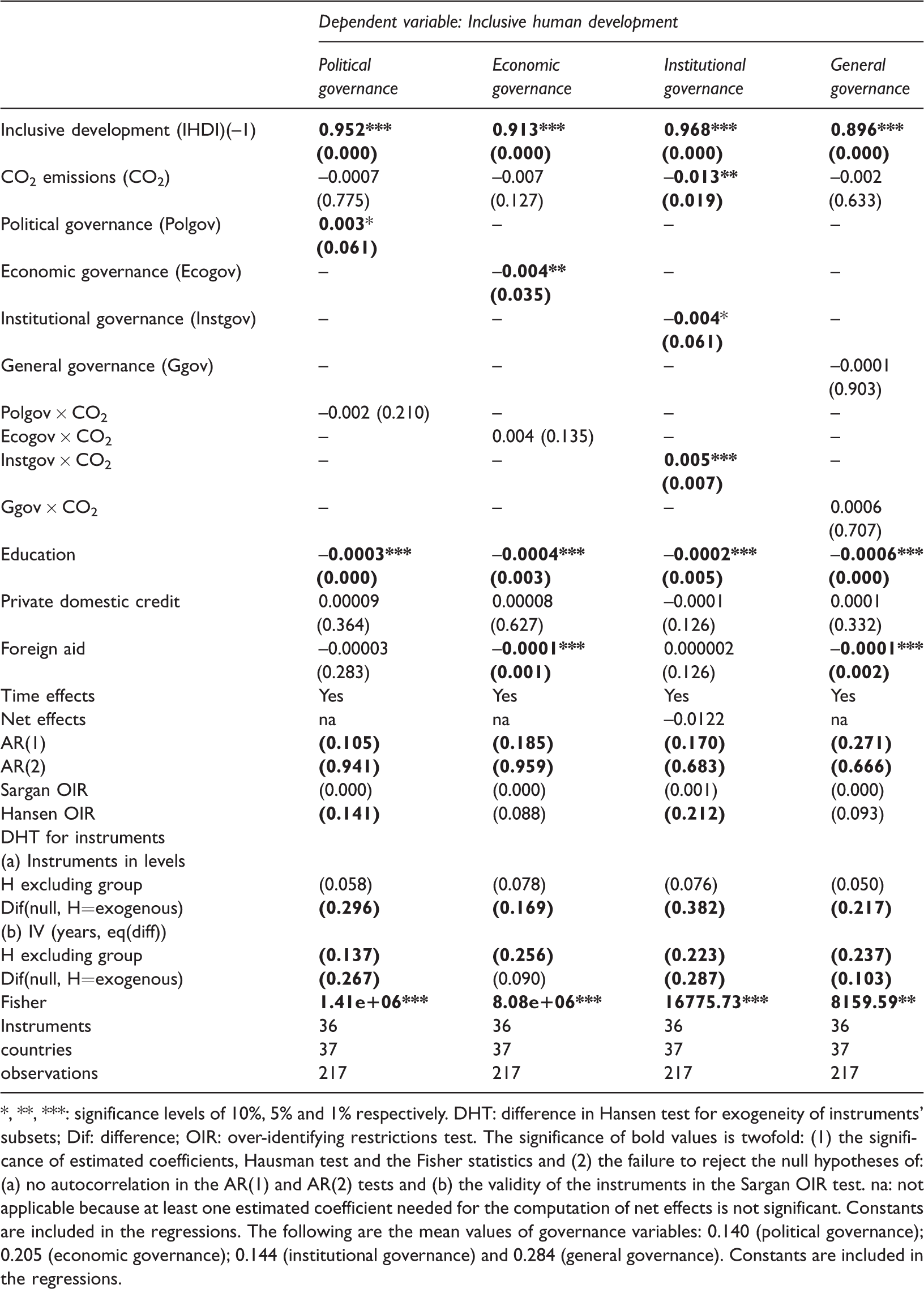
*, **, ***: significance levels of 10%, 5% and 1% respectively. DHT: difference in Hansen test for exogeneity of instruments’ subsets; Dif: difference; OIR: over-identifying restrictions test. The significance of bold values is twofold: (1) the significance of estimated coefficients, Hausman test and the Fisher statistics and (2) the failure to reject the null hypotheses of: (a) no autocorrelation in the AR(1) and AR(2) tests and (b) the validity of the instruments in the Sargan OIR test. na: not applicable because at least one estimated coefficient needed for the computation of net effects is not significant. Constants are included in the regressions. The following are the mean values of governance variables: 0.140 (political governance); 0.205 (economic governance); 0.144 (institutional governance) and 0.284 (general governance). Constants are included in the regressions.
Concluding implications and future research directions
This study has investigated the relevance of government quality in moderating the incidence of environmental degradation on inclusive human development in 44 sub-Saharan African countries for the period 2000–2012. Environmental degradation is measured with CO2 emissions while the governance dynamics include: political stability, voice and accountability, government effectiveness, regulation quality, the rule of law and corruption-control. The empirical evidence is based on the GMM. The following main findings are established. First, regulation quality modulates CO2 emissions to exert a net negative effect on inclusive development. Second, when the six governance indicators are bundled by means of principal component analysis for robustness checks, institutional governance (consisting of corruption-control and the rule of law) modulates CO2 emissions to also exert a net negative effect on inclusive human development.
While this net effect pertaining to regulation quality is negative, it is worthwhile to emphasise that both the conditional and unconditional effects are positive. Hence, the negative net effect is largely traceable to the fact that the average value of regulation quality for the sampled countries is negative. In other words, the fact that regulation quality is negatively skewed implies that regulation quality needs to be further improved in order for net positive effects to be achieved. As a policy implication, enhancing regulation quality is essential for the government dynamic to effectively modulate CO2 emissions for the expected positive net effects on inclusive human development.
It is also worthwhile to note that the conditional effect pertaining to institutional governance is positive, which implies that enhancing institutional governance modulates the unconditional negative effect of CO2 emissions on inclusive human development. Moreover, a threshold of institutional governance at which the conditional positive effect completely dampens the unconditional negative effect is 2.6 (0.013/0.005). This threshold makes economic sense and it is feasible from a policy perspective because the maximum limit of institutional governance disclosed in the summary statistics is 3.766. Hence, at a critical mass of 2.6, the net effect of institutional governance in modulating the effect of CO2 emissions on inclusive development is zero: 0 ([0.005 × 2.6] + [–0.013]). As a policy implication, a level of institutional governance beyond the established 2.6 threshold ensures that institutional governance completely modulates the unfavourable effect of CO2 emissions on inclusive human development. Above the threshold, positive net effects are apparent.
The findings broadly show that there is a need for greater action in the governance dynamics from which significant findings could not be established. Such greater action is also relevant for governance dynamics that significantly modulate the effect of CO2 emissions on inclusive human development.
Future studies can employ appropriate estimation techniques for country-specific studies in order to assess if the established findings withstand empirical scrutiny from country-oriented frameworks. This recommendation for country-specific studies builds on the caveat that country-specific studies are not considered in the GMM approach. Accordingly, country-specific effects are eliminated by first-differencing in order to avoid inherent concerns of endogeneity linked to the correlation between the lagged inclusive human development indicator and country-specific effects.
Footnotes
Author note
Simplice A Asongu is now affiliated with Department of Economics, University of South Africa, Pretoria, South Africa.
Acknowledgement
The authors are indebted to the editor and referees for constructive comments.
Declaration of conflicting interests
The author(s) declared no potential conflicts of interest with respect to the research, authorship, and/or publication of this article.
Funding
The author(s) received no financial support for the research, authorship, and/or publication of this article.