




Abstract
Coalbed methane is now large-scalely explorated and exploitated in the world. The Changzhi coalbed methane block, south-central Qinshui Basin, is a new resource target zone for coalbed methane exploration and exploitation in China. However, the gas content distribution of this block and its influential factors have not yet studied. Based on the recent coalbed methane exploration and exploitation activities, the gas content distribution of coal reservoir in this block was studied. The results show that the gas content hold by the coal reservoir is 7.0 − 21.7 m3/t, which was determined by a combining control effect from geologic structure and hydrogeology. The Changzhi coalbed methane block has experienced multiple-stages geologic structure evolution, especially a tectonic-thermal event during the middle Yanshanian Orogeny improved the coal to the current Ro,max 1.9 − 2.7% and meanwhile the coalbed methane was greatly generated. Subsequently, the widespreadly developed normal fault structures during the Himalayan Orogeny accelerated the coalbed methane escape through the “gas escape windows”, particularly where the location within the distance of about 1300 m to the “gas escape window” the gas content decreases significantly. Moreover, due to the action of the later Himalayan Orogeny, the slope areas of most Yanshanian fold structures were structurally cross-cut by the Himalayan normal faults, and thus an “open” syncline folds were formed. The coal reservoir was depressurized surrounding this “open” syncline structure and consequently the hydrodynamic losing effect has resulted in a comparatively lower gas content therein. By the control of geologic structure and hydrogeology, this block can be generally, compartmentalized into three hydrodynamic systems including the western groundwater stagnation region, the middle runoff region, and the north-eastern recharge region, where the hydrodynamic sealing effect at the groundwater stagnation region has made a comparatively higher gas content for the coal reservoir, but the hydrodynamic losing effect at the recharge region and runoff region has made a comparatively lower gas content of the coal reservoir.
Introduction
As an unconventional natural gas resource, coalbed methane (CBM) can remedy to the shortage of conventional gas resource and is now large-scalely explorated and exploitated in the world (Colosimo et al., 2016; Moore, 2012). In coal reservoir, methane is primarily adsorbed at the surface of the coal matrix micropores and is limited from desorbing by the reservoir pressures (Moore, 2012; Tao et al., 2018; Zhang et al., 2013), where the gas in the conventional reservoir is either free state or dissolved. Therefore, the accumulation mechanism for CBM is quite different from that of conventional gas reservoirs, which largely depends on the favorable combination of the right properties of the coal, an adequate pressure regime, and the depositional, structural, and hydrogeology settings (Ayers, 2003; Bustin and Clarkson, 1998; Kaiser, 1994; Scott, 2002; Song et al., 2012), of which the geologic structure and hydrogeology may be determinant for some basins (Kaiser, 1994; Pashin and Groshong, 1998).
Studies of the San Juan Basin of New Mexico by Ayers (2002), of the Powder River Basin by Rice et al. (2008), of the southeastern Ordos Basin by Yao et al. (2014), of the southern Qinshui Basin by Tao et al. (2014) revealed that the geologic structure and hydrological condition have significant controls on the CBM storage and accumulation. Drobniak et al. (2004), Strąpoć et al. (2007), and Solano-Acosta et al. (2007) documented that the erosional uplift in the SE Indiana have caused fracturing structure that allowed hydrological infiltration of methanogenic microbial consortia into coal beds and ≥96 vol.% of microbial CBM generation and accumulation. In addition, the results of the hydraulic flushing simulation experiments conducted by Qin et al. (2005) and Wang et al. (2015) showed that the CBM was more hydraulically flushed and escaped at strong hydrodynamic setting. Whereas abundant CBM accumulation and high gas content occur at the hydrodynamic trapping zone (Scott, 2002). In the recent exploration and exploitation activities, it has been shown the CBM accumulation and high gas content often distribute at the core area of the syncline structure, such as the east-central Utah Basin (Lamarre, 2003), the northeastern Greater Green River Basin (Scott, 2002), the San Juan Basin (Ayers, 2002), the southeastern Qinshui Basin (Cai et al., 2011; Song et al., 2012; Su et al., 2005), and the Ordos Basin (Xu et al., 2012; Yao et al., 2014). In these cases, the hydrological sealing in the syncline core plays an important control on the CBM accumulation and high gas content.
The Changzhi block, located at the south-central Qinshui Basin, is a new and reserve resource zone for CBM exploration and exploitation (Figure 1). The gas content distribution and its influential factors have not yet systematically studied. In this study, based on the recent CBM exploration and exploitation activities and the measured gas content data from the coal cores of the CBM parameter wellbores, the gas content distribution of this block was studied by combining analyses of geologic structure and hydrogeology.
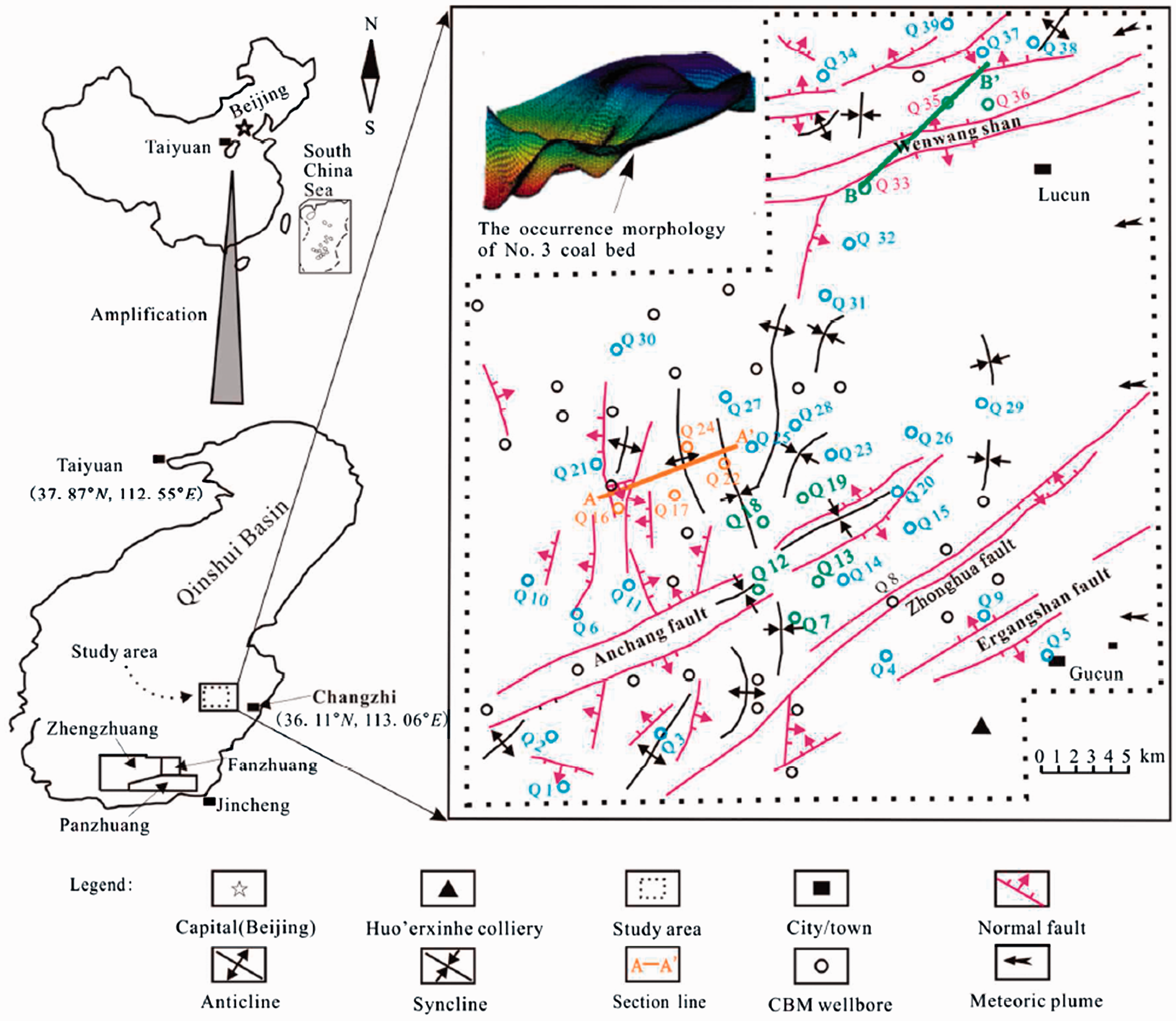
The geological structure frame of the Changzhi CBM block.
Geology setting of the Changzhi block
Structure
The Qinshui Basin, one of the Mesozoic basins evolved from the Late Paleozoic Northern China’s Craton Basin, has been described in numerous literatures (Cai et al., 2011; Sang et al., 2009; Song et al., 2012; Su et al., 2005; Zhang et al., 2016). This basin was a stable intracontinental basin until the Late Permian age (Lv et al., 2012). Since then, the basin has undergone multiple phases of tectonic reconstructions from orogenies of the Indosinian, the Yanshanian, and the Himalayan. Especially during the Jurassic-Cretaceous Yanshanian Orogeny, this basin was rapid uplifted and separated from the North China Craton. It was at this stage that the basic geological structure configuration of this basin was determined and a large synclinorium basin was developed.
The Changzhi CBM block structurally locates at a transition zone between the eastern wing of the Qinshui Basin and the western part of the Taihangshan anticlinorium. Controlled from the geological structure frame the coal bed generally displays a monocline morphology dipping to the west, and emerges coal outcrop at the eastern elevated topography. In the tectonic evolution of this basin, the compression action from the Yanshanian Orogeny during the Jurassic-Cretaceous period produced series of NNE-SSW folds structure. Subsequently, the extensional tectonic evolution of the Himalayan Orogeny resulted in the development of numerous small-scale normal fault structures and the major regional large-scale normal fault structures (Cao et al., 1995; Ren et al., 2005; Zhang et al., 2011), such as the Wenwangshan Fault, the Anchang Fault, the Ergangshan Fault, and the Zhonghua Fault. Because of the faulting control by these regional major fault structures, the Changzhi CBM block was divided into three sub-blocks as the north sub-block, the middle sub-block, and the south sub-block, where the middle sub-block encompasses the maximum area and CBM wellbores. Besides due to the interaction cutting relationship between the fault and fold structures during the tectonic evolution, the Yanshanian folds were cross-cut by the later Himalayan faults throughout much of the Changzhi block. Meanwhile, the tectonic differentiation action during the Himalayan Orogeny has made the Changzhi block a faulted sub-basin of the Qinshui Basin, which increases the coal burial depth of this region to 917 m at average, and the coal bed with depth more than 1000 m occurs at the western area of this block.
Coal-bearing strata
The Qinshui Basin was exposed and subjected to erosion from the Silurian to the Mississippian age, but subsided and received sediment between the Pennsylvanian and the Jurassic age (Cai et al., 2011). Accordingly, the stratigraphic section of this basin ranges from the bottom Paleozoic through Mesozoic to the top Cenozoic. For the Changzhi block, a sediment stoppage happened from the middle Triassic to the Neogene period, the Quaternary sediment directly overlies the early Triassic at most areas (Figure 2). The stratigraphic column of this block includes the Cambrian Formation, the Ordovician Formation, the Pennsylvanian Benxi and Taiyuan Formations, the Permian Shanxi, Xiashihezi, and Shangshihezi, Shiqianfeng Formations, the early Triassic and Quaternary Formations.
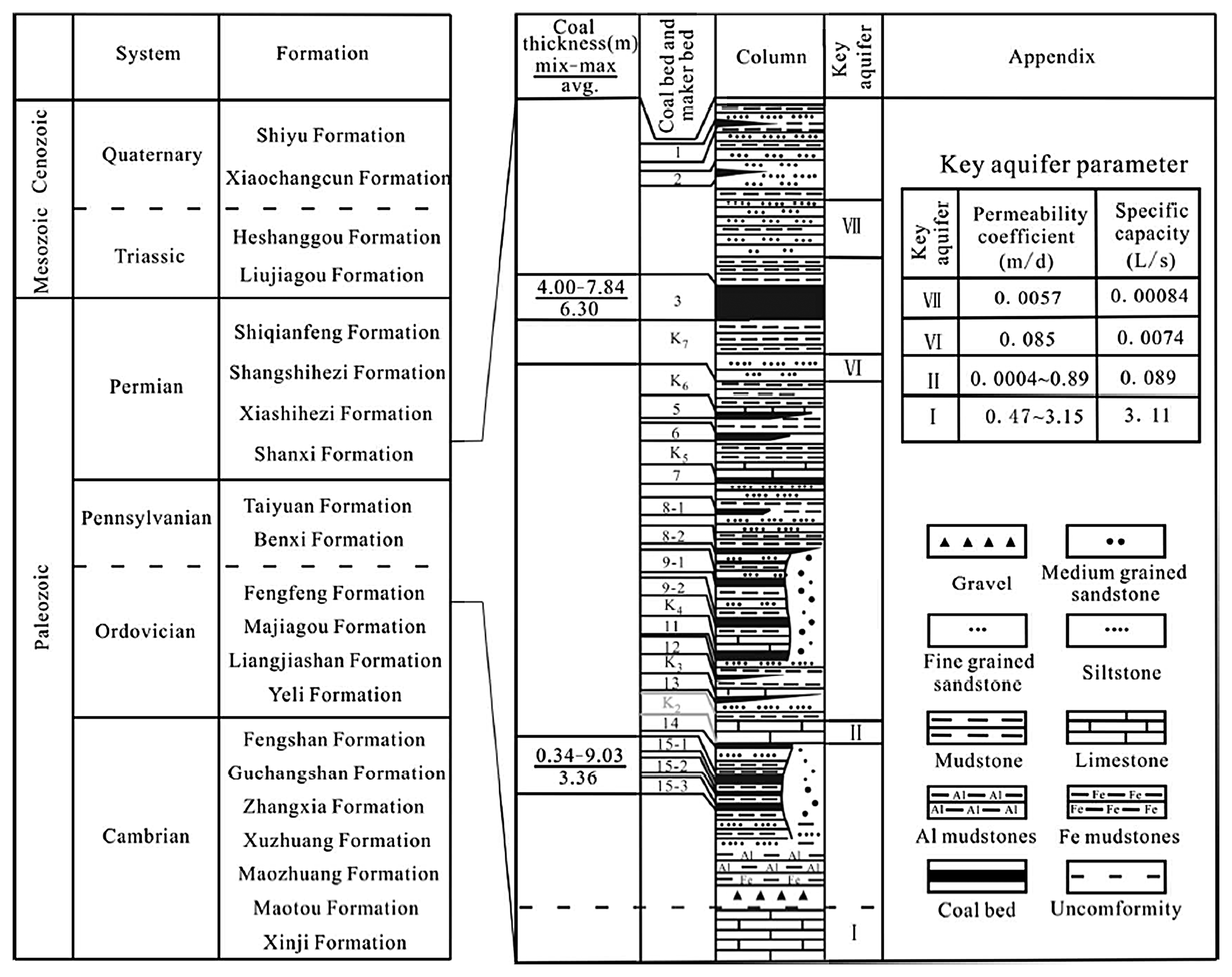
Stratigraphic column of the Changzhi CBM block.
The main coal-bearing strata are the Permian Shanxi Formation and the Pennsylvanian Taiyuan Formation. The Permian Shanxi Formation was deposited on the background environment of continental river-dominated paralic delta, and consists of sandstone, siltstone, mudstone, and three coal beds. Among which the No. 3 coal bed ranges from 4.00 to 7.84 m and is the primary target bed for the CBM exploration and exploitation currently. All the CBM wellbores in Figure 1 have been drilled through this coal bed. The Pennsylvanian Taiyuan Formation was deposited on the background environment of epeiric sea, marked by the top appearance of K6 black marine mudstone. The Taiyuan Formation is about 50–135 m at thickness (generally less than 90 m) and consists of limestone, sandstone, siltstone, mudstone, and about ten coal beds. Among which the No. 15 coal bed averages at 3.36 m, and locally splits to three sub-beds as Nos. 15-1, 15-2, and 15-3. In this block, at some locations the designed CBM wellbores have been drilled through both the Nos. 3 and 15 coal beds such as the Q 4, Q 5, Q 15, Q 9, , Q 20, Q 23, Q 26, Q 31, Q 34, Q 35, Q 36, Q 37, Q 38 shown in Figure 1.
The basic features of the Nos. 3 and 15 coal beds have been listed in Table 1. In the coal maceral analyses, both the Nos. 3 and 15 coals primarily consist of vitrinite and inertinite. Making a comparison between these two coal beds, the vitrinite maceral of No. 3 coal bed is lower than the No. 15 coal bed: the former is 62.26–81.50%, and averages at 73.69%; the latter is 65.00–87.37%, and averages 79.80%. Besides, the mineral substances in the coal include clay mineral, sulphide mineral, carbonate mineral, and silicon-oxide mineral. Thereof, the clay mineral is predominate in both the Nos. 3 and 15 coal beds. However, due to the difference in the coal accumulation environment, the average ash content of No. 3 coal is 18.30%, higher than 13.47% of the No. 15 coal bed.
The basic features of the Nos. 3 and 15 coal beds.
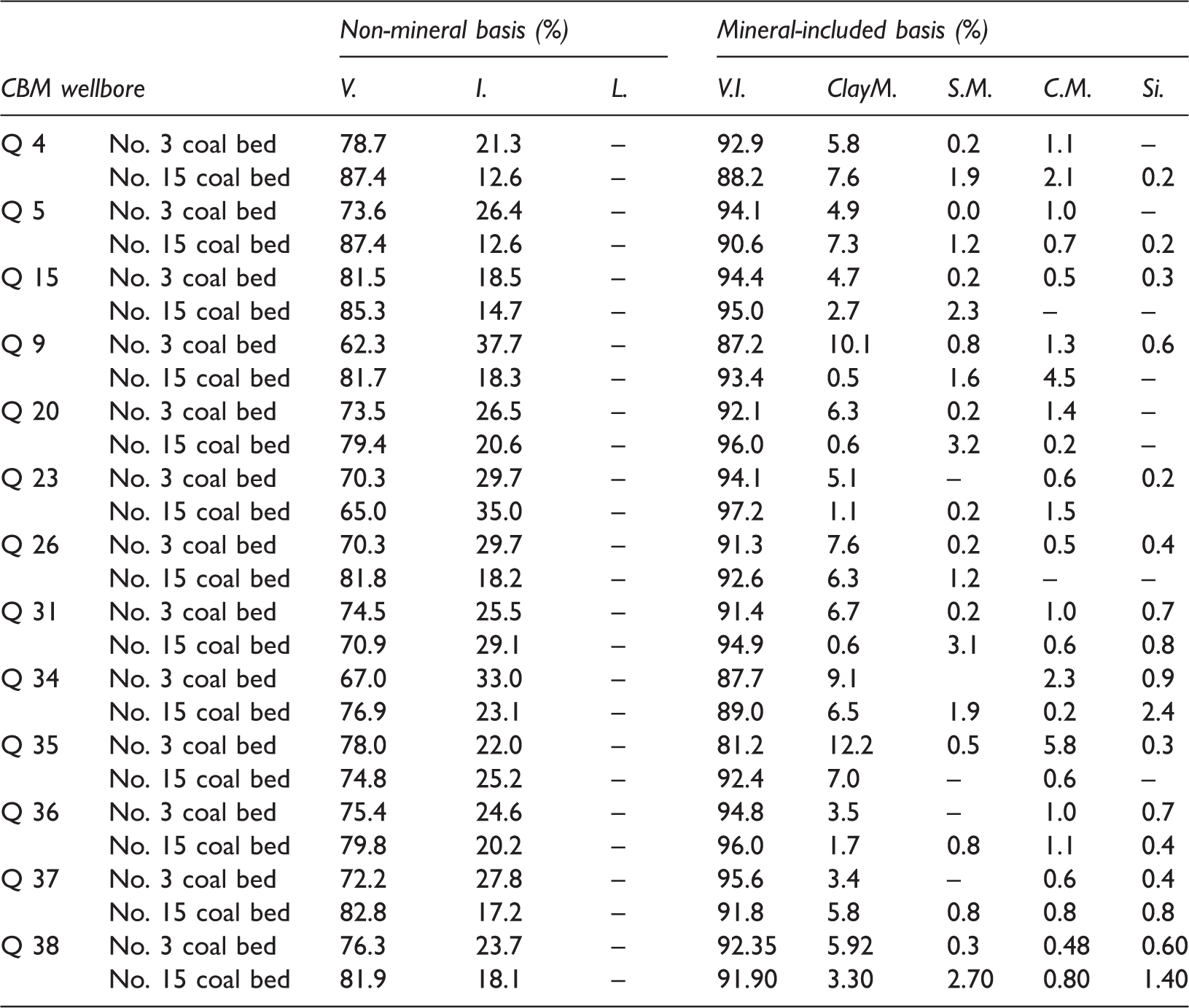
V.: vitrinite maceral; I.: inertinite maceral; L.: liptinite maceral; V.I.: vitrinite and inertinite maceral; ClayM.: clay mineral; S.M.: sulphide mineral; C.M.: carbonate mineral; Si.: silicon-oxide mineral.
Samples and methods
All the samples were collected from the CBM wellbores as shown in Figure 1. Coal cores of fifty-four CBM wellbores were sampled by wireline coring. And in all these wellbores, thirteen were drilled through both the Nos. 3 and 15 coal beds, where the cores of both these two coal beds were sampled.
After cores were sampled, they were instantly placed in the gas desorption canister, connected to an water-filled graduated cylinder, to measure the desorbed gas content by the drainage method according to the national standard, GB/T 19559-2008. After the desorbed gas content was obtained, the residual gas content contained in the cores was measured by smashing the sample in the jar mill. Besides the lost gas content in the wireline coring process was determined by the direct method of USBM. Lastly, the gas content of the coal core is obtained by summing over the desorbed gas content, the residual gas content and the lost gas content.
In the process of measuring the desorbed gas content, the desorbed gas sample was taken to measure the gas composition by the gas chromatography according to the national standard, GB/T 13610-2003. And the δ13C1-CH4 isotope value of the desorbed gas sample was also measured by the mass spectrometry according to the national standard, SY/T 5238-2008.
The reservoir pressure was achieved from the injection/fall-off well test. The detailed test procedure of this method has been discussed by Hopkins et al. (1998) and Chen et al. (2017).
Besides, to discuss the gas accumulation mode in this block and the combining control effect of geologic structure and hydrogeology on the gas content distribution of coal reservoir, two typically stratigraphic sections A-A′ and B-B′ illustrated in Figure 1 were selected and analyzed based on the geological structure information from the seismic prospecting.
Results and discussion
Regional hydrogeology and reservoir pressure
Regional hydrogeology: The hydrogeology condition is essential for gas accumulation by maintaining (or not) the reservoir pressure needed for gas adsorption on the coal surface (Song et al., 2012). The Changzhi CBM block, a general west-dipping monocline, lies in the middle part of the Xin’an springs. According to Chen (2015), the aquifers of Xin’an springs can be divided into three classifications as the Quaternary unconsolidated aquifer, the Carboniferous-Permian clasolite fracture aquifer, and the Ordovician carbonate aquifer (Figure 3).
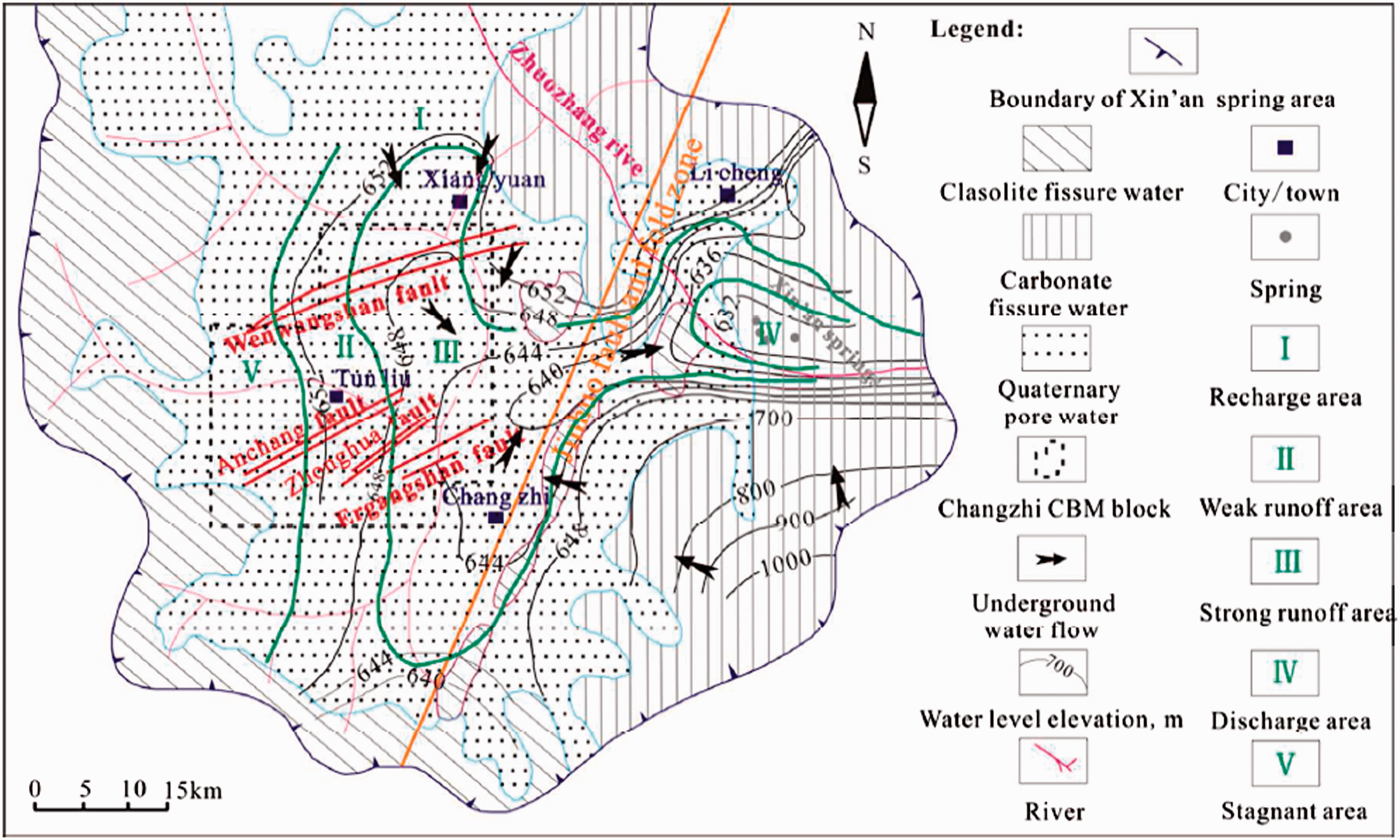
Regional hydrology map of the Changzhi block modified from Jin (2006) and Cao et al. (2016).
The quaternary aquifer is a shallow aquifer system with topography driven flow. Meteoric recharge is from the high surface topography area of the east and north. This aquifer system contains little water, has low permeability and has little influence on the coal-bearing strata, unless at some locations where the aquifer is hydraulically related to the coal-bearing strata by the regional fault structures. The clasolite fracture aquifer is the main source for water inflow to the No. 3 coal bed, which is widespread outcropped and recharged at the western region. The carbonate aquifer underlying the coal-bearing strata is intimately related to the No. 15 coal bed. This aquifer has a complete groundwater flow system in this block, where the atmospheric precipitation recharge comes from the north side of the Wenwangshan fault, following southwards is the groundwater runoff area, and eventually turned eastwards to the outcropped Xin’an springs and the groundwater discharge area.
Besides, according to the presentation of Jin (2006), the areas westwards from the Tunliu county of this block is located at a groundwater stagnant setting. And thus regionally a general division of hydrogeology setting for this Changzhi CBM block can be that the north side of this block with elevated topography is under atmospheric precipitation setting, the east area of this block adjacent to the Xin’an springs is under a groundwater discharge setting, westwards to the Tunliu county this block is under a groundwater runoff setting, and further towards to the western area far away from the Tunliu county this block is under a groundwater stagnant setting. Vertically, the more than 100 m interval and the existence of the interbeded impermeable mudstone between the Nos. 3 and 15 coal beds prevent the hydrodynamic infiltration between these two beds. And thus there is no hydrodynamic connection between those two coal beds, but except the locations where those two beds are hydraulically connected by the regional fault structures.
Reservoir pressure: Taking instances from fifteen CBM wellbores of the No. 3 coal bed, covering the most regions of this block, the injection/fall-off well tests show that the CBM reservoir pressure gradient of this Changzhi block is 0.2–0.78 MPa/100 m (Table 2), which indicates the reservoir of this block is commonly under-pressured.
The reservoir pressure of this block.
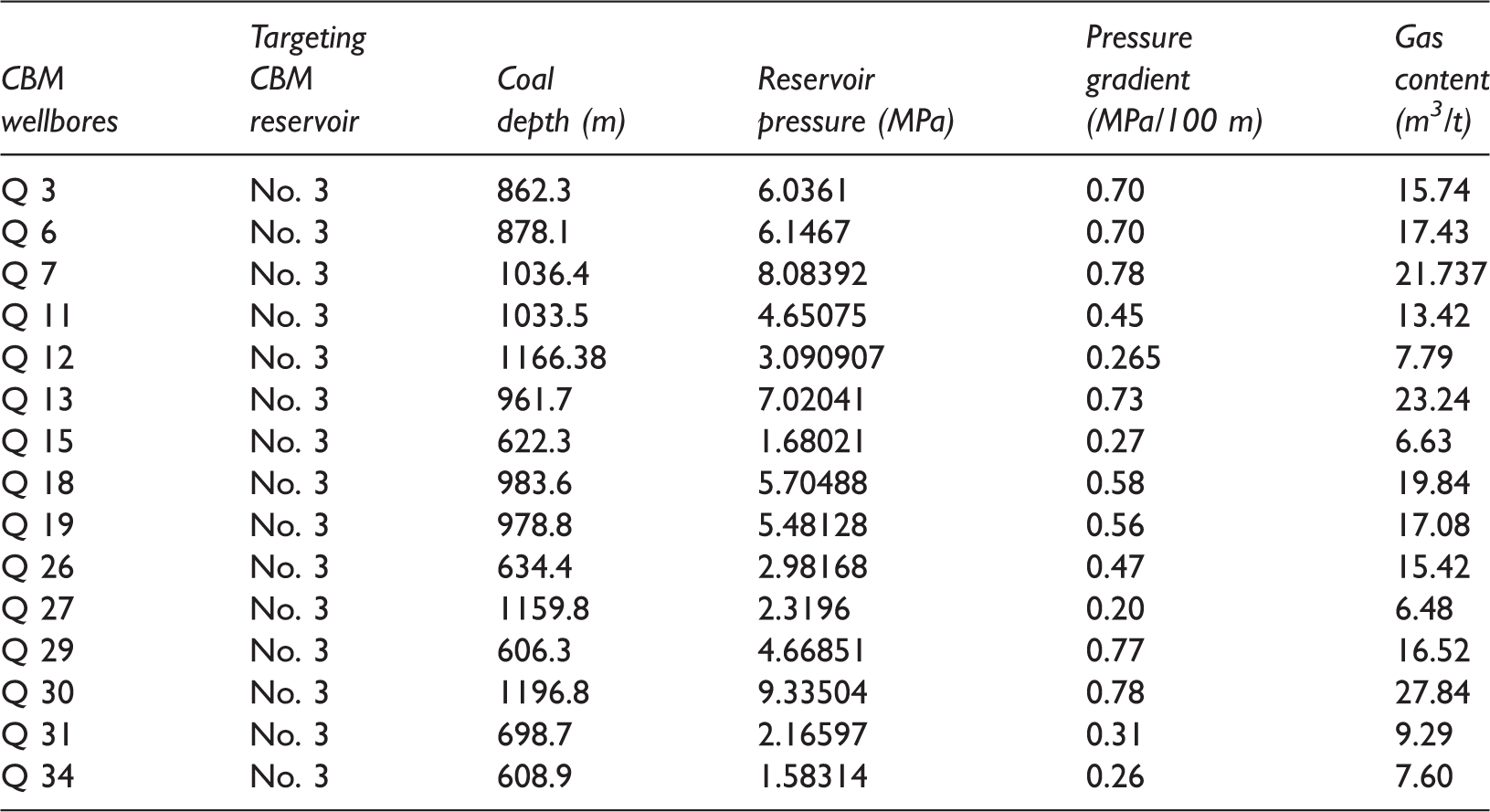
CBM: coalbed methane.
Anomalous reservoir pressures are commonly considered to be resulted from the processes that alter the pore or fluid volume (Law and Dickinson, 1985; Xu et al., 2012). As a result of unbalanced development between the enlarging porosity and decreasing pore fluid volume, the basin-wide under-pressured coal reservoir can be developed (Xu et al., 2012). In view of the tectonic evolution of this block, the successive deposition of the Pennsylvanian-Permian coal-bearing strata had little effect on this unbalanced development of coal reservoir porosity and the pore fluid volume. However, a recent study by Wei and Ju (2015) showed that the current coal reservoir fluid (coal reservoir water) has a geology age of 0.8–3.3 Ma (i.e. Pliocene to early Pleistocene). It is apparent that the age of the reservoir fluid is incompatible with the depositional age of the coal-bearing strata (Permian-Pennsylvanian).
Therefore, from the tectonic evolution of this block it can be inferred that, during the Jurassic-Cretaceous period, the significant uplift and erosion of the overburdens throughout the Qinshui Basin has resulted in the unbalanced development between the enlarging porosity and the decreasing pore fluid volume, and which has resulted in the development of paleo-fluid losing. And thus the basin-wide under-pressured reservoir was developed. Additionally, the extensional tectonic evolution during the Himalayan Orogeny has produced numerous small-scale or regional normal fault structures, which not only further make the development of paleo-fluid losing but also provide migration passage for the Cenozoic meteoric precipitation into the coal bed. Resultantly, the reservoirs surrounding the regional large-scale normal fault structures are more under-pressured. Such as the CBM wellbores of Q 7, 12, 13, 18, and 19 surrounding the Anchang faulting zone (Figure 4), where all these reservoirs are under-pressured. Especially for the wellbore of Q 12 located close to this open fracture structure, its reservoir pressure gradient is only 0.265 MPa/100 m and the gas content is low to 7.79 m3/t.
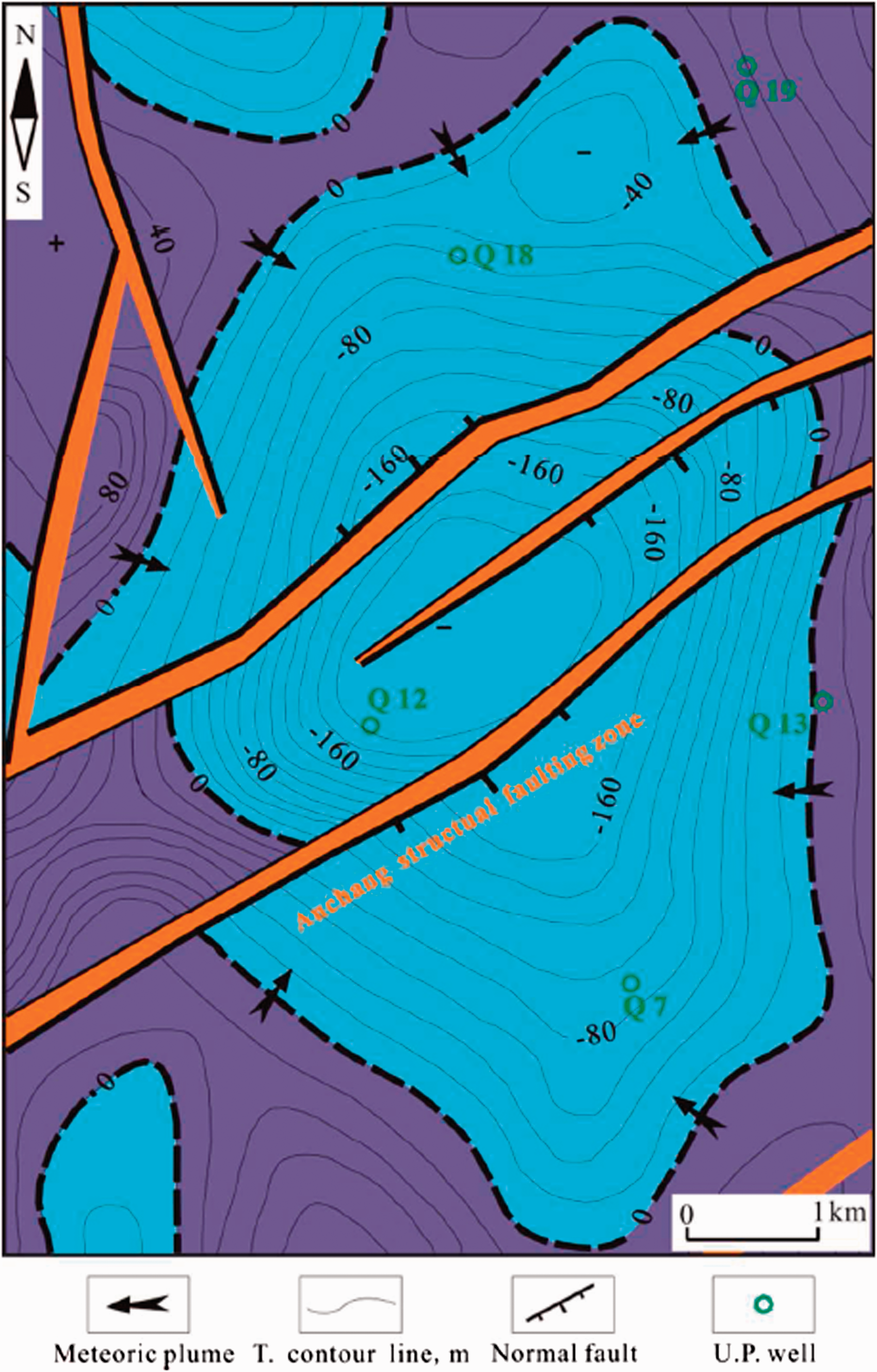
The under-pressured CBM reservoir surrounding the Anchang faulting zone.
Gas generation and its evolution
The burial and thermal evolution processes of coal can be used to evaluate the gas generation stage. The burial and thermal history of coal-bearing strata is shown in Figure 5. It shows that the coal maturation and gas generation of the Changzhi block have experienced four periods. From the formation of coal-bearing strata at the Pennsylvania-Permian to the end of the Permian period, the coal was at a low temperature thermal maturation state, when only lignite and microbial methane gas was generated. However, due to the shallow burial depth, the gas was not preserved.
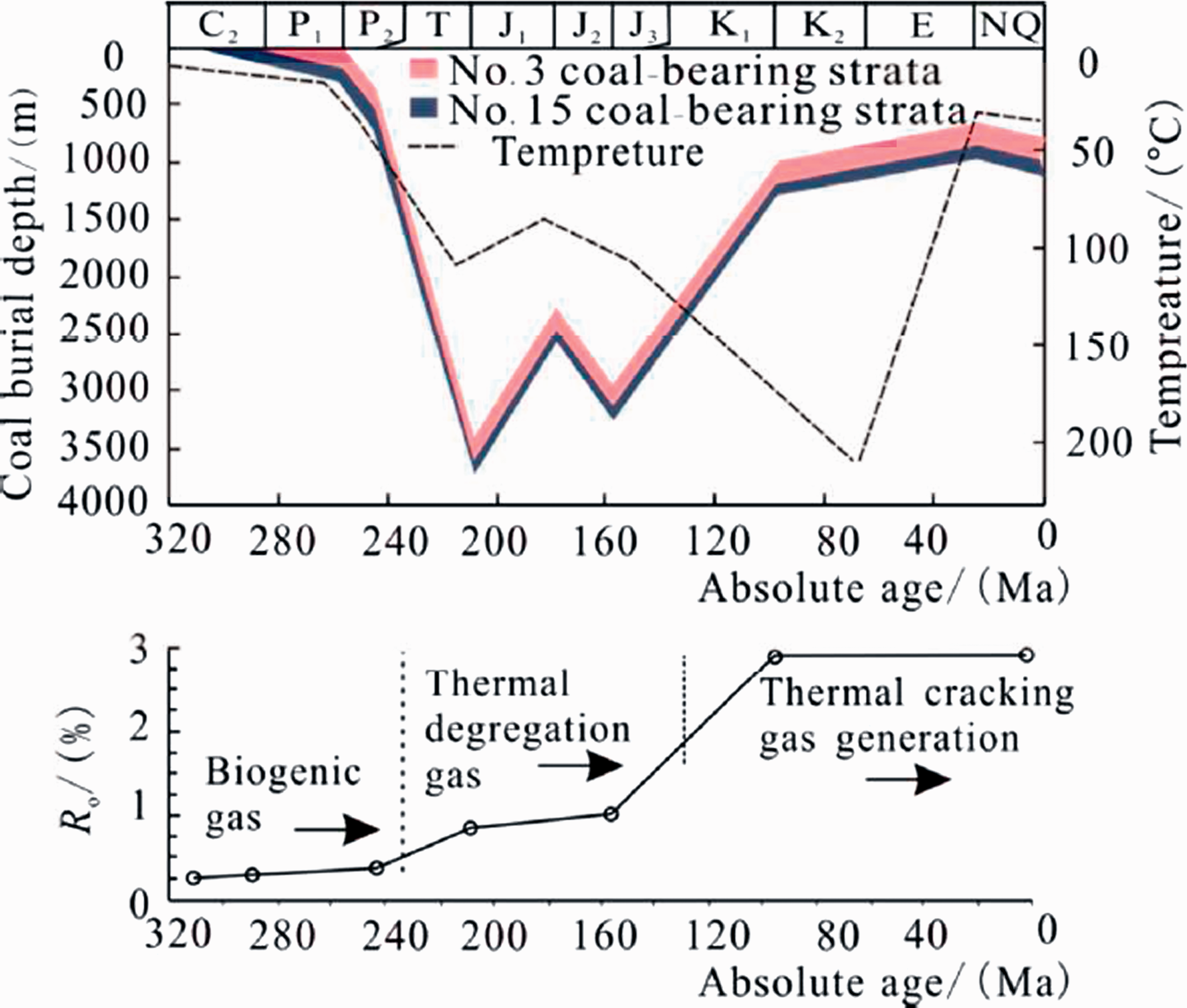
The coal rank evolution and CBM generation in the Changzhi block.
During the Triassic period, a continuous and fast sediment was received, and the geo-thermal was increased at a normal gradient 2 − 3°C/100 m to about 100°C, which improved the coal to R o 0.4–0.8% (Qin et al., 1997). Simultaneously, the thermal degradation gas was generated from the dislocation of the oxygen-containing functional groups on the side chain of coal aromatic nucleus.
Then at the early-middle Jurassic period, the basin was in a fluctuation burial history with interval uplifting erosion or sinking compaction, the maturity of coal was relatively stable, and no significant gas generation. But at the subsequent late-Jurassic stage, a tectonic-thermal event associated with the Yanshanian Orogeny made an anomalous geothermal gradient 4–6°C/100 m for this region (Cai et al., 2011; Qin et al., 1997), the coal rank evolution gradient reached 0.26% Ro/100 m. It was at this stage that the coal was elevated to the current Ro 1.9 − 2.7% (Ro contour in Figure 6). And then the thermal cracking gas was massively generated from the dissociation of the macromolecular hydrocarbons. As reported by Qin et al. (1997), the pyrolysis simulation experiments showed the thermal maturation of coal at this stage was sufficient to make a gas content of 194.57–253.07 m3/t. However, the gas content measurement results from the CBM wellbores show the current gas content is 7.0–21.7 m3/t. It is inferred that due to the continuous strata lifting erosion and the development of basin-wide under-pressured coal reservoir at the Jurassic-Cretaceous period, bulk of gas was desorbed and then lost by migration (Zhao et al., 2005).
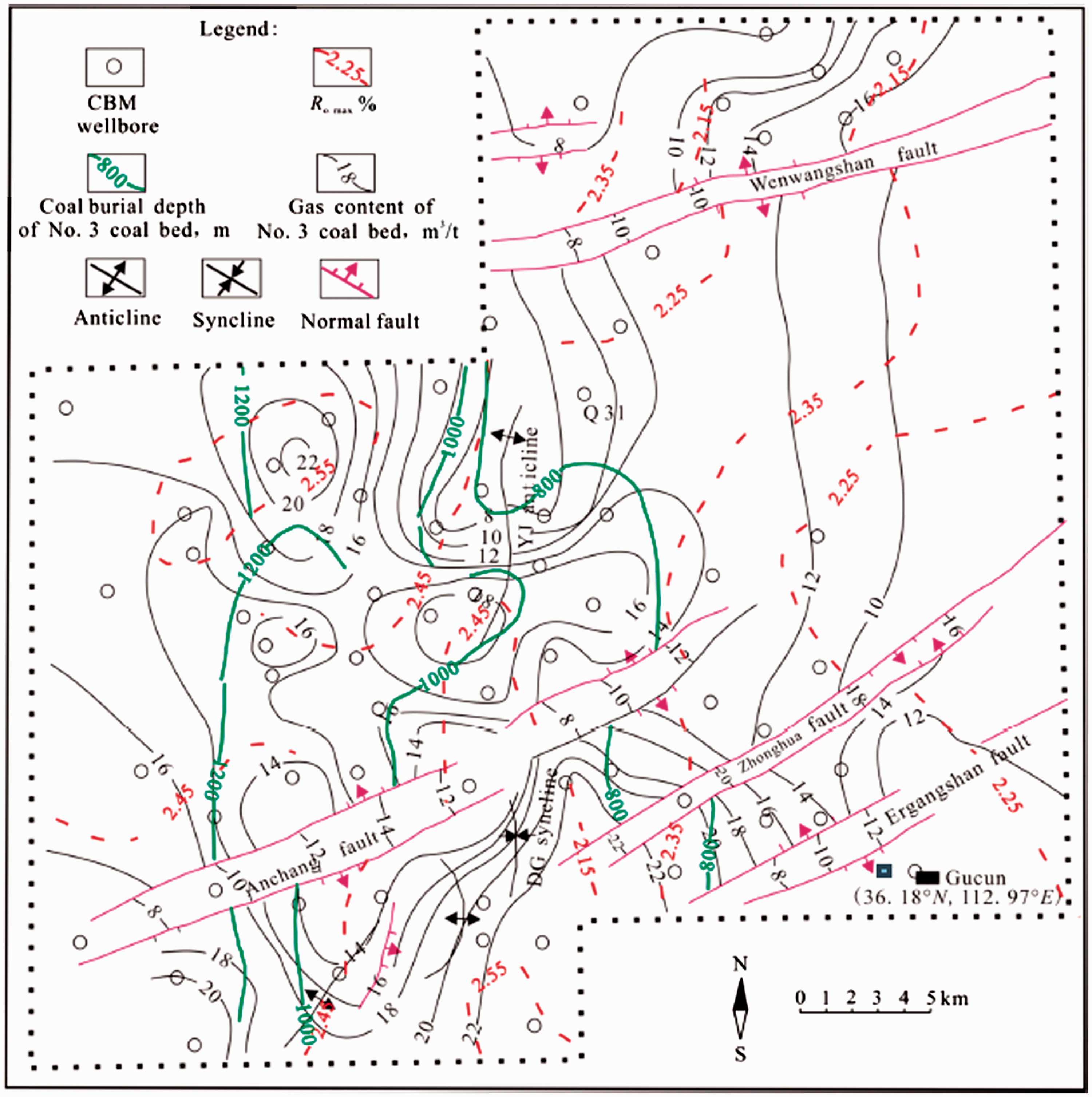
The gas content distribution of the Changzhi block.
Subsequently, the tectonic differentiation action of Himalayan Orogeny has caused the coal-bearing strata subsidence again. Nevertheless, because of the shallow coal burial depth and low strata temperature the coal rank was not improved and no gas was generated. Meanwhile, due to the widespreadly developed extensional normal fault structures at this period, the more under-pressured coal reservoir surrounding the fault structures has been developed, which significantly decreases the gas content therein.
Gas content distribution
The gas content distribution is usually controlled by the depositional, hydrodynamic and structural settings (Bustin and Clarkson, 1998; Yao et al., 2014). The favorable CBM accumulation zone is typically characterized by high gas content. According to the gas content measurement results of coal cores from the CBM wellbores, the gas content distribution of this block is shown in Figure 6.
Gas content distribution related to hydrogeology: Taking the gas content measurement results of coal cores from the thirteen CBM wellbores drilled through both the Nos. 3 and 15 coal beds, the gas content of the No. 15 coal bed is often lower than that of the No. 3 coal bed (e.g. Q 4, Q 5, Q 15, Q 20, Q 23, Q 26, Q 31, Q 35, Q 37, Q 38) (Figure 7). Moreover, except for the Q 31, it is more commonly measured that there are negative δ13C1-CH4 compositions for the desorbed gas samples of coal cores from the No. 15 coal bed than that of the No. 3 coal bed (Figure 8). The data of Figures 7 and 8 are shown in Table 3.
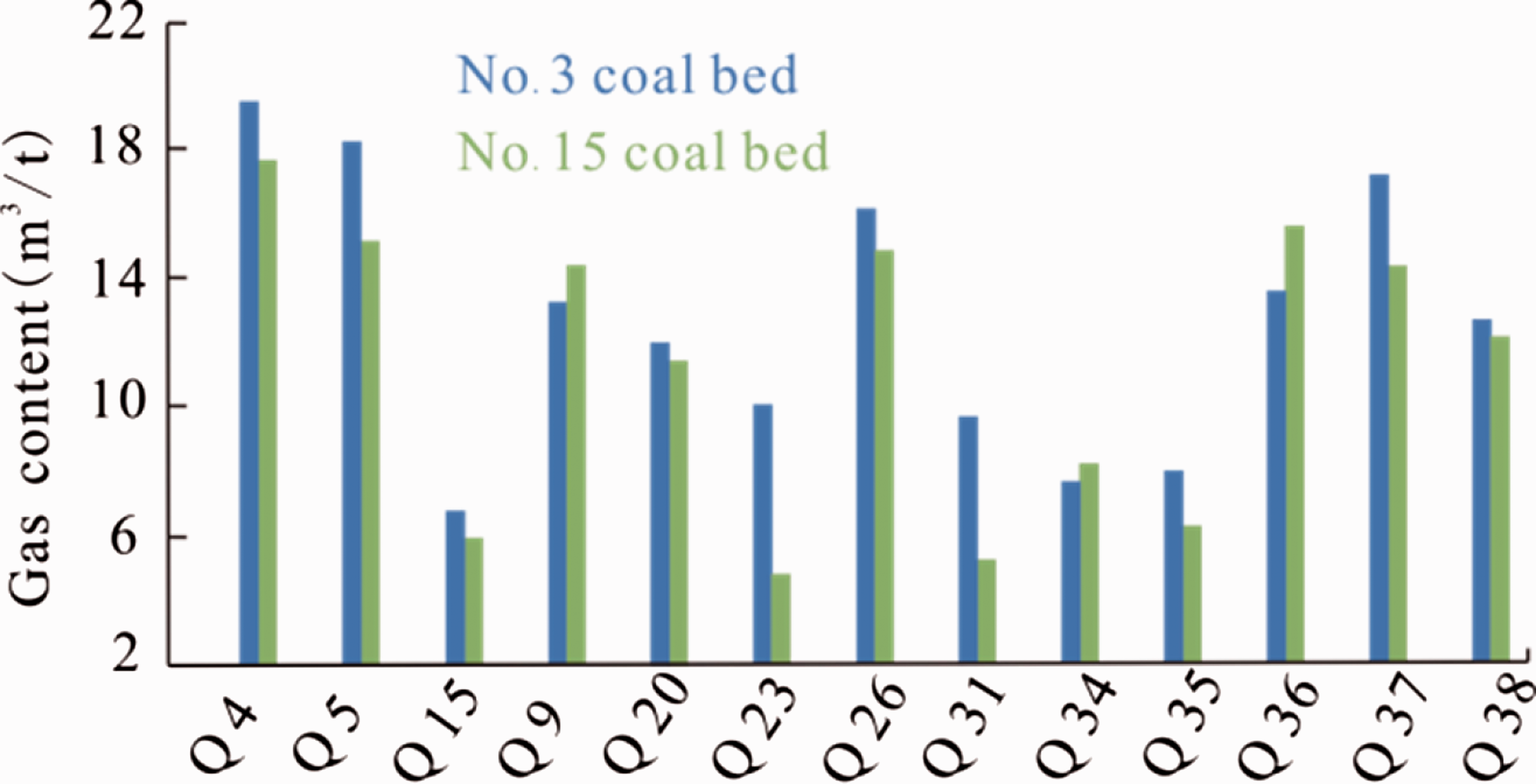
The gas content contrast between the Nos. 3 and 15 coal beds.
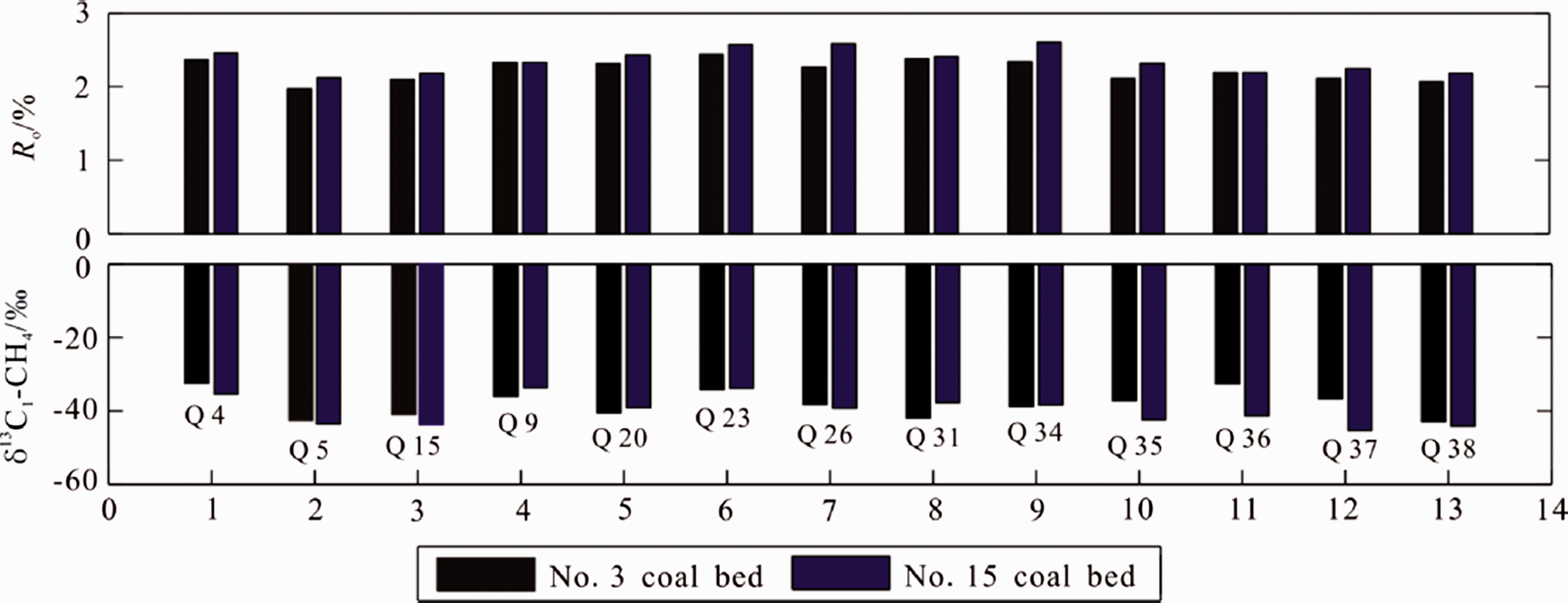
Comparison of Ro and isotope value of δ13C1-CH4 between Nos. 3 and 15 coal beds.
The data of Figures 7 and 8 from the CBM wellbores.
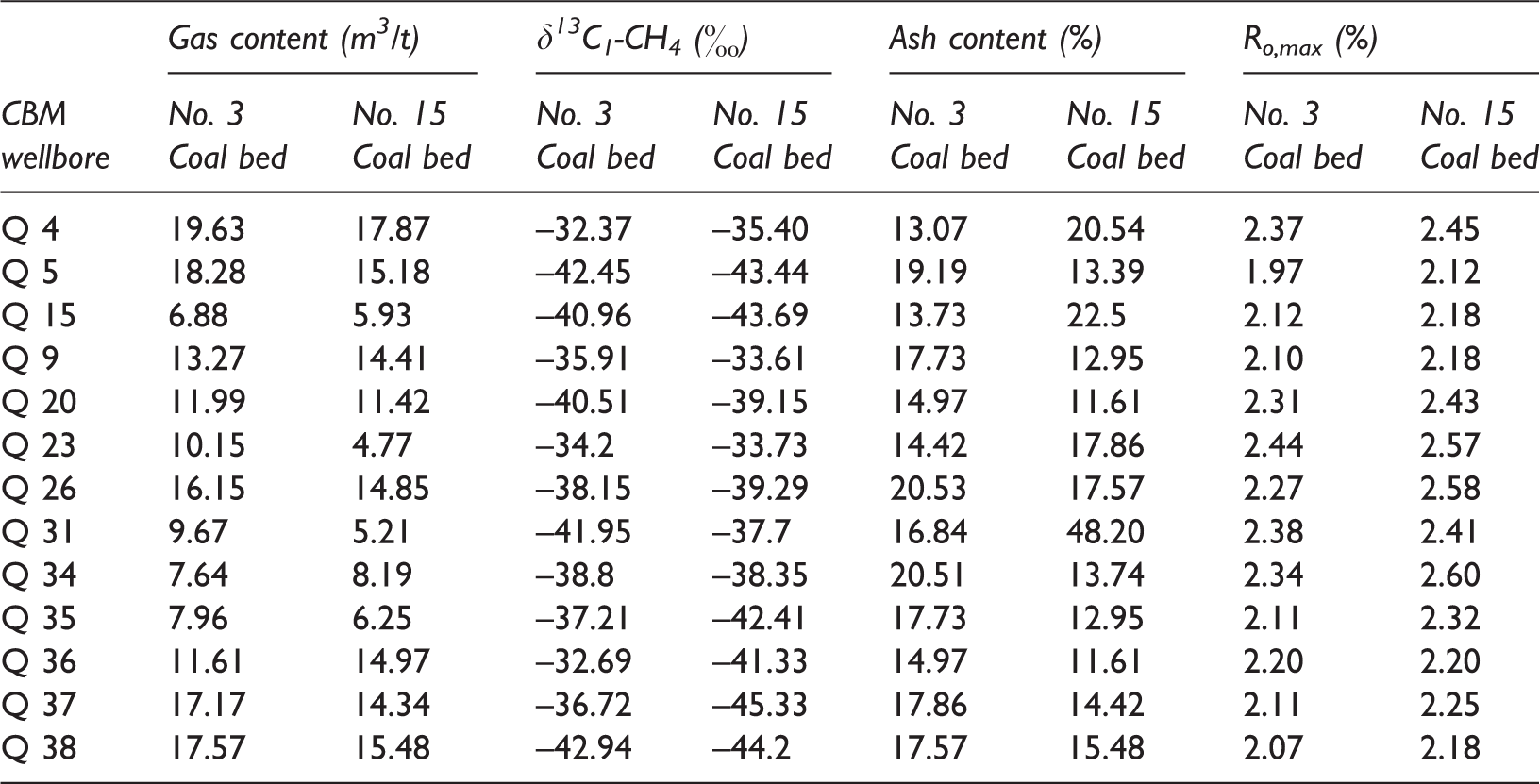
CBM: coalbed methane.
In discussion of the gas content distribution between the Nos. 3 and 15 coal beds, for the particular case of Q 31, it may be that the ash content of the coal up to 48.2% would significantly decrease the gas adsorption capacity and then result in a comparatively low gas content. In other cases, the essential factors such as coal rank, coal bed burial depth and ash content are all favorable for No. 15 coal bed to have a higher gas content than the No. 3 coal bed. However, the gas content measurement results from the exploration and exploitation activities indicate that the No. 15 coal bed usually has a lower gas content than the No. 3 coal bed. This anomalous gas content distribution between the Nos. 3 and 15 coal beds makes it important to consider the effect of hydrodynamic condition on the gas content. As documented in the hydraulic flushing simulation experiments under different hydrodynamic intensities (Qin et al., 2005; Wang et al., 2015), the 13C1-CH4 is more easily water-dissolved and hydraulically flushed than the 12C1-CH4. Although the amount of methane dissolved in water is relatively low and depends on pressure and salinity, significant amounts of gas can be transported over geologic time (Qin et al., 2005; Wang et al., 2015).
In order to evaluate the hydrodynamic intensity of these two coal beds, the key aquifer parameter were evaluated from the steady pumping test and listed in the appendix of Figure 2. It is showed that the hydrodynamic flow intensity of No. 15 coal bed represented by the specific capacity is higher by one to two orders of magnitude than that of the No. 3 coal bed. Stratigraphically, this strong hydrodynamic condition for the No. 15 coal bed can be resulted from the regional limestone aquifer roof for the No. 15 coal bed throughout the Qinshui Basin (Song et al., 2012; Yao et al., 2014). And thus this coal bed can be regarded as a single aquifer by its hydrodynamic connection through fractures or water-eroded caves to the limestone aquifer (Yao et al., 2014). Consequently, due to the stronger hydrodynamic condition in the long-term geology time, the 13C1-CH4 component of the CBM for the No. 15 coal bed can be more hydraulically flushed and water-dissolved, which eventually made the anomalous gas content distribution between these two coal beds, and the more negative δ13C1-CH4 composition for the No. 15 coal bed.
Gas content distribution related to geologic structure: In this block, the coal reservoir is generally cross-cut by the steep normal fault structures at most areas, especially for the middle sub-block. The reservoir with “gas escape window” (reservoir connected with surface by the fault structure) and long-term exposure on surface have been commonly seen. This “gas escape windows” has produced the heterogeneous gas content distribution at this block. For instance, the gas content is 8–12 m3/t surrounding the horst structure formed by the Wenwangshan fault zone, the Anchang fault zone, and the Ergangshan fault zone; whereas the gas content is 16–18 m3/t surrounding the graben structure formed by the Zhonghua fault zone (Figure 6). The heterogeneous gas content distribution surrounding the horst structure and the graben structure is primarily determined by the difference at the coal bed burial depth. The equally stratigraphic coal-bearing strata was uplifted more than 100 m at the horst structure, which has significantly decreased the reservoir pressure for the shallow burial depth and then promoted gas desorption from the coals (Kędzior et al., 2013). Consequently, the desorbed gas migrates and escapes along the “gas escape window”. This gas content distribution situation is similar to the Brzeszcze coal reservoir located at the Upper Silesian coal basin, Poland where the Jawiszowice fault zone produces an “open” methane pattern to naturally degasses the coal reservoir (Kędzior, 2009, 2013). To further investigate the impact distance of the “gas escape window” on decreasing the gas content of coal reservoir, the statistical result of the gas content distribution of coal reservoir at a location versus its distance to the fault structure has been shown in Figure 9. It clearly indicates that the closer of the coal reservoir to the fault structure, the lower gas content to be hold by the reservoir, and vice versa. Besides, it also shows that within the distance of about 1300 m to the fault structure, the gas content is significantly decreased by the “gas escape window”.
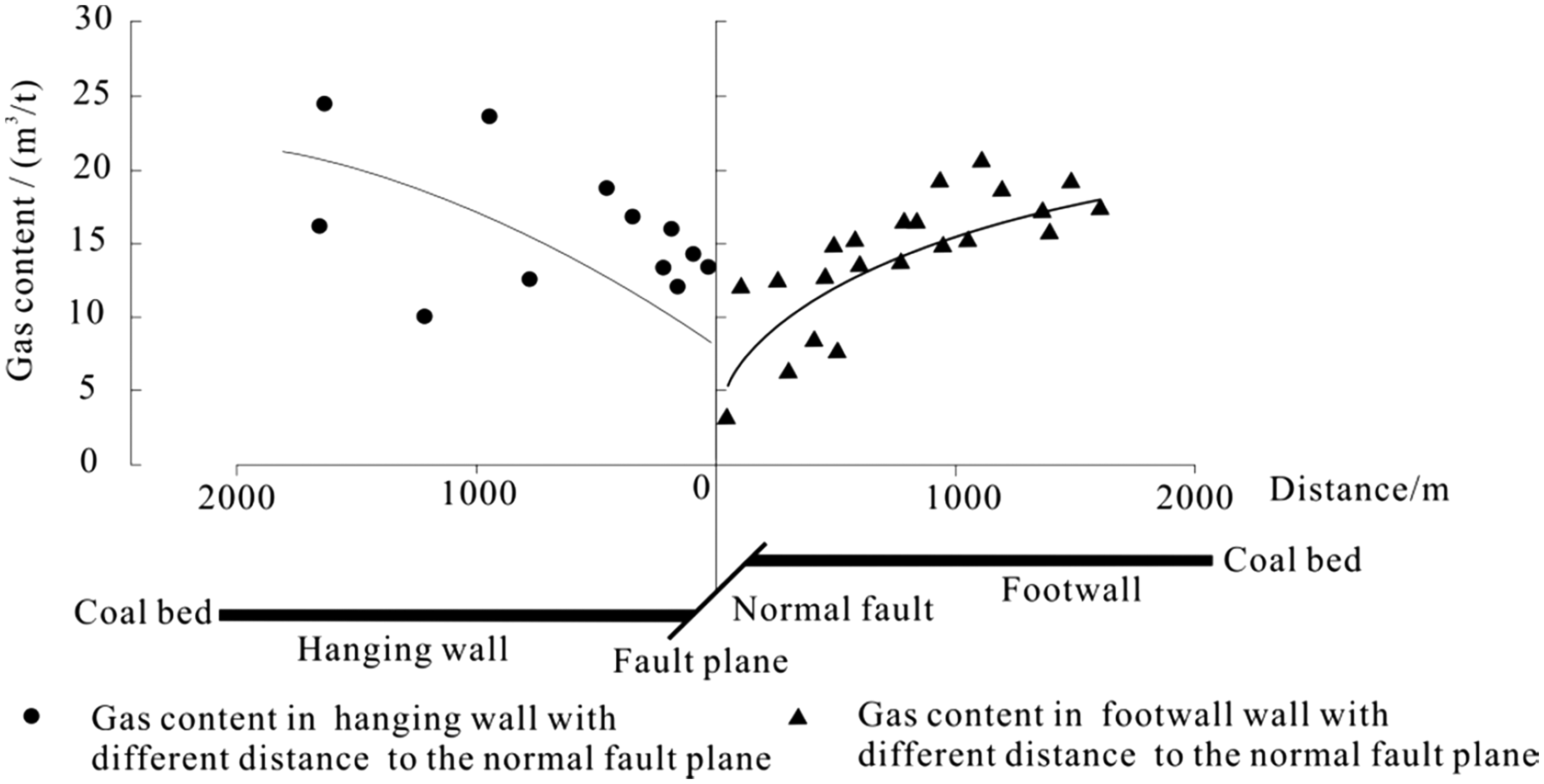
Gas content at the location versus its distance to the fault plane.
The gas content distribution surrounding the fold structures also shows regularity. In the fold structure, the crest region of anticline is subjected to a low in-situ stress (Albertz and Lingrey, 2012; Albertz and Sanz, 2012), whereas the groove region of syncline is subjected to a high in-situ stress. As a result, the crest region of anticline is stress-relaxed to enlarge the cleat aperture of coal reservoir and to improve the coal reservoir permeability (Tao et al., 2012), which is favorable for the gas escape from the coal reservoir and then can results in a lower in-situ gas content at the crest region than that of the wing region. This gas content distribution regularity can be seen surrounding the YJ anticline structure in Figure 6. On the contrary, for the syncline structure, a compressed stress state of the groove region decreases the cleat aperture of coal reservoir as well as its permeability, which is favorable for the gas accumulation and conservation. Resultantly, a higher gas content occurs at the groove region of the syncline structure than that of the limb region. This gas content distribution regularity can be seen surrounding the DG syncline structure in Figure 6.
Gas accumulation mode
The gas accumulation mode is comprehensively controlled by the geologic structure and hydrogeology. This comprehensive control effect can be expressed in two ways as hydrodynamic sealing and hydrodynamic losing. In the mechanism, the hydrodynamic sealing effect is favorable for the development of over-pressured CBM reservoir and then for gas to be adsorbed, whereas the hydrodynamic losing effect results in the development of under-pressured CBM reservoir and low gas content (Scott, 2002; Song et al., 2012).
In the traditional view, the gas accumulation often occurs at the synclines core where a down-dip water flow fed from continuous meteoric water recharge maintains the reservoir pressure and forms an effective hydrodynamic seal (Song et al., 2012). However, in most regions of the Changzhi CBM block, as a consequence of extensional tectonic evolution during the Himalayan Orogeny, the slope of the syncline structures were cross-cut by the regional or local normal fault structures, and then an “open” syncline mode was made. As shown in Figure 10, the gas content surrounding the large-scale “open” synclines structure is comparatively lower (e.g. Q 16 of 7.83 m3/t, Q 17 of 13.04 m3/t) than that of the adjacent small-scale “closed” synclines structure (Q 22 of 20.92 m3/t). The decreased gas content and more negative δ13C1-CH4 towards the “open” syncline structure area indicate that the “open” syncline structures area is more hydraulically flushed by the meteoric precipitation into the coal bed through the “gas escape windows”, which is an unfavorable geological setting for gas accumulation.
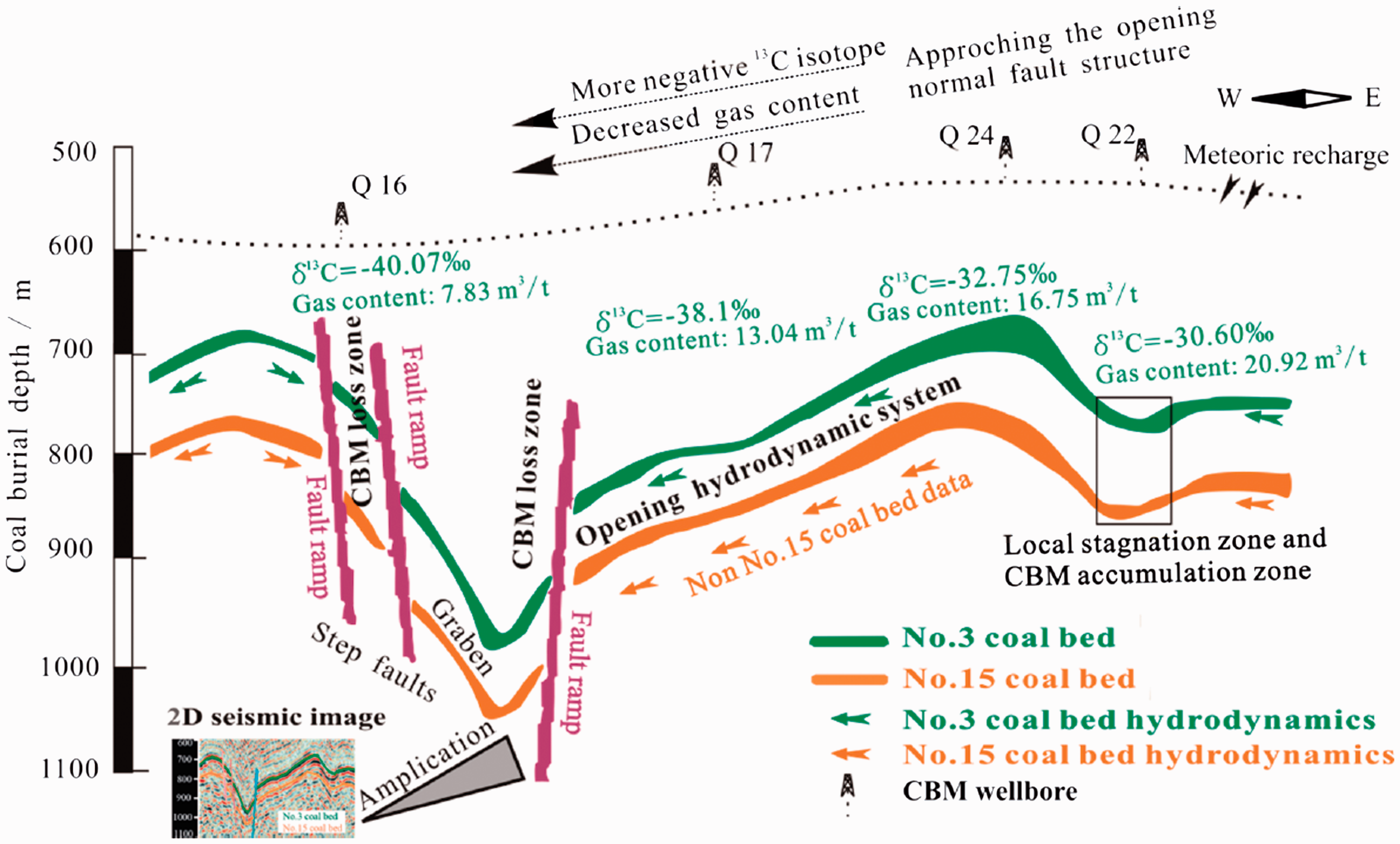
The section A-A′ from Figure 1: illustrating the CBM accumulation in relation to the fold structure.
Moreover, it was reported by Kinnon et al. (2010) and Yao et al. (2014), the gas accumulation and high gas content occur surrounding the fault structure where the thrust fault serves as a sealing boundary in terms of the water and gas flow. However, due to the Himalayan Orogeny, the Changzhi block is located at an extensional tectonic setting, where the numerous normal fault structures serve as an open boundary and “gas escape windows” for gas migration and escape. As shown in Figure 11, both the gas content and the δ13C1-CH4 composition are steeply decreased towards the regional Wenwangshan fault structure zone, where the CBM wellbore of Q 33 has only a gas content of 8.92 cm3/t. Therefore, it can be concluded that the extensional tectonic setting, indicated by the development of widespread normal fault structures, is unfavorable geological setting for gas accumulation for this block.
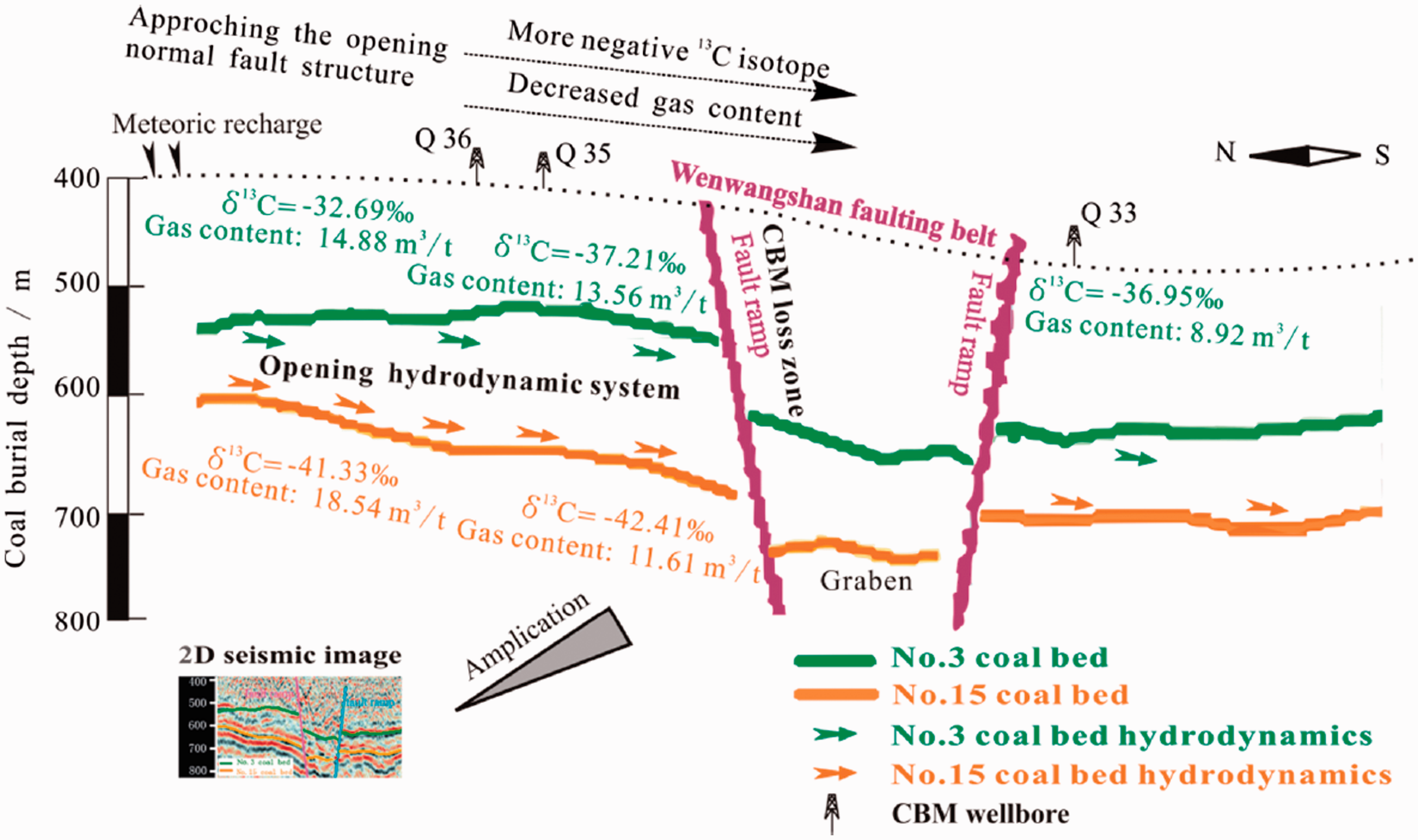
The section B-B′ from Figure 1: illustrating the CBM accumulation in relation to the fault structure.
Compartmentalization of gas content distribution
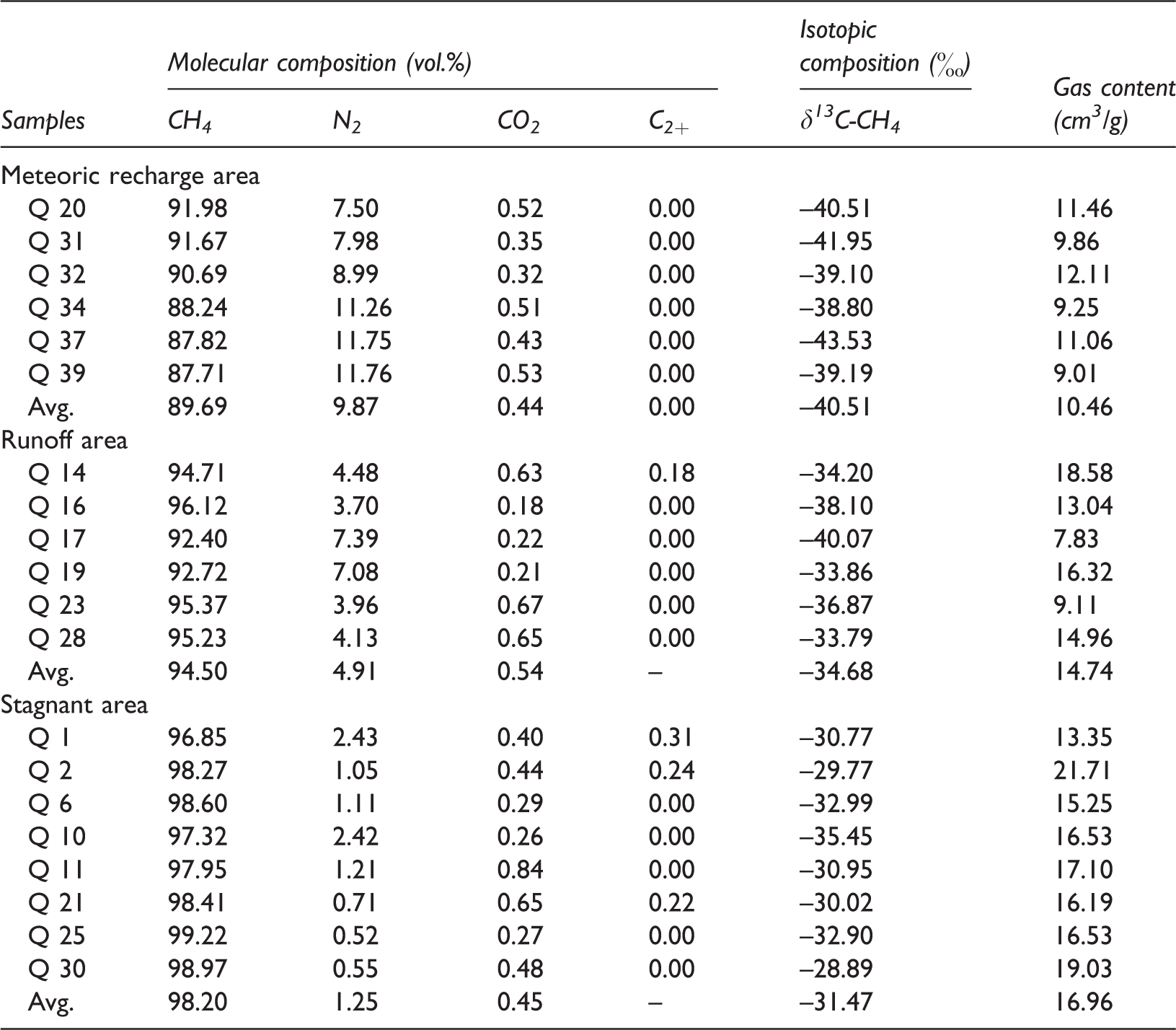
Analyses of gas composition and gas isotope (δ13C-CH4) from the desorbed gas samples of the coal cores from the parameter wellbores show that the gas composition and gas isotope have an obvious zonal distribution from the eastern area to the western area at this block (Figure 12). The molecular and isotopic composition measurement results from the desorption gas samples of wellbores displayed in Figure 12 are listed in Table 4. According to the hydraulic flushing simulation experiments under different hydrodynamic intensities carried out by Qin et al. (2005) and Wang et al. (2015), the 13C1-CH4 is more easily water-dissolved and hydraulically flushed than the 12C1-CH4. And thus at the eastern region of this block, with the meteoric precipitation inflowing into the coal bed, the original CBM was intensively hydraulic flushed and more N2 composition (average at 9.87%) was carried into the coal reservoir with the meteoric precipitation. This hydraulic flushing effect has made the coal reservoir to be characterized by rather negative δ13C-CH4 gas composition (average at −40.51%) and comparatively lower gas content (average at 10.46 m3/t).
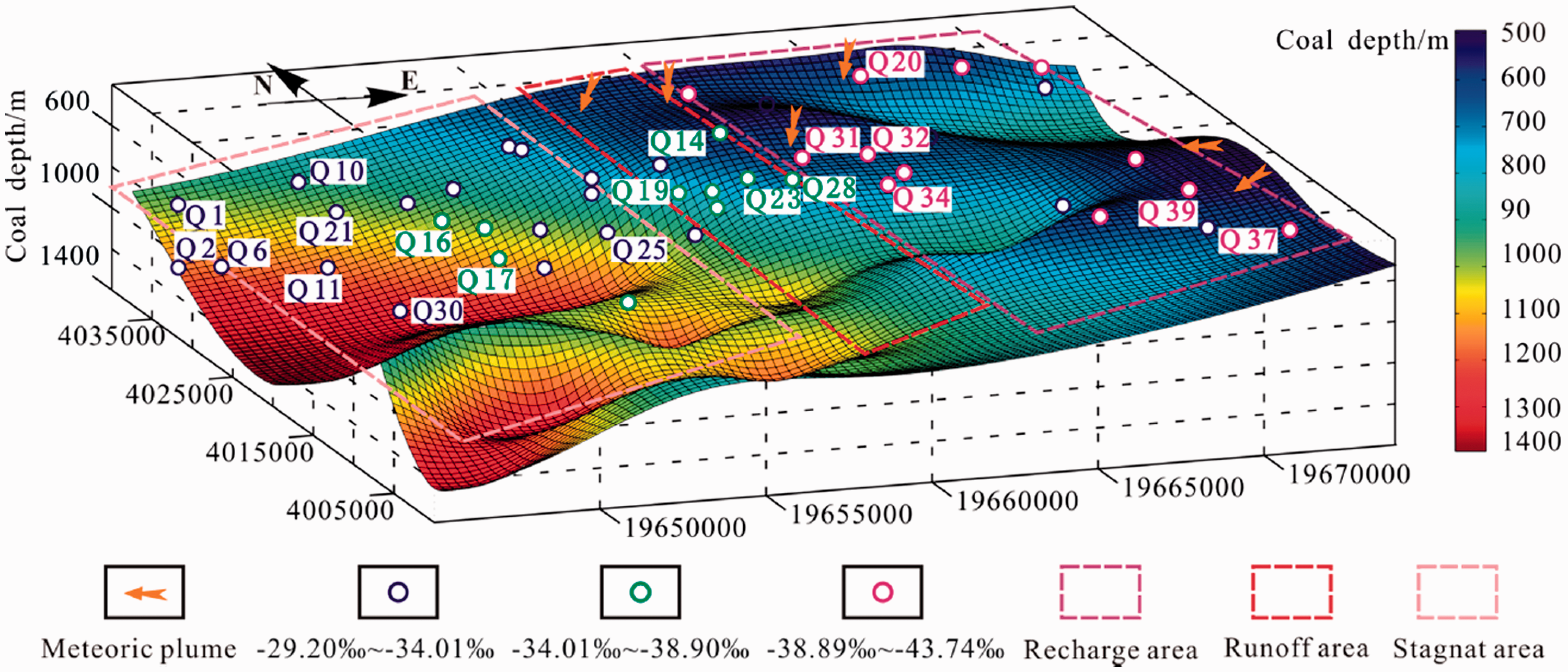
The compartmentalization of CBM accumulation zone at the Changzhi block.
Molecular and isotopic composition of CBM from the desorption gas samples of wellbores displayed in Figure 12.
CBM: coalbed methane.
Towards the middle-western region along the trend of the coal bed occurrence, the coal reservoir is located at the underground runoff setting where the reservoir is characterized by comparatively increased gas content (average at 14.74 m3/t) and positive δ13C-CH4 gas composition (average at −34.68%). But in this region, the Q 16 and Q 17 have an anomalously negative δ13C-CH4 gas composition. This may be caused by the geological structure setting as illustrated in Figure 10, where the Q 16 and Q 17 wellbores are located surrounding the normal fault structures. As discussed above, the intensively hydraulic flushing by the meteoric precipitation into the coal bed at this “open” geological structure setting can make more 13C1-CH4 water-dissolved and carried away, and thus resulting in the existence of negative δ13C1-CH4 and comparatively lower gas content.
Further westwards from the groundwater runoff setting the reservoir is located at a groundwater stagnation setting. The gas composition of positive δ13C-CH4 (average at −31.47%) indicates that the reservoir is less hydraulically flushed. Meanwhile, the hydrodynamic sealing effect at this setting makes more methane to be adsorbed on the surface of coal micropores, which is favorable for the reservoir to contain a comparatively higher gas content of 16.96 m3/t.
Conclusions
The gas content of this CBM block was 7.0–21.7 m3/t which was controlled by a combing effect of geologic structure and hydrogeology. In view of the geologic structure evolution, a tectonic-thermal event at the middle Yanshanian Orogeny made the coal has a maturity of Ro,max 1.9 − 2.7% and massive CBM was generated. However, the significant uplift and erosion at the Jurassic-Cretaceous period made the development of basin-wide under-pressured coal reservoir, and then bulk of gas was desorbed and lost by migration. Subsequently, the widespreadly developed normal fault structures during the Himalayan Orogeny accelerated the CBM escape through the “gas escape windows”, particularly where the location within the distance of about 1300 m to the “gas escape window” the gas content decreases significantly.
Besides as a consequence of extensional tectonic evolution during the Himalayan Orogeny, the slope area of the Yanshanian syncline structures was cross-cut by the regional or local normal fault structures, and then an “open” syncline structure mode was made. Surrounding this “open” syncline structure, the coal reservoirs were more under-pressured and hydraulically flushed, which results in a comparatively lower gas content therein.
By the control of geologic structure and hydrogeology, this block can be generally compartmentalized into three hydrodynamic systems including the western groundwater stagnation region, the middle runoff region, and the north-eastern recharge region, where the hydrodynamic sealing effect at the groundwater stagnation region has made a comparatively higher gas content for the coal reservoir, but the hydrodynamic losing effect at the recharge region and runoff region has made a comparatively lower gas content of the coal reservoir.
Footnotes
Acknowledgements
We appreciate PetroChina Huabei Oilfield Company for providing the abundant material about this CBM block, and the comments from the anonymous reviewers to improve this paper. Besides, sincere thanks were given to Prof. Kędzior and Moore for their suggestions and language help to improve this paper.
Declaration of conflicting interests
The author(s) declared no potential conflicts of interest with respect to the research, authorship, and/or publication of this article.
Funding
The author(s) disclosed receipt of the following financial support for the research, authorship, and/or publication of this article: This study was jointly sponsored by the Scientific Research Foundation of Key Laboratory of Coalbed Methane Resources and Reservoir Formation Process, Ministry of Education (China University of Mining and Technology) (Grant No. 2016-010), the National Natural Science Foundation of China (Grant No. 41372162), and Science and Technology Innovation Team Support Plan of Henan Province (Grant No. 14IRTSTHN002).