




Abstract
This paper first describes a mathematical model of a vertical fracture with constant conductivity in three crossflow rectangular layers. Then, three forms of vertical fracture (linear, logarithmic, and exponential variations) with varying conductivity are introduced to this mathematical model. A novel mathematical model and its semi-analytical solution of a vertical fracture with varying conductivity intercepting a three-separate-layered crossflow reservoir is developed and executed. Results show that the transient pressures are divided into three stages: the linear-flow phase, the medium unsteady-flow stage, and the later pseudo-steady-flow phase. The parameters of the fracture, reservoir, and the multi-permeability medium directly influence the direction, transition, and shape of the transient pressure. Meanwhile, the fracture conductivity is higher near the well bottom and is smaller at the tip of the fracture for the varying conductivity. Therefore, there are many more differences between varying conductivity and constant conductivity. Varying conductivity can correctly reflect the flow characteristics of a vertical fractured well during well-test analysis.
Keywords
Introduction
For low-permeability reservoirs or damaged formations, hydraulic fracturing is an effective technique to enhance productivity, with a great impact on the performance of a fractured well (Cinco-Ley and Samaniego, 1981; Luo and Tang, 2014, 2015; Ozkan et al., 2011; Yu et al., 2016).
Hydraulic fracturing stimulation usually creates vertical fractures unless it is in shallow layers (Gringarten et al., 1974; Hubbert and Willis, 1955, 1957). There are many multilayered formations due to geologic sedimentary dynamics (Jiao and Zheng, 1998; Patella, 1978; Shu, 2011). During hydraulic fracturing, multilayered formations are fractured and open them (Adachi et al., 2007; Chu et al., 2007; Valko and Economides, 1995). Thus, to establish a mathematical model of the characteristics of a hydraulic fracturing multilayered reservoir has important theoretical directive functions to help optimize fracturing design, analyze fractured-well performance, and provide realistic explanations (Wang et al., 2012, 2013).
Many mathematical models for a non-fractured well in crossflow/no-crossflow multilayered formations have been studied. The methods and equations for calculating transient pressure with wellbore storage and skin effects of a non-fractured well in crossflow/no-crossflow multilayered reservoir were presented (Bourdet, 1985; Kucuk et al., 1986; Lefkovits et al., 1961; Liu and Wang, 1999; Tariq and Ramey, 1978). The transient pressure of a multilayered reservoir and the difference of interlayer communication were performed and analyzed by many researchers (Aly, 1994; Aly and Lee, 1995; Bello et al., 2016; Eisa et al., 2008; Frantz et al., 1992; Gao, 1986; Jatmiko et al., 1996; Jordan and Mattar, 2000; Lu et al., 2000; Nikjoo and Hashemi, 2012; Ryan et al., 1994; Sun et al., 2003; Wang and Wang, 2014a, 2014b; Valdes-Perez et al., 2018; Yuan et al., 2016; Zhang et al., 2001).
The above models for calculating transient pressure mainly focused on a non-fractured well in a multilayered reservoir. Little research on hydraulic fracturing was conducted on multilayered reservoirs. Now that hydraulic fracturing stimulation has been widely and successfully used for economic production in oilfields (Barros-Galvis et al., 2018; Ezulike et al., 2015; Gao and Li, 2015), it is necessary to establish a mathematical model of a hydraulic fracturing well combined with multilayered reservoirs.
When hydraulic fracturing is conducted in a multilayered formation, the vertical hydraulic fracture can be divided into the three categories of uniform-flux, infinite-conductivity, and finite-conductivity fractures based on the dimensionless fracture conductivity (CFD). CFD can be defined as the ratio of the ability of the fracture to carry fluids into the well to that of the formation to carry fluids into the fracture (Gringarten et al., 1974, 1975; Liu et al., 2016; Prats et al., 1962).
The conductivity of fracture proppants and the uniform-flux/infinite-conductivity-mathematical models and solutions for a vertical fracture in multiple layers were evaluated and developed (Cooke, 1973; Gringarten et al., 1974; Ozkan and Raghavan, 1991). The mathematical models for calculating transient pressure for a finite-conductivity fracture were introduced (Bennett et al., 1986; Cinco-Ley and Samaniego, 1981; Gringarten 1974; Hagoort, 2009; Kuchuk et al., 1991; Liu and Wang, 1993; Wang et al., 2005) but they only focused on the infinite-conductivity fracture without considering varying conductivity.
The transient pressure and the flow regimes in detail for a finite-conductivity fracture in a Laplace domain were studied (Cinco-Ley and Samaniego, 1981; Cinco-Ley and Meng, 1981). Over the past 30 years, thousands of papers have focused on the transient pressure analysis for a finite-conductivity fracture (Barros-Galvis et al., 2018; Chen et al., 2017; Cinco-Ley and Samaniego, 1981; Ozkan et al., 2011; Tian et al., 2017; Yuan et al., 2015a, 2015b).
In view of the above research, scholars have often aimed at uniform-flux/infinite-conductivity or finite-conductivity vertical fractures, failing to consider fracture conductivity as a varying parameter at different positions along a fracture. (The pressure drop in a fracture was not considered or was kept constant without considering varying conductivity at different positions along a fracture.) In fact, the conductivity varies at different positions along a fracture, depending on fracture characteristics, such as fracture length or width, penetration, and proppant type, and it also depends on possible damage to the formation surrounding the fracture (Mcguire and Sikora, 1960; Prats et al., 1962; Raghavan et al., 1978; Tinsley et al., 1969). In general, the fracture conductivity is greater near the wellbore.
Luo and Tang (2015) established a semi-analytical solution of a vertical fractured well with varying conductivity. However, they only focused on the transient-pressure behaviors of a varying-conductivity fracture in a one-layered formation and did nothing about the varying fracture conductivity in multi-layered formations. There is still no literature that analyzes or solves a mathematical model of a vertical fracture with varying conductivity in a multi-layered crossflow reservoir.
In this paper, a mathematical model of a vertical fracture with constant conductivity in three rectangular crossflow layers is established. Then, three forms of varying conductivity are introduced (linear, logarithmic, and exponential), a mathematical model of a vertical fracture with varying conductivity intercepting a three-separate-layered crossflow reservoir is developed, and a semi-analytical solution for calculating transient pressure using a Laplace transform and Stehfest numerical inversion is determined. The direct influences of the characteristic parameters of a fracture and three-separate-layered reservoir on the transient pressure are analyzed. Finally, the curves for the above three forms of varying conductivity in three separate crossflow layers are analyzed.
Mathematical model and semi-analytical solution
Mathematical model
Model descriptions
Figure 1 is a schematic of a fractured well with a vertical fracture in the center of a three-layered rectangular reservoir. The basic assumptions of fluid flow in the reservoir and fracture follow.
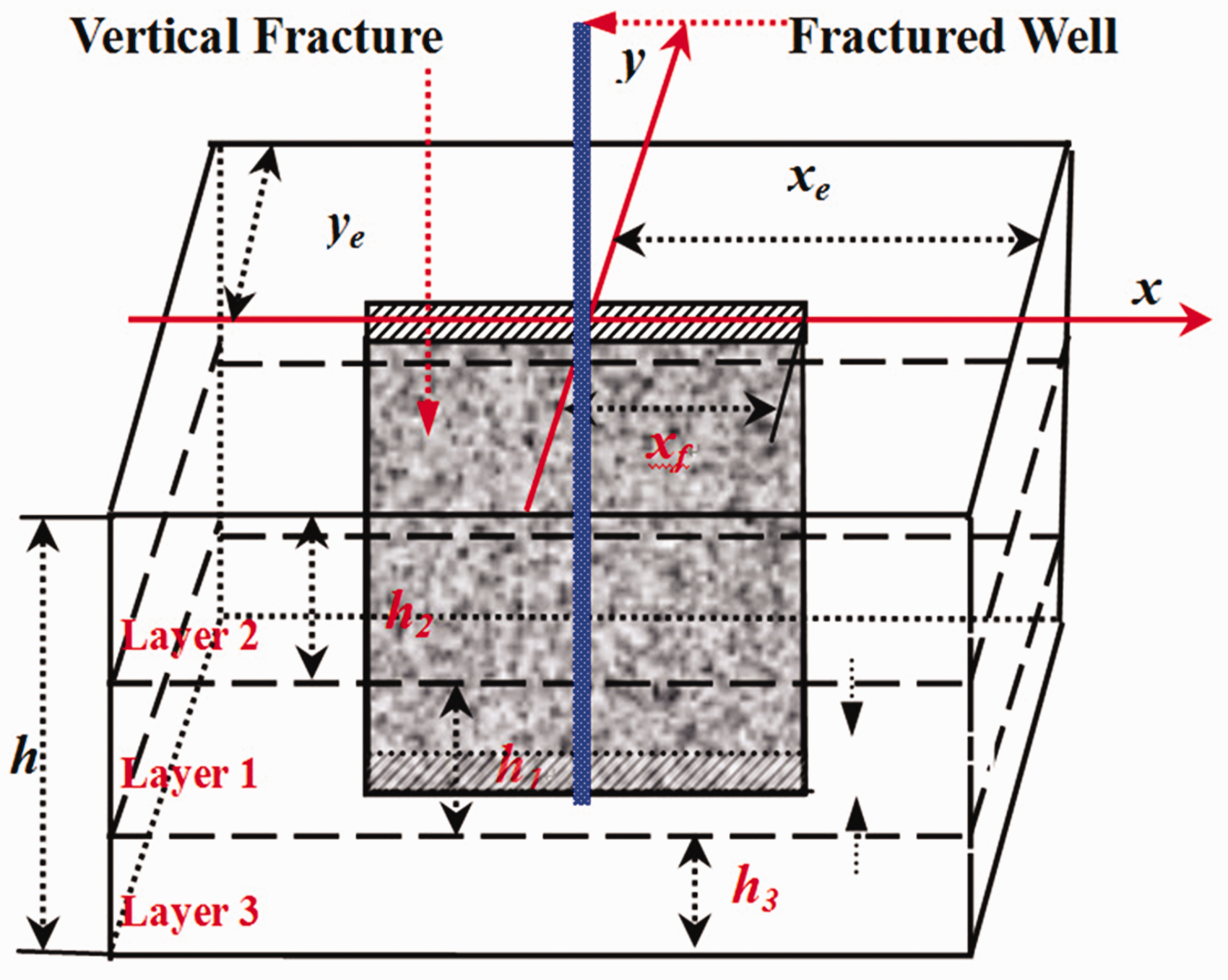
Schematic of a fractured vertical well in a three-layered rectangular reservoir.
The three layers are all isotropic, homogeneous, and horizontal in a sealed rectangular drainage area. The three layers respectively have constant thickness h1, h2, and h3; permeability k1, k2, and k3; and porosity
The fracture is very small compared with the reservoir. The fluid is produced through a vertically fractured well intersected by three fully-penetrating layers. The fracture half-length is xf, the width is wf, the fracture permeability is kf, and the fracture porosity is
There exists a crossflow interlayer between two layers. λ is the transfer coefficient between the two layers, and ω is the storage coefficient of each layer.
The initial pressure is p0. The drainage area contains a slightly compressible single-phase fluid of constant compressibility ct and constant viscosity μ. No flow is allowed through the fracture tips, and fluid flow is linear in the fracture. The flow is assumed to obey Darcy’s law in the reservoir and fracture. The total production of a vertically fractured well in multiple layers has a constant flow rate of Q.
The conductivity varies at different positions along a fracture. Varying fracture conductivity is introduced to describe this phenomenon.
Dimensionless definitions
For the sake of simplicity, the dimensionless parameters are defined as follows







Flow model in reservoir
A single-phase fluid flows from the three-layered sealed rectangular reservoir to a vertical fracture with constant conductivity at a constant flow rate Q, as presented by equations (1)–(8) (Liu et al., 2016; Wang et al., 2005)






First, the Laplace transforms of equations (1)–(8) are determined






The derivation of equation (16) is shown in Appendix 1.
Flow model in fracture
For a vertical fracture with finite conductivity, the governing equation describing fluid flow in a fracture is strictly described as

Since the fracture size is relatively small compared to the drainage area of a well in the reservoir, the above equation can be simplified by means of the integral average in the fracture

No flow is allowed into the fracture through the fracture tips, and the flow of the fluid is linear in the fracture. The fluid flow is steady, and the flow model based on dimensionless variables can be described by

Outer boundary condition

Inner boundary condition

The flow correlation formula at the surface of a fracture

Combining equations (19)–(22), the solutions can be obtained as

The Laplace transformation of equation (23) yields

Connection condition between reservoir and fracture
The reservoir pressure is the same as the fracture pressure at the surface of the fracture

Normalization condition of flow rate in fracture
There is a normalized relation along a fracture at the constant flow rate of a hydraulic fracturing well

Combining equations (16), (24), (25), and (26), the simultaneous solution yields

Model of varying-conductivity fracture
The varying conductivity cannot be accurately described. Generally speaking, the varying conductivity of a vertical fracture has three trends, namely, linear variation, logarithmic variation, and exponential variation, along a fracture (Mou and Fan, 2006).



Different types of vertical fractures have different proppant supporting laws, which leads to a different fracture heterogeneity and different fracture closure law. The parameters a, b, and c in equation (28) have specific values. To determine the specific expression of variable conductivity of a vertical fracture in equation (28), laboratory experiments often are conducted based on the hydraulic fracturing operations combined with the studies on proppant type, reservoir characteristics, and the law of fluid flow in a fracture.
The regression relationships between variable conductivity and the distance along a vertical fracture were obtained in sandstone reservoirs according to a large number of laboratory conductivity measurements for a vertical hydraulic fracture filled with Yixing, Chengdu, Oriental, Tengfei, Weifang, and Cabo ceramsite or fracturing proppants in China (Yu, 1987; Zhang and Zhou, 2000).
Figure 2 displays the relationships between varying conductivity and the distance along a fracture for the three trends of linear, logarithmic, and exponential variation, which can well express the varying conductivity from well bottom to the tip of the fracture.
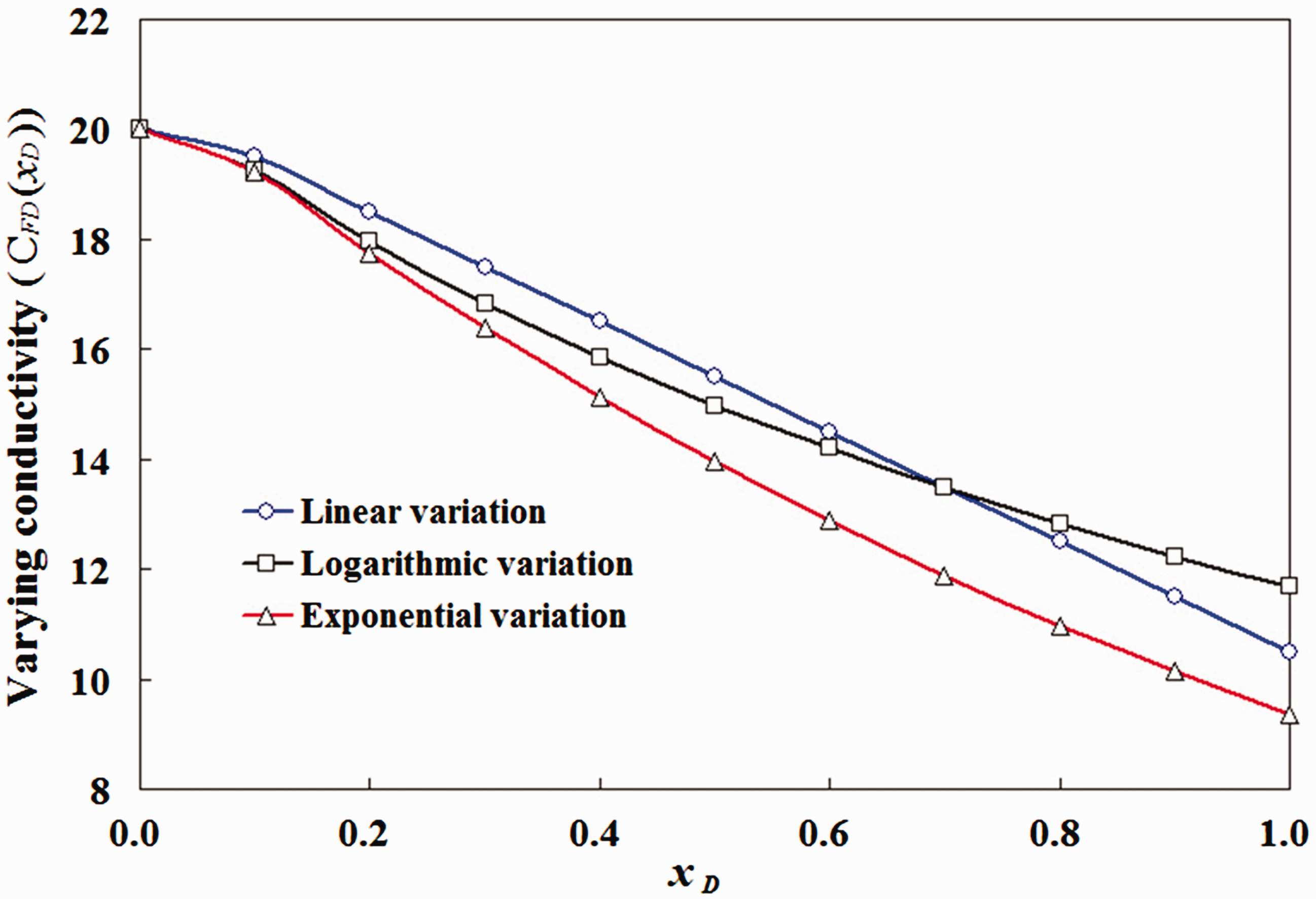
Relationships of three trends between variable conductivity and the distance along a vertical fracture.
CFD (xD) is introduced and substituted in equation (28) for CFD in equation (27), to obtain

Equation (29) is the mathematical model in a Laplace domain of a vertical fracture with varying conductivity in three rectangular crossflow layers. Note that pwD is a function of the variable xD that depends on the distribution of varying conductivity CFD (xD).
Semi-analytical solution of the mathematical model
Equation (29) is a Fredholm-type integral equation (Fredholm, 1903; Wazwaz,2011). The transient–pressure solution can be semi-analytically solved by dividing the half fracture into N segments with equal length ΔxDi, where α is an arbitrary dimensionless length along the fracture (as shown in Figure 3).
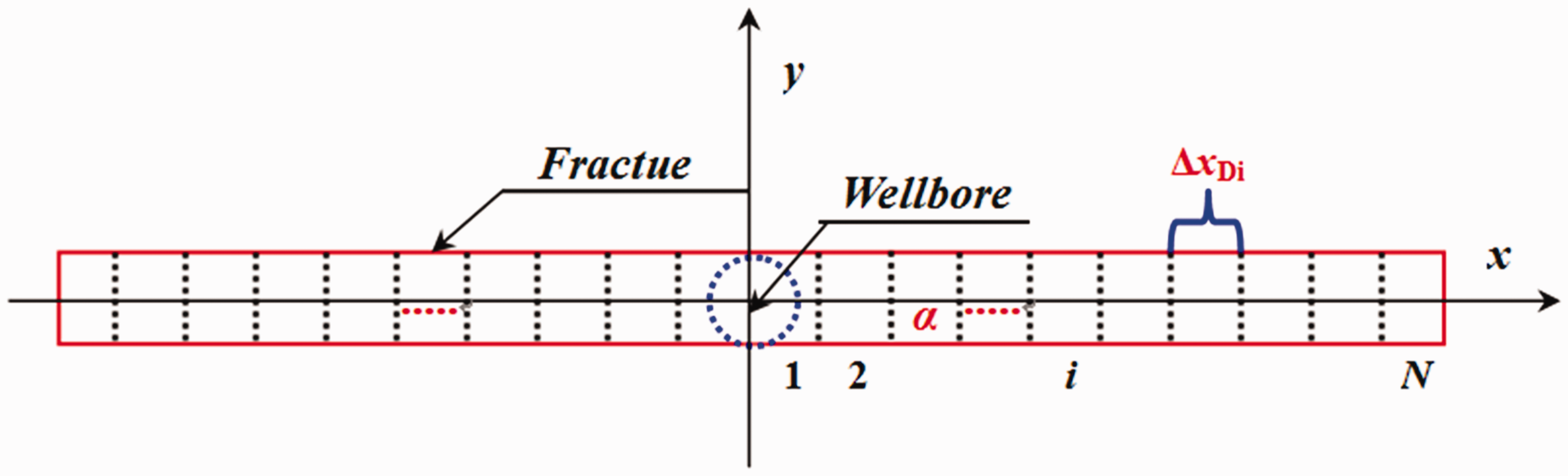
Fracture divided into N equal segments along the half fracture.
Then, equation (26) can be discretized as

Discretizing equation (29), a system of linear equations of order N + 1 can be expressed as

Equation (31) can be easily solved by Gaussian elimination. The wellbore pressure and flow rate can be obtained in the Laplace domain (Luo et al., 2016). Then, the solutions in a real domain can be further inverted by Stehfest numerical inversion (Stehfest, 1970).
Results and discussion
Parameter analysis of constant finite-conductivity fracture
Many parameters can influence the transient pressure of a vertical fracture with a constant finite conductivity in a closed-rectangular three-separate-layered crossflow reservoir. This paper only discusses the influences of the fracture half-length xFD, drainage boundary yeD, formation capacity ratio ω1, and interporosity flow ratio ratio λ1 and λ2.
Figures 4 and 5 display the effects of parameters (ω1 and λ1, λ2) on the transient pressure of a vertical fractured well in a three-separate-layered reservoir. Figures 6 and 7 respectively display the effects of parameters xFD and YeD on the type curves of a vertical fracture in a three-separate-layered reservoir.
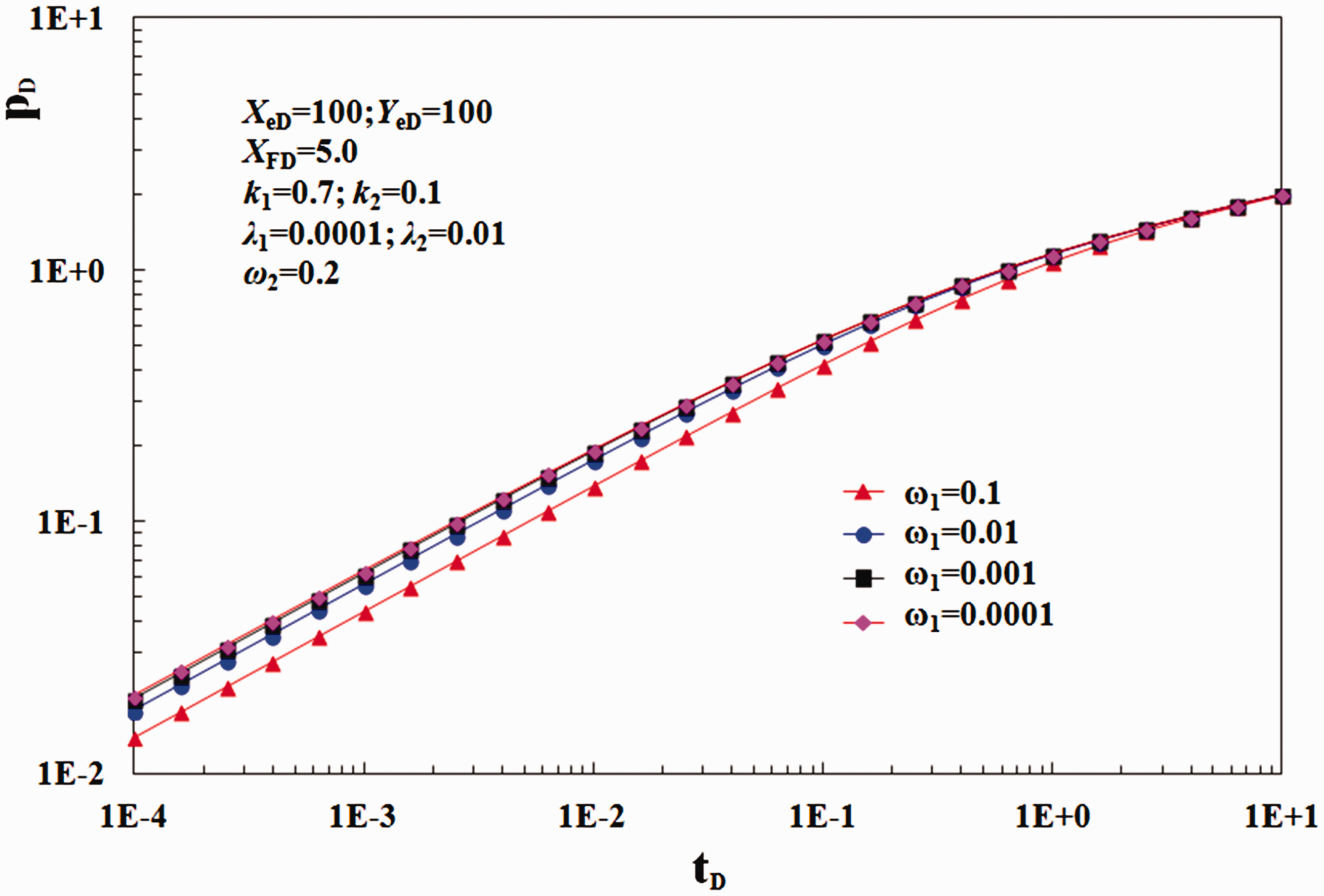
Effects of parameter ω1 on transient pressure of a vertical fractured well in three separate layers.
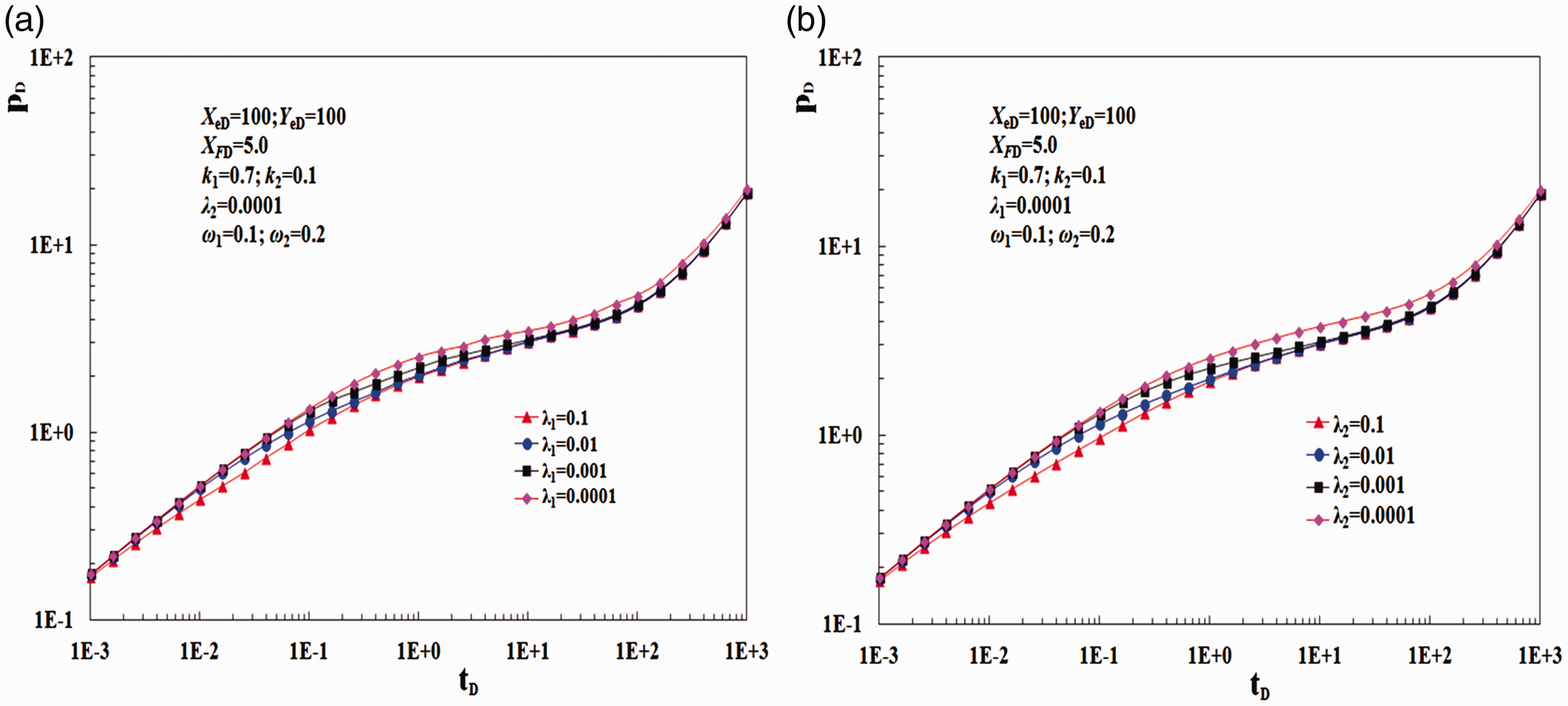
Effects of parameter (λ1, and λ2) on pressure curves of a vertical fractured well in three-separate layers. (a) Effects of parameter λ1 on pressure curves. (b). Effects of parameter λ2 on pressure curves.
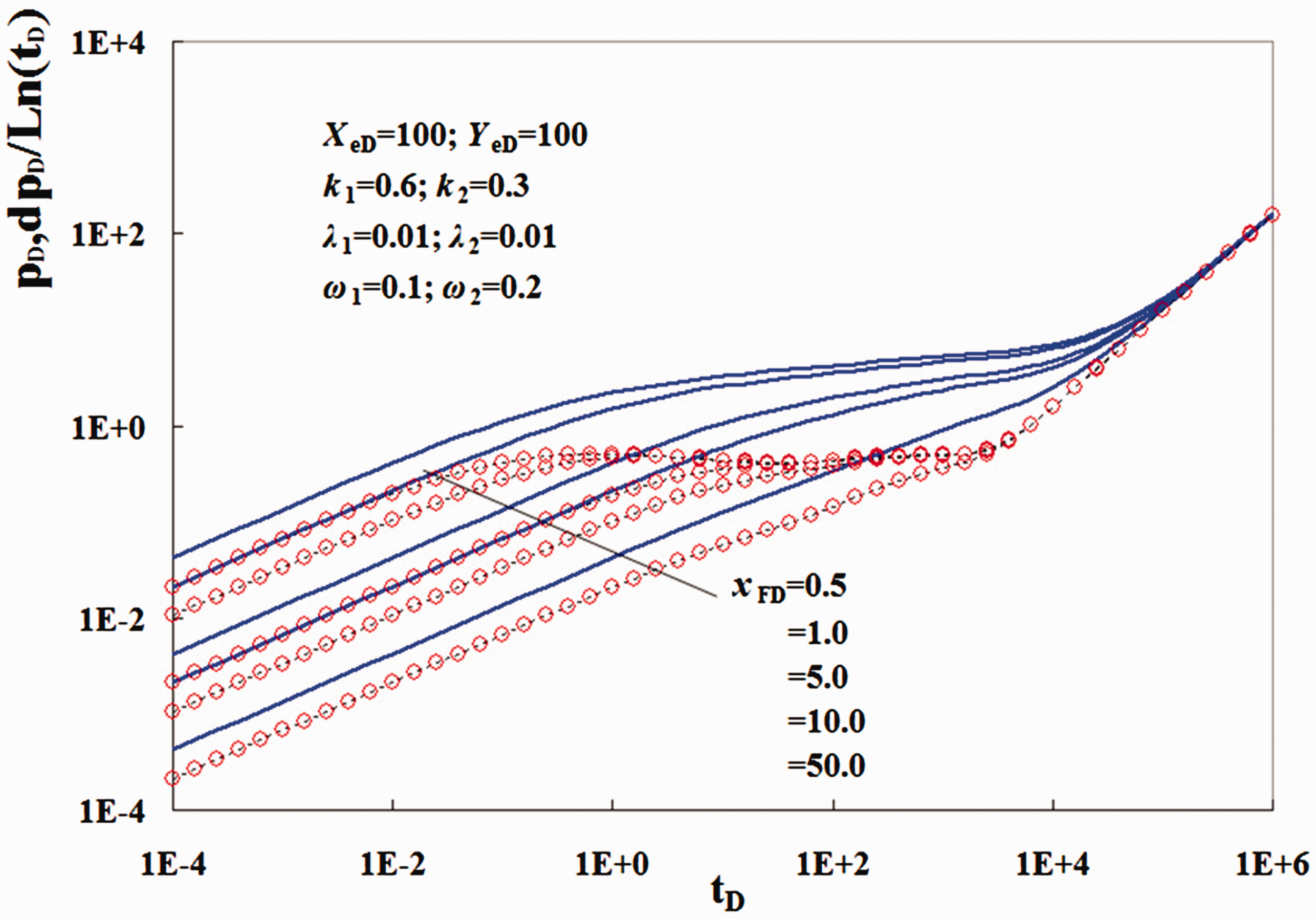
Effects of parameter xFD on type curves of a vertical fractured well in three separate layers.
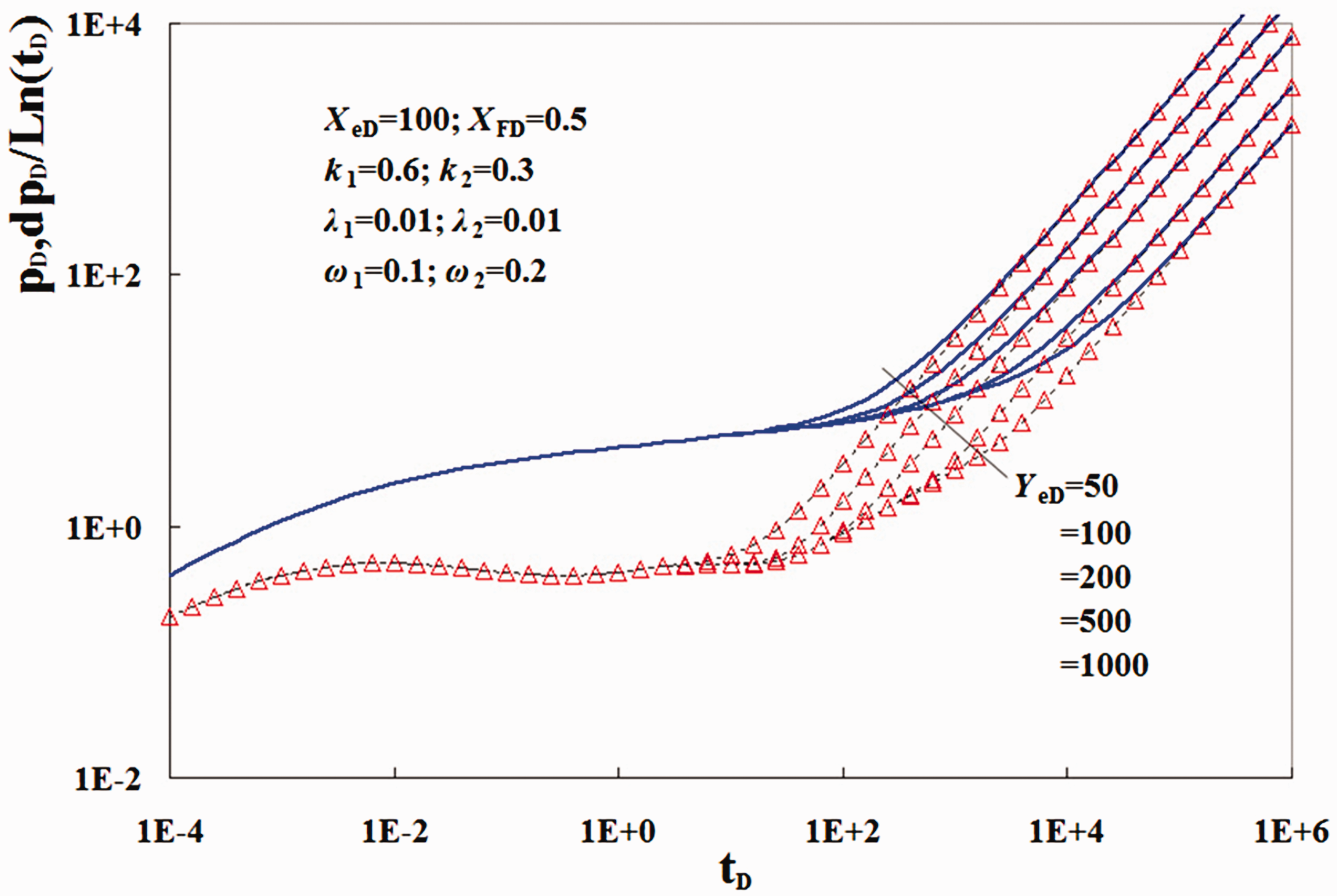
Effects of parameter YeD on type curves of a vertical fractured well in three separate layers.
From Figures 4 to 7, the transient pressures are divided into three stages: the linear-flow phase (the early slope 0.5), the medium unsteady-flow stage, and the later pseudo-steady-flow phase. The parameters of the fracture, the three-separate-layered rectangular reservoir, and the multi-permeability medium (such as XeD, YeD, XFD, k1, k2, k3, ω1, ω2, ω3, λ1, λ2, and λ3) directly influence the direction, transition, and shape of the transient pressure during the three stages of a vertical hydraulic fracture.
Parameter analysis of varying-conductivity fracture
Figures 8–10 display the type curves (dimensionless pressure and dimensionless pressure derivative) of a vertical fractured well in three-separate layers with varying conductivity by linear variation (Figure 8), logarithmic variation (Figure 9), and exponential variation (Figure 10), where the undetermined coefficients a = 10.0, 8.0, 5.0, 3.0, b = 2.0, 1.5, 1.0, 0.5, or c = 3.0, 2.0, 1.0, 0.5 are displayed from top to bottom followed. The bottom line is the constant conductivity for each.
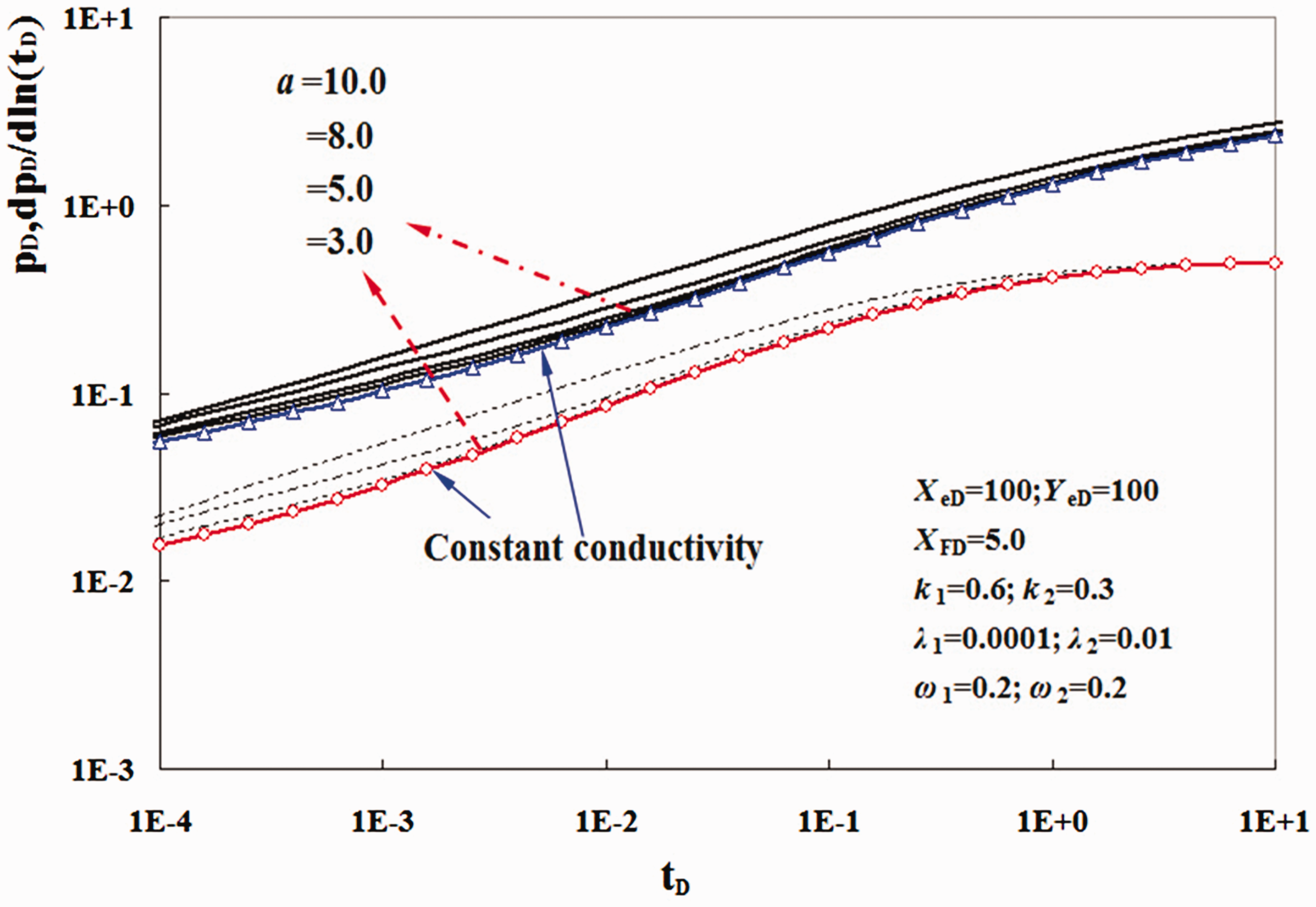
Type curves of a vertical fractured well in three separate layers (linear variation).
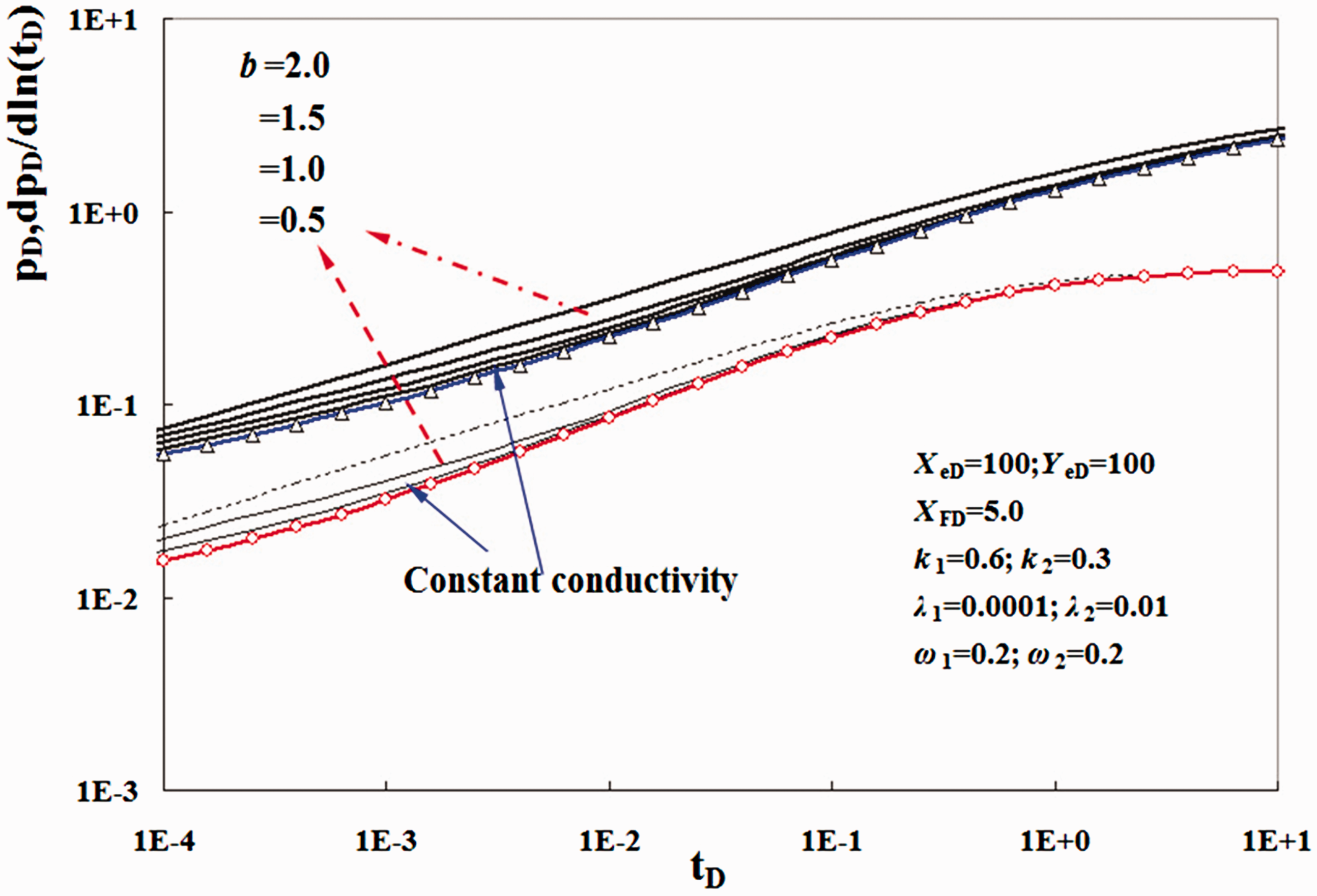
Type curves of a vertical fractured well in three separate layers (logarithmic variation).
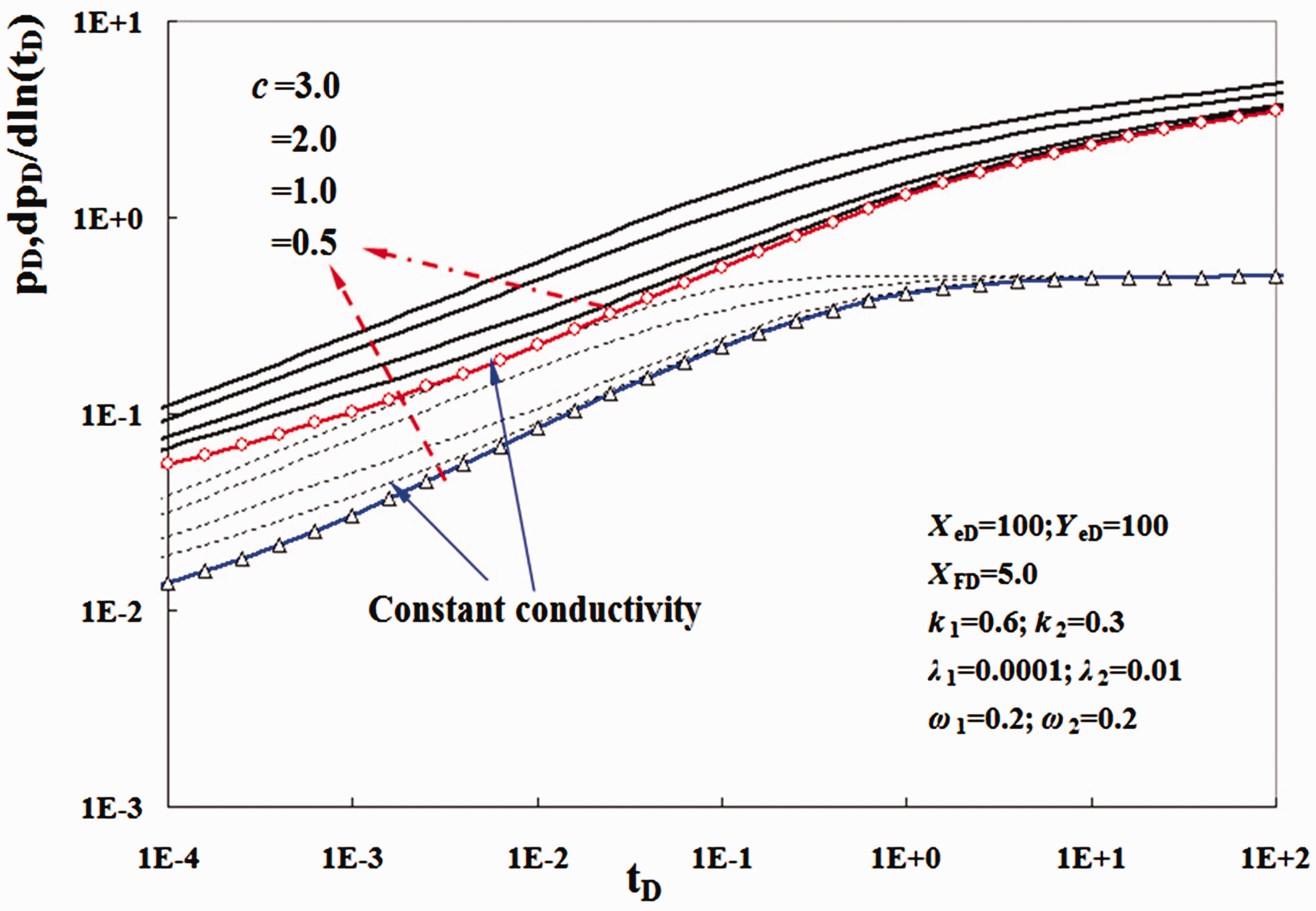
Type curves of a vertical fractured well in three separate layers (exponential variation).
From Figures 8 to 10, the change trend of varying conductivity is greater if the coefficients of a, b, and c are bigger, which also illustrates that the fracture conductivity is higher near the well bottom and is smaller at the tip of the fracture. During the process of a vertical hydraulic fracture, a fracture near the well bottom was filled with more ceramsites or fracturing proppants than at a long distance from the well bottom, resulting in the fracture having a greater width near the well bottom.
As shown in Figures 8–10, the dimensionless pressure and dimensionless pressure derivative perform better with varying conductivity than with constant conductivity. Therefore, there are many more differences between varying conductivity and constant conductivity during well-test analysis. Varying conductivity can correctly reflect the flow characteristics of a vertical fractured well, which can provide a theoretical basis for well-test analysis.
Specially note there is not a real field case to validate the presented model. But, the proposed model can provide a theoretical basis for well-test analysis. If the well testing data are available in three cross flow rectangular layers during the process of hydraulic fracturing in the future, the proposed model can conduct the well testing interpretation.
Conclusions
A mathematical model of a vertical fracture with constant conductivity was established in three separate rectangular crossflow layers. Three forms of varying conductivity were introduced (linear, logarithmic, and exponential). A new mathematical model of a vertical fracture with varying conductivity intercepting a three-separate-layered crossflow reservoir was developed, and its semi-analytical solution was achieved by the methods of Laplace transform, Fourier cosine transform, and Stehfest inversion. The transient pressures are divided into three stages: the linear-flow phase, the medium unsteady-flow stage, and the later pseudo-steady-flow phase. The parameters of the fracture and reservoir directly influence the direction, transition, and shape of the dimensionless pressure and dimensionless pressure derivative during the three stages of a vertical fractured well. The type curves of a vertical fractured well in three-separate layers were analyzed and diagnosed with three forms of varying conductivity. Results show that the fracture conductivity is higher near the well bottom and is smaller at the tip of the fracture for the varying conductivity. The dimensionless pressure and dimensionless pressure derivative performed better when considering varying conductivity than with constant conductivity. Varying conductivity can correctly reflect the flow characteristics of a vertical fractured well during well-test analysis. The novel mathematical model and its semi-analytical solution of a vertical fracture in three separate layers with varying conductivity may form a theoretical basis for well-test analysis.
Footnotes
Declaration of conflicting interests
The author(s) declared no potential conflicts of interest with respect to the research, authorship, and/or publication of this article.
Funding
The author(s) disclosed receipt of the following financial support for the research, authorship, and/or publication of this article: This research was supported by the National Natural Science Foundation of China (No. 51774256), Fundamental Research Funds for the Central Universities of China (2–9-2017–310, 53200759268). and Science and Technology Special Funds of China for 2016ZX05015–002.