




Abstract
In order to keep the formation pressure be larger than the dew-point pressure to decrease the loss of condensate oil, cyclic gas injection has been widely applied to develop condensate gas reservoir. However, because the heterogeneity and the density difference between gas and liquid are significant, gas breakthrough appears during cyclic gas injection, which apparently impacts the development effects. The gas breakthrough characteristics are affected by many factors, such as geological features, gas reservoir properties, fluid properties, perforation relations between injectors and producers, and operation parameters. In order to clearly understand the gas breakthrough characteristics and the sensitivity to the parameters, Yaha-2 condensate gas reservoir in Tarim Basin was taken as an example. First, the gas breakthrough characteristic of different perforation relations by injecting natural gas was studied, and the optimal relation was achieved by comparing the sweep efficiency. Then, the designs of orthogonal experiments method were employed to study the sensitivity of gas breakthrough to different parameters. Meanwhile, the characteristic parameters, such as gas breakthrough time, dimensionless gas breakthrough time, and sweep volume, were calculated and the prediction models were achieved. Finally, the prediction models were applied to calculate the gas breakthrough time and sweep volume in Yaha-2 condensate gas reservoir in Tarim Basin. The reliability of the model was verified at the same time. Please see the Appendix for the graphical representation of the abstract.
Introduction
Condensate gas reservoir is a kind of special gas reservoir controlled by a certain geological environment. The properties are between oil reservoir and gas reservoir (Afidick et al., 1994; Barnum et al., 1995). In the early 1930s, some condensate gas reservoirs were discovered in USA. Forthcoming, many districts around the world, including Canada, North Sea of Western Europe, Indonesia, and so on, have found amount of condensate gas fields. Numerous condensate gas reservoirs have been found as well in China (Fan et al., 2005; Huang et al., 2001; Pan et al., 2017; Sun and Hu, 2003). The reserves and production of condensate gas are still increasing, and playing an important role in petroleum industry (Ahmadi et al., 2014a; Wang et al., 2011; Zarinabadi and Samimi, 2016).
However, because the phase behavior of condensate gas reservoir is very complicated, it is difficult to effectively develop (Ahmadi et al., 2014b, Ahmadi and Ebadi, 2014; Fussell, 1973; Gringarten et al., 2000; Jun et al., 2017; Kenyon, 1987; Orangi et al., 2011). This fluid is usually gaseous under the original conditions. But retrograde condensate behavior occurs when the reservoir pressure is lower than the dew point pressure as the changing of reservoir temperature and pressure (Feng, 2017; Hou et al., 2016; Siregar et al., 1992). The contents of condensate oil and heavy components decrease. The condensate liquid will be controlled by capillary force or retarded in the region of low relative permeability. Therefore, it is very important to design a reasonable program to develop condensate gas reservoirs (Li and Sun, 2003; Yuan et al., 2003).
Many cases show that the geological conditions, gas reservoir type, condensate oil content, and economic index should be taken into account to determine the development modes (Coats, 1985; Gao et al., 2012). Cyclic gas injection is one of the major methods to develop condensate gas reservoir. The mechanism is that the injected gas compensates the decrease of formation pressure, so the loss of condensate oil will be declined, and the ultimate recovery increases (Gamadi et al., 2013; Gong et al., 2014; Shadizadeh et al., 2006; Shelton and Morris, 1973; Wan, 2013). Since 1950s, cyclic gas injection has been started and demonstrated the calculation of reverse evaporation. Standing et al. (1948) found that all the condensate oil can be extracted as long as the injected dry gas is enough. Weinaug and Cordell (1948) conducted some experiments and found that if the injected dry gas is enough, the condensate oil would enter the gas phase by reverse evaporation. Abel et al. (1970) observed that the higher the injection pressure is, the higher the recovery of condensate oil will be. Cullick et al. (1993) reported that gas–water alternating injection can significantly improve the recovery of stratified condensate gas reservoir contrasted to continuous injection if the high permeability strips exist. Edmond (2006) showed that CO2 injection is very effective to improve the recovery of condensate gas reservoir by reducing the surface tension. Yu et al. (2014) studied the enhanced oil recovery (EOR) mechanism by cyclic gas injection in the fracture model using C1, N2, and CO2. They observed that if miscible phase with condensate oil is achieved, miscible flooding is the main mechanism for EOR. Otherwise, gasification will be the dominant mechanism of gas drive for EOR (Meng and Sheng, 2016; Zarinabadi et al., 2016).
During gas injection, the seepage law is complicated, including phase transformation, overlap, and miscible phase. As a result, physicochemical seepage appears. Meanwhile, the front of injected gas will extend along the high permeability strip due to the areal and vertical heterogeneity. Gas breakthrough will significantly decrease the ability of pressure maintenance, so the injected gas will be invalid (Carlson and Cawston, 1996; O’Dell, 1967; Wang et al., 2012; Zendehboudi et al., 2012). Therefore, it is very essential to study the gas breakthrough characteristics. At present, most studies are focused on distinguish gas breakthrough by gas–oil ratio, flow pressure, and output components in gas well. It is very rare to study on gas channeling characteristics and its influencing factors. It is urgently needed to obtain the method of gas breakthrough prediction. In this paper, Yaha-2 condensate gas reservoir in Tarim Basin was taken as an example to study gas-channeling characteristics of cyclic gas injection. Then, the impact and sensitivity of different factors on gas-channeling characteristics were performed by the designs of orthogonal experiments (DOE) method. Finally, the quantitative prediction models of gas breakthrough time, dimensionless gas breakthrough time, and sweep efficiency were achieved to guide the gas injection of condensate gas reservoir.
Influencing factors of gas breakthrough characteristics in Yaha-2
Figure 1 shows the Yaha Field, which locates in Tarim Basin, China (Sun et al., 2003). The reservoir is a semi-anticlinal gas condensate pool controlled by contemporaneous faults, with a formation depth of 4900–5200 m. The Yaha formation is mainly composed of a basal Paleogene sandstone and an overlying Cretaceous sandstone. The Paleogene sandstone has an average thickness of 39.0 m, while the Cretaceous sandstone is up to 350.0 m thick. Across the field, the thickness of the reservoir formation is basically consistent.
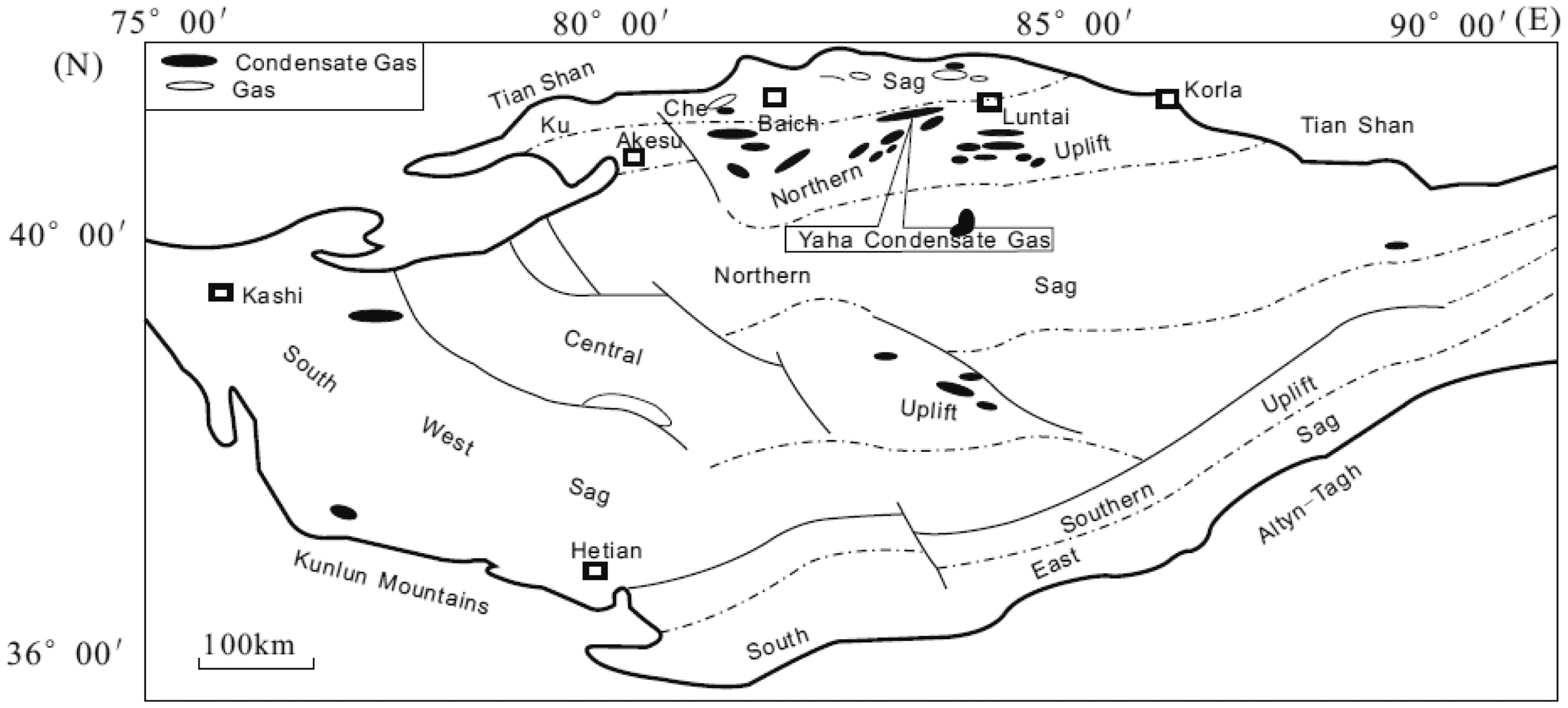
The location of Yaha Field in Tarim Basin, China.
There are three types of sediment subfacies in the Paleogene sandstone. The lower part contains gypsum clumps and a gypsum layer, which is a dry saline lake facies formed in low-lying land. The middle section is pure sandstone, belonging to a sand subfacies shaped by wind. The upper sandstone is rich in gypsum clumps, plaque, and thin layer plaster, which belongs to a sand/salt paste saline lake facies. The Cretaceous sedimentary facies is similar to the Paleogene and all are alluvial plain facies. The Paleogene sandstone is unconformable with the Cretaceous sandstone and together they constitute the reservoir rock.
Influencing factors of gas breakthrough in Yaha-2
It is very complicated for the seepage law in condensate gas reservoir. Now, there is no mature theory to describe the flow characteristics. It is different for the mechanisms for gas breakthrough in different condensate gas fields. Therefore, it is really difficult to clearly understand the impacts of different factors.
Yaha-2 condensate gas reservoir is a reverse rhythm reservoir. After many years cyclic gas injection, the influencing factors include geological characteristic (formation thickness and average permeability), permeability heterogeneity (variation coefficient and the ratio of vertical to horizontal permeability), development mode (production rate and well spacing), and the location of perforation.
Formation heterogeneity. The permeability heterogeneity in Yaha-2 is very apparent. There are mudstone interlayers in rock. The variation coefficient is 0.75–1.2 and net to gross ration is about 0.8. Because the density of injected gas is lighter than condensate gas, the flow resistance is weak. If there are existing high permeability strips, the injected gas will quickly channel into production well. As a result, the sweep efficiency is small and reservoir pressure decreases seriously. Heterogeneity may be the primary reason of gas breakthrough. Well spacing. Because the decrease of formation energy by depletion drives at the late development stage is not adequately considered in Yaha-2. The well spacing is too small. The injected gas will flow into production well in a short time. Production rate. Generally, the injection rate is adaptable to the production rate to keep the formation pressure to be balanced. But as the sweep area increases, the practical injection rate is difficult to be controlled. If the injection rate is too high, gas will channel along the direction of higher pressure gradient. Perforation locations of injector and producer. The perforation locations decide the flow path and sweep area. If the perforation locations are adaptable to the formation, gas breakthrough will be late; otherwise gas breakthrough will be early.
Gas breakthrough characteristics in Yaha-2
In order to study the gas breakthrough characteristics with different perforation locations of injector and producer, a typically geological model is firstly established based on the parameters of Yaha-2 in Tarim Basin. The relative permeability and fluid phase diagram tested in the laboratory are shown in Figures 2 and 3. We can see that the connate gas is very less and residual oil saturation is closed to 40.0% from Figure 2(a), so it is essential to keep the reservoir pressure to make more hydrocarbons be produced in the form of gas. Moreover, the rock is water wet from Figure 2(b), the content of connate water is high as well. It is also important to maintain a higher reservoir pressure to avoid to water to be mobile due to stress sensitivity. The distribution of component C1 of different perforation locations of injector and producer is shown in Figure 4. The gas breakthrough time and dimensionless sweep volume for different perforation locations of injector and producer are shown in Table 1.
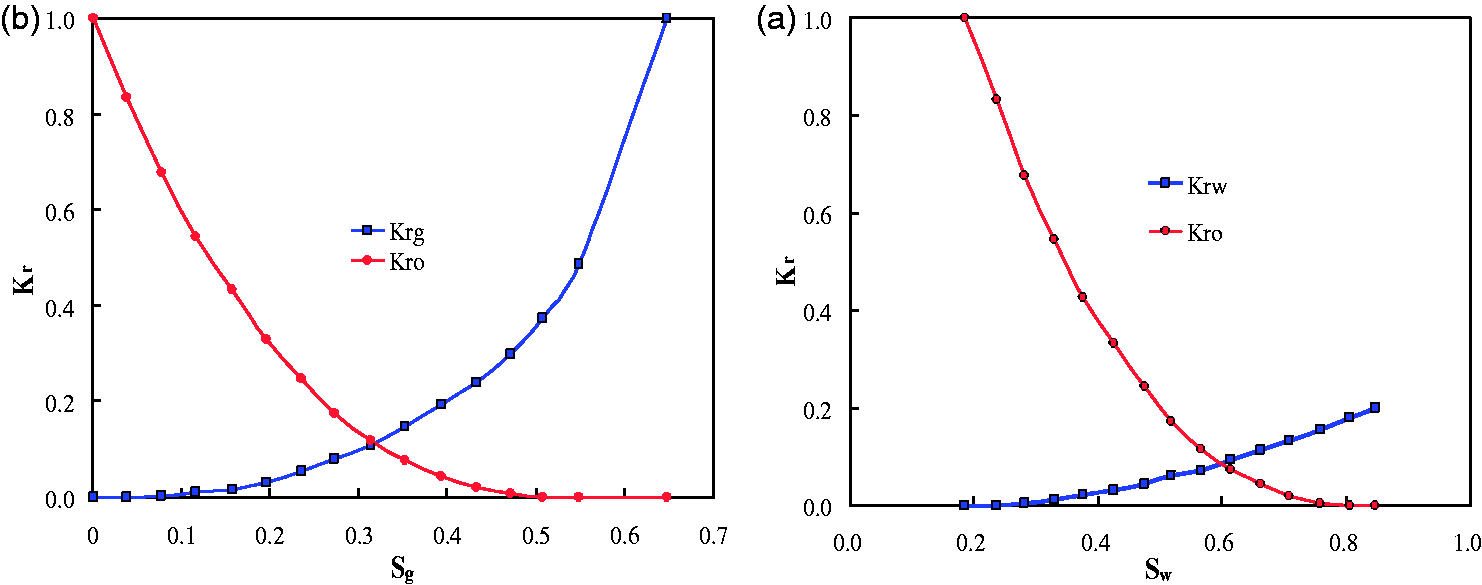
Relative permeability curve. (a). Gas–oil relative permeability curve. (b). Oil–water relative permeability curve.
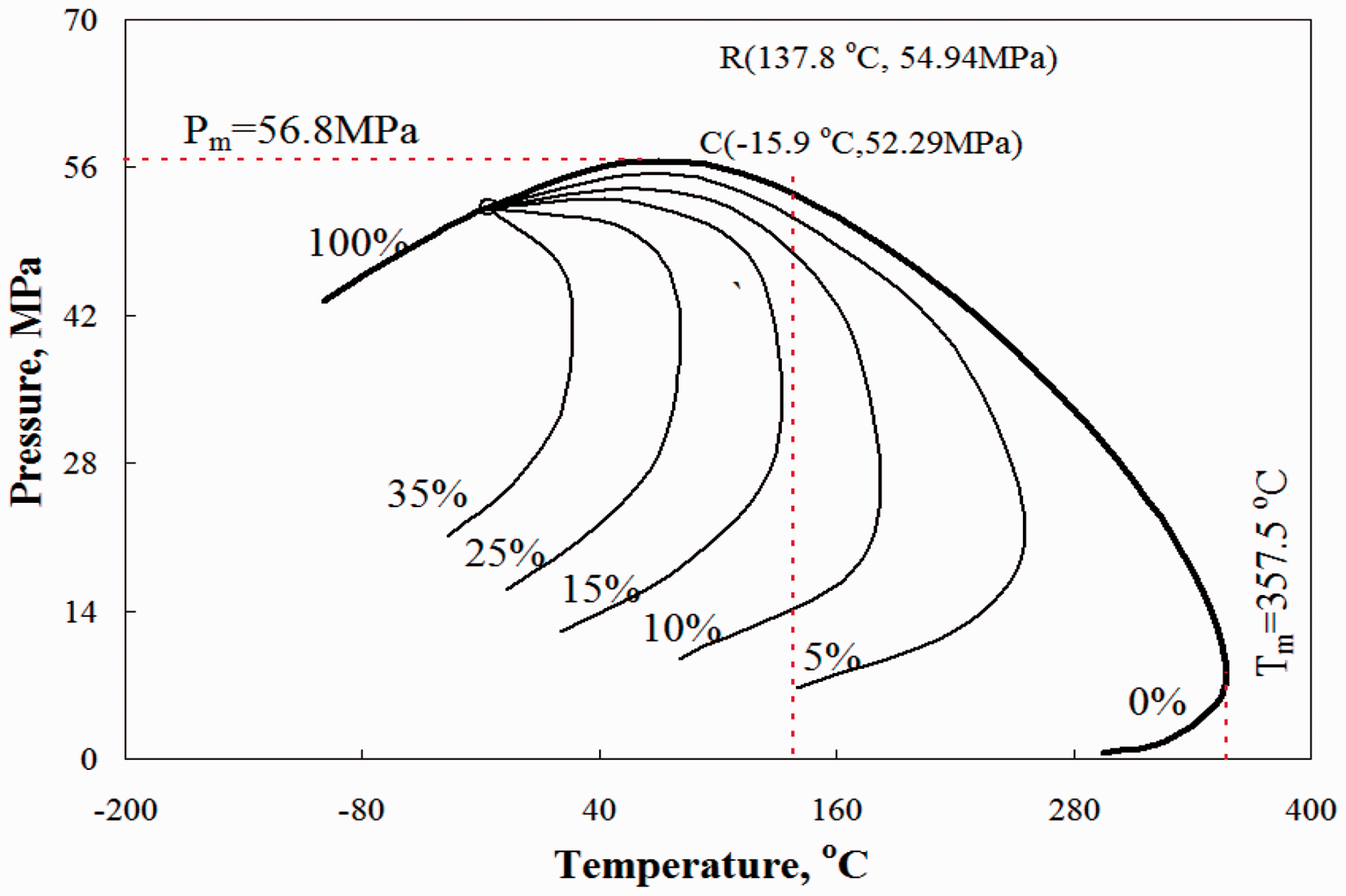
Fluid phase diagram.
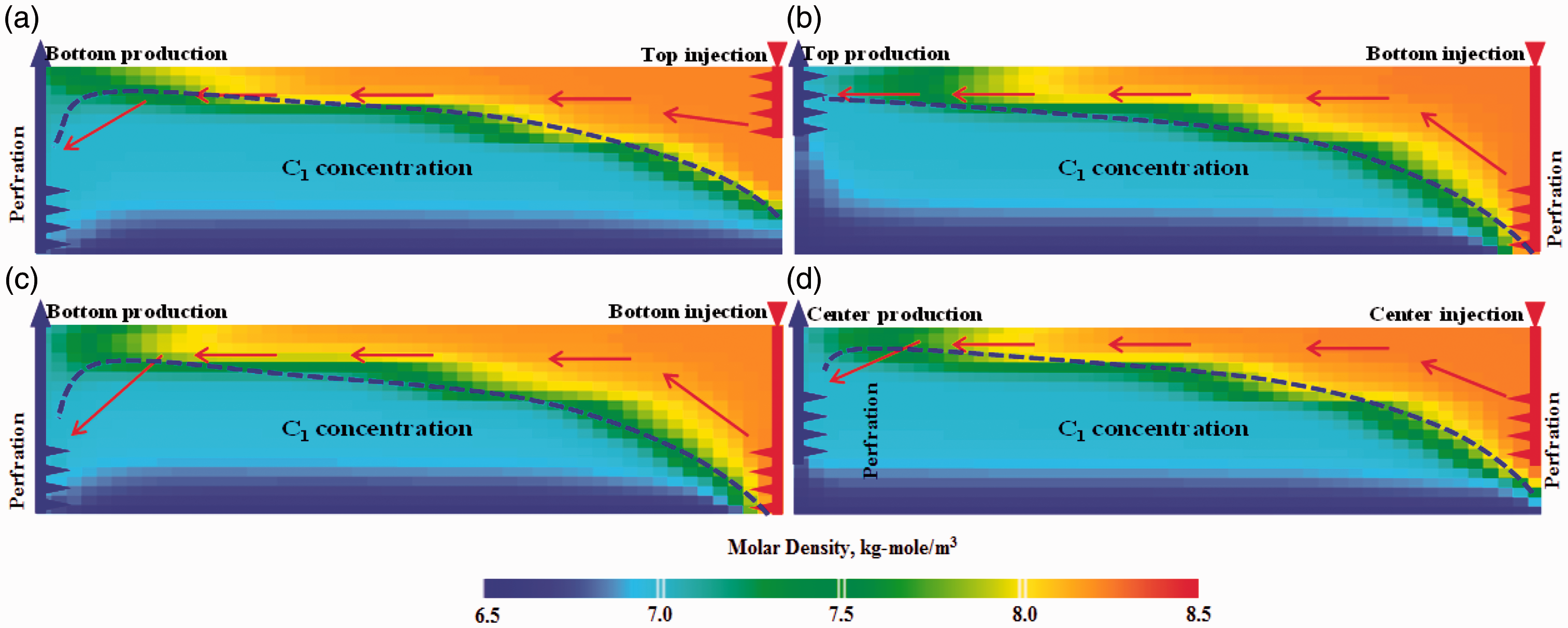
Distribution of component C1 of different perforation locations of injector and producer. (a) Top injector and bottom producer. (b). Bottom injector and top producer. (c). Bottom injector and bottom producer. (d). Center injector and center producer.
Characteristic parameters for different perforation locations of injector and producer.

From Figure 4(a) to (d), we can see that overlap phenomenon is very apparent. Because the density of dry gas is lower than condensate gas, the injected gas is inclined to flow through the top section. Moreover, the high permeability strip locates at the top, so the overlap is further strengthened. Thus, cycling gas injection using dry gas is unfavorable due to the reverse rhythm of Yaha-2.
From Table 1, it can be seen that when the perforation locations of injector and producer are both at the bottom, the breakthrough time and dimensionless sweep volume are the largest. More bottom volumes near the wells can be swept. The perforation locations of injector and producer are both at the top, the gas breakthrough time and sweep efficiency is the smallest. Therefore, for reverse rhythm reservoir, the difference of density and high permeability channel are the inducements of gas breakthrough, and the perforation locations of injector and producer are both at the bottom can achieve the best development effects than other perforation relations.
Sensitivity analysis of gas breakthrough in Yaha-2
DOE for gas breakthrough in Yaha-2
Based on the previous study, the main mechanism of gas breakthrough is gas flow through high permeability strip. In fact, all of the geological factors, formation heterogeneity, well spacing, and injection parameter will impact the gas breakthrough characteristics. So the formation thickness (H), average permeability (
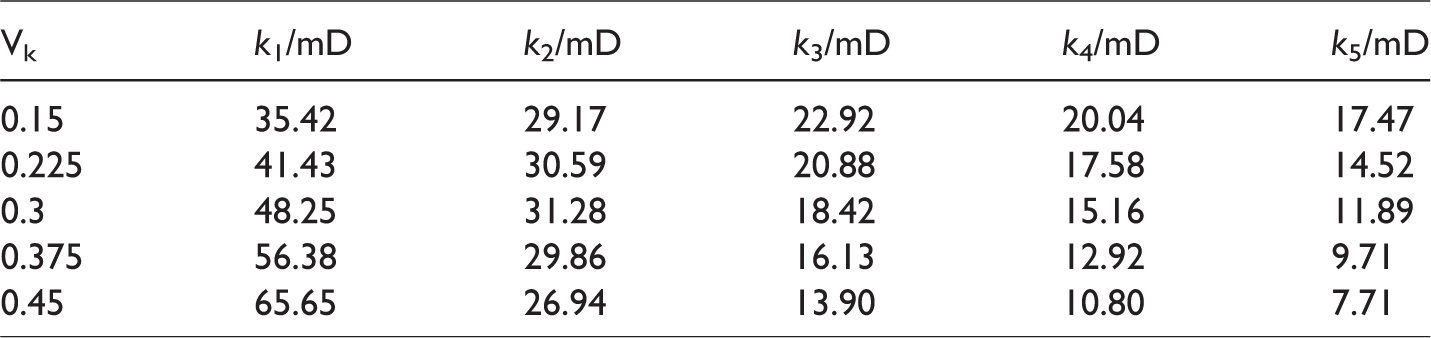
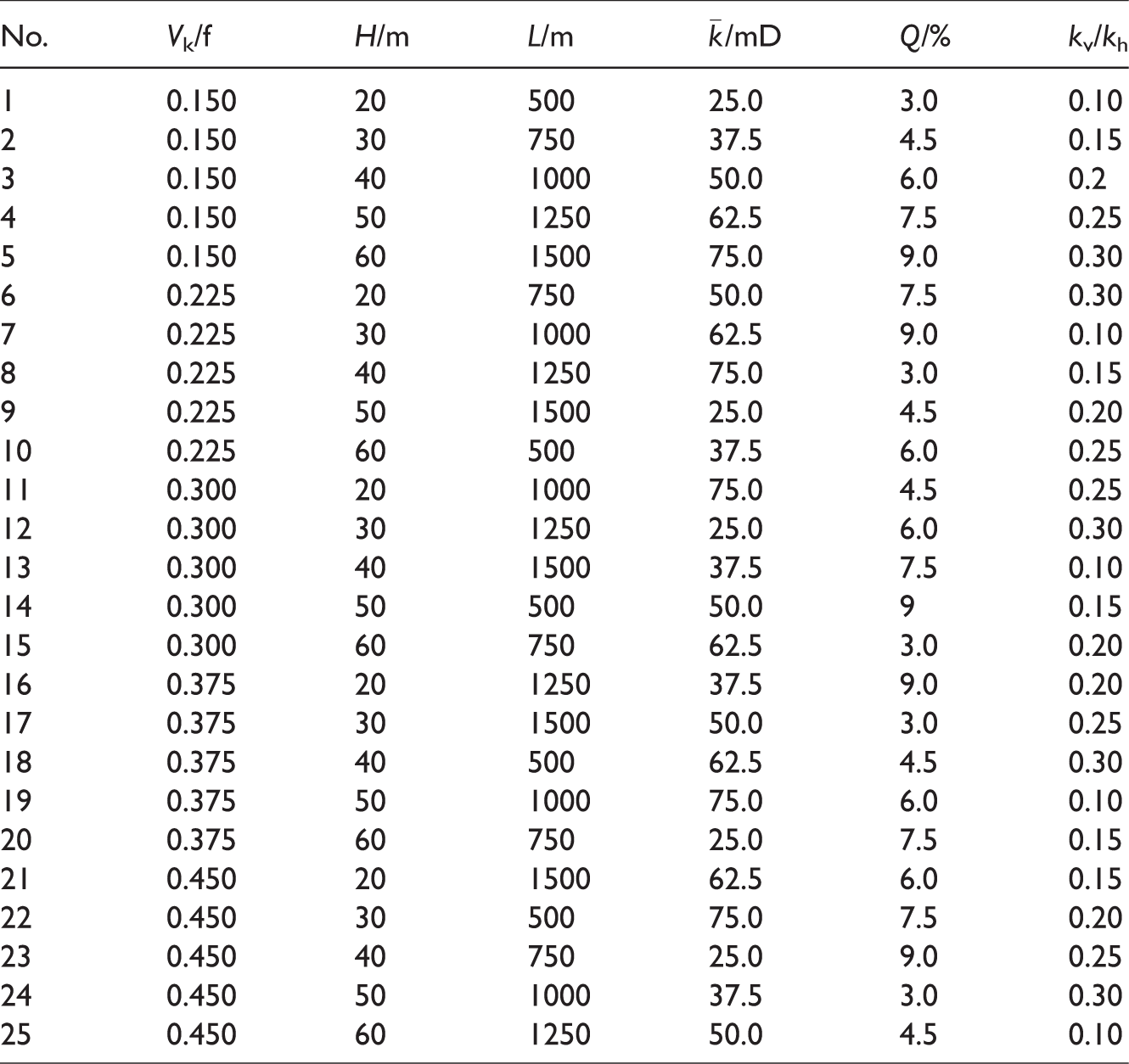
In order to get a comparable permeability variation coefficient, Lorenz method (Al-Anazi et al., 2003) is employed to calculate the permeability of each layer. The Orthogonal experiment table, L25 (56), is used to study the sensitivity of gas breakthrough characteristics to the influencing factors based on the DOE method.
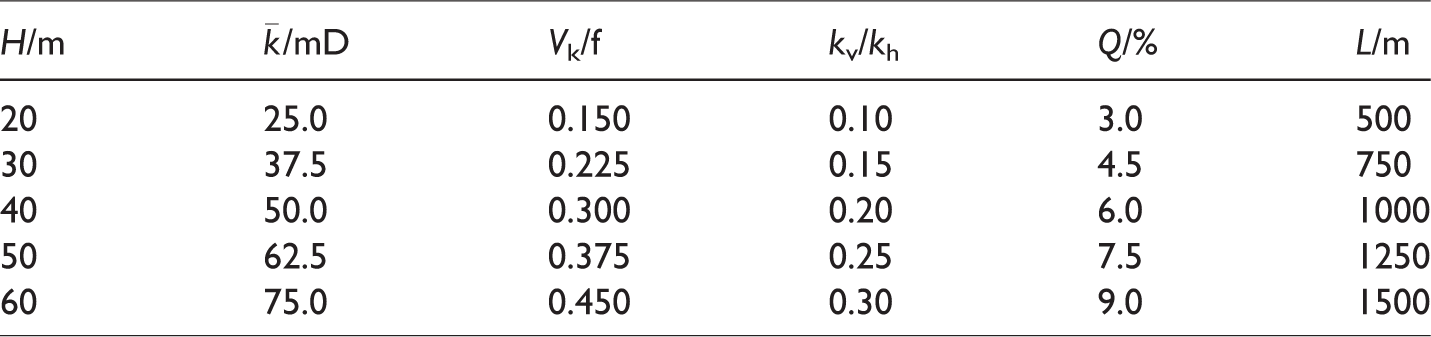
Based on the scope of the above parameters, the values of different influencing factors are shown in Table 2. The permeability of inverse computation by Lorenz method for different variation coefficients is shown in Table 3. Thus, 25 experimental cases can be achieved, and shown in Table 4. Then, the numerical simulation was performed to study the effects of different factors with the development model of bottom injector and bottom producer.
The values of different influencing factors.
Permeability of inverse computation by Lorenz method for different variation coefficients.
Orthogonal experiment table, L25(56).
Sensitivity analysis of gas breakthrough to different factors
Dimensionless gas breakthrough time and sweep efficiency are selected to represent gas breakthrough characteristics. Because gas breakthrough may seriously affect by the volume of research area and the absolute injection/production rate, which are also related to economic, the dimensionless gas breakthrough time is introduced as well. It is the ratio of cumulative injection volume to original gas in place (OGIP). It is written as follows,

Based on the simulation results of the above 25 cases, the corresponding values of the above three parameters are calculated. Then, the software named SPSS Statistics is employed to analyze the sensitivity of these three parameters to the influencing factors. The weighing factors of different parameters on gas breakthrough time, dimensionless gas breakthrough time, and sweep efficiency are shown in Figures 5, 6, and 7, respectively.
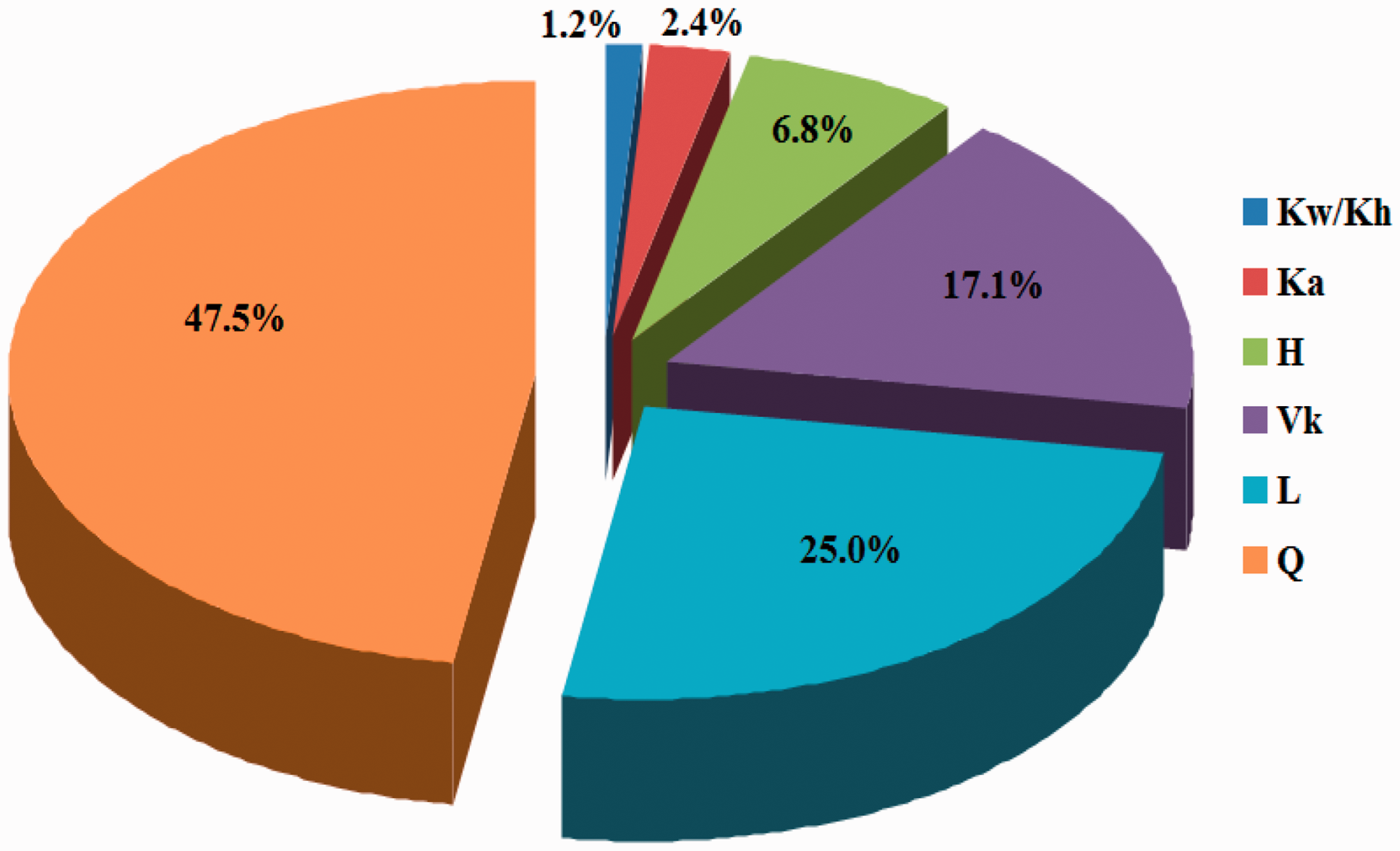
Weighing factors of different parameters on gas breakthrough time.
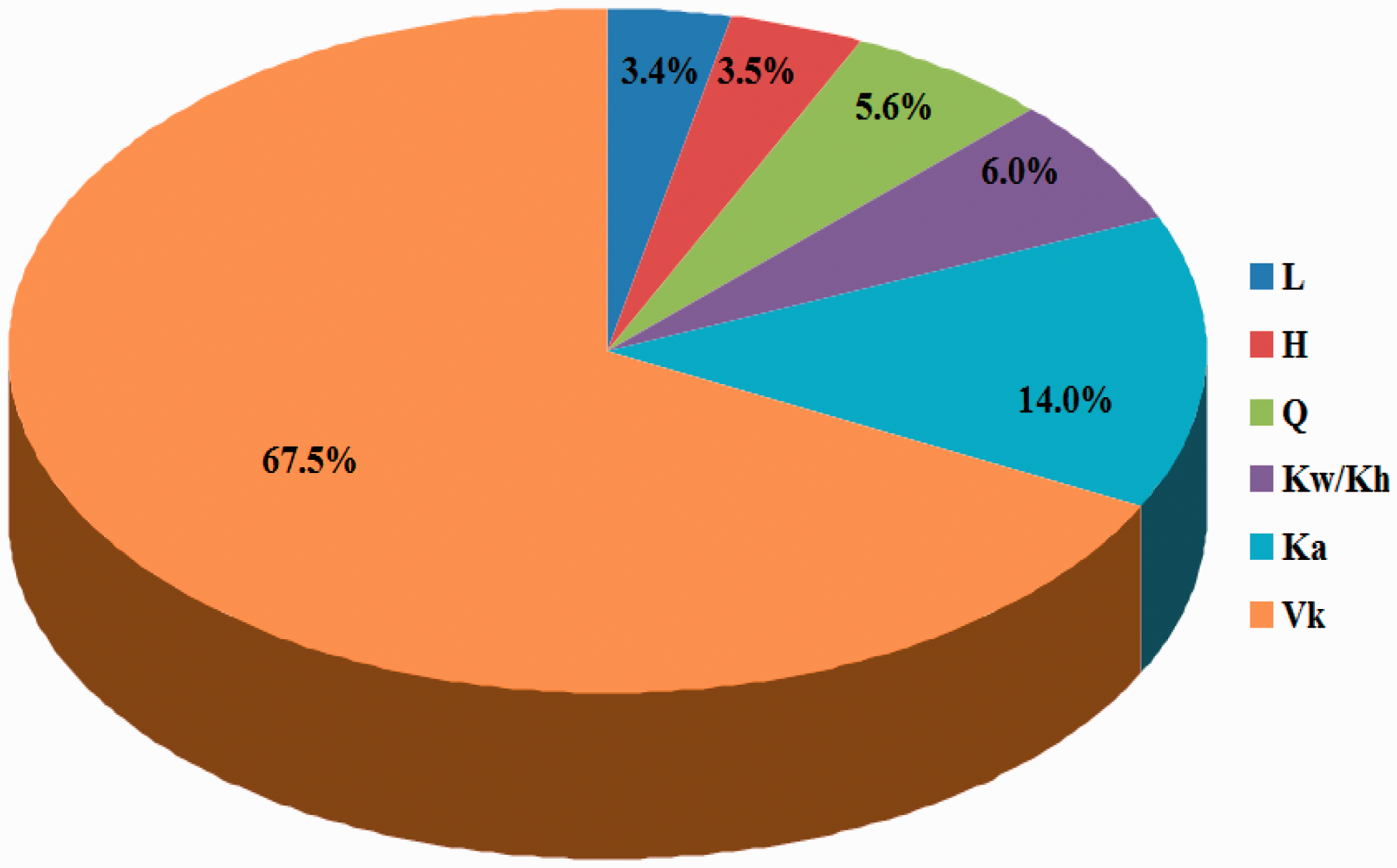
Weighing factors of different parameters on dimensionless gas breakthrough time.
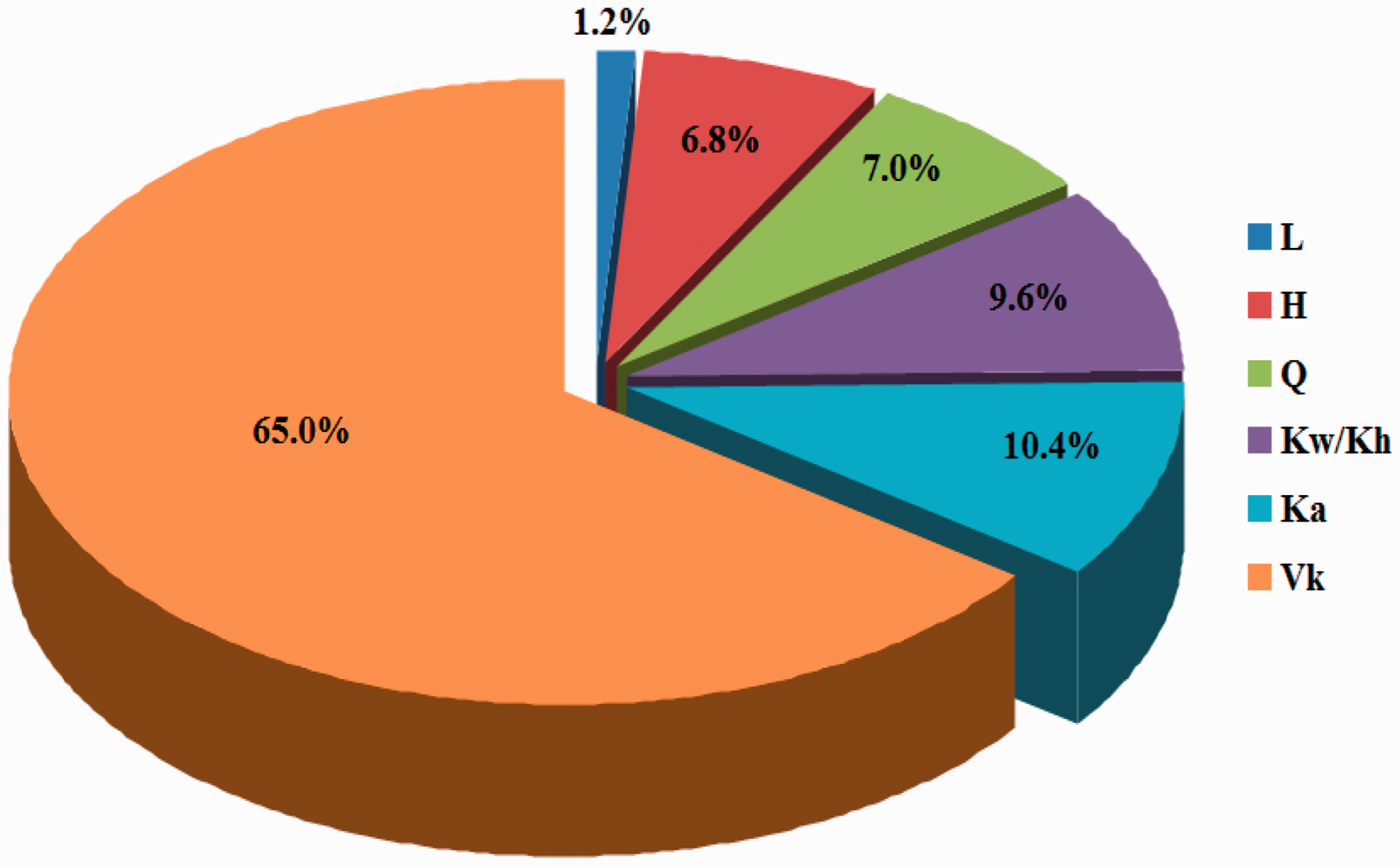
Weighing factors of different parameters on sweep efficiency.
From Figures 5 to 7, we can see that injection/production rate and well spacing are the dominant factors of gas breakthrough time. Permeability variation coefficient is the dominant factor of dimensionless gas breakthrough time and sweep efficiency. Therefore, moderately increasing well spacing and decreasing injection/production rate can delay gas breakthrough. It is very difficult to control gas breakthrough in a significantly heterogeneous formation.
Quantitative study of gas breakthrough characteristics in Yaha-2
Prediction models of gas breakthrough in Yaha-2
In order to easily predict the gas breakthrough time and sweep efficiency when gas breakthrough appears, we try to observe the rules between the characteristic parameters and influencing factors by regression analysis using least square method.
Then, the prediction models of gas breakthrough time, dimensionless gas breakthrough time, and sweep efficiency are achieved and written as follows,



We can see that gas breakthrough time and dimensionless gas breakthrough time are proportional to the well spacing, and inversely proportional to formation thickness, average permeability, permeability variation coefficient, the ratio of vertical to horizontal permeability, and injection/production rate. The sweep efficiency is proportional to the injection/production rate, and inversely proportional to formation thickness, average permeability, permeability variation coefficient, the ratio of vertical to horizontal permeability, and well spacing. But the effect of formation thickness to gas breakthrough time, and injection/production rate to dimensionless gas breakthrough time and sweep efficiency can be neglected.
Application of the models in Yaha-2
Injector “YH1–16” and producer “YH1–14” in Yaha-2 are used to verify the reliability of the prediction model. YH1–14 was commissioned in November 2000 and YH1–16 went into inject dry gas in January 2001. The perforation location is close to the bottom section. The other parameters are shown in Table 5.
The parameters of YH1–14 and YH1–16 in Yaha-2.

We used the above (equations (2) and 4) to calculate the gas breakthrough time and sweep efficiency. The predicted values are compared with the practical values and shown in Table 6. It is clear that the relative error is acceptable by engineering application.
Comparison of predicted values with practical values.

We also used another group of wells in this block to verify the reliability of the prediction model. The parameters are shown in Table 7. (Equations (2) and 4) were used to calculate the gas breakthrough time and sweep efficiency. The predicted values are compared with the practical values and shown in Table 8. The predicted values have agreement with the practical values.
The parameters of YH1–18 and YH1–20 in Yaha-2.

Comparison of predicted values with practical values.

Conclusion
Yaha-2 condensate gas reservoir in Tarim Basin was taken as an example to study the gas channeling characteristics for cyclic gas injection, the following conclusions are obtained.
Yaha-2 condensate gas reservoir is a reverse rhythm reservoir. The influencing factors include geological characteristic, permeability heterogeneity, development mode, and the location of perforation were discussed. The mechanism of gas breakthrough in Yaha-2 condensate gas reservoir in Tarim Basin is the injected gas flow through high permeability strip due to gas density difference. Gas breakthrough along the top section is the major pattern. The development mode of bottom injector and bottom producer can achieve a longer gas breakthrough time and larger sweep efficiency. The perforation locations of injector and producer are both at the bottom can achieved the best development effects than other perforation relations. The results of the DOE illustrate that injection/production rate and well spacing are the dominant factors of gas breakthrough time. The moderately increasing well spacing and decreasing injection/production rate can delay gas breakthrough. Permeability variation coefficient is the dominant factors of dimensionless gas breakthrough time and sweep efficiency. The reverse rhythm of Yaha-2 in Tarim Basin is unfavorable for cycling gas injection using dry gas. The prediction models of gas/dimensionless gas breakthrough time and sweep efficiency are achieved. The predicted values have agreement with the practical values. They can be conveniently applied to predict the gas breakthrough parameters, whose accuracy can satisfy the engineering application.
Footnotes
Declaration of conflicting interests
The author(s) declared no potential conflicts of interest with respect to the research, authorship, and/or publication of this article.
Funding
The author(s) disclosed receipt of the following financial support for the research, authorship, and/or publication of this article: This research was supported by Science and technology research project of PetroChina Company Limited, Key technology research on gas field development (No. 2016B-1504), the Science and Technology Special Funds of China (No. 2016ZX05015-002), and the Fundamental Research Funds for the Central Universities (No. 2-9-2017-310).