




Abstract
This paper presents an efficient technique to optimize a gas condensate field development plan under economic uncertainties. Many studies have been conducted to optimize development plan but mostly limited to oil field under fixed economic environments and required huge number of simulation runs. It is proved that black oil model can be a reasonable alternative of compositional model to complete field development optimization within acceptable period when reservoir pressure is higher enough than dew point pressure.
This study implements Monte-Carlo simulation to Genetic Algorithm to assess economic uncertainties while optimization procedure is being performed and to avoid duplicating whole optimization procedure by changing economic assumptions. An idea for setting optimization variables for well placement is also introduced to reduce required number of simulation runs.
A real field application confirms that the technique can be applied to optimize a gas condensate field with contractual gas sales obligation, and the idea plays a key role to find the optimized solution with limited resources by reducing the number of simulation runs required during the optimization procedure. The proposed technique can be applied to optimize not only full field development plan but also reservoir management plan and it will be helpful to improve economics of all kinds of E&P projects under lots of uncertainties.
Keywords
Introduction
Optimization is definitely required to make an investment decision of full field development in oil and gas industry since it costs from hundreds million to several billion dollars or more in many cases. The objective of optimization is not only maximizing the expected recovery of hydrocarbons, but also maximizing financial profits from production of their hydrocarbon accumulation.
There are a lot of choices associated with development planning, including items such as: number of wells, well placement, drilling sequence, producer to injector ratio, production and injection rate limits, and completion interval. These choices easily lead to a huge number of potential candidates of development designs when they are coupled with economic uncertainties.
Field development optimization is a very expensive task due to the large number of reservoir simulation runs required. Even with advances in today’s reservoir and facility simulation technologies and computer hardware, most investigators when faced with such a large number of complex possibilities adopt a manual or semi-manual method of analysis and selection of the design which they then assert is optimum. Typically tens, rather than hundreds of designs are actually fully simulated and investigated. From these results a final design is selected (Litvak and Angert, 2009).
Most investigators have used Genetic Algorithm (GA) to perform the optimization. GA has been applied to the well placement optimization (Bittencourt and Horne, 1997; Guyaguler et al., 2002; Tupac et al., 2007; Yeten et al., 2003). A very general field development optimization procedure based on GA and other optimization tools has been proposed and successfully applied to giant oil fields (Litvak et al., 2007a, 2007b).
These studies have introduced pre-processing methods to reduce simulation runs required in the GA-based optimization process. Applying field development rules or constraints such as minimum distance between wells, minimum distance between completion interval and gas-oil contact, oil-water contact or fault, minimum porosity, minimum permeability and/or minimum initial oil saturation criteria has been very helpful to reduce the number of simulation runs.
Recently statistical proxy procedure has been coupled with GA-based optimization to select development scenarios to be simulated (Litvak and Angert, 2009; Litvak et al., 2011; Onwunalu et al., 2008). The proxy is built by statistical relationships between the attributes and the objective function values obtained from a set of pre-run simulation results. Then, each development scenario is evaluated by the proxy, and only the one which gives higher objective value than threshold is passed to GA-based optimization procedure. This way reduces 55% of required simulation runs in real field case (Onwunalu et al., 2008).
The field development optimization technology has now been field trialed on a multitude of cases. A giant oil field in the Caspian Sea was optimized by GA-based optimization procedure with 8000 simulation runs. Location of 23 new wells, their drilling schedule, producer/injector ratio, water injection timing, water injection rates and locations of sidetrack wells were decided through the optimization (Litvak et al., 2007a). Two infill well locations for an oil field in Gulf of Mexico were optimized by statistical proxy and GA-based optimization procedure with 800 simulation runs (Onwunalu et al., 2008). A giant oil field in East Siberia was also optimized by statistical proxy and GA-base optimization procedure with 14,000 simulation runs. The subsurface uncertainties were also considered by six history matched reservoir models. Due to the large number of wells required to develop the giant field, development order among five zones, well pattern and well spacing rules were optimized rather than drilling sequence and each well’s location (Litvak and Angert, 2009). Finally, the technology has been applied to volatile oil and gas condensate field. Angert et al. (2011) investigated the field development optimization of a complex Deepwater Gulf of Mexico field containing five stacked hydrocarbon intervals bearing volatile and gas condensate. Both black oil and compositional simulation models were developed for the study. Roughly 20,000 black oil simulation runs were required to optimize location of nine wells, their drilling schedule, initial completion interval and up-hole recompletion interval of each well. Then, top 100 development scenarios were re-simulated by compositional model for verification purpose.
In this study, Monte-Carlo simulation and GA are applied to gas condensate field development optimization. In case of gas condensate field development, especially contractually bound with gas sales agreement (GSA), maintaining gas plateau is as important as amount of condensate recovery. Our goal in this study is to maximize the financial profit from optimized development plan which is given by the combination of gas sales plateau, condensate recovery and investment schedule.
Under given gas sales quantity and schedule to be delivered to the market, a gas recycling strategy to set production rate of gas condensate and injection rate of dry gas is determined by Monte-Carlo simulation. Due to the importance of gas sales revenue as well as oil revenue, gas and oil price uncertainties are also considered. Then, GA-based optimization procedure is applied to the selected gas recycling strategy. Well locations, drilling schedule, completion interval, production rate limits and dry gas injection rates are optimized to maximize net present value (NPV) of the project. Considering limited resources such as time, IT hardware and software licenses, and honoring the different nature between oil and gas field, well locations defined from the base case, which is the “best” manually derived field development plan, are used as initial seeds to reduce the number of simulation runs required. The study field is an offshore gas condensate field within Cuulong Basin, Vietnam.
Theoretical background
Gas condensate field
Since the reservoir temperature lies between the critical point and cricondentherm, gas condensate systems have complicated fluid flow and thermodynamic processes. Gas condensate fluids may form considerable liquid phase amounts at reservoir conditions as the pressure drops during the production phase (Ahmed et al., 1998). As the pressure in the near-wellbore region drops below the dew point, the condensate forms a ring around the wellbore and reduces the gas deliverability (Deng et al., 2013). This phenomenon is called condensate banking, and lean or dry gas reinjection is widely used to mitigate gas productivity drop and to maximize condensate recovery. Figure 1 shows the phase diagram of a gas condensate field in this study.
Phase diagram of the study field.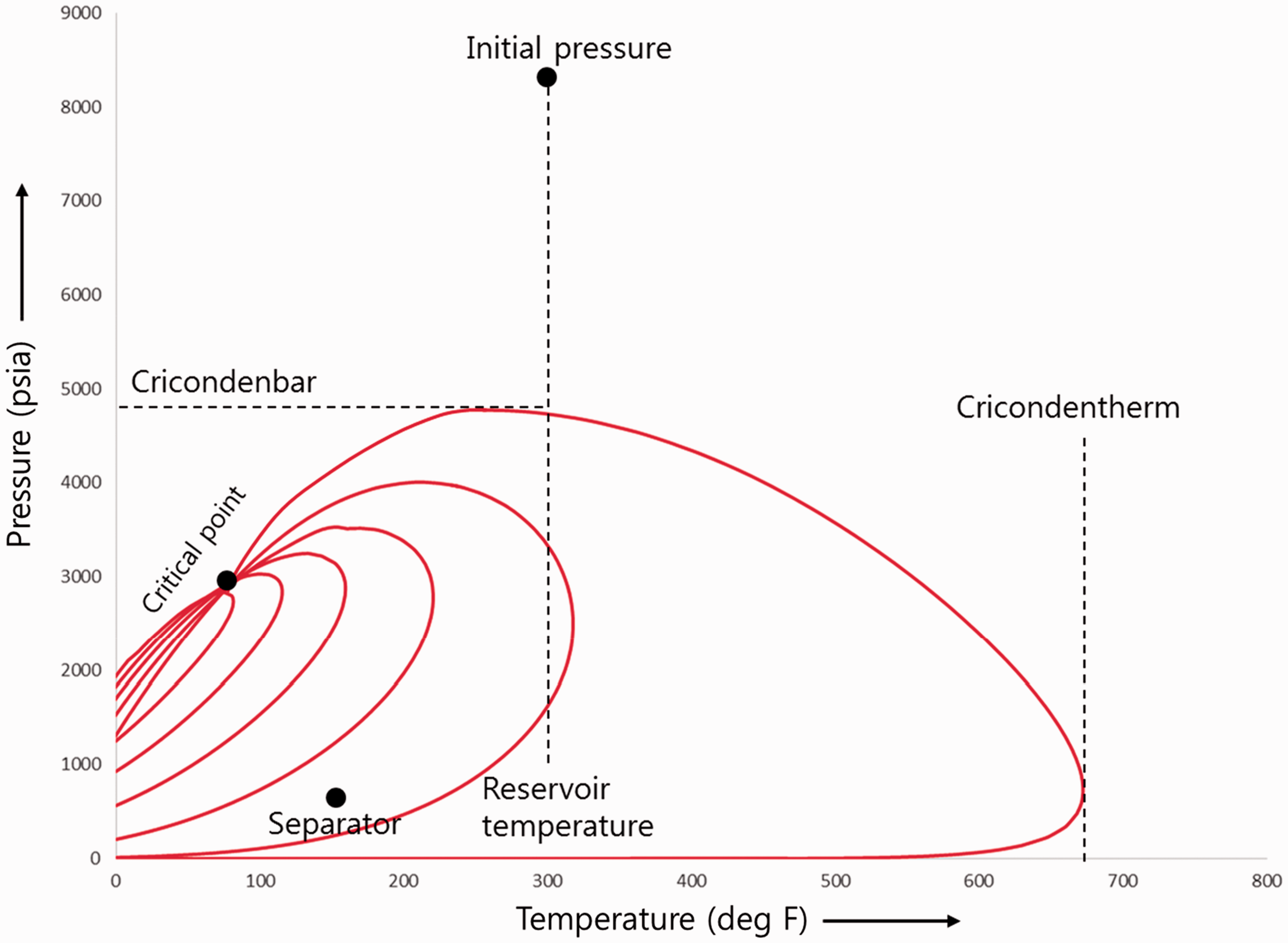
Compositional simulation models are normally used to predict behaviors of gas condensate systems because the composition of reservoir fluids changes as reservoir pressure changes. In spite of the advances in both computer hardware and software technologies, however, it is still challenging to use compositional simulation model in full field development optimization process because each simulation run takes much longer than black oil model.
There have been many studies for using black oil model instead of compositional model in gas condensate reservoirs. Fevang et al. (2000) proposed guidelines for choosing compositional and black oil models for volatile oil and gas condensate reservoirs, and it concluded that a black oil model can be used in lean to medium-rich gas condensate reservoirs undergoing cycling above the dew point for gas condensate fluids. El-Banbi et al. (2000) developed a modified black oil model for a near-critical rich gas condensate reservoir which showed agreeable results with compositional model for the entire simulation above and below the dew point pressure. Angert et al. (2011) used both black oil and compositional models to optimize field development plan of a complex field with stacked reservoirs of volatile oil and rich gas condensate. In order to maximize the optimization efficiency and accuracy, black oil model was used to run 20,000 cases and selected top 100 cases were re-run by compositional model.
Genetic Algorithm
Genetic Algorithm is an optimization technique inspired by natural evolution. A population of candidate solutions (individuals) to an optimization problem is evolved toward better solutions. The first application of GA to optimize a complex problem was presented by Holland (1975), and GA is now widely used for optimization in oil and gas industry. GA normally takes relatively long time to get the optimized solution, but it is known that it can be applied to highly non-linear problems and has low possibility to fail to find out the optimized solution.
The evolution process of GA consists in the submission of a collection of individuals to an evolutionary process that occurs in cycles. Each evolutionary cycle is called a generation and includes evaluation, selection, crossover and mutation (Emerick et al., 2009). Initial population is usually generated randomly, and the value of the objective function of every individual is evaluated. The more fit individuals are stochastically selected from the current population, and genomes of the selected individuals are modified by crossover and mutation. The crossover combines genes from two individuals to generate a new individual, and the mutation is applied to selected individuals separately by following pre-defined mutation ratio. The mutation inserts new genetic information into the population, which helps to avoid falling in local optimum. After several generations of evolution, the population will have individuals with better fitness than the ones on the first generation. The stop condition for the cycling can be a maximum number of generations or a goal for objective function value.
Methodology
Workflow
The workflow in this study consists of three parts: (1) preparation, (2) gas recycling scheme selection using Monte-Carlo simulation and (3) full field development optimization using GA. Figure 2 shows the workflow in detail. First, a black-oil simulation model for the base case and an economic analysis model are developed during preparation part. The base case is the best manually derived field development plan, and is to be used as an initial basis for the optimization procedure. Economic analysis model has uncertainties evaluation functions on uncertain variables such as gas price and oil price as well as the basic input for NPV calculation. Second, Monte-Carlo simulation is performed to select gas recycling scheme. Gas recycling scheme means how much gas will be produced and injected under fixed gas sales scenario. Simulation results from the base case with several combinations of gas production and injection are put into the economic analysis model, and the model runs Monte-Carlo simulation with variable sets of economical input parameters such as gas and oil price following pre-defined distribution functions. Finally, full field development plan for the selected gas recycling scheme is optimized. Optimization variables are defined first, initial population is generated randomly, then GA is applied to find out the optimum development design.
Workflow of the proposed approach.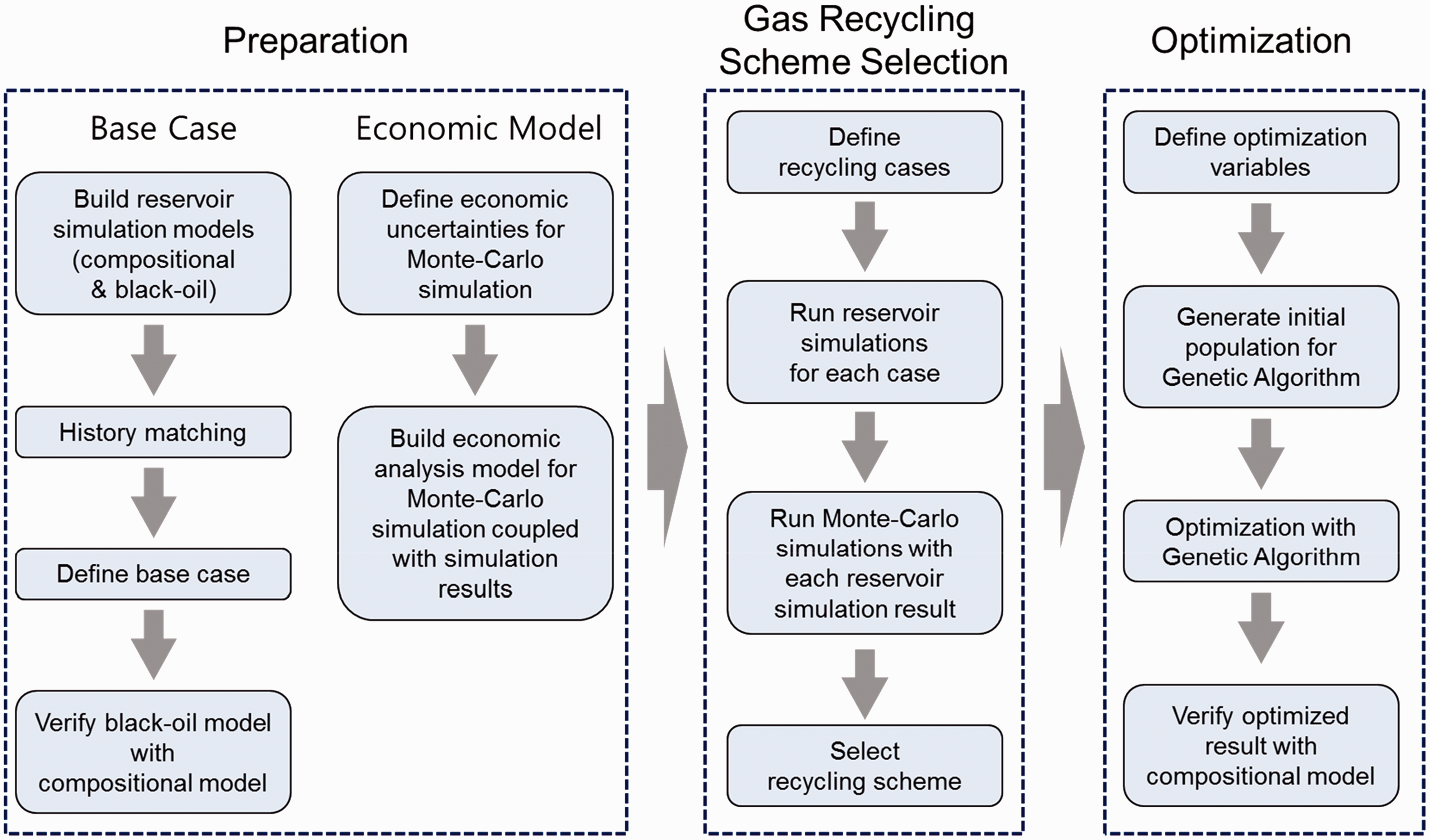
Defining a black-oil model for the base case
It is known that black-oil model and compositional model simulate the behavior of the reservoir similarly while reservoir pressure is higher than dew point pressure. Since optimization procedure requires many simulation runs, a black-oil model is preferred to be used because of its shorter simulation time than compositional model. In this study, a universal Peng Robinson equation of state (EOS) is constructed to match all fluids in the reservoir (Peng and Robinson, 1976). This EOS with 15 components is used to generate a black oil fluid property characterization of the fluids.
After achieving robust matches on historical data of the field from history matching process, the base case is defined. Then, the prediction results of the base case for both compositional and black-oil models are compared. In order to use a black-oil model for gas condensate field optimization, it is required to verify its results with those of compositional model before and after the optimization.
Monte-Carlo simulation for selecting gas recycling scheme
In this study, a stochastic approach is introduced to help the investment decision. The objective of the optimization study is to maximize NPV and it is very sensitive to gas and oil price assumption. In order to avoid duplicating whole optimization procedure again by changing the price assumption, each simulation result is incorporated with probability distribution functions (PDFs) of gas and oil prices when it is put into economic model. The PDFs of the prices can be set any such as normal distribution, triangular distribution, uniform distribution or custom distribution.
Gas recycling scheme is selected from the list of possible combination of gas production and injection designs. To assess uncertainties by the field development scenarios, design variables for the full field development optimization are set at this step. Numbers of producers and injectors, locations of the wells, drilling schedule, production rate, injection rate, completion interval, etc. are selected as variables in this study, and each variable has its own distribution function considering physical characteristics of the field. Then, simulation cases are generated per each gas recycling scheme randomly following distributions of the variables, and each simulation result is sent to the economic model. Once a simulation result comes to the economic model, the model generates a set of price decks following PDFs and gives NPV results as a cumulative distribution function (CDF).
Full field development optimization
Optimization of full field development is performed with the selected gas recycling scheme. Initial population for GA is generated by random selection of the development design variables defined at previous step, then GA generates offspring based on fittest testing results with rand to optimize objective function value, which is NPV in this study.
In order to generate offspring, the roulette wheel method is used in this study. The fitness is calculated as equation (1).

The fitness is calculated higher when the individual has higher NPV. The fitness means probability for the individual to participate in evolution process to make next generation, and stands for each slice in the roulette wheel shown in Figure 3.
Roulette wheel selection based on fitness.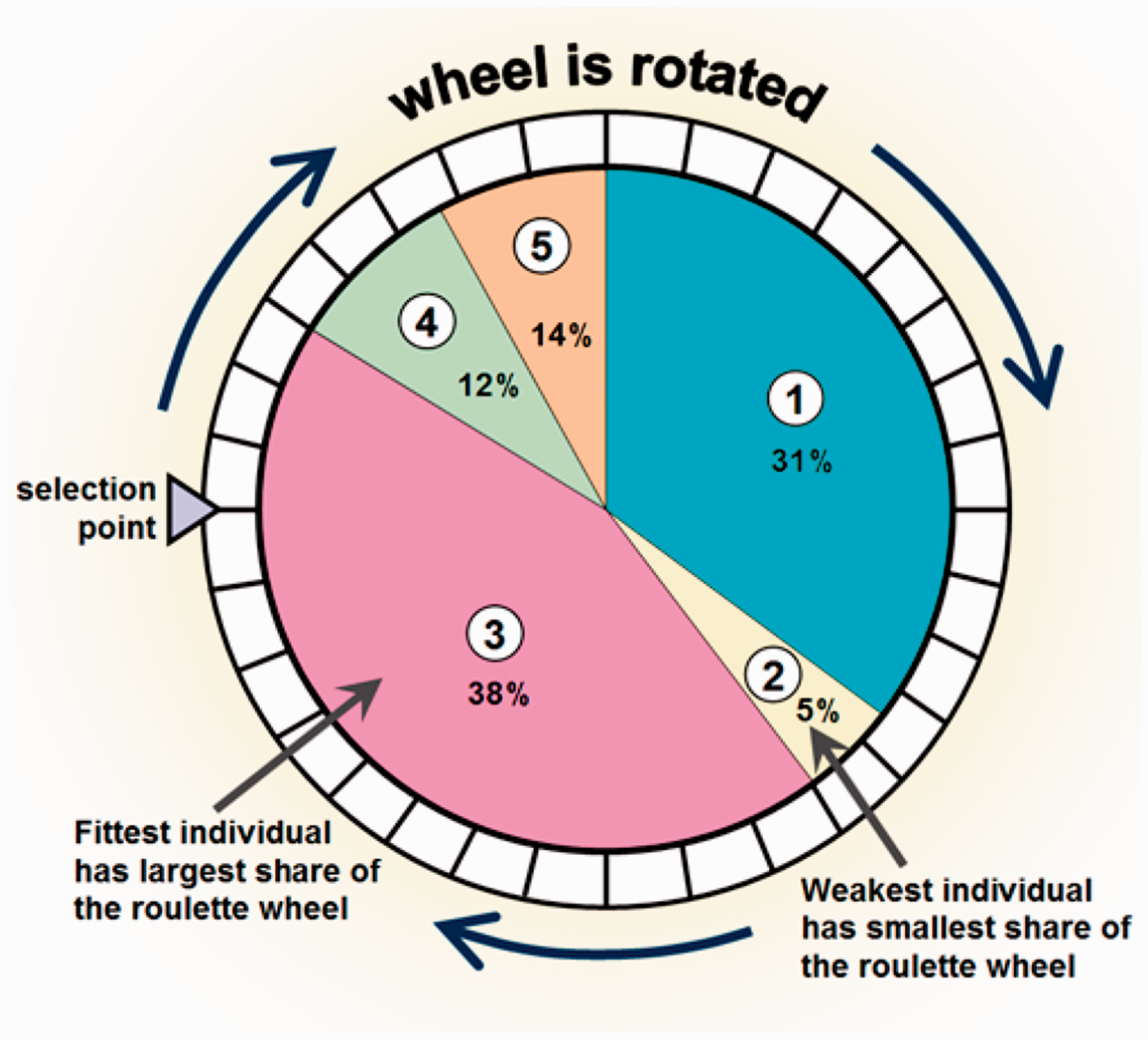
Genomes, which are design variables in this study, of the selected individuals are modified by crossover and mutation. One-point crossover method and 5% of mutation ratio are applied in this study. Figure 4 shows how one-point crossover works. A single crossover point on both parents' genomes is selected, and all data beyond that point in either genome is swapped between the two parent genomes.
One-point crossover operation for genetic algorithm.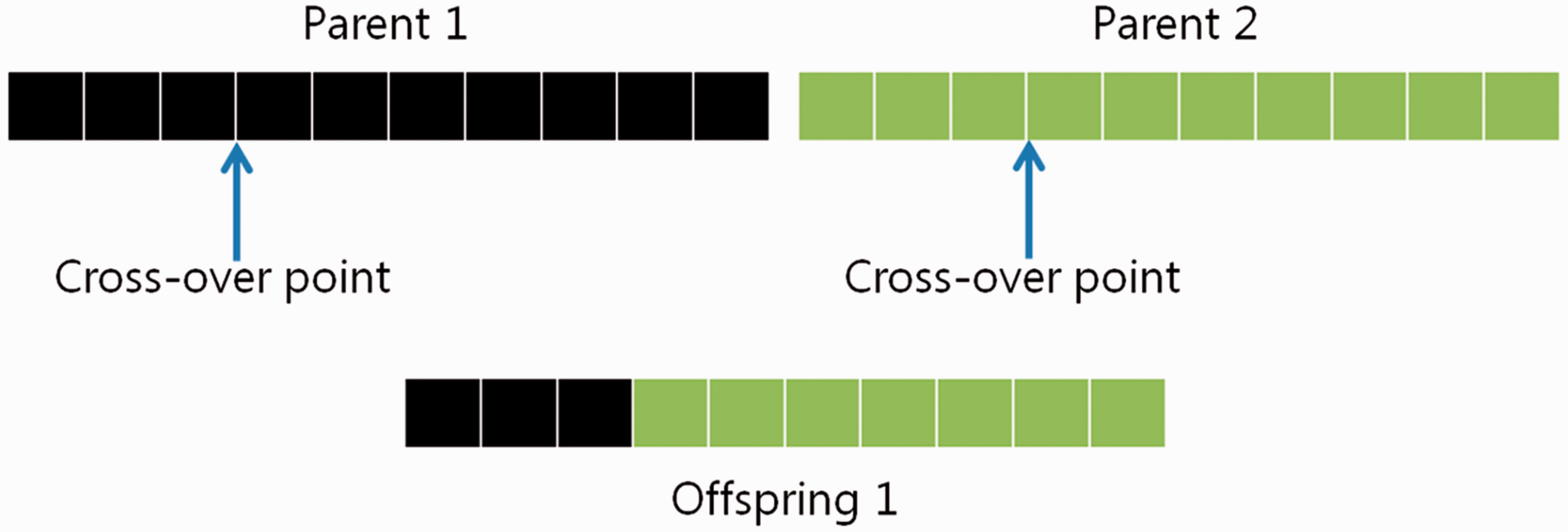
Figure 5 shows a general flowchart of GA. After several generations of evolution, the population has individuals with better fitness than the ones on the first generation. In order to avoid long stagnation of the objective function, it is programmed to stop the optimization when total number of simulation for optimization reaches 2000 or incremental 20% gain in objective function value is achieved.
Workflow of the proposed approach.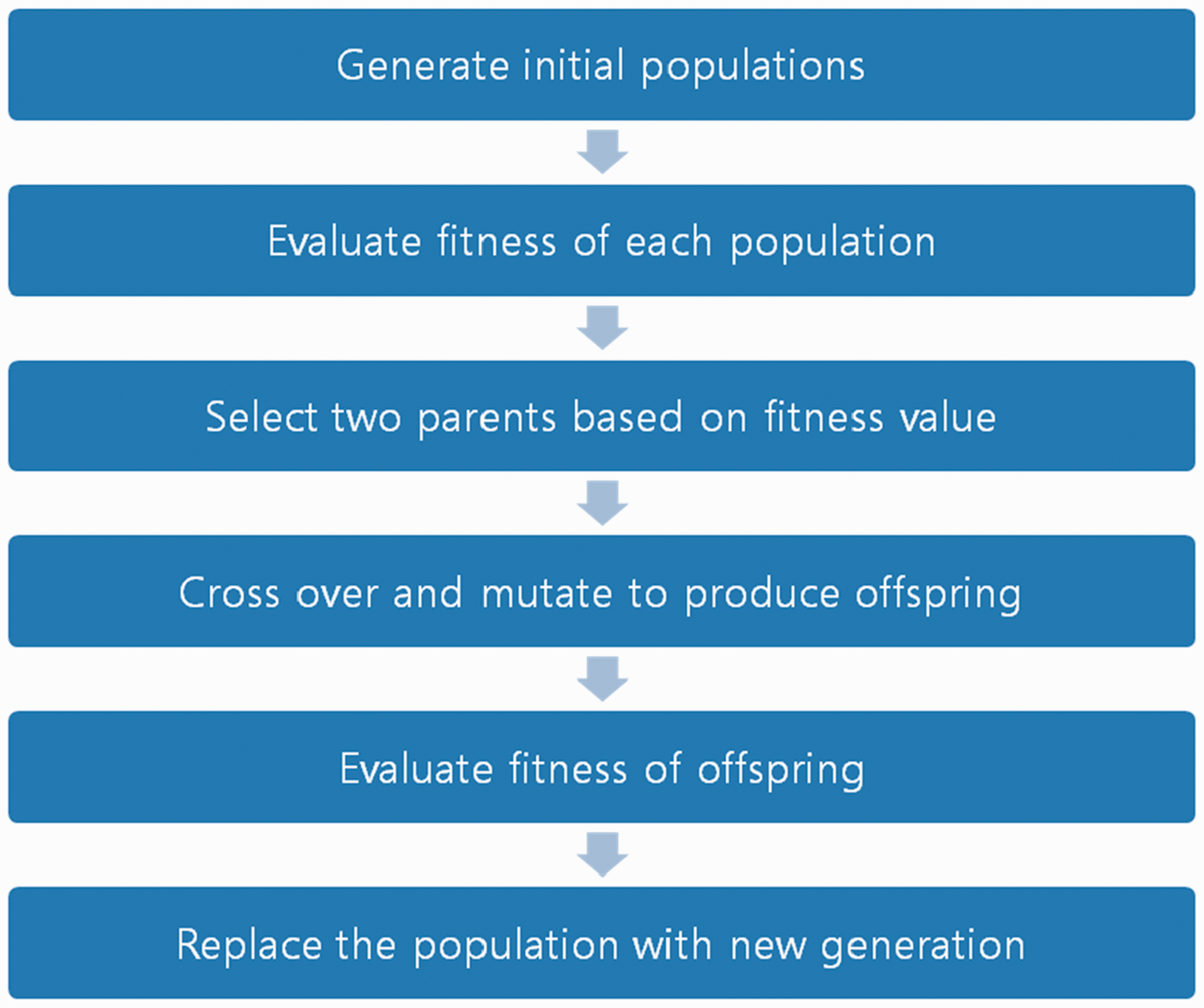
Results and discussion
Field application
The proposed workflow is applied to a gas condensate field located in the northern part of Cuulong basin, offshore southern Vietnam. Two gas condensate bearing Lower Oligocene reservoirs were discovered in 2003, and up to date four exploratory wells and four appraisal/production wells have been drilled. The upper reservoir (sand A) occurs below ∼3500 m-TVDSS and the lower (sand B) occurs below 3700 m-TVDSS and extends to greater than 4500 m-TVDSS. The highest initial pressure of a hydrocarbon bearing interval is ∼8800 psia. The condensate yield of the main area is about 140 bbl/mmscf and dew point pressure ranges from 4200 to 4800 psia. The reservoirs are slightly tight and highly heterogeneous. Permeability ranges from 0.1 to 700 md with average of 3 md and porosity ranges mostly from 5% to 14% in pay zones. Full logging suites, modular formation dynamics tester (MDT) fluid samples, core, rotary core, conventional core analysis, special core analysis and more data have been collected and are available for the field.
Figure 6 shows gas production and sales schedule with modified scale of gas rate. Oil and gas rates and their amount in this study are expressed with modified scale without units in order to avoid any possible confidentiality issues. The field is currently producing and selling gas in domestic market through existing pipeline on averaging amount of 1/day, and it is under development of its first gas recycling project which produces 3/day and injects 2/day maintaining 1/day of sales gas targeting start up in year 4. This field is currently at the initial stage of discussion for GSA, which will ramp up gas sales volume to 4/day from year 7 and 6/day from year 9 to year 16. Production by full field development starts from year 7, and gas recycling scheme is not decided yet.
Gas production and sales schedule (modified scale).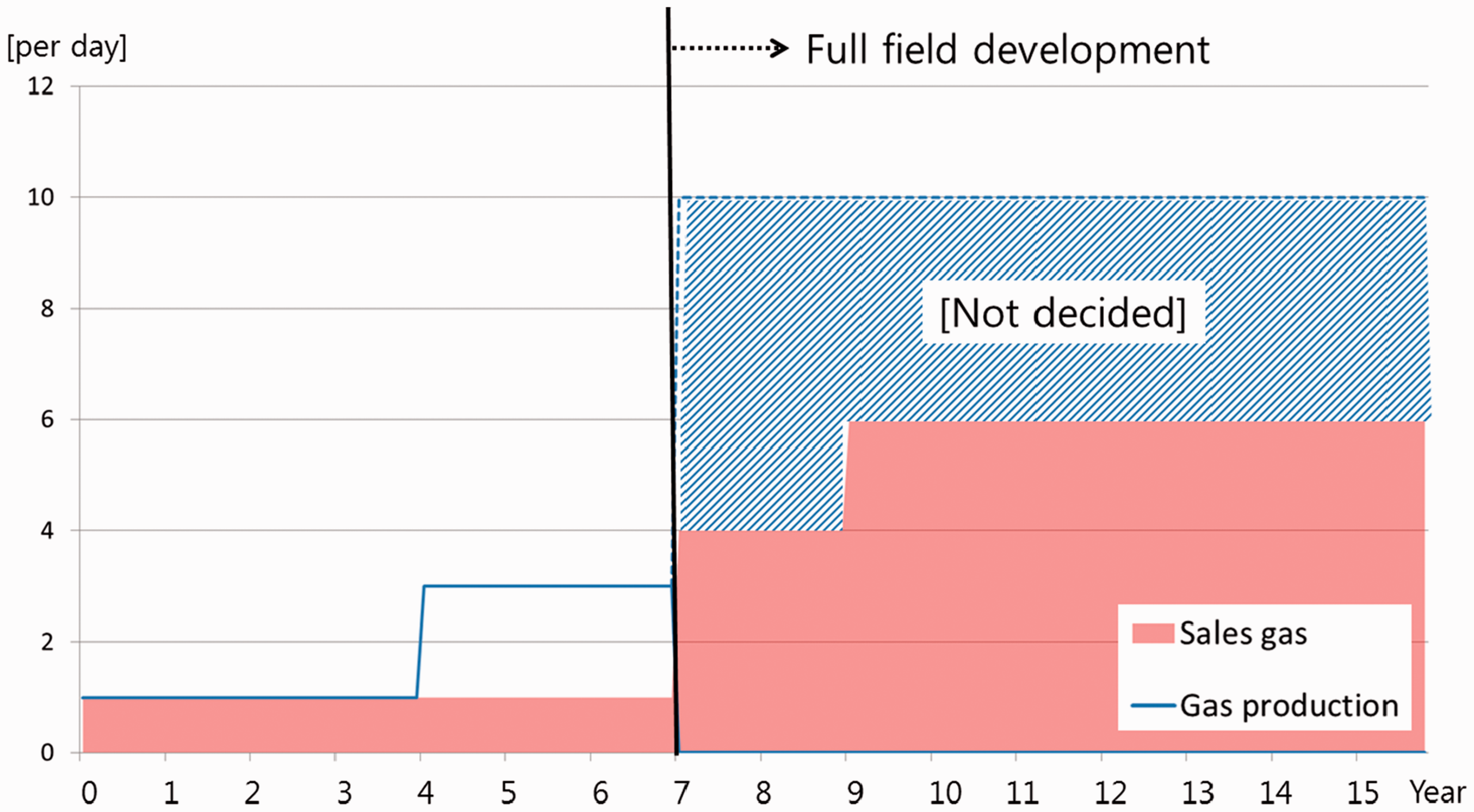
Compositional and black-oil simulation models are used in this study, and each model has 54 × 95 × 464 grid blocks with 220,000 active cells, which contain 3.4 TCF of initial gas in place with 470 MMBL of condensate. Grid cell size is 150 × 150 × 5 m. After quality controlling PVT data, Peng Robinson EOS with 40 components was used to check EOS predictions of all available PVT experiments. However, CPU and memory limitation in full-field compositional reservoir simulation makes it impractical to use the model. Therefore EOS model with 15 components is formulated by grouping the components into several pseudo-components. The model is used for compositional reservoir simulation and generating black-oil tables for reservoir simulation.
As documented in many technical papers, the black-oil model is acceptable for gas injection above the dew point. In order to take into consideration of condensate banking near wellbore, generalized pseudo pressure (GPP) calculation is applied to the black-oil model (Whitson and Fevang, 1997). In addition we have validated that black-oil model and compositional model results are very similar for the considered scenarios. Black-oil model is preferable because it is much faster to run a simulation than compositional model. While a compositional simulation takes 36 hours to run, black-oil model takes less than 2 hours to run a simulation. In this study, black-oil model is mainly used for the optimization, and compositional model is used for the verifications of simulation results from black-oil model.
Defining base case
History matching is performed first for the study. Assisted history matching techniques help shortlisting 24 models with high quality matching quality, and the best model is used for defining the base case (Jeong et al., 2013). Remaining 23 models are also used in this study to see how the optimized case performs under geological uncertainties.
Total 34 wells with 23 producers and 11 injectors are pre-defined as candidate wells to maintain total gas production and injection rates, which are dependent to gas recycling scheme to be decided in next step. The producers are placed first considering well spacing, faults and reservoir properties such as gas saturation, porosity and permeability. Then, locations for injectors are selected by z-direction summation of conductivity, which is multiplication of permeability, cell height and net-to-gross ratio. These locations are selected to cover whole reservoir area. Figure 7 shows candidate well locations of the base case.
Well locations of the base case.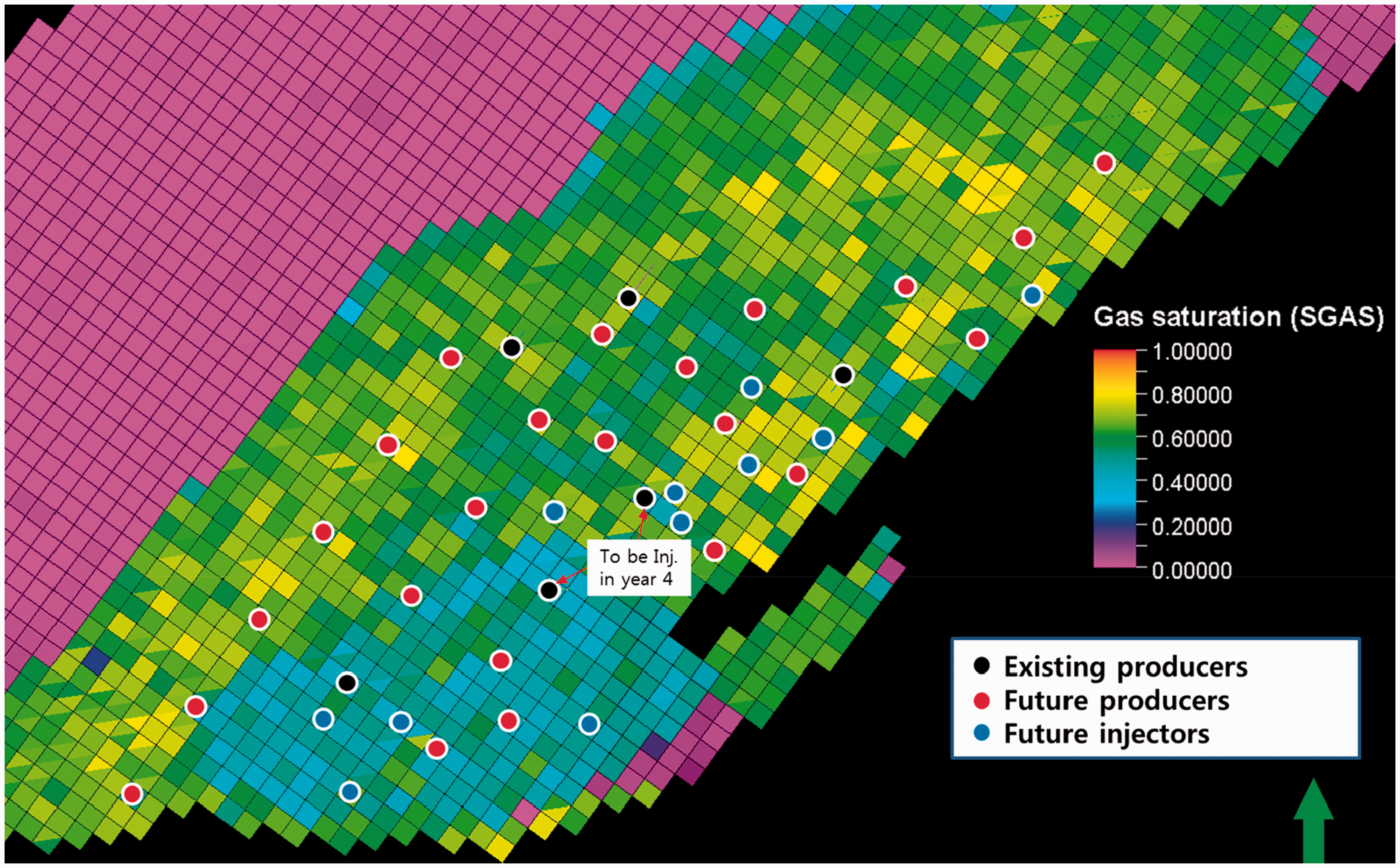
In order to select wells to be drilled and to decide drilling sequence, drilling priorities for all wells are also set considering productivity, injectivity, gas saturation, etc. Wells are drilled following drilling priorities when existing wells cannot maintain the plateau of the selected gas recycling scheme. Since there are two existing producers to be converted to injectors in year 4, it is expected that only a few more injectors would be drilled to meet the injection target while most of the producers would be drilled eventually to maintain plateau.
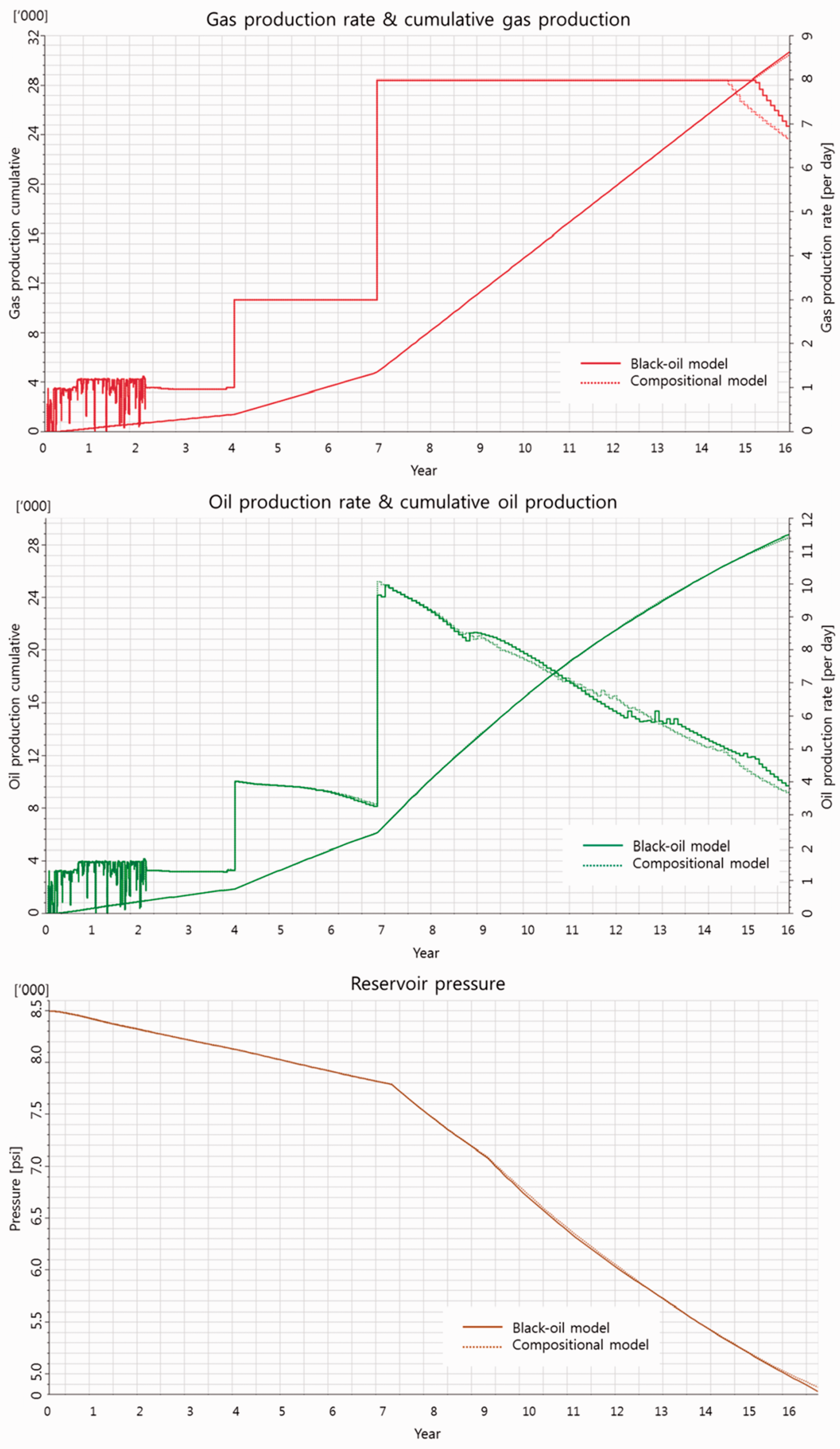
In addition to well locations and drilling sequence, each well’s perforation intervals, production rate and injection rate are also determined by multi-disciplinary cooperation. As mentioned earlier, the base case of this study is the best “manually” derived development design. This base case is simulated by both black-oil and compositional models. Figure 8 is the simulation result of the base case with selected gas recycling scheme, and it shows that black-oil model performs very similarly with compositional model in terms of bottom hole pressure, production rates of gas and oil and their cumulative amounts. Simulation results in this paper include historical data, therefore, initial two and half years shows instable oil and gas rates by operational reasons.
Simulation results of the base case run by black-oil model and compositional model.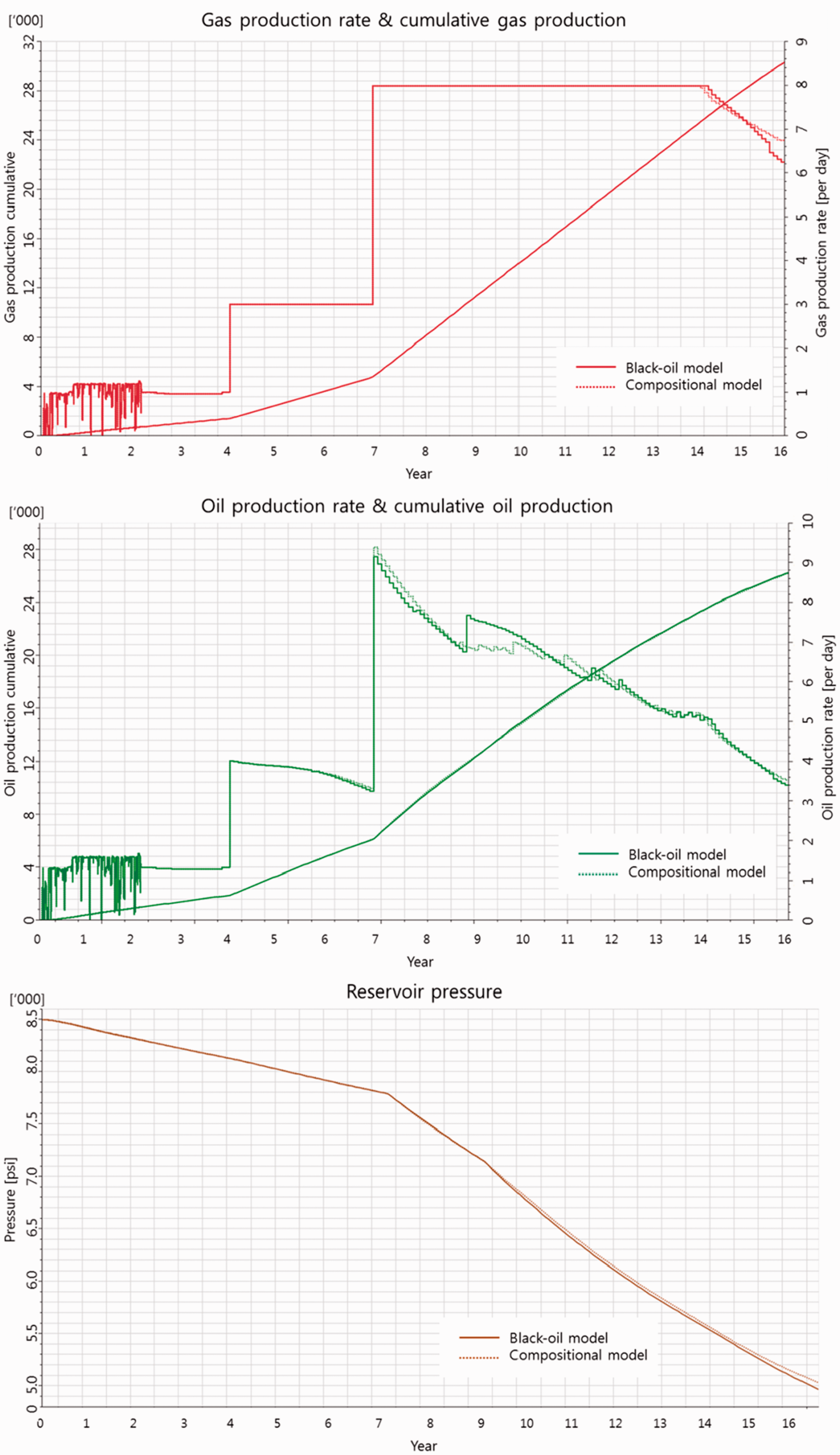
Gas recycling scheme selection with Monte-Carlo simulation
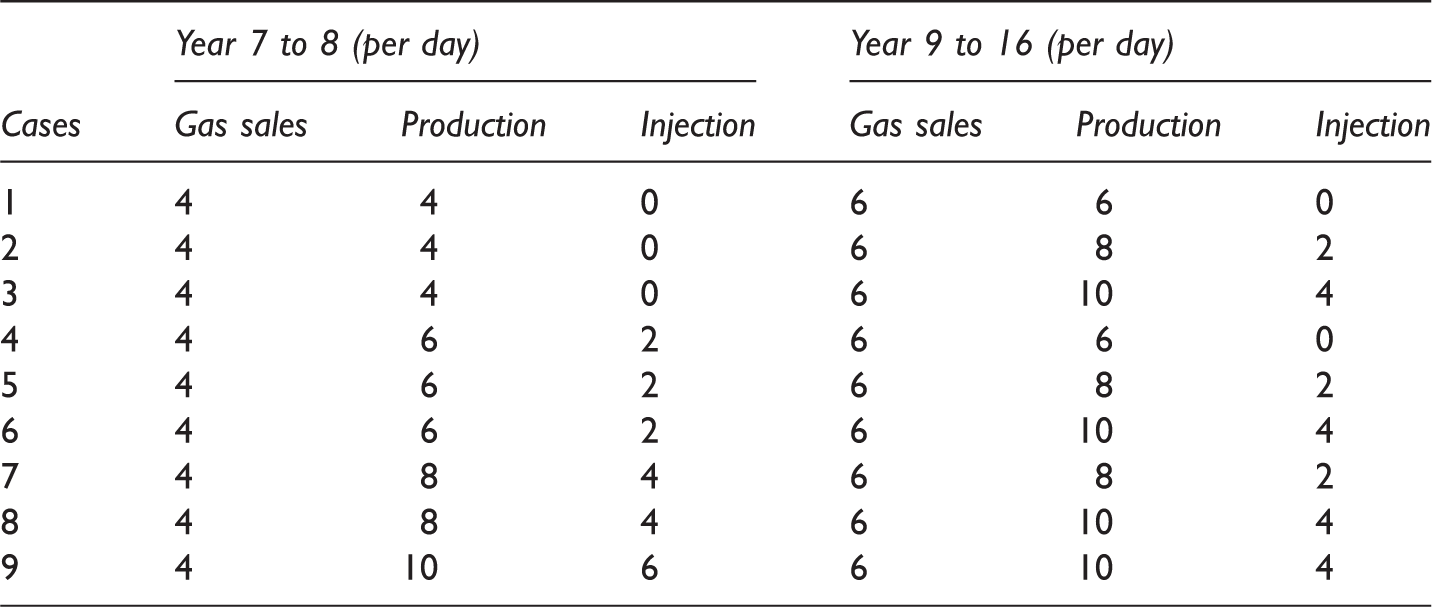
Gas recycling scheme cases (modified scale).
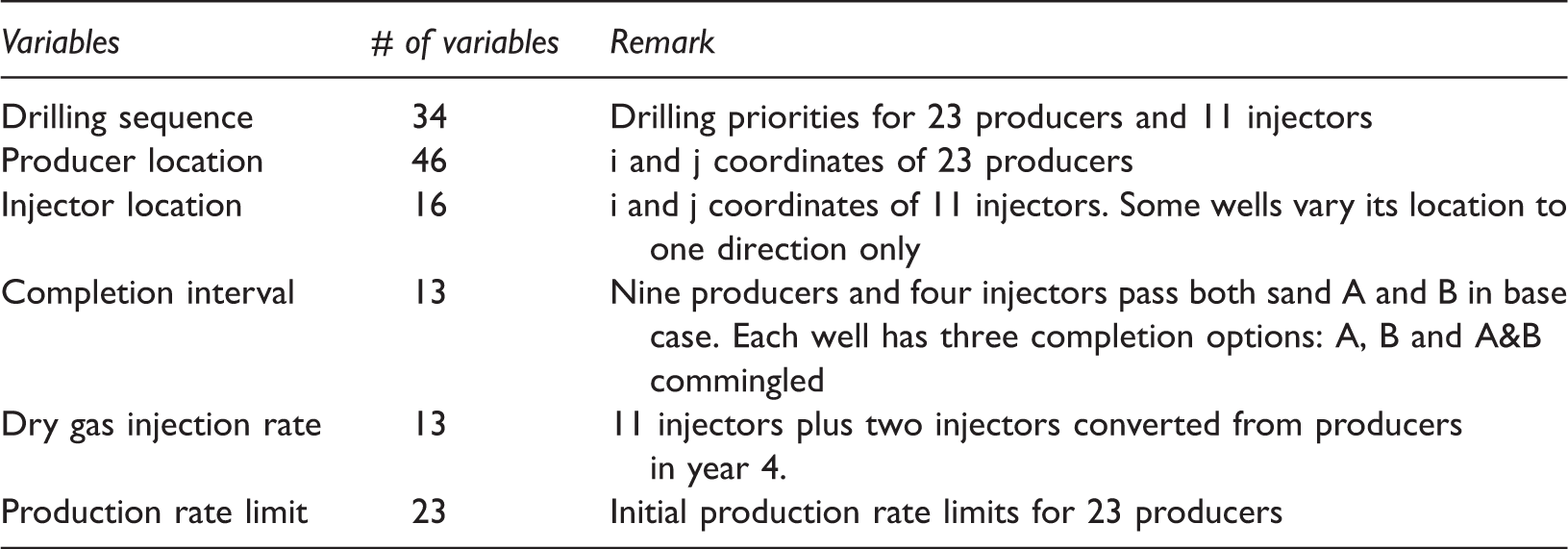
Design variables for full field development.
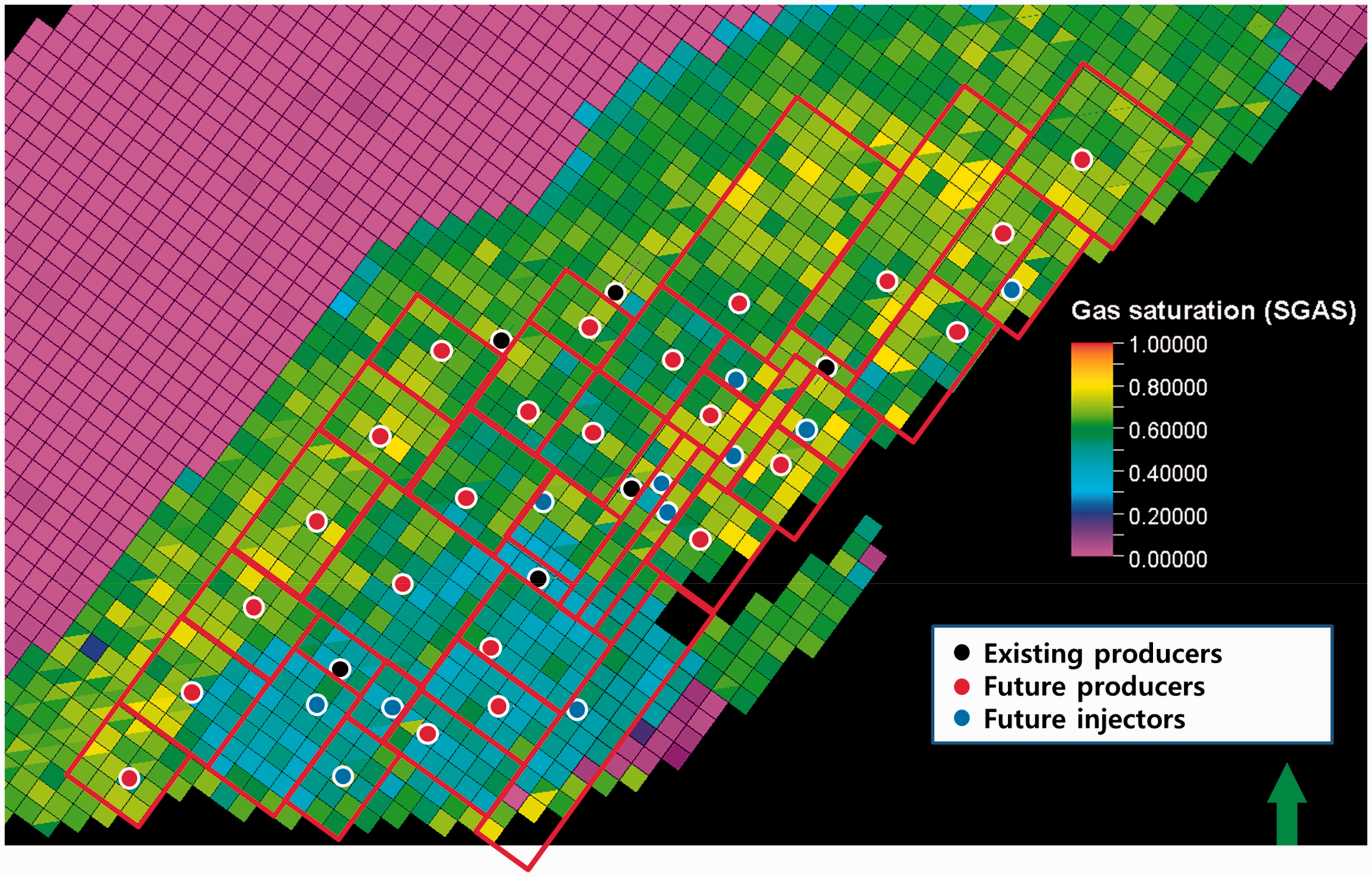
Possible locations of the wells.
In order to perform Monte-Carlo simulation, a hundred gas and oil price decks per a simulation case are generated following their PDFs. In this study, triangular distribution functions for gas and oil prices are defined as shown in Figure 10. Once a simulation result is obtained, economic model generates an NPV distribution with 100 NPVs calculated with generated 100 price decks. P90, P50 and P10 NPVs can be obtained from the NPV distribution. This step takes only a few seconds.
Gas and oil price distribution functions and generated price decks: (a) gas and (b) oil.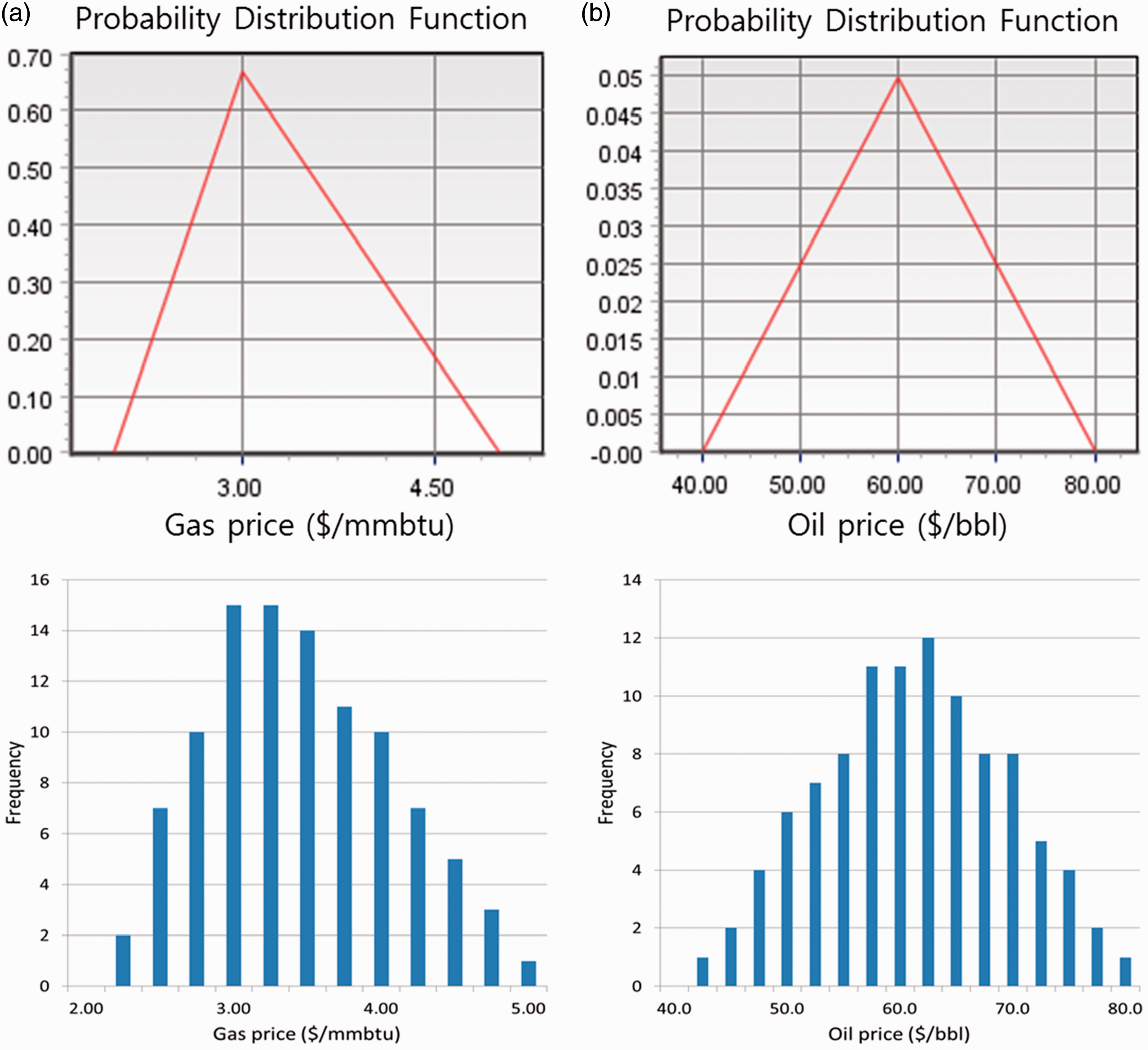
A hundred simulation cases per each gas recycling scheme are generated by changing design variables in Table 2 randomly following their distribution functions, and each simulation result is put into Monte-Carlo simulation. As a result, each gas recycling scheme has 100 NPV distributions. This is applied to all nine gas recycling schemes.
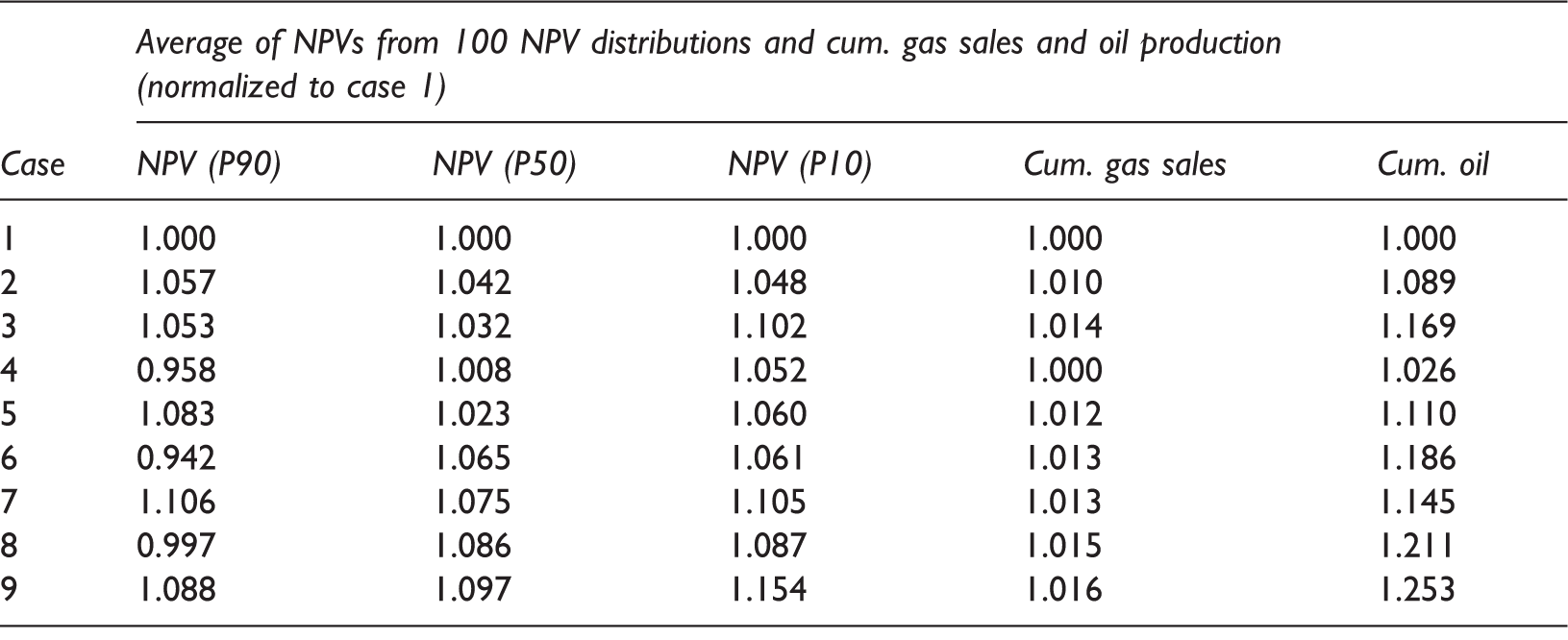
Figure 11 shows the results of 100 simulation cases per each gas recycling scheme, and Table 3 is the summary of the Monte-Carlo simulation results. The results are normalized to case #1, which does not recycle gas at all. Cumulative gas sales and oil production increase with increased gas production, but P90, P50 and P10 NPVs show different pattern due to development costs and commodity prices. In this study, case #7, which shows the highest P90 NPV, is selected for further optimization considering low oil price and volatile economic environment at that time.
Simulation results of 100 random runs per each gas recycling scheme case: (a) case #1, #2, #3, #4 and #5 and (b) case #6, #7, #8 and #9. Monte-Carlo simulation results for gas recycling scheme selection. NPV: net present value.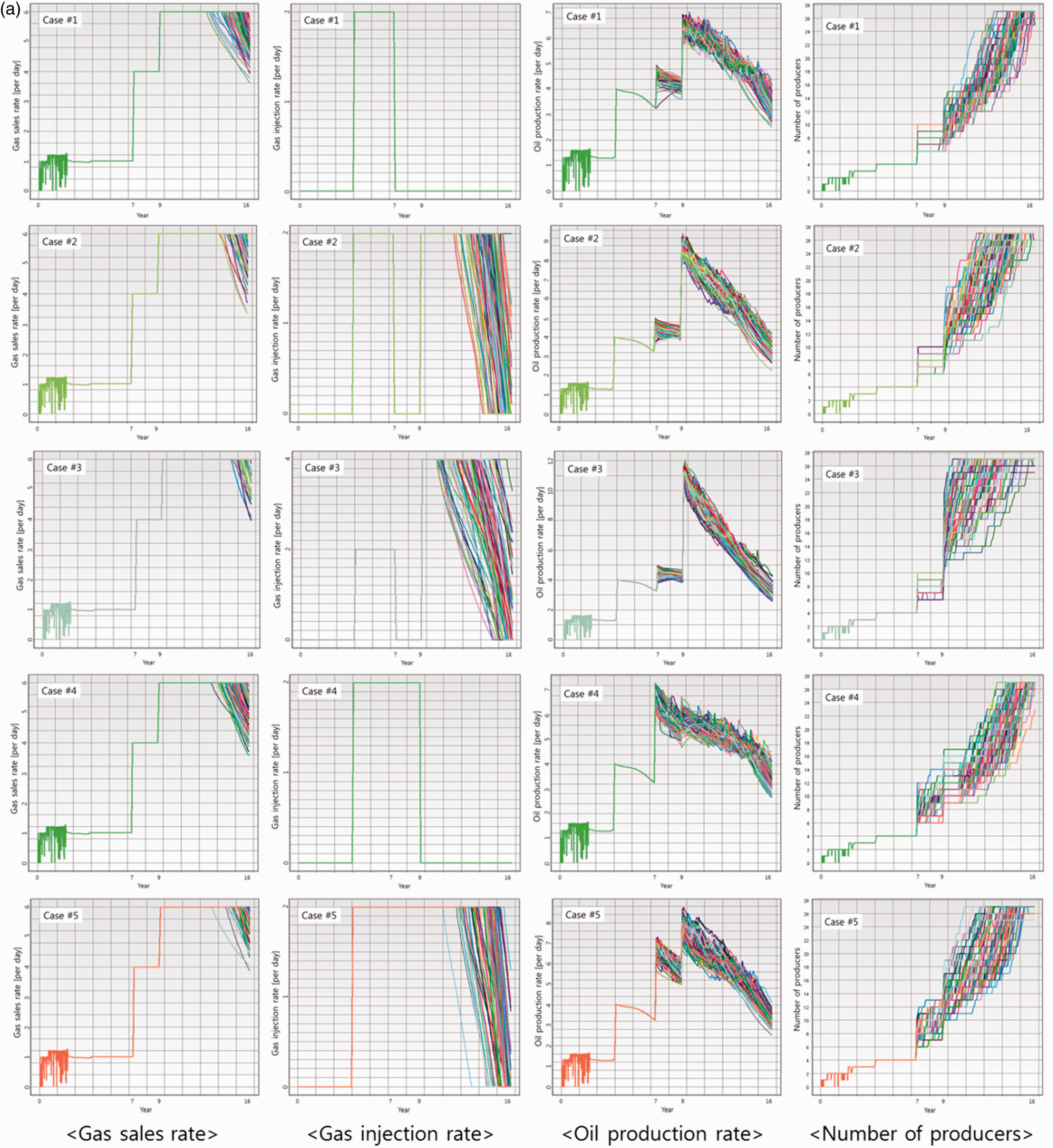
Full field development optimization
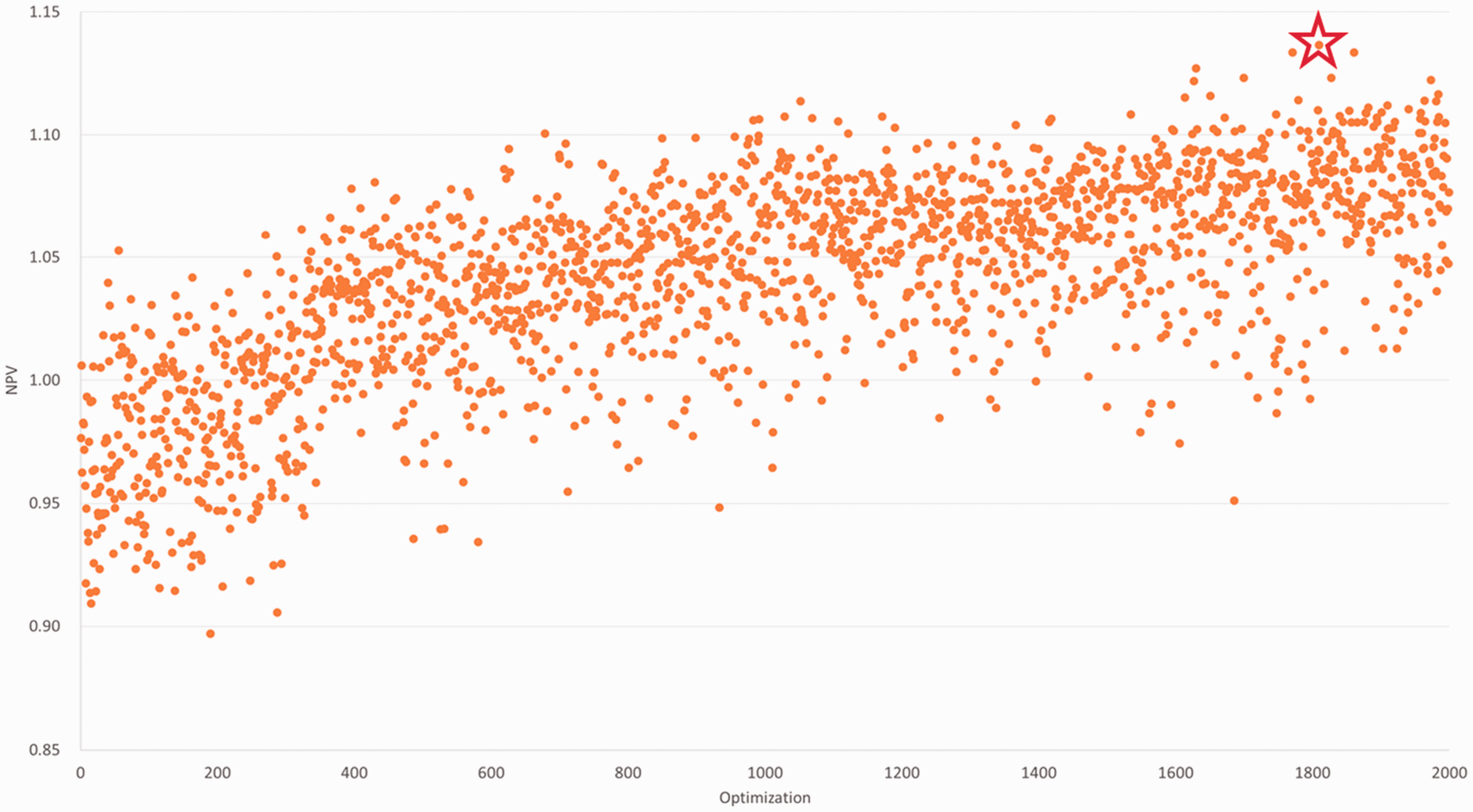
The objective of the GA-based optimization is to maximize the P50 NPV of case #7. Initially 50 simulation cases are randomly generated and simulated as an initial population, and the initial roulette wheel is generated with the objective function values of the population. With the selection from the roulette wheel along with cross-over and mutation, 20 offspring are generated as the first generation and simulated. Then, top 50 from all previous results are selected as individuals to create the roulette wheel for next generation. Each generation generates 20 offspring, and it is iterated until the total number of simulation run reaches to 2000. It takes approximately 5 hours to generate and simulate 20 offspring with four CPUs in parallel use.
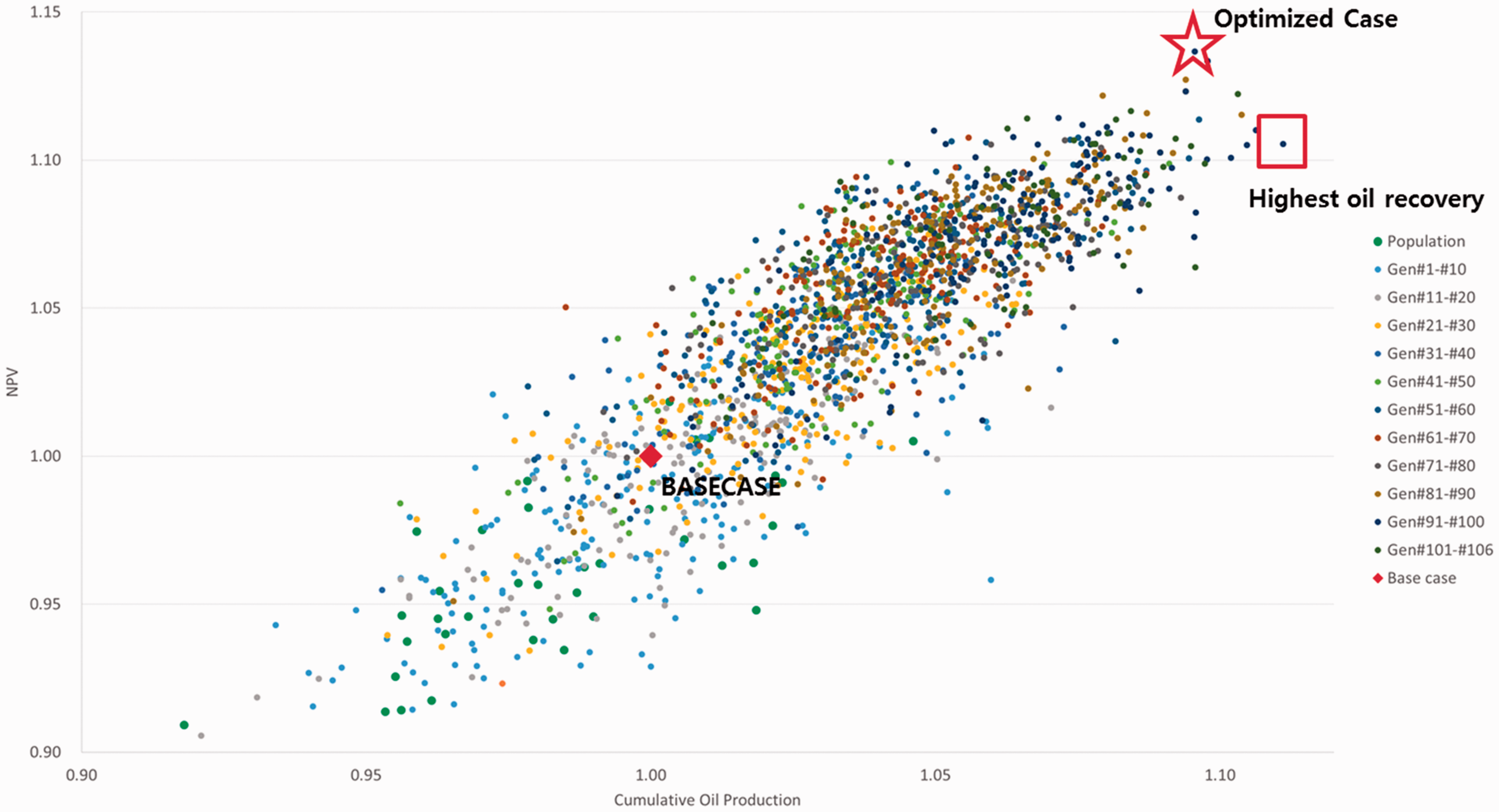
Figure 12 shows simulation results during the optimization process, and the result is plotted in Figures 13 and 14. Total 106 generations are generated, and the optimized case is obtained from 95th generation. The plotted values are normalized to the base case NPV. Showing the highest oil recovery design is not matched to the highest NPV design, it is well noted that the highest NPV is obtained not only by maximizing oil recovery but also by optimizing other development plan such as number of wells and drilling schedule. Comparing to the base case, 10% higher oil recovery and 14% higher NPV are achieved by the optimization.
Simulation results during the optimization process. Relative NPV versus simulation sequence for the optimization. Relative NPV versus relative hydrocarbon recovery for the base case.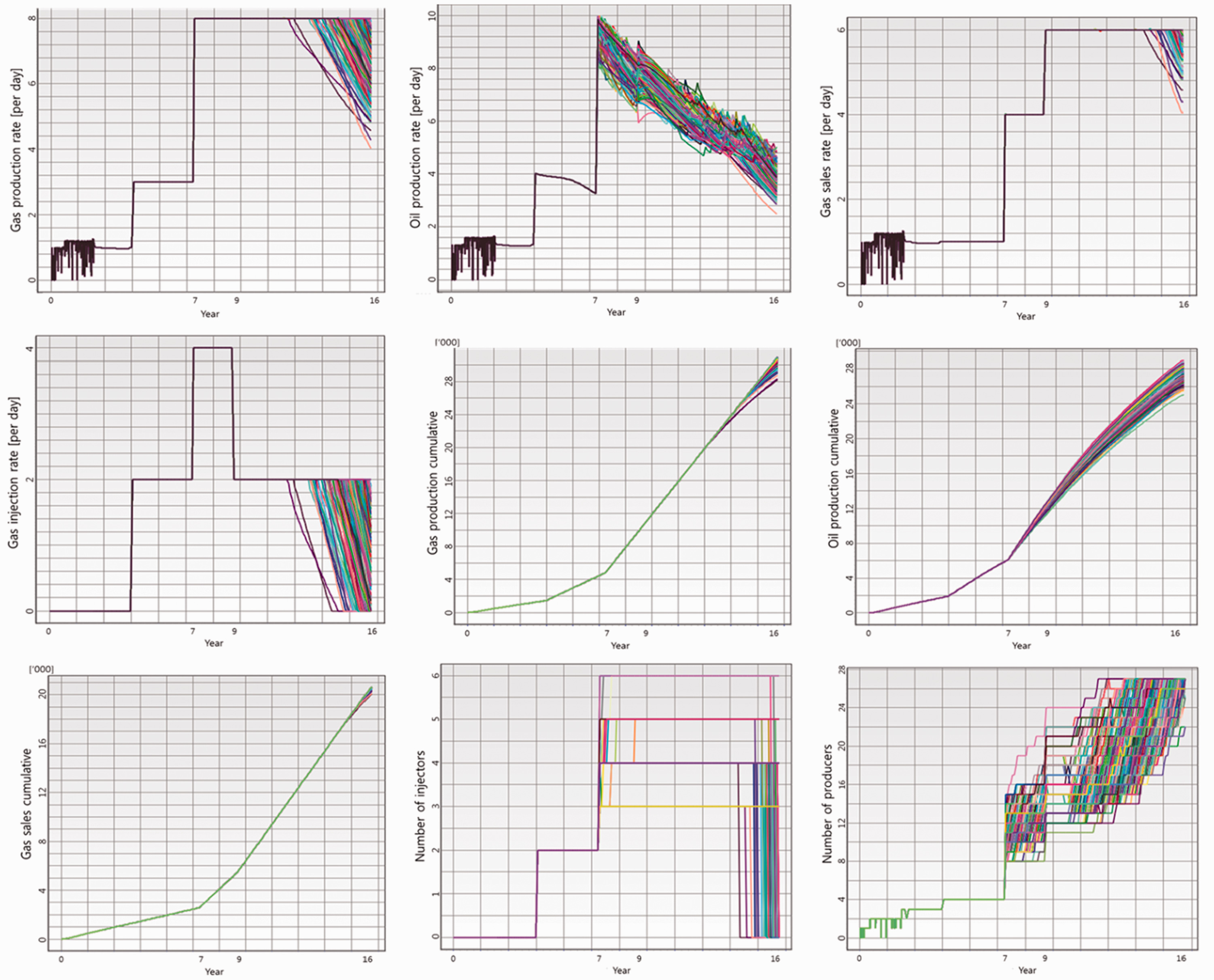
Comparison and verification
Simulation results of the base case and the optimized case (normalized to base case).
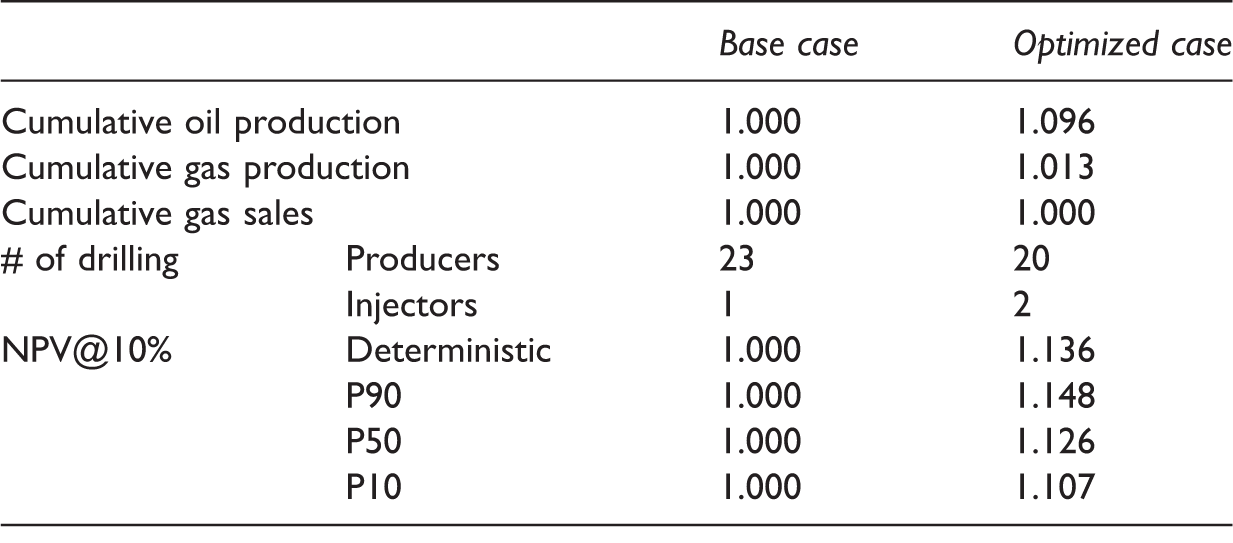
NPV: net present value.
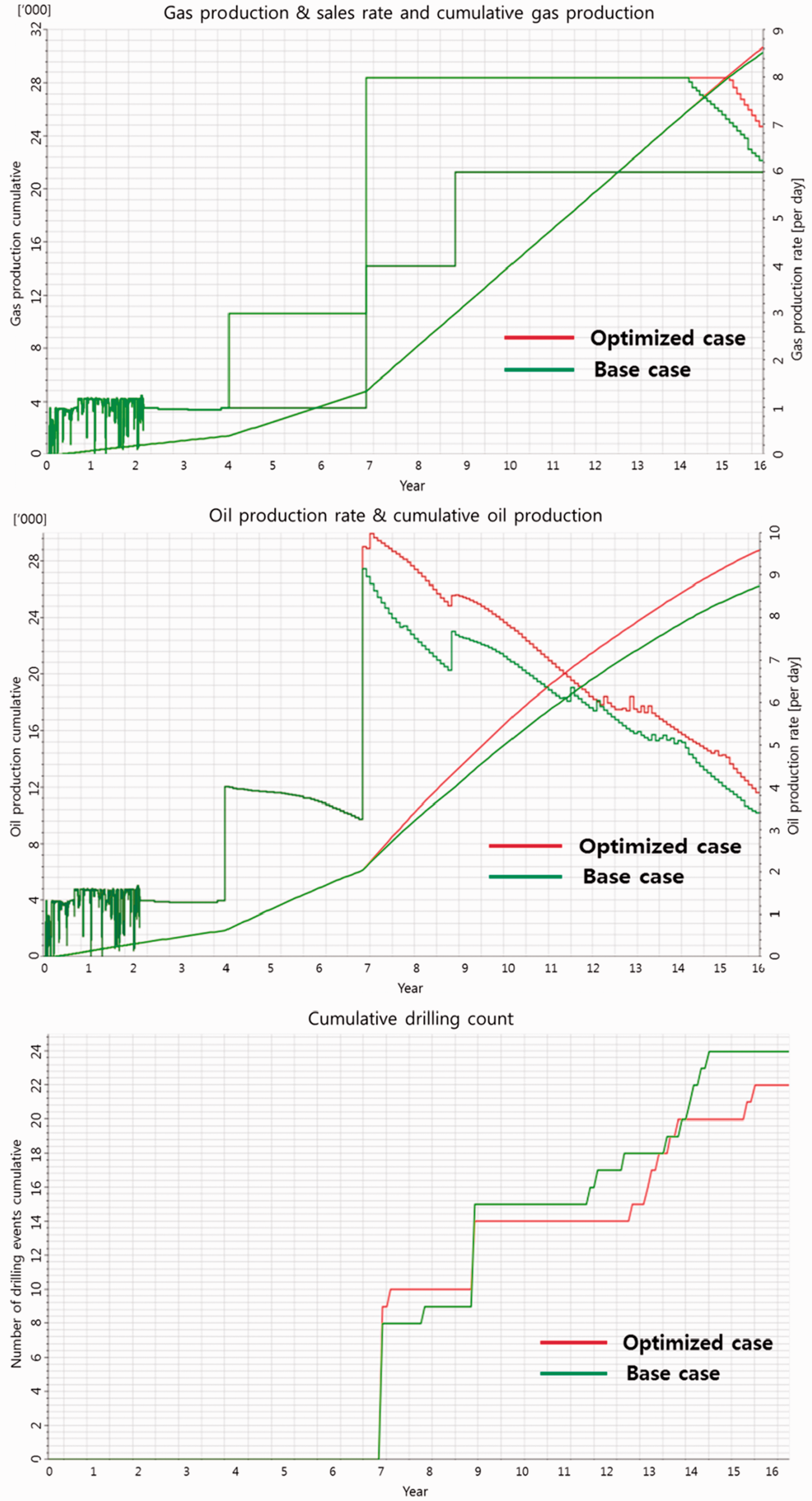
Comparison of the simulation results between the base case and the optimized case.
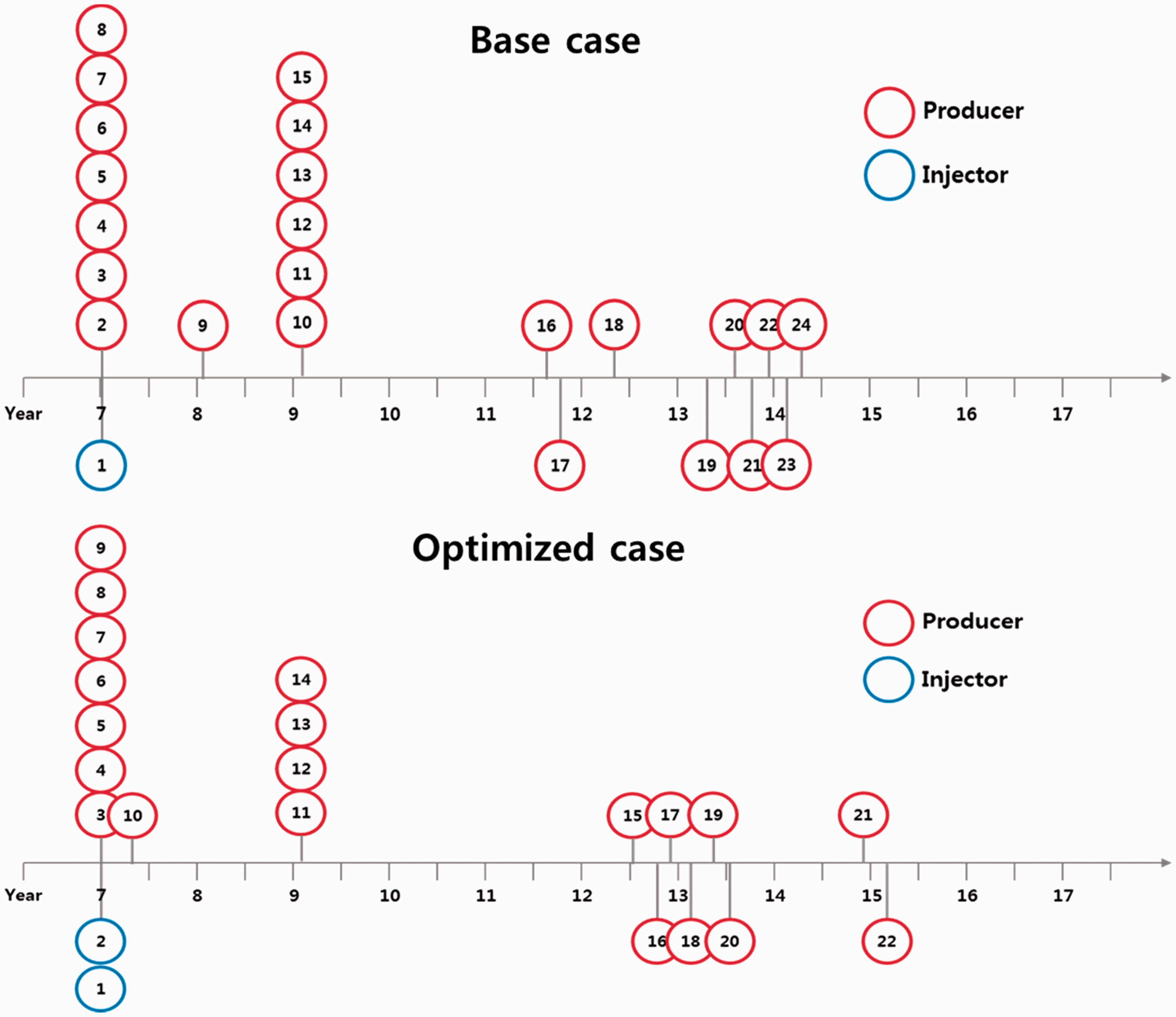
Figure 16 shows the well locations and drilling sequence, and Figure 17 shows drilling schedules of the base case and the optimized case. Well locations are different, and the optimized case has drilled one injector more and three producers less. The optimized case has drilled two more wells at the beginning, but it has longer drilling holidays and less wells in total.
Comparison of the well locations and drilling sequence between the base case and the optimized case. Comparison of the drilling schedule between the base case and the optimized case.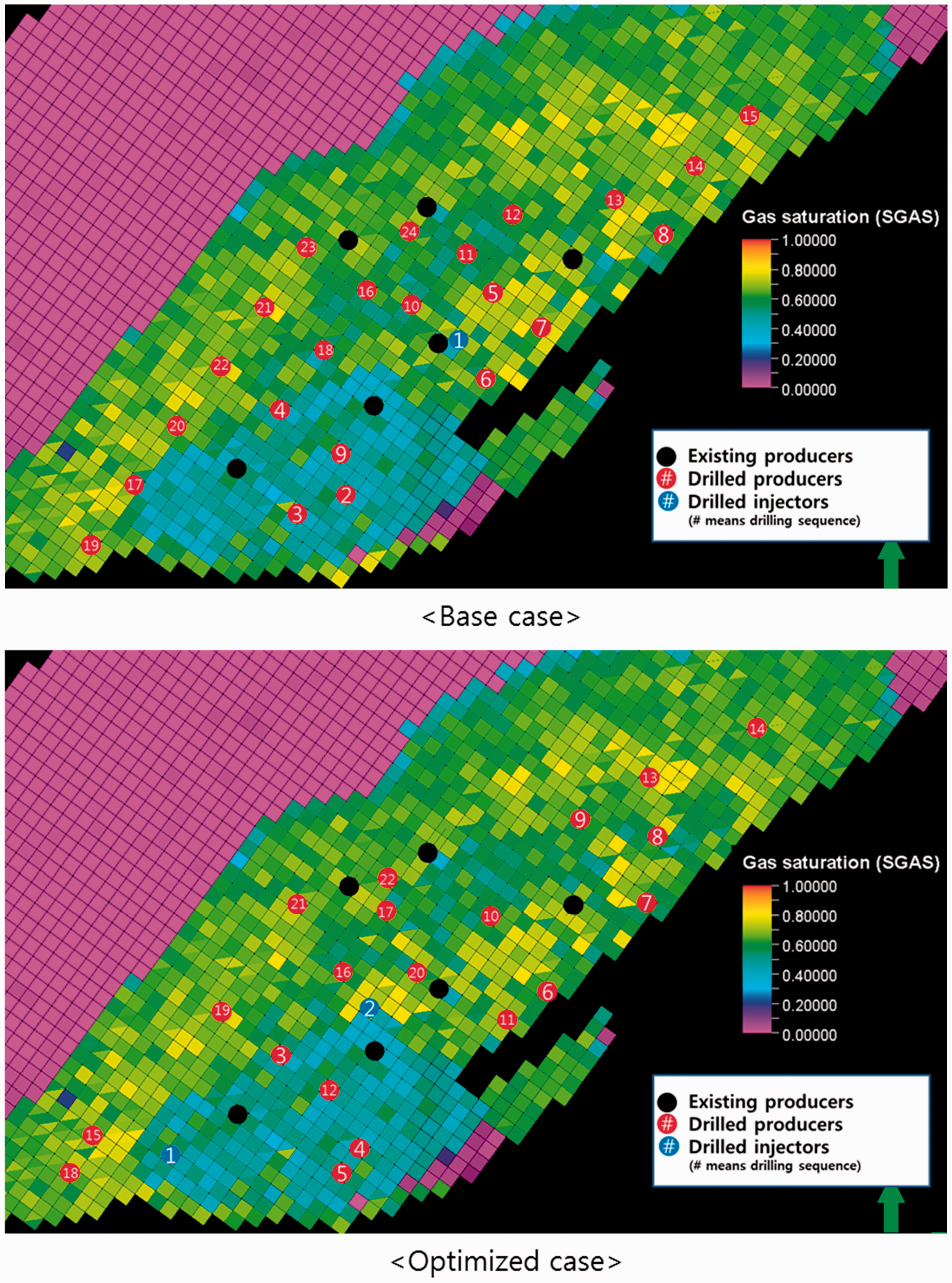
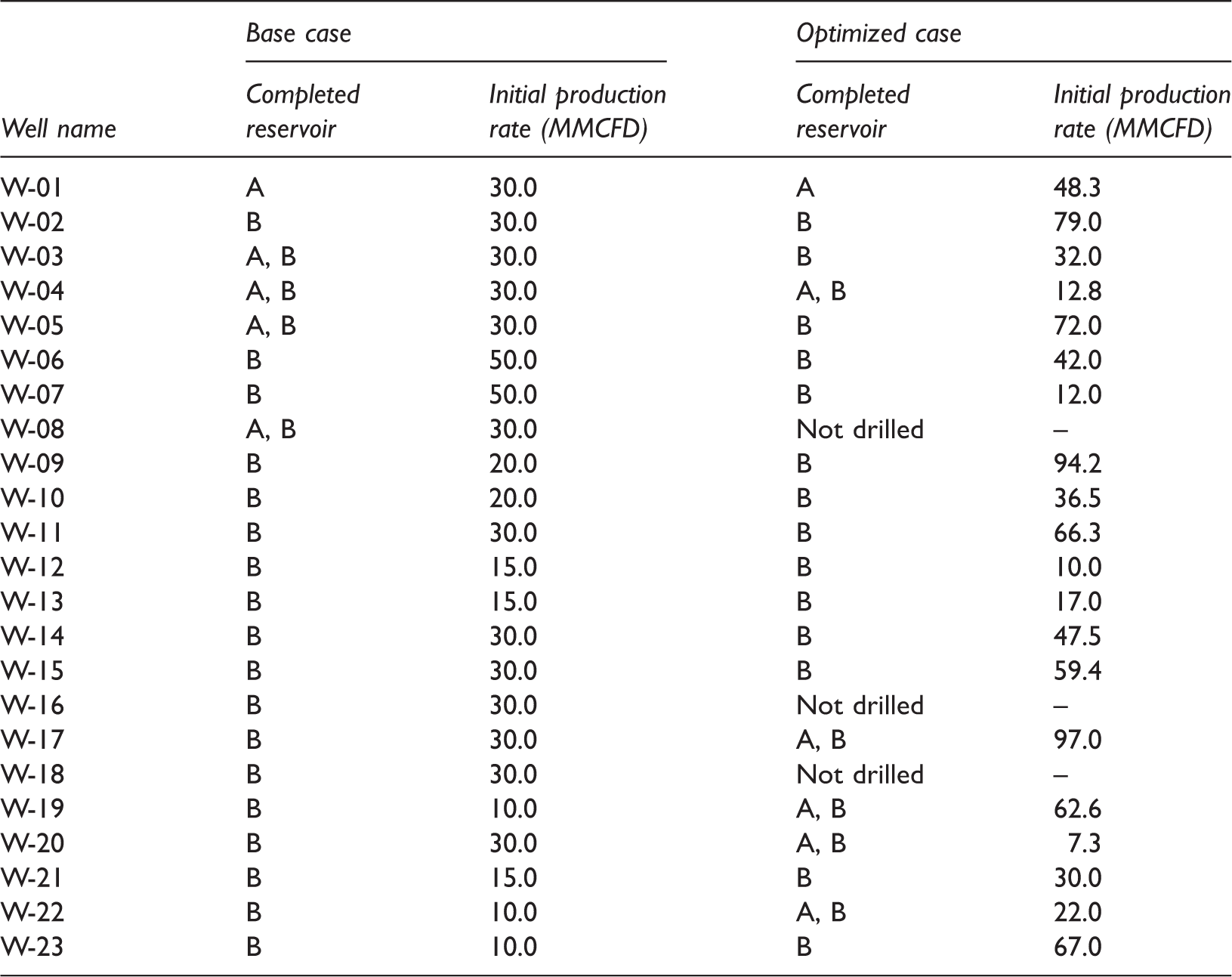
The optimized case has changed the settings for producers and injectors as well as well locations and drilling schedule. First, the optimized case has drilled one more injector. Figure 18 shows the locations of the injectors, injection rate, target reservoirs and oil–gas ratio by the end of simulation. The optimized case can achieve better drainage of oil by injecting dry gas to west side of the field. Second, the optimized case has different completion interval and production rate limit per each well. Table 5 summarizes the differences.
Locations and injection rates of the injectors for the base case and the optimized case. Completion intervals and production rate limit.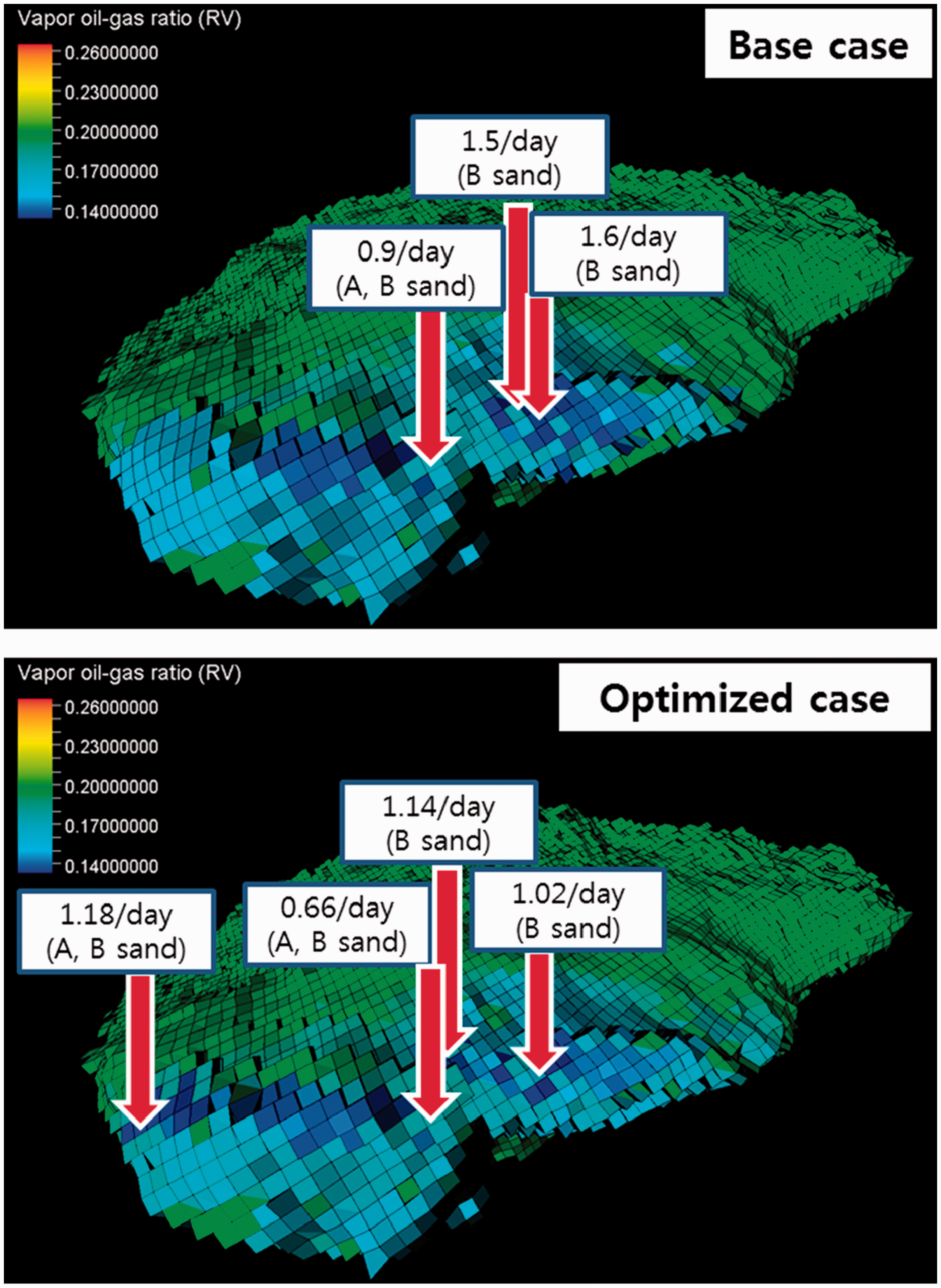
Verification
In order to see how the optimized case performs under geological uncertainties, the optimized case is simulated with additional 23 geological models, which are obtained during history matching. Figure 19 shows that the optimized case can achieve higher NPV and oil production than base case in all 23 geological models. The optimized case is also simulated with the compositional model. Figure 20 shows that there is little difference between black oil model and compositional model.
Simulation results run with 24 history-matched models for both the base case and the optimized case: (a) NPV and (b) cumulative oil production. Simulation results of the optimized case run by black-oil model and compositional model.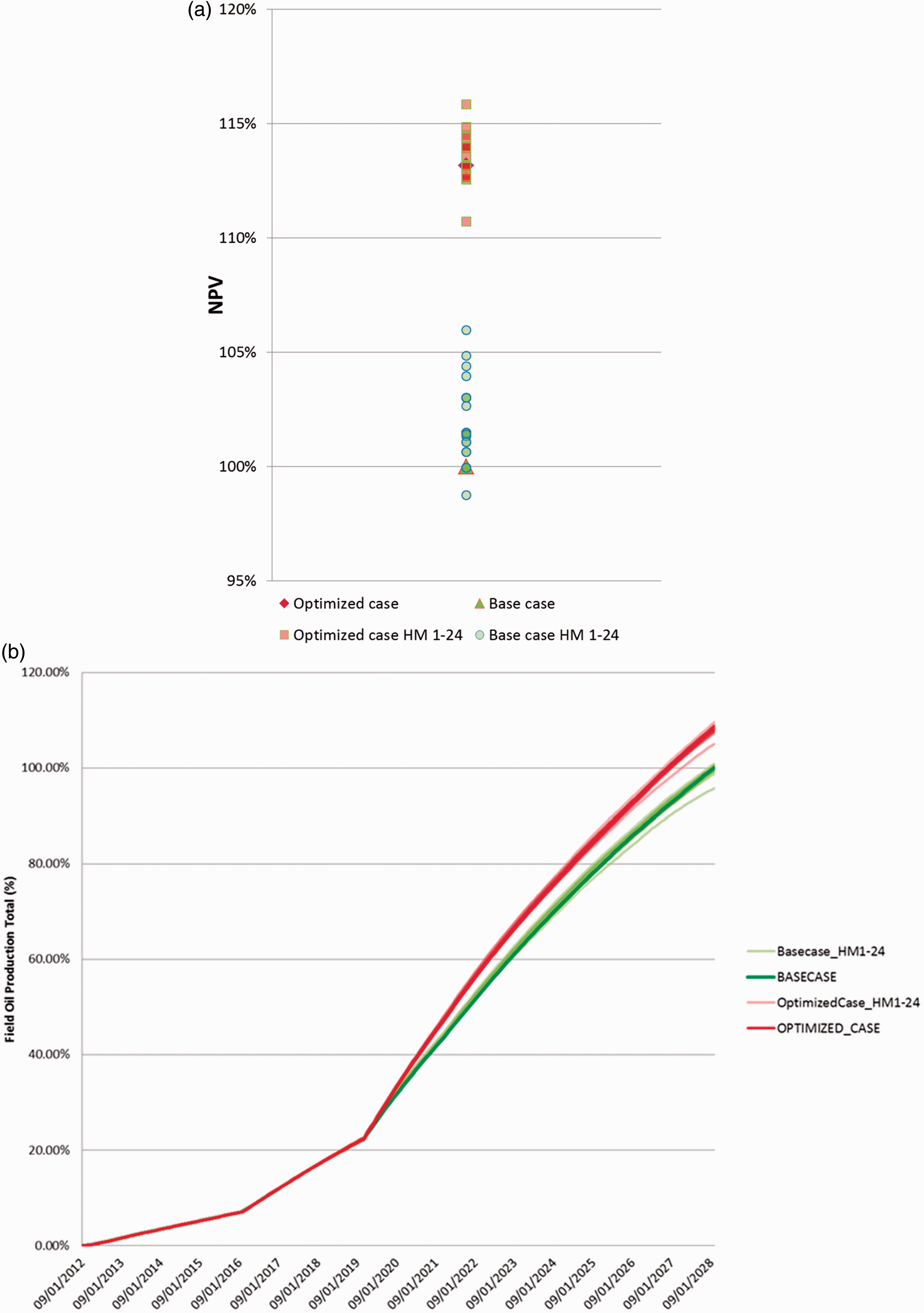
Conclusions
A useful and fast field development optimization methodology has been developed and successfully applied to a gas condensate field in offshore Vietnam. A previously reported general field development optimization methodology has been extended to a gas condensate field with constraints on gas sales plateau. Numbers of producers and injectors, locations of the wells, drilling schedule, production rates, injection rates and completion intervals have been optimized, and significant improvements in NPV, oil recovery, CAPEX reduction and sweep efficiency have been achieved compared with the base case whilst maintaining gas sales plateau. By assessing economic uncertainties in the process, it is able to make decision under volatile oil and gas price environment.
It is possible to accelerate the optimization process by applying black-oil simulation model and utilizing the well locations of the base case as initial seeds. The results show that well-developed and verified black-oil simulation model can be used for gas condensate field development optimization. Finding each well’s location inside the limited area from the original location defined in the base case can reduce the possible combination of well locations tremendously, and it helps to get to the optimized solution fast. Four CPU cores and one set of software license are used in this study, and only 2900 simulation runs are required; 900 runs to select gas recycling scheme from nine candidates, 2000 runs for finding out meaningful optimized solution.
The proposed technique, which implements Monte-Carlo simulation coupled with GA, can be a strong optimization tool to be used under volatile commodity price environment by avoiding duplication of the whole optimization procedure when economic assumptions are required to be changed. The idea for setting well placement variables limited to certain ranges from pre-defined well locations encourages engineers to conduct optimization with limited resources by reducing required number of simulation runs especially when it has many wells to be placed. Needless to say, the technique can be applied to optimize not only full field development plan but also reservoir management plan and it would be helpful to improve economics of all kinds of E&P projects under lots of uncertainties.
Footnotes
Declaration of conflicting interests
The author(s) declared no potential conflicts of interest with respect to the research, authorship, and/or publication of this article.
Funding
The author(s) received no financial support for the research, authorship, and/or publication of this article.