




Abstract
How have trade unions in Germany, Norway and Sweden been affected by pension and workplace reforms made necessary by demographic challenges? The study shows that in Norway, unions were involved in both processes through tripartite alliances, whereas in Germany and Sweden, unions were largely excluded from participation in the pension reform process, making them unsuccessful in their defensive strategies. However, in Germany tripartite network building supported social partners and works councils locally in work life reforms; in Sweden, such work is largely through bipartite negotiation. The difference between countries seems to reflect their respective history of corporative alliances.
Keywords
Introduction
Large parts of the world, including all OECD countries, face population ageing (OECD, 2018). In the European Commission’s Ageing Report (2018) it is forecast that the old-age dependency ratio (people aged 65 and above relative to those aged 15–64) in the EU will increase by 21.6 percentage points, from 29.6% in 2016 to 51.2% in 2070. This implies that the EU would go from having 3.3 working-age people for every person aged over 65 years to only two working-age persons. There is political agreement within the EU that this alarming increase in the demographic dependency ratio needs to be addressed: EU citizens are encouraged to work more years in order to help sustain the welfare systems. The European Commission declared (2005): ‘Member States should, in view of the projected costs of ageing populations, undertake a satisfactory pace of government debt reduction to strengthen public finances, reform pension and health care systems to ensure that they are financially viable while being socially adequate and accessible, and take measures to raise employment rates and labour supply.’ In the first decades of the millennium, pension reforms have been taking place across Europe (Carone et al., 2016; Halvorsen, 2022).
The goal of the European pension reforms has been to secure the financial stability of governments and pensions systems by delaying retirement of large groups of older workers, thereby stabilizing the dependency ratio. Germany, Norway and Sweden are examples of countries where pension reforms have been implemented successfully, following parliamentary decisions with overwhelming majorities. These reforms provide opportunities and economic incentives for those who can, and want to, continue working into higher age. However, in order to provide for larger groups to take advantage of these possibilities, work life reforms are also unavoidable; it is at the local workplace that retirement patterns need to be changed, by the introduction of technical and organizational measures (e.g. Ilmarinen, 2006). In particular, physical risks and social demands have direct implications for workers’ health and well-being (Eurofound, 2019). The European Commission (2005) recommended in its Integrated Guidelines ‘a lifecycle approach to work through . . . modern pension and healthcare systems, ensuring their adequacy, financial sustainability and responsiveness to changing needs, so as to support participation in employment and longer working lives, including appropriate incentives to work and discourage early retirement; support for working conditions conducive to active ageing’.
Trade unions are affected by the demographics and its implications in several ways, at the political as well as the organizational level. There is a significant social gradient in the statistics, showing that large groups of workers including many blue collars chose to take their pension early already before the age limits were pushed upwards (Buchholz et al., 2013); in some occupations, a majority exit from work before age 60 (Kadefors et al., 2018). Unions need to find ways to protect members at the workplace level by pushing for technical and organizational measures that help make them employable up to normal retirement age. As governments strive to implement pension reforms, unions tend to take a defensive stand: they oppose proposals where members risk being pushed into working longer until they become eligible for a full state pension (Ebbinghaus and Hofäcker, 2013).
However, trade unions are important players. In economies where social security is based on broad agreements between stakeholders, trade union opposition to pension reform can be expected to cause serious conflict, in particular if the ruling political party pushing the reform has close traditional ties to the trade unions. Schludi (2001: 19), in an analysis of the politics of pensions in European Bismarckian economies, noted: Unilateral pension reform without the support from either the opposition parties or the trade unions is an electorally risky strategy for the government and may endanger the durability and sustainability of its decisions in pension policy. Therefore, governments typically seek to organize consensus over pension reform either in the partisan or in the corporatist arena.
The demographic threat means, as emphasized by the EU, that national economies, and thereby the stability of the pension systems, are at stake. Unions may be fully aware of the financial necessity to delay work life exits, but if they consent to the proposals, they risk being looked upon as partly responsible for decisions that their membership oppose (Krause, 2012). They may find that their freedom of action is quite limited, depending on situational factors beyond their control (e.g. Flynn et al., 2013). Their action may be ‘path dependent’, which means that past events or decisions constrain later events or decisions (Muller-Camen et al., 2011); it may be defensive in character by focusing on protection of pension rights, or perhaps active, by engaging in public debate on the work life implications of the demographic change. Together with employers, alliances may or may not be formed so as to protect results of local bargaining; this may strengthen (or weaken) the position of unions.
The present study was undertaken to arrive at an understanding of the role of trade unions in current pension and work life reforms intended to address the demographic challenge, and thereby to shed light on their role as players in societal reform. Since Sweden, Norway and Germany share important labour market characteristics, it was considered fruitful to compare the process in these countries.
This study sets out to find answers to the following questions:
What role have the trade unions assumed in different countries in the pension reform processes, and in the work life reforms aiming at delaying exits from working life?
What impact have trade unions executed on the factual reforms?
Can the impact and influence of unions be related to tripartite or bipartite alliances, or to the unions’ own initiatives? Have relationships between political parties and unions helped?
As a point of departure, statistics showing the demographics of the three countries were gathered from EUROSTAT and UNCTAD sources. The process of pension reform since the turn of the millennium was documented by searching in reports of studies commissioned by the governments, in European Commission documents and in national analyses published by the Directorate for Employment, Labour and Social Affairs of the OECD. For assessment of the role of trade unions in the process, studies published by historians and social scientists in the English, German, Norwegian and Swedish languages were sought by applying sought terms: demographics, trade unions, pension reform (and corresponding keywords in the three languages). Similarly, sources providing information on the role of trade unions in age-related workplace reform were sought, applying the terms: social partners, trade unions, ageing workforce, workplace reform and industrial relations.
Reform processes in three countries
Germany, Norway and Sweden were selected in the present study for a comparison, since their economies and industrial relations have important characteristics in common. The trade union densities are above average in important sectors (OECD, 2023b). All three countries have a high work participation in the older population: the employment 1 rate of those aged 55–64 years is in Germany 74.7%, in Norway 73.5% and in Sweden 78.4%; the OECD average is a mere 63.9% (OECD, 2023a). In the three countries, pension reform processes have been under way in parallel in the 2000s.
Figure 1 shows historic and projected age dependency ratios, defined as the ratio of those of non-active age to those of active age in a given population, in the three countries. It is seen that whereas in Germany this demographic measure was lower than in Norway and Sweden at the turn of the century, prospects indicate a much more pronounced development towards higher dependency ratios in the coming decades. Norway and Sweden face similar developments, but more modest.
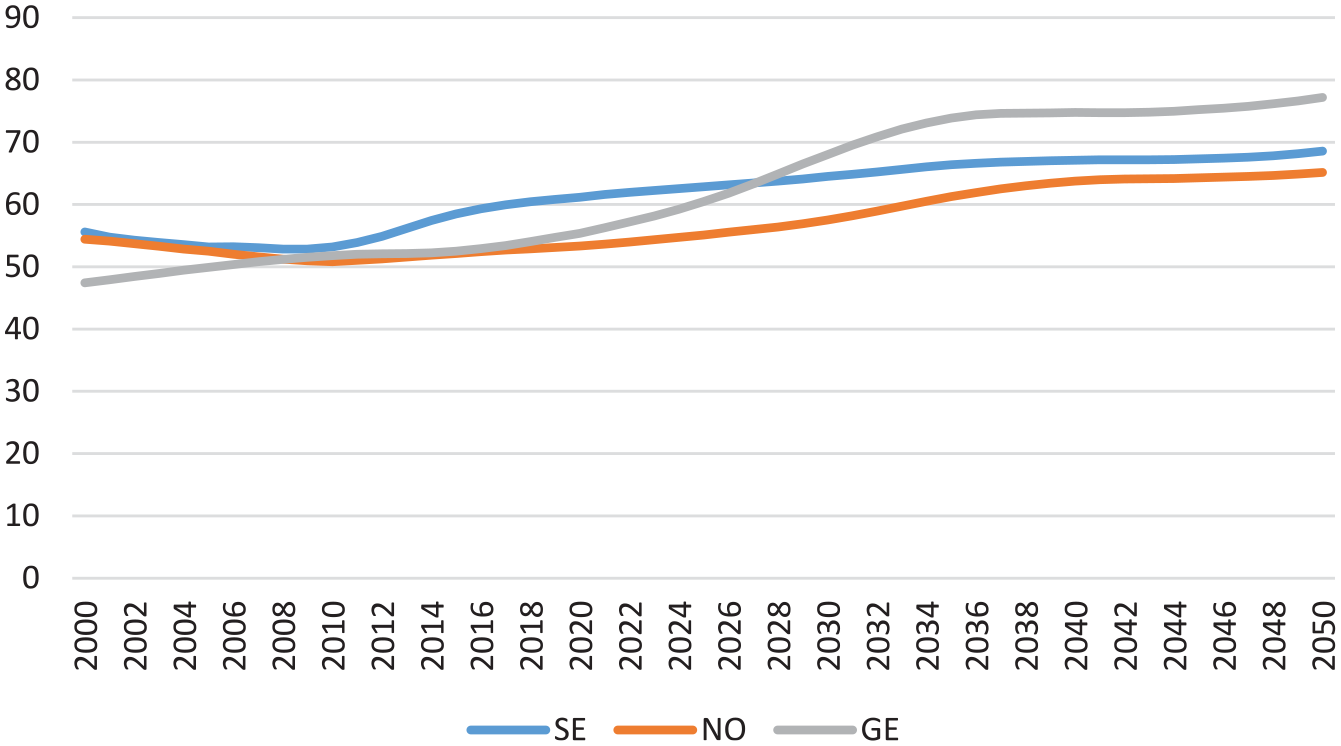
Historic and projected age dependency ratios (percentage) in Sweden, Norway and Germany.
Germany
Germany is one of the European countries where the demographic challenge was recognized at an early stage. In the 1990s, after a long period of early retirement policies, it became clear to policymakers that the financial stability of the pension system was under threat, and that a reform was unavoidable (Hofäcker and Naumann, 2015). At the turn of the millennium, steps were taken in order to increase the incentives for older people to prolong their working lives by penalizing early work life exits and closing early pension pathways (Buchholz et al., 2013). In order to instigate the growth of non-state pensions, in 2001 and 2003, the Social Democrat/Green government introduced incentives for employees to join subsidized and licensed occupational and privately funded schemes with tax incentives for lower income groups (Bridgen and Meyer, 2014). The Bundestag decided in 2007 to institute a pension reform establishing 67 years as a mandatory retirement age, to be reached in full by the year 2027. However, according to a proposal introduced by the Grand Coalition government in 2014, earlier retirement was made possible for those who had worked for 45 years (Rente mit 63). Then the ‘Flexible Pension Act’ (Flexirentengesetz) came into force in 2017: it included a statutory entitlement to participation benefits (prevention and rehabilitation) and promoted flexible transition from employment to retirement and extension of an individual’s working life (OECD, 2017).
Trade unions took a defensive stand with respect to the pension reforms initiated by the Social Democrat Chancellor Gerhard Schröder (SPD) in the late 1990s; they opposed for instance, the introduction of a privatization tier and any reduction of the level of benefits (Hering, 2004; Schludi, 2001). This opposition was in vain. In a meeting of the main public trade union ÖTV, Chancellor Schröder even declared with respect to the pension reform: ‘We will do it, Basta!’ (Frankfurter Allgemeine Zeitung, 2000). In the end, the unions consented, accepting the only slightly amended Old Age Provision Act (Altersvermögensergänzungsgesetz), passed by the Bundestag in 2001. Here, trade unions were provided with a mechanism allowing them to join in bargaining with respect to collectively negotiated pensions, but the level of public pensions was reduced from 70% to not below 64% of previous net wages (Bridgen and Meyer, 2014; Ebbinghaus, 2011). Developments showed that the reform of 2001, and those that followed in 2002/2003 and 2005, adhered to the austere political course outlined for European Social Democracy by Tony Blair and Gerhard Schröder in their ‘Agenda 2010’ (1999). This caused a crisis, ‘a low-water mark’ in the relations between the unions and the SPD; it has even been termed a document that could have been authored by the Federation of German Industries (Fricke, 2005), or Margaret Thatcher (Reichardt, 2019).
The pension reform (Altersgrenzenanpassungsgesetz) instituted by the Grand Coalition in 2007 was opposed vigorously by the trade unions, who considered the so-called Rente mit 67 a blow to the large number of older workers who for reasons of poor health could not sustain working longer. This worsened further the relationship between unions and the SPD (Dribbusch and Birke, 2019). Not until 2014, when Andrea Nahles, Minister of Labour and Social Affairs, managed to push Rente mit 63 through the Bundestag, did the unions have any substantial success in their defensive strategy. The German Confederation of Trade Unions (Deutscher Gewerkschaftsbund, DGB) welcomed this decision, saying that improvements to benefits paid by the statutory retirement scheme were long overdue. In fact, the DGB had been the only major stakeholder backing the SPD in the political process (RP Online, 2014). Employers judged the decision unwise: ‘Germans become older and have fewer children. The supply of skilled labour is waning. The only reasonable solution is that people work longer and are not sent into retirement, since many could continue working.’ And there were dissenting views to Rente mit 63 also within the DGB: a representative of the Chemical trade union IG Chemie declared: ‘Within the DGB, we are the only ones who advocate a longer work life of employees before retiring. . . . We must consider other solutions to be developed by employers and employees’ (Paprotny, 2016: 60).
The very limited influence that the German trade unions have executed in the pension reform process does not mean that they have lacked influence when it comes to how working life may respond to the demographic challenge – a problem of which they have been fully aware. The way that unions have addressed the issue has been by engaging in bipartite or tripartite alliances at the national as well as the regional and local levels. In 2002, the Federal Ministry of Labour and Social Affairs, together with the social partners, founded the initiative ‘New Quality at Work’ (Initiative Neue Qualität der Arbeit, INQA), with a stated aim to reform working life so as to address the demographic change: ‘The economic challenges of the future will have to be met engaging older personnel.’ In 2006, the INQA, with active support of the German United Services Trade Union ver.di, initiated the Demographie-Netzwerk ddn, ‘formed by employers for employers’. The ddn has more than 400 member organizations, organizing more than 2 million employees (Bundesministerium des Innern, 2017). The stated aim is to help employers transform the demographic change from a threat to a potential by addressing the challenges of the new working life. The member organizations commit themselves to adhere to a number of ‘golden rules’, including a non-discriminatory personnel policy, a balanced age structure, health surveillance and mentoring between generations. Strategic personnel planning is a key issue (Berendes, 2011). The ddn networks are regional organizations, supported financially by the Federal Ministry.
In 2002, the Federal Ministry of Labour and Social Affairs, under the umbrella of the demographic strategy ‘Every Age Counts’ (Jedes Alter Zählt), formed the working group ‘Working motivated, qualified and healthy’ (Motiviert, qualifiziert und gesund arbeiten). This group was headed by the Minister, with the chairpersons of the Central Federation of German Employers’ Associations (Bundesvereinigung der Deutschen Arbeitgeberverbände) and the German Confederation of Trade Unions (DGB) as co-chairs. With the aim to increase the employability of an ageing workforce, the state also made special subsidies available to companies hiring older workers and instituted training programmes targeting the older low skilled unemployed (Hess and Naegele, 2018).
The statutory regulation in Germany of works councils (Betriebsrat) means that the workplace representation of employees is regulated in detail by the state. One of the most prominent objectives of the legislation of works councils is to favour peaceful relations (Dribbusch and Birke, 2019). The works councils provide employees with a platform where they can articulate their concern with respect to the policies executed at the workplace, even though the representatives are not elected formally by the unions.
Works councils are entitled not only to information and consultation rights, but they also have substantial co-determination rights on social matters (Kohaut and Schnabel, 2024); this may facilitate addressing ageing policies at the local level. For instance, the metal workers union IG Metall noted (2012) that the BMW Dingolfing project ‘Today for Tomorrow’ had paved the way, showing how workplaces could be adapted to the work abilities of older employees. Further good examples of age management projects included workplaces at Bosch, Siemens, Mercedes and Hydro Aluminum. ‘Such good examples will be collected by IG Metall and used in negotiations where works councils can address the demographic issues. This makes possible for works councils and employers to adapt the work situation to the age and abilities of the workers, and to allow flexible exits from work life’ (IG Metall, 2012). All three major unions, IG Metall, ver.di and IG Chemie, have engaged in workplace projects making it possible for older workers to prolong their work lives. IG Metall published (2005) as part of their INQA engagement a workbook, Materialien zu einer alternsgerechten und lernförderlichen Arbeitspolitik, where it was stated that ‘the real challenge is to implement healthy ageing at work and to support employment and employability of older people’.
In January 2018, the Occupational Pensions Strengthening Act (Betriebsrentenstärkungsgesetz) came into force. This Act widens the range of occupational pensions provision on a voluntary basis, especially in medium-size enterprises and low income businesses. ‘The legislation has placed the design and introduction of contribution schemes into the hands of the parties to collective bargaining agreements and thus the trade unions’ (ILO, 2018). However, as the ageing of the population continues, and the economic sustainability of the pension system has become shaky, an expert commission aiming at prolongation of the working life was established by the government in 2018. The delivered recommendations, ‘Reliable Intergenerational Contract’ (Verlässlicher Generationenvertrag), were immediately challenged by the unions, who pointed out that ‘poor people live shorter’ (Richter and Werding, 2020).
Norway
In 2001, the Norwegian government noted that due to the demographic development, more people were leaving than entering the labour market. This was considered unsustainable; the Social Democratic Prime Minister Jens Stoltenberg also declared the old system ‘conditional, illogical, and unjust’ (Aabø, 2018). A Pensions Commission was appointed. In its final report (NOU, 2004), the Commission recommended that the pension scheme needed to strengthen the linkage between earned income and entitlements. Flexible retirement would be possible, starting at 62 years, and there would be unlimited possibilities to combine pension and income from work. People would be able to earn pension points up to age 70. This document formed the basis for a long period of consultations carried out under several governments, including Social Democratic as well as Christian Democratic/Conservatives. A final proposal was introduced in the parliament (Stortinget) and decided upon in 2011, again with Stoltenberg as Prime Minister.
Elements of the pension reform of 2011 in the Norwegian National Insurance Scheme included that the statutory retirement age of 67 years was abolished; old age pension could now be drawn starting between ages 62 and 75. Retirees could combine work and retirement without deduction of the pension, and pension rights could be generated up to age 75, even after take-up of the pension. The pension rights would be based on all earned income throughout the entire working life, whereas in the previous system, the 20 best years had provided the basis for the benefits.
The trade unions were deeply involved in the reform process. During the 10 years of consultation, the government – irrespective of political colour – negotiated options with the social partners: when the final bill was introduced in the parliament in 2011, it was accepted without political dissent and with support from the main social partners, employers and unions alike.
Two initiatives helped build this consensus. Firstly, in 2001, the central social partner organizations, the Confederation of Norwegian Enterprises (Næringslivets Hovedorganisasjon, NHO) and the Norwegian Confederation of Trade Unions (Landsorganisasjonen, LO) agreed on and signed together with the government the tripartite ‘IW Agreement on a More Inclusive Workplace’, where employers and employees committed themselves to implement a set of measures, including active employment after age 50. Signing the agreement was voluntary, but a few years later, a majority of Norwegian employees worked in organizations that were signatories (OECD, 2005). Evaluating the IW Agreement, Ose et al. (2009) found that the stated national goal to delay the actual retirement age by six months was achieved in 2009. It has been concluded that the IW Agreement is important for the Norwegian labour market and has led to higher employment among older workers (Halvorsen, 2019). An evaluation committee with representation of ministries and social partners is following up on the results currently. The agreement of 2019–2022 was expanded by covering not only the local signatories, but comprises the entire labour market. In return, the government declared that it ‘will not propose changes in the sick leave benefit scheme during the term of the agreement, neither for employees nor for employers, unless the parties agree’ (Norwegian Government, 2019).
Also in 2001, the Ministry of Labour and Social Affairs, NHO and LO were among stakeholders establishing the Centre for Senior Policy (CSP), 2 a resource dedicated to the stimulation and development of policies concerning older workers in the workplace. By promoting research, through awareness campaigns and by forging links with the social partners and politicians, the Centre encourages a broad range of activities that aim to reverse the growing trend towards early retirement (Aabø, 2018). The OECD (2013), referring to a peer review carried out by the EU Mutual Learning Programme in 2012, concluded that ‘all stakeholders in Norway consider that the CSP has played a significant role in raising awareness and working with social partners at the local and enterprise level to support a lifecycle approach to managing work ability’. The CSP is funded by the Ministry of Labour and Social Affairs and has a board chaired by alternating social partners and where a set of central working life organizations are represented.
During the ‘consultation period’ between 2004 (the Pensions Commission report) and 2011 (the pension reform), much attention was paid to reformation of the Contractual Early Retirement Pension (avtalefestet pension, AFP), opting for early work life exits. This agreement had for a long time been considered obsolete; the Thorbjörn Jagland government (Social Democrat) had started already in 1997 a process of negotiation with the social partners. This led to a revised agreement where the AFP was extended from 62 to 67 years to become lifelong; on the other hand, it would pay to work more years. A selling argument was that ‘no one would come out worse than in the current system’ (Aabø, 2018). The scheme was accepted and implemented by the social partners in the private sector in 2008, whereas the public sector, due to trade union resistance, did not join until 2018; it has been referred to as ‘Stoltenberg’s unfinished’ (Aabø, 2018). The public sector unions, while accepting cost reduction measures, advocated that the guaranteed level of 66% of the final wage at the point of retirement should remain untouched. This meant that in the period 2008–2018, two different and incompatible pension schemes existed in parallel; the system granted private sector employees choices and a flexibility that was not extended to the public sector (Hagelund and Skevik Grødem, 2019). In 2015, the Erna Solberg government (Conservative) raised the upper age limit for general protection against unfair termination of employment from 70 to 72 years in the private sector; the corresponding upper age limit for protection against unfair termination of employment in companies with equivalent group pension schemes was raised from 67 to 70 years.
The Solberg government appointed in 2018 an expert committee that was given the task to analyse the labour market development and to make recommendations aiming at an increase of work participation generally. The expert group recommendations (NOU, 2019:7) included lowering again the upper age limit for protection against unfair termination of employment for all from 72 to 70 years, while it should be made easier to work beyond the age limit, with adjusted pay and working conditions; an aim was to please both employers and trade unions. However, these recommendations were not acted upon. Instead, a public commission was given (2020) the task of evaluating if the goals set in the 2011 reform were possible to achieve, and to identify measures to be taken to secure the economic and social sustainability of the pension system. The Commission proposed (NOU, 2022:7) that all age limits in the pension and social security system in the future should be raised gradually in accordance with the general life expectancy. The trade unions, pensioners’ and senior organizations have given some but conditional support to the proposals, provided that a socially acceptable solution is found for people with a long working life in tiring jobs (‘toilers’). The government has announced that it will follow up the proposals to increase the age limits and cooperate with the social partners to find an acceptable way forward. In 2024, an overwhelming majority in Stortinget decided for a way forward, aiming at strengthening the social and economic sustainability of the pension system. The age limits would be pushed upwards, and every age group would be expected to work 1–2 months longer than the previous one. The social partners are being asked to find ways to reduce the number of ‘toilers’ who cannot sustain working up to normal pension age by instituting work life reforms (NAV, 2024).
Sweden
In the 1990s, the main Swedish political parties instituted a parliamentarian committee, the so-called Pensions Group, which took on the task to reform the pension system. This group was instrumental in the major pension reform of 1999 and has played a central role ever since in the political decision-making process with respect to further developments of the system. The 1999 reform aimed at entailing an economically sustainable system in an ageing society, while improving fairness and transparency; it has inspired other EU countries in their pension reforms (Aspegren et al., 2019; Halvorsen, 2019), but has also been criticized for having transferred all responsibility from state level to the individual level (Nyqvist, 2016; Scherman, 2003). This reform, which included changes in early retirement and disability pensions, was pushed through by the Göran Persson government (Social Democrat) and the Pensions Group, despite opposition by unions.
In 2011, the Swedish government under the conservative Prime Minister Fredrik Reinfeldt launched a study (the Pension Age Commission of Inquiry) aiming at changing the age limits of the current pension system. It was noted in the study directives that the number of people older than 65 years relative to those aged 20–64 would increase from 32 to 42% over the next 20 years. ‘This means that those working need to support more non-workers, but also impaired possibilities for growth, resulting in lower pensions. . . . In order to manage the upcoming demographic challenge . . . without impaired public welfare, there is a need to prolong working lives.’ These governmental narratives were aiming at the general public, emphasizing the financial necessities of reform.
In its final report, the Commission put forward a set of proposals (Swedish Pension Age Commission of Inquiry, 2013). The 61-year age limit for the earliest age when people were entitled to take old-age pension would be raised to 63 years, and the 65-year age limit for the guaranteed pension, sickness compensation and other benefits to 66 years. The age limit referred to in the Employment Protection Act would be raised from 67 to 69. The 55-year age limit for occupational and private pensions would be raised to 62 years. The Commission proposed further the introduction of a recommended retirement age, the ‘target age’ (riktålder), which would follow the development of the average life expectancy. The age limits of the public pension system and related systems would be linked to the target age. A number of measures aiming at workplace reform were proposed as well, including efforts to improve the work environment, combat age discrimination, upgrade skills and change contracted occupational pensions. Here the Commission, aware of the limitations of political influence in the Swedish model for the labour market, appealed to the social partners to comply. It was proposed that tripartite talks would be initiated, aiming at ‘systematic examination’ of contracted occupational pensions. The Commission also noted the need for more flexible working hours, even though ‘working time issues are, however, normally determined in collective agreements in the labour market’. In Sweden, occupational pensions have become increasingly important, as four broad agreements cover nearly 90% of Swedish wage earners (blue collar private sector workers, white collar private sector workers, state employees and municipal employees). The occupational pension plans are negotiated between the social partners.
The social partners tended to be unresponsive to the governmental arguments, and developed narratives of their own (Arman et al., 2022). Even though they were sympathetic to the general cause of increasing the number of worked hours in the economy, they were sceptical of most of the changes proposed by the Commission, with respect to age-related retirement frameworks – albeit on different grounds: employers asked for more flexibility, unions for more security. The Swedish Trade Union Confederation (Landsorganisationen i Sverige, LO) declared in their formal response to the Commission recommendations (2013): A prolonged working life can be achieved by earlier entries in the labour market, by delayed exits, or higher work participation during the working life. Focusing only exits from working life is not sufficient. What is needed is good work environment, secure employment, access to full-time jobs and life-long learning irrespective of age. This is an area of concern largely neglected by the Commission.
With respect to the proposal to start tripartite talks to change the age limits of occupational pensions, the social partners joined forces in their critique. Here, they did not address the subject matter as much as the mere intention of the government to enter an area where the social partners considered themselves sovereign. The Confederation of Swedish Enterprises (Svenskt Näringsliv, SN) declared in their official response in 2013: ‘We wish to emphasize strongly that the autonomy of the social partners must not be curtailed. The Swedish model has since long had a reputation as an adequate method to settle conditions in the labour market, and it is vital that the respect for the work of the social partners be maintained.’ 3 Likewise, the public Swedish Association of Local Authorities and Regions (Sveriges Kommuner och Regioner, SKL) stated that ‘any changes of benefits arrived at through collective bargaining will be up to the social partners to negotiate’. And the LO: ‘The different benefits in the pension agreements result from collective bargaining based on the wishes of employees, who have waived part of their salaries to this effect. Questions concerning occupational pensions should also in the future be settled in agreements between the social partners.’ The white collar union Swedish Confederation of Professional Employees (Tjänstemännens Centralorganisation, TCO) declared: ‘The Commission doesn’t take into consideration the impact of an autonomous system of social partners having high legitimacy in the Swedish labour market. . . . The Commission has chosen to present proposals that curtail the autonomy and the legitimacy of the system of the social partners, does not respect current collective agreements and to some extent even disadvantages collective insurance agreements compared to individual ones.’ Taken together, these responses represented a strong institutional narrative on behalf of the social partners.
The governmental recommendations were largely retained in the final Pensions Group proposal (December 2017), containing in part even more ambitious measures than those suggested by the Commission. For instance, the 61-year age limit for the earliest age at which people are entitled to draw their old-age pension was even to be raised to 64 years, instead of the proposed 63 years. Here the unions had been unable to influence the governmental policies. However, the original proposal concerning changes in the age limits of occupational pensions was withdrawn and softened to include only the ‘establishment of a council for organized and consecutive consultation with the social partners’. This was in response to the negative reactions to the proposal by the social partners. It marked the only significant influence that unions had in the whole of the reform process – and this happened by joining forces with employers, through a bipartite alliance. And indeed, bipartite negotiations between the social partners concerning occupational pensions have followed, making some new developments possible. For instance, in 2023, the Swedish Agency for Government Employers and the white collar trade union SRAT made an agreement ‘which will work better when we are expected to work longer before we retire. . . . You will be able to keep your currently defined benefit pension, but can earn pension points until the age of 69. This is a difference from today, when the accrual ends at the age of 65’ (Fackförbundet SRAT, 2024).
Following the recommendations made by the Commission and the Pensions Group, the Stefan Löfven government (Social Democrat/Green) established in 2018 a Delegation for Senior Labour ‘for the promotion of older labour to combat age discrimination and find ways to make better use of older people’s experience and skills’. The tasks included further, to ‘bring together various relevant actors in society (such as researchers, opinion-makers, pensioner organisations, the social partners and relevant government agencies) to discuss these issues, provide inspiration and propose measures’. The Delegation had the character of an expert committee and lacked representation of the social partners.
4
It published about 20 studies on different aspects of ageing, work and retirement, mostly authored by university-based researchers drawn from different disciplines. One of its central recommendations was to institute a resource in Sweden with similar characteristics as the Norwegian Centre for Senior Policy (Delegation for Senior Labour, 2020). This proposal received support from the social partners but has not been acted upon by the government. The white collar union Akavia noted recently (Nilsson, 2025): We are living longer and longer in Sweden and politics has clearly signalled that we should therefore work longer – from 2026, the target age will be 67 years, and the intention is that it will be adjusted in line with average life expectancy by one year every seven years. But the labour market does not live up to this ambition. On the contrary.
Measures proposed by Akavia in this debate article included creating incentives for employers to combat age discrimination, and appointment of a permanent Delegation for Senior Labor, given the task ‘to produce, collect and disseminate knowledge about how older people’s skills can be better utilised’ – much like the responsibilities assigned to the Centre for Senior Policy by the Norwegian government.
Discussion
A common denominator in the reforms of the pension systems in the three countries is the aim to make older employees continue working more years before retiring, and to provide strong economic incentives to encourage them to do so. However, for large groups of older workers, such incentives are not sufficient to motivate them to work into higher age. Many who continue working up to or even beyond normal retirement age do so not for economic reasons, but because they like working, wish to contribute, or simply enjoy the social environment at work (e.g. Feldman 1994; Schultz and Wang, 2011; Wisse et al., 2018). Another important group are those who choose early retirement because they value other aspects of life than work and can afford to do so. Other groups, particularly among blue collars, are unable to continue working even if they would like to, due to poor health or lack of updated skills (e.g. Cedefop, 2010; de Boer et al., 2004; Ilmarinen, 2006). This is where pension reforms tend to be ineffective; they rather risk widening the socioeconomic divide among retirees, leaving large groups behind (Bonin, 2009; Ebbinghaus and Hofäcker, 2013; Kadefors et al., 2018). Union narratives in the three countries at hand have highlighted this potentially negative aspect, pointing at the necessity of work life reforms in order to make possible for workers to remain healthy and employable as they approach retirement age – already before any pension reform takes place. This, unions claim, is the best way to address the need to increase the number of worked hours in the economies. There is considerable scientific support backing this argument; see, for instance, the scientific review by Chen and Gardiner (2019). However, it needs to be taken into account that such measures usually are introduced only when the employer finds that there is a business case (Taylor, 2006; Wallin and Hussi, 2011); this happens in particular when the management discovers that that it has become difficult to recruit competent workers to replace older employees as they retire (Arman et al., 2022). Unions and employers share concerns and may introduce measures affecting not only workplace conditions for older workers on an individual basis, but also building work environments that make sustainable work possible for all employees. The capability of an organization to implement such ambitious age management measures depends on its combined preferences and resources (Kadefors et al., 2020); union support in such processes is indispensable. There are many examples in Germany of such projects; they exist also in Norway, but to much less of an extent in Sweden. Undoubtedly, these differences can be attributed at least partly to the fact that shortage of competence was foreseen much earlier on in Germany, and that consensus building was initiated by the government at an early stage. The IW Agreement in Norway has served a similar cause. But in Sweden, where the government has left to the social partners to address the demographic problems by local bipartite negotiation, little has happened in terms of preventive age management interventions; the only project that has been well researched and reported on is Vattenfall AB (Mykletun and Furunes, 2011).
Trade union influence in the pension reforms
The collective agreements are an important source of norms for the regulation of wages and employment conditions in the three countries covered in the present study. The coverage of collective agreements is still comparatively high – approximately 56% in Germany, 73% in Norway and 90% in Sweden (OECD, 2023b). However, the way that trade unions have been engaged in pension reform, and the influence they have been able to execute, differs considerably between the countries. Trade unions have traditionally taken a defensive stand in the reform processes, since their memberships have largely been in favour of early retirement (Ebbinghaus, 2011; Flynn et al., 2013). In the current processes, path dependence has been influencing the position taken by unions to proposals that may result in mandatory delayed retirement for large groups of their membership. This reflects not only the way that governments have chosen to carry out the process, but also how unions have decided to engage themselves. The roles assumed seem to reflect strong institutional norms. For instance, the governmental approach in Norway was already at onset to invite the social partners to tripartite discussions on the needs and ways to achieve a pension reform. This reflects an established way to carry out social reforms in Norway (Halvorsen, 2019: 36): The tripartite collaboration between the government and the social partners on wage settlements and other working conditions is fundamental and works well. It helps ensure that wage growth is well-adjusted to economic developments and that jobs are not compromised.
The reluctance of the Norwegian government to legislate in matters of concern to social partners without their consent was particularly evident in the reform of occupational pensions, where the private sector accepted a tripartite agreement in 2008, whereas in the public sector this was not reached until 2018, due to trade union resistance. In Germany and Sweden, the pension reforms were pushed through in the parliaments with overwhelming majorities, under at least partial dissent of trade unions. In Sweden, tripartite negotiations are rare because the social partners do not welcome the government or any other party intervening in collective bargaining. The idea of self-regulation through collective bargaining by the social partners is strong (Hyman, 2007; ILO, 2009). The strong metanarrative developed by the social partners concerning the perceived autonomy in settling what they considered internal affairs, with respect to occupational pensions, prevailed; the government abided accordingly and withdrew the criticized proposal, and the matter remained only as a subject warranting discussion in the tripartite talks envisaged. This bipartite reasoning has a long history: it dates to the ‘Saltsjöbaden Agreement’ of 1938, when the government for reasons of national economy wished to achieve control over wage setting in the labour market (Koch, 2016). Under the threat of lawmaking, the Swedish Employers’ Confederation (SAF) 5 and the Swedish Federation of Trade Unions (LO) agreed to develop a way of work where problems were addressed by negotiation rather than conflict. This agreement gave an impetus to the development of the Swedish welfare state; for instance, the trade unions accepted rationalizations that were necessary for securing the competitiveness of Swedish industry. Wage negotiations for the entire labour market were carried out by a few representatives of the social partners. However, in the years to come, the system was gradually diluted: the government introduced laws on employees’ board representation, occupational safety, employment protection, the position of union representatives in the workplace, co-determination, working environment, and on equality of men and women in working life (Kjellberg, 2017). Nevertheless, the social partners retain according to the self-organizing model the right to organize and conclude collective agreements without the interference of the state; despite the changes in the actual content of collective agreements, the rules and principles established during the 20th century have been remarkably stable (Malmberg, 2002).
This way of power sharing, which is not unique for Sweden, has been referred to as ‘negotiated solidarism’ (Swenson, 2004). In political exchange with the government, the unions waive their mobilization capability as ‘veto players’ in order to achieve their own policy goals, such as protection for their members and benefits for their own organizations (Ebbinghaus, 2011). Immediate policy interests are translated into long-term policy interests and into the pursuit of power interests in the form of institutional participation of trade unions in political decisions. It is not clear whether the alliances do facilitate social policy reform: most recent pension reforms were not negotiated within tripartite processes (Hassel, 2009; Siegel, 2004).
During the time period of retirement reforms that is covered in the present study, parties of different political identity have been in power in all three countries, but the pension reform processes have moved forward steadily, irrespective of governmental shifts. Social Democrats have been in power for long periods of time: in Germany 1998–2005, and 2021 to the present; in Norway 1990–1997, 2000–2001, 2005–2013, and 2021 to the present; and in Sweden 1994–2006 and 2014–2022. In Germany, Social Democrats have participated in ‘gross coalitions’ together with conservatives; here they have always held the office of Minister of Labour and Social Security, thereby carrying major responsibility for the pension reform and its social consequences. It might therefore be expected that trade unions, which traditionally have had close ties to Social Democracy in all three countries, would have had ample opportunities to influence the outcomes of the pension reform processes. However, there are only a few examples where unions have executed such power on their own: the rejection of the occupational pensions proposal by the public sector unions in Norway in 2008, and the introduction of Rente mit 63 in Germany in 2018, with support by the trade union DGB, are almost the only examples. Since pension reform is of profound societal significance, it is logical that close cooperation between political parties has developed, making formal links between the Social Democrats and unions lose some of their potency. This is not to deny that informal talks and negotiations may have taken place off the record; as Ebbinghaus (2011: 323) observes, ‘in Nordic countries, not formal bodies but consultation procedures (hearings and commissions) are common in the policymaking process, providing ample opportunities for organized interests to influence policies’. Also, Jakee and Stacy (2021), analysing the Swedish pension reform process, emphasize the importance of informal rules in Swedish political decision making.
Trade union influence in workplace reform
The three countries pursue active and inclusive labour market and work environment policies, supported by laws and regulations that are developed through tripartite collaboration between the authorities, unions and employer organizations. ‘The situation for seniors in the labour market in the Nordic countries must be considered in light of the universal schemes as well as the more targeted programmes’ (Halvorsen, 2019: 9). The tripartite approach to pension reform taken in Norway encapsulated not only the legal frameworks, but also policies aiming at developing practices in work life that would facilitate delayed retirement. The Norwegian government, alarmed by galloping sick leave statistics in large sectors of the labour market, contemplated in 2001 the introduction of preventive economic measures affecting employers as well as employees. It was under this perceived threat that the social partners agreed to sign the IW Agreement, on the condition that the government would abstain from introduction of proposals aiming at changes in the sick leave conditions unless the social partners would agree (FriFagbevegelse, 2018). The collaboration has been rooted in four-year, mutually binding collaboration agreements centrally and at the workplace level since 2001. The main objective has been to create an inclusive working life by preventing and limiting sickness absence and attrition from employment, thereby helping increase overall employment. The agreements have included a goal to prolong occupational activity after the age of 50 years (Halvorsen, 2019). However, the OECD noted (2014) that the extensive tripartite cooperation in Norway, serving as a good basis for dialogue to reach consensus and pragmatic solutions, can make it difficult to take more complex decisions: The IW Agreement ‘could be reoriented toward making the targets more binding and changing the senior policies from a “one-size-fits-all” model towards stronger promotion and acceptance of a more individualised approach, to handle more effectively the large variation among older workers’.
In Germany, there has been widespread societal awareness that the demographic challenge needs to be addressed at the workplace level. This common narrative has made possible tripartite initiatives where social partners have joined forces to develop and share technical and organizational solutions; such networking has been initiated and supported financially by the government. Whereas trade union influence in the pension reform process was almost nil, bipartite work together with employers at the branch and local workplace level is widespread. This means that many German employers recognize the business case of implementing age management in the organization by prioritizing and financing such measures (Kadefors et al., 2020). Such widespread awareness has been largely absent in Sweden even though concerns have been voiced in the public sector with respect to difficulties to fill vacancies as old employees retire. The Swedish government and the Pensions Group focused entirely on the pension age frameworks, but refrained from opening a dialogue with social partners on issues such as preservation of health and employability of the older workforce. This is in contrast to the German and the Norwegian approaches. In Sweden, a long tradition has developed where work life issues are addressed through bipartite negotiations between employers and local unions. This institutionalized system, which (together with negotiated labour law) has helped make Sweden one of the countries with the best work environments, lowest rates of sick leave and occupational accidents in Europe (e.g. Eurofound 2017), may however produce a lock-in with respect to addressing the demographic challenge. The Swedish unions seem to prefer forming bipartite alliances even though this may limit their possibility to achieve work life reform in the process. ‘It may help preventing further “erosion of economic bargaining power” but impair the ability to assess opportunities for intervention; to anticipate, rather than merely react to, changing circumstances; to frame coherent policies; and to implement these effectively’ (Hyman, 2007: 198).
Pension system revision provides a good test for assessment of the role of unions in societal reform (Bridgen and Meyer, 2014): it encapsulates all citizens, including all union members; it concerns private, corporate and societal economy; it affects the work life in every workplace. Schludi (2001) claimed that governments engaging in pension reform had a real choice between forming alliances with opposition parties or joining force with unions. In the present study, we have found that in Norway, unions have been engaged though tripartite alliance (together with employers), whereas in Germany and Sweden, unions have been largely left aside in the reform process. So, forming a bipartite alliance with unions seems today not to present a viable choice for governments.
The role of corporativism
The three countries differ with respect to their relation to corporativism. Schiller (2023), in a major review of working lives, capital and politics in the Nordic countries, notes that in Norway after the Second World War, the long-term cooperation established in the 1930s was resumed; central agreements were supplemented with a workplace structure of cooperation and negotiation. The return to the tripartite agreement was formalized in the 1992 Solidarity Initiative, a social pact between the government and the major stakeholders in labour and capital, and has prevailed ever since.
In Sweden, once identified as perhaps the clearest representative of social corporativism, organizations and a parliamentary state have developed in a relatively free relationship (Schiller, 2023). But in the 1990s, the employers’ organization decided to withdraw from corporativist cooperation in governmental committees and commissions, and no longer participate in any coordinated negotiations. The unions followed suit reluctantly. This state of affairs has been effective to date, irrespective of the colour of government.
Germany, in contrast, has a pre-war history of national liberalism; in the Weimar Republic, corporative structures were limited (e.g. Burke, 2005). Weßels (2002) declares that in an international comparison, Germany should not be considered a typical corporatist country: In terms of organisational structure, it is not one of the highly centralized countries such as Austria, Norway or Sweden, and does not rely heavily on concertation of economic interests in terms of organizational structure. Nevertheless, there have always been corporatist political patterns in Germany that stand in continuity with the historically relatively strong negotiating democratic structures. In doing so, Germany is moving in a corridor of the ‘policy of the middle way’.
Political efforts in the post-war era to bring work and capital together and revive German corporativism have been in vain, most notably in the 1990s, when the Schröder government failed to win over business and trade unions for a ‘Bündnis für Arbeit’. Ebbinghaus (2023) notes that the links between the ‘Siamese twins’ – the Social Democrats and the German trade unions – have been weakened, not only because of the policies of the SPD, but also due to the political fragmentation within the union itself. When ‘even under a Social Democratic federal government, the deep rifts that had opened up within and between the two blocs could no longer be closed, the twilight of the gods of post-war corporativism began in Germany as well’ (Streeck, 2006: 6).
It seems reasonable to assume that the differences found in the present study with respect to the role of trade unions in the pension reforms of the three countries can to a large extent be traced back to their respective corporativist background. If so, it is a clear illustration of how much of the present is coloured by the past. Indeed, the importance of the corporatist history was noted in a study of the role of trade unions in the pension reform processes of France and Italy (Natali and Rhodes, 2004: 2): French pension politics are ‘special’ among Bismarckian systems in that they are characterized by both a paradox and a dilemma. The paradox relates to a labour movement that is too strong to be isolated in the pension policy network, but too weak and fragmented to participate in concertation. The subsequent dilemma for policymakers stems from the need to neutralize union opposition, and build support for reforms, in a country that lacks the institutional preconditions for corporatism.
In Italy, by contrast, reforms implemented in the early 1990s in collective bargaining and union representation provided a new organizational basis for negotiated reform (Natali and Rhodes, 2004: 2). ‘In most of Europe a consensual approach will typically proceed via negotiations with the social partners, whereas in France it is pursued without their active participation.’
It is of note that whereas trade union influence on matters in focus in the present report – pensions system and workplace reform – varies between the countries under study, collective bargaining prevails, even in a situation where the union densities across Europe are in decline. Ebbinghouse (2011: 319) notes: ‘Today trade unions (and to a lesser degree employer associations) have lost membership compared to the period of expansion, yet collective bargaining coverage and institutionalized corporatist participation has been less affected.’
Final remarks
It is difficult to see which one of the different routes to address the demographic issue taken by the unions in the three countries serves their membership best, in the long run. The tripartite process in Norway, where unions were invited to the negotiation table at every step in the process, seems to guarantee that they are heard; they have even been able to act as ‘veto players’. However, in the case of eventual failure, the unions are likely to lose institutionalized veto power through attacks by governments or employers on their role in social governance (Ebbinghaus, 2011; Hyman, 2007). And do collective agreements only provide a minimum standard when it comes to the protection of older workers, or do they also erect a ceiling (Malmberg, 2002)? In Germany and Sweden, trade unions have executed only little formal influence on the legislative process. With respect to work life reforms, German and Norwegian governments have taken a tripartite approach by encouraging social partners to implement measures that facilitate for older workers to work more years, and financing network building to this end. This is an important development, since it is imperative that the demographic challenge be addressed at the workplace level. The Swedish government has refrained so far from inviting lawmaking or active network building to tripartite negotiation, and has left it to the social partners to carry out bipartite negotiations aiming at workplace reforms. As long as Swedish employers do not see a business case, they are not likely to appear at the negotiation table in order to discuss the introduction of any age management measures; if they however recognize the importance of keeping older employees employable, things may happen fast. It would indeed be a paradox if Sweden, having the third highest trade union density among OECD countries, was the country out of the three where unions were the least influential in protecting their members from the effects of the demographic threat. If so, it indicates that the ideological ties in Sweden between unions and the Social Democracy – like in Germany – have lost much of their strength and importance compared to the discourse that takes place at the macro level between political parties in the national arena. Indeed, there is a risk that pension reforms that are carried through without considering the views of unions tend to focus on macroeconomics and disregard possible negative effects on large parts of the working population. Eiffe et al. (2025: 2), in a recent Eurofound report, declare that EU member states should ‘ensure that the concerns and needs of older workers are considered more systematically in collective bargaining and social dialogue, for example through joint action on demographic funds, flexible retirement options and age-appropriate training’.
Footnotes

Funding
This research was funded by the Swedish Research Council for Health, Working Life and Welfare (Forte), dnr 2015–01006; the Forte-Centre Aging and Health: Centre for Capability in Ageing (AGECAP), dnr 2013–2300; and University of Gothenburg, UGOT Challenges.
Declaration of conflicting interests
The authors declared no potential conflicts of interest with respect to the research, authorship, and/ or publication of this article.