




Abstract
The article adopts a humanistic theory of governance in democratic organisations to conduct a comparative case study analysis of six worker cooperatives in Europe and North America. Structural and procedural arrangements and self-imposed boundaries shield worker cooperatives from the potential pitfalls raised in the governance literature resting solely on property rights theories. Overall, good/exemplary governance in worker co-ops is seen to be well aligned with, and helps to further inform, the philosophies, theories and practices of humanistic economics and management in democratic organisations. In keeping with the International Cooperative Alliance’s 1995 Statement on the Cooperative Identity, the findings illustrate a rich, diverse and dynamic platform for effective democratic governance systems.
Introduction
Worker cooperative development and associated research has been undergoing a revival since the turn of the twenty-first century (see e.g. Cheney et al., 2014, 2023; Erdal, 2011; Kasparian, 2022; Kasparian and Rebón, 2022; Meyers, 2022; Novkovic and Veltmeyer, 2018; Novkovic et al., 2023a; Pencavel, 2002; Piñeiro Harnecker, 2009, 2013; Ranis, 2016; Rothschild, 2009; Sobering, 2022; Vieta, 2020). This can be attributed to the deepening polycrisis of contemporary capitalism – i.e. the pervasive degradation and breakdown of intertwined economic, ecological, political, social and care infrastructures (Fraser, 2022; Lynch, 2022). From a ‘real utopian’ perspective, then, the worker cooperative model has strong appeal as a possible engine of sustainable and democratic work, a prefigurative alternative to capitalist ‘business as usual’ (Cheney et al., 2023; McMahon, 2023; Webb, 2016; Wright, 2010).
However, the theoretical underpinnings of worker cooperative research have not offered much promise. The degeneration thesis (Ben-Ner, 1984; Cornforth, 1995; Webb and Webb, 1920) predicts the demise of the worker cooperative form due to its inherent instability. Worker-members maximising their average income (Ward, 1958) will hire non-member wage labour, eventually reducing the firm to the conventional investor-owned form. Economic theory of worker cooperatives in the twentieth century has been marked by the neoclassical and property rights approach to the theory of the firm. The question of (narrowly understood) governance, ‘Why does capital hire labour, and not the other way around?’, dominated the discourse (see Dow, 2018). Mounting evidence since Bonin et al.’s (1993) enquiry into the gap between theory and practice shows that, although relatively rare, worker cooperatives are surprisingly resilient and successful, even relative to conventional capitalist firms (see Pérotin, 2016; Roelants et al., 2012). This calls for both an empirical and theoretical reorientation, focused more on understanding the many cases of good/exemplary governance in mature worker co-ops (see Cheney et al., 2023; Novkovic and Gordon Nembhard, 2023; Novkovic et al., 2023a).
The present article sets out to make a modest theoretical, methodological and empirical contribution to the emerging body of cooperative governance research, taking as its point of departure humanistic organisational theories that aspire to greater ontological realism. Democratic governance is understood here more broadly, as a complex system encompassing structures, processes and their dynamic interplay (see Eckart, 2009; Novkovic et al., 2023a). Relatedly, we argue from a methodological standpoint that a deeper understanding of the social-relational nature of firm organisation and organisational outcomes requires greater attention to systematic qualitative case study investigation of co-op governance. Such an approach aims to uncover the real humanistic (individual and organisational) motives at play, and to map the decision-making arrangements and outcomes that transpire. To this end, there is a relative dearth of pre-existing cross-case qualitative studies into multiple longstanding, successful examples of worker cooperative regeneration (Bretos et al., 2020; Cornforth, 1995; and Unterrainer et al., 2022 stand apart; see also Soetens et al., 2023; Storey et al., 2014).
There are encouraging signs, however, pointing towards an accelerated output of research into co-op governance theories and (complex) systems across different types of cooperatives (Berner and Hanson Schlachter, 2022; Birchall, 2017; Cornforth, 2004; Michaud and Audebrand, 2022; Novkovic and Miner, 2015; Novkovic et al., 2023a; Spear, 2004). This relatively recent development coincides with the mainstreaming of Elinor and Vincent Ostrom’s widely influential empirical contributions and (if to a lesser extent) theoretical reflections concerning the regenerative ‘good governance’ of common-pool resource management systems (see Ostrom, 1990, 2010).
This article contributes to the ongoing development of a cohesive theoretical alternative to understanding worker cooperative organisation. 1 It does so by suggesting the integration of compatible heterodox strands of humanistic economics and management through realist social ontology (see also Byrne, 2022; McMahon, 2023; Martins, 2022; Novkovic and McMahon, 2023; Sacchetti, 2015; Sacchetti and Tortia, 2024). Secondly, the article applies a complementary realist methodological approach to the qualitative investigation of six case studies of good/exemplary worker co-op governance. Its findings support humanistic, socio-economic theories of worker cooperative governance through illustrative examples of institutional (statutory) instruments and social norms deployed to resolve relevant issues raised in mainstream economic theory. In other words, we contend that worker-members typically self-impose governance systems which secure adherence to the cooperative identity and values (International Cooperative Alliance [ICA], 1995), therefore rendering standard economic theory of worker cooperative governance limited and restrictive, and/or misleading.
The article is organised as follows: the second section outlines the humanistic approach to governance used as a lens for case analysis; this is followed by a presentation of the comparative case study methodology in the third section. The fourth section offers a description of the six worker cooperative cases; a report and discussion of research findings regarding the structures and processes of democratic governance in worker cooperatives, and their dynamic interplay under internal and external pressures; and, finally, a cross-case analysis. The fifth section concludes.
Humanistic theory and cooperative identity
There is broad agreement amongst cooperative researchers and representative organisations that good co-op governance aligns with the ICA’s (1995) Statement on the Cooperative Identity (see, for example, the recent ICA Review of International Cooperation two-volume ‘Special issue on the Cooperative Identity’ 2 ). Worker cooperatives subscribe to additional co-op type-specific values related to their concerns with dignified work, pay equity, free association of labour and democratic self-management, among others (see International Organisation of Industrial and Service Cooperatives [CICOPA], 2004). This consideration for the economic, associative (collective) and ethical formulation of cooperative enterprise 3 (see Novkovic and Miner, 2015; Novkovic et al., 2022, 2023a) results in dynamic participatory-democratic co-op governance, which is framed as the basis for sustainable resilience in the face of growing uncertainty and complexity (Birchall, 2017; Novkovic and Miner, 2015). Yet the humanistic mechanics of identity-aligned co-op governance and management systems have rarely been studied or mapped out comparatively in any great detail.
It is increasingly common to observe a disjuncture between the implicit humanistic philosophy underpinning the co-op identity (one centred on human needs, aspirations and dignity), and the economistic (profit/utility-maximising) philosophy that underpins standard corporate governance theory and practice (see Eckart, 2009; Novkovic et al., 2023a). The ideological influence of educational and cultural institutions generally, and of business schools in particular, weighs heavy on the co-op identity within socio-economies dominated by investor-owned firms (see Cheney et al., 2023; Kuznetsova et al., 2025). Consequently, there are strong isomorphic pressures on cooperatives to mimic and conform to conventional practices, so as to retain organisational legitimacy (Bager, 1994). Such inter-firm processes of corporate homogenisation are reinforced intellectually by neoclassical ‘economics imperialism’ – i.e. the pervasive spread of marginalist thinking within academic social science and the wider public debate (Fine and Milonakis, 2009).
We subscribe to the humanistic theory perspective applied to cooperative governance (see Novkovic and McMahon [2023] reproduced in Table 1) with a member–use–own–control relationship with the enterprise. Expanding beyond the polar principal–agent vs stewardship relationship between the board of directors and hired managers often used in cooperative governance research (see Birchall, 2017; Cornforth, 2004; Michaud and Audebrand, 2022) we adopt the humanistic theoretical foundations which centre economic activity around human needs and human development, instead of capital accumulation (see McMahon, 2023; Martins, 2022; Sacchetti, 2015; Sacchetti and Tortia, 2024). Humanism in economics presupposes the existence of absolute social values independent of individual preferences and market demand, with meaningful work and economic democracy as primary vehicles for human development (Lutz and Lux, 1988: 146–149). Relatedly, the potential unlocking of individual and collective capacities through democratic practices and processes at work speaks to humanistic notions of personal and community self-actualisation (see McMahon, 2023; Sacchetti and Tortia, 2024).
Greater involvement in decisions and diffused understanding of the production process (as opposed to overspecialisation and fragmentation of standardised production) support empowerment, the capacity to understand and influence production decisions, critical thinking, knowing what and how, and use of creativeness. This shifts the locus of control of one’s own action closer to the person. (Sacchetti and Tortia, 2024: 8, emphasis added)
Theoretical foundations of governance in investor-owned firms vs humanistic governance in worker cooperatives.
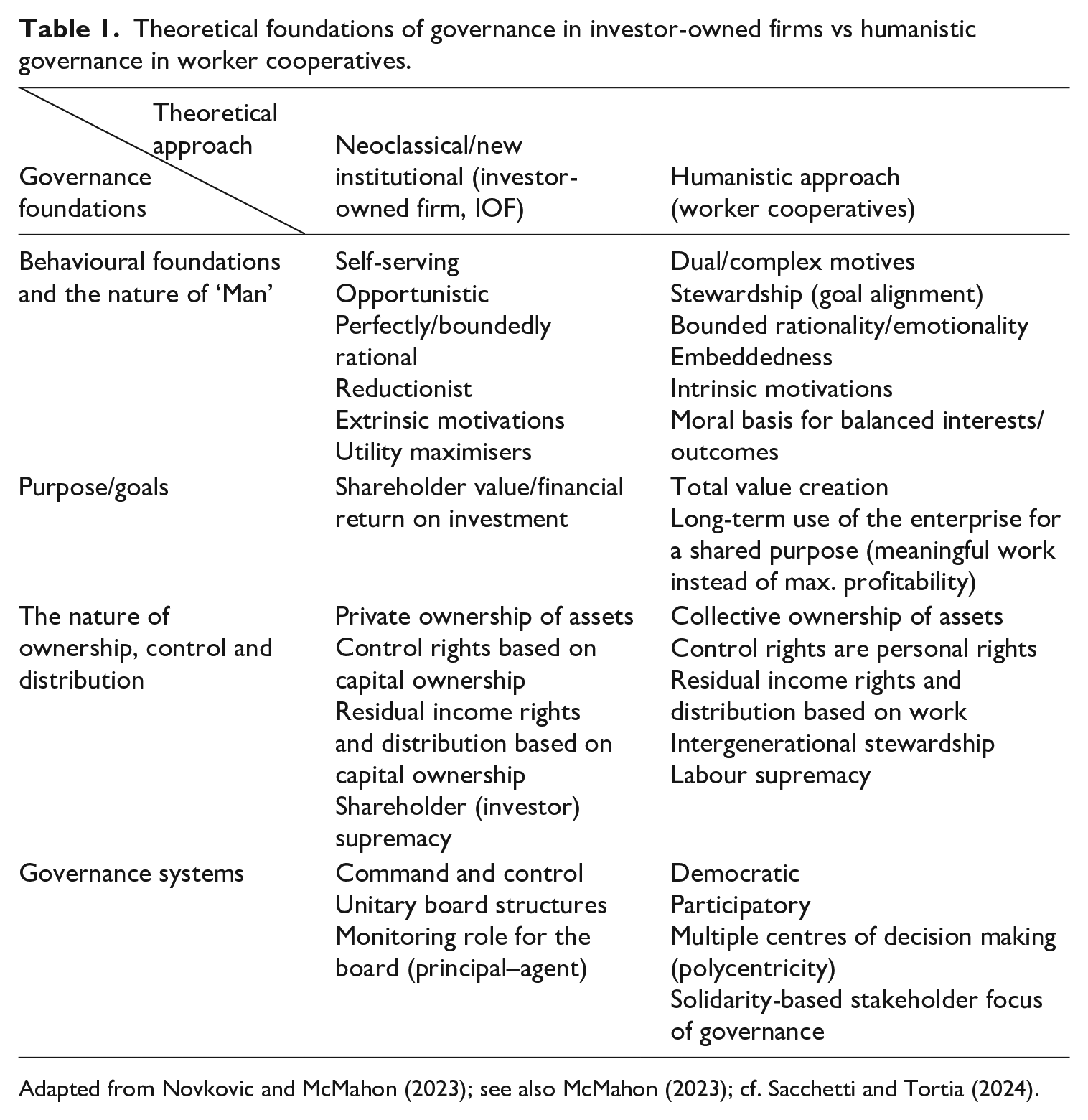
Adapted from Novkovic and McMahon (2023); see also McMahon (2023); cf. Sacchetti and Tortia (2024).
Novkovic et al. (2022) argue that this unlocking of personal human capacities extends to the co-op member collective through the co-creation of ‘associative intelligence, a belief that there is a special kind of knowing that emerges when people work together effectively; a conviction that people through working together could learn skills that would make collective behavior more economically rewarding, socially beneficial and personally satisfying’ (MacPherson, 2002, as cited in Novkovic et al., 2022: 5). The result is radical social innovation in organisational terms (see also Sacchetti, 2015).
Humanistic organisational theories argue for polycentricity and multistakeholdership in democratic governance structures (Novkovic et al., 2023a; Ostrom, 2010; Pirson and Turnbull, 2011). Arguably, this is best achieved through an overarching cooperative ownership structure, whereby stakeholder voice is ultimately backed up and incentivised by residual control and income rights (Novkovic and McMahon, 2023). But worker cooperative membership encompasses both ownership and work in the enterprise, implicating theoretical misspecifications in the mainstream theory of the labour-managed/cooperative firm (see Borgen, 2004; Novkovic and Gordon Nembhard, 2023). The core stakeholders in worker cooperatives are the workers operating inside the firm; this internal location offers a unique vantage point on possibilities for radical social innovation of the production process (Cheney et al., 2023; Vieta, 2014, 2020). The more workers are vested as co-op members, the greater the transformative potential of their collective labour, intelligence and capacity (Cooley, 2020; Laloux, 2014; MacPherson, 2002; Novkovic and McMahon, 2023; Stacey and Mowles, 2016). Workers also reside as members of the surrounding community, who therefore bring multiple stakeholder perspectives to the co-op (e.g. as workers, customers, citizens 4 ) (see Mamouni Limnios et al., 2018).
Table 1 illustrates the theoretical foundations of humanistic governance. Since worker cooperatives are the foundational organisational form in humanistic economics (see e.g. Ellerman and Gonza, 2024), the article proceeds to identify structures and processes of governance in this cooperative form. Given the proximity of worker-members to both the operations and long-term strategic decisions, one can conjecture that dynamics in governance systems are more pronounced in this context. An evolutionary dynamic would emerge through the interaction of vibrant democratic structures and participatory processes (Cheney et al., 2023; Cornforth, 1995; Novkovic et al., 2023a). Insider worker-members react to changes in the external environment, but also respond to internal struggles, relationships and needs or learnings that are typically shared among the workforce.
We describe our methodology and case cooperatives next, to return to governance systems placed in context. External context variables influence governance dynamics, but we also look for common threads of humanistic approaches in worker cooperative governance.
Methodology
With the aim of identifying the essential character of humanistic governance in worker cooperatives, as well as the different statutory and behavioural arrangements established in different contexts, we designed a multiple/cross-case study analysis (see Yin, 2018) of six longstanding, successful and identity-aligned worker cooperatives. These case co-ops are located in Canada, the US, England, France and Italy, and are concentrated in two broad economic activity areas: (1) relatively labour-intensive (organic) food/beverage production, packaging, wholesale and retail; and (2) relatively capital-intensive industrial custom engineering. Most of these worker co-ops fall into the category of small and medium enterprises (SMEs), with the exception of one large industrial case. Their trading names and headquarter locations are as follows: Just Us! Coffee Roasters Cooperative in Nova Scotia, Canada; Isthmus Engineering in Madison, Wisconsin, USA; Unicorn Grocery in Manchester, England; Suma Wholefoods in Elland, England; Comebo Industries in Bressuire, France; and Cefla Engineering in Imola, Italy.
Our adopted multiple-case study method tracks the iterative research stages proposed by Yin (2018). 5 The reflexive methodological approach draws on abductive and retroductive reasoning, as per critical realist social science (see Byrne, 2022; Fletcher, 2017), while at the same time acknowledging interpretivist insights regarding the uniqueness of individuals’ (interviewee/interviewer) perspectives and use of language (Ritchie et al., 2014).
The case studies were selected on the basis of three main criteria: (1) reputation for both commercial success and social/ecological commitment; (2) relative longevity through navigation of degenerative and regenerative governance processes; and (3) existence of prior studies and reports indicating exemplary participatory governance. Co-op gatekeepers were identified and approached to participate through the wider International Centre for Co-operative Management (ICCM) network of co-op researchers and practitioners. Interviews were subsequently organised according to purposive and snowball sampling methods (Patton, 2002; Ritchie et al., 2014), in keeping with a replication logic (Yin, 2018), as opposed to strict representative sampling.
Our main research instrument is the in-depth, qualitative semi-structured interview. A small number of key informants (current or former worker-members) were selected for interview in each case, based on their intimate knowledge and extensive experience of the co-op’s governance dynamics and historical membership. Initial interviews were supplemented with follow-up communications and, in particular, detailed internal reviews of the written case study reports. Preparatory document analysis (e.g. internal governing documents, co-op websites, previous case studies and reports), preceding the recording of interview discussions, facilitated case-specific annotation of the theoretically informed interview topic guide; it also allowed for triangulation of data generated from various sources (Ritchie et al., 2014).
In total, 15 interviews, typically one to two hours in length, were conducted by the lead author and/or by collaborating researchers between 2019 and 2023. Recordings were transcribed and textual data was stored and sorted according to established methods and protocols (Ritchie et al., 2014). Each case study was written up and analysed independently at first in a separate report. 6 These write-ups eventually facilitated structured cross-case comparative analysis in the final stage of the research process (Yin, 2018). The background, results and cross-case analysis of our case interviews are presented in the next section.
Research findings and discussion: Humanistic worker co-op governance
Before detailing, comparing and contrasting the case study governance systems, it is helpful to provide some background context regarding the co-ops’ founding purposes and development trajectories. The following sub-section logically divides the cases by sector into those that fall under organic production/packaging/distribution activities, and those that fall under custom automated engineering activities. It sets the scene for a more comprehensive dissection of the governance structures, processes and dynamics in each of the case study worker co-ops. This is followed in turn by a systematic analysis of the common and context-specific developments observed in governance systems across cases.
Background context: Founding purpose and development history
Organic food and beverage co-ops
The case studies in this activity group are Suma Wholefoods, Unicorn Grocery and Just Us! Coffee Roasters Cooperative (see respective case reports: McMahon and Novkovic, 2021; McMahon et al., 2021; and McMahon and Miner, 2021). These cases are indicative of the types of labour-intensive activities most often associated with worker cooperatives (Cheney et al., 2023).
Suma, based in West Yorkshire in northern England, is a partly-unionised co-op wholesaler that packages and distributes ethically sourced vegetarian wholefoods to domestic and international markets. Founded over 45 years ago in 1977 (see Cannell, 2021), it claims the mantle of ‘largest equal pay worker co-op in Europe’, with over 200 worker-members in a workforce of over 300. Its annual turnover was reported at more than £59m in 2022. 7 Pay, benefits and job security at Suma significantly outstrip industry norms, as do productivity levels and profit margins, and the co-op has recently embarked on an ambitious sustainability strategy (see Wolfe, 2023). Hence, over four decades since its establishment, Suma maintains a strong commitment to its founding social and environmental ethos/purpose, aligned to the alternative co-op movement during the 1970s (see Mellor et al., 1988) – this despite significant growth internally and increased market competition externally. Suma is also often acclaimed for its longstanding adherence to participatory, identity-aligned strategic co-op governance and day-to-day operations (e.g. Suma’s recourse to ‘coordinators’ rather than ‘managers’ or ‘leaders’; relatively widespread multiskilling and job rotation; and engagement of multiple stakeholders).
Inspired by the successes of Suma’s participatory-democratic eco-social model, Unicorn in Manchester established a complementary organic wholefoods retail outlet in 1996. Indeed, Suma is one of its main suppliers to this day. Unicorn is a smaller operation with circa 70 worker-members, alongside a handful of non-member casual workers, and roughly £8m in annual turnover (2023); 8 yet this has arguably facilitated Unicorn in sustaining an even more radical consensus-based decision-making model, one that results in deeper community building both internally and externally. This co-op was founded too with a social and environmental purpose at the forefront of its democratic deliberations. That said, an ongoing commitment to radical communitarian values has not prevented Unicorn from outcompeting conventional supermarkets, as numerous high-profile awards in recognition of its triple-bottom-line success attest.
While Unicorn cannot match the pay and benefits package of the larger wholesaler Suma, it nevertheless outstrips retail industry norms. Food justice and workplace democracy remain to the fore of its co-op identity, as reflected in its ICA-aligned Founding Principles of Purpose.
Across the Atlantic Ocean, in Nova Scotia, eastern Canada, the Just Us! Coffee Roasters Cooperative shares Unicorn and Suma’s ethical and ideological commitment to fair and sustainable trade with independent co-op producers/suppliers. It also champions participatory workplace democracy and cooperation among cooperatives. Established in 1995, Just Us! credits its founding inspiration and purpose to the small organic producer cooperatives in Central and South America who supply it with the coffee and cocoa beans it processes and sells as fair trade coffee and chocolate (see Byrne and Sharpe, 2014). Sales at Just Us! totalled CAD $7.8m in 2020, so it is a relatively small operation when compared to Suma, certainly, or even to Unicorn. The Just Us! workforce of around 50 people is comprised of circa 20 full-time worker-members, 10 full-time non-member workers and 20 part-time non-member workers.
Greater proportional reliance of Just Us! on non-member workers can be attributed in part to the often-transient nature of barista employment in its cafes, a characteristic of the wider industry, with most Just Us! members based in either production or administration at the co-op’s Grand Pré headquarters, or serving as cafe managers across its various locations. Until relatively recently, baristas were much less inclined/encouraged to become members, given the presumed shorter-term nature of their employment, as well as financial barriers associated with the membership cost. Just Us! has since opened new financial pathways to encourage growth in its barista membership.
In common with Suma and Unicorn, this co-op’s success is arguably attributable to its founding and continuing commitment to cooperativist ethical values and organisational principles. But while all three co-ops in this activity group remain committed to practising effective participatory-democratic governance and management, they have all also needed to adapt and evolve what were initially very flat, horizontal decision-making systems, so as to handle growing scale and complexity over time, as well as to adjust to the context-specific nature of their industries, operations and personnel (see Cornforth, 1995). This is perhaps clearest in the case of Just Us!, where operations are spread across several sites with a greater (part-time) non-member presence, and hence the tendency towards positions of stricter authority and greater complexity in the co-op’s pay structure, regardless of its relative (financial/human) size to Unicorn and Suma per se.
Yet degenerative pressures have been at least partly countered in each of these cases through the cultivation of an organisational culture of intergenerational stewardship (see Lund and Hancock, 2020), whereby younger generations of worker-members have emerged to steer and steady the ship in line with the cooperative identity and evolving member/stakeholder needs. Debates concerning the latter have resulted in ongoing policy deliberation and reform, and increased distributions of co-op surpluses to eco/social solidarity activities, with a particular focus on cooperative education, in tandem with the promotion of diversity, equity, inclusion and justice (DEIJ) in the governance of workplaces and their surrounding communities more generally (Cheney et al., 2023).
Custom engineering co-ops
The case studies in this activity group are Isthmus Engineering, Comebo Industries and Cefla Engineering (see respective case reports: Lund, 2021; Lund and Liret, 2022; and Hancock and Lund, 2024). Worker cooperatives are usually associated with smaller, more labour-intensive economic activities, given assumed barriers of access to (financial/physical) capital. However, Pérotin (2016: 3) finds that, based on available data from countries where they exist in sufficient number, ‘worker co-operatives are larger than conventional businesses and not necessarily less capital intensive’. The worker co-ops discussed in this sub-section demonstrate the potentials of capital-intensive worker cooperation in SMEs as well as large-scale industrial operations.
A case in point is Isthmus Engineering in Madison, Wisconsin. Isthmus prides itself on the design and manufacture of high-tech, high-quality custom automation machinery. A worker co-op since 1983, its founders were inspired by the innovative industry-based Mondragon cooperative experience in the Basque region of Spain; Isthmus has gone from strength to strength over the intervening decades. The co-op has radical roots through the anti-war commitments of its founder-member engineers, drawing comparison with the food justice commitments of organic worker co-op founder-members. This shared, cooperativist values-based subculture underpins solidaristic relationships within and across humanistic worker co-ops (see Cornforth and Thomas, 1990). The founder-members of Isthmus likewise preferred to dedicate their collective labours to (eco)socially useful and just rather than (eco)socially destructive productive outputs (e.g. weapons manufacturing) and production processes.
Annual sales at Isthmus are over USD $30m (2021), 9 and the workforce is composed of circa 80 people in total, split half-and-half between worker-members and non-member workers. Compensation varies relative to skill, experience, productivity and membership status, but remains attractive given the firm’s strong financial performance. Non-member workers also have access to benefits. Despite significant growth, the co-op maintains its commitment to participatory-democratic governance by providing opportunities and encouragement for active worker and member involvement in strategic and operational decisions. Isthmus has adapted and evolved its governance structures and processes over the years, as necessary to uphold its founding purpose and core values. This commitment extends also to DEIJ (with a higher proportion of women in leadership roles relative to industry norms), worker and public cooperative education, cooperation among cooperatives and solidarity donations.
Comebo Industries in Bressuire, France manufactures specialised custom industrial machinery and equipment for a variety of economic sectors. Established in 1970, its founding purpose was to provide good quality jobs for its worker-members, as well as quality products for its customers, and quality stakeholder relations (internally and externally). 10 Its annual revenue is about €8m (2021), 11 and its workforce consists of some 80 worker-members, a handful of new recruits and around 10 non-member occasional workers. Comebo’s priorities are to maintain safe and satisfying working conditions, fair wages and skill development for its workers. Over the decades, the co-op has experimented with socially innovative governance and management practices. Its ability to sustain and enhance participatory-democratic decision making was recognised in 2019 by the national association of French worker co-ops, when Comebo was awarded for its successful implementation of a system of autonomous work units, its firm commitment to cooperative education and training, and its nurturing of a mutualistic relationship with the co-op’s labour union local. A firm basis in the co-op identity also results in mutually beneficial cooperation among cooperatives at the meso level and intergenerational stewardship of the enterprise at the micro level.
Lastly, Cefla Engineering, which was founded in 1932 to provide stable and quality employment, and based in co-op-rich Imola in Italy, is a large, unionised worker co-op with an annual revenue of €685m (2023), 12 operating across four distinct business units: engineering, finishing, medical equipment and lighting. It employs over 1600 workers, and of its 1400 workers in Italy, 1200 are directly employed by Cefla. Only a minority (270) of its workers are co-op members, though. While this is not unusual for other large, industrial, capital-intensive worker co-ops in Imola and further afield (see e.g. Kasmir, 2016), it naturally leads to questions over the organisation’s integrity as a worker co-op. Yet the co-op’s 270 worker-members consist of a very representative sample of its overall workforce.
Cefla’s worker-members are actively engaged in participatory-democratic co-op governance to an unusual extent. As with Comebo, this worker-member participation is activated through what is ostensibly a standard co-op governance structure, but on closer inspection is seen to incorporate socially innovative checks and balances on the power and scope of management and the board. Common to our case co-ops generally, Cefla ensures that a very stringent membership and mentoring process protects the cooperative life of the organisation. Intergenerational stewardship of the enterprise and commitment to the local community are also core philosophies of practice at Cefla.
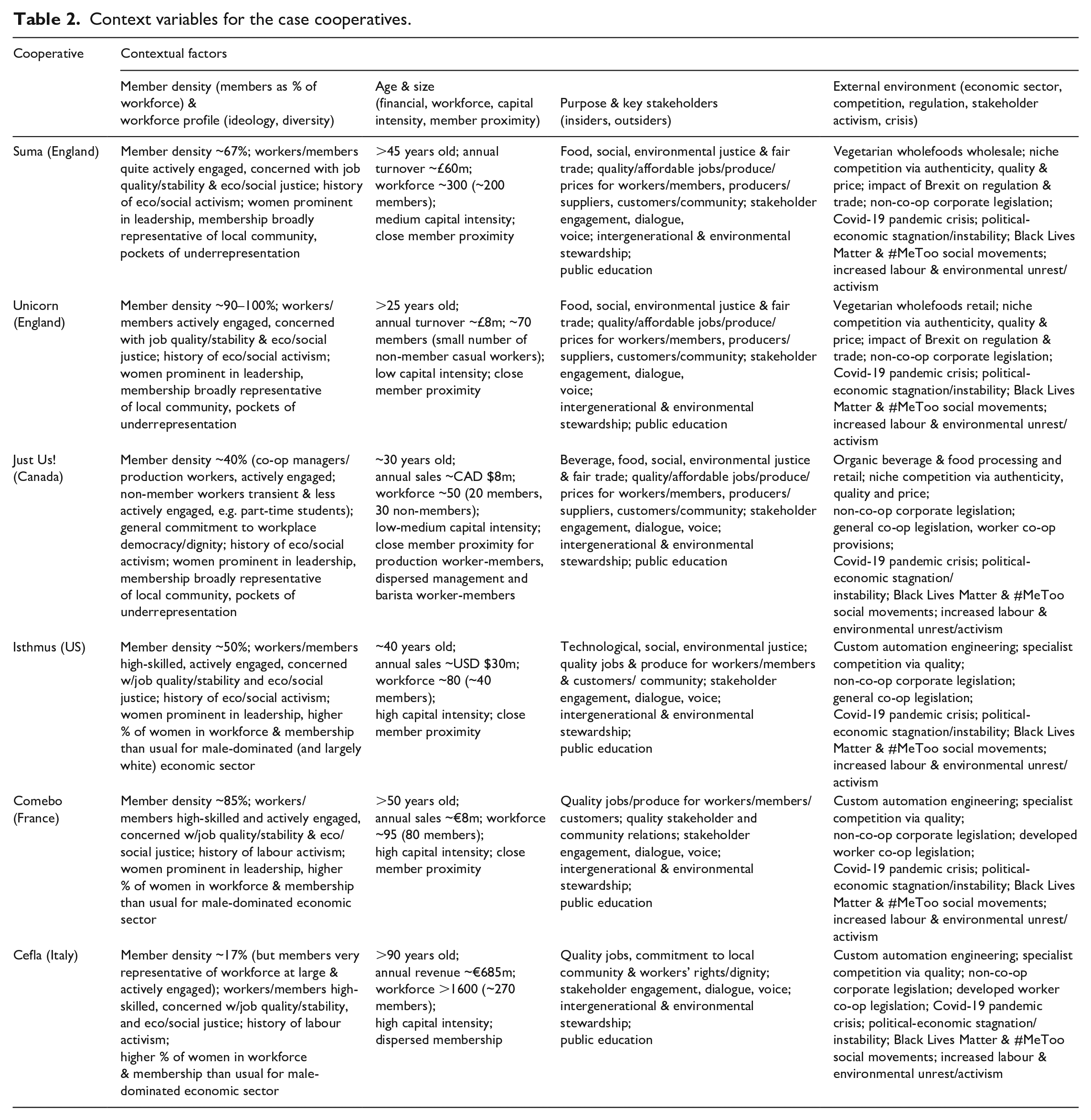
Before proceeding to take a closer look at their governance systems, we identify relevant context variables in Table 2. In particular, we outline the ratio of member to non-member workers and the workforce profile; the size and maturity of the organisation; the purpose and key stakeholders; and the external economic and political environment. These are some of the variables influencing strategic choices of our case cooperatives. Of note are the differences in size, member density, sector and regulatory environment; yet similarities are also observed across the cases regarding the purpose, connections to social justice movements, intergenerational stewardship and multistakeholder engagement.
Context variables for the case cooperatives.
Governance system: Structures, processes, dynamics
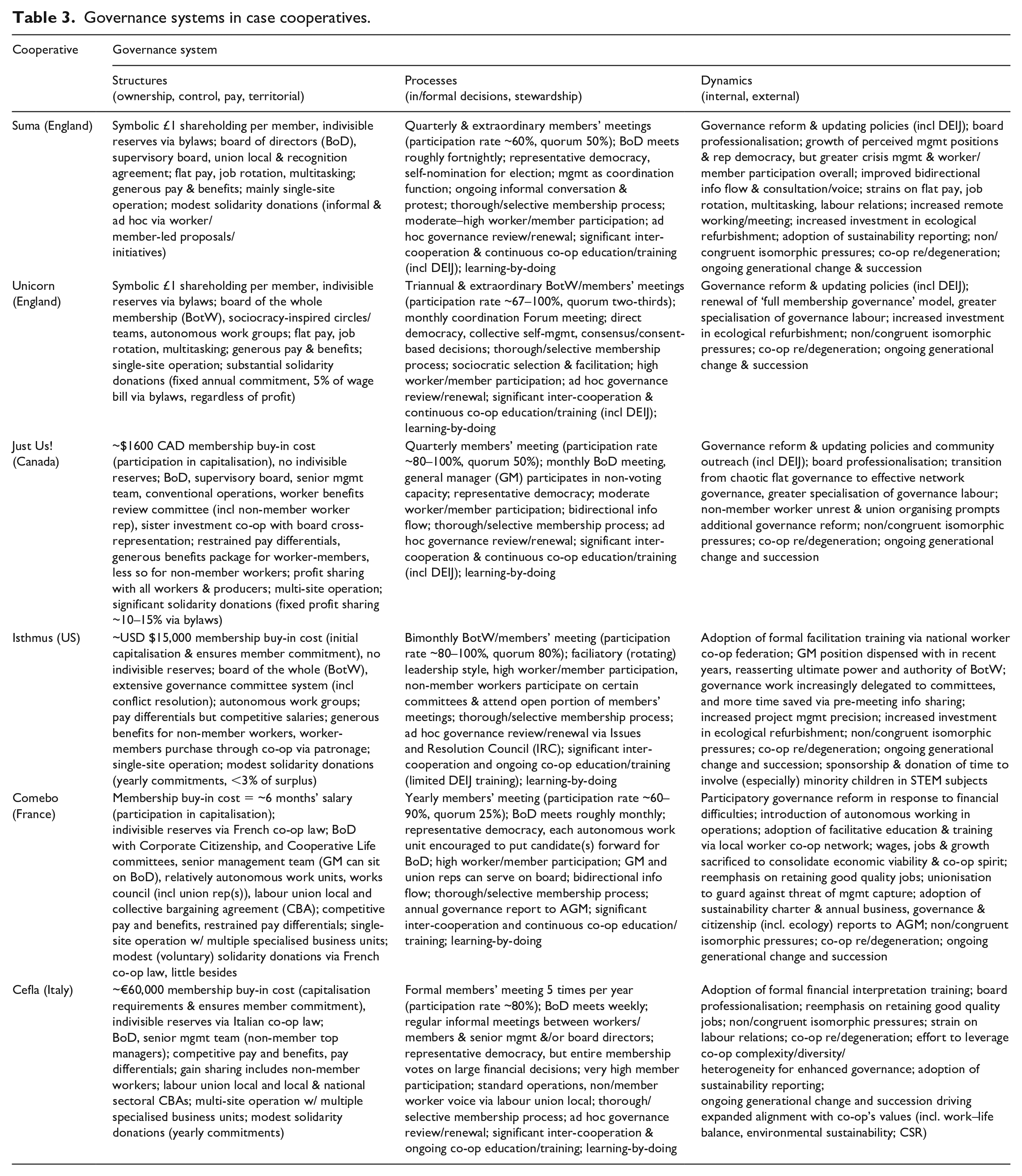
In keeping with the assumptions of humanistic governance, this section unpacks the governance systems of our case study co-ops, comprising of governance structures, participatory processes and their dynamic interplay (see Eckart, 2009; Novkovic et al., 2023b). Organisational governance structures include fundamental ownership and control rights, as well as formal decision-making bodies and written rules and policies. Participatory processes refer to forms of democracy and member and stakeholder participation, channels of communication, and monitoring and control practices. Dynamics involve the co-evolution and adaptation of co-op governance structures and processes to new and emerging circumstances, whether arising primarily from internal or external institutional or environmental pressures. The following sub-sections detail commonalities and contextual differences observed across the worker co-ops’ governance systems (structures, processes, dynamics), summarized in Table 3.
Governance systems in case cooperatives.
Organisational structures
Ownership structure
The ownership structure in a cooperative delineates access to (equal) voting/control/income rights. In worker cooperatives those rights are fully exercised by the insider members, and, often, the rights to a share in surplus is extended to non-member workers.
The standard worker co-op ownership structure in England, where Suma and Unicorn are based, derives from a relatively developed, militant history of labour and cooperative movement struggles. Consequently, co-op ownership/membership is relatively accessible, with cost posing little barrier to entry (Mellor et al., 1988). In addition, while worker cooperative law in England does not mandate asset locks or indivisible reserves, as do some European countries to disincentivise underinvestment and/or demutualisation, it is common for English worker co-ops to specify through their internal governing rules that any remaining assets upon dissolution are to be distributed to other ‘common ownership’ or social/charity enterprises (Mellor et al., 1988).
French worker cooperative law, by contrast, mandates indivisible reserves (minimum 16% of surpluses) for Comebo, which must be used for development of the co-op movement in the event of dissolution. There is also provision for a voluntary portion of revenues to be reinvested in the larger worker co-op movement. Likewise, under Italian worker co-op legislation, Cefla must set aside at least 30% of its annual profit in indivisible reserves, which again must be recycled within the co-op movement upon demutualisation. The longstanding practice of these worker co-ops holding significantly more than is legally required of them in the form of indivisible reserves indicates that national legislation tends to follow rather than lead co-op values of intergenerational stewardship (see also Lund and Hancock, 2020; Pérotin, 2016).
Due to a generally less solidaristic national political and cultural history (but see e.g. Gordon Nembhard, 2014; Pencavel, 2002 on co-op subcultures), the worker co-op movement in North America has tended to place greater emphasis on individual employee ownership over collective worker control (Mellor et al., 1988; Pencavel, 2002). There is less ideological or practical commitment to intergenerational stewardship of co-op enterprise in this political-cultural context, as manifest in the absence of mandated asset locks or indivisible reserves, and the general prevalence of significantly higher ‘buy-in’ costs for aspiring members. Just Us! and Isthmus are reflective of North American norms in this regard, notwithstanding their sharing of a relatively participatory-democratic cooperative ethos.
Despite emanating from a comparatively solidaristic national culture, though, Comebo’s capital-intensive operation still requires a substantial buy-in cost, equalling to six months’ salary. Likewise, Cefla sets a very substantial buy-in cost, roughly commensurate to its very high capital-intensity, and the expressed need to ensure member commitment and responsibility. Participation in capitalisation is also cited as an internal justification at Comebo, Just Us! and Isthmus. The internal justification at Isthmus centres on ensuring serious member commitment to the co-op project, while Comebo contends that it is necessary for adequate capitalisation of the enterprise by the associates. Such potential cases of prohibitively high buy-in costs at least allow a significant portion to be paid off over time through various financial planning mechanisms, where this is deemed necessary (e.g. payroll deductions, loans, severance, dividends).
Nested governance structures
The formal decision-making bodies observed across cases are quite variegated, even if there are some circumstantial similarities. Given its significant growth in size and complexity, Suma is primarily governed, outside of general members’ meetings, by a board of nine elected worker-members. The board appoints a team of coordinators to oversee operations, and a team of administrative officers, including a Company Secretary who is the public face and spokesperson of the co-op. But Suma doesn’t have any formal chief executive officer (CEO), general manager (GM) or senior management team, as conventionally understood. A consultative Member Council comprised of up to nine elected worker-members, as well as a local branch of the Bakers, Food and Allied Workers Union (BFAWU), scrutinise and influence governance and operational decisions on behalf of the wider co-op and union memberships, respectively.
At Cefla, by contrast, one finds a more conventional general manager and senior management team, hired by and accountable to the member-elected board of directors. Top managers are no longer permitted to be members of the co-op; this is intended to guard against undue management influence over board meetings. There also exists at Cefla the countervailing presence of a union shop stewards’ council, representing the interests of member and non-member workers vis-a-vis management. The union local’s strength, reflected in a company-level collective bargaining agreement (CBA) with Cefla, is further buttressed by regional and national CBAs. 13
Unicorn and Isthmus, on the other hand, have been able to accommodate all co-op members on their respective boards of directors: virtually the entire workforce in Unicorn’s case, and roughly half the workforce at Isthmus. In both co-ops, all workers and members are encouraged to participate in smaller governance teams focused on particular strategic issues. These nested teams are termed ‘circles’ at Unicorn and ‘committees’ at Isthmus. Their workforces also participate in relatively autonomous teams at the operational level. Neither co-op has a CEO/GM in place, nor have the workers/members seen fit to institute or advocate for a company-level union or CBA.
Just Us!, despite being relatively small by comparison to these and other cases, is nonetheless more geographically dispersed, with its operation spread across multiple sites. In combination with transitory employment norms in the retail/cafe industry, this arguably necessitates a more traditional cooperative governance structure at Just Us! Co-op complexities are seen to extend beyond geographies of scale (size/employment) to geographies of scope (sites/activities/personnel).
That said, much like at Suma, Just Us! has instituted channels of open communication and consultation to encourage greater worker-member participation in governance. In addition to the Member Assembly and elected board of directors (five to seven people, plus the GM in a non-voting capacity, plus two non-voting expert advisors), Just Us! has also instituted an elected supervisory body in the form of the Oversight Council including two non-board worker-members. The board appoints the GM, who appoints and oversees the senior management team, which in turn oversees the operations teams. The board also appoints board committees dedicated to particular governance concerns, including a Worker Benefits Review committee, which gives voice to member and non-member worker reps alike. All committees are chaired by a member of the board. In addition, Just Us! has set up a sister organisation, the Just Us! Fair Trade Investment Cooperative (JUFTIC), to raise capital and draw upon associated policy and governance expertise through interlocking directorates, i.e. each organisation has a board director delegated from the other organisation. Operational management remains more conventional at Just Us!, however, notwithstanding the nascent growth in co-op membership among its baristas.
Comebo elects for a more conventional co-op governance structure at root, but again supplements this with additional nodes of decision-making power and influence to encourage worker and member participation. While similar to Just Us! in this regard, Comebo’s participatory mechanisms extend also to the operational level through its system of relatively autonomous work units. In terms of governance, the General Assembly elects the board of directors, which nominates the general manager for election, with the latter coordinating corporate strategy with the GMs of the autonomous work units. 14
Each autonomous work unit is encouraged to put at least one candidate forward for election to the board. The board has also established standing board committees for Economic Affairs, Corporate Citizenship and Cooperative Life. The latter two committees deliberate on economic, social and environmental justice, and member participation and engagement, respectively. While standing committees are only open to board member participation, French companies of Comebo’s size are legally mandated to establish a works council – the Social and Economic committee (CSE) – on which one or more union reps typically sit. Members, aside from those sitting on the board, can also participate in various ad hoc committees – though all committees are advisory, i.e. they do not have any final decision-making power.
Pay structure
As for remuneration, we observe a variety of approaches towards intrinsic and extrinsic motivation (see Novkovic and Miner, 2019), in accordance with contextual factors. Suma and Unicorn, for example, maintain a flat/equal pay structure: for all (member and non-member) workers in Suma’s case, and all member-workers in Unicorn’s case. This is in part facilitated by significant multitasking and job rotation at both co-ops, though these policies are increasingly open to debate at Suma, given its greater specialisation of roles and responsibilities as the co-op grows in size and complexity. However, Suma retains its traditional, deeply embedded egalitarian policies, with base pay amounting to twice the regional industry norm; benefits at Suma are also very competitive by industry standards. While Unicorn cannot maintain such a high level of base pay (although it is accredited as a Real Living Wage Employer 15 ), it also incorporates a wide array of worker/member benefits. Any remaining financial surplus left over after covering operating costs ‘and solidarity donations’ is generally reinvested in the co-op, ‘invested in the [solidarity economy] movement’, or else held in reserve, according to a longtime worker-member.
It is not altogether surprising to find that the rest of the co-op cases presented in this study have more complex pay structures, given the relatively specialised or segregated nature of their business activities, and the divergent skillsets and productivity levels of their workforces. Just Us!, for example, deploys a performance-based wage policy, encompassing ‘seven different wage ranges’, with the co-op’s minimum wage set to increase over time towards a living wage. The maximum wage can only be three times the minimum wage. The wage package is supplemented by a generous package of member benefits. The benefits package is somewhat less generous for non-member workers, but this outcome is designed to incentivise and encourage membership. As regards profit sharing, the Just Us! GM explains that the co-op shares 20% of its profits with its worker-members; 5% with its workers, whether they are members or not; and 10% with its producer partners. Just Us! Does not have any indivisible reserves, with any remaining surplus retained or invested back into the organisation.
Isthmus’s hourly compensation for worker-members is based on their ‘skill factor’, i.e. a metric assessed annually by the membership that includes, amongst other components: job duties, skill level, experience and work ethic. Part of the wage also depends on profitability throughout the year. Any remaining surplus at the end of the fiscal year is distributed via profit sharing. Non-member workers have access to a full package of benefits. Worker-members can purchase benefits through the co-op with patronage at their own expense. A similar pay and benefits structure is in place at Comebo and Cefla, both of which offer competitive rates. In the former, pay differentials exist but are restricted; in the latter, non-member workers participate in surplus/profit sharing.
Participatory processes
Formal and informal decision making
Worker cooperatives retain a meaningful commitment to worker-member participation in governance and operational decisions, and our case cooperatives are no exception. In Suma’s case, the existing organisational structures and processes date from governance reforms implemented in 2019, before the co-op experienced the full force of Brexit- and pandemic-induced economic dislocation. Therefore, it is difficult to accurately assess the success or otherwise of the ongoing reform process. But whatever the hiccups experienced during this bedding-in period, the Suma Company Secretary’s perception is that the new governance structure has facilitated greater worker and member participation in decision making, given the additional avenues of consultation, communication and accountability.
Before the reforms were enacted, worker-member participation at quarterly general meetings had become somewhat ‘tokenistic’, he explains, bemoaning the lack of any ‘real engagement’. Board policies were often passively voted upon and approved at general meetings, and were rarely rejected, so the efficacy of all members voting directly on every board decision was questionable in his view. Under the reforms, worker-members still have a vote, but their collective will is exercised through greater indirect/representative democracy.
Roughly 60% of Suma’s members are usually in attendance, with a 50% quorum requirement. Member feedback indicates a general consensus that the greater concentration of final decision-making power in Suma’s board aided the co-op in successfully navigating the twin fallout from Covid-19 and Brexit. Guarding against board capture requires a reinvigorated, vigilant and actively engaged broader membership and workforce, however. So far at least, it has proven difficult to fill some of the new governance roles, particularly on the Member Council, with few candidates presenting for election. This owes in part to the extent and pace of organisational change at Suma; to the internal impact of external crises; and to a continued lack of clarity over specification of the new roles and responsibilities. It all indicates the need for better ‘change management communication’ according to the Company Secretary.
In terms of representative democratic procedure at Suma, the board and Member Council are elected by and from within the wider worker-membership at quarterly general meetings. The board meets roughly fortnightly. Only non-coordinator/administrator worker-members with two nominations can stand for election to the board, helping to protect it from informal management capture. The absence of a nominations committee also suggests some baseline commitment to grassroots democracy.
Unicorn has instead instituted a modified form of sociocratic governance (see Buck and Villines, 2007), a more direct form of democracy when compared to Suma’s model. As one longstanding worker-member describes it: ‘[Sociocracy means] having a properly democratic system, not just one-member, one-vote twice a year, but constantly day-to-day having people involved actively in decision making in their teams [or circles], which [are] now using consent, and in the regular general [members’] meetings using our modified form of consensus.’ A quorum of two-thirds of Unicorn’s members is required for members’ meetings to proceed; the participation rate is usually much higher at scheduled general meetings.
Operational and governance circles are generally limited to nine members, to make sure that circles are small enough for consent decision making, yet create an effective connecting structure between the nested circles. These foundational circles, afforded primary decision-making responsibility, are embedded within departmental circles, which support communication and information flow between them. Elected delegates to departmental circles are subject to ‘the sociocratic selection process’, which involves open and transparent discussions around what skills are needed to fulfil different roles and responsibilities. ‘It’s also very much conceived as a dynamic structure, so departments may ebb and flow, and circles may move between them or connect into more than one over time.’ This implicates fluid participatory-democratic governance processes and dynamics.
Multitasking is practised in shopfloor operational teams through a flat management structure, though governance circles involve more specialised decision making. As with department circles, there is fluidity within their component parts. Members’ meetings are held three times per year, while a central Forum holds court every month; the latter is primarily a central coordination body.
None of this is to suggest that Unicorn achieves total participation of its workforce across all aspects of co-op governance and management; but it strives towards ‘living the principle of everybody being listened to in deeply democratic structures’. It appears that such efforts are, at least in part, facilitated by Unicorn’s status as a labour-intensive single-site cooperative. In this sense, the interviewed worker-member adds that models of co-op democracy should be adapted to their ‘physical structures’, especially where social-communicative interaction is spread across multiple sites and locations (see also Cornforth, 1995).
Isthmus’s single-site operations similarly appear to be a faciliatory factor in the co-op’s vibrant participatory-democratic organisational culture, its relatively capital-intensive and specialist nature notwithstanding. All Isthmus worker-members serve on its board, in common with Unicorn’s collective approach to co-op governance, but the high prevalence of non-member workers at Isthmus perhaps indicates greater difficulty in finding and developing the specialist skills deemed necessary for membership, in addition to possible issues of co-op spirit and a higher buy-in cost.
Officers of the Isthmus board of the whole membership (BotW) are elected annually, and standard practice is to rotate the co-op’s leadership roles, which are perceived as facilitator positions, amongst more experienced members. The board meets twice a month, and co-op members are actively engaged in setting the agenda for each meeting. The participation rate at members’ meetings is between 80 and 100%, with a high quorum of 80%.
Formal facilitation training accessed through the co-op’s membership of the US Federation of Worker Cooperatives (USFWC) has greatly assisted in the streamlining of efficient and effective democratic participation in members’ meetings. Non-member workers and probationary members are encouraged to attend the open portion of board meetings as well as weekly company-wide meetings concerning operations and project work. Non-members and members alike sign up for committee work once a year and are encouraged to rotate through different roles over time to learn about different aspects of the business. 16 Committee charters are another important mechanism limiting ‘scope creep’ from a committee’s remit.
Though Comebo is also a specialist single-site operation, its larger membership (which assembles yearly at the AGM, with a participation rate of ~60–90%, and quorum of 25%) and workforce participate through representative democratic mechanisms. These co-op governance bodies are, primarily, the board, the labour union and the works council. Worker-members are nevertheless still encouraged to participate actively in the democratic process on an ongoing basis, and are provided with facilitative education and training to this end, particularly through a local worker co-op network organisation. In this sense, a more traditional organisational structure at its core has not inhibited vibrant participatory democracy from taking root and flourishing at the co-op.
Member engagement proved to be more of a challenge at Just Us!, given that the workforce is segmented across multiple worksites and operational activities. Early experimentation with ‘flat’ governance models proved mostly futile. Just Us! then reverted to a more traditional co-op governance structure, but while also incorporating additional governance bodies to encourage greater worker and member participation through mechanisms of representative democracy. Conscious not to create and reproduce the ‘classist scenario’ of an ‘elite group of worker-members’, 17 as the general manager puts it, Just Us! is ‘continuously look[ing] for new ways of engaging – in the right ways – our worker-members as well as our [non-member] workers’.
The focus is therefore on effective participation, recognising that not all co-op workers can easily attain the requisite ‘knowledge and information [and] experience . . . to participate in the [strategic] conversations’. The Just Us! GM observes that it is largely the nature of the co-op’s people, and ‘not actually the [governance] structure that dictates the participation level . . . We need to talk about appropriate participation depending on the folks involved’. The democratic structures and processes should, this line of thinking suggests, be reviewed and renewed in line with the acquisition and development of worker-members’ individual and collective capacities.
Just Us! board meetings are held monthly, and the GM attends in a non-voting capacity to provide ‘most of the new business and financial/operations updates’. The GM generally formulates policies first that are then brought before the board for final approval. If members disagree with the GM on any major strategic orientation, they are expected to build a level of consensus amongst their peers before approaching the board, rather than the GM directly, to have the issue dealt with appropriately. All members usually participate in annual and quarterly general meetings, with a member participation rate usually between 80 and 100%, and quorum of 50%. That said, maintaining deep member engagement is an ongoing challenge, aided to a certain extent by numerous intentional channels of bidirectional information flow, such as daily morning reports and the GM’s fortnightly (virtual throughout the Covid-19 pandemic) ‘Town Hall’ updates.
For reasons of much greater size and complexity, Cefla’s co-op governance system also relies on a representative form of democratic participation. The worker-members participate to an unusually active extent through the formal governance bodies (~80% participation rate), as well as through more informal avenues of consultation and communication. The GM, while likewise not a board member, participates in all (weekly) board meetings. Official member assemblies are scheduled five times per year. Members are provided with formal training to help them to interpret financial statements and budgets. Senior managers are also adept at communicating this information in an accessible manner. Any financial transactions exceeding 2% of the co-op’s net worth must be approved by the entire Assembly. Attendance at official assemblies is mandatory, and a quota of 10% of members is required to request an informal meeting of the Assembly, during which management may be excluded. Smaller groups of members often meet informally after official assemblies to delve into specific topics in more depth with managers and board members, who are tasked and committed to responding openly to queries and/or criticism.
All board members are (re)elected by the Assembly every three years; there are no term limits. The board then elects the Cefla president and vice president (full-time paid positions, whereas other board members continue on in their regular jobs). The board has responsibility for finance, investments and strategic planning, and also provides input to the GM on pay and benefits, etc. Non-member workers mainly assert their influence over co-op governance through the democratic structures and processes of their labour union(s), whose local bargaining unit negotiates the collective agreement with co-op management. Barring top managers from membership also arguably helps to ensure their accountability to the board and wider worker-membership. Co-op worker-members can and do serve as union shop stewards, participating meaningfully in both organisational logics (see Mandiberg and Kim, 2021).
Stewards of enterprise
While intergenerational stewardship of co-op enterprise may be safeguarded through legal provisions like asset locks or indivisible reserves, more fundamental to this is the cultivation of healthy and caring social-ecological relational practices based in a cooperativist values system (Lund and Hancock, 2020). Member reproduction has emerged as particularly important to the continued success of the sampled case cooperatives in this regard (see Stryjan, 1994).
Suma’s former personnel manager credits the transformation of the organisation from a ‘mess of conflict’ to a vibrant ‘cooperative conversation’ (see Cannell, 2015) to appropriate redesign of the membership process covering ‘recruitment, selection, induction, assessment and training, [and] reviews and performance management’ (see Stryjan, 1994). This approach naturally extends to the intake of non-member workers, through the nine-month probationary period for trial members, and all the way to governance succession planning.
Beyond internal co-op governance, Suma worker-members are also encouraged and incentivised, through worker education and paid leave, to participate in social and environmental regeneration in their surrounding community. Multiple stakeholders are thereby engaged in Suma’s cooperative conversation, broadening the political-cultural horizons of the workers and members concerned. These multistakeholder exchanges were largely informal at Suma, however, until more recent times (see Wolfe, 2023). This sustainable development orientation coincides with the emergence of a more structured approach to worker education and learning development at the co-op, now that it is in a better position to commit additional resources to the task and given that identity-aligned co-op business expertise is of increasing necessity.
A structured approach to member education and reproduction has also been adopted at Unicorn, in part inspired by the experience of Suma. Many early Unicorn (and Suma) members had experience of cooperative organisation and education through their involvement in social and environmental justice activism. A worker-member recounts how, every fortnight, all worker-members now gather for training sessions, ‘often delivered by external people’ with relevant expertise. Unicorn has a substantial training budget which also facilitates worker-member upskilling through external courses.
This all helps to inculcate an organisational culture of deeply cooperativist relations in terms of both internal and external co-op relationships (Cannell, 2010). Worker-members are expected to act as ‘steward’ or ‘caretakers’ of the organisation for the internal and external community as a whole. Outside of Unicorn’s workforce, customers and suppliers are also key stakeholders engaged in multistakeholder dialogue through various means, including the organised ‘Meet the Producer’ events. This intergenerational multistakeholder stewardship orientation speaks to a genuine co-op concern for community, as exemplified by Unicorn’s generous social and environmental regeneration solidarity funds.
Just Us! has formalised its own internal education and training programmes, which experienced members facilitate. The curriculum is based in co-op and fair trade values, naturally also serving for purposes of ‘probationary orientation . . . and required training’. The member reproduction process is fairly standard besides, with internal hires prioritised through training and work shadowing, even at the most senior levels of governance and management. Continuous learning is also encouraged through, for example, internally-funded participation on external courses or study visits to origin producer co-ops. The intra-firm commitment at Just Us! to participatory governance and learning development extends also to the extra-firm community. Dialogue with external stakeholders, such as the fair trade movement, is more informal and advisory, however.
An average of half of all employees at Comebo avail of paid, professional education every year. In all, the co-op dedicates about 2.5% of annual revenues to upskilling its workers. Isthmus, for its part, shares an organisational culture of learning-by-doing. The probationary period before being considered for full membership at Isthmus is two years, which is relatively long, when compared to seven months at Unicorn, for example. This might help to explain the divergent prevalence rates of non-member workers between these co-ops. Permanent workers at Comebo are also required to join as co-op members within their first year. The recruitment process is thorough, however, with cooperative ethos prioritised.
The membership process at Cefla is similarly exhaustive, aimed at protecting the integrity of the co-op’s values system. Prospective members must work with the co-op for at least four years, and they cannot be over the age of 50 when applying. This again helps to explain the high prevalence rate of non-member workers as a share of the overall workforce. Aspiring members are evaluated and selected by the board in accordance with a set of objective criteria, including social and ecological considerations of ‘cooperative spirit’, collective work and intergenerational and community stewardship, in addition to economic considerations of business acumen. While co-op education and training are provided to aspiring members of Cefla, the most important source of knowledge transfer is through informal mentoring, whereby more experienced members pass on the technical and relational-cultural aspects of co-op governance and operations.
Governance system dynamics
Internal dynamic pressures
The growth in the size of these case co-ops over the decades of their operation has led to internal pressures for, and resistance to, greater concentration and specialisation of roles and responsibilities. Careful navigation of such pressures has been pursued through social innovations in cooperative governance structures and processes – through their natural interplay, and through regular (recurring and/or ad hoc) governance system review and renewal initiatives.
Implementation of the latest reforms at Suma coincides with exceptional instability and disruption in the external environment since 2019. It is therefore subject to ongoing (re)assessment and adaptation as circumstances unfold. A formal review in 2020 highlighted shortcomings in ‘the skills and experience that we have internally and how we match that up externally’, according to the Company Secretary. This catalysed greater openness to the idea of cooption of external people onto the board. Similar moves towards board professionalisation were observed at Cefla, where blue-collar workers are on the decline as a proportion of a growing workforce in an increasingly complex organisation. The decision in recent years to disqualify top managers from membership of the co-op also indicates an awareness of greater potential concentration of power. The interviewed Unicorn worker-member, however, observed grassroots resistance to proposals for cooption of external expertise, mirroring too the historical philosophy of practice at Suma. Isthmus, meanwhile, has also kept managerial roles and powers to a minimum, showing the potential net savings that can accrue to flat models of governance and management.
Similar concerns arise with the relationship between non-member workers and worker-members. Take Cefla’s controversial decision to sell one of its business units: ‘When we sold the shopfitting division, there was a difficult period’, recalls one board member. ‘The unions were against us publicly’ and questioned the co-op’s commitment to workers ‘even though we did everything possible to protect workers’. Similar tensions may emerge in other fast-growing co-ops like Suma, where non-member workers are increasingly prevalent in the workforce. But, to date at least, there has never been a collective dispute between Suma and its BFAWU union local (branch). Just Us! also navigated a successful union drive from non-member baristas at two former cafes, indicating that smaller worker co-ops are not immune to such conflicts of interest arising (see also Byrne and Sharpe, 2014; Tarhan, 2021).
At the same time, the Just Us! case demonstrates how such conflicts can potentially lead to a recognition of degenerative tendencies on the part of the co-op’s membership, and subsequent actions to formulate and implement regenerative reforms (e.g. union recognition and collective bargaining; workers’ councils/committees with non-member worker representation; or opening co-op membership paths to underrepresented groups of workers). Neither Unicorn nor Isthmus have encountered unionisation drives, despite Suma’s sizeable influence on the former, and the high prevalence rate of non-member workers present in the latter. This may be attributable in part to their deeply participatory ethos in operational/governance decision making, both for member and non-member workers alike. Unionisation at Comebo – requested by its works council in response to a change of GM – was a more straightforward affair under French labour law. Unionisation, then, may arise as one potentially effective means of guarding against possible management capture (whether now or in future) or excessive corporate professionalisation. On the other hand, the role of trade unions in a worker co-op setting may appear less clear in the absence of significant managerial positions/powers, or indeed of non-member workers, indicating the need to rethink the union–co-op relationship along less well-established lines under such circumstances (see Cornforth, 1982; Ellerman, 1988).
Comebo’s lauded mechanisms of participatory governance were successfully introduced and implemented in recent years in response to – not in spite of – mounting financial difficulties. Its recourse to the co-op identity in times of crisis underscores common co-op resiliency principles and practices (Billiet et al., 2021; Miner, 2023; Roelants et al., 2012). The transition to financial stability and profitability was not without sacrifice – e.g. forgone wage increases and a reduced overall workforce – but the business’s future was secured by consolidating, rather than retreating from, co-op democracy. Universal challenges remain with respect to meeting facilitation, member voice and succession, but these are continually recognised and grappled with to enhance cooperation. Over time the purpose of the organisation has shifted somewhat from saving and creating jobs, to retaining good quality jobs, which indicates a rethink around the continued pursuit of growth (size/scale/scope) for its own sake. Comebo designed a system of relatively autonomous teams to rejuvenate its economic democracy, crediting the increased worker-led flexibility and radical social innovation to its cooperative organisational culture.
This increased emphasis on retaining good quality jobs (e.g. satisfactory work–life balance) through enhanced co-op democracy is also a dynamic tension observed at Cefla, complicated by the fact that its segregated business units are spread across multiple sites and countries, rather than being concentrated in a single site. By interviewees’ accounts, increased complexity and heterogeneity apparently feeds into, rather than exclusively hampering, cooperative regeneration.
External dynamic pressures
Governance (and operations) at all sampled cases has been shaped by both routine and extraordinary external developments. These include the impacts of changes in the regulatory environment, from its narrow legal sense to its broader political-economic and socio-cultural sense; as well as the outbreak and intensification of various macro-level (poly)crises, and the pressure of associated multistakeholder activism.
Worker co-ops generally operate within predominantly capitalist market economies. This means they are subject to standard corporate and employment legislation, which is particularly unsuited to the worker cooperative form (see Cannell, 2010). The development of coping strategies in this regard is an ongoing challenge.
Cooperation among cooperatives is one possible recourse, as a Unicorn worker-member describes: ‘Our HR [human resources] team is part of a cooperative HR network, and they work quite closely with Suma actually for skill and knowledge sharing around best practice.’ Identity-aligned expertise, education and training are also accessed by both Unicorn and Suma through Co-operatives UK and the Co-operative College in Manchester. Similarly, Isthmus draws on supports provided by the US Federation of Worker Cooperatives (USFWC); Just Us! from the Canadian Federation of Worker Cooperatives (CFWC); Comebo from the French national worker co-op federation (Fédération des Scop de l’industrie) and a local worker co-op network; and Cefla through a wider network of institutionalised cooperative expertise in the Emilia Romagna region of Italy.
Suma and Unicorn’s international trading relationships were adversely impacted by Britain’s 2020 exit from the European Union. This resulted in the sudden imposition of additional costs, tariffs and trade barriers on all domestic enterprises, but especially on those whose ‘model is [based upon] direct trade with European suppliers’, the Unicorn worker-member explains. But it is not the first time that either Unicorn or Suma have navigated such extraordinary shocks to their operations. Intercooperation is an important trade buffer, particularly within co-op fair trade supply chains. This can be seen too in the moral and strategic values-based commitment of Just Us! on the opposite side of the Atlantic Ocean.
All of the sampled cases are insulated to varying degrees from price competition, given the outstanding quality of their offerings, whether in economic, social and/or environmental terms. After all, each was founded with a deeply felt social/ecological as well as economic purpose, as reflected in the nature of their operations. This longstanding dual/complex co-op purpose has only gained in legitimacy over time (Novkovic et al., 2022). Suma and Cefla, for example, recently started producing annual sustainability reports, setting forth tools and measurements to progress environmental, social and governance (ESG) targets and goals (Cefla, 2023; Suma, 2023). Comebo previously adopted a sustainability charter committing it to corporate social responsibility (Comebo, 2014), and it also produces annual citizenship reports to the AGM on ‘policies and results in the areas of employment, training, pay and benefits, collective decision making, safety and health, [and] ecology’ (Comebo, 2014). Unicorn, Isthmus and Just Us! are noted for their intentional investments in ecological refurbishment of co-op operations, as well as their general responsiveness to extra-firm stakeholder activism.
The Covid-19 pandemic outbreak in 2020 adversely affected all firms, but particularly democratic firms based upon the cultivation of face-to-face cooperativist-humanist social relations (see Billiet et al., 2021; Cheney et al., 2023; McMahon, 2023). For Suma and Unicorn, it reinforced a general trend towards greater specialisation in governance roles and responsibilities – even if the more stringent emergency measures proved temporary in nature. The Suma Company Secretary relays a general consensus at Suma that greater concentration of decision-making power on the board ‘coped quite well . . . [and] probably more effectively [with the] crisis management’ than would have otherwise been the case. Even Unicorn’s highly engaged worker-members democratically agreed to set aside its ‘sociocrat-ish’ decision making for a period, with the creation of ‘a temporary emergency committee’ as ‘the COVID [steering] group’.
The nascent revival of social and ecological justice activism has also prompted a reconsideration of the role of trade unions in worker co-ops, and an increased focus on DEIJ within activist and worker co-op circles following the Black Lives Matter (BLM) and #MeToo movements (see Cheney et al., 2023). Suma is in the process of updating its policies and procedures in this respect; while still ‘a very white organisation’, as the Company Secretary describes it, partly reflecting local demographics, the co-op fares somewhat better with regard to gender balance. Either way, there is more to be done at Suma, as reflected in the recent appointment of ‘a diversity champion on the board’ and a ‘diversity officer with Personnel’.
In the same vein, Unicorn is considering how best to match its membership with its diverse consumer demographics. Its gender structure is balanced, and more women tend to occupy the few elected roles at the co-op. The co-op has also engaged in solidarity initiatives with women’s cooperatives in Rojava (western Kurdistan) in northern Syria. Just Us!, for its part, is increasingly engaged in minority-led ‘anti-racism [and] anti-oppression’ training, ‘decolonisation-type conversations’ regarding both producers and ‘[indigenous] reconciliation’, and the consequent updating of its policies and procedures, according to the GM. Isthmus has implemented limited DEIJ training and sponsorships and donations of time, in part given the male- and white-dominated nature of the engineering and manufacturing industry in the US.
Despite operating in the male-dominated engineering field, however, by industry standards both Isthmus and Cefla have a relatively high proportion of women in their respective workforces (circa 20%) and memberships (circa 15%). The figure is slightly lower at Comebo, where women account for 10–12% of all employees, and most of whom are also members. Two women were elected to serve at the highest levels of Isthmus’s leadership, as president and vice president of the board. One woman at Comebo had been a member of the management committee for over 10 years, and acted as chair of the board for four years. Broader DEIJ considerations are generally less prevalent in continental European settings relative to North America or Britain, however.
Cross-case analysis: Commonalities and contingent differences
This section analyses and discusses the case study results in light of the humanistic approach in economics and management as the underlying theoretical framework for cooperative governance systems (McMahon, 2023; Novkovic and McMahon, 2023; Sacchetti and Tortia, 2024). Arguing that humanism ranks highly in governance structures and democratic practices, our cases show the myriad of dynamic adjustments built over time to secure the resilience of the cooperative model of enterprise, prevent power concentration among workers, secure decent jobs and promote human dignity and individual and collective capacities at work. Key contextual factors, differences and commonalities are summarised in Table 2, while Table 3 provides key characteristics of governance systems in the worker cooperatives under study. We begin with a consideration of the common success factors underpinning good (i.e. resilient and participatory) worker cooperative governance, before outlining some contextual variations in the precise form/extent of this common co-op identity in practice (see also McMahon et al., 2023).
Common worker co-op success factors
Regarding good co-op governance commonalities, the case study findings are broadly in keeping with the humanistic and heterodox theoretical approach outlined in in the second section of the article. This is seen in the prevalence of cooperative values-aligned governance structures, the cooperators’ consciousness towards human-sized management of increasingly complex information flows, and their related maintenance of appropriate checks and balances on positions of power and authority (Cornforth, 1995; Novkovic et al., 2023a; Pirson and Turnbull, 2011).
Although it is an affective-relational aspect generally underappreciated in the humanistic management and economics literatures, the case studies display a particular emphasis on the content of social-communicative co-op relations (see Byrne, 2022; McMahon, 2023; Sacchetti, 2015) within and between governance bodies – that is, the so-called ‘complex responsive processes of relating’ (CRPR; Stacey and Mowles, 2016) as boundedly rational and boundedly emotional, ethical beings (see also McMahon, 2023). This is observed most clearly in the case co-ops’ identified need for, and careful development of, very thorough membership and succession processes and practices (Stryjan, 1994). Within this commitment, the dedication of significant time and resources – particularly after the initial economic consolidation phase of the co-op lifecycle – to ongoing cooperative education and training is seen as foundational to vibrant cooperative relationality (Cheney et al., 2023).
In no case is this learning development considered wholly adequate, but in all cases it is strongly emphasised as central to the co-ops’ continued success. That said, all of the case co-ops are also at least partially protected from ruinous price competition through the specificity of their niche offerings – i.e. they compete to a significant degree on the basis of product/service authenticity and/or quality, rather than engaging in price wars.
The most interesting finding to emerge in this regard is less the commonly appreciated formal co-op education and training programmes but, rather, the relatively underappreciated contributions of mentoring, skill sharing, ‘doubling up’ and work shadowing in the transfer of tacit knowledge through experiential, peer-to-peer learning-by-doing (see Cheney et al., 2023; Cornforth, 1995). This concerns not only the transfer of the necessary communication and technical work/business skills and competencies, or even the basic precepts of cooperative decision making, but also the less tangible cooperativist-humanist ideological values base (or ‘co-op spirit’) (McMahon, 2023; Sacchetti, 2015). It implies the cultivation of deep interpersonal, co-respectful and co-trusting relationships on (and off) the job, and between past as well as present and future worker cooperators (Lund and Hancock, 2020). Relatedly, meeting facilitation and financial training, alongside healthy conflict resolution mechanisms, also emerged as particularly important success factors as the worker co-op cases grow in size and scope (see Cornforth et al., 1988; Mellor et al., 1988). These observations support the existence of worker cooperative enterprise as a deliberate choice, rather than a defensive response to market failures (Zamagni and Zamagni, 2010) or a tool minimising transactions costs (Hansmann, 1996).
Such deeply cooperativist CRPR on (and off) the job lie at the root of radical/transformative social innovation (Cheney et al., 2023; Vieta, 2014, 2020); this is the key that unlocks workers’ individual and collective capacities and associative intelligence (Laloux, 2014; MacPherson, 2002). CRPR are cultivated most strongly, in theory and practice (see Cannell, 2010), in case study co-ops with a particularly high member density and participation rate. Take the award-winning, standout examples of Unicorn and Comebo, which thrive in line with their evolving purpose and regenerative co-op identity through autonomous working arrangements; these in turn are intimately linked in different ways to co-op governance decision making. As John McNamara observes regarding the blurring of lines between operations and governance in humanistic worker co-ops,
The traditional separation of governance and operations becomes more nuanced since the fundamental benefit for members of a worker co-op includes safe and humane practices in the co-op’s operations. . . . [T]he board of a worker co-op consists of frontline workers whose lived experience measures the ability of the co-op to achieve its mission and engage the cooperative identity. (McNamara, 2023: 138)
An evident structurally inherent and ideologically activated orientation towards the common good inside and outside of these identity-aligned worker co-op cases is observed as the basis of their shared competitive advantage across multiple – economic/social/ecological – spaces. These elements of complexity in the co-ops’ purpose appear to be mutually reinforcing rather than, as is often assumed, mutually exclusive (see Byrne, 2022; Novkovic et al., 2022). All case study co-ops emphasise an organisational culture of intergenerational and environmental stewardship and solidarity, supporting the humanistic theoretical assumptions.
Processes and practices of both regeneration and degeneration are observed over time and at critical junctures in the co-op lifecycle across cases. Indeed, it appears that, even in these exemplary cases, such processes and practices often coexist in unresolved tension for extended periods of time (see Bretos et al., 2020). To the extent that some degree of governance professionalisation is deemed necessary as co-ops grow and prosper over time, creating new challenges and hurdles along the way, it has taken on a more cooperative rather than standard corporate form 18 (see Basterretxea et al., 2022; Cheney et al., 2023). Formal and informal inter-cooperative networks help to cultivate countervailing (congruent) isomorphism between clustered worker co-ops in each of the cases (see Bager, 1994; Sacchetti and Tortia, 2016).
All case co-ops surveyed face unprecedented economic, political, social and ecological uncertainty, instability and recurring crises. On the other hand, they have also existed long enough to have successfully and sustainably navigated similar episodes in times past. This suggests a fundamental resilience to their governance dynamics.
The present round of polycrisis (i.e. structural crisis of capitalism) also presents opportunities for wider pro-co-op political-economic and political-cultural structural reform, brought about through the countermovement of growing labour, social and ecological unrest and activism (see Fraser, 2017, 2022; Lapavitsas et al., 2023; McDonough et al., 2021; Silver, 2014, 2019). Such transformative institutional change processes and activist struggles could bolster regenerative tendencies in identity-aligned worker co-op governance, and attenuate any coexisting degenerative tendencies (Bretos et al., 2020; Spicer, 2022). Nevertheless, our case co-ops also demonstrate the resiliency benefits of developing internal protective-ideological ‘institutional distinctiveness’ in challenging external environmental circumstances (see Soetens et al., 2023).
Last but not least, an important success factor in all of the cases appears to be the prominent role that women play, whether in co-op leadership and/or in proportion to the co-ops’ overall membership/workforce. This tracks with empirical evidence that indicates worker co-ops are generally more egalitarian than conventional firms in respect of intersectional gender- and race-based DEIJ considerations – at least in a North American setting (see Reibstein and Schlachter, 2022). The co-op governance advantage may therefore derive in part from suggestive research findings that women are particularly well attuned to cooperation (see Gordon Nembhard, 2023). That said, across all of the case co-ops, they either do not compile DEIJ statistics beyond gender, or, where they do, they identify pockets of underrepresentation that their respective memberships are actively trying to address (see also Cheney et al., 2023).
Contextual difference in worker co-op success
The case studies also display some notable contextual differences (see Table 2) from which to draw some tentative inferences for good worker co-op governance. One key determining factor to emerge in this regard is the territorial structure of the co-ops’ operations, which circumscribes their human geography: members’ numerical size, certainly, but also their spatiotemporal dispersion across single or multiple sites, and the co-ops’ capital intensity and economies of scope (i.e. production of a variety of specialised customer-specific outputs requiring a relatively concentrated division of labour and segmented project management in the cases of custom automation engineering co-ops).
Co-ops’ size and their number of production sites are noted already as particularly important contextual factors in the existing humanistic economics and management literatures (see Turnbull, 2002), as well as previous research into good worker co-op governance (Basterretxea et al., 2022; Cornforth, 1995). Shann Turnbull, for example, writes that, ‘According to evolutionary biologist Robin Dunbar, 500 represents a “critical threshold beyond which social cohesion can be maintained only if there is an appropriate number of authoritarian officials”’ (2002: 19). None of the case co-ops’ memberships exceeds 500 workers, though Cefla’s workforce is over twice that number; hence Cefla’s specialised and capital-intensive production operations are segmented into relatively autonomous and specialised business units within the larger co-op – a strategy also deployed by Comebo and Isthmus at a smaller scale.
Previous research suggests that co-ops need to develop a more complex democratic structure, combining representative and direct forms of democracy once they reach 15–20 members (Cornforth, 1995: 520). Yet our findings also suggest the possibility of maintaining relatively direct forms of democracy – e.g. via governing ‘boards of the whole [membership]’ rather than elected representative management boards, and/or collective self-management of operations rather than elected or board-appointed CEO/GMs – with a membership/workforce from twice to four times larger than Cornforth suggests, as in the cases of Isthmus and Unicorn, notwithstanding their adoption of a still more complex democratic structure alongside greater specialisation of roles, responsibilities and activities. This is achieved through committee (circle) systems of consensus- and consent-based governance and operations. Granted, such relatively flat governance is likely only feasible where worker-members are in close enough proximity to develop deeply cooperativist CRPR, e.g. within a single-site operation, or indeed a segmented business unit, without significant spatiotemporal-relational dispersal of workers and members.
More telling than the size of the membership/workforce per se then, our findings indicate that representative democracy in worker co-op governance and management is of greater necessity across ‘multiple geographically separate sites, where regular informal contact between members becomes more difficult’ (Cornforth, 1995: 516). This is clearest in the case of Just Us!, which has a smaller membership and workforce than both Unicorn and Isthmus, but which nevertheless experienced experiments with direct democracy in governance and management as impractical and virtually unworkable, given the geographic dispersal of work sites and the nature of the workforce. The perceived necessity of greater indirect democracy may be attenuated to a certain extent where the member density (members as a proportion of the workforce) is higher, with more baristas gaining membership in the co-op’s retail outlets (hence deeper democratic participation therein). However, the remaining spatial and cultural barriers are difficult to avoid between work sites, regarding the smooth and timely flow of formal and informal communications and information, especially tacit forms of knowledge.
There are additional good governance reasons, besides large size and low member density, even in single-site cooperatives, for implementing a more representative form of participatory-democratic governance and management. Comebo, for example, while a similar size and member density to Unicorn, has adopted a traditional co-op governing board and senior management team. The reason for this is the particularly specialised nature of custom automation engineering, with the co-op’s establishment of multiple relatively autonomous internal business units to tailor to customer needs. This implies less scope for regular job rotation and multitasking, since dedicated high-skilled labour is focused in particular project areas for extended time periods, and on developing long-term customer relationships, within the co-op’s business operation. In consequence, a significant degree of day-to-day labour segmentation and relational disconnect comes to pass even within a single-site operation. It might be countered to an extent by job rotation and multitasking within a particular autonomous work group rather than stretching across the co-op’s operations as a whole, implicating the radical social innovation of ‘different forms of job rotation and skill sharing’ (Cornforth, 1995: 519) across different physical and human geographies in worker co-op settings.
The contextual situation at Cefla is similar in certain respects, if operating at a much larger scale and across multiple sites and countries with a relatively low member density; moreover, traditional representative governance and management bodies coexist alongside representative participatory-democratic social innovations (e.g. union-co-op collective bargaining and a union reps’ council). Isthmus has so far avoided representative governance and management practices, in spite of its very specialised operation – that said, the co-op has a significantly lower membership than either Comebo or Cefla.
The heightened labour dispersion/specialisation/segmentation/complexity in Cefla, Comebo, Just Us! and Isthmus helps to explain their shared remuneration policy of differential pay according to skill, experience, etc. In comparison, the mainly single-site and relatively labour-intensive operations at Unicorn and Suma persist with flat pay and widespread job rotation and multitasking across their operations. Suma, though, increasingly faces tensions associated with continued worker co-op growth, regarding its pay structure and roles and responsibilities, with new and geographically-distant distribution centres coming on stream, a growing pool of non-member workers, increasingly specialised/segmented/complex/skilled labour needs, greater representative democracy, waning worker identification with the co-op’s founding purpose and history, and the consequent potential for strained industrial relations.
The labour union local at Suma is attempting to chart a more prominent role in governance to guard against potential management/board capture. This is also part of the motivation at Cefla and Comebo, both of whose member and non-member workers are covered by collective bargaining agreements, unlike at Suma (though the latter recently instituted a union recognition agreement for the first time). It contrasts with the lack of any labour union presence, or even the perceived need for one, at Unicorn and Isthmus, where direct democracy is relatively vibrant notwithstanding their varying member densities.
These findings suggest something of a relationship between increasingly representative governance and management practices, and the perceived need and the push amongst member and non-member workers for mechanisms of effective worker voice and (in/direct) participation: whether via labour unions, collective bargaining, works councils, governance committees, autonomous work groups, or some synergistic combination of any such mechanisms. The perceived need and push for greater formalisation and independence of labour representation appears, on the basis of the case study findings and previous research, to strengthen in accordance with greater scale and scope of worker co-op operations over time (see Cornforth, 1982; ILO, 2013; Kasmir, 2016; Thornley, 1983).
There also appears to be a relationship between the size and capital intensity of the case co-ops and the ‘buy-in’ cost of membership; though historical and political-cultural factors are evidently at play too. Suma and Unicorn emerged out of the countercultural ‘alternative lifestyle’ worker co-op movement of the 1970s and 1980s. They were influenced by radical environmental and feminist ideas, and aligned with the rules and model of the Industrial Common Ownership Movement (ICOM) (see Mellor et al., 1988; Thornley, 1981). These included a miniscule, symbolic membership cost, and internally mandated indivisible reserves. Both co-ops maintain this approach today, indicating their continued adherence to a distinctive cooperativist institutional ideology (Soetens et al., 2023). In addition, Suma makes modest solidarity donations on an informal ad hoc basis, while Unicorn dedicates a more substantial fixed percentage (5%) of its wage bill on an ongoing basis, regardless of profits.
While the alternative co-op movement also existed in North America (see Rothschild and Whitt, 1986; Rothschild-Whitt, 1979; Rothschild-Whitt and Whitt, 1986), and had its influence on the likes of Isthmus and Just Us!, the political culture of the US and Canadian co-op and labour movements overall is more individualistic than in Britain and continental Europe, reflecting different geopolitical-economic histories and socio-cultural contexts (see Pencavel, 2002). Both Isthmus and Just Us! maintain significant membership buy-in costs, although somewhat relative to their respective sizes and capital intensities; and neither co-op internally mandates indivisible reserves. Isthmus commits to making modest solidarity donations every year (generally less than 3% of surplus), while Just Us! commits a significant percentage of its profits (between 10 and 15%) to stakeholder solidarity on an ongoing basis through profit sharing with non-member workers and producer partners.
The picture regarding ownership structure is more complex in cases from continental Europe: notwithstanding the origins of relatively strong Italian and French co-op movements – i.e. more radical and collectivist political-cultural histories than in either North America or Britain – worker co-ops in Italy and France tend to be quite pragmatic in maintaining business viability, profitability and good quality jobs as their primary raison d’etre (see Lund and Hancock, 2020; Thornley, 1981). Comebo and Cefla are noted outliers amongst their peers in terms of the depth of their member participation in governance and operations, as well as their orientation towards advancing broader community and environmental justice. Yet both co-ops maintain even higher membership buy-in costs than their Anglo-American case study counterparts. This is again indicative, at least in part, of co-op capitalisation and member commitment considerations.
At the same time, and unlike in Anglo-American cases, developed Italian and French worker co-op legislation mandates indivisible reserves. This indicates their national movements’ broader commitment to intergenerational stewardship of co-op enterprise (Lund and Hancock, 2020). Both Comebo and Cefla commit to modest solidarity donations every year.
The case study results do tend to support the proposition that the share of non-members in the overall workforce tends to increase as worker co-ops grow in size. This finding lends support to one common variant of the degeneration thesis (see Mellor et al., 1988; Webb and Webb, 1920). However, the relationship between size and non-membership is complicated by additional factors, particularly relating to labour conditions in the wider economic sectors of operation. For example, while the largest case co-op in terms of employment and turnover, Cefla, does indeed have the lowest member density, the smallest co-op of our sample, Just Us!, has the second lowest member density. This is apparently a consequence of labour conditions in the hospitality sector within which Just Us! operates. Lack of security and high turnover of generally younger barista workers is the norm. Cefla, on the other hand, may restrict membership where the necessary skillset is in short supply in the high-tech engineering field. Human factors rather than size per se seem to be the key consideration in both instances. Indeed, finding the ‘right people’ who are willing and able to commit to cooperative ownership and control is a challenge for all worker co-ops.
Sizeable buy-in costs within Just-Us! and the custom engineering co-ops also seem important potential deterrents to lower-income workers from joining as members. That said, Comebo has the second highest member density of the case co-ops, since it adopts an explicit policy whereby permanent workers are expected to join as members after a set period of time. This ideological preference and practical commitment are also visible at Unicorn, implicating broader co-op organisational culture and policy in contradistinction to the predictions of mainstream economic theory.
As for environmental commitment, only Suma and Cefla have implemented annual sustainability reporting. This decision once again implicates broader organisational culture and policy. Commitment to various economic, social and environmental outcomes varies according to the founding and evolving co-op purpose, with priority concern afforded to the co-ops’ key stakeholders. There is a stronger history of social and environmental activism in the cases of Suma, Unicorn, Just Us! and Isthmus, and a stronger connection to the institutions and traditions of the labour movement in the cases of Comebo and Cefla. The findings indicate that labour, social and environmental concerns are of increasing prominence in all cases, due to mounting global uncertainty, instability and polycrisis. Unicorn and Suma are particularly vulnerable to the impact of the Brexit trade shock on their co-op business operations, governance and international trading relationships.
Concluding remarks
The humanistic approach to governance in democratic organisations implies that workers in a collectively owned and democratically controlled cooperative enterprise will resort to governance system design which ensures diffusion of power, fair income distribution and intergenerational transfer of wealth, development of individual and collective capacities, and dignified work. Structural and procedural arrangements and self-imposed boundaries shield worker cooperatives from the potential pitfalls raised in the governance literature resting solely on property rights theories. The findings from our comparative case study of six worker cooperatives illustrate a rich, diverse and dynamic platform for effective democratic governance systems. The findings overall indicate that ownership and control of enterprise by its worker-members create a canvas for meaningful participation in defining the rules and processes which promote dignity at the workplace (also see Stocki and Hough, 2016). There is sufficient evidence that points against the theoretical predictions of a shrinking membership and degeneration/demutualisation into an investor-owned enterprise. The use value (work; intergenerational transfer) trumps the investor mindset (profit/utility maximiser) ascribed to workers in the literature.
The humanistic governance approach uncovers the systemic solutions put in place by the worker-members to protect against management capture and secure longevity of the cooperative. Cooperative values steeped in labour, social and environmental justice play an important role in the way these systems are set up and evolve. When resorting to representative formations, an additional layer of worker control is introduced as a rule, such as member supervisory councils, committees, circles, labour unions, works councils, autonomous work groups and the like. All cooperatives in our sample work to increase membership size, further contradicting the theoretical predictions. When this is not the case, a concerted effort is made to include non-member workers in the cooperative conversation and distribution of surplus. Surplus sharing is a feature shared by all worker cooperatives in our sample, contrary to neoclassical theoretical conjectures.
The worker co-op cases surveyed have proven relatively successful and resilient in navigating difficult internal and external tensions and contradictions, without losing sight of the co-op identity’s foundational humanistic values and principles. A major reason for this appears to be their common and cumulative adoption of the pillars of good worker co-op governance: a combination of evolving nested governance decision-making bodies with careful membership selection and continuous education and training attuned to healthy formal and informal CRPR and multistakeholder concern. Priority is given to the transfer of tacit knowledge through experiential learning-by-doing, the kernel of peer-to-peer radical transformative social innovation in participatory-democratic co-op workplaces.
A closer examination of democratic processes suggests a strong concern for participation and inclusion of workers’ voices. Deliberate efforts are made to ensure a healthy flow of communication, and while conflicts arise, worker cooperatives tend to resolve them through negotiated changes in their rules. This means carefully vetting (potential) worker co-op members throughout the degenerative-regenerative co-op lifecycle, and in addition practising identity-aligned co-op governance review processes. All cooperatives in our sample are affected by internal and external forces and have been adjusting and adapting to the evolving circumstances. Some have changed their structures multiple times, testing what works best for their members. Cycles of de/regeneration seem to add fluidity and responsiveness, re-examination of purpose, and commitment to the worker cooperative model. This dynamic structure facilitates intergenerational stewardship, longevity and resilience (Pérotin, 2016).
Our findings also suggest diversity due to contextual differences. Context matters – the co-ops’ stage in their lifecycle; their age and size; purpose and key stakeholders; industry and regulatory environment, to name but a few core and subsidiary variables. These are reflected in the diverse internal governance arrangements and particularly their dynamic changes. This includes the broader ecosystem and tradition of cooperation, reflected for example in the indivisible reserves. Such reserves are legally mandated or incentivised in some contexts so that intergenerational stewardship is more pronounced. But where this is not the case, cooperative members are mindful of the need to reinvest/reserve part of the surplus (Pérotin, 2016). Some cooperatives resort to hierarchy in day-to-day management, while others maintain flat structures. The former often include labour unions in their governance as a protective social innovation.
A more specific finding is that relatively flat and consensus or consent-based governance and management models are possible with a workforce multiple times larger than that identified in previous literature. Albeit this requires the coming together of a mutually-reinforcing assemblage of faciliatory contextual factors – most prominently, regular face-to-face interaction of communicatively skilled and conflict-resolving worker-members, combined with an effective division of governance and operational labour, and mentoring to facilitate values-embedded skills transfer over time – also evident is a necessary degree of protection from market pressures through a niche offering and congruent isomorphic processes and practices (e.g. co-op networking, ‘institutional distinctiveness’ [see Soetens et al., 2023], political lobbying and alliance building).
Where these conditions are met, a distinctive competitive and cooperative advantage emerges: complexity in the co-op purpose produces synergy rather than trade-off between its various (economic-social-ecological) components. The present macro political-economic conjuncture, animated by ongoing structural crisis (see Lapavitsas et al., 2023; McDonough et al., 2021), indicates possible openings to reinforce this cooperative difference: by creating the conditions for congruent isomorphism through co-op-friendly regulatory, legislative and policy reform, underpinned by a potentially resurgent cooperativist political culture and ideological values base. Of particular note is, increasingly, the leading role played by women and minorities in advancing labour, social and environmental activist struggles (see Silver, 2014); we find evidence of a parallel leadership role emerging within several cases of identity-aligned reform and renewal of co-op governance.
In summary, while this article suffers from a number of limitations, such as small sample size and a narrow subjective perspective of a limited number of interviewees, it nevertheless makes three main contributions: (1) it points the way towards a more ontologically cohesive humanistic theoretical perspective on worker cooperative governance; (2) it applies this heterodox perspective to the study of six cases of pre-identified good governance in worker co-ops, using a realist methodological approach consistent with the working theory; and (3) it adds to the limited empirical investigation into cases of good/regenerative governance in mature worker co-ops, offering some tentative conclusions without making definitive claims to generalisability given the nature of qualitative case study research (see Ritchie et al., 2014).
The observed porous relationship between governance and operations in identity-aligned worker co-ops points to a greater focus on the labour process in relation to governance per se, with a notable potential role of labour unions. It is hoped that the broader realist theoretical and methodological orientation along with the indicative findings outlined in this article can assist future research.
Footnotes
Acknowledgements
The authors would like to extend thanks to collaborating researchers and practitioners within the wider International Centre for Co-operative Management (ICCM) network who contributed to this article – in particular, Margaret Lund, Matt Hancock and Pierre Liret, each of whom provided invaluable research assistance. We are also very grateful to two anonymous reviewers for their critical insights and helpful suggestions in reworking the article. Any remaining errors or omissions are the responsibility of the authors.

Ethical considerations
Our institution does not require ethics approval for reporting individual cases or case series.
Consent to participate
Informed consent to participate was granted verbally by interviewees before interviews commenced.
Consent for publication
Not applicable.
Funding
The authors are grateful for financial assistance from FWO Belgium (SBO project S006 019N).
Declaration of conflicting interests
The authors declared no potential conflicts of interest with respect to the research, authorship, and/or publication of this article.
Data availability
It is not possible to share our data publicly, so as to protect the confidentiality of research participants.