



Abstract
This qualitative interview study examines how high-tech entrepreneurs in Sweden (N = 11) perceive their contextual prerequisites and the expectations they hold towards their broader social and institutional environment. Findings from a thematic analysis reveal that participants have implicit expectations towards society and the state that are not being met, leading to frustrations, perceptions of unfairness, and cynicism. Through the lens of psychological contract theory, we demonstrate how the contextual framework shapes expectations and experiences of entrepreneurs, contributing to both psychological contract theory and to the contextualization of entrepreneurship.
Introduction
Entrepreneurship is often portrayed as a triumph of an individual’s dispositions, passion, creativity, and resilience (Baron et al., 2016; Cardon et al., 2009; Hartmann et al., 2022). Scholars and popular narratives alike have idealized the entrepreneur as a visionary who identifies opportunities and overcomes obstacles through stable and inherent capacities and entrepreneurial behavior (Obschonka and Stuetzer, 2017; Rauch et al., 2009). A growing part of the entrepreneurial literature has focused on the person of the entrepreneur, suggesting that those born to be entrepreneurs will thrive while others falter (Heupel et al., 2024; López-Núñez et al., 2020). Nowhere is this perspective more pronounced than in the tech sector, where entrepreneurs are celebrated as pioneers of innovation and drivers of economic growth, and who have long been considered reflecting true entrepreneurship (Welter et al., 2016). Already Schumpeter (1942) emphasized that technological innovation, often spearheaded by entrepreneurs, is the primary source of economic change, positioning them as central figures in economic evolution (Neumann, 2021; van Praag and Versloot, 2007).
However, this narrative risks overshadowing the importance of contextual factors that shape entrepreneurial success, leaving critical questions about the environment in which entrepreneurs operate underexplored. Multiple calls have been made to incorporate the role of the institutional context and the nexus between individual and institutional aspects of entrepreneurship (Shepherd et al., 2018; Welter, 2011; Zahra and Wright, 2011). Aldrich and Martinez (2010), for instance, argue that entrepreneurship cannot be understood solely by focusing on individual traits or decisions; instead, it is shaped by social and institutional environments in which entrepreneurs operate. Entrepreneurs are embedded not only in social contexts—such as relationships and organizational structures—but also in institutional frameworks that include cultural norms, legal systems, and economic conditions, all of which influence their behaviors and opportunities.
Yet, beyond shaping entrepreneurial opportunities, these contextual conditions also influence the implicit expectations entrepreneurs form towards their environment. Entrepreneurs do not act in a vacuum: they navigate their roles and engage with their surroundings based on assumptions about what they can expect from their social and institutional environment, just as these also place expectations on entrepreneurs. In this article, we examine how entrepreneurs perceive their contextual prerequisites and which expectations they hold towards their broader social and institutional environment.
The interplay of contextual prerequisites and individual expectations can be understood through the lens of psychological contract theory (Rousseau, 1989). Traditionally, the framework examines assumptions and obligations between employees and organizations, that—being unwritten—are based on trust, perceived fairness, and reciprocity. In the context of entrepreneurs, psychological contract theory provides a useful lens to explore the unspoken and perceived expectations and agreements between entrepreneurs and their environment: Entrepreneurs can be assumed to hold implicit expectations about the support, resources, and opportunities provided by their environment. These expectations shape their behaviors and can affect their persistence and success. If entrepreneurs perceive that these expectations are unmet—whether in terms of access to networks, funding, or favorable policies—their motivation and chances of success may be significantly hindered (Robinson, 1996). Therefore, to fully understand entrepreneurial outcomes, it is essential to explore not only the individual but also the contextual factors that shape entrepreneurs’ psychological contracts with their environment.
Therefore, the aim of this article is to answer the following questions: How do tech-entrepreneurs in Sweden experience the contextual prerequisites that influence their entrepreneurial ventures, and what expectations do they have regarding the support and resources from their environment to succeed?
Past research on tech-entrepreneurs
Welter et al. (2016) highlighted the strong interest of researchers, policymakers, and the general public in the so-called Silicon Valley model of entrepreneurs—here, the focus is on “high-growth, technology-enabled, venture capital-backed businesses” where founders “treated as heroes or villains, become celebrities” (p. 312). Although these tech-entrepreneurs, founders, and owner-managers of technology-enabled ventures are an extremely rare form of entrepreneurship, they have dominated entrepreneurship research (Welter et al., 2016). In addition to a narrow focus on a very specific group of entrepreneurs, much of the psychological literature on entrepreneurs (Frese and Gielnik, 2014; Gorgievski and Stephan, 2016) has centered around individual differences of entrepreneurs. For instance, entrepreneurs with resilience (Ahmed et al., 2022), with passion (Cardon et al., 2009), with psychological capital (Baron et al., 2016), or with entrepreneurial identity (Radu-Lefebvre et al., 2021) all have an advantage over entrepreneurs without these qualities. As a result of the personality and trait dominance, several scholars have called for more research taking into account the impact of the industry and social context, as well as geographical and institutional environments, to better understand the complexity of entrepreneurship (Shepherd et al., 2018; Welter, 2011; Zahra and Wright, 2011). A shift to more context-focused studies could be observed in the wake of the Covid-19 pandemic that led to a flurry of research on the impact of external changes on entrepreneurs. For instance, Belghitar et al. (2022) investigated the effects of governmental support policies on the survival and earnings of businesses. Furthermore, at the core of emerging research on entrepreneurial ecosystems (Wurth et al., 2021) are interactions between individual entrepreneurs and institutional and geographic contexts.
Although the number of studies on contextual prerequisites for entrepreneurs has increased, many of said studies have investigated samples of entrepreneurs from a variety of occupations and sectors, of which high-tech entrepreneurs are only a subset. Studies specifically dealing with the contextual prerequisites of high-tech entrepreneurs are relatively rare and many of these outline success factors for scaling (Litvak, 1992; Warren and Hutchinson, 2000), rather than focusing on the entrepreneurs’ subjective experiences and expectations. Following a high-growth firm over time, Harlin and Berglund (2021) outlined the specific challenges high-tech entrepreneurs can face. Due to the high-growth environment, the startup needed to constantly onboard new international talent and deal with cultural differences among its staff, develop the business rapidly despite a lack of resources, as well as balance stakeholders’ interests and founders’ visions of the firm. Other context-focused research on high-tech ventures outlined that public financing rather than private financing may be a success factor for firm survival (Pajunen and Järvinen, 2018). Sourcing data from female high-tech entrepreneurs’ calendars, Brecht et al. (2023) showed that participants spent much of their time on business development, meeting clients, financing, and responsibilities in relation to their children. Orser et al. (2012) showed that female high-tech entrepreneurs perceived gender to be a disadvantage and barrier in their work. While the mentioned studies focus on some contextual factors, what is missing so far is a wider take on contextual prerequisites that also include the societal and institutional context. Since the aim of this study is to do just that, a brief overview of the Swedish context for entrepreneurs will be given in the next section.
The context of tech-entrepreneurs in Sweden
Sweden has brought forth many well-known high-tech ventures, such as Spotify, Klarna, or Voi, and was considered the most innovative country in the EU between 2017 to 2022 (European Commission, 2024b). Furthermore, Sweden stands out in that it is considered a “strong innovation leader” (European Commission, 2024b), performing substantially higher than the European average, regarding research and development intensity, a highly educated workforce, and high proficiency in information and communication technologies (European Commission, 2024a). A particularly strong role in innovation activities in Sweden is played by small and medium-sized businesses (SMEs), with businesses up to 10 employees typically described as micro businesses, up to 50 employees small businesses, and those employing up to 250 employees considered medium-sized (European Commission, 2020). In recent years, venture capital expenditures represented a growing funding source for innovation activities in Sweden (European Foundation, 2009). A Swedish report summarized that most entrepreneurs finance their business through either own funding or revenue from customers, followed by funding from owners, loans from family/friends or banks, and, lastly, public funds (Wiberg and Daniels, 2021).
The European Commission report (European Commission, 2024a) also points out potential weaknesses for entrepreneurs in Sweden, relative to other EU countries. Specifically, the report mentions the limited labor mobility, shortage of affordable housing and insufficient integration of low-skilled and foreign-born individuals. The national GEM report (Thulin et al., 2023) noted a problematic long-term downward trend of established companies, suggesting that ventures have problems scaling up. Relevant for tech-entrepreneurs is also to mention that Sweden has high taxes, generous welfare, and is a high-trust society (Sanandaji et al., 2023). However, welfare benefits are designed to predominantly cover the organizationally employed. A report by the Swedish government to examine welfare policies for entrepreneurs revealed that policies on sick leave, pension, unemployment, and parental leave for entrepreneurs are experienced as difficult to understand, arbitrary, and insecure, with the consequence that many entrepreneurs do not seek support at all (Statens Offentliga Utredningar, 2021). Other reports found that even if entrepreneurs seek welfare support, many claims are not supported, and therefore entrepreneurs do not take parental leave, work when they are sick, and are ill-prepared for retirement (Ageberg, 2019a, 2019b, 2020).
In this article, we explore how tech-entrepreneurs perceive their societal and institutional context as entrepreneurs in Sweden. “Tech entrepreneurship” has been defined by Marvel and Lumpkin (2007) as: “Technology entrepreneurs are individuals who recognize and exploit opportunities by leveraging technology knowledge and experience to create new value through the venture creation process” (p. 809). The tech sector comprises various subsectors, such as software and IT services, but also financial, health, retail, education, and green technology, etc. A report estimated that the Swedish tech industry in 2023 accounted for 12% of Sweden’s exports, employed more than 250,000 people, and contributed more to Sweden’s GDP than traditional base industries (TechSverige, 2024). The same report also stated that Stockholm ranks 23rd for global startup ecosystems, and that in 2023, around 8% of all new businesses can be considered tech businesses (p. 45). In light of these facts, the importance of the environmental context and tech-entrepreneurs’ expectations regarding support from, for instance, governmental agencies, is highly relevant.
Psychological contract theory: An integrative perspective for tech-entrepreneurs
Psychological contract theory (Rousseau, 2001) explores the implicit beliefs and mutual expectations that underpin formal organizational relationships. Rooted in early social and reciprocal exchange theories (Blau, 1964; Gouldner, 1960; Homans, 1961), psychological contract theory underscores that beyond written agreements lie a web of tacit understandings crucial for maintaining balanced exchanges in the workplace (Coyle-Shapiro and Parzefall, 2008). At its core, psychological contracts are concerned with mental models individuals create and that encompass both tangible rewards and intangible assets. Importantly, mental models are subjective and individuals can have varied interpretations of mutual obligations (Rousseau, 1989). Furthermore, psychological contracts are highly dynamic, they are developing and unfolding within individuals, making them particularly sensitive to events and changes, which can lead to perceptions of breaches of psychological contracts (Coyle-Shapiro and Parzefall, 2008).
For entrepreneurs, psychological contracts extend beyond organizational boundaries to encompass relationships with key external stakeholders such as investors, funders, society, the state, and institutional settings. Such inter- and extra-organizational contracts are crucial in shaping entrepreneurial strategies and actions, as entrepreneurs rely on trust, shared expectations, and mutual obligations with these diverse parties. Entrepreneurs must navigate tacit dynamics and understandings regarding roles, resources, and long-term commitments carefully, ensuring that implicit promises made to external stakeholders align with evolving business goals and market realities. Recognizing and managing psychological contracts with external parties can significantly impact an entrepreneur’s ability to secure resources, cultivate strategic partnerships, and build a sustained base of support across different sectors and societal groups.
Research on entrepreneurs’ psychological contracts with stakeholders is, however, rare, with most studies focusing on psychological contracts within the firm. Examples for studies focusing on the entrepreneurs include, for instance, Nadin and Williams (2012), who reveal how small business owners managed disruptions in psychological contracts and re-negotiated obligations towards their employees. Complementing this view, Ntalianis et al. (2015) demonstrated that owner conscientiousness in small firms was positively linked to the formation of mutual psychological contracts, which prevented perceptions of breach and violation among employees. Schell et al. (2023) illustrated how family succession involves both implicit psychological contracts and explicit business agreements that align expectations and facilitate critical information exchange. Moving to inter-organizational relationships, reciprocation and fairness helped establish trust and cooperation in strategic alliances (Luo, 2008). Another study focused on the reactions of venture capitalists to unmet expectations of entrepreneurs (Parhankangas and Landstrom, 2004), showing that psychological contract violations impacted the continuity of these high-stakes relationships. Similarly, a study on bank officials dealing with entrepreneurs in financial distress highlighted the importance of meeting expectations for bank officials’ decision-making processes (Cusin and Maymo, 2021).
While these studies broaden the theoretical landscape by integrating perspectives on the psychological contract beyond that of employees, the lack of research on entrepreneurs’ views of implicit expectations towards their institutional environment is striking. Expanding the psychological contract framework with insights on entrepreneurs’ expectations and assumptions shaped by the societal and institutional environment offers a richer understanding of how psychological contracts function in diverse contexts.
Methods
The project was approved by the Ethics Review Authority (dnr: 2023-00786-01). Interviews with N = 11 high-tech entrepreneurs of small and medium-sized enterprises operating in Sweden were conducted between May and September 2023. Recruitment of the participants was carried out via established contacts with interest organizations for entrepreneurs, via accelerators, university-connected incubators and private equity firms that specialize in tech industries, online searches, and social media posts. Following the occupational definition of entrepreneurs (Stephan, 2018), the inclusion criterion for the study was that participants had to run a company in a tech industry registered in Sweden. Information about the study was provided in written form. No compensation was given. Interviews lasted between 23 and 68 minutes, with an average of 46 minutes and a median length of 49 minutes. Interviews were audio-recorded via Zoom and transcribed verbatim via Amberscript. All interviews were conducted in Swedish, and, therefore, quotes used in this article were translated into English by the authors, leaving out filler words and repetitions, and were corrected for grammar where needed.
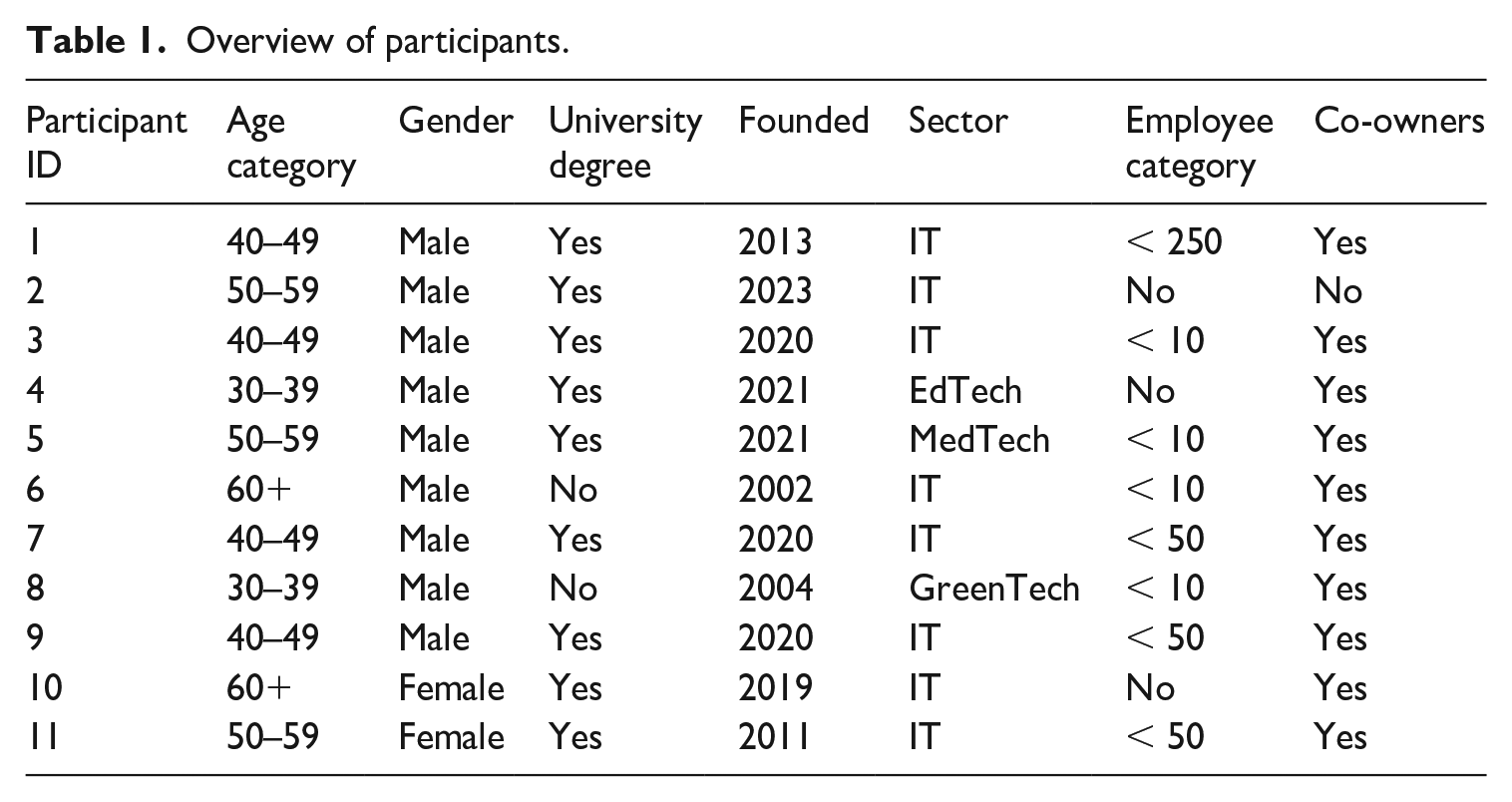
To achieve as much qualitative representativeness as possible, diversity across contextually relevant experiences and perspectives was sought (see Table 1 for information on the participants). Nine men and two women participated in the study, with ages ranging from 34 to 65 (average age 49). Educational background varied from not having attended university to having completed a PhD, and entrepreneurial experience varied from recently having founded a first company to already having founded several successful companies. In terms of company characteristics, the sample included different sectors: IT, EdTech, MedTech, and GreenTech. Regarding company size, the sample included micro, small, and medium-sized companies, employing between zero and 140 employees, with three entrepreneurs being solo entrepreneurs and another four entrepreneurs currently employing fewer than 10 employees. All entrepreneurs had a limited company, and all but one had co-owners (between one and 17). The companies ranged in age between a few months to 21 years, with six having been founded in the past three years. Lastly, participants were dispersed geographically across the country, with five entrepreneurs working in Stockholm.
Overview of participants.
A semi-structured interview guide with several questions and prompts was used and continuously re-evaluated and shaped throughout the interview process. The same topics were covered in each interview, but the order of questions could vary. After ensuring that participants understood their rights, the purpose of the study, and that the interviews would be recorded, participants gave informed consent and were asked about their background and their business. Sample questions included “What is the best/the worst about being an entrepreneur in Sweden?”, with prompts such as “Could you explain why that is? Do you have any examples? What does this mean for you and your business?” Further questions about expectations were sampled with “Which stakeholders do you consider particularly relevant for your business?”, with follow-up questions probing deeper into experiences: “Can you recount a particularly good or bad situation with stakeholder XYZ?”, and, in cases where respondents had not already talked about expectations: “What do you expect from stakeholder XYZ to be able to run your business?” and “Have your expectations been met?” At the end of the interviews, participants were asked if they wanted to add anything else and were then thanked for their time.
We employed an inductive approach to thematic analysis to allow themes to emerge from the data while maintaining a structured process (Braun and Clarke, 2013). Unlike reflexive thematic analysis, which foregrounds researcher interpretation, this approach aimed to limit subjectivity by ensuring themes were consistently derived from participant responses rather than researcher reflexivity (Braun and Clarke, 2021). Coding was conducted through semantic and latent coding, focusing on identifying patterns of responses from the respondents. This was done using the software QDA Miner. Both authors engaged with the materials and discussed insights together to ensure consistency in coding and theme identification. The first author engaged in inductive coding of all interviews. The second author engaged in reading all transcriptions and codes, as well as discussing results to deepen the understanding of participants’ meanings. Theme development was done by both authors in mutual discussions, in an iterative process between data, codes, and candidate themes. Figure 1 shows exemplary codes. Data saturation was used as a guiding principle to determine the final sample size. Following Braun and Clarke’s (2006) thematic analysis approach, saturation was considered reached when no new themes, subthemes, or meaningful insights emerged from the data.
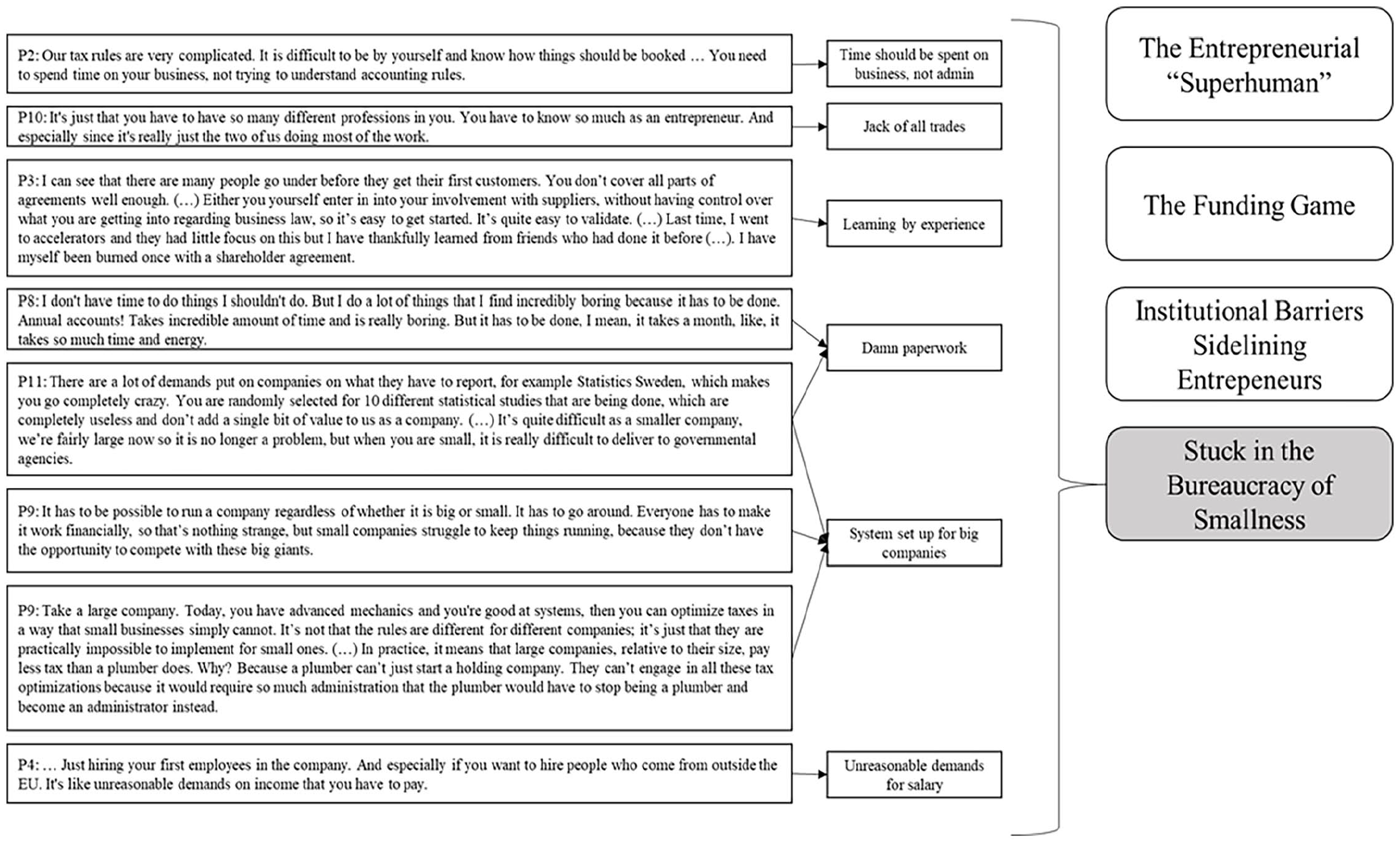
Example quotes and codes for subtheme “Stuck in the Bureaucracy of Smallness.”
Results
The results of our analysis are presented in four parts. The first part deals with the entrepreneurs’ experiences of the societal view on them, as well as their own view on their entrepreneurship and the commitment expected from them. In the second, third, and fourth parts, a more detailed account of the entrepreneurs’ unmet expectations towards society and the state are given. Specifically, the second part deals with funding issues, the third with institutional barriers, and the fourth with the bureaucracy of smallness.
The entrepreneurial “superhuman”
Considering both the public and scholarly image of tech-entrepreneurs as the most prestigious form of entrepreneurship, this first part deals with the paradox of the entrepreneurial ideal versus reality.
Participants felt that the view by others concurs with the positive and somewhat idealized view of entrepreneurs as “superhumans” (P4). According to the participants, especially younger people think being a tech-entrepreneur is a dream job. Several of the participants recalled that as soon as they revealed their entrepreneurial identity, people’s behavior changed: “If you say you run a company or you’re a CEO, suddenly you start getting lots of questions about what it’s like to run a company. (. . .) Having ‘CEO’ on a business card has become a status symbol” (P8). The communication of admiration often happens in face-to-face encounters but also through social media. One of the female entrepreneurs shared that she gets a lot of confirmation on LinkedIn: “People come and say, ‘Oh my God, go for it!’ and ‘Damn, you’re a real role model.’ (. . .) Entrepreneur is a buzzword. It’s damn cool to be an entrepreneur, right? And extra cool to be a tech-entrepreneur” (P10).
Yet, the admiration communicated by others also incorporates an element of risk, where people find entrepreneurship impressive and fun to watch, but would not do it themselves. While referring to people’s more or less explicit question of “why would you do that to yourself?”, participant P9 explained: “I think people look at it with a mixture of delight, mixed with horror. It’s kind of like when you watch ski jumping. It looks completely insane. Don’t do it. But it’s very fun to watch when others do it.”
Part of what participant P9 describes as “completely insane” about being an entrepreneur may be the fact that being an entrepreneur is experienced as very demanding. The entrepreneurs’ narratives were ones of intense commitment, reporting that they worked a lot of hours and were always attuned to the demands of the job. Thinking about work non-stop was considered an inherent trait of entrepreneurship: “Being an entrepreneur, it’s not a job, it’s a passion. It’s something you do 365 days a year, 24 hours a day. And if you don’t love what you do, it’s not going to work” (P11).
One reason for always keeping going can be found in the participants’ high ambitions, which are not necessarily expressed in terms of company size or revenue, but in terms of greatness. Participant P10 likened entrepreneurs to heroes: “We [entrepreneurs] are a bit like heroes because we’re trying to create something,” and participant P5 claimed world dominance for entrepreneurs: “In contrast to [regular self-employed people] a startup company aims for a kind of world domination.” Beyond greatness, the entrepreneurs also shared that they were fueled by a drive to create and build something, that they had a vision or idea, and wanted to contribute to people’s lives. Participant P3, for instance, said: “You’re not doing it for the money (. . .) we want to give something to the world that someone appreciates and helps someone.” Participant P10 expresses a similar feeling in even stronger terms: “I’m driven by truly believing in this. (. . .) What will be written on my tombstone? (. . .) It’s about the reason for being.” Participants described the pure joy of being creative, building and growing something from scratch, particularly when their work was completely aligned with their own values. Their work was described as an all-encompassing passion, as participant P11 expressed: “It’s the fire, it’s the passion, it’s the drive! It’s about creating things from nothing, from empty hands, creating something, seeing it grow, and going your own paths.”
While one part of the “completely insane” (P9) entrepreneurial journey consists of being a visionary, being highly motivated, and working non-stop out of sheer excitedness, other aspects of entrepreneurial life are less glamorous and demand “superhuman” (P4) behavior. Several participants mentioned physical and mental issues, like gastric ulcers, problems with keeping their weight down, wear and tear in their bodies, high levels of frustration, and problems winding down. Health problems were normalized and ubiquitous, as participant P9 recounted: “The majority of my colleagues have burned out or suffer from permanent damages, primarily stomach issues. I have multiple stomach diseases. I don’t think I know anyone who doesn’t have it in my industry.” Participant P2 expressed the normalization of ill-health in even stronger terms: “I often joke and say that if your health and relationships aren’t suffering, then you can work harder.”
Additionally, entrepreneurs expressed frustration about the fact that there is no such thing as taking sick leave, parental leave, or vacation days for entrepreneurs. While it is taken for granted in Sweden that everyone should be able to be sick, stay home with a child, or take vacation without big financial losses, the reality for the interviewed participants was that they felt excluded from the welfare system. They expressed that the system treats employees better than the people providing jobs for them. One participant described entrepreneurs’ inaccessibility to the welfare system in relation to the demands entrepreneurs face as employers:
We have a society that places a great deal of responsibility on the entrepreneur. (. . .) But the entrepreneur is a single person who maybe has two or three or five employees. They are all humans. How come one of them does not get to take vacation or be able to take sick leave because they are faced with such high demands to deliver [jobs] to others? (P2)
The question by participant P2 regarding how it can be that those providing jobs to others do not enjoy the same welfare rights as their employees was echoed in many of the interviews. Participants expressed feelings of unfairness when talking about small businesses with only a few employees being expected to fulfill the same normative expectations for their employees as big companies—while not being in a situation where they can provide these things for themselves. Thus, while the welfare system works for employees, respondents were of the opinion that it does not work for entrepreneurs, although they are the ones taking the financial risks and putting in a lot of effort into making their business work.
The entrepreneurs also highlighted that the impact of responsibilities and a never-ending workload means that their partners need to accept the strain entrepreneurship puts on their relationships:
I work a lot now, but when I was young, I was always working. It was really seven days a week, around the clock, and we have four children, and she [spouse] had to take a huge load. (. . .) It’s extremely tough to be married to an entrepreneur and having to take responsibility for the house, home, and children. (. . .) This is probably the biggest price that many [entrepreneurs] have to pay. (P6)
In sum, the sentiment of entrepreneurs being “superhuman” captures not only their visionary capacities and strong work ethic, but also the resilience that is necessary regarding the contextual prerequisites the entrepreneurs describe as demanding and unfair in the interviews. Not least due to their negative affective reactions to their experience of exclusion from or inaccessibility to welfare support, one can deduce that the entrepreneurs had expectations of getting something in return for being “superhuman” tech-entrepreneurs. Based on their reactions and comparison to employees, the entrepreneurs had expectations towards the state, even if unwritten and implicit, that were not met.
The funding game
One of the most prominent—and known from the literature—problems faced by entrepreneurs concerns the constant struggle to secure a stable financial situation for their business to survive. On the surface, solutions to the funding problem seem abundant due to various funding agencies and venture capitalists. Yet when diving deeper into the participants’ narratives, it became clear that the funding issue was linked to the entrepreneurs’ implicit expectations.
Applying for funding was experienced as tedious with low success rates, as participant P4 pointed out: “It’s maybe 8–9 out of 10 of those who seek investments that don’t get investments. (. . .) This hinders entrepreneurs across the board.” Furthermore, there seemed to be an inherent catch-22 since funding often is granted to already established companies: “It’s practically impossible to borrow from a bank without a solid cash flow. And if you have a solid cash flow, you usually don’t need to borrow money” (P5). Interview participants agreed that funding was needed especially before they reached the stage of a solid cash flow. The entrepreneurs also shared that they found it difficult to know what kind and how much effort to put where to solve this contradictory logic.
Some participants deliberately focused on learning how to navigate the funding game. Here, the importance of relations to individual financiers and the ability to handle them was mentioned: “[Getting funding is] more dependent on the financiers themselves than anything else. There are those who are easier to handle, and those that are more difficult to handle” (P7). In a similar vein, participant P5 argued that particularly state funding was energy-draining:
It would be better to raffle off the money than to sit and fill out lengthy applications. It’s also a hindrance for entrepreneurs where these [funding agencies] attract interest but then they drain your energy. (. . .) Often, there are people working there who don’t have direct experience of entrepreneurship, they’ve just read about it. And then they theorize.
Apart from financiers’ idiosyncrasies and decision-makers’ perceived incompetence, there is also the matter of networking, contacts, and gender issues. Participant P10 shared a rather sober picture of the prerequisites for (older) female tech-entrepreneurs when she mentioned that she was operating in the context of a “Boys Club”:
You need to know someone. And you can see that male networks surely have it a bit easier. It’s not many percent of the capital that goes to [older female founders]. (. . .) It’s still The Boys Club, you know. That’s just how it is and guys get completely different questions from investors than girls. Girls get: But how do you think you’ll manage? And much more diminishing questions. While guys get more expansive questions. It’s just ingrained in the whole system. (. . .) We don’t really have time to sit and be angry or offended, it’s just about pushing forward. Just keep going.
Thus, beyond business ideas, communication and people skills, entrepreneurs are also faced with the need to know the right people and belong to the “correct” sex category. Particularly the latter aspect creates insecurities that have their origin in societal norms and expectations regarding who successful tech-entrepreneurs are—or should be.
The interviews showed that particularly early-stage entrepreneurs often spend the better part of their working hours chasing funding—an activity that demands great efforts. Yet, the question is in what way success in the funding game in fact can alleviate the entrepreneurs’ situation. Some entrepreneurs highlighted their gratefulness for having solved the money issue, at least temporarily. Others, however, pointed out that receiving funding can cause other problems and uncertainties. One such problem is the fact that state investors demand high interest rates, making the loans an expensive business, as participant P10 illustrated: “They [state investors] have given us loans. (. . .) At the same time, we’re sitting on pretty hefty interest rates, right?” The same experience is shared by participant P5: “But the money almost makes you angry because it’s an 8% interest rate (. . .) for state money, which is quite absurd.” Thus, while funding can provide the entrepreneurs with much needed resources, it can, at the same time, create new stressors and insecurities that both need attention and problem-solving.
In theory, being an entrepreneur can generate wealth. Yet, instead of tales of prosperity, participants’ narratives tell a story of finances being a constant headache. In the absence of external funding, participants mentioned different ways to keep their business afloat, for instance by using their occupational pension or savings, selling their apartment, taking student loans, or taking on extra jobs. Participants also shared that all available financial means go into product development, and for many it took several years of development before they registered their business and were able to take out a salary for themselves. Not having enough or an uncertain income was described as stressful for themselves and their families. Participant P5 recounted: “We put in private money, our own money, and take a tremendous amount of personal risk. And this is where the family suffers, putting houses and everything at risk. That’s just how it is to be an entrepreneur.”
Summarizing, although building a business is at the core of entrepreneurship, the respondents felt disappointed in their expectations to be supported in this risky undertaking by their environment. Having to carry the entire financial burden themselves, and even to transfer it to their families and loved ones, was not perceived as the reciprocal exchange they were hoping for.
Institutional barriers sidelining entrepreneurs
In this part, two institutional contexts are discussed that do not meet the entrepreneurs’ expectations: the power of state agencies, and one particular institutional practice, the public procurement system.
In general, participants preferred to have as little as possible to do with the state and governmental agencies. While they were conscious and respectful of the fact that the state has the power to make or break their business, they also complained about a lack of transparency and efficiency because of inertia and a lack of direct contact. Several participants highlighted that the relation to the state is purely formal, one-sided, and oftentimes digital, not offering the possibility to talk to an actual person. Yet, apart from that, one particularly problematic aspect that demonstrates the power of governmental agencies concerned the recruitment of international talent. Entrepreneurs were forced to recruit employees from other countries, as participant P9 expressed: “We’ve given up on recruiting in Sweden. There’s no point.” The process of legally getting people to Sweden has proven to be a very long process—with sometimes serious consequences. Participant P1 explained:
We hire quite a few people from abroad. And the Migration Agency has been a debacle over the past year. (. . .) The processing times have been up to six months. We depend on getting the workforce we need. (. . .) It has certainly hindered our growth.
Several entrepreneurs talked about how long processing times leave both the recruits and the employers hanging in limbo, not knowing whether they can quit their current jobs or accept new clients. In the worst case, people have already quit their jobs and end up being unemployed for several months until the Swedish authorities have dealt with their case. For entrepreneurs, this means lost business opportunities. Participant P3 suggested that there should be fast tracks allowing to get through the system more quickly:
There are a lot of foreign people coming from abroad that you want to hire. I find it very cumbersome, and they do too. It’s really complicated. (. . .) It takes time, and above all, it’s some kind of limbo for the staff.
While the entrepreneurs put a lot of effort into administrative tasks and navigating bureaucratic mazes to grow their business, they do not find that their expectations regarding opportunities for scaling are met.
Another institutional barrier for tech-entrepreneurs is the public procurement system and an allocation of contracts that is experienced as unfair. Several participants recount instances where they applied for public procurements, but their tender was declined in favor of another company’s—usually a large, established company, as participant P9 explained: “There’s a lot of money, but essentially, it’s already allocated. The concept of public procurement is flawed. It doesn’t work because it’s not tailored for small companies.” Participant P3 argued along the same lines and said that the system is flawed since it only allows big players to get the deals:
In this country, public procurement essentially means that as a small player, we are completely excluded from these types of procurements. Sure, you can’t be too small either. (. . .) But somehow it should be opened up for smaller players too.
Several participants note that engaging in the procurement process takes a lot of time and effort, yet essentially never leads to success. Participants mention how they, as entrepreneurs and innovators in the tech sector, often have unique products that could be of particular value for the public sector. Yet, when big companies compete with their tenders, they often lie and claim to be able to offer the same products or services as the smaller companies—and strike the deal:
What I’m objecting to is this issue with public procurement. It severely hampers innovation. (. . .) It drives us crazy. (. . .) When the big players systematically lie their way through to win deals, you know. (. . .) It also means that maybe we’d rather seek opportunities abroad and build a market overseas, which is harder than selling in our home market. (P5)
Participant P5 outlines the consequences of the exclusion from public procurements, namely an orientation towards international markets. He also mentions that it is much harder to sell internationally, meaning that one headache is exchanged for another. Many entrepreneurs ultimately lose interest. The process costs more than they gain from it, not only in time and money but also in psychological effort due to the feeling of being excluded from the start.
In sum, while the entrepreneurs expect their surroundings to accommodate their ambitions to grow their businesses, they experience the opposite to be true, with governmental agencies, rules, and regulations sabotaging and sidelining them in their entrepreneurial endeavors.
Stuck in the bureaucracy of smallness
As the previous themes showed, the interviewed entrepreneurs do not lack ideas, engagement, or commitment. The opposite is the case: they are dedicated to making their ideas work and to growing their business. However, the smallness of their company gets in the way and causes a set of problems. Because of a lack of personnel, the entrepreneurs are forced to engage in administrative and bureaucratic tasks. Particularly paperwork and details related to annual reports and tax issues—things they often know very little about—takes time from what they want and need to engage in: their business idea. Participant P2 said: “One needs to focus on one’s business, not on trying to understand accounting rules.” The entrepreneurs communicated feelings of being overwhelmed and frustrated since they felt forced to solve such tasks themselves, reach out to friends or family or chase free online tools for help, as participant P10 explained:
I feel like my brain is about to burst. (. . .) You're constantly chasing free stuff. There aren’t many tools that we’ve been able to buy, so you’re just juggling around with free tools. (. . .) I’m sitting here, frantically watching YouTube [tutorials] and just like “Aaah!!”
The interviews also revealed a more overarching pattern regarding smallness: The entrepreneurs expressed frustration with the fact that the Swedish labor market system, in their eyes, is not in favor of small companies, and therefore demands a lot of unnecessary effort from them. The framework in which entrepreneurs operate is mostly designed to fit large companies, as participant P2 argued: “We are a country tailored for big companies. But big companies exist because they were small once upon a time.” Participant P7 expressed this similarly: “Generally speaking, many small businesses may indeed be frustrated because the regulations are pretty much the same for all types of companies. (. . .) We all live under the same rules, more or less.” Participant P9 explained that while life is made easy for big companies, small companies must put unreasonable amounts of effort into the same tasks:
Almost all systems we have are tailored to the idea that all companies should grow and become bigger. And the larger you get, the more advantages you get. This fits quite poorly with a country like Sweden where 97% of all companies are small and medium-sized enterprises, meaning fewer than 50 people. The more you grow, the more the systems are adapted to make life easier for companies that want to become large. The system is sort of rigged for that. It’s a poor match.
Following from participants’ statements, it could be argued that entrepreneurs are faced with equal, but to them unjust, prerequisites. In terms of company size, they do not have a level playing field. Participant P9 suggested different rules for different company sizes: “If you look at soccer, if you look at any context, you have slightly different rules for slightly different dimensions or divisions.” While one could argue that whoever wants to play needs to adhere to the rules of the game (“If you choose to run a business, you have to do so under the existing conditions,” P7), it becomes clear from the interviews that other participants find the prerequisites unjust. They would like to see different regulations for different company sizes, which would reduce the efforts the entrepreneurs view as overly burdensome and superfluous.
Lastly, the entrepreneurs shared their experiences with governmental agency officials or what one participant called “the establishment.” The entrepreneurs described an us-and-them situation between themselves and the establishment that treats them as outsiders and causes extra work. According to the entrepreneurs, the establishment views entrepreneurs with suspicion, assuming they engage in fraudulent activities, exploit workers, and keep the money to pay themselves a high salary:
This is a part of the Swedish mentality. (. . .) That view of entrepreneurs as those who exploit people. (. . .) Those [government] officials, who have chosen a secure life, they think it’s a bit crazy and strange that one has chosen such a lifestyle. (. . .) And when it comes to anonymous officials at the Tax Agency, (. . .) you just notice that you have to report often and a lot, so there’s a certain suspicion. (P2)
Taken together, the expectation that the efforts of (much sought-after) tech-entrepreneurs would be met with circumstances facilitating their ventures is experienced as unmet and disappointed by the respondents. Their frustration with systems, circumstances, and environments that hinder them from growing is palpable in the interviews.
Discussion
Our study contributes to the understanding of how tech-entrepreneurs in Sweden experience the contextual prerequisites that influence their ventures and how their expectations regarding institutional support shape their entrepreneurial journey. Specifically, we extend the concept of the psychological contract—typically explored in dyadic relationships between employers and employees—to a broader, systemic level by examining the implicit contract between entrepreneurs and their institutional environment.
The first key finding highlights the notion of tech-entrepreneurs as “superhumans,” meaning they must navigate an institutional context that does not necessarily support or safeguard their progress. Prior research has documented high levels of stress and workload among entrepreneurs (Boyd and Gumpert, 1983; Stephan, 2018) and has pointed out that psychological capital and positive affect can mitigate stress in entrepreneurs (Baron et al., 2016). Yet, our findings reveal a more nuanced reality, where even successful and resilient entrepreneurs, who invest their available resources into their businesses, often find themselves burdened by the lack of a welfare safety net. This challenge is particularly pronounced in Sweden, where employees benefit from extensive social protections (Henrekson and Roine, 2007; Statens Offentliga Utredningar, 2021). Given this context, it is understandable that entrepreneurs expect institutional support, as the broader societal mentality fosters a belief in governmental safety nets. In other contexts, such expectations might seem unrealistic or naïve, but in Sweden, they align with the cultural norms surrounding welfare and social security. Therefore, the contrast of the institutional divide between the security afforded to employees and the precariousness faced by entrepreneurs can generate feelings of sacrifice and unfairness.
We can only speculate if and what attitudinal or behavior consequences such a potential perceived breach of the psychological contract may have. Equity theory (Adams, 1965) would suggest that entrepreneurs will try to remedy and compensate for these sacrifices. For instance, entrepreneurs may wish to take a larger dividend from the business as compensation or may encourage their accountant to look extra carefully where to save tax payments. Entrepreneurs may also cognitively reframe the experience and justify their disadvantages regarding the welfare system by operating outside of the traditional labor market. Instead, the effort–reward imbalance (Siegrist, 1996) would suggest that entrepreneurs see these experiences as lack of rewards, despite high efforts, which can lead to higher strain and poorer health. A first avenue to test these ideas would be to examine how entrepreneurs move on from disappointments and experiences of psychological contract breach (Piccoli and De Witte, 2015).
The second finding revolves around the availability of financial support for entrepreneurs. Contrary to what might be expected based on the generally supportive institutional context of the Swedish welfare state and societal norms, Sweden does not offer more state funding for startups compared to other countries (GEM, 2025; OECD, 2023). When entrepreneurs encounter limited public funding opportunities and instead rely on private investments—often at the expense of their personal and family finances—they experience a sense of institutional betrayal. The divide between expectations and reality can lead to frustration and, in some cases, resentment towards government agencies, particularly when bureaucratic processes demand extensive reporting without offering tangible financial support.
There are many reasons why financial support options may be limited, but in this article, we want to highlight that the interviewed tech-entrepreneurs perceived their expectations around finances and funding as unmet, resulting in a problematic consequence: they developed resentment towards decision-makers, banks, funding agencies, and governmental agencies. Given previous studies on the consequences of perceived unfairness in relation to work and well-being (Cropanzano and Ambrose, 2015), this is highly relevant for our understanding of how well entrepreneurial ecosystems work. Sweden has traditionally been a high-trust country (Henrekson and Roine, 2007), but over time, unfairness perceptions can elicit political cynicism (Van Hootegem et al., 2022) and erode the institutional setting entrepreneurs are operating in.
A similar institutional barrier is the public tender system. The system is designed to encourage competition, implying that any company with a high-quality product and competitive pricing has a fair chance of securing public contracts. However, large, well-established firms tend to dominate these opportunities, making it difficult for smaller tech-startups to compete effectively. Entrepreneurs enter the system with the expectation of fairness, only to encounter structural disadvantages that favor companies with extensive resources, long-established reputations, and the capacity to meet complex bureaucratic requirements. This is a known barrier in Sweden, as the government initiated improvements to the tender system for smaller businesses (Statens Offentliga Utredningar, 2018). Nevertheless, there are a variety of reasons for the current design of the tender system, one being to prevent crime and corruption, that make it difficult for SMEs to compete with large companies.
Furthermore, participants mentioned government officials’ suspicion towards smaller or unknown business owners. Instead of being welcomed as entrepreneurs and employers, the tech-entrepreneurs were disappointed when they realized that they were, justified or not, viewed with suspicion. This lack of respect and trust propensity (Colquitt, 2001) adds another dimension to perceiving an unfair institutional barrier, because lack of respect and of not being seen as righteous and honorable due to the mere fact of being a tech-entrepreneur likely elicits strong negative emotions, like anger and sadness (Bies, 2001). Strong negative emotions resulting from perceptions of unfairness relate strongly and negatively to commitment, satisfaction, and performance (Colquitt et al., 2013).
A final insight relates to the role of smallness in the Swedish entrepreneurial landscape. Entrepreneurs in our study encountered a tension between two competing models: the Silicon Valley model, which emphasizes rapid scaling and the creation of unicorn companies, and a more localized, organic approach comparable to that of the German “Mittelstand” (Pahnke and Welter, 2019), where businesses grow slowly but steadily and become deeply embedded into their regional environment. Many entrepreneurs entered the ecosystem believing that Sweden supports a Silicon Valley-style growth model, only to realize that the institutional rules and structures do not fully align with this approach. While some accepted and adapted to this reality, others experienced it as a violation of their expectations, leading to frustration and uncertainty about their long-term prospects and their future in Sweden.
Our study does not argue for specific policy interventions but rather highlights how the mismatch between expectations and institutional realities influence tech-entrepreneurs’ experiences and attitudes. The findings highlight the importance of understanding how institutional contexts shape entrepreneurial expectations. The entrepreneurs’ experiences underscore the potential need for clearer communication about Sweden’s entrepreneurial framework. If the country prioritizes steady, sustainable growth over rapid scaling, this should be reflected more explicitly in policy and support structures. Entrepreneurs, in turn, would benefit from greater awareness of which growth pathways are realistically supported within the Swedish context, allowing them to align their strategies accordingly. Policymakers and stakeholders such as incubators should consider these perspectives when designing support mechanisms and ensure that entrepreneurs are adequately informed about the financial realities of running a business within Sweden’s institutional framework.
Overall, our primary contribution lies in demonstrating how the institutional framework shapes the psychological contract of tech-entrepreneurs. While psychological contracts have traditionally been studied in interpersonal settings (e.g., between entrepreneurs and employees; see Coyle-Shapiro and Parzefall, 2008), we extend this concept to the entrepreneur–institutional context relationship. Our findings reveal that society and the state foster expectations about the level of support and resources entrepreneurs can access. However, when these expectations are unmet—whether through bureaucratic inefficiencies, inconsistent policies, or a perceived lack of competence among state actors—entrepreneurs experience frustration and unfairness and become cynical and less trusting towards the system. This breach of the psychological contract risks manifesting not only in individual disappointment but also in broader consequences: if entrepreneurs perceive the state as unsupportive or incompetent, they may disengage, relocate, or hesitate to invest further in their ventures—ultimately impacting economic growth and innovation.
Our second contribution is to the broader call for a contextualized understanding of entrepreneurship (Shepherd et al., 2018; Welter, 2011), emphasizing that entrepreneurs do not act in a vacuum but are influenced by their interactions with institutions, policies, and broader societal narratives: they are embedded within a broader system that implicitly communicates expectations about what it means to be an entrepreneur. Prior studies have emphasized the importance of inherent traits, dispositions, and entrepreneurial capacity and behavior (Baron et al., 2016; Cardon et al., 2009; Hartmann et al., 2022). We highlight that entrepreneurs’ subjective experiences of contextual factors are equally important. Many entrepreneurs in our study reported experiencing unmet expectations not with individual stakeholders, such as employees as explored in prior research (Nadin and Williams, 2012; Ntalianis et al., 2015), but with the institutional environment as a whole. This shift in focus from individual stakeholder relationships to systemic expectations adds nuance to existing discussions on the impact of the entrepreneurial ecosystems on entrepreneurial activity and success (Dutta and Khurana, 2024; Roundy and Burke-Smalley, 2022).
Methodological considerations
The study’s limitations warrant caution. Given the small sample size, it is difficult to generalize findings to all high-tech entrepreneurs in Sweden, or abroad, or to other types of entrepreneurs. Given the contextualized approach, the findings may only be applicable to other tech-entrepreneurs in institutional contexts with similar welfare state legislations. However, the approach of studying expectations of entrepreneurs in relation to the social and institutional environment can be extended to other contexts. Further, entrepreneurs volunteered for inclusion in the study, which bears the risk that the more frustrated entrepreneurs may be overrepresented. To safeguard against this as much as possible, we kept the description of the study neutral, being interested in experiences of business owners in Sweden in general. Moreover, we were careful in asking open-ended questions and received varied views and opinions. We also sampled from a diverse group of tech-entrepreneurs, regarding age, gender, educational background, industry, entrepreneurial experience, size of organization, etc. In addition, we also made sure to anchor the findings in discussions with peers, with subject matter experts, and with support organizations for entrepreneurs.
Conclusions
The disappointment and frustrations experienced by both first-time and seasoned entrepreneurs in this study suggest that these issues are not isolated but systemic, with potential consequences for the long-term sustainability of the entrepreneurial ecosystem. Therefore, these findings raise important questions: Are unmet expectations simply a reality of entrepreneurship that entrepreneurs need to learn to live with? Are there untapped options to actively educate entrepreneurs on the challenges of running a business? Is it possible to recalibrate the expectations the institutional environment sets for entrepreneurs to foster a more predictable and supportive environment? Ultimately, our findings reinforce the importance of context in shaping entrepreneurial expectations and experiences. Understanding these dynamics is critical for policymakers and stakeholders—both for fostering an ecosystem that acknowledges and addresses the specific challenges faced by tech-entrepreneurs in Sweden, and for realizing that fostering entrepreneurship is not just about providing resources but also about managing expectations.
Footnotes
Author contributions
CE contributed with the initial conceptualization of the study and the grant that enabled the data collection. Both authors contributed equally to theorizing, the analysis, the initial writing and the revisions. Both authors read and approved the final manuscript.
Declaration of conflicting interests
The authors declared no potential conflicts of interest with respect to the research, authorship, and/or publication of this article.
Funding
The study was enabled with funding from the Swedish Research Council for Health, Working Life and Welfare (2021-00916).
