



Abstract
Technological changes associated with the rise of digitalisation are sometimes envisioned as disrupting forces for the role of workers on the shopfloor. Whether these changes will lead to enhanced or reduced participation of labour and unions has been the subject of conjectures put forward by different schools of thought. The article proposes a framework mobilising various forms of participation to understand patterns of involvement under technological changes. An exploration of four cases in the aluminium and rubber manufacturing sectors in Québec (Canada) reveals a high variation of participation schemes, ranging from collective and formal to mixed (collective and formal, direct and informal), and direct and formal. The authors argue that patterns of participation at work should be understood as the outcomes of the material conditions (technology, markets, economic) in which workplaces are embedded in conjunction with the ability of workers and unions to mobilise power resources to influence changes at work.
Introduction
Workers’ participation has been an ongoing topic of debates within the field of employment relations and has been analysed within various frames of reference, reflecting diverging views of its meaning, purpose and outcomes in workplaces (Wilkinson et al., 2010, 2020). Yet, the recent wave of technological changes surrounding ‘digitalisation’ has renewed interest in the role of workers, including potential new forms of participation. How does digitalisation affect different forms of workers’ participation and can workers – individually and collectively – shape its effects on their work efforts? To date, analyses of the effects of digitalisation, in its various forms, on workers’ participation have tended to follow earlier paradigms regarding changes at work, ranging from techno-optimist, socio-technical, to critical accounts (Vereycken et al., 2021), and the current state of research, which is empirically limited, makes it is difficult to identify the changing patterns of participation.
The goal of the present article is to analyse how digitalisation affects workers’ influence within participation schemes and to identify factors determining the forms of that participation in various unionised manufacturing industries. Following Wilkinson et al. (2010: 11–12), we broadly conceptualise workers’ participation as: ‘the range of mechanisms used to involve the workforce in decisions at all levels of the organisation, . . . whether undertaken directly with employees or indirectly through their representatives’. We argue that this participation can take different forms (direct vs collective; formal vs informal) depending on the influence of a number of factors. Our argument is based on the conjunction of two lines of analysis. First, we explain this variability through a materialist approach highlighting the crucial importance of market, economic and productive conditions that affect the nature of workplace compromises (Bélanger and Edwards, 2007; Edwards, 1986). In complement, we defend the idea that the power resources of workers – in particular structural, institutional and associational – in relationship with these material conditions, strongly affect which forms participation will take.
It is well known that workers’ involvement can take on different meanings, forms and purposes (Dundon et al., 2004; Marchington, 2008; Wilkinson and Dundon, 2010; Wilkinson et al., 2010, 2020). The focus of this article, however, is on participation at the workplace level, particularly in relation to task-based and decision-making aspects of digital technology integration on the shopfloor. We illustrate these impacts through in-depth case studies from two manufacturing industries (aluminium and rubber) in the province of Québec (Canada). We constructed a matched-pairs design to analyse plants affected by digitalisation efforts in order to understand how such implementations influence relationships between workers, unions and managers at the workplace level, whether various workers’ participation tools are mobilised and what type of participation schemes are dominant in this context. Four cases of local plants (two in each industry) were studied using a qualitative research strategy mobilising semi-structured interviews (N = 89) with managers, unionists and workers, as well as the comprehensive analysis of collective bargaining agreements (CBAs) and non-participant direct workplace observations.
Our results show that workers’ participation takes on a range of different forms in the digitalisation context, from collective and formal, to mixed (collective and formal/direct and informal), to direct and formal schemes. Contrary to predictions by both techno-optimists and socio-technicists, we did not find increased participation in the workplace, but rather a continuity of patterns tied to existing social relationships on the shopfloor and the power dynamics between managers, unions and workers. Our principal contribution is to shed light on the dialectic between production, markets, economics and power in order to understand participation and workers’ influence under the rise of digitalisation.
The enigma of participation under digitalisation
With all new waves of technological change come predictions about the nature of their disruptions, their idiosyncratic characteristics and their signification in workplaces. Workers’ role in implementing, refraining from or being alienated by these changes is cyclical and informs the frames of reference and preferences of authors addressing the meanings of participation in organisations. The recent wave of digitalisation 1 is not an exception to this and has given new impetus to predictions of the potential redundancies of human work and its transformation through the deployment of new technical means. But how do these technologies affect workers’ role on the shopfloor and their influence on the organisation of the work effort in the digitalisation context?
Vereycken et al. (2021) surveyed publications addressing the link between Industry 4.0 (I4.0), participation and workplace dynamics. As mentioned above, the authors identify three schools of thought present in the literature. First, the techno-optimist perspective (the dominant school in terms of number of publications) envisions employee participation as a consequence of digitalisation, with generally positive outcomes for workers. Second, the socio-technicist perspective frames the successful alignment of social and technological systems as a prerequisite for digitalisation, producing positive results in terms of workers’ participation, skills and working conditions. Finally, a critical perspective frames participation under digitalisation in terms of a ‘structured antagonism’ between workers and managers that makes potential positive outcomes unlikely given employment relations that are marked by tensions and contradictions.
Techno-optimists, for the most part belonging to engineering and production management disciplines, have described the shift in workers’ role through the ‘Operator 4.0’ concept, i.e. the upgrading of shopfloor workers’ skills and roles resulting from the use of new digital technologies (Kaasinen et al., 2020; Romero et al., 2016, to name but two of the most cited studies). Romero et al. (2016: 1) define the Operator 4.0 as: ‘a smart and skilled operator who performs not only cooperative work with robots but also work aided by machines as and if needed by means of human cyber-physical systems, advanced human-machine interaction technologies and adaptive automation towards achieving human-automation symbiosis work systems’. As for participation, Kaasinen et al. (2020) insist on the need to ‘empower’ the Operator 4.0 and with resources facilitating the adaptation of work to new technologies.
Socio-technicists, whose studies represent a minority in the literature, but tend to have resonance in the policy sphere (at least in countries where digitalisation discourses emerged early on, such as in Germany), prescribe the adaptation of work organisation patterns to digital technologies (Kagermann et al., 2013). According to this approach, the participation of stakeholders is key to performance and the successful deployment of digital technologies. Kagermann et al. (2013: 23), pioneers of I4.0 policies in Germany, argue that in addition to investing in new technologies and deploying flexible production processes, firms should invest in worker participation to complete this shift: [W]ork organisation and design models will be key to enabling a successful transition that is welcomed by the workforce. These models should combine a high degree of self-regulated autonomy with decentralised leadership and management approaches. Employees should have greater freedom to make their own decisions, become more actively engaged and regulate their own workload.
As for the critical approach, workers’ participation in digitalisation efforts is framed in terms of continuity, reflecting the frontiers of control and struggles between workers and managers. Butollo et al. (2018) argue that I4.0, while having much in common with Lean production, is limiting for workers’ autonomy and participation because digitalisation efforts aim to standardise work, making these new systems interdependent and prone to failure, therefore limiting the full potential of genuine employee involvement and problem-solving. Therefore, real participation is an illusion, since digitalisation is designed to intensify workloads and deskill workers, promoting forms of neo-Taylorism.
These three distinct approaches all offer normative perspectives on participation under digitalisation. Socio-technicists and critical researchers generally build their frames of reference on past research into the reorganisation of work, while techno-optimists depict an ideal type that discounts workplace tensions. However, as Vereycken et al. (2021) agree, despite offering rich descriptions of the potential effects of workers’ involvement in organisations, these perspectives are marked by a general lack of empirics on existing implementations, making it difficult to identify conditions under which different forms of participation emerge and are recomposed or marginalised following digitalisation efforts. Recent research has underlined the importance of strong institutions and the capabilities of union representatives to empower workers and shape digitalisation (Bosch and Schmitz-Kließer, 2020; Doellgast et al., 2023; Haipeter, 2020), but has tended to be confined to so-called coordinated-market economies and national-level analyses. The goal of the present study, therefore, is to offer a framework for understanding potential differences in workers’ participation following the implementation of digital technologies in a North American context and how workers and their representatives are (or are not) able to shape these managerial efforts at the workplace level.
Technologies, participation and workers’ power: A conceptual framework
The concept of workers’ participation goes back to the 19th century and originates in debates surrounding industrial and economic democracy. Resurfacing intermittently, workers’ participation has gained traction since the 1990s in a context of profound economic shifts, declining unionisation and an apparently growing desire by certain employers to mobilise their workforce towards achieving superior performance by breaking away from labour conflicts and a Taylorist division of work (Wilkinson et al., 2020). We acknowledge that the concept is rather elastic and has numerous synonyms (e.g. industrial and economic democracy, voice, employee involvement, citizenship at work) but, as stated previously, for the purposes of the present study, we mobilise participation as the encompassing term to describe the patterns in which workers are involved in decisions at all organisational levels (Wilkinson et al., 2010).
What are the purposes and forms of participation in the workplace? Dundon et al. (2004) identify four different meanings of voice at work: the articulation of individual dissatisfaction, the expression of collective organisation, the contribution to management decision-making, and the demonstration of mutuality and cooperative relations. In practice, these meanings can be actualised through specific mechanisms such as grievance procedures, collective bargaining, quality circles, teams and joint consultative committees. Marchington (2008) identifies three types of voice systems: task-based participation, upward problem-solving and complaints to management.
Authors generally divide participation schemes into dichotomic categories: indirect (collective) versus direct (individual) participation (Wilkinson and Dundon, 2010; Wilkinson et al., 2010, 2020). While it is commonly acknowledged that direct participation has risen since the 1990s due to the decline of unionisation and managers’ desire to communicate directly with workers (Wilkinson and Dundon, 2010), both the direct and indirect forms can operate in parallel, in contradiction or in symbiosis, even in unionised workplaces (Marchington and Wilkinson, 2005). Collective/indirect participation is exemplified by schemes in which the involvement of workers with management is channelled through representation (e.g. collective bargaining, works councils, elected stewards). Direct participation, on the other hand, can refer to a wide array of mechanisms that promote interaction between workers and management individually or in small groups (e.g. direct complaints, quality circles, team-based work, continuous-improvement mechanisms), without traditional forms of representation.
Focusing on other lines of division, some authors have aimed to assess whether participation is codified in explicit norms and procedures or whether it reflects the daily interactions of workers and managers in their relationships within production. Incidentally, participation can take formal and informal forms that may be present simultaneously in an organisation (Litwin and Eaton, 2018; Townsend et al., 2013). Formal participation is indeed codified within prevailing structures, norms and rules that foster involvement of workers (Litwin and Eaton, 2018; Wilkinson and Dundon, 2010). Informal participation, rather, is defined as the ‘day to day relations between supervisors and subordinates in which the latter are allowed substantial input into decisions . . . a process which allows workers to exert some influence over their work and the conditions under which they work’ (Strauss, 1998: 15) and is usually located at the local (shopfloor) and intermediate (department) levels of organisations (Townsend et al., 2013).
Furthermore, participation schemes vary in terms of degree, scope, level and form (Marchington, 2008; Wilkinson et al., 2010). Variations of degree relate to the intensity of control workers exercise through participation. While this degree can be relatively low, as in the case of information sharing, it can also be high, such as when participation is deployed through co-determination and workers’ control. Scope refers to focus and reach of participation, and can vary widely (e.g. task-based, strategic decisions, financial participation). Moreover, participation can occur at different levels: shopfloor, department, plant, corporation, multinational corporation. Finally, as discussed earlier in this section, participation can take different forms: direct, indirect, formal and/or informal.
The fundamental issues addressed by the present study are the influence of digitalisation on workers’ participation and the impact of various participation schemes on the deployment of new technologies. A priori, our conceptualisation concerns the scope, level and forms of participation. We focus our attention on task-based and upward problem-solving scopes, which are crucial for the nature of the work effort. In terms of level, we concentrate our analysis at the shopfloor/organisation level, without discounting the influence of other levels. Finally, an analysis of the forms of participation is crucial. To this end, we propose a framework that includes the four types discussed previously: while collective vs direct and formal vs informal can be conceived as dichotomous, we argue that different combinations of any and all of the four are possible in any given case; we therefore seek to identify the dominant patterns of these combinations in relation to digitalisation. As for the degree of participation, this issue is a matter of empirical exploration. Figure 1 illustrates our framework of analysis with examples of existing forms of participation in a North American context.
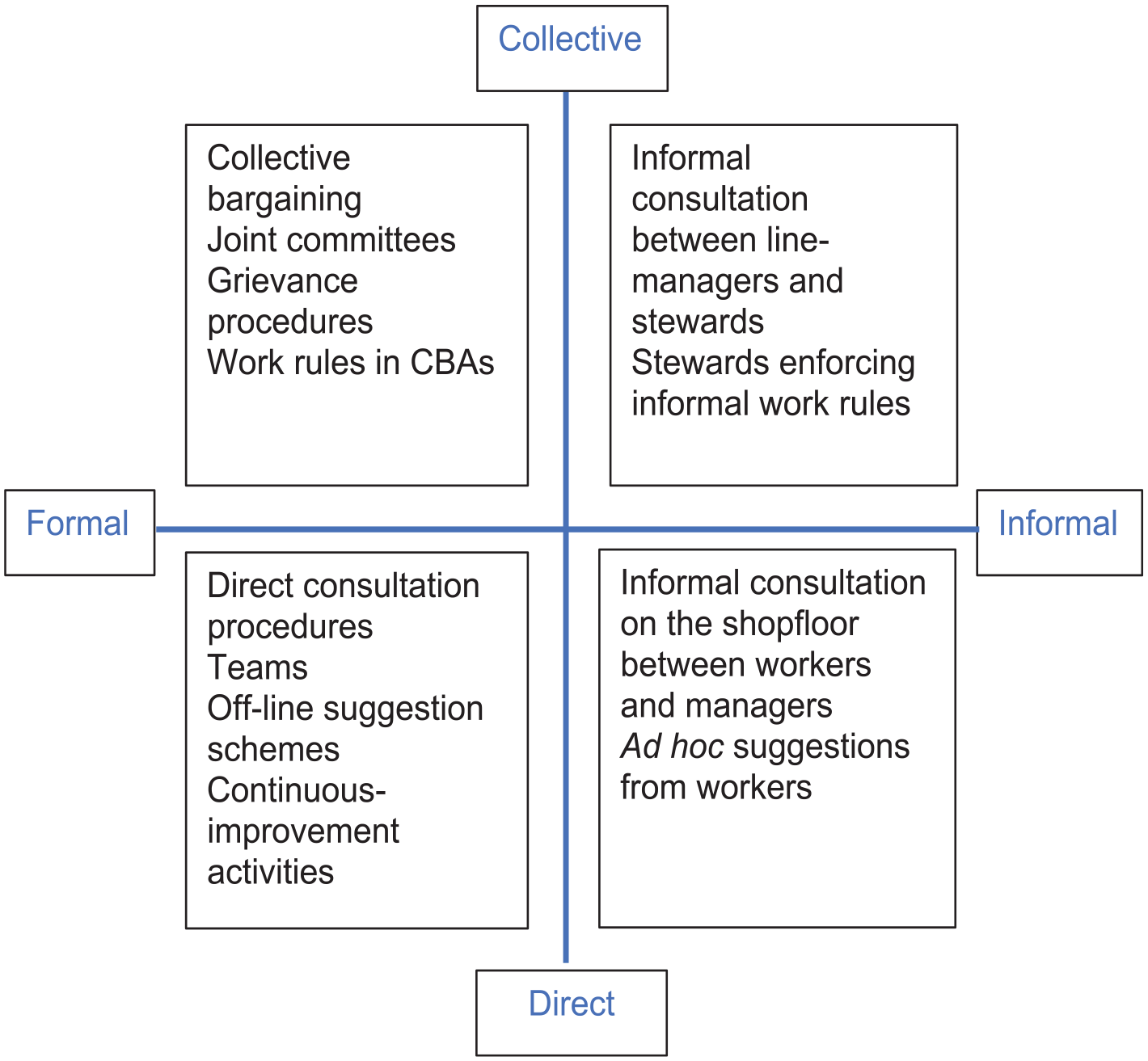
The forms of workers’ influence on the shopfloor.
This framework is useful to describe forms of workers’ participation and influence in organisations. It does not, however, provide insights into why a given pattern may be adopted/deployed instead of another. We argue that existing forms of workers’ influence on the shopfloor should be understood as the outcome of workers’ and unions’ ability to mobilise different forms of power which they retain in the sphere of production and exchange (Refslund and Arnholtz, 2022). In this article, we focus on three main forms of power: structural, associational and institutional. Structural power may be defined as: ‘the capacity to control, structure, and disrupt production and distribution at either the site of production or at more aggregated societal levels’ (Arnholtz and Refslund, 2024: 12). Associational capacity, for its part, is linked to ‘trade unions that enable organisations to create and express unity of action among members of the group it represents to realise collective interests’ (Arnholtz and Refslund, 2024: 12). Finally, institutional power is defined as: ‘the capacity to use formal rules to enable one’s own ability to influence labour politics and limit opponents’ ability to do so’ (Arnholtz and Refslund, 2024: 12). We conceive these forms of power as being variously overt and latent, formal and informal (i.e. crystallised in the day-to-day relations of production), and as manifest in the interactions of workers and unions with managers.
How might power vary and how does it influence participation in workplaces? Our core theoretical argument in this article is that the material conditions of a given workplace interact with the capacity of workers to mobilise specific power resources and their ability to shape participation schemes. It is relevant to note that both pluralist and critical writers have deployed such factors to account for how workers’ position in the labour process and in the economic sphere affects forms of participation. In his classical work, Poole (1986: 39–43) framed participation in terms of power and ideology. In his analysis, government action promoting participation is crucial, as are economic (labour market conditions, product market, concentration of the industry) and technical (types of technologies, their impacts on workers’ skills) factors. Likewise, Marchington (2008: 243) highlights key factors influencing the adoption of voice systems, including product markets (oligopolistic and stable vs highly competitive and unstable markets), technology and skills (capital-intensive vs labour-intensive systems) and labour markets (high skill vs low skill levels).
A critical approach based on labour process theory and the social shaping of technology makes similar points about the material conditions of workers’ influence on the shopfloor (Bélanger and Edwards, 2007; Edwards, 1986; Howcroft and Taylor, 2023). In the critical perspective, workplace relations are rooted in a ‘structured antagonism’ that reflects the different positions of workers, managers and corporations in a capitalist economy, where employment relationships are shaped by ongoing compromises between conflict and cooperation (Edwards, 1986). Several factors can influence these compromises (Bélanger and Edwards, 2007; Howcroft and Taylor, 2023). Technology may strengthen workers’ capacity to influence their labour effort and pressure management, depending on their position in a given technical system. Markets and economic conditions can also either restrain or enable some categories of workers to exercise their power according to their level of insulation from competition. This power is not always deployed concretely, in the form of a strike for example, but it nevertheless impacts relationships between workers and managers; it can also influence the structural power that workers can (in principle) exercise.
To sum up, while the literature on workers’ influence under digitalisation makes predictions of the forms that participation may take and the possible outcomes of workers’ influence, it generally lacks explanatory power or empirics in relation to actual changes occurring in the workplace (Vereycken et al., 2021). Based on various sources concerned with participation, we propose a framework to categorise workers’ influence in its various forms in terms of direct/collective/informal/formal participation schemes. We argue that the emergence of specific forms can be explained by variations in power (structural: the position of workers in, and their capacity to disrupt, production and exchange; associational: the capacity of workers to build organisations in the form of trade unions; institutional: the capacity of workers to mobilise formal rules to influence their opponents), and that this power is affected by conditions related to product markets, economics and technology, as well as the ability of workers and unions to mobilise those conditions to gain influence on the shopfloor. In other words, we believe that agentic and structural factors interact and influence power resources which will shape ultimately the forms of participation under digitalisation.
Methods
Design and case selection
This article emerges from a larger research project that seeks to understand the impact of digitalisation on work organisation in Canada’s industrial manufacturing sector. While the project makes enquiries into a range of issues, the present article deals specifically with workers’ potential influence on digitalisation and the role of their participation in the workplace under the implementation of new technologies. The sectoral focus of the present study is specific to the aluminium and rubber industries while the geographic focus is on Québec (Canada). We selected these sectors according to several criteria. While having strong similarities, the two industries also exhibit differences that are significant for an in-depth sectoral comparison. In terms of similarities, both industries are export-driven, have recently received substantial investments, and are highly important in Québec’s economy. As for differences, as will be detailed below, the two industries are characterised by differing market structures, technologies and business strategies, with important effects on the power that unions and workers hold.
The main empirical aim of this article is to understand how digitalisation affects participation at the shopfloor level. To that end, we developed a matched pairs design to compare digitalisation–participation dynamics in two different workplaces within each of the two selected industries, in order to isolate factors that might be determinant for workers’ influence. Thus, four distinct unionised workplace cases (Al-1, Al-2, Rb-1, Rb2; two in the aluminium, two in the rubber industries) are examined in order to assess the effects of digitalisation.
Within the larger project sample, we selected these four cases for four main reasons (see the next section for further details on each case). First, for each sub-sector, the case studies use similar technologies, making the comparison easier, as we could control for this factor. Second, the size of the workforce, while differing across the four plants, nevertheless allowed us to classify the cases as large workplaces in their respective industries. Third, we were able to control for market type in each sub-sector, as the cases in each pair were active in similar fields. Finally, we selected these cases to control for ownership type, as all four plants under study were owned by multinational corporations that had recently invested in new technologies. For these four reasons, we consider that the sample is representative of ‘lead cases’ in each respective sub-industry and that controlling for key factors enabled us to conduct a reliable comparison of similarities and differences across the four cases.
Al-1 is a smelter owned by a British-Australian multinational corporation built in 2000 that employs around 750 production workers and skilled workers. 2 Al-2 is also an aluminium smelter owned by the same multinational corporation. The workplace is part of a larger complex of 1400 unionised workers (refinery, port, hydroelectric installations, other smelting operations), but our focus was on this specific plant, which employs 400 unionised production and skilled workers.
Rb-1 manufactures a wide selection of rubber products for industrial and commercial purposes, employs more than 250 workers, 160 of whom are dedicated to production and maintenance, and is owned by an American multinational active in a range of markets, but it is the company’s sole plant in the rubber industry, giving it a measure of autonomy in its industrial decisions. Rb-2 is a major rubber tyre producer and serves mass markets of private, commercial and industrial consumers, has had a stable workforce of around 1000 production workers, this number being on the rise recently along with many investments in new technologies, and is owned by a Japanese corporation active in the rubber industry and other markets, but it is the company’s sole plant in Canada.
Data collection strategy
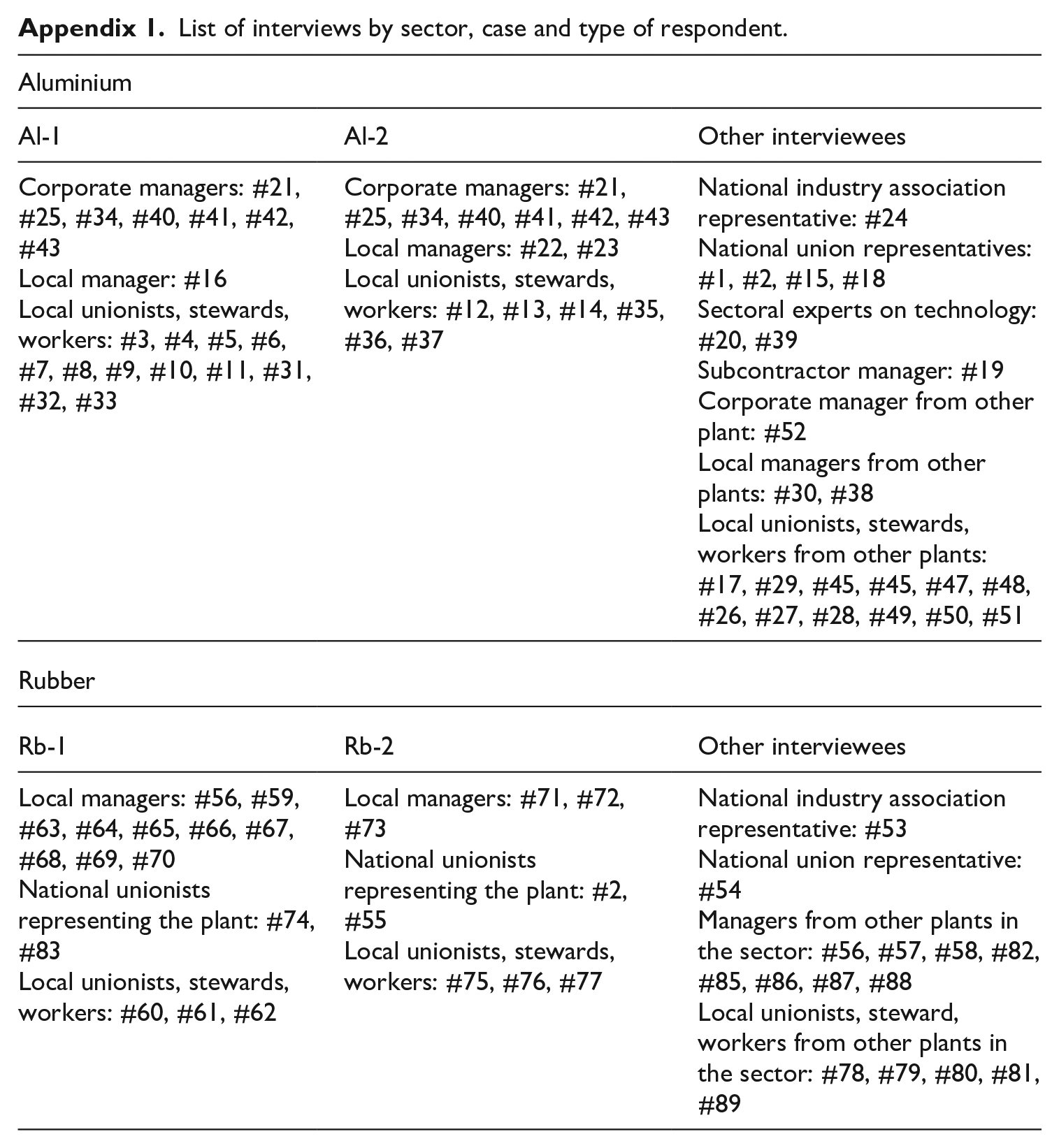
Our strategy for data collection was deployed between 2020 and 2023, in three steps. First, we interviewed national union representatives and staff from sectoral institutions to understand the extent of digitalisation in both industries, identify potentially relevant cases to study, and assess the general effects of new technologies on workers and labour–management relationships. Following these high-level interviews, we identified four cases in each sector that fit our initial selection criteria. We then interviewed corporate and local managers, local union representatives, as well as stewards and workers in each of the eight potential case study workplaces. Among this sample, Al-1, Al-2, Rb-1 and Rb-2 were selected to form the basis of our analysis. For three out of these four cases, a second round of interviews was completed. Semi-directed interviews with a total of 89 participants form the database of this research. Out of this total, 56 participants work directly in the plants under study. The interviews enabled us to identify and understand formal, as well as informal, forms of participation. (See Appendix 1 for a list of interviewees by sector and case.)
The second step of data collection involved a comprehensive analysis of local collective bargaining agreements (CBAs) regulating work in all plants in the sample. Collective bargaining agreements are crucial sources for understanding work rules in North American workplaces, particularly as concerns participation. The main level of representation in Canada is in the workplace, with unions and managers having extensive freedom to negotiate provisions relating to such aspects as employment regulations, workers’ collective and individual rights, technology, and organisational changes, to name a few. To understand formal participation schemes, it is imperative to analyse work rules. In analysing the CBAs, we applied a coding grid to extract relevant articles and clauses from each. We then compared the rules prevailing in the plants under study, referring also to the interviews in order to understand which rules were mobilised in specific contexts and what were the main drivers of this mobilisation.
Finally, we conducted non-participant direct observations in two of the four cases (one in each sector) and in other plants of the two sectors. 3 We were able to understand the nature of technological implementations and production processes, as well as providing an opportunity to informally interview shopfloor workers. We asked questions on how digitalisation was changing the work effort, how these implementations were managed individually and collectively, and whether workers participated in one form or another.
Participation in a unionised Canadian context
As mentioned, in Canada, union representation is the primary channel through which workers can formally exert collective influence over the contours of the work effort. In contrast with Continental and Northern Europe, no statutory rights enable the formation of works councils. Workers can collectively bargain an agreement only through monopolistic union representation and participation in unionised workplaces is negotiated within this system (Campolieti et al., 2007). Despite this limitation, CBAs are legally enforced by state agencies, all workers in any unionised workplace are covered by a CBA, and local unions can use a standard grievance and arbitration system to impose work rules challenging management decision-making. While general work rules can create a counterpoint to technological changes (e.g. seniority rights, job classifications), labour and management are also free to negotiate all types of schemes to foster participation in the workplace on a range of issues, such as organisational and technological changes, work pace or retraining.
Yet, direct forms of participation are common in Canada (Campolieti et al., 2007) and have spread since the 1990s, even in unionised workplaces. Direct participation can be covered by CBAs or be initiated through rules promulgated by corporations and management. Its forms can be diverse and include quality circles, teamwork, continuous-improvement, employee suggestions and others. Whether these types of participation are favoured over others is highly contingent on specific workplaces, labour–management relationships and union power.
Shaping digitalisation? Technological changes and dominant patterns of participation in the four cases
Al-1
Al-1’s parent corporation is active in diverse markets, with mining and metalworking representing its core businesses. The smelter employs a traditional technology typical of this continuous process industry to transform alumina into aluminium. The plant is divided into three sections: the carbon section (which manufactures the carbon anodes that conduct the electric current in the pots), the electrolysis section (the ‘pots room’ where the aluminium fusion is carried out), and the casting house (in which the molten aluminium is transformed into various products). It is the newest smelter in the company’s portfolio and has been characterised by financial stability and productivity for the past two decades. Despite this, labour relations have been tense at certain times, especially in relation to subcontracting and work rules, during which the local union fought to resist conditions imposed by the corporation. It operates in an oligopolistic type of competition in which the metal produced is sold in centralised markets.
Lately, the plant has launched the production of specialised alloys sold for premium prices and which are expected to be in high demand. As mentioned, Al-1 is the most recent plant in the corporation’s portfolio, is highly profitable and is the second largest smelter in North America in terms of output. Nevertheless, the plant has been subject to many formal and informal conflicts since its opening and the local union has built a strong cohesion with the workforce it represents. Formal conflicts included a long lockout in which the corporation sought to implement outsourcing of direct operations. The union resisted and while management secured the right to outsource certain operations, further outsourcing is closely regulated by the CBA. Informal conflicts have also erupted from time to time over the organisation of production, tasks and teamwork, which resulted in the union strictly enforcing work rules. Given these conflicts and the relative victory of the local union over management outsourcing projects, internal solidarity has stayed strong over the years, giving legitimacy to the local union and cementing associational power that could eventually be mobilised regarding digitalisation. As for labour–management relationships, they have been relatively positive in recent years, but managers and the local union structure their relationships through a classical ‘arm’s-length’ strategy in which formal schemes and CBA clauses are strongly enforced.
Digitalisation efforts at Al-1 began around 2016, and were largely the result of a strategy deployed at the corporate level. Stability is key to aluminium production and efficiency comes from the control of electric power and alumina in pots to maximise the output and quality of the molten aluminium. Tight management of the casting house is also crucial for efficiency, and product quality tracking has lately become critical for profitability. With these concerns in mind, the corporation launched a broad effort to collect data on the production process. The pots are now equipped with many sensors targeting data from every step of the production process, as is other equipment throughout the plant (e.g. anode production, vehicles which transport molten aluminium, casting equipment, smartphones assigned to shopfloor workers). The data are centralised in a remote-control centre through which the corporation can track its entire production process. Algorithmic rules were constructed to predict which operations become necessary in given situations (e.g. to regulate smelting production problems), and direct communication was established between the remote-control centre and shopfloor workers. In theory, these processes enable a form of digitalised workplace to coordinate with production workers and dictate some of the work effort.
Al-1 exhibits strong forms of collective participation in the sphere of technological changes. The existing CBA specifies that the company must inform the union of any planned changes in technology, organisation or work methods. The agreement also enables the creation of a union–management committee to study such changes and institute, if needed, ad hoc committees for specific projects. Workers affected by such changes are entitled to salary protection and mandatory training, and can be reassigned to other jobs in the plant according to seniority. The CBA includes a system for the evaluation of all job classifications, tasks and occupations, co-managed by the union and local managers. It enables the committee to recommend a ‘re-evaluation’ in the case of changes, including technological changes; disagreements may be mediated by a third party. Movement between jobs is subject to seniority. The CBA also calls for a joint committee on the evolution of the organisation of work which can propose recommendations. Lastly, but importantly, a clause specifies divisions between unionised workers’ tasks and managers’ responsibilities, enabling the union to preserve a strong form of job ownership.
A local unionist illustrated how workers can influence changes with overt and covert forms of institutional power: ‘In any case, we would have made a grievance over this [digitalisation implementation]. Maybe they would have done it anyway, but the operators would have stopped working and would have come to us. They would have said: “You want to check my work pace!” It would have been hell. I can tell you’ (Interview #31). Related to economic and market conditions that potentially shape participation, the industry’s specific type of production also favours some forms of collective counterpower, as plant performance is assessed on a weekly basis: ‘It is a mode of production that is on a weekly basis. We have regional meetings every week, usually it is the union president that goes to these meetings. The production managers will sit down with us, and say “Ok, this week, the casting house had some problems, why?”’ (Interview #33). While digital tools may enable tighter control of the work effort, managers refrain from using collected data to discipline workers. As the local union president explained, this reticence is due to managers’ working relationship with the union and workers’ potential to mobilise collective forms of counterpower: ‘I think if they don’t use it more, it’s partly because of the relationship with the union. It is more rewarding for them to accumulate the data than to use it for disciplinary motives or to control workers. Because if they do it for disciplinary reasons, we will have a reaction, and mobilise the CBA’ (Interview #3).
The plant manager described the process of integrating this digital technology in relation to labour–management relationships: ‘When we implemented this system, it was to produce data and for managers to have access to this information. . . . It was to have an overview of all the pots and be able to say to shopfloor operators that there is a certain problem. But we followed the division between what is the manager’s job and what are unionised workers’ tasks’ (Interview #16). Another manager illustrated the limitations for direct worker involvement in this context: ‘I will be honest, we fear a reaction. If we say we’re going to give more responsibilities to the workers, they will say “pay us more”. . . . I would love for us to go forward with more important changes, and then say “let’s fix the problem with the union”, but I would say that here is a strong barrier upstream if we go with this strategy’ (Interview #21).
The dominant participation schemes in the context of Al-1’s digitalisation efforts are mostly collective and formal. Our interviewees noted instances in which individual workers were involved in forms of participation when it comes to changes to tasks, but this participation was not formalised or systematised in the workplace. The union relies on the CBA to influence changes at work, maintaining the strict division between managers’ and unionised workers’ tasks, to evaluate classifications following organisational changes and to regulate discipline and productivity issues collectively through CBA rules. These processes are mostly governed through committees through which the union and management jointly elaborate standards.
Al-2
Al-2 manufactures primary aluminium using a continuous process technology and the division of work is similar, as is the type of market it serves. Dating to the late 1980s, the smelter’s equipment is older than that of Al-1, but the plant’s overall productivity has been steady over the decades. Faced with strong pressures due to a lack of investment since 2005, the complex has faced repeated threats of closure and workforce reductions. The local union and workforce have been keener to accept some concessions in order to guarantee employment and attract potential investments.
The division of work is similar to Al-1, but production is more integrated with the other parts of the company’s complex of industrial installations. As mentioned earlier, the plant was built at the end of the 1980s and runs on older technology than does Al-1. Productivity and profits are steady, but the larger complex composed of Al-2 has faced significant economic difficulties for about two decades. A change of ownership in 2007 was followed by a reduction of the workforce. As well, the ageing technology of the company’s installations is more polluting and less productive compared to Al-1. Both have been harmful factors for the plant’s stability and these economic conditions had some effects on union power and the leverage of influence on participation schemes. This industrial complex has been producing aluminium for a century and has seen labour strife erupt cyclically since its opening. In the 1980s, after a period of conflicts, labour and management negotiated ‘innovations’ to sustain partnerships and new forms of workers’ involvement. While some of these schemes have not been perpetuated, the local union has made some concessions in relation to outsourcing and work rules over the past two decades. The consequence has been an erosion of the cohesion between the workforce and the union – in other words, the associational power – as job losses and higher outsourcing have weakened the plant’s economic prospects. Nevertheless, the union can count on a robust team of elected representatives (17 executive members and tens of shopfloor stewards) and enjoys substantial legitimacy among the workforce vis-a-vis management. Concerning technological implementations, Al-2 has experienced the same digitalisation process as Al-1 with the massive implementation of sensors, the deployment of a remote-control centre and algorithmic management, with the potential to reframe manager–worker relationships on the shopfloor.
An analysis of the CBA in effect at Al-2 reveals collective and formal participation schemes with the potential to shape the implementation of digitalisation, highlighting some forms of institutional power. Just as in Al-1, the CBA includes clauses regulating changes, including the obligation to inform the union of considered changes before they are implemented and the creation of a permanent joint committee to study and issue recommendations if proposed changes affect the organisation of work. Workers also benefit from economic protections (job and wage security) in the case of technological changes, as well as retraining and reassignment to other jobs according to seniority. The CBA includes provisions stipulating that ‘operational stability’ measures must be co-managed and encourage employee involvement. It also includes clauses related to the study of ‘new organisation of work’ enabling managers to subcontract some operations within the plant and impose flexibility of tasks and occupations. However, oversight of these changes must be co-managed by a joint committee. A jointly managed system for evaluating tasks and occupations allows the union to exercise influence over technological implementations. Lastly, the CBA imposes strong divisions of managers’ and unionised workers’ tasks.
The analysis of interviews with managers and local unionists reveals that the union leveraged some of these schemes to shape digitalisation and maintain traditional forms of labour–management divisions of work, highlighting the influence of union power on participation. A unionist provided the following example: ‘It is clear in our CBA what is a task that should be accomplished by unionised workers. The remote-control centre, even though it’s digital, it’s considered as management functions, so there is the same relation between our jobs and what is management’s responsibilities and limits. And we would not hesitate to file a grievance if there is a grey area’ (Interview #12). The introduction of these technologies had some unintended consequences and resulted in concerns for the workforce. While the corporation aimed for broader changes, workers and unions used their formal power to circumvent them, forcing the company to reduce the scale of change. A plant manager illustrated these developments: ‘When we implemented this centre, there was enormous resistance. We did not manage the changes well or give sense to them. We were too much in a “top-down” scheme and workers and the union were reluctant’ (Interview #22).
Aside from these collective and formal schemes, direct and informal forms of involvement emerged from the interviews. A manager illustrated how workers can have influence over their interactions with managers at the remote-control centre: ‘And the analyst in the centre, it can happen sometimes that when a worker finishes a training, and [the analyst] notices a [problematic] pattern, he will engage with a supervisor. The supervisor will say “ok, let’s spend a shift with him and see what is going on”. There is some involvement that happens like that’ (Interview #43). The same manager confirms however that these schemes are not fully formalised: ‘Now, it is just beginning. Some hourly workers will raise their hands and say, “I want to participate”, but not everyone. But I think there is a potential there’ (Interview #43).
Local unionists also confirmed the presence of some forms of informal direct involvement at the plant level. In some departments, workers are reluctant to participate in efficiency initiatives: ‘Operators are not that motivated to participate in that type of meeting. When they want to involve people in projects that might lead to job cuts, it is sure that no one would like to be a part of it!’ (Interview #37). Yet some workers do participate: ‘But there are always some persons that decide to participate and to be involved’ (Interview #37). These informal forms of participation exist in tension with traditional forms of union–management relationships: ‘Yes, there are always some people who will raise their hands and say “Me, myself, and I. I can do it!” But I can count them on the fingers of my hands. They will be involved, but they will be often at odds with the rest of the team’ (Interview #37).
In sum, Al-2 exhibits various forms of workers’ involvement. Collective and formal schemes still regulate change, including digitalisation, and the local union mobilises them to maintain traditional patterns of work division. Overall, the CBA enables workers to shape technological implementations. Interviews revealed that workers also participated individually, but this did not reflect extensive or formalised schemes. Dominant patterns of participation in the case of Al-2 were mixed, ranging from collective and formal to direct and informal.
Rb-1
Rb-1 combines niche and diversification approaches in its business model and manufactures a variety of rubber products for diverse customers, including commercial and industrial corporations. This business model helped the plant to secure financial stability in the aftermath of the 2008–9 crisis and it has since remained profitable. Despite being owned by an American multinational corporation, the plant has a level of autonomy in technological improvement, implemented through quinquennial plans. Capital investments are generally attributed based on criteria related to return on investment and efficiency as evaluated by the parent company’s higher managers. While one of its main markets is rubber floors, the plant also has a diverse portfolio of products (over 200 ‘recipes’) and supplies raw mixed rubber for other companies within the sector.
Rb-1 operates in much more competitive markets than do Al-1 and Al-2, but, as we will see below, still enjoys a degree of economic stability due its diverse type of production. These economic and market conditions are factors that would eventually shape the participation schemes. Typical of the rubber industry, work is segmented according to the stages of the production process: the first step is the determination of the recipes, which involves selecting the materials appropriate for given products; second is the mixing, during which these materials are combined; and third, the shaping process consists in extruding the mixes to create specific products. While historically work at this plant has been labour intensive, workers developed a degree of power given their knowledge of the process and the diversity of products they manufacture. Managers favoured paternalistic labour relations, but the long tradition of unionism in the plant parlayed labour power into a comprehensive CBA regulating work rules.
At the time of conducting field research for the present study, Rb-1 was at the end of a multi-million-dollar investment plan for new technologies related to the automation and digitalisation of its productive system. Automation was introduced in labour-intensive parts of the plant, such as weighing and transfer of materials at the mixing stage, and automated vulcanising machines were also implemented at the shaping stage. Along with automation, digitalisation of the productive process aimed at implementing a ‘virtual plant’ based on data collection. Digital sensors were installed in the machinery, enabling coordination through an enterprise resource planning (ERP) system. Moreover, a digital system for managing the workload of skilled trades workers was implemented for coordination purposes.
The analysis of the CBA regulating work at Rb-1 reveals forms of participation affecting technological implementations and potential institutional power that could be used to shape these schemes. While it is generally accepted in the North American context that corporations and managers are the prime drivers of capital investment and of the selection of technologies to be implemented, collective forms of workers’ participation are nevertheless enshrined in the CBA. The agreement specifies that the union must be informed of any planned technological changes no later than two weeks (and potentially as early as six months) prior to implementation, while the timeframe is three to six months in the case of changes that may result in the closing of any department. A clause specifies that the corporation and the union must meet to institute a joint committee in the case of such changes in order to safeguard employment stability. In the case of layoffs due to technological changes, affected workers must be reassigned to other jobs according to seniority. The CBA includes ‘operation standards’, which stipulate that the company must inform the union of all tasks affected by any planned changes. A union representative must be designated to study the intended changes and determine relevant standards. The union has the right to file a grievance, contest standards imposed by managers and propose adjustments.
Overall, Rb-1 workers benefit from formal collective participation schemes to shape technological changes. To the question of whether these schemes were mobilised during recent technological changes, a local union representative affirmed: ‘Yes, we have a union technician specialised in time study, he is a member of our local union council. He has been trained by the national union to undertake time and motion studies. The corporation has [a technician] to evaluate the work standards. The two will meet, evaluate the specific job and negotiate the standards for time’ (Interview #83). Despite economic turbulence in the sector, over the years the local union has been able to preserve associational power and a strong cohesion with the workforce; the union team is relatively large and experienced given the number of members it represents (22 elected representatives from among some 200 unionised workers). As stated by a representative of the national union serving the plant (Interview #74), the local union is seen as one of the most robust among their affiliates and often serves as an example for other locals in terms of structure and expertise.
Apart from these formal schemes jointly regulating the work effort, we also identified individual and informal forms of participation that appear, however, to be contingent on the attitudes of managers. As the union representative illustrated: ‘They can or they can’t, there is nothing in the CBA that forces the employer to involve individual workers or not. They might do it, but it will depend which manager is on the project’ (Interview #83). A manager interviewed at Rb-1 confirmed that forms of individual involvement were deployed during the last wave of digitalisation implementation, but in an ad hoc fashion: ‘We built these new machines with the recommendations of some operators. We did not give them the machine for them to say afterwards “this or that would have been good to have, but it’s already settled”. We always try to involve operators’ (Interview #69). Yet this process was not formalised or subject to any specific rules.
Another manager illustrated the process of involving workers on the shopfloor by selecting those keener to work with managers: ‘Me, what I wanted [during this phase of implementation], was to select workers who have something to say that we like, or some things that we don’t like. I want the more critical workers on the shopfloor. The ones we have selected for this project are workers who are never at a loss for words’ (Interview #56). He added: ‘We opted for a route in that project – I don’t like to say it – by selecting the ones who have more leadership, workers who have more to say on the standards and tasks’ (Interview #56). Final decisions are made by the managers and the process of selecting workers ad hoc to participate in projects has certain advantages for the corporation. Politically, it has the effect of making it easier for workers to accept the changes. It also enables management to circumvent formal schemes present in the CBA which otherwise give the union influence over standards. In addition, by involving shopfloor workers in technological changes, managers gain knowledge on various aspects of production. As mentioned above, the corporation has a segmented, customised and niche production strategy, which makes it dependent on key workers’ experience and knowledge in building multiple products on a single line. These informal forms of participation enable managers to ease the plant through technological implementations and facilitate the transition from design to the production process.
In sum, the dominant forms of participation under digitalisation in Rb-1 are mixed, collective and formal, as well as direct and informal. While the union still retains sufficient influence to impose collective participation through CBA provisions, managers can consult and involve workers directly by selecting certain operators to participate in specific projects.
Rb-2
As a major tyre producer, Rb-2 follows a ‘mass customisation’ business model focused on value-added tyres for SUVs and a wide range of product choices (80 tyre models) for personal and commercial customers. The division of work, just like Rb-1, follows the segmentation of rubber production through the recipe, mixing and shaping steps. Over the decades, the plant has been repeatedly affected by labour strife. However, the high level of competition and the 2008–9 crisis diminished union power and strengthened management’s hand in demanding concessions in work rules highlighting the influence of economic and market conditions on participation.
About a decade ago, the plant faced serious financial difficulties. Ageing machinery, moreover, made the plant less efficient than other ‘low-cost’ locations in the MNC’s production network. Following a contest for investments launched in 2015 among the corporation’s plants, Rb-2 won a multi-million-dollar modernisation plan partly financed through state subsidies. These investments have coincided with a shift in the plant’s business strategy towards more value-added tyres for the truck and SUV markets. Meanwhile, through two bargaining rounds, local management convinced the workforce that concessions were necessary to secure investments, which had the effect of eroding workers’ power on the shopfloor. The granted investments targeted the implementation of automated machinery in the tyre building department, a critical component of the plants’ type of production. Automated guided vehicles (AGVs) were deployed to carry materials and products between sections of the plant. As in the three other cases, new and existing machinery was equipped with sensors which network with the plant’s ERP system. Standards of production are now relayed to workers directly, while individual ‘key performance indicators’ (KPI) are shown at workstations in real time. As well, AI was deployed to process collected data and plan orders and workloads. Furthermore, the warehouse in which tyres are stored was completely automated.
Our analysis of the CBA prevailing at Rb-2 reveals that certain forms of formal and collective participation are enshrined in the contract. As with the other cases, the agreement contains clauses relating to technological changes which make it mandatory for managers to alert the union of planned changes and their impact on the workforce. The CBA protects the most senior workers from layoffs resulting from technological changes and stipulates that, in the event, the employer must enter into discussions with the union. But the agreement does not call for a joint committee. Seniority determines movement between jobs and a special programme of monetary compensation was introduced in 2015 to protect builders who would be strongly affected by automation. The CBA contains rules to determine work standards in the case of technological change and, in the event of such changes, mandates that a union representative be assigned to the study of time and motion. This union representative is granted access to any information concerning work standards and can contest changes to wage rates and the job classifications, but not the broader aspects of technological implementations. An elected union official described the process: ‘It is done jointly with the industrial engineering department, so there can be some debates. In that department, they are five, and I’m alone. When there are changes to tasks or new machinery, we go jointly to do the time studies’ (Interview #77). Overall, while formal collective participation schemes are present in Rb-2’s CBA and can have an impact on technological implementation, the union and workers have less leverage than do their counterparts in the other cases under study, highlighting an important difference in institutional power.
Interviews with managers and unionists at Rb-2 revealed strong direct participation by workers in technological changes and in the determination of work standards following automation and digitalisation. The CBA mentions ‘individual representatives’ dedicated to continuous improvement, but their role and responsibilities are not explicit in the contract. Since 2011, the corporation has implemented a Japanese ‘Lean type’ programme that is based on the Toyota Production System and direct participation by workers on the shopfloor. The ‘Kaizen’ culture is determined by a rigorous set of rules that define the steps of standardising a task affected by technology. As one manager emphasised, this was the system used in the latest phase of technological changes: [W]e have enlarged our employee involvement system. When we do a project, we will involve the operators, the mechanics, the electricians, during the phases of predesign, design, and when we go to visit the suppliers. The technologies [that were implemented since 2016], some workers even travelled with engineers abroad to select them. (Interview #73)
The goal of this system is to assist engineers and external firms during the conception phase of new technologies and to transform designated workers into ‘ambassadors’ among other workers, as well as to design training manuals for new machines and tasks stemming from technological change. The system is strongly institutionalised at the plant level, but not all workers participate. A local HR manager put it thus: ‘We have targets for employee involvement. We want to have a certain percentage and a diversity of involvement. However, we do not force workers to participate, and we will select them according to their willingness and depending on the kaizens we initiate in certain departments’ (Interview #72). And, as the plant manager added: ‘The continuous improvement programme is strongly institutionalised, but the way we select the workers is not. It is voluntary’ (Interview #73). Some projects are managed informally, however: ‘[T]he ones that are more ad hoc are short term projects. In general, people are open to participation. Some of them are not, but I would say most of the workers participate’ (Interview #73).
According to interviewed unionists (Interviews #75, #76, #77), the involvement process was contentious, and the union and some workers protested when it was launched. As a response, managers presented individual workers’ participation as critical for new technological investments. In other words, if workers’ involvement did not materialise, there would be no new investments in technologies. In a context of declining financial stability and ageing facilities, these tactics successfully played on workers’ fears and helped to implement a direct involvement system despite the union’s opposition again underscoring the influence of market and economic conditions.
Overall, the forms of participation at Rb-2 are various and, to a certain extent, are contested by managers and the union. While the CBA covers some elements of formal collective participation, it also opens the door to the direct involvement of workers in technological changes. Related to the influence of material conditions, our data reveal that the corporation and its local managers capitalised on a period of financial turmoil and the contingencies of new investment to implement a strong formal direct involvement scheme through which to manage changes at the shopfloor level. This turmoil also gave rise to discontent within the workforce and affected the cohesion between workers and the union, an important difference in associational power compared to the other cases studied. Concessions over work rules created dissension between different segments of the workforce – especially between high- and low-seniority workers (Interviews #75, #76, #77) – and weakened, to a certain extent, the union’s associational capacity. Despite this, workers could still influence the changes, but the union lost its leadership position in shaping the plant’s digitalisation. Rb-2’s dominant pattern of participation is thus direct and formal.
Explaining forms of participation under digitalisation: A discussion
The cases under study revealed a diversity of forms of participation at the shopfloor level, which, in principle, can shape digitalisation processes at work. A first result of our analysis reveals that most of these schemes were employer-led and that unions and workers, at first glance, functioned mostly in ‘reaction mode’ – which is not entirely surprising given North American unions’ limited resources to influence technological change. However, as we have shown, this limitation does not extend to their influence over participation modes once changes have been implemented. While our analysis illustrates certain tensions between different forms of involvement and discerns a nexus between collective, direct, formal and informal schemes, the dominant patterns are varied and dependent on local contexts and existing power dynamics between unions, workers and managers. Table 1 synthesises the results of this analysis and highlights the economic conditions, productive characteristics and dominant patterns of participation for each case under study.
Case study characteristics and forms of participation.
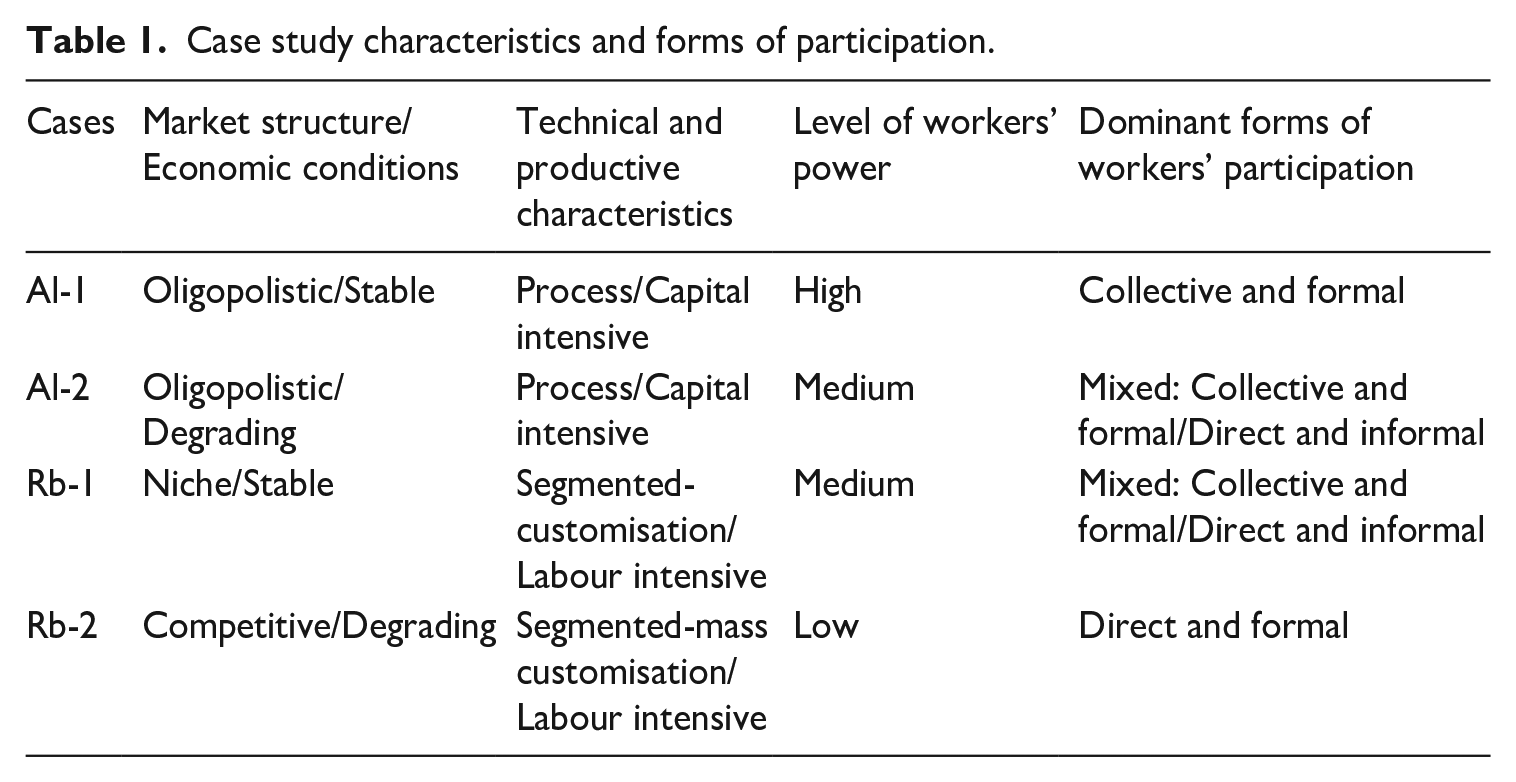
The analysis reveals that different forms of participation exert various influences on digitalisation processes in workplaces, and that these variations transcend sectoral divisions. In the case of Al-1, workers and their union were able to shape digitalisation through formal and collective methods and safeguard traditional forms of workers–management relationships and work division. This case did not present strong forms of direct involvement, as managers were reluctant to implement such schemes. Al-2’s unions and workers were also able to shape these changes collectively through their CBA, but forms of informal and direct involvement were more apparent here and enabled management to involve individual workers in some changes. Rb-1 presents a degree of similarity. The union still exercised power through the CBA and the crucial role of key workers in certain parts of the production process gives them leverage. Nevertheless, managers also informally involved individual workers in certain projects, thus circumventing the union’s traditional forms of influence on technological changes. Rb-2, for its part, was in theory characterised by collective and formal workers’ participation, but in practice the plant’s challenging economic conditions enabled management to impose a comprehensive system of direct involvement as the prime driver of workers’ involvement in technological changes at the plant level.
What can account for these differences between the four plants in terms of patterns of participation in technological changes? We believe that the conjunction and interaction between material conditions and union power contribute to the explanation of these differences, thus shedding light on both structural and agentic factors.
To begin with, participation’s various forms are partly determined by economic conditions and market structures affecting workers’ power on the shopfloor (Bélanger and Edwards, 2007; Greer, 2024; Marchington, 2008; Poole, 1986). The two aluminium industry cases operate in oligopolistic markets that provide workers with relative isolation from direct competition and enable them to develop strong forms of structural power. Rb-1 is active in a niche market that is more competitive than the aluminium trade, but that still provides a degree of security to workers as the plant’s product diversity stabilises its profitability. Rb-2 is at the opposite end of the spectrum, operating in a highly competitive market dominated by foreign competition and low-cost locations. These differing characteristics shaped the forms of participation prevailing at each plant: more favourable conditions helped workers and unions to preserve collective influence and enhanced their power resources, while adverse conditions provided opportunities for managers to promote direct participation.
Economic conditions, moreover, alternately reinforced and weakened the effects of the market structures in the four cases. While the position of RB-1 is less advantageous than either of the aluminium industry cases, it nevertheless benefits from stable economic conditions that enable workers and the local union to exercise some forms of power over digital implementation. Al-2’s economic conditions, by contrast, were deteriorating, enabling management to impose concessions in terms of flexibility and direct involvement that were not present in Al-1. The situation of Rb-2 was similar, the plant having gone through financial turmoil following the 2008–9 crisis, providing management with the opportunity to mobilise individual involvement as a token of exchange for investments.
Technical and productive characteristics also played a role in shaping technological changes and workers’ involvement (Bélanger and Edwards, 2007; Howcroft and Taylor, 2023; Marchington, 2008; Poole, 1986). Aluminium, as a typical capital-intensive and process industry, favours workers’ power on the shopfloor and the union’s ability to exercise influence over the organisation of work. Rubber is a more segmented and labour-intensive industry, which can have the consequence of diminishing this power. However, differences were noticeable between Rb-1 and Rb-2 in this regard, despite similar types of division of work and production processes. Rb-1’s business model is structured around a niche type of production, which gives workers certain forms of control over critical parts of the labour process and managers must still rely on certain operators’ knowledge. Rb-2’s mass customisation strategy has the opposite effect, decreasing workers’ control in the production process.
But these material conditions should be put in perspective with the ability of workers to mobilise them to affect changes at work. It has been argued recently that workers’ power resources are important to understand labour’s influence at different action levels, including in the workplace (Arnholtz and Refslund, 2024). In the area of digitalisation and technological changes, recent literature has highlighted the importance of institutional power in shaping these changes (Bosch and Schmitz-Kießler, 2020; Doellgast et al., 2023), but, while institutional power matters, our analysis shows that structural and associational powers are also crucial for attempts to understand the various forms of workers’ influence. Concerning structural power, workers’ position in the production process is determinant for patterns of influence, participation schemes and unions’ preservation of collective and formal forms of participation.
Our analysis shows that power should be conceived in a dialectical relationship with structural conditions. Indeed, the material conditions present in the different cases provided workers with various resources through which to exercise influence over changes at work promoted by managers. These conditions, however, must not be viewed independently of the potential agency of trade unions. While our analysis reveals that structural power can indeed ‘be seen as the basic building block for the other power resources, at least contributing to their efficiency’ (Refslund and Arnholtz, 2022: 1962), the two other mobilised resources were also important in shaping participation schemes. Institutional power, in that regard, appears to influence management endeavours, notwithstanding that the four cases operate in the same national context. While the cases exhibit some of these rules, we have shown that some unions were more successful in preserving collective and formal participation (Al-1), while others enabled management to promote other types of schemes (Rb-2 in particular and, to a lesser extent, Al-2 and Rb-1). Despite the fact that some rules are specific to individual workplaces (joint committees on classifications, time and motion studies, joint evaluation of tasks) and others are similar across cases (advance notice of technological changes), our analysis reveals that the presence of robust joint committees on tasks and classifications (present in Al-1, Al-2 and Rb-1, but weakened in Rb-2) mattered for the ability of unions to affect participation under technological changes. Through this channel, Al-1 in particular, but also to a lesser extent Al-2 and Rb-1 were better able, in various ways, to preserve collective and formal participation when compared with Rb-2.
In addition, associational capability played a certain role in enabling unions to influence participation in certain cases. Al-1 and Rb-2, in this regard, reflect contrasting experiences: Al-1’s union has been able to maintain strong cohesion with the workforce it represents, while Rb-2 is clearly the case where the relationship between workers and the union was disrupted the most. Al-2 and Rb-2 are to a certain extent similar, as some unfavourable economic conditions have shaken the foundations of the respective unions’ associational power, but both can still rely on strong organisational resources and relative cohesiveness with their members. But the link between associational power and influence on participation was more tacit and less direct than the two other forms of power. More research is likely needed to understand the role of unions’ legitimacy and technological changes at work.
Finally, our analysis sheds light on the need to contextualise technological changes (Howcroft and Taylor, 2023) and shows that workers’ participation in digitalisation implementation is highly contingent and a source of tensions. As we have highlighted, workers’ and unions’ agency in shaping digitalisation is important, but their power is not created ex nihilo and reflects the structural and material conditions that determine the shape and level of compromise arising in a particular workplace. Markets, economics, specific technologies and production processes can create the conditions in which workers can exert power and influence changes at work through different patterns of participation.
Conclusion
As the use of data, automation and artificial intelligence harnessed to the digitalisation of work processes advances apace, are workers’ participation and influence on the shopfloor transformed? It is generally acknowledged that workers’ involvement is a point of contention between different frames of reference (Vereycken et al., 2021; Wilkinson et al., 2020) and our study adopts a critical perspective highlighting the sources of tensions between managers’ desires to promote certain forms of participation, workers and unions’ will to preserve control on the shopfloor, and the highly contingent nature of compromises in the workplace. However, this article makes several contributions to ongoing debates in the literature and we believe that our analysis departs from conventional normative appreciations of workers’ participation.
From an analytical point of view, the present study proposes a framework bridging debates on the diversity of participation schemes. We also propose a dialectic approach highlighting how material conditions could shape how technology affects these forms of workers’ participation and, inversely, how workers’ participation may shape technological change, particularly digitalisation. But, in line with recent contributions on the nature and variety of sources of power (Arnoltz and Refslund, 2024; Greer, 2024; Refslund and Arnholtz, 2022), we highlighted three forms (structural, institutional, associational) that are key to understanding compromises over participation and contradictions affecting technological change in workplaces, which are rooted in (fluctuating) antagonistic relationships between managers and labour.
Empirically, this study redresses the lack of practical research on existing implementations of digital technologies in workplaces (Vereycken et al., 2021) by presenting an in-depth analysis of case studies from two different industries, specifically in relation to tensions ensuing from corporate and managerial digitalisation strategies. The analysis reveals a variety of participation schemes (collective and formal, mixed, direct and formal) and demonstrates the need for a contextualised approach to understand the tensions between workers’ involvement and technological change.
This study contains limitations as it focuses on sectors in which unions are still (relatively) strong, one institutional context (North American, and specifically Québec, style of collective representation) and one level of analysis (the shopfloor). Future research into digitalisation, and the nature of workers’ participation and involvement should therefore consider other institutional, sectoral and organisational contexts to strengthen overall understanding of the changing contours of the influence that labour and management exert on technology in workplaces.
Footnotes
Appendix
List of interviews by sector, case and type of respondent.
| Aluminium | ||
|---|---|---|
| Al-1 | Al-2 | Other interviewees |
| Corporate managers: #21, #25, #34, #40, #41, #42, #43 Local manager: #16 Local unionists, stewards, workers: #3, #4, #5, #6, #7, #8, #9, #10, #11, #31, #32, #33 |
Corporate managers: #21, #25, #34, #40, #41, #42, #43 Local managers: #22, #23 Local unionists, stewards, workers: #12, #13, #14, #35, #36, #37 |
National industry association representative: #24 National union representatives: #1, #2, #15, #18 Sectoral experts on technology: #20, #39 Subcontractor manager: #19 Corporate manager from other plant: #52 Local managers from other plants: #30, #38 Local unionists, stewards, workers from other plants: #17, #29, #45, #45, #47, #48, #26, #27, #28, #49, #50, #51 |
| Rubber | ||
| Rb-1 | Rb-2 | Other interviewees |
| Local managers: #56, #59, #63, #64, #65, #66, #67, #68, #69, #70 National unionists representing the plant: #74, #83 Local unionists, stewards, workers: #60, #61, #62 |
Local managers: #71, #72, #73 National unionists representing the plant: #2, #55 Local unionists, stewards, workers: #75, #76, #77 |
National industry association representative: #53 National union representative: #54 Managers from other plants in the sector: #56, #57, #58, #82, #85, #86, #87, #88 Local unionists, steward, workers from other plants in the sector: #78, #79, #80, #81, #89 |
Declaration of conflicting interests
The authors declared no potential conflicts of interest with respect to the research, authorship, and/or publication of this article.
Funding
Funding for this research was received from the Social Sciences and Humanities Research Council of Canada and the Fonds de Recherche du Québec-Société et Culture.
