



Abstract
This article engages a moral economy (ME) approach with mobilisation theory (MT), using Sayer’s concept of lay morality to examine how solidarity was articulated and developed during a hunger strike. It argues that subjective moral evaluations and the historical context influenced solidarity and the outcomes of the strike. To explore this, a theoretical engagement between ME and MT found that solidarity was based on strong moral evaluations by workers and union leaders within a historically informed moral economy. The article confirms the analytical value of theoretically engaging ME and MT to provide a more fertile ground for understanding solidarity.
Introduction
Worker solidarity is created when workers share and express a common understanding of their grievances, forming a bond of identification and collective interest (Fantasia, 1988; Kelly, 1998; Morgan and Pulignano, 2020). Mobilisation theory (MT) highlights the importance of worker solidarity, leadership and collective agency in transforming worker dissatisfaction into a shared sense of injustice and collective action (Kelly, 1998; McAdam, 1988; Simms and Dean, 2015). The article is based on a hunger strike, a nonviolent form of mobilisation involving the refusal to consume food (Aitchison, 2022), in the year 2017 in Mauritius. Two union leaders and six female public school cleaners (henceforth yard cleaners) went on a 10-day hunger strike, demanding higher pay for yard cleaners who were employed by a private tendered company (IndustriALL, 2017; Le Mauricien, 2017a). The strike was a form of resistance against the government for using private contractors, who paid yard cleaners only $43 per month compared to other school cleaners who were employed by the public sector and were better paid. The strike became a historical moment by introducing a national minimal wage for the whole country and creating nationwide consciousness about existing pay disparities (Le Mauricien, 2017b; Lexpress, 2017a; National Productivity and Competitiveness Council [NPCC], 2019).
MT’s ability to explain solidarity in the hunger strike is limited in two ways: first, MT emphasises the role of the leader in creating a shared sense of injustice as a prerequisite for collective interest, agency and class-consciousness to develop (Darlington, 2018). This overlooks moral evaluations and the subjective experiences of workers, positioning them as ‘a passive reflection of social structure’ (Ezzy, 1997: 428). Some studies include workers’ subjective evaluations (see for example Bolton and Laaser, 2020; Hughes et al., 2022; Laaser, 2016; Taylor and Bain, 2005), but MT does not accord enough attention to the agentic ability of workers to morally evaluate their conditions particularly in unorganised workplaces. Second, existing MT analyses overlook how worker solidarity manifests in large-scale consciousness that may have a broader institutional and national impact. This point underscores the relevance of context in explaining types of resistance and mobilisation, and the need to analyse mobilisation processes beyond the leader.
To address these explanatory limitations, the article proposes a theoretical engagement between MT and the moral economy (ME) approach. ME gives centrality to people, emphasising that they are sentient beings fused with lay morality; that is, they can morally evaluate and understand how people should treat others and be treated by them (Sayer, 2005a, 2007). Theoretically, ME is bound by a historical context where shared understandings of justice are nurtured, normative economic practices exist and mechanisms of social pressure are exerted when these shared understandings are disrupted (Thompson, 1971). In the study context, resistance against the government, the large-scale consciousness generated by the hunger strike, and its outcomes, call for a theoretical engagement between ME and MT to understand solidarity and worker mobilisation. Using this approach, the article seeks to answer two research questions: (1) How did moral evaluations inform solidarity and mobilisation in the hunger strike? and (2) How did the context influence these processes and their outcomes?
The article advances theory in three ways: first, it demonstrates the analytical value of ME by drawing attention to subjective moral evaluations of workers and union leaders. Through the concept of lay morality, it demonstrates how workers in unorganised workplaces are able to engage in deep organising (Holgate et al., 2018; McAlevey, 2016), and how the union leader–worker relationship is imbued with moral sentiments. Second, it brings resistance back into ME and a new understanding to the discussion of how social and economic principles are intermeshed (Bolton et al., 2012), thus refuting the misconception that social norms and values void ME of its economic dimensions and heuristic value (Thompson, 1991). Third, it shows the relevance of history and context in creating an interdisciplinary understanding of mobilisation, confirming Thompson’s view that to truly understand moral economies, the specific context of a community should also be analysed.
The next section provides a critical review of the theoretical engagement between ME and MT, followed by a historical overview of mobilisation in the study context, and rationalising the theoretical approach. The third section discusses the research methodology. Findings are presented in the fourth section, followed by a discussion section where the article outlines its key contributions, before concluding.
Towards a theoretical engagement between ME and MT
Existing theories of mobilisation highlight the importance of union leaders and a process of mutual association, for worker solidarity to exist and collective action to take place (Fantasia, 1988; Kelly, 1998; McAdam, 1988; Tilly, 1978). Leaders are viewed as key actors who frame grievances and shape collective interest into action through their influence on the organisation and mobilisation of people and resources (Tilly, 1978). Additionally, leaders transform individualistic cost and benefit calculations of acting into collective goals and motives. They do so through attribution, which involves identifying a clear target, usually the employer, as the source of the problem, and through social identification, where they instate the subordinate group to start distinguishing themselves (we) in opposition to others (them) (McAdam, 1988). Both processes are socially constructed (Fantasia, 1988), and through micro-mobilisation, leaders create small group interactions where collective attribution is made (McAdam, 1988).
Dissatisfaction and differences in interests are not enough to motivate collective action (McAdam, 1988; Wilkinson et al., 2018). As Kelly (1998) puts it, a sine qua non for collective action is a sense of injustice, the conviction that an event, action, or situation is ‘wrong’ or ‘illegitimate’ (p. 27). Leaders imbue workers with that sense of injustice (Fantasia, 1988). In the absence of a leader, workers may also engage in unorganised forms of resistance when they sense injustice and become aware of their entitlements and rights, and when they feel that they can change their situation by collective action (Atzeni, 2009; McAdam, 1988). Hence, workers are equally capable of attribution through moral evaluations because they are sentient beings (Bolton and Laaser, 2020; Laaser, 2016).
The idea of a shared sense of injustice and collective action is also at the core of ME, a concept that was popularised by cultural historian EP Thompson (1971). In his essay ‘The Moral Economy of the English Crowd’, Thompson focused on the food riots that took place in 18th-century England during the transition to a modern market system. Instead of seeing the riots as reactions to hunger, he posited that they were grounded on ‘a consistent traditional view of social norms and obligations, of the proper economic functions of several parties within the community, which, taken together, can be said to constitute the moral economy of the poor’ (Thompson, 1971: 79). The ‘crowd’ had agency and acted based on calculations of what were legitimate and illegitimate practices, to punish immoral profit-seekers (Palomera and Theodora, 2016).
Theoretically, the riots were a mechanism of social pressure that was triggered when normative economic practices around the subsistence ethos that regulated grain prices came under threat and challenged the shared understanding that merchants would sell grains at lower prices within their communities (Thompson, 1971). Thompson’s view of economic behaviour as being ‘social’ was critiqued for over-idealising pre-market societies and underscoring the market’s ability to filter through non-economic spheres (Granovetter, 1985). Yet, there are countless community arrangements where locally established norms and notions of justice govern access to resources in times of need (see Beresford et al., 2023), denoting that sentiments and values are deep-rooted in economic action and behaviour (Bolton et al., 2012; Sayer, 2007). To highlight how economic and capitalist processes are socially constructed, Sayer (2000a, 2007, 2011) embedded moral values within the normative aspect, using the concept of lay morality, which is the ability to morally evaluate and understand how people should treat others and be treated by them (Sayer, 2000a, 2011). It exists as humans are sentient beings who monitor and evaluate ‘what is good, bad, fair or unfair about particular situations and what to do for the best, by considering the human capacity to flourish/suffer’ (Hughes et al., 2022: 148).
At work, tensions between capital and labour augment workers’ need for human connection, respect and recognition, causing people to monitor and evaluate through their lay morality what is happening (Sayer, 2007). The outcomes are ‘formal and informal practices that have a solidarity at their heart’, and a shared understanding of the ‘necessity to establish, maintain and defend the well-being of oneself and those people that actors care for, by mediating and resisting harmful practices and relations at work’ (Bolton and Laaser, 2020: 61). This perspective offers synergetic opportunities between ME and MT, as normative judgements and shared norms of (in)justice are the foundation of both.
Another synergetic opportunity between ME and MT is the significance of context. In MT, transforming solidarity into collective action is influenced by contextual dimensions such as traditions of solidarity, trade unions’ capacity for disruptive collective action, and labour regulations (Kelly, 1998). In ME, Thompson (1991: 340) highlighted the relevance of the ‘moral’ part within the historical context. Additionally, he emphasised that values are not enough to make a moral economy, but rather the moral economy is based on economic exclusion and class struggle in the context (Thompson, 1991). Similarly, Sayer (2000a) emphasised the relevance of historically nurtured social norms and values that guide lay morality, that are embedded in economic principles.
Mobilisation and trade union activity in the study context
Mauritius is a small island economy in the Indian Ocean, with a population of approximately 1.3 million. British colonisation from 1810 to 1968 led to the formation of the first trade union and the 1938 Mauritian Industrial Associations Ordinance, No. 7, which legalised unions for the first time among all British colonies (Croucher and McIlroy, 2013). The ordinance was introduced following mass protests, petitions, riots and strike action between 1935 and 1937, by Indian labourers against the British administration and Franco-Mauritian sugar estate owners (see Table 1). Sugarcane plantations were burnt down, and sugar factories were sabotaged over demands for better wages, food, housing, health care and pensions (Napal, 2015; Storey, 1995). The Hooper Commission Report, led by the British administration, confirmed the deplorable living and working conditions of workers, and for the first time in history, British rulers introduced pensions, health care, increased wages and village councils (Lalit, 2018). The ordinance was introduced to avoid future protests and barbaric behaviour by the agricultural proletariat and was highly restrictive for unions (Croucher and McIlroy, 2013). This first working-class mobilisation also saw the foundation of the Mauritius Labour Party (MLP), and a will for independence (Lalit, 2018).
Timeline of mobilisation and trade union activity in Mauritius.
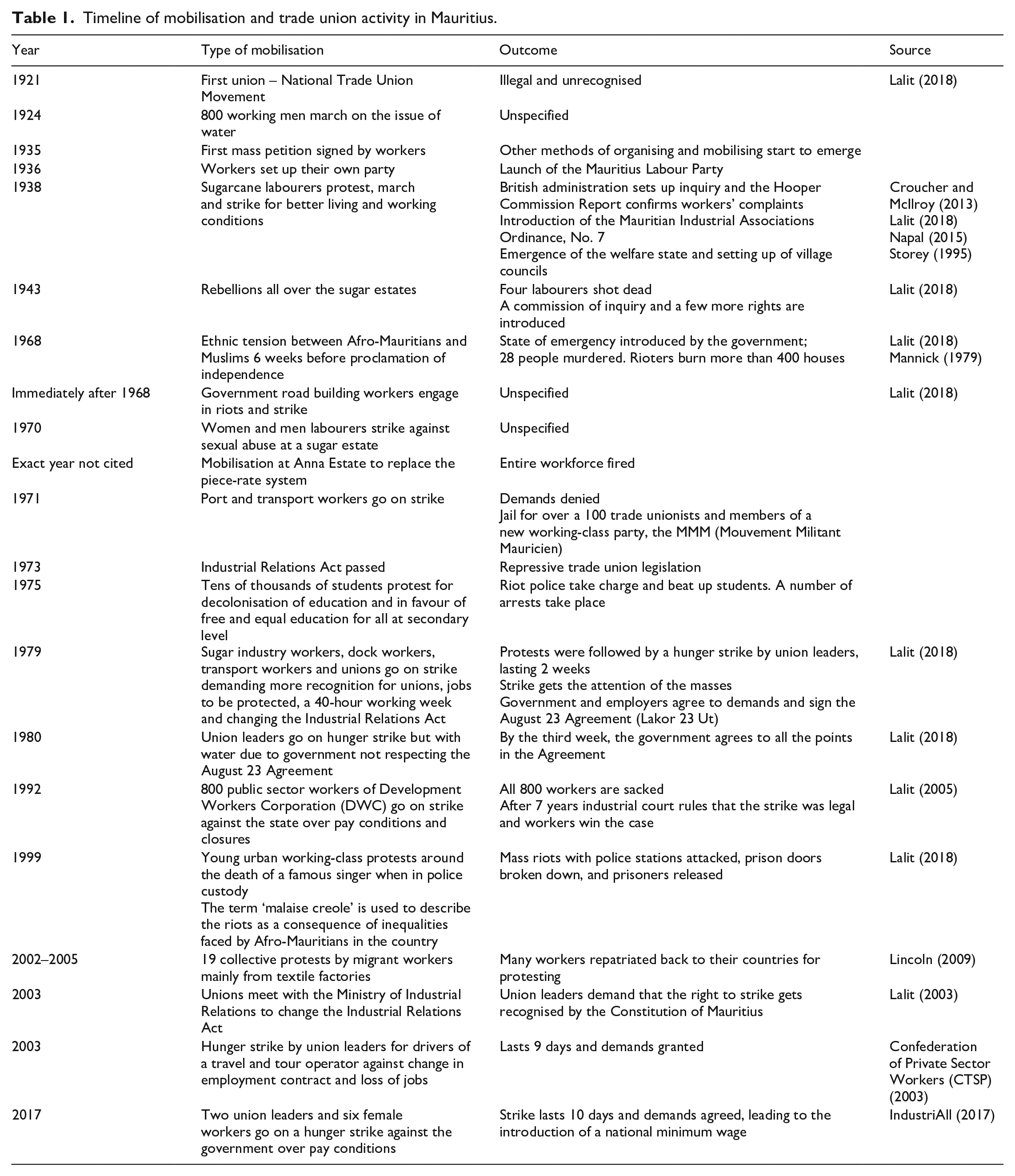
The MLP led Mauritius to independence in 1968 and formed the first government. Working-class mobilisation continued post-independence, with strikes and riots spanning other sectors such as construction, ports and transport. The year 1971 also saw the foundation of the Mouvement Militant Mauricien (MMM), another influential political party in the country. In 1973, a highly repressive trade union legislation, the Industrial Relations Act, was passed to curb the rising resistance from trade unions, leading to a loss of faith in the MLP from the working class. In 1979, the largest strike took place with protests by trade unions, workers and MMM leaders. The fight was for recognition of trade unions, a 40-hour working week, stopping the closure of sugar factories and revisiting the Industrial Relations Act (Lalit, 2018; Lexpress, 2017f). The strike was described by Lalit (2018) as ‘bands of workers from all over the country, as if on pilgrimage . . . to visit the hunger strikers. By the fourth day, so galvanized was the working class, that the Government and bosses ceded.’ Mauritius has since known several protests and hunger strikes by union leaders. In most cases, union demands were granted, showing the power of mobilising. In a historical recollection by trade union leader Rajni Lalla, she noted that elections and by-elections were taking place every one to two years between 1982 and 2000, with working-class demands dominating the political agenda (Committee for the Abolition of Illegitimate Debt [CADTM], 2017). Workers’ demands had political relevance and power. This is also evidenced by the Workers’ Rights Act 2019 (WRA19) that replaced the repressive Employment Relations Act and Employment Rights Act whereby employers could hire and fire workers easily, and working conditions were minimal (Mahadew, 2022). The WRA19 gave workers the right to mandatory consultation with an independent advisor before signing a settlement agreement of dispute and/or termination of employment, and the right to join a trade union or be represented in case of a dispute with the employer.
Historically the hunger strike has been a powerful mobilisation strategy in Mauritius with major wins around pay, working conditions and recognition of unions. The 1979 and 1980 hunger strikes involved only union leaders demanding union recognition by sugar estates, hence rationalising the sacrificial act by union leaders (Connolly et al., 2023). However, in the year 2017, the hunger strike, on which this article is based, resistance and mobilisation were against the government, involving both union leaders and workers, with demands centred on pay conditions. Union leaders putting their bodies on the line for workers constitutes a selfless sacrificial act indicative of strong collective identification and shared emotions binding strikers (Machin, 2016; Yuill, 2007). The strike not only highlighted unfairness towards yard cleaners but also created large-scale consciousness around pay disparity in the country. Three points are noteworthy: first, given the sacrificial nature of the hunger strike, both workers’ and union leaders’ rationalisation of the act would have been fused with lay morality; second, shared moral understandings emerged between strikers and the rest of society and played an important role in putting pressure on the government; and third, historically founded moral economies around workers’ rights continue to influence organisation and mobilisation in the context.
The article examines these points through two research questions: First, how did moral evaluations inform solidarity and mobilisation in the hunger strike? Second, how did the context influence these processes and their outcomes? A theoretical engagement between MT and ME is proposed using Sayer’s concept of lay morality and Thompson’s emphasis on historically founded moral economies. Based on moral evaluations of how people should treat others and be treated by them, lay morality can offer a deeper understanding of the shared sense of injustice that emerged before and during the hunger strike. It goes beyond MT’s focus on the union leader and conceptualises humans as fused with lay morality and capable of organising and mobilising. It adds analytical value to our understanding of solidarity by elevating a sense of mutuality and ‘thick’ relationships that can exist between humans (Sayer, 2007). Moreover, when applied to the union– member relationship, it conceptually reveals common moral understandings that create a strong bond of identification between leaders and workers that is learnt and developed through ongoing social interaction (Sayer, 2005b).
The view that moral economies are bound by the historical context in which they occur is valuable to this study. Thompson (1971) argued that moral evaluations and values are not enough to form moral economies. Rather, it is historically nurtured shared understandings of justice, normative economic practices and mechanisms of social pressure that inform the emergence of the moral economy. In the study context, working-class mobilisation is historically and politically embedded in workforce mobilisation since pre-independence. This calls for a consolidated contextual analysis combining both historical and political factors that influenced how solidarity emerged in the hunger strike and the outcomes of mobilising.
Research methodology
The study uses an interpretivist approach to communicate narratives from four yard cleaners and two union leaders who participated in the hunger strike. Interpretivism supports the examination of ways people create, sustain and modify actions based on their beliefs rather than what is given to them by the institution or universal rationality (Bevir, 2003). It fundamentally allows the research to focus on the interpretation of meaningful human and social actions, where human actions cannot be separated from the social context (Smith, 1992). This counters Sayer’s realist inclination, where understanding events in the social world requires understanding the structures that generate these events rather than their human understandings (Sayer, 2000b). In this study, a realist view would mean looking at the structural mechanisms of working-class action in the context and how they led to the hunger strike. Notwithstanding the article’s proposition of including contextual structures such as history in its analysis of the event, and embedding solidarity as a social outcome that cannot be unmeshed from the country’s history of working-class struggle and structures that bound workers to the economic system, it can also be argued that different social outcomes can result from the same action and structures and different actions and structures may lead to the same social outcome (Zhang, 2022). Hence, understanding the hunger strike requires going deeper into the motives and values of strikers, as opposed to a purely means to end, and structure to action epistemology. Thus, the interpretivist view that social action is the outcome of beliefs, norms, values and subjective meaning (Berger and Luckmann, 2016) supports the article’s research questions.
The author is of Mauritian origin and has worked on research projects with UCT, the confederation of trade unions that supported the hunger strike. The need to communicate and articulate this study originated from a lack of empirical evidence on the evolution of labour laws in the country, and the need to bring to the fore the voices of workers who conducted the hunger strike. In total, six workers and two union leaders started the hunger strike. Two of them had to end the strike earlier for health reasons, explaining variations in the number of strikers mentioned in some press releases cited in this article. Using purposive sampling, the author recruited four workers: Sandra, Santi, Salonee and Sheetal, and two union leaders, UL1 and UL2, through UCT. This sampling method suits relatively small samples, yields appropriate and useful information, and aims to increase the depth of understanding (Miles and Huberman, 1994). The four workers can be said to be representative of yard cleaners by the nature of their work and employment conditions.
UL1, a female union leader, and UL2, a male union leader, are the founders of UCT. They have been labour activists since the 1980s and have led several fights against the government and private employers. In 2003, they participated in a hunger strike for 160 drivers of a travel and tour operator, over contractual changes and job losses (see Table 1). Related to the case of yard cleaners, UCT had helped a group of public school cleaners in 2012 in obtaining permanent employment in the public sector.
Sandra, Salonee, Sheetal and Santi cleaned public schools to support their families. Salonee began working as a yard cleaner in 2015, while Santi started in 2007, Sandra in 2010 and Sheetal in 2012. Despite cleaning the yards of public schools, they were employed by a private cleaning company contracted by the government. They worked shifts, with the schedule requiring one hour of work in the morning, one hour after the children’s lunch break, and one hour in the afternoon. Santi, Salonee and Sandra chose this job as the schools were close to their homes, therefore allowing them to care of their young children. Sheetal’s workplace was far from her house. She stayed at work between her shifts to avoid travel costs, which were not reimbursed by the employer.
Ethics clearance was obtained from the author’s academic institution in August 2023. Unstructured interviews were conducted over the phone from September to December 2023. This method was preferred as it gave more control to participants over the interview process, particularly when the interview might cause emotions related to recalling an event (Corbin and Morse, 2003). The interview protocol included an introduction about the author, explaining the purpose of the study, information on data protection and the right to withdraw, obtaining consent, and conducting and closing the interview. Interviews were conducted in Creole, the local dialect, and lasted approximately one hour each. Interviews with UL1 and UL2 consisted of narrating their journeys as labour activists and how the hunger strike emerged. The four workers were asked to narrate when they started working as yard cleaners, how they organised co-workers, the incidents leading up to the hunger strike, and how they maintained solidarity post-strike.
Data from the six interviews were analysed using thematic analysis (Braun and Clarke, 2006). This consisted of data familiarisation, followed by generating initial codes using line-by-line coding (first-order) looking for themes around working conditions, organising, mobilising, emotions of workers and union leaders, and relationships at different stages in the hunger strike. Second-order themes were formed by categorising first-order themes to reflect moral evaluations, lay morality and solidarity. Final aggregated themes were generated by categorising in a sequence that shows how solidarity emerged and the outcomes of the strike, that is, how realisation of injustice and deep organising took place, how a morally informed union–worker relationship emerged, how shared understandings of (in)justice prevailed and how it ended in a win for all (see Table 2).
Data structure.
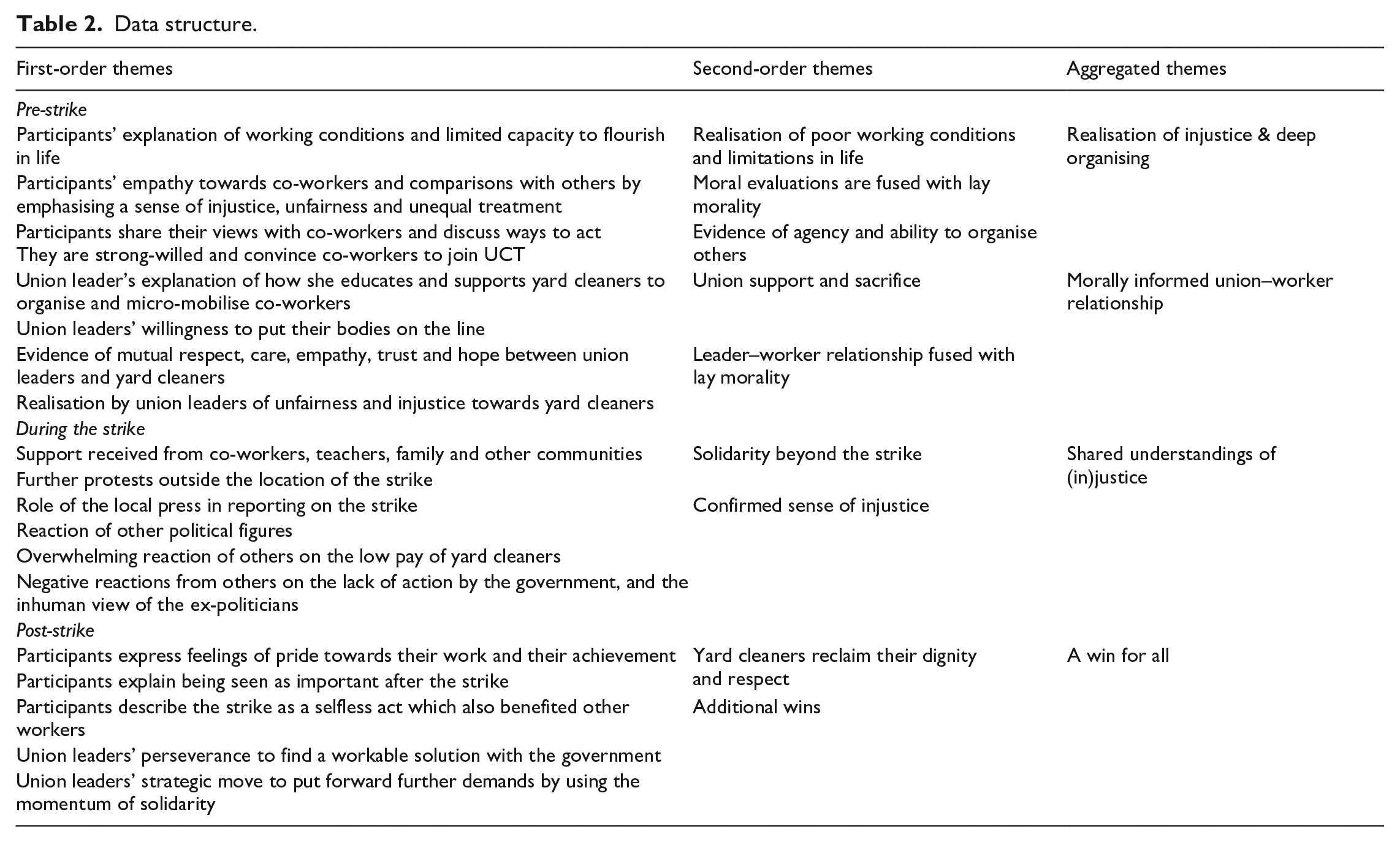
Interview data were further triangulated with other empirical sources from Table 1 to understand the event at different levels (Patton, 2014), and to include a more contextualised discussion of the findings. These sources included press releases, journal articles with historical accounts of the context, and a rich online documentary archive from Lalit, a national activist party founded in 1976 (see reference list).
Findings
Pre-strike
The realisation of injustice and deep organising
Sandra, Salonee, Sheetal and Santi earned less than other cleaners, and usually experienced delays in the payment of their salary. They were neither entitled to paid leave nor the national statutory end-of-year bonus. They were embarrassed vis-a-vis their co-workers because of the low pay, but continued working in the hope that one day the school or government would offer them a permanent contract, as explained by Sheetal:
People told me to leave the company, but I did not have another job. At that time, Rs1500 was very little money but still, we had something. Then my husband told me to leave but I refused. I told him that maybe one day the government would employ us. So, I continued to work. . . We receive only Rs1300 when there are public holidays. We feel embarrassed to go take the money in the office.
Sandra had a strong sense of empathy towards co-workers in the same situation and narrated how they were treated differently from other cleaners. Comparisons with others resulted in the constant use of ‘us’ and ‘them’, indicating the beginning of a social identification process:
There was no consideration for us. We must just come and clean. Do our job. . . No more than that! When they organise a party, we were not invited and at the end of the party, they asked us to take the leftovers. Some of us did not go. They remember us at the last minute, it is not fair. Why don’t they consider us at the same level as them? We must clean so that they can be in a clean school. If we are not here, how will they do their work? Some had some humanity in them, but the majority did not. (Sandra)
In 2013, Sandra was the first of the four workers to hear of UCT through another group of school cleaners that UCT had helped. She had visited UCT’s office with two co-workers, including Sheetal, but was turned away. UL1 narrated her first meeting with Sandra:
I met with them and explained what other cleaners did, what steps they took, and that they had to do the same. They would not get anything on a plate. They told me that 600 women are working in all the primary and secondary schools in Mauritius and I said ‘So in 600 women only 3 of you came? There is nothing I can do!’
Sandra and her co-workers had no previous support base to organise more workers. This first meeting with UL1 was a turning point for Sandra, Sheetal and Salonee, who organically emerged as leaders of the group. They started deep organising (McAlevey, 2016), contacting co-workers from other schools, and framing a sense of injustice and denial of rights for all cleaners:
When we met them [co-workers], we asked them for how long will they accept a salary of Rs1500?? For this job where you must clean the whole school’s yard and do deep cleaning. I asked them how long we will continue like this? (Sandra)
They took risks, searched for co-workers’ contact information, visited schools and talked to others. A sense of self-efficacy had emerged, as expressed by Sheetal:
As if we were clever, we searched for their phone numbers at school itself. We phoned and said, ‘let’s go, you never know what may happen’.
In the end, they were successful at imbuing a sense of injustice in co-workers (Fantasia, 1988) and transforming individual interests into collective goals and motivations for cleaners, by attributing the injustice to a government that did not care or recognise them. They were able to convince co-workers to join UCT, as related by UL1:
These women are the ones who continue to fight, ask people to organise, join the union, and so on. . . They have become so strong, they have been in this union world for so long, that they can go around the country and convince others to join the union!!! They can do it.
Deep organising was important for the hunger strike. It was driven by emotions, empathy and the need for justice. It gave UCT and its members a stronger power base. As organising progressed, the number of cleaners joining UCT slowly increased. Co-workers were able to share their stories during meetings, reinforcing a shared sense of injustice and collective interest.
A morally informed union–worker relationship
In the end, after four years Salonee, Sandra and Sheetal (and other workers not cited in this article) organised nearly 300 yard cleaners across the country. UCT’s initial role during the organising process was to educate workers on the importance of joining a trade union, as narrated by UL1:
I told them that I can write on a piece of paper the importance of a trade union and what fights we have led before. So they can give this paper quietly to those people so that they will know the function of a trade union. When they go home, they will read it and understand, and if they cannot read, their family will help them, and they will become conscious and they will come.
From 2013 to 2017, the four yard cleaners, UL1 and UL2 made several visits to ministries, conducted meetings with workers, and organised many marches. However, the case of yard cleaners was not taken seriously or was deemed not a matter for the government given their employment with a private company. Policies and rules for privately contracted workers in the public sector were used by government officials to legitimise their position. This confirmed a disconnect in moral understanding between the government and yard cleaners, which reinforced UL1’s solidarity towards the workers. Her moral evaluation of the situation of yard cleaners was loaded with mutual empathy. She cared for and defended their wellbeing vis-a-vis the government. Below she narrates a meeting with the Minister of Education at the time:
She [minister] said the women [yard cleaners] should have paid more attention to their terms and conditions of work. They were supposed to work one hour in the morning, one hour after the children had their lunch break, and one hour in the afternoon. . . So, I asked her, ‘who would pay for their transport to go and come back so many times’. She had no answer.
UL1’s views reflected a strong normative base against injustice and inequality. She was sensitive to how Sandra, Salonee and Sheetal were treated during meetings, even when they were not directly targeted:
I was disgusted and realised how people in this country are disconnected from the reality of what other people are facing. We took some of the workers to the meeting with the minister. She respected me and UL2, but she was not interested in them [referring to Sandra, Salonee and Sheetal] and wanted them to speak fast. . . I do not like this because you must be able to listen to people before you can understand their problem.
A strong sense of mutual empathy and mutual respect had developed between UL1 and Salonee, Sandra and Sheetal. She said, ‘Their understanding is very basic. . . but I tell you honestly, I love working with them because as soon as they understand they become their biggest defender.’ The first call for a hunger strike was in July 2017. UCT and yard cleaners were ready to start strike action when the Ministry of Labour decided to consider their demands and asked for a list of workers affected (Lexpress, 2017a), but by September 2017, it became clear that this was just an attempt to demobilise the strikers (Lexpress, 2017b). UL1 recalled this moment: ‘Everyone was happy. We stopped everything, then came September nothing had happened. . . These women were restless. They were stressed and said we must do something.’
Authorities continued avoiding UCT and the workers, claiming that they were working on the case. It was when the government decided to advertise all yard cleaners’ posts, that anger, distrust and a strong sense of unfairness and injustice emerged and led to the decision to go on hunger strike, as narrated by UL2:
She [the minister] said she would advertise these 300 posts and would conduct an interview to employ these people because she needed to follow the law! They previously stopped us from doing the strike and asked us to negotiate to find a solution. We agreed but it was to buy time and we understood that they stopped us because all the preparation[s] to advertise the posts were made. . . on 13th October, we decided to start the hunger strike.
UCT’s previous success in a nine-day hunger strike for drivers (see Table 1) was an important departure point for the union leaders and yard cleaners. It gave hope that the situation can change through collective agency. The hunger strike was strategically planned to happen four days before Diwali, a major Hindu festival, and a national public holiday. UL1 was convinced that if they entered the strike, the government would have to end the strike before Diwali. UL2’s decision to join the hunger strike despite being diabetic reflected a strong sense of sacrifice in the interest of workers and justice:
UL2’s family came, and they were all against him joining the strike as he is diabetic, but then I told him that since Diwali is 4 days away, the government will not let women sleep in a tent. So, before Diwali, they may end the strike, and solve the problem. (UL1)
UL1’s enduring involvement in micro-mobilising other workers alongside Sandra, Salonee and Sheetal, the struggles with government officials, both union leaders’ decision to put their bodies on the line, and the relentless deep organising lead by Salonee, Sheetal and Sandra, are symbolic of ongoing social interactions that created a strong sense of solidarity between UCT and yard cleaners. It was based on moral sentiments and dispositions between them, as expressed below:
When we saw that UL1 and UL2 were with us, we felt strong. A strength that no one can take away from us. These women, these men, all together, as if, a big force. (Salonee)
During the strike
Shared understandings of (in)justice
There was hope that as per UL1’s strategic calculations, the strike would end by the fourth day, but there was no reaction from the government (Lexpress, 2017c; Le Mauricien, 2017a). Thereon, it was their faith in God that bound the strikers, as narrated by Sheetal:
Everyone was praying. After taking a bath, each and every one was doing their prayers in the place where we were lying down.
The hunger strike started getting attention at the national level. Journalists visited the location of the hunger strike on a daily basis and a critical incident during the strike was the intervention of one of the most important historical and political figures in the country, also an ex-prime minister and president. During an interview, the press asked him about his views on the hunger strike, to which he replied that if the strikers wanted to die, they should be left to die. Salonee recalled the emotions she felt when she heard him:
This made us realise that we are poor, and they don’t care for us. You understand! We are poor. Even if we die, it does not matter! They are rich people, they need a big car. Even if we get Rs1500, and our children don’t get the things they want, it’s not a big deal! Let them die!
The press asked UL2 about his view on the answer of the political figure, to which he replied: ‘You know if your father tells you to die then what can you say. . . we understand him as an elderly person. . . so we forgive him.’ This non-aggressive response triggered an abundance of respect and solidarity towards the strikers. On the fourth day (Diwali), crowds gathered at their tent to celebrate, as recalled by Sandra:
No one believed that we would celebrate Diwali over there. . . Many came to support us. They brought lights, and lamps, played music, and sang for us to support us. We were touched that day. We all cried. . . There was that song ‘We Are the World’. . . Everyone cried as they thought about the struggle we were going through.
News about the hunger strike had spread and created a shared sense of injustice in the country, as narrated by Santi: ‘Teachers from the school could not believe that we used to get only Rs1500. They were encouraging us to carry on, everybody supported us.’ The response to the political figure moved the country, as recounted by UL1:
UL2’s answer and what the political figure said had moved the whole country. From that 5th day to the 10th day, the press people kept coming to see us. We were everywhere in the news. People started coming to see us from everywhere, they started to understand the problem. There was a big crowd every single day. People started to write messages of solidarity.
Solidarity during the hunger strike transcended boundaries of race and ethnicity in a context where ethnicity is quite defined. UL1 recalled the Muslim couple who came to celebrate, Diwali under the tent:
You know what was more beautiful? When it was Diwali, a young Muslim couple came with diyas [lamps] and decorated our tent. It was very touching. At the same time, there was a Bahai celebration, and my daughter also sang Bahai prayers for us. There were songs, prayers, folkloric songs. . . I can tell you that from that 5th day, the strike was extraordinary.
Other yard cleaners who were not in the hunger strike started organising protests in front of the parliament building in solidarity with the hunger strikers. They wore their aprons and carried their brooms. Family members and schoolteachers supported strikers by visiting them each day and in Sheetal’s case, the head of school even agreed for her husband to sweep the schoolyard to keep her job while she was on strike:
From my side, my husband was sweeping so that I do not get myself into trouble. . . So that they don’t sack me. I informed the very kind headmaster. He told me to go forward as I was fighting for a cause but told me not to inform the company that I was not there. As if, they were helping me.
The lack of reaction from the government was criticised by the public and important ex-government officials (Lexpress, 2017d, 2017e). The local press played a key role in strengthening lay morality through empathy towards the strikers and their working conditions, as narrated by Sandra:
Nobody believed that we earned Rs1500. Teachers and heads of schools did not believe us when we said we earned Rs1500. . . When we did the hunger strike, it was then that they believed it. They wondered how we survived with all the work we were doing. That is incredible! The government was disappointed too as all newspapers and all radios started talking.
UL2 described what was happening as ‘a real transformation where a union’s fight became a fight for the civil society’. Other trade unions also visited them, and a negotiating team was set up to liaise with the government. It also became a political opportunity, as narrated by Sheetal: ‘Ministers came to see us, especially the Labour Party [also the opposition at the time]. They all came and started to talk. Everyone was saying that the government should have resolved this a long time ago.’
Post-strike
A win for all
It became clear that the six strikers had caught the attention of other members of society, the press and the government (see Lalit, 2017; Le Mauricien, 2017a, 2017b, 2017c; Lexpress, 2017a, 2017b). Finally, on the fifth day of the strike, the prime minister agreed to speak to the negotiating team through whom UCT proposed that yard cleaners should be recognised and paid directly by the government, as expressed by UL1:
Finally, we proposed a solution to the government that it should create a company under the public sector to register them [300 yard cleaners] so they can pay these workers directly. This is possible and it has been done before.
On the tenth day of the strike, this demand was accepted (Le Mauricien, 2017b; Lexpress, 2017b, 2017c). Using the hunger strike and the solidarity it had gathered across the country, a second demand was put forward by UCT:
In 2014, we wanted the 2008 employment law to change, and we had asked for a minimum wage to be introduced. Both had been accepted by the government and they were meant to be working on it. . . We used the hunger strike to say that if these 300 women are now earning Rs8000, then there are still women who work as maids and earn Rs4500, and women in the EPZ [export processing zones] who earn Rs4500. Why this disparity? When will the 31 different remuneration order[s] system end? If everyone is working the same, then they should get the same. . . We asked for a national minimum wage. On New Year’s Eve 2018, the government announced that there will be a national minimum wage, and a national wage council [NWC] was set up for the first time. They agreed on Rs8000 as the national minimum wage for everyone working 45 hours per week. . . We won two fights: those 300 women and every worker in any sector earned a national minimum wage. (UL1)
The hunger strike helped yard cleaners reclaim dignity in their work. Through deep organising, they became leaders and were able to decide matters relevant to them. They felt respected and important, a feeling never experienced before, as narrated by Sandra:
The broom sweeper finally sits in the board committee! Those who hold a pen in my workplace have never been to places where I have been. I tell them that I have been to the parliament, to the government’s office and I have even accompanied the boss to the board committee along with UL1 and UL2!
Salonee expressed how she was proud to have made history, and how the green uniform (cleaner’s uniform) has become a symbol of good work and pride:
When we see the green uniform on the road, we are proud because now it is acknowledged for doing a good job. This is all thanks to the union and the few women who cleaned the school for just Rs 1500.
The selflessness in the sacrifice showed how, in the end, the hunger strike was no longer about the yard cleaners’ case, but it became a matter of justice for all workers:
Never mind we gave our life, but we have helped all workers in Mauritius. (Sandra)
Discussion
This article demonstrates the explanatory power of lay morality and the moral economy (Sayer, 2000a, 2010; Thompson, 1971) in understanding how solidarity and mobilisation emerge within the labour process. It illustrates how solidarity was created between workers, within the union–worker relationship, and across broader society, leading to strong shared understandings of (in)justice around paid work, capable of exerting pressure on the government. Mobilisation theory underscores the importance of attribution as a crucial step in enabling collective action (Kelly, 1998). In this study, through deep organising (de Turberville, 2007; McAlevey, 2016), workers strengthened the trade union’s power base by reinforcing the attribution step. At the same time, this confirmed workers’ subjective capacity to create a sense of injustice and engage in attribution through moral evaluations and lay morality.
Historically, Mauritius has witnessed two significant hunger strikes. The first occurred in 1979–80, when union leaders protested against the government for not respecting the August 23 Agreement. The second, in 2003, was initiated by UCT in response to job losses faced by drivers of a travel and tour operator. In both cases, workers did not participate directly in the hunger strikes but instead mobilised through other means beforehand. These events draw parallels with EP Thompson’s concept of moral economy, illustrating that hunger strikes have become a mechanism of social pressure during working-class mobilisation in Mauritius. Historically, such actions have been driven by shared understandings of justice aimed at protecting the working class, and are triggered when these collective understandings are threatened, as seen in the case of yard cleaners.
The article provides both empirical and theoretical insights into how history shapes the contextual opportunity structure for collective action (Kelly, 1998; Tilly, 1978). Among the success stories of worker mobilisation in Mauritius, the historical struggles between capital and labour have created a strong connection between trade unions and politics (Lalit, 2018; Ramgutty-Wong, 2010). Since spearheading the independence movement and leading various protests and strikes from the 1930s onward, trade unions have helped establish moral economies and shared understandings of justice within the working class to challenge unjust economic practices. This has strengthened solidarity among workers and entrenched the mobilisation of the working class against the government as a cornerstone of industrial democracy in Mauritius (Betchoo, 2014).
There are many similarities between the 1979–80 and 2017 hunger strikes. Both were preceded by successful government-led demobilisation strategies. In 1979 the August 23 Agreement was agreed upon but not actioned, and in July 2017, the government agreed to consider the case of yard cleaners, which was later declined. The use of tendering in public services causes a considerable loss of autonomy and power within the labour process due to the intensification of work and deterioration of terms and conditions of employment (Patterson and Pinch, 1995). The government’s refusal to address yard cleaners’ pay-related problems, its acceptance of different contractual and employment terms and conditions within the same type of public service, its proposal to advertise yard cleaners’ jobs, and its tendency to blame workers confirm the government as an active political apparatus in the labour process (Burawoy, 1983).
The article’s theoretical engagement between the moral economy and mobilisation theory advances theory in three ways: first, a moral economy lens adds analytical value to MT by drawing attention to deep subjective moral evaluations and the lay morality of workers and union leaders. Conceptually, lay morality uncovers issues of justice, rights and care (Sayer, 2005a), often conflated under organising in MT. In this article, lay morality was vital in initiating the process of deep organising in an unorganised work environment. Additionally, it revealed that union leaders are also imbued with moral sentiments and dispositions that develop through ongoing social interaction with workers.
Second, engaging lay morality in the context of worker mobilisation brings resistance back into the moral economy following criticisms that its focus on social values and norms lacked economic principles (see Bolton et al., 2012), and for diluting the economic turmoil and resistance that are rooted in EP Thompson’s idea of a moral economy (Siméant, 2015). The study confirms that moral evaluations through lay morality have heuristic value and can be conceptually integrated within the understanding of how worker solidarity develops and how the union–worker relationship can also be based on moral evaluations and moral understandings. This is significant as it brings new understanding to the discussion of how social and economic principles are intermeshed, shedding new light on normative bases of mobilising.
A third contribution relates to recent attempts to combine ME and labour process theory (Hughes et al., 2022; Laaser, 2016), and broader MT (Kelly, 1998; McAdam, 1988; Tilly, 1978). The study shows that moral economies and mobilising are historically influenced events, even when structural conditions in the labour process change. They continue to be drawn upon by unions, workers, politicians, and the rest of society, and influence the outcomes of mobilising. This is significant as it shows the relevance of history in creating an interdisciplinary understanding of solidarity capable of advancing theory.
Conclusions
This article advances our understanding of solidarity in the labour process. Its theoretical engagement with moral economy and mobilisation theory adds analytical value and provides a more fertile ground to understand the subjective moral evaluations of workers and union leaders. The importance of a trade union in reinforcing moral connections between workers is incontestable and union leaders are also fused with lay morality, and convey acts of sacrifice and selflessness, particularly when a strong shared sense of injustice is experienced. In this article, the union’s power base increased through workers’ deep organising and the organic emergence of other leaders. After years of protest, the union–worker relationship transformed into stronger human connections. The success of the hunger strike is certainly the outcome of resistance by yard cleaners, union leaders and civil society. However, the role of the context’s history in influencing the opportunity structure for organising and mobilising should not be overlooked. It paved the way for a strong working class where unions continue to influence the political space. It is also noteworthy that it was women who led the organising and mobilising in this study. Further research is needed to understand how women and historical dimensions influence solidarity and mobilisation in different contexts.
Footnotes
Declaration of conflicting interests
The author declared no potential conflicts of interest with respect to the research, authorship, and/or publication of this article.
Funding
The author received no financial support for the research, authorship, and/or publication of this article.
