



Abstract
Global Union Federations (GUFs) pursue their agendas in ways that are both enabled and constrained by their relational interactions with affiliates. These interactions have been primarily understood in terms of the principle of subsidiarity – a perspective that positions the GUFs as playing a residual, passive role in global labour governance rather than as organisations with the potential for autonomous action and strategic agency. Drawing on data gathered at the headquarters level, in the GUFs’ Asia-Pacific regional offices, and from GUF affiliates in the Asian region, this article argues for the utility of the concept of ‘constrained agency’ as a more useful way of analysing the tensions between GUFs’ desire to act strategically at the global scale, their duty to respond to the needs and agendas of their affiliates, and their reliance on the varying effectiveness and capacities of those affiliates to achieve their strategic aims.
Introduction
Trade union agency is relational and dependent on unions’ capacity to mobilise workers and represent their interests and concerns but also on the institutional, political and market contexts in which they are embedded. This balancing act is particularly acute for labour movement organisations that are removed from the point of production and thus distant from day-to-day engagement with and representation of workers. Grassroots unions maintain direct links of accountability to their members. But, as ‘organizations of organizations’, the Global Unions are responsible to, and engaged with, their affiliates rather than directly with the worker-members of those affiliates (Gumbrell-McCormick and Hyman, 2013: 162). As such, the Global Unions face unique challenges in ensuring their democratic accountability and legitimacy, and in terms of their own organisational agency, they can be said to be both enabled and constrained by their relational interactions with those affiliates.
As Lillie (2013: 11) has argued, the transnational dimensions of the labour movement are ‘not an automatic reflection of its day to day activities, but rather something which it must independently construct as a political project’. The Global Unions’ role as agents in advancing this project – and the enabling and constraining conditions in which they make their interventions – are important topics of study that have seen a marked expansion in the scholarship in recent years (e.g. Ford and Gillan, 2022; Hyman and Gumbrell-McCormick, 2020). 1 However, the complex relational interactions between the Global Unions and their affiliates have received relatively little attention within these analyses of labour transnationalism. Where they have been observed, assessment of them has often been incidental rather than central, as in research on transnational agreements (see, for example, Ashwin et al., 2020).
What discussion there is centres primarily on interactions between the Global Union Federations (GUFs) and their affiliates, which are most often explained in terms of subsidiarity. The problem with this approach is that it positions the GUFs as playing a residual and passive role in global labour governance rather than as organisations with the potential for autonomous action and strategic agency. This may have once been so, but it has not been the case for several decades now. Platzer and Müller (2011: 155) noted a ‘qualitative change’ in the International Metalworkers’ Federation (IMF) as far back as the early 1990s when it assumed a ‘greater strategic role in relation to its affiliates that extends beyond the provision of services’ and which, in turn, enhanced its status and recognition as a ‘collective actor’. 2 More recent studies of the GUFs have identified numerous instances in which they have provided strategic direction to their affiliates on issues such as labour migration (Ford, 2019) or climate change (Felli, 2014; Stevis, 2021). Understanding this strategic role is important since transnational union action and strategic capability are essential for union renewal in our globalised world (Murray, 2017). 3
Offering an alternative to the concept of subsidiarity, this article argues for the utility of the concept of constrained agency as a tool for analysing tensions between the GUFs’ desire to act strategically at the global scale, their duty to respond to the needs and agendas of their affiliates, and their reliance on the varying capacities – and willingness – of those affiliates to contribute to the achievement of the GUFs’ strategic aims. Having first outlined the concept of subsidiarity and argued for an agentic view, the article examines how these tensions play out in practice through the GUFs’ relationships in the Global South, where affiliate engagement is most intensive. As demonstrated in the following discussion, constrained agency is contingent insofar as it is associated with the ebbs and flows of interactions between the GUFs and their affiliates over space and time. These contingent, relational interactions may result in congruence and strategic alignment to support real impact but also misalignment that leads to diminished outcomes or threatens a GUF’s relationship with individual affiliates. Crucially, however, the GUFs and their affiliates have dynamic and mutually constituted experiential understandings of the character of their relationships and the degree of alignment in their strategic goals and priorities.
From subsidiarity to constrained agency
The principle of subsidiarity describes a situation whereby ‘power resides in local or regional structures with the central body carrying a framework-setting, coordinating and monitoring function’ (Cotton and Gumbrell-McCormick, 2012: 718). As used in discussions of global governance, this principle is ‘typically understood as a presumption for local-level decision making, which allows for the centralisation of powers only for particular, good reasons’ (Jachtenfuchs and Krisch, 2016: 1). In discussions of the GUFs, subsidiarity has been identified as a core ‘organising principle’, whereby the ‘main institutional power of these international bodies resides in local affiliates or regional structures’ (Cotton and Royle, 2014: 709; see also Hammer, 2005; Sobczack, 2012).
At one level, this understanding makes perfect sense: the GUFs have no formal power to direct their affiliates and thus must ultimately rely on those affiliates’ strength of commitment and sustained engagement when implementing their organisational objectives (Hyman and Gumbrell-McCormick, 2020). It does not, however, capture the complex, bidirectional nature of these relationships. The GUFs may have weak hierarchical authority or sanctioning power, but they do not act simply as agents of their affiliates; they also seek to shape the agendas and actions of those affiliates to serve their own strategic goals, and can act in their own right. As such, they not only decide when and how to support individual affiliates but also lay claim to the authority and coordinating mechanisms to advance transnational action and worker representation.
This level of strategic independence is possible because the GUFs possess a degree of informal authority ‘based on their expertise, reputation, status, gatekeeping privileges and control over key resources’ (Garaudel, 2020: 9). Their capacity to work as institutional entrepreneurs, network coordinators and governance intermediaries in bilateral relationships and multi-stakeholder initiatives involving global counterparts like multinational corporations (MNCs) across various geographic scales is underpinned by their informal authority. This informal authority also positions them to act as change agents in promoting the values and ideologies of international solidarity and a shared global organisational identity (Frangi and Zhang, 2022), as well as providing pathways to specific repertoires of transnational action (Ford, 2024; Ford and Gillan, 2022; Garaudel, 2020).
The GUFs’ relationships with their affiliates are also characterised by ‘asymmetrical interdependence’ insofar as they ‘bring direct support to their members, especially the weakest ones, but are strongly dependent on their strongest ones’ (Garaudel, 2020: 13). Most Southern affiliates operate in hostile institutional and political contexts and are typically weaker than their Northern counterparts in terms of their membership base and access to resources (Caraway and Ford, 2017). As a consequence, they are in obvious need of support. And, despite the dominant rhetoric of partnership, the form this support takes and the uses to which it can be put are seldom, if ever, determined by its recipients. By contrast, many Northern affiliates – while grappling with eroding membership and institutional power – still effectively bankroll international union activities, affording them a level of authority and influence over the strategic direction of the GUFs (Croucher and Cotton, 2009; Platzer and Müller, 2011). In other words, the case against subsidiarity, as described in the labour studies literature, is strongest when it comes to the GUFs’ relationships with affiliates in the Global South. Importantly, however, there are also many instances where the GUFs have taken on issues or developed strategies independently of even their most powerful affiliates, driven by secretariat staff or by the agendas of non-union allies and non-union donors (Field observations, 2013–2023). 4
One possible course of action is to look beyond labour studies for a broader definition of subsidiarity. In business studies, subsidiarity is recognised as a principle that ‘regulates the assignment of responsibilities both top-down and bottom-up’ wherein ‘organizations of higher order are the result of the association of individuals or lower-order groups to accomplish task [sic] which could have not been accomplished on the lower level’ (Aßländer, 2020: 724). This expanded conceptualisation better accommodates the level of interdependence between the GUFs and their affiliates. However, the idea of a neat division of tasks and sharply defined organisational boundaries and authority remains problematic since the GUFs and their affiliates often engage in iterative ways that draw on the mutual authority and capabilities of each. What is required, then, is a more relational conceptualisation of the structures and processes that bind – and distinguish – the GUFs and their affiliates.
We argue that ‘constrained agency’ better accommodates the paradox between the GUFs’ reliance on their affiliates and their quest to realise their autonomous strategic potential. As a concept, constrained agency has been used within the organisational studies literature to draw attention to the interaction between structure and agency and actors’ roles within networks, whereby various ‘resources equip actors to exert agency in the face of constraint, and motivations propel them to do so’ (Gulati and Srivastava, 2014: 77). It has also been deployed by labour geographers, who recognise that ‘agency is always relational, and never completely autonomous’ (Coe and Jordhus-Lier, 2011: 221) and that the agency embedded in the labour movement is spatial, multi-scalar and embedded in specific economic, social and institutional contexts.
To understand the constrained agency of the GUFs, it is necessary to tease out the different dimensions of their relationships with their affiliates. First, there are tensions between their ambitions to engage with, and even shape, the global architecture of labour governance and the agendas of their affiliates. It is important to acknowledge the capacity of even the GUFs’ weakest affiliates to resist global agendas. Regardless of geographic location, membership or resourcing, each affiliate has its own organisational dynamics, strategic plans and repertories of action. Consequently, their engagement beyond the national scale may be sporadic, opportunistic and contingent on an ideological or organisational commitment to international solidarity as well as to the GUFs’ specific strategic agendas. For example, building collective power through interventions in global institutions, policy domains and value chain governance requires effective connections with unions in the Global North, where lead firms are located, and in the Global South, where production occurs. Countless campaigns have foundered on a lack of affiliate interest, commitment or capacity, even where those affiliates have received external funding to support their engagement (Interviews, 2013, 2017, 2022).
Second, since GUFs are bound to work through their affiliates, they are very much constrained by the actual capacity of those affiliates, irrespective of their geographical location. Given the GUFs’ reliance, affiliate capacity and inter-affiliate competition are arguably the strongest determinants of the success or failure not only of country-specific initiatives but also broader campaigns. However, labour movements are very often fragmented, particularly in the Global South, where much of the GUFs’ country-focused activity occurs – and a GUF’s affiliates are not necessarily the strongest unions in a given country or even in a given sector. Also, while the GUFs are increasingly looking to non-union donors, their ability to prosecute their strategic vision – namely, their access to resources – is very often contingent on their capacity to convince well-resourced affiliates, the Solidarity Support Organisations (SSOs) of national trade union centres in wealthy countries, or even foundations with no real links to the labour movement, to support their work.
In short, GUFs can and do act independently of their affiliates in ways that are not congruent with the principle of subsidiarity. However, as the discussion below illustrates, their capacity to do so is constrained by the contingent and dynamic character of their relational interactions with affiliates and characterised by periods of alignment and misalignment in organisational goals and levels of commitment – especially when affiliates’ own organisational dynamics and priorities change in ways that affect their engagement with the GUFs.
Context and method
The GUFs comprise the majority of the group of international labour movement organisations known as the Global Unions, which dominate the international trade union landscape. 5 Like the International Trade Union Confederation (ITUC), they act as international umbrella organisations for national-level unions. However, while the ITUC brings together national centres like the United Kingdom’s Trades Union Congress or the American Federation of Labor and Congress of Industrial Organizations (AFL–CIO) – which themselves are often federations or confederations of sectoral and other unions at the national or sometimes sub-national level – the GUFs bring together unions that represent workers in particular sectors, for example, manufacturing, construction, transport or education.
Our aim in this article is to develop a synthesised analysis of (a) the constraints associated with the GUFs’ interdependence with unions at other geographic resolutions and (b) how the GUFs work with and through these conditions to exercise strategic agency. In order to achieve this aim, we draw on data collected as part of a longitudinal study that focused on headquarters and the regional level within the seven main GUFs and on affiliates in several key Asian countries where unions receive substantial support from the international labour movement. By observing GUF activities and collecting interview data over time and space, we have been able to develop a historically and relationally informed understanding of these relationships (cf. Baird, 2023). Extended fieldwork also meant that we could track changes within GUF narratives and action repertoires. Its temporality and geographical scope also allowed us to observe how different projects and initiatives played out.
As part of this longitudinal study, we conducted 56 interviews of between one and two hours in length with representatives of all seven large GUFs at the headquarters level and 36 interviews with their staff in the Asia-Pacific, one of several distinct geographical regions within the Global South represented within the international labour movement between 2013 and 2023 (Table 1). 6 We conducted an additional 120 interviews with GUF affiliates in Cambodia, India, Indonesia, Myanmar, Nepal, the Philippines and Sri Lanka during the same period. 7 Affiliates were identified based on their listing on GUF websites, through active snowballing, and through documentation of country-level project-based activities or organising campaigns facilitated by GUF regional or global secretariats.
GUF representatives interviewed.
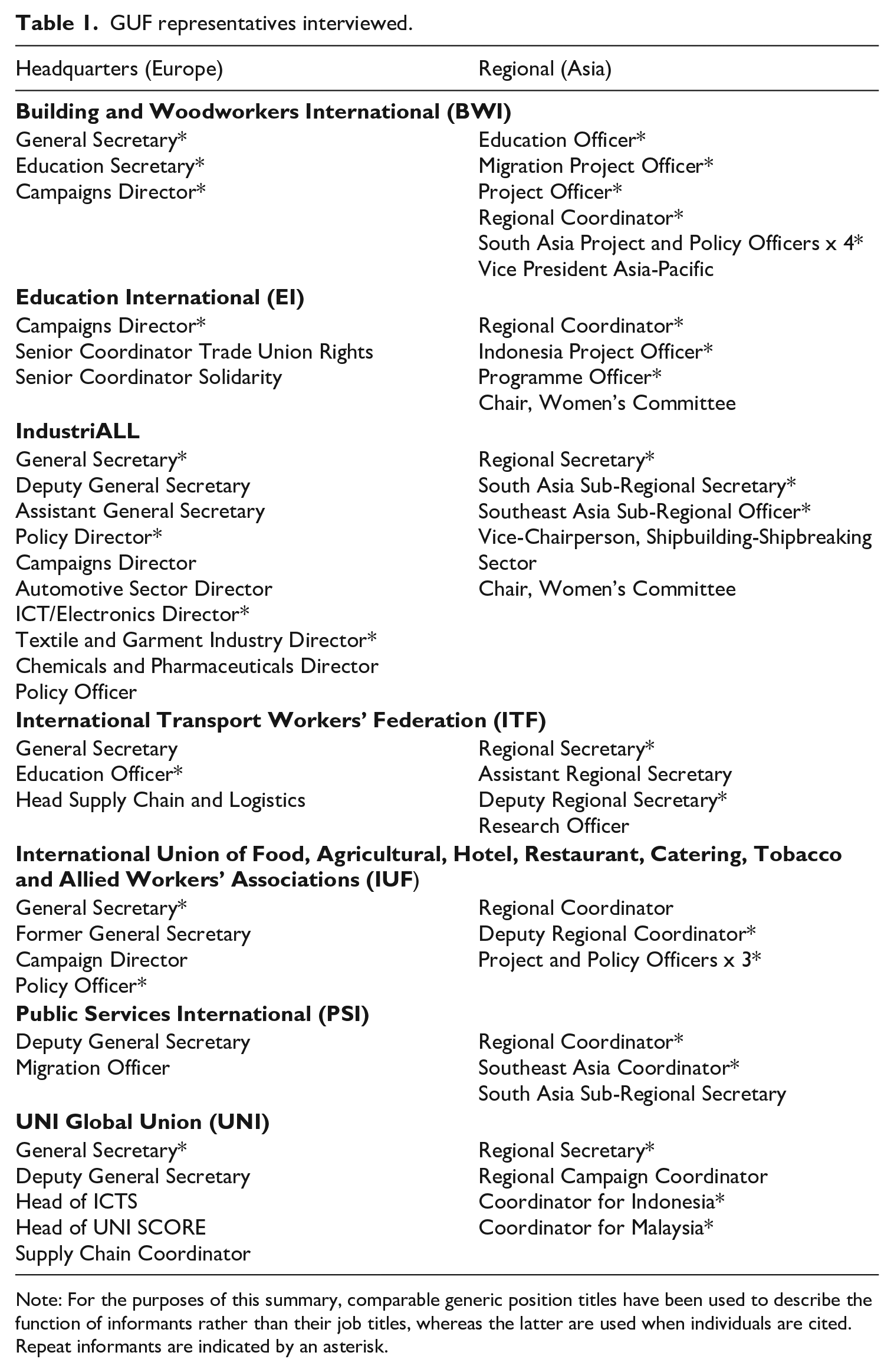
Note: For the purposes of this summary, comparable generic position titles have been used to describe the function of informants rather than their job titles, whereas the latter are used when individuals are cited. Repeat informants are indicated by an asterisk.
We analysed the data collected using inductive thematic coding to capture the dynamic nature of relationships between the GUFs and their affiliates and the impact of different aspects of those relationships on GUFs’ capacity to act. Through this analysis, we identified three clusters of key themes. The first cluster – drivers of change, refinements and changes in decision-makers’ thinking, and comparisons of current and earlier practice – related to the GUFs’ strategic direction and its implications for their relationship with affiliates. The second cluster focused on known risks for the GUFs in their work with affiliates and their strategies for managing them. These included responsiveness to affiliates’ needs and agendas, attempts to accommodate affiliate capacity, managing fragmentation among affiliates and resource constraints. The third cluster concerned dynamics within GUF–affiliate relationships from an affiliate perspective. This cluster included affiliates’ understandings of GUFs’ capacity, perspectives on GUF agendas and responses to perceived GUF overreach.
As Lévesque and Murray have noted, organisational narratives are an important power resource for unions. These narratives, or ‘stock of stories’, ‘frame understandings and union actions and inform a sense of efficacy and legitimacy’ (Lévesque and Murray, 2010: 336). They further suggest that narratives ‘constitute a body of interpretative and action frames that can be mobilized to explain new situations and new contexts and point to consecrated repertories of action’ (Lévesque and Murray, 2010: 339). Narratives emerge over time, and institutional memory of their previous iterations can be tenuous. In this respect, the extended period over which this study was conducted was invaluable since it made it possible to track the evolution of the GUFs’ change narratives through repeat interviews with key stakeholders over the 10-year timeframe of the study. Finally, having compared GUF and affiliate accounts for inconsistencies and differences in perception, we triangulated the information we had gathered through interviews with field observations – on several occasions, we had the opportunity to engage as observer-participants in GUF–affiliate activities at the national level – and documentary sources collected over that same extended period.
The following sections report on and analyse our findings, first unpacking GUF narratives of change and the institutional adjustments that have accompanied them before examining their attempts to manage their relationships with their affiliates while attempting to pursue a broader strategic agenda. Affiliates’ perspectives on the strategies and efficacy of the GUFs are also examined, noting both alignments and misalignments between a GUF’s agenda and their own perceived needs and organisational priorities.
A (more) strategic approach
As Gumbrell-McCormick (2013: 242) points out, shifts in the ideology and identity of particular unions have an enabling or inhibiting influence on organisational restructuring and the adoption of new practices. For the GUFs, such shifts have been associated with attempts to clarify their purpose and strategic priorities. Driven by this desire for ‘a new type of global union’ that would be more strategic and results-oriented, they embarked on a conscious process of reimagining their role (Interview with IndustriALL General Secretary, September 2015). This process involved building an identity as more ‘union-like’ organisations – in the sense of moving beyond labour diplomacy and capacity-building to campaigning and even organising or involvement in dispute resolution (Ford and Gillan, 2021, 2022) – and not mere ancillaries to national unions.
Studies of union renewal have pointed to structural and institutional threats to the legitimacy and survival of unions and unions’ capacity to exercise agency in ways that slow, counter or reverse their decline (Ibsen and Tapia, 2017). According to Murray (2017: 23), the development of strategic capability feeds into union renewal using ‘organizational innovations, occupying new spaces of representation through organizing, enlarged collective action repertoires and connecting with members and potential members’. As such, union renewal does not constitute arrival at a stable set of reconstituted organisational practices but rather a process of transition. Indeed, as Fairbrother (2015: 563) emphasises, this process is best understood with reference to the interaction between how unions are organised, their varying capabilities and resources, and how they conceive of and frame their primary purpose. In the GUFs’ case, this position is neatly summarised by the General Secretary of the ITF, who described it as being ‘in a process of transition to become a more dynamic organisation with an objective of having real workplace issues driving our processes’ (Cotton, 2019).
Our analysis of the GUFs’ strategic planning documents and interviews with their leaders point to a sense of renewed purpose and confidence about opportunities to initiate and support strategic interventions that enhance space for labour voice and worker representation in specific countries, at the supranational level and in global production networks. Framed in the discourse of union renewal, GUF planning documents increasingly describe their activities, objectives and achievements in terms of engaging directly with unions at different scales to improve rights, assist with union coordination and strategic development and strengthen campaigns and bargaining leverage (e.g. BWI, 2017; IndustriALL, 2016; ITF, 2014; UNI, 2018). The influence of the Anglophone organising model 8 is clear in these documents, a fact that is unsurprising since several GUFs commissioned formal reviews led by Paul Goulter, a unionist and consultant from New Zealand with extensive experience of that model. As BWI’s General Secretary Ambet Yuson explained, in the past, the GUFs had put their efforts into ‘promoting the European way of social dialogue. Now, they are focused on campaigning and organising’ (Interview, 2013). As the ITF’s Global Supply Chain and Logistics Organising Programme Head observed, ‘We have all grown in a servicing approach, a union knocks on our door, and we help. But none of this goes to real power building. It’s a heavy change process, and we’re now going through it’ (Interview, 2015).
The GUFs’ emphasis on renewal is reflected in a push for different kinds of organisational structures and leadership. The most prominent example of the former is the merger of the IMF, the International Textile, Garment and Leather Workers’ Federation (ITGLWF) and the International Federation of Chemical, Energy, Mine and General Workers’ Unions (ICEM) to establish IndustriALL in 2012. This merger was in part driven by the near collapse of ITGLWF. However, according to IndustriALL’s first General Secretary, Jyrki Raina, it also reflected a need and desire for a ‘new type of global union, an organising and campaigns type organisation’ that would be results-oriented and strategic and would eschew the ‘soporific’ meetings, speeches and resolutions of the past (Interview, 2015). After its establishment, IndustriALL moved to develop regional structures linked closely to headquarters and councils of national affiliates to facilitate a more coordinated approach (Interview with IndustriALL Deputy General Secretary, 2013). 9 This renewal process also prompted changes in the GUFs’ relationships with the ITUC and each other, with several GUFs seeking to increase engagement through cross-sectoral campaigning, regulatory initiatives and country- and regional-level coordination (Ford and Gillan, 2022).
A second shift has involved appointing agents of change to leadership positions. In several cases, incoming leaders ran for office on an agenda for strategic renewal. ITF President Paddy Crumlin was elected in 2010 based on a strong demand for organisational change. The ITF’s change agenda was further supported by the appointment of Steve Cotton as Acting General Secretary in 2013 and his subsequent election to the position in 2014. Crumlin and Cotton oversaw a shift from a servicing approach to affiliates towards strategic interventions and global campaigns that aim to build union power (Interview with ITF General Secretary, 2022). Elected in 2012, PSI’s General Secretary, Rosa Pavanelli – situated in Italy’s tradition of contentious politics and social movement activism – brought a significant break from PSI’s past (Magdahl and Jordhus-Lier, 2020). Reflecting on Pavanelli’s leadership, a headquarters-level senior leader observed, ‘Her arrival coincided with the crisis of capitalism, climate and neoliberal austerity, deregulation, privatisation. This confluence of factors allows us – and requires – us to be much more hard-hitting in how we see the defence of public sector workers’ (Interview, 2019).
A third and related shift has been in the diversity of GUF leadership. The GUFs have been rightly criticised for their Eurocentric assumptions, institutional preferences and governance composition (Bourque and Hennebert, 2011). Leadership changes have brought greater diversity and representation from the Global South to the GUFs’ top ranks. Although the ITF elected an Indian president in 1998 and a South African president in 2006 (ILWU, 2007; ITF, 2010), the top leadership teams in most GUFs were still primarily drawn from Europe or the Anglosphere. This began to change in December 2009, when BWI elected Ambet Yuson, the first person from the Global South to hold the position of General Secretary in any GUF. IndustriALL followed suit in October 2016 when it elected Valter Sanches as its second General Secretary.
More women also took up senior leadership positions. In addition to Pavanelli, who served as PSI’s General Secretary until 2023, the IUF’s Sue Longley and UNI’s Christy Hoffman now numbered among their ranks. There has also been a significant shift in this respect at the regional level. For example, feminist lawyer and labour activist Apoorva Kaiwar was appointed as IndustriALL’s South Asia Regional Secretary in 2015. 10 Although women leaders are not by definition ‘union feminists’ (cf. Fonow et al., 2011), their presence in senior leadership roles has necessarily challenged the gender politics of these organisations, as evidenced, for example, by the IUF’s field-leading efforts on combatting sexual harassment in the workplace but also within unions themselves (Field observations, 2013–2023).
GUF leaders claim that organisational change – whether through restructuring, leadership transition or managed critical review and reflection processes – has supported thinking and acting in new ways. 11 As Yuson put it, ‘We are actually playing as a global union, not just a federation of unions . . . and in most situations we have relative autonomy’ (Interview, 2019). Yet, while this sense of rising confidence and autonomy was palpable, interviewees understood that implementing their strategic agendas required commitment and buy-in from affiliates – as demonstrated in the next section, which explores this interdependence from the perspectives of the GUFs and their Southern affiliates.
Constrained agency in action
The GUFs’ assertion of relative autonomy is associated with claims to greater recognition from affiliates and external organisations of achievements and impacts across intersecting action domains (Ford and Gillan, 2022). However, their capacity to exert their autonomy remains subject to very real constraints. Key among these are resource constraints, responding to affiliate needs and agendas without undermining broader global agendas and priorities, supporting affiliates’ capacity-building while monitoring their commitment and capabilities over time, and working with and through the persistent problem of union fragmentation, especially in the Global South. As our discussion of these factors underscores, the GUFs set the strategic agenda, but Southern affiliates frequently resist their coordination efforts or are disappointed with the absence or redirection of GUF resources and organisational capabilities.
Resource constraints
The GUFs have traditionally relied to a greater or lesser extent on donor funds sourced predominantly from Northern SSOs to bankroll their project-based work. The amount of money available through these channels is decreasing, and the requirements imposed on the SSOs have become increasingly stringent, as the Northern European governments that provide much of their funding now require that union solidarity programmes be held to the same standards as other forms of aid (Ford, 2019). GUF personnel at both the headquarters and regional levels must thus find ways to align their strategic priorities with the priorities of their donors as well as to the needs and concerns of their affiliates (Interview with PSI Sub-Regional Coordinator for Southeast Asia, 2017). This is not always easy, especially in cases where an SSO (or its back-donor) identifies themes of little interest to a GUF’s affiliates or targets countries where its affiliates are ill-placed to make good use of the funds (Interview with IndustriALL staff member, 2019). The SSOs also require specific forms of monitoring and evaluation, often on short-term project cycles that do not accommodate the lead times associated with long-term union-building work (Interviews with SSO staff, 2017, 2018, 2022).
In response to dwindling external resources and growing demands from SSOs and their back-donors, some GUFs have taken steps to broaden the donor pool. Others have moved to earmark a portion of affiliate fees for strategic initiatives. UNI, for example, created a strategic organising fund to enable organising in the production locations and targeted supply chains, as well as in previously unorganised firms or subsectors in the Global South (Interview, 2015). Recognising that the small group of affiliates providing the bulk of affiliate-sourced funding might expect some control over expenditure, UNI introduced a formal process to keep them at arm’s length. Under this process, applications for support are measured against criteria endorsed at its World Congress, enabling the secretariat to exercise greater control over the selection of targeted countries, industries and potential local union partners (Interview, 2015).
Another response to resource constraints has been growing collaboration among the GUFs. Although a Council of Global Unions was established in 2006, inter-GUF coordination has not always been a feature of the GUFs’ work. In recent years, however, there has been more communication, a more effective division of labour, and more collaboration, for example, through joint campaigns, such as the ITF/UNI joint DHL campaign (Ford and Gillan, 2021, 2022). Joint work with non-governmental organisations (NGOs) has also proved useful. For example, an IndustriALL organising project in the electronics sector in Southeast Asia was funded through a successful application to the European Union Commission under the banner of the Good Electronics Network. The application, spearheaded by a Dutch NGO, made it possible to obtain otherwise difficult-to-access funds (Interview with IndustriALL ICT Project Officer, 2015).
A second but related resource constraint pertains to staffing. Although some initiatives are run directly from GUF headquarters, regional officers play a vital role in capacity-building and organising initiatives and campaigns. In addition, regional offices support affiliates seeking to, for example, leverage agreements negotiated at the headquarters level. The success of the GUFs’ programmes and initiatives thus often relies on the capacity and interests of individual officials and project officers at the regional level (Ford, 2019). Despite the evident benefits of a local presence, 12 the GUFs rarely have country-level staff. This means that the attention of regional staff is necessarily thinly spread. In addition, there are often real tensions between headquarters and the regional offices. 13 These tensions were observable in interviews, with some headquarters staff expressing frustration about the recalcitrance of regional officers and some regional officers pointing to being bypassed in setting programme agendas.
Responsiveness to affiliates’ agendas
Southern affiliates constantly demand direct support from the GUFs, most often through capacity-building or an enabling campaign.
14
As IndustriALL’s General Secretary observed, ‘Unions want us to do everything, and of course we can’t’ (Interview, 2015). Putting it even more bluntly, the ITF’s General Secretary said, ‘It’s not our job to fight every dispute in every place – we’d be doing nothing but chasing around’ (Interview, 2022). Having a clear long-term strategy makes the task of saying so no easier. In the words of one GUF Policy Director:
We’re trying to be very targeted, focused, strategic. You don’t do that by swapping things every year. We now have the political mandate to say, ‘No, we’re not doing migration, and we’re not doing x.’ We have changed the internal dialogue. Now, we’re very confident about saying this is what we’re doing, and no, we’re not interested in that. (Interview, 2015)
As the Regional Secretary of another GUF observed, ‘Big regional projects are not a thing these days. Some unions don’t love that. There is still a mindset that everyone should get their fair share rather than working on priorities’ (Interview, 2022).
Due to this more targeted approach, affiliates often complain that the GUFs do not adequately respond to their needs. A representative of one of IndustriALL’s many Cambodian affiliates explained:
IndustriALL used to do protests in front of Uniqlo in Australia, but not anymore. But my big question is, why can NGOs organise this kind of thing, and Global Unions can’t? Unions have 80,000 members, say, in Germany. Why can’t they protest? They don’t need to go on strike or go to jail. But the way the Global Unions work now is that they are very slow to put pressure on the brands. Most of the time, when we talk to the brands and brands don’t listen, [an NGO] comes in. When they protest, the employer comes to us and says that if the protest stops, they will reinstate our members. But IndustriALL talks, talks, talks, talks until we die! (Interview, 2022).
This sense of frustration with fluctuating resource flows and organisational support was also evident among some Indian unions. A senior leader from an IndustriALL affiliate with a long history of working with the IMF complained, ‘The help we got then, we don’t get any more.’ Elaborating, he said there was less support for industrial campaigns initiated by the affiliate and that the GUF ‘no longer has an education department’ and ‘arranges training as a formality’ (Interview, 2017). This response underscores the misalignment between the GUFs’ renewed organisational purpose and affiliates’ desire for global support to progress their own organisational priorities rather than participating in a broader campaign.
Importantly, the GUFs are also constrained by the need to secure affiliate buy-in for their supranational policy agendas. In cases where global campaigns align with affiliates’ priorities, they can strengthen trust between global and national unions and support impact. For example, IndustriALL’s thematic campaign on precarious work resonated strongly in many national contexts but nowhere more so than in Indonesia, where the Federation of Indonesian Metalworkers’ Unions ‘led the way’ with its strong and sustained campaign on securing permanent positions for contract workers, reducing outsourcing, and improving social security (Interview with IndustriALL Policy Director, 2013). 15
According to IndustriALL’s third General Secretary, Atle Høie, a key challenge in securing buy-in for global and regional campaigns relates to the need to better communicate with and coordinate affiliates:
We had campaigns, but we never defined them in a way that was understandable to everyone. We’re trying to do that now. We’re thinking about how we define and strategise on campaigns, breaking it up so everyone knows if we agree on a campaign, what is everyone’s responsibility. What is the secretariat’s responsibility, and what is the affiliates’ responsibility. We need to get affiliates to agree. You can never run a campaign in Geneva. You need the buy-in. That has been very much of the missing link. (Interview, 2022)
However, buy-in can be difficult to secure. For example, a regional campaign to promote the ratification of ILO Convention 176 (Safety and Health in Mines) was backed by Indonesian affiliates and achieved ratification in the Philippines. Elsewhere in the region, however, it proved to be a ‘difficult campaign because frankly many affiliates do not care’ (Interview with IndustriALL Regional Officer, 2017). In another example, a UNI campaign targeting Walmart’s global retail operations gained little traction among affiliates in India because of its weak alignment with affiliates’ capacities and agendas (Interview with UNI Regional Secretary, 2014).
While campaigning strategies undoubtedly need continued refinement, it is clearly possible in some circumstances for the GUFs to set the agenda, especially in contexts where their affiliates rely on their financial support. For example, in Hong Kong, Malaysia and Thailand, BWI affiliates moved from a strongly anti-migrant stance to reluctant engagement with a BWI migration project officer to making substantive changes in their rhetoric and operations to better accommodate migrant workers (Ford, 2019). In another issue domain, the ITF has mobilised resources to engage with its affiliates and external organisations (the ILO and employer and industry associations) on the need for action on climate change and a just transition (ITF, 2021). According to the ITF’s General Secretary, ‘going heavy’ on climate, especially the decarbonisation of maritime shipping and the need for a reskilled workforce, was ‘quite a stretch to get affiliates to understand’. Consequently, it has required sustained organisational resources and commitment to shape affiliates’ priorities and thinking (Interview, 2022).
Ultimately, however, the more remote GUF campaign themes are from unions’ day-to-day concerns, the more likely it is that affiliates may choose not to devote their scarce resources to them. For example, PSI’s Asian affiliates have been reluctant to engage in its global campaign on trade and tax justice, a campaign that has gained traction elsewhere in the Asia-Pacific region. As PSI’s Sub-Regional Coordinator observed:
The affiliates are not into it, it doesn’t fall into their priorities. This makes it very difficult. I know that it’s quite important in terms of the global perspective, but unions’ interest in the campaign is very low . . . Even in the Philippines, which is very progressive in terms of tax, we have a problem with this campaign. (Interview, 2017)
In other cases, campaign themes – such as gender or sexuality – may be seen as threatening local values. This has been particularly the case in some countries with large Muslim populations, but also elsewhere in this relatively conservative region (Interviews, 2017, 2019, 2022).
Accounting for affiliate capacity
Affiliate capacity is a significant constraint on GUF initiatives anywhere, but especially in the Global South. Capacity-building projects have also traditionally been a key strategy for strengthening Southern unions. In some cases, GUF capacity-building projects have transformed affiliates. For example, EI’s long-running programme in Indonesia saw the transformation of that country’s enormous teachers’ union from a top-down, bureaucratic organisation that was primarily focused on implementing government policy to one that, although still struggling to find its place industrially, became far now more connected with its members (Ford and Mufakhir, 2013). In others, however, large capacity-building projects have achieved little real change (Ford and Patel, 2010).
In recent years, the GUFs have attempted to tie capacity-building activities into campaigns or organising initiatives (Ford and Gillan, 2022). The GoodElectronics project illustrates the logic behind such attempts. 16 As part of this project, IndustriALL funded organiser training in Indonesia, Thailand, Malaysia, Philippines, Taiwan and Vietnam as a basis for organising activities (Interview with IndustriALL ICT Project Officer, September 2015). The project supported the participation of over 3000 union activists in training sessions and network meetings in the six countries. Less predictably, it led to the recruitment of over 20,000 workers by affiliates, including temporary labour migrants and other precarious workers (Interview with IndustriALL ICT Project Officer, October 2019). For example, in Malaysia – where unions are notoriously poor at organising – the Electrical Industry Workers Union (EIWU) and the Electronics Industry Employees Union (EIEU) used the momentum generated by GoodElectronics to target temporary labour migrants, who comprise more than 50% of workers in some factories (Ford, 2019). One of the outcomes of this initiative was a collective bargaining agreement that included migrant workers and organised more than 900 workers at an electronics MNC (Matsuzaki, 2015).
This case points to a general theme in our data, namely an increased emphasis on outcomes. The GUFs are obliged to support weak or even new unions in priority industries or countries in the Global South, such as Myanmar, after the political and labour reforms of 2011–12 in that country (Interviews, 2015, 2017, 2018). Traditionally, funds were dispersed without considering individual affiliates’ potential. Now, GUFs are more likely to assess the prospects that a particular affiliate will actually build organisational capacity. As one GUF staffer observed, ‘There are countries where we keep giving money, and there is no result on the ground . . . We should give it to unions that have capacity. Otherwise, it’s like giving them drugs’ (Interview, 2019).
This shift towards outcomes is also evident in areas of strategic priority for the GUFs, such as the creation and activation of Global Framework Agreements (GFAs) with MNCs (Fichter and McCallum, 2015; Lévesque et al., 2018; Niforou, 2012; Stevis, 2010). GFAs were long seen largely as an end in and of themselves but are now increasingly seen to be meaningful only when they can be activated via ‘organising activity, real engagement with the company about how the agreement is going’ (Interview with UNI Deputy General Secretary, 2015) or by drawing affiliates into corporate campaigns (Interview with BWI General Secretary, 2013). As one GUF staff member noted, ‘striking a deal is one thing, but it’s about enforcing it in a way that creates space for local unions and gives them ownership’, which requires identifying and working with the ‘right unions’ in a particular country and industry context. In India, for example, the leader from one GUF affiliate suggested, ‘GFAs are not all useful in India! Workers need to come together and demand. The primary condition is absent. It’s only a piece of paper. They can be useful where unions exist! You can offer training, but who will you train?’ (Interview, 2017).
Similarly, organising interventions require GUF staff to work effectively with and through affiliates’ authority structures. Successful GUF-driven organising projects require protocols to avoid competition between participating unions, such as the mapping and determination of union coverage in targeted worksites, the allocation of funds for joint campaigns, and rigour in the registration of recruited workers and payment of membership dues and affiliation fees so that the unions are not so project-dependent (Interview with IndustriALL Regional Secretary, 2014). However, attempts to direct and monitor organising projects from headquarters or a regional office give rise to tensions between bottom-up and top-down design principles and potentially challenges to GUF authority from affiliates. For example, BWI’s ongoing work around mega-sporting events required innovation to address the absence of local unions in Qatar by recruiting workers to join BWI affiliates or affiliate councils in their countries of origin in South Asia (Interview with BWI South Asia Policy Officer, 2017). Organising and campaign-based advocacy raised awareness of BWI but also led to questions as to whether BWI was acting as a union, not just an umbrella organisation. As Yuson explained, ‘I said, “Yes, if there is a country where there isn’t representation, we play that role”.’
Managing fragmentation among affiliates
Union fragmentation and competition are among the foremost challenges the GUFs encounter when implementing their strategies in the Global South. They seek to manage these challenges in various ways, ranging from selectivity insofar as working only with certain selected unions to try to achieve outcomes to institutional inclusion, in the form of retaining a larger pool of affiliates at the national level but seeking to develop mediating institutions to manage the tensions and competition between them. Both these strategies carry risks. GUFs that choose not to engage with large, powerful unions in ways that encourage reform from within risk irrelevancy, while an ‘open tent’ policy carries the risk of affiliate disengagement or even open hostility. Some GUFs have responded to the challenges presented by competition between affiliates by building company-based, sectoral and national union networks to encourage collaboration, support global campaigns and enforce GFAs. However, these networks do not always function as intended.
At one end of the spectrum sits the IUF, which consciously decided not to ‘go for big numbers, because often big numbers aren’t in the organisations that you can build on’ (Interview with IUF General Secretary, 2015). In the Indonesian case, the IUF supported the establishment of a small union that focused specifically on hotels rather than working with one of the big tourism federations, a strategy it also adopted in other sectors, including plantations. In India, too, the IUF has historically worked in the food production and hospitality sectors with grassroots unions that are independent of national federations, which are typically aligned with competing political parties (Hensman, 2011). In 1994, when it expanded its coverage to agricultural and plantation workers (Platzer and Müller, 2011: 352), it faced a strategic dilemma in India, where some affiliates were perceived to be lacking in their ‘democratic functioning and genuine representation of workers’. For example, some unions were found to be colluding with plantation owners and managers to suppress workers’ wages (Interview with former IUF India Organiser, 2014). This disjuncture led to a gradual process by which several tea unions in India either did not renew (or were not allowed to renew) their affiliation.
At the other end of the spectrum sits IndustriALL, which accepts a broad range of affiliates and then attempts to manage the often-bitter divisions between them (Interview with IndustriALL General Secretary, 2022). IndustriALL’s key strategy has been to establish national councils that bring all its affiliates together across sectors. In Indonesia, IndustriALL’s National Council has had some success in building bridges between formerly hostile affiliates. In the words of one clothing and textile union branch leader, it ‘brought the unions together and made collaborating easier. There is a feeling of brotherhood’ (Interview, 2014). In Bangladesh, IndustriALL staffers felt it provided a more consolidated structure for communication and lobbying of the brands and state authorities (Interview with IndustriALL South Asia Regional Secretary, 2014). However, the challenge of enabling local union cohesion and effectiveness remained (Kang, 2021).
Conditions are even more difficult in Cambodia, where IndustriALL’s affiliates include unions aligned with the ruling party and the (now-defunct) political opposition, as well as nominally politically independent unions. IndustriALL’s Regional Secretary reported: ‘It’s always a challenge to have a joint statement, joint action, joint position. We are always faced with divisions in the house . . . We are trying very much to provide a platform for affiliates to sit down and continue discussing and not really tolerating disengagement or uncooperative approach. But it’s always a challenge’ (Interview, 2017). In reality, many of IndustriALL’s Cambodian affiliates reject the open tent policy and feel torn about participating in the national council (Interviews, 2017, 2022). On the one hand, they want support from IndustriALL. On the other hand, they see little or no benefit in this form of engagement. In the words of the President of one Cambodian affiliate, ‘IndustriALL has a National Committee to resolve cases, but the members of the committee are drawn from all the federations, including pro-government federations, so I feel like the committee is a waste of time’ (Interview, 2022).
Coordinators of sectoral and company-based networks also struggle with the need to build stronger trust and connection between unions at the national level while at the same time trying to develop transnational union solidarity to support organising and campaign goals (Field observations, 2013–2023). Across South and Southeast Asia, GUF staff acknowledge that the performance of these networks is influenced by the organisational and political fragmentation of unions and that they often fail to move beyond regular information exchange to enable successful campaigns or organising initiatives (Interview with IndustriALL Assistant General Secretary, 2015). In the hotel industry in India, for example, the IUF experimented with supporting the creation of a cross-union coalition called the Hotel Employees Federation of India (HEFOI) to facilitate inter-union communication and public campaigns for improved wages and working conditions in the industry. However, the network struggled to translate its actions into concrete outcomes and gains for workers (Interviews with HEFOI General Secretary and State Secretary, 2015, 2017).
Constrained agency vs subsidiarity
The GUFs have always had a unique – albeit contested – mandate to work beyond and across national social, economic and regulatory contexts. In recent decades, they have exercised this mandate in response to the rise of global production networks, corporate power and an increasingly global approach to broader policy issues with strategic initiatives to address global governance gaps and fill vacuums in union presence and worker representation in the Global South. In doing so, they seek to support the growth of affiliated unions and their own emergence as consequential actors in global labour governance, not as mere subsidiaries of their constituent unions.
The GUFs’ management of relational interactions with their affiliates – elsewhere described as the ‘logic of membership’ (Platzer and Müller, 2011) – remains at the heart of their prospects for success. At the same time, however, these relationships defy the fundamental assumption underpinning the concept of subsidiarity, namely that GUFs’ power to act is determined by their affiliates. As the analysis presented here reveals, the GUFs have developed a sense of capacity to act independently from affiliates, evidenced by their articulation and ideating of strategic priorities. Identifying and communicating these global strategic priorities to constituent unions allow GUFs to ‘say no’ to activities and demands for support that are incongruent with them. Communicating these priorities also allows for the assertion of organisational autonomy in playing a more direct, ‘union-like’ role in contexts where local unions are weak or non-existent.
It is also evident that the GUFs have the capacity to mobilise and direct resources to affiliates using allocations under their control or by acting as organisational intermediaries with donors – a capacity that affords them relational leverage with resource-constrained affiliates. The GUFs increasingly monitor resource utilisation and impact in a particular country or industry to ensure that it is aligned with their broader strategic priorities. This is something that GUF leaders and staff believe they have become better able to do through more targeted use of project-based donor funds and growing the pool of resources under their direct control. They also engage in reputational monitoring of their affiliates to assess their efficacy in using those resources. These assessments can change and shift over time and are also shaped by staff’s perceptions of affiliates’ leadership, union identity and organisational capability or capacity to grow and change. This reputational monitoring determines the likelihood of the future direction of resources, thickened relations, and enhanced mutual trust.
In addition, the GUFs seek alignment in these policy agendas and priorities with their affiliates via relational influence. The GUFs’ strategic priorities, whether these be taxation to enable public services, supporting climate change mitigation measures, or accommodating migrant workers, do not always align with the priorities of their affiliates. In such cases, translating GUF priorities beyond formal engagement with global governance institutions into national labour policy domains requires understanding and real ‘buy-in’ from a critical mass of affiliates. It is undoubtedly possible in some circumstances for the GUFs to set the agenda, especially in contexts where their affiliates rely on their financial support (Ford, 2019). Importantly, however, their ability to do so – even where funding is available – remains contingent not only on the presence and capacity of affiliates but also the capacity and interests of GUF personnel at both headquarters and the regional level and the strength of their relationships with those affiliates.
The GUFs’ capacity to leverage these relationships is further complicated by the need to manage fragmentation among their affiliates. Some GUFs – the IUF being a prime example – have sought to avoid inter-union competition by working with unions that align with their own identity and purpose and eschewing those that do not. Others – most notably IndustriALL – have tried to manage inter-affiliate competition through GUF-sponsored institutions such as national councils, global agreement monitoring councils and sectoral or corporate union networks. There is little evidence, however, to suggest that these institutions are effective in addressing union fragmentation, which remains a structural constraint that the GUFs have neither the authority nor the organisational heft to resolve. Yet, even in such situations, they maintain ideational and other forms of power.
These strategies function to expand the GUFs’ scope and agency. At the same time, they sit in tension with the ideas of affiliates about what a global union could and should be doing. To varying degrees, affiliates expect the GUFs to be responsive to their needs, supporting the campaigns and actions they initiate – nowhere more so than in highly resource-constrained national contexts in the Global South. These expectations do not align with the GUFs’ assertion of greater autonomy and strategic purpose, which is necessary if labour is to influence transnational practice. This tension – which exists for all ‘organisations of organisations’ – is especially significant because the GUFs rely on democratic processes involving their affiliates to maintain their legitimacy. In other words, the GUFs are not mere appendages to those affiliates, but their agency remains necessarily constrained by their relationship with them.
Conclusion
This study has highlighted the need for understanding the interplay between the GUFs’ autonomous capacity for the development of strategies and actions that seek to shape industrial relations outcomes and the fact that the implementation of such strategies requires them to secure commitment and mobilisation ‘on the ground’ by their national and local affiliates. As we have argued, the principle of subsidiarity explains the GUF–affiliate relationship in a formalistic sense. In all other ways, however, it falls well short of capturing the complex and multifaceted nature of these relationships and their implications for GUF agency. We do not, of course, assert that the GUFs are free to act as they choose. As we have documented, GUF leaders now see their organisations as being more confident and purpose-driven, with a distinct sense of relative autonomy in identifying strategic priorities and aligning resources and relational interactions to support those priorities. At the same time, however, their capacity to fulfil their strategic goals is constrained by their identity as ‘organisations of organisations’, which means that their capacity to lead, coordinate and mobilise their affiliates is contingent on multi-directional flows of knowledge, influence and resources.
Our purpose here has been to map out a theoretical terrain and agenda for future research. In providing a broad-based global view of this problematic, it has not been possible to provide an in-depth analysis of how funding mechanisms and political, economic and institutional conditions globally and in different countries shape the agendas and priorities of the GUFs and their affiliates, let alone forensically examine specific decision-making processes and power struggles. Rather, by advancing the idea of constrained agency, we hope to facilitate deeper explorations of these relational interactions with reference to specific campaigns and projects in different national contexts. Some of this work has already begun. However, as we noted at the outset, GUF–affiliate interactions remain for the most part incidental rather than central to analysis. In short, systematic analysis of these interactions and the relationships underpinning them is required for more robust assessments of the GUFs and their prospects for developing effective mechanisms for transnational labour relations.
Footnotes
Declaration of conflicting interests
The authors declared the following potential conflicts of interest with respect to the research, authorship, and/or publication of this article: Michele Ford has conducted project evaluations of GUF activities and undertaken commissioned research for some GUFs. These activities were undertaken in her capacity as an academic and with permission for her to use data collected for academic purposes.
Funding
The research underpinning is article was funded by two ARC Discovery Project Grants (DP130101650 and DP180101184). Ford and Gillan are joint principal authors and are listed in alphabetical order.
