



Abstract
This article analyses the patterns in the increase in precarious employment in Swedish retail during the period 1990–2019. As expected, class, gender, age and migrant background are decisive for unequal working conditions. However, the study also finds a polarisation of work contracts, displaying class differences and an increase in non-standard contracts among blue-collar workers, and that conditions have become more difficult for younger workers. Although female workers still have lower incomes and more insecure conditions than other groups, the findings show a masculinisation trend among precarious workers. The increases in inequality are due not primarily to lower hourly wages, but to larger numbers of precarious contracts. During the last decade of the period, there was a sharp increase in the percentage of people on sick leave due to stress and mental disorders. Although this increase is general, precarious workers have more diagnoses of mental disorders, in both the short and long term.
Introduction
A major change in the Swedish labour market since 1990 has been the sharp increase in temporary and precarious work contracts. Historically, this trend represents a changed direction in relation to earlier developments towards standard contracts and more secure forms of employment, suggesting a connection between precarity and new forms of inequality between different categories of workers. Research highlighting the connection between precarity and work-related ill-health emphasises the need to investigate the differentiated impact of precarious work on specific groups within the workforce. In this article we argue that, in order to grasp the scope and character of these inequalities, it is necessary to investigate not only divisions between precarious workers and the permanently employed but also internal differentiation processes within the workforce. In this regard, a historical sectoral analysis of this trend can contribute to a deeper understanding of the evolution of precarisation and its consequences for the workforce in general, and specific groups in particular. This is especially relevant in a context where high levels of sick leave among female workers reveal the need to explore the impact of insecure jobs on health conditions (Berggren, 2023; Försäkringskassan, 2023).
The focus of this article is on the retail sector, which is one of the largest private sectors in Sweden. Retail is also the private sector that, by number, has the most temporary and part-time workers (LO, 2020). In Sweden, the total wholesale and retail sector (NACE codes 45–47) has employed 12–13% of the overall Swedish workforce during the period we study, 1990–2019. The companies in this sector are essentially vertically integrated between wholesale and retail. However, the article focuses on employment conditions in retail (NACE code 47), which during our period has employed almost 7% of the total workforce.
The industrial relations are typical for the organisation of the Swedish labour market. There are two dominant trade unions that organise different occupational groups based on class. Blue-collar workers (such as retail salespersons, cashiers, etc.) are organised by the Commercial Workers Union (Handels), and white-collar workers (such as office staff, store managers, etc.) are organised by another trade union (Unionen). The overall trade union density in the commercial sector is relatively high in an international comparison, but it has shown a downward trend since the turn of the millennium, decreasing from 63 to 57%. The collective agreements are sectoral and apply nationally, and they cover all segments of retail – both food and non-food retail. During the period, the collective agreements have covered more than 80% of the employees (Medlingsinstitutet, 2022).
The period 1990–2019 is a distinct economic historical period that featured major changes in the Swedish economy and labour market, starting with the great crisis of the 1990s, a three-year recession 1991–1993, and ending in 2019, before the pandemic crisis of 2020–2021. During this period, retail gained a more significant role in the transformation of work organisation in particular and industrial relations in general. Large retail companies strengthened their power positions and influenced working conditions both globally and nationally – not only in retail but also in other sectors (Chan, 2011; Coulter, 2014; Lichtenstein, 2006). A central issue in this article is to analyse the main patterns in the evolution of precarious work and their impact on the working conditions of retail workers in Sweden.
To these ends, this article presents a detailed account of the main changes in the composition of the precarious labour force in the retail sector during the period between 1990 and 2019, paying special attention to the connection between insecure jobs, inequality and work-related ill-health. Taking an intersectional perspective as its point of departure, the article highlights how processes of precarisation operate upon structural divisions on the basis of gender, age, migrant background and class. Using labour-market statistics and register data, the evolution of precarious work in the retail sector is examined in order to provide an account of the key transformations during the period in relation to types of contracts, working hours, incomes and health conditions experienced by different groups of workers. In this way, the article attempts to contribute with new insights by analysing the character and transformation of the patterns of inequality in the Swedish labour market.
The article is organised as follows. In the first section, we present a brief introduction to theoretical debates on precarious work and research results that highlight its incidence within the Swedish labour market. An important aspect of these debates is the relevance of intersectional perspectives to aid in understanding patterns of inequality in the labour market. The sources and methodological considerations of our analysis are described in the following section, where we examine the operationalisation of precarity in a Swedish context. In the third section, we present the empirical sources for our analysis. The next section deals with the changing structure of precarious work and its impact on gender and class divisions. The following section presents an analysis of the impact of precarious jobs on work contracts, working hours and income levels. The preliminary results of a cross-sectional study are included in the last empirical section to illustrate the connection between precarity and sick leave, with a special focus on mental-health diagnoses. Our concluding remarks summarise the theoretical and empirical results of our analysis and suggest questions to be analysed in future research.
Debates, definitions and differences
The increase in insecure working conditions has attracted growing interest among working-life researchers during the last few decades (De Grip et al., 1997; Kalleberg, 2011; Rodgers and Rodgers, 1989; Standing, 2011). While recognising the great variety behind perceptions of precarious work or atypical work, Rodgers and Rodgers (1989) identify four central dimensions of this phenomenon: the degree of certainty of continuing employment; the degree of control over working conditions, wages and the pace of work; the degree of labour protection; and income level. Lack of access to social benefits, low salaries and health risks are also highlighted as signs of precariousness by Fuller and Vosko (2007). A more recent definition based on a systematic literature review highlights three central dimensions associated with precarious work: employment insecurity, income inadequacy and lack of rights and security (Kreshpaj et al., 2020).
Another serious consequence of precarious working conditions can be an increased risk of suffering from common mental disorders. Previous research has shown that there is a connection between work, mental disorders and sick leave. There is also clear evidence that precarious employment can lead to mental illness. The uncertainty and unpredictability of employment and income contributes to constant worry, which can lead to symptoms of stress, difficulties in sleeping and substance abuse. Thus, there is an increased risk of serious mental illnesses such as anxiety, depression, substance abuse and suicide attempts (Canivet et al., 2016; Jonsson et al., 2021; Rönnblad et al., 2019).
Although empirical evidence indicates a connection between precarious work and mental illness, in Sweden there is a lack of studies focusing on specific branches of employment, such as retail. However, a study from the USA shows that retail workers generally report significantly higher levels of psychological distress than other employees, and that the differences increased between 1997 and 2015 (Patel et al., 2018). A generally high workload, constant contact with demanding customers and difficult working conditions are of course risk factors across the entire retail trade. A central question here is the extent to which different categories of workers who are in precarious employment in retail run a greater risk of suffering from mental disorders later in their working lives. In this study, we attempt to answer this question on the basis of sick-leave data on diagnosis.
While most definitions identify the conditions that characterise precarious work, it remains to be analysed why some categories of workers are more likely to become precarious than others. In addition to the specific characteristics associated with precarious work identified by the authors above, it is therefore necessary to address the contexts in which precarious work takes place and to identify the structural conditions that make some workers more vulnerable than others. In this context, Fuller and Vosko (2007) stress the importance of highlighting the implications of unstable working conditions for women and migrant workers. These authors suggest that the precarious conditions of certain groups are particularly relevant in contexts where the existence of strong protective regulations constitutes an incentive for employers to avoid regulations that establish benefits and employment protection. On the basis of research conducted in Canada, Fuller and Vosko conclude that the importance of gender relations and processes of racialisation in the constitution of precarious work is connected to the existence of strong regulations concerning the rights of workers. These results suggest the relevance of informal hierarchies and norms that associate labour rights with masculinity and whiteness, and also of particular working-life contexts where these norms have contributed to establishing different categories of workers.
Focusing on the Swedish labour market, Nyberg and Jonsson (2009) stress gendered dimensions that normalise (and justify) the existence of part-time employment. To the extent that women’s paid labour is traditionally considered subordinate to household responsibilities, part-time work is more often considered a question of choice than an (un)employment issue (see also Ottosson and Lundequist, 2006). Thus, to highlight the tensions between gender representations and non-standard work (and wages), the authors propose the term part-time unemployment instead of part-time work.
Despite structural inequalities among the workforce, most analyses relate precarity to a deviant situation that blocks access for certain groups to regulated working conditions, at the same time as they rely on the perception of stability as an established, desired and general norm in the labour market. Exploring the relation between precarious work and those with a weak position in the labour market, Giesecke (2009) highlights the impact of temporary work on social inequality. Research reports highlighting the relationship between precarious work and social differentiation patterns stress the relevance of class, gender, age and racialised divides to understanding the situation of precarious workers (Bernhardt, 2015; Vosko et al., 2009; Young, 2010). The existence of a masculinity norm and the vulnerable situation of many migrant workers therefore appear to be important factors behind the feminisation and racialisation of precarious work.
While the vulnerability of specific groups is often highlighted, the question of why some groups become more precarised than others is a matter of debate. As Mezzadra and Nielson (2013) argue, developing methodologies to conceptualise current processes of bordering is crucial for understanding the differential inclusion of migrants (or women) as precarious and subordinated workers in the current labour-market model. Far from corresponding to essential features, bordering practices adhere to the power relations operating within specific national settings. The concept of the precariat, coined by Guy Standing (2011), specifically highlights the contexts of power that connect precarisation to the partial or full denial of civil, political and social rights. Along these lines, Kalleberg (2011) identifies the trend of dismantling labour protection regulations since the 1980s as an important reason behind the rise of precarity in many countries. In the case of Sweden, the changes in labour regulations allowing for the growth in different kinds of non-standard contracts during the 1990s appear to be a key aspect of the rise of precarious work (Carlén and de los Reyes, 2021).
Although the overrepresentation of women, migrants and young people among precarious workers is amply documented, it is necessary to understand the ways in which structural inequalities are reproduced and transformed within particular workplaces and specific sectors. According to Bhattacharyya (2018), the idea of an embodied otherness, which relies on categories constructed on the basis of attributes considered natural, essential or fixed, usually accompanies processes of differentiation. In this way, age, gender and race become normalised markers of otherness, and are thus considered a deviance from ideals based on masculinity, whiteness and productive age. An important issue in this context is how the increase in non-standard contracts and precarious work is associated with established divisions between normal and deviant workers, and how this division relates to the (ill-)health of precarious workers. Taking as our point of departure an intersectional perspective that highlights how gender, age and migrant background act upon precarious work in the retail sector, this article provides new empirical evidence that enables a deeper understanding of the evolution of the differentiation processes that took place during the period studied.
Data and methodology
As precarity has many dimensions, we have attempted to capture it by using different databases that track the evolution of employment conditions, working time and income. In order to develop an intersectional approach, our empirical analysis also highlights the precarious conditions emerging from the simultaneous impact of divisions based on gender, class, age and migrant background.
Our first statistical database consists of specially ordered statistics from the Swedish Labour Force Survey (LFS). The LFS, provided by Statistics Sweden, serves as the official source for statistics on employment conditions. The database is a linked series for the retail sector during the period 1990–2019. It contains information on temporary and permanent employment, as well as class and gender, of all those aged 16–64. Class is defined according to the Swedish socio-economic classification (SEI) and we have used its definition of blue-collar and white-collar workers. These data provide the basis for the section in this article where temporary employment and part-time contracts constitute an approximation for precarious work.
Our second database is the ‘Longitudinal Integrated Database for Health Insurance and Labour-Market Studies’ (LISA), also provided by Statistics Sweden. It contains various kinds of individual data for all individuals in Sweden aged 16–74 for the period 1990–2018. We have used several variables that provide information on age, gender, country of birth, parents’ country of birth, industry in which the individual mainly worked during the year, earned income before tax, and other forms of social benefits. Not all data are available for the entire period. From 2003, there is more detailed information about earned income before tax, based on the Swedish Tax Agency’s information about each individual’s declared income. With the help of these, we extracted information about who had income during every month of the year (full-year employment), or only for parts of the year.
From 2003, this database also includes a dichotomous variable for those who are assessed to be only weakly established on the labour market. To define weak establishment, median incomes are calculated by Statistics Sweden based on individuals who have nine years of education or less, and for each age group and gender. With 57 age groups, there are 114 different median values. To obtain the cut-off value for each group, the median values are multiplied by 0.6 (60%). Statistics Sweden uses 60% to bring it in line with the economic poverty literature.
We have used this variable, but also extended it. The reason is that individuals who are defined as weakly established on the labour market in Statistics Sweden’s own variable turn out to be extremely low paid and poor in comparison with other workers. For example, in 2018, the median income per month for employees in retail was SEK 22,042 (€2,128). For those who qualified as weakly established, the median earned income was as low as SEK 5,675 (€602). By adding another limit, corresponding to 60% of the median earned income for full-year employees, we gain a better understanding of the precarious workers with low incomes. All employees with an income lower than SEK 13,225 (€1,404) per month have been included, and the median earned income for this new group is SEK 9,033 (€959) before taxes. It is important to remember that we start with earned income from work and that in addition to this there may be other social benefits. Still, this is a very low earned income. The Swedish limit for belonging to the group with low economic status (relative poverty line) in the same year was SEK 12,808 (€1,360) as disposable income after taxes. These data provide the basis upon which very low and insufficient earnings for full-year employed workers are used as an approximation for precarious work.
We have also matched these individual data with another database, consisting of disease diagnosis statistics from the Swedish Social Insurance Agency. Although we do have such data from 1993, it is relatively incomplete at the beginning of the period, when a diagnosis is not specified for many patients. From 2010, the records are more complete, and we have used them exploratively to study how different work-related diseases differ between different social groups working in retail.
Finally, we have used wage statistics from the largest collective bargaining agreement in retail. These wage statistics provide us with information about wages, contracted working hours and other wage elements. It is collected by the social partners in the Swedish labour market and forms the basis for the official wage statistics provided by Statistics Sweden. These data have been used as a measure of hourly wages, part-time hours and earned income with regard to contracted working hours.
Temporary, part-time and non-standard employment contracts
If we first consider the total labour market, some basic facts are needed in order to understand the context in which temporary, part-time and non-standard jobs have evolved. During the great crisis of the first half of the 1990s, employment fell dramatically, while unemployment rose sharply. It was an international recession which, due to an extensive austerity policy, deepened into a comprehensive crisis in Sweden. Between 1990 and 1994, the employment rate decreased from 83 to 72%, while the unemployment rate increased from 2 to 10 %. Since then, the Swedish labour market has remained far from full employment. Unemployment has only dropped to 6% during the peaks of three economic booms, in 2001, 2007 and 2018. At the depth of the recessions, unemployment has been at 8–11%.
Employment has slowly increased since 1994, especially during the strong economy in the second half of the 2010s. In 2019, the employment rate was 77%, which is still lower than in 1990 but higher than the minimum in 1994. When considering employment rates statistically, it is also necessary to study changes in population. The total Swedish population increased during the period from 8.6 to 10.7 million (20%). In the working-age population that we are studying (16–64 years), the population increased from 5.4 to 6.3 million (17%).
The dramatic changes in the Swedish labour market during the period 1990–2019 can be seen in Figure 1. If we look at the development of the entire Swedish labour market, permanent employment decreased by almost 20% at the beginning of the crisis. Even though the population of the group increased by 17%, it was only at the end of the period that the number of people in permanent employment reached the same level as in 1990.
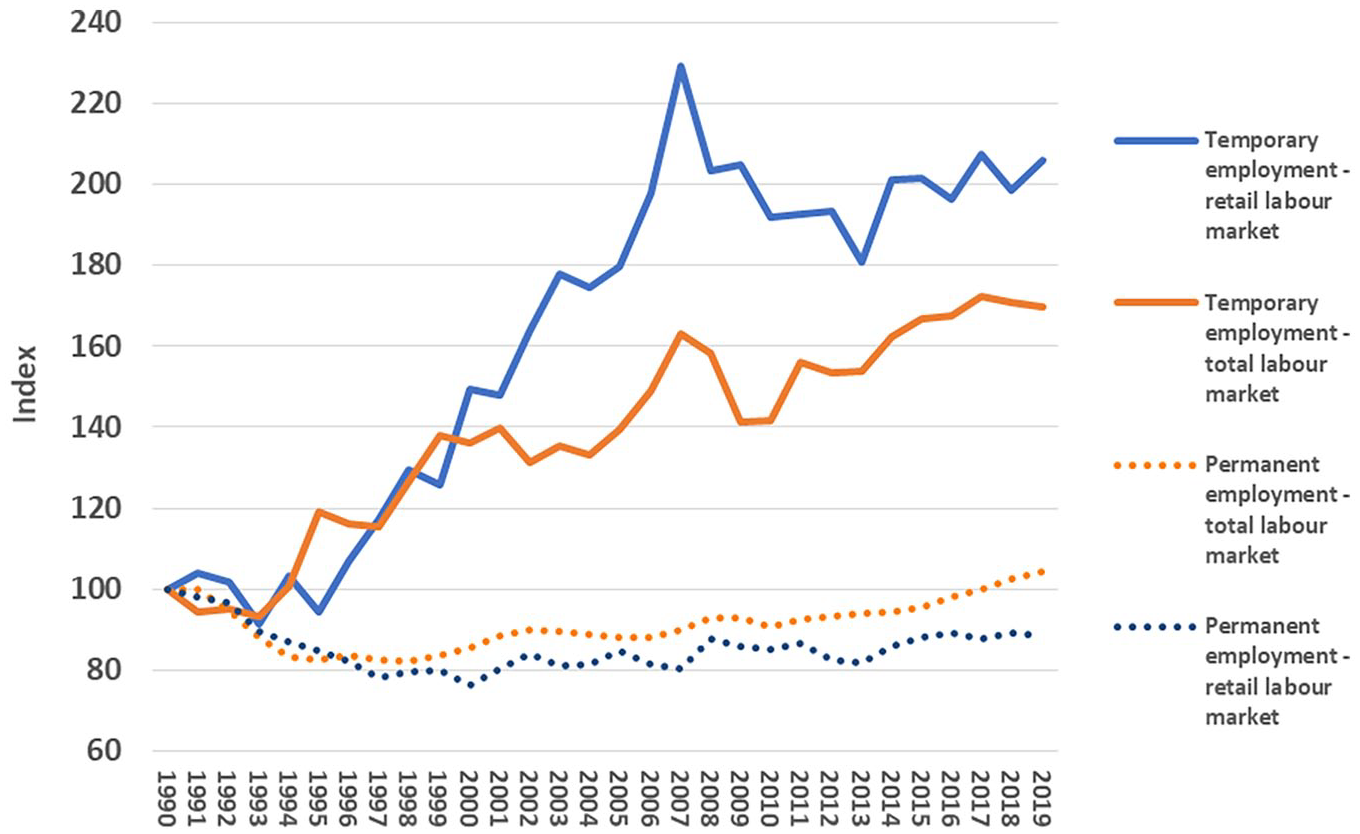
Temporary and permanent employment contracts in Sweden 1990–2019. Total labour market and retail labour market, aged 16–64. Index 1990 = 100.
At the same time, it is the development of temporary employment that stands out. At the beginning of the 1990s crisis, this also decreased, but by the end of our period it had increased by 70%. In other words, the vast majority of the job growth took place in temporary employment. Two aspects can be underlined here. Firstly, the increase coincides with changes in legislation. In 1993, the Conservative government made it easier for employers to hire workers on temporary contracts. The Social Democratic government reversed this in 1995, but reintroduced new reliefs in 1997. In 2007, the new Conservative government made it possible for any employer to hire workers on temporary contracts without any specific reason. Secondly, there is a new business cycle pattern. During earlier periods, an economic boom led to fewer temporary jobs and more permanent employment. But, if we look to the peak of the economic boom in 2007, we find a sharp increase in temporary employment, while it falls rapidly with the financial crisis of 2008–2010. Thus, temporary employment seems to have acquired the character of a cyclical regulator.
In the same figure, we can see the developments in the retail sector, which is the focus of this study. As regards total employment in retail, the development has been almost the same as for the total Swedish labour market. At the end of our period, a total of just under 230,000 individuals were working in retail, of which 160,000 (70%) were classified as blue-collar workers and 70,000 (30%) as white-collar workers. The composition between the different class-based occupational groups has been relatively constant.
The pattern of labour-market development in particular industries may differ from the total labour market due to various special circumstances. The increase in temporary employment is significantly higher in retail but it shows a slightly different pattern, for example 1995. This could be due to effects of the austerity economic politics of that year, which affected the retail sector negatively. In 1995 there was also a wide-ranging strike in the sector. From 1996, there is a rapid increase that continues until the peak in the business cycle in 2007, just before the financial crisis. Meanwhile, permanent employment declined rapidly during the 1990s crisis, just as in the overall labour market. Despite an increase at the end of the period, permanent employment still has not reached the same level as in 1990.
Class and gender polarisation of employment contracts in retail 1990–2019
Although the development towards more temporary and fewer permanent jobs is more evident in retail, the magnitude of the change may vary among different groups of workers. In this section, we analyse the evolution of class and gender differences when it comes to temporary, part-time and non-standard employment contracts in the retail sector.
When we examine class differences based on the Statistics Sweden definition of blue-collar and white-collar occupations, a strong polarisation of employment contracts emerges. Temporary employment contracts have increased by 150% among blue-collar workers, while decreasing somewhat among white-collar occupations. If we look at the proportions of all workers in the various social groups, temporary contracts have increased from 12 to 30% among blue-collar workers but remained relatively unchanged among white-collar workers.
There are some observations in the period 2000–2004 that stand out. We can see a sharp increase in the number of temporary contracts among blue-collar workers, while this number decreases among white-collar workers during the same period. Here, the development for blue-collar workers in retail differs, not only compared to white-collar workers in the same sector, but also compared to the total labour market (see Figure 2).
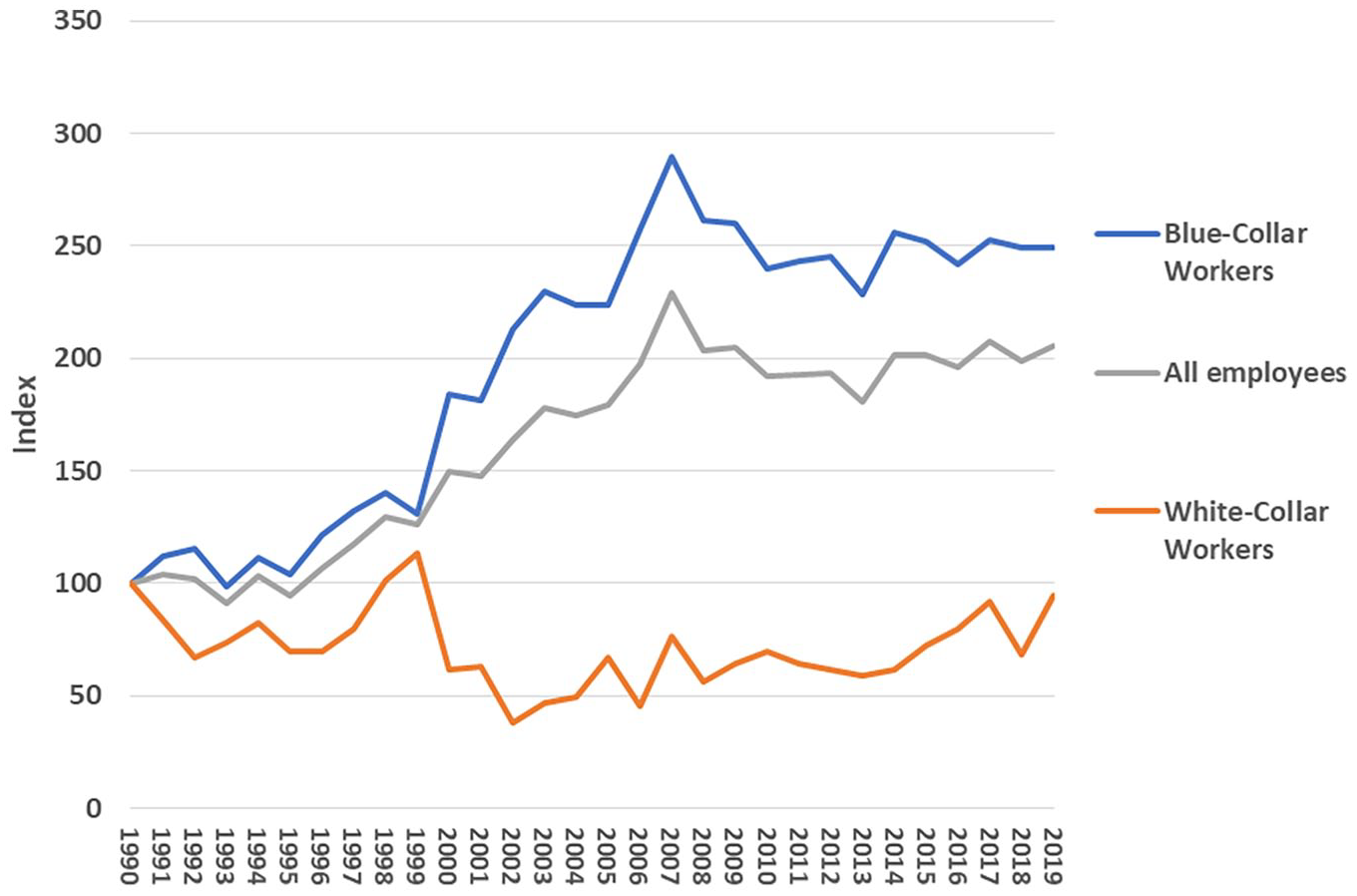
Temporary employment in Swedish retail 1990–2019. Number employed, aged 16–64. Index 1990 = 100.
When we study temporary employment among blue-collar workers, it is important to note that its character has also changed over the period. Although such contracts are given the same name in the statistics throughout the whole period, two fundamental changes have occurred within the statistics.
Firstly, there are different forms of temporary employment. The most insecure forms are hourly employment and called as needed, while substitute employment and trial employment are often more secure. During the period, the most secure forms have decreased from 56 to 24%, while the most insecure have increased from 44 to 76%.
Secondly, Swedish labour legislation has, as we mentioned above, changed, which means that even if the statistics have the same name during the period, the content of the temporary employment has become more unstable. At the beginning of the period, employers were required to give objective and factual reasons for employing workers on temporary contracts. This was changed in 1997 when employers were allowed to hire temporary workers without giving any objective reasons, but with some restrictions such as a maximum of five workers per workplace and that the employment contract would be for at least one month. Since 2007, however, employers do not have to state any reason or consider any restrictions when hiring. The only restriction has been that the employment may only be for a maximum of two years in a given five-year period, but in retail with its high labour turnover this has had a marginally limiting effect.
As state before, considering only temporary employment is insufficient to analyse how precarity developed during the period. If we also look at part-time work, another dimension of precarity is revealed. And if we combine temporary employment and part-time jobs, it is possible to bring out differences between standard and non-standard contracts.
Table 1 shows that the proportion of part-time contracts (here fewer than 35 hours per week) among blue-collar workers increased from 53 to 64%, while among white-collar workers it decreased from 42 to 27%. Standard employment contracts are defined as permanent employment with full-time hours, and non-standard are either temporary or part-time, or both. Some part-time jobs are permanent, and some temporary jobs are full-time. If we take this into account, we can obtain the proportion of non-standard contracts. Among blue-collar workers, non-standard contracts have increased from 57 to 68%. Among white-collar workers they have decreased from 42 to 30%.
Non-standard employment contracts in retail occupations. Percentage of total employment.

Source: Statistics Sweden.
When we focus on blue-collar workers and their part-time work, we can see that there have been major changes related to gender. From Figure 3, we can confirm that women worked part-time to a greater extent than men throughout the period. What stands out, however, is the sharp increase in the proportion of men working part-time. From remaining steady at around 20% throughout the 1990s, the proportion gradually increases from the turn of the millennium in 2000.
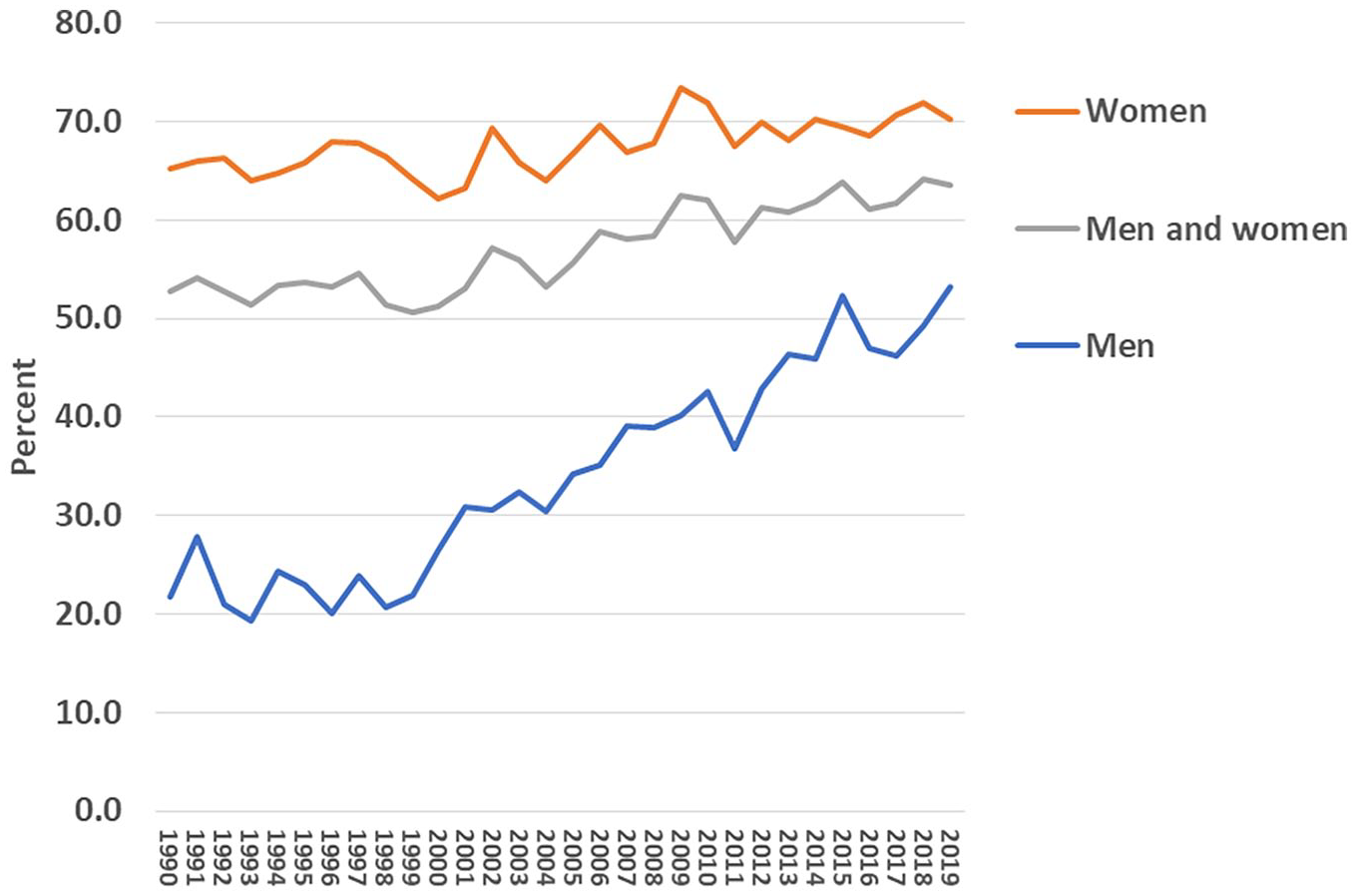
Part-time work in Swedish retail, 1990–2019. Blue-collar workers, aged 16–64, in percent.
By 2019, men’s part-time contracts had increased from 22 to 53%. Women’s part-time contracts also increased, from 65 to 70%. In total, part-time contracts increased from 53 to 64%. A larger part of this increase is thus due to many more men working part-time.
As seen above, the sharp increase in part-time jobs in Sweden is closely related to a symbiosis with the increase in temporary employment. Accordingly, the proportion of part-time permanent jobs increased by only 4%, while the proportion of part-time temporary jobs grew by 20%. At the same time, the figures show important changes in the gender composition of workers with non-standard contracts. While the proportion of female workers increased slightly, the proportion of male workers more than doubled (see Table 2).
Blue-collar workers in retail. Non-standard employment contracts 1990 and 2019. Percentage of total employment.

Source: Statistics Sweden.
To conclude this section, we summarise how the structure of non-standard contracts changed during the period 1990–2019 with respect to class and gender (see Figure 4). For white-collar men, non-standard contracts increased from 12 to 18%, while for white-collar women they decreased from 58 to 37%. Blue-collar men saw an increase from 27 to 60%, while blue-collar women experienced a minor increase from 69 to 74 percent. We can thus conclude that the class dimension deepened during the period. On the other hand, the sharp increase among male blue-collar workers, combined with the sharp decrease for white-collar women, weakened the gender differences. Nevertheless, in 2019, there was still a clear class–gender structure in relation to non-standard employment contracts.
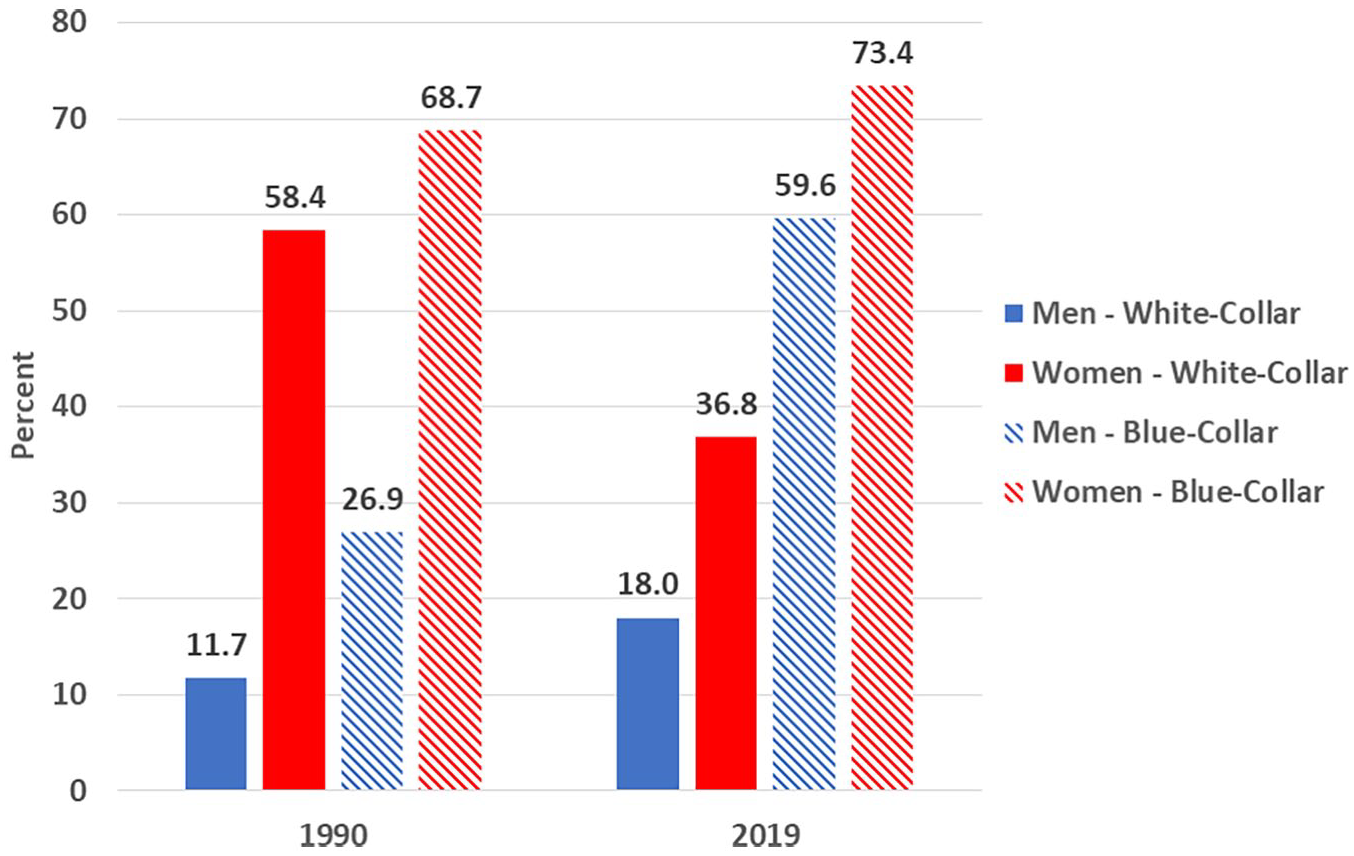
Non-standard employment contracts in Swedish retail 1990 and 2019. Class and gender, aged 16–64, percentage of total employment.
Precarity, polarisation, gender and age
According to previous research, a fundamental aspect of precarity is insufficient income. This is not only due to low wages but also to unstable employment conditions, part-time work and irregular wage payments. To what extent is it also associated with increased inequality in the form of polarisation? And what does it look like if we consider age and gender divisions?
Polarisation is a phenomenon whereby low-wage and high-wage jobs increase while medium-wage jobs decrease. There have been several international studies demonstrating this phenomenon (Autor and Dorn, 2013; Fernandez-Marcias et al., 2012; Goos and Manning, 2007). Even in the Swedish labour market, there are studies showing tendencies towards polarisation during the period we are studying (Åberg, 2013, 2015; Adermon and Gustavsson, 2015).
Most studies have been carried out based on median wages, since the advantage of median wages is that it creates a uniform and comparable measure. The disadvantage is that there are other working conditions that affect the content and total payment for people’s work. This becomes evident when studying special industries such as retail.
In a previous study, we examined the development of the wage spread for retail workers between 1990 and 2015 in search of possible polarisation tendencies. When based only on hourly wages, the spread of wages had decreased, and we could not find any polarisation. But when we instead considered the working hours on the employment contracts and monthly wage income, we found a huge increase in inequality and clear polarisation tendencies (Carlén and de los Reyes, 2021).
This pattern persists even when we examine all blue-collar workers in the retail collective agreement between 1990 and 2019. The wage spread according to the 90/10 measure has decreased from 1.45 to 1.30. This means that the 90th percentile had a 45% higher wage in 1990, but only a 30% higher wage in 2019. Accordingly, if we only look at hourly wages, we observe reduced inequality, but when we study the monthly wage income spread, we find a completely opposite development. The monthly income spread according to the 90/10 measure has increased from 5.4 in 1990 to 9.4 in 2015. That is, in 1990, the 90th percentile received 5 times as much monthly wage income. But 30 years later this percentile had almost 10 times as much income (Handels, 2019). This result underlines the importance of considering the number of working hours on employment contracts in addition to hourly wages.
What has happened to hourly wages, working hours and monthly wage income during the period if we look at age and gender? In the source we used, the wage statistics for the largest collective agreement in retail, we identify some structural changes regarding young people when we compare 1990 with 2019. If we consider the entire group of 18- to 29-year-olds, there have been no extensive changes. There was a slight increase in the number of young workers, from 51%. in 1990 to 54% in 2019. The gender distribution among young workers was fairly stable, with approximately two-thirds of these workers being female at both measurement points.
Among young workers, however, we can observe major changes. In comparison with the entire population aged 18–64, the youngest group of 18- to 19-year-olds has decreased from 15 to 9%. Young 20- to 24-year-olds have increased marginally from 23 to 25%, while 25- to 29-year-olds have increased sharply from 12 to 20%. The fact that the ages of young workers have shifted upwards reflects the higher skill requirements in retail. During our study period, the proportion of retail workers with only primary education decreased from 42 to 10%, those with secondary education increased from 49 to 60%, and those with tertiary education increased from 9 to 30%. It has become more difficult to get a job without a high-school or university education.
How have working conditions changed for young workers during the period? To investigate this, we related the younger workers’ hourly wages, working hours and monthly wage income to the entire group of 30- to 64-year-olds (Table 3).
Share 18- to 29-year-olds in relation to 30- to 64-year-olds.

Source: Wage statistics, Retail Collective Agreement 1990 and 2019.
When it comes to paid hourly wages, there are minor differences between 1990 and 2019. The proportion of the very youngest has increased slightly, while it has decreased slightly among other young people. An exception is young men aged 25–29, who in 1990 had 5% higher hourly wages than all 30- to 64-year-olds, but in 2019 had 5% lower. This is a decrease of 10 percentage points.
However, it is for contracted working hours that the major differences occur between 1990 and 2019. For the entire group of young people aged 18–29, the contracted median working time fell from 35 hours in 1990 to 25 hours in 2019. When we study this more closely in relation to different young age groups and gender, we find a more complex picture. In relation to workers aged 30–64 years, we can see that all the young groups have lost significantly in contracted working hours. The working hours of young female workers, which were already lowest in 1990, had declined even more by 2019. But this decline is even sharper among young male workers. As seen above, in 1990, young male workers over 20 had significantly higher average working hours than the older group. But in 2019 it was significantly lower.
One consequence, mainly due to the decline in working hours, is that the relative monthly wage income was also considerably lower for the younger workers. The change for young male workers is very substantial. In 1990, young male workers aged 20–24 years had the same income as the total 30- to 64-year-old group of workers. In 2019, their relative income had dropped by 32 percentage points (to 0.68). Young male workers aged 25–29 years had 20% higher income than the total 30- to 64-year-old group of workers in 1990. By 2019, the income of this group had declined by 33 percentage points. Of course, incomes have also fallen sharply for young women, but not as much as for young men. This is because, in the initial situation in 1990, young female workers did not have full-time jobs to the same extent.
A central question is: To what extent do these changes in working conditions affect the ability to earn a living? If we start from Statistics Sweden’s definition of low economic status, which is 60% of the median income, we can find a possible measure. Sometimes this is called the relative poverty line. Admittedly, it relates to all income, not just wage income. But if the focus is what workers can earn in wages, it can work as an approximation.
In 2019, a monthly income for individuals below SEK 13,128 (€1,394) was considered low economic status. At an average tax rate, this corresponds to SEK 16,244 (€1,724) before tax. Of all employees, 39% had a basic wage income that was below this threshold value for low economic status (Table 4). Among women, it was 42%, and among men 33%. For young workers aged 20–24, 58% had a low economic status. But, even among those aged 30–64, 22% had low status.
Proportion of retail workers with basic monthly wage income below low economic status in 2019 (percent) and changes since 1990 (percentage points).

Source: Wage Statistics, Statistics Sweden, and our own calculations. Note: Changes since 1990 are measured as earned income before taxes in 1990 and 2019.
Based on the large decline in working hours and wage income, we can expect an increase in the proportion of workers who have a low economic status. However, from a methodological perspective, there are some difficulties in measuring income after taxes during the period. There are time series breaks in the measure of low economic status, combined with a tax reform in 1990/91, and a lack of source material that makes it difficult to obtain correct changes. In order to gain an idea of the magnitude of the change, we used the method of measuring the proportion of workers who before taxes had wage incomes below the low economic status cut-off in 1990 and 2019.
Among all workers, the proportion of the relatively poor has increased by 16 percentage points, and all groups are affected (see Table 4). The largest increase in low economic status is among young workers. Meanwhile, although male workers aged 30–64 saw an increase of 8 percentage points, and the rate of increase is highest for this group, it comes from a low starting point. The fact that more younger workers have a low economic status, while low incomes are also spreading to groups that have traditionally enjoyed good conditions, strengthens the overall development we have previously perceived.
This change among retail workers is not due to hourly wages falling behind, but to the sharp increase in non-standard employment contracts. Accordingly, the sharp increase in part-time and unstable jobs has had a major impact on income distribution.
Class, gender, migrant background and age
A challenge in our study was to develop an intersectional analysis of the evolution of precarity during the period studied. To this end, this section presents an account of the distribution of precarious employment conditions in which we integrate age and migrant background into class and gender. Using migrant background, we distinguish domestic from foreign background. Domestic background refers to those born in Sweden with one or two Swedish-born parents. By foreign background, we mean both foreign-born and domestic-born with two foreign-born parents.
We know from previous studies that precarious employment links structural conditions to socio-economic conditions. For instance, it is more common among blue-collar than white-collar workers and among women than men. At the aggregated level, i.e. the total Swedish labour market, it is well known that it is more common among employees with a migrant background, and among young people. For Swedish retail, as for other industries, there is a lack of studies on precarious employment from an intersectional perspective that includes class, gender, migrant background and age. In our database, it is possible to achieve such an analysis towards the end of the period, but at the beginning we cannot include the class dimension.
As we saw earlier, the age structure in the industry has changed. A decrease in the size of the 16–19 age group was succeeded by a sharp increase in 20- to 29-year-olds, and fewer older 40- to 64-year-olds. There have also been major changes in terms of workers with migrant background. If we count everyone employed in retail aged 16–64, in 1990 8.7% of workers in the sector had a foreign background. By 2018, this had increased to 20.9%. Another pattern also appears. In 1990, the proportion of employees with a foreign background was evenly distributed across all age groups. But in 2018, this percentage was lower (18%) in the youngest (16–29) and oldest (50–64) age groups. In the age group 30–49, it was significantly higher (26%).
In Figure 5, we have summarised the distribution of weakly established employees in 16 different categories that integrate class, gender and migrant background among workers aged 20–64.
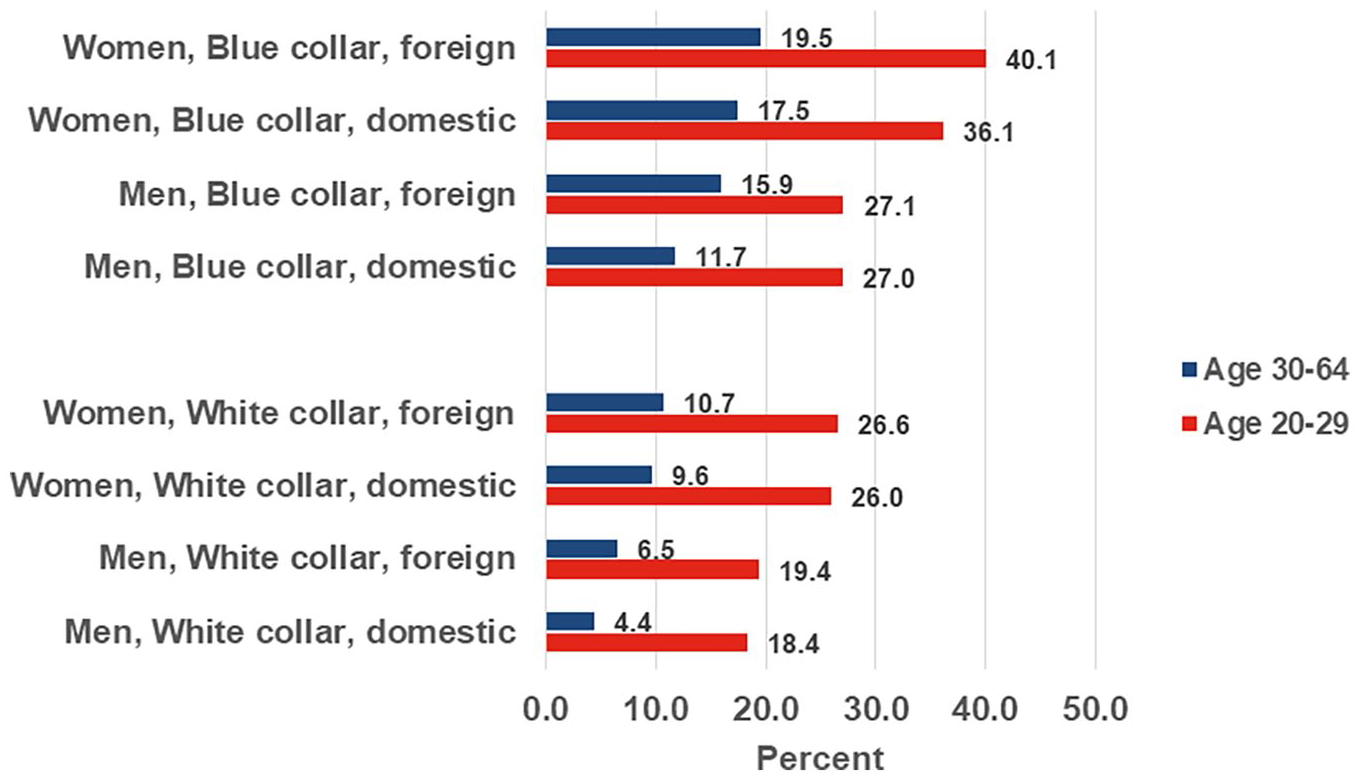
Weakly established employees in Swedish retail 2018. Class, gender and migrant background, age 20–64, in percent.
Although we have previously shown that precarious work has started to spread to social groups that were previously considered to have secure positions on the labour market, there is still a clear division based on how strongly different groups are established.
Young employees aged 20–29 are a group that lost out in both relative and absolute terms during the period 1990–2019 in relation to income and working conditions. In this cross-section for 2018, it is clear how their conditions differ from those of the age group 30–64 years. But we also see how the relations are gradually affected based on class, gender and migrant background. The most favoured group is white-collar, domestic-born men, aged 30–64. The group with the worst job conditions is blue-collar, foreign-background women aged 20–29. These results show how important it is to move away from aggregated totals in analyses and to study different social groups in different industries more closely.
Precarious employment and mental disorders
In addition to poor employment conditions, inequality, polarisation of employment contracts and low wages, there are other consequences of precarious employment. Several studies have shown that precarious employment carries risks of affecting health negatively (Rönnblad et al., 2019).
Although we lack studies dealing specifically with retail, there are some clear indications that workplaces with a high degree of temporary employment also have more problems related to health and safety. In annual questionnaires sent out to safety representatives in Swedish retail, it has been repeatedly shown that workplaces with a high degree of temporary employment have more work-related health problems than workplaces with a low degree of temporary employment. Where there is a high degree of temporary employment, more sick leave is reported due to stress-related conditions, negative competition for working hours among employees, more dissatisfaction among employees and a poorer relationship between staff and managers (Handels, 2019, 2020, 2022). In addition to the data provided, we examine below how the evolution of diagnoses for retail workers is related to precarious work.
A first step is to investigate how different forms of work-related disorders have developed among all employees in retail. Regarding the entire labour market, we know that sick leave has varied over the period. During the 1990s, sick leave in Sweden increased sharply, reaching high levels at the beginning of the 2000s. After that, it decreased, but following the financial crisis of 2008–2010, it increased again. In particular, there was a sharp increase in cases of mental disorder (SOU 2021:69).
Figure 6 shows the development of various grouped disease diagnoses for employees in retail during the period 2010–2018. We chose this period due to better source conditions, and fewer changes in legislation.
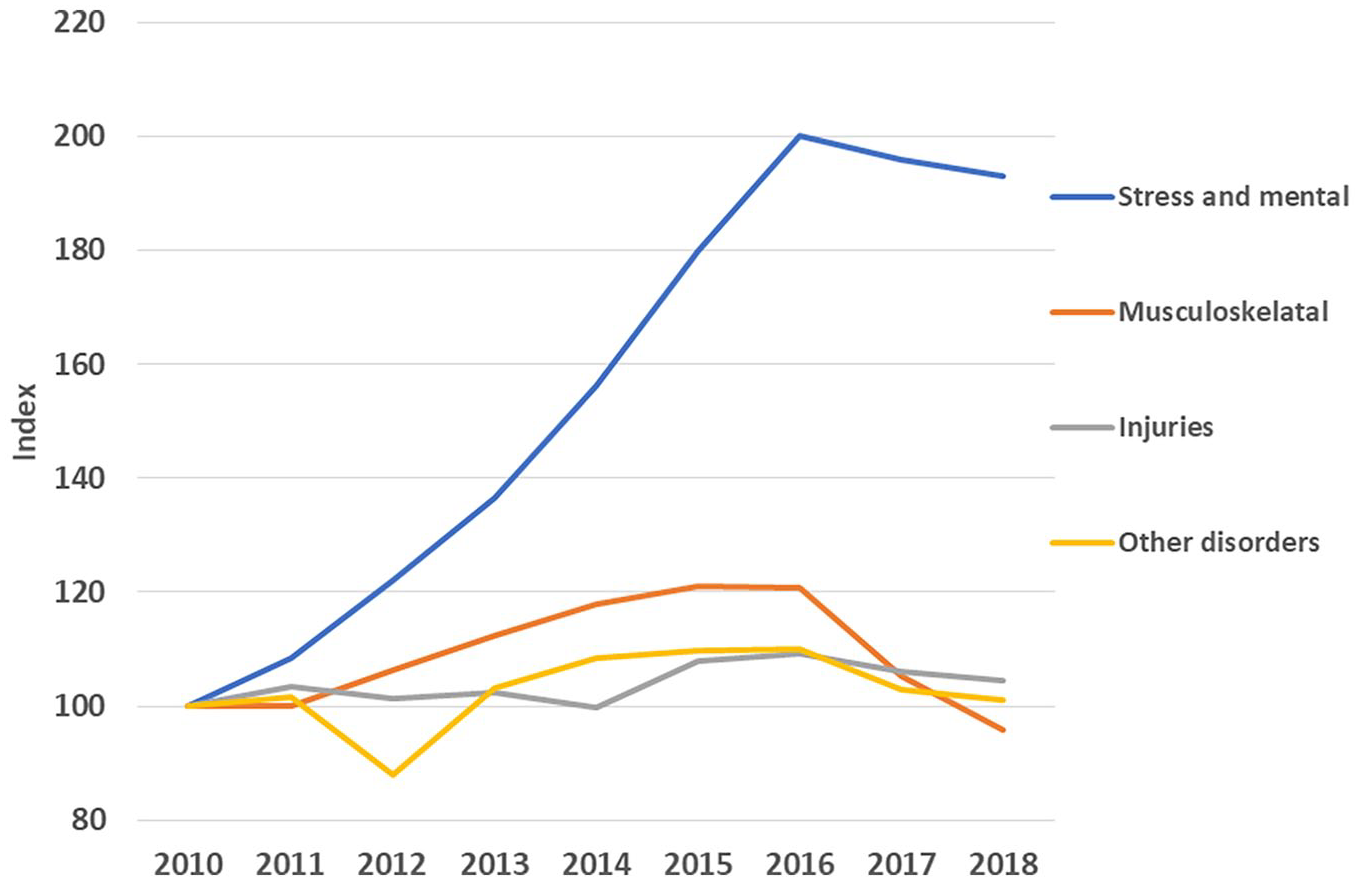
Sick leave by type of disorder in retail 2010–2018. Proportion of all employees aged 16–64. Index 2010 = 100.
Among musculoskeletal disorders, injuries and other disorders, we see an increase of 10–20% up to 2016, and then a decrease during the last two years. What stands out is the sharp increase in stress and mental disorders, which is consistent with the development of the entire labour market. The number of employees taking sick leave as a result of stress and mental disorders almost doubled during the 2010s, even though there is a minor reduction in these diagnoses in the final two years.
Was the reduction in sick leave during 2017 and 2018 a result of improved health? It is difficult to find any social or economic signs of this during the late 2010s. At that time, the economy was at the peak of the business cycle. Normally, this means that more individuals who are more likely to get sick enter the labour market, which, ceteris paribus, should represent a certain increase in the percentage of people on sick leave. Another, more plausible, explanation could be a change in the practice of assessments by the Swedish Social Insurance Agency. We know from previous research that the Agency’s assessments became more restrictive in 2016 regarding approved sick leave after 180 days. This related to a change in the application of the law due to a political decision to reduce the number of working days lost to sick leave (Altermark, 2020; Jacobsson and Hollertz, 2021). It is possible that this also applied to assessments of sick leave after 14 days. Still, we lack the necessary studies to be certain.
If we now focus on stress and mental disorders, there is clear evidence even in retail that employees who are weakly established are more vulnerable to mental disorders. This is the case even though it may be more difficult for weakly established workers to access their legal right to sick pay (ISF, 2016). Taking this into account, the proportion of weakly established workers on sick leave for mental disorders may be underestimated.
If we make annual cross-sections, we can see that the full-year employees who can be regarded, according to Statistics Sweden, as weakly established have a significantly higher rate of sick leave due to stress and mental disorders. With the broader definition used in Table 5, these differences are marginally reduced, but they are still very large.
Proportion of employees (full-year employed) in retail on sick leave diagnosed with mental disorders 2018, and percentage change since 2010.

Source: Statistics Sweden and our own calculations. Note: The definition of precarious here is 60% of median income based on both earned income and sick pay to avoid the lower earned income being due to an individual being on sick leave. However, the differences between the methods are small.
Firstly, we can note that, even in these results, a clear gender pattern emerges. Women suffer significantly more from mental disorders than men. Age is also important, with such disorders increasing from young ages and peaking in the thirties and forties. After that, the proportion decreases in the older age groups. Here, stress and mental disorders differ from other forms of disorder, which usually increase up to retirement age.
Secondly, we can see that precarious workers are much more likely to be on sick leave due to mental disorders. In 2018, if we look at our total population, mental diagnoses are roughly 50% more common among women in precarious positions, and over 100% more common among men. But behind ‘the total’ there are big differences that stand out. For example, among women aged 40–49, almost 20% of the precariously employed had been on sick leave after being diagnosed with mental illness. In that group, the difference with established employees is large, with sick leave almost four times as common. Among men in the same age group, who generally have lower rates of sick leave, the difference between precarious and established employees is even greater.
Thirdly, when we focus on the full-year employed, and exclude 16- to 19-year-olds (who are rarely qualified for sick pay), we see an increase in the number diagnosed with mental illness of over 100% in 2018 compared to 2010. In general, this increase is greatest among precarious employees. It also turns out that mental illness has increased most among young workers, aged 20–29, when we consider both precarious and established workers, although from low levels.
In order to explore the impact of precarious work on work-related ill-health, below we present the results of a longitudinal study exploring the risk of being diagnosed with a mental disorder among precarious workers. Our starting point is all full-year employed workers in 2010 divided into precariously and non-precariously employed. As mentioned before, the precarious full-year workers have earnings well below the Swedish relative poverty line. We then follow them until 2018 and examine the degree to which the various groups have been diagnosed with mental disorders.
We can see from Table 6 that the risk of taking sick leave due to diagnoses of mental disorders is rather high for workers who had been in a precarious position on the labour market eight years earlier. Irrespective of age group, the percentage of workers diagnosed with a mental disorder is higher if they previously held a precarious position than a non-precarious one. As we can see, this differs between gender and age groups. The differences in the results are higher in older groups than in younger ones. Among those who were over 30 years old in 2010, the proportion affected by mental disorders is 40–60% higher for those who were precariously employed. Among younger people, 20–29 years old, the proportion is 5–30% higher.
Sick leave for mental disorders 2018, dependent on precarious or non-precarious position in retail in 2010. Full-year employed, age 20–54 in 2010, in percent.
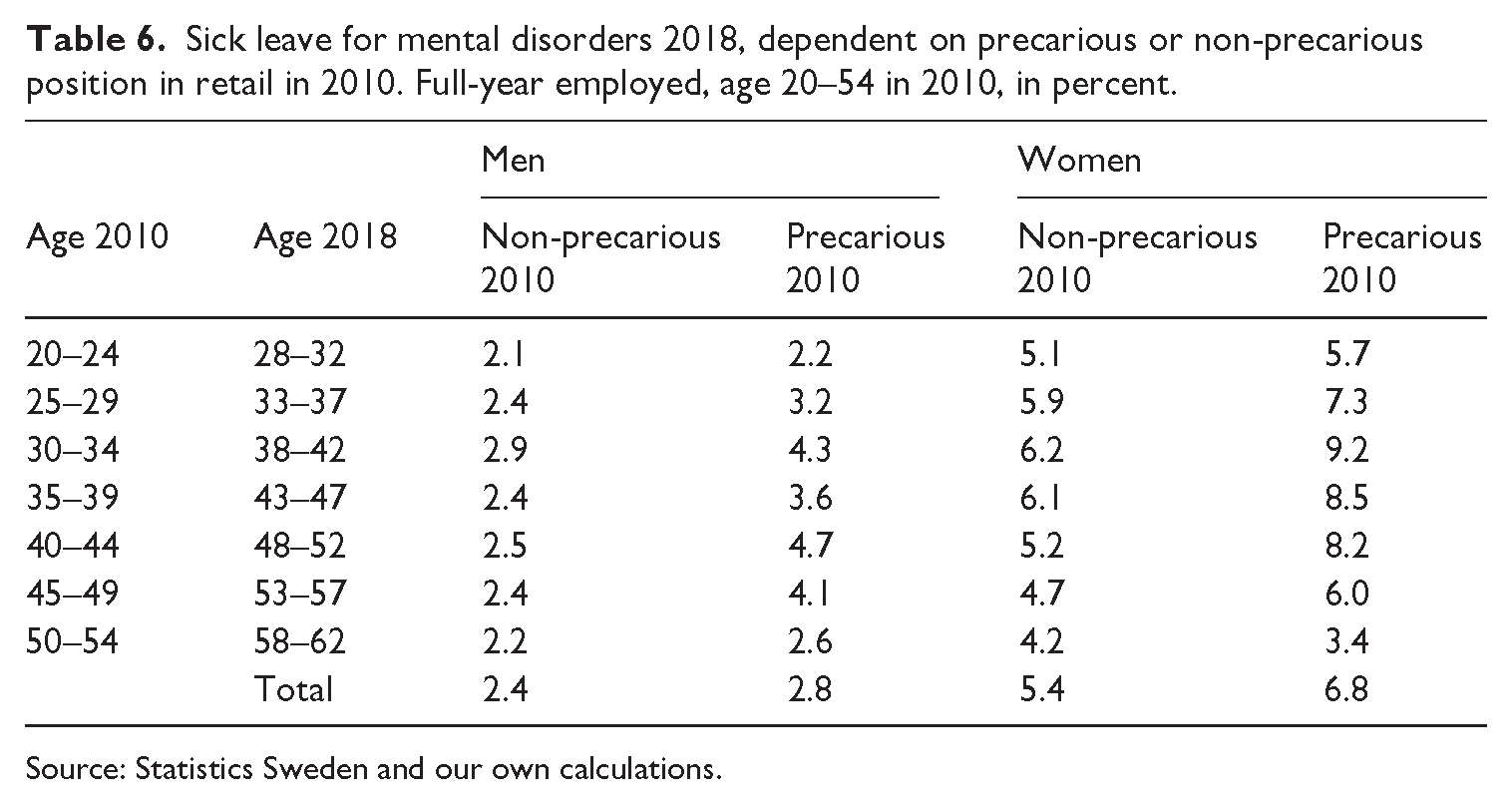
Source: Statistics Sweden and our own calculations.
The results provide support for the observations reported by safety representatives in retail in annual surveys. They also confirm what other researchers with different and sophisticated methods have concluded in various studies and from other sectors of the economy (Canivet et al., 2016; Jonsson et al., 2021; Rönnblad et al., 2019). Our results also suggest the importance of examining the long-term consequences of precarious work on the health conditions of workers.
In terms of retail jobs in general, evidence from earlier research and union reports show that current organisation models can be mentally and emotionally exhausting, for instance, jobs where workers are constantly on the front line and meeting different customers. There are high demands on maintaining good customer relations, while interactions with customers can be stressful and emotionally challenging. There are many examples of dissatisfied, demanding, complaining and even threatening customers. At the same time, retail workers are expected to manage their own emotions and remain positive even in difficult situations (Arman et al., 2019; Berggren and Carlén, 2016; de los Reyes and Holmlund, 2024).
Another general characteristic of retail jobs is long, irregular and unpredictable working hours, including late evenings, early mornings and weekends (Holmlund, 2023). This could lead to difficulties in planning a social and family life and lead to social isolation, and/or disrupt sleep patterns. These circumstances are well-known risk factors that can contribute to mental exhaustion (Henly and Lambert, 2014).
This general problem will be even more accentuated if the work contract is temporary or part-time, where the worker must be available at short notice. In a survey of retail workers, almost 70 % of those who had temporary part-time employment answered that they had to be available in their spare time. They were also expected to read work-related emails, text messages or other digital communication during their free time. Lack of recovery is a risk factor for mental illness (de los Reyes and Holmlund, 2024; Holmlund, 2023).
To sum up, there is no single explanation for why sick leave due to mental disorder increased during the 2010s. However, several Swedish authorities and research funders have compiled meta-studies and literature reviews on the relationship between work-related risk factors and mental disorder (Forte, 2020; Mynak, 2021). These studies provide scientific evidence that deficiencies in the work environment and working conditions increase the risk of mental disorder. These include high workload combined with low control over the work, inadequate leadership, job insecurity and temporary employment. This is particularly common in female-dominated industries. Several of these factors can overlap and reinforce each other. It is possible that the Swedish labour market became more pressured after the financial crisis of 2008–2010, and that several of the risk factors for mental health issues have become more pronounced. In this context, the increased risk for mental diagnoses among workers who have been in precarious positions in an earlier period calls for a deeper examination of the long-term effects of precarity on mental health issues.
Concluding remarks
This article examines, exploratively, the evolution of precarious work among retail workers in Sweden since 1990, a period characterised by increasing levels of unemployment and profound transformations in the labour market. Although there are similarities between the precarisation process at both an aggregate labour-market level and an industry level, the historical and intersectional analysis of the retail sector enables a deepened understanding of this process. As shown in this article, the increase in temporary and precarious employment is more evident in the Swedish retail sector than in the overall labour market. Behind this sharp increase in retail, we can identify specific patterns relating to class, gender, age and migration status. On the basis of an intersectional perspective, we can identify not only how precarity affects different groups of the labour force but also how the simultaneous impact of divisions based on gender, class and migrant background creates particularly vulnerable positions in the labour market. This trend indicates the need to investigate how and to what extent discriminatory practices are operating in the retail sector.
If we focus only on class differences, that is between blue-collar and white-collar workers, the increase in numbers of non-standard employment contracts in retail is entirely attributable to their increase among blue-collar workers. Temporary employment contracts increased by 150% for blue-collar workers but decreased by 6% for white-collar workers. When we consider part-time contracts, class inequality becomes even more accentuated. The proportion of such contracts among blue-collar workers has increased considerably, compared to white-collar workers, among whom it has decreased.
Among blue-collar workers, there are some interesting observations regarding gender differences. As previous research already highlights (Carlén and de los Reyes, 2021; Vosko et al., 2009; Young, 2010), temporary contracts and part-time work are more common among women. What stands out in our results is the huge increase in non-standard contracts among men. This trend indicates that precarious working conditions have spread to a group that was previously considered well established in the labour market. We can thus conclude that a masculinisation process is taking place among precarious workers, a process that suggests the expansion of precarity to other groups in the labour market.
This masculinisation process becomes even more evident if we consider changes in income distribution based on age. Young workers aged 20–29 are those who have lost most in relative wage income, and here especially young male workers stand out. At the beginning of the period, young male workers had higher wage incomes than the average income for all workers aged 30–64, but by the end of the period, their wage income was well below average. It is worth stressing that hourly wages are not the main reason for this, but rather the increasingly widespread use of non-standard contracts, and especially part-time work among men. These results stress the importance of a historical perspective to assess qualitative transformations of the labour market. As shown in our analysis, these transformations concern not only an increase of precarity but also a changing composition of the precarious workforce. A historical perspective allows a deeper understanding of apparent paradoxes in the evolution of wages and earned income. If we only consider hourly wages, the impact of inequality decreases, but if we take employment contracts into account, we find the opposite – increased inequality. As a consequence, a growing group of workers, especially younger workers, have wage incomes below the threshold value for low economic status (the relative poverty line). This is perhaps expected as a result of precarisation, but as we show in this article the increased number of working poor in retail includes groups who were previously considered to experience safe conditions, for example 30- to 64-year-old men.
Even though precarious work has started to spread to groups of workers who were previously considered to have secure positions, there are still clear divisions based on class, gender, age and migrant background. Taking into consideration the intersections between these divisions, we can see that 40% of young, female, migrant, blue-collar workers are considered to have a precarious position, in comparison with 4% of older, male, domestic-born, white-collar workers.
In addition to low wages and unstable working conditions, the existing literature highlights an increased risk of precarious workers suffering from stress and mental disorders. Our empirical evidence confirms these results for the retail sector, and also shows that precarious employees are much more likely to take sick leave for mental illness than non-precarious workers. In addition, the results of our analysis show that these consequences are not always immediate, but can appear after some years. Thus, we stress the relevance of a long-term perspective in order to evaluate the consequences of precarious work on the occurrence of mental disorders among retail workers.
Most studies on temporary and precarious employment take a macro-perspective on the entire labour market. At the same time, the consequences of this phenomenon on different groups of workers, and not least between industries, emphasise the relevance of sectoral studies addressing specific inequalities and long-term transformations. Our findings from this retail survey underline this.
Footnotes
Declaration of conflicting interests
The authors declared no potential conflicts of interest with respect to the research, authorship, and/or publication of this article.
Funding
This work was supported by the Swedish Research Council for Health, Working Life and Welfare (Grant 2019-00544).
