




Abstract
Trade union free-riding is a highly contentious issue for trade unions. Yet, it is poorly understood. Using data from a representative survey this article examines the incidence of free-riding in Ireland and profiles those who free-ride, distinguishing between two cohorts – never-have-been union members and former union members. The authors examine a series of hypotheses derived from the international literature to assess how free-riders are distinguished from union members and, in turn, how the two cohorts of free-riders are dissimilar from one another in their orientations to unions. The article concludes by identifying a number of theoretical contributions, makes some suggestions for the conduct of future research and identifies a number of policy implications for unions.
Introduction
In most Anglophone countries, employees working in unionised organisations are under no obligation to join the trade union in their workplace, but are permitted nonetheless to enjoy the benefits of collective representation (Ballot, 1992; Bryson, 2008; Bryson and Gomez, 2005; Harbridge and Wilkinson, 2001; Haynes et al., 2008; Murphy, 2023; Wilkinson et al., 2003). This phenomenon is usually referred to as ‘free-riding’ and sometimes ‘free-loading’ (Ballot, 1992; Freeman and Medoff, 1984). It is widely seen as a major problem for trade unions, primarily arising from the financial loss associated with non-members not paying union membership dues and the consequent diminishment of union density, power resources and mobilisation capacity (Haynes et al., 2008; Murphy, 2023). There is also the prospect that union members will grow to resent their work colleagues who chose not to join the union but who otherwise benefit from union members’ collective efforts, potentially giving rise to heightened division and acrimony (Cardador et al., 2017; Freeman and Medoff, 1984).
Measuring the extent of free-riding is not an easy task. It is often estimated by subtracting union density rates from the extent of collective bargaining coverage (Harbridge and Wilkinson, 2001). However, these data points are usually derived from different sources, including surveys and databases, which are oftentimes provided by several parties, including employers, government departments and trade unions. These estimations, although helpful, have been neither entirely accurate nor fully representative (see Eurofound, 2022). In addition, we do not know a great deal about the free-riders themselves, who they are, how they might be distinguished from one another, or what biographical, occupational and organisational characteristics are linked to their free-riding.
Using data from a nationally representative survey in Ireland we address these gaps in our knowledge. We make two important empirical contributions: first, we measure the proportion of the workforce who engage in free-riding, which we find to be relatively high and to have risen in recent years; and second, we identify the biographical and employment characteristics of free-riders. We also make an important conceptual distinction in distinguishing between two types of free-riders: namely those who are former union members, which we label the ‘leavers’, from those who have desisted from joining unions, which we call ‘the never-have-beens’.
We begin by considering why free-riding is a problem for trade unions. We then detail a series of hypotheses to guide the analysis of our data. Drawing from the Working in Ireland Survey 2021, we use a representative sample of 806 workers employed in unionised organisations in Ireland to profile the free-riders as well as to identify the features of their work and workplace that are associated with their free-riding. We conclude the article by highlighting the theoretical contributions of our study and exploring what actions unions might pursue in the face of free-riding as well as pointing to how future research might build on the research we conduct here.
Free-riding: A contentious behaviour yet a rational and defensible principle?
The concept of free-riding first appeared in the American literature as a phenomenon rooted in the ‘freedom of individual choice’ (Bennett and Johnson, 1979). The so-called Right-to-Work Laws, enforced in 1947 in the US, provided workers with the freedom to join or not to join the union engaged in collective bargaining at their workplace. Those workers who desist from joining unions in the US, as also with workers in Ireland and indeed in other Anglophone countries, still stand to benefit from the gains achieved by trade unions in their workplace. As such, (most) union benefits are not delimited to union members: they accrue to members and non-members alike (Bennett and Johnson, 1979; Freeman and Medoff, 1984; Olson, 1965). 1 To put it plainly, a free-rider’s gain is derived at the expense of union members who actively contribute to the collective endeavour, either by paying membership dues or by participating in collective action (Cardador et al., 2017; Freeman and Medoff, 1984; Olson, 1965). This Olson (1965) referred to, in his seminal work The Logic of Collective Action, as the first order problem of collective representation wherefrom the free-rider believes there is no rational incentive for them to join a union as they benefit from union representation whether they join or not. Further, seeing their individual contribution as being of minimal or of no value to the collective effort, the free-rider opts to withhold it and simply rides the wave of other people’s efforts.
Union members, for their part, may resent that non-members are permitted to avail of the benefits of union representation without incurring or sharing in any of its costs. In response, members may seek to compel the free-rider to join the union, or punish or reprove the free-rider in some manner, or they may reduce their own contribution to the collective effort, thus potentially setting in train a vicious cycle of diminishing cooperative effort and, with it, the diminishment of union influence (for all) within and beyond the workplace (Cardador et al., 2017; Freeman and Medoff, 1984).
Where such a dynamic takes hold, it may become difficult for a union to prevail upon management to continue to maintain a strong collective bargaining relationship with the union. It also deprives unions of financial resources to organise workers in non-union organisations, and to mount campaigns at a sectoral or national level. Thus the presence of a significant number of free-riders may come to represent a fundamental challenge to a union’s claim to be the representative organ of workers. In such instances, too, where there are significant numbers of free-riders a union may desist from providing collective representation even where some workers at least desire it, but where the marginal costs militate against it. This is Olson’s (1965) second order problem of collective representation. It is not surprising, then, that free-riding is often perceived to be a highly charged and emotive phenomenon. It is especially so when the term is deployed to denote a moral violation where the free-rider is castigated for not contributing to the collective good. However, as well as being marshalled to lay charge on a party, it can also be used as a means of self-vindication when, in reproving of any castigation, the free-rider may well respond that they possess a legal right to choose whether or not to join a union, and that right cannot and must not be nullified or demeaned.
Research hypotheses
Our first research interest is to identify those who are the free-riders, and to explore how their orientations towards union representation are different to those of union members. From our reading of the international literature, we anticipate that they are distinct in discernible ways. First, free-riders are more likely to see unions as being ineffective in representing their interests and are likely to place little store on the representative value of unions more generally (Fiorito et al., 1986; Walsh, 2015). Union members, on the other hand, are more likely to value the role performed by unions, would wish to have continued union representation and, as a corollary, are more likely to regard their employer with some suspicion and distrust (Fiorito et al., 1986; Guest and Dewe, 1988; McClendon et al., 1998).
Notwithstanding these likelihoods, we expect to identify differences in the dispositions of the two cohorts of free-riders as identified here – the ‘never-have-beens’ and the ‘leavers’. It is conceivable that the latter may have left unions because they saw them to be ineffective in a narrow instrumental manner and, as such, are deliberate free-riders. The never-have-beens, on the other hand, may conceivably be either ideologically opposed to unions or may simply be neutrally disposed towards them, holding neither hard nor fast views either way. Those free-riders who are hostile to unions would be more likely to vote against keeping the union in a workplace (Bigoness and Tosi, 1984) than would other more neutral never-have-beens. The latter are more likely to be young workers and will have only recently encountered unions and, as such, are unlikely to be agnostic towards them, or at least will not have formed a definitive opinion or political commitment in respect of them (Aleks et al., 2021; Peetz et al., 2015). Therefore, in relation to free-riders’ dispositions towards unions, our first set of hypotheses read as follows: 2
H1a: There is a higher probability that free-riders will see unions as being ineffective in representing workers’ interests when compared to union members.
H1b: Among free-riders, leavers will be more likely than never-have-beens to perceive unions as being ineffective.
H1c: Leavers will also be more likely than never-have-beens to vote against keeping unions in the workplace.
H1d: Union members are more likely to be politically or ideologically committed to trade unions than free-riders but, among the latter, never-have-beens are more likely to be politically in favour of unions, or perhaps to be simply neutrally disposed towards them than leavers.
Second, we anticipate that free-riding is associated with particular demographic characteristics, such as whether workers were ever union members in the past, their age, gender, levels of educational attainment, length of employment tenure and employment status. Taking each of these factors in turn, then, we anticipate that most free-riders have never been union members; that is, it is not that they grew disgruntled with union representation and ceased being members, but rather that they never joined in the first place (Bryson and Gomez, 2005). It is also probable that older workers, having entered the labour market when union membership was higher and when unions enjoyed the status of social partners through their participation in a succession of social partnership agreements, will be less likely to query the social custom of union membership. Younger workers, however, are less likely to have been socialised into such a social custom. They are also more likely to enjoy multiple job options in Ireland’s booming economy. These factors are likely to diminish the value they might attach to private excludable goods afforded by union membership such as individual grievance representation (Bryson, 2008). We anticipate that the incidence of free-riding will be greater among males than among females as it is in other countries such as New Zealand and the UK, although the presence of a positive association between gender and free-riding is modest – and negligible depending on the statistical test used – in the UK at least (Bryson, 2008). Based on the literature, we also anticipate that highly educated workers will be less predisposed to join a union as they see themselves more equipped to influence their working conditions independently and on an individual basis (Harcourt et al., 2024).
Further, long-tenured and permanent workers are more likely to be union members than non-permanent workers as they are more heavily vested in their firms having acquired firm-specific skills and see value in union influence over their terms and conditions of employment (Blanchflower, 2007; Budd and Na, 2000; Jermier et al., 1988). As with older workers, long-tenured workers are more likely, too, to have been socialised into the social custom of union membership. By contrast, temporary or contract workers may be less motivated to stay with the firm, see less reason and feel under less obligation to join a union, as well as seeing it as being relatively expensive (Blanden and Machin, 2003; Booth and Bryan, 2004; Bryson, 2008; Bryson and Gomez, 2005; Haynes et al., 2008). Our second set of hypotheses read as follows:
H2a: Most free-riders are likely to have never been union members.
H2b: The probability of free-riding is likely to be higher among young workers than it is among older workers.
H2c: The incidence of free-riding is likely to be higher among males than females.
H2d: Free-riding is likely to be more apparent among employees with higher levels of educational attainment.
H2e: Long-tenured workers are less likely to free-ride than short-tenured workers.
H2f: There is a lower probability that workers on a permanent contract will free-ride.
Third, we would expect workers on low salaries and who struggle to make ends meet not to join a union and instead engage in free-riding. Those occupying higher occupational grades and with good salaries may also be more likely to free-ride due to their individual bargaining power and the ease with which they can get jobs elsewhere. For those too who occupy managerial positions the custom of not joining a union is likely to be pronounced as would the reputational cost of being found to be a union member (Bryson, 2008; Schnabel, 2002; Visser, 2002). The sector, too, in which an employee works is an important influence (Booth, 1986; Bryson, 2008). As the social custom of union membership is more deeply embedded in the public sector than it is in the private sector, free-riding is likely to be less evident among workers in the public sector. These propositions and findings from the literature inform our third set of hypotheses:
H3a: Those whose earnings are low and who struggle to make ends meet are more likely to engage in free-riding.
H3b: There is a higher probability of free-riding among employees within higher occupational categories.
H3c: There is a higher probability that workers in the public sector will not engage in free-riding.
Finally, the literature identifies certain organisational factors as being associated with free-riding. One key factor is the provision of line management support for employees, such that the greater the support provided by management to employees, the greater the likelihood of their engaging in free-riding. By corollary, where such support is absent and where the climate of employment relations in the workplace is poor, the more likely employees are to join the union in a bid to avail of union representation and protection (Freeman, 1978; Freeman and Medoff, 1984). These findings from the existing literature are thus expressed in the following two hypotheses:
H4a: Workers who report strong management effectiveness and support are more likely to free-ride than those reporting weak management support.
H4b: Workers experiencing a poor employment relations environment are less likely to free-ride than those who encounter a good employment relations environment.
The Irish context: The legal situation in regard to free-riding
The legal status of a requirement to be a trade union member as a condition of securing and maintaining employment in a job – a so-called ‘closed shop’ provision – although unclear or unproven in part, is generally held to be unlawful in Ireland. Where such so-called ‘closed shops’ did exist in the past, most notably in the media, printing, mining, docks and construction sectors, they were rare and were more often negotiated as informal understandings where the employer assented to a union injunction that union members would not work alongside non-union labour.
There apart, closed shops are not regulated by legislation in Ireland, although there have been a number of cases brought before the courts under the constitutional right relating to the freedom of association. The rulings indicate that employees have a right to dissociate and that this, it would appear, renders unconstitutional closed shop provisions of either a pre-entry or post-entry form. That said, as indicated, the Irish courts have not ruled definitively on the constitutionality of either the pre-entry or post-entry closed shop as it applies to new employees. Regardless, it is most unlikely that any type of closed shop agreement would survive a constitutional challenge given the European Court of Human Rights ruling in respect of Sørensen and Rasmussen v. Denmark in which the two applicants successfully claimed that the existence of closed shop agreements in Denmark in their respective areas of employment violated their rights under Article 11 of the Convention. 3 The Court noted that the trend in the Contracting States was towards eliminating entirely the use of closed shop agreements, on the basis that such agreements were not an essential means for securing the interests of trade unions and their members, and that due weight had to be given to the right of individuals to join a union of their own choosing, without fear of prejudice to their livelihood. Although this decision is not binding on the Irish superior courts, it would likely be highly influential in any future litigation. 4
The significance of this legal context, then, is that trade unions cannot compel workers to join a union and that workers have a legal right to remain outside membership in unionised enterprises and engage in free-riding if that is what they wish to do.
Data source
To examine our research questions we analyse data derived from the University College Dublin’s Working in Ireland Survey 2021 (WIIS). The survey, which draws from a nationally representative sample of 2,076 people of working age in paid employment across the country, was conducted between May and August 2021. The data were weighted for age, gender, region and economic sector to agree with the then most recent population estimates as derived from the Labour Force Survey (Q1 2021).
Of those surveyed, 806 employees work in unionised organisations, of which 493 are union members, 203 have never been a union member (the ‘never-have-beens’) and the remaining 110 are former union members who have now left the union (the ‘leavers’). Our data analysis is confined to these three categories of employees (806 in total) who work in unionised organisations. This permits us to provide a uniquely granular account of free-riding that has not been provided in Ireland or, to our knowledge, elsewhere before. In addition, we examine a sub-sample of workers employed in the public sector (N = 513).
Measuring the incidence of free-riding
Measuring the incidence of free-riding is not an easy undertaking. In Ireland, estimates of its incidence have often been made by drawing on data derived from different sources and different respondents. Usually this involves subtracting the level of union density from an estimate of the coverage of collective bargaining. The latter is a measure of all workers whose terms and conditions of employment are determined by negotiations involving union and employer representatives. In Ireland, apart from the public sector where negotiations are centralised at a national level, negotiations are usually conducted at the level of the enterprise and, in some instances, at a sectoral level involving legally-supported provisions such as provided for by Joint Labour Committees (JLCs) and Sectoral Employment Orders (SEOs). 5 While union density can be measured with considerable accuracy from representative sample surveys, the coverage of collective bargaining is usually derived from returns supplied by government departments, unions and employers and is regarded to be a rough estimation. Consequently, measures of the extent of free-riding in Ireland have been approximate estimations to date.
In our analysis we confine our estimate of the incidence of free-riding to that at the level of the unionised organisation where an employee works. We are not in a position from our survey results to estimate the number of workers who benefit from JLCs and SEOs and who are not union members. To begin, we establish who are the non-union workers and we identify where they work. The majority work in non-union organisations where the staff have not sought union representation or, where they have, their employer has not ceded union recognition. These workers are not considered to be free-riders. Our interest is in non-union workers who work alongside union members in unionised organisations where the employer negotiates terms and conditions of employment with a trade union. The former are free-riders and from establishing their number, we are able to estimate the extent of free-riding in Ireland.
The incidence of free-riding in Ireland
Drawing on the WIIS, we estimate union density among employees in the Republic of Ireland is 28%. 6 A further 16% were union members in the past but are no longer. These are the ‘union leavers’. The remaining 56% of the employed workforce have never been union members. Of those who have never been union members, 80% work in non-union organisations while the remaining 20% work in unionised organisations. Thirty-six per cent of the union leavers continue to work in unionised workplaces. Having determined the number of non-union workers who work in unionised organisations, which includes both the union ‘leavers’ and ‘the never-have-been union members’, the question, then, is whether all these workers might accurately be considered free-riders. At this point in our analysis, we say yes, with the assumption that they all occupy job categories that have union representation, and for whom union membership is a possibility.
We calculate the extent of free-riding in two ways. In the first we estimate the levels of union density and collective bargaining coverage: the difference between the two represents the incidence of free-riding, and the ratio of the difference to collective bargaining coverage is the free-riding ratio (Peetz, 2005; Wilkinson et al., 2003).
We calculate the coverage of collective bargaining by asking respondents whether there is a trade union recognised by the organisation where they work that negotiates workers’ pay and/or conditions of employment. Forty-three per cent of employees reported the existence of such an arrangement. Our estimate of the coverage of collective bargaining – 43% – represents a decline on the last estimate as derived by similar means from the Changing Workplace Survey of 2009, which found that 48% of employees were employed in workplaces where there was a union presence (O’Connell et al., 2010). This latter estimate represented a further decline as measured in a previous iteration of the national workplace survey in 2003, when it was found to be 53% (O’Connell et al., 2004). This continual decline in the reach of collective bargaining over the past 18 years mirrors the decline in union density over the same period, which in 2003 was 38%, fell to 32% in 2009 and fell yet further to 28% in 2021. Not surprisingly, too, the net free-riding ratio increased over this period of 18 years from 28% in 2003 to 33% in 2009, and to 35% by 2021. From these calculations and with the aforementioned assumptions, we estimate that 35% of the Irish workforce are free-riders. We can be reasonably confident in our calculations as to the rise in free-riding as our estimates are derived from data obtained from similarly designed employee surveys conducted at different points in time. The effects of sampling variability are thus minimised. When compared to other Anglophone countries, the extent of free-riding in Ireland is very similar, for example, to Australia at 39% (Haynes et al., 2008; Peetz, 2005) where it too has increased in recent years, and so too in Britain where it was estimated to be 35% in 2003, and even higher again in New Zealand at 45% in 2001 (Bryson, 2008) where it was measured as a proportion of those employed in unionised workplaces that could join a union if they wished. The extent of free-riding in Ireland (and elsewhere), however, is considerably higher than that found in Canada, where a legal principle called the Rand Formula allows unions to collect dues from all employees, union members and non-members alike, so long as the union has a right to and is required to represent that person.
In our second approach to measuring the incidence of free-riding the denominator is different to that used in the first method. Here we confine our analysis to those workers who work only in unionised companies and we estimate the proportion who are and are not in unions. The latter represent the free-riders. With this means of calculation a different and larger ratio emerges. Here, 39% of respondents are found to be free-riders. In Table 1 we show the results by sector using this approach. With this approach, there remains the likelihood that we may overestimate the incidence of free-riding. It may be the case that not all non-unionised employees in a unionised organisation (the numerator) are eligible to join a union and have their terms and conditions of employment determined by a collective agreement. Recognising this, if we restrict our calculations to exclude those for whom union representation may not usually apply – managerial staff/directors/senior officials – the proportion of the Irish workforce who are free-riders falls, but only slightly, to 37%. Of this occupational cohort – managerial staff/directors/senior officials – 44% continue to retain union membership. Consequently, one would have to be very cautious in excluding them from our calculations.
Levels of union density and free-riding (leavers and never-have-beens) among workers employed in unionised organisations by sector.

If we adopt yet a narrower calculation of measuring the extent of free-riding and include only those who have ceased to be union members on the basis that are likely to continue to work alongside union members and exclude non-members who have never been union members on the basis they are not eligible to join a union, the incidence of free-riding falls considerably to 18%. However, to rely solely on such a measure and to assume all those who were never union members are not in a position to join a union in their workplace and do not benefit from collective agreements (i.e. are free-riders) is, we believe, erroneous.
We are on more secure ground when we confine our analysis solely to those who work in the public sector where union membership is available to all employees irrespective of their occupation or grade. Here, we estimate the extent of free-riding to be 28%, which is considerably lower than that in the private sector (57%). See results reported in Table 1. Although the number of respondents from non-governmental organisations (NGOs) and state-owned organisations is small, we include them here for general interest. The latter, often referred to (unhelpfully) as semi-state companies, are commercial businesses or governing bodies that in most cases are wholly- or majority-owned by the state. Free-riding in semi-state companies is similar to that in the public sector. Most free-riders are never-have-beens. The proportion who are leavers is considerably smaller across all sectors.
Who are – and are not – the free-riders in Ireland?
We turn now to examine whether free-riding is a feature of certain cohorts of workers and organisations over others. As much as is practicably possible, we follow the order of the research hypotheses as laid out earlier in the article. At this point, as our results are derived from bivariate analyses, they should be seen as provisional. Until we conduct a series of multivariate tests, which we do later in the article, we cannot confirm if these preliminary results will still hold. All of our independent variables are listed below in Tables 5 and 6, and we also provide the details (definitions in the tables) as to how they are operationalised in the survey. They can be reviewed here and also when we turn to the multivariate analysis of our data below.
Table 2 provides data in respect of the influence of a series of indicators as to respondents’ disposition towards unions. In contrast to union members, free-riders, as anticipated in our hypotheses (H1a–d), are significantly less likely to see unions as being effective in exercising influence over the terms and conditions of their employment, the way their work is organised and also over the adoption of flexible working practices. However, there is a difference of view among free-riders, with never-have-beens being more likely than leavers to see unions as being effective in their levels of influence. Not surprisingly, free-riders are less likely than union members to vote for continued union representation and, while their respective proportions are relatively modest, there are differences in the orientations of the two cohorts of free-riders, as anticipated in our hypotheses. Twenty-three per cent of leavers as opposed to 12% of never-have-beens are identified as steadfast objectors to union representation in that they would vote to cease the operation of the union in their workplace if given the opportunity in a ballot. The remainder are either undecided (19% and 23% leavers and never-have-beens respectively), or are in favour of continued union representation (58% and 65% leavers and never-have-beens respectively). It would seem, then, that the majority of free-riders are either neutral or well-disposed towards, and supportive of, the principle of union organisation and would vote to ensure its continuance either because – one might speculate – they benefit themselves from union representation and/or they are tolerant of other employees’ voice preferences. Those free-riders who would extend a blanket opposition to union voice are a small minority, particularly among never-have-beens.
Free-riders’ and union members’ views of and orientations towards union representation.

We also formulate a proxy measure of free-riders’ political or ideological commitment to unions to test hypothesis H1d. Those who are deemed to be politically committed to unions are those who see the union as exercising little or no influence in their workplace but who would still vote to have the union continue in their role as worker representatives. By contrast, those who are not politically committed to unions are those who, irrespective of the level of union influence in the workplace, would vote to terminate the unions’ representative role. The proportion of union members who exhibit this form or level of political commitment to unions is higher (40%) than it is among free-riders but not remarkably so. And while the data might be read to support H1d, the difference in the political disposition among the two cohorts of free-riders is very modest indeed: almost a third of ‘leavers’ and a little over a quarter of ‘never-have-beens’ exhibit a political commitment to unions.
We turn next to examine the links between free-riding and the remaining independent variables identified in our research hypotheses H2a to H4b. The results presented in Table 3 illustrate the proportion of workers in any given particular cohort who are free-riders of either type. Echoing the results presented in Table 1, most free-riders have never been union members, confirming hypothesis 2a. Never-have-beens constitute 25% of all workers employed in unionised organisations and almost two-thirds (65%) of all free-riders. By comparison, the leavers comprise 14% of all employees in unionised organisations and 35% of free-riders.
Percentages of free-riding and union membership across the remaining independent variables.
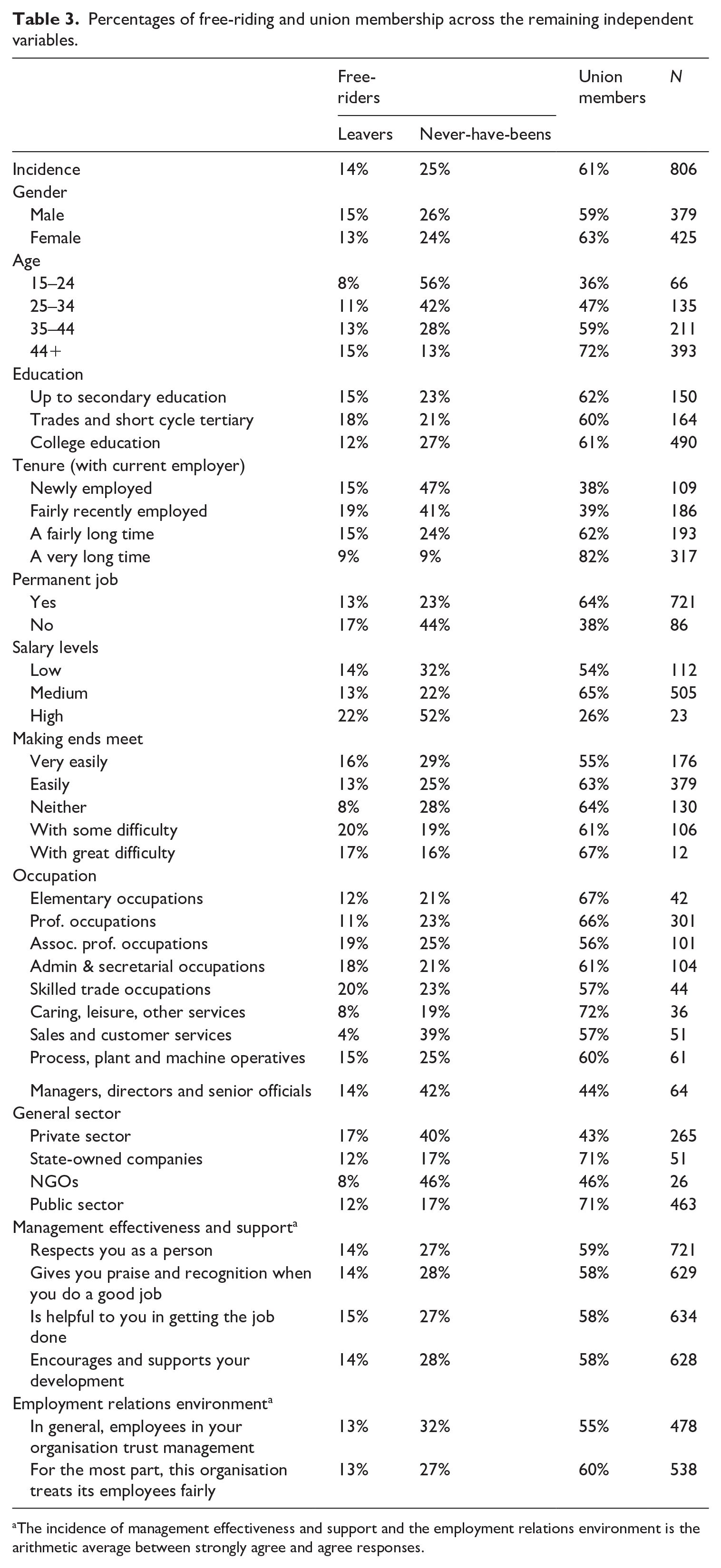
The incidence of management effectiveness and support and the employment relations environment is the arithmetic average between strongly agree and agree responses.
The finding that free-riding is noticeably higher among young workers than it is among those workers in older age cohorts confirms hypothesis 2b: 64% of those aged between 15 and 24 years are free-riders, while only 28% free-ride among those workers over 44 years of age. As a proportion of those who free-ride, young workers are considerably more likely to have never-been union members (88%) in contrast to those over 44 years (46%). Conversely, few young free-riders are leavers. We do not find a positive association between being male and free-riding as anticipated in hypothesis 2c. Rather, the incidence of free-riding is broadly similar among males and females.
With respect to hypothesis 2d, we find there are few differences in the distribution of union members and free-riders among employees with different levels of educational attainment. There is a slightly higher incidence of college graduates in the never-have-been group.
Turning to the influence of length of employment tenure, 62% of newly employed workers are free-riders, the great bulk of whom have never joined a union. By contrast, only 18% of very long tenured employees are free-riders. This points to a confirmation of hypothesis 2e. Free-riding is also, as expected with hypothesis 2f, more apparent among those workers who do not possess a permanent contract.
In relation to our third set of hypotheses, our descriptive data show that the highest incidence of free-riding is found among those reporting high salary levels (74%), the great majority of whom have never joined a union. However, our binary analysis does not support that those earning a low salary will be more likely to engage in free-riding (H3a). Nonetheless, it indicates that free-riding rates decrease as workers are able to make ends meet with greater ease. In relation to occupational groups and hypothesis 3b, it is striking that a considerable proportion (44%) of managers, directors and senior officials in unionised organisations continue to be union members. The remainder are free-riders, most of whom have never been union members. For all other occupational groups the incidence of leavers and never-have-beens is very similar with the exception of sales and customer services occupations, where the bulk are ‘never-have-beens’. Free-riding is also, as expected with hypothesis 3c, more apparent among those workers who are employed in the private sector, particularly in organisations operating in the manufacturing and wholesale and retail sectors.
We turn now to our fourth set of hypotheses concerning perceptions of management effectiveness and support in the workplace (4a) and the employment relations environment (4b). A little over 40% of workers who report that they strongly agree or agree that management is effective and supportive in their organisations are free-riders, most of whom have never joined a union. A similar incidence of free-riding is found among those who strongly agree or agree that their organisation offers a trusting and fair employment relations environment. This points to a potential validation of these last two hypotheses (4a and 4b).
Finally, the intra-variation of all independent variables within the leavers, never-have-beens and union members categories is included in Appendix 1. We provide these details for the interest of the reader.
In summary, the findings as presented here provide indicative support for a number of our hypotheses: that is, union free-riding is linked to perceptions of union effectiveness, workers’ age, level of educational attainment and employment status, but the association with other factors, including occupation and gender, is weaker or not evident at all. These results, while revealing, are nonetheless derived from bivariate statistical tests and do not control for the influence of various other factors that we have not taken account of, such as the specific sector or the size of the organisation, nor do they help determine which factors exercise a stronger influence over others. To do so, we turn now to provide a multivariate analysis of the factors independently associated with free-riding.
Independent influences associated with free-riding
As our dependent variable is categorical with three different responses – namely, (1) yes, I am currently a member; (2) no, but I have been in the past; and (3) no, I have never been a member of a trade union – we employ a multinomial logistic regression. The first category in our dependent variable (‘being a union member’) is our reference category and, therefore, is omitted in the model. The two remaining categories (leavers and never-have beens) are always interpreted in relation to our reference category. Our model specification is detailed in Tables 4, 5 and 6 wherein we define all our variables (dependent, independent and control) and the manner in which they were operationalised in the survey.
Dependent variable’s definition and descriptive values.

Independent variables’ definition and descriptive values.

Control variables’ definition and descriptive values.

We ran Spearman correlations for all variables and these were generally low or moderate (see Appendix 2). Only a handful of paired variables reported moderately high correlations. These were age and tenure (.555**); holding a permanent job and tenure (.355**); effectiveness of unions and political commitment to unions (.607**); and finally vote to keep the union and political commitment to unions (.358**). We then proceeded to test for any collinearity existing among our independent variables through the calculation of the variance inflation factor (VIF), which gauges both the correlation and the strength of correlation between variables. Most independent variables report normal levels of collinearity. Very few variables signal a moderate level of correlation and all are considerably below a value of 5, and are not sufficient to merit attention or concern.
The results of our regression analysis are reported in Table 7. In Model 1, we introduce the control variables as our ‘baseline’ model. Model 2 also incorporates all of our independent variables, namely, employees’ perceptions of the effectiveness of unions, vote on keeping the union in the organisation, employees’ political commitment to unions, employees’ age and gender, employees’ education level, employees’ tenure, type of job contract, employees’ salary level and their ability to make ends meet, employees’ occupation, employees’ perceptions of management effectiveness and support, and employees’ perceptions of the ER environment in the organisation.
Multinomial logistic regression for leavers and never-have-beens (odds ratios and p-values).

N decreases as some control and independent variables contain missing values.
Statistical significance: p-value < 0.005 (***); p-value < 0.050 (**); p-value < 0.100 (*).
In Model 1 when we examine individual sector effects, we find that workers in public administration and defence as well as those in education are less likely to free-ride (as leavers) when compared to those who free-ride in manufacturing, the reference category. Additionally, workers in virtually all sectors are more likely to free-ride than never-have-beens when compared to those in manufacturing. We still need to examine whether these identified (disaggregated) sector effects also operate at an aggregate sectoral level, i.e. at public and private sector levels. We return to examine this below. Another potentially important control variable is size of the organisation. We find that leavers are more likely to be present in micro-firms (1–10 employees), and never-have-beens are more likely to be employed by organisations of sizes smaller than that of large firms (250 employees+).
We turn now in Model 2 to include our independent variables and to see if any of these control variable effects are diluted in the complete model. Perceptions of union effectiveness are found to be associated with free-riding: the more workers rate unions to be ineffective, the more likely they are to free-ride. This holds true particularly for leavers, but is less evident among never-have-beens. These results provide modest support for H1a. In a similar vein, while leavers are significantly more likely to vote for the cessation of union representation at their workplace, never-have-beens are more likely to remain undecided on the matter when compared to union members. To put it in other words, leavers are considerably more likely than union members and never-have-beens to be hostile to, or diluted in their support for, continued union representation in their workplaces. These findings offer support for hypotheses H1b and H1c. We further expected in our formulation of our hypotheses that free-riders’ estimation of union influence and their views on whether unions should have a continued role in the workplace would also parallel their political commitment to unions. This would appear to be the case. Both categories of free-riders are less politically committed to unions than are union members. However, we again need to be cautious. The associations in the data are modest and while they may be read to support hypothesis H1d, it needs to be noted that the relevant p-value here is < 0.1000. With a lower p-value, free-riders would evidently not be distinguishable from union members in their levels of political commitment to unions.
The results in respect of age are not entirely as anticipated (H2b). Young workers between the ages of 15 and 24 years are less likely to have relinquished their union membership than those workers aged 44 years or more (the reference category), while those aged between 25 and 35 are more likely to have never joined a union when compared to those over 44 years of age. There apart, however, there are no other evident differences across the different age cohorts; that is, other younger age cohorts are no more or less likely to be free-riders than older workers. These results, then, only partially support H2b. We return to the significance of these findings in respect of the influence of age in the conclusion to the paper.
Our regression analysis reports no significant association between gender or educational level and free-riding, confirming our earlier results derived from our bivariate analysis. Thus, there is no support for hypotheses H2c and H2d.
Job tenure, however, would appear to play a large part in explaining the probability of an employee being a free-rider. The strength and direction of the links across both cohorts of free-riders would indicate that this is the most powerful explanatory influence in our modelling of independent factors. Those who are recently employed in their job with their current employer are considerably more likely to free-ride, thus providing support for hypothesis H2e.
Job status exercises no influence. Thus, those possessing a permanent job are no more likely to engage in free-riding than those who do not. Therefore, hypothesis H2f is not supported.
The results in respect of the influence of salary levels vary. It has no effect with regard to leavers, but does in relation to never-have-beens where those on low and middle incomes are less likely to free-ride than those on higher incomes and, as such, these findings only provide limited support for hypothesis H3a.
We found no significant association between the ability to make ends meet and free-riding in the case of leavers but it is supported for never-have-beens. This could be read to suggest that the financial cost of union membership is a significant factor in explaining union free-riding albeit only for those who had never joined a union but not for leavers. This partially validates hypothesis H3a.
Turning now to the influence of employees’ occupations. Here again we find important differences between the two cohorts of free-riders. Occupation exercises no influence with respect to leavers but does in regard to never-have-beens. The latter who occupy elementary jobs, professional occupations, skilled trades, sales and customer service positions, and plant and machine operatives have a lower propensity to free-ride than those in managerial occupations. Thus hypothesis H3b is only partially endorsed.
When we turn to look at the influence of broad sectoral effects, the results are very clear; there are no such evident effects. Thus, for example, an employee is as likely to free-ride in the private sector as is one in the public sector once other factors are taken account of, thereby leaving hypothesis H3c unsupported.
Finally, we consider the influence of management effectiveness and support, and the perceived quality of employment relations within the workplace. Neither exercise any substantial effect on the likelihood of workers engaging in free-riding. It is only in respect of where workers report the existence of good employment relations that there is some association and that is only in respect of never-have-been free-riders. As such, we can reject hypothesis H4a and, while there is modest support for hypothesis H4b, it is only in regard to never-have-beens but not for leavers.
Findings in respect of employees in the public sector and state-owned organisations
To this point in our analysis we have considered the dispositions of workers to free-ride across the entire Irish labour market. However, we cannot be fully assured that the option of joining a union was available to all workers in our sample. We are on far more secure ground when we examine the case of workers in the public sector and in state-owned organisations. In both these sectors, workers, irrespective of their occupation or position, are always eligible to join a trade union and for whom a union exists in their workplace. For this reason, we focus in specific detail on this subsample of 514 workers employed in the public sector (463) and the state-owned organisations (51). These two sectors share the same levels of free-riding, and the proportions of leavers and never-have-beens are broadly similar. We include the same independent variables as we ran in Model 2 above for this sub-sample. A full account of this multinomial regression is available in Table 8. We focus here in our discussion only on the principal findings.
Multinomial logistic regression for leavers and never-have-beens (odds ratios and p-values) in the public sector.

N decreases as some control and independent variables contain missing values.
Statistical significance: p-value < 0.005 (***); p-value < 0.050 (**); p-value < 0.100 (*).
The findings are again instructive. They reveal a broadly similar pattern to that found in our previous analysis of employees across all sectors of the economy albeit with some qualifications. Job tenure is again the major influence. Second, and again as in the full sample, free-riders are more likely to perceive unions to be ineffective although they are somewhat more tolerant of continued union representation. The qualification is in respect of the never-have-beens whose evaluations and orientations to unions are considerably more negative than the leavers. The latter remain just as positive and as well disposed towards unions as union members.
Summary and discussion
We conclude by summarising our main findings and by indicating the important contributions of the study to the existing literature. Then, we detail the findings’ implications for union strategies and conclude by pointing to the limitations of our study as a means of providing guidance on the conduct of future research.
The incidence of free-riding in unionised workplaces in Ireland has grown significantly in recent decades. It now exceeds one-third of the employed workforce and is considerably higher in the private sector (57%) than it is in the public sector where free-riding accounts for nearly one-third of the workforce. We find that union free-riding is more prevalent among young workers (at least in the private sector) newly employed in their jobs and who earn low to medium salaries. This finding is similar to prior research (Blanden and Machin, 2003). However, it is job tenure – by some distance – which is the most significant factor in accounting for free-riding across both cohorts of free-riders. Such effects can be taken to support Booth’s (1986) social custom model of union joining and are similar to the findings of other research internationally (Blanchflower, 2007; Budd and Na, 2000). That is, as the social custom of union membership has declined, so young workers entering the labour market feel under less pressure to join; simply put, the reputational risks and costs of free-riding are not what they used to be. By corollary, that there is less free-riding in the public sector where union density remains high would also support this thesis. In addition, that the size of the organisation does not influence the propensity to free-ride would suggest that the influence of social custom relates more to the length of time a worker is in employment and has less to do with the size of their workplace and again this finding offers further support for Booth (1986), as well as Bryson (2008).
We find that the influences associated with free-riding among leavers and never-have-beens vary. For the leavers the influences cited in the previous paragraph largely account for their dispositions to free-ride. With the never-have-beens, other influences are also important such that we can claim never-have-beens are more likely to occupy poorly-paid jobs, they struggle to make ends meet and they rate the employment relations climate within their workplace to be poor. Indeed, it is plausible to think that for low earning never-have-beens in unionised workplaces paying union dues is simply not affordable. By contrast, these factors matter appreciably less or not at all for leavers, who are more likely to be evenly or indeed randomly distributed across occupations, economic sectors and salary levels.
Other key influences are orientations to unions and perceptions of union influence. With the latter, there is an inverse relationship – the poorer unions are rated in their representative capacity, the greater the likelihood workers will free-ride. This certainly chimes with prior research in the field (Bryson, 2008). And with respect to the former, free-riders are more likely to call for the union to cease in its role in representing workers or at least they are ambivalent or undecided as to the merit of continued union representation when compared to union members.
These differences across the two cohorts of free-riders hold broadly for both those working in the private and public sectors save that in the latter never-have-beens have a higher propensity than union members (and leavers) to be ill-disposed towards unions and to be critical of the benefits of continued union representation. Leavers, by contrast, tend to be more anodyne or at least neutral in their dispositions and views of unions. Never-have-beens are also less politically committed to unions than leavers and union members.
To this point our consideration of the effect of various influences on the propensity to free-ride has focused on behavioural, demographic and organisational features. We have not considered the influence of any institutional factors. While the degree to which we can is limited by our data, they still merit consideration, and, in particular, the influence of the structure of collective bargaining. 7 From the late 1980s until the onset of the global financial crisis, collective bargaining in Ireland was conducted at a national level under the aegis of a series of tripartite social partnership programmes involving the state, the employers’ association (Irish Business and Employers’ Confederation) and the Irish Congress of Trade Unions. 8 It could be suggested that those workers who entered the labour market during this period would have had less incentive to join a union as the terms negotiated under national agreements applied to all workers in unionised workplaces. It might then be supposed that those workers – now entering middle age at the time of our survey – would have continued to free-ride after centralised bargaining came to an end, mainly due to inertia. Our data reveal a more complex picture. Certainly, the bivariate analysis does not support this possibility: older workers, those aged 44 or more years of age, are considerably less likely to free-ride than those younger workers who entered the labour market when enterprise-level bargaining was re-established. Further, the multivariate analysis reveals that age mattered considerably less than other factors in accounting for workers’ propensity to free-ride. Thus, we can fairly claim that the location of the conduct of bargaining – whether that be at a national level as it was up to 2009 or at a local enterprise level since then – did or does not play a decisive role in accounting for free-riding.
We turn now to the theoretical contributions of the paper. Our principal contribution is derived from our conceptual distinction between the two different types of free-riders – those who never joined the union (the ‘never-have-beens’) and those who were once union members but who subsequential rescinded their membership (the ‘leavers’). In significant respects these two cohorts exhibit different orientations to union membership which has not been revealed in previous research. In the future, then, theoretical propositions of free-riding would do well to discriminate between these two distinct groups of free-riders in identifying the factors associated with their free-riding. Second, consideration of the propensity to free-ride resides mainly within behavioural and biographical attributes of workers and considerably less – if at all – with factors associated with the institutional context of collective bargaining. These theoretical contributions and attendant empirical findings reveal important practical implications as to how unions might respond to free-riding, which we turn to now.
A word of caution, or at least circumspection, is warranted at the outset. Free-riding is not an anomalous or indeed deviant form of behaviour. It is becoming more common and the evidence presented here would suggest that workers have not only clear identifiable preferences in regard to union membership and representation and also exhibit clear reasons – it can be inferred – for eschewing union membership. And, as discussed in respect of the legal context in Ireland and elsewhere in the EU, whatever tensions free-riding might generate within a workforce, free-riders cannot be compelled to join a union. Employers are very likely to assert, too, that this is proper and appropriate and that all workers should be free to choose whether they join a union or not. As such, in a context where there is no viable legal basis to compel workers to join a union, we suggest the following policy prescriptions for unions who may seek to organise free-riders. These recommendations are derived directly from our research findings and they point to ways in which unions can direct their resources and energies. First, campaigns might usefully target the young: most free-riders are young never-have-been union members. Second, there is a great deal unions can do to alter these workers’ as well as union leavers’ preferences for non-union membership. Crucial here are these workers’ perceptions of union (in)effectiveness as they act independently to influence the likelihood of free-riding. Relatedly, unions might explain what unions do. One way to do this is to elucidate the distinction elaborated by Alan Flanders (1970), where unions are and/or should not be seen solely as a ‘vested interest’ (i.e. a good for individual groups of workers) but that their work also involves of necessity a collaborative endeavour where they act as a ‘sword of justice’ (i.e. be a good for society). The evidence presented in the current study would suggest that the latter union ambition will likely land on fertile ground, as some free-riders at least are politically and ideologically committed to the broader political ambitions of trade unionism. Third, organising strategies need to be customised to the cohort of free-riders to be approached – the research findings provided here show that in significant respects they are different from one another and have different predispositions in regard to union membership. Finally, as many never-have-beens work in poorly paid jobs consideration might usefully be given to soliciting union dues according to workers’ income. While this might not meet the full cost of bringing free-riders into membership and in representing them, it is important symbolically in signalling that all members are willing to make a contribution, albeit according to their means. Further, free-riders can then demonstrate that their former actions were not motivated by exploitative intent whereby they sought to benefit themselves at the expense of their fellow workers.
We turn now to lessons for future research. While we argue that our findings have considerable merit and help us greatly in examining the incidence of free-riding and in profiling those who are the free-riders, ultimately they cannot determine why it is that some workers choose to free-ride. To be able to do so, future research would need to include questions in their survey instruments which specifically focus on ascertaining workers’ motives for engaging in free-riding. Future surveys would also require a larger sample size. In the current study only around a quarter of the sampled workforce are in union membership. When one then looks only at unionised workplaces across various sectors of the economy or across various cohorts of the workforce, one’s ‘N’ becomes inevitably smaller. A larger sample size would permit more detailed statistical tests. In addition, future research would also profit from undertaking repeat surveys where similar questions would be asked by similar means so as to avail of reliable longitudinal data (Felstead, 2021). In the absence of such longitudinal data, one cannot determine the direction of causality or take account of possible selection effects where, for example, workers who are hostile to trade unions may deliberately avoid seeking work in strongly unionised workplaces where the peer pressure or the social custom to join a union is very difficult to evade. Instead, they may choose weakly unionised workplaces where their aversion to unions is more easily accommodated.
Footnotes
Appendix
Spearman correlations for all independent and control variables.

| Variables | Gender | Age | Education |
Tenure | Perm. |
Occup. | Salary |
Ends |
Gen. |
Spec. |
Firm |
Mgmt |
IR |
Effect. |
Vote |
Pol. c. |
|---|---|---|---|---|---|---|---|---|---|---|---|---|---|---|---|---|
| Gender | 1 | |||||||||||||||
| Age | .032 | 1 | ||||||||||||||
| Education level | .190** | –.082** | 1 | |||||||||||||
| Tenure | .051 | .555** | –.028 | 1 | ||||||||||||
| Permanent job | .045 | –.266** | .011 | –.355** | 1 | |||||||||||
| Occupation | –.151** | .024 | –.285** | –.030 | –.023 | 1 | ||||||||||
| Salary level | –.147** | .195** | .192** | .191** | –.246** | –.054 | 1 | |||||||||
| Making ends meet | –.012 | –.044 | –.098** | –.127** | .015 | .067* | –.166** | 1 | ||||||||
| General sector | .253** | .182** | .237** | .212** | –.018 | –.290** | .040 | –.118** | 1 | |||||||
| Specific sector | .266** | .094** | .162** | .051 | –.012 | –.188** | .068 | –.083* | .228** | 1 | ||||||
| Firm size | .111** | –.028 | .015 | –.036 | .030 | –.051 | –.069 | .067 | .158** | 0.081* | 1 | |||||
| Management support | .034 | .131** | –.032 | .137** | .007 | –.011 | –.024 | .111** | –.014 | .000 | .082* | 1 | ||||
| ER environment | .036 | .108** | –.019 | .177** | –.053 | –.074* | .045 | .042 | .073* | .056 | 0.79* | .562** | 1 | |||
| Effectiveness of unions | –.002 | .025 | .001 | –.051 | –.005 | –.004 | .063 | .073* | –.182** | .019 | –.069 | .058 | .056 | 1 | ||
| Vote on union | .093** | .051 | –.016 | .086* | –.016 | –.095** | –.066 | –.010 | .207** | .014 | .064 | .064 | –.240** | .056 | 1 | |
| Pol. commit. union | .069 | .065 | .034 | .009 | –.001 | –.059 | .049 | 0.20 | .005 | .031 | .032 | .077* | .046 | .607** | .358** | 1 |
Statistical significance: p-value < 0.050 (**); p-value < 0.100 (*).
Acknowledgements
We thank the editor and the two referees whose feedback helped us to improve the article. Our thanks too to Alan Felstead, who read a first draft and provided valuable suggestions.
Declaration of conflicting interests
The authors declared no potential conflicts of interest with respect to the research, authorship, and/or publication of this article.
Funding
The author(s) disclosed receipt of the following financial support for the research, authorship, and/or publication of this article: The authors gratefully acknowledge the financial support provided by UCD Foundation.
