




Abstract
How managers collaborate across firm boundaries to legitimate novel institutional arrangements in the eyes of the public is a topic that has attracted the interest of a wide range of researchers. This article, which is informed by this literature, explores the rise and fall of the employee representation movement in the United States. The period 1913–1935 saw intense interest on the part of American managers in the creation of non-union employee representation plans (ERPs) such as works councils and shop committees. The article uses archival and other primary sources to argue that the employee representation movement of the pre-1935 era was an attempt to legitimate big business in the eyes of a wide range of stakeholders, not just workers.
Keywords
In this article we develop our understanding of how managers seek to legitimate novel institutional arrangements by analysing the rise and fall of the employee representation movement in the United States. The period 1913–1935 saw the creation of non-union employee representation plans (ERPs) such as works councils and shop committees in many American workplaces. We argue that the employee representation movement of the pre-1935 era was an attempt to legitimate big business for a wide range of stakeholders, not just workers. The employee representation movement came to an abrupt halt after the passage of the National Labor Relations Act (NLRA) of 1935. Casebeer (1987, 1989) and Walker (2020) have examined the motives of lawmakers who effectively banned ERPs in most American workplaces. 1 Our contribution is to explain why large numbers of American managers embraced the idea of creating elaborate systems of non-union employee representation. We see the employee representation movement as a strategy for legitimating big business in the eyes of external, non-worker stakeholders. This dimension of the employee representation movement is largely overlooked in the existing literature on this topic.
In the generation prior to 1913, American capitalism was transformed by the advent of a set of institutional arrangements that contemporaries and posterity called ‘big business’. This set of institutions was controversial in the eyes of many Americans of that era. ERPs were among the strategies managers used to legitimate this new type of organization. It is unsurprising that American managers needed to legitimate big business as we know that the emergence of new institutional arrangements is frequently controversial (Suddaby and Greenwood, 2005). The term legitimacy work denotes the efforts of managers to induce stakeholders to regard something as ‘desirable, proper, or appropriate’ (Suchman, 1995: 574). Earlier studies of legitimacy work show that managers invest considerable resources such as money, time and mental energy in attempts to legitimate both individual firms and the economic institutions and systems in which their firms operate (Ruef and Scott, 1998).
This article develops our understanding of how such legitimacy work is done with a historical case study. We argue that the employee representation movement of 1913–1935 was about far more than dissuading workers from joining real unions. We argue that the ERP concept helped to legitimate the new organizational forms known as ‘big business’ in the eyes of consumers, intellectuals, voters and other non-worker stakeholders. This article extends and modifies the existing theory used to understand how managers gain legitimacy for new organizational forms by introducing the concept of the ‘imagined community’ (Anderson, 1983) into our model of how managers do legitimacy work. The existing theory says little about how nations and other large-scale imagined communities conceptualize themselves and associate themselves with values. The literature on imagined communities indicates that units such as nations are typically associated with particular sets of political, social and religious values (e.g. Thomas and Antony, 2015). We argue that managers attempting to increase the socio-political legitimacy of a new form of organization will invest in efforts to make the form appear compatible with the core values of the imagined community, whatever those values may be.
In the period discussed in this article, the American national identity was strongly associated with ‘democracy’ and a relatively egalitarian social order, as we show below. Big business, the organizational form that emerged out of the second industrial revolution, was inherently hierarchical and socially stratified and was thus seen by many Americans as incompatible with democracy. We thus have evidence of a contradiction in American capitalism that managers needed to address to maintain their legitimacy. When critics argued that the new giant corporations were undemocratic and therefore un-American, managers responded with the ERP movement, which involved creating quasi-democratic institutions within workplaces and then informing the public about their existence. 2
The term employee representation plan movement denotes a collective attempt by managers to change public perceptions of big business by introducing into companies non-union employee representation mechanisms including ‘works councils’, ‘shop committees’ and more elaborate industrial democracy systems. All of these terms require clear definitions because their meanings vary across time and space and were contested by actors in the context under discussion. Contemporary Americans used the term ‘works council’ to denote a body within an industrial establishment that is created by management and which includes employees who were elected or otherwise chosen to represent all of the establishment’s wage-earners in periodic meetings with managers. ‘Shop committees’ were like work councils except that they tended to be less formal and to represent workers at a lower-level unit. The term ‘industrial democracy’ has a long history and was appropriated by advocates of employee representation, both unions (Derber, 1970) and the more radical forces who envisioned an end to capitalism itself, such as the leaders of the Industrial Workers of the World union (Niemi and Plante, 2008). In 1913 John Leitch, a freelance labour-relations consultant who worked for large corporations, attempted to change the ideological valence of the term when he developed an elaborate ERP that was modelled on the US Constitution, which he called ‘Industrial Democracy’. 3
Literature review
The legitimation of new organizational forms
Legitimacy can be defined as ‘the generalized perception or assumption that the actions of an entity are desirable, proper, or appropriate within some socially constructed system of norms, values, beliefs, and definitions’ (Suchman, 1995: 574). The property of legitimacy can adhere to both an organizational field or an individual organization (Greve and Rao, 2014). Legitimacy, particularly ‘socio-political legitimacy’ and ‘regulatory legitimacy’ (Scott, 1995), is essential for organizational survival (Aldrich and Fiol, 1994; Baum and Amburgey, 2017; Baum and Oliver, 1991; Bitektine, 2011; Bitektine and Haack, 2015; Deephouse and Carter, 2005; Haack et al., 2021; Meyer and Rowan, 1977; Ruef and Scott, 1998). How new forms of organization acquire legitimacy is therefore a subject of considerable interest to researchers (Deephouse and Carter, 2005; Greenwood et al., 2002; Ruef and Scott, 1998; Suddaby and Greenwood, 2005).
Socio-political legitimacy refers to the acceptance of a phenomenon by stakeholders that is consistent with their cultural norms, values and practices (Deephouse et al., 2017; Jones et al., 2022; Suchman, 1995). Recent studies of how socio-political legitimacy can be gained or preserved include Finch et al. (2015), which examined stakeholders’ attitudes to a controversial oil project; Baumann-Pauly et al. (2016), who studied how a sportswear brand maintained its legitimacy following a scandal about working conditions in Asia; and the business-historical study by Jones et al. (2022), which examined how a British bank funded the arts to regain socio-political legitimacy despite its involvement with an odious regime. The recent literature corroborates the claim made by Navis and Glynn (2011) that harnessing broader belief systems can help organizations to erase the illegitimacy associated with novelty.
One limitation of the existing literature on how novel arrangements acquire socio-political legitimacy is that it tends to pay little attention to how the cultural dynamics of specific national contexts influence the processes of legitimation. For instance, in Baumann-Pauly et al.’s study on Puma, the fact that the company was German rather, than, say American or British, is incidental. This article seeks to remedy this oversight. In our historical case study, the imagined community of the United States and Americans’ collective self-perception as a democratic people is a core part of our explanation for why American managers tried to use ERPs, which gave a patina of democracy to corporations, to legitimate big business.
Legitimacy research in industrial relations
Employment relations researchers have long drawn on Suchman’s theory of legitimacy to understand the factors that influence the perceived legitimacy of labour unions (Chaison and Bigelow, 2018 [2002]). The idea within Suchman (1995) that ER scholars appear to regard as the most useful is his distinction between three main types of organizational legitimacy: pragmatic, or the perceived usefulness of an organization to its stakeholders; moral, or whether an organization’s action are congruent with the values of the wider society; and cognitive, or whether an organization’s existence and practice are taken for granted in a given society (Wright and McLaughlin, 2021).
The employment relations literature on legitimacy has long focused on unions (Chaison and Bigelow, 2018 [2002]; Harvey et al., 2017). Industrial relations scholars have also explored how third parties, most notably governments, grant legitimacy to unions and how this changes worker perceptions of the legitimacy of union representatives (Dufour and Hege, 2010). Hodder et al. (2024) have called for the study of legitimacy in industrial relations to be extended from the study of trade union legitimacy to other actors, such as the state and employer associations. Perhaps anticipating this call, Howell (2021) and Morgan and Hauptmeier (2021) have researched the state and other actors. Morgan and Hauptmeier (2021: 775) examine the role of think-tanks associated with the ‘Mont Pelerin Society’ in giving legitimacy to neoliberal labour market reforms. In their account, ideational factors and, crucially, the work of the ideologists who are paid by the representatives of capital to try to change the climate of opinion, influence the perceived legitimacy of different ways of organizing work.
While we certainly do not wish to minimize the need for employment relations research on legitimacy to examine demographic-group identities, such as how gender and racial identities influence perceptions of legitimacy (Carstensen et al., 2022; Doellgast et al., 2021), we also suggest that researchers be attentive to how national identities influence perceptions of the legitimacy of different ways of organizing work. To date, the employment relations scholars who use the concept of legitimacy have ignored the impact on legitimation of national identities and the normative value systems that are bundled into them. For instance, the paper by Wright and McLaughlin (2021) on trade union legitimacy in Australia and New Zealand does not talk about how national identities and values influenced how actors viewed shifts in how work was organized. We think that these variables would matter in their analysis because other researchers have shown that Australians traditionally defined themselves against more hierarchical cultures and thus associated the value of egalitarianism with the country’s identity (Turner, 1979). How this sense of Australian-ness influenced perceptions of changes in the country’s industrial relations system in the 1990s goes undiscussed by Wright and McLaughlin, as do all other issues related to national identity. In contrast, our study of the American ERP movement foregrounds the imagined community of the nation-state and the socio-economic values that nations are perceived as embodying.
The literature on the employee representation movement
We now turn to the literature that discusses the ERP movement. The early literature on the pre-1935 ERPs, much of which was published within living memory of the phenomenon, argued that all such plans were simply ruses created by managers to frustrate real unionization. This approach was epitomized by Millis and Brown’s (1950) hostile study, which drew on Millis’s experiences as chair of the National Labor Relations Board from 1940 to 1945, and which dismissively labelled non-union ERPs as ‘company unions’. The position of these scholar-activists was shared by near contemporaries such as American Federation of Labor (AFL) President Samuel Gompers, who denounced works councils and other employee discussion forums as depriving the workers of ‘real representation’ and giving bosses ‘unabridged autocracy and power’. In 1921, Gompers, whose AFL had previously been cautiously supportive (French, 1923: 82; Leiserson, 1919: 13), claimed that ERPs were a mockery of the phrase ‘industrial democracy’ (New York Times, 1921).
Since the 1980s historians have revised our understanding of the ERPs of the pre-1935 era, thereby moving us away from the position articulated by Millis and Brown and towards a more nuanced view. This process was led by Nelson (1982), who associated the employee representation movement with the development of more ‘advanced personnel management’ systems ‘that bridged, however imperfectly, the traditional chasm between blue- and white-collar employees. Employers became personally familiar with their employees’ interests and vice versa’ (Nelson, 1982: 357). Fairris (1995) further rehabilitated the pre-1935 ERPs by arguing that they had reduced employee turnover, increased morale, while improving health and safety, and further speculated they might have increased labour productivity (p. 514).
Kaufman and Taras (2016: 259) built upon earlier work by Kaufman (2000) to further challenge the Gompers–Millis–Brown view by arguing that the pre-1935 ERPs were ‘on net, a positive development in employee relations’ that ‘benefited not only employer interests but also the interests of workers and the broader society’. In his comparative history of ERPs in Germany and the English-speaking countries from 1914 to 1939, Patmore (2016) argues that pre-1935 American ERPs served several important functions that were ignored by the labour movement. Hogler (2016) arrived at broadly similar conclusions and noted an abortive effort under President Bill Clinton to revive ERPs inspired by continental European practice.
Patmore (2016) further reveals that there was widespread interest in the creation of employee representation plans in the UK, US, Australia, Canada and Germany in this era. Patmore’s analysis is both comparative and transnational: he also shows that advocates of employee representation in different countries borrowed ideas from each other, which is consistent with the findings of other scholars, such as those who found that advocates of works councils in Scandinavia were inspired by the codetermination movement in the Federal Republic of Germany (Haug, 2004). One striking finding presented by Patmore is that the United States, a country that today has vanishingly few non-union ERPs, was once the global leader in this area.
It is certainly true that companies in other countries began to introduce ERPs in the period covered by our article. The government of the the Weimar Republic democracy (McGaughey, 2016: 155–156) encouraged the creation of works councils from 1921 to 1933. This experiment was ended by the Nazis, who expected workers to show unquestioning obedience to firms, an extension of the Führerprinzip into the workplace (Kuntz, 2018). The antecedents of the Weimar Republic works councils can be traced to a sort of codetermination law that was drafted during the short-lived 1848 democratic revolution (McGaughey, 2016: 146–149; Teuteberg, 1961). However, while some Weimar Republic managers, noticeably those in AEG, Siemens, and the railway sector, supported the concept of employee representation in the 1920s, many others did not (Patmore, 2016: 150). Works councils and codetermination did not reappear in Germany until the passage of legislation in West Germany in 1951 (Kuntz, 2018: 222). Works councils and other employee representation systems were subsequently emulated in a variety of European countries, as in Sweden after 1977 (Levinson, 2000; Streeck, 1995). In Europe, as in the United States pre-1935, democracy in the workplace has been widely associated with democracy at the level of the nation-state.
Our view of the pre-1935 employee representation movement differs from both the Gompers–Millis–Brown view and the revisionist scholars who have stressed its social benefits. Both schools of thought suggest that the sole motivation of the managers who created the ERPs was to legitimate their firms in the eyes of the workers. We argue that managers’ support for ERP was motivated by the quest to legitimate the large firm in the eyes of non-worker stakeholders. As we show below, when managers created such employee representation systems, they typically announced their creation to the public via the press. These efforts to make non-worker stakeholders aware of the existence of ERPs appear to have been successful, as hundreds of articles about ERPs appeared in American newspapers in this period (see Figure 1).
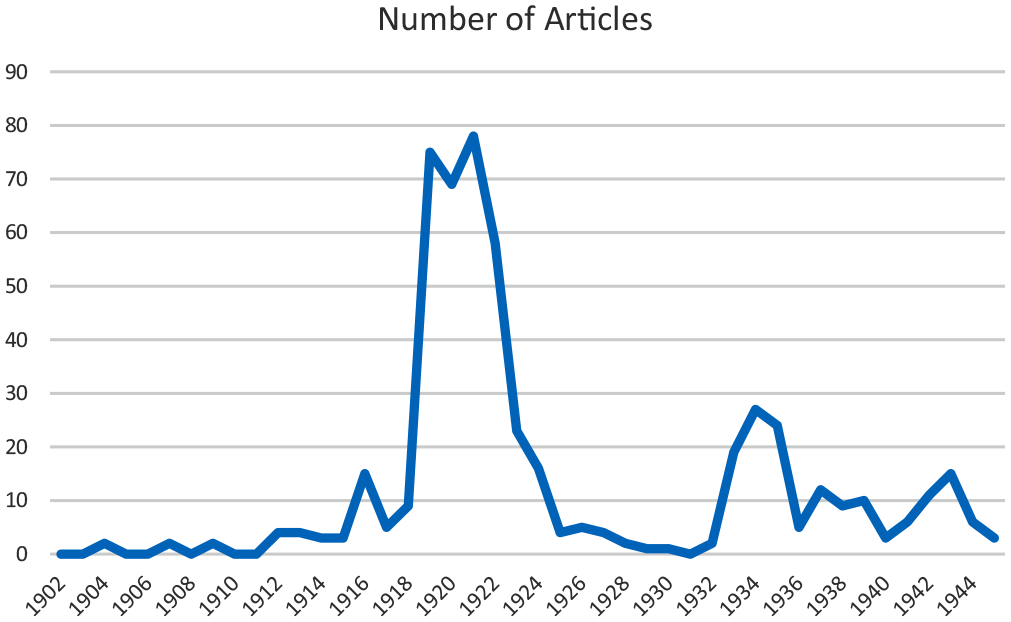
Press coverage of ERP in newspapers in the Chronicling America database.
Methodology and data
Case study research is a powerful method for theory building, theory extension, and, to a lesser extent, theory testing (Eisenhardt, 1989; Yin, 2009). The utility of business-historical case study research in advancing management theory is increasingly recognized in leading management journals (Argyres et al., 2020). Historical case study research has long been used in papers devoted to understanding changing systems of industrial relations (e.g. Godard, 2009; Jacoby, 1983; Tengblad and Andersson, 2025). Historical case study research (Yates, 2014) typically spans longer periods than would be feasible in ethnographic research, which allows researchers to think about the drivers of long-term trends. Data availability and reliability can be a disadvantage of historical research, as historical sources are often scarce and fragmentary. Moreover, the further back in history a researcher looks, the more difficult it may be to interpret their data, due to such factors as the changing meaning of words. We addressed the problem of fragmentary sources with the search strategies described below, which allowed us to access a range of primary sources now kept in repositories in different parts of the United States. To deal with the other major problem involved in historical case study research, difficulties in interpreting data due to changes in the meaning of words and cultural shifts, we employed the technique of hermeneutics, which increases the robustness of research findings by requiring the researchers to become familiar with the social context in which the primary sources were produced (Kipping et al., 2014). Our hermeneutical research process involved extensive reading about the broader historical context in which these documents were produced.
Although historical case study research is sometimes labelled as inductive research, we believe that it is best regarded as a form of abductive research (Sætre and Van de Ven, 2021). Abductive research seeks to understand complex phenomena by combining elements of both deduction and induction. In abductive reasoning, the researcher begins with a set of observed facts and then generates plausible hypotheses that could account for the observed pattern, which involved creative thinking. These working hypotheses then guide further investigation (Timmermans and Tavory, 2012). The term historical research methods denotes a family of related research methods, which means researchers need to think carefully about which particular historical research methods are most appropriate for answering a given research question (Blum and Colvin, 2018; Cioni et al., 2020). The research methods used in preparing this case study are broadly similar to those of Perchard and Gildart (2023) and Wuokko et al. (2022), two recent papers that use historical data to advance theorizing about employment relations systems. However, our research methods differ from those of Perchard and Gildart in that we did not conduct any oral historical interviews, as it is no longer possible to speak to any of the practitioners involved.
We made extensive use of primary sources. For business historians, internal firm correspondence, articles in the business press and inter-organizational correspondence are particularly important primary sources in conducting historical case study research (Lipartito, 2014; Wadhwani and Decker, 2017). These sources are often found and analysed after the researcher has mastered the existing secondary literature on the topic. Reading the secondary literature relevant to a given historical topic helps the investigator to understand both historians’ debates about that topic and the topic’s chronology and the identities of the key personalities as well as to identify primary sources (Tennent and Gillett, 2023).
At the start of this research project, we reviewed the historiography of the employee representation movement, observing differences in how historians have interpreted the movement and compiling a list of keywords (personal and corporate names, terminology) and dates from the secondary sources. We then used those sources to search for relevant primary sources in union library catalogues such as WorldCat and in databases of primary sources, including digitized historical newspapers. We also visited university libraries in the United States. The most important of the primary sources obtained in this fashion were the 1922 National Industrial Conference Board report into works councils, which contained rich data about the distribution and functioning of ERPs, and the 1938 Department of Labor Statistics report on non-union employee representation, which presented the findings of a large team of federally-funded researchers who had studied the operation of works councils in the period immediately before they were effectively banned.
After analysing these printed primary sources, we searched for archival sources, such as meeting minutes or other materials generated by firms or ERPs themselves, which had the potential to illuminate the working of pre-1935 American employee representation systems from the inside. Following the process described by Tennent and Gillett (2023), we searched for collections of documents in CLUMOP (corporate, local authority, university, museum, other libraries) repositories. In conducting this research, we were guided by Popp and Fellman’s (2020) insight that corporate archives, far from being a neutral repository of corporate communications, are actively curated and edited by firms. During our search we formed the impression that while many companies had employee representation systems prior to 1935, few corporate archivists retained the associated records. We would attribute the loss of these documents not to a conscious or malevolent strategy of document suppression after the passage of the NLRA but instead to the pragmatic need to create storage space for more operationally relevant documents.
We learned from secondary sources that some of the meeting minutes produced by the ERP of the Colorado Fuel and Iron Company had been preserved in a university repository in Pueblo, Colorado. However, Patmore and Rees (2008: 261–264) show that these records, far from being a faithful account of what was said by workers in the meetings, had been heavily edited by managers. After a 1928 visit to Colorado to study the workings of the system, the pioneering HRM academic Mayo concluded that the minutes were doctored by managers, who deleted remarks by workers who were critical of management and even inserted fictitious pro-management speeches. Based on the description of these records by Patmore and Rees, we decided to continue searching for other archival repositories that held relevant collections.
After a long and occasionally frustrating search, we found a wonderfully detailed set of archival records held at the Hagley Museum and Library in Wilmington, Delaware, about the ERPs of Leeds and Northrup (L&N), a maker of advanced precision equipment in Philadelphia, Pennsylvania. This electrical equipment firm was founded in 1899 by Morris E Leeds. By 1929, L&N had 728 employees and had thus grown into the admittedly nebulous category of big business. This firm had an ERP from 1918 until 1938, when the Supreme Court ruled ERPs unlawful. Leeds and Northrup eventually became a unit of Honeywell, which later donated 13 microfilm reels of L&N archival documents to the Hagley. These documents contain the minutes of meetings of both senior executives as well as of its ERP, known as the Cooperative Association. In 2019, a member of the research team visited Hagley with a digital camera and spent four days investigating the documents as well as other collections of documents pertaining to ERPs held by Hagley, including those of larger companies such as Bethlehem Steel and the Pennsylvania Railroad.
We now turn to the issue of how we interpreted the primary sources. We employed the source criticism techniques discussed by Kipping et al. (2014), Lipartito (2014) and Heller (2023). We first surveyed the available primary sources to establish their potential relevance to our research question. We found materials of both reportative and performative types (Heller, 2023), which helped us to understand the mechanisms through which ERPs were constructed, operated and used to gain external legitimacy. Our analysis of the published and archival primary sources then allowed us to develop a system of historical periodization that facilitated understanding the reasons for the rise and fall of ERPs. We thus engaged in ‘temporal bracketing’ (Langley, 1999), which involves identifying turning points, creating named historical periods and sub-periods, and reflecting on historical causation, the highest stage of analysis in our study. The historical sub-periods we identified in our research are indicated by the subheadings in the following section. In determining patterns of historical causation, our approach was informed by such theorists of historical causation as Froeyman (2009), Ermakoff (2019) and Collier and Munck (2022) as well as the literature on the contradictions of capitalism (Harvey, 2014).
The rise and fall of the employee representation movement in the United States
The emergence of the employee representation movement: The broader social context
By 1800, the United States had acquired a set of economic institutions that correspond to those listed in the definition of capitalism provided by Hodgson (2019), such as markets, privately owned farms and shops, and banks and those that are part of Williamson’s (1975) definition such as firms, markets, financial institutions, contracts, property rights and competition. Thereafter, Americans generally regarded the basic economic institutions of capitalism as legitimate. However, the United States experienced dramatic institutional change in the closing decades of the nineteenth century with the rise of big business, that is the emergence of oligopolistic, vertically and horizontally integrated firms and the displacement of artisanal production (Lamoreaux et al., 2003). The new breed of large firms, which sat atop the country’s long-established basic economic institutions, was efficient at achieving economies of scale and scope, and tended to be characterized by a growing separation of ownership and control and the listing of firm’s shares on stock exchanges, particularly the NYSE (Chandler, 1977).
Fields of economic activity that had previously been characterized by the dispersion of production to large numbers of tiny firms in which a few employees worked alongside the owner came to be replaced by a handful of large firms with complex managerial hierarchies (High, 2011). Firms began to displace markets in a variety of sectors of the economy as managers sought to economize on transaction costs (Langlois, 2023). Today, firms are defined as ‘large’ if they have more than 250 employees (OECD, 2023). Prior to the late nineteenth century, only a handful of organizations in the United States, mainly railroads, crossed this threshold (Chandler, 1977). The growth of large firms in which managers were separated from front-line workers by layers of management dramatically changed the nature of American business.
In the twentieth century, large firms came to dominate many sectors in the industrialized countries in Europe, North America and Asia. This transnational pattern strongly suggests that this new organizational form was functional (Chandler, 1990; Porter, 2014). The emergence of large firms created political backlash wherever they appeared, but large firms were especially controversial in the United States’ political-cultural context because they were seen by many as antithetical to the country’s republican institutions (Freyer, 1992; Sklar, 1988). While there was widespread recognition of their efficiency, many Americans regarded such centralized entities as incompatible with the founding ideal of a nation of self-employed and self-governing farmers, crafts people and petty traders (Trachtenberg, 2007).
From the Revolution onwards, American writers and political leaders including Presidents Jefferson, Jackson and Lincoln had celebrated the sturdy independence and innovativeness produced by this social order (Wilson, 1979). Americans constructed a cult around the concept of democracy that was linked to such beliefs as decentralization, individual autonomy and socio-economic equality. For Americans, the aristocratic monarchies of the Old World were the Other against which they defined themselves (Appleby, 1992; Wiebe, 1995; Wilentz, 2002; Wood, 2011). The rise of big business around the turn of the twentieth century resulted in the accumulation of large fortunes by the industrialists who were dubbed Robber Barons, an allusion to European feudalism (Solganick, 1965). Income inequality in the United States increased (Glaeser et al., 2003; Lindert and Williamson, 2016), generating a wide range of political responses that included campaigns for regulations to hobble particular types of large firms, such as restrictions on the proliferation of department stores and chain stores (Levinson, 2011) and the introduction of antitrust legislation (Cuff, 1969; Moarefy, 2022).
The rise of big business undermined the socio-political legitimacy of management and capitalism in the American republic. Managers responded with efforts to bolster the legitimacy of the capitalist system, and their own power, including the invention of corporate public relations (Leccese, 2017), the move to create personnel departments that limited the arbitrary authority of foremen (Jacoby, 2004), and conspicuous philanthropy (Harvey et al., 2011). The ERP was one of several tools that managers used to legitimate big business. Some business people stood aloof from the employee representation movement, most notably Henry Ford, whose famously autocratic managerial style (Farber, 2002) was incompatible with power sharing with workers and, indeed, other managers. Rather than investing in the creation of ERPs, Ford sought legitimacy through the payment of higher wages and philanthropy (Clarke, 2003; Meyer, 1981). However, while not all managers supported the creation of ERPs, the movement nevertheless enjoyed significant support among the American managerial class.
Early experiments with employee representation, 1898–1912
ERPs began to appear in American workplaces in the late 1890s with the advent of ‘shop councils’ and ‘shop committees’. In 1898, the managers of Boston’s Filene Department Store formed a cooperative association that gave employees influence over such matters as wages and dismissal (Guzda, 1984: 26). In 1904, the Nernst Lamp Co. of Pittsburgh established a ‘factory committee’ that was credited by contemporaries with turning the firm around by improving product quality in time to prevent bankruptcy (La Dame, 1930). Writing in Engineering Magazine, the labour relations consultant Holbrook Porter reported that one of his clients had experienced a surge of useful suggestions from employees after the creation of a factory council. Porter (1905: 5–6) argued that though the discussions took employees away from their work, the benefits of this outweighed the costs. Porter’s rationale for creating ERPs centred on technical knowledge sharing rather than enhancing the social legitimacy of large firms – an idea that become a major theme in managerial discussions of such plans after 1912.
Intensifying managerial interest in employee representation, 1913 onwards
There was a significant increase in managerial interest in ERPs around 1912, the year that saw the election of President Woodrow Wilson, an intellectual who was unconvinced that big business was wholly compatible with republican institutions. Wilson and his key ally Louis Brandeis, an ardent trustbuster, participated in the intense national debate about whether big business was desirable. After Wilson’s election as president he would appoint Brandeis to the Supreme Court, where he would then rule on antitrust cases (Adelstein, 1989). In our view, the election of Wilson to the White House helped to trigger the ERP movement.
The presidential election campaign in 1912 was, unusually, a contest between three serious contenders for the White House, each with a different outlook on big business. William Howard Taft, the incumbent who was seeking re-election as an orthodox Republican, was the most sympathetic to big business. Taft favoured limited government intervention in the economy and while his administration had pursued several antitrust cases against major corporations, it pursued them less aggressively than that of his predecessor, Theodore Roosevelt. In 1912, Roosevelt was the nominee of the Progressive Party, having broken with the Republican Party because of its perceived conservatism. His philosophy of the ‘New Nationalism’ envisaged more intensive federal regulation of large firms but did not go as far as breaking them up. Woodrow Wilson’s ‘New Freedom’ platform hinted at the need to break up large corporations – an idea that was particularly attractive to the many southern and western agrarians within the Democratic Party (Link, 1951; Votaw, 1964). Another sign that American big business was experiencing a crisis of social legitimacy was that Eugene V Debs of the Socialist Party of America performed well in this election. Even after Wilson’s inauguration in March 1913, it was unclear to what extent his administration would act on his previous anti-big business rhetoric.
It was in this highly charged political atmosphere that managerial interest in ERPs increased. Very few American workplaces had created ERPs before 1913. Thereafter, their numbers radically increased (Davis et al., 1938). In our view, the sudden intensification of interest on the part of managers in employee representation systems was driven by growing scepticism of big business. During the first Wilson administration, American managers developed a rich taxonomy of ERPs that included shop committees, works councils, ‘Rockefeller-plan councils’ and the Industrial Democracy system. All the ERPs created after 1913, regardless of their precise name or format, were about making large companies seem more democratic and consistent with America’s republican institutions.
It was in this context that John Leitch developed an ERP modelled on the US constitution. First put in place in a mid-western paint factory in 1913, Leitch’s ‘Industrial Democracy’ system involved a ‘House of Representatives’ elected by manual workers, a ‘Senate’ chosen by the foremen and a ‘Cabinet’ chosen by the owners of the firm. The House of Representatives ‘had a President, a Vice President, a Secretary, and a Sergeant-At-Arms’ as well as such standing committees as ‘Imperfect Material and Poor Workmanship, Suggestions, Publicity, Safety, Flag, and Educational’. In explaining this system to workers in a factory in which it was being introduced, Leitch would announce that the workplace would henceforth ‘be governed exactly as the country in which we are living is governed. They were told that all complaints, all grievances, all disputes over rates or wages, should be presented to their representatives in the House who would take them up in meeting’ (Leitch, 1919: 70–71).
By 1922, Leitch’s system, or a variant thereof, was in place in 37 of the 230 American industrial establishments that had ERPs, according to the National Industrial Conference Board (1922: 185). An example of the system in action is provided by the 1920 case of the wage reduction agreed by the workers of the Dan River Cotton Mills, a 6000 worker enterprise in Virginia, which had adopted Leitch’s system in 1918. Faced with plunging demand for cotton goods and seeking an alternative to layoffs, the workers’ representatives in the House and Senate voted to cut wages for the duration of the trade depression. The company ‘cabinet’ or management team implemented this and publicized the decision of the workers’ elected representatives to reduce wages, ensuring it was reported in newspapers as far away as Chicago (Chicago Daily Tribune, 1920).
The Rockefellers, who continued to own the oil companies that had been created after the breakup of Standard Oil in 1911 (Patmore and Rees, 2008), also introduced a system of joint worker–management committees after a violent 1914 strike at their Colorado Fuel and Iron Company. The Rockefeller system, which was designed by future Canadian Prime Minister Mackenzie King, was modelled on representative government: workers from a given work unit, such as a mine, would elect representatives to a district conference. The district conference would meet with the top management team at least three times a year and formed standing joint management–labour committees that dealt with such issues as wages and conditions, health and safety, and housing. To ensure the wider American public was aware of this change in labour relations within the Rockefeller empire, the company distributed a free newsletter about the ERP to ‘libraries all across the United States’ (Patmore and Rees, 2008: 260). Given that the firm was deeply unpopular with a segment of American public opinion and had been the subject of a prolonged antitrust investigation, the managers’ desire to inform the public about the new power-sharing arrangements is understandable.
US entry into the First World War in 1917, which was justified by President Wilson as a crusade for democracy, further raised the profile of the issue of industrial democracy. During the conflict, the National War Labor Board mandated the establishment of works councils in industrial establishments, such as shipyards and munitions factories, that were important to the war effort. These works councils functioned much like the Whitley Councils that were established in British war industries as power-sharing mechanisms that brought workers and managers together (McCartin, 1997). During the war, trade unionists and others compared the lack of democracy within American workplaces to Germany’s hierarchical and militaristic regime by using the terms ‘industrial Prussianism’ and ‘industrial despotism’ (New York Times, 1916; Rockefeller, 1918).
Many firms expanded the ERPs after the armistice (Evans, 1919; Chicago Tribune, 1921) with 391,400 workers covered by an ERP by 1919. This number increased to 690,000 by 1922 and reached 1,117,037 by 1924. During the same period, the number of councils rose from 225 to 814 (Lauck, 1926: 136). By 1920, ‘industrial democracy was a household term’ in the United States (Derber, 1970: 173). In 1922, ERPs were in place in at least 230 manufacturing establishments, including those of such leading firms as General Electric, Du Pont, International Harvester, Western Union, Standard Oil of New Jersey, Standard Oil of Indiana, Warner Bros and Universal Film (National Industrial Conference Board, 1922: Appendix). ERPs were found in companies with large workforces, typically over 500 wage-earners, in which ordinary workers were separated from chief executives by multiple layers of management. In 1919 there were 2770 establishments with large workforces in the United States (Thorp, 1924: 76). The 230 firms with ERPs known to the survey takers in 1922 would signify at least 10% of the large companies. A survey published in 1933 found that 894,327 workers were covered by ERPs. Of these, 484,072 worked in firms with more than 10,000 employees (National Industrial Conference Board, 1933: Table 4). The large firms that created ERPs deserve to be characterized as leading firms because many of them had the following characteristics: they were unusually technologically innovative companies, they represented a significant proportion of the market capitalization of American public companies, were listed on the Dow Jones Index, and are widely acknowledged by historians of management practice as setting patterns that were emulated by many other firms (Chandler, 1977; Jacoby, 2004).
The utility of ERPs was stressed in 1919 by the consultant William Leavitt Stoddard, who argued that they provided ‘facilities for the full consideration and utilization of inventions and improvement designed by work people, and for the adequate safeguarding of the rights of the designers of such improvements’ (Stoddard, 1919: 6). Writing in praise of ERPs in 1924, the management academic Earl Miller claimed they allowed for the ‘better utilization of the practical knowledge and experience’ of the workers by allowing managers to give ‘full consideration and utilization of inventions and improvements designed by the workpeople; improvements of processes, machinery, and organization’ (Miller, 1924: 20).
Managerial and academic enthusiasm for employee representation began to influence legislation. In April 1919, Massachusetts passed a statute to allow manufacturing firms to appoint worker representatives to corporate boards (Massachusetts General Court, 1919). Although it is uncertain whether any companies took advantage of this permissive statute, the fact it was passed suggests the degree to which Americans were interested in the concept of ‘industrial democracy’ (McGaughey, 2018: 21). In an address in May 1919 to the National Association of Manufacturers, Secretary of Commerce William Redfield praised the recent Massachusetts law (Redfield, 1919). Redfield’s support for the concept of non-union employee representation represents a significant victory for the ERP movement. Redfield, a member of President Wilson’s cabinet, whose scepticism about the compatibility of large firms and democracy was noted above, seems to have accepted that big business was a legitimate organizational arrangement, provided there was some form of democracy within large firms. Moreover, Redfield’s opinions about bigness and corporate power were highly relevant to American managers because his position in the Commerce Department gave him considerable influence over antitrust policy.
The supporters of the ERP movement within the American managerial class appear to have been very successful at advocating the concept to external stakeholders. Articles about company-created systems that allowed workers to elect representatives appeared in elite newspapers such as the New York Times (New York Times, 1921) and the Wall Street Journal (Wall Street Journal, 1919, 1933a, 1933b). The Russell Sage Foundation in New York (Selekman, 1924) published scholarly studies of ERPs. The Colorado Fuel and Iron conglomerate funded a research trip to Colorado by Elton Mayo, then a very influential Harvard Business School professor, to study the firm’s ERP, of which the managers and the Rockefeller family were evidently very proud (Mayo, 1928). Mayo’s experiences in Australia had made him sceptical of the idea of bringing institutions modelled on political democracy into the workplace but the Rockefeller executives he corresponded with worked hard to convince him that the concept was valid. Between 1910 and 1945, 542 articles about non-union employee representation appeared in the newspapers that are now included in the Library of Congress Chronicling America database (see Figure 1). Coverage of the concept of employee representation surged at the end of the First World War and then during the New Deal years, when policymakers were debating a ban on non-union employee representation.
Employee representation in the Great Depression
The onset of the Great Depression in the wake of the 1929 market crash had a mixed impact on the ERP movement. While some managers eliminated their ERPs as a cost-saving measure, other firms, such as Kodak, maintained systems of internal representation during the darkest periods of the Great Depression. The Depression prompted some firms to create ERPs for the first time: in the early 1930s, steel mills in the upper Ohio Valley formed labour–management committees charged with devising strategies to avoid bankruptcy (Murray and Cooke, 1940; Wren, 2009). The early phases of the New Deal in 1933 initially stimulated the creation of ERPs due to a provision of the National Industrial Recovery Act (NIRA) that mandated the introduction of industry-specific production codes designed to limit production and competition. In the next two years, the industrial cartels established under NIRA created 557 industry codes (Taylor and Klein, 2008). The government’s expectation that workers in each industry would be involved in the governance of these cartels gave additional encouragement to firms to create ERPs, at least according to a Bureau of Labor Statistics report (Davis et al., 1938).
By 1933, most American labour leaders had become decidedly hostile to ERPs, seeing them as a barrier to unionization. In March 1934, Senator Robert F Wagner, who had close ties to organized labour, declared that he wished to move swiftly to ban ERPs (Chandler, 1936; Huthmacher, 1968; New York Times, 1934). Section 8(a)(2) of the legislation he sponsored, the National Labor Relations Act of 1935, prohibited managers from dominating, participating in or even supporting any organization that serves to represent the interests of workers. This provision of the law, which was explicitly intended to prevent managers from creating tame company unions, was subsequently used by National Labor Relations Board (NLRB) members to suppress virtually all ERPs in the industries over which they had jurisdiction. During the Senate hearings on the bill, a variety of witnesses testified, without contradiction, that ‘the avowed purpose of this legislation is to outlaw and get rid of employee representation plans’ in all the industries covered by the legislation (Ellard, 1935: 1881).
Managers who strongly supported the employee representation movement testified before Congress during the hearings on Wagner’s bill. Managers from the Institute of American Meat Packers and the Automobile Manufactures Associations, industrial lobby groups, lawyers who represented firms such as United States Steel and Goodyear Tire and Rubber, and smaller manufacturing firms all spoke in favour of ERPs. Several ordinary workers travelled to Washington to speak in defence of their ERPs, almost certainly at employer expense. For instance, manual worker John Collins travelled twice to Washington, doing so in April 1934 and March 1935. Collins worked for a Standard Oil subsidiary in New York State that operated a chain of filling stations that employed ‘about a thousand’ workers. Collins claimed that his fellow workers were supportive of the plans (Collins, 1934: 503).
The pleas in favour of ERPs were insufficient to persuade Wagner and other legislators to materially change the legislation, which became law in July 1935. In October 1935, the NLRB initiated action against Pennsylvania Greyhound Lines Inc under Section 8(a)(2). This company had established an ERP in its garage in Pittsburgh in July 1933 in response to NIRA, which had been interpreted by managers as requiring the creation of such a body (National Labor Relations Board, 1935: 8). In February 1938, the Supreme Court agreed with the NLRB that Greyhound’s non-union ERP was illegal under the terms of the NLRA (US Supreme Court, 1938). Armed with this victory, the NLRB (Crager, 1942) launched legal action against the other firms that had attempted to preserve non-union employee representation. In December 1939, the Supreme Court again sided with the NLRB in declaring that an ERP that had existed in the Newport News Shipbuilding and Dry Dock company since 1927 was illegal (US Supreme Court, 1939). By 1942, the Rockefeller-run firms appear to have given up any hope of perpetuating any type of non-union ERP (Patmore and Rees, 2008). The employee representation movement was now effectively dead (Clarke, 1986; Crager, 1942; Drutchas, 2016).
A detailed study of an employee representation plan
In 1918, managers of L&N, which then employed 450 people, decided to give workers a greater voice in the management of the firm. In 1918, the corporate charter was altered so that only shareholders who worked within the firm, had been employed for more than five years, and earned at least $1500 per annum, would have voting rights (Executive Service Bulletin, 1926). This salary threshold was the rough equivalent of the annual income of an unskilled worker in Philadelphia machine shops in this period (US Department of Labor, 1928: 45). How many L&N employees subsequently purchased shares in their employer is unknown. To complement the new employee stock ownership plan, the firm created a Cooperative Association that included a council elected by workers. In addition to negotiating with management over wages and working conditions, this council supervised the company’s employee welfare programmes, such as sports leagues and the pension plan (Leeds and Northrup, 1937a).
L&N’s ERP initiatives attracted media and intellectual attention on a national scale, including an article by the company’s treasurer in the management magazine Factory in 1927 (Redding, 1927) and a feature in the New York based social and political review The Survey in 1928 (Bruére, 1928). In 1920, the firm’s president, Morris E Leeds, presented a paper on the new system to the American Academy of Political and Social Science. Leeds’s investment of time in speaking to a group of professors about his ERP reflects a broader pattern: the companies that created ERPs broadcast news of their existence to a wide audience far beyond the factory gates. Leeds prefaced his remarks by observing that while the phrases ‘industrial democracy and the democratic control of industry have in the past few years come into wide use in connection with a great range of economic experiments’, the precise meanings attached to these terms varied dramatically (Leeds, 1920: 1). He also observed that the rise of industrial capitalism in the previous 150 years ‘with its great and beneficent wealth producing powers, has been, in spite of its glaring faults, a tremendous advantage to our civilization’. Leeds explained that he had introduced a form of industrial democracy for two purposes: to promote ‘cooperation among the employees in a wide variety of activities’ related to welfare such as ‘athletics, entertainments, such as dances, dramatic clubs . . . oversight of dispensary and lunch room’ and their involvement in ‘problems that have to do more directly with the business and in which the employees have a vital interest’ such as the organization of the ‘building and grounds . . . hours of work, overtime pay, lateness and absence arrangements, holidays, procedure in safeguarding employees in case of discharge, and wages’ (Leeds, 1920: 3).
The L&N ERP included a General Council annually elected by the workforce. Its monthly meetings were held in the middle of the workday and typically lasted at least 20 minutes (Leeds and Northrup, 1938c). Meetings at which contentious topics were discussed, such as the 10% temporary wage reduction agreed during the 1938 recession, took much longer (Leeds and Northrup, 1938d). The topics discussed are shown in Table 1. Wages, working hours and vacation time were discussed most frequently in both periods for which we have full records, 1918 to 1922 and 1934 to 1938. The representatives spent more time debating the company’s ‘Strategy/Policy’ in the first period (3.8% of meetings involved discussions of this topic) than in the second, when just 1.9% of meetings discussed the firm’s overall strategy. In the first period, ‘working conditions and safety’ appear to have been more important for the Council than in the latter period. The Council did not discuss the employment of women at all in the period 1918 to 1922 but did devote 4.6% of meetings in 1934 to 1938 to this contentious issue.
General Council Leeds and Northrup Cooperative Association – major topics of discussion.
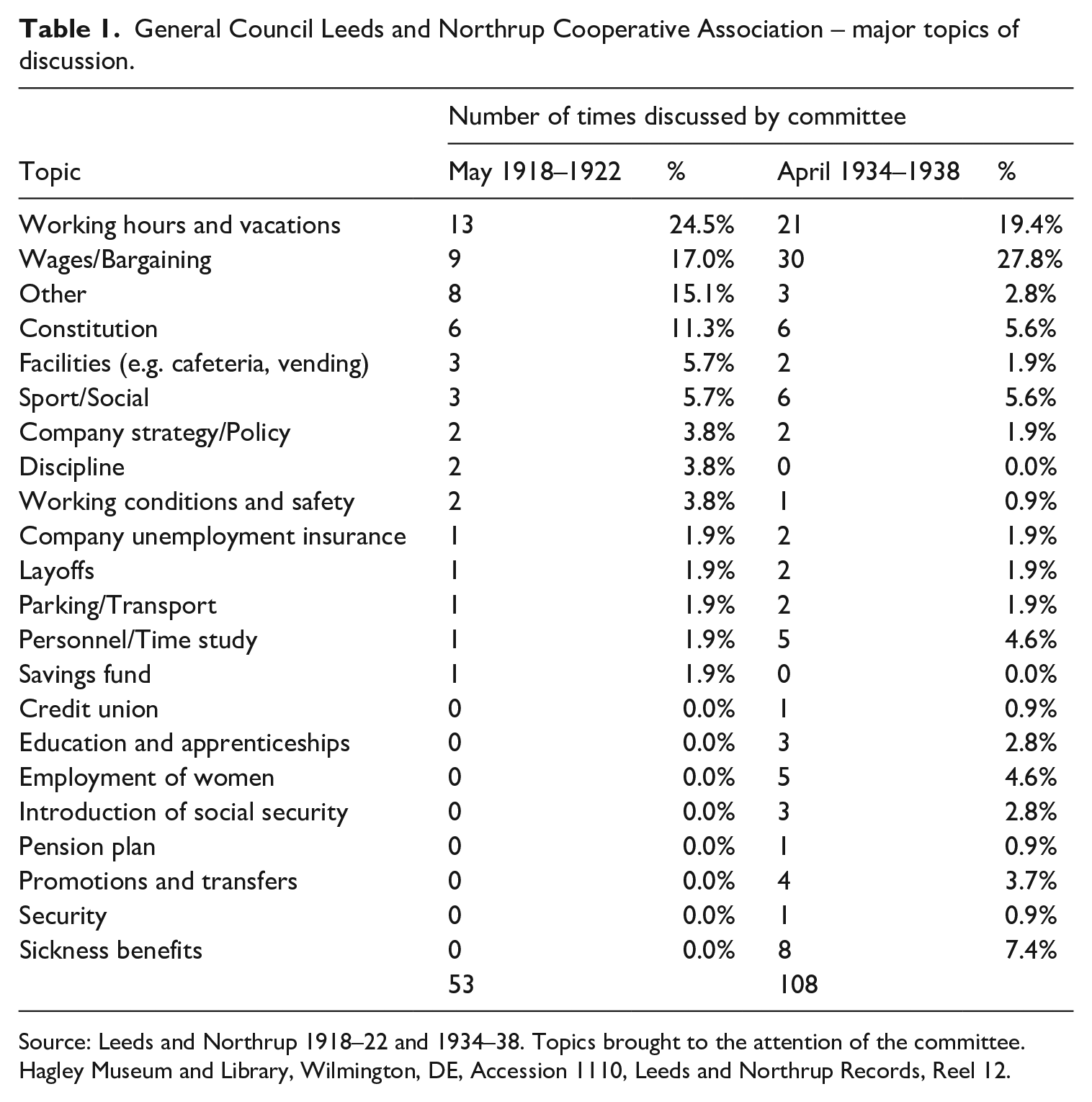
Source: Leeds and Northrup 1918–22 and 1934–38. Topics brought to the attention of the committee. Hagley Museum and Library, Wilmington, DE, Accession 1110, Leeds and Northrup Records, Reel 12.
Sub-committees of the General Council did important work. The Safety Committee was formed ‘to carry on inspection and constant watch in all departments to locate and remedy dangerous conditions, practices, and hazards’ (Leeds and Northrup, 1929b), with a representative in each shop and department with a specific brief to carry out a formal inspection of the department on the first Tuesday of each month. The Safety Committee put in place a ‘large number’ of safety measures around equipment (Leeds and Northrup, 1937c). The General Improvement Committees voiced concerns about physical conditions in the factory around lighting, temperature and air quality. In 1937, discussions of the high temperatures and lack of ventilation in the parts shop resulted in the installation of air conditioning (Leeds and Northrup, 1937d).
The Cooperative Association engaged in collective bargaining in what appears to have been a largely harmonious fashion. During the depths of the Great Depression, which reached its nadir in 1933, the managers of L&N convinced the workers’ representatives of the need for a temporary reduction in wages as an alternative to layoffs. The workers appear to have accepted the managers’ explanation that falling orders required a reduction. In 1935, the Cooperative Association and the managers reached an agreement whereby there would be a ‘5% restoration’ of incomes for both hourly waged and salaried workers once the firm’s monthly orders reached the threshold of $210,000 (Leeds and Northrup, 1935).
Gender politics were also discussed. The General Council was overwhelmingly male as just two of its 24 members in 1938 were female (described as ‘girls’) (Leeds and Northrup, 1938b). Historians have shown that many of the interventionist economic policies introduced during President Roosevelt’s New Deal were designed to favour white males at the expense of other groups in the population, typically by limiting the ability of women (Mettler, 1998; Novkov, 2001) and non-whites to compete in ways that undercut the earning power of white males (Katznelson, 2005). In a manner consistent with this national pattern, the L&N General Council sought to exclude married female workers during periods of economic distress. We know from the firm’s unemployment insurance fund data that of the 782 individuals employed by L&N in 1929, 42 were female (Leeds and Northrup, 1929a). Male workers came to resent the firm’s long-standing practice of employing married women during the Great Depression, with many regarding this practice as depriving male breadwinners of income. In 1934, when married women constituted just 5.6% of employees (Leeds and Northrup, 1934b), an employee petition calling for a marriage bar was circulated (Leeds and Northrup, 1934a). The firm’s managers simply ignored the petition. In 1937, the General Council discussed a proposal for the creation of a special female seat on it. The overwhelmingly male Council rejected this proposal, with one member deeming the proposal superfluous: ‘if the members of a division wish a girl to represent them on Council, they would elect one’ (Leeds and Northrup, 1937b).
From May 1937 to June 1938, the US economy was mired in a recession (Hausman, 2016). The intensifying threat of unemployment appears to have made many male workers at L&N even more resentful of perceived job theft by women. The workforce’s duly elected representation on the General Council responded to the demands that jobs be reserved for male breadwinners by creating a ‘Special Committee on Married Women’ to investigate. In April 1938, the General Council recommended that henceforth the firm no longer hire any married woman whose husband could support her except as ‘temporary employees’ during periods of peak demand. The resolution also declared that whenever layoffs became inevitable, the company would dismiss married women first, except in such cases that the application of this principle would undermine the ‘efficiency’ of the firm. Morris Leeds agreed to abide by these resolutions (Leeds and Northrup, 1938a).
In our view, by siding with male workers concerned about employment competition from women, the ERP of Leeds and Northrup contributed to maintaining the legitimacy of this individual firm and of business as a whole, in its existing socio-cultural context. If either big business as a set of institutions or this firm had come to be perceived as incompatible with the existing gender norms of American society, its legitimacy as perceived by its core stakeholders would have been reduced. The action of the General Council against women workers suggests that a key function of ERPs was to maintain the legitimacy of individual firms, and of big business, in the eyes of those stakeholders who really mattered. In this case, the stakeholders whose views were most important to the firm were males with traditional views on gender roles.
Discussion
ERPs were popular with American managers because of their perceived potential to legitimate big business in the US. As noted above, many contemporaries believed that big business was antithetical to republican institutions and to such principles as equality and decentralization. Large firms were accused of un-American monopolistic practices and the men who led them were denounced as analogous to the feudal lords of medieval Europe (Solganick, 1965). The legitimacy of big business was under threat. American managers created ERPs to reframe the public’s understanding of big business by showing that American managers were not tyrannical lords of the workplace.
To what extent was the employee representation movement effective at bolstering the legitimacy of the big business? During his 1936 re-election campaign President Roosevelt denounced the businessmen who opposed his policies as ‘economic royalists’ similar in spirit to the monarchists who had opposed the American Revolution of 1776. The association between big business and the un-American institution of monarchy was precisely the type of thinking the ERP was designed to dispel. Roosevelt praised small business, announcing that he had no quarrel with the ‘thousands of small-businessmen and merchants who sought to make a worthy use of the American system of initiative and profit’ but instead his conflict was with the economic royalists who had ‘carved new dynasties’ out of the United States (Roosevelt, 1936). The fact Roosevelt won re-election suggests that the ERP was of limited success in convincing the median voter that big business was legitimate.
Managers whose firms had been among the many that had previously created ERPs, such as Standard Oil, were among the targets of Roosevelt’s hostile rhetoric. L&N came into conflict with local New Dealers in Pennsylvania, with Morris Leeds being particularly unpopular with the local union activists. All these pieces of evidence would suggest that ERPs were an expensive failure that did little to legitimate big business in the view of policymakers. However, we cannot know what level of legitimacy big business would have enjoyed in the eyes of stakeholders in a counterfactual scenario in which the employee representation movement had never existed. Perhaps hostility to big business would have been even more intense during the crisis of the early 1930s had managers not previously invested in the creation of the elaborate ERPs. Judging the relative effectiveness of the movement compared to other legitimation tactics used in this era (corporate philanthropy and spending money on public relations or efforts to curtail the arbitrary authority of foremen) is also extremely difficult. We can, however, say that the employee representation movement was one of several collective tools that American managers used to try to legitimate big business. In subsequent historical periods, American managers would develop other mechanisms to legitimate both big business as a whole and specific novel institutional arrangements, such as the funding of think-tanks the produced pro-business writings (Burgin, 2012).
Theoretical implications of our findings
We now shift from discussing the specifics of our case study to outlining a theoretical contribution of generalizable applicability. In our study of the employee representation movement, the legitimacy work of managers included the creation of ERPs that were explicitly modelled on the national constitution. The US Constitution was admired by almost all Americans in this epoch. In seeking to legitimate the then novel set of institutions known to contemporaries as big business, American managers were attempting to borrow some legitimacy from a set of venerable political institutions. This pattern suggests to us that managers in other countries and historical periods will seek to legitimate novel institutional arrangements by trying to associate them with whichever institutions are widely respected by their stakeholders. As we observed above, the United States in the 1920s was probably the world leader in the introduction of ERPs into workplaces, notwithstanding their presence in some British, German and Australian workplaces at this time. We argue that the popularity of ERPs with managers as a tool of legitimation in the American cultural context is due to the centrality of democracy in the American national identity in this period. American managers knew they had to do something to increase the legitimacy of big business and they also knew that they were operating in a country whose national identity was intertwined with the principle of democracy. They created ERPs in which workers elected representatives to make their firms seem more democratic.
As we observed earlier, the existing theory on how managers try to legitimate novel organizational forms is silent on the issue of how national identities impact legitimacy work. We argue that managers who are attempting to legitimate a new form of organization will invest in efforts to make the form appear compatible with the core values of the imagined community in which they work, whatever those values may be. We therefore call for additional case study research of managerial attempts to legitimate new forms of organization by associating those forms with the values that are connected, in the popular imagination, to the imagined community of the nation. The theory we have developed here predicts that in trying to legitimate such organizational forms in different countries, managers will try to associate this form of organization with the values that are embedded in the local national identity.
We now turn to the issue of boundary conditions that may limit the applicability of our core finding to all contexts and places. The core generalizable claim we make based on our case study is that managers who are attempting to legitimate a new organizational form will associate that form with the values that are connected, in the popular imagination, to the imagined community of the nation. This pattern would likely apply in most countries and sectoral contexts, because in most countries most people identify with their nation and the values associated with the local national identity. However, there may be contexts in which the population, or at least a portion of it, have rejected their national identity and the values associated with it. These stakeholders may then develop a xenophilic tendency to denigrate anything associated with their country and to venerate those associated with a foreign country they regard as superior. Managers who are attempting to legitimate a novel organizational form in the eyes of those stakeholders would, in that case, strive to show that the form is incompatible with the values that are associated with the national identity.
Footnotes
Declaration of conflicting interests
The authors declared no potential conflicts of interest with respect to the research, authorship, and/or publication of this article.
Funding
The authors disclosed receipt of the following financial support for the research, authorship, and/or publication of this article: The corresponding author received an Exploratory Research Grant from the Hagley Center, Wilmington, DE in support of the research for this article.
