



Abstract
Working life relations are in a continuous state of change. So are the institutions of working life democracy. In Norway, three well-established components of working life democracy have been in place since the 1960s and 1970s, developing along different institutional tracks: collective bargaining at the national level, employee representation on the boards, and employee participation in protection of health and safety in the work environment. From 2007, legal protection of whistleblowing was included in the Working Environment Act (WEA), anchored in specific institutional arrangements. Before the turn of the century, a common assumption was that whistleblowing mainly targets irregular, even criminal, dispositions of the enterprise. After the inclusion in the WEA, data from Norway from the years 2016 to 2022 demonstrate that to a large extent, psycho-social problems have become the object of whistleblowing. However, institutional specificities limit the handling of social interaction problems by the traditional work environment arrangements. Against the background of its separate institutions for the handling of grievances, it is argued that whistleblowing, along with freedom of expression, are parts of a fourth track of democratization. Even though the institutional setup of whistleblowing has been revised twice since 2007, the findings indicate that additional revisions are still desirable.
Working life relations are continuously in change. So are the institutions of working life democracy. In Norway, well-established elements of working life democracy have been in place for decades. After the first Basic Agreement was adopted in 1935, the formal channels for voice, influence, and participation were further developed up to the 1970s. These institutions developed at a different pace along three complementary tracks of relevance to democracy in working life: (1) collective bargaining at the national and sector levels on wages and work conditions; (2) employee representation on the boards of joint-stock companies above a certain size, later also in public enterprises; gender quotas to the boards in listed firms and in relevant public enterprises were incorporated into the Limited Liabilities Company Act in 2003 (Teigen, 2021); and (3) employee participation in the active protection of health and safety in the work environment (Dølvik et al., 2015; Engelstad, 2015; NOU 2010:1). Common to these three tracks is that they are formalized institutions based on relationships between employers and employees as groups. A different, less formalized, track of democratization (4) refers to employees as individuals in two related respects, with different legal bases. Freedom of speech has always been a part of the Norwegian Constitution (§100), but the 2000s brought increased attention to freedom of expression as an essential part of working life (NOU 1999:27; NOU 2022:9; Trygstad and Ødegård, 2022; Wessel-Aas et al., 2021). This also serves as the basis for whistleblowing, included as part of the Working Environment Act (WEA) from 2007, as the second element in a fourth track.
Democratic reforms in working life are usually the objects of heated debate already before their introduction (Bergh, 1983). But they are far from perfect, concerning both their form and practical application (Alsos and Trygstad, 2018). This was indeed the case for the protection of whistleblowers (Skivenes and Trygstad, 2017; Trygstad, 2017). In this article, potential democratic aspects of whistleblowing in working life will be the focus. From the legislator’s perspective, whistleblower provisions were intended as a clarification of the relationship between the duty of loyalty and freedom of speech. The question, then, is how these provisions can be understood and positioned in relation to the traditional democratic institutions in Norwegian working life. This may appear a purely academic question. But it is not, because interpretations of the framework surrounding whistleblowing – whether the institutional aspects primarily reflect the democratic rights of employees, or management’s right to formalize and run the work organization – are essential for the handling of conflict as well as for future revisions. Thus, the overarching topic discussed in the following is whether and how whistleblowing expands the scope of workplace democracy. This is addressed by two specific questions: How does whistleblowing affect the position and power of employees? Does it challenge employer prerogatives; if so, to what extent?
Aspects of whistleblowing
In the social sciences, the topic of whistleblowing in working life is relatively new. Not so in the cultural sphere. In Scandinavian literature, the topic can be traced back to Henrik Ibsen’s play An Enemy of the People (1881). There are striking similarities between modern whistleblowers and the fate of Ibsen’s protagonist, ostracized for speaking truth to power (Garaventa, 1994; Hagelunds, 2009). In the last decades, the theme of whistleblowing has been picked up by the movie industry. An early example was Steven Spielberg’s hugely successful Jaws (1975), partly along the same lines as Ibsen’s play. And there is more; on their home page, Transparency International (2020) mentions ‘11 movies about whistleblowers that you cannot miss’.
These stories portray employees acting mostly alone in revealing criminal action at a high organizational level – be it corruption or illegal handling of waste from production processes. In real life, the picture is just as grim. The Enron case became world famous (e.g. Deakin and Konzelmann, 2004). In Scandinavia, prominent examples were the Bofors case in Sweden (Hagelunds, 2009), and the Siemens case in Norway (Monsen, 2010); both attracted wide public attention.
After the turn of the millennium, the scope of whistleblowing changed to broader political concerns. Several European countries adopted laws covering whistleblowing. Among them UK made an early start already in 1998; Norway was the first country in the Nordic region to give whistleblowers legal protection in 2007. Ireland, the Netherlands, Sweden, and Italy among others, followed during the 2010s. By the end of 2021, the EU Directive (2019/1937) on whistleblowing was to be transposed into national law. Still, the need for legal amendments in the member states depends on existing national provisions.
In the literature, different concepts are used to identify the matters to which ‘whistleblowing’ applies, including malpractice, illegal behavior, illegitimate practices, and unethical activities. For the purposes of whistleblowing research, the term wrongdoing is most generally invoked. However, what constitutes wrongdoing may vary according to structural features like country context, labor market models, legislation, local and global cultures/norms, codes of conduct, and organizational procedures (Skivenes and Trygstad, 2014). Indeed, the perception of wrongdoing can be highly subjective, and this is compounded when in some jurisdictions protection is only afforded to those who report ‘serious’ acts or failures.
In the UK, the organization Public Concern at Work (now ‘Protect’) has systematized all decisions in whistleblower cases that were processed by employment tribunals from 2009 to 2013. In terms of misconduct, the figures show that throughout the entire period, discrimination and harassment topped the list (Public Concern at Work, 2016: 29). In Norway, a series of systematic surveys from 2010 have demonstrated that whistleblowing in practice covers a wide range of misconduct and as in the UK, psycho-social types of wrongdoings are over-represented (Trygstad and Ødegård, 2022). A robust finding from these studies is that one out of eight employees reported observing harassment and destructive behavior from managers and colleagues during the last 12 months.
The point of departure of the following text is a brief discussion of how working life democracy is positioned within the framework of political democracy. It is followed by a more detailed description of processes and institutions of whistleblowing. Their effects are then specified in data analyses covering the years 2016–2022. Finally, similarities and differences between the established forms of working life democracy are discussed, centering on the institutional aspects of work environment protection.
Procedural and normative aspects of democracy
How does it make sense to talk about democracy at the workplace? Mainstream conceptions of democracy are focused on the political sphere of society, the state and political processes and their relationship to the population. Free and fair elections are combined with citizens’ voice between elections – via direct encounters with politicians as well as indirect contact via media, civil society organizations, social movements, ad hoc demonstrations, and petitions (Diamond, 2016).
These features concern procedural aspects of democracy. An extended approach includes individual autonomy as a precondition for democratic governance. The rights of voters to participate in elections are anchored in citizens’ freedom and liberty. Individual autonomy and political equality are specified as equal abilities and equal opportunities to take part in political processes. In combination with the procedural aspects, these normative features constitute what John Rawls characterized as constitutional democracy (1993: 11; 2001: §44), enabling citizens to be ‘be full participants in a fair system of social cooperation’ (Rawls, 1993: 19).
This conception of a democratic society rests on a basic structure of political, economic, and social institutions outside politics, such as civil society, education, working life, or health care. Each institution has its specific mode of functioning, which shapes their form of organization, with professional and occupational requirements, types of funding, and a series of formal and informal norms (Luhmann, 2013; Roth and Schütz, 2015). Hence, they cannot be a blueprint of political democracy. At the same time, the norms underlying constitutional democracy must be valid also for the parts of society outside political institutions. They are adopted, shaped, and legitimized by politics, and are affected by the individual political rights of their incumbents and stakeholders. The way these institutions reflect basic democratic norms is a measure of the quality of democracy (Engelstad, 2018; Rawls, 1993; Shapiro, 1999).
Working life and democratic class struggle
Conceptions of working life democracy come in many versions. One dominant idea in the labor movement has been that of class struggle with the aim of overthrowing capitalist property rights and establishing workers as owners, if not abolishing property rights altogether. A series of alternatives have been suggested and partly tried out: state ownership to companies, worker ownership, workers’ control, election of management by workers, or political nomination to enterprise boards. At best, they have had a moderate success, often at the cost of economic efficiency, or individual rights, or both. Forceful suggestions for working life democracy (e.g., Honneth, 2023; Pateman, 1970) tend to overlook crucial normative restrictions in democratic societies. Property rights and freedom of contract, the former based in the Constitution, the latter enjoying status as a deep principle, are both closely connected to individual liberty, while at the same time they are constitutive parts of working life. Hence, conceptions of working life democracy must delve into the details of institutional preconditions set by the overarching national democracy.
In Scandinavia, the origin of working life democracy lies in the Basic Agreements between employer organizations and trade unions, adopted in Denmark already in 1899, and in Norway and Sweden in the 1930s (Bergh, 2010). These agreements rest on the reciprocal acceptance of management prerogatives, on the one hand, and the recognition of trade unions as regular bargaining parties, on the other. As with all kinds of rights, their practical realization is necessarily the object of interpretation. Thus, working life democracy is shaped by continuous conflicts between employees and employers, which make up a democratic form of class struggle.
A concept of democratic class struggle implies continuous processes of negotiation, rather than the idea that one of the parties may win a permanent victory. The dynamism of this class struggle takes the form of slow but long-term changes. In addition to practical decisions on production processes and worker remuneration, bargaining also takes place at a deeper level, over rights and the roles of employers and employees; in other words, how the space of action of the parties is defined and delimited. As formulated by Ian Shapiro (1999), democracy at the workplace means that necessary power differences are diminished as much as possible, concerning institutional features as well as interaction processes at the workplace.
Democratizing processes can get started if employees see the possibility to challenge the space of action of employers, while simultaneously increasing their own, without serious losses in productivity. Employers, in contrast, mostly desire to preserve or increase their own space of action, intuitively resisting political regulations and interventions. Between these two positions, important grey zones exist, with considerable ambiguity and uncertainty. How flexible are property rights and employer prerogatives? And to what extent are employees willing to share the risks associated with management decisions? These grey zones are to a large extent unexplored terrain for both parties. Thus, a decisive aspect of the democratic class struggle concerns what kind of compromises are conceivable and sustainable. Under what circumstances may limitations in employer rights be beneficial for enterprises, for business life, and for society? Continuous institutional change, partly in the form of trial and error, is one reason why democratizing reforms have their ups and downs. Some are sustained, others turn out to be unsuccessful; some suggestions are rejected, whereas still others unexpectedly pave the way for new compromises (Engelstad, 2015; Hagen, 2015).
Four tracks of working life democratization
The four tracks of democratizing reforms in Norwegian working life – negotiations, company governance, work environment, and freedom of speech – differ in modes of problem solving, involvement of employees, power resources, and thereby in their effects on employer sovereignty and strategies. Simultaneously, they have in common a significant interplay of the labor market parties with the state. Intervention by the state takes place by legislation, by institutional regulation, and by formal and informal contacts.
The negotiation track
Originally a framework for bargaining at the enterprise level between the social partners, the Basic Agreement laid the ground for institutionalization of the national frontline model from 1967, combined with state participation in tripartite wage negotiations (Dølvik and Marginson, 2018). A consequence of their cooperation is that the labor market parties significantly influence national policy fields such as education policy and the shape of the welfare state, to name a few.
Changes in the negotiation track are foremost a history of expansion but also display examples of decline. Critical issues are visible, which lead to revisions and changes in the future (Dølvik and Marginson, 2018). The rate of unionization and coverage of collective agreements has declined in Norway as well as in Europe over the last decades (Nergaard, 2022). While the downturn has been less severe in Norway compared to other European countries, a continued reduction could still impact the bargaining power of employees and alter the balance between labor and capital.
The governance track
Employee participation in decision-making was established in the private sector with the revision of the Companies Act in 1972 (Bergh, 1983). The innovation consisted of two components. The first was representation of employees on one-third of the positions of the company boards in joint-stock companies over a certain size. Subsequently, similar arrangements were introduced in the public sector. Employee representation on the boards is not legally enforced, only established as an option. To be introduced in a company, a majority of employees must support a written petition to the board for representation (Companies Act AL §6-4; AAL §6-4). The second component was the introduction of a new body, the Company Assembly. It was conceived as an arena for long-term discussion between representatives of workers and management and was made obligatory in enterprises with more than 200 employees.
These arrangements have changed considerably since 1972. The Company Assembly, which was conceived by employers as an unnecessary link between management and the board (Bergh, 1983), is now optional, and of little significance (Hagen, 2014). In contrast, a suggestion from the Norwegian Confederation of Trade Unions (LO) and the Labor Party to broaden employee representation was effectively stopped by employers, and confirmed by a White Paper in 1985 (Hagen, 2015; NOU 1985:1). A study of private companies with trade unions present indicated that only some 53% of the companies sufficiently large for employees to demand representation, actually have it (Hagen and Svarstad, 2021: 18).
The working environment track
The WEA was adopted in 1977 as an extension of the previous Worker Protection Act. The purpose of the Act is to secure a healthy and meaningful work environment, and with a new amendment from 2020, to facilitate a satisfactory climate for expression in the enterprise. The WEA established two important arrangements for co-determination. From 2024, a Safety Representative elected by the employees is obligatory in all enterprises with five employees or more. The Safety Representative has the competence to halt the production process temporarily if life and health are considered in danger. Whereas the Work Environment Committee is required in all companies with 30 employees or more, and comprises 50/50 representation by employers and employees. All kinds of problems in the work environment are open to discussion.
In contrast to employee representation on the company boards, the Safety Representative and the Work Environment Committees are obligatory by law, without exception. Furthermore, these arrangements are directly related to the physical, psychological, and social welfare of employees, something that constitutes them as salient issues for workers, for trade unions, and for ‘in-house’ associations outside the trade union movement. Whistleblowing was incorporated in the WEA as a separate chapter from 2007. In its institutional setting, whistleblowing differs from other types of work environment conflict, concerning both employee rights and institutional handling. In these respects, it has more in common with freedom of expression, as discussed below.
During its more than 40 years of presence in Norwegian working life, the WEA has met broad acceptance. Safety Representatives are present in virtually all relevant companies. Work Environment Committees are slightly lagging behind; even so, they are present in three out of four enterprises with more than 50 employees (Trygstad et al., 2021: 42). 1 A main reason for the high prevalence of these work environment institutions is their immediate relevance to the welfare of the employees. A large, formalized apparatus of teaching and control is built up around them. This gives the system high stability, but also brings about considerable bureaucratization.
Freedom of speech track
Freedom of speech as a fourth track is more complex than the other three. It covers three different levels. (1) Nationally, the right is enshrined in the Constitution §100; among international legal sources, most central are the European Convention on Human Rights (ECHR) Article 10 and the United Nations International Covenant on Civil and Political Rights (ICCPR) Article 19. Formal limits to freedom of speech include legal confidentiality, protection of individual privacy, and restraint on hateful speech. (2) Given the employer’s right to govern and requirement of loyalty in the employment relationship, the position of the employee is under somewhat greater limitations than the general freedom of expression, whereas employers have an obligation to prevent mobbing, harassment, and racism. Even so, freedom of speech for employees is protected both through national and international legal sources, and the limits are still wide (Trygstad, 2015; Wessel-Aas et al., 2021). (3) Whistleblowing represents a sub-class of freedom of expression in working life. The provisions on whistleblowing included in the WEA play a significant role in highlighting and emphasizing the strengthened position of freedom of speech in Norway. The whistleblowing provisions justify not only positive articulation but protect expressions that may be perceived as offensive, disruptive, or insulting. The handling of whistleblowing is regulated by a special system of investigation of assumed wrongdoing, along with protection of the person blowing the whistle.
Different tracks – structural parallels
At a deep level, the four tracks have important features in common. Despite significant changes in the social environment, and revisions of their mode of operation, their institutional stability has not been seriously affected. The basic aspects of employer prerogatives remain untouched, even though the space of action of employees has been widened to a considerable degree (Engelstad, 2015). Simultaneously, they reflect different aspects of democracy. Bargaining relations imply reciprocal recognition of the parties, also when they have competing interests. On enterprise boards, employee representatives obtain important information and take part in crucial decisions on the running of the enterprise, even though they are in a minority position. In the field of work environment, the focus is primarily on health and safety problems; simultaneously this invites employees, who often have the best knowledge of where the shoe is pinching, to initiate improvements of the work processes (Kalleberg, 1983). Freedom of speech in the constitution legitimizes and strengthens the employee’s possibility to voice concern and take part in public debate.
The first three tracks rely on representation. In collective negotiations, individual preferences and emotions are toned down as parts of the game. Whereas freedom of speech and whistleblowing in many respects are of a different nature, directed to the individual worker. Activating the well-established distinction between management and leadership (Bennis, 1989; Zaleznik, 2004 [1977]), the traditional tracks of working life democracy have most in common with the management aspect, whereas whistleblowing has a closer, albeit ambiguous, connection to the quality of leadership.
Whistleblowing – actors and institutions
The institutionalization of whistleblowing represents a growing concern for the quality of working life. In 2017, a decade after it was included as a separate chapter in the WEA, the rules were revised and considerably extended. In parallel, a public committee was established, with a whistleblower, experts, and representatives from the press and from employer and employee organizations. The committee delivered a White Paper the following year suggesting further changes to the WEA (NOU 2018:6). From 2020 the Act was revised once more and expanded with new elements in the whistleblower provisions, under the general intention to facilitate a good climate for expression in the enterprise (§1-1c).
What qualifies a statement as whistleblowing? First, a negative delimitation: in the present version of the WEA, whistleblowing does not cover the work conditions of the employee her- or himself as long as more general aspects are not implied. Relevant general principles of whistleblowing comprise violation of legal rules, of written ethical guidelines, or of ethical norms enjoying broad acceptance in society (WEA §2A-1(2)). These generic formulations are further specified according to the assumedly most important violations:
Risks to life and health
Risks to climate and environment
Corruption and other form of economic criminality
Abuse of managerial power
Unacceptable psycho-social work environment
Insufficient safekeeping of personal information
The issues in this heterogeneous list require clearly different modes of handling. Risks to life and health are normally handled by the Work Environment Committee in the enterprise. Climate risks and corruption are primarily subject to criminal prosecution. In contrast, most examples of psycho-social conflict and abuse of power concern social relations at the workplace. The examples formulated in the WEA, however, are still in need of interpretation. By implication, their application depends on employer discretion.
Employers and employees – rights and obligations
The WEA ascribes a set of rights to whistleblowers. Several channels are available if an employee finds it necessary to blow the whistle. Primarily, the employee has the right to address management or other relevant groups at the workplace, such as trade unions or safety representatives. These are often the preferred options. Moreover, she or he has a legal right to inform relevant public authorities, not least the Labor Inspection Authority. Finally, if the employee finds it necessary, she or he may address the public via formal news channels or social media. In the latter case, the information is presumed to be justified and given in ‘good faith’ (WEA §2A-2(3)a).
If reporting to public authorities, the whistleblower has a legal claim to remain anonymous, as far as possible. Furthermore, retaliation from the employer against the whistleblower – in the form of harassment, threats, changes of work tasks, suspension, or layoff – is forbidden. These rules are meant to confer power to employees when it comes to grievances about managers’ behavior.
On the part of the employer, the Act does not specify rights, only obligations. Written routines for the handling of whistleblowing are obligatory in all enterprises with five or more employees (WEA §2A-6(1)). Trade union representatives or other relevant groups are to participate in the establishment of the written routines. Nevertheless, the employer bears the main responsibility for the subsequent handling of the case.
Upon the reception of a whistleblowing grievance, the employer is obliged to make interrogations into the issue within reasonable time (WEA §2A-3(1)). This implies starting a process of deliberation where the relevant parties are heard. In this process, impartiality on the part of the employer is required, and they are obliged to secure a safe work environment for the whistleblower. Finally, it rests on the employer to elaborate a solution to the problem. Thus, despite absence of special rights, the requirement on the employer to handle whistleblowing implies considerable power.
Even though the obligations of the employer are clearly stated in the WEA, the handling of complaints involves considerable use of discretion. It is up to the employer to decide whether an utterance qualifies as whistleblowing or just as a statement that does not qualify for the application of formal procedures. This has two potential implications. One is that the employer may discard a serious statement as a point of view that does not deserve further investigation. If so, the protection against retaliation loses its force. Alternatively, a relatively spontaneous utterance may be defined as a case of whistleblowing, something that unleashes the important process of investigation and deliberation. Even if these alternatives may be uncommon in practice, they will easily affect the perception of whether a problem is worth reporting.
In most cases, both employees and employers have an interest in solving the problem at the lowest level possible. It is well documented in research that this makes the whistleblowing process gentler, both for the whistleblower and the subject of the report (Brown et al., 2014). However, this may be hindered by legal formalities and written routines in the enterprise. Given that a problem reported is defined as sufficiently serious to initiate the relevant procedures in the enterprise, the employer takes over the subsequent process. In the employee–employer relationship there are two different sources of power. On the employer side, the handling of the process yields a potential for defining and redefining the issue, which by implication opens the situation up for counter-moves. On the employee side, the right to report concern is strengthened, and thereby the space of action is broadened.
Data on whistleblowing
Legal rules must of course pre-empt a variety of problems. Some are of great importance, even though they are quite uncommon. Other issues may be of less importance from a substantive viewpoint but gain importance because of their high prevalence. During the last decade, several studies have mapped the prevalence of whistleblowing and the variety of grievances (Bjørkelo et al., 2011; Skivenes and Trygstad, 2010, 2017; Trygstad and Ødegård, 2016, 2019, 2022).
Since 2016, datasets on specific instances of whistleblowing have been produced in Norway. They are the basis for the most recent of the studies mentioned above. The data were collected by TNS Gallup/Kantar in 2016 (N=2901), 2018/19 (N=3868), and 2022 (N=3120). Here, they are collated into a time series spanning seven years, from 2016 to 2022. Further details are given in Trygstad and Ødegård (2019).
The sample consists of individuals aged 18–65, who are employed, either as permanent employees or as temporary workers, and recruited from Kantar’s web-panel of 45,000 persons. The respondents were asked:
Over the last 12 months, have you witnessed, uncovered, or experienced wrongdoing in your workplace that should have been stopped? By ‘wrongdoing’ we mean unethical and/or illegal incidents, episodes, or practices.
The answers to this question were classified under 19 different types of wrongdoing, subsequently grouped into four categories: ‘Psychosocial issues’ consisting of destructive management practices that have a negative effect on the working environment, harassment because of ethnicity, life stance, gender or sexual orientation, sexual harassment and other forms of bullying/harassment. ‘System failure issues’ include conditions that may cause danger to life or health, violation of health, environment and safety regulations, breach of ethical guidelines, use of illegal chemicals, discharge of environmental toxins, use of drugs at work. ‘User/customer issues’ comprise unwillingness to correct serious errors in the service or product affecting the user/customer, treatment of the user in violation of applicable legislation, violence against the user, breach of statutory confidentiality. The last category, ‘Financial issues’, covers illegal or unethical use of public funds, embezzlement, bribes/corruption and undeclared work/tax evasion, social dumping, theft of the company’s resources/assets. An additional category of ‘other issues’ is not included in the present analysis.
Those who had observed wrongdoings were subsequently asked:
Did you report these conditions to anyone with authority to take action?
Respondents who had reported wrongdoings, between 5 and 10% of the total sample, were then asked about the effectiveness of the whistleblowing,
. . . if the situation was improved or rectified, if nothing happened, or the result meant a deterioration.
Moreover, they were asked what kind of reactions they received,
. . . positive, mixed, negative, or no reactions.
Among the respondents was also a group of the recipients of whistleblowing. It comprises top managers, HR personnel, trade union officers, and safety representatives (for 2022, N=747). They were asked about their views on the possible effects of whistleblowing, with the following specifications:
(i) Creating problems of balancing rights of whistleblowers and the alleged wrongdoer. (ii) Creating conflict in the working community. (iii) Creating challenges to management’s right to manage. (iv) Making it possible to develop better services/become more efficient.
Main findings – employees
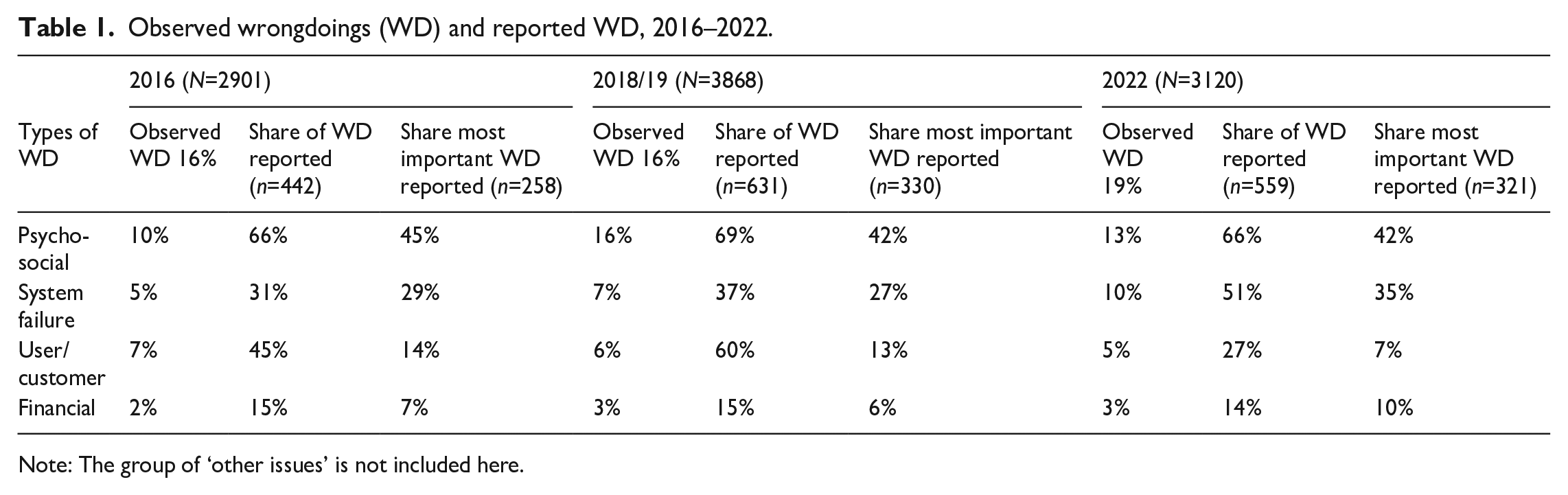
In 2022, 19% of the employees interviewed had observed wrongdoings sufficiently serious to be the object of whistleblowing, as shown in Table 1. About half of these cases were reported as grievances. The most important reason given for abstention was that personal consequences would be too great. Even so, some 8–9% of the workforce actually blowing the whistle is an impressive amount.
Observed wrongdoings (WD) and reported WD, 2016–2022.
Note: The group of ‘other issues’ is not included here.
Table 1 shows the most common types of wrongdoings observed between 2016 and 2022, divided into the four categories described above. The numbers in the first column for each year refer to the rates of critical cases observed by all respondents in the survey. The second column in each year shows the distribution of the total amount of wrongdoings reported by the group that did blow the whistle. As respondents might have reported more than one issue, the sum adds up to more than 100%. In the third column, only the one most important type of transgression per reported wrongdoing is cited. The sum would be 100% if ‘other sources’ were included.
The composition of the four types of wrongdoing shows a clear pattern. The columns covering ‘Observed WD’ indicate that the most important issues as perceived by the employees as a whole are of a psycho-social character, concerning either harassment or destructive behavior, as part of working life. At the other end, the ‘Financial’ type of issues, connected to corruption and criminality, albeit of great social significance, is quite small. The types of ‘System failure’ and ‘User/customer’ issues fall in a middle position. Similar patterns are found in the two columns covering cases observed (‘Share of WD reported’) and reported by whistleblowers (‘Share most important WD reported’). The only exception is that issues concerning users and customers show a significantly lower rate of reporting.
The tendency for all four types is that of modest changes over time. For amounts of wrongdoings actually reported, the stability is slightly weaker, as shown in the columns ‘Share of WD reported’, but here too there is no clear trend. The columns of ‘Share most important WD reported’, covering the most important grievances, have a similar pattern. Computing averages over the years shows that psycho-social issues are by far perceived as the most important types of reports. The fact that these patterns are repeated in three consecutive surveys gives the results high credibility.
In Table 2 the index of psycho-social conflicts is broken down to distinguish between wrongdoing attributed to managers and to colleagues. Two tendencies can be read from the table. Firstly, with one exception, the prevalence of destructive behavior is reported to be higher among managers than among colleagues. Secondly, here too stability is striking. The numbers demonstrate a critical attitude to unacceptable behavior among management and indicate that questions of personal recognition and individual integrity of employees are important challenges in working life.
Most important psycho-social violence of rules reported, 2016–2022.
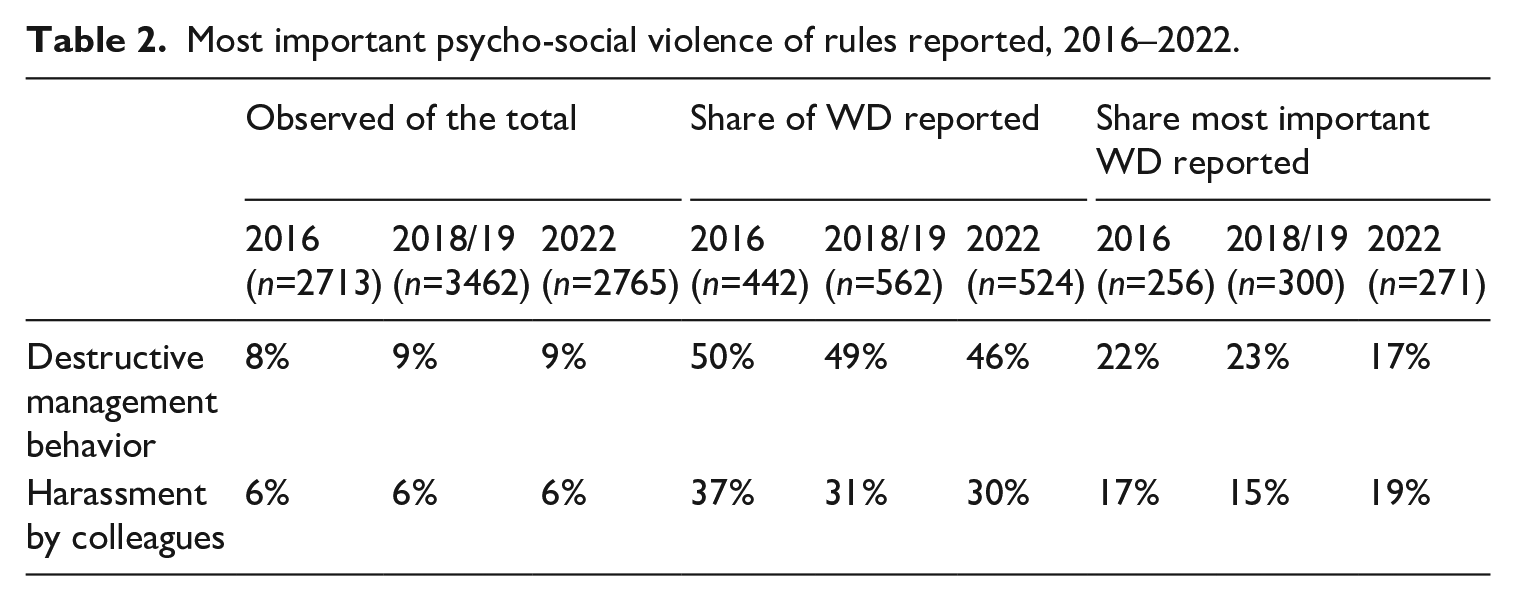
The observations in Table 2 are supported by a related question focusing on organizational responsibility for critical events. In the 2018/19 study, 68% among respondents who reported critical events pointed to middle or high-level managers or members of the company board as bearing responsibility for such events (Trygstad and Ødegård, 2019: 32). Obviously, some of these cases may be based on misunderstandings or idiosyncrasy; others may cover unreasonable complaints among employees. Even so, the extent of observations reported remains important.
Receiving complaints and handling of cases
Several channels are open to whistleblowers, inside as well as outside the enterprise. In the majority of cases, the primary recipients of the whistleblowing communication are directly related to the enterprise. Together they constitute a broad group of line managers, HR managers, trade union officers, and safety representatives. The roles of these subgroups vary with respect to the process triggered by whistleblowing.
The WEA prescribes that trade union officers and safety representatives are consulted when internal rules for handling of whistleblowing are established. This changes when someone actually blows the whistle. At this stage, most recipients are part of management, mostly HR managers. The role as primary recipients is more modest for employee representatives, be they trade union officers or safety officers. In 2018 they were involved in about 15% of the whistleblowing cases (Trygstad and Ødegård, 2019: 30, 40). This means that their most important role is connected to arrangements in place in the enterprise before whistleblowing occurs. Even if trade union officers may be consulted subsequently, at that phase of the process responsibility lies with management. As a result, safety officers to some extent, and trade union officers in particular, end up in an ambiguous position with little influence on the handling of the case.
Table 3 sketches the possible costs and gains from whistleblowing processes, as perceived by the recipients of said communications. The recipients have mixed experiences of whistleblowing. Most common are problems of finding a balance between the opposing sides in conflicts within the organization. Three out of four recipients point to this as a difficult issue. It is a cost to the organization of an indirect nature, mainly because it demands competence in conflict resolution from those who handle it. Other challenges concern the employees and the enterprise as a whole. Around one-half of the recipients experience the whistleblowing process as a burden to the organization, probably because it becomes a source of conflict at the workplace, or because it requires too much energy at the cost of regular tasks.
Based on your experience with whistleblowing cases, do you agree or disagree with the following statements? Recipients, 2022, N=747.
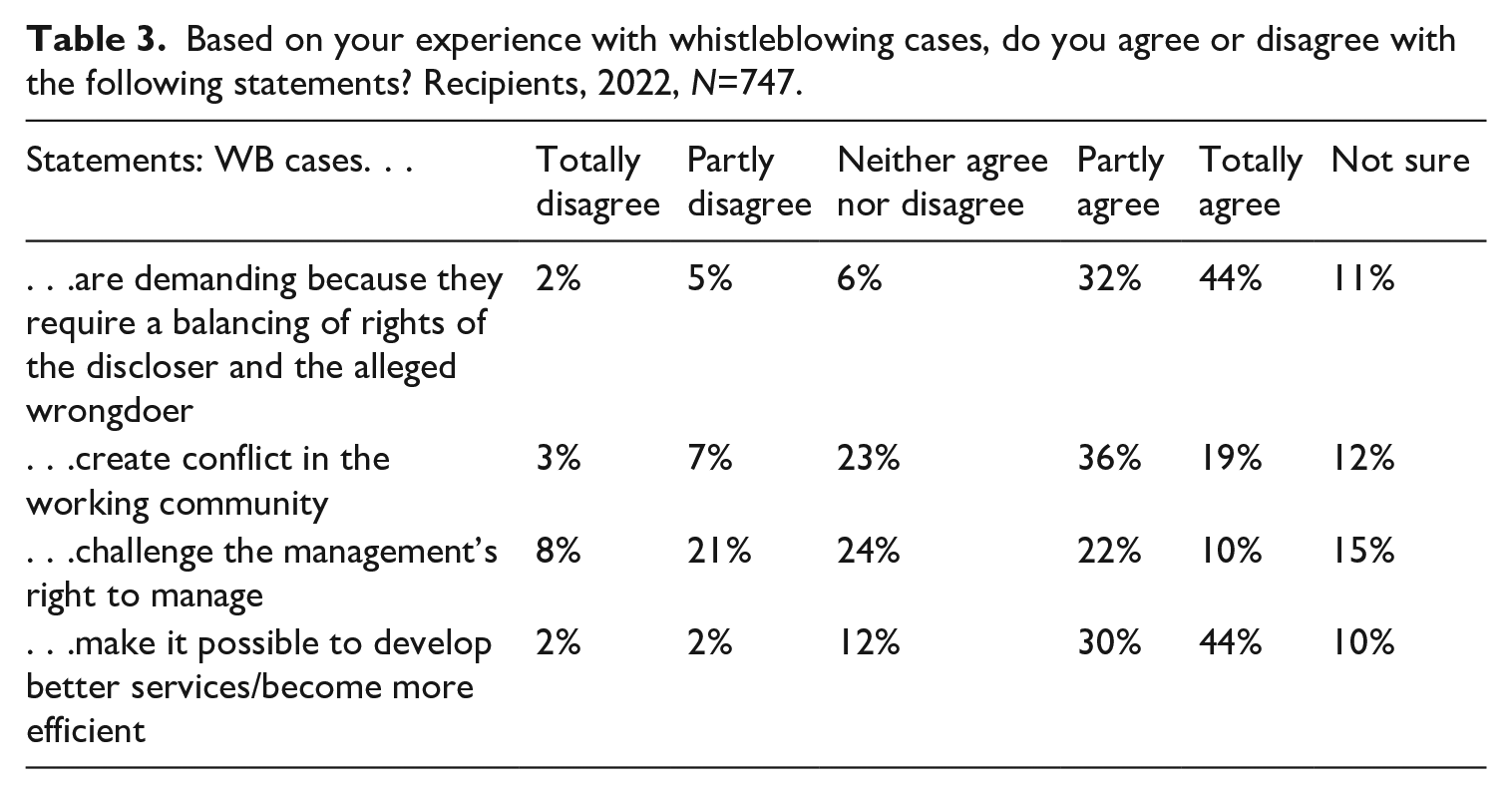
In contrast, the question of interference with employer prerogatives is the issue that recipients find least challenging. Given that much of whistleblowing activity targets management and employers, it could be expected that this was felt as particularly worrisome, but only one out of three recipients express that whistleblowing interferes with managers’ right to manage. Similar ambiguities are discernible in the ways wrongdoings are handled, as illustrated in the 2018/19 study. Two out of three find it problematic to get a clear picture of what the problem is, and that those who handle the case are too unexperienced to fulfill what is required for the issue to be dealt with efficiently (Trygstad and Ødegård, 2019: 41, 43).
The ambivalence is extended to their perceptions of the whistleblowers. In companies with procedures for whistleblowing in place, 67% of recipients found that whistleblowers reported in accordance with the procedures. In other words, where whistleblowing is part of set procedures, one out of three cases was regarded as incorrect; where procedures are absent the number is probably higher and ambivalence stronger. These findings are in line with international studies (Contu, 2014: 395).
Reactions and outcomes
Given the many ambiguities in the processes, a salient question is how those involved react to them. Figure 1 summarizes how whistleblowers view the reactions on their involvement in the organization. The pattern is very stable; between 2016 and 2022, hardly any change took place. One-third of whistleblowers felt that they were met with positive responses from colleagues or management, while one in five reported negative reactions in the organization. The largest group, however, around half of whistleblowers, perceived responses from colleagues as mainly ambiguous, with reactions either mixed or even absent. Hence, in sum, the experience of whistleblowers is positive, but only moderately so.
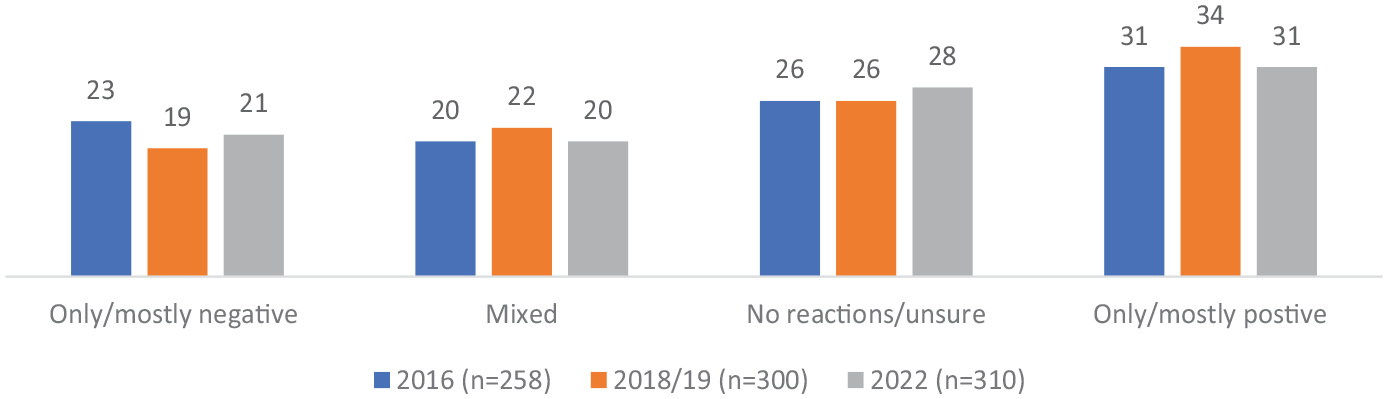
Whistleblowers’ experiences of reactions in the organization, 2016–2022 (in percentages).
Of equal importance is the question of whether the whistleblowing is felt to be effective. This is shown in Figure 2. The pattern of stability is almost the same, but here the differences between positive and negative results are more on the positive side. About one-third of the whistleblowers report that their intervention led to improvements, whereas 5–8% report negative results. By implication, here too ambiguity or absence of reactions form a large middle group of about 40%. It is worth mentioning that research generally demonstrates that the perception that no improvements will be made or that retaliation will occur are the two main reasons for not reporting wrongdoing (Lewis et al., 2014). This is in line with findings from Norway.
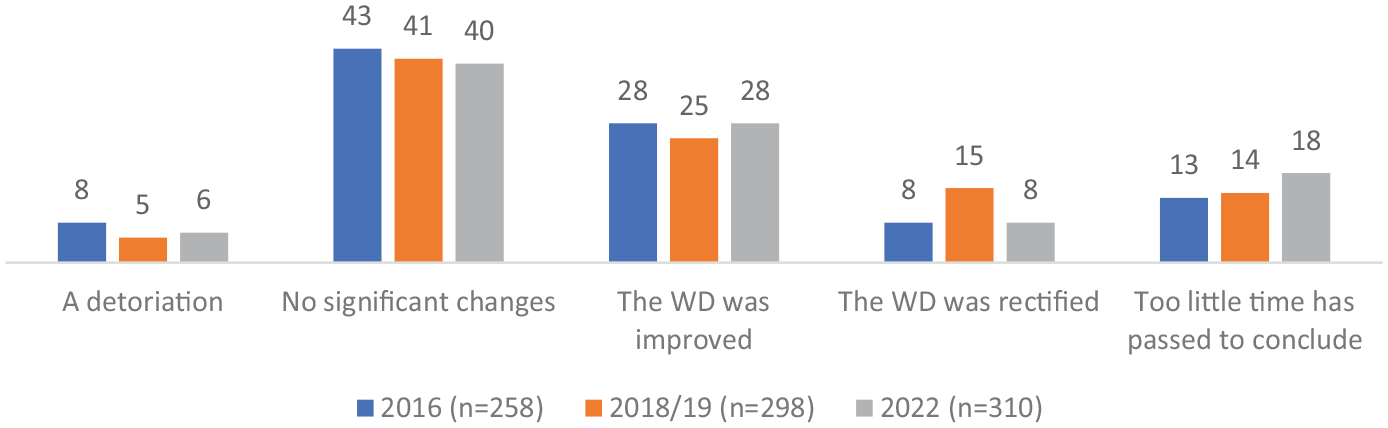
Whistleblowers’ perceptions of effects of whistleblowing, 2016–2022 (in percentages).
A matter of trust?
In organizations no system is perfect. To function according to intentions, a fair amount of support and trust is required. Given that whistleblowing is closely connected to organizational conflicts, controversies are virtually unavoidable, as testified in detailed descriptions of whistleblowing processes (e.g., Hagelunds, 2009; Monsen, 2010). The present analysis indicates that it became neither more efficient nor less risky to blow the whistle during the period 2016–2022. This raises the question as to whether the arrangement has found an optimal form. Together the observations reported above point to reasons for both trust and distrust in the present system of whistleblowing. The general pattern in the findings is moderate satisfaction. Reactions vary, however, between the groups with differing positions in the whistleblowing processes – employees, recipients, and whistleblowers themselves.
Among employees as one group, existing data indicate a distinct divide. Fewer than half of the employees expressed trust in the handling of whistleblowing cases (Trygstad and Ødegård, 2019: 45). This has a parallel in the finding that only half of the employees who have observed wrongdoing are willing to blow the whistle, for fear of unwanted reactions and sanctions (Trygstad and Ødegård, 2016, 2019, 2022). Likewise, skepticism toward whistleblowing is quite common among those at the receiving end, be they managers, trade union officers, or safety representatives. As indicated in Table 3, the majority agree with the statement that whistleblowing may improve the quality of services, but considerable reservations are expressed.
An ambiguous pattern is found in the group of whistleblowers as well, albeit from a different perspective. Figure 2 shows that in two of three cases, 36% report positive effects on the organization as a result of their intervention. At the same time, 40% or slightly more state that no serious change took place in the organization, whereas a small minority reports negative effects on the organization. Negative effects on whistleblowers as persons, however, are described as substantial. Even though retribution is prohibited by law, more than one in ten whistleblowers report removal of work tasks, reprimands from managers, diminished career prospects, or exclusion (Trygstad and Ødegård, 2019: 36).
In the data presented, positive reactions are higher than the negative ones in all three groups, i.e., whistleblowers, recipients, and employees in general. But none constitutes a majority, and openly dissatisfied reactions are present in a significant minority on all issues. Case studies also show examples of escalating and destructive conflict in the handling of whistleblowing (Kuldova and Nordrik, 2023). This generally fragmented pattern points to a problem of trust as well as legitimacy. One reason may be that whistleblowing rules are relatively new and need more time to become more familiar. A more critical alternative is that the institution of whistleblowing in its present version is in need of further revision. Not least the asymmetry in the relationship between management and individual whistleblowers may be a source of distrust among employees.
Whistleblowing within working life democracy
The observations presented above allow a more precise comparison of whistleblowing with the three traditional channels of working life democracy. These procedural aspects of working life democracy serve as meeting points for the labor market parties within the context of the work contract and employer prerogatives. In the various arenas of deliberation or bargaining, equal rights between the parties is the rule. Thereby, personal relationships acquire a neutralized and objective character. In contrast, whistleblowing as an individualized act involves a different set of mechanisms for conflict resolution. As a form of freedom of expression, it allows for the expression of grievances with the potential to enhance employee power in the enterprise vis-a-vis open or indirect abuse of managerial prerogatives as well as collegial conflict.
In line with the intentions of the legislators (St.meld. nr. 26, 2003–2004: 110), institutionalization of whistleblowing in itself represents an extension of democracy at the workplace. Even if partly true, this conclusion is too crude. Whistleblowing covers a broad swathe of topics that need to be discussed separately, with respect to the types of issues, conflicts, and institutions for conflict handling and resolution.
Issues
Most visible among issues is the ‘classical’ revelation of corruption and criminality, tax evasion, or embezzlement – termed ‘Financial’ problems in Table 1. They are dramatic but relatively uncommon. Laudable as these interventions are, in themselves they have relatively little to do with working life democracy, and more with working life criminality. What counts in a democratic context is the whistleblower’s position of vulnerability. A common tendency is to attack the messenger and not the problem. To the degree that this becomes an attack on the autonomy and credibility of the whistleblower, it also involves a democratic problem.
A different bundle of topics is what in Table 1 is termed ‘User/customer’ issues. They have much in common with the financial issues, as they mainly concern third parties outside the given organization. Here too, criminal action may be involved. These types of wrongdoings can activate power dynamics between different professional groups within the organization, at the same time as serving as a critique of the company’s allocation of resources. Such problems certainly deserve attention, but if participation in decision-making internal to the enterprise is not directly affected, they are only indirectly related to working life democracy. Here too, it is lack of recognition of the whistleblower that potentially represents a democratic problem.
In contrast, ‘System failures’, i.e., problems of safety in the workplace, are clearly of a democratic nature. These problems normally belong to the agenda of the work environment system, and should be prevented, or at least handled, by safety representatives and work environment committees. If such issues come up via whistleblowing, it normally constitutes an overlap with regular protection of the work environment. Hence, such issues are normally relevant to the third track of working life democracy. A further question is whether work environment committees are working within too narrow an area, e.g., that effects of external pollution are not dealt with. If so, the problem is mostly one of environment criminality, rather than democracy. Concerning working life democracy, this question is similar to the financial issues mentioned above, i.e., the possible rejection of a whistleblower confronted with a coalition of powerful actors clinging to the short-term interests of the enterprise.
The issue that gets the highest scores on grievances is ‘Psycho-social’ problems, which include conflict or harassment from managers and colleagues. In Table 2, the dominant problem reported is ‘destructive management behavior’. It comes in many versions, from insufficient attention to co-workers and authoritarian leadership styles, to illegal harassment and sexual abuse. An additional aspect to the dark sides of company culture is the horizontal or quasi-horizontal relationship between colleagues, likewise with harassment or discrimination of gender, sexual orientation, or ethnicity. Destructive behavior between employees undoubtedly creates problems in many workplaces; some employees are ‘difficult’ or even experience mental challenges.
There is a certain overlap between psycho-social topics and those subsumed under ‘System failures’. Psycho-social issues have been a part of work environment legislation for almost half a century. However, the present data indicate significant problems in a grey zone of informal work relations. They are connected to democracy via freedom of expression and the central values of autonomy and recognition of employees as citizens. This is relevant for relations between managers and employees, and a need to counter a possible danger of abuse of leadership authority. Equally central is the quality of the work culture in the relationships between employees. Both are dependent on the ability of managers as a group to work out solutions to collegial conflicts.
Procedures and power
The handling of work environment problems follows patterns established and revised over a period of half a century. Employees elect representatives to defend their interests in the work environment. Routines for improvement of the work environment are circumscribed by the institutional setting. Over time, roles and rules are stabilized, concerning definitions of social relations, problem formulations, and modes of conflict resolution. As with traditional work environment problems, whistleblowing is anchored in employment relations in the enterprise, and is entrenched in the same Act. The WEA underscores the common values of employee dignity and integrity, and points to the importance of avoiding violence, harassment, and inappropriate behavior (§4-3).
In the introduction, the question was raised, as to how employer–employee relationships are differently played out when the whistle is blown in the enterprise. The answers are ambiguous. A decisive feature is that regulation of whistleblowing is based in individual rights, not in the settled, collective routines for handling of work environment problems common to the three established tracks of workplace democracy. Written regulations for the handling of whistleblowing are prescribed by law. But rules and routines vary between enterprises; provisions for problem solving are set up ad hoc for each new case. Employee representatives are heard when routines are established but have a modest if any role in the further management of cases.
In the practical handling of whistleblowing, the employer is in the dominant position. Granted freedom of expression within given limits of the employment relation, employer prerogatives are not affected, additional rights are not required. In the initial phase of a case, this includes the power of defining the situation, whether an issue reported belongs to the category of whistleblowing or not. The subsequent handling of the case includes elucidation of the facts, by collecting statements from the parties involved. In this process, the employer often sits at both sides of the table, as part of the conflict and as judge. Identification with colleagues in management will generally be stronger than loyalty vis-a-vis single employees. To ease the situation, ‘neutral’ agencies, mostly consultants or law firms, may be engaged to run important parts of the process. An unintended consequence of ‘neutrality’ may instead be escalation of the conflict. At any rate, it is up to the employing organization to reach a conclusion and decide on relevant solutions.
Formally, the power position of the employee is relatively strong. The WEA confers a high degree of protection to the whistleblower. At the same time, the whistleblower mostly acts as an individual standing up against the enterprise. The resources of the whistleblower are considerably smaller than for a coalition of managers. Although the whistleblower can seek support from the trade union or a safety representative, or hire assistance from lawyers, power differences remain. If the conflict escalates, the personal burdens may be very heavy (Leer Salvesen, 2023; Monsen, 2010).
These points represent extreme versions of situations where the parties involved have a common interest in keeping the process at the lowest possible level. But several forces are pulling in opposite directions. Given that serious actors are worried about their public reputation, a common impulse is to defend one’s own position as far as possible. This is reinforced if the problem somehow involves high-level management. On the other hand, worries among managers about the possibility of irregular or false grievances from employees may be justified. Unfortunately, this may invite enterprise leadership to put up defensive barriers, to the cost of whistleblowers (Kuldova and Nordrik, 2023).
Working life democracy – possible ways forward?
Already by being included in the Working Environment Act, whistleblowing is accorded democratic significance. However, if this is all that can be said, a restriction of the democratic potential of whistleblowing is implied. A basic assumption in the present discussion is that institutional differences between whistleblowing and the topics traditionally covered by the WEA are decisive. Even if it still is underdeveloped, the specificity of individual and institutional characteristics justifies classifying whistleblowing as part of the fourth track in working life democracy.
As mentioned in the introduction, the question of classification may appear mostly academic. Does the answer imply any practical consequences? A very general answer emerges from the practical aspects of working life democracy and its modes of responsibility. Including whistleblowing in the third track of work environment problems directs the focus on workplace democracy to the traditional institutions of safety representatives and work environment committees and their institutionalized mode of operation. In contrast, by localizing whistleblowing in a fourth track of freedom of expression, two democratic aspects are emphasized: the quality of the informal relationships between employers and employees, and between colleagues; and the strongly asymmetrical relationship between management and whistleblowers in the handling of grievances, where the single whistleblower is confronted by the organization as a whole.
The relatively low confidence among employees and other relevant actors represents an additional reason why the institutionalization of whistleblowing still calls for improvement. In the years after its inclusion in the WEA in 2007, whistleblowing has been discussed quite extensively in public. Legal regulations were revised twice in 14 years. Experience shows that any arrangement affecting employer prerogatives meets strong resistance. Skepticism is also visible among relatively broad groups of employees, whether they have blown the whistle or not. The fast changes may be one reason why the understanding of whistleblowing has not been fully settled. But the large number of employees abstaining from reporting indicates that this is hardly the whole story.
Given that there is a potential for democratic improvement of whistleblowing as an institution, a demanding task is to modify the deficiencies in the institutional setup. Compliance with the EU Directive might require a separate Act, as the Directive protects a wider range of people – not just employees. At this point, it is not yet clear how the EU Directive will be implemented in Norwegian law. The Working Environment Act would probably need to be amended in this respect as well as other details. It seems unlikely that the whistleblower provisions will be removed from the WEA, as this would undermine whistleblowing as part of working life democracy.
Interviews with top management in banking and hospitals indicate that in practice there are two or even more different channels for the handling of whistleblowing (Engelstad et al., 2024; Trygstad and Ødegård, 2022). One is oriented to treatment of criminal or semi-criminal phenomena; examples in banking are corruption and black money, in hospitals theft or abuse of medication. Typical of these cases is that they usually are supported by objective facts; they potentially involve the police or the Norwegian Health Authority and involve few or no other employees in the enterprise. Another channel, with relevance for a broader set of conflicts, is the involvement of external agencies such as consulting firms for handling whistleblowing processes. In most cases this strengthens the formal aspects of the process, at the cost of internal deliberation and democratic considerations.
The most central channel comprises internal social relations. As shown in this study, psycho-social work environment issues are those most reported by whistleblowers. These cases are often in a grey zone, less fact-based and therefore more open to various interpretation and judgment. One possibility is that the Work Environment Committee and safety representatives as institutions are transformed and given a more active role in the regular handling of whistleblowing cases. However, this may imply an institutional break with long-term traditions for problem solving and would require both training and resources to handle whistleblowing cases. Further, it may provoke resistance, both from safety delegates and the WEC, due to increased responsibility. Seen from the employers’ side, there could also be questions raised about the actors’ objectivity. Nonetheless, we would argue that established forums should be upgraded, and the actors should be trained to handle whistleblower cases in the work organization.
An alternative way forward is to reinforce and formalize the connection of whistleblowing to freedom of expression. This was already suggested by the recent White Paper on whistleblowing (NOU 2018:6, p. 14). Instituting an independent ombudsman for freedom of expression could contribute to reduce problems of informality. The basis in the Constitution opens the way for a more precise discussion of what are acceptable and unacceptable statements at the workplace. This could invite increased involvement of employee representation in the processes, in addition to the traditional forms of working life democracy. In the long run, these measures may increase confidence in the system.
By implication, further initiatives to establish whistleblowing as a well-functioning part of working life democracy will still be a process of trial and error.
Footnotes
Declaration of conflicting interests
The authors declared no potential conflicts of interest with respect to the research, authorship, and/or publication of this article.
Funding
The work is funded by the Norwegian Research Council, project number 314681.
