




Abstract
The deregulation and flexibilisation of labour relations has been on the active neoliberal agenda of policymakers all over the world, including in Portugal. Against this backdrop, labour conditions have been worsening since the 1970s and 1980s, and workers have progressively lost some labour rights, which is noticeable in stagnant (or falling) wages, the rise of personal income inequalities, the proliferation of atypical work, the increase of precariousness, the surge of emotional abuse in the workplace, the deterioration of work–life balance and the spread of informal work. Nonetheless, workers have evidenced higher resignation and conformism and lower claimant behaviour in order to demand higher wages and better labour conditions, which is visible in the strong reduction in strike activity in the last four decades. In this article the author argues that workers’ financialisation and indebtedness levels restrain their demands for higher wages and better labour conditions due to the fear of decreasing their income and losing their jobs and the consequent risks of default. The article aims to assess the relationship between workers’ financialisation and indebtedness levels and their strike activity by performing a time-series econometric analysis focused on Portugal during the period 1979–2021. It is found that workers’ financialisation and indebtedness levels have a negative effect on strike activity in Portugal, both in the short term and in the long term, especially on strike volume and strike duration, and indeed have been one of the main drivers behind the decline of strike activity in Portugal in the last four decades.
Keywords
Introduction
It is widely acknowledged that labour conditions have been worsening and workers have been progressively losing labour rights since the 1970s and 1980s (Gouzoulis, 2023), which is visible in stagnant (or falling) wages (Barradas, 2019; Stockhammer, 2017), the rise of personal income inequalities (Barradas and Lakhani, 2024), the proliferation of atypical work (Chan, 2023; Gouzoulis et al., 2023a; Kalleberg, 2000, 2009), the increase of precariousness (Pariboni and Tridico, 2020; Tridico and Pariboni, 2018), the surge of emotional abuse in the workplace (Buttigieg et al., 2011), the deterioration of work–life balance (Ayudhya et al., 2019) and the spread of informal work (Chan, 2023).
Nonetheless, workers have evidenced higher resignation and conformism and less claimant behaviour by decreasing their strike activity and, thus, constraining their demands for higher wages and better labour conditions (Godard, 2011; Gouzoulis, 2023; Kelly, 2015). The deceleration of economic activity (Goerke and Madsen, 2004; Kaufman, 1982; McConnell, 1990; Tracy, 1986), the disinflationary process (Gouzoulis, 2023), the deindustrialisation and the consequent reduction of industrial work (Bell, 1973; Troy, 1990), the globalisation and corresponding increase in trade openness (Brandl and Traxler, 2010; Piazza, 2005; Tuman, 2019) and the decrease in the unionisation rate and the resultant deterioration of workers’ bargaining power (Gouzoulis, 2023; Kaufman, 1982, 1983) are the traditional explanations found in the literature to justify the paradox of worsening labour conditions yet less strike activity since the 1970s and 1980s.
In the aftermath of Reaganomics and Thatcherism, policymakers all over the world have been committed to an active neoliberal agenda based on deregulation and flexibilisation of labour relations and, therefore, have not focused on low unemployment, high benefits and better labour conditions (Gouzoulis, 2023; Korpi and Shalev, 1979). This has not been enough to spark higher strike activity, probably due to the strong growth of workers’ financialisation and their indebtedness levels that inhibit their demands for higher wages and better labour conditions due to the fear of decreasing their income and losing their jobs and the consequent risks of default (Gourevitch, 2018; Gouzoulis, 2023; Grady and Simms, 2019; Langley, 2007; Lazzarato, 2012; Stelzner, 2017; Sweet, 2018).
Against this backdrop, this study aims to assess the relationship between workers’ financialisation and indebtedness levels and their strike activity by conducting a time-series econometric analysis focused on Portugal over the period from 1979 to 2021. This article presents at least a threefold contribution to the existing literature on this subject. First, it aims to identify the determinants of strike activity in Portugal by taking into account the potential role played by workers’ financialisation and their indebtedness levels, which is a topic that has scarce empirical evidence. Gouzoulis (2023) is the only exception, and he employed a time-series econometric analysis for Japan, Korea, Norway, Sweden, the United Kingdom and the United States in the post-1970 period. This author concluded that workers’ financialisation and their indebtedness levels exerted a negative impact on strike activity in the majority of these countries. Second, this article is focused on Portugal, a country for which the empirical evidence is non-existent. Portugal is a very interesting case study in a context in which we have also observed a decline in strike activity in the last four decades and a strong increase in workers’ financialisation and their indebtedness levels (Figure 1). Portuguese workers have lower wages and the worst labour conditions in comparison to the wages and conditions observed in the majority of European Union countries, reflecting the strong deregulation and flexibilisation of labour relations in the last four decades (Marques and Fonseca, 2022). Portuguese workers are also the most indebted among the European Union countries (Romão and Barradas, 2024). This suggests that workers’ financialisation and their indebtedness levels have played a central role in the decline of strike activity and the related lowering of wages and worsening of labour conditions in Portugal. Third, this article presents the economic effects of our statistically significant estimates (McCloskey and Ziliak, 1996; Ziliak and McCloskey, 2004), which allow us to identify the drivers behind the decline of strike activity in Portugal since the 1980s.
We rely on a macroeconomic approach according to which strike activity depends on workers’ financialisation and indebtedness levels as well as other control variables that have been both theoretically and empirically revealed to be important determinants of strike activity (macroeconomic performance, the inflation rate, industrial work, the degree of globalisation, the unionisation rate and the left-wing orientation of the parliament), which allow us to consider all the stylised facts observable in Portugal over the last four decades (Figure 1) and to mitigate the problem related to omitted relevant variables by enabling us to obtain estimates that are more consistent and unbiased (Brooks, 2009). We employ the Autoregressive Distributed Lag (ARDL) estimator developed by Pesaran et al. (2001) due to the presence of a mixture of variables that are stationary in levels and variables that are stationary only in first differences.
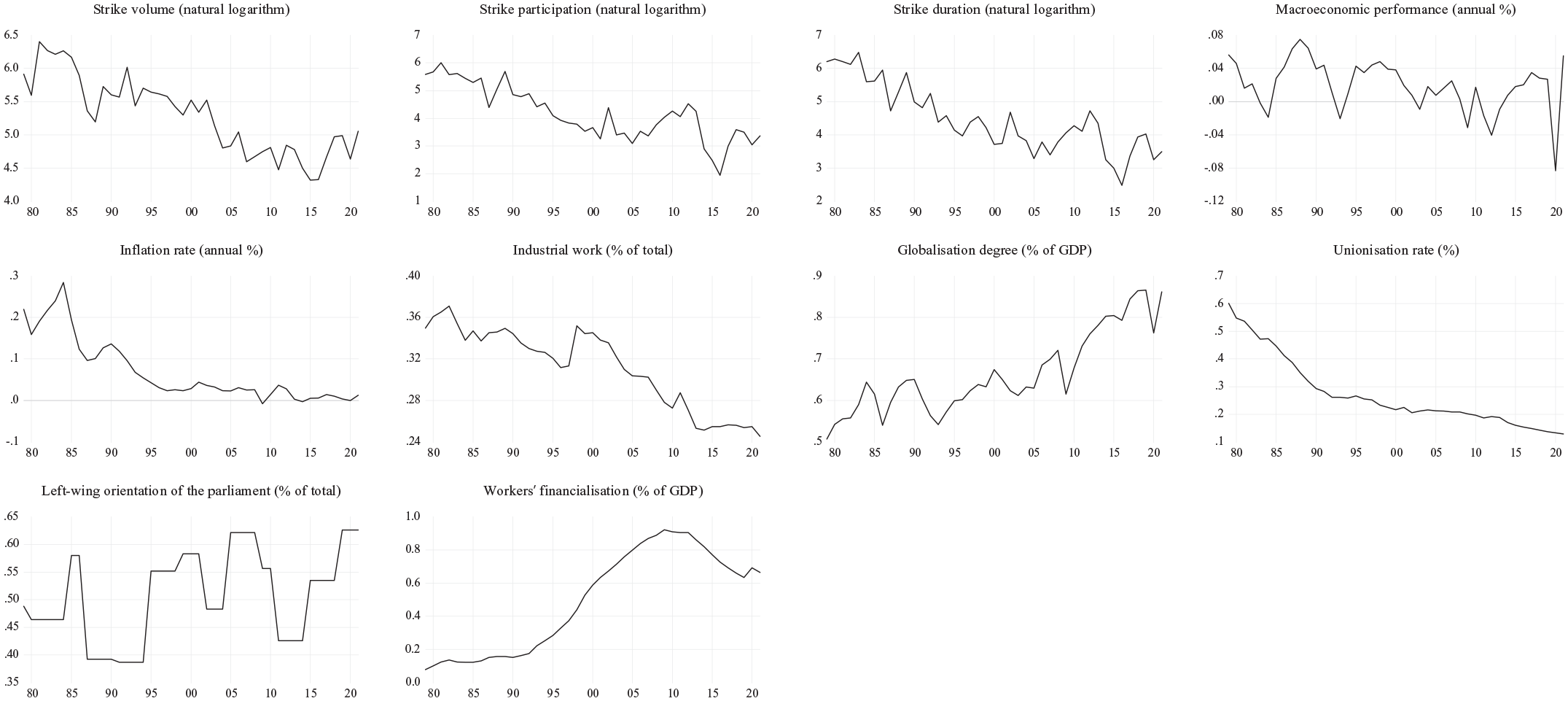
Plots of our variables.
Our results confirm that workers’ financialisation and their indebtedness levels have a negative impact on strike activity in Portugal, both in the short term and in the long term, but mainly on strike volume and strike duration. Our results also corroborate that workers’ financialisation and their indebtedness levels are one of the main triggers behind the decline of strike activity in Portugal in the last four decades.
The remainder of the article is structured as follows. In the second section, we provide a theoretical background on labour relations in the era of financialisation, namely with regard to labour conflict, labour unrest and strike activity. The third section presents the model design and the main hypotheses. Data are described in the fourth section and in the fifth we explain the econometric approach that will be used to produce our estimates. The sixth section presents and discusses the empirical results. The final section provides the main conclusions.
Theoretical background on labour relations in the era of financialisation
The ideas promoted by Reaganomics and Thatcherism have been disseminated in the majority of the developed countries since the mid-1970s and 1980s, particularly due to a strong engagement with the adoption of several neoliberal policies based on supply-side economics, a laissez-faire paradigm, the abandonment of Keynesian policies and full employment goals, liberalisation of trade and capital mobility, labour flexibility and weaker labour market institutions, tax competition for corporations and capital, privatisations, and retrenchments of welfare states (Barradas, 2023; Pariboni et al., 2020; Tridico and Pariboni, 2018).
All of these policies were also accompanied by the adoption of several reforms and structural adjustments to the labour market, particularly supported by wage restraint measures as a crucial condition to boost macroeconomic performance. Wage restraint measures included the deregulation and flexibilisation of labour relations (e.g. at the level of unemployment benefits, employment protection, employment rights and minimum wage), the absence of living wages, the reduction of collective bargaining, the deterioration of the power held by trade unions and/or the decreasing importance of workers’ commissions on the board of directors of corporations (Lavoie and Stockhammer, 2013; Naastepad and Storm, 2006).
There are two reasons that could explain these more liberal orientations taken by policymakers in the last five decades. On the one hand, this stance by policymakers was induced by the theoretical claims provided by mainstream economics, according to which functional income distribution and aggregate demand do not exert any effect on economic growth in the long term because this is exclusively determined by supply-side factors (Romer, 1986; Solow, 1956) that require the adoption of pro-capital policies in order to promote technological progress, sustain economic growth and foster job creation (Lavoie and Stockhammer, 2013). On the other hand, this stance was persuaded by the orthodox belief that all countries follow a profit-led growth model instead of a wage-led growth model (Naastepad and Storm, 2006), according to which the decline of wages is beneficial because its positive effects on both private investment through higher profits and on net exports through reduced unit labour costs and a rise in external competitiveness more than counterbalance its negative effects on private consumption. 1
As a result, labour conditions have been worsening and workers have progressively been losing some labour rights since the 1970s and 1980s, which is clearly visible in the drop of the labour income share and the consequent stagnant (or falling) wages (Barradas, 2019; Stockhammer, 2017); the rise of top management compensation vis-a-vis the working class and blue-collar workers and the corresponding widening of personal income inequalities (Barradas and Lakhani, 2024); the proliferation of atypical work (e.g. temporary or fixed-term contracts, dispatched contracts, involuntary part-time jobs and multiple job-holding) and the resultant prevalence of non-standard labour contracts (Chan, 2023; Gouzoulis et al., 2023a; Kalleberg, 2000, 2009); the increase in job insecurity, instability, insufficient social protection, precariousness, higher flexibility, scarcer incentives and lower-paid jobs (Pariboni and Tridico, 2020; Tridico and Pariboni, 2018); the surge of emotional abuse and/or other threats (e.g. discrimination, bullying, harassment and violence) in the workplace (Buttigieg et al., 2011); the deterioration in work–life balance and the intensification of work pressure (Ayudhya et al., 2019); and the spread of informal work and non-contract workers (Chan, 2023). These stylised facts have been exacerbated by the growth of digital labour platforms and the corresponding emergence of freelancers and gig workers (Chan, 2023), and in the countries that requested international financial assistance (e.g. Southern euro area countries) in the last decade, namely because international organisations (e.g. the International Monetary Fund, the European Commission and the European Central Bank) imposed the adoption of several austerity measures based on internal devaluation and huge wage constraint polices as an excuse to restore external competitiveness and a sustained growth pattern (Lima et al., 2021; Sánchez-Mosquera, 2023).
Nonetheless, workers have evidenced higher resignation and conformism and lesser claimant behaviour in order to demand higher wages and better labour conditions, which is observable in the general decreasing trend in strike activity in the last five decades (Godard, 2011; Gouzoulis, 2023; Kelly, 2015). This represents a certain paradox because, historically, labour conflict, labour unrest and strike activity were the main tools and sources of pressure applied by workers to gain higher wages and better labour conditions with employers and/or policymakers (Chan, 2023; Gouzoulis, 2023).
The literature has presented several explanations for the decline in strike activity since the mid-1970s and 1980s. Apparently, the higher preponderance of governments with an active pro-capital agenda that is not focused on low unemployment, high benefits and better labour conditions (Gouzoulis, 2023; Korpi and Shalev, 1979) has not been enough to trigger higher strike activity in the last five decades, notably due to the deceleration of economic activity (Goerke and Madsen, 2004; Kaufman, 1982; McConnell, 1990; Tracy, 1986), the disinflationary process (Gouzoulis, 2023), deindustrialisation and the consequent reduction of industrial work (Bell, 1973; Troy, 1990), globalisation and the corresponding increase in trade openness (Brandl and Traxler, 2010; Piazza, 2005; Tuman, 2019) and the decrease in the unionisation rate and resultant deterioration of workers’ bargaining power (Gouzoulis, 2023; Kaufman, 1982, 1983). However, the literature shows that few attempts have been made to explain the general decreasing trend in strike activity in the last five decades due to the role of workers’ financialisation and their indebtedness levels (Gouzoulis, 2023; Thompson and Cushen, 2020).
The main feature related to workers’ financialisation corresponds to the steep increase in their indebtedness in the last decades to unprecedented and unsustainable levels, particularly up to the Great Recession (Barradas and Tomás, 2023; Romão and Barradas, 2024). Barradas (2022) discusses in detail the reasons behind the growth of workers’ indebtedness in the last decades, such as the higher availability of credit supported by financial innovation (e.g. debt securitisation and the ‘originate to distribute’ strategies of banks), technological progress (e.g. credit scoring models), a lower level of interest rates, increased competition among banks and/or other financial institutions and the corresponding adoption of more aggressive credit policies, and the appearance of new financial instruments (e.g. home equity loans and credit cards) that have implied a deterioration of creditworthiness standards and a reduction of the collateral requirements, even for low-income and low-wealth workers (Bezemer et al., 2023; Hein, 2012; Stockhammer, 2009).
A strong dependence on credit for different purposes has emerged (e.g. housing credit, consumer credit, credit cards and overdraft banking accounts) and has contributed to a more self-disciplined attitude and risk-averse behaviour of workers in the workplace due to the fear of losing their jobs and the corresponding risks of default (Langley, 2007; Lazzarato, 2012; Stockhammer, 2009; Sweet, 2018). The extensively indebted workers essentially prioritise preservation of their jobs and a steady flow of income until they repay their existing debts and, thus, avoid a potential default (Gouzoulis, 2023). This is especially relevant due to the general recognition that personal default constitutes a social stigma given that inability to successfully manage your own finances is viewed as a personal failure (Wood, 2017). Against this background, workers have diminished their demands for higher wages and better labour conditions and, occasionally, accepted a further worsening of their situations to retain their jobs and to honour their financial obligations. Workers’ financialisation and their indebtedness levels have even been represented as one of the main causes behind the decline of the labour income share (Gouzoulis, 2021, 2022; Gouzoulis et al., 2023b; Kohler et al., 2019; Wood, 2017), the fall of organised labour and the resultant decrease in the unionisation rate (Gouzoulis, 2024), the rise of atypical work and non-standard labour contracts (Gouzoulis et al., 2023a) and the reduction in strike activity (Gouzoulis, 2023). This happens because participation in a strike leads to a loss of income in the short term, even in the cases in which trade unions provide some strike pay due to a time lag between the day of the strike and the day of receipt of that reimbursement, as well as a high risk of being permanently replaced and/or dismissed in the medium and long term (Gourevitch, 2018; Gouzoulis, 2023; Grady and Simms, 2019; Stelzner, 2017).
Nevertheless, the empirical evidence on the relationship between workers’ financialisation and indebtedness levels and their strike activity is quite scarce. To the best of our knowledge, Gouzoulis (2023) is the only exception, as he performed a time-series econometric analysis for Japan, Korea, Norway, Sweden, the United Kingdom and the United States in the post-1970 period. The author concluded that workers’ financialisation and indebtedness levels negatively influenced the strike activity in these countries, with Norway as the only exception for two reasons. First, the development of the process of financialisation occurred relatively later in Norway in comparison with the remaining other countries. Second, more extensive debtor protection exists in Norway vis-a-vis the remaining countries (Blackwell and Kohl, 2018; Gouzoulis, 2021, 2023).
This article aims to provide further empirical evidence in order to assess the relationship between workers’ financialisation and indebtedness levels and their strike activity by conducting a time-series econometric analysis focused on Portugal over the period from 1979 to 2021.
Model design and hypotheses
Our econometric model is based on a long-term aggregate equation to assess the determinants of strike activity in Portugal, which takes the following form:

where t is the time period (years), SA corresponds to the strike activity, X is a set of control variables that have been revealed both theoretically and empirically to be robust determinants of strike activity in the last decades, WF is workers’ financialisation and indebtedness levels and ε is an independent and identically distributed (white noise) disturbance error with null average and constant variance (homoscedastic).
As discussed in the previous section, our set of control variables includes all variables that have been both theoretically and empirically revealed to be forceful determinants of strike activity in the last decades (macroeconomic performance, the inflation rate, industrial work, the degree of globalisation, the unionisation rate and the left-wing orientation of the parliament), which allow us to consider all the stylised facts observable in Portugal over the last four decades (Figure 1) and to mitigate the problem related to omitted relevant variables by enabling us to obtain estimates that are more consistent and unbiased (Brooks, 2009). Accordingly, our long-term aggregate equation to assess the determinants of strike activity in Portugal takes the following specification:

where t is the time period (years), SA corresponds to strike activity, MP is macroeconomic performance, IR is the inflation rate, IW is industrial work, GL is the globalisation degree, UR is the unionisation rate, LO is the left-wing orientation of the parliament, WF is the workers’ financialisation and indebtedness levels and ε is an independent and identically distributed (white noise) disturbance error with null average and constant variance (homoscedastic).
Our aggregate equation to assess the determinants of strike activity in Portugal follows a macroeconomic approach that implicitly assumes the existence of a representative worker in Portugal whose behaviour does not change across time and space. This macroeconomic approach could lead to two important drawbacks in our empirical analysis (Correia and Barradas, 2021). First, we cannot assess whether the determinants of strike activity in Portugal differ according to the workers’ own characteristics (e.g. age, sex, qualifications, occupation, type of labour contract, household size and social stratum). Second, we cannot assess whether the determinants of strike activity in Portugal differ according to the corporations, sectors, industries and/or regions of workers’ jobs. However, this macroeconomic approach offers at least four conspicuous advantages that, from our point of view, compensate for these two drawbacks (Correia and Barradas, 2021; Gouzoulis, 2023). First, we can assess the determinants of strike activity in Portugal as a whole by looking beyond the specificities of each worker in each corporation, sector, industry or region. Hence, if these determinants are proved to exert a statistically significant effect on strike activity, we are unable to know whether that effect occurs only with some workers or in some corporations, sectors, industries and regions or whether it is a more generalised effect across all workers, corporations, sectors, industries and regions in Portugal. If these determinants are proved to exert non-statistically significant effects on strike activity, we cannot reject whether there is an effect for some workers, corporations, sectors, industries and regions although at an insufficient level to create a general effect in all workers, corporations, sectors, industries and regions as a whole in Portugal. Second, we can assess the determinants of strike activity in Portugal covering the longest period possible, paving the way for a microeconomic approach at the worker level, the corporate level, the sector level, the industry level and the regional level. Third, we can assess the determinants of strike activity in Portugal in a context in which the majority of them will necessarily have the predicted microeconomic effects. Fourth, we can assess the determinants of strike activity in Portugal by taking into account some important long-term trends and structural adjustments (e.g. the deindustrialisation and the consequent reduction of industrial work and/or the globalisation and the corresponding increase in trade openness) that could not be analysed if we followed a microeconomic approach at the worker level, the corporate level, the sector level, the industry level and the regional level.
Our hypotheses indicate that the macroeconomic performance, the inflation rate, the industrial work and the unionisation rate should positively impact strike activity, whilst the globalisation degree and the workers’ financialisation and indebtedness should negatively impact strike activity. The left-wing orientation of the parliament should have an undetermined impact on strike activity. Therefore, the long-term estimated coefficients should present the following signs:

Macroeconomic performance should exert a positive influence on strike activity, particularly due to the general recognition that strike activity tends to exhibit a procyclical behaviour (Goerke and Madsen, 2004; Harrison and Stewart, 1994; Kaufman, 1982; McConnell, 1990; Tracy, 1986). This happens because an acceleration of the economic activity tends to contribute to a decrease in the unemployment rate and an increase in the inflation rate by positively influencing strike activity as workers demand higher wages to maintain their purchasing power.
Strike activity is also positively affected by the inflation rate, particularly due to the fact that higher inflation rates induce workers to engage in more strikes to demand higher wages in order to maintain their purchasing power (Gouzoulis, 2023).
Industrial work is expected to positively impact strike activity, primarily because workers in the manufacturing sectors tend to be more strike prone vis-a-vis the less militant stance exhibited by the workers in the non-manufacturing sectors (e.g. agriculture and service sectors) or even by unemployed workers (Bell, 1973; Troy, 1990). This occurs because workers in the manufacturing sectors have closer ties with the trade unions and have more typical labour contracts, while the workers in the non-manufacturing sectors are normally non-unionised and have more atypical labour contracts and/or are self-employed (Gouzoulis, 2023).
Strike activity negatively depends on the globalisation degree due to the threat effects from multinational, transnational and ‘nomadic’ corporations related to offshoring and/or relocating production to low-wage countries, which disincentivises strike activity as workers try to preserve their jobs even with worsening labour conditions (Brandl and Traxler, 2010; Hein, 2012; Piazza, 2005; Tuman, 2019; Zamagni, 2003).
Unionisation rate, which reflects a higher capacity for workers’ mobilisation and higher workers’ bargaining power, is expected to exert a positive impact on strike activity (Gouzoulis, 2023; Kaufman, 1982, 1983).
The left-wing orientation of the parliament should negatively or positively impact strike activity (Gouzoulis, 2023; Korpi and Shalev, 1979). A negative (positive) effect is expected when the presence of a more democratic or progressive parliament (does not preserve) preserves an active pro-labour agenda with a strong focus on low unemployment, high benefits and better labour conditions without public pressure that disincentivises (incentivises) workers to strike and/or when the presence of a more democratic or progressive parliament (does not approve) approves pro-worker right-to-strike legislation reforms.
Finally, workers’ financialisation and indebtedness levels should also exert a negative effect on strike activity due to the fear of a decrease in income or the loss of a job and the resultant risks of default (Gourevitch, 2018; Gouzoulis, 2023; Grady and Simms, 2019; Langley, 2007; Lazzarato, 2012; Stelzner, 2017; Sweet, 2018).
Data
We collected annual data for Portugal from 1979 to 2021, constituting a total sample of 43 observations. This corresponds to the time span and the frequency for which all variables were available. Proxies to assess workers’ financialisation and indebtedness levels were only available from 1979 onwards, proxies to assess strike activity were not yet available for the year 2022 and the majority of proxies were only available on a yearly basis. We collected all data in October 2023.
Our sample was suitable to produce our results for two reasons. First, we used a relatively large sample by covering at least four decades, which allowed us to assess the long-term trends and structural adjustments behind the decline of strike activity in Portugal. Second, the large sample allowed us to take into account some heterogeneity related to workers’ financialisation by encompassing periods of increase and periods of decrease in their indebtedness levels (Figure 1).
We used three variables to proxy the multidimensional nature related to strike activity in Portugal, namely strike volume (i.e. the number of strikes per year), strike participation (i.e., the number of workers involved in strikes per year) and strike duration (i.e. the number of working days not worked due to strikes per year). This allowed us to assess the robustness of our results according to the proxy chosen to measure strike activity. Three models were estimated by contemplating each of these three variables as the dependent variable.
We now present the definitions, units and sources for all variables. Strike volume corresponded to the natural logarithm of the total number of strikes per year in Portugal, which is available from the PORDATA and International Labour Organisation (ILO) databases. Strike participation was proxied using the natural logarithm of the total number of thousands of workers involved in strikes per year in Portugal, as obtained from the PORDATA and ILO databases. Strike duration was the natural logarithm of the total number of thousands of working days not worked per year due to a strike in Portugal, as obtained from the PORDATA and ILO databases. 2 Due to data availability, the information for strike volume, strike participation and strike duration in Portugal only accounted for the strike activity of workers in the private sector. However, this should not penalise the reliability of our results because public servants only represent a small fraction of the total employment in Portugal (around 15% on average in the last decade), although they tend to be the most strike-prone workers (Gouzoulis, 2023).
The macroeconomic performance in Portugal was assessed by the annual percentage growth rate of gross domestic product at market prices based on constant 2015 prices, which was collected directly from the World Bank database.
The annual percentage growth rate of the consumer price index was used to proxy the inflation rate in Portugal. This variable was collected directly from the World Bank database.
We used the number of workers employed in the secondary sector (i.e. workers from industry, construction, energy and water) as a percentage of the total number of workers in Portugal to measure industrial work. Both variables were obtained from the PORDATA database.
The globalisation degree in Portugal was measured by using the sum of exports and imports of goods and services as a percentage of the gross domestic product, which is available on the World Bank database.
The unionisation rate (i.e. the number of workers who are union members as a percentage of the total number of workers) in Portugal was collected from the Institutional Characteristics of Trade Unions, Wage Setting, State Intervention and Social Pacts (ICTWSS) database and from Barradas and Lagoa (2017). 3
The left-wing orientation of the parliament corresponded to the total number of members of the parliament elected by left-wing parties as a percentage of the total number of elected members of the parliament, which is available on the PORDATA database. 4
Workers’ financialisation and indebtedness levels were quantified through Portuguese household debt (i.e. the total stock of loans and debt securities issued by households in Portugal) as a percentage of the gross domestic product, which is available on the International Monetary Fund (IMF) database.
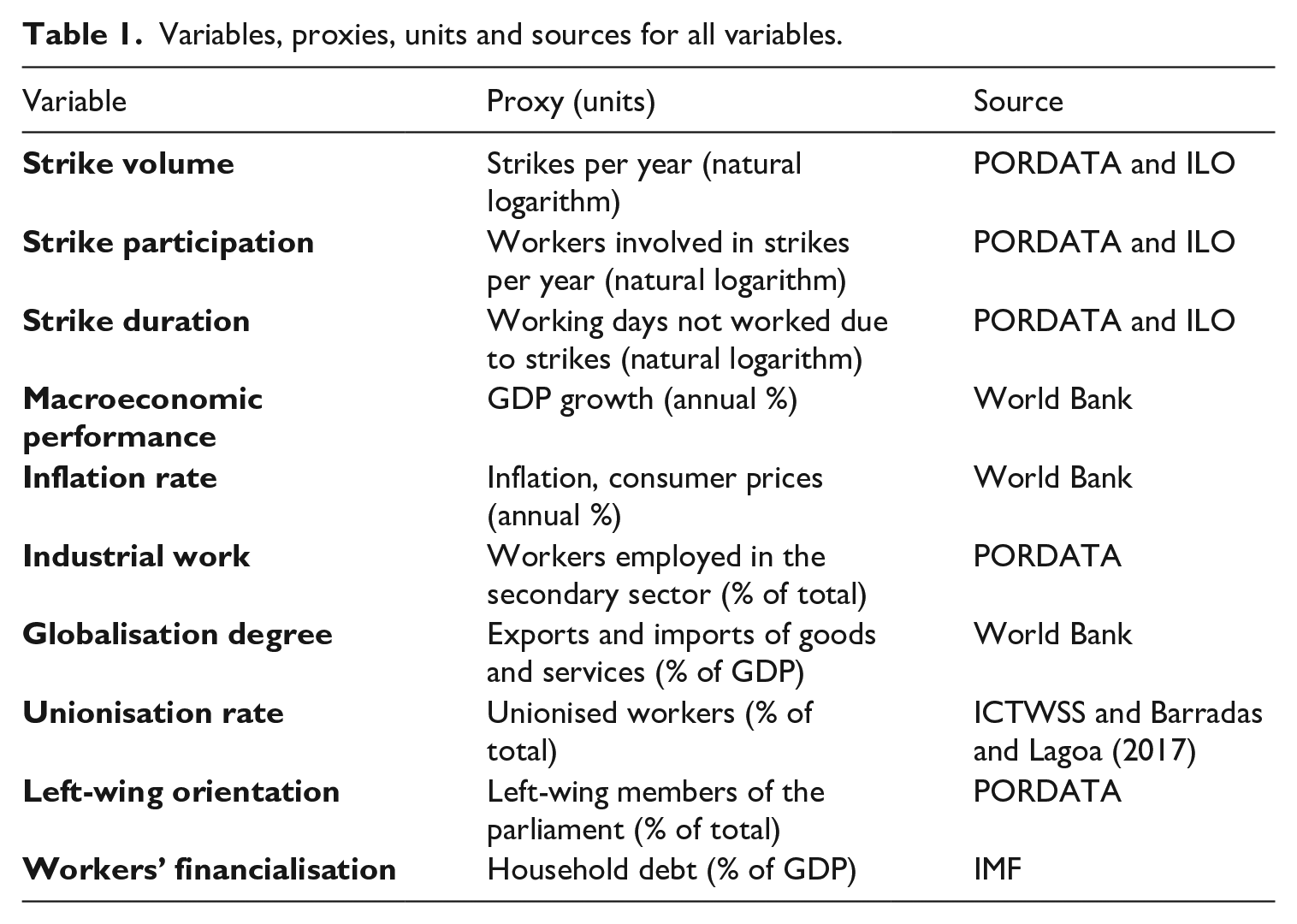
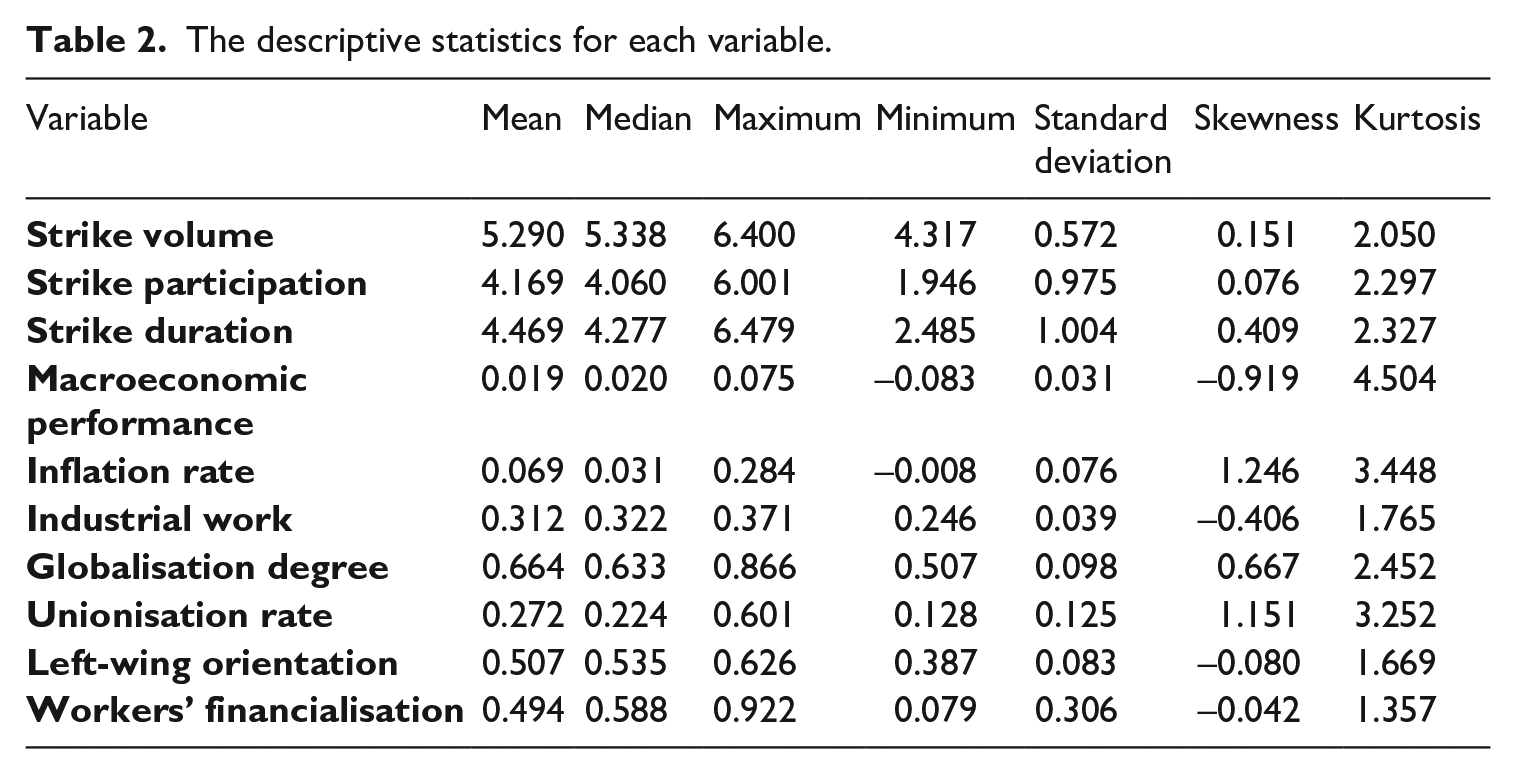
Figure 1 provides the plots of all variables and Table 1 synthesises the definitions, units and sources for all variables. Table 2 displays the descriptive statistics for each variable, Table 3 exhibits the correlations between all variables, Table 4 contains the conventional augmented Dickey and Fuller (ADF) (1979) unit root test for each variable and Table 5 shows the traditional Phillips and Perron (PP) (1998) unit root test for each variable.
Variables, proxies, units and sources for all variables.
The descriptive statistics for each variable.
The correlations between all the variables.
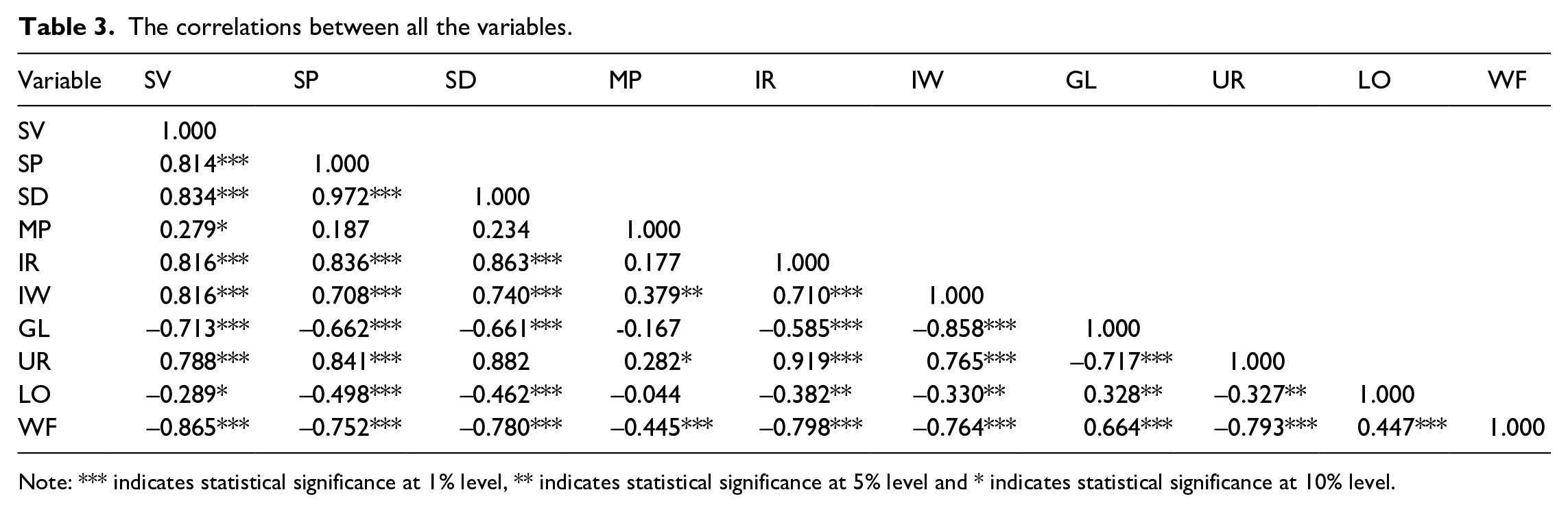
Note: *** indicates statistical significance at 1% level, ** indicates statistical significance at 5% level and * indicates statistical significance at 10% level.
p-Values of the ADF unit root test for each variable.
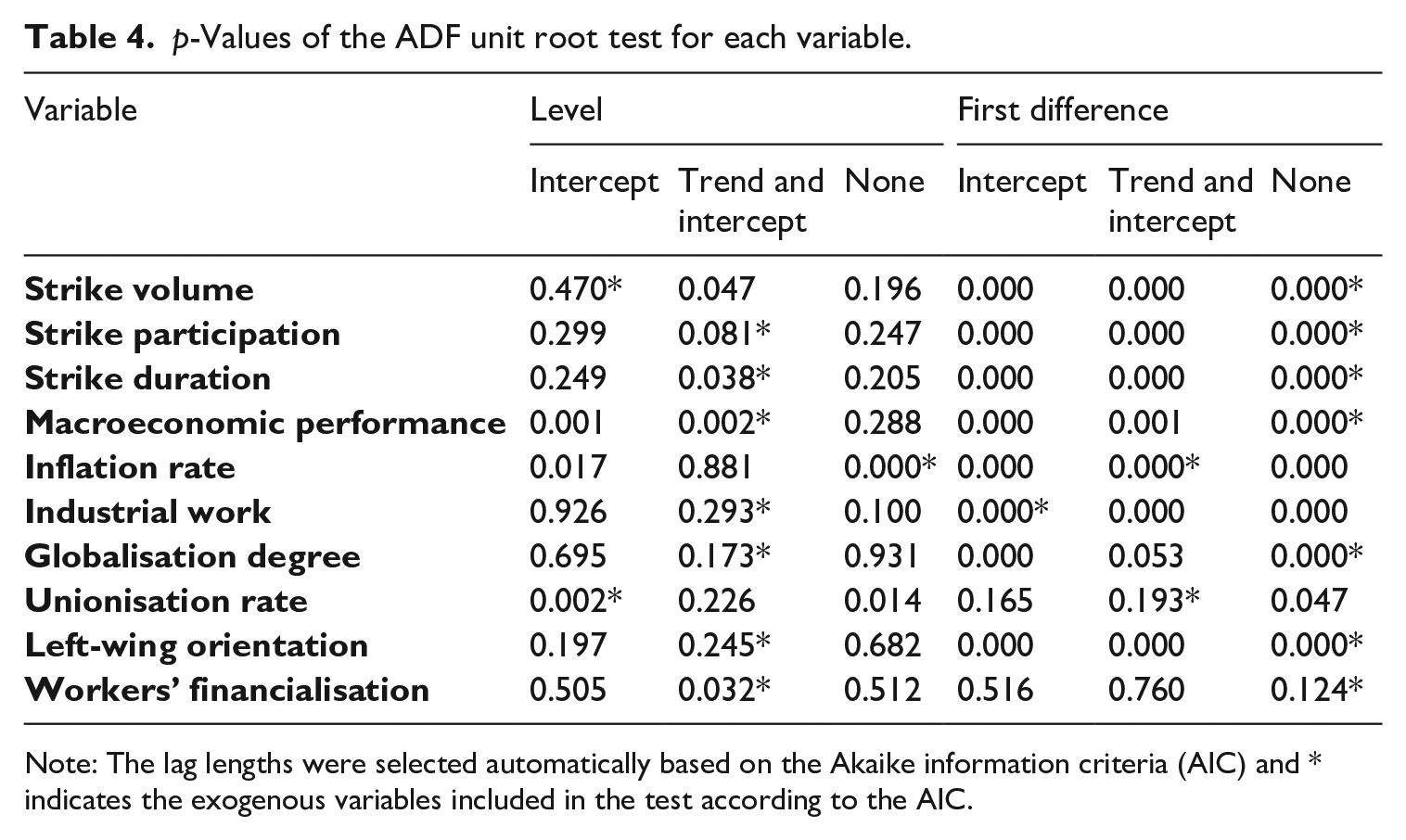
Note: The lag lengths were selected automatically based on the Akaike information criteria (AIC) and * indicates the exogenous variables included in the test according to the AIC.
p-Values of the PP unit root test for each variable.
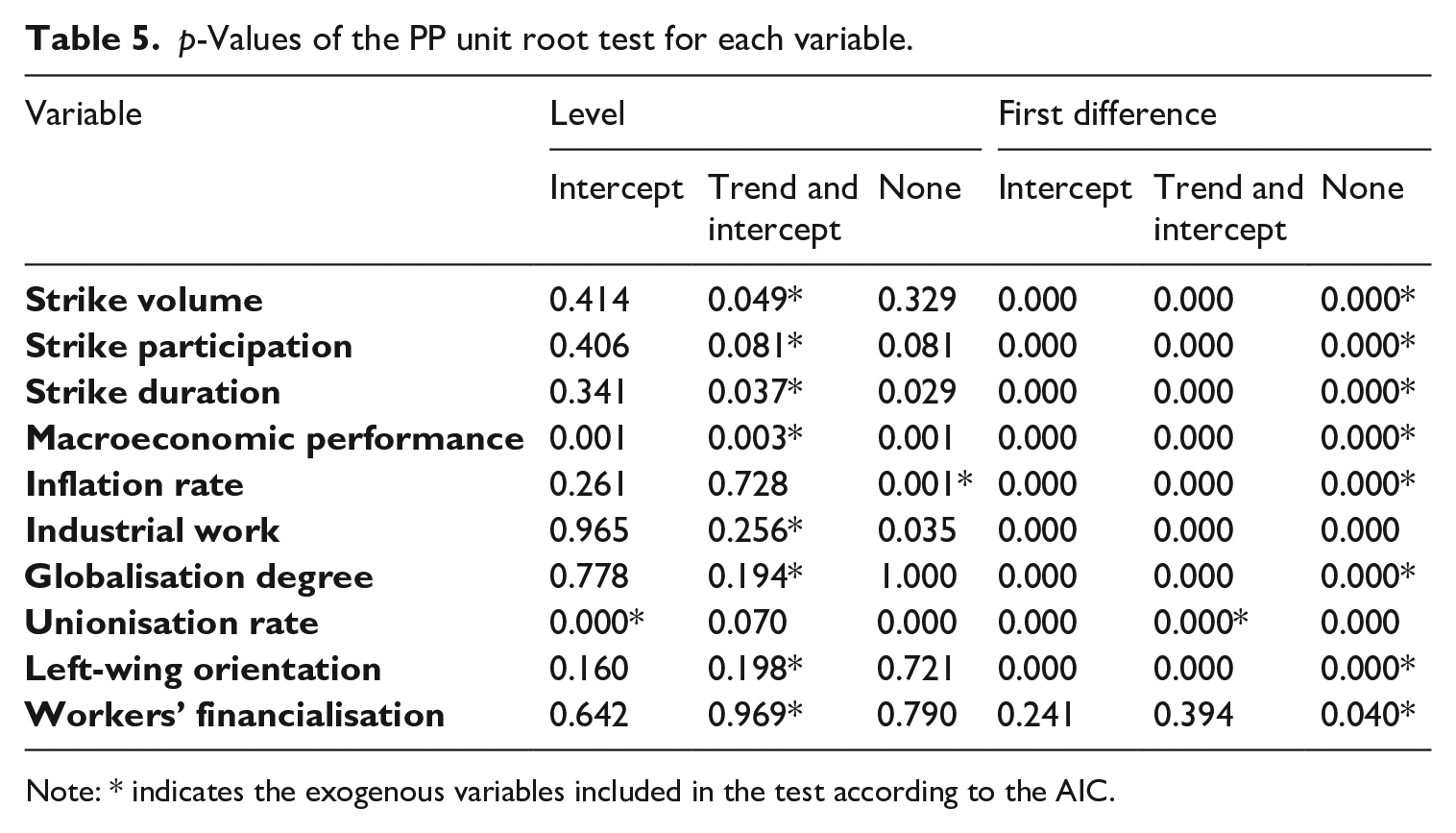
Note: * indicates the exogenous variables included in the test according to the AIC.
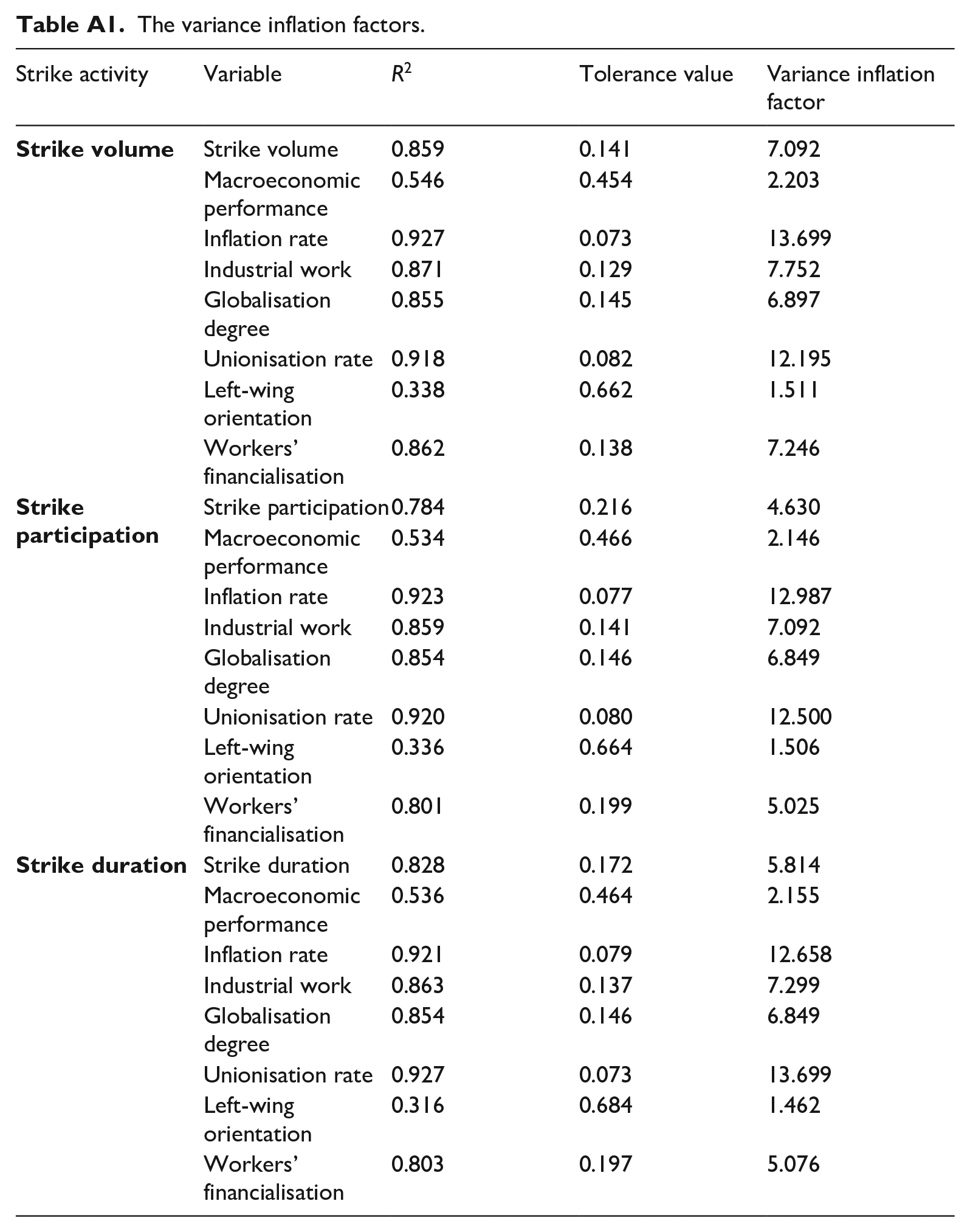
We cannot exclude the existence of multicollinearity between our variables because some correlations among them are higher than the conventional ceiling of 0.8 in absolute terms (Studenmund, 2016). We then proceeded with the analysis of the variance inflation factors (Table A1 in the Appendix), which allowed us to completely discard the existence of multicollinearity between our variables because all the variance inflation factors are lower than the traditional ceiling of 20 (Greene, 2017).
Note that strike activity in Portugal has registered a sustained decline in the last four decades, which has occurred simultaneously with a slowdown in economic growth, a deceleration of the inflation rate, a plunge in industrial work, an increase in the globalisation degree, a deterioration of the unionisation rate and a general increasing trend in workers’ financialisation and indebtedness levels (Figure 1). This seems to suggest that the decline in the strike activity in Portugal during that time cannot be dissociated from the deceleration of the economic activity, the disinflationary process, the reduction in industrial work, the increase in globalisation degree, the decrease in the unionisation rate and the rise of workers’ financialisation and indebtedness levels. The high positive correlation between the macroeconomic performance (or the inflation rate, the industrial work or the unionisation rate) and strike activity in Portugal and the high negative correlation between the globalisation degree (or the workers’ financialisation and indebtedness levels) and strike activity in Portugal sustain these beliefs (Table 3). The slight negative correlation between the left-wing orientation of the parliament and strike activity in Portugal seems to suggest the absence of a considerable association between them (Table 3).
We confirm that we have a mixture of variables that are integrated of order zero (i.e. variables that are stationary in levels) and integrated of order one (i.e. variables that are stationary only in the first differences), which is in line with the results of the ADF unit root test and the PP unit root test (Tables 4 and 5). Effectively, at the traditional significance levels, strike participation, strike duration, macroeconomic performance, inflation rate and unionisation rate are stationary in levels according to the results of both tests. Industrial work, globalisation degree and the left-wing orientation of the parliament are only stationary in the first differences in accordance with the results provided by both tests. Workers’ financialisation and indebtedness levels are stationary in levels by the ADF test but stationary only in the first differences by the PP test. Strike volume is stationary only in the first differences by the ADF test but stationary in levels according to the PP test. Therefore, none of our variables is stationary only in the second differences (i.e. variables that are integrated of order two) according to the ADF test and the PP test.
Econometric approach
Our econometric approach employed the ARDL estimator developed by Pesaran et al. (2001), primarily because it is the only suitable estimator that can be performed for cases like ours, involving a mixture of variables that are stationary in levels and variables that are stationary only in first differences. There are four advantages that support the use of the ARDL estimator to produce our results. First, the ARDL estimator can be used irrespective of the presence of variables that are integrated of order zero and integrated of order one or mutually cointegrated, which minimises the risks related to the conclusions provided by the unit root tests due to their poor performance in the case of small samples (Harris and Sollis, 2003; Mills and Narkellos, 2008). Second, the ARDL estimator has better small size properties vis-a-vis other cointegration techniques (e.g. Engle and Granger, 1987; Gregory and Hansen, 1996; Johansen, 1988; Johansen and Juselius, 1990; Saikkonen and Lütkepohl, 2000) by producing unbiased and consistent estimates even in the case of small and finite samples (Pesaran and Shin, 1997; Philips, 2018). Third, the ARDL estimator also produces reliable estimates in the case of some potential endogenous variables among the independent ones (Harris and Sollis, 2003; Pesaran and Smith, 1998). Fourth, the ARDL estimator allows us to use all variables in levels (i.e. without differentiating the ones that are stationary only in first differences), which makes the interpretation of our coefficients more intuitive (Romão and Barradas, 2024). Our estimates were produced by using the EViews software (version 12).
The ARDL estimator explains the behaviour of the dependent variable (i.e. strike activity) through its lagged values and the contemporaneous and lagged values of the independent variables (i.e. macroeconomic performance, inflation rate, industrial work, globalisation degree, unionisation rate, left-wing orientation of the parliament and workers’ financialisation and indebtedness levels). Against this backdrop, the implementation of the ARDL estimator involved the following five steps.
First, we determined the number of lags that should be included in our ARDL to produce our estimates. We relied on the conclusions provided by the majority of the information criteria but especially on the conclusions of the final prediction error (FPE) and AIC because these two information criteria should be preferred in the case of small samples with fewer than 60 observations (Liew, 2004), which is our case.
Second, we employed the bounds test procedure developed by Pesaran et al. (2001) in order to assess whether there is a cointegration relationship between all the variables. Pesaran et al. (2001) provided the asymptotically critical values for the upper and lower bounds, which are only applicable to larger samples with more than 1000 observations. This represents the main disadvantage associated with the use of the ARDL estimator, which we overcame by relying on the critical values for finite samples provided by Kripfganz and Schneider (2020) due to the relatively small dimension of our sample. 5 Thus, the null hypothesis of no cointegration can be rejected if the F-statistic is above the upper critical value and cannot be rejected if the F-statistic is below the lower critical value. The results are not conclusive in terms of cointegration if the F-statistic lies between the upper and the lower critical value.
Third, we conducted several diagnostic tests in order to ensure the adequacy and reliability of our estimates. We relied on the Breusch–Godfrey serial correlation LM test, the Jarque–Bera test, the Breusch–Pagan–Godfrey test, the Ramsey’s RESET test and the CUSUM test in order to confirm that the residuals are not serially correlated, are normal and are homoscedastic, to guarantee that our models are well specified in their functional forms and to certify the stability of our estimates and the corresponding absence of structural breaks. If our models fail in at least one of these diagnostic tests, we need to adopt some remedies in order to correct the related econometric problems and to ensure the trustworthiness of our estimates.
Fourth, we present the long-term and short-term determinants of strike activity in Portugal. Our estimates were produced by relying on the first trend specification in which no deterministic components (intercepts and trends) were included in the model because the majority of our variables were indeed stationary in levels according to the ADF and the PP unit root tests (Tables 4 and 5). We included two dummy variables for the years 1992 (Dummy1992) and 2003 (Dummy2003) as exogeneous variables in our ADRL models in order to take into account the effects of two amendments to the law on strikes in Portugal that occurred in those years. 6
Fifth, we evaluated the economic effects of our long-term estimates in order to identify the role of each statistically significant determinant in explaining the behaviour of strike activity in Portugal in the last four decades (McCloskey and Ziliak, 1996; Ziliak and McCloskey, 2004).
Empirical results and discussion
We started by defining the number of lags that should be included in the ARDL models to produce our estimates (Table 6). A number of lags between 0 and 3 were put into consideration because the use of more lags would imply that the unrestricted VAR would not ensure the stability condition with more than one characteristic polynomial root outside the unit circle (Lütkepohl, 2005). 7 Under these conditions, we used three lags in our ARDL models because this represents the choice of the majority of the information criteria and, particularly, the conclusions of the FPE and AIC that are more indicated for small samples (Liew, 2004). Note that the EViews software produced the respective estimates of the ARDL models by automatically defining the number of lags that are incorporated in each variable up to the defined maximum of three lags.
Values of the information criteria by lag.
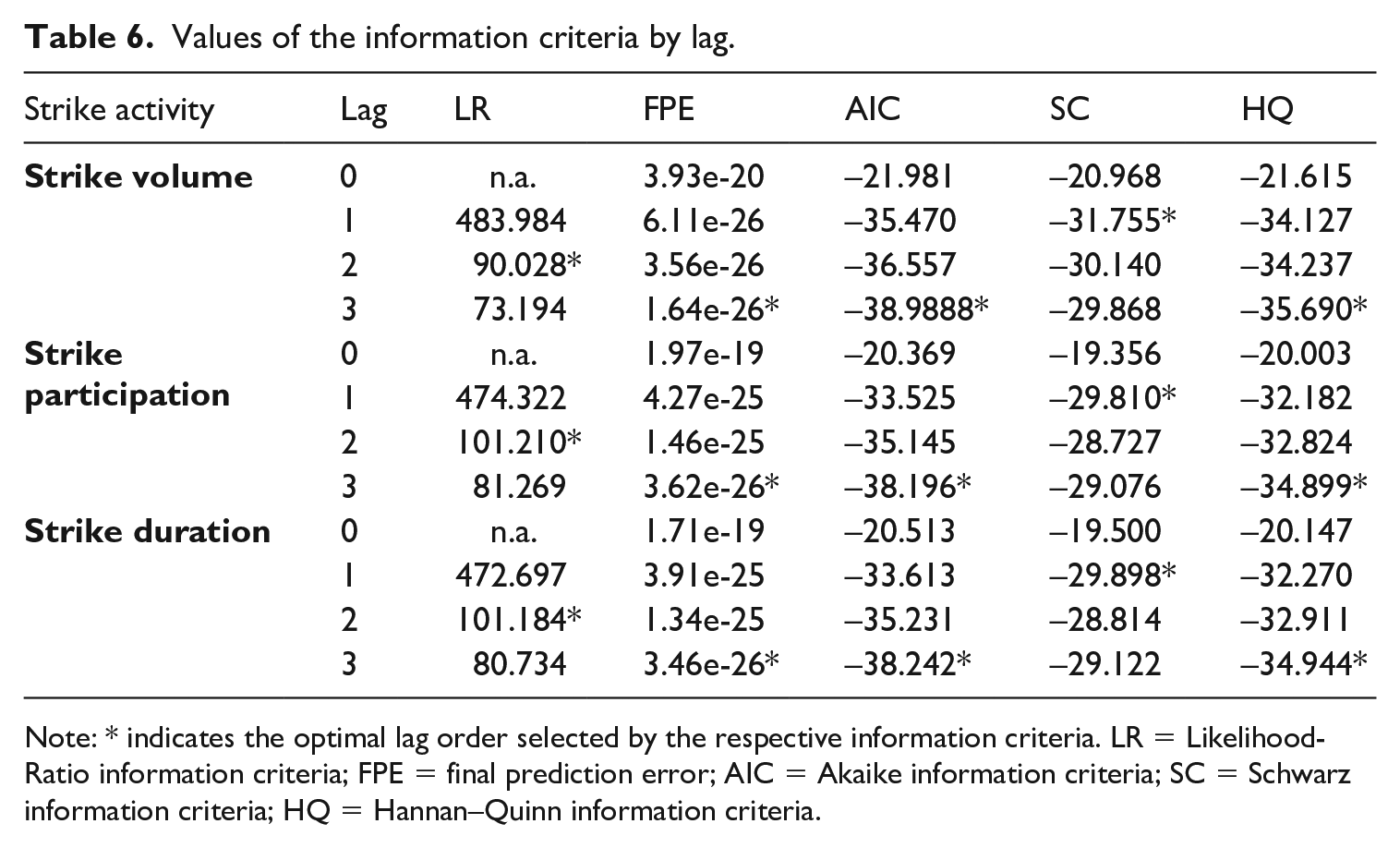
Note: * indicates the optimal lag order selected by the respective information criteria. LR = Likelihood-Ratio information criteria; FPE = final prediction error; AIC = Akaike information criteria; SC = Schwarz information criteria; HQ = Hannan–Quinn information criteria.
Next, we analysed the existence of a cointegration relationship between our variables by performing the bounds test procedure for each one of our three ARDL models (Table 7). For all of them, we strongly confirmed that our variables are really cointegrated because the computed F-statistics are higher than the upper bound critical values at the traditional significance levels.
Bounds test for cointegration analysis.
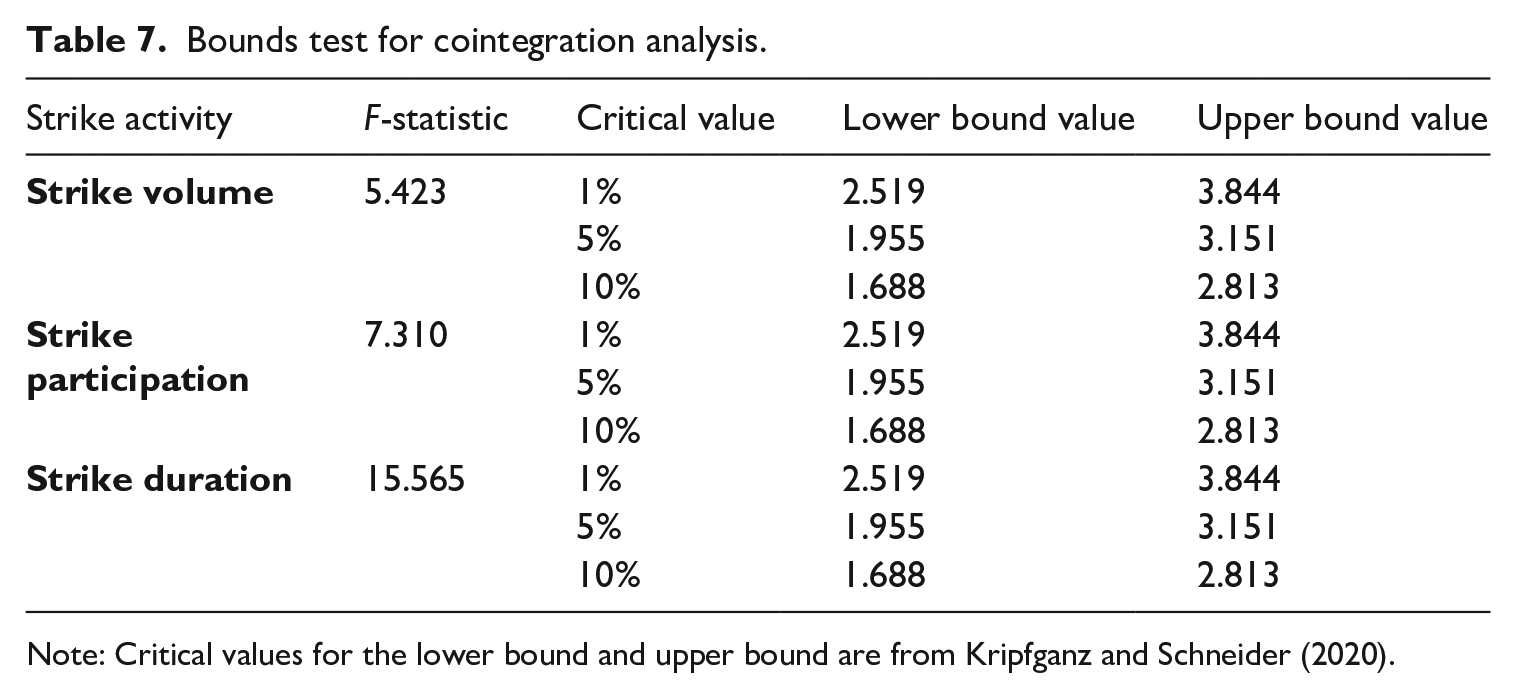
Note: Critical values for the lower bound and upper bound are from Kripfganz and Schneider (2020).
We then carried out the diagnostic tests for our three ARDL models (Table 8). We confirm that the ARDL models for strike volume and strike duration do not suffer from any econometric problem. For these two models, we certify that the respective residuals are not serially correlated, and they are normally distributed and homoscedastic. We have also ensured that these two models are well specified in their functional forms, and they produce stable estimates because no structural breaks were identified. 8 The ARDL model for strike participation exhibits an econometric problem related to the presence of residuals that are serially correlated. Therefore, we increased the number of lags of the dependent variable (strike participation) from three to four in this ARDL model. 9 The adoption of this remedy corrected the serial correlation of the residuals and did not modify the conclusions for the remaining diagnostic tests.
Diagnostic tests for the ARDL models.
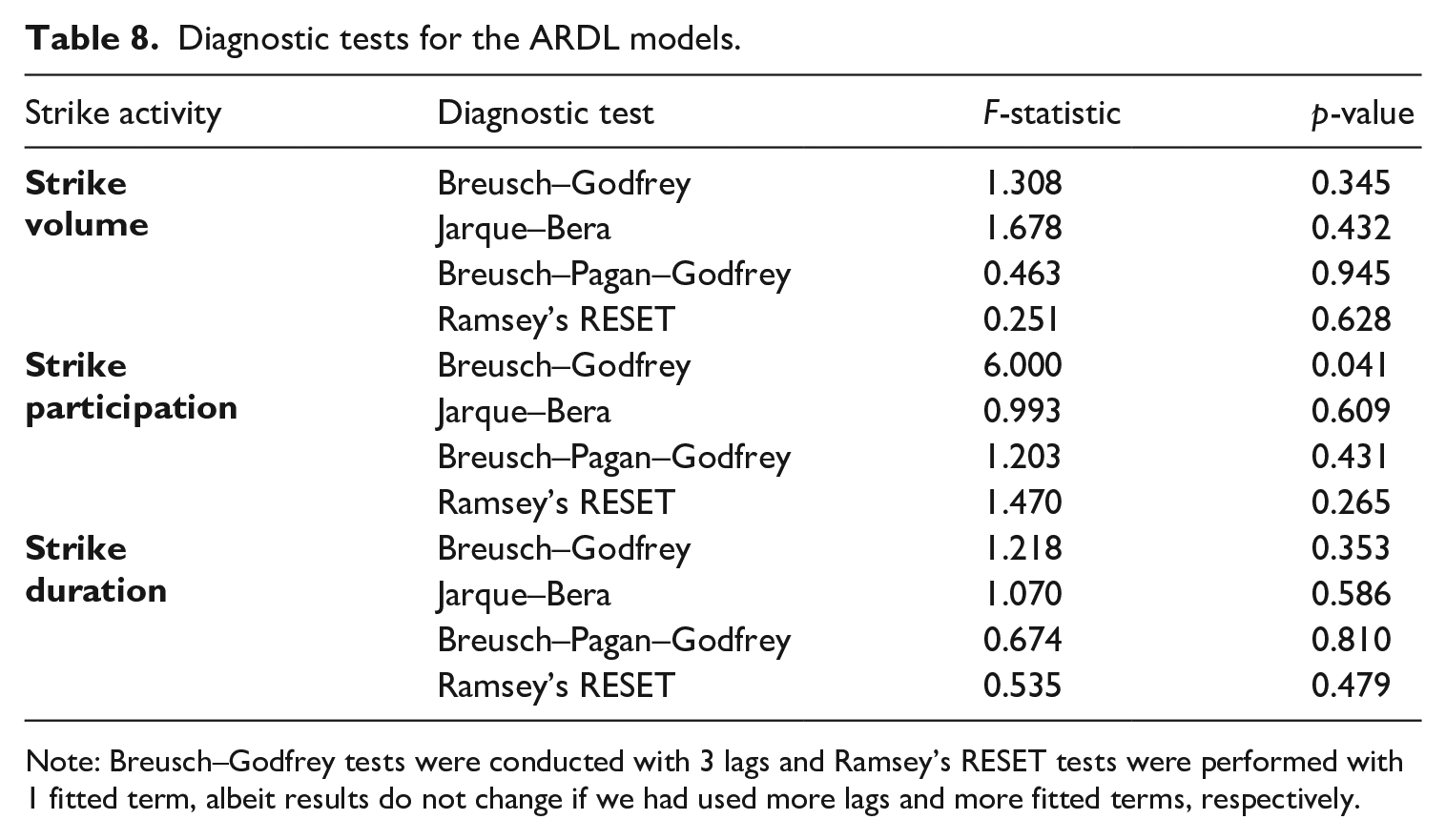
Note: Breusch–Godfrey tests were conducted with 3 lags and Ramsey’s RESET tests were performed with 1 fitted term, albeit results do not change if we had used more lags and more fitted terms, respectively.
We next discuss the long-term and short-term estimates of our ARDL models (Table 9). First, it is interesting to note that our models describe quite well the strike activity in Portugal due to the high R-squared (and adjusted R-squared) values. Our estimates explain more than 98% (94%) of the movement of strike volume in Portugal, more than 96% (87%) of the evolution of strike participation in Portugal and more than 97% (93%) of the behaviour of strike duration in Portugal.
Long-term and short-term estimates.
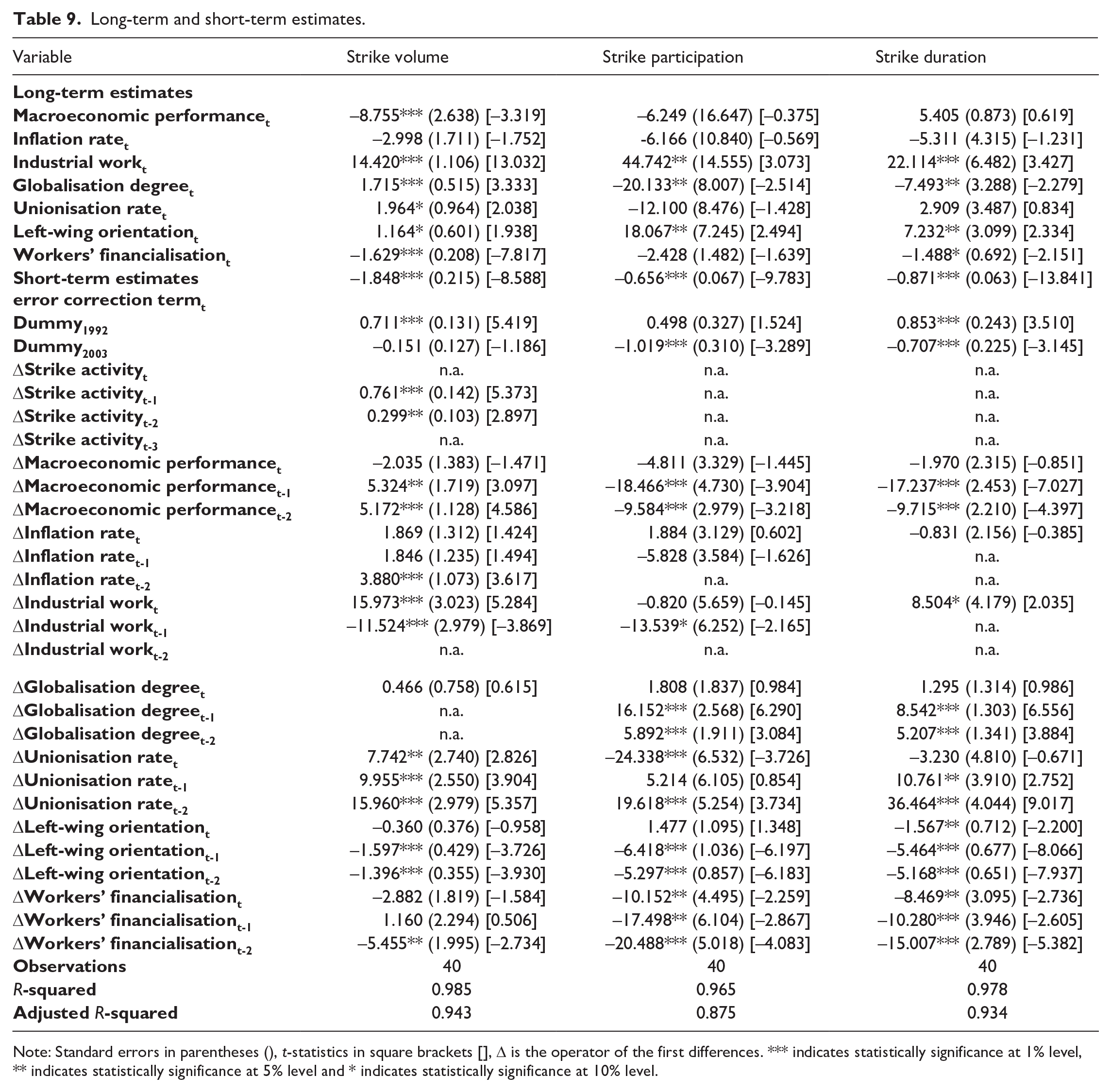
Note: Standard errors in parentheses (), t-statistics in square brackets [], Δ is the operator of the first differences. *** indicates statistically significance at 1% level, ** indicates statistically significance at 5% level and * indicates statistically significance at 10% level.
Regarding our long-term estimates, all variables are statistically significant at the traditional significance levels, with the inflation rate the only exception. 10 Contrary to the theoretical claims, this seems to suggest that the inflation rate in Portugal does not induce workers to engage in more strikes to demand higher wages. This is not too surprising because in the last four decades, real wages in Portugal have denoted a (slightly) positive growth in most years, which confirms that workers have not on average been losing their purchasing power. The remaining variables are all statistically significant at the conventional significance levels, particularly in the model of strike volume, and they have the expected effects on strike activity. The macroeconomic performance is the only exception by exerting a negative impact on strike volume. 11 This counterintuitive result does not corroborate the conclusions provided by Kaufman (1982), Tracy (1986), McConnell (1990), Harrison and Stewart (1994) and Goerke and Madsen (2004) on the procyclical behaviour of strike activity. Our results show that strike volume exhibits a countercyclical behaviour in Portugal. This could be associated with the countercyclical behaviour of wages and their sluggish nature (Willis and Wroblewski, 2007). This also suggests that risk sharing could exist between employers and workers in Portugal, in a context in which the latter tend not to engage in strikes to demand higher wages and better labour conditions during expansions in exchange for wage and job security in recessions, particularly in an increasingly globalised competitive environment. This mechanism could be particularly relevant due to the associated costs of firing and hiring workers faced by employers. Against this backdrop, Hein and Schulten (2004) even highlighted the existence of a change in collective bargaining arrangements in the last few decades, which has occurred at the corporate level and at the national level. At the corporate level, these authors confirmed the emergence of the so-called ‘pacts for employment and competitiveness’, according to which there is certain concessional bargaining whereby workers agree to labour cost reductions (e.g. wages contraction and/or working time extensions) in exchange for limited job guarantees given by employers. At the national level, these authors confirmed the existence of tripartite social pacts that establish the so-called ‘competitive corporatism’, the primary goal of which is to secure a policy of wage moderation to reinforce economic competitiveness. The remaining variables are statistically significant and have the expected effects on strike activity. Industrial work positively impacts strike activity in Portugal, which reflects the more strike-prone stance of these workers in comparison to those in the non-industrial sectors or even to those who are unemployed (Bell, 1973; Troy, 1990). The globalisation degree exerts the expected negative effect on strike activity in Portugal and, especially, on both strike participation and strike duration. 12 This supports the theoretical belief that workers prefer to preserve their jobs instead of going on strike to demand higher wages and better labour conditions in the face of fear that their corporations will offshore and/or relocate production to low-wage countries (Brandl and Traxler, 2010; Hein, 2012; Piazza, 2005; Tuman, 2019; Zamagni, 2003). These fears are particularly relevant in Portugal because there are a lot of examples of corporations that have already shifted their productive capacity to Eastern European countries to benefit from their lower wages, higher educational attainment levels and geographical proximity to the main European trading partners, particularly after the respective enlargement in 2004 (Barradas et al., 2018). Also, as expected, the unionisation rate positively affects strike activity in Portugal, but only with regard to the strike volume. 13 This corroborates that a higher unionisation rate is associated with a higher capacity for worker mobilisation and higher worker bargaining power, which play a crucial role in organising new strikes (Gouzoulis, 2023; Kaufman, 1982, 1983). Strike activity in Portugal is also positively impacted by the left-wing orientation of the parliament, which suggests that the Portuguese governments have not preserved an active pro-labour agenda with a strong focus on low unemployment, high benefits and better labour conditions, and this can encourage strike activity (Gouzoulis, 2023; Korpi and Shalev, 1979). This is visible, for instance, in a further deregulation and flexibilisation of labour relations that were adopted with the reforms of 2009 and 2019 by a left-wing government with a left-wing majority in the parliament during that time (Marques and Fonseca, 2022). Marques and Fonseca (2022) have stressed that the first reform increased working time flexibility and motivated the realisation of a general strike (also due to the absence of a revocation in the reform adopted in 2003 by a right-wing government) and the second reform implied a minor deregulation of permanent contracts and encouraged some social protests. Finally, workers’ financialisation and indebtedness levels exert a negative effect on strike activity in Portugal, particularly on both strike volume and strike duration. This confirms the theoretical claims that workers’ financialisation and indebtedness levels constrain their demands for higher wages and better labour conditions due to the fear of decreasing their income and losing their jobs and the consequent risks of default (Gourevitch, 2018; Gouzoulis, 2023; Grady and Simms, 2019; Langley, 2007; Lazzarato, 2012; Stelzner, 2017; Sweet, 2018).
With regard to our short-term estimates, five conclusions should be addressed. First, the error correction terms are all statistically significant at the traditional significance levels, are negative and exhibit a coefficient that lies from 0 to –2. This reveals that our ARDL models converge to the long-term equilibrium whenever there is any shock or disturbance in the short term. The speed of adjustment of any shock in the short term is automatically corrected within a year by around 185%, 66% and 87% in the case of strike volume, strike participation and strike duration, respectively. Second, the two dummy variables are statistically significant at the conventional significance levels, but they had different effects on strike activity in Portugal. On the one hand, the dummy for the year of 1992 exerts a positive impact on strike activity, predominantly on strike volume and strike duration. This seems to indicate that the amendment to the Portuguese legislation related to the right to strike that took place in 1992 was considered more restrictive by workers and led them to participate in more strikes to claim pro-worker right-to-strike legislation reforms. On the other hand, the dummy for the year of 2003 exerts a negative effect on strike activity, especially on strike participation and strike duration. This seems to indicate that the amendment to the Portuguese legislation related to the right to strike that took place in 2003 was considered more permissive by workers and led them to participate in fewer strikes to support the new legal framework. The strong increase in strike activity in 1992 and the strong decrease in strike activity in 2003 in Portugal seems to sustain those assumptions (Figure 1). Third, strike activity tends to be highly persistent in Portugal, notably because the lagged values of strike volume exert a positive influence on the contemporaneous values of strike volume. This could reveal that reasons to engage in a strike do not disappear with the end of that strike by incentivising workers to continue to engage in strikes until their demands are completely (or at least partly) attended to by employers and/or policymakers. Fourth, the inflation rate becomes statistically significant in the short term by exerting the expected positive effect on strike volume in Portugal. This means that workers tend to be more strike prone in contexts of high inflation in order to not lose their purchasing power, but mainly in the short term. Fifth, the remaining variables tend to exert the same impacts as in the long term, which suggests that strike activity in Portugal is similarly affected by these variables in both the short term and the long term.
Finally, we identified the main drivers of strike activity in Portugal in the last four decades by analysing the economic effects of our long-term estimates (Table 10). In relation to strike volume, the main triggers that explain the reduction in the number of strikes accomplished per year in Portugal in the last four decades were the acceleration of economic activity, the decline of industrial work, the surge in workers’ financialisation and indebtedness levels and the reduction in the unionisation rate. Strike volume in Portugal during that time would have effectively been higher by about 16.6%, 11.5%, 9.1% and 7.1% on average per year if there had not been an acceleration of economic activity, a decline in industrial work, a surge in workers’ financialisation and indebtedness levels and a reduction in the unionisation rate, respectively. The rise of the globalisation degree and the growth in the left-wing orientation of the parliament were not enough to sustain a higher strike volume in Portugal during that time. The number of strikes carried out per year in Portugal would have been lower by around 2.6% and 1.5% on average per year if there had not been a rise in the globalisation degree and if the left-wing orientation of the parliament had not grown from 1979 to 2021, respectively. Concerning strike participation, the decline in industrial work and the rise in the globalisation degree were the main drivers behind the reduction observed in the number of workers involved in strikes per year in the last four decades in Portugal, accounting for that reduction by around 35.8% and 30.2% on average per year, respectively. During that time, the growth in the left-wing orientation of the parliament was not enough to support a higher strike participation in Portugal. The number of workers involved in strikes per year in Portugal would have been lower by around 23.5% on average per year if the left-wing orientation of the parliament had not grown from 1979 to 2021. With respect to strike duration, the decline in industrial work, the rise in the globalisation degree and the surge in workers’ financialisation and indebtedness levels were the main causes of the reduction in the number of working days not worked due to strikes per year in Portugal in the last decades. In fact, strike duration in Portugal during that time would have been higher by about 17.7%, 11.2% and 8.3% on average per year if there had not been a decline in industrial work, a rise in globalisation degree and a surge in workers’ financialisation and indebtedness levels. Once again, the growth in the left-wing orientation of the parliament was not enough to exacerbate a higher strike duration in Portugal during that time. The number of working days not worked due to strikes per year in Portugal would have been lower by around 9.5% on average per year if the left-wing orientation of the parliament had not grown from 1979 to 2021.
Economic effects of strike activity in Portugal.
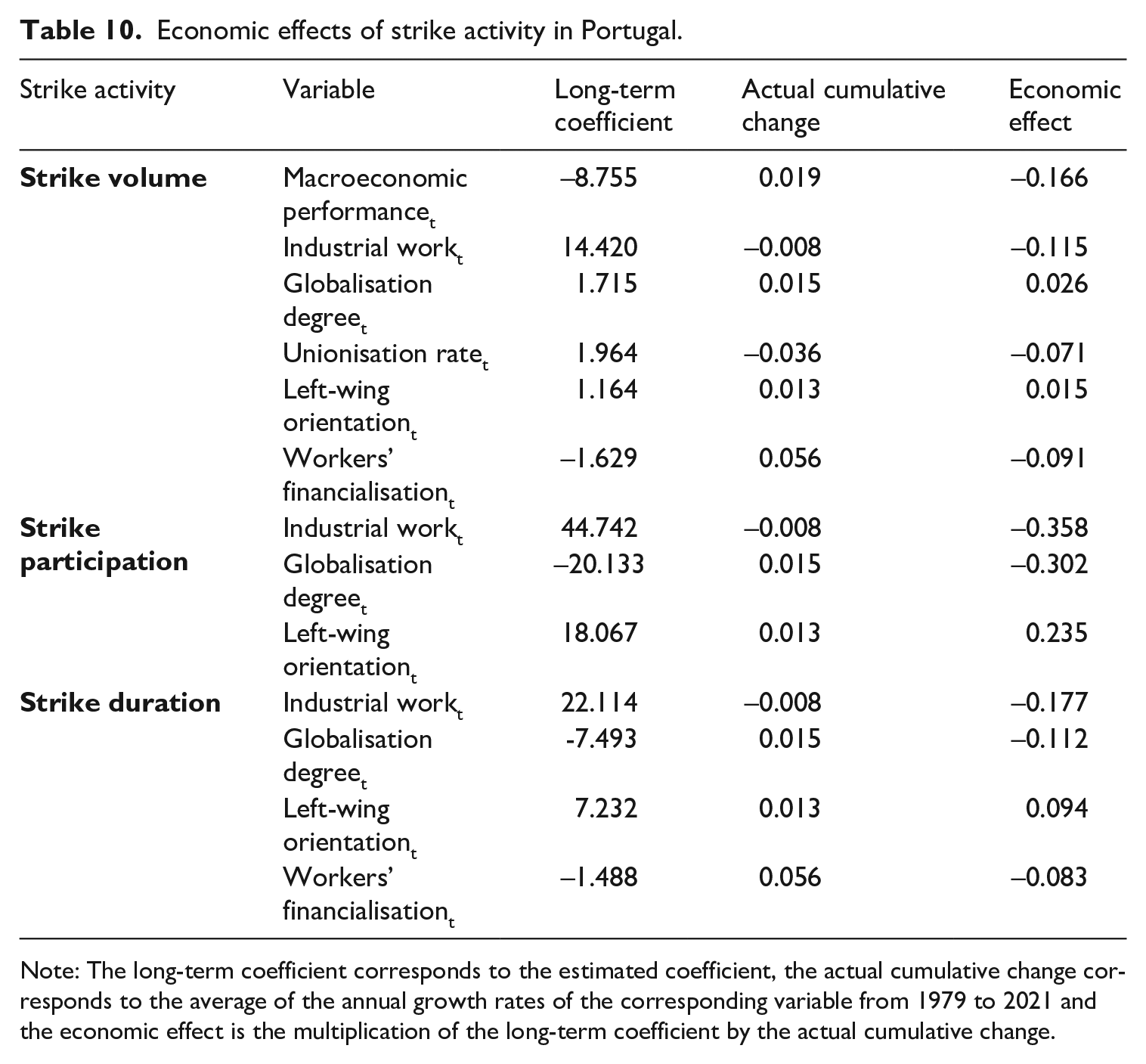
Note: The long-term coefficient corresponds to the estimated coefficient, the actual cumulative change corresponds to the average of the annual growth rates of the corresponding variable from 1979 to 2021 and the economic effect is the multiplication of the long-term coefficient by the actual cumulative change.
To sum up, we confirm that workers’ financialisation and indebtedness levels exert a negative effect on strike activity in Portugal both in the short term and in the long term, but they particularly exert a negative effect on strike volume and strike duration. Workers’ financialisation and indebtedness levels have indeed been one of the main drivers behind the fall of strike activity in Portugal in the last four decades.
Conclusion
This article aimed to assess the relationship between workers’ financialisation and indebtedness levels and their strike activity by performing a time-series econometric analysis focused on Portugal between 1979 and 2021.
During that time, workers’ financialisation and indebtedness levels revealed a strong increase that simultaneously occurred with a general decreasing trend in strike activity in Portugal. This seems to suggest that the decline of strike activity in Portugal cannot be dissociated from the workers’ financialisation and indebtedness levels because their demands for higher wages and better labour conditions have been inhibited due to their fear of decreasing their income and losing their jobs and the consequent risks of default (Gourevitch, 2018; Gouzoulis, 2023; Grady and Simms, 2019; Langley, 2007; Lazzarato, 2012; Stelzner, 2017; Sweet, 2018).
We followed a macroeconomic approach according to which strike activity depends on workers’ financialisation and indebtedness levels and other control variables that have been both theoretically and empirically revealed to be important determinants of strike activity (macroeconomic performance, the inflation rate, industrial work, the globalisation degree, the unionisation rate and the left-wing orientation of the parliament), which allows us to minimise the problem linked to omitted relevant variables and to obtain estimates that are more consistent and unbiased (Brooks, 2009). We employed the ARDL estimator developed by Pesaran et al. (2001) due to the presence of a mixture of variables that are stationary in levels and variables that are stationary only in first differences.
Our results confirm that workers’ financialisation and indebtedness levels exert a negative effect on strike activity in Portugal in both the short term and the long term, but especially on strike volume and strike duration. Our results also show that workers’ financialisation and their indebtedness levels have indeed been one of the main drivers behind the drop in strike activity in Portugal in the last four decades. The fall in industrial work, the rise in the globalisation degree and the reduction in the unionisation rate also sustained the downward trend of strike activity in Portugal since 1979.
Our results provide very important insights for workers, employers and policymakers. Workers should find new ways to demand higher wages and better labour conditions. This is already apparent as workers are starting to limit their commitment to their jobs and/or to put less effort into their jobs (i.e. the so-called ‘quit quitting’) or even to engage in voluntary dismissals from their jobs (i.e. the so-called ‘great resignation’). Employers should effectively improve labour conditions in order to recover levels of job satisfaction, to retain (or attract) talent and the best workers and to avoid high levels of both absenteeism and turnover or even a strong labour shortage (i.e. the so-called ‘general strike’). Policymakers should make all efforts to adopt pro-labour policies, which should involve a re-regulation and de-flexibilisation of labour relations in order to minimise mental and non-mental ill-health (e.g. stress, anxiety, burnout, depression and cancer) and other social costs (e.g. suicides, corruption, violence, criminality, injustice, poverty and destitution) that are directly or indirectly related to the worst labour conditions, to contain the emigration of the most qualified workers (i.e. the so-called ‘brain drain’), to improve labour productivity, to sustain higher economic growth and to preserve the general quality of the democracy by containing the proliferation of populisms and socio-political unrest. Nonetheless, the ongoing deleverage process since the Great Recession and the corresponding reduction of workers’ financialisation and indebtedness levels could induce a resurgence in labour conflict, labour unrest and strike activity in Portugal that could contribute to the promotion of higher wages and a certain improvement in labour conditions.
Our results should be interpreted with some caution for two different reasons. First, they present a limited capacity of generalisation to other countries, which certainly present distinct historical, social, economic and institutional circumstances that could influence the relationship between workers’ financialisation and indebtedness levels and their strike activity. Second, they cannot be generalised to encompass all workers and/or corporations, sectors, industries and/or regions in Portugal. To address these limitations, further research on this matter should employ panel data econometric analysis and/or adopt a microeconomic approach at the worker level, the corporate level, the sector level, the industry level and the regional level. These two strategies will allow us to assess whether workers’ financialisation and indebtedness levels (and the remaining determinants) affect strike activity differently in other countries or even within Portugal, based on other factors according to workers’ own characteristics (e.g. age, sex, qualifications, occupation, type of labour contract, household size and social stratum) and/or according to the corporations, sectors, industries and/or regions of workers’ jobs.
Footnotes
Appendix
The variance inflation factors.
| Strike activity | Variable | R 2 | Tolerance value | Variance inflation factor |
|---|---|---|---|---|
|
|
Strike volume | 0.859 | 0.141 | 7.092 |
| Macroeconomic performance | 0.546 | 0.454 | 2.203 | |
| Inflation rate | 0.927 | 0.073 | 13.699 | |
| Industrial work | 0.871 | 0.129 | 7.752 | |
| Globalisation degree | 0.855 | 0.145 | 6.897 | |
| Unionisation rate | 0.918 | 0.082 | 12.195 | |
| Left-wing orientation | 0.338 | 0.662 | 1.511 | |
| Workers’ financialisation | 0.862 | 0.138 | 7.246 | |
|
|
Strike participation | 0.784 | 0.216 | 4.630 |
| Macroeconomic performance | 0.534 | 0.466 | 2.146 | |
| Inflation rate | 0.923 | 0.077 | 12.987 | |
| Industrial work | 0.859 | 0.141 | 7.092 | |
| Globalisation degree | 0.854 | 0.146 | 6.849 | |
| Unionisation rate | 0.920 | 0.080 | 12.500 | |
| Left-wing orientation | 0.336 | 0.664 | 1.506 | |
| Workers’ financialisation | 0.801 | 0.199 | 5.025 | |
|
|
Strike duration | 0.828 | 0.172 | 5.814 |
| Macroeconomic performance | 0.536 | 0.464 | 2.155 | |
| Inflation rate | 0.921 | 0.079 | 12.658 | |
| Industrial work | 0.863 | 0.137 | 7.299 | |
| Globalisation degree | 0.854 | 0.146 | 6.849 | |
| Unionisation rate | 0.927 | 0.073 | 13.699 | |
| Left-wing orientation | 0.316 | 0.684 | 1.462 | |
| Workers’ financialisation | 0.803 | 0.197 | 5.076 |
Acknowledgements
The authors thank the helpful comments and suggestions from an anonymous referee, Rúben Silva Barros and the participants in Ciclo de Conversas – Governação, Economia e Cidadania (ISCTE – Instituto Universitário de Lisboa, April 2024). The usual disclaimer applies.
Declaration of conflicting interests
The author declared no potential conflicts of interest with respect to the research, authorship, and/or publication of this article.
Funding
The author received no financial support for the research, authorship, and/or publication of this article.
