



Abstract
The Nordic working life model (NWLM) promotes ‘good work’ on societal and workplace levels. However, this model is now challenged by emerging business models in the platform economy. This study investigates how digital labor platforms respond to conflicting institutional logics and how platform-mediated work intervenes with the inherent logic of the NWLM. The authors examine platform business strategies and their implications for working environment regulations, co-determination, and collective bargaining. Empirical data comprising 50 interviews with food delivery workers, platform managers, union representatives, employer association representatives, and occupational health and safety regulators from the Norwegian Labor Inspection Authority were analyzed by applying institutional complexity as a theoretical framework. The findings illustrate that a high degree of institutional complexity provides companies with discretionary space, which they utilize to achieve legitimacy and competitive advantages. The authors introduce the term institutional opportunism to describe how adaptation is performed. The study reveals that the platform economy, characterized by workers with limited experience of and knowledge about working life and strong market pressures, poses a challenge to the NWLM.
Introduction
The Nordic working life model (NWLM) is recognized for its contribution to ‘good work’ (Gustavsen, 2007), understood as employees’ perception of meaningful work tasks, degree of involvement in decision-making, career opportunities, and job security (Gallie, 2003). The model is based on a coordinated market economy in the Nordic countries, characterized by market forces being modified and supplemented by agreements between major interest groups of society, such as employers’ organizations and trade unions (Gustavsen, 2007). It relies on factors such as a high degree of membership in trade unions and employer organizations, the institutionalized power balance between these actors, a high level of trust, and collaboration at the societal and workplace levels (Fløtten and Jordfald, 2019). Although resilient in the face of crises (Dølvik et al., 2014; Eklund, 2011), the NWLM’s adaptability is being tested by emerging platform economy business models.
Digital labor platforms (platforms) have become established business concepts attracting organizational research attention (see Heiland, 2022; Ilsøe and Larsen, 2023). Platform-mediated work (PMW) refers to on-demand paid labor mediated through digital platforms, which appeals to workers seeking autonomy and flexibility. Platforms often designate workers as independent contractors, partners, or freelancers. Although a 2017 survey estimated between 0.5% to 1% of the working population in Norway engaged in PMW (Alsos et al., 2017), there is currently no overview of the scale of the phenomenon in the country (Nilsen et al., 2022b). Many scholars have raised concerns regarding worker safety, health, and well-being from two main strands of PMW research: algorithmic control stemming from technology and precarious conditions created by loose labor ties to the organization (Schor et al., 2020). However, worker satisfaction is heterogeneous and varies considerably, leading Schor et al. (2020: 833) to consider PMW ‘weakly institutionalized,’ i.e., not fully adapted to societal values, norms, and rules.
PMW exists at the intersection of market and corporate logics (Meijerink et al., 2021). Institutional logics present unique organizing principles, practices, and symbols that influence individual and organizational behavior (Thornton et al., 2012: 2). Organizations facing conflicting institutional logics need organizational responses (Greenwood et al., 2011). Resolving tensions between competing logics is essential for addressing stakeholder concerns, maintaining legitimacy, and achieving organizational success (Greenwood et al., 2010; Meijerink et al., 2021).
Although collective bargaining strategies of digital labor platforms in the Nordic context have been investigated by Ilsøe and Larsen (2023), we found that applying the same theoretical framework (i.e., Varieties of Capitalism) was inadequate in explaining negotiation strategies between the two platforms in our study. Moreover, limiting the study of institutional complexity in the platform economy to two competing logics – market and corporate logics (Frenken et al., 2020; Meijerink et al., 2021) – was insufficient in the study of PMW within the highly institutionalized context of Nordic working life. The NWLM involves its own logics, where the main source of legitimacy is egalitarianism which is managed and reinforced through structural and national procedures for collective bargaining, co-determination and collective forms of worker protection. The NWLM has historically had a strong position in Nordic working life, but the institutional logic behind the NWLM is at times in strong contrast to the more global market and corporate logic. This study enhances our understanding of how companies based on emerging business models adapt to new contexts and navigate and influence the discretionary space between different institutional logics. The research question is as follows: How does PMW intervene with the NWLM’s inherent logic?
Using the institutional logics perspective, we examine platform strategies and their implications for working environment regulations, co-determination, and collective bargaining. The empirical data comprise 50 qualitative interviews with food delivery workers, platform managers, union representatives, employer association representatives, and occupational safety and health (OSH) regulators from the Norwegian Labor Inspection Authority (NLIA).
The remainder of this article is organized as follows. We provide a brief overview of previous studies on PMW, followed by the study’s analytical framework and a short description of the NWLM. Using institutional complexity as a theoretical framework, we examine the diverse organizational responses and how they result in only a partial subscription to the NWLM’s logics. Finally, we identify the elements that can advance the inclusion of the model in PMW.
Previous studies on PMW
PMW refers to paid labor organized through digital platforms, with participation from the platform, the worker, and the client. Its field structure comprises a patchwork of digital labor platforms providing work ranging from online tasks that vary in skill requirements to localized services, including ICT consulting and delivery work.
In PMW, traditional open-ended employment contracts and hierarchical structures are replaced by peer-to-peer, on-demand services and ideas of entrepreneurship, autonomy, and flexibility (Ahsan, 2020; Aloisi, 2015). By classifying workers as self-employed or independent, platform companies relegate responsibility (Nilsen et al., 2022a), including financial risks, to individual workers and create ambiguities in existing regulations and labor institutions (Sharma, 2022). Therefore, platforms are described as fervent advocates of neoliberal ideologies that shift company responsibilities to individuals (Fleming, 2017; Murillo et al., 2017; Zwick, 2018).
PMW accounts range from portraying platforms as empowering systems enabling entrepreneurship and independence (Petriglieri et al., 2019) to criticizing them as exploitative and despotic (Griesbach et al., 2019). Tirapani and Willmott (2022) analyzed conflict and found that PMW workers, influenced by autonomy and flexibility discourses, were less inclined to engage in collective action for structural changes. They argued that platforms foster a neoliberal regime that socially isolates labor and individualizes performance responsibility (Tirapani and Willmott, 2022: 67).
This study involves PMW in food delivery. The growing research on food delivery riders has revealed some general and specific working conditions challenges for this group (Christie and Ward, 2019; Griesbach et al., 2019; Nilsen and Kongsvik, 2023). They share the same risk factors as in other forms of non-standard work, including economic insecurity, reward pressures, social welfare gaps, and regulatory gaps (Quinlan, 2015). Specific risk factors include traffic, weather conditions, working alone, and customer interaction (Nilsen and Kongsvik, 2023; Tran and Sokas, 2017). As freelancers and self-employed workers, safety and traditional employer responsibilities are relegated to the individual rider (Nilsen et al., 2022a). Tasks are distributed through an app, and algorithms determine worker compensations, performance ratings, and potentially increase the work pressure (Griesbach et al., 2019). Overall, working conditions are challenging for food delivery riders because of low resources coupled with high work demands and a decoupling of the relationship between the organization and the workers (Kovalainen et al., 2019; Nilsen and Kongsvik, 2023).
While recognizing constraints on radical conflict within PMW, we also acknowledge the heterogeneity of platform adaptations to different contexts. Applying the institutional logics perspective, we describe how social environments with multiple coexisting logics result in varying platform responses.
Institutional logics and institutional complexity
PMW represents a new and rising form of organizing work in Nordic countries (Oppegaard, 2020), which must find its place in this institutional context characterized by a solid industrial democratic tradition (Ilsøe and Larsen, 2023). The institutional theory 1 incorporates a symbolic approach to pure rationality and efficiency considerations in studying organizations (Meyer and Rowan, 1977). Norms and conventions in an organization’s surroundings (i.e., the institutional context) influence its design and structure, and its survival may depend on how these conventions are met. Scott et al. (2000: 237) present legitimacy as a general explanation for why some organizational forms survive over time, while others disappear. Platform companies can be viewed as ‘principal players’ (Scott et al., 2000), aiming to establish themselves as legitimate entities in service organizations.
Later developments in institutional theory consider specific logics that institutions involve, meaning ‘socially constructed, historical patterns of cultural symbols and material practices, assumptions, values, and beliefs by which individuals produce and reproduce their material subsistence, organize time and space, and provide meaning to their daily activity’ (Thornton et al., 2012: 51). As organizations strive for both success and legitimacy (DiMaggio and Powell, 1983), expectations from their surroundings require coherence to these logics in the form of symbols or practices (Friedland and Alford, 1991). In our case, this means that models of the free market, of how corporations should be structured and administered, and of how working life should be organized to support ‘good work’ involve some specific logics and expectations from the surroundings (see Table 1).
Institutional logics in PMW.
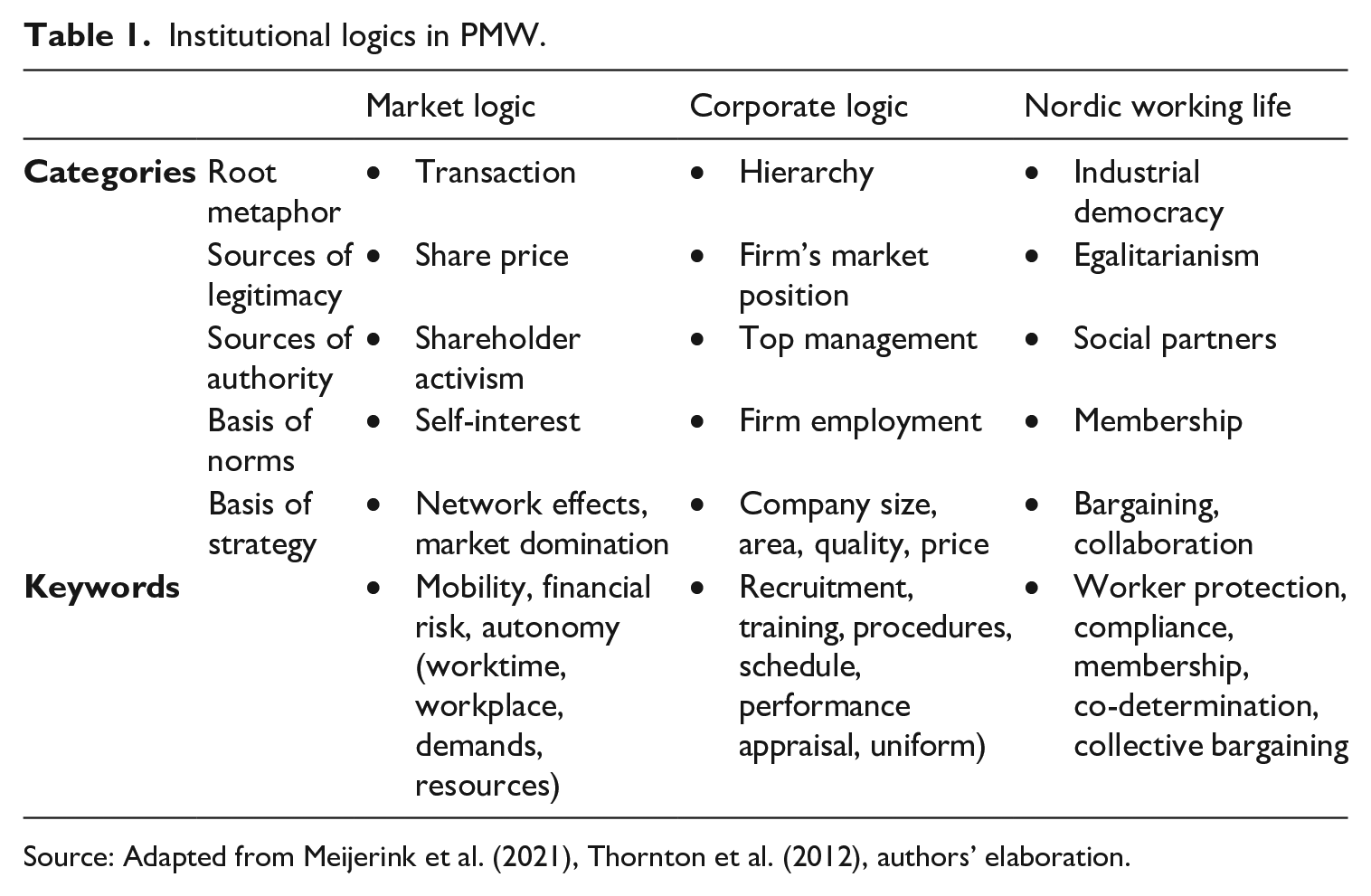
Source: Adapted from Meijerink et al. (2021), Thornton et al. (2012), authors’ elaboration.
This means that organizations might face different and conflicting institutional logics where different sets of rules apply (Kraatz and Block, 2008; Ocasio et al., 2017). This is referred to as a situation of ‘institutional complexity’ (Greenwood et al., 2011: 319). Organizations must somehow respond to this complexity.
Organizational responses to complexity can be strategic and structural (Greenwood et al., 2011). Strategic responses could involve expunging or marginalizing competing identities derived from institutions or attempting to balance them by forging links and increasing collaborations. For example, in high-risk industries, tensions between safety and productivity can be addressed by devaluing safety concerns and safety professionals or fostering sustainable growth, which requires an alignment between safety and productivity. A third strategy might be to build an identity of independence to immunize the organization to external pressures of compliance, that is, by promoting a corporate identity as a new and innovative enterprise. Finally, compartmentalizing identities allows identities to coexist without cooperation. Structural responses comprise blended hybrids, combining logics within the organization, or structurally differentiated hybrids, managing different logics in dedicated subunits. Hybridization simultaneously enhances legitimacy from external actors and efficiency, increasing the probability of success (Greenwood et al., 2011; Kraatz and Block, 2008).
Certain organizational attributes, such as field position, structure, ownership, and identity, can influence how they experience and respond to institutional complexity (Greenwood et al., 2011: 339). Compared to organizations central in a field (because of their size or status), those at the periphery experience lower institutional complexity, as they are less scrutinized and therefore, less motivated to comply with established practices. Further, complex and differentiated organizational structures are more likely to experience institutional complexity because of more intra-organizational communities tied to different institutional logics enacted in the organization. Ownership focuses on the power of certain groups within an organization and their influence on decision-making and organizational responses. Finally, an organization’s identity (Kodeih and Greenwood, 2014) influences its interpretation and response to issues.
PMW can be considered an emerging organizational field with unique characteristics that have implications for the institutional complexity experienced by its organizations (Greenwood et al., 2011). Organizations in nascent fields may experience higher complexity than mature ones, as tensions between different logics are unresolved. In addition, the permeable boundaries of such fields allow easy entry of new actors and introduce practices stemming from divergent logics (Greenwood et al., 2011).
Multiple institutional logics not only constrain behavior but also provide organizations agency when they employ potentially conflicting logics to their advantage (Friedland and Alford, 1991: 232, 248, 251). This perspective offers an opportunity to explore heterogeneity and agency (Thornton and Ocasio, 2008: 104). We investigate how platforms respond to different logics when entering an emerging field where there is ample discretionary space to exercise what we introduce as institutional opportunism. Distinct from institutional entrepreneurship – where peripheral organizations are more likely to initiate radical changes or the formation of new institutions than central organizations (Hardy and Maguire, 2017; Kodeih and Greenwood, 2014: 32) – institutional opportunism in this study is exercised by central organizations within the emerging field of PMW.
Nordic working life model
The Nordic working life model has been presented in terms of egalitarian income distribution, a strong union influence on work–life issues, and generous welfare system arrangements (Midttun and Witoszek, 2020). The NWLM is structurally linked to the organization of working life as it relies on well-functioning businesses and industry, along with comprehensive welfare schemes supported by high levels of taxation and workforce participation. A critical logic behind this is to produce a foundation for equality by ensuring that individuals who engage in paid work can be self-supporting and integrated into society (Bugge, 2021).
The NWLM has historically been defined by elements such as the collective bargaining system, arrangements for co-determination, and working environment regulations (Heiret, 2012). The overarching logic of the NWLM is the centralized and strongly regulated nature of working life, which aims to protect and support the entire population, including the weakest (Moene and Wallerstein, 2006).
The Nordic countries’ collective bargaining system means that wages, sick leave arrangements, parental leave, and pension schemes are regulated through a tripartite bargaining process between employer organizations, trade unions, and the state. In Norway and Finland, collective bargaining agreements apply to all parties regardless of trade union membership. Wage compression attained through highly coordinated wage settings has contributed to profitable and well-paid jobs, even for employees with little or no formal competence (Barth and Moene, 2016; Moene and Wallerstein, 2006). This structure can provide a favorable starting point for platform workers with few formal competence requirements to ensure good working conditions. However, the compressed wage structure renders low-skilled labor comparatively expensive, restricting job opportunities for individuals with limited experience or inadequate education. Consequently, certain groups, such as immigrants, face difficulties entering the Nordic labor market, with much lower employment rates than the rest of the population – the difference ranging from 13 percentage points in Norway to 22 percentage points in Sweden (Østby and Gulbrandsen, 2022).
The collective bargaining system has partly maintained legitimacy through a high unionization rate among workers. Although employees in temporary and vulnerable working conditions may have the greatest need for trade union membership, Nergaard (2018) demonstrates that the degree of union participation is usually higher among permanent employees than among temporary ones.
In addition to collective bargaining agreements, the NWLM is characterized by employers having high expectations of co-determination in matters that impact employee working conditions. Co-determination arrangements are regulated by law and the main agreements between trade unions and employers’ associations. Worker representation practices and institutionalization ensure that trade unions or employee representatives are entitled to be informed, consulted, and have co-determination rights regarding significant workplace changes.
Finally, the Working Environment Act (WEA) is another important aspect of working life in Norway. The WEA (or its equivalent) underscores the prevalence of standard employment relationships in the Nordic region. The Act contains rules on the working environment, working hours, leave, employment, and termination of employment. Under the WEA, employers bear the overall responsibility for the work environment in the enterprise. However, employees must participate in efforts to create a safe and positive working environment. Although the NWLM is developed to enable ‘good work’ (Gustavsen, 2007), in practice, these rights are not universally accessible. Trygstad et al. (2021) demonstrate significant differences between temporary and permanent employees in the private sector regarding their participation and co-determination opportunities. Temporary and hired employees are less likely to be aware of or have access to collective schemes, such as safety representatives and working environment committees, than permanent employees.
PMW and institutional complexity
Building upon previous platform studies applying the institutional logics perspective (Frenken et al., 2020; Meijerink et al., 2021), our study analyzes the institutional complexity experienced by platforms within the context of the NWLM, focusing on market and corporate logics. We identify three primary institutional logics: market, corporate, and NWLM. Both market and corporate logics have been analyzed in various fields and organizations (Goodrick and Reay, 2011; Thornton, 2004; Thornton et al., 2012). The categories presented in Table 1 incorporate existing literature on the NWLM, and keywords related to these categories are included to integrate the institutional logic approaches from previous PMW studies.
The market logic of the PMW becomes evident in how platforms define themselves as digital intermediaries or marketplaces that mediate supply and demand (Muller, 2019; Schmidt, 2017). In Norway, the extent of labor and welfare protection is determined by employment contracts, and employment remains highly significant in both collective agreements and statutory regulations (Hotvedt, 2020).
Consequently, many platform workers outside standard employment relations may find themselves vulnerable. The irregularity of on-demand work and low pay may prevent platform employees from qualifying for unemployment benefits determined by their previous income (Hotvedt, 2020). Platforms have created labels for workers, such as taskers, riders, turkers, and dashers. They have transformed labor into favors, hits, and gigs to distance themselves from labor regulations and potential employer responsibilities (De Stefano, 2016).
Platforms position themselves as mediators that connect clients with workers in exchange for payments. The ‘freelancing entrepreneur’ narrative is constructed using terminologies that emphasize individual responsibility and autonomy (Prassl, 2018: 43). Hiring becomes ‘onboarding,’ uniforms are sold as ‘equipment pack,’ salary is converted into ‘invoices,’ and firing is translated into termination of the ‘Supplier Agreement’ (Prassl, 2018: 44). An emphasis on an entrepreneurial narrative, together with consistent use of terminologies, enables governance of precarious workers (Moisander et al., 2018) acquiescing to neoliberalist ideas of flexibility, autonomy, and ‘individual self-interest’ (Fleming, 2017: 698). In governing the market, platforms reserve the right to suspend or terminate the accounts of users who do not abide by their terms of use or codes of conduct (De Groen et al., 2021; Frenken et al., 2020).
The entrepreneurship narrative is supported by platforms that promote temporal flexibility by enabling control over the work schedule regarding when and how long one wants to work (Ahsan, 2020). The technology also offers spatial flexibility by allowing workers to decide where they want to wait for their orders in delivery work (Barratt et al., 2020) or to work remotely using the Internet in the case of virtual work (Berg, 2015).
Similar to other forms of non-standard employment, the organization of platform work has implications for industrial relations. The Nordic labor authorities have expressed concern about the decline in union membership and the increasing individualization of contracts, which contribute to the lack of representation in the tripartite process essential to working conditions (Mattila-Wiro et al., 2020). Although self-employed platform workers can be members of a trade union, the challenge arises in concluding a collective agreement in which the trade union’s legal status is restricted to representing only employees (Hotvedt, 2020).
Platforms do not entirely subscribe to market logics as they also adhere to corporate logics. Digital technology has enabled several methods of exercising control over work, including supervision (Moore and Joyce, 2020), performance evaluation (Anderson, 2016), and delegating supervision to customers through performance ratings (Prassl, 2018). Spatiotemporal flexibility is also impeded by ‘structural constraints,’ such as work availability and worker dependence on income (Lehdonvirta, 2018: 23–24). Subtle forms of control and algorithmic surveillance (Newlands, 2021) also impact autonomy and flexibility through information asymmetries that influence decision-making and behavior (Rosenblat and Stark, 2016; Shapiro, 2018). Hence, labor control and coordination, by combining technology and organizational elements, constrain worker effort and mobility while ensuring worker availability, efficiency, and reliability (Heiland, 2022). Platform labor control systems contradict market logic and the image of independent market participants (Fleming, 2017).
Meijerink et al. (2021) demonstrated how delivery platforms support market logic regarding workplace and worktime autonomy, job resource autonomy, and job demand autonomy, while training, instruction, recruitment, compensation, management, and performance appraisal adhere to corporate logic. Moreover, they described how delivery platforms responded to institutional complexity through ‘covert’ human resource management approaches, delegating performance appraisal and instructions to customers, and outsourcing employer-related activities to third parties (Meijerink et al., 2021: 4029).
The corporate logic permeating through what Gandini (2018) described as algorithmic systems controlling the labor process may transform labor into a commodity sold in the market, reinforcing platforms’ market logic as an intermediary between supply and demand. Platform features, such as ‘spatiotemporal flexibilization’ of work, have been analyzed for their impact on working conditions (Weber, 2018), although their repercussions for the NWLM in PMW have not been examined.
Platforms have been known to harness advantages from regulatory arbitrage by operating at ‘the fringes of regulation and non-compliance with labor regulations and social responsibility’ (De Stefano and Aloisi, 2018: 4; Joyce and Stuart, 2021); conceivably, platforms employ institutional arbitrage as a strategy to acquire legitimacy. Therefore, focusing on organizational responses to institutional complexity in platform delivery work is worth investigating.
Research strategy and methods
This study focuses on two qualitative case studies of food delivery platforms in Norway, denoted as P1 and P2, and explores how platforms navigate institutional complexity and identifies elements contravening the NWLM. Fifty semi-structured interviews lasting between 45 and 75 minutes were conducted with delivery workers, platform managers (national-level), union representatives, employer association representatives, and OSH regulators from the NLIA. The primary data consisted of these interviews (Table 2), covering broad themes (work description, software application or app features, union membership, motivations for work, and working conditions). The interviews were conducted between February and September 2020, with follow-up interviews and personal communications with key informants between January 2022 and October 2022. Given the challenges in recruiting platform workers for interviews, several strategies were employed, including recruitment near restaurants, social media profile searches, using the platforms’ delivery services, and snowballing techniques (Biernacki and Waldorf, 1981).
Empirical data (interviews and personal communications).
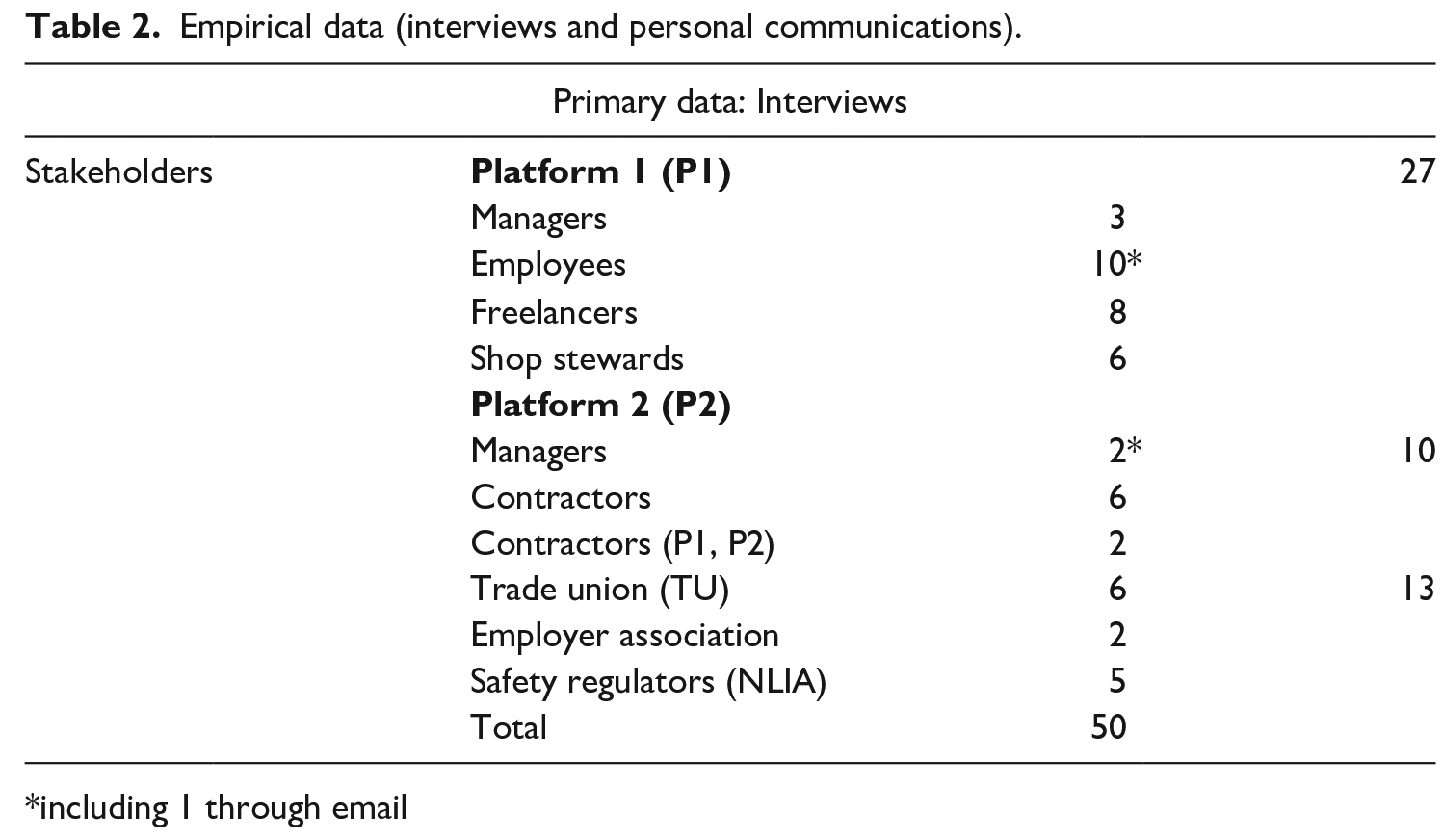
including 1 through email
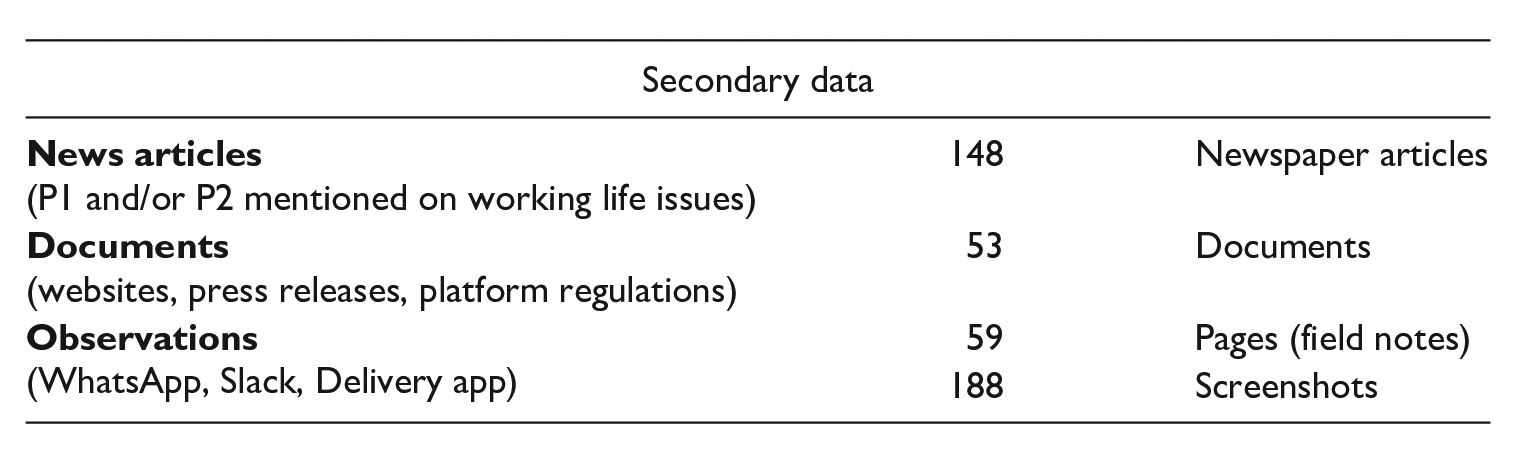
The study also incorporated secondary data from various sources to complement the primary interview data. These included news articles mentioning the platforms, seminars on working life in which one of the platforms was represented, observations of online worker communities, documents from stakeholder websites, and P1 courier interactions on two social media platforms. These two worker-established online communities for P1 are open to all types of couriers, although a few channels are restricted to union members. The ethnographic study was conducted through online community observations performed daily between June and August 2020.
As the entire delivery zone is the workplace, ethnographic studies aided by digital technology (Kozinets, 2010) have provided insights into the social interactions between workers, their views on management, and changes implemented, as well as themes that may not have emerged from the interviews alone. They also provided various worker perspectives not covered because of the limited number of workers willing to participate in the interviews. The websites of the two platforms and their social partners (trade unions, employer associations, and safety regulators) provided some input into their views on platform work in addition to news articles (148 news articles published between September 2019 and October 2022) and seminars held by different research institutes on PMW. Language offers insight into how people understand the world, their beliefs, and their behaviors (Berkelaar, 2017). As logics are uncovered through language, practices, and symbols, qualitative studies are suitable for exploring logics in PMW (Reay and Jones, 2016). Hence, interviews with stakeholders, particularly managers, provided us with an understanding of how companies define themselves in the field and adhere to the three logics examined in this study.
The process of ‘capturing logics’ through a combination of pattern-matching and pattern-inducing approaches (Reay and Jones, 2016) was used in analyzing the qualitative data. Pattern-matching is a theory-driven process that identifies ideal types of logic from existing literature and analyzes data to identify patterns that match the ‘ideal types’ (Reay and Jones, 2016; Thornton et al., 2012). We incorporated elements from the comparative study by Meijerink et al. (2021) into pattern-matching to examine how the two platforms experience institutional complexity and interpret their responses based on the interplay of logic.
Before pattern-matching, raw data were analyzed in three steps, following a pattern-inducing approach (Reay and Jones, 2016). In the first phase, the transcribed interviews were coded into general categories (including functions of the platform, organization of work, presence/absence of unions, communication, contractual relationships, communication and information, training, compensation, ability to reject orders, platform requirements, incentives, and sanctions) using NVivo (version 1.7.1). The findings were discussed by the authors and iteratively compared with extant PMW literature. The results of phase 1 were used as input for the next coding phase. The second phase involved text searches for words related to industrial relations, which were grouped according to elements that constrain or facilitate adherence to the NWLM in terms of co-determination, WEA, collective bargaining, and the need and motivation for collective representation (unionization). This helped determine how platforms respond to various pressures and how their strategies align with workers’ views on PMW. The third phase involved categorizing the codes under three logics and interpreting the data using Greenwood et al.’s (2011) institutional complexity framework.
Secondary data from observations consisting of screenshots and field notes, documents from stakeholders, public discourse through the media, and seminars provided depth to interpreting the analysis of interview data. These provide insights into how platforms attend to the different expectations of stakeholders, the application of logics, and how their decisions impact the NWLM. We drew upon a triangulation process using multiple data sources to create an integrated analysis for this study (Yin, 2010).
Results
This section first describes the organizational attributes of the platforms, followed by a comparison of the market, corporate, and NWLM logics applied by the two platforms. While similarities exist between the platforms’ application of market and corporate logics, their structure and identity distinguish them significantly. Table 3 presents an overview of the similarities and differences between the two anonymized platforms.
Overview of the two delivery platforms.
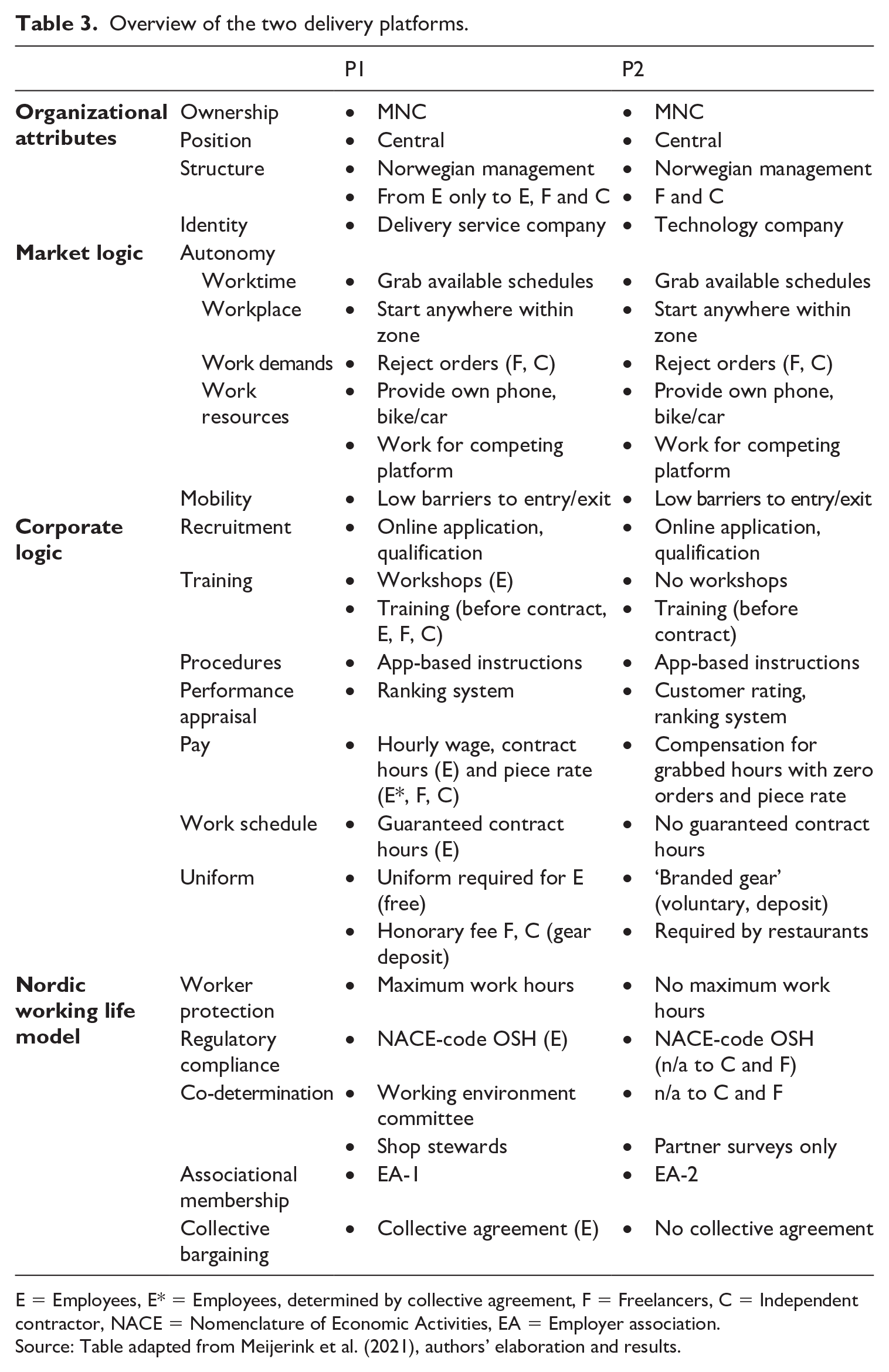
E = Employees, E* = Employees, determined by collective agreement, F = Freelancers, C = Independent contractor, NACE = Nomenclature of Economic Activities, EA = Employer association.
Source: Table adapted from Meijerink et al. (2021), authors’ elaboration and results.
Platform attributes
P1 began delivery services with only employees, whereas P2 started in the country with only freelancers and independent contractors. However, P1 later expanded to include freelancers and independent contractors, which coincided with a union strike and was met with negative reception from employees. The media covered the strike extensively and highlighted the structural change.
Both platforms are operated by multinational companies (MNCs) headquartered outside Norway. The platforms’ software applications (apps) are developed by their respective headquarters. Both companies, mostly operating in the same cities, hold a central position in the country’s delivery market. Managers from both platforms describe the field as still emerging, including its regulations, and express their openness to adapting their business models.
Despite their similarities, they differ in terms of structure and identity: P2 prefers to view itself as a technology company developing new infrastructure that builds a connection between restaurants, retailers, couriers, and customers, emphasizing the importance of all parties benefiting from their partnership. The business model is thus based on a partnership between independent partners and can only work if all parties win from the partnership. The P2 website supports its identity as a technology company: ‘We are a technology company known for our food delivery platform.’
By contrast, P1 positions itself as a delivery service platform that has experienced significant growth since its establishment in 2015. This is supported by P1’s website presentation and job advertisements, which identify the company as a subsidiary of one of the largest ‘home food delivery’ companies. Employees who had been working for several years with P1 remarked on a significant change in the collegial atmosphere among the workers compared to the earlier stages. The platform’s explosive growth, coupled with short-lived worker engagement, resulted in less interaction among couriers. An increasing number of encounters with ‘new faces’ are especially noticeable outside headquarters, which has no designated equipment rooms for workshops and social interaction. Frequent advertisements support an increasing need for additional couriers. An advertisement published in 2022 highlighted the need for 99 new independent contractors in a single city. News articles during the same period illustrated the challenges faced by both P1 and P2 in recruiting couriers, especially during times of low unemployment in the target cities. This indicates the significant growth of the delivery work sector.
Market logic
P1 applies market logic to attract individuals to engage in PMW. Their website emphasizes high demand in the market, ease of becoming a courier, and work flexibility through phrases such as ‘work anytime’ (worktime autonomy). As the city is ‘your office,’ workplace autonomy is also described. They also focus on increasing the number of couriers using the platform through a referral incentive system. P2 emphasizes the low-entry bar to the market by highlighting five easy steps in becoming a ‘courier partner.’ Similar to P1, they underscore worktime autonomy by defining flexibility as the ability to choose ‘whenever you want to’ with a simple ‘swipe.’ Both companies stress job resource autonomy, requiring couriers to supply their own smartphones, mobile subscriptions, and modes of transport (bikes, cars, or scooters). Additionally, both platforms claim to provide easy access to the labor market.
Market logic is also reflected in the terms used by P2 and their focus on ‘partner satisfaction.’ P2’s 2020 survey revealed that 80% of their couriers expressed satisfaction with their partnership, while 10% selected a neutral answer. In addition, their survey found that only 6% of their couriers delivered for them because they had no other alternatives. Therefore, according to the company, the perception that P2 only has marginalized groups does not hold water. However, the interviews revealed that most couriers for P2 in a specific city had migrant backgrounds. While three of our P2 interviewees (including one with a master’s degree) stated that they would prefer a stable job over their current delivery gig, a contractor reflects on the risks the job entails and expressed a strong market logic emphasis of P2: ‘Everybody takes risks. [. . .] Everything has its pros and cons, depending on one’s focus. Some individuals are likely to complain during interviews because they prioritize negative aspects. If they do not like working, they should leave’ (P2, independent contractor-6).
Corporate logic
Recruitment and work processes follow corporate logic related to training, workforce management, performance evaluation, and compensation. Recruitment includes an online application and an online introduction to working as a courier, including requirements and guidelines. Once qualified, individuals formally engage in PMW by signing a contract. P1 offers three types of work arrangements (an employee with a minimum of 10 contract hours per week, a freelancer with employment through a third party, or an independent contractor), whereas P2 only offers freelancing and independent contractor contracts. Except for P1 employees, both platforms provide branded gear and require a deposit for equipment rentals.
Corporate logic is further evident through performance evaluation and internal ranking systems implemented by both companies. P1’s ranking system categorizes users into different groups based on performance, determining their time of access to available hours. One employee describes the ranking system as demotivating for workers: ‘The problem with that is that it significantly undermines morale as it fosters an atmosphere of competition by ranking individuals against one another. This approach is not conducive to cultivating a motivated workforce. Another issue arises from the inaccuracies prevalent in the statistical data provided. [. . .] I think how people are ranked is arbitrary and unfair’ (P1, employee-10).
Unlike P1, P2 courier partners can log on at any time. However, unscheduled work without orders does not provide compensation. Earlier interviews revealed that another system exists that provides a minimum payment for signed-up hours that the couriers could grab during the day the available hours are released. Later interviews revealed that the number of compensated hours had been reduced and kept to times when couriers were usually few and demand was low. Although performance ranking does not directly impact delivery allocation, continuous negative ranking and feedback can be considered when evaluating the termination of a partnership.
P1 employees are guaranteed pay for the contract hours stipulated in their contract. Their hourly wages and additional payments per delivery are specified in their collective bargaining agreements. A piece-rate system applies to freelancers and independent contractors on both platforms. Except for P1 employees, who are obligated to accept the delivery they receive, couriers can reject delivery requests, although this is reflected in the ranking system.
Both management representatives and couriers acknowledged a high turnover of couriers on the two platforms. However, P2 emphasized that turnover, which is generally linked to employment and long-lasting relationships, is less important than flexibility for both the platform company and couriers. They prefer considering worker satisfaction as the key indicator. The flexibility argument has been reiterated in news articles following criticism of PMW’s organizational structure. A P1 manager acknowledged the high turnover of workers and admitted that delivery work offers limited variation and that the structure is relatively flat, providing few prospects for career development. They introduced a team leader position as a form of advancement within the courier role. Team leaders motivate their team members (approximately 10 employees per team) and monitor their performance individually and as a team. The manager added that only a few have been on the platform for years, and they commonly have a passion for cycling.
In addition to training shop stewards on social partner collaboration and employee rights, P1 provides free bike workshops for employees and has a language cafe in their headquarters’ equipment room for foreign workers eager to learn about Norway. The company sponsors social activities for the best-performing group. During the pandemic, P1 started an employment project with a charitable institution and the Norwegian Labor and Welfare Administration to provide individuals entry into the labor market.
NWLM logic
In analyzing the NWLM logic, we focus on how three main issues are handled in the context of the companies studied: the collective bargaining system, arrangements for co-determination, and working environment regulations (Heiret, 2012). The results illustrate that the platforms are not fully aligned with the NWLM logic, although some adjustments were made to adapt to certain aspects.
Collective bargaining
The first P1 collective agreement was signed in 2019. Familiarity with the use of social media to connect an otherwise dispersed workforce, intense (news and social) media coverage of the strike, and the financial as well as strategic backing by a strong labor union are some of the factors that may have created pressures on P1 to conform to the NWLM logic. A renewed agreement in 2022 reflected a continued bipartite relationship. Despite labor union representatives and P1 workers publicly challenging P2 to play by the same rules, P2 management has addressed these issues (also publicly) by underscoring administrative challenges and emphasizing flexibility for workers and the platform to continue with the status quo. The main stumbling block to achieving a collective agreement, however, lies in the structure of P2. There are no employees to begin with.
P1 couriers organized themselves under a transportation union, reaching a membership of 256 during the strike. However, membership has since decreased to 155. Interviews with union stewards indicate three potential causes: (1) high turnover in the sector, (2) employees opting for freelance or independent contracts to increase their earnings, and (3) personal conflict among members.
Interviews also revealed reasons why couriers may choose not to join the union in the first place. These include couriers not viewing themselves as workers but as their ‘own bosses,’ considering membership fees as a cost, lack of awareness about the union’s role, and perceiving courier work as temporary. Union stewards and the trade union view the spatiotemporal flexibility of courier work in the platform economy as a significant challenge, as it lacks fixed work schedules and workplaces where social relations are typically established. Thus, dispersed workers in terms of time and space require more effort from stewards and other union members to engage with fellow workers and develop social ties. An OSH regulator also mentioned the individualistic tendencies among PMW workers, echoing platform rhetoric about working when, where, and with whom they want.
Regulators, EA representatives, and trade union representatives all underscored individualistic tendencies as challenging the NWLM. P2 management acknowledged the NWLM and emphasized their Nordic roots, expressing the need for change to provide fair platform work while maintaining flexibility and safety nets. Both platforms pointed out that the current regulations are not well-structured to accommodate modern working life. While advocating for the inclusion of platform work within the NWLM, they also underscore the need for a solution that can harmonize the flexibility and easy access to the labor market that platforms provide with the values and safety nets provided by the Nordic model. They also highlighted the different conditions under which their competitor operates. While P1 begrudges P2 for leveraging significantly lower costs due to exemptions from certain OSH requirements and labor law obligations, a manager from P2 criticized P1 for ‘stepping forward as the positive role model, claiming to have various collective agreements, whereas, in reality, you can see on the streets that very few premium elites enjoy those benefits.’
Trade union representatives have also used concepts such as ‘the good role model’ and ‘best in class’ to describe P1. This was also mentioned in two seminars open to the public related to the topic of ‘future working life.’ Trade union representatives recognized the room for improvement and encouraged the company’s efforts to align with the NWLM.
Consistent with the NWLM logic and further establishing its identity as a technology company, P2 signed up as a member of EA-2, an employer association for technology and knowledge enterprises in Norway. By contrast, P1’s delivery service identity is reflected in their choice to become a member of EA-1, an employer association for the trade and service industry.
WEA compliance
Freelancers and independent contractors usually fall outside the regulations governing WEA, unemployment insurance, and other social safety nets designed to protect employees. Hence, they are legally responsible for ensuring they have a system and insurance that safeguard their health, safety, and well-being. Statutory limits do not govern freelancers and contractors for regular work hours. Interviews revealed that many workers choose not to work as employees to maximize work hours and increase their earnings.
Under Chapter 13 of the regulations on organization, management, and employee participation, specific Nomenclature of Economic Activities (NACE) 2 codes are obligated to be affiliated with an approved occupational health service because certain occupations are associated with risk factors. This requirement applies to both platforms because they are involved in the delivery and registered under NACE code 53.200 (other postal and courier services). Although P2 management stated in their communications that they are acquiring such services, compliance with the WEA remains only a ceremonial gesture (Meyer and Rowan, 1977) as their employees are all office workers. Thus, the risk associated with delivery work falls outside the organization’s legal boundaries and is faced by couriers performing the work as partners.
P1 has a hybrid structure in which half of the organization adheres to the NWLM, which is observed in the three focal areas. They comply with the WEA by having a safety management system and providing safety training for couriers during onboarding. They have also acquired occupational health services to support the management of workers and the work environment, as required by regulations.
Safety representatives at P1 believed that cooperation with the management had improved. During a period of heavy snowfall, the management and safety representatives collaborated to develop a set of rules that safeguarded the safety of cyclists while maintaining efficient food delivery: ‘The management reminded us of the competition situation but respected our judgments, and we agreed to switch to “walking shifts” in the most extreme snow chaos. On slightly less extreme days, we opened up other measures, such as offering couriers the freedom to reject orders if they felt the conditions were unsafe’ (P1, safety representative).
The same safety representative pointed out that regular working environment committee meetings between the management and safety representatives led to the management deviating from the plan to introduce an algorithm that ranked workers according to the number of orders delivered per hour. The ranking determines the couriers’ opportunities to obtain shifts beyond contracted hours, which means that the workers’ working speed affects their earnings. This plan was discontinued entirely for safety reasons.
However, as many couriers are defined as freelancers, following regulations such as the use of bicycle helmets and lights is difficult. Some cyclists deliver for both P1 and P2 and are not faithful to the platforms’ dress code. Some even use their own clothes and means of transport that are not considered safe. Safety representatives opine that had the relationship been an ordinary employee–employer relationship, regulating would have been much easier. Safety representatives’ greatest concern is that the development seems to be moving in the opposite direction – away from employee status toward freelancer status: ‘We have fewer and fewer employees compared to freelancers in P1 because competition compels the company to opt for the cheapest solution. This means that the OSH only applies to increasingly fewer individuals. The Norwegian model will soon only exist on paper for us’ (P1, safety representative).
Co-determination
The NWLM emphasizes co-determination, with employers having high expectations for employee involvement in matters that impact working conditions. In their daily work, couriers have a certain degree of autonomy as long as they fulfill their professional duties. The manager in P1 describes this as limited guidelines from management: ‘Freelancers receive limited guidance, with the expectation that they deliver a degree of professionalism aligned with our standards. Breaches can be addressed, but otherwise, the contractor role aligns more closely with standard industry practices. However, employees are treated following Norwegian regulations’ (P1, management).
By contrast, in a traditional employer–employee relationship, the employer is a well-known person or persons with whom one can negotiate directly. In PMW, the one ordering the work is a ‘black box’ in the form of a digital platform, where the negotiation options are hidden from the worker. The couriers attempt to comprehend the system but end up making decisions based on poor understanding: ‘Based on my observations, a higher batch number appears to be associated with receiving more favorable orders or an increased number of shifts. This seems to be influenced by demand. In situations of high demand, individuals with higher batch numbers are likely to be prioritized and have a greater opportunity to secure those shifts’ (P1, employee-11). This implies that, even with a certain degree of autonomy in work performance, opportunities to change the basic work conditions are still limited.
Although Nordic countries have often been pioneers in testing and implementing workplace co-determination, this logic seems to be losing relevance in encounters with PMW. Workers themselves may not necessarily view this as a problem. The expression ‘where I want to work, when I want to work, and with whom I want to work. Do not interfere,’ suggests that some workers prefer not to engage in the design of the work. For example, the introduction of the ranking system did not result in high dissatisfaction among the interviewees. One reason could be the high demand for delivery, which ensures enough orders for everyone in the current system. The ranking system has leveled the playing field among the different types of workers by reducing the motivation to reject long-distance requests that may be assigned to employees.
Discussion
Resolving institutional complexity
The results illustrated how platform companies address institutional complexity, as they navigate between corporate, market, and NWLM logics (see Table 3). The NWLM, deeply rooted in the national context, emphasizes employment, strong unionization, collective bargaining processes, and high expectations of worker involvement and participation (Gustavsen, 2007). By contrast, the platform companies promote market logic ideals of flexibility and the notion of ‘freelancing entrepreneurs’ (Prassl, 2018), while also incorporating corporate practices such as digital supervision/control and customer-delegated performance ratings (Meijerink et al., 2021; Moore and Joyce, 2020). While an inherent tension between corporate and market logics (Thornton et al., 2012) may be expected, the selective application of these two logics subject individuals to the corporate practice of labor control despite promoting independence to workers as market participants. That is, market logic is more rhetoric than reality.
The platforms studied are also part of an emerging field in which tensions between different logics must be resolved (Greenwood et al., 2011). Drawing on the concept of a discretionary space or ‘space of possibilities’ inspired by Rasmussen (1997), these companies operate within the boundaries set by the different institutional logics (Figure 1). Within these limits, companies can experiment with responses to institutional complexity, aiming to mitigate tensions between different logics. Platforms experience institutional complexity both within and outside the organization. To address these varying demands, they deal with complexity using strategic and structural approaches.
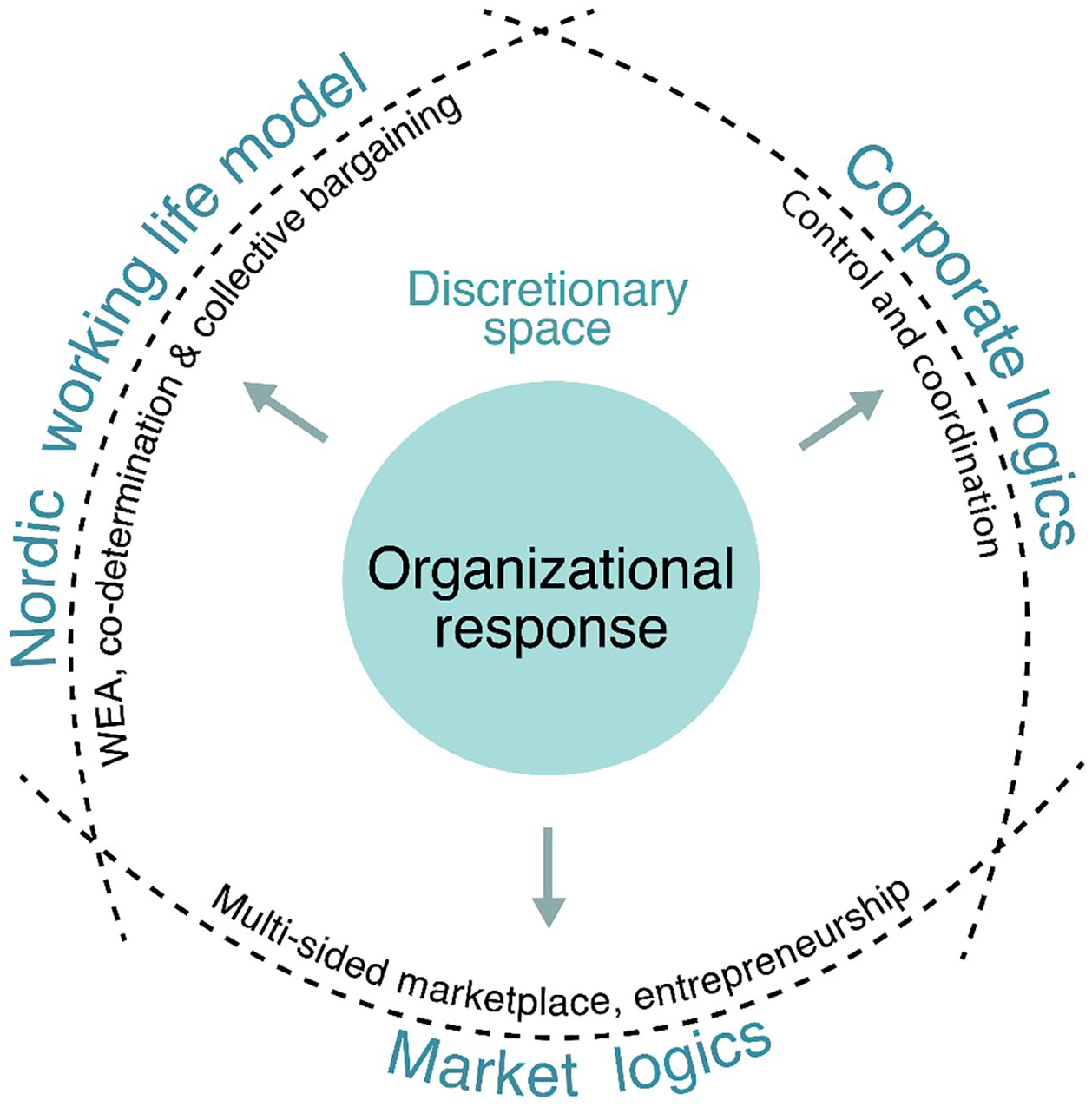
Exploration of the discretionary space to address institutional complexity (adapted from Rasmussen, 1997).
To gain endorsement from important stakeholders outside the organization (Greenwood et al., 2011: 318), they capitalize strategically on market logic in emphasizing independence to attract workers who value autonomy, control over their time, and the desire to be their own boss. These workers are content with the working conditions provided by the platform and do not strongly identify with or have extensive knowledge about the NWLM (Trygstad et al., 2021). This could apply to young workers and workers with immigrant status, who are also overrepresented in platform work (Tran and Sokas, 2017). The utility of this response for resolving the complexity seems to be strengthened by the relatively high turnover of workers and the influx of ‘new faces.’ The strategic use of identity as a technology company (as in the case of P2) could provide companies with more discretionary space and less compliance pressure as they are not strictly bound by NWLM and corporate logics.
One of the companies in this study also introduced a structural response that involved both freelancers and employees organized in subunits with different rights and obligations. The tension between market logic and the NWLM is thus addressed by establishing a differentiating hybrid (Greenwood et al., 2011; Kraatz and Block, 2008), where legitimacy can be obtained from different actors adhering to different logics, such as trade unions and the general public appreciating regulated working conditions on the one hand, and workers appreciating being their ‘own boss’ on the other hand.
Institutional opportunism
The long coexistence of the NWLM and corporate logics has traditionally been complementary in the Nordic context. However, the emergence of digital platforms that combine market logics based on network effects and rapid expansion with corporate logics of control and coordination introduces institutional complexity for platform establishment within the Nordic context. As a dominant, historically grounded societal-level institution, the NWLM is forced upon platforms that operate on a highly divergent consolidation of market and corporate logics, resulting in two contextual misfits. We refer to institutional opportunism as the process of superficially integrating deeply embedded institutional logic into neoteric business models to exploit the wide discretionary space within an emerging field.
Platforms have varying degrees of adherence to the multiple coexisting logics. Research conducted by Ilsøe and Larsen (2023) among Danish platform companies shows that the customer sets guidelines for whether the platform company adheres to the NWLM, such as collective bargaining. Company customers often demand that the providers are legitimate players in the market, while private customers do not have the same requirements. Our research indicates, in addition, that the workers themselves drive this development. While platforms apply control mechanisms that support corporate logic, they use market logic to attract a supplementary pool of workers to cater to the growing demand for convenience and society’s prioritization and valorization of time. As the winning platform in the race to market domination is yet to be decided, companies must deal with the short-lived engagement of workers by continuously attracting new workers and offering autonomy and mobility in the labor market. Market logic appeals to a heterogeneous constellation of workers loosely linked to a platform through smart devices. This heterogeneity includes cultural background, motivation for engaging in PMW, knowledge of and adherence to the NWLM logics, and employability. While many workers are aware of the contradicting logics at play, corporate logic is often disregarded in favor of embracing entrepreneurship ideas, creating tension among workers who perceive a disparity between market logic and complementary NWLM and corporate logics.
Thus, the platform companies challenge the established notions of what constitutes ‘good work,’ and their promotion of flexibility and ‘being your own boss’ appeals to some workers. The opportunism displayed by the companies challenges the core of the NWLM and hegemonic ideals related to work, including participation, career opportunities, and job security (Gallie, 2003). It is a paradox that rights negotiated and fought for by trade unions, such as collective bargaining, WEA compliance, and co-determination, do not seem to be important for many of those whom the rights are designed to safeguard. This applies to migrants, who are particularly vulnerable and where the unions have not been able to meet the migrant workers’ needs (Refslund and Sippola, 2022). Consequently, trade union representatives and rank-and-file members must continuously work to maintain the number of members required for collective agreements. Union representatives themselves may be loosely linked to the organization as they find new jobs or return home after finishing university. Workers’ different backgrounds also become a challenge in terms of communication and understanding the role of unions in upholding the NWLM. Although the challenges posed by internal conflicts between worker groups and external pressures from competition may nudge the platform toward incorporating similar strategies employed by P2, their central position puts them under scrutiny by trade unions, fiercely guarding the values upheld by the NWLM.
Platform ownership and development occur outside Norway and introduce the challenge of complying with the NWLM logic regarding co-determination. Under the WEA, co-determination allows workers to influence their working environment. Even if some standardized communication channels exist, the locus of decision-making is fragmented between top managers in Norway and higher authorities, with a more direct influence on software development. Thus, only minimal co-determination is achieved. Additionally, the platform technology itself hampers employees’ understanding and implementation of co-determination at work.
Furthermore, this study demonstrates the union’s vulnerable position. As highlighted in the interviews, EA membership can be used as an external display of NWLM adherence with limited collaboration. The collaboration process becomes less attractive to platforms as their union counterparts’ bargaining power decreases with membership numbers. The pressure to comply with the NWLM diminishes as employees find freelancing and self-employment more suited to their personal interests.
Two main strategies are relevant for ensuring the model’s viability in the context of PMW. Firstly, there is a need for information to new groups of workers about the NWLM’s importance for the promotion and protection of rights and social development. As illustrated, workers might have little knowledge about the model and limited working life experience. Secondly, regulatory measures might be necessary to countervail the platform companies’ power and adherence to market logic. As the companies are international, regulatory measures might also be needed on the supranational level.
Conclusion
This study illustrates that complexity provides companies with an agency that is applied to achieve legitimacy and competitive advantage. Thus, the discretionary space between different logics represents opportunities for companies. Further, the study demonstrates how companies within an emerging field use the relatively wide discretionary space to loosely adapt to the long-standing Nordic working life model as an institution and to challenge hegemony over the notion of ‘good work.’ Thus, the novelty of the study lies especially in how companies introducing new ways of organizing work adapt to a context were working relations and working life are highly institutionalized. We introduced institutional opportunism as a term describing how this adaptation is performed.
Notwithstanding, the NWLM logic does not readily interweave with the neoteric combination of market and corporate logics (Meijerink et al., 2021) generally used in labor platforms. The limited work experience and knowledge of platform workers and intense market pressures threaten the historically rooted coexistence of the NWLM and corporate logic.
PMW may be considered part of a broader trend of work deregulation and a drive toward more flexible work arrangement. As this study illustrated, ‘good work’ may suffer, at least for certain groups. Nevertheless, the proposal for an EU directive on PMW and regulatory changes in Norway’s WEA (enacted in 2024) may provide regulatory counterforces to strong market logics threatening to undermine the NWLM. These regulatory instruments articulate the value of standard employment relations and offer possibilities to counterbalance the power asymmetry by allocating the burden of proof to the enterprise.
PMW is evident in a range of services. One limitation of this study is its focus on food delivery services. How fruitful the perspective of institutional logics could be for analyzing other types of platforms should be explored further. Furthermore, the study was completed within a Nordic context, and institutional complexity could take different forms in other national contexts where the NWLM is absent.
Footnotes
Acknowledgements
The authors would like to thank the anonymous reviewers and the Associate Editor for their invaluable comments and suggestions.
Declaration of conflicting interests
The authors declared no potential conflicts of interest with respect to the research, authorship, and/or publication of this article.
Funding
The authors received no financial support for the research, authorship, and/or publication of this article.
