



Abstract
Sweden has the reputation of being one of the most progressive countries in the world concerning work-life development and industrial democracy. In this article, an analytical overview of the development in these areas is provided, which includes the antecedents, major events, actor positioning and also the broad-term outcomes. Two major reform movements are described: one aiming to create a radically different work-life where workers control their own work with a power balance between labour and capital, and one a reformist movement aiming to create a degree of co-determination and a more engaging work-life without any major changes in power relations. The case shows that the radical movement was not able to generate radical change and that the reformistic movement achieved only partial success. The outcome over time has been a decreased interest in work-life development where co-determination practices are heavily institutionalized but perhaps do not provide better conditions for workers than in many other advanced industrial countries with a lesser degree of formal co-determination.
Introduction
How the principles and practices for work organization and the formation of complex organizations have evolved over time in different national contexts has been a topic for several important studies in the economic and sociological sciences (Barley and Kunda, 1992; Bendix, 1956; Chandler, 1990; Guillén, 1994; Gustavsen, 2007; Haake, 2002; Hotho, 2014; Waring, 1991; Wren and Bedeian, 2020). These studies have shown – in somewhat simplified terms and despite important differences in national trajectories – that an ideological competition exists between principles for mass production (often referred to as scientific management, Fordism and/or Taylorism) and principles for basic human needs in the workplace (often referred to as human relations and organizational development). On the one hand, division of labour, standardization of work procedures and hierarchical distribution of power can be used for producing products and services in a reliable and inexpensive way, but on the other hand, these principles often create problems such as alienation, grievances, rigidity and lack of innovation. Yet, management practices that take a more humanistic stance have not been easy to implement in a viable way. Some would argue that the capitalist mode of production inevitably reduces the worker into a powerless object, while others would see this as a result of a lack of imagination and human fallibility where insecure managers feel the need to have tight control instead of empowering the employees in joint decision-making (Ciulla, 2000; Hales, 2002).
Since the advent of labour unions, there have been power struggles between owners and their appointed representatives on the one side and the workers on the other side (Dunlop, 1958). State influence and different social actors have affected these struggles in different ways. In Sweden, as in many other advanced economies, work legislation and union agreements have curtailed the power of owners in many regards. However, no real power balance between labour and capital has been established, despite several efforts to achieve this. In this article, we describe and analyse the main trends of the development of governance in the working life of Sweden, where there was a strong movement in the 1970s and 1980s to achieve a power balance and strong work autonomy. This is what we refer to in the article as the Radical Vision. At the same time, there was a movement for reforming work-life with a changed leadership, new roles for the workers and the advancement of co-determination practices within the existing realm of industrial ownership and control, in what we refer to as the Reformistic Vision. The Radical Vision proposed radical change, whereas the Reformistic Vision has proposed reformation of the working life within an existing order. Sweden is also an interesting case in that Swedish industry conducted world-famous experiments in the 1970s, which according to several commentators (Cole, 1991; Guillén, 1994; Sandberg, 1982) led to a socio-technical development that was more extensive and imaginative than in any other country.
The aim of the article is to describe and explain how reform efforts have challenged traditional ways of production with the help of Guillén’s (1994) framework in order to reach a hermeneutic understanding of the historical events. The structure of the article is as follows: after a description of the analytical framework and the methods, a chronological description of the main reform efforts is presented, which is then analysed and discussed on a general level followed by a concluding section.
Theory
There are many different theoretical approaches for understanding industrial relations development, such as structural and institutional approaches (Crouch, 1993; Dunlop, 1958; Kochan et al., 1994). The main theoretical tool for analysis in this article is Guillén’s (1994) explanatory framework for comparative studies of organizational paradigms. The reason for this is that it highlights material conditions, ideational development and actors’ interplay in order to explain the evolution of organizational practices. Mauro F Guillén is a Spanish-American sociologist, well-known for his comparative studies of management practices in a variety of countries. The framework, published in his book Models of Management, is widely used and one of the most prominent analytical frameworks in economic sociology published in the last decades. It can be seen as a synthesis of many of the previous studies and its multidimensionality and orientation towards longitudinal analysis are feasible for our article as it is focused on understanding change and agency as well as continuity, and thereby avoiding the risk of determinism. Guillén’s framework attends directly to the adoption, re-making or rejection of organizational ideologies and practices from governing bodies to the shop-floor level, and thus not only focuses on the role of policy-makers but also the role of managers as an own social class. The framework consists of seven related factors:
Structural changes: For instance, changes of size and complexity of organizations, different types of structure, industrial bureaucratization, and development of markets and general societal beliefs.
International pressures and opportunities: Cooperation and/or competition between national states, the level of openness to other economies and feelings of insecurity/security within societies.
Labour unrest: Guillén sees industrial conflicts as a pervasive engine of organizational change and an impetus for developing new forms of governance. A nation’s labour market can be more or less riddled with conflicts and the amount of cooperation between proponents of labour and capital varies substantially between countries.
Elite mentalities: Mentalities are thought dispositions that are non-reflective in character and comprise a worldview and taken-for-granted assumptions often in connection with religious beliefs. Important elite groups in this setting are capital owners and entrepreneurs.
Professional groups: Salaried managers often make decisions based on their professional training for instance in engineering, business administration, finance or business law. Also, the status and importance of professional groups such as engineers and business economists can have an influence through their training and professional bodies, and they can serve more interests than those of their employers.
State involvement: The state can play an important role for the institutionalization of organizational paradigms, according to Guillén. The level of state activity at the work-life level varies at different times and for different countries.
Workers’ responses: The final factor in the analytical schema is the way workers and their unions respond to different management techniques and ideologies presented to them. Workers’ and unions’ responses can vary from loyal cooperation to hostility.
Guillén (1994) compares the development of organizational paradigms in the United States, Germany, Spain and Great Britain, from the rise of industrialization to around 1970. He shows that each of these countries has developed their own institutions for industrial organization due to differences in strength between the factors in different countries and differences in the interplay between various actor groups. By doing so he demonstrates the usefulness of his framework for describing and analysing long-term development of national labour markets and work-life.
Methods
This research is based on a hermeneutic approach with the interpretation of texts as key method (Czarniawska, 2014). The hermeneutic circle has influenced our research process, implying that the meaning of a part can only be understood in a rich way by relating it to the whole – that is, other facts that are known about the object, its context and its history (Alvesson and Sköldberg, 2009; Silverman, 2019). We have started in certain parts (texts and cases) and have tentatively related this to the whole (the development of Swedish work-life), which has sparked new thoughts and helped us see a bigger picture in all the details we have noticed. We have then returned to texts and cases (existing and new) with this new picture of the development of Swedish work-life, which has constructed new meanings to the texts and cases. A large proportion of the literature is of a historical nature and written in Swedish. Literature has been selected on the basis of relevance and through recommendations, and we have looked for the research that we judge as the most credible – often texts from leading historians or by authors who have studied a particular phenomenon first hand. The writing of the article itself also reflects a hermeneutic circle where by reading and referring to certain details in the description we gain an even greater understanding of the general picture and this picture has in turn made us aware of other details. The article has moreover been developed over a long time period. Consequently, the hermeneutic circle is not a circle when translated to the research process, but rather a spiral. The shift alternately between the whole and the parts gradually creates a deeper and more holistic understanding.
Context: Sweden – a modernist society with post-modern values
A good starting point for Sweden as a case is to note that this is a country relatively abundant in natural resources such as forests, mining and hydro-electric power, which provided a fertile ground for heavy industries in the metals, timber, paper and pulp sectors (Schön, 2012). Also important for the development was a peaceful introduction to democracy, a non-belligerent position in both world wars and without any serious regional and/or ethnic tension. The economic growth from 1870 to 1970 was remarkably strong and meant that Sweden went from one of the poorest to one of the richest countries in Europe (Magnusson, 2000; Mörner, 1989).
At the end of this period, a relatively early adoption of post-modern values can be noted in Sweden, which is visible in the well-known study by Hofstede (1984), where IBM employees from 70 countries answered a questionnaire about personal values around 1970. Here, Sweden stood out in two regards in comparison to other Western European countries: (1) there was a low level of uncertainty avoidance; and (2) a low level of masculinity (the lowest of all investigated countries) (Hofstede, 1984). This should according to the theory imply that Swedes have a high tolerance for ambiguous situations and that they value good relations, environmental care and equality relatively higher than material rewards and social prestige. Moreover, these values can be anticipated to create impetus for a reform movement aiming at greater equality, self-actualization and satisfying work, as material rewards and social status are not seen as sufficient. The focus on equality and personal self-fulfilment in Sweden is also recognized by Trompenaars and Hampden-Turner (1997).
In the theoretical framework of modernization and post-modernization developed by Ronald Inglehart and colleagues (1997), Sweden is a country with one of the highest frequencies of post-modern values, and with a high level of secularization and orientation towards self-expression. Inglehart and Baker (2000) therefore identified Sweden as a country on the cutting edge of cultural change. Byrkjeflot (2003), referring to Cetron and O’Toole (1983), perceives Sweden in a similar vein, as a country especially receptive to social innovation. These cultural features lie behind the early rise of the radical vision as material rewards and safety were not enough to maintain a peaceful labour market in the long run.
Before 1965: Economic modernization through scientific management and collaborative industrial relations
Around the First World War scientific management was introduced in larger industrial firms in Sweden (De Geer, 1978). Gradually, this meant the introduction of principles of mass production and a decreased reliance on craftmanship, as work became more and more standardized and automated. The Social Democratic Party came into office in 1932, and they stayed in power for 44 years in a row (until 1976) even though some of the elections were very close. The labour movement was in this period the dominating political force, where the Swedish welfare state was built with a strong emphasis on equality and economic redistribution (De Geer, 1992). This strength of its labour movement led Esping-Andersen (1990) to refer to Sweden (and the Nordic countries) as belonging to a Social-Democratic regime cluster.
Together with the Social Democratic Party the strongest organization in the labour movement was the Swedish Trade Union Confederation, LO (Landsorganisationen), which organized the great majority of blue-collar workers. LO developed early a positive view of economic rationalization, presupposed a large proportion of the economic gain went to the workers and that the state was supporting workers that became unemployed due to the rationalization and relative high wage increases (Magnusson, 1993). The main idea was that the workers should leave relatively unproductive work (including farming) and move to larger cities with successful export industries. The Social Democrats were also positive towards free trade and industrial restructuring as long as it led to increased standards of living for the common labourer even though this meant that labour-intensive industries such textiles and shoe manufacturing were faced with financial troubles and closedowns. In this way, they accepted the employers’ efficiency paradigm (Oudhuis, 1999).
The dominant philosophy for most of the period examined was definitely modernist, which made it possible for proponents from both private companies and the labour movement to cooperate and to make larger investment in both the private and the public sector. Whereas the public sector came to dominate in education, healthcare, railways, postal services and telecommunications, the private sector was dominant in industrial production, agriculture, forestry, retailing and finance. The outlook among the leaders from both spheres was sometimes antagonistic, but there was also a consensus that decisions should be based on facts and rational thinking, and that a combination of societal modernization and economic growth was basically something to be desired. The leading industrialist of the time, Marcus Wallenberg (1899–1982), collaborated with the state in several important areas such as power systems, telecommunications, transportation and military aircraft and in what was widely seen as a win-win situation between labour, capital and the nation-state.
An early form of co-determination had already developed by the 1940s, with the agreement on works councils, between the federation of employers (SAF), the blue-collar union (LO) and the white-collar Swedish Confederation of Professional Employees (Tjänstemännens Centralorganisation, TCO) (Hedin, 2019). The works councils were voluntary arenas for discussing matters of workplace management and production, personnel and workplace environment (Hedin, 2019). Many employers saw the need to abandon authoritarian governance practices and embrace progressive ideas from the US related to human relations and organizational development where the cultural distance between social classes would be reduced through efforts such as communicative leadership, corporate training and public relations measures.
There were important structural factors behind the interest in industrial democracy, as a means of gradually transitioning companies from Fordism towards post-Fordism (meaning a shift in the organization of production, labour and consumption), in order to solve problems of declining profits (Viktorov, 2006). The first influential business thinker in Sweden regarding industrial democracy was Eric Rhenman, who had studied a year at Carnegie-Mellon (Stymne, 1995). In the role of professor at Sweden’s leading business school, the Stockholm School of Economics, he was given the mission by the federation of employers, SAF, to write a book about industrial democracy. In this book Rhenman (1964) took a reformistic approach and a stakeholder model of the firm is presented. Rhenman viewed a conflict between labour and capital as inevitable. Therefore, he argued, there was a need of industrial democracy to deal with this conflict in a productive and collaborative way, with the long-term survivability of the company as the overall goal. The employees should be seen as an important stakeholder, who should have an important influence, but not a dominant one. Rhenman’s approach to industrial democracy had a very strong influence, especially among employers, and strengthened the reformist approach in the governance of the Swedish economy (Hedin, 2019; Stymne, 1995). He took a modernist outlook as he saw that the problems could be understood on a factual basis and that negotiations could lead to satisfactory outcomes for all parties. Rhenman can be viewed as the pioneer of the reformist approach to work democracy and his standpoint was important for making the employers willing to accept certain forms of co-determination which did not really challenge employers’ prerogatives or the strong emphasis on reaching economic efficiency.
1965–1990: The rise, evolution and decline of the Radical Vision and the evolution of the Reformistic Vision
Increasing tension on the shop floor
The historical compromise between labour and capital in Swedish work-life, which previously had been very successful for increasing productivity and generating growth, met new challenges in the second half of the 1960s (Sandberg, 1982). A new left movement emerged in the Western world, with critique of an unequal economy where the profit motive was seen as detrimental to humanistic ideals. Students in many countries put forward a radical critique of the existing order. In Sweden, there was also a shortage of workers in many industries and many employers were plagued by a troublesome high personnel turnover. For the young generation, higher education was no longer restricted only to the upper-class and they had more freedom as ‘teenagers’ as their years in school were prolonged considerably. They proved rather reluctant to accept the harsh conditions of industrial work with its high work pace, repetitiveness and sometimes poor work environment. Policy-makers from different camps now began to question the principles of scientific management with its fragmented and repetitive work (Tengblad, 2003). All these events created an opportunity structure for various kinds of reforms.
The Swedish Employers’ Confederation (SAF) saw the mounting problem as severe and set up a technical department in 1966 with the mission to find ways of how to combine productivity with work satisfaction and within existing institutional arrangements (De Geer, 1992). The technical department had from the beginning established contacts with researchers from the Tavistock Institute in the UK and Einar Thorsrud and his colleagues in Norway, who conducted work-life experiments in four Norwegian companies in the mid-1960s (Emery and Thorsrud, 2013). This contact turned out to be very important and their book (Thorsrud and Emery, 1969) on the experiments and their view on how work organization could be developed was translated and published by a joint development council consisting of representatives from SAF, the blue-collar union LO and the union for semi-professionals (TCO). Of extra importance in this book was the idea to abolish the supervisory function and letting groups of workers plan their work autonomously (Bäckström, 1999; Sandberg, 1982). This could be seen as a semi-radical approach: the workers were still subordinates and could not object to orders from above, but their status regarding work autonomy became much stronger. This idea remained controversial among employers during the period – some accepted it, others rejected it (see for instance the development with Scania described by Giertz, 1991).
In 1969 the party congress of the Social Democrats decided that the state should play a much more active role in the private business sector. This was the starting point for the holding-company Statsföretag AB that in the 1970s made several investments in regions with weak employment and in companies close to bankruptcy (Källström, 1971). The minister for a newly created Department of Industry, Krister Wickman, decided in 1970 that a delegation for industrial democracy should develop methods for this within Statsföretag (Sandberg, 1982). However, tensions about the delegation’s work soon arose. Svenska Tobak’s (the state tobacco monopoly) top management came into open conflict with the delegation and opposition to industrial democracy was also strong among middle and lower management and even among many white-collar employees. The delegation’s work ended in 1973 without any functional forms of wage-earner influence having been established in the state-owned sector (Sandberg, 1982).
A radical movement for industrial democracy arises
In the 1970s, post-modern ideas had organized themselves into new social movements for gender equality, environmental protection, international solidarity, and – of special interest for this article – for industrial democracy. The emerging post-modernist mentality led to a cultural clash in the 1970s between the proponents of the modernist regime and young politicians with a radical agenda that was gaining popular support. It was a period rife with confrontations on issues such as construction of nuclear and hydro-electric plants, industrialized deforestation, piece-rate systems seen as exploitive of workers, women’s right to abortion and public child-care, a more extensive welfare provision and many other issues. The social welfare net for sickness leave, unemployment assistance, access to educational and healthcare services evolved during the 1960s and 1970s into one of the most generous in the world.
The dominating view among leading Social Democrats had in the 1950s and 1960s been to let work-life be reformed by negotiations between the employer federations and the leading unions – that is, a reformistic approach. However, in the early 1970s two bourgeois parties started to urge for work-life reforms in favour of strengthening the rights of employees, which forced the Social Democrats to become active as well in work-life reform (Schiller, 1988, 2023). For the more radical left and for many representatives of the blue-collar union, LO, the reforms led by the technical department were not sufficient and were attacked for not addressing the key issue in their minds, which was the unequal power over production. Shop-floor reforms should therefore be supplanted and even be preceded by reforms on the boardroom level.
The spark that ignited a fervent development and political activity that challenged the rather slow but steady reformist trajectory more than anything was a large wildcat strike at the state-owned iron mining company LKAB in the northern-most part of Sweden (Schiller, 1988). The strike started at the end of 1969 and lasted for three months, and it provoked a large number of smaller wildcat strikes all over the country. These strikes led to a change in perspective from a focus on technical rationalization to what could be done to adjust the production technology and work organization to the needs of the workers (Schiller, 1988). The reasons behind the strike were mainly related to work environmental problems and an unsatisfactory wage trend, but soon became a question of industrial democracy in the public debate. The miners’ strike strengthened more radical left-wing movements within LO that challenged the reformist way which accepted that the employers had all managerial prerogatives to unilaterally decide both on strategic issues and on shop-floor issues. Thus, at the LO congress in 1971 it was decided that LO should strive for the unions to be co-determinants in the management of the company (Hedin, 2019; Pontusson, 1993). The strategy for this was a fight to remove a rule in SAF’s charter which stated that the employer has the right to unilaterally decide in the area of organization and work management (Sandberg, 1982; Schiller, 1974). However, this call for radical co-determination was difficult to envision in practice and was also incompatible with the Companies Act in Sweden, which states that the shareholders have the full right to exercise power in the companies based on the voting power of their shares. The attitude among industrial owners to share power voluntarily with union representatives was not favourable and SAF defended the right of shareholder representatives to have their decision-making power untouched. A political struggle now emerged, but it ended in a victory for the reformist movement, as will be described below.
Union board representation and the Co-determination Act: Two successes for the reformist movement in 1970s
The CEO of Volvo during this period was Pehr G Gyllenhammar, a career manager unfettered by the strong owner spheres of the time (the Wallenberg family, etc.), and the most acknowledged business leader in Sweden in the 1970s. Gyllenhammar was active in the reformist movement and invited the unions on his own initiative to elect representatives to the company board of Volvo in 1971, despite resistance from SAF. This was two years before a legislative bill which stated that there should be two seats for the unions in companies with more than 200 employees (Schiller, 1988). The new law gave the unions more influence and insight, but the voting power was still firmly in the hands of the shareholders and their appointed representatives.
The notion that employees should have more say on their work has had strong political support in Sweden from the 1970s onwards. There was a robust political majority behind the idea that managers should consult with employee representatives before important decisions and also that joint decision-making be conducted in industrial relations and work environmental issues (Stråth, 1998). During the first half of the 1970s, other new work-life legislation was introduced. The most important was a law for employment protection, the Employment Security Act (LAS), and there were also laws that regulated (and supported) the work for union representatives, work environment and legal rights related to absenteeism for child-care, education, etc. Also changes in the collective agreements were made in favour of the workers, which according to Schiller (2023) were done against a backdrop of new mandatory legislations if the employers were not willing to agree.
To create functional co-determination practices below the boardroom level but above the shop-floor level was, however, more difficult. Haas (1983) noted that the law of co-determination brought a noticeable but not drastic improvement in employees’ opportunities to participate in decisions at the workplace. Managers on different levels were unwilling to share power and differences in viewpoints between managers and union representatives were hard to reconcile. To grant union decision-making power in company affairs was not possible without remaking the Companies Act and curtailing ownership rights (Schiller, 1988). The employers were clearly negative to drastically increase co-determination practices. Also, the Social Democratic Party was reluctant to make larger amendments to the Companies Act, so the work on the new bill was prolonged.
The centre-right coalition, which came to power in 1976, removed the more radical propositions in the bill, which was granted in 1977. The bill replaced the agreements on works councils and expanded the rights of receiving information, to negotiate and in some cases to block decisions, but it did not change the power distribution between labour and capital in any radical way and therefore was more in accordance with the reformist tradition. Both employers and union representatives were dissatisfied with the outcome (Pontusson, 1993), and lengthy negotiations about how the new law should be interpreted followed. Not until 1982 was an agreement established, and this agreement was firmly in the modernist tradition of joint consultation to maintain economic efficiency (Schiller, 1988; Simonson, 1989). The law on co-determination has since then acted as a bedrock for regulating employer–union relations in Swedish work-life and the content of the law in 2023 is still the same. According to Sanz de Miguel et al. (2020), Sweden is the country in the European Union with the highest degree of co-determination and its development has been remarkably stable over a 30-year period.
The proposal, introduction and abolishment of wage-earner funds
After the unsuccessful attempts to reach a more equal power balance through new co-determination legislation and under pressure by leftist activists, LO approached this dilemma by developing a scheme for wage-earner funds. In short, the proposal, which was adopted at the LO congress of 1976, was that companies should issue new shares to be handed over to the unions based on company profitability (Pontusson, 1993). This scheme should gradually make the unions major shareholders of the companies.
Unlike many other proposed labour reforms, it was difficult to gain strong public support for the proposed measures. Instead, Viktorov (2006) claims that the radical wings of LO and SAP were driven by their own political purposes to solve problems resulting from the crisis of Swedish Fordism. Similarly, SAF and the bourgeois parties also mobilized strong resistance to the proposal, which was regarded as a socialistic effort to increase centralized control over the economy and hampering entrepreneurship and personal wealth accumulation.
The bourgeois parties won the elections in 1976 and 1979 and were able to block any legislative proposal for wage-earner funds. Back in power in 1982, the Social Democrats were able to pass a bill on the creation for wage-earner funds, but the most radical aspects had been removed and now there was more of a focus on increased capital investments than redistribution of wealth and power (Pontusson, 1993). The new proposal was still not popular and according to Lewin (1985: 356), ‘The Social Democrats won the 1982 election despite, not thanks to, the wage-earner funds.’ The resistance from SAF and other employer representatives to the funds was very intense (Schiller, 1988). A long-lasting advertising campaign was mounted in 1979 and in October 1983, 75,000 people demonstrated against the funds in central Stockholm, which Stråth (1998) described as a manifestation that the traditional Social Democratic and LO concepts of justice and freedom were now charged with new content by the employers. The loss of the previously established symbolic power of these concepts had major impact on the Social Democrats and LO. Stråth (1998) describes the proposal as, on the one hand, an expression of the political radicalization of social debate from the 1960s that had now reached its peak, and, on the other hand, as an attempt to respond to this radicalization by the trade union movement by canalizing the criticism. However, the long-term impact was according to Stråth that LO lost the political initiative and that the Swedish model began to erode. Also, Simonson (1989) reports that the leadership of LO saw the final proposal of wage-earners’ funds as a defeat.
When the bourgeois parties came into power the next time, in 1991, one of their first decisions was to dismantle the system and to relocate the accrued capital for new purposes, not least work-life development (see below).
The socio-technical movement gains prominence and democratic leadership is introduced
The technical department of SAF forged a leading position in the 1970s for both theoretical underpinnings of work-life reforms and practical development work (Sandberg, 1982). Their main idea was to organize workers into small groups, which meant that workers would have influence over production practices and planning and other forms of job enrichment and that there would be a group level incentive structure with respect to production goals. The department conducted a large number of projects and the most famous was the Volvo Kalmar plant. This plant, inaugurated in 1974, was the first mass-production automotive factory without a conveyer-belt since the days of Henry Ford. The socio-technical movement received at this time strong support from a rapidly growing cadre of work-life scientists (Bäckström, 1999).
The CEO of Volvo, Pehr Gyllenhammar, established himself as an international spokesperson for work-life reforms, to make industrial work more meaningful and rewarding for the workers (Gyllenhammar, 1977). Other prominent business executives of the time such as Jan Wallander (2003), Jan Carlzon (1987), Hans Werthén and Gunnar Dahlsten led companies that publicly advocated decentralized organizations with large employee responsibility in the 1970s. Inherent in this was a critique of existing leadership practices, which were referred to as authoritarian and undemocratic. The new kind of leadership was heavily influenced by the concept of democratic leadership, developed in the US by Kurt Lewin and his disciples within the growing field of social psychology. This resulted in an Organizational Development movement, which became very popular in Swedish work-life in the 1970s. It meant that managers at lower levels to a large degree ideally should involve workers in decision-making and to make decisions based on consensus if possible, and this became a trademark of Swedish leadership (Jönsson, 1994). In the 1980s and 1990s Jan Carlzon and Percy Barnevik become successful CEOs who advocated radical empowerment for achieving anti-bureaucratic and high-performance organizations (Carlzon, 1987; De Vries, 1998). The democratic leadership approach could be used to give more power to subordinates but was also meant to instil a greater sense of employee responsibility, to increase motivation and improve decision-making quality by utilizing the often more fine-grained knowledge about production technology among the skilled workers. This was in contrast to an authoritarian leadership style which could lead to a decrease in motivation among co-workers and also a reason for employees to terminate their employment. These advantages with a democratic leadership style made the concept robust and viable also in periods when improving work-life democracy was not on the agenda.
According to Sandberg (1982), Swedish employers went through a socio-technical evolution in the 1970s that was more extensive and imaginative than in any other country. Sandberg (1995) found through a survey that by the late 1980s, roughly 20% of Swedish firms claimed to have adopted socio-technical practices in some form. Institutional support for socio-technical practices was provided not least from SAF and its technical department that was active in the development of a work organization based on production groups with extended responsibilities for planning, preparation and conduct of work. Socio-technical work organization also received large institutional and financial support from established government agencies in the period, such as the Swedish Institute for Work Life Research, and the Work Environment Fund (Gustavsen et al., 1996). According to the proponents of socio-technical systems, more autonomy and responsibility for workers and employees was seen as very beneficial regarding work satisfaction, commitment and productivity.
The struggles between proponents of the radical and the reformist movement in the 1970s was fought against the backdrop of mounting economic problems. The Swedish economy during the 1970s was much less favourable than in the 1960s. Two oil crises and high wage and tax increases put a heavy strain on the private sector. The new bourgeois government gaining power in 1976 quickly faced a huge problem of companies suffering heavy losses and needing governmental assistance to survive. The state-controlled industrial sector expanded rapidly from the mid-1970s as several large industries in shipbuilding, steel, textiles and others had to be taken over by the state. The competitiveness of the Swedish economy declined so seriously that three currency devaluations (1977, 1981 and 1982) were enforced. The reforms in virtually all sectors of the society were very costly and Swedish taxes increased year by year to become among the highest in the world (Henrekson and Du Rietz, 2014). Still, there was a large budget deficit as high as 14% of GDP in 1981. The political will and capability to reform working life ran out of steam, also among two of the bourgeois parties that previously had challenged the Social Democrats by supporting radical reforms in the work-life area.
The development during the 1980s: The economy recovers
The 1980s saw election victories for the Social Democratic Party in 1982, 1985 and 1988, and an improved competitiveness and expansion of the Swedish economy after a 16% devaluation in 1982. The state-controlled industrial sector was now seen more as a liability than an asset and the majority of the sector was downsized, closed down or sold to private investors. It was in many respects a return to the policies of the 1950s and 1960s, when a strong, privately-owned industrial sector was key for financing both the welfare state and imported goods. Economic growth and stable state finances were in focus for the governments, not work-life reforms.
The period did however contain reform efforts that were more radical. A large-scale research and development programme called ‘Leadership, Organization and Co-determination’ (LOM) was initiated in 1985 which came to encompass 60 researchers and 150 organizations (Naschold et al., 1993). The LOM programme was mainly driven by work-life scientists in collaboration with unions and employers’ representatives and drew on Jürgen Habermas’s ideas about democratic dialogue, where workers and managers were trained in communication skills and took part in open-ended discussions about issues that the participants felt important. The main idea was that better decisions could be made if managers and employees understood each other better and that decisions made in consensus could enhance harmony and develop the workplace. The programme was based on a vision that advances in communication could make work-life into a democratic arena, and thus adhere to the radical movement. However, the LOM programme was not able to succeed in terms of viable work-life practices. Naschold et al. (1993) claim that the reason was the absence of tangible methods for creating ‘undisturbed communication’ where the power of facts and arguments should be seen as more important than the power of the actors. There were probably more factors that contributed to this outcome, such as tradition, educational levels and the urgencies of ongoing production.
The good work: A radical vision for shop-floor production
The blue-collar union LO was from the beginning critical of the SAF inclination to use socio-technical work groups, but changed its strategy in the 1980s. In an influential report from 1985 called ‘The Good Work’, the Metal Workers’ Union (at that time, the largest branch within LO) accepted the use of socio-technical work organization in order to increase productivity and flexibility, if the power over shop-floor management was delegated to the workers. This meant that the supervisory function would be abolished and that production groups were given full responsibility to take care of internal matters as long as agreed quotas of production and quality levels were fulfilled (Metall, 1985). Instead of workers obeying orders, the workers should be able to negotiate on production quotas and delivery schedules. The good work represented in many ways the best synthesis of the radical vision: that is, work that was combining industrial democracy with good working conditions and work development. The report was given strong institutional support by LO and work-life researchers (Johansson and Abrahamsson, 2009). To abolish supervisors was seen both as a means of saving money and to provide job enrichment by making workers supervise themselves in work groups. Here there was a difference in outlook between employers and unions, the former wanted to develop a more entrepreneurial spirit among the employees that worked with production improvements and to create more satisfied customers, while the latter wanted to increase the workers’ internal solidarity as wage-earners in the best interest of the workers in collective efforts. In fact, the idea to abolish supervisors would take firm root in work-life reforms in the wake of the severe 1990s economic crises for the Swedish economy, as part of the T50 programme, but then with a focus on cost reduction as will be discussed below.
In the second half of the 1980s, similar problems with labour turnover and shortages as in the 1960s occurred and the employers were once again motivated to continue with work-life development and particularly semi-autonomous groups. Whereas the Kalmar factory had many innovative features, it was not radically different and the workers had three to four minutes to accomplish their work until an automatic wagon transported the vehicle. The socio-technical aspects also decreased after a downturn in car sales in 1977, which threatened to make the factory redundant. The factory survived this time but the assembly work was substantially intensified (Berggren, 1993).
In 1988, Volvo started a new car factory in Uddevalla based on craft production where small groups assembled a whole car. This was seen as a manifestation of the union vision of ‘The Good Work’ (Sandberg, 1995). The radical movement was still active and influential and the combination of the strength of the labour movement and the three consecutive election victories for the Social Democrats did provide hope for the radical movement, although the political winds were blowing more to the right due to the success of Ronald Reagan and Margaret Thatcher, which meant that more socialist oriented proposals were seen as unfashionable.
After 1990: The further development of the reformist movement – the institutionalization of co-workership and influence of lean production
At the end of the 1980s rapidly expanding real estate prices and irresponsible lending led to high inflation and drew several large banks into insolvency and a large economic crisis with skyrocketing interest rates emerged. The crisis had a strong impact on work-life development, which was clearly manifested by Volvo’s decision to close both factories in Kalmar and Uddevalla due to a severe decline in sales (Berggren, 1995). The Swedish state had mounting budget deficits as the tax revenues decreased. It was strongly pressured by international lenders to make economic reforms. Large budget cuts were made and the intention to join the European Union was declared. The Social Democrats were in opposition between 1991 and 1994 and this was a period of recession in Sweden and employers therefore perceived a need for extensive efforts to decrease costs (Bäckström, 1999). Total employment fell by 12% between 1990 and 1993, in both the private and public sectors (ekonomifakta.se).
Work-life reforms in Sweden now took a different direction. To some extent, different economic crises paved the way for other directions in work-life reforms, since the crises also made unionists accept increasing employer direction in mutual agreements (Murhem, 2013). When the Social Democrats came back into power they did not launch any new major work-life reform, but continued to reform the economy through deregulations and tax cuts on capital gains in order to stimulate growth, fiscal austerity and to be a good member in the European Union. Deregulation not only moved large parts of the infrastructure into private hands but also large parts of traditional welfare sectors such as education, elderly care and healthcare (Schön, 2012).
The T50 programme: Rationalization through socio-technical work design
One particularly influential example of employer-led work reform was the T50 programme launched in 1991 within the Swedish units of the trendsetting engineering firm ABB. ABB at this point took over Volvo’s role as the national leader of work-life reform (Tengblad, 2003). The T50 programme aimed to create radical increases in productivity, customer satisfaction and flexibility as well as to create a corporate culture centred on the creation of customer value (Lillrank, 1996). The implementation of T50 also included the abolition of supervisors in favour of ‘production leaders’ responsible for two or three work groups, making it an interesting hybrid of economic rationalization and socio-technical practices. Each work group was given responsibility for planning, internal work distribution and productivity development (Gustavsen et al., 1996). The role of production leaders was to be coaches for the work groups and not least work with HRM issues such as compensation, personal development, rehabilitation and counselling (Bergström and Sandoff, 2000). Compared to research from the UK that reports a reluctance among line managers to take greater responsibility in HRM issues (Frances and Keegan, 2006; Kirkpatrick et al., 1992; Lowe, 1992), HRM in Sweden has become a major work role for managers (Hällstén, 2003; Tengblad, 2003).
Pivotal for diffusion of the T50 experience was the Swedish Working Life Fund, financed by money collected through the dismantled wage-earners’ fund, which enthusiastically advocated the principles and techniques used in ABB’s T50 programme (Gustavsen et al., 1996). The introduction of work groups with extended responsibilities became a major trend within manufacturing, in services and also in many branches of the public sector. The Swedish Working Life Fund financed 25,000 development projects between 1991 and 1995, most of which combined empowerment and downsizing.
The rise of the co-workership concept
In line with the new approach towards economic rationalization, the concept of medarbetarskap became a phenomenon in the 1990s. Medarbetarskap has no English synonym, but here we translate it to co-workership in line with current research (Andersson et al., 2021; Kilhammar and Ellström, 2015; Styhre, 2002). The concept was intended to support a new and a more active role of employees characterized by agency, responsibility and initiatives among co-workers, but also a strengthened, more cooperative relationship between them (Andersson et al., 2020; Tengblad, 2003). Many organizations, both private and public, have tried to develop a co-workership spirit (Andersson and Tengblad, 2015; Andersson et al., 2020; Hällstén and Tengblad, 2006). This meant that co-workership was developed in line with what the employers wanted, whereas unions (and particularly LO) were ignorant or even negative towards it (Hällstén and Tengblad, 2006).
There are several comprehensive case studies that describe implicit and explicit co-workership development work, through which it is possible to trace strategies and ideas behind the work. Co-workership development could be used to manifest organizational values (Stockhult, 2005), which shows the shift to a reformistic vision, where management tried to extend the boundaries of worker responsibility. Different expectations of co-workership development between different groups (Kilhammar, 2011) manifest an employer/manager/HR perspective focusing on creating responsible employees versus an employee perspective focusing on participation and to be a decent colleague, sometimes in opposition to management decisions. Management did not infrequently themselves define what kind of co-workership should characterize the organization (see Stockhult, 2013), which illustrates the strongly employer-led vision about co-workership.
The development in recent decades
After 2000 the Metal Workers’ union continued to argue for their Good Work programme and they received institutional support from many work-life scientists active in the Swedish Institute for Work Life Research and within the university sector (Abrahamsson and Johansson, 2008). It is not known how influential the concept was other than it was very modest in relation to the employer-led development programmes, and it was furthermore challenged by the vigorous reception of lean production. The book The Toyota Way (Liker, 2004) contributed to a strong wave of lean implementations in industry and many other parts of Swedish work-life. Lean production has spread to new sectors (Kosuge, 2014) and given rise to a new authoritative leadership based on standardization and centralization where work becomes scripted and highly monitored, for example in call centres. Lean practices also challenge work arrangements in Sweden due to increased globalization when similar production models are implemented as global standards (Oudhuis and Olsson, 2015).
The policy shifts in the early 1990s, which included membership in the EU (in 1994), meant that many sectors of the economy were deregulated. The rise of flexible work and platform work (Uber, etc.) or market rationalism with deregulation and increased use of temporary employment arrangements (Calmfors et al., 2018) has led to strong competitive pressures that threaten all forms of work-life arrangements that are not efficient from an economic point of view (Vallas and Schor, 2020). Another challenge to socio-technical work design has been economic globalization (Schiller, 2023) and in particular the reception of the shareholder value movement and the rapid increase of institutional owners almost exclusively seeking high return of capital. In 1993 institutional owners blocked the proposed merger between Volvo and Renault and Pehr G Gyllenhammar consequently resigned as chairman. Volvo was the leading company in Sweden in what can be called ‘stakeholder governance’, where shareholders were seen as an important stakeholder but not necessarily the overarching one. The institutionalization of shareholder value that took place in the years that followed created a more impatient climate according to Tengblad (2004), where achieving better average stock market returns was the focus.
In 2007, a bourgeois government closed down the Swedish Institute for Work Life Research, where most of the researchers who had been active in work-life reforms around workplace democracy and socio-technical design worked. This was a clear signal that work-life research should not be activist but follow established norms of research objectivity and that the state should not have an active role in work-life development. It can also be noted that top business leaders in recent decades have not acted as spokespersons for the development of working life as many did during the 1970s and 1980s. Working life was no longer seen as an arena for creating a better society and the democratic ambitions that were strong during the 1970s and 1980s had definitely waned. LO’s strength has also decreased due to declining membership. The proportion of organized workers has fallen from 88% in 1995 to 61% in 2022 (Landsorganisationen, 2023). The decline was exceptionally strong in the years after 2007 when the bourgeois government reduced subsidies to unemployment insurance administered by the unions. This led to a drop in LO membership by 240,000 in just three years (Landsorganisationen, 2023).
In the 5th European Working Condition Survey (Eurofound, 2012) Sweden stands out as the EU country with the highest frequency of organizational changes (p. 31), the highest percentage of employees who wish to work less than at present (p. 38), and with the highest perception of health or safety risk (p. 61). Although there is relative stability in labour rights and benefits, Sweden is in this investigation a country far from spearheading a humanistic-oriented work-life as we described was the case in the 1970s and 1980s. LO has published several critical reports about the development (Landsorganisationen, 2021). In their annual analysis of wage differences (Almquist, 2023), it is found that what is called the business elite earned on average 22 times more than industrial workers. This was an increase from five times in 1980 when the differences were the smallest.
In a recent study by Oudhuis and Tengblad (2022), the long-term viability of the socio-technical work design is investigated at the heavy truck manufacturer Scania, a company previously famous for work organization according to socio-technical ideals. The study showed a strong reception of lean production with many practices stemming from Toyota: i.e. rather narrow and repetitive tasks for operators, with designated supervisors (team leaders). In this setting neither the radical vision nor the reformistic vision is really maintained. While it is not possible to say that this case is representative for the development of Swedish work-life, it shows that international influence continues to be important and that this influence can take very different directions than was anticipated by actors from the 1960s and 1970s. On the macro-meso level the Union Board Representation Act and the Co-determination Act have survived the impact of global management concepts and competitive pressures, but on the shop floor socio-technical work-design seems to be in danger. The concept of co-workership has been established but remains firmly in the hands of the employers, more as a prescriptive ideal of employee behaviour than as something that is a part of workers’ own identity. In many ways this state of affairs can be seen as only a bleak remnant of the ambitions of the work-life reformist agenda emerging in the heyday of Taylorism in the 1960s.
The picture described above has developed against a background of a very low level of labour unrest. Between 2000 and 2009, only 10 minutes per year per worker were lost due to strikes. The period 2010–2019 saw a significant drop to just 69 seconds according to the European Trade Union Institute (www.etui.org). This equates to less than one hour of strike action in a worker’s lifetime and is about 5% of the European average.
What about future developments? It could be argued that a continuous individualization is threatening socio-technical work designs as young workers may be less inclined to take up a responsible role within semi-autonomous work groups. They seem to prefer individual feedback from their manager and individual development much more than workplace development, with more focus on one’s next assignment than one’s current one – ‘already elsewhere’ as it has been described (Strannegård et al., 2001). The question is whether we are facing a development where the cooperative relationships that we can see between managers and employees will be abandoned for traditional managerialism. In that case, the radical vision for work organization practices has transformed to a reformist one, and might be exchanged for no vision at all. Swedish working life in the future may resemble other late capitalist economies where the radical vision of a different working life resembles a rather short, albeit very interesting, historical episode.
Discussion
In summary, the case over this long period of time involves a radical movement that aimed to give workers, through their unions, an equal power base through formal decision-making bodies and legislation (Figure 1). When this was not successful, an attempt to create employee funds was made but also with little success. Moreover, the ambitions to create a large state-controlled industrial sector turned out to be very costly for the state and the taxpayers. At the shop-floor level, proponents of the radical movement argued to give workers a great deal of control over work processes; that is, to see workers as independent contractors and/or actors with equal power in democratic dialogue.
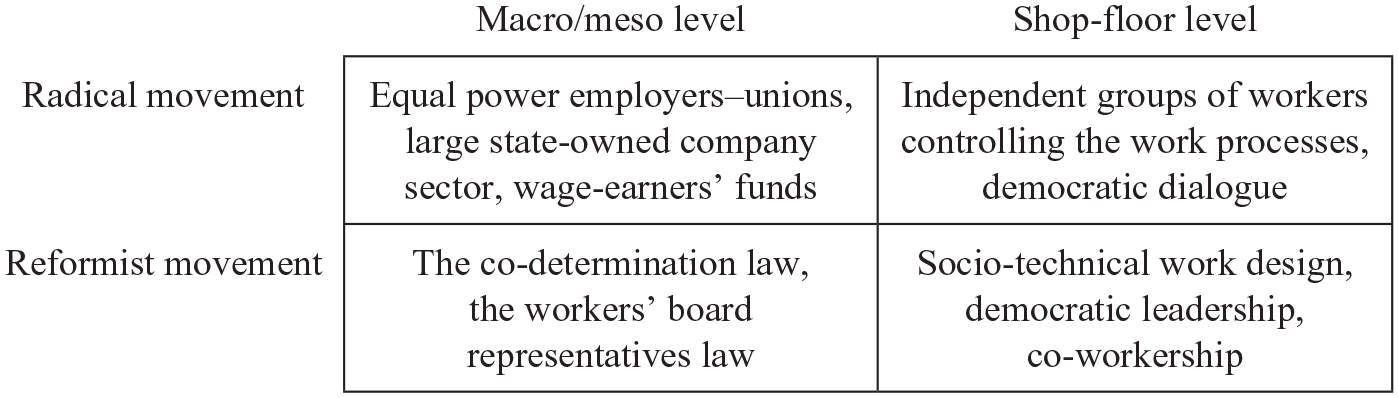
Summary of reform ideas in Swedish work-life from 1965 and onwards.
The reformist movement was more successful when new legislation was passed in the 1970s strengthening the rights of workers/employees by giving unions seats on company boards and their right to be consulted and sometimes even to negotiate and veto. On the shop floor the use of socio-technical work design increased over time, especially in the 1990s when it became focused more on production efficiency than work improvement. The responsible role for the worker/employee, that is, co-workership, now became defined more from the employer side as productive employee rather than as solidaristic wage-earners (Andersson et al., 2020). In summary, the reformist movement has focused on giving employees more voice and responsibility to increase economic efficiency by remedying some of the dysfunctions of Taylorism and bureaucratic organizations.
The results show that the efforts behind the vision to create a radically different work-life with an equal power balance did not come to fruition. However, the radical movement should not be seen as a failure, as its efforts probably made co-determination more extensive and more strongly institutionalized than without the pressure it posed to achieve working life reforms. Thus the reformist movement was most successful when the radical movement was at its strongest, that is, during the 1970s. Similarly, during this time period worker autonomy was increased with the reduction of direct supervision and industrial work became less tedious with efforts to train multi-skilled workers and the use of long work cycles. The reformistic vision of responsible workers/employees with a focus on work development and customer satisfaction has also not been fully accomplished even though the role of workers/employees has been more active and responsible. The vision of turning them into loyal stewards who put their own self-interests aside for a common cause remains elusive. Furthermore, the long-term effects of the increased importance of workers’ rights, union influence and progressive work design in the 1970s and 1980s have waned over longer periods, as illustrated by the introduction of lean production and a decline in union membership. The development illustrates that even in a country with in many ways exemplary labour movement strength and the Social Democrats’ political longevity, it has been an overwhelming task for long periods to succeed in working life development and democratization, and also to maintain radical sentiments among the political followers and members. Conflicts in Swedish work-life are seen as uncomfortable and costly, by employers, politicians, union representatives, and the wage-earners themselves. Negotiations and agreements related to collective agreements are the standard operating procedure when grievances have occurred; they are like the valve in a pressure cooker, releasing steam in an orderly fashion and helping to maintain high pressure without risk of explosion. It may lead to both hostilities and more ambitious work development being rare.
In the further analysis of the process and outcome, we return to Guillén’s (1994) framework:
Structural change: The increased affluence and stronger emphasis on quality of life and self-actualization presented a challenge to the Swedish system where employers and unions cooperated in order the raise productivity according to the principles of mass production. Post-Fordism represented a departure from rigid organizational structures based in the mass production era. The movement was generally towards greater adaptability and technological advancements, but it also meant a shift towards knowledge-based industries, and a more globalized and consumer-driven economy. The more affluent baby-boomers did not want to be cogs-in-the-machine as their parents were. This change created an impetus for change of the existing order and the strengths in the movement consisted of several actor groups (managers, workers, politicians, representatives of interest organizations, work-life scientists, etc.).
International pressures and opportunities: The rapid rise of a strong new left movement that started in the US and France and spread rapidly to Sweden led to demands for radical changes to Swedish working life. Socio-technical work design, mainly developed in Great Britain and Norway, was introduced as a solution together with humanistic and democratic ideals of leadership stemming primarily from the US which served as international opportunity structures. When there was a high external demand for Swedish products (1965–1975 and 1983–1990), employers were more interested in work-life reforms with a humanistic orientation, while harsh economic conditions (1976–1982 and 1991–1995) created incentives for rationalization regardless of the effects for the workers. Ongoing deregulations, in particular the creation of the European Common Market, the rise of low-cost Asian manufacturers and platform companies such as Uber, have created strong competitive pressures which serve as a threat to many of the unique features of Swedish work-life.
Labour unrest: The case supports Guillén’s view that industrial conflicts are a pervasive engine of organizational change. The wildcat strikes in Sweden in 1969–1970 convinced many employers of the need to make reforms in order to continue to have a rewarding cooperation with unions and workers. The radical vision movement was more influential when labour was a scarce resource. One might also wonder whether a generally peaceful labour market could hamper work-life reforms since employers might not see the need for them if there is little unrest. It is definitely worth looking more closely into how tougher working conditions and growing inequality in recent decades have coincided with record low levels of industrial conflict.
Elite mentalities: The employer federation had during the period a relatively progressive stance towards industrial democracy/co-determination and work-life development, but they had a focus on allowing such developments without losing control. Not surprisingly, they were negative towards solutions that could more drastically reduce their capital income and control over the companies. Their resistance to far-reaching industrial democracy and the wage-earners’ funds has been fierce throughout the period, especially when they feel threatened by radical claims. In the 1990s, they were willing to give workers broad work autonomy in exchange for a focus on productivity increases, which was in line with the tradition of compromises that primarily had governed Swedish working life over longer periods of time.
Professional groups: Historically, the power of engineers in manufacturing can explain the strong orientation towards scientific management, while the described work-life reforms were spearheaded by social scientists and psychologists. The case shows that senior career managers were receptive to the trends of the time and that they can promote the development of working life reforms. There were several top executives from a younger generation who were very positive towards ideas like decentralization, democratic leadership and group organizations, i.e. the reformistic movement. There are also several examples of resistance to more radical solutions such as self-governing work groups and power sharing between managers and employees. Linked to contextual factors it can be noted that top career managers in recent years are not very interested, or not at all interested, in work-life reforms. There are reasons to believe that career-oriented professionals most likely choose paths to promotion other than work-life development. The path to the ever-increasing executive compensation is through agile behaviour, ability to keep a budget and an unquestionable loyalty to superiors (Tengblad, 2004).
State involvement: The Swedish state played an important role, first as catalyst for labour reforms during the 1970s and 1980s, but then gradually reduced its involvement. The ebb and flow of state involvement is in line with Guillén’s analysis. When there was a strong political interest in work-life development, the state became an important actor, firstly as legislator and secondly as financier of work-life development. However, the traditional stance of the state in Sweden is not to interfere actively other than to give financial assistance in restructuring efforts and support for investments in new technology and sometimes in the establishment of new industrial sites. This passive role of the state has been especially heralded by the employers’ federation and the bourgeois parties. The state’s non-interventionist stance was further emphasized when the Swedish Institute for Work Life Research was closed in 2007.
Workers’ responses: It can be noted that the workers’ interest was divided. The blue-collar workers and their unions were much more committed to the work of humanizing and democratizing working life, while the white-collar employees were more in favour of the reformist vision. The labour union took initiative related to the radical movement and sought an equal power base and self-governing workers. But the mentality of the labour movement is relatively cooperative and a high level of tension is rare. Thus, the employers do not risk high levels of tension related to rationalization and restructuring efforts. Furthermore, the radical movement could not for extended periods of time gather strong support for its cause by mobilizing a workforce willing to fight hard to abolish or at least substantially reduce employer prerogatives. When the Social Democrats were in power, they often prioritized good relations with industrialists and investors, striving more for economic growth than economic democracy. In the 1980s the tensions between the party and LO, who wanted the party to act in a radical direction, became so strong that it was labelled the ‘War of roses’ (a red rose features in the party’s logo). Without radical sentiments either among the party or among the members, LO’s ability to counter the development has largely been insufficient.
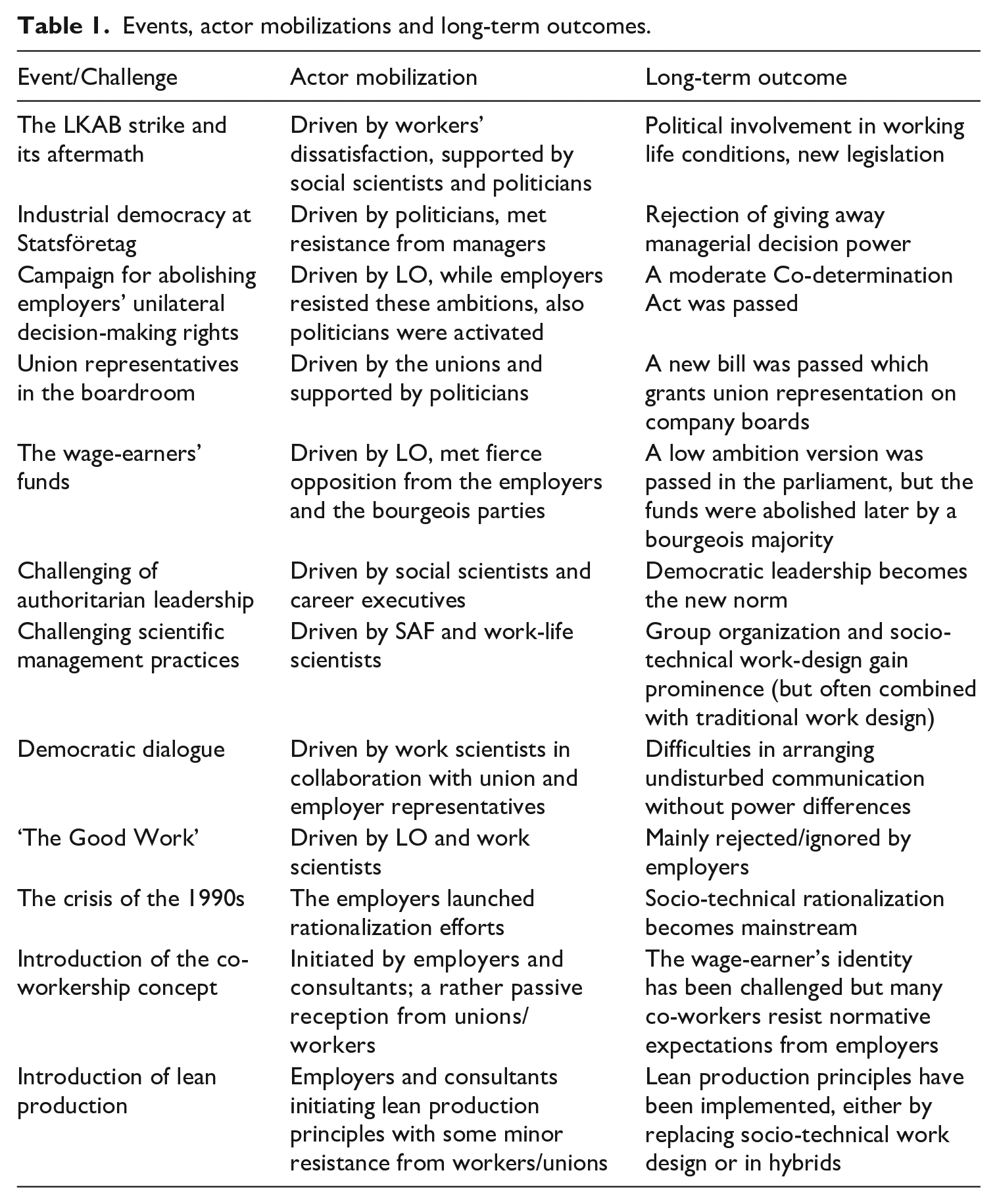
In Table 1, we summarize how different events entailed different actor mobilizations and what the outcomes were.
Events, actor mobilizations and long-term outcomes.
Conclusion
This case describes the rather extraordinary development of Swedish work-life over more than half a century and tries to explain what made the radical vision to reform work-life to emerge and to challenge the existing order, but which eventually failed to win enough political support for a different distribution of power. The reason for this may be related to the uncertainty of whether industrial democracy really produced positive outputs in economic terms, and probably its inability to win elections. It was during the era of the strong left movement that the extraordinary long period of Social Democratic power ended (in 1976) and increasing economic problems also led to their defeat in 1991. On the contrary, periods with a focus on maintaining strong economic growth and stable public finances have been a source of renewed electoral victories. Margaret Thatcher’s famous slogan ‘Labour Isn’t Working!’ may echo as a warning for leading Social Democrats not to turn too much to the left. This could in this case be contrasted with the words that ‘Labour Isn’t Striking!’ as the calm attitude on the part of workers and their unions does not provide incentives for employers to undertake work-life reforms. The result has been a working life that combines a high level of unionization and relatively generous employee rights and benefits, but which, on the other hand, is also characterized by a focus on cost efficiency, rationalization, significant work environment problems and yet humble and docile workers.
Footnotes
Acknowledgements
The authors want to express their gratitude to the two anonymous reviewers and to the journal editor for constructive comments on previous versions of the article.
Declaration of conflicting interests
The authors declared no potential conflicts of interest with respect to the research, authorship, and/or publication of this article.
Funding
The authors received no financial support for the research, authorship, and/or publication of this article.
