




Abstract
Researchers still struggle with unravelling the internal interaction processes between management and employees (and their representatives). In empirical studies explaining the effects of works councils, the multidimensional nature of the works council–management team relationship is therefore largely ignored. By utilising a unique questionnaire among works councillors, this article examines the (potential) inner workings of this black box, by developing a construct aimed to capture the essence of these forms of social interaction. The authors find that behavioural aspects of cooperation, power, communication, goal sharing and trust significantly affect the relationship between works council and management. The authors also test their construct via a model that seeks to explain the influence of works councils on company decision-making. Their results indicate that despite a few noticeable cross-country differences, their black box construct is the most important factor in explaining this influence both in Germany and the Netherlands, revealing that a good relationship with management is imperative.
Keywords
Introduction
On paper, by law, works councils in both Germany and the Netherlands have ample possibilities to exert influence on company decision-making: these worker representation bodies have extensive rights of information, advice and consent in both countries, legally rooted in the works council (WC) institution. WCs are obliged to act in trustful cooperation with the employer (in Germany) or to serve both the interests of the workforce and of the company at large (in the Netherlands). If WCs exercise these rights to the fullest, this could benefit employees and employers alike in terms of a range of outcomes, as Industrial Relations (IR) empirical research has increasingly shown over the years (for overviews, see e.g. Addison, 2009; Jirjahn and Smith, 2018; Nienhüser, 2020).
In all likelihood, the positive WC effect runs through a mediation channel. Specifically, we can expect that having a WC in place will lead to favourable organisational outcomes as a result of trustful interaction between employee representatives and management. Such a mediation channel involves an internal mechanism of intra-organisational interaction through which these advantages could materialise, ranging from sufficient information provision by a supportive management team (henceforth MT) to a cooperative WC, endowing the latter with sufficient facilities to exercise its representative function well. Then, the WC is enabled to develop a substantiated, knowledgeable opinion in order to come up with valuable advice. Of course, next to mediation, moderation may impact outcomes. Particularly the specific context in which WCs operate may play a moderating role, examples being the economic circumstances, the extent of trade union involvement, and the degree of backing by the workforce.
Yet, the majority of extant IR studies fail to (or hardly) measure any of the elements that make up this internal mediation mechanism, usually because of a lack of detailed information in the data regarding the inner workings of the WC–MT interaction. Large-scale data sets containing all sorts of demographic and economic indicators about organisations normally only include one question, at best, regarding whether or not a WC is present. In this type of studies, the mere presence of a WC is hypothesised to impact organisational performance positively. And if this positive impact is indeed found, it is ascribed to this unobserved and hence unidentified internal mechanism, often with reference to the (theoretical) arguments forcefully put forward by Rogers and Streeck (1995) and Freeman and Lazear (1995).
Increasingly, however, there are calls for (and attempts to) quantitively capturing the ‘contents of the black box’ associated with this organisation-internal mediation mechanism (Frege, 2002; Jirjahn and Smith, 2018; Nienhüser, 2020; Pfeifer, 2011). Already decades ago, the German sociologist Kotthoff (1981, 1994) attempted to qualitatively unravel the black box of WC–MT relations by developing an elaborate typology of WCs that became very influential. Based on a range of different dimensions, he classified WCs into ineffective and effective types. In a few later studies, similar typologies have been used to examine the effects of different WC types on outcomes such as personnel turnover, innovation and profitability (Dilger, 2006), labour agreements (Nienhüser, 2009), productivity, wages and profits (Pfeifer, 2011), and establishment survivability (Addison et al., 2023). Recently, Addison and Teixeira (2020) contributed to this stream of literature by including the effect of mutual trust between MT and employee representation in a quantitative study on organisational performance, showing that different WC types do not function in the same way at all, underlining the importance of taking behavioural interactions between WC and MT into account when empirically estimating their effect on any outcome.
However, the current state of the art suggests a conundrum. On the one hand, qualitative research is able to reach nuanced and subtle conclusions, but is often based on just a few cases. On the other hand, quantitative studies usually employ large(r) data sets, but these include only limited (if at all) information about the actual internal functioning of WCs in relation to their MT. The current study intends to pick up that gauntlet, aiming to answer two consecutive questions: (1) How can we, in a quantitative manner, open the black box and identify the key dimensions of the internal WC–MT relationship? And (2) can we demonstrate that this ‘summary black box construct’ can contribute to the explanatory power of a straightforward regression model that takes a measure of WC effectiveness as the independent variable? As far as we can see, our summary black box construct is new to the works council literature. This implies that our primary contribution is to develop a reliable and valid measure of the key mediation channel of WC–MT interaction, with the first question addressing the essential issue of internal validity, and the second that of external (or predictive) validity. So, our study serves primarily a measurement development purpose.
Specifically, as a predictive validity check, we test to what extent our composite construct is associated with an employee representation outcome that happens to be available in our own data: the degree to which WCs believe that they exert influence on company-level decision-making. We use self-collected data from a unique questionnaire conducted in 2014 among Dutch and German WCs. With these comparative data, we can also examine to what extent and in what way the effect and role of Dutch and German black boxes differ. This implies a secondary contribution to the literature, by way of by-catch, because most studies are still concerned with German WCs only. Moreover, extant work typically makes use of MT respondents, whereas our data set is based on WC informants. Comparing Dutch with German WCs is particularly interesting as a litmus test of employee representation effectiveness, as both countries rank high in terms of strict WC regulation. That is, by focusing on this pair of countries, we can explore whether or not this internal mediation channel is important to explain WC influence next to and on top of strict regulation.
We proceed as follows. We start by reviewing the relevant literature on the causes and effects of WCs of different types in different countries, with a focus on qualitative studies that already moved beyond the crude approach of a council dummy. This will provide the building blocks (or dimensions) needed to create our own conceptual ‘summary black box construct’, which is followed by introducing our measurement development strategy. After the description of our data set, we present our findings for our two country sub-samples. First, we report which factors affect the WC–MT relationship, addressing the internal validity issue. Second, we examine how this relationship, in turn, affects WCs’ perceived influence on company-level decision-making, in concurrence with contextual circumstances, so exploring the external (or predictive) validity issue. As a by-catch of our methodological exercise, the latter provides the opportunity to produce a substantive contribution in the form of a two-country comparison of WC effectiveness. Our findings convincingly show that a detailed quantification of the WC–MT interaction is possible, and that the resulting construct is by far the most important determinant when taken up in a model explaining employee representation effectiveness. We reflect on our findings in the Conclusion.
The heterogeneity of works councils in the literature
Key aspects of the mediation channel
Many qualitative cases studies and, in subsequent years, albeit less so, quantitative analyses on employee representation–MT relations have been performed in different countries, of which we discuss a few that nicely illustrate the nature of this line of work. We do so to learn what to include in our to-be-constructed and validated measure of the key mediation channel construct. Hence, we are interested in any study opening the black box of the inter-organisational functioning of employee representation, irrespective of regulatory context, and thus not restricted to those conducted in Germany and the Netherlands. Rather, what can we learn from in-depth studies into the internal functioning of employee representation and the latter’s effectiveness regarding the dimensions potentially relevant to understand the mediation channel linking the presence of employee representation to organisational outcomes (including employee representation effectiveness)?
Qualitative work
Starting in the 1990s, labour economists have frequently estimated the effects of (mostly German) WCs on different measures of company performance, by comparing a particular outcome indicator for establishments with and without worker representation. This empirical body of work, which treats WCs as homogeneous representative bodies, is usually based on the influential study of Freeman and Lazear (1995), reasoning that the WC’s rights of information, consultation and consent on balance lead to a win-win outcome for the firm and its employees alike. The underlying mechanisms run through a mediation channel by generating this favourable outcome, which have been extensively described elsewhere (e.g. Addison, 2009; Frege, 2002). In a nutshell, the idea is that the MT and WC are required to exchange valuable information, enabling the latter to have a serious say in company-level decision-making on behalf of the workforce. This promotes trust and commitment among employees, which motivates the latter to contribute to achieving organisational goals. Potential rent-seeking behaviour arising from these extensive legal rights for workers could be curtailed by the same law that requires the WC to cooperate with the MT in a trustful and peaceful manner, and to pursue common goals.
However, testing whether the mere existence of a WC leads to a favourable organisational outcome comes with ignoring the many varieties of WC–MT relationships. In 2002, Frege therefore concludes that ‘the discussion on the economic benefits and costs of works councils seems to be at a dead end. What would really be useful, though, is the incorporation of the sociological insights, such as different types of works councils, into economic analysis’ (p. 239). Frege prominently refers to the pioneering work of Kotthoff (1981, 1994). This sociologist, after conducting in-depth interviews with works councillors and managers in 63 industrial German firms, argues that employment relations are determined by social interactions and a balance of power. Kotthoff proposes that WCs can be categorised into six types, based on a mix of dimensions consisting of (a) MT’s perception of workplace relations and of WC’s functioning, (b) WC’s perceptions of their role and of MT’s interest in cooperation, (c) WC’s behaviour, (d) formal and informal communication between MT and WC, and between unions and workforce, and (e) strategies of WC and MT. Three WC types are ineffective in interest representation, because they are either ignored and isolated or exploited by an authoritarian management. The other three types are considered effective because they are viewed either as autonomous (looking for compromise), or respected (not avoiding conflict if need be), or as a cooperative countervailing power.
Three examples of qualitative follow-up work are particularly revealing. First, examining 21 firms, Hall et al. (2013) explore the factors (dimensions) that influence the effectiveness of Information and Consultation (I&C) bodies. These bodies are considered effective if they fulfil their roles as formulated in the relevant UK regulations (i.e. being sufficiently informed and consulted on a range of work-related areas). The determining factors are the economic context of the business, the MT’s approach to consultation (the degree to which the MT proactively communicates with employee representatives with the intention to seriously engage in consultation), MT support for the I&C body (the degree to which the senior MT facilitates the representatives), the organisation and cohesiveness of the I&C body, and trade union engagement with the I&C body. Based on these characteristics, Hall et al. (2013) arrive at a categorisation of I&C bodies into three types: ‘active consulters’, ‘communicators’ and ‘defunct I&C bodies’. They conclude that I&C bodies’ effectiveness predominantly depends on the MT’s approach to consultation.
Second, the qualitative work by Skorupińska-Cieślak (2021) is in the tradition of Kotthoff, too. She conducted a series of comprehensive interviews among representatives of the MT, WC and trade unions in 20 Polish firms, aiming to construct models of WCs that are based on more or less the same determining factors as employed by Hall et al. (2013). These factors are supplemented with a few more, namely (1) the age of the WC, (2) who initiated the WC’s establishment (employer or workers) and why, and (3) the intensity of the I&C process, specifically measuring the frequency and quality of communication (information provision plus consultation) with the MT. Skorupińska-Cieślak’s three resulting WC types are ‘constructive’ councils, councils as a ‘complement to unions’ and ‘perfunctory’ councils. Even though the Polish context is rather different from the British and German ones, she also concludes that the MT approach to the councils is the main determinant of WCs’ strength.
Third, Van der Brempt et al. (2017) aim to contribute to organisational behaviour theory as regards interactions between MTs and WCs that lead to cooperation (which, in turn, may enhance firm performance). They find evidence for their framework through six illustrative company case studies in Belgium, interviewing representatives of MTs, WCs and trade unions. The central argument is that interactive group processes among people with divergent backgrounds, interests and beliefs influence trust. In turn, trust positively affects cooperation. But trust will come about less easily if members of the WC and MT differ in education and in ideology (associated with different perspectives toward the organisational goals), and if internal differences and unwillingness to collaborate among WC members are larger. At the same time, these negative effects may be moderated by the degree to which WC members perceive fair treatment and organisational support.
Quantitative work
In the 2000s, in line with the insights from prior qualitative work, quantitative studies started to take the heterogeneity of WCs into account by making use of a certain WC type (on a one-dimensional scale) or typology (engaging multidimensional scales), instead of merely including a WC dummy. Mostly, this work explores larger data sets that contain mainly factual (often quantitative) information, including one or two usable questions regarding the WC–MT relation. So, this work still is rather limited in terms of opening the black box of the WC–MT interaction. Below, we provide a brief description of the employed WC types, without discussing the revealed effects of such types on a certain performance indicator, for the sake of parsimony. By focusing here on the applied WC types, we hope to arrive at a comprehensive overview of what is already known about modelling interaction between WCs and MTs in quantitative work, and what is still lacking in the quantitative vis-a-vis the qualitative tradition.
Because Kotthoff’s work was only published in the German language, his insights mainly found their way in Germany-oriented studies by, for example, Dilger (2002, 2006), Nienhüser (2009), Jirjahn et al. (2011), Pfeifer (2011, 2014), Backes-Gellner et al. (2015) and Addison et al. (2023). Dilger’s research appears to be the earliest attempt to apply Kotthoff’s insights to larger data sets through a quantitative lens, by making use of two existing surveys administered to German mechanical engineering firms, one among managers and one among WC members. In both surveys, only one quite similar question was posed, asking the respondent to qualify the nature of their relationship with ‘the other side of the table’ (hence, the MT or WC, depending upon the respondent’s side). Three WC types are largely identical in the two surveys, namely seeing the other side as ‘antagonistic’, as ‘cooperative’ or as judging that ‘the MT excludes the WC’.
Nienhüser (2009) interviewed about a thousand HR managers, restricting himself to the features of power (based on two different statements) and willingness to cooperate (based on three different statements), leading to four WC types. Jirjahn et al. (2011) make use of a survey among top managers of German small and medium-sized enterprises. Their main contribution is adding the dynamic dimension. As the study by Kotthoff (1994) already made clear, WC–MT relations may change over time due to learning effects. An initially adversarial relationship may become more professional and cooperative over time. Jirjahn et al. (2011) therefore seek to establish in what way the age of the WC impacts, firstly, a good or bad WC–MT relationship and, secondly, whether or not the WC is involved in decisions even where it has no legal powers. Backes-Gellner et al. (2015) analyse the same survey data, but only employ the characteristic as to whether the WC has a good or bad relationship with the MT.
Pfeifer (2011, 2014) employs one suitable question in the 2006 wave of the large-scale IAB Establishment Panel, asking managers: ‘How would you characterise the role of the works council in managerial decision-making in your establishment?’ This leads to three WC types: ‘mostly in line with management’ (weak, cooperative), ‘different opinion but with consensus’ (strong, cooperative) and ‘different opinion without consensus’ (strong, non-cooperative). Addison et al. (2023) explore the same survey and the same question, but add a dynamic dimension by linking all IAB Establishment Panel waves between 2006 and 2015.
Quantitative empirical studies on the effects of types of (non-union) employee representation outside of Germany are rare, even though WCs and other forms of I&C bodies with the right to be informed and consulted exist all over Europe as a consequence of the European Information and Consultation Directive. One early exception concerns the UK, where a large national survey (Workplace Employment Relations Study) was held among managers and workers six times between 1980 and 2011, including an abundance of information concerning mutual relations between employee representatives and managers. A relevant study based on these data is Bryson et al. (2006), who write ‘There is a wealth of qualitative evidence on the processes of industrial relations . . ., which suggests that the character of voice practices is critically influenced by the ways in which management treat the workforce’ (p. 443). Therefore, they constructed a variable based on three questions to employees, namely the degree to which management (1) asked for the views of employees or employee representatives, (2) took suggestions from them into account, and (3) allowed them to influence final decisions.
Another exception involves the studies by Van den Berg et al. (2011, 2018) among Dutch and Belgian managers, respectively. In their 2011 paper, the first of their key independent variables is managerial leadership style: the MT being strict and following the rules, as opposed to a more cooperative style. The second is WC attitude: councils (1) are proactive, implying they actively influence company decision-making, (2) are strictly focusing on monitoring or (3) are passive and mainly just communicate with management. In their 2018 paper, they use a data set containing objective economic information of Belgian companies, plus subjective information from their CEOs about their relationship with the WC. The three key independent variables employed are (1) whether councillors are involved in company-level decision-making at an early stage, late or not at all, (2) how much influence the WC has on five different company policy areas, and (3) a construct measuring the degree to which MT and WC cooperate.
A final study worth mentioning is that of Addison and Teixeira (2020), which is based on the 2009 and 2013 waves of the European Company Survey, covering information from management and worker representatives (trade union or WC) in (the then) 28 EU member states about their mutual relationship. They write in their introduction (pp. 874–875), ‘yet despite the seemingly central relevance of the concept to workplace relationships, most economic discussions have eschewed consideration of the empirical importance of employee trust in management for firm performance’. In the two waves, there was one rather similar question posed to both MT and employee representatives – i.e. whether ‘the other side’ could be trusted. Their findings show a significantly positive association between trust and establishment performance.
A conceptual model of the black box of WC–MT interaction
The above review reveals that the heterogeneity of WCs is more and more taken into consideration in the IR literature, but that quantitative work still includes just a few of the aspects of the WC–MT relationship that are brought forward by in-depth qualitative work. The German studies influenced by Kotthoff predominantly make use of one or two of his dimensions, namely cooperation and/or power. These two dimensions, moreover, are typically only captured by two single questions – be it with a few different answer options – posed in the surveys at hand. The non-German studies mostly include this same pair of dimensions, but occasionally add a different one: the degree to which WCs are proactively exercising (Van den Berg et al., 2011) or are enabled to exercise (Van den Berg et al., 2018) their legal rights for information and advice, or the degree to which WC and MT have trust in one another (Addison and Teixeira, 2020). Additionally, the in-depth case studies concerning British and Polish relations between workers and managers have formulated their own dimensions, which are partly similar to Kotthoff’s, and partly different. Next to cooperation and power, this concerns aspects of communication (between MT and employee representation) and the involvement of trade unions. Finally, the qualitative study by Van der Brempt et al. (2017) focuses on the dimensions of trust and cooperation, which will come about more easily if the people involved share the same background and goals.
Taking all these insights together, our own conceptual model for detailing the black box of WC–MT relations consists of five underlying ‘boxes’ or dimensions: (1) cooperation, (2) power, (3) communication, (4) goal sharing and (5) trust between WC and MT. The first three dimensions follow logically from many of the studies reviewed above, also relating to the rights given to WCs in Dutch and German law. The last two dimensions appear less frequently in these studies, but have been taken on board to capture key aspects of the legal duties of Dutch and German WCs. After all, both WC and MT are expected to interact with one another in the spirit of the law. On purpose, we leave union involvement out of our black box construct, as we focus entirely on the interaction processes between WC and MT. As unions are a key actor at the national and/or industry-level, we consider union influence as part of the institutional-legal context in the second part of our analysis. The concrete content of these five boxes depends on the accurateness of measures and the availability of the data. These will be discussed in the next section, after which our conceptual model can be further operationalised with reference to our own measures and data. But first, we briefly introduce the theoretical structure of our conceptual model of the inner workings of the WC–MT interaction.
Our conceptual measurement model is presented in the upper half of Figure 1 and constitutes the first stage of our measure-development exercise, during which we establish the multidimensional first-order content of the main summary black box construct in a quantitative internal validity analysis. For the sake of convenience, we will henceforth refer to the overall or composite measure as the ‘WC–MT Black Box’, which is a second-order construct that is based upon the five main first-order constructs introduced above: cooperation, power, communication, goal sharing and trust. In the second stage, which is depicted in the lower half of the same figure, this resulting WC–MT Black Box composite measure is one of the independent variables in an external validity analysis, explaining the extent to which WCs and their scores on our novel measure are associated with a more distant employee representation effectiveness indicator that happens to be available in our data set (see below). The second-stage model is supplemented by relevant control variables, including those capturing the broader context (e.g. union-related variables).
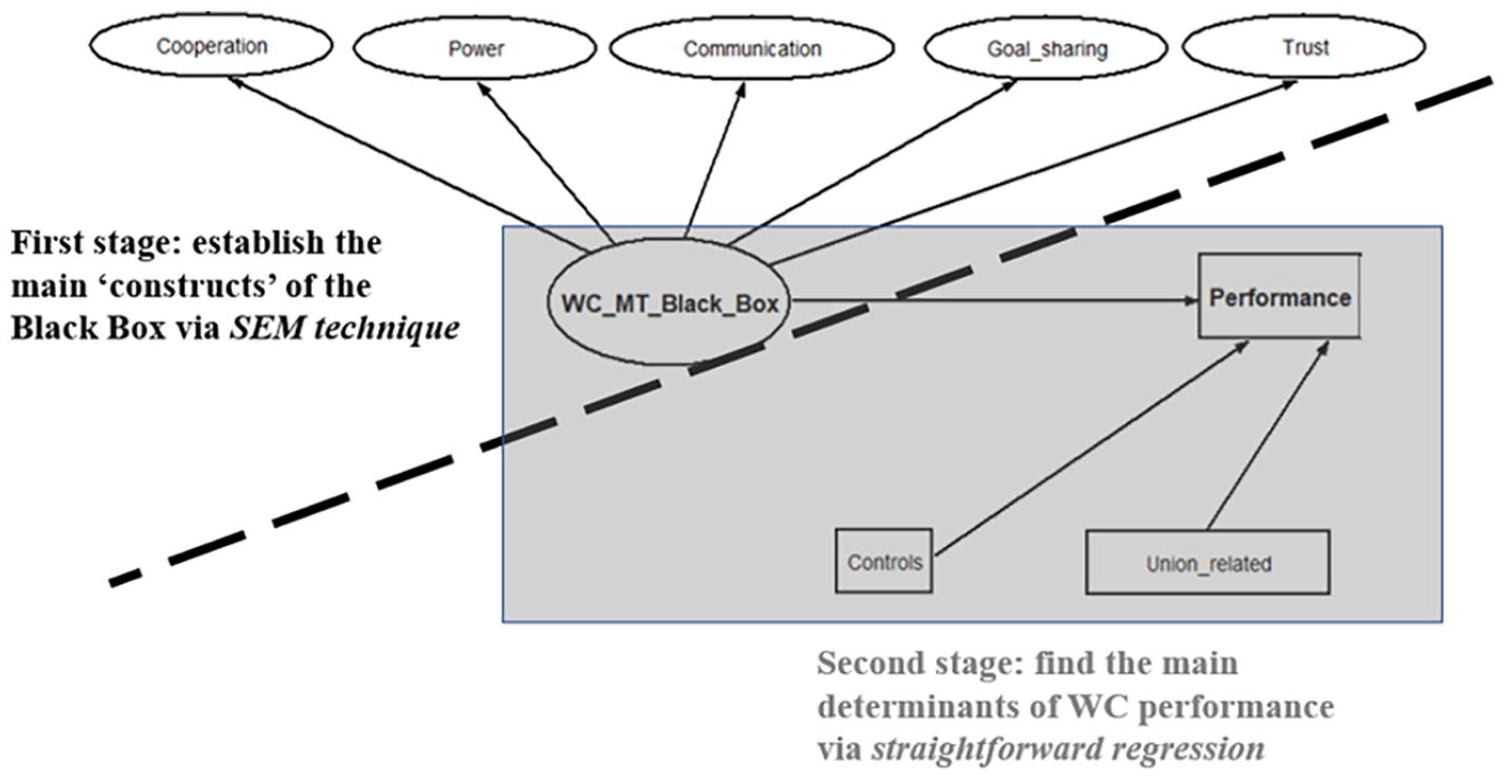
A conceptual model for the black box of WC–MT relations.
Data
In 2014, members of our research group affiliated with the Dutch University of Tilburg at the time and the German Institute of Economic and Social Research (WSI) performed an economy-wide survey conducted among Dutch and German works councillors, in small, medium-sized and large private sector organisations. These WCs were already in the database of German union-related organisations and the Dutch GBIO, which used to be responsible for training WCs in the Netherlands. So, we could benefit from address lists of WCs that were proactive and engaged, probably more so than in a truly random sample. The upside of this, however, is a large willingness to complete our rather extensive questionnaire, which was inspired by the above-reviewed qualitative case studies. The underlying motivation for this comparative two-country setup was to find out more about the actual functioning of WCs inside establishments, and whether there are differences between the two countries.
The WC respondents (one per organisation) were asked about the performance of their tasks and about their relationship with the MT, fellow councillors, unions and workforce. In practice, the respondent is the chair or secretary of the WC. We will henceforth refer to the data as CWCS (Comparative Works Council Survey). A detailed description can be found in a WSI publication by Van den Berg et al. (2019). In Appendix A, we include all the questions from the CWCS that we use in the current study, because we only selected a subset of questions, given the measure development purpose of the current study. Also, given this purpose, we are not concerned with the degree to which the Dutch and German sub-samples are representative for their countries’ population.
For our current research purposes, we discarded all observations belonging to organisations with fewer than 50 employees, which is the official Dutch legal threshold to install a WC (in Germany, WCs can already be in place in companies with five or more workers). For both countries, of the six size classes distinguished in the CWCS, the smallest two are strongly underrepresented and the remaining larger size classes strongly overrepresented, which is in line with prior surveys. In all likelihood, representatives of larger establishments have more opportunities to fill in a (rather lengthy) questionnaire. Our estimates as reported below will be confined to 651 usable observations for the German sub-sample and 348 for the sub-sample from the Netherlands.
Methodology and operationalisation
We aim to incorporate a range of aspects of WC functioning at the same time in order to do justice to the rich findings in qualitative studies. In this way, we hope to further open the black box of the inner workings of the WC–MT interaction to create a quantitative black box summary measure that can be applied to estimate the effects of these inner workings of employee representation in a more refined way. For further inspiration as to what to include and what analyses to perform, we decided to turn to the HR literature, with a decade-long tradition of constructing multi-item measures within the setting of intra-organisational interaction (of which that between the WC and MT is a key manifestation). As the HR literature is massive, we cannot but briefly review a few studies that offer a stepping stone for what we seek to do here. This literature clearly illustrates that structural equation modelling (or SEM) is a methodology highly appropriate in the context of validity exercises in view of measurement development studies.
In contrast to the IR literature, several HR studies pay attention to the processes that operate as a mediation mechanism between HR policies and organisational outcomes (e.g. Beltrán-Martin and Bou-Llusar, 2018; Savaneviciene and Stankeviciciute, 2010), referred to as the ‘black box mediating stage’ (Boselie et al., 2005: 79), using quantitative measures, which are more often than not of a multidimensional and multi-item nature. In particular, the focus tends to be squarely on the question as to which mechanisms actually enhance individual employees’ abilities, motivations and opportunities (the so-called AMO framework) in such a way that this contributes to their individual performance, and hence to firm performance. Here, we notice an analogy with the qualitative and quantitative IR research discussed above, in which the central issue is: Which behavioural processes (or WC types) contribute to an effective representation of employees, leading to an improvement of firm performance?
Based on a carefully selected sample of 104 articles, Boselie et al. (2005) is an early but still representative analysis of how the key concepts in the conceptual AMO model that relate HRM activities to HRM outcomes and performance were chosen and operationalised in the HR tradition of quantitative work. One of the six research questions on which the articles are categorised addresses the so-called ‘black box’ stage between HRM and firm performance. In their review, Boselie et al. find that the mediating effects of ‘employee–organisation fit’ are frequently hypothesised and modelled by means of stepwise analysis, SEM and/or hierarchical linear modelling, but are still hardly ever examined and understood in sufficient detail.
Five years later, Savaneviciene and Stankeviciciute (2010) discuss the concept and content of the mediating stage between HR practices and HR-related outcomes through which HR practices can positively influence the more distal firm performance outcomes. Regarding the mediation perspective, they conclude that the AMO framework together with the role of line managers is essential for transforming HR practices into HR-related outcomes. However, regarding the content of the black box, they observe that consensus is still lacking on the number of mediating variables, the number of underlying relationships, as well as on the operationalisation of each of the associated variables. And indeed, until this day, the HR literature has revealed that detailing the mediating black box between HR practices and firm outcomes is an ongoing endeavour that has not been settled yet in terms of precise substance, but does reveal convergence as to measurement methodology. It is the latter that we adopt here, too.
Specifically, as noted above, the HR–performance link is often analysed using SEM. Applying SEM, a measurement model based upon confirmatory factor analysis (CFA) for the latent constructs in the black box (see, among many others, Aktar and Pangil, 2018) is combined with a path model including the mediating black box. So, SEM implies that two flies can be killed in one stroke, taking account of the underlying correlation structure of all constructs and the associated items. In the IR literature, SEM is a well-known technique as well (see e.g. O’Brady and Doellgast, 2021; Timming and Summers, 2020). However, as far as we are aware, this comprehensive SEM method has not yet been applied as regards the effect of WCs on firm performance. This is another contribution of our study.
Based on the first stage of our conceptual model, we set out to establish the multidimensional content of the black box regarding WC–MT relations. We do so by first analysing the five underlying ‘boxes’ or first-order constructs that represent the aspects of (mutual) cooperation, power, communication, goal sharing and trust (as visualised in Figure 1). For most of these first-order constructs, we can use validated scales from the HR literature, which are adjusted to the context of WC–MT relations, and assessed by exploratory factor analysis (EFA, promax rotation, factor loadings > 0.40) and confirmatory factor analysis (CFA, goodness-of-fit indicators: Chi2 (p-value > 0.05), RMSE < 0.08, CFI > 0.90, TFI > 0.90) to check their internal validity. Subsequently, before estimating the measurement model to establish the overarching WC–MT Black Box measure (reflecting the second-order construct), we will test for multicollinearity.
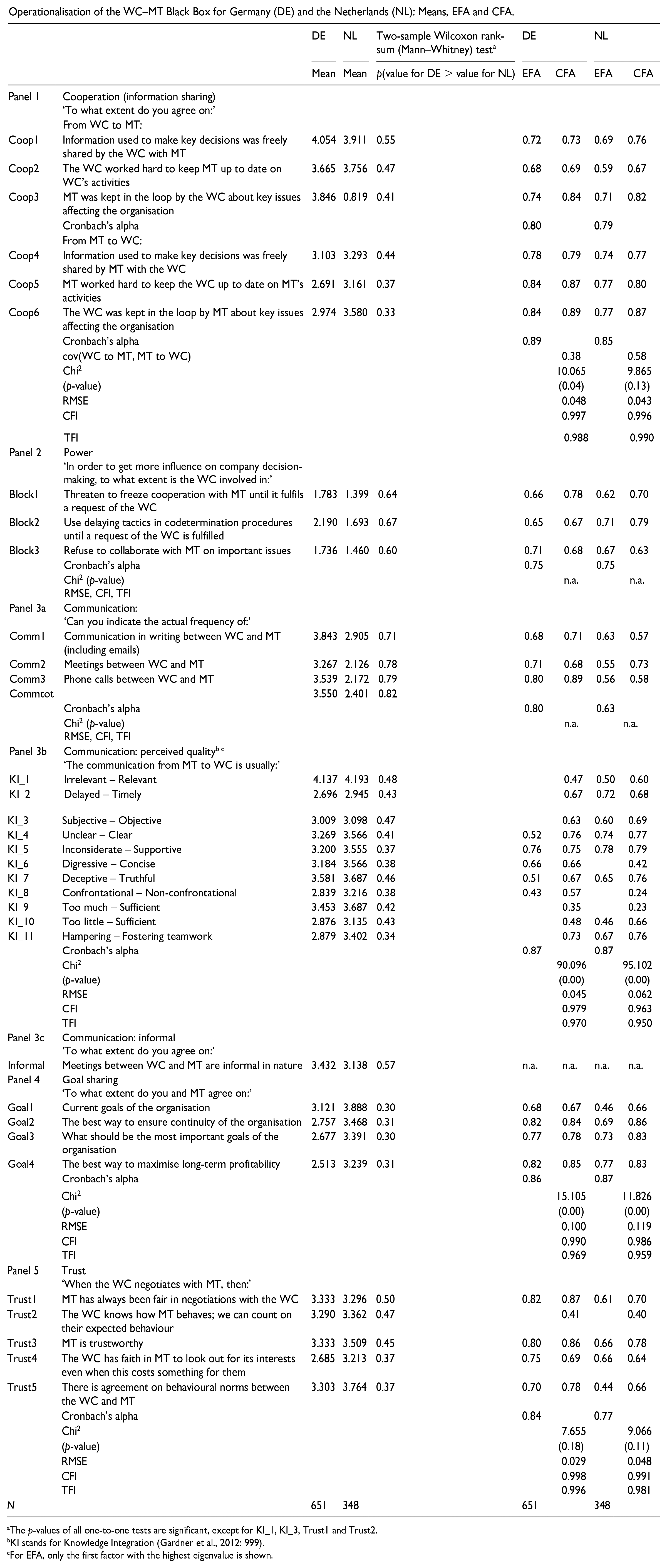
Note that because we are in the position to compare Dutch and German WCs, the differences and similarities between the two countries will be presented in Appendix A, which we will briefly discuss below by way of by-catch. In Appendix A, since most items are measured on a Likert scale, the two-sample Wilcoxon rank-sum (Mann–Whitney) statistic is shown, instead of the familiar t-statistic. In addition, the probability that a random draw from the German population is larger than a random draw from the Dutch population is calculated, to give an indication of the differences between the densities of the determining factors.
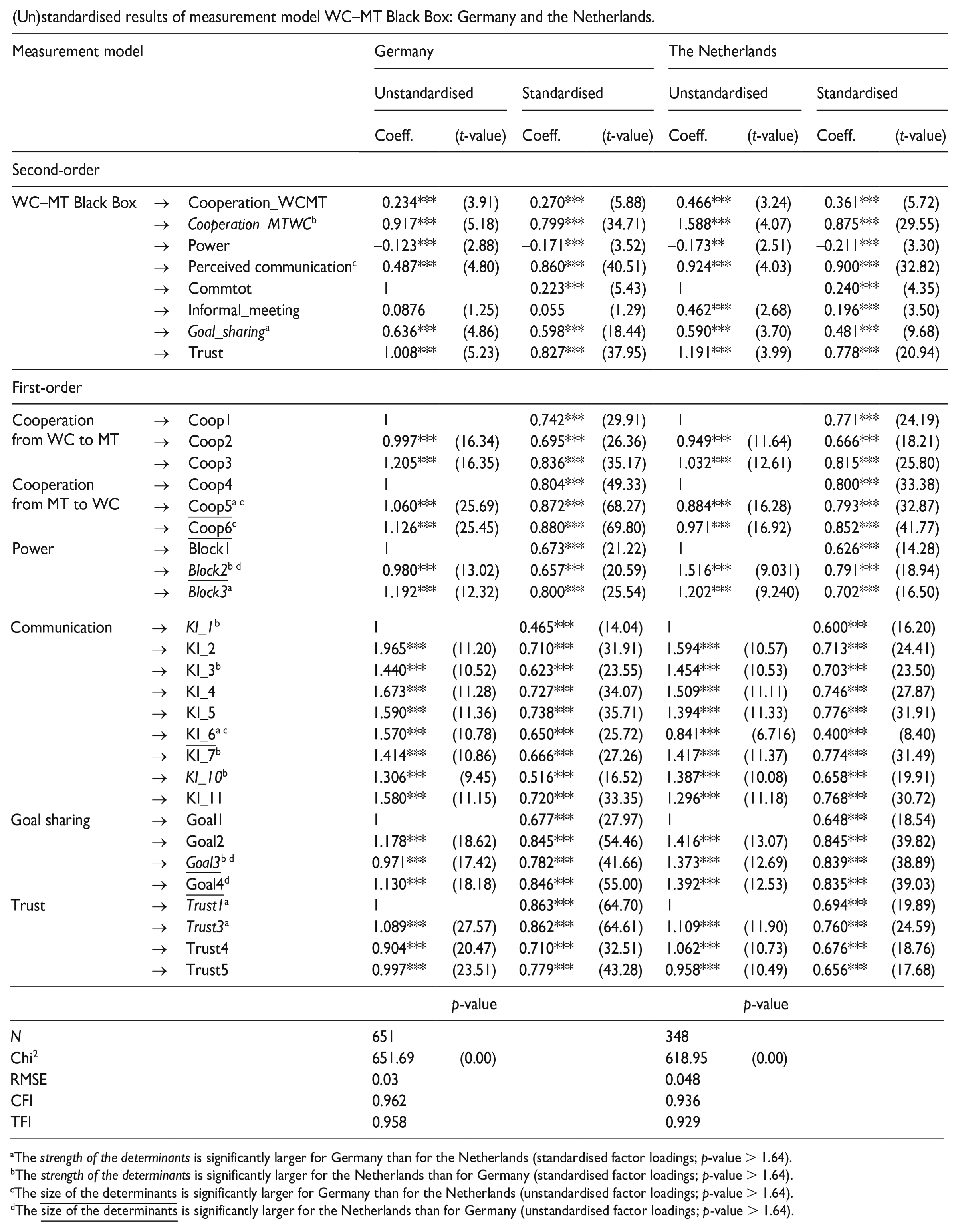
For the second-order WC–MT Black Box composite construct, which is based on all first-order constructs and their measures, a SEM measurement model is estimated. The graphical representations in Figures 2 and 3 show the standardised factor loadings that give an indication of the strength of the determinants within a box or dimension. In Appendix B, the goodness-of-fit indicators of this CFA are shown, as well as the unstandardised factor loadings and their significance. The latter are an indication of the size of the determinants. Although SEM normally at the same time estimates a measurement model with a path model (including mediation and/or moderation paths), we have chosen to separate the two in the second stage to ease interpretation (see also Aktar and Pangil, 2018). Constructing a valid WC–MT Black Box composite measure is our main goal. Hence, for now, we do not want this to be hindered by the complexities and peculiarities of a path model. Rather, subsequently, the measure of the second-order black box construct for WC–MT relations will be one of the explanatory variables in a regression to analyse the association with an employee representation effectiveness indicator, as a predictive validity check. By adding control variables well known from the WC literature, we can assess the increase of explanatory power due to the inclusion of our novel measure. But before proceeding, we start with the description and validation of the five underlying boxes or first-order constructs, one by one. Along the way, we will indicate differences across the Dutch and German sub-samples, if any.
Cooperation
The extent of cooperation between WC and MT is proxied by the degree to which both sides exchange information. The CWCS measure is based on the adjusted information-sharing scale for teams of Bunderson and Sutcliffe (2002). In the first panel of Appendix A, the statements regarding the extent to which the WC shares information with the MT and vice versa (on a scale from 1 = totally disagree to 5 = totally agree) are presented: ‘Information used to make key decisions was freely shared’, ‘Working hard to keep the other one up to date on own activities’ and ‘The other one was kept in the loop about key issues affecting the organisation’.
We observe that members of Dutch and German WCs significantly differ in their opinion on sharing information (p-value Wilcoxon rank-sum test = 0.000 for all aspects). Notably, the Dutch works councillors are more positive, especially regarding sharing information by the MT with the WC (p(score from the distribution for Germany > score from the distribution for the Netherlands) are for all but one statement smaller than 0.50). In the first panel of Appendix A, the EFA shows that all items load onto two factors (i.e. information sharing in two directions), which is confirmed by the CFA.
Power
CWCS’s power scale is based on three Likert-type survey questions that determine the degree to which the WC uses blocking tactics vis-a-vis the MT in order to gain more influence on company-level decision-making. These three items are derived from Kipnis et al. (1980): (1) threaten to freeze cooperation with the MT, (2) use delaying tactics in codetermination procedures and (3) refuse to collaborate with the MT on important issues. Due to data limitations, as CWCS’s respondents are all WC representatives (and not from the MT), we have no information on blocking tactics used by the MT.
The details can be found in the second panel of Appendix A, revealing clear cross-country differences. In the Netherlands, we see that the majority of the works councillors never or hardly use these tactics. In contrast, a closer look at the data (not shown here) reveals that the probability that German works councillors use these tactics more often is significantly higher. The results of the EFA reveal that all items load onto one factor, which is confirmed by the CFA.
Communication
For communication, three potentially relevant items are included in the data regarding (a) actual two-way communication, (b) perceived communication and (c) perceived nature of meetings. For details, we refer to the third panel of Appendix A. The CWCS team first selected items on the basis of a review of a series of communication-oriented studies (particularly in the HR literature), as we will explain below, and subsequently added a self-developed WC-tailored question as suggested by the work of Kotthoff (1981, 1994).
First, Panel 3a shows three types of actual two-way communication modes between WC and MT (in writing, in meetings and by phone), and provides the frequency thereof: about twice a year, once per month, once per week, twice per week, daily, or several times a day (cf. Skorupińska-Cieślak, 2021). There is a significant difference between the two country sub-samples, for all three communication channels. A substantial part of all communication activities in the Netherlands takes place once a month or once a week, at best, whereas this is much more frequent in Germany. For both countries, the results of the EFA show that all items load onto one factor, which is confirmed by the CFA. Therefore, the actual two-way communication measure is constructed by using the scores for all three forms of communication.
Second, perceived communication from MT to WC in Panel 3b addresses 11 aspects of the encountered adequateness of this information (on a five-point scale running from 1 = totally disagree to 5 = totally agree): the information is relevant, timely, objective, clear, supportive, concise, truthful, non-confrontational, not too much, not too little, and fostering teamwork. The CWCS team took this scale from Gardner et al. (2012). We observe significant differences between the two country distributions for all aspects: Dutch works councillors are, on average, significantly more satisfied than their German counterparts about all kinds of received information. By applying EFA, we reveal that WC members describe the underlying process differently in the two countries. The 11 aspects are not the result of just one factor, nor do they load onto the same factors. Applying CFA on all aspects shows that the factor loadings are mostly in line with the factor loadings from EFA. For both countries, the information received is hardly ever ‘too much’; and for the Netherlands, the information received is hardly ever ‘confrontational’. Therefore, we decided that these two aspects with very low CFA factor loadings will not be considered as a part of our perceived communication measure.
Third and lastly, we present our data’s information regarding the nature of meetings in Panel 3c. WC members were asked whether they consider their joint meetings with the MT to be informal rather than formal. The CWCS team self-developed this item, inspired by the work of Kotthoff (1981, 1994). In Germany, meetings are relatively more informal than in the Netherlands, with this difference being significant.
Goal sharing
Panel 4 in Appendix A lists the four statements regarding the extent to which WC and MT agree or disagree (on a scale running from 1 = totally disagree to 5 = totally agree) on aspects of goal sharing, inspired by Miller et al. (1998). In the context of worker representation, this also relates to the legal task of Dutch and German WCs (i.e. not only serving the interests of the employees, but also those of the organisation at large). The statements address respondents’ agreement on (1) what the goals of the organisation are; (2) how to best ensure the organisation’s continuity; (3) what should be the most important goals; and (4) how to maximise the organisation’s long-term profitability, respectively.
Again, Dutch WC members are more positive and share more goals with the MT in comparison with their German counterparts. This holds for all goals. What further stands out is the high extent to which the German respondents actually disagree with the MT: a closer look at the data (not shown here) reveals that among our German respondents around one-half of all works councillors hold different views vis-a-vis the MT about what is best for the organisation at large. The results of the EFA show that all goals load onto one factor. The CFA reveals a reasonable fit for both country sub-samples.
Trust
Finally, trust is based on five items taken from Zaheer et al. (1998), adapted to the WC setting, with a five-point answering scale (from 1 = totally disagree to 5 = totally agree; see Panel 5 in Appendix A). The items involve (1) fairness in negotiations by the MT, (2) behaviour of the MT is known, (3) trustworthiness of the MT, (4) interests of the WC are considered by the MT and (5) the WC and MT agree on behavioural norms.
Despite the fact that German law explicitly requires the WC and MT to cooperate in a trustful manner, German WCs experience significantly less trust in the relationship with the MT than Dutch WCs. The results of the EFA reveal that four out of five items load onto one factor, which is confirmed by the CFA. Therefore, we decided to leave the item ‘behaviour of the MT is known’ out, as this is the odd one.
Multicollinearity
Next, we checked the correlations between all items of the five first-order constructs. None of the bivariate correlations is above 0.60. Subsequently, following Kock (2015) and O’Brady and Doellgast (2021), we performed two collinearity tests. First, we inspected the occurrence of relatively high VIFs (variance inflation factors). Second, we conducted a full EFA on all 28 items of the five underlying first-order constructs to check for common-method variance. For both countries, all VIFs were below 3.3 (with 10 being the rule-of-thumb threshold). The full EFA revealed six different factors for each country, with the first factor explaining 21% (Germany) and 39% (the Netherlands) of the variance, respectively. So, there seems to be no multicollinearity issue, nor does common-method variance deflate or inflate our measures. All underlying statistics that are not provided in Appendix A, for brevity’s sake, are available upon request.
First-stage analysis: WC–MT Black Box’s internal validity
We start with analysing in one model the effect of all five latent dimensions, each based on several determinants (first-order constructs), on the latent WC–MT Black Box composite measure (second-order construct). In Figures 2 and 3, the results of the measurement model for the WC–MT Black Box construct are presented for Germany and the Netherlands, respectively (see Appendix B for all results and statistics). The model has a satisfactory overall fit. Although the chi-squared is not insignificant, three well-established goodness-of-fit measures (RMSE, CFI and TFI) are all very good. The standardised factor loadings of the first-order dimensions are similar to the factor loadings (CFA) of the validation of the five underlying constructs separately, as discussed above and reported in Appendix A. Moreover, all standardised factor loadings are significant and mostly far above 0.6 (see Appendix B) in one model providing the effect of all five latent first-order dimensions on the latent second-order WC–MT Black Box composite construct. For most items, the German WC members are less positive than their Dutch counterparts. Moreover, we see that the five latent dimensions reveal different patterns, as above. Clearly, the questionnaires provide item-level data that are valid in finding the five dimensions that are part of the WC–MT Black Box composite measure in both country sub-samples.
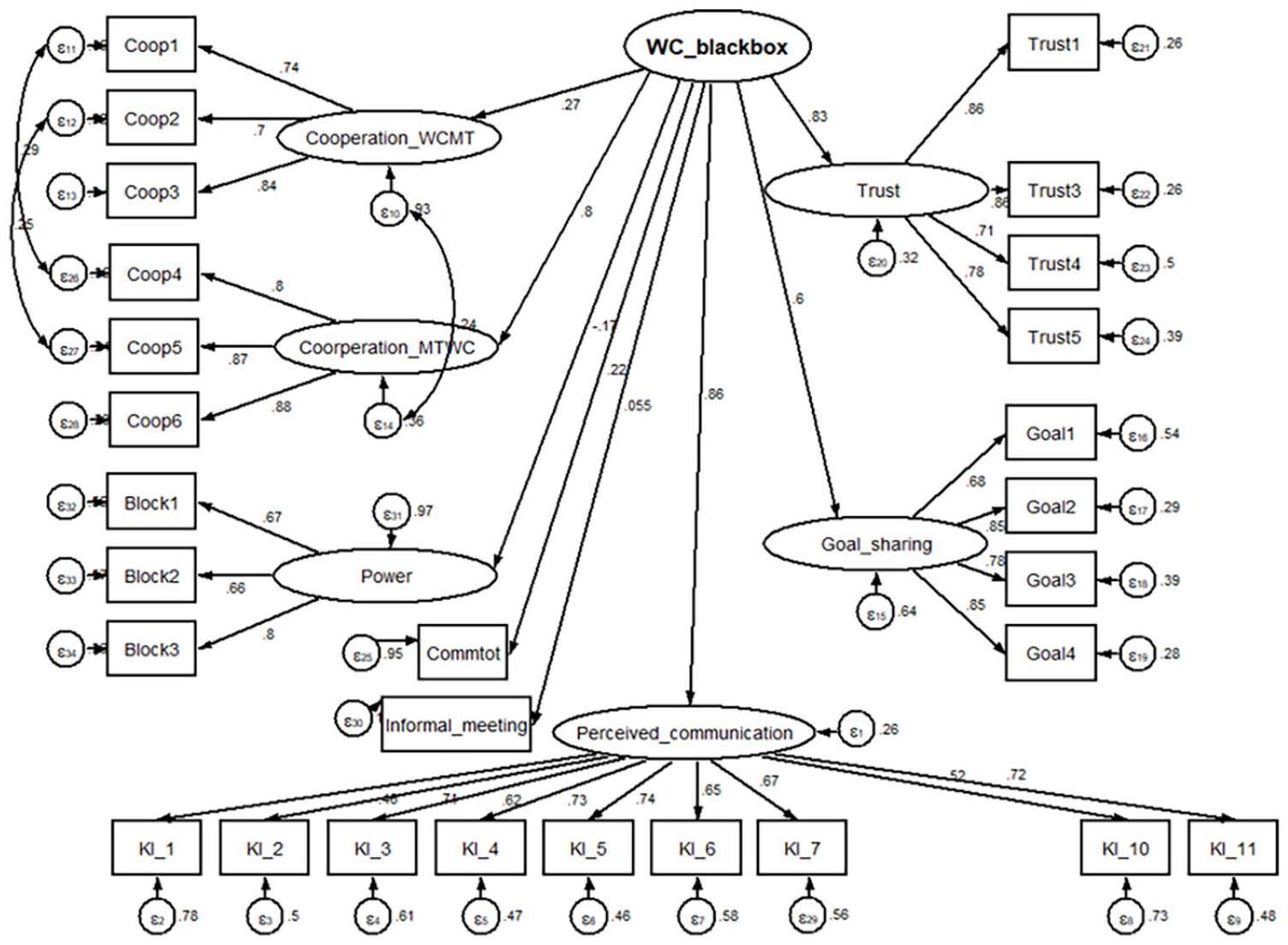
The content of the WC–MT Black Box: Germany.
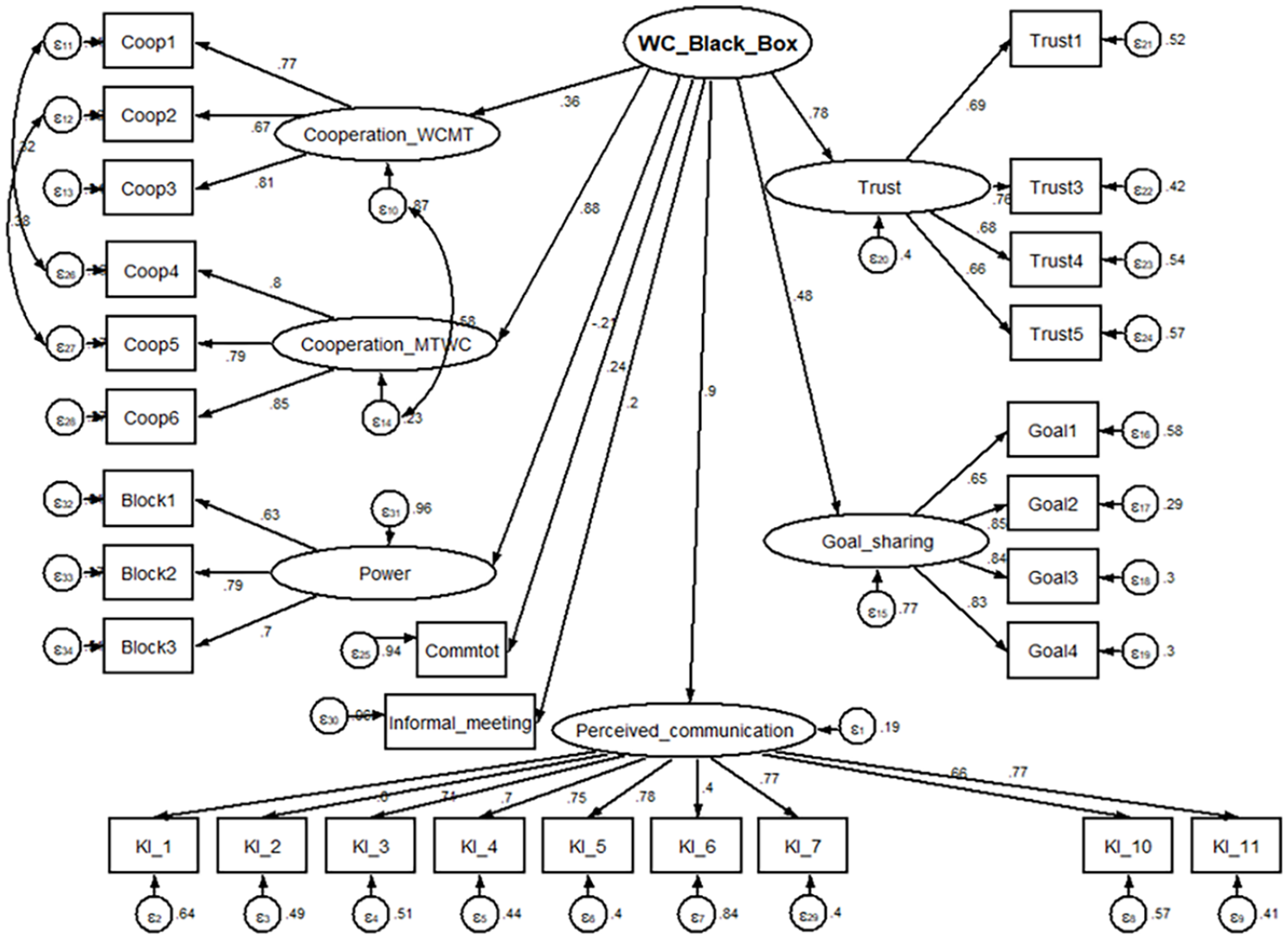
The content of the WC–MT Black Box: the Netherlands.
The second-order standardised and unstandardised factor loadings of the WC–MT Black Box composite measure are all significant for both countries, except for ‘informal meeting’ for Germany. The results indicate that the content of the WC–MT Black Box second-order construct comes with varying weights and sizes of the underlying first-order dimensions. For both countries, cooperation (the information provision of MT to WC), the perceived communication of MT to WC and trust in the MT all have substantial standardised factor loadings, ranging from 0.80 to 0.86 for Germany and from 0.78 to 0.90 for the Netherlands. The standardised factor loadings for goal sharing between MT and WC are somewhat lower: 0.60 for Germany and 0.48 for the Netherlands. In both countries, a high communication frequency, informal meetings and information provision from WC to MT reveal a weaker association with the relation between MT and WC, and the same holds for the extent to which WCs exercise power. Here, as expected, the factor loadings are negative, but they are very small.
For Germany, the unstandardised factor loadings (absolute value) range from 0.12 (power) to 1.01 (trust); for the Netherlands, they do so from 0.17 (power) to 1.59 (information sharing from MT to WC). This indicates that the size estimate of the relationship between WC and MT differs per dimension and between the two countries. The effect of WC-perceived cooperation, power and communication are 1.5 to 2 times larger for the Netherlands than for Germany. For goal sharing and trust, the factor loadings are more or less the same, with these small differences not being significant. For Germany, the cooperation from MT and WC (the MT works hard to keep the WC up to date on MT’s activities) and perceived communication (especially concise communication) are both associated more strongly with (and have a larger share in) the WC–MT Black Box composite construct vis-a-vis the Netherlands. In the Dutch sub-sample, the emphasis is more on power (using delaying tactics in codetermination procedures until a request of the WC is fulfilled), but also on goal sharing (to agree about the most important goals of the organisation and the best way to maximise long-term profitability): both the strength and size of these associations are larger in the Netherlands than in Germany.
All in all, the black box of WC–MT relations seems to be associated with a rich set of underlying mechanisms, involving (mutual) cooperation, power, communication, goal sharing and trust – and doing so differently across the two country sub-samples. In future empirical work on the effects of works councils, data permitting, this multidimensional WC–MT Black Box composite construct is therefore advised to be taken on board. In the next section, we will illustrate how that works out for the specific case of the outcome variable ‘influence on company-level decision-making’. In so doing, we also examine the external or predictive validity of our second-order WC–MT Black Box construct, which is a necessary element in any measurement development endeavour.
Second-stage analysis: WC–MT Black Box’s external validity
Our new WC–MT Black Box composite construct offers the possibility to fill a gap in the empirical IR literature by capturing the interaction between the WC and MT. In prior IR work on employee representation, evidence showed that the inner workings of this interaction are key in deepening our understanding of employee representation effectiveness. Hence, a new measure of this mediation channel such as our WC–MT Black Box composite construct may well serve as an essential variable in any ‘straightforward’ regression model aimed at explaining the effect on (or the association with) employee representation effectiveness and, mutatis mutandis, any relevant organisational performance indicator. As said, most existing quantitative IR work only studies the impact on codetermination effectiveness or organisational outcomes of either a dummy for WC presence, or a limited WC typology capturing just a few dimensions. With our WC–MT Black Box composite construct, we can move beyond this.
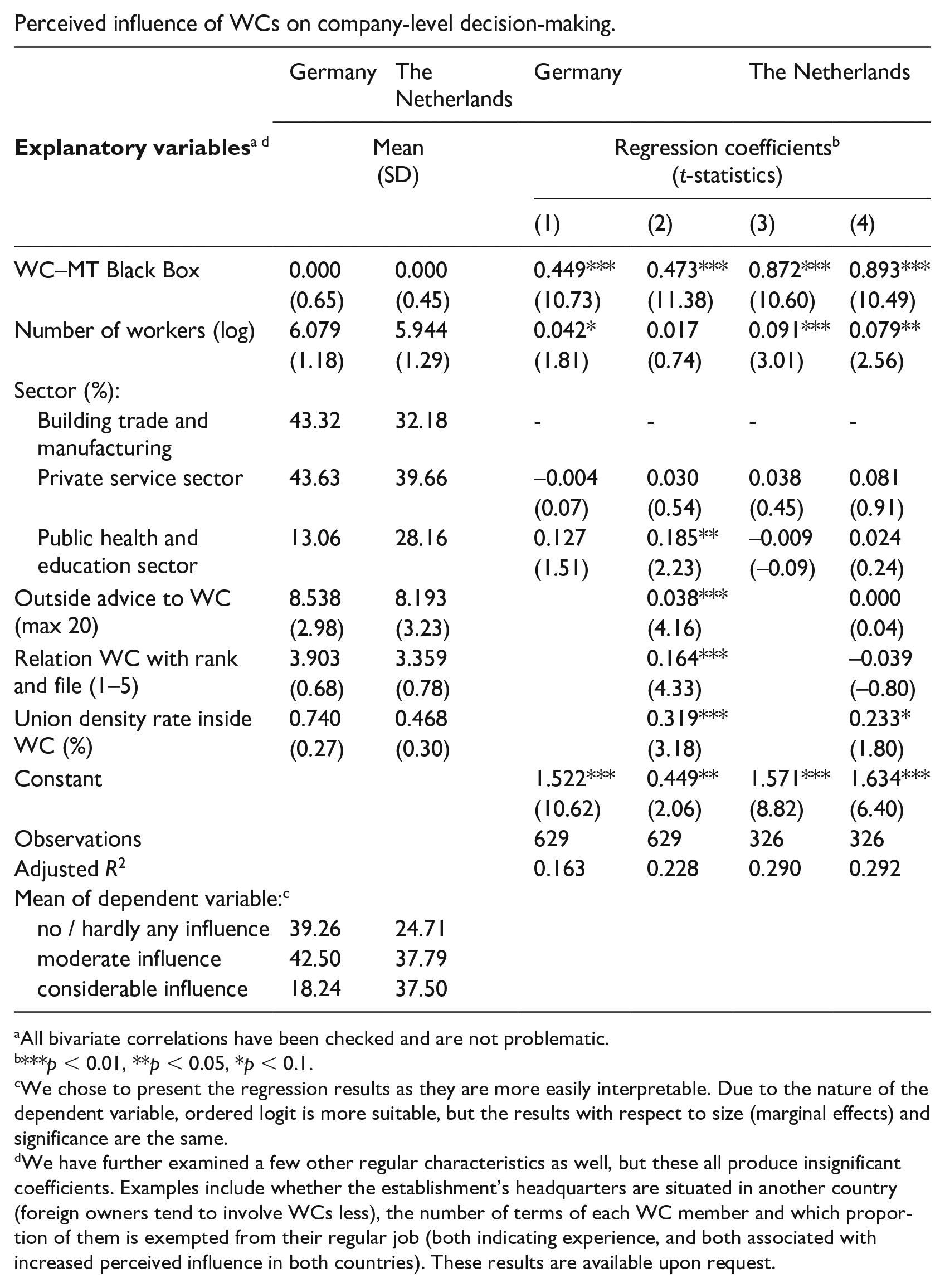
The in-depth qualitative studies by, for example, Kotthoff (1981, 1994), Hall et al. (2013) and Skorupińska-Cieślak (2021) all stress the multidimensional nature of the WC–MT relationship as an important, if not the main, determinant of WC’s influence or power. By way of example and as predictive validity check, and based on the availability of information in our own data set, we estimate the association between the WC–MT Black Box composite construct and the perceived influence of the WC on company-level decision-making. This dependent variable has three values, namely hardly, intermediate, or quite a lot of influence on organisational matters in general (p-value Wilcoxon rank-sum test = 0.000; p(influence score from the distribution for Germany > influence score from the distribution for the Netherlands) = 0.382). The underlying descriptives reveal that the Dutch works councillors, on average, consider themselves more influential than their German counterparts. Next to the usual control variables capturing establishment size (the log of the number of workers) and industrial sector (private service and health and education, with the reference category being building trade and manufacturing), we have added a few potentially relevant explanatory variables regarding trade unions, as union involvement figures prominently in extant IR literature. These variables will be briefly described in conjunction with the results for the two country sub-samples, as presented in detail in Appendix C.
The most striking finding involves the highly significant and dominant estimate for our new explanatory variable – the WC–MT Black Box composite construct. This confirms the IR literature’s qualitative evidence that there is indeed a strong link between the interaction processes between WC and MT, on the one hand, and the degree to which WCs feel they can exert influence on company-level decision-making, on the other hand. Given the multidimensional content of our WC–MT Black Box composite construct, this finding suggests that (1) information being shared, (2) WCs’ unwillingness to use blocking tactics, (3) the frequency of communication, (4) meetings being informal, (5) information by MT being seen as beneficial for the functioning of the WC, (6) WC and MT sharing goals and (7) WCs putting trust in MT work together in their association with a larger perceived influence of WCs on company-level decision-making.
The dominant impact of the WC–MT Black Box composite construct holds for both country sub-samples, and remains clearly dominant after adding a few more explanatory variables in columns (2) and (4) in the table in Appendix C. Dropping the WC–MT Black Box composite construct does not alter the results for the other explanatory variables, but the explained variance of the employee representation effectiveness indicator decreases sharply. Taking the most comprehensive models as our yardstick (i.e. columns (2) and (4) in Appendix C), we observe a very substantial drop in the adjusted R2 from 0.228 to 0.068 for Germany, and from 0.292 to 0.050 for the Netherlands. This provides clear evidence of our composite measure’s large contribution to the explanatory power of our models. And importantly, given our paper’s main focus on measurement development, this result strongly supports the predictive validity of our novel construct.
In all other respects, interestingly, the series of estimates for the two countries show, again, many results that differ across the two sub-samples. Overall, compared to the Dutch model, the coefficient of the WC–MT Black Box composite variable is considerably smaller in the German analyses. Moreover, in Germany, several other aspects also play a clear role in explaining WCs’ influence on company-level decision-making, which is hardly the case in the Netherlands. Hence, the probability that WCs feel they can exert influence on company-level decision-making in the Netherlands is predominantly and almost solely associated with all the dimensions that are covered by the WC–MT Black Box composite measure. In the Dutch context, it is thus of utmost importance to establish a good relationship with the MT. In Germany, having a good WC–MT relationship contributes the most to WC’s involvement in company-level decision-making as well, but substantially less so than in the Netherlands, with other factors being very important, too.
Finally, we highlight a few key differences at this level of individual explanatory variables. Firm size is significant in the Dutch but not in the German model (the more employees in Dutch organisations, the higher perceived WC influence). For the sector variable, this is the other way around, as only in Germany does it appear to matter whether or not the WC is active in education or health. For other variables, we observe a (stronger) impact in Germany, but not (or much less so) in the Netherlands. For one, the more advice German WCs receive from outside experts (foremost unions), the stronger is the association with having influence on company-level decision-making. The same holds for having a good relationship with the rank and file: support of the German WC from the workforce adds significantly to perceived influence. Lastly, the union density rate among council members also shows a positive link with perceived influence – modestly so in the Netherlands, and strongly so in Germany.
The two countries compared
As a by-catch of this measurement development paper, we produced many potentially revealing insights regarding differences across the Dutch and German sub-samples. Given the need for more in-depth comparative work on WCs, we take a pause to reflect on what we can learn from these differences. To facilitate this, we summarise the key differences in Table 1 along the lines of the five dimensions of our novel WC–MT Black Box composite construct (the first-stage analysis), and the latter construct as such (the second-stage analysis).
Germany and the Netherlands compared.
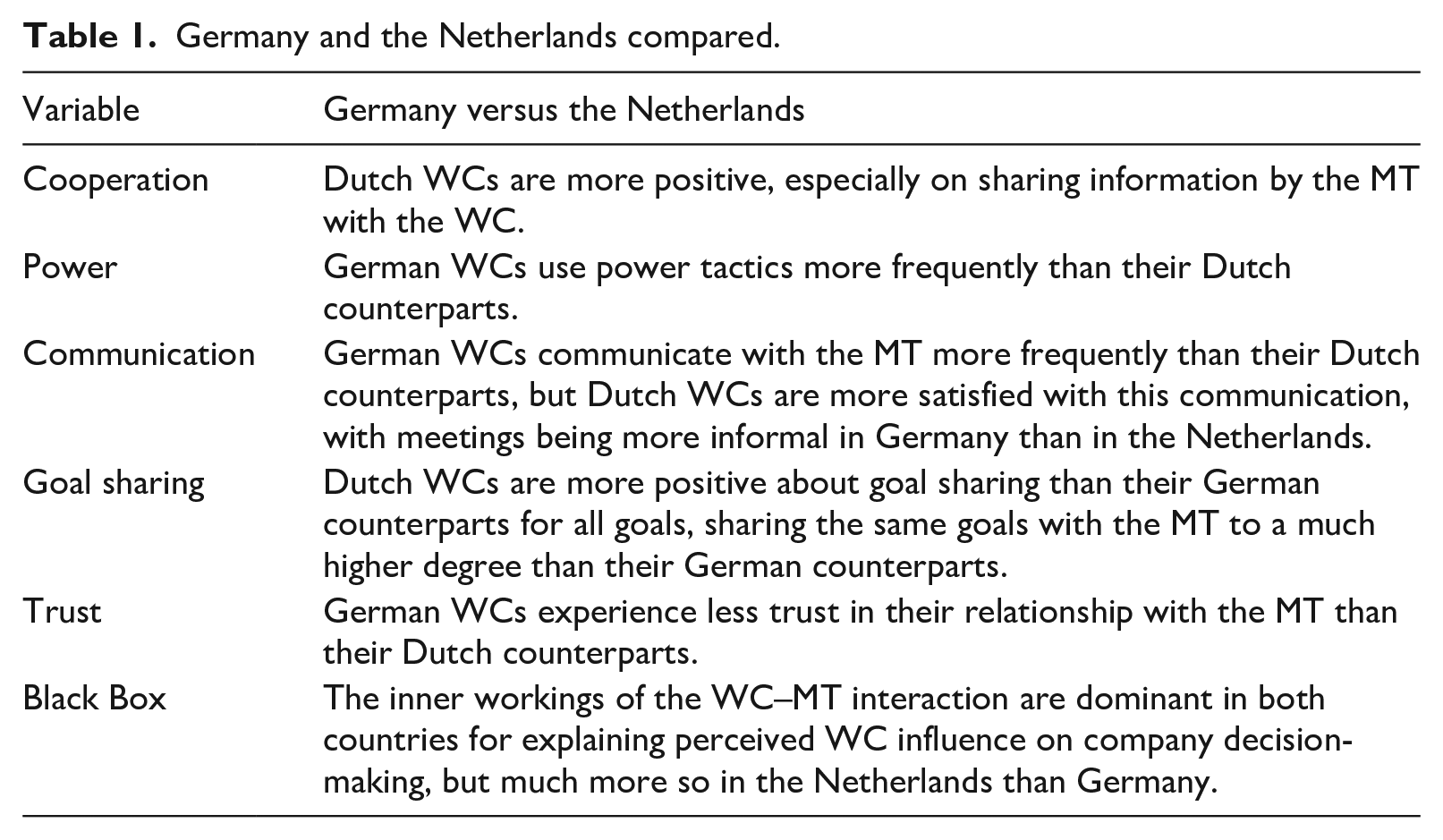
To start with, we would like to emphasise a similarity, rather than a difference. Our focus on two strict regulatory employee representation systems is particularly interesting in this paper’s context. After all, a priori, we could expect that the influence of our WC–MT Black Box composite measure would be relatively modest in IR regimes in which an influential role of employee representation is firmly embedded in the law. This makes our finding that our novel measure is so important in our external validity analysis even more revealing: even in countries with strict regulation, the internal mechanics of employee representation are key to understand the latter’s effectiveness. Hence, even then and there, the internal mediation channel is critical.
Looking at the key differences, the overall observation is that the German employee representation system emerges as much more confrontational than the Dutch one, notwithstanding large similarities in terms of the institutional (legal) context. Dutch WCs are substantially more positive about their relationship with the MT across the board, regarding all aspects associated with the WC–MT Black Box composite construct, as well as the perceived WC influence on company-level decision-making. Specifically, Dutch WCs are more positive than their German counterparts about (1) sharing information by the MT, (2) not using power tactics vis-a-vis the MT, (3) satisfaction with their (less frequent and less informal) communication with the MT, (4) sharing similar goals with the MT and (5) trusting their MT. In the Conclusion, we will briefly speculate what might explain these consistent and striking differences.
Conclusion
In this study, we sought to contribute to the quantitative IR works council literature in two main ways, with one by-catch as a bonus. The first key contribution is that we further spell out the underlying causal mechanisms of WC impact by opening the black box of the inner workings of the WC–MT interaction by explicitly incorporating the – often unobservable – internal behavioural processes between WC and MT as a potential key variable in the chain explaining the effect of WC presence on organisation-level outcome variables (such as employee representation effectiveness and organisational performance). Our second main contribution is that we develop a measure of the inner workings of this black box by (1) introducing five survey measures of five aspects of the inner mechanics of the WC–MT interaction and (2) constructing a composite measure, referred to as WC–MT Black Box, of these five behavioural aspects in tandem. Compared to other empirical work, our quantitative composite measure encompasses more dimensions, in line with outcomes of the qualitative case studies we briefly reviewed. On top of this, as an extra, we compare Germany with the Netherlands, two countries that are both characterised by a high level of institutionalised codetermination. We primarily do so by way of predictive validity check of our new WC–MT Black Box composite construct, but also to find out whether under the surface of institutional similarities we can identify more subtle behavioural differences, due to different inner workings of the WC–MT interaction.
Specifically, we constructed a two-stage measurement development model. In the first stage, the aim was to unravel the key behavioural aspects of the black box of the WC–MT relationship. For this, we turned to the HR literature for inspiration, adapting established survey measures to fit with the WC context. In our empirical analysis, after establishing our measure’s internal validity, it turned out that – both in strength and in size – the most important building blocks of this black box are the same in the two country sub-samples, namely the degree of WC–MT cooperation (in particular, the perceived quality of information provision from MT to WC), the degree of WC’s trust in the MT, and the quality of perceived communication. Only slightly less important is the degree of goal sharing, while the exercise of power, the communication frequency and the nature of meetings carry less weight. Based on these findings, we could construct an internally valid composite measure of the inner workings of the WC–MT interaction. We hope that our composite measure (or a tailor-made variety thereof) will find its way into the empirical WC literature in IR. Of course, although our composite construct performs well in our two country sub-samples, the dimensions of the black box may be extended or adjusted in future work in order to accommodate for the specific (country or sector) setting of the data at hand. While three main dimensions unequivocally stem from the established literature and two from law practices in the countries under study, other researchers can depart from our composite construct but replace dimensions with ones that would fit better the IR system that they are investigating.
In the second stage, we have incorporated our novel black box composite construct in follow-up analyses in order to explain the extent to which WCs believe they exert influence on company-level decision-making. We not only do this to illustrate the added value of our new composite construct, but primarily so to offer a first test of the composite measure’s external or predictive validity. It turns out that our black box composite construct is the most important explanatory variable by far in both countries, but especially in the Dutch model. In other words, our quantitative findings confirm the outcome of earlier qualitative case studies that the nature of the behavioural WC–MT relationship is the main determinant of the WC’s influence. For Germany, several other – notably union-related – variables are significant as well, indicating that German and Dutch WCs do operate differently. This latter finding relates to our by-catch contribution.
That is, we reveal how behavioural subtleties relating to the actual inner workings of the WC–MT interaction may lead to overall cross-country differences in WC impact and the latter’s antecedents, notwithstanding important institutional IR similarities between Germany and the Netherlands, both being in the top in the world in terms of legal employee representation strictness. This finding underlines the importance of the argument that macro-level institutional aspects alone do not suffice to develop a deep understanding of micro-level differences, in terms of both WC impact and its underlying antecedents. This finding adds to the classic WC typology literature, which already revealed striking differences in the behaviour and impact of WCs that operate within the very same institutional context.
We suggest that future research along such comparative cross-country lines is needed to further increase our understanding of the subtle behavioural inner workings of the WC–MT relationship, and how that interacts with the institutional context in determining the impact of codetermination. For now, we can only speculate why the German codetermination model turns out to be so much more confrontational than its Dutch counterpart. Here, we would argue that the cultural context overshadows the institutional system. The Netherlands has a century-long heritage of cooperation, known as the ‘polder model’, which is very different from the German pattern of cooperation, which had its roots in union opposition towards introduction of the Works Constitution Act in 1952, which they had considered to pave the way for plant egoism and which ultimately led unions to gain close control over works councils (Pirker, 1979: 252–256).
Of course, our study has a number of shortcomings, pointing to further research avenues, of which we would like to emphasise three. First, we have not addressed the problem of reverse causality in the second stage. Having influence on company-level decision-making might also lead to a better relationship between WC members and the MT. Because we added the second stage mainly as a predictive validity check of our composite construct, and as an illustration of the importance of unravelling the black box in analysing employee representation effectiveness, we leave this for future research. Second, in our data, specific industries and firm size classes are underrepresented. Still, we would argue that the nature of the WC–MT relationship could be independent of size and sector, as working together is a matter of human beings, not of products or services. However, this is an assumption that must be checked in future work. And third, obviously, we suggest to further detail the inner workings of the WC–MT interaction, as well as linking this to an extended set of relevant outcome measures, to further develop a behavioural theory of the functioning and impact of employee representation. In all, we hope that our findings show the practical relevancy of opening the black box of WC–MT interactions in quantitative work: the highly significant and dominant estimate for our WC–MT black box construct demonstrates the importance for MT and WC to invest in one another, because both sides may benefit from this.
Footnotes
Appendix A
Operationalisation of the WC–MT Black Box for Germany (DE) and the Netherlands (NL): Means, EFA and CFA.
| DE | NL | Two-sample Wilcoxon rank-sum (Mann–Whitney) test a | DE | NL | ||||
|---|---|---|---|---|---|---|---|---|
| Mean | Mean | p(value for DE > value for NL) | EFA | CFA | EFA | CFA | ||
| Panel 1 | Cooperation (information sharing) ‘To what extent do you agree on:’ |
|||||||
| From WC to MT: | ||||||||
| Coop1 | Information used to make key decisions was freely shared by the WC with MT | 4.054 | 3.911 | 0.55 | 0.72 | 0.73 | 0.69 | 0.76 |
| Coop2 | The WC worked hard to keep MT up to date on WC’s activities | 3.665 | 3.756 | 0.47 | 0.68 | 0.69 | 0.59 | 0.67 |
| Coop3 | MT was kept in the loop by the WC about key issues affecting the organisation | 3.846 | 0.819 | 0.41 | 0.74 | 0.84 | 0.71 | 0.82 |
| Cronbach’s alpha | 0.80 | 0.79 | ||||||
| From MT to WC: | ||||||||
| Coop4 | Information used to make key decisions was freely shared by MT with the WC | 3.103 | 3.293 | 0.44 | 0.78 | 0.79 | 0.74 | 0.77 |
| Coop5 | MT worked hard to keep the WC up to date on MT’s activities | 2.691 | 3.161 | 0.37 | 0.84 | 0.87 | 0.77 | 0.80 |
| Coop6 | The WC was kept in the loop by MT about key issues affecting the organisation | 2.974 | 3.580 | 0.33 | 0.84 | 0.89 | 0.77 | 0.87 |
| Cronbach’s alpha | 0.89 | 0.85 | ||||||
| cov(WC to MT, MT to WC) | 0.38 | 0.58 | ||||||
| Chi2 | 10.065 | 9.865 | ||||||
| (p-value) | (0.04) | (0.13) | ||||||
| RMSE | 0.048 | 0.043 | ||||||
| CFI | 0.997 | 0.996 | ||||||
| TFI | 0.988 | 0.990 | ||||||
| Panel 2 | Power |
|||||||
| Block1 | Threaten to freeze cooperation with MT until it fulfils a request of the WC | 1.783 | 1.399 | 0.64 | 0.66 | 0.78 | 0.62 | 0.70 |
| Block2 | Use delaying tactics in codetermination procedures until a request of the WC is fulfilled | 2.190 | 1.693 | 0.67 | 0.65 | 0.67 | 0.71 | 0.79 |
| Block3 | Refuse to collaborate with MT on important issues | 1.736 | 1.460 | 0.60 | 0.71 | 0.68 | 0.67 | 0.63 |
| Cronbach’s alpha | 0.75 | 0.75 | ||||||
| Chi2 (p-value) |
n.a. | n.a. | ||||||
| Panel 3a | Communication: |
|||||||
| Comm1 | Communication in writing between WC and MT (including emails) | 3.843 | 2.905 | 0.71 | 0.68 | 0.71 | 0.63 | 0.57 |
| Comm2 | Meetings between WC and MT | 3.267 | 2.126 | 0.78 | 0.71 | 0.68 | 0.55 | 0.73 |
| Comm3 | Phone calls between WC and MT | 3.539 | 2.172 | 0.79 | 0.80 | 0.89 | 0.56 | 0.58 |
| Commtot | 3.550 | 2.401 | 0.82 | |||||
| Cronbach’s alpha | 0.80 | 0.63 | ||||||
| Chi2 (p-value) |
n.a. | n.a. | ||||||
| Panel 3b | Communication: perceived quality
b
c
|
|||||||
| KI_1 | Irrelevant – Relevant | 4.137 | 4.193 | 0.48 | 0.47 | 0.50 | 0.60 | |
| KI_2 | Delayed – Timely | 2.696 | 2.945 | 0.43 | 0.67 | 0.72 | 0.68 | |
| KI_3 | Subjective – Objective | 3.009 | 3.098 | 0.47 | 0.63 | 0.60 | 0.69 | |
| KI_4 | Unclear – Clear | 3.269 | 3.566 | 0.41 | 0.52 | 0.76 | 0.74 | 0.77 |
| KI_5 | Inconsiderate – Supportive | 3.200 | 3.555 | 0.37 | 0.76 | 0.75 | 0.78 | 0.79 |
| KI_6 | Digressive – Concise | 3.184 | 3.566 | 0.38 | 0.66 | 0.66 | 0.42 | |
| KI_7 | Deceptive – Truthful | 3.581 | 3.687 | 0.46 | 0.51 | 0.67 | 0.65 | 0.76 |
| KI_8 | Confrontational – Non-confrontational | 2.839 | 3.216 | 0.38 | 0.43 | 0.57 | 0.24 | |
| KI_9 | Too much – Sufficient | 3.453 | 3.687 | 0.42 | 0.35 | 0.23 | ||
| KI_10 | Too little – Sufficient | 2.876 | 3.135 | 0.43 | 0.48 | 0.46 | 0.66 | |
| KI_11 | Hampering – Fostering teamwork | 2.879 | 3.402 | 0.34 | 0.73 | 0.67 | 0.76 | |
| Cronbach’s alpha | 0.87 | 0.87 | ||||||
| Chi2 | 90.096 | 95.102 | ||||||
| (p-value) | (0.00) | (0.00) | ||||||
| RMSE | 0.045 | 0.062 | ||||||
| CFI | 0.979 | 0.963 | ||||||
| TFI | 0.970 | 0.950 | ||||||
| Panel 3c | Communication: informal |
|||||||
| Informal | Meetings between WC and MT are informal in nature | 3.432 | 3.138 | 0.57 | n.a. | n.a. | n.a. | n.a. |
| Panel 4 | Goal sharing |
|||||||
| Goal1 | Current goals of the organisation | 3.121 | 3.888 | 0.30 | 0.68 | 0.67 | 0.46 | 0.66 |
| Goal2 | The best way to ensure continuity of the organisation | 2.757 | 3.468 | 0.31 | 0.82 | 0.84 | 0.69 | 0.86 |
| Goal3 | What should be the most important goals of the organisation | 2.677 | 3.391 | 0.30 | 0.77 | 0.78 | 0.73 | 0.83 |
| Goal4 | The best way to maximise long-term profitability | 2.513 | 3.239 | 0.31 | 0.82 | 0.85 | 0.77 | 0.83 |
| Cronbach’s alpha | 0.86 | 0.87 | ||||||
| Chi2 | 15.105 | 11.826 | ||||||
| (p-value) | (0.00) | (0.00) | ||||||
| RMSE | 0.100 | 0.119 | ||||||
| CFI |
0.990 |
0.986 |
||||||
| Panel 5 | Trust |
|||||||
| Trust1 | MT has always been fair in negotiations with the WC | 3.333 | 3.296 | 0.50 | 0.82 | 0.87 | 0.61 | 0.70 |
| Trust2 | The WC knows how MT behaves; we can count on their expected behaviour | 3.290 | 3.362 | 0.47 | 0.41 | 0.40 | ||
| Trust3 | MT is trustworthy | 3.333 | 3.509 | 0.45 | 0.80 | 0.86 | 0.66 | 0.78 |
| Trust4 | The WC has faith in MT to look out for its interests even when this costs something for them | 2.685 | 3.213 | 0.37 | 0.75 | 0.69 | 0.66 | 0.64 |
| Trust5 | There is agreement on behavioural norms between the WC and MT | 3.303 | 3.764 | 0.37 | 0.70 | 0.78 | 0.44 | 0.66 |
| Cronbach’s alpha | 0.84 | 0.77 | ||||||
| Chi2 | 7.655 | 9.066 | ||||||
| (p-value) | (0.18) | (0.11) | ||||||
| RMSE | 0.029 | 0.048 | ||||||
| CFI |
0.998 |
0.991 |
||||||
| N | 651 | 348 | 651 | 348 | ||||
The p-values of all one-to-one tests are significant, except for KI_1, KI_3, Trust1 and Trust2.
KI stands for Knowledge Integration (Gardner et al., 2012: 999).
For EFA, only the first factor with the highest eigenvalue is shown.
Appendix B
(Un)standardised results of measurement model WC–MT Black Box: Germany and the Netherlands.
| Measurement model | Germany | The Netherlands | ||||||||
| Unstandardised | Standardised | Unstandardised | Standardised | |||||||
| Coeff. | (t-value) | Coeff. | (t-value) | Coeff. | (t-value) | Coeff. | (t-value) | |||
| Second-order | ||||||||||
| WC–MT Black Box | → | Cooperation_WCMT | 0.234*** | (3.91) | 0.270*** | (5.88) | 0.466*** | (3.24) | 0.361*** | (5.72) |
| → | Cooperation_MTWC b | 0.917*** | (5.18) | 0.799*** | (34.71) | 1.588*** | (4.07) | 0.875*** | (29.55) | |
| → | Power | –0.123*** | (2.88) | –0.171*** | (3.52) | –0.173** | (2.51) | –0.211*** | (3.30) | |
| → | Perceived communication c | 0.487*** | (4.80) | 0.860*** | (40.51) | 0.924*** | (4.03) | 0.900*** | (32.82) | |
| → | Commtot | 1 | 0.223*** | (5.43) | 1 | 0.240*** | (4.35) | |||
| → | Informal_meeting | 0.0876 | (1.25) | 0.055 | (1.29) | 0.462*** | (2.68) | 0.196*** | (3.50) | |
| → | Goal_sharing a | 0.636*** | (4.86) | 0.598*** | (18.44) | 0.590*** | (3.70) | 0.481*** | (9.68) | |
| → | Trust | 1.008*** | (5.23) | 0.827*** | (37.95) | 1.191*** | (3.99) | 0.778*** | (20.94) | |
| First-order | ||||||||||
| Cooperation |
→ | Coop1 | 1 | 0.742*** | (29.91) | 1 | 0.771*** | (24.19) | ||
| → | Coop2 | 0.997*** | (16.34) | 0.695*** | (26.36) | 0.949*** | (11.64) | 0.666*** | (18.21) | |
| → | Coop3 | 1.205*** | (16.35) | 0.836*** | (35.17) | 1.032*** | (12.61) | 0.815*** | (25.80) | |
| Cooperation |
→ | Coop4 | 1 | 0.804*** | (49.33) | 1 | 0.800*** | (33.38) | ||
| → |
|
1.060*** | (25.69) | 0.872*** | (68.27) | 0.884*** | (16.28) | 0.793*** | (32.87) | |
| → |
|
1.126*** | (25.45) | 0.880*** | (69.80) | 0.971*** | (16.92) | 0.852*** | (41.77) | |
| Power | → | Block1 | 1 | 0.673*** | (21.22) | 1 | 0.626*** | (14.28) | ||
| → |
|
0.980*** | (13.02) | 0.657*** | (20.59) | 1.516*** | (9.031) | 0.791*** | (18.94) | |
| → | Block3 a | 1.192*** | (12.32) | 0.800*** | (25.54) | 1.202*** | (9.240) | 0.702*** | (16.50) | |
| First-order | ||||||||||
| Communication | → | KI_1 b | 1 | 0.465*** | (14.04) | 1 | 0.600*** | (16.20) | ||
| → | KI_2 | 1.965*** | (11.20) | 0.710*** | (31.91) | 1.594*** | (10.57) | 0.713*** | (24.41) | |
| → | KI_3 b | 1.440*** | (10.52) | 0.623*** | (23.55) | 1.454*** | (10.53) | 0.703*** | (23.50) | |
| → | KI_4 | 1.673*** | (11.28) | 0.727*** | (34.07) | 1.509*** | (11.11) | 0.746*** | (27.87) | |
| → | KI_5 | 1.590*** | (11.36) | 0.738*** | (35.71) | 1.394*** | (11.33) | 0.776*** | (31.91) | |
| → |
|
1.570*** | (10.78) | 0.650*** | (25.72) | 0.841*** | (6.716) | 0.400*** | (8.40) | |
| → | KI_7 b | 1.414*** | (10.86) | 0.666*** | (27.26) | 1.417*** | (11.37) | 0.774*** | (31.49) | |
| → | KI_10 b | 1.306*** | (9.45) | 0.516*** | (16.52) | 1.387*** | (10.08) | 0.658*** | (19.91) | |
| → | KI_11 | 1.580*** | (11.15) | 0.720*** | (33.35) | 1.296*** | (11.18) | 0.768*** | (30.72) | |
| Goal sharing | → | Goal1 | 1 | 0.677*** | (27.97) | 1 | 0.648*** | (18.54) | ||
| → | Goal2 | 1.178*** | (18.62) | 0.845*** | (54.46) | 1.416*** | (13.07) | 0.845*** | (39.82) | |
| → |
|
0.971*** | (17.42) | 0.782*** | (41.66) | 1.373*** | (12.69) | 0.839*** | (38.89) | |
| → |
|
1.130*** | (18.18) | 0.846*** | (55.00) | 1.392*** | (12.53) | 0.835*** | (39.03) | |
| Trust | → | Trust1 a | 1 | 0.863*** | (64.70) | 1 | 0.694*** | (19.89) | ||
| → | Trust3 a | 1.089*** | (27.57) | 0.862*** | (64.61) | 1.109*** | (11.90) | 0.760*** | (24.59) | |
| → | Trust4 | 0.904*** | (20.47) | 0.710*** | (32.51) | 1.062*** | (10.73) | 0.676*** | (18.76) | |
| → | Trust5 | 0.997*** | (23.51) | 0.779*** | (43.28) | 0.958*** | (10.49) | 0.656*** | (17.68) | |
| p-value | p-value | |||||||||
| N | 651 | 348 | ||||||||
| Chi2 | 651.69 | (0.00) | 618.95 | (0.00) | ||||||
| RMSE | 0.03 | 0.048 | ||||||||
| CFI | 0.962 | 0.936 | ||||||||
| TFI | 0.958 | 0.929 | ||||||||
The strength of the determinants is significantly larger for Germany than for the Netherlands (standardised factor loadings; p-value > 1.64).
The strength of the determinants is significantly larger for the Netherlands than for Germany (standardised factor loadings; p-value > 1.64).
The
The
Appendix C
Perceived influence of WCs on company-level decision-making.
| Germany | The Netherlands | Germany | The Netherlands | |||
|---|---|---|---|---|---|---|
|
|
Mean |
Regression coefficients
b
|
||||
| (1) | (2) | (3) | (4) | |||
| WC–MT Black Box | 0.000 | 0.000 | 0.449*** | 0.473*** | 0.872*** | 0.893*** |
| (0.65) | (0.45) | (10.73) | (11.38) | (10.60) | (10.49) | |
| Number of workers (log) | 6.079 | 5.944 | 0.042* | 0.017 | 0.091*** | 0.079** |
| (1.18) | (1.29) | (1.81) | (0.74) | (3.01) | (2.56) | |
| Sector (%): | ||||||
| Building trade and manufacturing | 43.32 | 32.18 | - | - | - | - |
| Private service sector | 43.63 | 39.66 | –0.004 | 0.030 | 0.038 | 0.081 |
| (0.07) | (0.54) | (0.45) | (0.91) | |||
| Public health and education sector | 13.06 | 28.16 | 0.127 | 0.185** | –0.009 | 0.024 |
| (1.51) | (2.23) | (–0.09) | (0.24) | |||
| Outside advice to WC (max 20) | 8.538 | 8.193 | 0.038*** | 0.000 | ||
| (2.98) | (3.23) | (4.16) | (0.04) | |||
| Relation WC with rank and file (1–5) | 3.903 | 3.359 | 0.164*** | –0.039 | ||
| (0.68) | (0.78) | (4.33) | (–0.80) | |||
| Union density rate inside WC (%) | 0.740 | 0.468 | 0.319*** | 0.233* | ||
| (0.27) | (0.30) | (3.18) | (1.80) | |||
| Constant | 1.522*** | 0.449** | 1.571*** | 1.634*** | ||
| (10.62) | (2.06) | (8.82) | (6.40) | |||
| Observations | 629 | 629 | 326 | 326 | ||
| Adjusted R2 | 0.163 | 0.228 | 0.290 | 0.292 | ||
| Mean of dependent variable: c | ||||||
| no / hardly any influence | 39.26 | 24.71 | ||||
| moderate influence | 42.50 | 37.79 | ||||
| considerable influence | 18.24 | 37.50 | ||||
All bivariate correlations have been checked and are not problematic.
***p < 0.01, **p < 0.05, *p < 0.1.
We chose to present the regression results as they are more easily interpretable. Due to the nature of the dependent variable, ordered logit is more suitable, but the results with respect to size (marginal effects) and significance are the same.
We have further examined a few other regular characteristics as well, but these all produce insignificant coefficients. Examples include whether the establishment’s headquarters are situated in another country (foreign owners tend to involve WCs less), the number of terms of each WC member and which proportion of them is exempted from their regular job (both indicating experience, and both associated with increased perceived influence in both countries). These results are available upon request.
Declaration of conflicting interests
The authors declared no potential conflicts of interest with respect to the research, authorship, and/or publication of this article.
Funding
The authors received no financial support for the research, authorship, and/or publication of this article.
