




Abstract
In this article the authors investigate how high unemployment and sustained economic crisis influence employee beliefs regarding their employers’ psychological contract (PC) obligations. Based on 32 semi-structured interviews with Greek white-collar employees, the authors compare PC changes among workers with pre-crisis work experience and others whose entire work lives coincide with the crisis. The majority of participants perceive their employer to exploit the crisis, demanding more of workers while offering them less. Those participants who remained with their pre-crisis employer held more positive perceptions. At the same time, social comparison and sense of gratitude influence how individuals interpret their employee–employer obligations. These factors buffer how individuals interpret their employer’s PC fulfillment in the crisis economy.
Introduction
The present study investigates how workers experience employment under the extreme conditions of a crisis economy. The 2008 financial crisis severely impacted European countries, particularly Greece. Following several bailouts and a decade of austerity politics, the Greek labor market manifested fundamental changes including lower wages, reduced overtime and easier dismissal (Gialis et al., 2017). Increasing unemployment coincided with the brain drain of young professionals fleeing Greece for jobs abroad, while other young people became more dependent on family support as the welfare state shrank (Papadopoulos, 2016). For workers employed during the crisis economy, their experience is one of diminished opportunities, inconsistent or eroding wages, and job precarity (Simosi et al., 2015).
Uncertainty prevails in this context with restructuring and intermittent downsizing the norm. These disruptions impact the psychological contract at the heart of the employment exchange. The psychological contract (PC) constitutes beliefs regarding the mutual obligations between parties, typically employee beliefs regarding the reciprocal obligations between themselves and their employer (Rousseau, 1995). Individuals facing ongoing uncertainty are inclined to re-evaluate their PC (Rousseau et al., 2018). Under extreme conditions like sustained economic crises, certain PC dynamics can become more visible, as basic processes influencing how individuals interpret their employment exchange become more apparent. Such was the case as the economic system under communism broke down revealing previously unrecognized positive consequences of bureaucratic practices for workplace trust (cf. Pearce et al., 2009).
Previous research highlights how employee understandings of their own and the organization’s obligations evolve in response to changes in employment conditions during organizational restructurings (Van Gilst et al., 2020). Other researchers have explored psychological contracts in crisis contexts, as in the case of the 2007/2008 global financial crisis in the UK (Davis and Van der Heijden, 2018) and Australia (Metz et al., 2012). Our study contributes to these streams of literature by investigating how sustained economic crises over more than a decade shape worker perceptions of their employer’s obligations and evaluations of their fulfillment. In doing so, we identify the roles played by (1) social comparison to under- or unemployed others and (2) gratitude for having a job in the judgments workers make of their employer’s psychological contract (PC) obligations. The present study explores how an economic crisis influences employee interpretations of PC obligations. It contrasts with typical PC research, which largely ignores economic factors and tends to rely on researcher-oriented measures (Conway and Briner, 2009). We investigate individual cognitions with respect to the lived worker experience of crisis employment, where both individual factors and context can shape PC dynamics (Rousseau et al., 2018). By capturing in their own words how individuals experience employment during economic crisis, we reveal the meanings and interpretations workers associate with crisis employment, a context where little theory or research exists.
Our study makes three contributions. First, we drill down into the process of PC development and change in a crisis economy, examining the basis of employee PC beliefs and factors affecting their fulfillment. We provide a rich description of individual PC experiences and attributions made regarding these experiences. Doing so reveals judgments regarding contract fulfillment and their calibration, particularly with respect to the social information workers rely on. Second, we compare PC beliefs of workers having pre-crisis work experience with those whose entire work lives coincide with the crisis. This comparative perspective allows us to investigate differences in both the specific obligations workers attribute to their employer and the factors influencing their perceptions of PC fulfillment. Third, we investigate two psychological mechanisms a crisis economy can activate in shaping PC dynamics: downward social comparison and gratitude. Social comparison tends to be upward in conventional economies, particularly where individuals are not under conditions of threat. However, social comparison by those employed in a crisis economy is likely to be downward (Jiang et al., 2017), given the threat to financial and career well-being this economy poses. We investigate social comparison and its downward trajectory along with its connection to gratitude for having paid employment. Together social comparison and gratitude shed light on potential buffering mechanisms influencing how workers evaluate PC fulfillment in an economy where many others are under- or unemployed. These contributions position our study to inform scholarship and practice regarding PC dynamics under extreme economic conditions.
Psychological contract
Psychological contract is defined as ‘individual beliefs, shaped by the organization, regarding terms of an exchange agreement between the individual and their organization’ (Rousseau, 1995: 9). The beliefs making up the PC are influenced by both promises the parties offer each other as well as obligations that emerge from the contributions and inducements they exchange over time (Rousseau et al., 2018). Although promises reflect both written or oral commitments (Conway and Pekcan, 2019) that give rise to obligations, additional obligations can result from interpretations of past exchanges, observations of the treatment others receive, and prevailing societal assumptions the parties may take for granted (e.g., normative practices) (Rousseau, 1995). Regardless of how derived, PC obligations involve an array of employment conditions (such as future promotion, training, development opportunities and job security). These obligations exist ‘in the eye of the beholder’ (Rousseau, 1989: 123), shaped by dynamic processes whereby individuals can attribute reciprocal obligations to employers over time in response to their own contributions and sacrifices (Rousseau et al., 2018).
PC theory specifies dynamic processes that lead to changes in both PC obligations and evaluations of fulfillment over time. A PC phase model (Rousseau et al., 2018) provides a basis for investigating PC changes over time. It specifies mechanisms operating in and across PC phases including changing employee and employer goals, environmental cues, and responses to employee contributions. Along these lines, Costa and Coyle-Shapiro (2021) proposed that the social information employees rely on can make the experience of PC violation a social process. Cues that lead to employee cynicism are found to alter the nature of PC fulfillment (Bari et al., 2022) while changes in employer inducements (i.e., supports and rewards) play a crucial role in altering obligations attributed to the employer over time. Informed by PC theory and research, our study is the first to investigate how the wider economic context can influence the development and change in PC obligations workers attribute to their employer.
Two streams of research demonstrate that social context influences PC dynamics. The first examines PC obligations through the lens of cultural differences (e.g., Aldossari and Robertson, 2016). The second uses PC to investigate responses to organizational change, focusing on PC-related phenomena like breach or violation (Chaudhry et al., 2009; Conway et al., 2014). We contribute to both streams by examining how prevailing economic conditions and organizational actions can lead to an evolving understanding of PC obligations and their fulfillment. We examine how economic and workforce constraints relate to how individuals understand PC. We show how external economic factors, viewed as uncontrollable, and internal behaviors by management, viewed as more discretionary, can contribute to employee appraisals of their PC and its fulfillment. We highlight the motivations or reasons employees attribute to their employer’s treatment of its workforce, known contributors to employee PC-related responses (Rousseau and Tijoriwala, 1999). We now turn to the mechanisms that can link macro-economic forces to micro-PC experiences.
Social comparison during economic crisis
Social comparison is ‘the process of thinking about information concerning one or more persons in relation to the self’ (Wood, 1996: 520). Social comparison theory maintains that individuals evaluate themselves against similar others for self-enhancement and uncertainty reduction (Brown et al., 2007). Evidence from experimental studies suggests social comparisons are stronger predictors of employee attitudes and behaviors than are general expectations (Austin et al., 1980). The direction of social comparison differs: downward when individuals compare themselves to others they consider to be in a worse situation (Wills, 1981) and upward when they compare themselves to those they consider in a superior situation (Gibbons, 1986). Downward social comparison tends to generate positive feelings like increased self-esteem (e.g., Gibbons, 1986; Wills, 1981), while upward comparison generates negative feelings like inferiority and envy (e.g., Strack et al., 1990). Economic crisis itself can evoke social comparison, although little is known about its direction or dynamics in this context (Ragnarsdóttir et al., 2013).
Employees compare themselves to co-workers with respect to rewards, contributions, work conditions and outcomes (Greenberg et al., 2007), which in turn can impact their motivation, attitudes, commitment, and ability to adapt to the work setting (Vardaman et al., 2016). Under occupational uncertainty, individuals engage in social comparison to cope with stress (Brown et al., 2007; Pavlova et al., 2018). Brown and colleagues (2007) find that upward comparisons are triggered by the need for uncertainty reduction and self-enhancement, while downward comparisons serve as self-enhancement only. Along these lines, in a region of high unemployment, Pavlova et al. (2018) found that the threat of losing one’s job is associated with frequent downward comparison.
PC research highlights the centrality of social comparison in shaping employee responses. Ho (2005) theorized how social comparisons influence evaluations of PC fulfillment or breach. She argues that PC breach occurs when employees believe that their deal is worse compared to another; at the same time PC fulfillment occurs when employees view their deal to be better. In Ho’s empirical research, the comparisons reflect an individual’s social network ties (e.g., Ho and Levesque, 2005). Relatedly, in the context of change, Chaudhry et al. (2009) specifies how social comparisons can influence PC under-fulfillment, where the employee is expected to react more negatively to unfulfillment when a referent’s PC seems superior. Tomprou and Bankins (2019) in turn report that when resources are limited and an individual’s self-esteem vulnerable, downward social comparison aids in recovery from PC violation. Our study contributes to this body of work by testing whether sustained crisis economic conditions prompt downward social comparison as opposed to upward comparison as individuals cope with stress and uncertainty.
Gratitude
Gratitude is ‘willingness to recognize increments of value in one’s experience’ (Bertocci and Millard, 1963: 389), and ‘the emotional response stemming from the recognition and/or appreciation of the receipt of a benefit’ (Vernon et al., 2009: 118). It is both a state – a positive emotion felt at the time in which a kindness is perceived – and a trait – where an individual may have an appreciative nature (Lambert et al., 2009). Individuals with a grateful disposition have a mental lens affecting how they view the world, making gratitude a way of life (Wood et al., 2010). Gratitude is associated with positive emotions including happiness, hope, and optimism (McCullough et al., 2002) and aids in developing healthy relationships (Algoe et al., 2008). Many cultures and religions recognize gratitude as both a value and coping mechanism (Emmons and McCollough, 2003). Seeing good in undesirable circumstances prompts both gratitude and well-being via an optimistic reinterpretation of one’s problems (Lambert et al., 2009).
The literature presents gratitude as essential for fostering social relationships by nurturing reciprocal behaviors between giver and receiver (Algoe et al., 2008). Positive social exchange and relations at work stimulate helpful employee emotions including happiness, gratitude, and pride (Cropanzano and Mitchell, 2005). McCullough et al. (2002) argue that positive feelings like gratitude predispose employees to reciprocate positive behaviors back to the source of positive emotions (the giver). Studies show relationships of individual trait gratitude with well-being (Emmons and McCullough, 2003), prosocial behaviors (Locklear et al., 2023), citizenship behaviors and job performance (Spence et al., 2013). Fehr et al. (2017) proposed that organizational factors, such as developmental feedback, cultivate employee gratitude, arguing that gratitude is broader than a trait as it develops at the individual level in the form of ‘persistent gratitude,’ ‘a stable tendency to feel grateful within a particular context’ (2017: 362). We explore how gratitude manifests in coping with the undesirable work situations arising from sustained economic crises. Though Harpham (2004: 21) asserts that ‘gratitude is always embedded in the relationship between two parties,’ most gratitude research is dispositional and does not specify a target (McCullough et al., 2002). We note that little research exists on gratitude in the PC context. In line with Polak and McCullough (2006), we argue that gratitude can decrease the negative influence of the unmet organizational obligations associated with economic deprivation by focusing attention on the value and meaning the worker experiences in the employment relationship.
The present study addresses three research questions:
RQ1: How do a sustained economic crisis and its high unemployment contribute to employee perceptions of the employer’s PC obligations?
RQ2: How does social comparison in the crisis context contribute to employee understandings of the employer’s PC obligations and employee evaluations of PC fulfillment?
RQ3: How does gratitude manifest in employee responses to undesirable employment conditions in the crisis context? What is the focus or content of that gratitude and who or what are its targets?
Method
We use qualitative methods to investigate the meanings individuals attach to their employment exchange in the crisis context. Conway and Briner (2009) estimated that over 90% of PC research is survey-based, despite its limitations in representing social behavior. We deploy qualitative methods to explore worker feelings and experiences and to capture social construction-based PC beliefs (cf. Driver, 2018), specifically, using an inductive interpretative approach where employees voice their lived experience (Corley and Gioia, 2004).
Research context
We studied Greek nationals living and working in Greece. The long-lasting financial crisis with its prolonged deterioration in employment conditions permits examining worker PC experiences under extreme conditions. In response to the crisis, austerity measures have increased taxes while decreasing welfare and social benefits, contributing to deteriorating living standards (Gialis et al., 2017). Approximately half of small firms operating before the crisis have shut down, reducing available jobs (Trading Economics, 2019). Greece has had the highest unemployment in the European Union, averaging 16.3% from 1998 through 2019. Due to their limited bargaining power, Greek workers generally became more willing to accept low-skilled jobs, part-time employment, working without benefits, and informal or unpaid work in the form of volunteering and internships (Simosi et al., 2015).
Sample and data collection
Between 2017 and 2018, we interviewed 32 Greeks working in the private sector. Our sampling strategy followed Patton (1990), recruiting participants through purposive and snowball sampling. Five interviewees were personal contacts of the authors (purposive sampling); the rest were recommended by other interviewees (snowball sampling). Participants fell into two distinct groups: (1) 17 individuals between 40 and 50 years old with work experience prior to the financial crisis (referred to as the Before Crisis or BC group) and (2) 15 individuals between 25 and 34 years old who entered the labor market post-2008 (the After Crisis or AC group). These two groups differ in chronological age, years of work experience, and generational cohorts (Gen X for BC and Gen Y for AC), which together can give rise to different frames of reference for their crisis-based work experience. Fifteen held a postgraduate degree, 14 a bachelor’s and three a technical degree. All were white-collar workers and Greek citizens living in Athens, ruling out regional differences in employment opportunities (for demographics see Online Appendix I and II).
The interview schedule reflected several themes highlighted in the PC literature, including the mutual obligations participants perceive. At the same time, the schedule remained somewhat flexible to tackle emerging themes interviewees described. This approach allowed consistent coverage of questions while offering participants an opportunity to reflect on their careers in personally meaningful ways. We collected demographic information at the interview’s outset, including gender, marital status, job title, employment history, and age. All interviews took place in a private location participants chose, such as a local cafe. With participant consent, interviews were tape-recorded and lasted an average of 45 minutes. The interviews were conducted in Greek by the second author and translated into English. Back-translation ensured that the meaning after translation was unchanged.
Data analysis
All interviews were transcribed in full and coded using NVivo 10. We combined inductive and deductive approaches to analyze the data. We carried out a three-stage coding process following Strauss and Corbin (1990). First, we identified open coding statements that addressed the participant’s work experience during the crisis (first-order coding). Comparable statements were grouped at this stage into provisional categories. For example, ‘lack of recognition of individual performance,’ ‘lack of career development and training opportunities,’ and ‘lack of support or guidance for tasks assigned’ were labelled as unmet organizational obligations in light of the PC literature. In the second stage, axial coding placed the first-order categories into themes. We searched for relationships among categories and referenced literature for concepts and theories to account for emerging findings. For example, the first codes relating to participant feelings of ‘appreciation of employment history,’ ‘appreciation of having a job,’ and ‘appreciation of getting paid on time’ were combined into the theme sense of gratitude. A third stage compared themes across our two groups of participants. Figure 1 maps our process and coding.
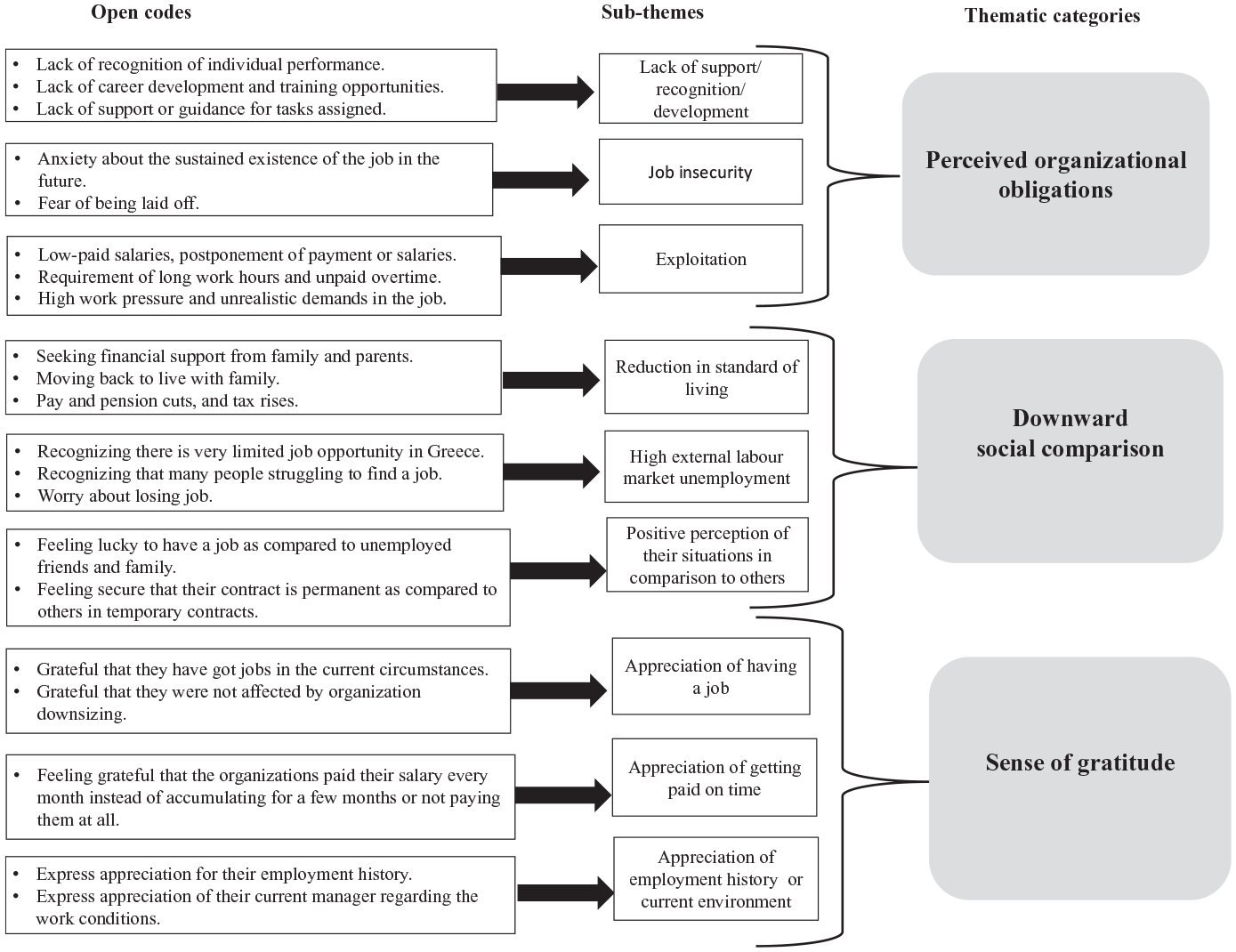
Primary themes and codes.
Trustworthiness of our coding was enhanced by collaborative data analysis with peer debriefing and member checking (Miles and Huberman, 1994). The researcher who conducted the interviews, a native speaker, initially analyzed the data. The other authors then challenged various interpretations to reduce bias. Throughout, we kept in mind three criteria for trustworthy qualitative research: credibility (ensuring results reveal the ‘truth’), confirmability (researcher neutrality in the research process), and dependability (consistency and repeatability of findings) (Guba and Lincoln, 1986).
Findings
The majority in both BC and AC groups believed their employer had failed to fulfill its obligations. This evaluation is tied not to the crisis conditions per se but to the employer’s responses to the crisis. Excepting some interviewees still employed by their pre-crisis companies, our interviewees tended to agree that their current employers had engaged in prolonged exploitation of their lack of alternative job opportunities. This perceived exploitation is grounded in two beliefs, a sense that individual contributions are not reciprocated by the employer and the perception that basic obligations regarding fair treatment are unmet. Both beliefs are grounded in fundamental notions of fairness in employment, as reflected in the adage ‘fair day’s work for a fair day’s pay’ (Rousseau, 1995). We found no evidence that interviewee PC beliefs derive from specific employer promises, in contrast to research in more stable economies where explicit promises frequently contribute to PC beliefs (e.g., Conway and Briner, 2002). Failures in reciprocity or general obligation fulfillment are a source of frustration and negative feelings. Our data also show that social comparison and gratitude are present in many interviews, appearing in an attempt to remedy negative employment experiences due to the crisis (Figures 2 and 3). We next examine the role of these mitigating factors in the employment experience under crisis conditions, presenting our findings in three sections: (1) unmet organizational obligations, (2) downward social comparison, and (3) sense of gratitude. In doing so we compare experiences of workers who began their employment before and after the crisis began.
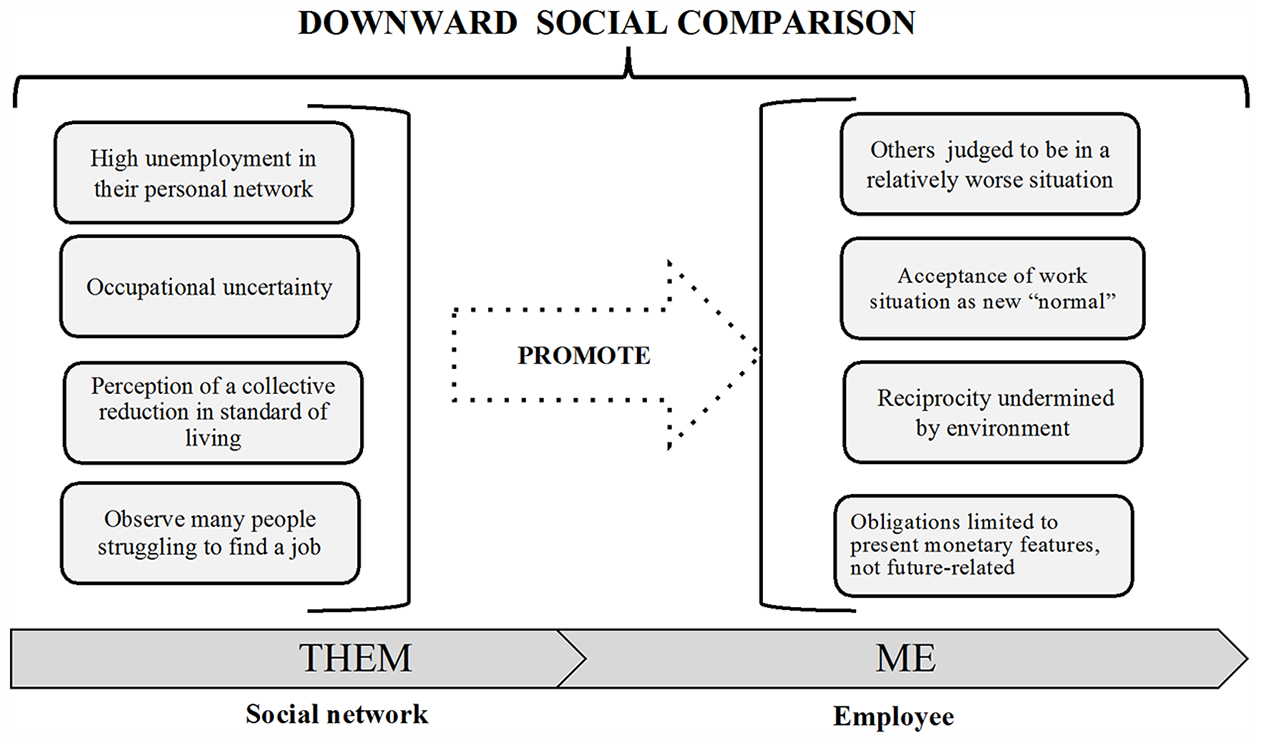
The process of downward social comparison.
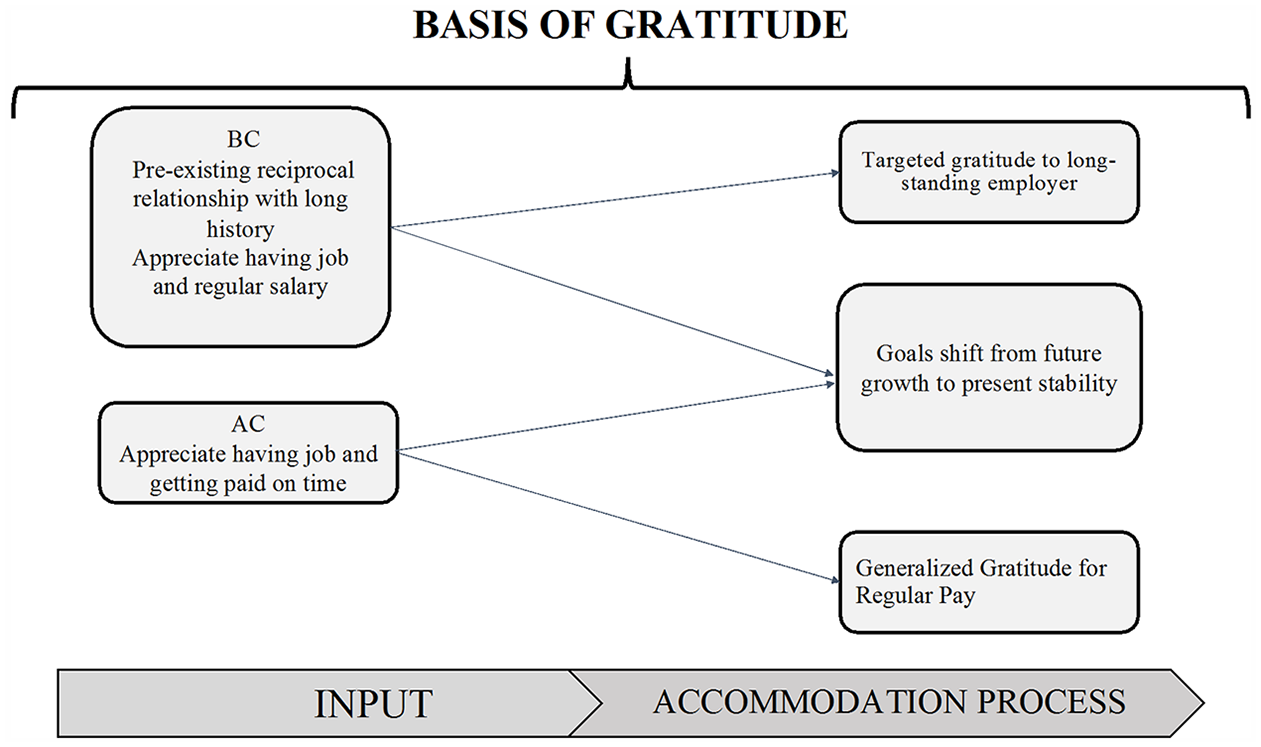
Differential bases of gratitude for Before Crisis and After Crisis employees.
Unmet organizational obligations
Before Crisis workers
BC participants describe a sudden change in employment conditions at the outset of the crisis due to downsizing and layoffs, resulting in disbelief and shock. Acknowledging these original changes were beyond their employers’ control, the majority still believed their organizations have since failed to fulfill basic obligations. This low fulfillment led to emotional experiences associated with PC violation (Griep et al., 2020; Tomprou et al., 2015), primarily manifest as resentment and disappointment. For many of our BC interviewees, these breached obligations by their current employer have persisted for several years. The obligations most frequently mentioned include lack of support and recognition (n = 15), absence of development and training opportunities (n = 13), and increased work pressure and job insecurity (n = 11) although the crisis itself has not necessarily worsened over time: I was in a company that was making profit, even during the crisis, although these profits were reduced. Management wanted the same profit next year too, so they told us there would be no more money, for bonuses or raises. . . I was very disappointed since I always supported the company. . . it was not an equal relationship that went both ways. I was giving more to the company than the company was giving to me. (Lucas, telecom engineer, 13 years with same employer BC)
Note the reference to a lack of reciprocity (‘not an equal relationship’), which anchors a sense of exploitation. Along these lines, Nickolas sees his employer’s reluctance to provide a promised company car as exploitive: He told me that I would start by using my car, because the company didn’t have a car but they were about to buy one. A car was bought one year later and I continued using my car for another year and a half [. . .] I was afraid to go to him and tell that he did not honor our agreement, since he could tell me ‘You want a car although you are not efficient at all?’ When my sales volume increased, then I felt more comfortable. I went to him with the pretense that my wife needed to use the car. (Nickolas, salesperson, BC)
Feeling exploited, Nickolas continues: He told me that when we have too much work, we have to work overtime [i.e., without being paid]. However, he creates work for us, even when we don’t have any. For example, I am back to my office about 3-3:30, when the stores are closed on Mondays and Wednesdays. He doesn’t tell me anything, and about 4:30 he calls me and asks me to check the sample books. Fix that, change that [. . .] He just wants to show he is THE boss.
Those who had worked pre-crisis tend to attribute an array of obligations to their employer, including regular salary, retirement benefits, respectful treatment, appreciation, and good interpersonal relations. Such obligations reflect a combination of traditional economic benefits (e.g., pay and retirement) and socioemotional resources (e.g., interpersonal support), consistent with common PC obligations before the crisis. Before the crisis, if we wanted training, we could apply for a certification or take an exam and the company would pay for it. This no longer happens [. . .] The company gave me the impression that their interest was getting the job done, without any care for you as an employee and a human being. Things were quite better before. After the crisis, things became really bad. (Lucas, telecom engineer, BC)
Agnes describes how her employer fell short in supporting her goal for career development when she took on a new demanding job for which training had once been typical: In 2004, we were 350 employees, now we are 200. After the crisis, the working conditions changed a lot, workload and responsibilities are much higher. . . When they moved me to HR, I saw it as an opportunity to evolve. I expected to be trained. . . The only thing I got was help from a colleague for a couple of hours showing me how the platform works. . . In HR, it’s only me and I deal with the everyday nitty-gritty stuff!!! [. . .] They make us work like donkeys and they know it. (Agnes, HR manager, BC)
Not only do people report working with little training or support, but traditional economic returns in line with ‘a fair day’s work for a fair day’s pay’ are also absent: [during the recruitment interview] he told me that when we have too much work, we will have to work overtime (without being paid). I told him that this goes without saying. (Achilles, marketing manager, BC) I now need to prove that I am productive, that I am needed. . . I need to prove that I’m not an elephant. Productivity in our company has doubled. (Natassa, proofreader, BC)
Nonetheless, the value placed on reciprocity is a persistent theme among those employed pre-crisis. Emilia, a 39-year-old HR administrator with her employer over 10 years, says: My manager asked me if I could help another department as well, as there was a need for help. I was all right with that [since my projects have been reduced after the crisis], so I was helping that department. I believe they appreciated that [. . .] If I may need something, like a day off, or being to work later, I don’t have any problem. I had even been to work at 12 o’clock and left at 5 and nobody said anything. (Emilia, HR administrator, BC)
Similarly, a relational exchange is also evident for George: Due to the high number of redundancies, there are times we can hardly get the newspaper out on time. Two days ago, even though my shift finished at midnight and despite my supervisor telling me to leave, I stayed on for four more hours. He did the same as me [i.e., stayed on until the job was finished]. We know that this is appreciated from people at higher levels, even though it is not translated into money! (George, IT professional, BC)
After Crisis workers
Much like BC workers, AC participants repeatedly cited a lack of support and recognition (n = 8) and an absence of development and training opportunities (n = 11) as their employer’s unmet obligations. As Stephen, a 32-year-old telecom engineer, describes his first full-time (non-fixed-term contract) job: I have a feeling of security and a permanent contract. These are positive. However, I can’t see any prospect for improvement and the salary is not so good. For example, I am taking seminars on-line through Amazon to earn certificates needed in the IT field. I have to pay for the seminars myself, as the managers say it is completely a personal decision. . . My company is doing what is absolutely necessary, which is the right thing to do during the crisis. (Stephen, telecom engineer, AC)
One striking trend, younger people (AC) frequently mentioned being paid on time as a benefit, though pay typically was at or below the legal minimum wage. Having employer-paid social security benefits (i.e., government-mandated contributions towards pension and health coverage and paid annual leave) was also seen as a plus. Arianna’s experiences in her first job as a bookshop assistant are representative of AC workers: Just the possibility of having this job seemed like a miracle to me [. . .] He told me that I wouldn’t sign a contract and I would be paid on an hourly basis. This amounted to 3 euros per hour. I knew that I would have to work on Saturdays too and that if I needed a day off, I would not be paid for this day. (Arianna, bookstore assistant, AC)
Neither Arianna nor her co-workers had a set job description, instead doing whatever task is needed: He had hired me for sales and I can understand that a store needs to be clean for the customers so we were doing the basic cleaning. Besides that, I was also doing product shelving, I was dealing with invoices, I was also dealing with the cash desk, as he trusted me when we had too much work. I was of course doing customer service, I was dealing with orders, and I think that I did all the tasks of the store. . . All the employees did almost everything. (Arianna, bookstore assistant, AC)
In contrast with BC workers above, interviewees relatively new to their current employer tend to view the PC as narrower and more transactional with a focus on short-term economic benefits: I have heard that there are professionals looking for young people with fresh ideas and skills. They offer them a job, but then don’t pay them. I wasn’t paid the first month. . . I don’t remember if they told me that I wasn’t going to get paid, I think that in my mind it was a test period so I wouldn’t be paid. . . But I don’t know if it is right to think like that. I mean an employer has to think about his company and at the same time think about me as an employee. Surely, he will think about his company first. We are not family. (Elena, graphic designer, AC)
The findings show that AC participants focus on short-term returns and benefits, such as being paid on time. For BC workers, their formative work/life experience prior to the crisis engendered a sense of reciprocity with their pre-crisis employer, which continues if they remain with that employer. However, like AC participants, those BC employees working for a different employer post-crisis experience little sense of reciprocity.
Where both BC and AC workers agree
A majority in both groups (BC/n = 13 and AC/n = 10) feel exploited, emphasizing increased job demands and declining take-home pay. They feel disadvantaged and vulnerable to exploitation. The government decided that companies needed to pay more for their employees’ social security. . . However, my company’s management team decided that employees should pay for this themselves. . . That created a big disappointment among the employees, even though nobody quit. (Dimos, surveyor, BC)
AC interviewees make similar observations, often describing rigid work demands and pressure to meet unrealistic targets: Now, there has been an indirect decrease in salaries for salespersons. They gave us unrealistic goals, which we were unable to achieve, so we didn’t get our bonuses. I discussed this with my manager and told him that these goals were unachievable. He told me he experienced exactly the same situation. . . Moreover, management cut expenses by firing people. . . and ‘burned out’ the rest of the people working there. . . the problem for my generation is that, by the time I’m 50, I’ll feel like I’ve been working to age 65. (Elias, marketing manager, AC)
The above quotes convey an almost defiant sense of exploitation in both groups, with lack of reciprocity for their hard work as a dominant theme. The majority (BC/n = 13 and AC/n = 10) reflect negatively on the conditions under which they work, focusing on low salaries, job insecurity, lack of development opportunities and other employer supports. In all, disappointment and resentment regarding the non-reciprocal employment exchange underlie the perceived failure of their employer to honor basic obligations, and ongoing exploitation due to the lack of job alternatives. This failure is tied to sustained resentment but not to turnover or pursuit of alternative employment: If I don’t win the lottery, I see myself in the same position. (Joanna, bank employee, BC) I think that employees feel obliged to their employers because they do have a job. . . they don’t think that things will be better, they just hope that they are going to keep their jobs. . . on these grounds, they are willing to do almost anything – apart from losing their integrity. (Natassa, proofreader, BC)
Downward comparison
Participants report making three types of social comparisons, all of which are downward. No upward social comparison was reported. These downward comparisons focused on: (1) a collective reduction in the standard of living in Greece, (2) awareness of high Greek unemployment generally, and (3) a positive evaluation of their own situation relative to others in their social network. For employees who had worked before the crisis, the comparisons made originate directly from their own experience, the changes they have experienced since the crisis began, and their broad social networks, largely comprised of people often who are employed but in worse conditions than their own. For younger employees, their perception of worsening living standards derives primarily from declining parental income (see Figure 2) and comparison with their unemployed or under-employed peers. All BC participants mentioned reduced living standards during the crisis (n = 16) and high external unemployment (n = 15). One employee sums up the experience of many: The working conditions in Greece do not allow movement between jobs. It is very difficult. I have many friends working in private companies. . . I know that there are only dismissals, not new hires. The few companies hiring people, they are hiring young people who are starting their careers now. They are not going to hire a 50-year-old person with 25 years of experience. . . The employer knows you can’t leave your job as you won’t find another. This gives him power over you. (Joanna, bank employee, BC)
Similarly, the AC majority agree that the combination of high unemployment (n = 14) and lower living standards (n = 12) necessitates acceptance of the work situation with a goal of maintaining stable employment despite deep dissatisfaction. As a 31-year-old university teacher states: It took me years to find this job. I was the only one of my friends who didn’t have one. Although I only have a six-month contract here, I will probably get a part-time fixed term contract from another University. . . this is a kind of ‘secure’ employment. If I manage to keep these contracts. . . I will be ok. Maybe the six-month contract is not the best. But I am living in Greece, in the middle of the crisis, with so many academics leaving the country to work abroad, along with all the people my age who do not know what to do in our country. So, mine is a good start. (Olga, university teacher, AC)
Contrasting AC and BC worker experiences
Comparison with others in their personal network impacts participant perception of their own situation and the expectations they form. BC participants tend to have network ties with others who are employed. Positive perceptions of their own work situation relative to others are more pronounced among ACs (n = 13) than BCs (n = 8). ACs’ positive perception of their work may be attributed to observations of how peers struggle to find a job. We observe that employees can experience partial PC fulfillment and positive emotions by favorable comparisons of their situations with others. A psychology graduate currently working as a salesperson reports: I feel that I am one of the luckiest in my group of friends in terms of experience. For instance, my closest friend has only recently started to have a kind of ‘stable’ job. (Athena, salesperson, AC)
Some older workers make similar comparisons. Agnes, a 49-year-old working in media says: In comparison to our friends. . . I am lucky. . . many newspapers are closing down [. . .] my friends tell me that I’m living in a palace. (Agnes, HR manager, BC)
Favorable assessments of one’s relative situation create a sense of partial fulfillment: From time to time, there are these odd months where my salary is delayed for a couple of weeks, or even more. But at least in this company I know that I will not lose this money altogether, plus my day-to-day tasks are more or less what we agreed upon. (Achilles, marketing manager, BC)
These assessments can trigger satisfaction particularly among young employees with only post-crisis work experience, reflecting internalized lower expectations: My expectations are very basic. You cannot have crazy expectations due to what is happening around you. You first wish to find a job. Once you do so, you are hoping/expecting to be paid. Then you hope that you’ll have your social security paid, then your holiday allowance. I have friends who are working with no social benefits or were fired without warning. Other employers have gone missing and not paid their employees. (Callie, administrator, AC)
Further analysis affirms the role of social comparison. First, employees compare their current work experiences to those of others in the Greek economy. Second, they evaluate their current experiences in relation to the limited alternatives available in Greece. Third, their evaluations are shaped by direct comparisons with others in their social network, which appears to reduce experienced discrepancies between their treatment by the employer and the obligations attributed to it.
Gratitude and its targets
A sense of gratitude appears to mitigate negative reactions to undesirable work arrangements. This gratitude is often a general feeling of thankfulness without a specific target; instead, the participant appreciates having a job and/or being paid on time without necessarily crediting the employer for these conditions. We note that the majority (BC/n = 11; AC/n = 9) are grateful for having a job: Sometimes, the crisis makes you think that you are lucky to have a job, to be paid on time. . . I see many friends and acquaintances who left the bank after the voluntary termination of service and things are not positive for them. (Demi, bank employee, BC)
Many participants (BC/n = 6; AC/n = 8) express gratitude for being paid on time: They are doing whatever they said they would. We are always paid on time, which is something important for me. There has not been a single delay in our payments. Even at the beginning of capital controls, when I was scared, we had no problem. (Emilia, HR administrator, BC)
Among those maintaining a good relationship with the same employer they have had since before the crisis (n = 5), we observe another aspect of gratitude: appreciation for their employment history. Even George, a 45-year-old IT professional with a former employer for 15 years, continues to speak highly of that employer: Reductions in our salaries started in 2011. Every six months there may be 15 days’ delay. . . The truth is that I couldn’t imagine that all these things would happen so fast and so suddenly. I am not angry about the money they owe me or the way they have treated us. It is a company that gave me money for many years. It helped me to evolve and to reach the point I am at now. It was a good environment. I learned a lot of things. (George, IT professional, BC)
Still, several AC participants (n = 8) expressed appreciation for their current job despite often receiving less than the minimum wage. Some found ways to pursue developmental and career goals, despite poor pay, as a 26-year-old architect working outside her field indicates: I was expecting to get the basic salary. . . what I got was even lower than that. When I found out, I was shocked, became sad and thought of quitting. . . but then again, I know that other ateliers don’t pay well either and their working environment is worse. The pressure there is enormous – they only take young people for so-called ‘training’. They don’t pay them and at the end of the training they let them go and take others and so on and so forth. So I decided to stay, to learn as much as I could. . . At least I really appreciate the fact this is a quite good work environment. (Tina, architect working in fashion design, AC)
Such gratitude is expressed by many participants, despite undesirable employment circumstances. In line with Emmons and McCullough (2003) we suggest that gratitude is a coping response, reducing anger and related emotions.
Nonetheless, for BC workers, we observe a difference in the consequences of high vs low gratitude towards their long-term employer. Nickolas’s gratitude to a former employer of 16 years is apparent: My employer had asked me for a second reduction in my salary which I refused. I knew it was a matter of time [before] I would lose my job, since [there] was practically very little work to do. To take him out of the uncomfortable situation, I asked him to make me redundant earlier than he had planned. . . I could tell there was no task to be performed and I knew that the company’s finances were deteriorating. (Nickolas, salesperson, BC)
In contrast, Nickolas does not report gratitude towards his new employer. Although happy to have this job, he feels poorly treated, affecting the effort he puts in: Sometimes, I tell him that I am off to a visit to a client’s store in the afternoon and I don’t go. I don’t want to run everywhere like a fool. . . My colleagues are doing the same. (Nickolas, salesperson, BC)
Discussion
We sought to understand how people employed in a crisis economy respond to extreme conditions where job markets have collapsed and future opportunities are limited. A sense of exploitation prevails among the majority of workers interviewed. However, most seek to remain with their current employer, doubtful of better alternatives. Through the downward social comparisons that prevail (Figure 2), our interviewees contrast themselves with others who lack stable jobs. The personal networks of our participants appear to mirror Greek society with its high unemployment and deteriorating living standards (left column of Figure 2). In consequence, a typical interviewee accepts his or her current working conditions as the alternatives available are worse. Our interviewees also tend to have limited expectations for a reciprocal relationship with their employer. Age-related differences in social comparison are also evident. While BC participants draw their comparisons from their own work experience and broad social networks formed over the years, AC participants show a tendency to engage in social comparison with a narrower personal network, primarily peers of similar age.
We observe that appreciation for having a job and being paid on time leads to generalized feelings of gratitude (Figure 3). This gratitude enables interviewees to better cope with their undesirable work conditions. A few BC workers direct their gratitude towards their employer. This applies to BC workers who had a more reciprocal relationship with that employer before the crisis. Although interviewees frequently describe their employer’s current failure to meet what they view as basic obligations, those who remain with their pre-crisis employer report more positive experiences than do those now working for an employer they joined after 2008. Although both groups experience unfavorable working conditions, older employees recall positive experiences during their formative pre-crisis work lives. Such a positive history with an employer offsets more recent negative experiences. These differences in perspectives have implications for PC theory, which we describe below.
We now return to our specific research questions. Research Question #1 addressed how sustained economic crises and high unemployment contribute to employee beliefs regarding their employer’s PC obligations. Although macro-environmental conditions are known to shape how workers interpret employer obligations (Baruch and Rousseau, 2019), we observe that they also contribute to more limited beliefs regarding what the employer owes workers under conditions of economic distress. Our interviewees report diminished obligations particularly with respect to once-taken-for-granted practices like being paid on time. Although workers in conventional economies typically anticipate being paid on time, our interviewees repeatedly acknowledged their acceptance of working for periods without pay and being paid late or less than owed. Similarly, workers in conventional employment are typically tasked to perform work that aligns with the services or products the firm produces, while interviewees in the crisis economy report often being asked to perform trivial or meaningless work to look busy or gratify an abusive boss.
The actual obligations our interviewees report are in line with those reported for other workers in vulnerable positions. Such is the case of a study by O’Leary-Kelly and colleagues (2014) of Indian IT workers brought to the US on H-1B visas (granting permission to an employer to hire temporary foreign workers in specialty occupations). Although that study found heterogeneity in PC beliefs since its sample included a mix of transactional and relational contracts, it also found about 28% of those contingent IT workers to have what O’Leary-Kelly and colleagues referred to as ‘underdeveloped contracts.’ Neither relational nor transactional, these underdeveloped contracts were characterized by high uncertainty regarding the availability of work, on-time compensation, and legally required benefits. Failing to meet the basic criteria for a clearly specified economic or transactional contract, underdeveloped contracts fail to provide the worker with the capacity to rely upon the terms of an employment agreement, a key function of the PC in employment (Rousseau, 1995). The broad uncertainty regarding benefits and on-time compensation that our Greek interviewees report suggests that underdeveloped contracts exist in our sample too. However, in the study of IT workers by O’Leary-Kelly et al. (2014), these underdeveloped contracts were present at the outset of their employment, attributed to a lack of social information since workers were hired in India and lacked US work experience. In contrast, our interviewees, both veteran (BC) and new workforce entrants (AC) had ample social information and experience in the Greek labor market. We also note that our interviewees tended to sustain a PC with their employer, continuing to believe in their employer’s obligations to them, despite their low fulfillment, while in the O’Leary-Kelly et al. (2014) study this underdeveloped contract became wholly economic and transactional over time.
In other ways our findings are at odds with previous PC findings. Empirical studies tend to find that employees come to expect more from their employers over time and shift their PC obligations in a more relational direction (Lester et al., 2007; Robinson et al., 1994). In contrast, we find little evidence that our Greek white-collar workers came to expect more over time, particularly in the context of relational support or future opportunities. Instead, prevailing uncertainty focused their attention on present circumstances and downplayed attention to the future. In another contrast, reduced obligations on the part of the employer typically are expected to lead to lower job performance and other contributions (e.g., Conway and Briner, 2005); however, we find that this need not be the case in a crisis economy where workers fear losing their jobs and may sustain their contributions despite limited rewards. Last, past PC research on individuals’ responses to organizational changes like restructurings (Conway et al., 2014) shows that such changes often trigger judgments that their organization is purposefully failing to meet its obligations, leading to PC violation. Our study captures circumstances where low fulfillment is not necessarily judged to be the employer’s failure. Many interviewees attribute unmet obligations to forces beyond the employer’s control. On the other hand, we note that a segment of our interviewees report feeling exploited when their employer made a profit despite the distressed economy but failed to pass on benefits or subsequently improve its support or rewards to workers. We conclude that employers are less likely to be held responsible for low fulfillment in the crisis economy unless they fail to pass on benefits they receive to their workers. These findings challenge some long-standing inferences in PC research, making a case for updating PC theory in line with findings from employees working under vulnerable conditions, a matter we address below in the section on research implications.
Regarding Research Question #2, social comparison appears to provide a buffering mechanism in times of economic distress, reducing negative evaluations of both one’s work situation and the employer’s PC fulfillment. In previous PC research involving social referents, the social comparisons employees tended to make involved others who were structural equivalents (in similar roles), friends (same-level comparisons), or more central members in the advice network (upward comparisons) (e.g., Ho and Levesque, 2005; Ho et al., 2006). The sustained deterioration in the Greek economy prompted our interviewees to make downward social comparisons, a means of reducing stress and enhancing coping. Prior research by Ho and colleagues suggests that workers use social comparisons to better understand what treatment they may expect from the employer, a focus of traditional social comparison research. In the present study, we infer that our participants were less interested in predicting how their employer would treat them in future and more concerned with coping with their current circumstances.
Social comparison can provide a means of mitigating negative experiences. For example, Jiang et al. (2017) report that people exposed to stresses that others in their unit share felt less upset than those whose stresses were not shared. We note that use of downward comparison has been observed in contingent IT workers who ‘make more money than the employees who work for the client organization’ (O’Leary-Kelly et al., 2014: 344). Our interviewees also made comparisons with others less advantaged than themselves (the under- or unemployed), in line with PC research on relative deprivation (e.g., Chaudhry et al., 2009) affirming that employees choose downward referents to feel better.
Regarding Research Question #3, we observe that feelings of gratitude can mitigate employee re-evaluations of employer obligations in a crisis economy. We show how gratitude manifests in coping with undesirable work situations, particularly in combination with downward social comparison, fueling judgment that one’s personal situation is not that bad. This gratitude was pronounced among younger workers, likely due to their lower expectations generally and social networks replete with under- or unemployed peers.
Implications for theory and research
Our findings call attention to a dynamic characterizing the psychological contracts employees form with their employer, that is, the contribution of goals and goal progress to both the obligations employees come to perceive and their appraisal of their employer’s PC fulfillment. PC dynamics in crisis economies and other precarious environments may look somewhat different than found in conventional PC research due to the salience of the adverse economic environment and the fragility of goal progress. Our findings have implications for employment research in broader economic contexts including distressed economies. We build on the dynamic model of psychological contracting (Rousseau et al., 2018), which incorporates self-regulatory processes explicitly to account for how PC operates across phases as a function of goal progress and the consistency of PC beliefs with current experience. Similar to research on non-traditional or contingent workers (e.g., O’Leary-Kelly et al., 2014), our interviewees reported distinct but limited psychological contracts, comprised of a narrow preponderance of employer obligations centered around job stability and on-time compensation.
The dynamic PC model (Rousseau et al., 2018) theorizes that PC beliefs and related experiences (e.g., violation) are affected by goals salient at a given point in time. Goals are desired outcomes, which reflect fundamental personal needs such as safety and achievement and more situational outcomes tied to tasks or the targets managers set (Locke and Latham, 1990). Goals operating at a given time influence past recall and attention to present events (Lord et al., 2010). As such, personal goals activated in the present tend to impact what employees attend to and recall as PC obligations. Goals also affect evaluations of PC fulfillment and changes in obligations over time. Rousseau and colleagues (2018) posit that employees tend to rely on goal-consistent information in formulating PC beliefs. Because the fundamental motivator of the PC’s self-regulatory processes is goal attainment (Carver and Scheier, 1990) and people are less committed to goals they think they cannot attain, our findings call attention to the predominance of survival goals among our interviewees, particularly regarding sustaining current employment. Although interviewees would be interested in growth opportunities and future advancement if offered, regular pay and job stability can be sufficient to generate positive views of the employer in a crisis economy. In contrast to stable economic circumstances where employers often make promises regarding the future, explicit and implicit, in hiring, motivating, and seeking to retain workers, promises are infrequent in crisis economies, indicated by their relative absence in our interviewee reports. In the absence of promises, beliefs are more likely to be based on more general expectations including those reflecting the basic economic and survival goals individuals can attain via employment.
How employees perceive their employer’s PC obligations during an economic crisis is likely to depend on the goals activated at that time. Goal-consistent cues are especially salient in PC formation and evaluation (Rousseau et al., 2018). We note that different goals can be activated across situations and over time with consequences for PC development and change. PC dynamics in circumstances of distress and precarity look somewhat different than what is observed under stable economic conditions due to the absence of promise making, the fragility of goal progress, and salience of precarity, reducing attention to the future and focusing on the present.
There is an exception, however. Interviewees who remained with the same employer since before the crisis expressed socioemotional attachment to that employer in line with a relational PC. These interviewees tended to express gratitude towards that employer despite undesirable current conditions. We attribute this gratitude to the maintenance of the employment bond through troubled times. Although the material aspects of their employment were similar to those of AC employees, BC employee perceptions of relational obligations suggest that bonds between worker and employer can be sustained in crisis economies. The fact that only BC employees experienced such bonds can be attributed to two explanations: (1) a pre-existing relational contract providing the employee with stability and a sense of fair treatment, and/or (2) those employers who kept members of their pre-crisis workforce may have continued to provide their workers with some forms of socioemotional support.
We posit that in general PC development under conditions of economic crisis tends to focus on attaining goals focused on stability (e.g., avoidance goals to minimize uncertainty or risk) as opposed to goals focused on career progress (e.g., approach goals like future promotion or advancement) characteristic of workers in more stable economies (Elliot and Friedman, 2007). We observe that in conventional economies, employees frequently perceive obligations regarding future rewards and opportunities (e.g., Coyle-Shapiro and Conway, 2005), while our study finds that the present looms large among interviewees with little thought of the future.
A key feature of a functioning psychological contract is that workers can count on its terms, a reliance that benefits both workers and employers in guiding workplace attitudes and behavior (Rousseau, 1995) and allowing both to plan for the future. With the exception of BC workers with relational PCs, we observe a more dysfunctional PC, referred to as a ‘transitional contract’ by Rousseau (1995: 98) and an ‘underdeveloped contract’ by O’Leary-Kelly et al. (2014). This unreliable arrangement yields distress and frustration for workers, with lower and inconsistent contributions to employers due to the weak commitments offered and high degree of uncertainty that persists. As such, the PC dimensions characterizing crisis employment may take different forms from the conventional obligations typically studied. Since employers in a crisis economy appear to offer workers fewer emoluments in the present and make few promises for the future, seemingly small features available in the present become important as in the case of being paid on time or having a pleasant work environment. Our findings also suggest that macro-economic conditions like a prolonged economic crisis can dampen the process of individual PC re-evaluation. We suggest that the process of evaluating PC fulfillment is itself affected by whether alternative opportunities exist should the appraisal be negative and whether the individual pursues avoidance or approach goals in employment.
Practical implications
We advise employers in crisis economies to focus on what they can offer their employees, who are likely to be at least as distressed by the crisis as the firm’s managers. Providing stable employment and regular income helps workers attain basic goals. Still, other human needs for growth and relatedness do not vanish in hard times. Moreover, there is a slippery slope between meeting the employer’s survival needs and exploiting its workers by failing to share the benefits the employer reaps from sustained operation and profitability. Employers faced with disruption themselves can become defensive and self-focused, overlooking its impact on employees who have even less information and control than the employer.
Limitations
We focused on employee rather than employer experiences. Yet, how executives and firm owners respond to the crisis is pertinent to distinguishing between justified disruptions and exploitative tactics. We advocate study of the perspectives taken and reasoning used by employers in the context of crisis economies. Our design used a snowball sample of interviewees in different organizations in line with O’Leary-Kelly et al. (2014), although sampling people employed in the same firm would highlight individual differences in responses. Note that Coyle-Shapiro and Neuman (2004) call attention to exchange ideology as a moderator of how individuals react to unmet organizational obligations. Given the emphasis our participants place on reciprocity, a factor in exchange ideology, we advise investigation of how individual exchange ideology affects responses to employer PC fulfillment in crisis conditions. Further research is required to test whether the same or similar buffering mechanisms we observe exist for the strains workers experience under non-crisis conditions. Finally, the patterns we observe differentiating workers who began their careers pre-crisis from those who entered the job market after 2008 are confounded by age, cohort, and generational effects, which cannot be teased apart in our study. Nonetheless, we note important differences as a function of the lived experience of workers in a crisis economy and encourage research that better isolates effects from maturation (age) and social context.
Conclusion
Crisis economic conditions can lead individuals to make different interpretations of their employment relationships from those found in research on conventional economies. In both circumstances, these interpretations may be predicated on what workers believe to be possible. In a crisis economy, workers tend to focus on maintaining stable employment even under exploitive conditions. Departing from research findings in stable economies where mutual and reciprocal obligations are more normative, we observe that norms of reciprocity are largely absent in a crisis economy where workers hired after the inception of the crisis fail to experience the expansion of relational ties typically observed in employment over time. These findings call attention to the distinct lived experience of workers in crisis economies and the adjustments workers may make to sustain their livelihoods.
Supplemental Material
sj-pdf-1-eid-10.1177_0143831X231213017 – Supplemental material for So lucky to be paid on time! Downward social comparison and gratitude in crisis economy psychological contracts
Supplemental material, sj-pdf-1-eid-10.1177_0143831X231213017 for So lucky to be paid on time! Downward social comparison and gratitude in crisis economy psychological contracts by Maryam Aldossari, Maria Simosi and Denise M Rousseau in Economic and Industrial Democracy
Supplemental Material
sj-pdf-2-eid-10.1177_0143831X231213017 – Supplemental material for So lucky to be paid on time! Downward social comparison and gratitude in crisis economy psychological contracts
Supplemental material, sj-pdf-2-eid-10.1177_0143831X231213017 for So lucky to be paid on time! Downward social comparison and gratitude in crisis economy psychological contracts by Maryam Aldossari, Maria Simosi and Denise M Rousseau in Economic and Industrial Democracy
Footnotes
Declaration of conflicting interests
The authors declared no potential conflicts of interest with respect to the research, authorship, and/or publication of this article.
Funding
The authors received no financial support for the research, authorship, and/or publication of this article.

Supplemental material
Supplemental material for this article is available online.
Author biographies
References
Supplementary Material
Please find the following supplemental material available below.
For Open Access articles published under a Creative Commons License, all supplemental material carries the same license as the article it is associated with.
For non-Open Access articles published, all supplemental material carries a non-exclusive license, and permission requests for re-use of supplemental material or any part of supplemental material shall be sent directly to the copyright owner as specified in the copyright notice associated with the article.
