




Abstract
This article assesses the political dynamics behind labour standards reform attempts and their divergent outcomes in Lebanon and Tunisia during the neoliberal era according to a success/failure and flexibility/security configuration. It emphasises the interconnection of three power resources. Institutional legacies mattered for organised labour’s influence on these reforms. Having already had access to formal channels of decision-making since the 1970s, Tunisian labour effectively used these channels during the 1990s reforms. Such channels were not historically well-developed for Lebanese labour and were critical in the reform failure. Furthermore, thanks to its ideational power (i.e. legitimacy), Tunisian organised labour was part of the political coalition of reform. Consequently, Tunisian labour was successful in gaining some job security privileges in exchange for flexibility. Conversely, Lebanese organised labour lacked such legitimacy, which contributed to their exclusion from the political coalition. Instead, employers used their informal channels (e.g. networks) with the political coalition’s elites to halt job security reform.
Introduction
Structural adjustment programmes and international trade agreements put pressure on developing countries for trade liberalisation and global economic integration. International organisations (IOs) like the World Bank, the International Monetary Fund (IMF) and the Organisation for Economic Co-operation and Development (OECD) provided several justifications for the need to have flexible labour markets. For the World Bank (1993: 63), rigid labour legislation was the primary cause of shrinking formal sector employment and expanding the scope of informal employment. OECD (1994: 118) used a similar argument for labour legislation: relaxing working time and wage legislation was necessary to accelerate labour markets’ quantitative adjustment.
As a result of these pressures, many developing countries reformed their labour standards legislation after 1990. Reform dynamics and outcomes were, however, different despite these converging pressures. Tunisia, for instance, signed the IMF’s structural adjustment programme in 1986 and the European Union’s (EU) Association Agreement in 1995. It underwent a labour standards reform in the 1990s, resulting in the adoption of both flexible and security measures. In Lebanon, the 2002 reform attempt occurred during the country’s preparations for the EU Association Agreement (2002). Reform initiatives in 2002 and 2010 were both unsuccessful. They were intended to increase job security measures, but since they failed to do so, a high level of flexibility remains in effect.
For the analysis of labour legislation reform dynamics, this article relies on power resource and institutionalist perspectives. The power resource approach, focusing on the power of class actors, allows us to investigate societal actors’ distinct characteristics (Korpi, 1974, 1985). The examination of various power sources has dominated the approach’s advances throughout the last two decades (Chun, 2005; Lehndorff et al., 2018; Lévesque and Murray, 2010; Refslund and Arnholtz, 2022; Schmalz et al., 2018; Wright, 2000). With the help of institutionalist perspectives, this article seeks to make an innovative contribution to the power resource approach. Here, of significant importance is the historical institutionalist approach with its emphasis on the institution’s path-dependent attributes in explaining the reform outcomes (Conran and Thelen, 2016; Fioretos et al., 2016; Mahoney and Thelen, 2015; Streeck and Thelen, 2005). For instance, as the article argues, the concept of ‘path dependency’ can be examined through the lens of ‘channel of influence of societal actors’ and the impact of these channels on labour legislation reform. The study seeks to determine whether or not such a channel may be an institutional power resource for labour unions. Another institutionalist approach, sociological institutionalism, can complement the power resource perspective, with its assertion that ideas and culturally specific practices matter (Blyth et al., 2016; Hall and Taylor, 1996). In particular, ‘legitimacy’ is located at the nexus of the sociological institutionalist approach and the power resource perspective: ‘legitimacy’ is an idea, while, at the same time, it can also serve as an ideational power resource for certain actors. The article, in that sense, offers a better understanding of ‘legitimacy’ with respect to its function as an ideational power resource for labour unions. Such a multidisciplinary vision helps us to explain the role of societal actors in reform processes while not losing sight of institutional legacies and ideational aspects.
The article highlights the importance of three causal mechanisms in the labour legislation reform process in the two countries. First, ‘channel of influence’ shapes the opportunities for organised labour. There are two types of channels: ‘formal’ and ‘informal’. An effective ‘formal channel’ contributes to the consideration of workers’ interests in reform outcomes. The effectiveness of a formal channel depends on its institutional legacy and whether or not there is a competing ‘informal channel’ that can override the effectiveness of the formal channel. Second, these types of channels, formal and informal, emerge out of political coalitions, the participation in which constitutes a power resource for organised labour. The article argues that after the formation of the political coalition in Tunisia, which pursued an economic developmental strategy, organised labour became part of it. The inclusion of organised labour into a coalition as such was not the case in Lebanon. The Lebanese political coalition excluded organised labour, and this coalition had more of a predatory nature that manifested itself in poor developmental performance and state–society relations based on personal ties (Evans, 1995). The evolution of labour standards since the 1990s confirms such divergence between these two countries. Through a formal channel of influence, Tunisian reforms aimed at facilitating labour market development during the neoliberal era by adding flexibility measures without eliminating job security. Reform attempts in Lebanon to enhance job security through a formal channel of influence failed. Instead, employers succeeded in protecting existing flexible measures and imposing a de facto transformation of labour standards towards more flexibility through an informal channel of influence. Third, another power resource influencing the nature of the political coalition and the labour reforms is the legitimacy of the labour union. This article argues that ‘moral-structural legitimacy’ is contingent upon an historical record of events. The Tunisian labour confederation, Union Générale Tunisienne du Travail (UGTT), acquired its ‘moral legitimacy’ by virtue of its involvement in the struggle for independence and its embodiment of the only space for collective action for decades under authoritarianism. By means of this, it secured its place in the political coalition and allowed the retention (and even strengthening) of some forms of job security. The lack of ‘moral legitimacy’ of the General Confederation of Lebanese Workers (GCLW) can be attributed to the implementation of liberal economic policies and those of political confessionalism. The absence of legitimacy facilitated its exclusion from the political coalition and prevented the promulgation of job security measures during the reform attempt.
Overall, this article applies the power resource approach to the dynamics of labour standards reform in the context of two developing countries, Lebanon and Tunisia. It begins by emphasising the fragility of the structural power of organised labour in both countries. The examination of associational power reveals that the two confederations pursued distinct organisational paths in the 1990s. The GCLW’s organisational dynamism had no impact on labour standards reform, whereas the UGTT’s organisational weakness did not prevent it from influencing the reform outcomes. The article then draws attention to labour unions’ institutional (i.e. formal channel of influence), coalitional (i.e. participation in the national political coalition) and ideational (i.e. moral legitimacy) power resources. It also explains the relationship between those sources of power. By considering these two cases, it provides an in-depth examination of a labour reform under an authoritarian regime, the Tunisian case, not well studied in the literature so far. It explores the reform in Lebanon, a country unrepresented in the literature and distinguished, among developing countries, by its originally flexible labour standards and historically democratic regime. The diversity of the cases provides an opportunity to explore the role of these factors and the relationships between them in reform processes.
The structure of the article is as follows. The next section outlines the theoretical framework used to examine labour law reforms. The section thereafter elaborates on the methodology. The fourth section summarises the evolution of labour laws in Lebanon and Tunisia since their independence. It demonstrates that the reform attempt in Lebanon, albeit unsuccessful, concentrated on the improvement of job security; consequently, labour legislation retained its flexible character. By contrast, Tunisian labour legislation, historically providing more security to workers, went through successful reforms, the results of which were increased flexibility and improvements in certain forms of security. The fifth section offers a discussion of the critical factors shaping labour standards’ transformation in these countries and the divergent reform outcomes. The final section draws out the study’s main contributions.
Theoretical framework: Power resource and institutionalist theories
The power resource theory, an agency-centred approach, draws attention to the power distribution among social classes (Korpi, 1980). The core premise of this approach is that labour unions attempt to defend their interests by mobilising available power resources (Schmalz et al., 2018). The differentiation of multiple power sources has been a major recent advancement in this approach (see especially Refslund and Arnholtz, 2022). In an early contribution, Wright (2000) contrasted structural power (workers’ status in – and influence on – the production system) with associational power (the size, structure and internal cohesiveness of the workers’ collective organisation). Later, scholars added other types of power resources, such as institutional (Dörre et al., 2009; Ellem et al., 2020; O’Brady, 2021), ideational (Chun, 2005; Fine, 2006; Lévesque and Murray, 2010; Von Holdt and Webster, 2008) and coalitional (Refslund and Arnholtz, 2022; Schmalz et al., 2018). Consequently, a burgeoning literature has emerged with an interest in examining these new resources in different contexts and at various levels. The relationship between different forms of power resources has also been a scholarly interest.
This article relies on the power resource approach to analyse the role of organised labour in labour standards reforms. It asserts that in Lebanon and Tunisia, the structural power of organised labour has diminished over the past few decades. Associational leverage differs between the two labour confederations. The UGTT enjoys various organisational advantages, whereas the GCLW is hampered by organisational fragility. Interestingly, they pursued divergent trajectories during the 1990s: the UGTT was organisationally weakened, and the GCLW witnessed an enhanced organisational dynamic without affecting labour reforms. These divergent trajectories necessitate the contemplation of alternative resources beyond the organisational realm.
By building on those developments, this article examines the three remaining sources of power: institutional, ideational and coalitional. It also expands on the premises of the power resource approach by using other perspectives. In doing so, it has three main contributions.
First, the article integrates the historical institutionalism perspective, which permits institutions to be perceived as a power resource themselves. Though representing the outcome of previous political action, institutions can facilitate or limit strategies and actions (Dörre et al., 2009). The classic power resource approach considers institutions as ‘simply a reflection of the present distribution of power’ (Refslund and Arnholtz, 2022: 1964). Historical institutionalism stresses the role of institutions and their legacies in labour market reforms. Reform studies on developing countries (Caraway, 2004; Cook, 2007; Lee, 2009), for instance, emphasise the importance of the institutional legacy of the industrial relations system during authoritarianism and the development of early legislation, and how these legacies affected labour reforms during the neoliberal period. For historical institutionalism, reform studies need to consider various materialisations of the institutional legacy inherited from the earlier period of state–labour relations, including institutional design (e.g. bipartite and tripartite bodies).
The role of the ‘the channel of influence of societal actors’ in reform processes is one of the manifestations of institutional legacy, as these channels were often established in the past and affect future reform processes. The labour reform literature identifies two types of channels of influence – formal and informal. Formal channels of influence dating back to the state corporatist period allowed labour unions to influence labour legislation reforms (Cook, 2007: 79–80; Etchemendy, 2004: 275). Since the 1970s, Tunisia has had a formal channel of influence, assisting organised labour in influencing labour standards reforms. Those pre-existing formal channels are, however, not always effective. For instance, in Egypt, the formal channel of influence inherited from the corporatist model only permitted organised labour to delay the implementation of the Labour Code reform during the 1990s, without securing concessions for job security (Paczynska, 2006; Posusney, 1997). Lebanon is characterised by a pluralist model that excludes organised labour from policymaking, but a formal channel of influence was implemented at the time of the labour standards reform attempt in 2002. This channel was ineffective due to the failure to adopt the reform draft. It is, nevertheless, important to recognise that societal actors could still intervene to protect their interests even if the formal channel was ineffective. Then, what are the other mechanisms that assist societal actors in influencing the reform process? Some scholars suggest the role of ‘networks of privilege’ formed within the economy (Allal et al., 2018; Cammett et al., 2015; Heydemann, 2004; Owen, 2004). These networks constitute an informal channel, especially for employers, by nurturing a clientelist relationship between them and political elites. Such an informal channel provides employers the opportunities to impact the reforms’ outcome and content.
Through the historical institutionalist lens, this article also considers labour standards’ historical path in the two countries. Originally, Tunisia adopted labour standards legislation (1966) that put strong emphasis on a high level of job security for workers, while Lebanon had more flexible labour legislation (1946). The labour legislation’s historical development thus differed in these two countries. Tunisian labour legislation went through reforms in 1994 and 1996. Lebanon had no labour legislation reform (in relation to security and flexibility measures) after 1990. Only reform attempts, such as the one in 2002, were carried out. The historical trajectory prompts reflection on the significance of labour standards’ stability in Lebanon since 1990. Historically, earlier labour standards legislation possessed protective measures in developing countries, especially the labour legislation in Latin America that later went through three ‘patterns of liberalisation’ (Cook, 2007). In the first pattern, the labour legislation elaborated under the state corporatist regime showed a significant degree of continuity during the neoliberal era. In the second one, the pro-workers legislation introduced under a radical regime was replaced by pro-employers flexible measures after the 1970s. In the third pattern, labour standards elaborated under a revolutionary state were not reformed during the neoliberal era, but they were subject to violation and non-enforcement that created a parallel regime characterised by ‘a strong disjuncture’ between law and practice (Cook, 2007: 20). The patterns of liberalisation typology offered by Cook (2007), however, are unable to explain the development of labour standards in a developing country with a liberal economy and weak (or flexible) labour legislation. Lebanese labour standards legislation represented such an exception, as it was originally flexible and elaborated under an economically liberal and pluralist model. Although some protective measures were added as late as 1975, labour legislation remained flexible during the neoliberal era. This stability warranted consideration of the 2002 reform draft, which appeared to be an unsuccessful attempt to increase employment security. What is more, the lack of reform and non-reinforcement of the existing Lebanese labour standards during this period resulted in more flexibility.
Second, the article explores ‘ideational power’ in a novel way. Since the elaboration by Chun (2005) of ‘symbolic leverage’ (i.e. the intersection between exploitation and social discrimination) and by Fine (2006) of ‘moral power’ (i.e. recasting worker struggles as the struggle of ‘right’ against ‘wrong’), ideational power has been examined from different angles (Hauptmeier and Heery, 2014; Lévesque and Murray, 2010; Preminger, 2020; Sezer, 2019). One strand of ideational power focused on labour unions’ legitimacy (Chaison and Bigelow, 2002; McLaughlin and Bridgman, 2017; Wright and McLaughlin, 2021). The societal legitimacy of unions is to know if ‘unions are seen as a highly legitimate actor’ or ‘as anachronisms’ (Refslund and Arnholtz, 2022: 1965). This article builds on the sociological institutionalist concept of ‘legitimacy’ (Powell and Dimaggio, 1991; Suchman, 1995). Suchman (1995: 574) defines legitimacy as ‘a generalized perception or assumption that the actions of an entity are desirable, proper, or appropriate within some socially constructed system of norms, values, beliefs, and definitions’. There are three types of legitimacy: pragmatic, cognitive and moral. Pragmatic legitimacy is earned through serving the self-interest of the immediate audiences. Cognitive legitimacy means that the institution is taken-for-granted and no longer evaluated. Moral legitimacy ‘rests not on judgments about whether a given activity benefits the evaluator, but rather on judgments about whether the activity is “the right thing to do”’ (Suchman, 1995: 579).
This article gives fresh insight into the legitimacy of labour unions by analysing the concept within the general societal vision of labour unions. The legitimacy concept has primarily been utilised in the context of assessing the legitimacy of union demands amid a labour dispute. The concept of ideational power can also be comprehended through a broader societal perspective on labour unions, which is a ‘discursive battle about visions for society and workers’ self-perception’ (Refslund and Arnholtz, 2022: 1965). Kinderman (2017) reveals how employers impacted public opinion in Germany and Sweden by sponsoring pro-market think tanks. In the same manner as Wright and McLaughlin (2021), this article builds on the moral legitimacy of labour unions but extends it by investigating a specific subtype of moral legitimacy (that is, the structural one, referring to the organisation’s position within the larger institutional framework) and by analysing the interdependence of various power resources. Furthermore, the article examines the concept through the historical institutionalist lens. Here, the focus is on the ways in which legitimacy became an ideational power resource as the national dominant discourse that strengthened the unions’ capabilities (see Ellem et al., 2020). This examination of ideational power seeks to ascertain the nature of legitimacy that enabled the UGTT to impact outcomes, as well as whether the GCLW possessed such legitimacy. The UGTT participated in the country’s liberation prior to its independence and subsequently succeeded in positioning itself as a regime opponent and autonomous actor. The GCLW lost the struggle of ideas; political confessionalism and economic liberalism dominated the national discourse.
Third, the investigation of organised labour’s institutional legacy and ideational power resources is complemented with the adoption of the notion of ‘coalition building’ – the commitment of actors to construct a national political coalition. Fligstein (2001: 43) asserts that ‘the alliances made at this historical moment between workers, state officials, and capitalists structure the way in which states build policy domains and the policy styles that develop in those domains’. Political coalitions among state and societal actors shape the country’s economic and social development. Their nature matters for labour unions and labour standards. The political coalition can take several forms, and organised labour can be either included in it or excluded from it.
This article argues that organised labour’s role in the political coalition depends on its power resources. The power resource approach ‘is viewed as the theoretical contrast to perspectives emphasising coalitions’ (Refslund and Arnholtz, 2022: 1965). Literature on labour unions highlights the different types of coalitions they engage in, including those with social movements, worker centres, social associations and non-governmental organisations (NGOs) (Frege et al., 2004; Ibsen and Tapia, 2017; Ruth et al., 2010; Tattersall, 2020; Turner, 2006). Labour unions may also form a coalition at the national level. By focusing on the national coalition, this article stresses the significance of determining whether the labour union is included in the political coalition and the conditions under which such inclusion would influence labour reforms. The findings of the analysis indicate that the political coalition in Lebanon excluded organised labour. Organised labour was incorporated in Tunisia, as was the case with labour under other corporatist regimes (e.g. Egypt, Iraq, Syria). However, not all labour confederations within the corporatist framework were able to exert influence during neoliberal reforms. In Egypt, for instance, labour, which had been part of the corporatist structure, was unable to adequately defend labour interests during the 1990s labour legislation reforms. This article examines the role of labour within political coalitions and elucidates the circumstances under which its presence is regarded as a source of power, by analysing the interplay between different power resources. More specifically, this multidisciplinary study is an application of union legitimacy based on an historical examination of the role of labour unions in the national political coalition.
With its emphasis on coalitions, this article goes beyond the reductionist viewpoint based on the political regime type. One argument of the pre-existing literature is that, in authoritarian regimes, organised labour was disadvantaged during labour legislation reforms and struggled for its organisational survival (Cook, 2007: 16). In contrast, democratic regimes are expected to favour progressive redistributive policies due to electoral competition and interest groups’ influence (Haggard and Kaufman, 2008: 13–14). Among the few authoritarian regimes (e.g. Chile, Egypt and Tunisia) that reformed their Labour Codes, in Chile Pinochet increased flexibility radically (e.g. easing hiring and firing restrictions) in 1979 in order to reduce labour costs and weaken organised labour (Caraway, 2004; Murillo, 2005: 449). In Egypt, the reform during the 1990s introduced a high level of flexibility in exchange for the constrained right to strike (Boni, 2009: 17; Posusney, 2003: 284). 1 In contrast, the Tunisian labour reform experience under authoritarianism stands out as an exception. As I will demonstrate below, organised labour was able to secure some job security measures in exchange for labour flexibility (see also Alexander, 2001). In Lebanon’s democratic regime, attempts to strengthen security measures through reform failed.
Methodology
This study used data collected as part of a wider research project investigating labour reforms in Lebanon and Tunisia since 1990. It employed a qualitative approach using semi-structured interviews (N = 51) and archival research conducted in both countries between 2017 and 2019. A process tracing method was utilised to analyse the data collected within each case. Interviews were conducted with representatives of the government, organised employers and labour, and IOs. These participants were asked to describe the content of their organisation’s demands and their influence on the reform outcome. Further interviews were conducted with researchers, professors and NGOs working on labour issues to explore the wider context of reforms. Participants were selected according to the snowball sampling procedure, which consists of asking the first participants to refer to other experts and so on (Auerbach and Silverstein, 2003: 18). In this study, I only quote from 11 interviews conducted in French and Arabic, and I translated the extracts used in this study into English.
Archival research consisted of consulting primary archival sources, which are materials produced during the events under consideration (Gidley, 2017), like parliamentary proceedings, government reports, dedicated archives and newspapers. An in-depth documentary analysis of labour legislation since independence was also conducted. Those archival and historical data provided evidence about labour standards’ evolution in each case study and permitted drawing a wider picture of the political climate, organisational history and relationships between the state, business and labour (Ackers, 2016; Forde, 2023). It also allowed the triangulation of the data.
As for the empirical strategy, labour standards have been systematically analysed according to three steps. First, I traced those standards’ development since both countries’ independence. I mainly considered flexibility and security measures, such as hiring and firing and working time. Second, I examined the way the reform initiatives took place during the neoliberal era (i.e. through a formal channel of influence or not). For the two initiatives selected for the analysis, social actors had access to a formal channel of influence. Historical analysis was undertaken to determine the nature of the channels of influence (i.e. inherited from the past or introduced recently). The two formal channels are of different natures, with one pre-existing in Tunisia and the other newly established in Lebanon. Such differences impacted the degree of the channels’ effectiveness, which refers to the channel’s capacity to serve as a source of power and facilitate organised labour’s influence on reform outcomes. The last step highlighted the success/failure of the reform attempts, i.e. whether they were adopted in parliament or not.
Labour standards development in Lebanon and Tunisia
Institutional legacies of earlier labour legislation are important for the analysis of recent labour legislation reforms, as they provide information on the initial conditions prior to labour legislation reforms during the neoliberal era. These conditions help, to some extent, to determine the direction of the reform process. Lebanon originally established a flexible labour legislation (1946) putting little burden on employers. For example, the dismissal procedure was limited to the fulfilment of statutory dismissal notification and severance pay. Not until the early 1970s did the legislature include unfair dismissal, economic and technological layoffs, and the protection of union committee members. Those modifications improved job security and represented the only job security enhancements in the labour standards’ history. The earlier Tunisian labour legislation (1966) put more emphasis on job security. The determination of damages for unfair dismissal, for example, was left to the discretion of the judge, 2 whose decisions often favoured workers. 3 Also, consultation with the Commission on Control of Economic and Technological Dismissal (CCETD) was mandatory.
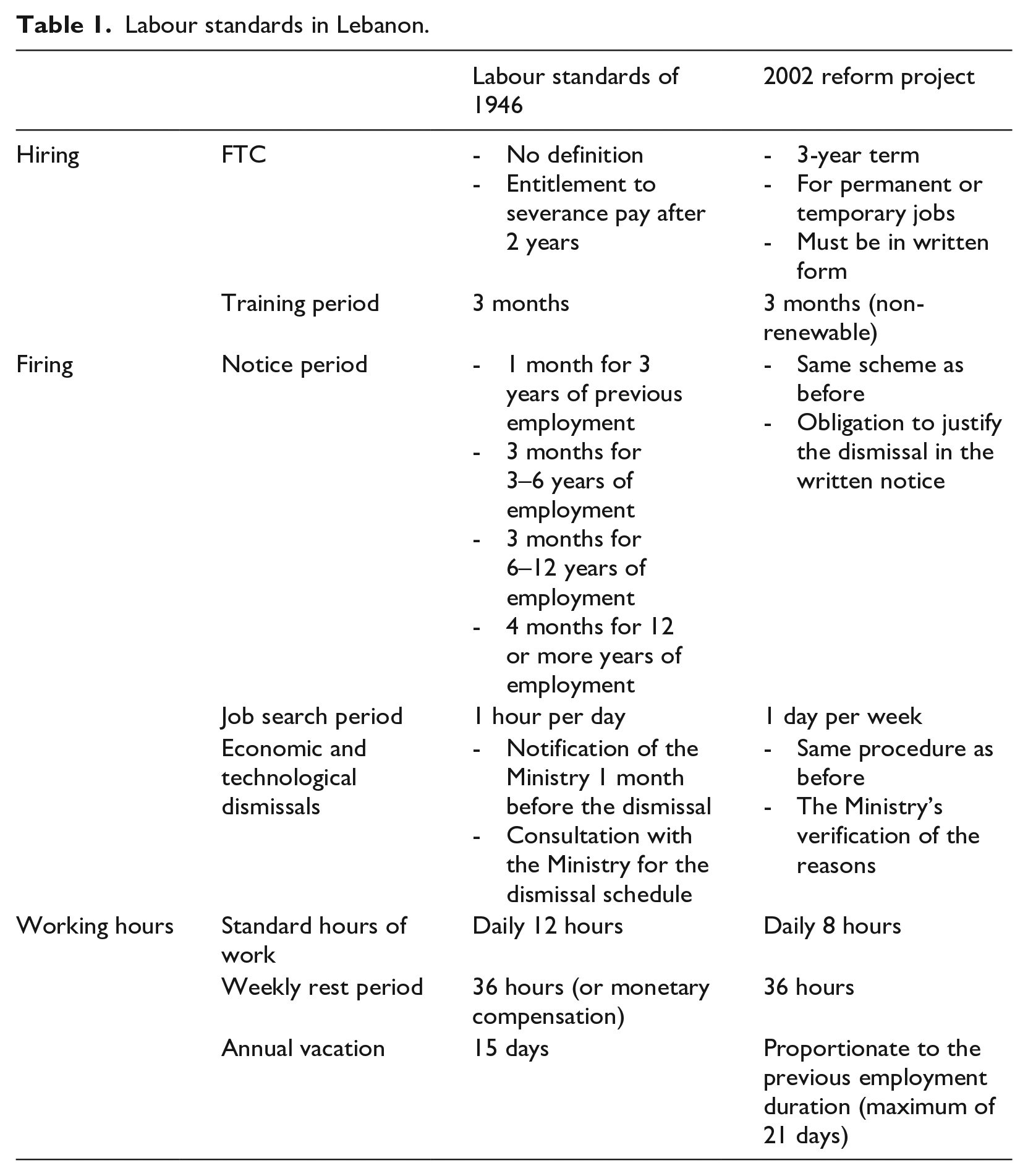
The two reform projects to improve job security in Lebanon in 2002 and 2010 failed. Since the Labour Code does not distinguish between a permanent employment contract and a fixed-term contract (FTC), the 2002 bill sought to fix the FTC duration at three years. It imposed the conclusion of the FTC by writing, 4 and obliged employers to justify their dismissals in the notice letter as well. This bill increased the job search duration following the dismissal notification from one hour daily to one day weekly. 5 It, furthermore, gave labour unions’ founding members increased protection against arbitrary dismissal. 6 It reinforced compliance with the economic and technological dismissal procedure by authorising the Ministry of Labour to verify the validity of employers’ dismissal reasons. 7 Concomitantly, the bill improved the legal framework for working hours by setting a maximum eight-hour daily working time 8 and clarifying the conditions to increase working time, including urgent situations, force majeure and shift schedules. 9 As for the weekly rest, the bill removed the compensation option in lieu of the lost weekly rest period. 10 Labour standards in Lebanon are summarised in Table 1.
Labour standards in Lebanon.
In Tunisia, labour standards legislation underwent two major reforms in 1994 and 1996 (see Table 2), aiming to introduce flexibility measures, but the result reflected a mix of flexibility and security measures. The 1994 reform enhanced some security measures by standardising contract termination requirements. First, it extended the one-month notice period to all workers, thereby eliminating discrimination between workers with monthly salaries and other types of workers. 11 Second, the reform required employers to explain their dismissal reasons in the dismissal letter. 12 Third, it introduced the just and sufficient cause as a precondition for fair dismissal 13 and specified a restrictive list of cases of gross misconduct justifying dismissal. Consequently, the reform limited the liberating effects of the employer’s will (Dammak-Lahiani, 2016: 59). Fourth, the newly established ‘Commission consultative d’entreprise’ was given the authority to act as a disciplinary board. 14
Labour standards’ evolution in Tunisia.
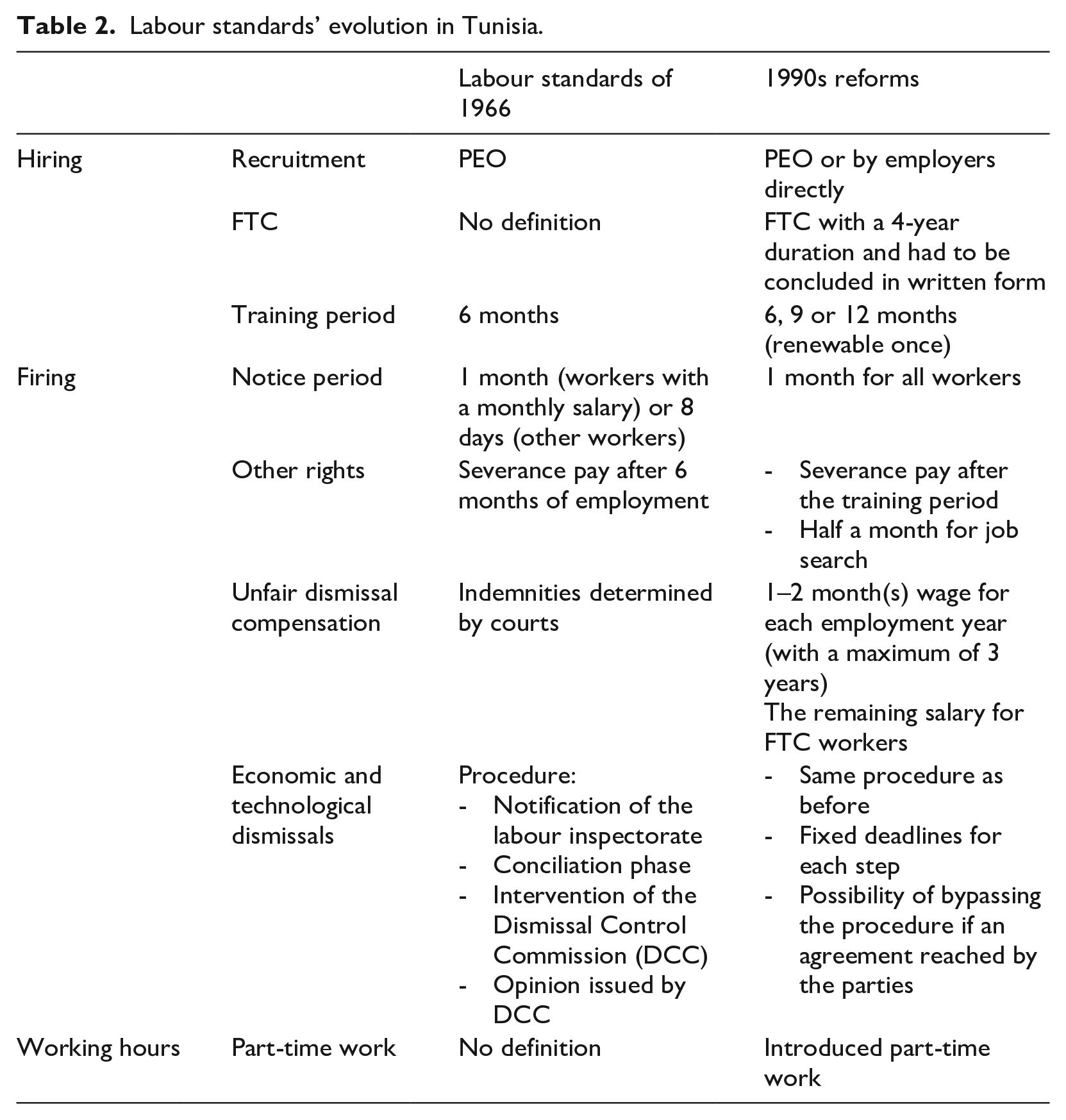
The 1996 reform incorporated more flexibility provisions into the labour legislation. FTC, for instance, could be used for permanent and temporary tasks with a four-year maximum duration. 15 Employers were not obliged to retain their employees at the end of their FTC, nor did they need to provide any reason for ending the employment relationship. The reform, furthermore, abolished public employment offices’ (PEOs) monopoly in recruiting workers, but it instead required employers to inform those offices within 15 days after recruitment. 16 As to dismissals, the reform aimed to improve the mandatory consultation system of the CCETD. There were some qualitative clarifications to the procedural requirements, such as the deadlines for the Commission’s consultation procedure (Article 21) and the permission granted to the two parties to bypass the procedure if they reached an agreement. Moreover, the entitlement to workers’ compensation scheme benefits was granted after the trial period (determined by collective agreements or the law) instead of six months (Article 22). The determination of unfair dismissal compensation for damages was capped and no longer left to the judge’s discretion. 17 By submitting the calculation to a legal scale, the reform makes the sanction for unfair dismissal less dissuasive and grants an advantage to employers (Dammak-Lahiani, 2016: 71; Mzid, 2014: 16). 18 The reform also introduced some changes to working hours. Workers could be employed on part-time contracts, 19 the duration of which must not exceed 70% of regular working hours and must be specified in the written contract. The worker must provide written consent for part-time working hours.
Figure 1 presents a graphic overview of the evolution of labour standards in the two countries.
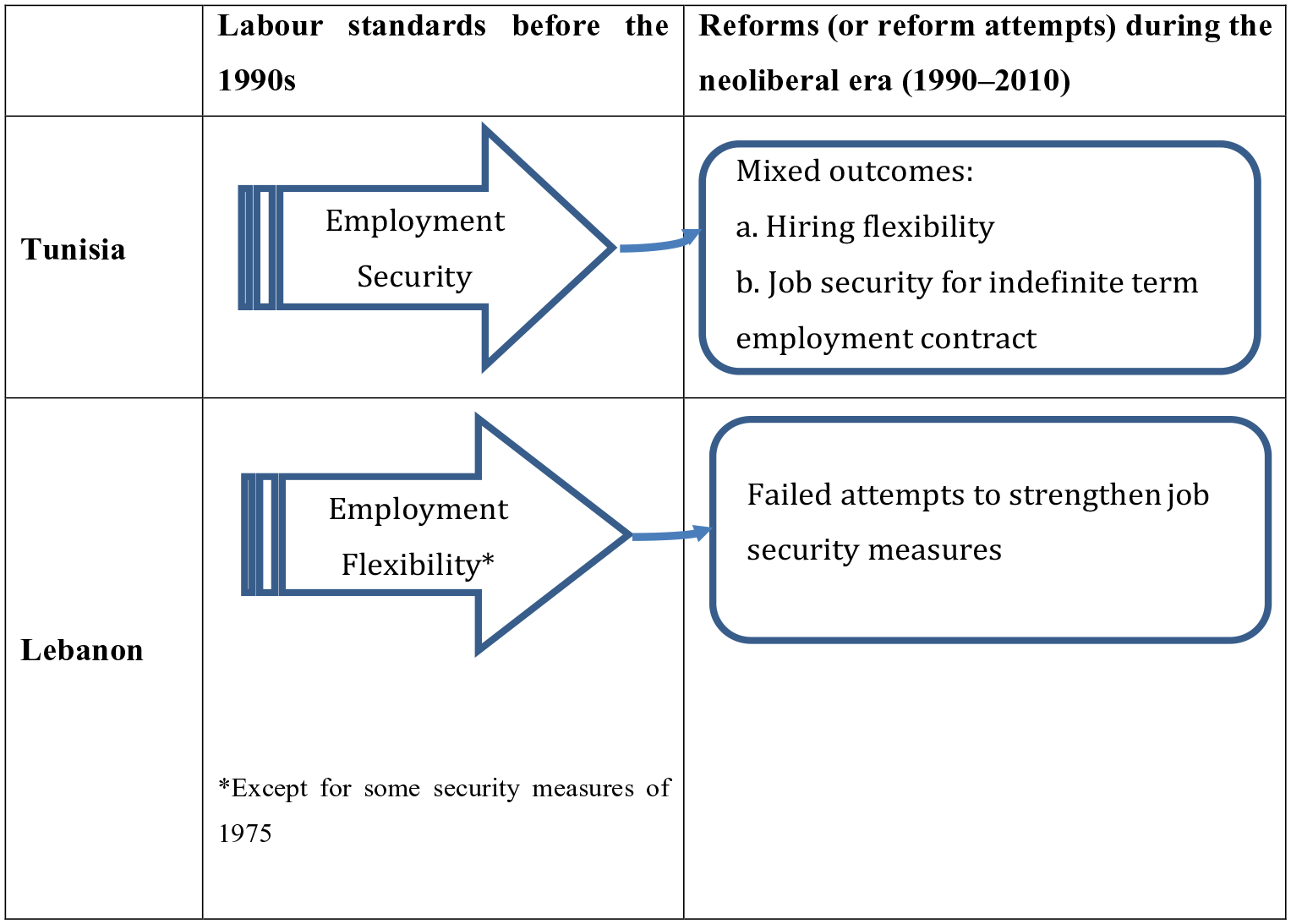
Trends in labour standards’ evolution in Tunisia and Lebanon.
Discussion: Dynamics of labour standards transformation during the 1990s and 2000s
Tunisia and Lebanon had different outcomes from their major labour legislation reform attempts during the 1990s and 2000s, suggesting that the power resources available to labour in each country were dissimilar. Lebanon failed to achieve labour legislation reforms, despite the two attempts in 2002 and 2010 seeking to improve job security. Consequently, flexible pre-war standards remain in force in Lebanon. Also, the lack of legislative change paved the way to a de facto transformation of labour standards because those standards are no longer adequate for contemporary employment relations. In Tunisia, the 1990s reforms added some flexibility measures while retaining and even improving some job security instruments. So, which power resources can explain the Lebanese reform failures during the 2000s and the introduction of reforms in Tunisia during the 1990s?
Lebanon: Reform failure
The lack of power resources is primarily responsible for the GCLW’s limited influence on labour legislation reform. Structural power is limited since the labour market is dominated by informality (Alloush et al., 2013) and by small establishments with fewer than five employees (CRI, 2016: 24). Unlike its neighbours, Lebanon has never pursued a statist approach (World Bank, 1995), with few state-owned enterprises. The tertiary sector accounts for approximately 75% of overall employment (CRI, 2016: 30). Government regulations constrain the labour market by, for example, facilitating the presence of foreign workers and prohibiting public sector workers’ unionisation.
At the organisational level, the GCLW is beset by democratic deficiencies, given that the executive board is not elected by the board of representatives and the representation of federations on the latter board is not proportional to their membership size. The GCLW has a heterogeneous structure, as federations can be general (i.e. from multiple sectors), sectorial or geographical. The GCLW’s financial resources are contingent exclusively upon the government and the solidarity fund. Affiliated federations do not provide any contributions to the Confederation. In addition, the Confederation is subject to government interference, as elections are only considered final with the Ministry of Labour’s approval. Prior to the 1960s, the government declined to grant authorisation to leftist unions, ultimately resulting in their inclusion in the GCLW only in 1971.
Notwithstanding these limitations, the organisational dynamisation of the Confederation during the 1990s prompts a consideration of possibilities beyond the organisational deficiencies. In fact, throughout the Civil War, causing a division among confessional affiliations at the state level, the Confederation upheld its unified structure. During the 1990s, the GCLW made some efforts at mobilisation in opposition to neoliberal policies. However, the state successfully impeded the progression of these efforts. Why then, despite the organisational dynamisation, was the GCLW unable to effectively influence the outcome of labour standards legislation? As per prior surveys conducted with labour union members, the impediment to the GCLW’s empowerment is believed to be primarily rooted in the country’s political and societal framework, rather than solely in organisational structure deficiencies (Abou Shackra et al., 2021; Zbeeb and Bedran, 2001).
From a general point of view, one mode of reforming institutions is through formal and tripartite channels of influence. This type of channel would be a source of power and qualify social actors to impact reforms (Caraway, 2004; Cook, 2007), but the effectiveness of formal channels depends on other factors. In Lebanon, as a formal channel of influence, a tripartite committee had the leading role in the failed reform attempt of enhancing job security in 2002.
20
The failure of the reform, in fact, served the employers’ interests and helped them to push their political agenda for the retention of flexible labour standards legislation. Employers, moreover, relied on their informal channel of influence to defend their interests. This informal channel was effective thanks to the close connections between the country’s political and economic elites. One union leader stated that: We knew from the beginning that this project would be put back in the drawer. If you look, the government and employers are in the same group. They don’t want to reform the Labour Code. Better than this [current labour standards], they can’t get.
21
In the Lebanese case, economic elites (e.g. business and financial organisations) had historically strong control over the state since its independence (Johnson, 1986) and prevented the involvement of organised labour in the political coalition. A small group of merchants formed the ‘Consortium’ and controlled the economy after 1943 (Traboulsi, 2016: 86). The Consortium played an important political role as well (Traboulsi, 2012: 116–119). This elite quashed economic and social reform attempts, such as the one led by the government of young technocrats in the early 1970s (Salibi, 1976: 56). As the most influential actors, economic elites were part of a political coalition that promoted national economic development based on the tertiary sector and reliance on remittances and crowded out the productive sector (Gates, 1998; Traboulsi, 2012: 119–121). After the Civil War (1975–1990), the new contractor bourgeoisie arose, sought political influence, and supported the economy’s neoliberal transformation (Baumann, 2012). The private sector played a dominant role in post-war reconstruction (Denoeux and Springborg, 1998; Leenders, 2012; Wakim, 1998) and it faced only a few legal barriers restricting its activities.
22
The following quote from a member of the Association of Lebanese Industrialists illustrates this dynamic during the Association Agreement negotiations with the EU:
23
The state did not consider the interests of Lebanon’s industrial sector. The European Union, for example, has signed an agreement with Tunisia. They benefited greatly from this agreement. They granted them access to the European market. We don’t just want money; we want access to the European market. Besides, my sources informed me that the Lebanese government has refused financial assistance that could be granted to industry’s development. It favoured a market liberalisation orientation. Members of the government even told me personally that this is not a country for industry, and that we should sell our businesses. We were not protected and were denied market access.
Concretely, the political coalition controls the national economy through ‘networks of privilege’ (Leenders, 2004). The Lebanese labour market is not organised according to the neoclassical presumption of supply and demand, but it operates as networks that exclude investments from business organisations not part of the political coalition (Leenders, 2004: 187). As summarised by Salloukh et al. (2015: 5–6), ‘[w]hole sectors of the economy [. . .] operated in a non-competitive and non-transparent manner. [. . .] The recycled and reinvented postwar “merchant republic” composed of an alliance between the sectarian/political elite and their business partners in the financial, commercial, and tertiary sectors managed the economy as an archipelago of cartels monopolizing a range of industries and exclusive import licenses beyond any semblance of accountability.’ 24
The GCLW is then deprived of a vital source of power, namely involvement in the political coalition. The fact that the Lebanese political coalition protects the informal channel of influence rules out the possibility of reforming labour standards through a formal channel. Employers exercise their influence without the need to establish an effective formal channel. Channels of influence structure the opportunities for social actors in their political struggles. More precisely, the dominance of the informal channel of influence allows employers to have a say in reform outcomes while eliminating the GCLW’s possible impact on the development of the labour market.
The exclusion of the GCLW from the political coalition, resulting in negligible influence on labour standards legislation reform, is facilitated above all by the lack of a specific power resource, i.e. ‘moral legitimacy’. The situation is presented in the following way by two participants: If there had been a union movement up to the task in Lebanon, you can be certain of one thing that the laws would have changed. It requires a societal push, which Lebanon lacks.
25
Lebanese employers perceive the union in two ways: as a co-opted union or as a union excluded from the workplace.
26
Historically, the moral legitimacy (especially its structural form) of the GCLW has been negatively affected by liberal economic policies and political confessionalism.
Liberal economic policies with an emphasis on private initiative and minimum legal restraints on the private sector have dominated Lebanese national development strategies throughout the twentieth century. They are inherited from French colonialism, which imposed a liberal orientation, a market-friendly state favouring private education and health systems (Abi-Rached and Diwan, 2022), and little public investment (Al-Saleh, 2002). The French favoured the service, commercial and banking sectors (Owen, 1976: 26). After independence in 1943, the development of these sectors was guaranteed and encouraged by special financial regulations and monetary policy (Safieddine, 2019) and deregulation of capital flows (Gaspard, 2004: 183–184). The evolution of the customs duties regulation illustrates the embeddedness of this pattern in the Lebanese economy. In 1971, Decree No. 1943 tried to increase customs duties on imported goods as a protective measure, but it faced strong opposition and a 10-day strike by Beirut merchants and shopkeepers that led to its removal (Owen, 1976: 31).
One of the fathers of this liberal orientation in the Lebanese economy is Michel Chiha, a Lebanese thinker who supported a trade- and service-based liberal economy, but not industrialisation. He asserted that ‘the commerce of this country is ten times better informed than the State of what suits it and what does not suit it. It lives from a more established tradition and a richer experience than any other’ (Chiha, 1965: 120). Chiha participated in the preparation of the Lebanese Constitution. Through his family’s bank, Pharaon & Chiha S.A.L., he had a strong influence on Lebanese economic policies (Dib, 2007: 100–101), in that his vision and ideas for a national liberal economy profoundly shaped the state and national identity. Chiha considered that ‘[it] is not only by collecting fees that we will build this country; [. . .] it is by developing everyone’s means of action, by stubbornly looking on the side of freedom’ (Chiha, 1965: 31). In an international context of cleavage between economic liberalism and state planning at the dawn of the Second World War, those policies were perceived as the best suited for the (myth of) Lebanese ‘old merchant people’ (Chiha, 1965: 123). Legal restraints were, therefore, considered to stifle the initiative of Lebanese people (Chiha, 1965: 46). In this context, the labour movement was not seen as an essential factor for the country’s economic development. On the contrary, it was perceived as an obstacle to Lebanese employers’ initiative and their contribution to the country’s development. Not surprisingly, organised labour was excluded from the political coalition and did not achieve a legitimate place within the national institutional configuration.
In addition to economic liberalism, the political regime’s confessional character weakens the ideational power of the Lebanese labour movement. France institutionalised a confessional system of administration and representation in the 1926 Lebanese Constitution, Article 95 of which stipulates that ‘communities will be fairly represented in public employment and in the composition of the ministry without this being able to harm the good of the State’. Furthermore, the Decree of 1936 27 entrenches the notion of the historical constituent communities of the country. Political confessionalism affects class consciousness in Lebanon. Dubar (1974: 308) argued that ‘it is necessary to consider both the confessional phenomena linked to traditional structures and the economic phenomena resulting from capitalist penetration’. Dubar’s double perspective is specific to peripheral capitalism like the one existing in Lebanon. It is a question of ‘[r]ecognizing the simultaneous presence in the Lebanese social structure of a politico-confessional structure, defined as the set of positions and symbolic relationships uniting the different ethnic-religious communities (especially Christians and Muslims) and a class structure constituted by the positions and social relations resulting from the economic system’ (Dubar, 1974: 312). This structural duality manifests itself as a gap between socio-economic situations and political realities. Workers are, in other words, disassembled beyond politics and identify themselves with the existing confessions. Confessionalism thus precludes the construction of a class consciousness that would often result in mobilisation around labour unions.
The political coalition uses political confessionalism to deprive the GCLW of its internal solidarity and co-opt its executive. During the 1990s, the political coalition and the GCLW were at odds with socio-economic policies. The GCLW fought to improve workers’ purchasing power (Baroudi, 1998; Bou Khater, 2022). The political coalition neutralised the GCLW by authorising confessional federations, which grew from 23 before 1990 to around 63 federations in post-war Lebanon. The GCLW advocated for a new organisation comprised of 18 sectoral federations. 28 Such a structure would have favoured federations with a professional identity rather than a confessional one. Yet, by employing political confessionalism, the political coalition controlled the vote and replaced the leftist executive – which was led by Elias Abou-Rizk and opposed the neoliberal order – with a co-opted one. The strengthening of the confessional character of labour federations has made workers identify themselves with the confession to which they belong and not with their social class. This led to the constituent federations of the GCLW no longer sharing the same perception of struggle or benefits in the Lebanese system. The state control of the labour movement via political confessionalism acts as ‘extra-economic constraints’ (Kabanji, 2017: 57) on class solidarity and class consciousness. State control of federations means a lack of internal democracy in the GCLW, and it transforms the confederation ‘into an agency of control over their members’ instead of ‘a means of control for these same members’ (Hyman, 1975: 68).
Tunisia: Institutional transformation through formal channels of influence
The UGTT succeeds in retaining (and strengthening) some forms of job security. To illustrate, a labour law professor, commenting on the authority of the Commission consultative d’entreprise to act as a disciplinary board, explains that: It is a public-sector rule. Because the labour union was formed in this sector, they negotiate with the mentality of the public sector’s statutes. The disciplinary board is unique to Tunisia and is not found in comparative legal systems.
29
In addition to that, the UGTT prevented the legalisation of private recruitment agencies (Amouri, 2016: 10). As a former member of the Economic and Social Council (ESC) testifies, 30 in earlier drafts, two more articles, namely Articles 6-5 and 6-6, relating to subcontracting, were included, but they were withdrawn following pressure from the UGTT. Also, the UGTT managed to protect the overtime premium from lowering the rate of salary increase for these hours from 75% to 50% for the full-time work regime of 48 hours weekly.
Even the adoption of the flexible FTC measure with a maximum four-year duration was not easy to secure for employers. Regarding this, a representative of the employers’ association at the negotiation table declared
31
that ‘Nobody expected us to get the four-year period’. A member of the ESC adds to this observation by stating that:
32
. . . a few months before the adoption of Article 6-4 in 1996, the four-year period was included in certain collective agreements because it was believed that the reform would fail.
The first scheme, negotiated at the bargaining table, offered two distinct regimes. The first one proposed a standard permanent contract for permanent jobs, while the second permitted the conclusion of an exceptional FTC for temporary jobs. With a maximum four-year duration, the use of the FTC would thus be limited to objectively temporary jobs like an extraordinary increase in work or the temporary replacement of a permanent worker (Article 6-4-2). However, the Ministry of Social Affairs sent an alternative proposal to the ESC for review. Briki, the UGTT delegation’s leader at the negotiation table, notes that the new proposal included an additional point in Article 6-4-2: ‘the FTC can also be concluded, in cases other than those indicated in the previous paragraph, by agreement between the employer and the worker’.
33
This addition authorises the FTC in permanent and not only temporary positions as under Article 6-4-1. One labour law professor who participated in the reform observed that:
34
The 6-4-2 is the UTICA [i.e. the employer confederation] that imposed it, a fortiori, it completely cancels what is said in the 6-4-1. [. . .] The 6-4-1 is UGTT, the 6-4-2 is UTICA, and the whole thing is total confusion.
Consequently, Article 6-4 introduced a flexible hiring regime (Kotrane, 2017; Mzid, 2014). The only true gain is the guarantee of the same wages and allowances to both permanent and FTC workers with the same professional qualifications (Article 6-4-3). As minimal as it is, this provision is considered noteworthy since it alters the manner that prevailed before the reform. 35
These examples illustrate the important role played by the UGTT in labour standards reforms. The labour law professor concluded that the reform’s outcomes: . . . relativise the question of the dictatorship. The political power before the revolution did not decide everything. On social issues, it was always necessary to preserve the balance and the agreement of the Labour Confederation. Ben Ali could not decide everything in matters of work. I lived through the time of the reform of the Labour Code. I was consulted [. . .], and I was in all the commissions that discussed this reform. I know we were afraid [of the reaction of the UGTT].
To understand the UGTT’s role in shaping reform outcomes, it is imperative to scrutinise its power resources. To start, structural power had less significance, as informal sector workers constitute over 50% of the total workforce and lack the ability to articulate their demands (Gopal, 2020). Heavy industrialisation and public sector employment facilitated the UGTT’s empowerment following independence, but after the 1970s, there was a transition from intensive industrialisation towards an export-oriented development model resting on low-skill assembly. This spread out the concentration of labour (Bellin, 2002). A substantial portion of unionised state-owned enterprises went through privatisation and workforce reduction (Harik, 1992: 219). The UGTT has a notable presence in key sectors like manufacturing (including textiles, electronics and automobile supplies), mining and oil, metals and electronics, and chemicals. However, these industries have faced significant pressures over the past few decades. In textile manufacturing, which constitutes a significant portion of Tunisia’s industrial sector, subcontractors are subject to stringent demands from major corporations, resulting in workers being compelled to accept unsuitable working conditions or, alternatively, to choose unemployment. It is noteworthy that, according to the UGTT’s statutes, local unions are exclusively established in enterprises with more than 50 workers, a criterion that is not met by over half of the textile industry (FTDES, 2017). The phosphate industry experienced a significant workforce reduction following the introduction of an early retirement programme and the adoption of mechanisation (Ghilès and Woertz, 2018: 59–61). This sector also witnessed the rise of subcontracting firms, the employees of which lacked the favourable employment conditions of formal workers (Ghilès and Woertz, 2018: 61). The utilisation of logistical power, as exemplified in the first general strikes of 1978, caused the deployment of security forces and the subsequent sentencing of numerous union leaders.
Furthermore, Tunisia exhibits a comparable distribution of unionised workers to other Arab countries, even in the public sector (Gopal, 2020; Hartshorn, 2019: 9). It has undergone a similar restructuring trajectory to other liberalising economies. If the constraining structural conditions had still left sufficient power for organised labour to affect the reforms’ outcomes, then confederations, such as the Egyptian one, would have had the capacity to exert such an influence. In a context where the political and business elites strive for increased flexibility and liberalisation, organised labour cannot rely on its remaining structural power to steer the course of action, but it needs additional resources.
The UGTT in Tunisia exhibits diverse organisational capabilities. The confederation has at its disposal various financial resources (e.g. the newspaper Achaab, a travel agency, a cooperative involved in fisheries and the Amilcar Hotel), paid time off for elected union officers in the public sector, and the deduction of union dues at source for public sector employees. In the 1970s, the unionisation of white-collar and leftist workers gave the UGTT a more combative base. In Egypt, however, the exclusion of the left was a prerequisite for the formation of the labour federation (Beinin, 2015: 30). The inclusion of militants served as a leverage point in the 1990s because it ‘strengthened UGTT institutionally even as the national leadership largely accommodated the regime’ (Beinin, 2015: 55), whereas in Egypt, workers’ mobilisation occurred independently of organised participation (Beinin, 2015: 41).
In spite of this, sources of organisational power within an authoritarian regime are susceptible to suppression. This is particularly true in the context of Arab corporatism, wherein a trade-off resulted in the loss of the working class’s collective power in exchange for a broad redistributive programme (Gopal, 2020: 96). In the 1980s, the political regime rescinded several entitlements of the UGTT, including union dues deducted at source, union meetings on company premises, publication of Achaab, jurisdiction over various public enterprises, and remuneration for public sector employees elected to full-time UGTT leadership positions (Beinin, 2015: 49). It also abolished the UGTT’s monopoly of representation on multiple occasions, especially after the state’s recognition of the Union Nationale des Travailleurs Tunisiens (UNTT) in 1984. Overall, state assaults after 1978 ‘coerced UGTT into submission’ (Beinin, 2015: 35), and by 1984, it ‘had been tamed’ (Ghilès and Woertz, 2018: 66). This impeded the UGTT from reversing the austerity measures of the Rachid Sfar government (1986–1987) and compelled it to reconcile with Ben Ali’s regime to restore its organisational capacities after 1987 (Beinin, 2015: 50–52). In this regard, associational capabilities do not completely explicate the UGTT’s impact on reform outcomes in the mid-1990s.
Since the 1970s, Tunisia has pursued a neo-corporatist social consultation model. In the case of labour standards, a tripartite committee (formed by the UGTT, the employers’ confederation and the government) oversaw the reforms in 1994 and 1996. This formal channel of influence ensured the social actors’ involvement in the labour standards legislation reforms, the outcomes of which reflected the actors’ antagonistic interests. Its effectiveness constituted a source of power for the UGTT and facilitated the defence of workers’ interests.
Nevertheless, the channel of influence is not a neutral device, but a product of the national political coalition. The latter has historically endorsed the formal channel of influence in Tunisia. This coalition, which united groups that fought for the country’s independence, including the soon-to-be ruling party (i.e. the Neo-Destour Party) and the UGTT, is rooted in the country’s liberation period from French colonialism. As a result of the liberation struggle, big urban traders who defended colonial power were marginalised (Cammett, 2007: 63). Subsequently, the first years after independence strengthened the ties between the political regime and the UGTT in the state corporatist structure. Later, in the early 1970s, the political regime rehabilitated the private sector with an export-oriented industrialisation strategy. It also sought to bring together the key players in the Tunisian labour market by introducing a social concertation arrangement with the goal of reaching consensus on socio-economic policies. The UGTT consolidated its position in the political coalition after Bourguiba needed its support in response to his internal conflicts with members of the ruling party’s leadership (Wilder, 2016). In the 1990s, the formal channel of influence was supported by the strategic decision of Ben Ali’s regime to favour national actors’ participation in policy elaboration (1987–2011),
36
which favoured a ‘dynamic of labour law marked by this dialectic between the normative autonomy of social partners and state intervention’ (Mouelhi, 2016: 109).
37
A sociologist, who is also a director of a research centre, stated that:
38
. . . there was a clear political agreement between Bourguiba’s government and UTICA, even during Ben Ali’s reign. So, there were no strategic or other political divergences. Between UGTT and the government, there was a tense relationship much more than a relationship of complementarity.
Despite being organisationally compromised by an authoritarian regime, the UGTT remained in the political coalition and effectively utilised the formal channel of influence. The utilisation of the ideational resource, specifically moral-structural legitimacy, can provide insight into the UGTT’s role within the Tunisian institutional framework. For instance, Von Holdt (2003) underscores the importance of the discourse surrounding the South African labour union’s involvement in the struggle against racial and colonial oppression in relation to the union’s empowerment. In a similar but more elaborated manner, this article argues that the UGTT also leans on moral-structural legitimacy, which was guaranteed by two main factors: participation in the liberation of Tunisia from French colonialism and embodiment of the only space for collective action for decades under authoritarianism.
On the one hand, the UGTT fought for the country’s liberation during the 1940s and 1950s (White, 2001). The UGTT’s founder, Farhad Hached, was assassinated in 1953 by the colonial power, not because of his trade union actions, but his involvement in national politics. His assassination assured the sympathy of the Tunisian people towards the UGTT. Hached became a national symbol of the defence of workers’ interests. The UGTT qualifies as a national organisation, in contrast to international standards where we speak of social organisations. 39 Gobe (2008: 275) argues that the ‘UGTT imposed itself in the mid-1950s as a partner in full share in Bourguiba’s party from when the latter found itself in need to join forces with other forces in its fight against the French colonial power’. After independence in 1956, the two bodies worked together to run the country based on a state corporatist structure; the UGTT leaders were members of the political bureau of the ruling party (the Neo-Destour), stood for election on its electoral lists and held several important ministerial posts. The political regime was inspired by the UGTT programme of 1955 for various social and economic reforms (e.g. the Health and Education policies of 1958 and the 1964 industrialisation strategy). The regime entrusted the application of these reforms to UGTT members (Yousfi, 2017). Organised labour was thus a power parallel to the party-state (Ben Hamida, 1994).
On the other hand, despite its close links with the authoritarian regime, the UGTT was not reduced to a mere transmission belt of political powers. Instead, it represented the only collective action space, remaining sheltered from the party-state’s total control (Yousfi, 2017). When the government devalued the national currency in 1964, the UGTT, led by general secretary Habib Ashour, demanded a salary increase as compensation for this devaluation. The government opposed it, and this first clash ended with the short-term imprisonment of the general secretary. During the decade of 1978–1987, the UGTT fought for its autonomy vis-a-vis the political regime. Ashour, back at the head of the confederation, obeyed the UGTT rank-and-file, which refused the 1977 Social Pact. The UGTT was notably behind the first general strike in Tunisia in 1978, which was violently suppressed by the army.
40
This strike ended with the political regime’s seizure of the UGTT and the imposition of a co-opted leadership over the UGTT. At the end of the decade, the UGTT became the refuge and the carrier of the forces opposed to power (Zghal, 1998: 10). In the mid-1980s, it fought another battle for autonomy and salary adjustments. In this context, the Bourguiba regime weakened the confederation by cancelling the organisational entitlements mentioned previously. Yet, the UGTT arose again. The sociologist described the role of UGTT as follows:
41
[It] has always acted as an autonomous interlocutor who is supposed to defend only the interests of the working class. This autonomy from the state and UTICA gave it this union charisma. Therefore, it does not consider itself to be linked to the state or UTICA. It regards itself as only having a contract with workers.
Hartshorn and Sil (2019: 30) called it ‘moments of militancy’. During those moments, the political regime tried to completely control the UGTT, but the labour confederation’s historical legitimacy prevented it. The historical legitimacy and the moments of militancy formed the structural legitimacy of the UGTT.
Conclusion
This article explores the dynamics of labour law reform in two under-studied countries. It has shown that, in Tunisia, a layer of flexible measures was added without, however, removing all job security measures. Even more, some security measures, including dismissal protection, were improved. In Lebanon, the labour standards reform failure after 1990 implied that flexible standards continued to prevail. The lack of reform also led to certain aspects of the legal framework becoming obsolete, in that the legislation no longer offered an adequate regulatory framework for working conditions in the neoliberal era. This situation benefits employers and gives them a high level of flexibility in hiring and firing decisions.
The national differences in the outcomes of labour standards reforms can be understood in light of the sources of power. The explanatory capacity of structural power is inadequate to explain the divergent outcomes. The UGTT’s structural power is constrained due to factors like a predominantly informal economy, privatisation pressures and an export-oriented approach. In Egypt, sharing a similar historical trajectory, the labour confederation’s structural power was inadequate to impact reform outcomes. Likewise, the GCLW’s structural power has been historically constrained by informality, tertiary sector development and a liberal economy. The comparative analysis, however, reveals that the UGTT and GCLW exhibit differing levels of associational power, with the former enjoying a wider range of associational power than the latter. In the 1990s, the two confederations underwent divergent paths in terms of their organisational trajectories. During the 1980s, the UGTT faced state oppression and subsequently resorted to collaborating with the Ben Ali regime after 1987 as a means of rebuilding its associational power. Throughout the state-dividing civil war of the 1980s, the GCLW remained united, and displayed notable organisational agility during the subsequent decade of the 1990s. Although the UGTT was subject to an authoritarian government’s control, it exerted a significant influence on the outcomes, whereas the GCLW’s organisational vitality failed to yield any effect on labour standards reform.
This article contributes to the power resource literature by analysing three resources, i.e. institutional, ideational and coalitional resources, and the relationship between them throughout the history of each country. It seeks to fill a gap in the literature and respond to recent calls to ‘examine more closely the ways in which different forms of power resources are connected to each other and must do so in ways attentive to a union’s history and geography’ (Ellem et al., 2020: 426).
The historical institutional analysis has demonstrated that the type of channel of influence structures opportunities for social actors. A pre-existing formal channel of influence in Tunisia not only played an important role in the achievement of the labour standards reform through consultation, but also helped the labour union participation to shape the reform’s content. By contrast, in Lebanon, the failure of reform attempts through a formal channel of influence was closely related to the ineffectiveness of this channel. Such ineffectiveness stemmed in part from its lack of institutionalisation in Lebanese history, and in part due to the existence of informal channels of influence favouring the business community. Different political coalitions support these formal and informal channels of influence. Labour unions can be included in or excluded from the political coalition. In Lebanon, political and economic elites are the key players in the political coalition. As part of the political coalition, the economic elites in particular fostered an informal channel of influence. In contrast, groups that fought for Tunisia’s independence, notably the Neo-Destour Party and the UGTT, formed the cornerstone of the political coalition. This coalition established later a formal channel of influence.
This article, furthermore, has considered the ideational resource through the legitimacy of the labour union in the national context. The ideational resource ‘both depends upon and influences’ (Refslund and Arnholtz, 2022: 1965) the legitimate or anachronic view of a labour union in this context. Moral legitimacy can act as a constraining or enabling force for the labour movement. And more importantly, the establishment of moral legitimacy depends on a history of events. The application of institutional legacy to the concept of legitimacy enables us to analyse the construction of moral legitimacy over time. In Tunisia, the UGTT gained such legitimacy since it was involved in the country’s liberation from French colonialism and then its long-term opposition against the authoritarian regime. The UGTT reserved its permanent place in the national institutional configuration. By contrast, liberal economic policies and political confessionalism prevented the GCLW from acquiring such legitimacy. With a collective imagination idealising successful traders, liberal economic policies stressed the Lebanese people’s private initiative. The political confessional system acted as an extra-economic constraint on workers by negatively affecting their class consciousness and allowing the state control of the GCLW’s executive. Legitimacy, in that sense, acts as a path-dependent normative mechanism for the labour union’s actions. Society’s perception of the labour movement affects the movement’s role in labour market reforms. Conceptualising ideational resources as path-dependent assets sheds light on whether these resources contribute to organised labour’s being part of the political coalition and its influence on the evolution of labour standards. Our two cases, in that regard, demonstrate that consecutive events in Tunisia have provided the UGTT with legitimacy, while the Lebanese liberal economic and confessional policies deprived the GCLW of this power resource. The variation in ideational power resources helps us to explain why similar labour movements may have different influences on labour reforms. For example, even though Egyptian and Tunisian labour movements had infrastructural resources and representation in corporatism (Hartshorn, 2017), labour standards legislation reforms had different outcomes in these two countries. This type of power resource also helps explain why, in Lebanon, the GCLW remained weak despite many occasions of renewal. For example, during the 2002 reform attempt, the GCLW was invited to the tripartite negotiation of the Labour Code. It was, however, unable to push for this reform.
Footnotes
Acknowledgements
Special thanks go to Umut Riza Ozkan for his insightful comments on earlier drafts of this article. Also, my thanks go out to the anonymous reviewers for their comments.
Declaration of conflicting interests
The author declared no potential conflicts of interest with respect to the research, authorship, and/or publication of this article.
Funding
The author disclosed receipt of the following financial support for the research, authorship, and/or publication of this article: This research was funded by the Interuniversity Research Centre on Globalization and Work (CRIMT); and Mitacs Globalink (IT08718).
