




Abstract
This article explores the ideological orientations of ‘younger workers’ in relation to their experience of precarious employment in Scotland and Greece. Based on 60 semi-structured interviews with workers in hospitality-related occupations in two national settings, it counterposes their actual material conditions to their ideational conceptions, values and worldviews. By interrogating stances on issues such as flexibility, future plans, collectivism and trade unionism, on the ideals of freedom and fairness and on their thoughts about what is possible in their field of work, it enquires about the impact of prevailing market-centred values and neoliberal axioms on younger workers. It identifies tensions, unease and contradictions in workers’ ‘subjective’ articulations and explains how these are not a product of ideology per se but have their causes in the ‘objective’ realm, the socio-economic conditions prevailing since the financial crisis.
Keywords
Introduction
Graduate jobs have increased at a far slower pace than graduates in the last decades. At the same time low-paid service sectors such as hospitality and retail have grown faster than other medium-paid sectors, and so has sub-standard employment (Eurofound, 2020a). While professional jobs and regular employment are still available to young university graduates, competition is fierce, and this results in many being significantly delayed in embarking on professional careers or excluded altogether (Berry and McDaniel, 2022). It is quite clear that conditions in the labour market have generally deteriorated, especially in the aftermath of the 2008 financial crisis and that younger people have been hit most (Pulignano, 2017). Yet in the contemporary inter-generational injustice debates the focus is not on employment conditions but on the impact of austerity and debt on general welfare and this, as Bessant et al. (2017) demonstrate, is often framed in problematic terms as being merely about the future rather than the present as well.
The youth studies literature which does deal with the contemporary employment field and transitions from education into the labour market, views precariousness in terms of the disadvantage of young people in the labour market and the various policies and programmes adopted for training and employment support (Dietrich et al., 2018; Simms et al., 2016; Stuth and Jahn, 2019). Other research deals with the delaying of adulthood traditionally associated with stable employment and the structural challenges that youth face today, or the impact these have on their subjectivity, identity and cultivation of the self (Farrugia, 2019a). Nevertheless, as Wong and Au-Yeung (2019) argue, the implicit dichotomy between determinism and voluntarism in the field of precarious employment studies thwarts us from achieving an in-depth understanding of the complexity of young people’s meaning-making processes.
While we know a lot about young people’s structural disadvantage (Doellgast et al., 2018), we know little about how this affects their ideological orientations. Similarly, while there is a lot of research about young people’s work preferences and choices, identity and agency in the process, there is less on how these are being shaped by their lived experience. Notwithstanding the voluminous research on precarious work, including more recently on the experiences of the self-employed (Murgia and Pulignano, 2021) and the dynamics of work groups (Manolchev et al., 2021), a gap remains with regard to the connection and two-way interaction between the determining material conditions and the cultural-ideological milieu in which precarious workers make sense of them. To address this, this research focuses on the impact of poor employment conditions on younger workers’ perceptions and consciousness through interrogating their perspectives and orientations.
Building on what is known about labour market transitions, this article focuses on the interface between the objective and the subjective dimensions of younger persons’ experience. Informed by abstract concepts, it closely investigates their narratives, projecting out from the facts to the norms and making inferences about their broader ideological orientations. Subjects are very often enmeshed in contradictions that defy easy categorisation. Moreover, ideology and consciousness operate in dynamic, not static ways. Consistency and coherence are thus neither a given, nor something that can be fully reconstructed while analysing narrative extracts. What the analysis can do in the face of diverging and contradicting positions contained within narratives is to recognise, account and interpret their meaning. By examining them in context, assessing their significance and implications, it can offer explanations about their causes and consequences. In doing so, the analysis illuminates the ways in which ideology, in this case the dominant neoliberal ideology, functions as subjects are asked to reflect on their own lived, working experience.
The main argument articulated is that while younger workers’ experience in the labour market contrasts with their hopes, they tend to adapt to the conditions they encounter without undergoing a process of rethinking the basic tenets of their broader worldview. Lowering expectations and avoiding long-term thinking are the key coping strategies adopted, as this seems easier and offers some needed stability which their social location deprives them of. Limited belief in the feasibility of rights enforcement and collective action as identified by Ioannou and Dukes (2021) structures not only the understanding of their current employment relations but more broadly the prospects for positive change. This leads to at least a partial acceptance of neoliberal premises and an implicit normalisation of existing conditions. After outlining the theoretical framework, the article presents the context and research questions and describes the methods and sample. Subsequently, findings are discussed in three thematic subsections and the final section concludes the article, returning to the theory.
Neoliberalism as a social ideology
Neoliberalism has been approached as a policy framework, a political ideology and a phase of capitalism, driving institutional change in labour and social policy in the last four decades (Baccaro and Howell, 2017; Davies and Freedland, 2007; Thelen, 2014). Underpinned by the parallel process of financialisation, neoliberalism extends much deeper than the management of the economy and the production process. Neoliberalism is also operative at the societal level, shaping modalities of social action and class dynamics (Fine and Saad Filho, 2017; Harvey, 2005; Umney, 2018). It impacts on values and discourses, embedding for example ideas such as the primacy of the consumer, personal choice and individual responsibility as the key to general prosperity (Bessant et al., 2017); it can thus become rooted in popular subjectivities, which allows it to survive amidst declining political legitimacy (Gago, 2017). Neoliberalism is thus also a social ideology, an assembly of ideological fragments, which dominate the public sphere and can determine common sense (Gramsci, 1972).
An ideology that becomes dominant is not necessarily more coherent than other competing ideologies, nor does it necessarily offer more comprehensive explanations about its subject matter. Often it suffices for it to be able to oust other ideologies, deconstructing some of their central notions and promoting its own frames upon a range of issues. Ideologies backed up by economic force and political power do not need to link the disparate elements that compose them robustly, in a logical manner. They can secure their necessary cohesion by connotations rather than denotations (Seymour, 2014: 155). Nor is hegemony built simply on the consent of the subaltern classes to the social status quo. While persuasion is an integral part of any hegemonic ideology, this always coexists with other types of power resources while naked force, disciplinary devices and the capacity of coercion remain ever present. Homo economicus is both ‘taught’ and ‘nurtured’ into existence (Davies, 2014).
In employment, the leitmotif of neoliberal ideology has been the promotion of flexibility through the battle against ostensible rigidities. Flexible management serves productivity and efficiency; external flexibility allows utilisation of market dynamism; and internal flexibility facilitates better adaptation to innovation (Vallas, 1999). National competitiveness in the globalised economy presupposes limiting employer costs, a strategy encompassing liberalising industrial relations systems, curbing trade union power, decreasing employment protections and facilitating the mobility of workers (Gumbrell-McCormick and Hyman, 2013; Streeck, 2014). Working time flexibilisation, like outsourcing and agency work, emerged as instruments in this process and central concepts within the broader discourse. Active labour market policies were seen as the recipe for dealing with unemployment and life-long learning and mobility the strategy that workers must adopt to survive (Greer, 2016).
At the societal level, this involved the curbing of youth expectations for stability and upward mobility, and adjustment to the worsened conditions prevailing in the labour market. For most newcomers, precarity was all that was visible on the horizon, constructed as an acceptable or required alternative to unemployment and thus normalised (Alberti et al., 2018; Rubery et al., 2018). The rhetoric of soft skills acquisition, entrepreneurial spirit, professional ethos and employability with which young students and graduates are bombarded, further enhanced by subsidised training programmes, not only stands in contrast to the diffused precariousness but also operates as a substitute to regulated and ultimately decent work (Southwood, 2017). What is more, the crisis and post-crisis conditions forced the active immersing of young workers into neoliberalism: that they conceptualise low-paid internships as experience opportunities, frequent movement from one job to another as mobility, non-predefined working time as freedom, living with temporariness as acquiring the capacity to be flexible and adaptable (Bithymitris and Papadopoulos, 2017; Farrugia, 2019b). To play the game one must abide by its rules – and those most fully structuring their behaviour patterns according to the rules are more likely to be successful, or at least this is the implicit promise.
At the workplace level, managerial hegemony is established through organisational means producing consensual forms of cultural adaptation to the existing order (Burawoy, 1979). Yet acts of workplace resistance are prevalent, especially at the micro level, and in addition to the dominant ideology, other counter-ideologies exist, even if only in implicit form, which may produce oppositional consciousness that is more conflictual than acquiescent (Vallas, 1991). Dissent, however, whether as a growing unpopularity of neoliberalism at the macro-political level, or as workplace disobedience against the work process, is insufficient to change the contours of existing capitalist social relations (Lloyd, 2017). Thompson (2015) argues that the Marxian notion of false consciousness, when reformulated as defective social cognition, can explain the process whereby the social status quo of inequality is being reproduced. False consciousness, a form of thinking distracted from considering the basis of existing social relations, is rooted in irrationalism because it is based on heteronomous values and ideas internalised and legitimated by subjects who however cannot defend them rationally. These value orientations ‘distort the cognitive and epistemic structures of thinking’ leading to an inability on the part of the subject to be able to conceptualise the world in any objectively valid sense (Thompson, 2015).
Precariousness at work and consciousness
Precariousness has both material and non-material consequences: not just limiting income but also available time for domestic and care duties and socialisation (Cuervo and Chesters, 2019). Highly skilled young workers may end up frustrated and demotivated as precariousness not only blocks careers but spills over from the employment sphere into private and social life cancelling or postponing plans of housing independence and parenthood (Murgia and Poggio, 2014). Feeling insecure results in accepting jobs below one’s qualifications and hesitating to apply for other jobs, while it increases dependence on others. As Worth (2016) argues in her study of Canadian women, however, these subjective experiences of precariousness can open a relational understanding of autonomy and agency that recognises social interdependency and mutuality of relations with others against neoliberal individualisation.
There is a specifically gendered dimension of precariousness in employment and work, compounding precarious work with more general gender inequalities (Charles and James, 2003; Cranford et al., 2003). This derives from the gendering of jobs through occupational sex-segregation, intertwined with a social process, often institutionalised, of undervaluing work that is feminised (Perales, 2013). It also derives from over-representation of women in part-time work, which has structural implications on work function, workplace positioning and employment status (Landivar, 2014). Interestingly in recent years, expanding male part-time employment opens the potential for narrowing gender inequalities inside and outside the home (Warren, 2022).
Material reality and everyday experience shape ideas and modes of thinking. Lived conditions structure expectations and determine the limits of what is considered feasible. These are historical processes, influenced by a variety of factors, and moulded by numerous forces. The past casts its weight upon the present as traditions bring pressure to bear upon actors as well as offering them the resources with which to understand the current conditions and act upon them (Marx, 2006 [1852]). At the same time hegemony must be worked upon, maintained, and constantly revised in the present. It is dynamic and can only be threatened by alternative strategies and visions challenging it, not by its internal contradictions (Hall, 2017 [2011]).
People adapt to the environment they find themselves in, not only physically but also mentally. For many younger workers self-limitation of needs is a key coping strategy, as most come to ‘accept, legitimate or endure’ precarity (Mrozowicki and Trappman, 2021: 234). In their turn ideas influence action, which has material impacts. Tirapani and Willmott (2023), in their examination of the gig economy, coin the term ‘econormativity’, whereby neoliberal individualisation and hegemonic ideology serve to buffer the potential of work conflict, always simmering in the background, from developing into radical labour revolt. Stavrou and Achniotis (2023), focusing on young, highly skilled, university graduates in post-crisis conditions of widespread precarity, argue that they come to forge a compromise between their search for emancipation and the embodied neoliberal narratives of the knowledge society.
The element of consent, integral to hegemony, necessary but not sufficient, can also itself be exhausted (Hall et al., 1978). This appeared as a possibility in the early stages of the 2008 economic crisis, when market failure of the financial system brought about massive state intervention in the economy. Yet soon neoliberalism regained its authority with the conversion of private debt into public, the branding of the crisis as a fiscal problem and austerity and employment deregulation as the main projected policy solutions (Walby, 2015). At the macro-political level this reconsolidation of neoliberalism as the only game in town was made possible however less by promises for prosperity as in the earlier era, and more via threats of collapse (Ioannou, 2021). What have the implications of the loosening of the grip of this ‘economist’s fantasy’ that wealth and freedom would be available to people working hard (Contu, 2019) been at the micro level of the social imaginary?
The comparative context and the research questions
Research on the economic crisis has largely focused on its impact on employment, social policy and wellbeing, with less attention given to how the emerging conditions affected social consciousness and ideology. This is a significant gap because social consciousness and ideology influence political attitudes, which is a factor shaping broader trends such as for example unionisation rates (Sánchez-Mosquera, 2023). It is known that austerity sparked protests and politicised and radicalised a substantial section of the youth population in several countries (Bailey, 2020; Kioupkiolis and Pechtelidis, 2018). What is less sufficiently explored is the longer-term impact of the crisis, societal upheaval and cultural battles on the ideological orientations of the youth. More specifically, how were young people’s understandings and views on employment and work affected, given that most have only experienced precariousness in their labour market trajectories?
Like Berry and McDaniel (2022), this research investigates how precarious labour market conditions, as ‘the new normal’, are internalised by younger workers. For this the hospitality sector broadly defined, with its concentration of young workers, ease of entry, prevailing precariousness and workforce diversity including both persons careering in it and persons seeking to career out of it, was selected. In the period 2010–2015, ‘commerce and hospitality’ was the only sector where the proportion of ‘high-skilled’ and ‘medium-skilled’ occupations declined by 2.4% and 3.1% and low-skilled occupations rose by 5.5%, even though the ‘cognitive tasks’ required have increased (Eurofound, 2020b). It is also the sector with the highest share of involuntary part-time work in general and particularly for female workers, and one of the sectors characterised by rising work intensity and low participation in training (Eurofound, 2020b).
Focusing on younger workers in hospitality-related occupations across two national contexts has the advantage of enhancing the generalisability of the analysis and the drawing of conclusions that are more universal. With an international comparative approach, both the comprehensiveness and the depth of the study can be enhanced, as the same themes and questions are examined in different settings, allowing the commonalities to surface and the divergences to be assessed. By counterposing an already neoliberal, traditionally highly deregulated labour market setting like the UK to a highly regulated one that was forcefully liberalised during the last decade like Greece, change can be examined across a range. Also, in this way the assessment of the significance of change on young people’s attitudes towards work and industrial relations can be made more extensive. Job insecurity has risen sharply as a result of the economic crisis both in the liberal and the southern countries. In the liberal countries job insecurity rose from 9% in 2004 to 19% in 2010 for all employees and from 15% to 36% for temporary employees, while in southern countries the respective rise was from 15% to 30% and from 20% to 46% (European Social Survey, 2013). It is known that insecurity associated with involuntary temporary contacts is negatively associated with job satisfaction (Canzio et al., 2023).
Greece was selected because of the severity of the long-drawn out crisis it experienced, with unemployment and underemployment devastating those entering the labour market after 2008; and within the UK, Scotland was chosen as the comparable area in terms of size and significance of tourism. Unionisation rates are generally low in hospitality-related occupations in both the UK (including Scotland) and Greece – yet in Greece, several big hotels do have unions and collective bargaining even if this benefits typically older, core employees as opposed to younger, precariously employed, seasonal ones (Papadopoulos and Ioannou, 2023). British and Greek youth (under 35) diverge in terms of job satisfaction: whereas 89% claim to be satisfied or very satisfied with their working conditions in the UK, the figure for Greece is only 65% (Eurofound, 2022). With respect to flexible working arrangements both countries report relative ease in making use of these where available (76% in the UK compared to 67% in Greece, and discouragement to use them by managers stood at 32% in the UK compared to 38% in Greece) (Flash Eurobarometer, 2018). In commerce and hospitality whereas 45% consider that they have career advancement prospects in the UK, the respective figure for Greece is only 35% (Eurofound, 2022).
With this initial framework in mind, based on secondary sources and survey data, which point to a mixture of convergences and divergences between the context and content of employment of younger workers in Scotland (UK) and Greece, this research aims to investigate qualitatively issues such as individualism and collectivism, stances vis-a-vis unions, freedom and flexibility, along with workers’ immediate and long-term goals and their thoughts on what is just, fair and possible in their field of work.
The main research question is thus:
How do young precarious workers make sense of the objective material conditions they encounter in the labour market?
Specified and extended further as:
To what extent does the possibility and prospect for improvement of employment and working conditions feature in their narratives?
What aspects and values of neoliberal ideology can be identified in the accounts given? How deeply are such elements embedded in their worldviews?
Empirical research: Method and sample
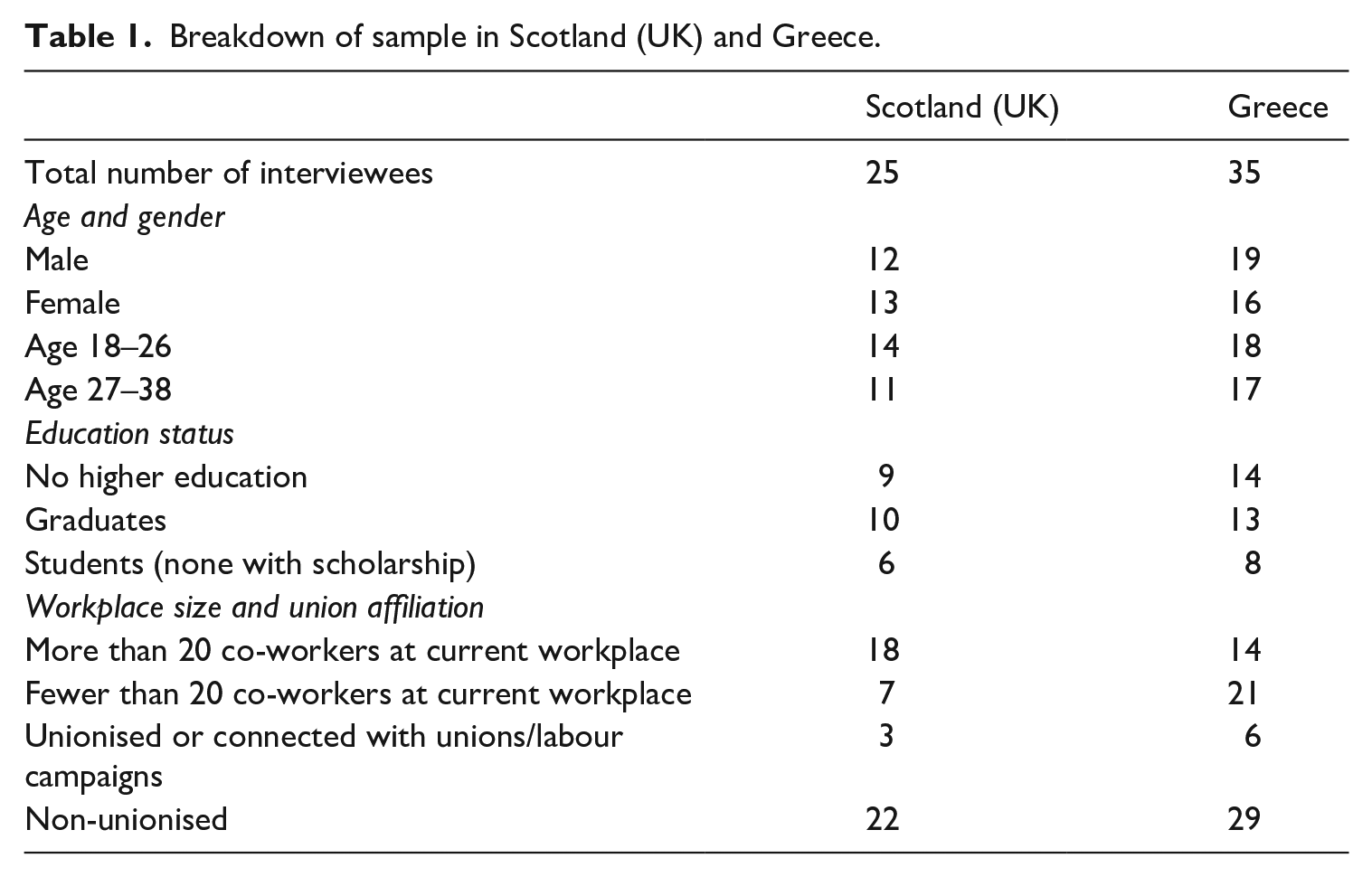
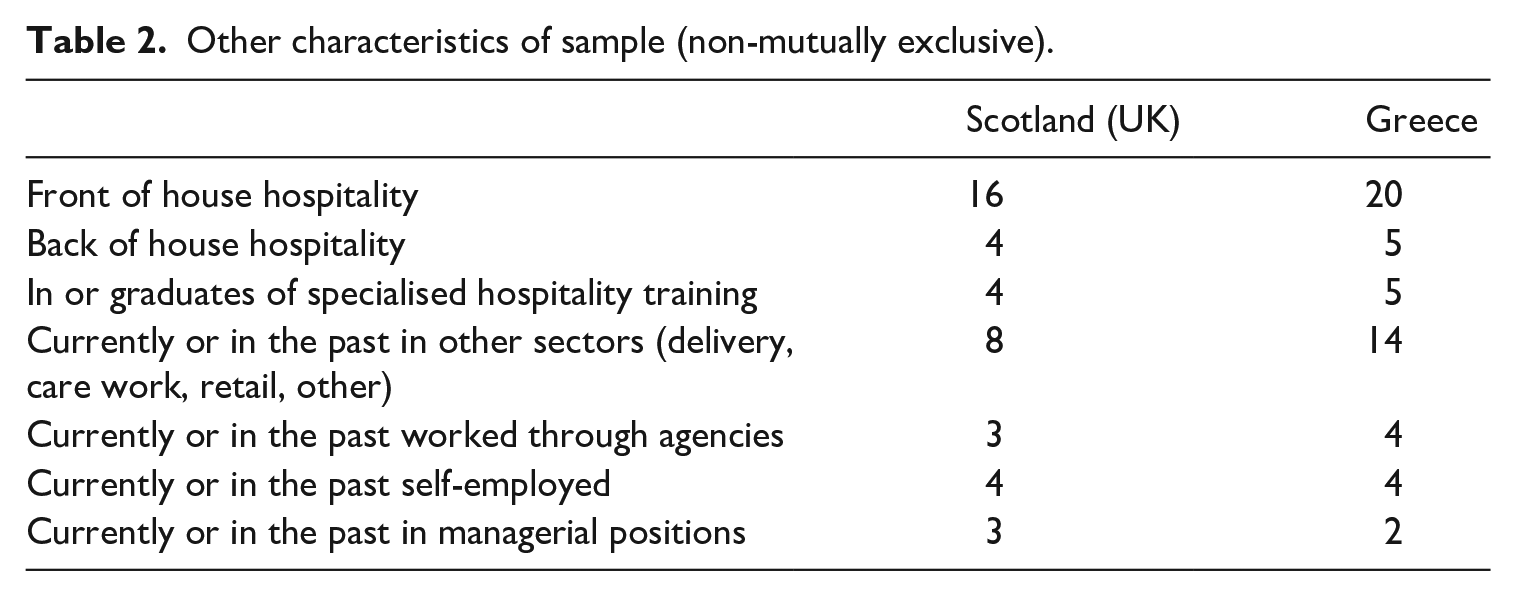
A qualitative methodology was adopted based on 60 in-depth, semi-structured interviews conducted during 2019. With worker subjectivity being at the centre of the investigation, having the subjects articulate their ideas and views through open, yet guided discussion was opted for as the optimal way of data production. The age cohort 18–38 was chosen to also include persons delaying entry into the labour market due to education, or other circumstances. Using the ‘18–38 age range’, ‘precarious employment’ and ‘hospitality-related occupations’ as the three criteria defining the sampling strategy and balancing gender, recruitment of interviewees in the two countries was conducted through suggestions via social contacts, advertisements and social media posts and finally snowballing. Most interviewees were based in Glasgow and Athens, but some came from and/or had also worked in Edinburgh, Aberdeen, Thessaloniki and Crete as well as in small islands and resorts. Most were natives of either country, non-unionised and working in diverse occupations including front of house in cafes and bars, hotels, restaurants and nightclubs. (For an overview of the participants, see Tables 1 and 2.)
Breakdown of sample in Scotland (UK) and Greece.
Other characteristics of sample (non-mutually exclusive).
Interviews lasted around one hour each and the framing of the questions, topics and emphasis given to each depended on the age, role, working trajectory and experience of each interviewee. They revolved around (a) terms and conditions of employment, (b) workers’ experience in different jobs and the impact of work on their personal, economic and social lives and (c) their views and ideas about worker rights and how these could be promoted. Interviews typically started with a discussion of the current job, moved to an account of the working trajectory and consequent on that zoomed in on interesting instances or examples and widened out to employment practices, norms and views and about how things could improve. Thus, whereas the first two areas of questioning established the general plane of material conditions and experience, the third stepped more firmly onto the terrain of ideology and subjectivity, enquiring on thoughts and beliefs and asking more explicitly for reflections and projections.
Fifty-six of the 60 interviews were individual, and 48 of these were transcribed (23 in English and 25 in Greek) and subjected to thematic analysis. The worker narratives were used to identify both specific events that took place during their employment and workers’ opinions and thoughts as they were prompted to reflect and comment on these. Initially the main themes identified concerned: (a) work schedules, time organisation, pay/benefits and relations with colleagues and managers and (b) employment rights and collective action including trade unionism, ideas about how working conditions could improve and personal future plans. During a subsequent round of analysis further sub-themes were identified such as instances of unfair practices experienced or witnessed, everyday work-related conflicts and their resolution, ideas about fairness, the law and rights enforcement, elements valued as important components of decent work and expectations from work, employers and colleagues. Finally, the connections and interrelations between different themes and sub-themes were mapped out taking account also of contextual parameters differing across cases.
Findings and discussion
It is known from the sociological literature that class background and available welfare, whether in the form of family sources or state support, may be crucial as to whether precarious work will be experienced as precarious life (Antonucci, 2018). It is also known that university education does not in itself provide access to a graduate job market with good terms of employment and career opportunities – and this is more so the case today than it was some decades ago (Kalleberg, 2018). It was thus not a surprise that no significant systematic divergences were identified between the narratives of graduates, non-graduates and students in terms of their understanding of work and expectations.
State welfare in the UK is modest and even more so in post-crisis Greece, though to some extent that is offset by stronger family ties. Moreover, while the ‘Great Recession’ did produce rapid deterioration in labour market conditions, processes such as destandardisation of employment, career stagnation and being trapped in precarious work extend further back in time and have deeper roots. In any case, the aim of this research was not to compare how precarious the lives of younger workers are today but to discover what they think about their experience of precarious work. In this, again there was no substantial generalisable distinction between the narratives of younger workers in Scotland and Greece.
In both countries young persons’ employment experience contrasted with the ideals they subscribed to and in both cases the potential for advancement seemed to be elusive. Few were actively searching for better jobs, and most were ambivalent with respect to collective action, especially at their workplace, as a means of improving their current jobs. These are discussed in the following three subsections. In the illustrative quotations below, selected on the basis of how clearly they reflected themes and views expressed by multiple interviewees, the occupation, country and education status (graduate, non-graduate, student) of each interviewee quoted is provided.
Freedom and flexibility as ideals and as lived realities
Flexibility, and the freedom from a rigid work-model which it suggests, was central in most of the interviewees’ narratives. This resonates with the general desire and search for autonomy which involves a critical stance vis-a-vis employment stability (Wong and Au-Yeung, 2019). Part-time work and sometimes the access to overtime work, even if that was not paid at a premium rate, or work on specified days and times every week, was a choice of at least some of the workers I interviewed. Some mentioned their search for work–life balance as the reason; the students in the sample mentioned their study obligations necessitating time free from work, and others their economic needs to work more for extra money. In some cases, workers’ choice aligned with the needs of the employing organisation, or their employers were ready to accommodate this, materialising the ideal of working time flexibility. Often though this was not the case, or not the case for long enough, as workload fluctuated and employer planning and demands changed accordingly. In such conditions it becomes obvious that flexibility as a lived reality is different from flexibility as an ideal; or in other words, the ‘flexibility for employers’ diverges from the ‘flexibility for labour’ (Bove et al., 2017). Given the structural power imbalance prevailing, when the question becomes whose freedom and whose flexibility, it is always the employer who gets the first say. This reaches its extreme form in the UK zero-hour contracts, putting workers on an on-call basis. It’s pretty insecure just in terms of being able to actually plan for the future and budget your finances and life because if you’re called up last minute and expected to work you need the money, so you’ll do it but then you’ve got to cancel plans that you’ve made so in terms of quality of life it really has quite an effect on that I’d say. (Ex-bar waiter, Scotland; graduate)
The high value attached to time flexibility by workers and their desire to determine their working time should not be underestimated. Some of my interviewees were ready to forego money and/or status concerns, and the relative security that more ‘regular’ jobs offered. Others cherished the freedom from direct supervision and the feeling of working for oneself, leading them to a preference for gig work. It’s eight-hour shift but I am doing three hours’ break, I am coming back home eating breakfast, dinner you know cleaning something and I can decide if it’s very rainy, I can stay home. I don’t have to be there. . . if I want to go for a holiday tomorrow, I can go I don’t need to say to my boss, boss I am going for a holiday, I am just going and that’s a big plus because I think it’s stable work, I am doing this for six months and it’s still orders coming, still people eating food. (Food delivery platform worker, Scotland; non-graduate)
The self-employed status in the gig economy, like the part-time employment contract in hospitality and other service sectors, is often the only thing on offer. Working time flexibility and the shift work pattern associated with it pose an additional barrier to trade union action (Wood, 2016). From the worker’s perspective, it less about their freedom of choice, and more about them making a choice between limited alternatives. Yet, some of my interviewees did have alternative options and still preferred gig employment with its non-defined, malleable working time and variable wage rate enticed by premiums, even if only as a supplement.
1
The game-like organisational structure of platform-mediated work with its lure of higher wages and its implied risk of lower ones as well has proven to be attractive.
2
Similarly, the social dimension of hospitality work and the lifestyle associated with it kept several university graduates among my interviewees refusing or delaying their pursuit of a career relevant to their studies. In this job, something that suits us young people is that we can also go on holiday, and do other stuff at the same time, we can cancel work, and it doesn’t have too much responsibility in the sense of being there, thinking about it, preparing from home as other jobs. (Bar waitress, Greece; student)
The preference for flexible working arrangements even at the cost of regularity of employment and career prospects is neither universal, nor absolute, nor constant. For some, stability always came before flexibility and for others there were definite limits as to what they could accept. References to the importance of employment regularity were more common among the older ones in my sample indicating that needs, priorities and evaluative criteria change with age. More importantly, as workers’ experience grows both their labour market knowledge and power increase and so does their understanding that the form of ‘actually existing flexibility’ is really determined by the balance of power. There is thus understanding that in seeking some ‘stability and comfort’ on working time patterns ‘you’re relying on someone else giving it to you and you don’t really have any recourse if you’re on a zero-hour contract’ (Bar waitress, Scotland; non-graduate). It’s beneficial to one party and that’s the employer because they’ve got control of everything, of how you behave, what you say, if you speak out about things that are wrong, about you taking a shift they’ve got control over all of that because you’re a zero-hours contract. (Ex-care worker and union campaigner, Scotland; non-graduate)
The ‘temporary’ present and the ‘absent’ future
While most informants were able to articulate details of their work experience and the place of work in their lives, they were at the same time unable to make any projections about their future. When asked about their plans, hopes and expectations, most responded that they had not thought about it, that they did not know or that they were not too optimistic. There were some already pursuing careers in hospitality, and some of the students had specific plans in mind about their desired occupational direction after graduation, but even they were not too convinced about their prospects of success. This process puts you into the trip, I have a job and you are happy with little because you are like. . . at least I’ve got a job. So, even the thought of making a step ahead becomes complicated. (Bar waitress 1, Greece; student) That’s how quite a lot of people end up in hospitality is they’re more they’re seeing it as a part-time job and then that [. . .] takes over their life and it becomes full-time their hopes, their dreams abandoned, anything they wanted to study down the toilet. (Kitchen porter, Scotland; non-graduate) We all say that we will stay one more year to make some money and then we stay until we are 30 and our bodies cannot take the fatigue anymore. (Restaurant waitress 1, Greece; student)
One of the key characteristics of precarious employment, according to the literature, is the feeling of temporariness with which workers must live and the consequent lack of control of their lives and plans (Chesters and Cuervo, 2019). This concerns both consecutive fixed-term posts and open-ended posts dependent on fluctuating demand in volatile markets, whose duration is uncertain and in which working time varies in largely unpredictable ways. Temporariness has consequences both with respect to the material conditions of work as well as at the level of social relations. When a worker conceives of their work as temporary, they are likely to show less interest in it, put in less effort and commitment. This in turn reinforces their inferior treatment by the employer, who views such workers as peripheral and maintains divisions within the workplace, as one more experienced interviewee mentioned.
A sort of anticipation of high turnover is embedded in hospitality in the form of a self-fulfilling prophecy. Employers do not usually expect their employees to stay and are unwilling to invest in them, and employees often choose to leave as they see no prospects. This vicious circle results in temporariness being internalised and normalised by both parties. It may then become difficult to distinguish students and recent graduates who move from one hospitality job to another to make some extra money from the sector’s professionals and the others who only work to make their living from this. Temporariness inculcates a mode of thinking that is fully immersed in the present, a continuous present (Bone, 2019), neglecting the future and thus the idea for progression, and this has a negative impact on the prospect of improving working conditions. Beyond the neglect that trade unions typically show towards temporary workers, workers who see their jobs as a stop gap accustom themselves to evading the effort of bringing about positive change in their workplace. To organise and set demands gives the impression that this is permanent, which is pretty bad to accept if you have finished [a university degree], when you have done all this, it is very hard to accept that this is my job condition and that I have to fight for this. . . I mean it is a relief to think that it is temporary. (Bar waitress 2, Greece; graduate) I think for a lot of people it’s forcing them to accept a reality that they’re maybe not comfortable with and I think that that’s causing a lot of problems, I don’t think people want to join a union [. . .] they’re like, I’m not going to be in hospitality for the rest of my life. (Nightclub waitress, Scotland; graduate)
This stance brings about a coping impulse and an accommodation logic which serve to quell the dissatisfaction and sometimes even frustration with precarious work. While most workers considered their working conditions unsatisfactory and regarded several employer practices as unfair, at the same time they accustomed themselves to tolerating these conditions because they saw them as ‘temporary’. I want to train more in dancing, post graduate study in psychology, I want to have low budget holiday with my friends. These are self-evident things, but we are unsure [if we can afford them]. To go 10 days’ free camping with our friends that is. My God! Standards have really dropped. (Cafe waitress, Greece; graduate)
This was not something restricted to the students, for whom it can be expected, but extended to most workers making their living out of precarious employment. While the more experienced ones knew that terms and conditions of employment are unlikely to differ across such sectors, at least for non-managerial and non-specialised roles, they too tended to change jobs frequently in search of something better. When they did not find it, they took comfort in the refreshing sense of working with other people in a new setting and in the thought that anyhow, something could still come up. The belief of being in a transition stage can be consoling as long as it is sustainable – clinging to the idea that their current position has a ‘medium-term future’ even though or until that ‘recedes into the distance’ (Finnegan et al., 2019: 168).
The ambivalence towards collectivism and trade unionism
When asked to say how work should be, informants either could not think of anything concrete and feasible or unexpectedly mentioned minor things such as hourly as opposed to daily pay (to limit unpaid hours), abolishing split shifts, or having existing laws enforced. This inability to put forward bolder normative suggestions, or even to verbalise aspirations may be seen as an instance of curbed desires – where the harsh experience of work realities constrained their ambitions and imagination. Even these pragmatic, modest targets voiced however remained theoretical as they could not identify an agent and a mechanism to make them a reality or a potentiality. Individualist frames, or individualist paths to improvement were strong elements in the work narratives of many. This was to a certain extent expected given the context, most being non-unionised, employed in small enterprises and interviewed alone, with questions also revolving around their personal experiences. While most were not hostile to trade unionism and were open to the idea of collective action, they also seemed reluctant to consider embarking on it and doubtful with respect to its feasibility and effectiveness. This was the case even with persons who had collective reference points and collective action experience in non-work settings, such as political or cultural activism. I think it is kind of more personal. I mean consciousness wise I would feel better if I did that [join a union], without believing that something will change in my workplace. (Restaurant waitress 2, Greece; student)
What is at stake here is not only that for an increasing number of young persons, precariousness is the norm in the labour market, but a process of internalisation whereby this becomes a ‘natural’ situation, one that cannot change, and that it makes no sense to attempt to change. ‘It’s called work, mate’, one person said to me when, while searching for precariously employed hospitality workers in Glasgow to recruit for interviewing, I mentioned in a forum that I was doing research on ‘precariousness’.
Similarly, the person quoted above would implicitly justify inaction by herself and other workers, even when labour law is violated in line with a private contractual arrangement because ‘from the beginning you made the agreement with the boss – it would be a 9-hour day, there will be no Christmas and Easter gifts, the wage rate is so, and overtime is so’ 3 (Restaurant waitress 2, Greece; student).
While acknowledging that improvement was more likely to come from the initiative of the workers themselves rather than from market dynamics or their employer’s action, from the state or other external agencies, most expressed little faith in this prospect. Lack of trust between colleagues and divisions among the workforce, such as for example the classic hospitality cleavage between ‘barmen and waitresses’ where gender inequality combined with work function to thwart solidarity, were mentioned in several interviews. The other reasons cited were lack of interest and fear of employer retaliation. These are of course typical difficulties encountered by trade unions whenever they attempt to organise workers, especially in low-paid service sectors; while not insurmountable they often block collective action before it begins (Allinson, 2022). While there are instances where these difficulties are surmounted and where workers do engage in collective action, whether successfully or not, in most cases these obstacles prove too difficult to overcome. 4
An assumed division between workers who adopt collectivist perspectives and those who do not is insufficient. A range of opinion exists, overly dependent on context, both dynamic and fluid. The same worker who expressed dissatisfaction with the terms and conditions of employment prevailing, and disappointment with how these are tolerated by younger colleagues, also confessed that he too is in the process of accustoming himself to, and thus internalising the existence of, an insufficiently low wage. They will never, ever research to find out their work rights and bargain with the employer for these. All they care about is finding a job, even if they get say 500 euros per month, they just care about working somewhere. Along the way they realise it’s not enough because six months may pass, one year, two, and they see that they cannot live on this, or they accidentally discover rights that they could have had. (Pastry worker, Greece; graduate)
And in the same interview: I try to accept that as much as I work, I will always owe somewhere. It is not easy to accept that. Personally, I want to fulfil my obligations. It is a big burden to know that you owe somewhere. And I don’t know whether this, to put it simply, will straighten out.
Or another worker, activist, and a trade union contact, approvingly registered the young generation’s newly found politicisation, but at the same time justified their unwillingness to join trade unions because of the subscription cost. They are becoming politicised because they’re realising my generation are reaching an age where if we fall pregnant now, we can’t afford that kid, we can’t afford houses, we can’t afford cars, most of us can’t afford to move out from our parents’ place. (Nightclub waitress, Scotland; graduate)
And then: I think that it puts people off because eight pounds [monthly reduced union dues] as silly as it sounds is a Netflix subscription and a Spotify subscription combined as a student. I could pay for two things that I get immediate gratification from, or I can pay for one thing that I don’t get gratification from.
Neoliberal axioms about the market as a just mechanism for the allocation of resources was not something that most of the workers I interviewed would explicitly ascribe to. Yet, market-centric views and prioritising individual effort and individual gain came out in several interviews, demonstrating the salience of dominant ideology, permeating, even if partly, the socio-cultural milieu and understanding of the world of the young and precarious. While few ascribed to the view that the functioning of the ‘free’ market is efficient or fair, few viewed the state as being capable of adequately regulating it.
5
The more politicised among the interviewees, those that explicitly identified themselves as being ‘left’ in the interviews, saw the state as lacking will, not the capacity, to do this. The state doesn’t care if the employer owes money to the employee. It cares for business development, businessmen, entrepreneurialism, blah blah blah. If the state cared, beyond collective bargaining, [it] would investigate if indeed gifts are paid and not returned [to the employer]. It would investigate seasonal work and the amount of overtime. The state does not care. (Restaurant waitress 1, Greece; student).
Whether the state was seen as irrelevant, too weak or too hostile (depending on interviewees’ lived experience or political beliefs), the recognition of the power imbalance between employers and workers was universal. As a result, the inability to conceptualise the possibility of better possible alternatives can be seen as an inverse adoption of neoliberal ideology, in the sense of accepting at least one of its key premises. I don’t believe in like raising the minimum wage too much too often. Like what the UK does I think is very good but raising it too much and too often could you know lead to inflation and that doesn’t really help anybody. (Barman, Scotland; graduate)
The same worker in the same interview also complained that ‘they’re doing it on purpose they are paying minimum wage because they want to make higher profits and they don’t really care about us as people’. In his narrative he attempts to see this from the perspective of the employer as well, while at the same time expressing his dissatisfaction both with the impersonal management structures and the low wages. The attempt to bridge the two leads him to the argument that higher wages are possible within the same operational framework: It’s more like you’re a number and everybody’s replaceable, right I understand that, but [. . .] industry could be more, personal, more human like more looking at us as like OK what, how could they feel like I mean not just be like they’re money-making machines. [. . .] I usually make about sales like two thousand a night, so I made them money sure OK, and they pay me minimum wage but really that extra pound you know an extra pound per person on the night adds up and stuff but if everybody makes about you know fifteen hundred sales a night like.
The identification of workers with their employers was another dimension where contradictions emerged. While workers in general viewed the employing organisation as distinct from them, and their interests as diverging, there were instances and contexts in which the lines became blurred and more unitary logics become dominant. Small workplaces, often family businesses with the owner present and working, more common in Greece than Scotland, had personalised management structures and operated in a less formal or even informal manner. In such contexts, the employment relationship was superseded by patriarchal/familial or social/communal logics, and it was more difficult for workers to view their interests as separate from those of the business, with all the consequences this has vis-a-vis the effort–wage bargain. Unitary industrial relations logics however are not restricted to small firms – as an element of management style and workplace culture, given workforce demographics and prevailing lifestyle trends, they may also arise in medium and even large enterprises. For that to happen, however, managers usually need to take steps to reduce qualitative job insecurity among their staff, so as to foster their affective organisational commitment (Muñoz Medina et al., 2022). Whether unitary or conflictual approaches prevail is critical in mobilisation moments. This effectively determines whether the hegemonic ‘common sense’ identified by Gramsci (1972) can be transcended or not. What we encountered, was most workers siding with the employers, considering our mobilisation as being against them and not against the employers. They thought that the interventions were defaming their workplaces. So, in essence challenging their possibility of working there and thus in a sense being against them. (Tourist guide, union activist, Greece; graduate)
Although the differences between the national industrial relations systems in the UK and Greece have decreased, at least with respect to low-paid work (Karamessini and Grimshaw, 2017), the two countries have distinct employment traditions and trade union legacies and occupy different positions in the global economy. Nevertheless, as far as the focus of this investigation on younger workers’ ideological orientations is concerned, there were no distinct elements in the two sets of interview data that could indicate divergent trends attributable to the two countries’ national contexts. Beyond differences in some terms and conditions of employment, and other differences attributable to national culture and work traditions, the narratives had more commonalities than differences on questions such as what would be freedom and fair work, whether collective action has prospects, and what they think and plan for the future. As Keune and Pedaci (2020) argued, national institutional contexts may be less significant than often assumed.
Conclusions
This article demonstrated aspects of younger workers’ thinking with respect to their precarious employment and analysed the implications deriving therefrom. It illustrated some of the contradictions that structure their positionality and the ways in which they are conscious of their circumstances and prospects. Contra McGovern (2014), contradiction is not used here to merely denote work and employment-related tensions or conflicts, nor adopted in the analysis to serve the function of the expectation of change. The value of the concept in this context is its ability to ground the analysis of ideas and beliefs in the material realities of work and employment of their bearers (Harvey et al., 2019).
At a higher level of abstraction, the social location of young people is determined by political economy imperatives – the division of labour and the social reproduction processes (Yates, 2017). Good jobs are scarce and, with age, increasing needs force people to take whatever jobs are available. While their educational credentials and skill sets are today much higher than in the past, the value of young people’s labour power has been reduced, as reflected in the rising job insecurity they experience (European Social Survey, 2013). Whereas their aspirations and long-term expectations are nurtured through the ideals of freedom and flexibility, their lived experience in employment suppresses and curbs these, forcing a short-term thinking grounded in the present. The contradiction between the ‘forces’ and the ‘relations’ of production is thus not restricted to the ‘economic base’ but overflows to the ‘ideological superstructure’ which via its capacity to influence agency feeds back onto the former. The reduced expectations and avoidance of long-term planning, the dissatisfaction and unease are only partly addressed by the coping strategies adopted. The impact of the pandemic and its management, being as it was more severe on precarious workers, have further reinforced this internalised temporariness (Cook et al., 2021). The ideals refuted in the context of their employment are not dropped, yet they are not actively used in a sense-making process, nor developed towards building an oppositional consciousness. As evident in the interviewee statements, the hegemony of neoliberal ideology is sustained more as a default, reproduced only in a passive, not an active mode; it is less a question of ‘persuasive power’ and ‘consent’ and more one of de facto acquiescence in the absence of credible oppositional alternatives.
The key theoretical contribution of this article is the illumination of the connection between the material and the ideological spheres with respect to work and employment. By focusing on the interrelation of employment conditions experienced by young workers in hospitality-related occupations (high work intensity, limited training and career advancement opportunities, etc.) and the dominant neoliberal ideology which surrounds them, this article has produced insights about how positionality shapes orientations. As illustrated through the interviewee statements, their current experience of precariousness precluded them from envisioning and articulating different futures. And as in Cuervo and Chesters’ (2019) analysis of Australian youth, here as well lack of structure in working patterns, or lack of leverage in arranging them, directly impacted their social lives. Young workers become trapped in the dissonance created between ideals and hopes and the harsh realities they face.
These findings resonate with those of Berry and McDaniel (2022), pointing to both acceptance and frustration among young people with the ‘new normal’, and to disbelief that trade unionism can be a way out. Yet workers’ adjustment to the prevailing conditions does not entail a fully-fledged immersion in neoliberal ideology. Whereas the terms imposed by neoliberal management are largely internalised in both Scotland and Greece, there is limited evidence of young workers internalising the values of entrepreneurialism and conceiving the marketplace as a level playing field in which merit and effort are eventually rewarded fairly. The ‘false consciousness’ element in the theory (Thompson, 2015) needs thus to be qualified. As Trappmann et al. (2021) conclude in their investigation of ‘moral boundary drawing’ in Germany and Poland, even where there is a general subscription to a performance discourse rewarding the determined, resourceful and industrious ones, as in their own findings, this may be less a result of worker enchantment by the market and meritocracy and more of the absence of an actor strong enough to build their political subjectivity as precarious workers.
This article has demonstrated that the tension and unease present in young workers’ orientations are not a product of ideology per se but rooted in the instability of their positionality in the contemporary division of labour. This positionality, being a quasi-structural parameter, does not seem to be significantly influenced by the national institutional context of employment at the macro level or the mere fact of graduate status at the micro level. The contradictions identified in the ‘subjective’ articulations of the workers have their causes in the ‘objective’ realm, of the prevailing socio-economic conditions as these have been shaped by the financial crisis in the UK and Greece.
Footnotes
Acknowledgements
The author is grateful to Ruth Dukes, Kirsty Newsome, Jason Heyes and the journal’s anonymous reviewers for their constructive feedback on earlier versions of the paper.
Declaration of conflicting interests
The author declared no potential conflicts of interest with respect to the research, authorship, and/or publication of this article.
Funding
The research upon which the authorship of this article is based was funded by the European Research Council (ERC) under the European Union’s Horizon 2020 research and innovation programme (grant agreement No. 757395).
