




Abstract
Drawing on qualitative data, in this article the authors apply Katz’s conceptual framework of agency as resilience, reworking and resistance practices to theorise UK migrant workers’ responses to worsened employment conditions, stress of unemployment and reduced incomes during the Covid-19 pandemic. The article draws attention to the range of micro practices these workers adopted to survive and rework existing conditions to their advantage – actions which rarely feature in academic writing, yet which recognise those who do not ‘resist’ as conscious agents who exercise power. Meanwhile, although outright oppositional responses to deteriorating employment conditions are rare, the article demonstrates the nature of workplace union representation as a central factor in resisting managerial control. The article extends Katz’s framework by considering the ‘how’ and ‘why’ behind migrant workers’ responses, to understand better their dynamic choices of resilience, reworking and resistance practices in the chaotic circumstances of the pandemic.
Keywords
Introduction
The Covid-19 pandemic greatly magnified challenges faced by migrant workers in the UK (Al Jazeera, 2020). We focus here on migrant workers in low-waged and precarious employment who, due to their labour market position and restrictions related to their immigration status, experience multiple vulnerabilities (Focus on Labour Exploitation, 2021). Precarious employment is that which is markedly exploitative and insecure, with few benefits and protections. It is commonly associated with one or more of the following terms: temporary, atypical, contingent or non-standard work; job insecurity; lack of work rights; and inadequate wage (Ornek et al., 2020). Already a vulnerable workforce, the pandemic increased migrant workers’ vulnerability in several ways. Given their concentration in key sectors such as healthcare, food processing and delivery (Fernández-Reino and McNeil, 2020; OECD, 2020), migrant workers ran higher risks of infection. They faced reduced income, additional pressures to meet targets and limited regulatory oversight (Burcu et al., 2021). In the workplace, language and associated cultural difficulties made it more difficult for migrant workers to resist managerial erosion of terms and conditions (Herman et al., 2021). They were also more likely to suffer job loss and less likely to access state benefits (Honeycombe-Foster, 2020) and employment protection such as furloughing (Hu, 2020). Moreover, the UK government response to Covid-19 prioritised UK citizens (Crockett and Grier, 2021), prompting calls for increased inclusion of migrant workers by social welfare organisations (Migrant Rights Network, 2020).
Such negative depictions of migrant workers, however, risk positioning them as victims, overlooking ways in which they exercise agency to sustain themselves. Such depictions also run counter to research (below) which shows that migrant workers do not passively accept their situations and, even in extreme circumstances, act to protect both their own interests and those of others. Given risk intensification during the pandemic (e.g. of exploitative employment, unemployment and reduced income), we ask how migrant workers responded.
We deploy Katz’s (2004) conceptual framework of agency as resilience, reworking and resistance practices to explore migrant workers’ diverse experiences, attitudes and responses to worsened employment conditions during the pandemic. We structure the article as follows. First, we engage with existing research on migrant workers’ exercise of agency under precarious conditions, including the resources upon which they draw. We then offer a synthesis of Katz’s framework and defence of its application, followed by an elaboration of our methodology. We present an original analysis of interviews with migrant workers, and representatives from formal and indie unions, organised through Katz’s conceptual framework. We draw attention to the broad range of migrant worker responses to increased precarity at work, offering a nuanced picture of their practices and motivations. We explore the ‘situated agency’ at play in the specific social, political, economic and environmental contexts in which they are embedded (Hughes et al., 2022).
Migrant workers, precarity and agency
The academic literature on migrant workers’ exercise of agency to cope with stress and poor working conditions is extensive, exploring the exercise of both individual and collective agency under precarity. In relation to the former, migrant nurses in Hamburg internalised discrimination, verbal and sexual harassment from their clients, rationalising this treatment as part of being a nurse (Schilgen et al., 2019). Ukrainian migrant women working as caregivers in Italy contended with feelings of ‘social devaluation’ and downward mobility as temporary: an interlude and sacrifice to improve their and their families’ upward social mobility (Vianello, 2014). Similarly, women Thai masseuses in Norway used Thai cultural practices to cope with stress and loneliness, financial worries and spousal conflict (Tschirhart et al., 2019). Migrant workers changed jobs, employers and locations, making tough working conditions bearable (Bruquetas-Callejo, 2020).
Migrant workers can draw on available social networks (Erel and Ryan, 2019; Ryan, 2011, 2018) in host countries to support their settlement (Wessendorf and Phillimore, 2019), protect their mental health (Lecerof et al., 2016) or cope with insecure regulatory environments (Tervonen and Enache, 2017). Networks consist of relationships and contacts that enable or constrain behaviours and goals (Bourdieu, 1986; Portes, 1998). They are positively related to migrant workers’ subjective well-being – providing instrumental support, including financial and socio-emotional assistance (Tegegne and Glanville, 2019). During the pandemic, networks of relationships (colleagues, friends, neighbours, co-ethnic communities) sustained migrant workers who stayed connected with them, allowing exchanges of information, provision of material and emotional support and keeping abreast of developments (Yen et al., 2021).
With regard to collective responses, research centred on industrial relations conceptualises migrant worker agency as the ability to undertake organised and collective resistance, including through union action (Penninx and Roosblad, 2000). Trade unions, however, face immense challenges in representing the interests of a flexible and less homogeneous workforce (Roosblad et al., 2017). Due to organisational and political gaps in organising strategies, unions do not always represent, or respond to, migrant workers’ needs (Martínez Lucio et al., 2017). Additionally, UK union recruitment challenges may be compounded by migrant workers’ negative perceptions or experiences of unions in their countries of origin. Globally, unions are far from homogeneous. Internationally they take many forms, with very different structures, identities and practices. The majority of the world’s unions do not practise collective bargaining. Many, especially outside the Northern Hemisphere, are primarily political bodies (Croucher and Cotton, 2009). Migrant workers may therefore have inaccurate conceptions which negatively affect their perceptions of UK unions, their functions and their potential value to them, especially where they are told by employers not to contact or trust unions (Refslund, 2021).
In order to deal adequately with representation and inclusion of migrant workers, it is argued that unions must engage with new logics of action, which challenges existing union identity and strategy (Connolly et al., 2014). One strand of research on trade union strategy toward migrant workers draws attention to the value of an intersectional approach. It has been argued that traditionally, trade unions have conceptualised migrant workers as workers (‘universalistic’ approach), rather than migrant workers facing specific, overlapping oppression (‘particularistic’ approach) (Alberti et al., 2013). As a result, unions may separate workplace and migration issues, thereby reducing migrant worker engagement with unions. Conversely, unions may draw migrant workers toward them by paying attention to specific problems related to their condition as migrants, and as workers (Marino, 2012; Tapia et al., 2017). Indeed, Holgate (2005) asserts the need for unions to understand the experiences of workers – especially those of a diverse and multi-ethnic workforce. These workers have specific concerns related to immigration, housing, racism and basic survival (p. 478). Trade union support for non-work-based problems may widen unions’ appeal and open new possibilities for organising. Alberti and Però (2018), while acknowledging the many common issues faced by migrant and non-migrant workers (p. 696), rejected conceptualisations of migrant workers as merely workers (class-only approach) in favour of an actor-centred conceptualisation of workers as intersectional actors with complex identities, interests and needs (p.708). Pannini (2023) showed that a universalistic discourse and a particularistic, practical approach can coexist and be effective – demonstrating how unions may remain class-based yet, through changes to their activities, are also able to engage migrants (p. 82).
Another strand of research considers the importance of ‘communities of coping’ in which workers share experiences of their working lives informally, often outside of work (Jiang and Korczynski, 2016; Korczynski, 2003; Yilmaz and Ledwith, 2017). These communities may also act as a site for workers to generate capacity to mobilise collectively around their concerns. Korczynski (2003), in investigating how service workers managed angry and disrespectful customers in Australia and the USA, drew attention to how these communities provided deeply important collegial support. He postulates that the existence of these communities of coping is itself an act of resistance, for they ran counter to management policies to share only positive feelings toward customers and internalise the pain of dealing with them (pp. 59, 73). Similarly, Jiang and Korczynski (2016) regarded these communities as an important micro-mobilisation context for resistive solidarity (p. 815), in which migrant workers may develop a political consciousness, constructing a critical understanding of themselves as workers with rights. Further, they may act as forums for the development of participative democracy and collective leadership development – the prerequisite for collective action with potential for the development of links to more formal and stable structures (pp. 826, 828). Yilmaz and Ledwith (2017), too, elaborated their potential to develop collective agency among migrant domestic workers in the UK by creating safe spaces for sharing work grievances, building trust and developing group leadership.
Però (2020) extends the notion of ‘communities of coping’ to encompass ‘communities of struggle’ – arguing that indie unions offer an important site for generating transformative collective action. Such unions are ‘emerging grassroots unions co-led by precarious migrant workers’ (Però, 2020: 901). They constitute a new wave of small, independent unions, engaged in ‘informal bargaining and social movement strategies, outside of recognised trade unions’ (Alberti, 2016: 84). The effectiveness of indie unions in organising migrant workers is due to their ability to appeal to and engage precarious migrant workers in/through the construction of cohesive and effective ‘communities of struggle’ (Però, 2020: 907). They facilitate the generation of collective combative identities, which underpins campaigning, mobilisation and informal bargaining (pp. 912, 914). The favoured approach is one of participatory democracy, in which workers take responsibility for organising and carry out actions and decisions themselves (p. 908). This approach resonates with Marino’s (2015) assertion that union procedures based on participatory democracy drew migrants in more effectively than hierarchical procedures. Dias-Abey (2021) elaborated the litigiousness of indie unions, extending migrant workers’ rights through test cases in the courts. Mobilisation was further facilitated by the generation of a collective class-conscious identity, framing their common interests as counter to those of their employer.
Conceptualising agency: Katz
To ensure that we consider the full spectrum of workers’ agentic responses to heightened work-related precarity during the pandemic, we apply Katz’s agency framework of resilience, reworking and resistance. For Katz, not every autonomous act indicates ‘resistance’. If it were so, ‘resistance’ as an oppositional practice would be romanticised, devoid of meaning and value. Katz (2004: 241) draws attention to the broad range of messy and contradictory responses of those who are disenfranchised and suggests that people respond to challenges through three fluid and overlapping categories: resilience, reworking and resistance. The boundaries between these practices are blurred, with transition from one to the other nearly imperceptible (Katz, 2004: 152).
Katz’s (2004) call to explore the array of responses, beyond resistance alone, enables us to position individuals who do not participate in acts of resistance, who adopt unremarkable and at times hardly discernible actions (Rogaly, 2009), as conscious agents who exert power. They should not be perceived as powerless, or their agency underestimated, because their practices are not ones of resistance (Hughes et al., 2022). Carswell and De Neve (2013) noted that labour agency is often perceived in terms of resistance and argued that this is overly simplistic. Such an interpretation assumes that organised and collective forms of resistance are labour’s only ‘ability to act’ (Cumbers et al., 2010), overlooks agency other than ‘collectively organised, political strategies’ (Lier, 2007: 829), and thus risks under-theorising worker agency.
Indeed, Berntsen (2016), Anwar and Graham (2020) and Rydzik and Anitha (2020) drew attention to the rarity of open challenge to employers. More commonly, workers engaged in acts of reworking and were sustained through acts of resilience that enabled ‘material and spiritual survival’ and ‘the recuperation of dignity’ (Katz, 2004: 246). These may include ‘toughing it out’ or working multiple jobs or moving between jobs to increase income or the adoption of ‘reactive, fragmented and fragile’ actions in the face of a hostile labour market (Datta et al., 2007). Berntsen (2016) showed that migrant construction workers in the Netherlands – who expressed reluctance to engage with unions due to the precarity of their position within the industry – nevertheless reworked existing conditions to their advantage. They did so by staying flexible; changing jobs; threatening to report employers; and forming work teams with colleagues to undertake work as a group. Here, the development of critical consciousness did not preclude use of resilience and reworking practices. What is at issue are the decision-making processes that underpin agentic decisions in each instance.
Data and methods
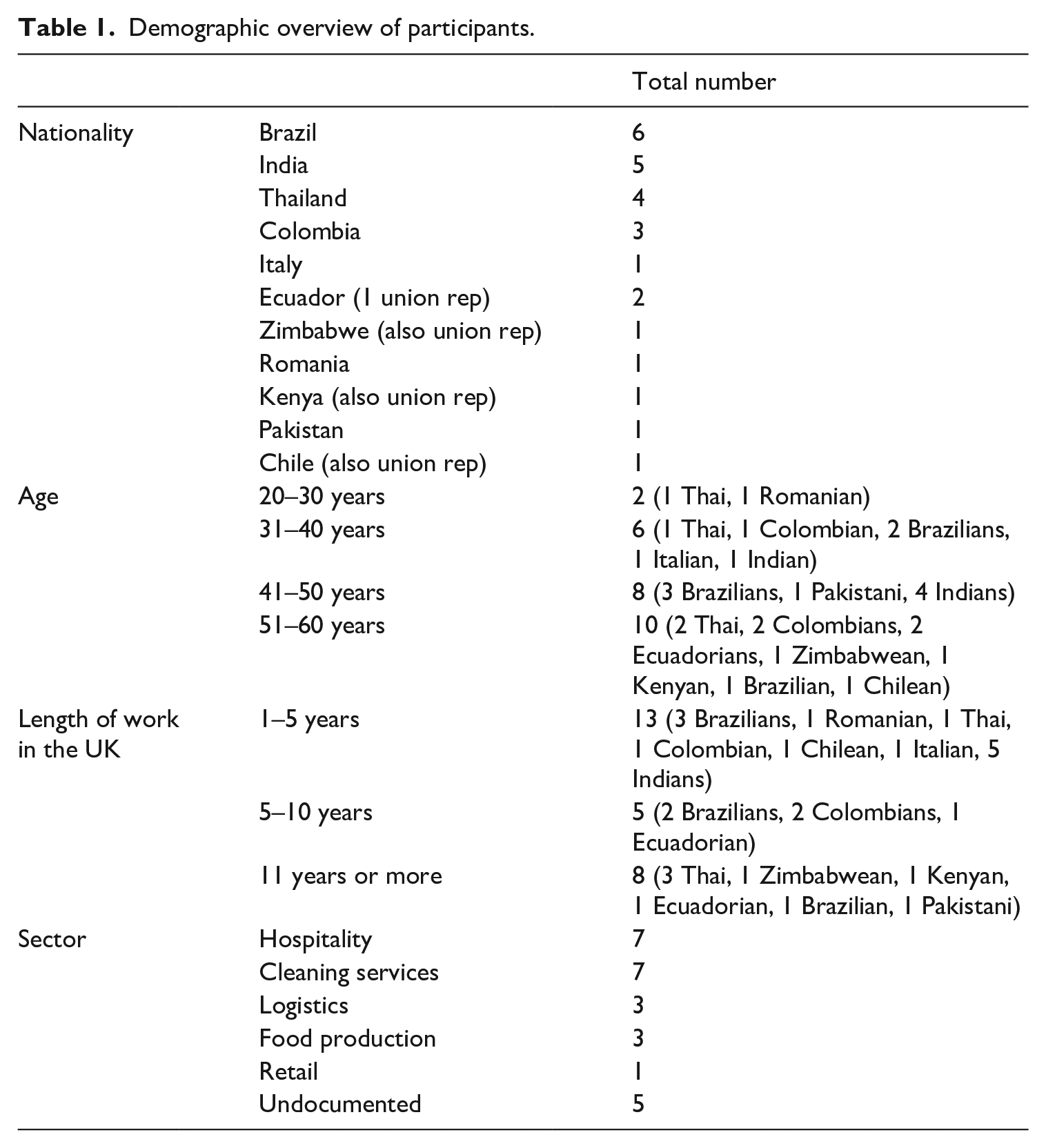
We draw on data gathered through a study conducted with migrant workers in low-waged and precarious occupations in the UK. We recruited 26 migrant workers from Europe, South America, Africa and Asia (Table 1). We derived our sample from initial key informants (unions, food banks, employers and through researchers’ personal contacts) recruited sequentially via snowball sampling. Participants held varying levels of education, proficiency in English and length of stay in the UK. Their ages ranged between 20 and 60. Nine participants were union members. The majority of migrant workers worked in the cleaning, food production and hospitality sectors. Their names have been changed to ensure anonymity. Additionally, we sought the perspectives of representatives from four unions (four representatives from three traditional unions; and one representative from one indie union) to broaden our understanding of the employment challenges faced by migrant workers under pandemic conditions, and their responses. We collected data between December 2020 and June 2021.
Demographic overview of participants.
We employed a semi-structured interview schedule to explore migrant workers’ experiences and practices related to resilience, reworking and resistance during the pandemic. In interviewing migrant workers, we guided their reflections on their responses to conditions and the outcomes of their actions. We probed them to consider the resources which they drew upon. Migrant workers were also asked to reflect on the value of unions in securing workplace gains and the extent to which they made use of unions. Ten interviews and seven focus group discussions were conducted in English with all study participants, with translators available for the Brazilian, Spanish, Indian and Thai migrant workers. Some of the research team were able to translate for the Brazilian and Spanish participants. For the Thai participants, we drew on a multilingual academic colleague to provide a contemporaneous translation for us. For the Indian participants, translation services were provided by the organiser of the food bank used by the participants. Interviews lasted between 45 and 60 minutes and were conducted via Microsoft Teams to comply with UK social distancing requirements in force at the time. All interviews were transcribed. Those not conducted in English were first translated into English, and then transcribed. Ethical approval was obtained from the lead author’s university ethics committee. Data were analysed thematically (Braun and Clarke, 2016) against Katz’s framework, drawing out the agentic practices employed by participants. The data on which our findings are based are available from the authors on reasonable request.
Findings
Resilience: Normalisation and survival practices
The narratives from the five Indian undocumented female migrants in our study best illustrate examples of resilience practices in the face of insecure and exploitative employment. They arrived in the UK with their families on tourist visas but did not leave when these expired. Already dependent on casual work to earn an income, the pandemic posed acute uncertainty for them because opportunities for ‘informal work’ (construction, painting and decorating, cleaning) had diminished significantly. Justine, in her 30s with young children, often undertook cleaning jobs. As a woman, cleaning was a job she was comfortable with. During the pandemic, she was asked to complete these jobs within unreasonable time frames. She lamented the injustice she was subjected to by her employer: . . . they [employer] only give us three hours to clean the whole house . . . £8.00 an hour . . . £24 . . . although mostly the work has to be done in six or seven hours, but wherever I go, they will insist to do the work within three hours for £24 . . . and I have to pay for personal protection equipment [PPE] out of my own pocket.
Even though clearly the subjugated party in the employment relationship, the ability to earn even very small amounts of money gave Justine a sense of pride and dignity for being able to put food on the table. She did not have knowledge of working rights and, compounded by her inability to speak English, did not challenge her terms of employment. She regarded work instrumentally: survival was more important and the priority was to derive an income to support her family.
Justine further explained that loss of work opportunities during the pandemic meant she found it very challenging to pay her rent on time. Her landlord had harassed and threatened her family for payment, even though the government had introduced legislation to delay when landlords can evict tenants. As she was not entitled to social benefits: ‘we borrow from friends and relatives . . . to prevent the landlord from coming over here to shout at us’.
During the pandemic, many organisations set up food banks to supply emergency food. Figures indicate that half of people who used a food bank had never needed one before the pandemic and that families with children were the hardest hit (Trussell Trust, 2020). Didi, in her 40s, explained that since opportunities for casual work had significantly reduced, her husband no longer earned an income. She herself did not work, was unskilled and did not speak English. Not being a legal migrant, she was not entitled to welfare benefits. Food banks became a lifeline for her: . . . We are struggling to pay rent but it is not easy to get job. For food and other stuff, I depend on charity.
Migrant workers drew on their unions as part of their resilience practices, to mitigate the impact of reduced incomes and unemployment. There were innumerable such instances. Macy, a national officer from a large union in the public service sector, explained: . . . we have a charity giving emergency grants or funding . . . nearly every single migrant worker I spoke to, experienced issues that were related to finance and fees, and poverty and destitution . . . they have been supported with financial assistance from our union . . . to feed their children, to put the heating on, to just survive.
In sum, the pandemic had made life and work even more deleterious for migrant workers during the pandemic. These migrant workers responded in low-level and small ways. The undocumented migrant workers in particular understood their position in the labour market. They tolerated ill-treatment instead of challenging it. They relied on each other and helped each other survive. Their location at the intersection of several forms of disadvantage – including their gender, insecure immigration status, low-status jobs and educational backgrounds – shaped their experience of exploitative employment (and unemployment) and informed their responses to it. Resilience practices did not change the power structures within which participants were embedded. Indeed, the absence of legal status operated as a crucial factor – limiting access to many reworking and resistance practices. Opportunities for employment requiring proof of legal status (reworking) were reduced, and union membership – as a vector of resistance – was closed to them.
Reworking: Targeted and pragmatic ways to improve one’s situation
Many migrant workers did not try to get their employers to change exploitative working conditions. Instead, they quit their jobs. For example, Fabio, a migrant worker from Brazil, in his 40s, explained that he was not given a formal contract with the construction company. He was simply called upon when needed. He felt aggrieved at this treatment as he perceived that while he was capable and skilled (he had a university degree in business from Brazil), that his employer perceived him as ‘cheap’ and ‘readily available’ labour. Additionally, he felt unsafe, as the risk of infection on the construction site was high. Fabio left his employment, to set up business as a self-employed driver. His secure immigration status offered him an opportunity to do this. He also possessed the necessary qualifications to work legally as a driver. While his decision to quit did not overturn the employment relations within the construction company, it enabled him to use his business knowledge to become self-employed. His legal immigration status, professional qualifications and mobility were powerful tools through which he expressed his agency.
Actively drawing on social networks which could introduce new employment opportunities is another practice to secure improved material conditions during the pandemic. Eden, a 50-year-old migrant worker from Ecuador, worked in the cleaning industry, a sector heavily reliant on migrant labour. Eden explained the insecure nature of the work. He had never been given holiday or sick pay. Additionally, work hours were never predictable (‘I used to work 9 hours, now I work 5’). Reduced income during the pandemic became a concern. Eden persuaded his manager to allocate extra hours to him, which were granted. This was only possible because of his close relationship with the manager in the 12 years that he had been working at this company. In this instance, proximal social networks helped Eden improve his life materially.
In contrast, fewer options were available to undocumented migrants. They attempted to gain access to a constrained labour market, in extremis, but this proved difficult, given their fear of arrest and deportation should their undocumented status be discovered. Yet, they consciously undertook such risk during the pandemic if an opportunity to obtain work arose – even if such work was exploitative. The translator for the Indian migrant workers, familiar with their lives, provided an example: . . . [one of the women’s husbands] was standing outside [the construction site for] weeks for looking for construction work . . . This is during this pandemic and the police go over there and ask him why he is standing over here.
Additionally, migrant workers drew upon their unions to support reworking practices. This involved engaging union representatives in individual case-work on work-adjacent issues of hardship, such as enabling applications for sick pay, or supporting cases for sickness absence. Such practices ensured access to legal entitlements that may otherwise have proved elusive, given limited English language skills. Victor, a union representative in a food production factory (Trade Union #1) explained: . . . some people . . . have not been getting sick pay because they haven’t been able to send [proper] documentation to the company, they don’t know how to do it, I mean technology is a big problem for migrant workers who don’t speak the language or don’t know how to ask for things . . . we as a union are reading letters, have been helping them to get the signal for the internet, sending them links [webpage addresses] and all that.
In all, migrant workers were able to secure dividends during the pandemic by reworking conditions to their advantage. Their actions were shaped by their educational backgrounds, immigration status and the ability to draw on networks, including colleagues and unions. Outcomes were, however, mixed. While Fabio attained material advantages, outcomes for undocumented migrant workers continued to be temporary and uncertain. As broader power relations within which all these migrant workers were embedded remained unaltered, we argue that these practices constitute reworking. We also note the limited yield of reworking practices for undocumented migrants.
Resistance practices to redress power imbalances and increase bargaining power
Many migrant workers in our study did not resort to unions to help them cope with deleterious work conditions under the pandemic. In fact, drawing on trade unions was entirely absent from the narratives of the majority of the migrant workers in our study. It was even evident that the majority did not have a good impression of unions. This lack of interest was attributable to previous poor experience with unions in their home countries. Fabio explained that in Brazil, joining unions was compulsory for all workers and a fee for union membership was, until recently, automatically deducted from wages (this applied between 1943 and 2017). However, members did not necessarily know who the union representatives were, or how membership fees were used. Fabio’s perspective was shared by other Brazilian participants, who perceived that union representatives served the interests of employers (they in fact had a legal obligation under the previous 1943 Labour Code to take employers’ interests into account), and not union members.
In contrast, other migrant workers did draw on unions to support individual resistance practices. They became aware of the magnitude of the injustice of the terms of their employment during the pandemic. Eden, whose reworking strategy related to working hours was considered above, relayed that he worked without a written contract: They [the employer] just call you and tell you to go to work . . . they would just tell us where to go and we would work, now with the pandemic we can see how we have actually been treated.
After being informed by his union that not issuing a contract was unlawful practice, he resisted: ‘the Union, they have made us aware of our rights, so we would ask for a contract’. Another example is provided by Damian’s successful overturning of a company decision related to sickness absence, and the role played by the union representative, Samuel (union representative in a food production factory, Trade Union #1). Damian, a migrant worker in his 20s, originated from Romania. During the pandemic, he travelled back to Romania to seek treatment for an eye condition and was quarantined upon return. His employer marked him as ‘absent due to sickness’, which meant that his entitlement to sick pay the following year would be reduced. Damian approached Samuel to help challenge the decision. They invoked formal grievance and appeal procedures, causing the employer to reverse the decision.
From an industrial relations perspective, an important question is how trade unions may effectively recruit and organise migrant workers (Alberti et al., 2013; Connolly et al., 2014; Refslund, 2021). What moved Eden and Damian to resort to their unions? Why did Fabio and his compatriots shun them? What was it about the unions which drew migrant workers toward them? Did unions galvanise collective action and, if so, how?
Resistance practices: Universalism vs particularism in traditional and indie unions?
The narratives of nine of our participants showed how unions supported resistance practices. We found that the traditional union did not distinguish between migrant and local workers, adopting a universalistic approach to organising resistance. This is consistent with its institutional preference and model of organising. In the indie union, the organising model was framed around the intersectional needs of migrant workers. Collective action was informed by a sense of common migrant identity. The organising model within each union structure thus shaped the nature of resistance which manifested, explored in detail below.
Resistance in the traditional union: Universalism and particularism
Shop floor union representatives in the traditional unions we interviewed were themselves migrants, and keen to broker resistance practices on behalf of their migrant members. Despite a formal institutional preference for universalistic organising, we found that officers with migrant backgrounds adopted both universalistic and particularistic approaches (Alberti et al., 2013).
Victor, in his 50s, arrived in the UK from Zimbabwe 15 years earlier. He came from a long tradition of militant unionisation. He relayed how he recently defended the need for agency workers, a significant majority of whom were migrant workers, to have equal access to PPE in the factory (in food distribution). Provision of this equipment was expensive for employers, who did not want to extend its availability to agency workers. Victor adopted a universalistic approach – in which migrant workers were identified as workers with shared common interests with non-migrant workers – which required him to ‘put my foot down’ on behalf of these workers. As far as he was concerned: . . . they [migrant workers] were union members. They should have the same amenities that we [local workers] have because they’re working in the same place on the same line.
We also found instances of particularistic practice – in which resistance was organised to address issues specific to migrant workers – within traditional unions. Victor took his cue from the issues brought to him by his local migrant worker membership, which concerned management insistence on continued visa compliance during the pandemic. Victor explained: You know, it [management] is very strict on the visa requirements, but we had to intervene with the management. If the worker is not at fault . . . where there is no wilful default, but a default which had been brought about by the pandemic, we asked them [management] to give migrant workers a moratorium so the migrant workers would be able to keep working, and to try and put for the food on the table, and to make sure that they were assisted with the visa requirements.
Similarly, Samuel’s advocacy on behalf of Damian (above) was informed by his ability to relate closely to migrant workers’ concerns – drawing on his own migrant background. Samuel recognised that Damian had to return to Romania to seek medical treatment, and that this should not result in disadvantage upon his return. Damian explained Samuel’s openness to particularistic concerns thus: Samuel told me: if you got any problems, you come and talk to us, if you have anybody part of the Union [migrant members] and they have any problems, and they can’t speak English or something, you can come with them and I will help you with visa, with appointments . . . health care.
Resistance in the indie union: An institutional preference for particularism
The indie union in our case study is migrant driven. Its members work in low-paid, precarious occupations, and it is led by migrant workers. Given its genesis, it enthusiastically endorses particularistic action, to the extent that it underpins their campaign strategies. Michael, general secretary of the indie union, explained that the union organised migrant workers around their identities as migrant workers: . . . we are migrants and we support the economy and yet we are of no value. This is why within the union we are working hard to fight for it, so as workers we have good conditions, so we are treated the same . . .
The indie union’s commitment to resistance underpinned by a particularistic approach informed its campaign strategy directly, reflecting concerns specific to migrant workers in pandemic times: . . . we hear the stories, of people being abused by companies that are taking advantage of this crisis and have been making a lot of people redundant rather than using the option made available by the government so people would not be unemployed. They have also taken advantage of reducing working hours, changing contract hours to zero-hour contracts, hence this pandemic has doubly disadvantaged migrant workers.
Michael elaborated how the union led collective action to challenge companies who dismissed members rather than putting them on furlough. The union mobilised workers to require companies to take measures to protect migrant worker health and safety during the pandemic. Despite the attendant risks, it was not afraid to threaten court action to secure migrant worker rights: ‘We have been threatening to take legal action, if they [employers] still refuse to take health and safety measures to protect workers.’
To organise its membership, the indie union built coalitions and networks with other campaigning groups to address intersectional inequalities facing migrant workers. It did so to generate critical consciousness and solidarity beyond the workplace: . . .we work with other organizations like [ethnic minority women’s rights groups] and we help with [reducing women’s domestic violence] and [reducing sexual harassment]. We work with . . . organizations that help European migrants who are on the European passport to apply for their status in this country. And we provide English classes in collaboration with other organizations . . . [to help migrant workers] improve their English . . . or claim benefits . . . or claim against the landlords trying to remove them because they have not been able to pay rent . . . So, in a way to help these workers to be more included in society.
Such coalitions provided liminal spaces for empowering migrant workers. It is a generative process, in which migrant workers’ identities are refashioned beyond simply their labour market contribution. These processes support the development of critical consciousness, resulting in solidarity. Yet, such efforts on the part of the union to refashion migrant worker identities in a manner conducive to solidarity were not always successful. James, in his 30s and very involved in indie union activity, expressed the view that many minority ethnic migrant workers were fatalistic in relation to possibilities for improving their circumstances and, in some cases, voted against action intended to secure positive change: . . . recently we had a meeting with other members of the Union, to talk about what we had to do to fight for improvements, and some of them rejected [the proposal]. Their intellectual level is very basic really, we work with people who didn’t have the opportunity to access education. I’m really not insulting anyone, but I want to make a point that a lot of problems that we face is only because we haven’t asked for help . . . you can ask [name] here who is a union leader . . . it’s very hard to convince a [minority ethnic] migrant worker that they can improve their own lives, their own salaries, their health, pension.
Discussion
The pandemic exacerbated employment-related vulnerabilities and exposed migrant workers to new ones. Regardless, migrant workers were active agents, and expressed this agency through a variety of practices to carve out spaces of control. In sequence below, we highlight discrete and non-transformative practices as an important mode of agency in their own right; the role of social networks in supporting resilience and reworking practices; and conditions required for migrant workers’ collective resistance. Additionally, we consider the importance of context in informing agency.
Agency as discrete and non-transformative practice (resilience and reworking)
Our analysis runs contrary to the conceptualisation of migrant worker agency as collective resistance (Penninx and Roosblad, 2000). Rather, we draw attention to the discrete, low-key and informal practices that they adopt in response to pandemic circumstances. These are often exercised on an individual basis. Each of the migrant workers in our study had internal personal narratives which made migration an imperative (Vianello, 2014). They were not deterred from chasing their aspirations and carrying forward their life plans. Our findings detail the resilience and reworking practices adopted by study participants. While the transformative potential of collective resistance is curtailed by the social relations and structural constraints in which these workers are embedded (Berntsen, 2016; Bernsten and Lillie, 2016), the range of actions they chose nevertheless produced outcomes which suited them. These non-radical and less obvious actions permitted manageable and dignified livelihoods during the pandemic and are, equally, manifestations of agency (Carswell and De Neve, 2013; Hauge and Fold, 2016).
It is sometimes difficult to see how resilience is a category of agency, given the implication that it concerns merely tolerating a situation. For example, Justine appeared to simply accept exploitative conditions, and her agency here may be difficult to discern. Yet, while Justine’s narrative is one of enduring exploitation, her agency is revealed in her ongoing active choice to undertake such work to earn an income. She treats work instrumentally, adopting a set of tactics (Datta et al., 2007) in order to ‘get by’ – including complaining and lamenting the exploitative conditions. Her choice to remain, and the practices that she adopts in order to reconcile herself to this decision, are acts of agency. In such situations, a wide range of tactics are available. These include normalising exploitation as part of the migrant experience; pretending not to understand others’ intentions; and viewing work instrumentally to achieve more meaningful goals, e.g. travel or study (Rydzik and Anitha, 2020). As resilience is a category of agency on these terms, it may perhaps best be explored empirically by close description of the circumstances in which actors are embedded; delineation of the specific tactics that they employ; and consideration of the intentions which inform these tactics.
The role of social networks in resilience and reworking
Social networks (friends, co-workers and relatives) proved crucially important to migrant workers in our study. While none indicated that they drew on these networks in resisting exploitative working conditions, networks proved to be a resource informing both resilience and reworking practices. They enabled migrant workers to mitigate adverse outcomes of work – including low wages, exploitative employers and employment uncertainty. During the pandemic, as existing problems intensified and new ones appeared, participants drew on friends, neighbours, work colleagues and charities as part of their resilience and reworking practices (Lecerof et al., 2016; Tegegne and Glanville, 2019; Yen et al., 2021). In some instances, a single network ‘tie’ was drawn on to secure advantage – as in the case of Eden, who drew on his friendship with his manager to obtain extra work hours. In other instances, webs of social ties helped migrants to cope in an environment where they were considered undesirable and unwanted (Tervonen and Enache, 2017). In the case of Justine, friends, relatives and food banks provided material support. These descriptions are resonant with Katz’s ‘webs of care’ in her work within East Harlem between neighbours providing everyday support such as childcare, guidance and advice, even acting on behalf of others to deal with more empowered actors such as landlords and city authorities (Katz, 2004: 246).
However, the networks available to migrant workers in our study were limited and typically proximal. Participants drew principally on their immediate circles. Many interacted superficially with their local surroundings, could not establish strong connections due to cultural and language barriers (Martinovic et al., 2009) and relied heavily on co-ethnic networks (McPherson et al., 2001). How do migrants access, maintain and construct different types of networks, in different locations and with diverse people? In exploring how migrants ‘embed’ into new societies, Ryan (2018) cautions us to look beyond social networks themselves, to the wider structural contexts within which migrants live and work. There are depths or degrees to migrants’ ‘embedding’, influenced by networks but also wider socio-political structures and ways in which migrants are located in particular places (p. 236). Thus, structural (macro) opportunities and obstacles (e.g. labour markets, political systems, pandemic conditions) to migrants’ embeddedness warrant as much attention as their individual relationships and networks in exploring how they negotiate attachment and belonging in new societies. These structures have particular import for undocumented migrant workers in our study. Their fear of the authorities, lack of legal immigration status and consequent inability to enter the formal labour market all deprived them of opportunities to build strong networks, contributing to their social isolation.
Agency as collective resistance
Our findings are also significant for the field of industrial relations with regard to union recruitment and organising of migrant workers. While the organising strategies of traditional unions toward migrant workers have come under criticism (e.g. Connolly et al., 2014; Tapia and Alberti, 2019), we offer insights into the conditions required for unions to organise migrant workers’ collective resistance.
The formal organising model in our traditional union attenuated possibilities for migrant worker collective resistance given its universalistic premise, based on a homogeneous ‘worker’ identity. Such a premise does not differentiate workers on the basis of any additional intersectional categories (Alberti et al., 2013; Tapia et al., 2017). However, we found that traditional union representatives with an understanding of migrant worker needs were able to represent their needs and secure collective benefits for them despite their universalistic formal organising model. Their migrant-oriented practice included listening to the expressed concerns of their migrant worker members, and challenging managerial decisions related to these concerns. This can be seen clearly in the case of Victor, who adopted both universalistic and particularistic approaches tactically as required. He secured PPE for all workers – including migrant workers (universalistic) – and also supported migrant workers’ visa applications (particularistic). Both approaches secured improved outcomes for migrant workers. We concur with Pannini (2023) that universalistic and particularistic approaches may coexist and be deployed successfully by unions to include migrant workers in their organising practices, and effectively represent them.
Our indie union tells a different story with regard to collective resistance. Here, their organising model was predicated on engaging their membership in activities intended to develop collective self-identity as migrant workers (Holgate, 2005; Però, 2020). This is a particularistic approach in which migrant workers were conceptualised as ‘intersectional, agentic subjects characterized by distinctive complex identities and multifaceted interests and needs . . . [and not] either free-floating and atomized individuals or mere organizational reflections / embodiments’ (Alberti and Però, 2018: 708). Leaders sought to build ‘communities of struggle’ (Però, 2020) through outreach and networking with a wide variety of civil society actors engaged in campaigning against specific and overlapping forms of oppression (Alberti, 2014; Alberti et al., 2013; Tapia and Alberti, 2019).
Although our data offer an empirical test of this theoretical framing which is largely supportive of the efficacy of the approach, it cannot be taken for granted that attempts to build collective combative identities will result in action. Indie union officers expended considerable energy in generating migrant worker identities as workers with rights (Jiang and Korczynski, 2016; Però, 2020), addressed issues which migrant workers deemed important to them (Pannini, 2023), and worked with other organisations to enable migrant workers to develop an understanding of themselves located within overlapping systems of inequality. Such an understanding provides the raison d’etre for resistance. Despite the best efforts of union officers paving the way for development of empowerment, solidarity and critical consciousness, not all indie union members developed such an understanding of themselves. In its absence, the very democratic processes which give migrant workers the opportunity to express collective resistance may – paradoxically – lead to its rejection. Contrary to the optimism afforded to indie unions’ potential to galvanise collective action among their migrant worker membership, our analysis offers the more tempered view that transformative resistance is a contingent process.
Choosing between resilience, reworking and resistance: The situated nature of agency
We show that the exercise of agency is contingent on the social, political and economic processes in which migrants are embedded (Hughes et al., 2022). Our analysis not only distinguishes different forms of agency, but we also elaborate the ‘how’ and ‘why’ of these different responses, informed by considerations of relative advantage and risk in the context of the pandemic. We pay attention to migrant workers’ embodied experiences, the strategies they adopt and choices they make – while acknowledging the open-ended nature of such choices, their potential to change over time and (sometimes) paradoxical nature. Such sensitivity to the interplay between context and agency gives us a better understanding of why migrant workers move back and forth between resilience, reworking and resistance in the chaotic circumstances of the pandemic.
This is clearly exemplified in Eden’s strategy of securing individual advantage through negotiating additional hours directly with his manager (reworking), rather than challenging the basis of allocation (resistance). This decision yielded material advantage while avoiding risks associated with resistance – which could have damaged his good relationship with his manager. Eden chose resistance – in the form of challenging company practice not to issue formal contracts – under circumstances in which he trusted his union to support his action. Meanwhile, Fabio decided to no longer tolerate exploitative working conditions in the construction industry (resilience), and instead used his business qualifications and legal status to move into self-employment (reworking). In marked contrast, Justine lacked opportunity to adopt practices other than resilience.
Conclusion
Our contribution is threefold in attending to the diversity of migrant workers’ agency in the face of the pandemic; the contingencies which influence selection from the range of available practices; and the conditions required for unions to successfully organise resistance.
Migrant workers managed increased work-related precarity during the pandemic through diverse resilience, reworking and resistance practices. In cataloguing how these practices are performed, we better understand how deleterious employment conditions during the pandemic were accepted, negotiated and challenged by migrant workers. While (collective) resistance is lauded within the literature, we create much needed space to discuss individual labour agency, by drawing attention to those low-key and informal practices adopted by migrant workers. We build on an emerging body of work by labour geographers who are interested in delineating individual, less radical and less obvious practices (Carswell and De Neve, 2013; Sportel, 2013). Such creative interpretation of practices (Carswell and De Neve, 2013) moves us a considerable way from binaries of agency/victimhood (Rydzik and Anitha, 2020) and opposition/compliance, toward greater sensitivity to the meanings, possibilities and limits of the range of practices which migrant workers employ, and the circumstances under which they choose to do so. We thus attend to the paucity of research which considers the importance of individual and informal practices through which workers navigate their working lives (Hauge and Fold, 2016).
Secondly, we extend the analytical merit of Katz’s framework to reveal how and why different practices were chosen (Hughes et al., 2022). We explore migrant workers’ understandings of the power relations within which they are embedded and the intersections of disadvantage in which they are located; the drivers behind their practices; the outcomes attained; and the extent to which these practices altered power dynamics within the workplace. In doing so, we explore the ‘situated agency’ at play in the specific contexts in which migrant workers are embedded. We thus promote a better understanding of the contingencies which inform migrant workers’ situated decisions to choose resilience, reworking or resistance practices in the chaotic circumstances of the pandemic.
Finally, our study has implications for industrial relations research concerned with union organisation of migrant workforces. We extend the boundaries of existing literature, showing how traditional unions may successfully secure collective benefits for migrant workers, even though their formal organising model attenuates opportunities for organising migrant worker collective resistance. For indie unions, we demonstrate empirically the importance of developing critical consciousness based on an identity as migrant workers, but caution that such development may not always be achieved.
Footnotes
Acknowledgements
We dedicate this paper to the memory of Professor Richard Croucher, who sadly passed away in the period between submission and publication of this paper. The authors would also like to thank the editorial team and anonymous reviewers who provided such constructive feedback on the article.
Declaration of conflicting interests
The authors declared no potential conflicts of interest with respect to the research, authorship, and/or publication of this article.
Funding
We are grateful for the generous grant support provided by the University of Westminster Research Communities COVID-19 Funding Scheme ‘The “Inclusion” Challenge: UK Social integration of low-skilled and low-waged migrant workers during the pandemic’ (Miles and Freeman, £10,000, August 2020–July 2021).
