




Abstract
Drawing on the principles of Conservation of Resources (COR) theory and the Work–Home Resources (W-HR) model, this research captured the lived experiences of 19 parents from across Scotland during and after the Covid-19 pandemic. The data were derived initially from two digital interviews per participant, with interview content in both cases informed by preceding questionnaires. A third phase of interviews was conducted post the pandemic. Findings revealed that while participants valued increased flexibility gained through enforced home working, this often led to feelings of guilt, working longer hours and perceived work intensification. Work–home conflict emerged as a source of tension, dependent upon social and relational interactions, and physical and shared spaces at home. The authors analyse these issues in the context of job crafting as a means of organising the jigsaw pieces of work–home conflict as participants transitioned to a ‘new normal’. In conclusion they examine the implications and suggest avenues for further research.
Introduction
Technological advancement and increased mobility have been driving gradual changes to the temporal nature, rhythms and patterns of work through time (Felstead and Henseke, 2017). The impact of the global coronavirus (Covid-19) pandemic is a defining point in the acceleration and transformation of working patterns and practices, creating what is increasingly being labelled the ‘new normal’. For many, this new normal has made the place of work incidental to the work itself and hugely expands the phenomenon of ‘working from home’ (WFH hereafter). We are also seeing not just the defined space of work (the workplace), but also the defined boundaries of work time during this period fundamentally recast. Amid these changes, the uptake of WFH during the pandemic was rapid and to a large extent the transition smooth for those who work through technology. However, while the benefits of such change have been acknowledged, the negative impacts were largely overlooked (Žiedelis et al., 2023). These fundamental changes to working patterns, in effect bringing work home, have specific and long-term consequences for families who have needed to redress and (re)balance their work and family lives in new ways (Wheatley et al., 2021). The lasting impact of Covid-19 will continue to transcend and transform working lives through the ongoing need, and opportunity, for people to work more remotely and to balance work and family in different ways as society continues to transition towards a new normal for working lives (Wheatley, 2022). The new normal will be shaped by factors including the time people spend working, where they carry out that work, and the associated issues of blurring traditional work–home boundaries and sharing physical workspaces with family members. We suggest that to enable this transformation to take place, the concept of job design needs to be revisited and recast in the context of the technological advancement that increasingly enables people to work remotely. In particular, the idea of job crafting (Wrzesniewski and Dutton, 2001), where employees have certain agency in shaping (crafting) their role, is brought to the fore. For job crafting to be effective, the consensus is that there needs to be proactive support and intervention from management to navigate this new normal.
This empirical study captured the ‘journey’ of 19 parents from across Scotland both during and after the pandemic. We focused specifically on parents who had to juggle children’s schooling and social demands as well as the impact on working lives. Through this detailed and nuanced study, we aim to contribute to the empirical literature by providing rich, qualitative insights into the lived experiences of working parents, and how job crafting strategies have enhanced and might enhance the employment experience within the new normal. The specific research questions we sought to address are:
RQ1: How did participants manage work and other priorities during the pandemic?
RQ2: To what extent were participants empowered and supported by management to (re)craft their jobs to meet work and personal needs?
An important gap in the extant literature is that most of the pre-pandemic empirical evidence draws upon hybrid models of remote working, for example, by combining home working with some time spent in the workplace, as opposed to WFH on a full-time basis. Moreover, the rationale for pre-pandemic remote working was often down to personal choice, or privilege, as opposed to the wider societal shift and ‘enforced’ (Anderson and Kelliher, 2020: 677) need to WFH brought about and accelerated by the pandemic (Delanoeije and Verbruggen, 2019). Responding to the pandemic meant that there was no clear structure or strategy in place for the initial transition to WFH, not least in the designing and crafting of work in response to the crisis, nor for managing the new employment relationship. The current research makes two important contributions to the literature. Our first contribution concerns the apparent absence of, but need for, management leadership in developing strategies for effective work design during this major change to work behaviours. Second, in the context of work design and specifically job crafting, as work and home boundaries become increasingly blurred, we evidentially argue the need for a proactive shift away from – or extension of – the long-standing traditional thinking and focus on ‘work–life balance’ towards a renewed emphasis on ‘work–home conflict’ factors and associated outcomes in the post-pandemic world (Žiedelis et al., 2023). This we frame in the context of Conservation of Resources (COR) theory (Hobfoll, 1989, 2002) and the more contemporary Work–Home Resources (W-HR) model (ten Brummelhuis and Bakker, 2012). This research is therefore timely and makes an important contribution to the emerging debates about work design and the future of work and working lives. These debates are explored in this study from the dual perspectives of ‘time and pace’ (of work) and ‘place and space’ for work.
The remainder of the article is organised as follows. First, we introduce COR theory and the W-HR model as a theoretical framework, or lens, through which to explore the critical issue of work (re)design. We follow this with the framework of job crafting and a description of the research context and design. Next, we present our findings followed by a discussion of their implications. Finally, we acknowledge the limitations of the present study alongside highlighting future issues and suggesting avenues for further research.
Theoretical framework
COR theory offers a useful lens through which to identify and explore triggers of resource loss and gain, and the associated outcomes from these. This is particularly important in a period of extreme change. We looked specifically at how study participants sought to acquire resources and maintain and/or redress the balance between resource losses and gains as they navigated their journey throughout and beyond the pandemic. Resources in this context are defined simply as those assets that one values (Halbesleben et al., 2014). COR theory proposes that people seek to acquire, retain and protect resources, and that psychological stress may occur when there is: a threat of resource loss; an actual loss of net resources; or lack of gained resources to compensate for those lost (Hobfoll et al., 2018). This study sought to explain how participants experienced resource loss and gain resulting from the changing work context exacerbated by the pandemic, as well as how this continued into their ‘new normal’ post-pandemic experience. We explored how participants sought to maintain existing resources and pursue new resources through the need to redress or (re)balance and craft their work and home lives, and what support their organisation provided.
At its simplest level, COR theory distinguishes between contextual resources such as supervisor and social support, and personal (internal) resources such as physical, psychological and affective resources (Hobfoll, 2001, 2002, 2011). The idea is that workers will draw upon resources to cope with stressors and to mitigate negative impacts on health and wellbeing. COR theory advocates the ‘motivational’ perspective where workers will ‘strive to obtain, retain, foster, and protect those things they centrally value’ (Hobfoll et al., 2018: 104), many of which have been challenged by the pandemic. The theory argues that resource loss is more potent than resource gain, resulting in a resource investment principle which emphasises that workers must invest resources to gain resources in addition to protecting themselves against, and recovering from, resource loss and negative health and wellbeing outcomes. Thus, primacy is given to how workers evaluate resource imbalance and how they strive to gain, (re)balance and conserve resources and, importantly in this study, what support management provides them with (Halbesleben et al., 2014; Hobfoll et al., 2018).
COR theory was used by ten Brummelhuis and Bakker (2012) as a basis to develop the W-HR model. This model specifically focuses on the interplay between the work environment (macro and contextual demands and resources) and personal resources. Where previous studies have posited that interactions between the work–home interface are distinct (e.g. Boyar and Mosley, 2007), the W-HR model offers a useful ‘process’ perspective on conflict between work and home roles, based on the premise that demands, or spillover, from one domain (work) will deplete personal resources in the other (home) or vice versa. A central assumption within COR theory is that existing resources generate new resources (Hobfoll, 2002). Hence, positive experiences in one domain can lead to resource gain spirals and subsequent enrichment and improved functioning in the other domain (Aw et al., 2021). The W-HR model provides a more nuanced approach in the context of the pandemic WFH directive and the emerging new normal. Indeed, this process perspective is central to exploring how our study participants experienced resource loss and gain associated with the need to WFH during the pandemic, and how they sought to acquire, accumulate, and conserve personal resources to mitigate the negative effects of resource loss (e.g. Aw et al., 2021; Bakker et al., 2019; Du et al., 2018). With the urgent need to re-design work to accommodate this mandate to WFH, we explore how job crafting can play a critical role in the management of resources both during and post the pandemic.
Workplace flexibility
WFH, prima facie, has its advantages. Firstly, it eliminates unnecessary commuting and facilitates sustainable environmental outcomes (McNaughton et al., 2014; Zhu, 2013). Secondly, productivity can be improved through provision of uninterrupted time and space to complete tasks that require high levels of concentration and fewer distractions from co-workers (Wheatley, 2022). Arguably, WFH creates greater control, autonomy and discretion over work (Abgeller et al., 2022; Tietze et al., 2009; Yunus and Mostafa, 2021) leading to enhanced job satisfaction, organisational commitment (Kelliher and Anderson, 2010) and better work–life balance and mental health outcomes (Pariona-Cabrera et al., 2023); in other words, a ‘resource caravan’ (Hobfoll, 2011: 116). Yet, evidence shows that WFH can be isolating and lonely (Tietze et al., 2009), with reduced social interactions often leading to relational challenges (McNaughton et al., 2014). Indeed, evidence throughout the pandemic suggests that online meetings are more fatiguing than in-person communication (Bennett et al., 2021), and have been shown to reduce teamwork (van der Lippe and Lippenyi, 2019) and exacerbate friction and tensions among co-workers (Neeley, 2015). WFH often creates feelings of guilt (Mann and Holdsworth, 2003), longer working hours (Lazauskaitė-Zabielskė et al., 2022) and subsequent work intensification (Abgeller et al., 2022; DeFilippis et al., 2020). In other words, significant resource demands emerged from this new work environment. This in turn raises the likelihood of increased work–home conflict, and greater work–life blurring (Eddleston and Mulki, 2017) where workers are contactable 24/7 and often struggle to disconnect or detach from work (Delanoeije et al., 2019; Palumbo, 2020; Wöhrmann and Ebner, 2021). This is particularly problematic for parents with children at home during working hours (Craig and Churchill, 2021) and where work is undertaken in shared family or personal spaces such as the kitchen or bedroom, which calls for the renegotiation of spatial boundaries between work and domicile spaces (Osnowitz, 2005; Tietze and Musson, 2005). Similarly, interacting with co-workers and friends and family on the same platforms such as Zoom and WhatsApp Messenger has also been shown to create challenges in further blurring work–home boundaries (Buglass et al., 2016). A key aspect missing from much of the debate around this new normal working model is the proactive (re)crafting of jobs to integrate with other competing aspects of people’s lives as the structured boundaries of work and home melt away.
Job crafting
The concept of job crafting as defined by Wrzesniewski and Dutton (2001: 180) is ‘the actions employees take to shape, mould, and redefine their jobs’. What is central here is the agency that workers are perceived to have over the process, which has been reinforced in research highlighting the relationship between job crafting and work engagement (Petrou et al., 2012; Tims et al., 2012; Van Wingerden et al., 2017). Critical to the positive outcomes of job crafting is the ability of individuals to sculpt their jobs in ‘personally meaningful ways’ (Kim and Beehr, 2022: 3822) to fit their work–life balance, which research also identifies as creating a more satisfied and engaged employee (cf. Bakker and Demerouti, 2007). This is important to note, as a further complication that the pandemic created was the dislocation of work and the working environment, in dramatic and unplanned circumstances. However, as noted by Bakker et al. (2016) and Wong et al. (2017), job crafting is not an isolated behaviour but rather needs to be undertaken in the context of those who work with and around each job. Importantly, Wrzesniewski and Dutton (2001) highlight that job crafting ‘serves the employee, but it is not inherently good or bad for organizations’ (p. 187). Critically, they argue that management plays a central and pivotal role in nurturing job crafting behaviours, not least in helping to create boundary conditions. This is of particular interest, as management within our study appeared to play a very limited, or at best laissez-faire, role in guiding or nurturing job crafting behaviours. The new normal that is beginning to endure post-pandemic encapsulates a significant rise in flexible and hybrid working with many workers spending at least some of the time WFH and many others seeing their home becoming their permanent base (Green and Riley, 2021), hence the relevance and significance of the present study.
Methodology
The findings reported in this article are part of a larger study that explored the ways in which working parents were dealing with the conflicts of work–life boundaries during and post Covid-19. We adopted an abductive research design, which incorporated a longitudinal element with quantitative and qualitative data being collected from 19 participants from across Scotland, both during and after the pandemic. Data were collected cyclically in five waves, initially comprising two questionnaires and two telephone (or online) interviews per participant. In line with our abductive research design, questionnaires preceded the interviews in both cases (i.e. questionnaire-interview-questionnaire-interview) with the questionnaire data in each wave used to inform the subsequent interview design. A third phase of interviews was conducted following the pandemic as participants transitioned towards the new normal. The findings reported in this article are derived from the interview data and are limited to the aspects of work and employment, which were covered during all interviews (Bluhm et al., 2011).
Sampling frame
The purposive sample represents roughly an even split across key demographics including mothers/fathers, lone parent/two parent households, low-income households (as defined by receiving state benefits)/higher income households. Recruitment was conducted principally through Facebook adverts. Of 282 people who clicked the link which took them to the Qualtrics landing page with details of the project, 33 completed a pre-qualifying questionnaire and then 19 took part in the research project.
Research process and timeline
Our study examined a range of factors that have impacted families’ abilities to balance work and family life during and after the pandemic. The first questionnaire was completed in March 2021. It included questions related to housing circumstances, the division of labour within the household, networks of support, and participants’ work and employment situation. The first interview took place in April 2021 and was designed to build qualitatively on the topics identified within the first questionnaire (Lee, 1999). This included the topics of main demands on time, experiences of restrictions, home schooling, the impact of Covid-19 restrictions on relationships, and the work-related circumstances of participants within each household. Example first round interview work-related questions included: Where did/do you spend most of your paid working time? What impact is this having? How are you managing to balance work and personal demands? What support are you receiving? What future work-related changes do you anticipate because of the pandemic? A second online questionnaire was completed in June 2021 by almost all participants (n = 18) and focused predominantly on ‘work and income’. The second telephone (or online) interviews took place in July/August 2021 and provided a further opportunity to check-in with and explore participants’ journeys. Second phase questions included: What work-related changes have you experienced? How are you coping with/adapting to these changes? Looking to the future, what would your ideal work situation look like? Do you have any worries about the long-term impact of work-related changes brought about by the pandemic? Has your manager discussed with you what will happen once restrictions are lifted? The third phase of interviews (n = 9 of the original participants) then took place in December 2022 and focused specifically on the transition to a new normal following the pandemic and the extent to which participants had been able and supported to (re)craft their jobs in the wake of the pandemic. This question set included: How has your job changed since the pandemic? What changes have you been able to bring about? What support have you had from your manager to make changes to your job and/or work pattern? Across the study, interviews averaged at around one hour and all interviews were recorded with participants’ permission and transcribed verbatim.
Data analysis
We drew reflexively upon the principles of thematic analysis to make sense of the data (Braun and Clarke, 2006, 2022). Interview transcripts were firstly analysed by the first author using NVivo 20. Following our abductive research design, the a priori themes associated with and deduced from our theoretical framework (COR and W-HR) provided the first order codes, i.e. relating to ‘resource gain’ and ‘resource loss’ and associated ‘spillover’ between work and home domains. Second order themes were then emergent and participant-driven, relating to the overarching themes of ‘time and pace’ (of work) and ‘place and space’ (for work). Codes associated with these themes were generated inductively through meanings that participants ascribed to each theme. Generation of additional codes was then conducted in an iterative and reflexive way throughout the analysis process (Braun and Clarke, 2022), with all authors continually sensitive to ambiguity and interpretation by study participants. The thematic map provided in Figure 1 was developed by all authors and served as our final coding framework. The authors regularly discussed and deliberated the codes and focused on areas where there were differences in their interpretation or analysis. The latter stages of data analysis consisted of the development of more specific axial codes and focused on the relationships within and between codes, as well as with the extant theory (Alvesson and Karreman, 2007). A colleague, independently of the data collection, also reviewed and corroborated our categorisations, particularly the lower order sub-categories, helping to ensure that any potential personal biases did not influence interpretations of the abundant interview data (Madill et al., 2000).
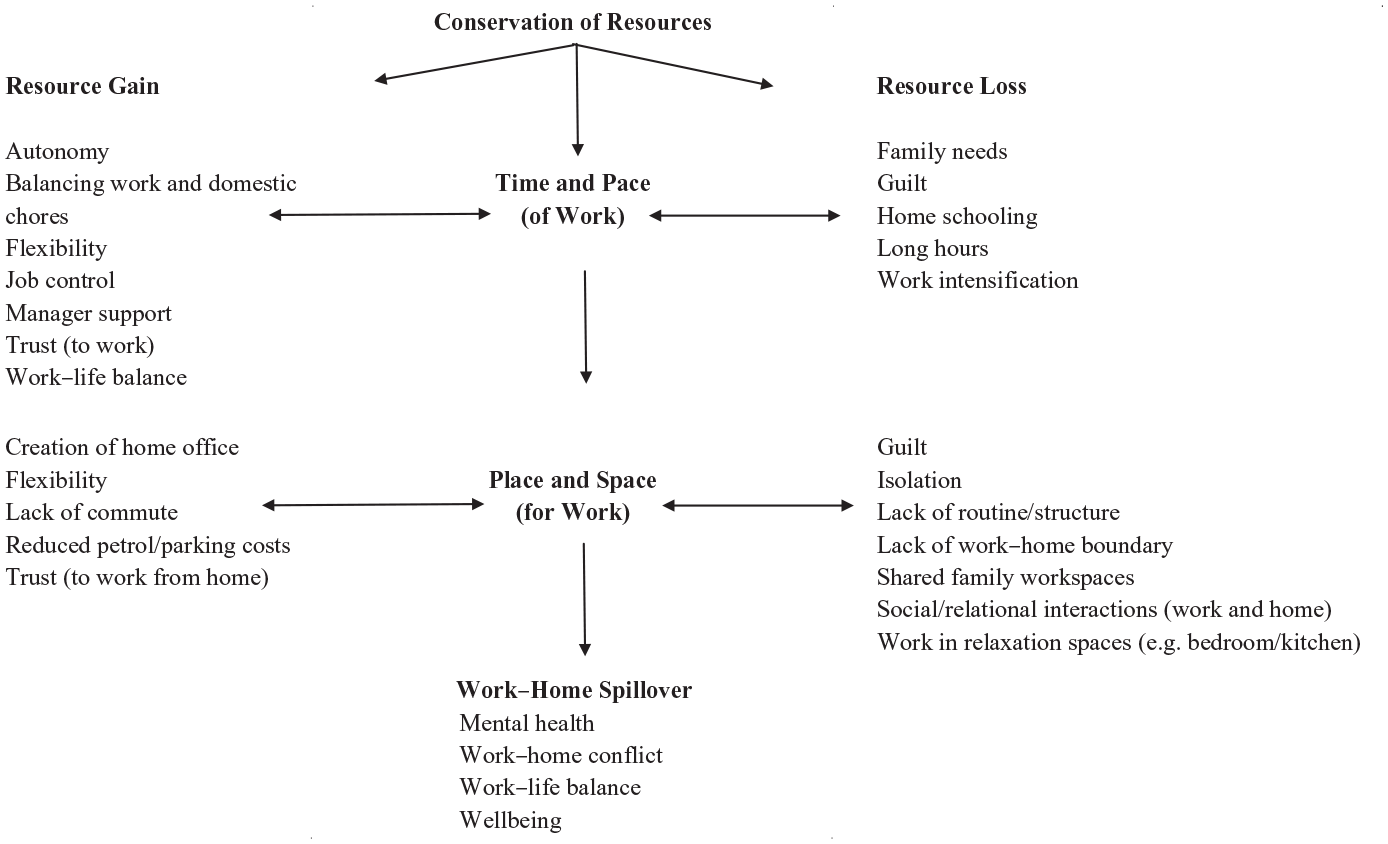
Thematic map.
The research received University ethical approval. All participants were provided with an information sheet when invited to take part and written consent was taken from participants. All data were anonymised and participants assigned a pseudonym, which is how quotes are attributed in the next section.
Findings
The emergent factors that underpinned or contributed to participants’ resource gains and losses during the pandemic were discussed in detail within the initial interview. Subsequent changes and adaptations by participants to these factors were followed up throughout the second and third phase interviews. Hence, the reporting of our findings is organised in accordance with the interview timeline – and participant journey – throughout and beyond the pandemic. Using COR and W-HR as our overarching theoretical lens, we focused on the resources that participants valued in leading to resource gains and replenishment. In contrast, we report the triggers of resource loss and potential for depletion of resources through loss spirals, and the extent to which participants strived to achieve a balance between gains and losses. We discuss the outcomes of resource loss and depletion resulting from work–home conflict and spillover between work–home domains. Resultantly, we consider the potential role of job crafting in creating a solution to balancing work–home conflict and personal resources.
Phase 1: Pandemic lockdown
The first round of interviews took place during the second national lockdown. It became clear that whether participants thrived or simply survived during the pandemic depended on multiple factors, key aspects being the merger of the household and work, and the associated support network and flexibility within it. This was highlighted vividly by Anna: ‘It’s like there’s a whole load of jigsaw pieces and I know that they all fit together, but sometimes they need a bit of jiggling . . . and right now it feels like everything’s been shaken and the pieces are not quite [fitting] together properly.’ The need for ‘(re)jiggling’ or crafting of the pieces that Anna referred to emerged as an important factor during the pandemic as a new work and workplace environment underpinned by flexibility and WFH became entrenched. Aligning with our thematic map (Figure 1), the emerging factors fell under two over-arching categories of ‘time and pace’ (of work) and ‘place and space’ (for work), which directed our interview findings.
Time and pace of work
Time for and pace of work were viewed simultaneously as sources of resource gain and loss, and this was largely dependent upon context resources such as the levels of flexibility and support offered by management. For instance, several participants revealed that work and workplace flexibility realised through WFH had a positive impact on both stress and work–home conflict, often describing this in the context of personal resources such as autonomy and job control. According to Jane, ‘Just being able to work from home, I mean, like, honestly, it’s completely changed my life really. I’m far less stressed out.’ Many participants reported that managers were understanding, particularly when parents were having to balance work with home schooling children. For example, ‘My boss [is] not on my back every day saying, what are you doing? He knows that if he leaves me to do it, it’ll get done and that’s it, so I do have a lot of discretion’ (John). Similarly, Kirsty commented: ‘Do you know, our work has been really good. Like they have been . . . do your work when you can, we understand you’ve got a child.’ Hence, autonomy and flexibility within paid work meant that parents could often continue working through adapting their hours or working pattern. The sense of stability from being able to continue working was also an important source of resource gain for some parents. For Kirsty, ‘We both [colleagues] were like, what are we going to do, and within half an hour our manager had said you can go home and work from home and you work when you can work, and it’s fine. It’s only going to be a few weeks, and that was last year’ (emphasis added). What is important to note in these comments is the inference that the pandemic was perceived as short-term, and that laissez-faire management could allow employees to ‘ride through the disruption’. Significantly, no participant commented on how management had (as yet) initiated a conversation or proactively sought to redefine work and boundaries or crafting of appropriate WFH strategies, or to discuss work–home conflict even, as noted, a year into the pandemic.
While autonomy and flexibility were generally viewed positively, triggers of resource loss emanated from strong feelings of guilt, which become a recurring theme throughout several interviews. This was especially the case as participants had children at home during their working hours. For example, Anna reflected on the work–family conflict: ‘I feel guilty. I mean the guilt has been phenomenal because I know that other people are knocking themselves out to keep things going . . . and I’m just basically saying, sorry, I can only do 20 hours this week.’ Feelings of guilt leading to stress in other cases were driven by participants not being able to put boundaries in place. As Ellen explained: ‘I’ve got a very supportive employer . . . The pressures are more coming from me than from my boss every single time.’ Similarly, Rachel added: ‘I think my employer has been quite flexible . . . I’m always just trying to justify that I’ve done enough. I think it is more on me than my employer . . . I think it is more how I feel.’
Clearly, the lack of boundaries or crafting of the job at home was increasingly leading to negative outcomes. These self-perceived notions of having to work harder or longer in many cases escalated the pace and intensity of work, which in several cases resulted in recurring resource losses often experienced through tensions in work–home conflict and work–life balance. For Craig: ‘The reality was, there I was home in my own house, couple of emails, I’ll just do this, just do that. Before you know it it’s eight o’clock. There’s no dinner made or anything.’ The lack of boundaries or initiatives to craft jobs around WFH resulted in several participants reflecting that they were working more hours, because they perceived that it was expected. Kirsty highlighted: ‘When you’re in work it’s not so bad because you finish at a certain time, you go home [physical boundary] and that’s it. But when you’re at home . . . I felt like I needed to do more.’ This lack of crafting of the job, in particular boundaries around work and home, created the major conflict. For example, Liam commented: It’s a sales job I do, so it is very target driven. It wasn’t like my targets dropped or anything . . . my phone is always on, I couldn’t switch off, I’m working in the evenings, I’m working at the weekends, I was stressed out to the max if I’m being honest.
Place and space for work
The recurring issue of the work–home boundary was a further area that was perceived as both a source of resource gain and a potential source of resource loss, often dependent upon individuals’ unique circumstances. For example, Belle commented: ‘My work is really understanding, so I was able to work and if he [child] popped in when we were on a video call, they just said hi and then he was away, and it was fine.’ Yet, for others the separation between work and home was an important buffer between the two domains. Craig described it this way: . . . a little bit of me time is just driving to work, listening to a bit of radio or whatever, it’s undisturbed. I don’t even have a car phone these days, so nobody can even phone you and you’ve got half an hour or 40 minutes of just you and the car radio.
The significance of a physical work–home boundary was raised in several interviews and was often highlighted in the context of routine and structure. Craig went on to explain: ‘You found yourself getting a bit lazy, a bit sort of sloppy. Sort of log on, have a coffee, get a bit breakfast. Whereas going to work, you’ve got a bit of routine, a bit of pattern.’ Kirsty and Rachel explained that what they missed about routine was the psychology of ‘going’ to work: ‘leaving the house in the morning and coming home . . . getting dressed and ready for work, going out the door and coming home’ (Kirsty); and for Rachel: ‘Having to get dressed for work, and then the head space driving to and from work.’ Rachel also referred to the physical boundary in the context of work–life balance, explaining: ‘The fact that work is in your home, I feel I never really switch off from it and quite often at eight o’clock I’ll just come back and do a few emails . . . Before this I . . . yeah, you leave work, and you leave it behind don’t you? . . . There would be some nights I’d be working, psychologically I don’t switch off.’
Others cited boundary issues in the context of exercise and health. Bruce commented: ‘There was a period for, like . . . from Monday to Friday . . . I just never moved away from the sofa, like, sitting in front of a computer. Yeah, it wasn’t good.’ However, perhaps more importantly in the context of resource depletion, John explained the impact this had on his mental health: . . . you’re never away from the house. Whereas, when you work in an office, you know, you’ve got to commute to the office. So, kind of you’re out, I think there’s definitely less social interaction as well . . . when you’re in the house, you don’t have any of that . . . and it’s something I’ve spoken to my employer about, that, you know, I sometimes feel quite isolated at home because you don’t have anybody to talk to really.
Even with the proactive approach noted here about the nature of the work impacting on mental health, no follow-up by the employer was undertaken to address this. The impact of reduced social relationships and interactions emerged in several interviews as a key source of resource loss and depletion, which was particularly acute for lone parents, and which often had a detrimental impact across several areas. For instance, referring to working practices, Jane noted: ‘The downside of it [WFH] is that you’re not getting the same sort of interactions with work colleagues, like off-the-cuff kind of knowledge where you’re just sort of chatting and things come up. You’re not getting that sort of same knowledge of what’s happening’, in other words, what might be described as those ‘water-cooler moments’ where knowledge is transferred informally. Rachel explained it this way: I think employment has changed. I think opportunities have changed. That networking and socialising and sort of, you know, speaking to someone at the tea point or being in a lift with somebody, that’s gone. And mixing with people from different departments, or, you know, you speak to someone five minutes before or after a meeting or you speak to someone in a car park. Those sorts of interactions have just disappeared.
Importantly, the nature of remote/online social interactions was also regarded by some participants as a source of co-worker tension and conflict. Liam explained it this way: When you’re working like this [remotely], everything’s, how do I put it, intensified and people will erupt over the stupidest of things, that wouldn’t have happened if we were all sitting in an office. Just things get magnified and intensified and things are taken the wrong way . . . It’s like an email, you know, like people can take emails the wrong way, just the way they read it.
Again, the inference was that no intervention from management was forthcoming to manage these emerging WFH issues. A further area of contention was physical working spaces at home and the extent to which families were utilising shared spaces. Participants reported that spillover from work into shared spaces had put a strain on family relationships and were a source of stress and anxiety. For Kirsty, ‘My kitchen was my office. I mean you’re there all day . . . and then you’re having your dinner at the same table.’ Similarly, Oliver highlighted the work intensification aspect of this shared space: ‘I think when it’s the place you’re using for work . . . If you use it for work, I don’t think you can really truly relax.’ The practical challenges associated with a small, shared space were captured articulately by Ellen, who reflected: I didn’t have an office, I don’t have a dining room. I can’t work at the dining table in the living room because it’s meant to go up and down after meals and it is right in the middle of the room, and it’s so close to the kitchen. So, I started working there but it meant that every time that somebody needed a drink of water, they’d walk behind me . . . So, now . . . I’m working from a bookshelf.
It emerged from the phase 1 interviews that sources of resource gain emanated from high levels of flexibility and support offered by (laissez-faire) managers and participants’ support networks. Yet, the increased autonomy and flexibility oftentimes led to feelings of guilt, as the lack of boundary management meant work and home became blurred, and in some cases resulted in participants working longer hours and experiencing work intensification as boundaries were ill-defined in the work–home context. The resultant resource losses were experienced through increased work–home conflict, for example, using shared spaces and poor work–life balance. Feelings of social isolation and relational challenges also impacted negatively on some participants’ mental health and wellbeing.
Phase 2: Mid-pandemic
In terms of the participants’ journeys, what emerged from the second phase of interviews 15 months after the first restrictions were imposed was how the parameters of the new normal would develop. Much of this was driven by the increased awareness of both the positive and negative impact (resource gains/losses) that occurred from new ways of working.
Time and pace of work
For many participants this was a time for reflection. Bruce highlighted: ‘I’m trying to take a moment to pause and reflect on things going back to normal. I’ve had a few discussions with people just, kind of, saying do we really want to go back to that [previous] normality.’ In terms of pace of work, and the lack of crafted boundaries, what had now transpired was an enhanced recognition – and acceptance – of the often-negative impact that WFH was having on participants’ health and wellbeing. For Jethro: I guess me-time now is, you know, having a definite time of night that I stop working by, because that’s the one big change or the one danger, I think, working from home, is that your work is always there. So, every time I walk past that door, I’m thinking I could do such and such for 15 minutes, or, you know, the first thing I do when I wake up is I’m going to go through and check my emails.
Importantly, however, in these second phase interviews there were still no proactive strategies on job re-design or crafting emerging from management. This was despite clear indication that several participants were experiencing mental health and well-being issues.
Place and space for work
What did emerge in the second interviews was that after the experience of lockdown there was an openness towards more flexible hybrid models of working. As Bruce mentioned: ‘I think, it already is a kind of blend of, kind of virtual, phone support, real world support . . . it’s a good mix of everything.’ Some participants highlighted that previous (mis)conceptions around presenteeism and a lack of appetite from management for remote and home working were being challenged because of the pandemic and a new acceptance that it is possible, in many cases, to WFH was being realised. According to Violet: ‘my team all had the capability to work from home, but there just wasn’t the appetite from our very seniors’. Participants believed that the pandemic had offered an opportunity for management to reconsider flexible working and, where possible, develop strategies and policies that allow employees to craft work patterns that are flexible enough to meet individual needs and circumstances, and create a resource spiral. As Craig explained: Just spending 16 hours a day in the same room . . . It’s like, there’s no clear boundaries between – this is work, this is not work time. You just end up omnipresent at work. So that’s one of the reasons I elected to go back in for a bit, just for a bit of variety.
In summary of the phase 2 interviews, participants were anticipating a hybrid workplace in which they perceived a more nuanced or crafted approach to work. Whilst this approach was viewed positively (resource gain), in the longer-term work–home conflict had begun to emerge as a source of tension and resource loss. This tension largely came about through the lack of crafting of a physical and psychological boundary between work and home in the same space. As we have noted, the silence of management influence in these interviews was deafening and clearly spoke to little understanding or investment by management in job crafting for resource gains and issues of work–home overspill.
Phase 3: Post-pandemic
The key finding emerging from this phase was participants actively and positively adapting to their new normal (resource gain spirals).
Time and pace of work
A key theme to emerge was participants’ increasing ability to self-manage the work rhythms of the day and craft them around potential home conflicts as their daily routine had become embedded. For example, Craig commented that: ‘During the day I’ll quite often go for a little walk or go to the shops, do the groceries, so you fit in domestic stuff as well.’ Anna also reflected: ‘We’ve got a visual schedule in the hall downstairs, and I can put on here what time mummy’s working till, and [daughter] gets it.’ Participants appeared to be welcoming of the continued agency and control that WFH was affording them. For Tracey, ‘I can plan my days and how I want them to go, and where I want to go and not have to be somewhere sat at a desk at a certain time, clocking on, clocking off and things.’ Indeed, the strength of feeling towards having the autonomy to WFH had strengthened among participants. According to Anna: ‘It is not realistic for me to be at [workplace], it will put additional stress on my household’; and for Craig: ‘A bigger fear now would be going back to the office, doing some commuting.’
Place and space for work
Most participants expressed a desire to maintain workplace flexibly in the long-term. For example, many spoke of a welcome move to hot desking and hybrid workspaces and referenced unproductive commute times, public transport and parking charges as being prohibitive to returning full-time to the workplace. According to Anna: ‘I prefer working at home because I am in charge of the heating and light levels, and the noise levels, I don’t have to wait in a queue to use the microwave.’ Participants commented on having fundamentally changed their place and space employment expectations. For instance, Ellen reflected on how her perception of WFH shifted throughout the pandemic: Before lockdown I wouldn’t have wanted to work from home. That was never the model I wanted. By being forced into it, I came to appreciate it . . . Because I’ve created a [home] workspace now, the office being a benefit doesn’t exist anymore to the same level as it did. (emphasis added)
In a similar vein, Craig spoke about having moved jobs since his phase 2 interview, explaining: ‘I guess what Covid has done for me, and certainly other people, is open up opportunities for employers because there is an appetite for people to work from home.’ He went on to highlight that ‘For some managers, it’s very difficult for them to get into the mind-set that people can WFH and that they can come into the office when they need to, rather than 9am to 5pm . . . What this is perpetuating is this continuing inability to recruit, to fill jobs.’ Bruce also described this issue in the context of people placing greater emphasis on leisure time and a desirable work–life balance, which he described as ‘quiet quitting’.
Yet, while it was acknowledged that there is now perhaps more employer trust associated with WFH, it was apparent that management still did not appear to be playing an active or central role in assisting employees to (re)craft their jobs, but rather, it was still left up to individuals to figure out what worked best for them. For example, when asked what could be done better if faced with another pandemic situation, Anna responded: ‘I think it worked reasonably well last time, the way we organised ourselves’; and for Rachel: ‘They’re [employer] quite happy, we have the option to work full-time in the office, full-time at home, or hybrid.’ Yet, highlighting management’s responsibility, Ellen reflected that in hindsight: Homeworking assessments should have been done at the start of the outbreak as we don’t all have the same [home] set-ups. There were misunderstandings about what some people’s set-ups were . . . I think most of us would have been working around our kitchen table. That information is something that employers would need early on to support their staff.
Indeed, the idea that there was no one-size-fits-all solution to the pandemic and that the new normal post-pandemic work organisation emerged as a prominent theme, spotlighted the importance of individuals, where possible, being empowered and supported to craft their jobs in ways that best suit their needs and circumstances. For instance, while most participants were keen to continue some degree of WFH, Jethro commented: ‘Home for me, normally, is a place where I don’t think about work. It’s a place where I come and enjoy my kids and my family.’ Similarly, chiming with the previous interviews, other participants highlighted that issues associated with social isolation continued to prevail and this was regarded as the downside to WFH (leading to resource loss and depletion). For example, ‘You can go and get a coffee in your house but it’s not quite the same as popping down to the canteen and having a chat’, Craig commented.
Overall, what emerged throughout the three longitudinal sets of interviews was a journey from initial shock and uncertainty posed by enforced WFH coupled with the need to balance home schooling with work commitments. As their journeys progressed throughout and beyond the pandemic, participants had begun to accept, adapt, and transition to a new normal. The major gap in the jigsaw was the lack of intervention or involvement of management through proactive guidance or support in the (re)crafting of participants’ jobs, around work–home conflicts; specifically, this was very much left to individuals to figure out.
Discussion
We set out to address two research questions in this study: How participants managed work and other priorities during the pandemic; and to what extent participants were empowered and supported by management to (re)craft their jobs to meet work and personal needs. Through the lens of COR theory, we took advantage of the ‘process’ perspective offered by the W-HR model (ten Brummelhuis and Bakker, 2012) and utilised this in a contemporary context to explore participants’ journeys throughout and beyond the Covid-19 pandemic. This article contributes theoretical and practical insights into the often complex and dynamic interplay between resource gains and losses, and how workers experienced such gains and losses and ultimately sought to mitigate tensions between their work–home domains as the physical boundary separating both domains melted away.
Aligning the study findings with our theoretical framework, participants valued a high(er) level of flexibility generated through home working, which was predominantly viewed in the context of resource gains as with it came greater autonomy and job control (Abgeller et al., 2022; Yunus and Mostafa, 2021). Further sources of resource gain initially came in the form of enhanced management understanding, particularly as parents had children at home, although, as we note, this was more laissez-faire than strategic. In this context, it is important to note that none of the participants indicated that their manager had proactively – but rather passively – supported them regarding (re)crafting their work and home boundaries to meet personal and organisational needs for a longer-term approach to the emerging new normal. This is of particular concern as issues of stress, work intensification and isolation emerged as factors associated with WFH – a resource loss spiral. Returning to Ellen’s point (phase 3 interview): ‘Homeworking assessments should have been done at the start of the outbreak as we don’t all have the same set-ups’; in most cases, management appeared to be accepting of how employees would manage competing work–home obligations, arguably with limited understanding of the potentially harmful effects of spillover from the work domain to the home domain, or vice versa, which often emerged as a source of personal resource depletion among our participants (ten Brummelhuis and Bakker, 2012). Even during the third phase of (post-pandemic) interviews, despite participants’ concerns about WFH being evident, there was still no indication of management intervention in the (re)crafting of roles and boundaries for the longer-term.
The impact of continual WFH was felt on both physical and mental health and the resultant and longer-term implications from resource losses were numerous. Negative health and wellbeing outcomes were experienced from lack of daily exercise through not having to commute to or move around a physical workplace (Zhu, 2013). The inevitable social isolation and reduced social/relational interactions and networking that came with WFH were also regarded as being significant exacerbators of poor mental health and resource depletion spirals (McNaughton et al., 2014; Neeley, 2015). Importantly, this also impacted the quality of co-worker relationships, and the ways in which people communicated and interacted differently using online platforms was a noticeable source of tension and conflict (van der Lippe and Lippenyi, 2019).
Over the course of the three interview phases, and as the work–home model became more entrenched, participants had begun to accept and adapt to having work in their home and many had established better work practices and more appropriate workspaces in their home. By the third phase of interviews, the transition to a ‘new normal’ post-pandemic was explicitly recognised by participants, with many reflecting on their desirable future preferences and crafting their own work environment accordingly (thereby potential resource gains and enrichment) (Hobfoll et al., 2018). Yet, management initiatives to develop any sort of framework, i.e. strategies or policies aimed at enabling and empowering individuals to (re)craft their jobs for positive and mutually beneficial outcomes, remained absent. This, we argue, in hindsight may be a growing concern for management as many workers have now crafted their roles in ways which suit them, and which may not be fully aligned with organisational needs and priorities. This was evidenced through the increased strength of feeling among many of our participants towards not wishing to return to the physical workplace in the post-pandemic world. This is where job crafting may be coming of age in terms of critical management of the new normal work environment. A key factor emerging from this research was that job crafting can provide that critical information and boundary development to ensure workers can effectively manage competing interests in this new normal (Wrzesniewski and Dutton, 2001). Indeed, we argue that management-supported job crafting could prove beneficial in ensuring that both individual and organisational needs are accommodated, while alleviating some of the tensions elicited in this study. We also found support for the positive outcomes of job crafting as individuals sculpted their jobs in ‘personally meaningful ways’ (Kim and Beehr, 2022: 3822) to fit their work–life balance and work–home conflict, which research also identifies as creating a more satisfied and engaged employee (Bakker and Demerouti, 2007). For management in a post-pandemic period in many advanced market economies experiencing major labour shortages, such strategies can also be seen as critical to the attraction and retention of key staff and talent management. In exploring this in the context of job crafting theory and the changing of jobs by some participants, it became clear that having re-crafted their jobs through trial and error, they had found an equilibrium from which they did not want to retreat. Returning to Wrzesniewski and Dutton’s (2001: 187) point that job crafting ‘serves the employee, but it is not inherently good or bad for organizations’, what our findings also suggested, and thereby advances knowledge in the field, is that management does not necessarily need to be proactively involved in initiating job crafting, as research often suggests, but, critically, by not being involved they ultimately lose control of this aspect of management by providing neither the initial direction to workers nor the ongoing support needed (Bakker et al., 2016; Wong et al., 2017). This potentially leads to an imbalance in the needs of each group and therefore resource requirements down the track are needed to redress or re-balance worker and organisational needs and expectations for longer-term outcomes; otherwise talent may seek alternatives that provide them with their desired work environment.
Overall, the study demonstrated that while there were positive and negative aspects of WFH during the pandemic, these were often dependent upon unique individual circumstances and the ability to self-craft, including personal preferences and facilities that enabled productive WFH. Workers who had crafted a dedicated space to work from home were more likely to have a better experience than those working from a shared space such as a kitchen or bedroom, or from a ‘bookshelf’, as Ellen described. Managers therefore need to be cognisant of the multiple complexities and realities surrounding the work–home interface, and that proactively developing a framework to enable a personal choice approach, where feasible and within reason, may be a more beneficial policy than a one-size-fits-all or laissez-faire approach to flexible working in the future. This study also captured the complex and dynamic interplay, and ‘process’ perspective advocated within the W-HR model where workers strive to acquire resources to compensate for their losses and redress the balance to avoid spillover from one domain to the other (ten Brummelhuis and Bakker, 2012). As the longer-term entrenchment of new flexible working patterns and practices indicates, negative outcomes such as work intensification and isolation are likely to be exacerbated if management does not address the job crafting issues, and this will increasingly be seen by employees as a key aspect of managing their wellbeing and aid retention.
Research limitations, practical implications and avenues for further research
While some of the lived experiences reported in this study were context specific to Covid-19 lockdowns, the need to redress and (re)balance work and family life in new ways is set to endure as society transitions to a new normal for work and working lives throughout and beyond our recovery from the pandemic, and as autonomy and control through job crafting become the key elements in new (flexible) patterns of work. Diversity of experience may not be fully captured within this study due to the small sample size. Therefore, further research with a larger and geographically spread sample would be advantageous, as would further examination across specific sectors or industries.
Given the evidential lack of management intervention in developing frameworks for individual job crafting in the wake of the pandemic, research into how workers are continuing to increase their agency over how best to craft their roles according to their own individual and organisational needs and unique circumstances is called for. Many lessons can be learned from the pandemic and how workers navigated – and continue to navigate – their way towards a new normal. In this context, we believe we have advanced theoretical understanding of job crafting by showing that far from management being the key to fostering or driving job crafting, the pandemic and technological advancement that enabled remote working created agency in workers to shape (craft) their roles. The lesson learned in this context is that it challenges the long-held assumption that proactive support and intervention from management is central (Wrzesniewski and Dutton, 2001). Indeed, our study showed that this management vacuum was filled by workers’ initiatives, and that the longer-term consequences are only beginning to emerge.
Equally, we have highlighted the impact on work–home conflict and the need to manage the tensions between the two as we move to a hybrid ‘new normal’ work environment. It is important to recognise that flexible working affects workers in different ways and that people’s experience of WFH will vary depending on their circumstances. This, we argue, may be the foundation of management engaging more deeply with job crafting. Thus, at this juncture as work and home boundaries become increasingly blurred, we evidentially argue the need for scholars and practitioners to move away from – or extend – the long-standing and traditional focus on ‘work–life balance’ towards a renewed emphasis on ‘work–home conflict’ factors and their associated outcomes in the post-pandemic world, as well as understanding how significant these factors are in crafting work. Management needs to be cognisant of the potentially adverse effects of spillover from one (work/home) domain to the other, and the consequences of this for workers. It is to this end that theoretical frameworks such as COR and the W-HR model can help to engender a better understanding of how such factors lead to resource losses and gains, and how workers seek to acquire resources and redress the balance of resource losses and gains to avoid resultant spillover and negative outcomes for health and wellbeing though the framework of job crafting.
Conclusion
This study captured the lived experiences – and journey – of 19 parents from across Scotland both throughout and beyond the pandemic. Drawing on the principles of COR theory and the W-HR model, we sought to explore how participants managed work and other priorities during the pandemic, and to what extent they were empowered and supported by management to (re)craft their jobs to meet personal and work needs. We advocate that job crafting is a useful means of organising the jigsaw pieces of work–home balance and conflict following the pandemic as society continues to transition towards a new normal for work and working lives.
Footnotes
Acknowledgements
The authors are grateful to Edinburgh Napier University for funding this research. We would like to thank all those who gave their time to participate in the research, as well as the anonymous reviewers for their insightful comments.
Declaration of conflicting interests
The authors declared no potential conflicts of interest with respect to the research, authorship, and/or publication of this article.
Funding
The authors received no external financial support for the research, authorship, and/or publication of this article.
