




Abstract
Without structures of employer coordination, it is difficult to develop and deliver effective and legitimate labour market policy. This article theorises the conditions under which employer coordination occurs in a context usually described as a Liberal Market Economy. An explanatory framework of employer coordination is developed arguing that there are structural, institutional and ideational factors that facilitate and hinder coordination. The framework is applied to an empirical analysis of the Scottish context where devolution means that the Scottish Government has taken a different approach to issues of regulating work, emphasising the policy importance of ‘fair work’. Empirical material was collected through interviews with employers’ organisations (EOs) and other key stakeholders. The article extends existing theorisation by demonstrating that the pressures that facilitate and hinder employer coordination are dynamic and contested.
Introduction
This article conceptualises the factors that facilitate and hinder employer coordination in a context typically defined as a Liberal Market Economy (LME) (Hall and Soskice, 2001) to show how they shape future prospects of effective and legitimate employer engagement in labour market policy making. Scotland provides an unusual empirical example where devolution of some labour market policies means pressures for employer coordination are higher than might be expected in a conventional LME context. This illustrates the importance of understanding employer coordination as a dynamic process, rather than as a static outcome of institutional arrangements. Ibsen’s typology of approaches to coordinated bargaining (2015) is extended to illustrate the pressures that create this dynamism. The framework emphasises the interplay between three factors that shape employer coordination: structural factors, institutional dynamics and ideas. The article addresses two research questions. First, what evidence is there in Scotland of structural, institutional and ideational factors shaping employer coordination? Second, what evidence is there about what would be needed to support more structured and systematic employer coordination in future? Interviews with key stakeholders, including employers’ organisations (EOs), show that the extended Ibsen typology is robust in conceptualising and explaining what facilitates and hinders employer coordination. The article extends this by emphasising the dynamic and contested nature of these influences in shaping employer coordination and highlights the central role of the State in supporting social partners to coordinate.
Coordination of social partners is a central concern of industrial relations scholarship with a focus on how it is sustained or undermined in national and sectoral contexts (among many others, Hyman, 2005; Larsen et al., 2022; Prosser et al., 2022; Streeck, 1994). Many studies have described and theorised the changing organisational forms of collective representation of both employers (Croucher et al., 2006; Gooberman et al., 2018; Sánchez-Mosquera, 2022; Voskeritsian et al., 2022) and unions (Gumbrell-McCormick and Hyman, 2019; Hyman, 2005; Marino et al., 2019). This article speaks to many of these debates by highlighting an unusual case where a devolved jurisdiction (Scotland) within an LME (the United Kingdom) is pursuing policies that not only seek to strengthen social dialogue between unions and employers but is also asking questions about how to support effective coordination. The focus here is on the coordination of employers because although collective representation across the UK has weakened (Gooberman et al., 2018; Stroud and Fairbrother, 2012), unions continue to organise and articulate workers’ interests. UK employers, by contrast, are confronted with few incentives for coordination. Understanding dynamics that facilitate and hinder employer coordination is important because of criticism that labour market policies are often developed with weak engagement from employers who are crucial to the delivery of effective outcomes (Jones, 2022). For social partners to engage effectively in policy development, some level of coordination is necessary (Barry and Wilkinson, 2011).
To address the question of what shapes employer coordination in Scotland, the article first outlines what existing mechanisms there are for employer coordination in the Scottish context. It argues that coordination has been driven by the Scottish Government’s policy programme, which focuses far more on collective employment regulation than its UK-level counterpart. This extends existing literature by exploring how EOs have responded to increasing pressure for coordination. Importantly, the evidence emphasises that institutional arrangements of coordination are never fixed, even in a context that has so long been classified as an archetypal Liberal Market Economy, and that key actors have scope to shape institutional arrangements. The article makes two central contributions. The first is to demonstrate that although more than four decades of policy initiatives to decollectivise the regulation of work and employment impact across the UK, they do not operate universally. Pressures to coordinate are dynamic and are shaped by structural, institutional and ideational factors. The second is to conceptualise how EOs understand their scope for action to coordinate. Evidence illustrates both the conditions and limitations of efforts to rebuild coordinated employer voice within the broader context of uncoordinated structures of an archetypal LME.
A framework to conceptualise factors that facilitate and hinder employer coordination
Employers’ organisations in the UK: History and purpose
Employers’ organisations (EOs) are organisations that have the purpose of collectively representing the interests of member employers. In line with Gooberman et al. (2018) this article adopts the term employers’ organisations (EOs) rather than employers’ associations because the latter are typically engaged in multi-employer collective bargaining, which has largely been dismantled in the UK outside the public sector. As collective bargaining is no longer always the focus of collective employer representation, the term EO is more accurate because it focuses on the collective action of employers around issues of work, employment relations and human resource management (Gooberman et al., 2018). Gooberman et al. (2018) present an overview of the ways employers’ organisations in the UK have adapted and refocused their activities as sector collective bargaining has declined.
The UK has not always lacked coordination identified in the LME archetype (Hall and Soskice, 2001). From the early days of industrialisation, EOs have existed to promote the interests of employers in much the same way as trade unions do for workers (McIvor, 1996). Employers’ associations emerged as membership-based groups, typically organised in a particular sector, industry or territory, with a focus on labour market issues (Sheldon et al., 2019). Until the 1970s, employers’ associations were powerful organisations engaged in coordinating members not only in collective bargaining, but a wide range of other activities including labour market policy. As collective bargaining declined as a direct result of policies of the Conservative governments from 1979 to 1997, employers’ associations faced challenges to adapt their roles to focus less on bargaining and more on other forms of coordination and influence such as public relations, lobbying and making expert submissions to consultation processes (Gooberman et al., 2018; Sheldon et al., 2019). A small but growing academic literature has explored these changing roles in the UK (Gooberman et al., 2018) and beyond (Voskeritsian et al., 2022). Those authors emphasise a shift of activities towards lobbying, standard-setting and providing services to member employers.
The Scottish context: Scotland, devolution and fair work
Recent policy in Scotland has developed with a very different agenda to the UK Westminster governments in that it centres the policy objective of fair work and seeks to build coordination around labour market policies (Scottish Government, 2021a). This is explained in large part due to devolution, which has been in place since 1999 and which gives the Scottish Parliament control over some devolved policy areas. While it is not feasible to describe the full details of devolution in a short article, devolved issues include, but are not limited to, economic development, and education and training. Reserved issues, i.e. issues dealt with by the Westminster Parliament in London, include, but are not limited to: employment law and industrial relations, and trade and industry. This gives the Scottish Parliament and Government important levers in the broad area of labour market policy. These levers are both institutional and political. Institutionally, the Scottish Government has introduced policies that differ from Westminster in important areas of work and employment such as apprenticeships, vocational training and equality. Politically, the Scottish Government diverges from the UK Government with regard to making clear commitments to promote fair work, strong trade unions and collective bargaining (Scottish Government, 2021a). This institutional and political divergence provides a strong rationale to study the ways in which employers coordinate in this devolved setting, which nonetheless retains many features of an LME.
A major challenge to delivery of devolved policies is how to engage employers in a coordinated manner. A lack of systematic attention to coordination means that channels of consultation of employers are often relatively ad hoc, which risks a lack of legitimacy and representativeness. Scotland therefore provides a unique policy context within which to explore the role of EOs in coordinating employers to facilitate engagement with politicians and policy makers. Employer coordination is crucial within the Scottish policy objective of fair work. The history of the importance of ideas about fair work within Scotland is explored more thoroughly by others (Pautz et al., 2021). The strong policy commitment has led to the development of the Fair Work Convention, which defines fair work as ‘work that offers effective voice, respect, security, opportunity and fulfilment; it balances the rights and responsibilities of employers and workers, and can generate benefits for individuals, organisations and society’ (Fair Work Convention, 2016: 5). This commitment is integral to the political agenda of the Scottish National Party (SNP), which has held control of the Scottish Parliament since 2007 (in minority government) and 2011 (as a majority government). The Party committed to establishing a Fair Work Convention in the run up to the referendum on Scottish independence in 2014. The SNP has also committed to the United Nations’ Sustainable Development Goals (SDGs), thereby underpinning a commitment to SDG8 – decent work – and bolstering the idea of fair work as a policy priority. To achieve this, relevant Scottish labour market policies include: Scotland-specific approaches to funding and regulating apprenticeships, including the Apprenticeship Levy; policies around Developing the Young Workforce; the Scottish National Action Plan for Responsible Business; and the Workplace Equality Fund to support good employment outcomes for disadvantaged groups. In addition, many other policy areas such as productivity, innovation and support for entrepreneurship rely on engaging employers in a coordinated manner. In this context, the historical undermining of employer coordination presents a practical challenge for policy makers in delivering these ambitions.
Morgan and Hauptmeier (2021) show how such policies spread initially as policy paradigms, then to policy ideas, and then to practices and interventions. Pautz et al. (2021) explore the ways in which ideas around ‘fair work’, ‘decent work’ and ‘job quality’ developed at all three levels of Morgan and Hauptmeier’s analysis (2021). Despite being more sceptical about the effectiveness of these ideas in shaping (some) policy development than the analysis presented in this article, Pautz et al. (2021) highlight the translation of ideas about ‘decent work’ promoted by the International Labour Organization (ILO) and show how they gained traction among trade union movements, including the Scottish Trades Union Congress (STUC) across the early 2000s. The development of the United Nations’ Sustainable Development Goals in 2015, and the inclusion of SDG8 around ‘decent work’ gave further impetus to this paradigm. One of the roots of the development and agreement on policy ideas around fair work in Scotland was also seen in the 2002 Memorandum of Understanding between the then Labour–Liberal Scottish Government and the STUC which underpinned a profound change of relationship between civil servants and trade unions as compared to the Westminster counterpart (Pautz et al., 2021). By the time of the election of the minority SNP Government in 2007, this approach was reasonably well-established and fitted well with the social democratic policy position of the SNP on issues of social dialogue (Heery et al., 2020). While not explicitly discussed by either Pautz et al. (2021) or Heery et al. (2020), the commitment of the European Union to social dialogue and decent work from the 2010s onwards also transmitted paradigmatic ideas into the Scottish policy realm. The translation of those paradigms into policy ideas took longer and it was only in 2013 that the SNP focused on fair work and the development of the Fair Work Convention as part of the campaign for Scottish independence. From there, the translation into instruments and measures that shape social dialogue has developed in the past decade to articulate a broad policy commitment to job quality.
A central challenge in implementing policies around fair work is how to engage employers in both development and delivery. Varieties of capitalism literature conceptualises differences between Liberal Market Economies (LMEs) and Coordinated Market Economies (CMEs) (Hall and Soskice, 2001). The UK is usually presented as an archetype of an LME with countries such as Germany discussed as archetypal CMEs, especially in the context of skills and labour market regulation (Hörisch et al., 2020). A crucial difference between the two is the extent to which the regulation of work and employment is left to market forces (LMEs) or coordinated through involvement and bargaining between social partners and the State (CMEs). The collective representation of social partners is presented as a key point of difference between the two archetypal varieties of capitalism (Thelen, 2012). Weak or absent coordination mechanisms make it hard for policy makers to be confident that employers’ voices can be integrated into policy making, and even if they are, there are real concerns about the legitimacy of the voices being heard. Weak coordination mechanisms can lead to concerns that voices may be those of the most privileged, those who know how to access policy makers, and those who have particular concerns. Legitimacy and effectiveness of collective voice therefore risk being undermined. Writing about the continued collective influence of trade unions, Dufour and Hege (2010) argue that a key explanation relates to the fact that within institutions of social partnership in many EU countries, external partners and institutions continue to regard unions as the legitimate voice of labour. Equally, effectiveness is crucial. Again writing about unions, Bryson (2004) argues that the reduced effectiveness of unions in shaping managerial behaviour at workplace level is important to understanding the weakening of collective bargaining in UK workplaces. Gall and Fiorito (2016) also emphasise that effectiveness of social partners is important to understanding collective representation. Both arguments can be extended to our conceptualisation of collective employer representation, so the extent to which external actors and institutions attribute effectiveness and legitimacy to EOs is therefore important to explore. The specificities of the devolved national context also allow for an exploration of the role of the State in facilitating and hindering coordination (Trampusch and Eichenberger, 2012).
A framework to conceptualise employer coordination
There are important contributions that point towards factors that facilitate or undermine coordination of both employers (Martin and Swank, 2012) and workers (Hyman, 2007). Given the trajectory of decline of collective bargaining in many countries over the past 40 years, most literature explores the pressures and effects of employers moving away from coordination. Much of this literature draws on varieties of capitalism and challenges the view that institutions are monolithic and unchanging (see Hall and Thelen [2009] for a particularly important starting point). UK employer representation has received less attention than other national contexts in part because EOs have often preferred their strategies and actions to remain private (Barry and Wilkinson, 2011). Nonetheless, there is growing attention to questions of how we can understand the role of collective employer representation in the UK and beyond (Bryson and Willman, 2022; Gooberman et al., 2018).
Writing about the highly coordinated settings of Denmark and Sweden, Ibsen (2015) identifies three sets of literature that present competing explanations about why actors may choose to coordinate. Rational choice (structural) approaches emphasise that interests are exogenous and based on material structures such as the openness of the economy, relative sizes of sectors that are exposed to or protected from competition, and labour markets, especially skills composition. For example, employers who are more exposed to competition may have less incentive to coordinate and may well compete with each other. Skills available in the labour market might also provide an incentive to cooperate if there are good reasons to work together to build capacity and expertise (Swenson, 2002). Rational institutionalist (institutional) approaches (Ibsen, 2015) make similar assumptions about employers’ interests in that they are also seen as exogenous and based on material structures. Where this literature differs is that it centres the importance of institutions in shaping the ways in which interests can be pursued, and therefore in the expression of which interests are promoted. The desire of employers to coordinate (or withdraw from coordination) is understood as being shaped by institutions such as bargaining structures, the power of EOs and confederations, statutory regulation of bargaining, the power of unions to force coordinated bargaining, skills development institutions, etc. An example is the existence of sectoral bargaining, which provides considerable incentives and structures for employers to work together to articulate a common position (Traxler, 2003). In many coordinated market economies, employer confederations not only provide the institutional mechanism through which to coordinate, they often work to enforce the terms of collective agreements and ensure a degree of discipline on the part of member employers (Traxler, 2003).
Discursive institutionalist (ideational) approaches by contrast emphasise how ideas and discourses shape the meanings and structures that form mutual expectations around coordination. Ideas around coordination and institutions of coordinated bargaining provide shared understandings of socio-economic problems. Narratives of working together and shared understandings of threats and opportunities can provide a powerful impetus to employer coordination (Frege, 2005). Ideas are argued to shape both the institutional context and the behaviours of actors within those institutions. But ideas matter in a second way when it comes to coordination because without an imagined possibility of shared interests, it is difficult to envisage effective and legitimate mechanisms of employer coordination. Shared understandings of current and future opportunities and threats are central to developing a common position within an EO (see Lévesque and Murray [2013] for comparison with unions). In other words, ideas can provide the basis of narratives that build understanding about shared interests. These three sets of factors can be conceptualised as a framework through which the empirical material can be understood more clearly. Although originally developed to explore the highly coordinated settings of Sweden and Denmark where multi-employer bargaining is widespread, Ibsen’s identification of these three sets of literature has potential for wider applicability. Specifically, it is helpful in developing a framework (see Figure 1) that has explanatory potential regarding the factors that shape employer coordination that, as this article will show, can be applied in wider settings – here in a setting where multi-employer collective bargaining is largely absent. Demonstrating the value of this framework is a core objective of this article.
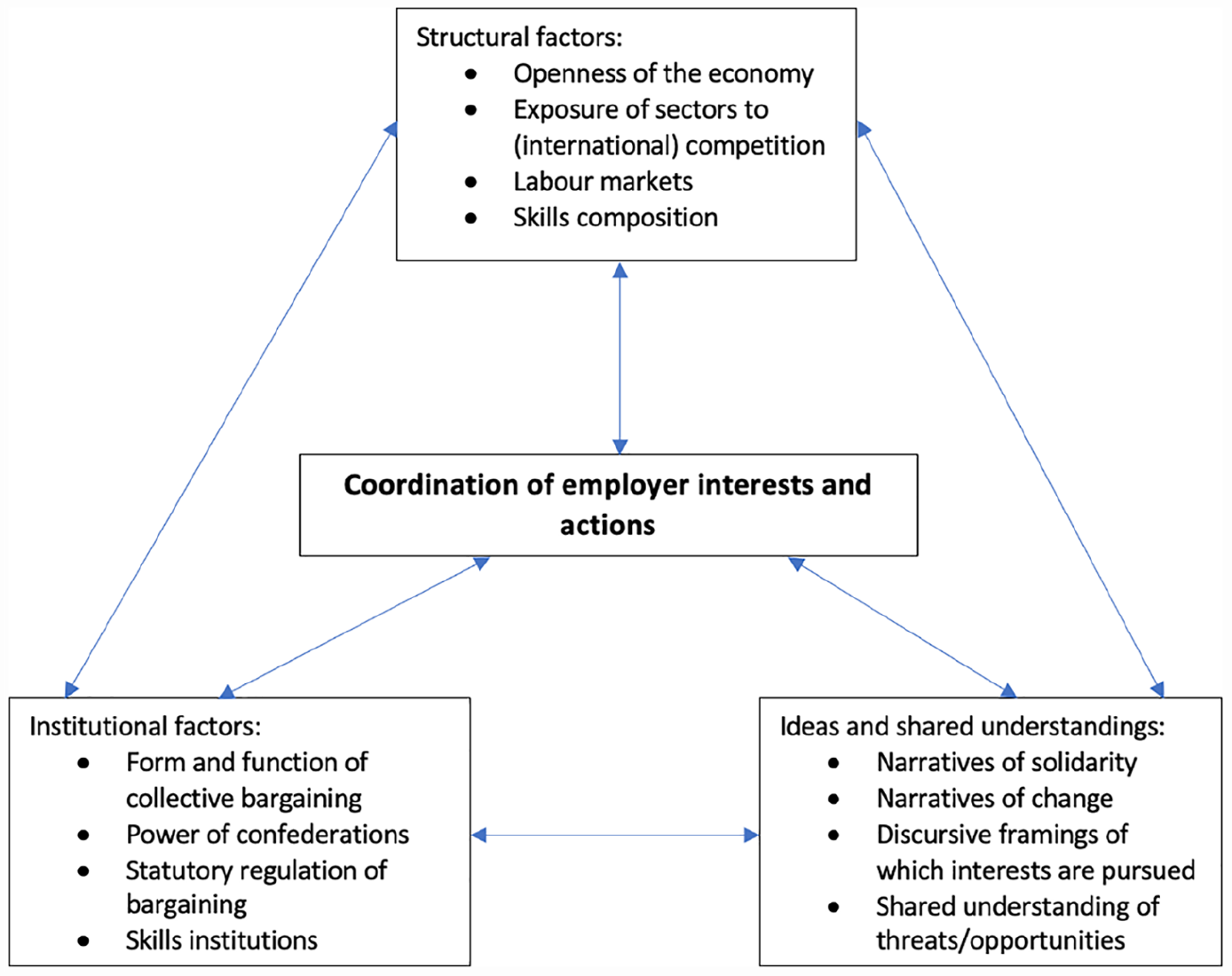
Framework to explaining the dynamics within and between factors that influence employer coordination; adapted from Ibsen (2015).
This framework allows us to explore the empirical experiences of employer coordination. Each of the areas speaks to a different, and sometimes competing, set of pressures that might support or undermine employer coordination. The framework can be used not only to establish whether these factors are present, but the relative weight that actors place on them in their evaluation of the likely future trajectory of employer coordination. This emphasises the dynamic and contested nature of the relative importance of competing pressures, which both extends and reinforces the utility of Ibsen’s approach, and highlights the importance of understanding coordination as an outcome of dynamic processes. This approach also allows for a test of the applicability of Ibsen’s framework in an LME context that shows significant variation between jurisdictions. The article addresses two research questions. First, what evidence is there in the Scottish context of structural, institutional and ideational factors shaping employer coordination? Second, what evidence is there about what would be needed to support more structured and systematic employer coordination in future?
Method and data collection
The study explored how key stakeholders perceive current structures of employer coordination in policy making around skills and training in Scotland. Although the project was disrupted due to the Covid crisis, this allowed the opportunity to integrate analysis of how existing coordination structures facilitated State responses to crisis. Thirty-two participants were interviewed for the project. All were selected because of their expertise in the area of either making representation on behalf of an EO, or as specialist stakeholders. Most voices (22) were from EOs representing a range of sectors across the Scottish economy. Four were from national (UK and Scotland) organisations representing employers’ interests and six were stakeholders with specialist expertise. In line with the ethics approval granted by the University of Glasgow all participants and their specific roles and organisational affiliations are anonymous.
Interviews typically lasted approximately one hour and were recorded and transcribed. The author subsequently coded interviews using an approach informed by the Gioia method (Gehman et al., 2018) whereby first-order codes where initially identified through a process of re-reading transcripts and listening again to the interview recordings, linking key themes identified by participants. Subsequently, second-order codes were developed in relation to literature identified above to develop aggregated dimensions that captured key concepts at a more abstract level. These were informed by the concepts developed from Ibsen’s (2015) writing and the framework above and used to structure the empirical analysis, giving strong support to the utility of the framework developed from Ibsen (2015). Additional empirical attention was paid to future prospects of employer coordination reflecting both the concerns of the participants, and recognising the tensions identified.
Employer coordination in Scotland: Increasing divergence from England
The central argument of this article is that there has been a partial rejuvenation of employer coordination in Scotland over the past 20 years, resulting mainly from a divergence of government policies and the rebuilding of some institutional mechanisms to support social dialogue. England is taken as the main implicit point of comparison here because it dominates the UK economy with around 85% of UK GDP. Scotland, by contrast, represents around 8% of the total UK GDP (Smith, 2021). Institutional and ideational factors have pushed towards increasing the incentives and rationale for employers to coordinate within the context of a UK Liberal Market Economy that not only disincentivises but undermines employer coordination. The empirical section of the article emphasises these tensions that work simultaneously to forge a different path for employer coordination in Scotland, but one that is currently precarious with regard to legitimacy and effectiveness.
Factors that facilitate and hinder employer coordination: Structural factors
Rational choice theories assume that actors behave rationally to maximise their material interests (Parsons, 2007). Many of the structural factors shaping the Scottish economy and employer behaviour are common to the rest of the UK. As we would expect in what is an archetypal Liberal Market Economy, the policies and practices of successive UK governments from the 1980s onwards have pushed towards establishing and reinforcing the dominance of capital. The UK economy was increasingly exposed to international capital, and competition policy was emphasised above industrial policy (see Heery [2016] for a discussion on the effects on UK industrial relations). There were some efforts to rebuild employer coordination during the period of New Labour governments (1997–2010), especially by attempting to re-establish forms of national social dialogue and sectoral skills bodies (McIlroy, 2008). However, State policy largely assumed that employers would take the opportunity to coordinate when presented with opportunities, and little attention was paid to the strongly countervailing forces that had systematically undermined coordination throughout the previous two decades. With the advent of devolution in 1998 and the establishment of the Scottish Parliament in 1999, it was therefore unsurprising that the structures of the Scottish economy echoed the rest of the UK in many important respects.
While the Scottish economy still reflects many of the structures of the rest of the UK (rUK), there are two important, but not unique, factors that are worth highlighting that shape employers’ views of coordination. First, the structure of the economy is dominated by very large and very small employers with few medium sized companies. Second, the concentration of economic and social activity lies within a very small geographic area known as the Central Belt. While these do not map easily onto Ibsen’s framework, they do set a context within which we can start to outline the reasons for the increasing divergence of Scotland from rUK with regard to employer coordination. Taking each in turn, very large employers account for only 0.5% of the enterprises in Scotland, but account for almost 40% of employment (O’Connor, 2021). Multinational corporations (MNCs) account for a large proportion of employment in many sectors of the Scottish economy (up to around 35% in sectors such as information and communication, and manufacturing) illustrating the importance of overseas capital in job creation (O’Connor, 2021). This focus on attracting Foreign Direct Investment (FDI) has long been a strategic priority for the Scottish Government and continues to yield significant investment compared to rUK and most of Europe (EY, 2022). By contrast, small and medium sized enterprises (SMEs) account for over 99% of all businesses, and around 55% of employment in the private sector (Scottish Government, 2021b). Both very large and very small enterprises play a significant role in the economy and employment, and this raises issues for the representational capacity and legitimacy of EOs.
Looking first at MNCs, many participants expressed a concern that they were largely unengaged in employer coordination. Key sectors include: financial services, energy production (mainly oil and gas, but increasingly renewables), food and drink production (especially Scotch whisky) and tourism. Although MNCs in these sectors typically offer relatively high-quality jobs and good career progression, these employers rarely engage directly in collectively shaping Scottish labour market policies. This is not only a problem for policy development, but also for engaging them in EOs and building a clear and legitimate expression of employers’ collective interests. One EO noted: ‘We spend a lot of time talking to [large MNCs]. They do great things. . . but they aren’t that interested in what we do. I do wonder how committed they are to Scotland. If things got bad, would they disappear?’ (EO6). This is a widely shared experience in many sectors. Of course, some MNCs engage with labour market policies, but they are less systematically engaged via EOs as many have access to policy makers through, for example, wider lobbying activities. The capital investment of these MNCs is typically highly mobile (although the exception of the whisky industry is noted as Scotch whisky is a regulated product which requires production and maturation within Scotland) and highly exposed to national and international competition.
The outcomes of the challenge of SMEs to employer coordination, especially within the quasi-market structures of the UK, have been explored by others (Benassi et al., 2020). These structural outcomes are also shaped by the challenges of engaging SMEs in the employer coordination structures that exist. Small companies are often difficult to engage because they are less likely than larger employers to have professionalised functional experts such as human resource management specialists (Antcliff et al., 2020). EOs consistently discussed the challenges of supporting small companies, especially very small companies with 25 employees or fewer, and highlighted the need for professionalisation of management capacity including around labour market issues. The lack of time and specialist expertise available within very small enterprises was consistently identified as a significant barrier to engaging with EOs, which, in turn, constrains the capacity to coordinate employer voice effectively and legitimately. Building membership strength and engagement among this group was therefore a priority for many EOs to reinforce both the legitimacy of their collective voice, and the support available to those companies.
The question of legitimacy is central to the organisational challenge facing EOs because it is crucial to the effectiveness with which they can represent their member organisations. Some EOs regularly survey employers, often when they are contacted with queries or requests for support. Others have representative committees and/or lead employers in particular sub-sectors. Recognising that many EOs put in a lot of effort to ensure they are aware of the interests of SMEs in their sectors, one national EO summarised the challenge of legitimacy: ‘In the main [EOs] have a very good understanding of the challenges their members are facing. Do a lot of survey work with their members. We can’t go to every SME. . . so the challenge is how’ (EO4). Clearly there is no perfect approach, but it highlights the barriers to building legitimacy and effectiveness of EO representation in this context. While there is a lot of evidence that EOs work hard to engage companies, it is inevitably a resource-intensive and ongoing activity.
The geographical structure of the economy and social activity also shapes employer coordination. Scotland is a small country with a population around 5.5 million. Economic activity and population are very condensed into the Central Belt that runs the 50 miles between the two largest cities of Glasgow and Edinburgh. For many employers and their representative organisations, this brings advantages for coordination as most employers in most sectors are concentrated into that small geographic area. This makes it relatively convenient to organise meetings, travel to meet policy makers, and understand issues as they emerge. However, it also brings challenges. Sectors that have large numbers of employers outside the Central Belt such as agriculture, farming, hospitality, tourism and energy face significant geographic challenges. Travel can be difficult and time consuming in rural, mountainous areas that include large numbers of island communities. Remote working during the pandemic helped EOs in these sectors, but they also noted that large areas of the country are not well-served with good internet infrastructure. This can make it difficult for some EOs to engage regularly with their membership base.
Clearly then, structural factors shape dynamics that both incentivise and constrain opportunities for employer coordination. The wider LME context of the UK continually shapes the Scottish economy, determining employers’ (lack of) engagement with EOs. EOs undoubtedly work to overcome some of these structural constraints but factors such as the size and shape of the economy constrain effectiveness. Issues such as employment concentration bring complexity to these dynamics with elements that both incentivise and disincentivise coordination. The evidence shows that although it would not be wise to over-emphasise the effects of structure on employer coordination, there are certainly ways in which these structural factors shape current and future opportunities. It also strongly highlights a degree of complexity and contestation in these processes.
Factors that facilitate and hinder employer coordination: Institutional shaping
Ibsen (2015) identifies a second body of literature that recognises the importance of institutions. Institutions such as sector collective bargaining clearly give incentives for employers to coordinate. Like those who focus on structural factors, authors in this tradition tend to agree that interests of collective actors are exogenous, but differ from rational choice arguments because they recognise the mediating influence of institutions (Hall and Taylor, 1996). Institutions of skills development are argued to facilitate and sustain coordination (Hall and Soskice, 2001). More widely, many institutionalist analyses argue that institutions are highly path-dependent especially where the State creates specific incentives (e.g. mechanisms to extend collective agreements [Traxler, 2003]) or disincentives (e.g. 40 years of policy to undermine coordination in the UK [Sisson, 1987]). This is relevant because although social dialogue has been fundamentally undermined across the UK, forms of bipartite and tripartite dialogue, consultation and negotiation persist and therefore shape employer coordination. Three areas are particularly important in the current terrain of social dialogue in Scotland: (1) institutional support for the fair work agenda including institutions of skills development; (2) high-level dialogue between EOs and the State; and (3) Industry Leadership Groups (ILGs).
First, there is clear evidence that institutional support for the fair work agenda, and especially of skills development, shapes opportunities for employer coordination. Devolution of skills policy, combined with initiatives around fair work, means there are a number of relevant State agencies including: Skills Development Scotland (SDS), Scottish Enterprise (SE), the Scottish Qualifications Agency (SQA), the Scottish Funding Council (SFC) as well as colleges. This brings complexity and provides incentives for employers to coordinate, especially at sectoral levels. An example was provided by one of the sectoral EOs: ‘Companies elsewhere in the UK [tell us] they’re not getting the same level of support or structure input that they’re getting in Scotland and that’s what we strive to achieve. . . I’m quite confident if an employer went to SDS [Skills Development Scotland] we would get pulled into the conversation’ (EO6). These institutions of skills development therefore help reinforce the benefits and legitimacy of employer coordination. A further example was given by an EO in a sector facing pressing skills challenges. ‘We [the EO] need to represent them [employers in the sector] well in those processes of designing and promoting apprenticeships because the demand [for skilled workers] is really there. We need to work as a sector’ (EO18). The opportunity for sector-level employer representation in designing apprenticeships meant that rather than engaging individual employers, the skills bodies could draw on specific experts with detailed knowledge of vocational training and the needs of their represented employers.
Evidence of the ways institutions of fair work and skills development shape the terrain of employer coordination is also visible in the establishment of the Fair Work Convention. This is a tripartite (employers–unions–experts) independent body that provides advice and recommendations to the Scottish Government and policy makers, as well as advocating for and promoting principles of social dialogue. To do that, they have held inquiries into specific sectors (hospitality, construction and social care to date) making recommendations to improve job quality. While keen to promote organisation-level social dialogue, because of the sectoral focus of these inquiries sector-level recommendations often implicitly push towards sector-level responses. The Inquiry into Fair Work in Scotland’s Social Care Sector (Fair Work Convention, 2019), for example, explicitly recommended that the Government establish a sector-level body to ensure effective worker voice as an immediate priority. This was somewhat delayed by the coronavirus pandemic and its specific effects on this sector, but restarted in June 2020 and a Bill proposing the development of a National Care Service that gives Ministers responsibility for embedding fair work across the sector was passed in June 2022. The requirement to act across the sector requires building formal institutions of social dialogue, and therefore effective employer coordination.
Fair work also supports employer coordination through the requirement that public sector bodies have an expectation to implement and promote fair work for all workers engaged in delivering a public contract. This includes an obligation for public sector suppliers to commit to adopting appropriate channels for effective worker voice (union recognition is explicitly mentioned), investment in skills and training, and provision of fair pay through payment of the real Living Wage. While explicitly focused on organisation-level social dialogue, there is some evidence that these requirements are providing an impetus towards employer coordination. One EO in a sector that often contracts to the public sector noted: ‘Smaller employers often first contact us because they want to know more about fair work. . . It’s a way into conversations about the benefits of membership’ (EO8). This EO clearly uses the queries of sector employers and their position as a source of expertise to draw in members among SMEs in the sector.
A second institutional development has emerged during the crisis of pandemic lockdown measures, and the catastrophic potential implications for employers, which saw new forms of social dialogue emerge between the State and EOs and gave particular prominence to specific EOs. Probably the most influential is the Group of Six comprising: CBI Scotland, Scottish Chambers of Commerce, Institute of Directors, Federation of Small Businesses, Scottish Financial Enterprise and Scottish Council for Development and Industry. It is an informal grouping that has become more embedded in Scottish Government consultation since the twin challenges of Brexit and the coronavirus pandemic. These economic and social challenges hit the UK almost simultaneously. Brexit meant that the Scottish Government had already started to engage these EOs about challenges and responses in key areas of the economy and labour market. Coronavirus lockdowns, suspension of activity in key sectors and the support packages to businesses added urgency and impetus. One of the representative organisations explained: ‘I speak to them [other EOs] every morning and that never ever happened under normal circumstances. So these abnormal circumstances have forced us to be more engaged with each other and also with government. . . Scottish government and the enterprise agencies, also Scottish Office and UK government. So we’ve got a daily communication line which I don’t believe ever happened before’ (EO1). This quotation highlights not only the perceived legitimacy of these representative organisations by the State but the high-level nature of discussions, which are certainly not a typical feature of an LME.
Participants in these bipartite (EO–State) consultations reported that pressures had started to shape an understanding that coordination and representational legitimacy are important: ‘I think [Brexit and coronavirus have] coincided with government actually realising that the best route to businesses, rather than to 300,000 businesses in Scotland, is through six people’ (EO1). This demonstrates that experience and necessity have shaped practices of social dialogue and, in turn, the role of EOs in coordinating employers. While it would be hard to argue that this kind of dialogue is an established ‘institution’ in the common understanding, it can certainly be considered a proto-institution that has shaped practices, understandings and expectations of employer coordination. The reasons for and potential benefits of coordination are rendered visible through those practices, laying the groundwork for future institutional shaping.
A third institutional factor that shapes the possibilities for employer coordination is the existence of Industry Leadership Groups (ILGs). These are bipartite (employer–State) or tripartite (employer–State–union) groups that coordinate within 16 sectors in Scotland. ILGs have different levels of activity ranging from currently having very little public activity and profile (Chemical Sciences) through to being highly active and very publicly visible (Scotland Food and Drink Partnership Board, Creative and Cultural Skills as part of Screen Scotland). There are notable gaps (e.g. the public sector), so ILGs are not fully representative. There is also significant variation in how these bodies are constituted, what their priorities are and how they seek to represent their sectors. Nonetheless, where they are active, they undoubtedly perform a role of coordinating employers within those sectors.
Importantly, a recent review of the activities of ILGs has opened the possibility of formalising them as coordination structures (Senior Review, 2020). A key stakeholder made clear that the need for employer coordination was part of the underpinning rationale for that review: ‘When we looked at how agencies were engaging [employers], where public money is being invested and spent. Who was playing in that space? ILGs came on the radar. Some ILGs are more professional, more mature than others and. . . rather than reinvent the wheel, look across the system and see what structures that are already there that can be improved and could be made to work much more efficiently and reach a larger number of businesses. And ILGs – there is a framework already there’ (S28). The potential benefits of employer coordination were clearly articulated in the subsequent report (Senior Review, 2020). Arguments for coordinated structures to support employers to engage in social dialogue recur throughout the report. An example from the Executive Summary makes this clear: ‘ILGs are a long-established route to engaging industry sectors in Scotland in constructive dialogue with the Scottish Government and share actions to boost sectoral growth in the economy as a whole’ (Senior Review, 2020: 2). Clearly, then, we can understand ILGs as shaping employer coordination and having greater capacity to do so in future.
The evidence presented illustrates how institutional arrangements in Scotland support and hinder employer coordination. Institutions supporting fair work clearly continue to push to support employer coordination and the important development of institutions around fair work and vocational skills provides strong incentives for employers to coordinate. What is also clear is that there is a degree of inconsistency of thinking and action around the shape and purpose of employer coordination. The Group of Six was clearly prioritised in the pressure of navigating both Brexit and coronavirus, but this raises questions about wider legitimacy of collective representation. ILGs provide a potential future for employer coordination, but with real questions about the scope and legitimacy of current arrangements. Again, the evidence highlights the contested and fragmented approaches to employer coordination which constrain the legitimacy and effectiveness of collective employer voice.
Factors that facilitate and hinder employer coordination: Ideas and shared understandings
The third body of literature highlighted by Ibsen (2015) identifies ideas and shared understandings as being central to the process of shaping institutional trajectories and imagined futures (Keune, 2015). The ideational turn in studies of collective actors has grown in the past decade in response to efforts to understand changes in institutions of the collective regulation of work and employment (McLaughlin and Wright, 2018; Morgan and Hauptmeier, 2021). Morgan and Hauptmeier’s (2021) identification of three ways in which ideas are mediated and advanced in development and transmission of policy ideas into practice are helpful. In the Scottish context, there is evidence that the three processes of paradigm development, articulation of specific policy ideas and designing interventions that create policies all work to challenge dominant UK LME ideas about labour market deregulation.
Two central ideas about the importance of employer coordination were identified in the interview data: (1) narratives of solidarity and shared interests within and between employers, and (2) the idea that Scotland is different from the rest of the UK, specifically England, in taking a more collective approach to developing policies around fair work. For employers to coordinate, it is necessary to share a view about what might be achieved by collective action and representation. All representative organisations work to build and articulate shared understandings and legitimacy to the process of collective representation and the same dynamic is evident in EOs. One explained: ‘A lot of what we do is talk to member organisations. Work out what they want. Explain what we do. . . build consensus’ (EO10). This speaks to an understanding of the important role of building common interests and giving voice to member employers to reinforce the legitimacy of both the positions articulated and the representative function of the EO.
Beyond building legitimacy, EOs also build relationships with wider partners as explained by a different EO: ‘[The sector skills group] is chaired by industry. But it includes Skills Development Scotland, [the awarding body], Developing the Young Workforce, SQA. So, it’s got all these people, and we meet fairly regularly to share ideas, commonalities, and try and get a little bit more connection between everybody. We’ve also tried to encourage the colleges to see themselves as partners, not competitors. And one of the hardest things we’ve had to do is actually get real engagement with [employers]. It’s hard to get them to really engage, to take their mind off things like Brexit, critical things to their business’ (EO13). Like all representative organisations, EOs work not only to build coordination between employers, but also to build legitimacy for dialogue between employers and other groups. This is crucial to the future of social dialogue. The example shows clearly how the EO is engaged in shaping the institutional terrain, in this case around skills. While these spaces of employer coordination could provide a future opportunity for social dialogue in both bipartite and tripartite forums, there is relatively limited evidence of that at present.
A final idea relevant to shaping employer coordination is that Scotland is different both from England and from the rest of the UK. In some regards, this is undoubtedly true. Skills and some other areas of employment are devolved issues with Scotland-specific policies. Those policies clearly shape employer behaviour in areas such as developing young workers, skills, equality and inclusion, etc. These reinforce the idea of difference in institutions of employment regulation between Scotland and the rUK which is crucial to giving legitimacy to coordination. The objective of fair work is recognised by EOs, although it is important to note that it is not seen as entirely unproblematic. One sectoral EO noted, for example, that sometimes discussions around fair work run up against a response that ‘I don’t need the SNP telling me how to run my company’ (EO7). The political narrative developed around fair work is clearly then important in how employers understand it as both an idea and practice, and is not always received positively.
That said, these ideas around fair work undoubtedly shape employer coordination. One EO described challenging conversations with member employers: ‘Fair work. We had some really good critical friend conversations [with member employers] this year. . . In our sector generally our companies are absolutely signed up to delivering a fair working environment. They would remind us all that for there to be fair work there has to be work in the first place’ (EO5). Other EOs use their representational legitimacy to help politicians and policy makers understand what fair work means in the context of their specific sector: ‘What frustrates us? Fair work is obviously a big one at the minute. We’re an industry that’s very easy to knock down. And the understanding of fair work is probably not very well understood and it’s too often associated with pay rate rather than the actual wider values. And it’s very easy to criticise. But we’re an industry that can accelerate somebody’s career very quickly. So we have an education piece to do on that front as well’ (EO16). This shows the ways in which EOs act to shape ideas: both upwards to the policy context, and cascaded to member organisations.
Ideas about fair work, as well as the importance of employers working together in expressed shared interests, clearly then shape both the form and function of EOs. Opportunities to engage with the State create an understanding that coordinated employer voice matters in shaping policy outcomes. Although this is not simple or uncontested, the importance of understanding EOs as having a legitimate and representative voice does provide incentives for employers to coordinate. The final section of this article explores these imagined futures, highlighting both opportunities for strengthened coordination and social dialogue.
The future of employer coordination in Scotland: The central role of State support in building effectiveness and legitimacy
The sections above have conceptualised the pressures that facilitate and constrain employer coordination in the contemporary Scottish context. Wider debates (Bechter et al., 2017) highlight that coordination of social partners is a necessary, but not sufficient, condition for effective social dialogue at sector, regional or national levels. It is therefore useful to reflect on assessments of the relative weight given by key stakeholders to factors shaping the future of effective and legitimate coordination. Ideas clearly matter in shaping policy and setting the institutional context within which social partners act. In the Scottish context, paradigmatic ideas emerging from the ILO, United Nations and European Union have shaped the trajectory of policy ideas in Scotland and the development of specific policy interventions around fair work and skills (Heery et al., 2020). These have been central to emphasising the importance of social partner coordination to deliver effective and legitimate policy outcomes. While it is difficult to argue that the result of these policies is a fully-formed and well-developed structure of sector social dialogue, it is clear that these factors encourage and facilitate employer coordination. The institutional context, by contrast, explains a large part of the continued alignment with England. Important policy areas are reserved to Westminster including employment law, industrial relations, immigration policy, trade and industry. These continue to shape the Scottish institutional context in ways that influence not only which employers are located within Scotland, but their approach to employer coordination.
A key argument of this article is that social partners are shaped by the context of the structures, institutions and ideas within which they operate. These are contested, and in the case of Scotland, the contrasting directions of UK and Scottish State priorities create a complex terrain for employers’ organisations to navigate. However, it is clear that the behaviour and priorities of State actors (politicians, civil servants, etc.) set the direction of travel for employer coordination. The State has two crucial roles: first, in supporting the institutions of social dialogue which then give opportunity and legitimacy to coordination; and second, in giving a narrative to the importance of the idea of social dialogue, and therefore coordination.
Central to legitimacy of employer representation in any structures of social dialogue is effectiveness. That is not to say that social partners must be organised in an entirely consistent way; there are plenty of settings where employers and workers are structured differently or where representative organisations overlap in their interests (Léonard et al., 2011). What is clear, however, is that effective employer coordination needs to cover all key sectors of the economy and here there is a role for the State. Indeed, the role of the State in shaping institutions of social dialogue is well-acknowledged in both academic and policy literatures (Molina, 2014) and has been implicitly acknowledged in some of the recommendations of the Senior Review of ILGs (2020). This issue was also highlighted as a practical challenge: ‘The other frustration we have into government is across the civil servant world. The way of working within the government and civil service sector is that the portfolios don’t seem to be as joined up or as in sync with one another’ (EO16). Another commented: ‘If we had a clear written brief, these are the areas that we want to engage with you as an industry body, these are the areas that we want you to look at, and this is the mechanism by which we will respond to that’ (EO15). These frustrations are worthy of our attention because they speak to the ways that the organisation of the State and its priorities constrain the effectiveness of employer coordination. An example of risking legitimacy of coordination was given by one EO where they had struggled to ensure that policy makers and politicians understood that they spoke on behalf of the whole sector. The example related to an issue of regulation that had been put out to consultation by the Scottish Government, and where the EO had responded on behalf of their members after an extensive consultation process. Because of the efforts invested in consulting member employers, they had actively encouraged employers not to send individual responses, in favour of a single collective response from the sector. Later feedback from civil servants revealed that the collective nature of the response from the EO had not been understood as a response from the entire sector and that they would have preferred a higher volume of response.
In many interviews, participants expressed these frustrations as being resolvable if politicians and civil servants structured requests for employer engagement more systematically. Clearly, the State has a crucial role in supporting and reinforcing social dialogue and the coordination of social partners. This extends beyond simply requesting engagement from employers and their EOs, into an understanding of the role of collective, coordinated engagement in policy making and delivery. While the State is not the only actor in shaping what employer coordination looks like, support (or not) of the State is given particular weight in shaping the institutions and ideas about coordination that can undermine or sustain coordination in future.
Conclusion: The dynamics shaping experiences and prospects of employer coordination
This article has conceptualised the terrain of employer coordination in Scotland. The need for conceptualisation and evaluation is both practical and theoretical. Practically, the Scottish Government has prioritised policies regulating some areas of work and employment, but has struggled to systematically engage employers. This risks policy that is either impossible to implement or which is ignored. Understanding how employers coordinate through their representative organisations, and what facilitates or hinders that, are pressing practical questions. Theoretically, an exploration of employer coordination in a jurisdiction where devolved authorities are pushing towards strengthening structures of social dialogue within the wider context of an archetypal LME gives opportunity to see the relative explanatory potential for the factors that can shape coordination.
These issues were explored with employer organisations (EOs) and other relevant actors in Scotland in a series of interviews. The evidence shows that what Ibsen (2015) presents as an overview of the literature around the factors that facilitate employer coordination can be used as a framework to explore, first, whether there is evidence of these pressures in practice, and then to evaluate their relative importance highlighting the particular role of the State promoting institutions and ideas around employer coordination. The Scottish case illustrates the centrality of understanding these pressures as dynamic and contested. State support helps create institutions that require coordinated employer engagement (especially around skills development) and through demands from the process of policy making. Structural factors such as the geography of the economy and ideas such as the specificity of the Scottish political economy also help develop and maintain employer coordination. At the same time, there are pressures that hinder coordination. EOs have to work hard to articulate shared interests and to remind other stakeholders of their coordination role in a context of tensions between the broader LME structures of the UK, and the increasing pressures for coordination in Scotland.
The first important extension made here is to demonstrate that even within the context of the UK, which is usually classified as an archetypal Liberal Market Economy (Hall and Soskice, 2001), there are circumstances under which employers are open to pressures towards coordination. This supports studies that emphasise the importance of understanding employer coordination not as binary and stable, but as a dynamic and contested process (see, for example, Jackson and Sorge [2012] on Germany). The second significant extension is to conceptualise and explain the factors that come into tension and create these dynamics. Ibsen’s (2015) review of literature on employer coordination is extended to demonstrate how these pressures are not mutually exclusive but work together to create dynamics that support or hinder coordination. The Scottish setting illustrates how structural, institutional and ideational factors are evident simultaneously, albeit in tension with each other. The extent and shape of employer coordination can be understood as being a dynamic and shifting terrain within which actors make choices. Ibsen’s (2015) framework allows exploration of the shape and relative importance of specific factors.
Ibsen’s framework allows us to identify empirically each group of factors evident within experiences of the Scottish context. Structural factors relating to the policy direction of Westminster governments continue to hinder employer coordination. In addition, concentration of activity within the Central Belt adds challenges to coordination of geographically dispersed employers. EOs in these sectors have to work harder to build engagement and representation, although some of those geographical challenges have eased since improvements in remote working. The dominance of both very large and very small employers also constrains the effectiveness of employer coordination as both are less likely to engage in activities of the EOs and need greater investment of limited resources to coordinate around key issues. In short, many of the structural factors relating both to the wider UK, and to the specificities of the Scottish economy work to constrain the logic of coordination.
The development of institutions, especially around fair work and skills, also shapes incentives and constraints on employer coordination. Literature that looks at coordinated market economies strongly predicts this finding. Two features of the contemporary Scottish context are theoretically significant here. First that where the (devolved) State makes policy priorities around employment and skills, these are likely to provide incentives to employer coordination. Second, crisis, here in the form of coronavirus lockdowns and Brexit, can provide impetus and momentum to further coordination because of the need to shape policy responses. This empirically reinforces the importance of State support for institutions of social dialogue, even where there is a wider context of decollectivisation (Trampusch and Eichenberger, 2012). It also speaks to the conditions under which coordination can be accelerated, although there is not sufficient evidence in this research to reflect on the durability and sustainability of such arrangements. There is also significant support for the central argument of Ibsen (2015) that coordination is not only incentivised by structural and institutional dynamics, but that ideas are fundamentally important in pushing the logic of coordination. In the Scottish context, the idea of being different from the rest of the UK is a crucial dynamic both for politicians and more widely. EOs work hard to build interests and solidarities within and between members and certainly their work with policy makers and politicians is generally seen as legitimate. The contrast with the Westminster approach of decollectivised approaches to labour market policy and disengagement with business is striking.
The evidence shows empirical extensions in each of the three areas that shape coordination of employers. The article introduces important caveats to any temptation to generalise about the UK as a single entity in terms of collective regulation of work and employment (cf. Hall and Soskice, 2001; Hörisch et al., 2020). More importantly, Scotland provides a context in which to empirically explore the ways employer coordination can be facilitated and strengthened in what is typically considered an archetypal LME, and shows the conditions that support and hinder coordination of employers which is a central pillar in effective social dialogue. This develops and extends studies of Central and Eastern European countries as they have built institutions of social dialogue in the period since EU accession (Croucher et al., 2006), but with a distinctive LME lens that has not previously been explored. The evidence relating to the future of employer coordination clearly illustrates the importance of the State building and supporting institutional arrangements that facilitate effective and legitimate employer collective voice and promoting the ideas central to coordination. The argument is that all three areas identified by Ibsen (2015) around employer coordination are evident in the Scottish case, but that they do not all pull in the same direction at the same time. The evidence consistently highlights tensions, contestations and contradictions that sometimes pull towards greater coordination, and sometimes away. Centring those tensions and contradictions is crucial to an effective understanding of how and why employer coordination is shaped in any specific setting.
Turning finally to the relative explanatory potential of the three factors, ideas are hugely important in setting a specific Scottish policy context within which fair work is given far greater prominence than at UK level. Without the paradigms, policy ideas and interventions promoted by international bodies, it seems unlikely that there would be a renewed interest in social dialogue, fair work and social partner coordination. The institutions that then support these policy areas become important in embedding behaviours and practices of dialogue and coordination. But devolution does not give full decision making over important areas that shape the economy such as finance, trade and industry. These factors continue to constrain the appetite of some employers for coordination. The central conclusion of the article is therefore that Scotland is currently playing out the tensions and contradictions between these policy arenas. Unless or until one gains dominance, it seems likely that structural factors, largely resulting from rUK, will continue to constrain opportunities for wider employer coordination in many sectors of the Scottish economy.
Footnotes
Declaration of conflicting interests
The author declared no potential conflicts of interest with respect to the research, authorship, and/or publication of this article.
Funding
The author(s) disclosed receipt of the following financial support for the research, authorship, and/or publication of this article: Melanie Simms received funding for this project through the Scottish Parliament Information Centre (SPICe) Fellowship scheme from 2019 to 2021. Award number: U13641.
