




Abstract
The proposal of a European minimum wage directive by the European Commission was supposed to improve working conditions. This article asks why such an initiative created a challenge to the unity of unions, but not of employers’ associations at transnational level. The authors provide a network analysis of the communication structure of social partners. Applying Scharpf’s concepts of positive and negative integration and Hirschman’s typology of exit, voice and loyalty, the authors use qualitative methods to show how employers stayed loyal and united towards negative integration, while different voices arose within the European Trade Union Confederation (ETUC) leading to the temporary ‘exit’ of the Swedish Trade Union Confederation.
For many decades, the European Commission avoided any direct influence on wage policies arguing that it was a national issue. This then changed with the policies to tackle the economic crisis in 2008, albeit according to a neoliberal agenda. Here various recommendations of the Troika (European Central Bank, European Commission and International Monetary Fund) aimed at the decentralisation of collective bargaining and at the ‘overall reduction in the wage setting power of trade unions’ (European Commission, 2012: 103). Then the proclamation of the European Pillar of Social Rights (EPSR) (European Commission, 2017) in November 2017 marked a new development, being paralleled by a previous initiative to revive the European social dialogue aiming at closer involvement of the social partners in the new system of economic governance (European Commission, 2016).
The introduction of a European minimum wage directive can be seen as a turning point regarding social and wage policies in the Union. Being an unprecedented regulation, the directive confronted different cleavages, which marked both the negotiations with the EU institutions, but also the finding of joint positions within the social partners’ organisations at transnational level. The decision on 4 October 2022, however, lay with the Council, which decided by majoritarian vote that a minimum wage directive should finally be adopted. 1 The result of the vote, combined with the reaction of the Swedish Trade Union Confederation (LO) to stop paying membership fees to the European Trade Union Confederation (ETUC) and to no longer participate in its meetings, in protest against the ETUC’s handling of the directive on adequate minimum wages, indicates a rift within the transnational union organisation – although the LO’s decision was reversed when the Council of Europe finally adopted the directive.
This process of introducing a European minimum wage calls for deeper insights into how the organisations of the social partners participated in the policy-making process. Hence, we want to examine how different national and sectoral interests of unions and employers are articulated and coordinated in the multi-level governance system.
In a first step we ask whether communication networks differed according to unions and employers with respect to the European minimum wage initiative. As a second step, we ask why the initiative towards a European minimum wage that was meant to improve the working conditions of European workers by supranational policy-making created a challenge to unions’ but not to employers’ organisational unity at transnational level. To answer these questions, we combine a multi-level governance approach with industrial relations literature to reflect the institutional settings of transnational decision-making and the variety of actors’ interests due to the diversity of national industrial relations systems. Based on the state of the art we first give a brief overview of the institutional setting and social partners’ role within the European social dialogue, indicating particular challenges for the formation of joint positions within the social partners’ umbrella organisations – hinting at differences between trade unions and employers. Existing cleavages are discussed with reference to the literature on minimum wages in the second section. In the following section we draw on different theories to form our assumptions: according to Offe and Wiesenthal’s (1980) idea of two logics of collective action, we expect that trade unions are more likely than employers to address European institutions of decision-making via umbrella organisations within the institutionalised channels. Accordingly, the pressure to form joint decisions is much stronger for trade unions than for employers. To explain the decision-making processes within the organisations of the social partners we combine Scharpf’s (1996) theses on positive and negative integration with Hirschman’s typology of (collective) actors’ behavioural options in organisations, namely loyalty, voice and exit (Hirschman, 1970). We assume that due to the different national and sectoral interests related to different traditions and economic conditions of trade unions a typical situation emerged where positive integration is not unanimously supported and unsuccessfully exercised ‘voice’ can turn towards an ‘exit’ strategy. Employers in contrast could easily be loyal to their umbrella organisations as they united in opposition and held onto a position of negative integration.
To test these assumptions we use a mixed-methods research approach, described in the fourth section. Using a quantitative survey we map transnational networks of unions and employers to show the ties between organisations in selected sectors on the national and the EU level. Based on expert interviews we analyse the process of joint position finding by umbrella organisations and sectoral associations. In the next section our research results are presented with respect to the communication network of employers and unions. As employers throughout the process had a unanimous position, we concentrated the analysis of the process of finding joint positions on the trade unions, particularly their position vis-a-vis the ETUC. Our general conclusions indicate why the initiative for a European minimum wage by the Commission and the final decision to formulate a directive has been a challenge to the unity of the European trade union movement, but not to employers’ associations. We close, in the final section, with a consideration of whether the so far marginal role social partners have played within the new paradigm of European social policy may change.
The role of social partners in the EU multi-level governance system
Multi-level governance analysis indicates that the supranational hierarchy, led by the Commission, the European Parliament, the Council and the European Court of Justice, shapes and redefines the boundaries and the institutional framework in which inter- and transgovernmental negotiations take place (Börzel, 2010: 192; Kohler-Koch, 1998). The space left for the social partners to participate is limited to lobbying and consultations (Kohler-Koch and Finke, 2007). Social partners have some power to frame problems and solutions and have some influence, i.e. in the wording of treaties and laws (Mende, 2021: 179), when the Commission gathers opinions, inputs and different views to assess the impact of the legislation that is being discussed (Obradovic and Alonso Vizcaino, 2006: 1053). However, since these consultations are not binding and European social dialogues are seen as ‘lip service’ (Schulten et al., 2016: 316, our translation), the democratic deficits and legitimacy problems of the European project are in evidence.
As the Commission admits only organisations to consultation which are able to speak for a broader range of constituents it sets the field of influence by privileging umbrella organisations (Mahoney, 2004; Obradovic and Alonso Vizcaino, 2006: 1061). Although lobbying occurs mainly through formal and informal advice at the different levels of the policy-making process, the access of lobbyists to the Commission and the European Parliament is highly institutionalised and regulated (Mende, 2021: 179). This also gives an advantage to organisations which enjoy long-term and trust-based relationships with the Commission (Coen, 2007: 335; Woll, 2006).
Although, inter-sectoral and industry level social dialogues as well as the institutionalisation of the European works councils can be seen as a form of participation, Schulten (2002: 3) has pointed out that they mainly deal with ‘soft issues’ and do not engage in issues such as pay and working time, leaving these topics to the national level. Hence, the multi-level industrial relations system that has been created (Keune and Marginson, 2013) may not (yet) have the same relevance within transnational decision-making processes as many national systems have.
However, all the institutional settings at transnational level require the social partners to develop ‘multilevel structures of organization and representation’ (Mende, 2021: 182). The EU umbrella organisations are ‘associations of associations’ (Platzer and Müller, 2012: 864). Their members display great differences in terms of size, resources as well as different sectoral and/or domestic orientations and interests (Börzel, 2010; Eising, 2007). Within this setting diverse obstacles to cooperation have been identified with respect to unions, as for example language, ideology, culture and tradition (see Larsson, 2017). Although these obstacles may also apply to employers, they may at least have more financial resources to overcome some of them.
With regard to unions, it is understood that their power and resources at supranational level are strongly shaped by opportunity structures and arenas preconfigured by the European authorities (Müller and Platzer, 2019: 312). A particular dependency of the ETUC 2 as the strongest and largest trade union organisation is that it is supported by EU subsidies that pushes it to respond to an agenda predefined by the EU institutions (Hyman and Gumbrell-McCormick, 2020: 262). It has therefore been argued that the ETUC is trapped between ‘the need for democratic accountability and legitimacy in order to coordinate the interests of diverse national confederations and the need to operate as part of the institutional machinery of the EU’ (Taylor and Mathers, 2004: 271). Hence, the focus of the ETUC has remained on institution-building.
Within the ETUC, national confederations are included in a top-down structure that mirrors the consultation mechanisms between the EU institutions and the social partners. Such forms of interest ‘coordination’ detach the umbrella organisation from its constitutional base of representation and mobilisation (Taylor and Mathers, 2002, 2004). Moreover, national unions have their own democratic mandates and forms to act collectively, and may not even be interested in delegating functions and resources to the EU umbrella organisations (Hyman and Gumbrell-McCormick, 2020: 261). According to the different interests, regional networks exist. For example, the Council of Nordic Trade Unions is an effective sub-organisation within the ETUC, but the Nordic network is also able to lobby separately from the ETUC due to strong internal coherence and coordination, and organisational and financial resources. In contrast, overall the Eastern European unions are characterised by a lack of resources (Kahancová and Kirov, 2021; Lovén Seldén, 2020). But sectoral and inter-professional differences have also been highlighted (Furåker and Larsson, 2020b). The development and intensity of cooperation in sectoral networks diverge, as do the topics of cooperation (Larsson and Törnberg, 2021). With respect to the enforcement of the Posting of Workers Directive, for example, cleavages were sparked by different positions on the form of regulation. The interpretation of the conflict by Seeliger and Wagner (2018) highlighted a stronger binding of transnational sectoral federations to national union members in contrast to the ETUC’s loyalty to the Commission’s position.
A major challenge to the ETUC is therefore the interest heterogeneity of its members according to different domestic models of industrial relations, working conditions and wage levels (Bernaciak et al., 2014) that increased with the integration of Eastern European member states (Meardi, 2012). As finding a joint position to be represented within the consultation process is a great challenge, often a position of the ‘lowest common denominator’ is chosen (Platzer, 1997) to bridge both national/regional and sectoral, but sometimes also ideological cleavages within the organisation.
On the employers’ side we see a slightly different picture. It is understood that the multi-level architecture of the EU also limits the possibility of employers’ organisations to influence the policy-making process as well as shaping incentives and opportunities to participate (Croucher et al., 2006; Eising, 2007: 387; Greenwood and Webster, 2000: 88). Similarly to unions, employers’ organisations at transnational level aggregate the interests of national associations, channel different opinions and present them as a uniform perspective (Bouwen, 2002: 377). They respond to Commission consultations and have meetings with high-level Commission staff, where they express their views and raise general or sectoral concerns towards draft directives (Aranea et al., 2021). A very common position influencing the programmatic and legislative initiatives in the field of social policy, however, seems to consist of ‘preventing binding employment and social legislation, which in the view of employers limits their flexibility and creates additional costs’ (Aranea et al., 2021: 5).
Moreover, both national business associations and big companies use various strategies to promote their interests and to establish their European representation (Kohler-Koch and Friedrich, 2020). Overall, big or multinational companies have multiple access points to the EU. They may engage interest organisations other than employers’ associations, or lobby directly with the support of professional consultants. For medium-sized companies or national sectoral associations located in countries with less power within the EU, or fewer financial resources, the incentives to join an employers’ association at transnational level are higher (Greenwood and Webster, 2000).
All in all we may deduce that the heterogeneity of interests in social partners’ umbrella organisations together with members’ orientation towards domestic concerns and national agendas (Börzel, 2010; Eising, 2007) is a major challenge. According to Offe and Wiesenthal (1980), however, it may be an even bigger challenge for the trade unions than the employers.
Cleavages with respect to the introduction of the European minimum wage
Although the original idea of a European minimum wage was first put forward by a handful of trade unionists in 2004 (Schulten, 2014) and further developed as a concept in the aftermath of the Athens Congress of 2011 (Seeliger, 2017), it was not at the forefront of discussion at the Vienna Congress in May 2019 (Lovén Seldén, 2020). In fact, the most recent policy process was initiated by EU institutional actors. In October 2019, the European Parliament had adopted a resolution on employment and social policies in the Euro area calling on the Commission to put forward a legal instrument to ensure that every worker in the Union had a fair minimum wage. This could be set according to national traditions, through collective agreements or legal provisions. Ursula von der Leyen, already president-designate of the European Commission, supported the idea of such a legal instrument. Since then minimum wage policy seems to be at the core of ‘Social Europe’ promoted by the Commission after years of austerity policy. The proposal of an EU minimum wage directive in 2021 signalled a paradigm shift with respect to EU engagement in social and wage policy (Schulten and Müller, 2021). Nevertheless, the topic was contested at both national and transnational level.
Statutory minimum wages in general encounter various lines of arguments and justification (Dingeldey et al., 2021). A pro-argument is that they create a floor to protect vulnerable workers, narrowing the possibilities employers have to set low wages (Peña-Casa and Ghailani, 2021: 140) – particularly where collective bargaining is weak (Furåker and Seldén, 2013: 515). The ILO argues that social policy functions ‘should be defined and designed in a way to supplement and reinforce other social and employment policies, including collective bargaining, which is used to set terms of employment and working conditions’ (ILO, 2016: 3). Most general arguments against minimum wages, however, see them as a market rigidity, and as an inadequate form of state regulation that intervenes in the sphere of free collective bargaining between social partners. Also, collective bargaining coverage within firms in single countries might be affected by the introduction of a statutory minimum wage, as it can work as a substitute mechanism (Bellmann et al., 2021). Additionally, from a neoliberal perspective, a negative impact on employment is expected (Neumark and Wascher, 2008). Empirical studies have indicated, however, that statutory minimum wages sharply increase average wages while employment losses may be very small and even employment gains can be expected, as for example shown for Germany (Bossler and Gerner, 2019).
Promoters of a European minimum wage see it as a step to complement the economic integration and to create ‘a level playing field for competition’ (Fernández-Macías and Vacas-Soriano, 2016: 100), advancing on the idea of a European Social Model. It is understood as a kind of European solidarity especially with those workers who struggle to cope with the pressures of globalisation and Europeanisation (Schulten and Watt, 2007: 5). This position is closely linked to the experience with the EU enlargement and the Posting of Workers Directive (Costamagna, 2019; Evju, 2010; Lillie and Wagner, 2015). The European Court of Justice decided in the case of the so-called Laval Quartet that collective agreements, as long as they are not binding for all workers of the sector, do not have to apply to posted workers. This allowed foreign companies to undermine minimum wages exclusively set by collective agreements by their not being made compulsory for all workers (Furåker and Seldén, 2013: 509–510). In contrast to prior intentions, this interpreted the provision of the directive not as a floor, but as ceiling of rights and therefore put pressure on the territorial application of labour law (Santagata de Castro, 2019: 151). Given this problem, statutory minimum wages started to be seen as a useful weapon against social dumping in some European countries.
Arguments against an EU minimum wage are diverse. According to the economic argument the criticism is that ‘one size does not fit all’, indicating the potential damage to competitiveness for some of the member states (Fernández-Macías and Vacas-Soriano, 2016: 100). The ‘governance’ argument is twofold. First, it is claimed that according to Article 153(5) TFEU the EU has no competencies in collective bargaining and that European wage coordination has the potential to undermine existing national institutions and traditions. Second, however, the strongest opponents of a binding European minimum wage regulation were the Nordic countries, including their social partner organisations, as they feared that the directive would undercut their national model of free collective bargaining (Furåker and Larsson, 2020b; Seeliger, 2017). Unions in the Nordic countries insist on setting minimum wages exclusively by collective bargaining (Alsos and Eldring, 2021; Furåker and Larsson, 2020b: 100) – albeit with differing ferocity (Furåker, 2020).
Given the variety of industrial relations models in the European member countries, but also the different impact of the proposed directive expected according to country and sector (see for example Fernández-Macías and Vacas-Soriano, 2016), it encountered both support and opposition. The EU directive suggests a level of 60% of gross medium national wages or 50% of gross average wage, so that this will overall impact countries where at present they are set at a lower level. Moreover, in sectors with a high incidence of low wage employment workers may expect significant pay rises, while employers will have to compensate for rising costs. Accordingly, overall Central and Eastern European unions have been among the proponents of the idea. In contrast, employer organisations and some governments – foremost in low-wage countries – want to defend their international advantage through cheap labour (see for example Jász, 2021). These cleavages do not strictly divide the unions’ and employers’ sides. As well as the diversified positions of trade unions concerning scope and action in the field, not all employers reject statutory minimum wages or the intervention of the EU in wage bargaining. Vaughan-Whitehead and his collaborators (2010) have shown that some employers’ associations have started to see a national minimum wage as a possibility to limit emigration or to promote migration in order to respond to labour shortages.
To sum up. The literature indicates well the ‘dependence’ of social partners’ organisations on EU institutions and their weak power position within the decision-making process. Moreover, with respect to the minimum wage, different cleavages are delineated and explained – overall with respect to unions – by the variety of industrial relations systems, including different traditions of regulation and action and possibly by different sectoral interests. In contrast, we know little about the position and communication structure within the organisations of the social partners. Moreover, an explanation is still needed as to why a European minimum wage that was meant to improve the working conditions of European workers created a challenge to the unions’ but not to the employers’ organisational unity at transnational level.
Forming joint positions within social partners’ organisations on transnational level
In order to understand how the European multi-level governance system shapes communication channels and the strategies of social partners’ organisations with respect to the introduction of a European minimum wage directive, we draw on different theoretical strands within organisational theory and look at both the inter- and intra-organisational coordination of the social partners within the multi-level governance system.
Offe and Wiesenthal’s (1980) idea of two logics of collective action highlights that the structural difference of power resources between capital and labour makes the latter more dependent on collective action based on collective identity. As they also assume a substantial heterogeneity of interests within the working class, this has to be achieved by communicative processes within the organisations (Offe and Wiesenthal, 1980: 79). This heterogeneity is also recognised between union organisations made up of different national institutions. Accordingly, we may assume that it is more relevant for trade unions than for employers to communicatively find a joint position and speak with ‘one voice’ that resembles the united power of all union organisations on the European level. We also draw on Scharpf’s (1996, 2014) ideas of negative and positive integration, which distinguish measures directed to increase market integration through the elimination of barriers to trade and competition – what he calls negative integration – from, in contrast, measures directed at European policies which shape the conditions of market operations – which he calls positive integration (Scharpf, 1996). Scharpf argues that positive integration is much more complex than negative integration given that it requires the agreement of governments in the Council on for example ‘joint institutions’ and thus it is prone to problems of intergovernmental policy-making. In contrast, negative integration is easier to achieve as it aims at the abolishment of regulation. Trade unions may tend to prefer positive integration, because overall in the field of social policy it gives hope to regain at the European level what has been lost or has not been reached at the national level (Scharpf, 1996: 2). Employers, accordingly, would choose negative integration as it tends to lower market barriers and promotes liberalisation.
First, we analyse the different communication channels and action structures that social partners develop. According to Offe and Wiesenthal (1980), the economic power position of employers may be less dependent on transnational umbrella organisations than are unions. Generally, large enterprises but also national and sectoral associations have organisational and financial resources for lobbying and are able to promote their interests via ‘separate’ strategies (Bouwen, 2002). Our first assumption is therefore that trade unions have a more centralised communication form clustered around the ETUC, while employers will be less orientated around BusinessEurope and SMEUnited, 3 as they may also exercise lobbying outside these main umbrella organisations. This assumption will be proven by denser and more centralised ties of communication around the trade unions’ umbrella organisation than around the employers’ organisations identified in our network analysis.
But besides the different forms of interest promotion that may be practised by employers – at least with respect to the regulation of a European minimum wage as an important element of Social Europe – they easily unite in opposition, and defend ‘negative integration’ in favour of a free market. In contrast, the protection of workers’ rights and interests on transnational level depends on positive integration. This, however, requires coordination and compromise on the union side. In order to find joint positions for common norms, building bridges is demanded between the different union traditions and cultural patterns, but also between the variety of governance of industrial relations systems (see Pernicka et al., 2015: 5). Hence, trade unions’ power and unity on a transnational level is dependent on the willingness to provide solidaristic support between member organisations (Müller and Platzer, 2019: 306). Taking this into account, our second set of assumptions is that the ETUC will push for positive integration, being in favour of a European minimum wage directive, as it may reduce price dumping in the Union and raise minimum wages at the national level. Employers’ organisations will opt for negative integration as a minimum wage directive would increase market barriers. This will be substantiated if our qualitative analysis indicates a positioning of the ETUC in favour of the EU minimum wage directive and a rejection of it by the employers’ associations.
Third, to analyse intra-organisational processes of joint decision-making, we draw on Hirschman’s (1970) typology of customers’ and organisations’ responses to failures. We argue that given the heterogeneity of members within transnational umbrella organisations, unanimity cannot be taken for granted. When members react to propositions made, they may choose between voice, exit or loyalty. Following Hirschman, voice implies an expression of dissatisfaction with the organisation or its proposition. In this case, there is a need to discuss the causes and find solutions to the issue that has triggered the dissatisfaction. Voice, unlike exit, is ‘any attempt at all to change, rather than to escape from an objectionable state of affairs’ (Hirschman, 1970: 30). As problems within an organisation usually develop over a period of time members will use voice as long as they think it will be effective. Only after voice has failed to effect a change, might they use exit as a last resort (Hirschman, 1970: 37). The chances to hold onto the use of voice increase with the degree of loyalty. Members who have a special attachment to an organisation will search for ways to get the organisation ‘back on track’ when they think that something is going in the wrong direction. Thus, loyalty prevents exit and activates voice (Hirschman, 1970: 77–78). Hence, without feeling loyalty, exit is costless (Hirschman, 1970: 80–82). Moreover, exit may be furthered by ‘own’ power resources or a collective exit, i.e. when an alternative organisational form to influence decision-making of superior institutions is presented.
Using Hirschman’s typology, our third set of assumptions is that with respect to the European minimum wage, employers’ organisations within BusinessEurope and SMEUnited as well as single organisations ‘unite in opposition’ against further (positive) integration in this field signified by a European minimum wage directive – and thus easily could provide a high degree of loyalty to their umbrella organisations. In contrast, the legal regulation of a European minimum wage as an element of positive integration implies a more general regulation that differently affects sectors and the governance of national collective bargaining systems. According to Offe and Wiesenthal (1980), trade union interests may diverge much more than on the employer side. We therefore assume that finding joint positions within the ETUC will more easily encourage members to utter ‘voice’, when essential interests are endangered. This will also be tested by our qualitative analysis focusing on the positions of single organisations, and respectively the mandates for negotiation given to umbrella organisations during the reform process.
Methods
This study presents a mixed-methods approach with the aim to shed light on the transnational connections and positions of trade unions and employers’ organisations regarding the European Minimum Wage Directive. We draw on four different data sources: (1) a quantitative survey in order to gain data to map two transnational networks showing the ties between trade unions and employers’ organisations on two levels, namely, national and EU level; (2) eight qualitative expert interviews (Liebold and Trinczek, 2009) to understand the positions and connections mapped with the quantitative data and therefore, to validate and complement our results (Hollstein, 2011: 411–412); (3) different documents, regulations and position papers published by European organisations, trade unions and employers’ associations; and (4) secondary analysis of appropriate literature.
We focused on road transport, construction and industrial cleaning as sectors where minimum wage regulations have a high relevance due to the general low wage level. The emphasis on sectoral organisations at transnational level pays attention to their particular interests that may increase problems of joint position finding – as already documented with respect to trade unions (Seeliger and Wagner, 2018).
For the network analysis, we used a standardised online questionnaire, which was sent to 102 trade unions and 121 employers’ organisations in the three above-mentioned sectors in the 20 biggest member states and at the EU transnational level. The timing of the survey was after the submission of reasoned opinion by three member states, as well as after the new EU minimum wage proposal was sent to the national delegations. The main question to be answered was ‘Please list up to five of the most important organisations in your country and the rest of Europe with which your organisation is or has been in contact in relation to the EU Minimum Wage Directive’. We received 33 responses from trade unions and 24 from employers’ associations, which represents a total response rate of 25.5%. Even though this number seems small, it is in line with the response rate of similar research studies. 4 With the received responses we conducted a network analysis to study the position and connections of national trade unions as well as employers’ organisations in relation to the European minimum wage directive, producing a total of 84 ties connecting 83 organisations for trade unions and 52 ties connecting 59 organisations for employers’ organisations. We use the networks to identify the most central EU trade unions and employers’ organisations. Using the open-source software Gephi, we mapped the two networks we present in this article and illustrated them using the Yifan Hu Proportional algorithm (Hu, 2006). Similarly to Furåker and Larsson (2020a: 21–22), we think that our network may be biased, because those trade unions and employers’ organisations who answered our questionnaire may be more prone to transnational action than those who did not respond. We also experienced the problem these authors mentioned regarding the differences in response rates across different European regions. A significant, and most indicative, problem is that overall the Swedish trade unions did not participate. Hence, we have to draw on existing publications to fill the gap in order to give an impression of their participation in the network.
Regarding the qualitative data, we conducted interviews with three trade unions at the European level: ETUC, European Transport Workers’ Federation (ETF) and the European Federation of Building and Woodworkers (EFBWW) and four employers’ associations at the same level: the European Road Haulers Association (UETR), the European Cleaning and Facility Services Industry (EFCI), the World Road Transport Organisation (IRU) and BusinessEurope, representing also the three sectors mentioned above. The interview partners had top positions in their respective organisations, such as general secretary or legal and policy advisor.
We also conducted one interview with the European Labour Authority and one with a former member of the Commission who participated in the process of developing the draft directive and the two consultation rounds. The interviews took place after the agreement by the EPSCO on a directive on adequate minimum wages in the EU. To this extent, the data we collected reflect the position and opinions of the social partners once the process of consultation, reasoned opinions and the decision of the EPSCO was already finished.
We also studied the position papers different European trade unions and employers’ organisations released during the consultations, as well as the responses of the Commission to these consultations. As the ongoing policy process confirmed the exceptional role of the Nordics, and especially the Swedish trade unions, we mirrored their position drawing on document as well as secondary analysis. We follow a content analysis approach (Mayring, 2015 [2008]) with respect to the qualitative data and present here some quotes to complement and exemplify the results of the document and quantitative analysis.
Communication networks and position finding
In order to identify the different communication and position finding strategies of the trade unions and employers’ associations in the EU multi-level governance setting we present two networks. As we will see, the communication networks show the need national social partners have to join umbrella organisations as these organisations have a central position in European policy-making. Still, some differences between employers and unions can be observed.
Trade unions
Figure 1 shows the connections of trade unions with regard to communication and contacts concerning the issue of the European minimum wage directive. It is important to note that given the data we managed to gather, some countries are not represented in this network, Sweden being one of them.
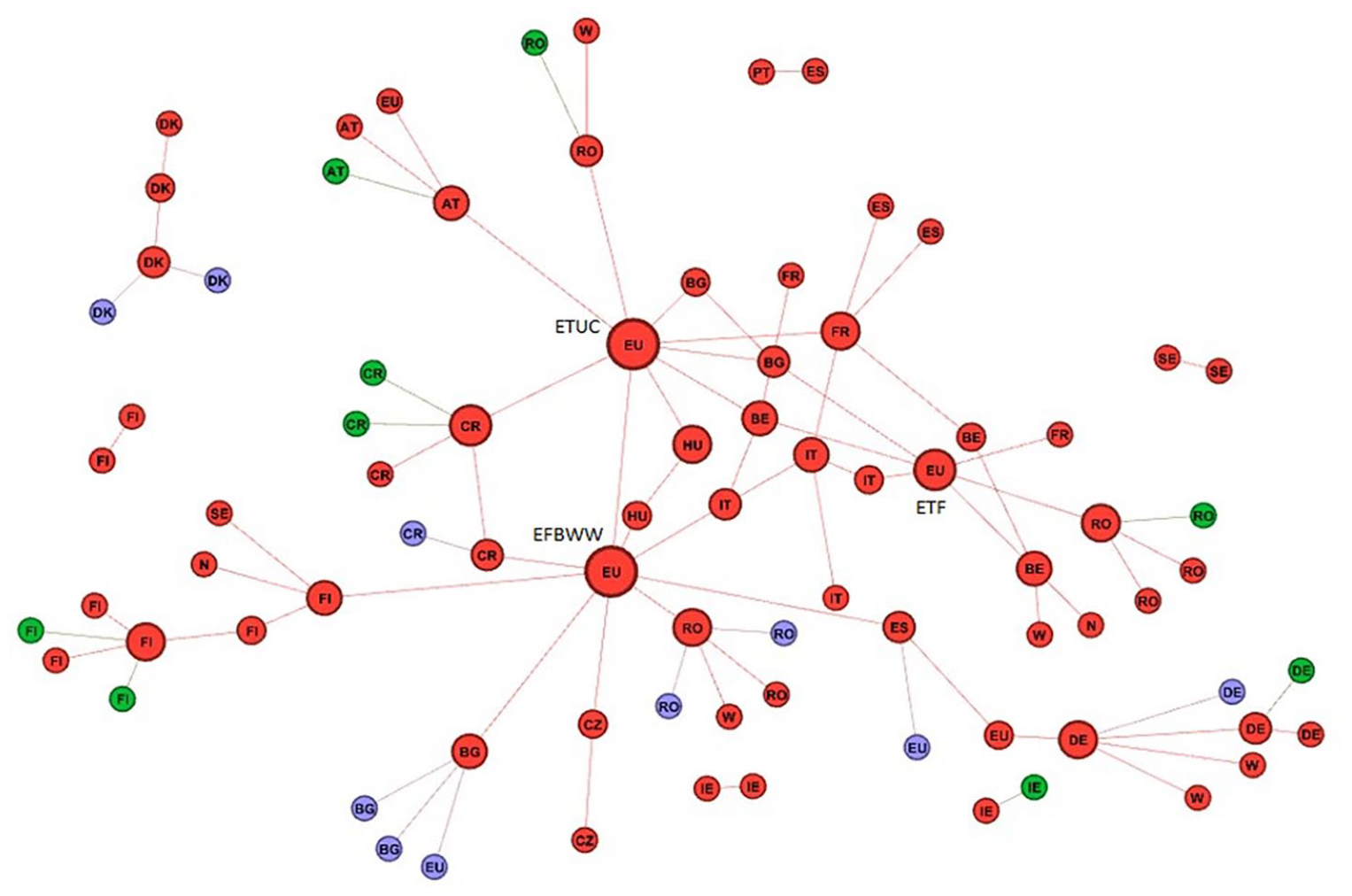
Communication network trade unions. 5
As we expected, EU umbrella organisations are central actors in the network. National trade unions contacted sectoral EU organisations such as the EFBWW or ETF in order to get information and to discuss the new directive proposal. But European trade union federations as well as national organisations also contacted the ETUC during the discussions on the directive.
In the interviews it became clear that the sectoral union confederations being investigated, such as the EFBWW, went even further and completely ‘delegated’ the discussion regarding an EU minimum wage and their interest representation to the ETUC – although the directive may have a major impact within their sectors. The representative of the EFBWW said: ‘To the first point related to the minimum wage . . . we do not have, let’s say, our own position on that. It is rather ETUC, and we follow the ETUC discussions, but we have not worked on that as a European Confederation’ (Interview EFBWW). The same is true for the ETF, whose general secretary ‘followed the discussion in the ETUC on this’ (Interview ETF). This substantiates why the ETUC is the most central node in the network. As the ETUC represents different sectors, broad interests and more than 45 million workers in Europe, this gives them the necessary power to reach the Commission and push workers’ interests forward. This centrality and power is reflected in our interview partner’s words: ‘we [the ETUC] feel, and we think that in the representation of workers’ interests and trade unions’ interests we are the actor, that is, let’s say, that is supposed to work on this directive’ (Interview ETUC).
Confirming our first assumption, the centrality of the ETUC shows that the national and sectoral trade unions under investigation here accept the ETUC as representing their interests at European level. This may legitimise the ETUC’s action within the very limited arenas of participation that are given to the social partners in the multi-level governance system. While showing a strong centralised and coordinated voice, national trade unions may feel they are making better use of their resources instead of directly lobbying the Commission and other European authorities in a decentralised and autonomous way. As Swedish unions did not take part in the survey, we cannot fully generalise this finding.
The main interest of the coalition represented by the ETUC is to support the directive even though, as they mentioned, ‘this was not the initiative that the trade union movement was asking for or looking for’ (Interview ETUC). But the positioning towards the directive shows a strong preference for positive integration – confirming our second assumption. In the eyes of the ETUC, a regulation regarding minimum wages at the European level is relevant as it can contribute to better workers’ living standards in the Union. According to the ETUC the proposal needed ‘changes and amendments in some key areas’, but they had supported the regulation since the Commission proposed it: ‘We think it’s very important that there is European action on these issues on the promotion of collective bargaining, on statutory minimum wages guaranteeing the standard of living. So, we fully supported the initiative, so, and this is the trade union movement position’ (Interview ETUC).
Even though the proposal did not come from the workers and was not completely satisfactory, the ETUC representatives had no doubts about its importance and have been willing to back it – although right from the beginning some dissenting voices were raised. Nordic trade unions saw in a minimum wage regulation a threat to their national model. Arguing that such a framework could undermine their extended bargaining agreement systems, they adopted a sceptical position and opted to defend the idea of a recommendation instead of a directive. However, the heterogeneity among the different trade union organisations hindered unanimity and indicated that also certain national union organisations adhere to negative integration in this field.
Employers
Figure 2 shows the communication network of the employers’ organisations regarding the EU minimum wage directive. Here, given the smaller response rate, a less dense network can be seen. Different from the trade unions’ network – and in accordance with our first assumption – trans-sectoral EU umbrella organisations such as BusinessEurope or SMEUnited seem to play a less central role. Nonetheless, the interviews have shown that these umbrella organisations are relevant for the policy-making process and that they represent and lobby for their European and national members.
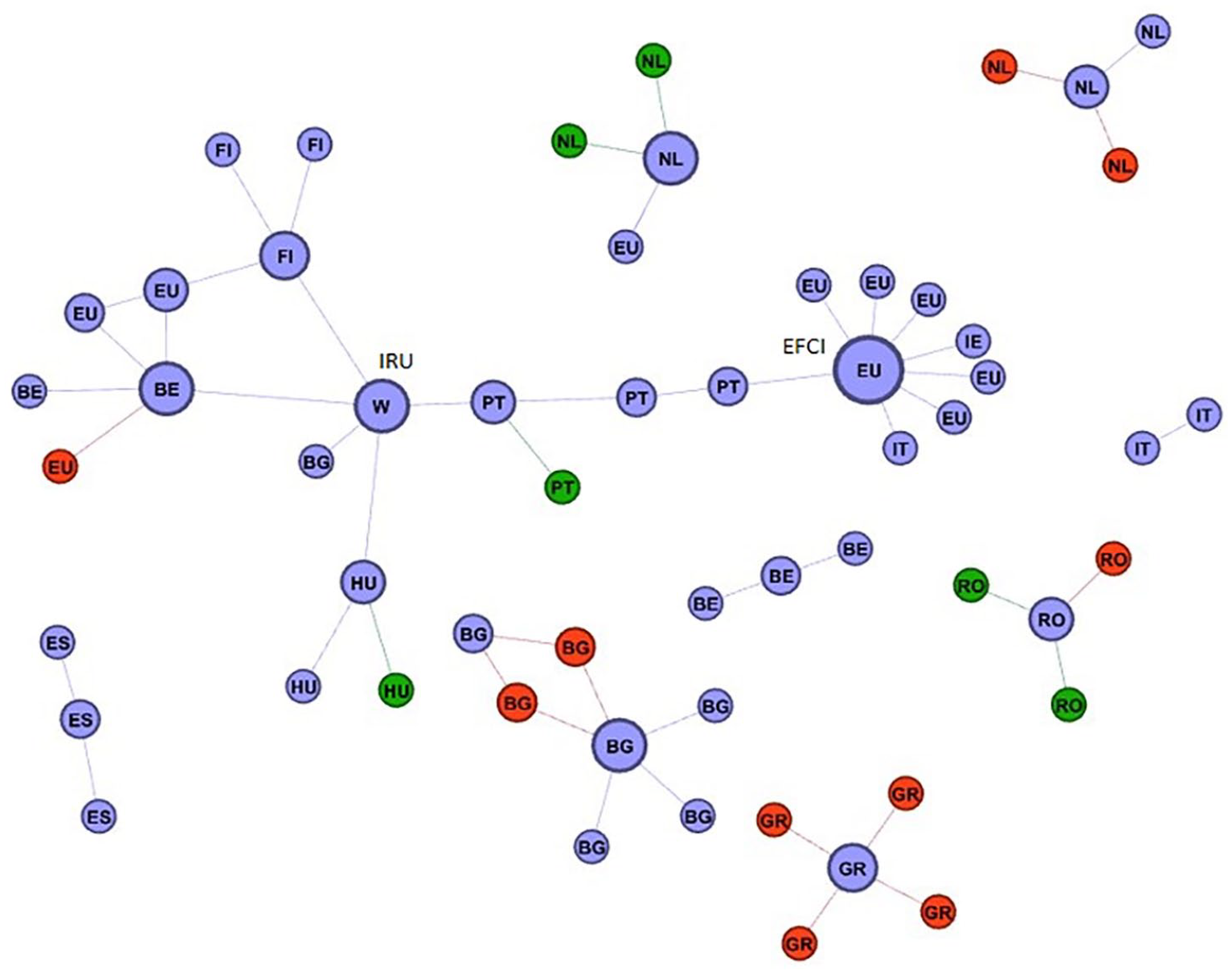
Communication network employers.
But although most connections are clustered around the transnational sectoral organisations such as the EFCI and IRU, some European sectoral associations of employers – just as the trade unions – took a step aside and gave their support to bigger umbrella organisations. The UETR, for example, delegated the discussion to SMEUnited: ‘so far we left the discussion on the general minimum wage matter on the European level to SMEUnited as an umbrella, wider organization’ (Interview UETR). Further, BusinessEurope plays an important role as well, as our interview partner from the IRU stated: ‘BusinessEurope is the organization representing our sector’ (Interview IRU). BusinessEurope and SMEUnited took part in the two consultation stages while the proposed directive was being discussed, showing that for the Commission these two umbrella organisations count as legitimate voices to represent European employers.
But there is clearly more than one way in which employers’ organisations have been lobbying against a directive on minimum wages. As our interview partners mentioned, some of them have directly contacted EU authorities and other actors: ‘we certainly have reached out to the Commission, to the Parliament. We have had some interviews, for example, with DG Employment, [the] Employment Committee at the Parliament . . . and contacted social officials of the permanent representations of the member states’ (Interview EFCI). This form of direct lobbying shows a difference between employers’ associations’ and trade unions’ ways of approaching European authorities and to push for their interests.
Both participation forms, lobby and consultation, have been used by employers’ associations to defend a position of negative integration. As they say, the EU ‘has no competence to introduce a directive on minimum wages or on collective bargaining as these matters are, for good reasons, the competence of social partners and Member States’ (BusinessEurope, 2020b: 3). This response of BusinessEurope to the first consultation was corroborated by our interview partner and can also be found in BusinessEurope’s response to the second round as well as in the responses of SMEUnited and in the Multisector joint statement on minimum wages launched in May 2021 by 10 European sectoral employers’ organisations. Employers’ organisations unanimously stated that they do ‘not consider a European Directive as the appropriate legal instrument to be adopted’ (SMEUnited, 2020: 9) and that ‘the absolute maximum possible would be a non-binding Council recommendation’ (BusinessEurope, 2020a). Also single sectoral organisations share this position, as the EFCI interview partner stated: ‘we completely oppose the Directive’. In this sense, even though employers do not seem to have a fully coordinated voice to push for their interests, as our interview partner said, ‘we have been very united across the process’ (Interview BusinessEurope), revealing that the different voices are ‘united in opposition’, and showing that they have all opted for a position of negative integration when it comes to minimum wages. This also confirmed our second assumption.
The process of finding joint positions within the ETUC
Holding onto a position of negative integration, employers could easily bridge differences related to national traditions or sectoral interests, giving reasons for this position and staying loyal to their umbrella organisations. In contrast, the commitment of the ETUC to ‘positive integration’ provoked fierce tensions, resulting in the temporary exit of the Swedish members. In the following we therefore concentrate on the ETUC. Looking at different cleavages and using Hirschman’s typology, we show the process of position finding that took place within the ETUC during the discussion of the minimum wage proposal.
As is well known, during the discussion, two strong positions arose within the ETUC. Most members, especially those where statutory minimum wages are already set, agreed with the idea of a directive and fully supported the two responses to the consultation rounds given by the ETUC. In contrast, the Nordic trade unions, as an interest coalition, did not support the directive and used a different strategy, namely voice and some of them later on, temporary exit. Nordic trade unions overall rejected the legal intervention such a directive would mean for their well-functioning national bargaining system. Looking at the different stages of the consultation process we can see how the ETUC searched for a position to combine these interests – and failed.
In their response to the first consultation round, the ETUC welcomed the proposal but critically asserted that ‘the document fails to make a clear distinction in the challenges (and in the possible actions) between statutory minimum wages and minimum wage floors defined by collective agreements’ (ETUC, 2020: 7), thus highlighting that EU action must not limit or undermine social partners’ autonomy. Besides that, the ETUC leadership’s strategy was based on appealing to the ‘loyalty’ of the Nordic unions as an interest coalition. By defending collective bargaining as a possibility to regulate minimum wages, the ETUC supported the Nordic unions in their claims. As our interview partner said, for the ETUC it was very important that member states which do not have statutory minimum wages ‘should not be forced to [be] obliged directly or indirectly to establish a statutory minimum wage and their systems of collective bargaining, which have a well-functioning [tradition] should be safeguarded and should not to be undermined by the directive’ (Interview ETUC). At this point this position contributed to the internal cohesion of the ETUC, even though the Nordic trade unions were from the outset sceptical of the idea of any form of EU minimum wage regulation, or a ‘one size fits all’ model.
The attempt to change the potential direction of the proposed initiative was shared by all ETUC members. Moreover, in its response the ETUC (2020: 3) ‘urges the Commission to be clear about the legal form of the initiative and, if the proposal will be a Directive’. In Hirschman’s words, both the ETUC and the Nordics used voice to express their disagreement with the Commission’s proposal for a European minimum wage. The Commission ‘answered’ this voice and made several changes to the proposal. First, it included collective bargaining as a way to establish minimum wages and to ensure that workers would benefit from access to minimum wage protection, thus recognising the importance of a strong role for the social partners. Second, the Commission decided to go for a directive instead of a Council recommendation, which should reduce wage inequality and in-work poverty as well as the gender pay gap. Third, the Commission took into account that the directive should not put at risk well-functioning collective bargaining systems in those countries without statutory minimum wage settings.
The second consultation round marks a split within the ETUC – and confirms our third set of assumptions concerning the strategy of member organisations, namely, that ‘exit’ follows when ‘voice’ cannot be turned into loyalty. As a reaction to trade unions’ critique the EU proposal included a clause that in all countries where collective agreements are applicable to fewer than 80% of the respective workers, governments should enhance coverage. Moreover, no member state is obliged to introduce a legally set minimum wage nor is the proposed level mandatory. In consequence, the remaining conflict within the ETUC lay in the decision to support a directive instead of a recommendation. On the one side, the position to back an EU minimum wage initiative as a directive ‘was adopted with 85% of support . . . a very strong majority of the ETUC members supported this position’ (Interview ETUC). On the other side, the mandatory nature of a directive made the Nordics raise their voice – not only within the ETUC itself, but publicly, when they opposed the ETUC position in their response to the second consultation: ‘it is therefore with great disappointment that we see that the ETUC is demanding a European Framework Directive on minimum wages as well as collective bargaining, in doing so, the ETUC risks creating a splitting division in the European trade union movement’ (TCO et al., 2020b: 1). In a separate statement (TCO et al., 2020a) the Danish, Norwegian, Icelandic and Swedish trade union federations pursued a negative integration approach – along the same lines as the employers did – supporting the idea that to legislate minimum wages had no legal basis in the treaty, and that there was a lack of EU competence in the area of wages.
The huge majority within the ETUC to support the recommendation was obviously not enough to act as a loyalty mechanism for the Swedish trade unions (Dowding et al., 2000: 477) in order to stay within the ETUC. The uttered threat became a reality when the Swedish Trade Union Confederation decided to stop paying its fees to the ETUC or attend its meetings in December 2021. But the hatchet was eventually buried when the Swedish LO resumed paying their fees again in early 2022 (Nordic Labour Journal, 2022). The Swedish option for a (temporary) ‘noisy exit’ strategy (Dowding et al., 2000: 475) shows a double split. First, between the ETUC and the Swedish Trade Union Confederation, and second, within the Nordic federation as the Danish, Norwegian and Icelandic trade unions continued to display a voice strategy within the ETUC. This happened despite the fact that finally only Danish and Swedish unions were backed up by their governments voting against the directive.
Conclusions
Within the multi-level governance system of the EU only big umbrella organisations are valid counterparts for the Commission. Accordingly, only a few trade unions and employers’ organisations were called to participate in the two consultation rounds on a minimum wage directive. This pushed national and transnational sectoral social partners to use the transnational umbrella organisations as central nodes of communication. However, the network analysis supports our first assumption that trade unions build more centralised communication structures than employers and align their interests with the most representative organisation at the EU level. The less centralised network of employers underlines the idea that they are more likely to use lobbying beyond the umbrella organisations.
With Scharpf’s concepts of positive and negative integration we can confirm that employers and their organisations are holding on to negative integration, understanding the proposed minimum wage directive as a threat to the liberalisation of markets within the EU.
Combining this with Hirschman’s concept of exit, loyalty and voice we can confirm our second assumption, namely that employers easily united in opposition to the proposal and no problems of ‘loyalty’ to umbrella organisations emerged. The general support of the ETUC for positive integration, however, had to bridge different interests among the heterogeneity of collective bargaining systems and trade union actors. In contrast to our expectation based on other policy fields, sectoral associations on transnational level did not pursue particular interests, but easily delegated issues concerning a minimum wage to the ETUC. The Nordics felt essential interests were endangered and used voice within the ETUC. In spite of important changes made to the Commission’s initial proposal in favour of minimum wage setting by collective bargaining, they remained unsatisfied and the position of the Swedish unions was to uphold the rejection of a regulation via directive on EU level. In line with our assumption they turned towards a (temporary) exit strategy concerning the ETUC. Thus also confirming Offe and Wiesenthal (1980), we may state that in the case of a European minimum wage, the interests of trade unions were indeed more heterogeneous than employers’ and therefore much more difficult to organise within a collective organisation. However, the full picture only emerges when taking into account the paradox related to positive integration towards a Social Europe and the problem to find joint positions among different national unions on transnational level – partly delineated by Scharpf (1996).
The ETUC was in a way overrun when the Commission pushed for a minimum wage directive. As an element of positive integration and an important tool to achieve better working and living conditions the proposal was not rejected. When it was implemented top-down, however, it created the demand for compromise and solidarity within the trade union movement. The ETUC had to bear the burden of positive integration, finding compromises across very different traditions of collective bargaining systems linked to different interests and ideas on the governance of wage setting among its members.
What was supposed to be an employee-friendly policy developed instead into a source of conflict for the European unions, exposing internal fractures and cleavages. Although the ETUC is still the biggest and most important umbrella organisation of trade unions in Europe, the introduction of the European minimum wage resulted in crisis.
The paradox of the European minimum wage thus strongly supports the need to widen social partners’ scope of action with respect to the agenda setting and decision-making process of the EU. Moreover, it becomes clear that not even trade unions are able to produce transnational solidarity on demand. Rather, transnational solidarity needs to be enabled both on a European and national level by processes of bridging and bonding between organisations and by intensifying the discourse on common ideas and values – not only among social partners – to lay the foundation for social cohesion within Europe.
Footnotes
Declaration of conflicting interests
The authors declared no potential conflicts of interest with respect to the research, authorship, and/or publication of this article.
Funding
The authors’ work is part of the project ‘Places and motives of acts of solidarity in transnational working relations’ and was funded by the BMBF - German Federal Ministry of Education and Research. Fund Number 01UG2112.
