




Abstract
Companies’ access to temporary workers is an important aspect of the functioning of labour markets. The strictness of regulations is not determined by the regulations alone, but also how these are enforced. Thus, knowledge on why some employees take action while others do not is important to understand the functioning of these regulations. We analyse temporary workers’ experiences and perceptions related to enforcement in the Norwegian labour market by distinguishing between ‘exit’, ‘voice’ and ‘silence’. Where enforcement is left to the temporary employee, as in Norway, enforcement may be difficult due to the limited power of the employee vis-a-vis the employer. Trade unions may, however, increase this power and in this study the role of local trade union representatives in enforcement is included. Taking the comprehensive Norwegian model of trade unions’ support into account, this case can be seen as a robust case for understanding the process of enforcement.
Keywords
Introduction
Regulations of employers’ right to terminate permanent employees and hire temporary workers, 1 known as employment protection legislation (EPL), is a fundamental and important aspect of the functioning of labour markets. It affects employers’ hiring strategies and individuals’ job and income security. Furthermore, the strength of EPL has been central to debates on ‘flexible labour markets’ and job creation in Europe (Esping-Andersen and Regini, 2000; OECD, 1994; Pissarides, 2001). Over the last decades, several European countries, for example Norway, Sweden, Germany, Italy and Spain, have partially liberalized their EPL by making it easier for employers to use temporary contracts or hire temporary agency workers (OECD, 2020). This article discusses whether, and how, fixed-term contracts and temporary agency work are enforced in Norway, an inclusive Nordic labour market (Gallie, 2011).
The OECD’s EPL index is often used as a way of estimating the flexibility of national regulations by assessing the strictness of different parts of the regulations. The OECD index shows that the Norwegian rules are moderately strict for firing permanent employees, but that the rules regulating employers’ possibilities to use fixed-term contracts or temporary work agency contracts are comparatively stricter.
Regulations may be unclear and open to misunderstandings, or may require a great deal of discretion (Mahoney and Thelen, 2010). Both instances may enable a more liberal employer practice of the regulations than what was intended by the legislator. Regini (2000: 23) points out that in countries with strict regulations, ‘There may exist “hidden flexibilities” alongside strict official regulations, where actors negotiate more flexible solutions to hiring and firing issues on firm or industry level.’ In Norway, legislation requires that to hire temporary workers directly or from a staffing agency, the hired employee must fill a temporary need for labour. In such situations, employers will have better access than the workers to information on the reasons justifying the use of a temporary position rather than a permanent contract. Therefore, disagreements regarding whether the fixed-term contract or agency work is justified may be difficult to handle for the individual employee, and the enactment of rules may be pushed or bent towards more ‘flexible’ practices than prescribed in the law itself (Oliver, 1991).
While statutory regulations and collective agreements are important constraints for hiring temporary workers, the way the regulations function is contingent on whether and how these are enforced. Enforcement in some countries is proactive, as when governments or private agencies in for instance the US, Canada or Australia inspect companies to check whether they follow various employment standards (Vosko et al., 2016; Weil and Pyles, 2006). The enforcement regarding use of temporary workers in Norway and the other Nordic countries is reactive only. The employment contract is a private law agreement between the employee and the employer; the individual employee must act vis-a-vis the employer, and a possible infringement case must be brought before the courts. As such, enforcement of these rules in Norway to some extent resembles common enforcement practice of such employment rights in for instance Britain (Morris, 2012). However, taking into account that the Norwegian system relies on trade union assistance, the comparison is most fruitful when it comes to non-union members. The Norwegian case of company level enforcement is thus a robust case of employee enforcement, due to the possible assistance from shop stewards and industry level trade unions in these disputes. At the same time this case is also able to shed light on obstacles to enforcement by non-unionized workers.
In a recent Norwegian study, Svalund et al. (2019) examined the proportion of companies using temporary contracts or agency workers in an unlawful way. The study estimated that at least 23% of the companies gave reasons for their use of temporary workers that indicated infringements of the Working Environment Act (WEA). When asked whether they had broken the rules, or entered ‘grey areas’ regarding fixed-term contracts during the last two years, 9% of employers answered yes, while 2% admitted having used temporary agency workers infringing the legal framework (Svalund et al., 2019: 55–56). Furthermore, employees were asked about the reasons why they were on temporary contracts in the Norwegian Labour Force Survey (LFS) in 2016 and 2017. Analysing their answers, Bergene et al. (2018: 29–36) concluded that between 23 and 35% of temporary workers gave only reasons that were not justifiable in the legislation. A study conducted in 1996 had shown similar results (Nergaard and Stokke, 1996), thus the share seems to stay rather constant.
Studies indicate that temporary workers to a lesser degree than permanent employees use their voice. They refrain from voicing issues due to job insecurity, or fear of negative personal or professional consequences (De Cuyper et al., 2008; Kish-Gephart et al., 2009; Rybnikova, 2016; Sluiter et al., 2020). It is reasonable to believe that this is also the case when it comes to enforcement of working-life regulations. However, studies of temporary workers’ use of voice regarding enforcement of temporary work have been called for (Oyetunde et al., 2021; Wilkinson et al., 2020). It has been pointed out by different scholars that unions may help employees voice their concerns (Freeman and Medoff, 1984; Punta, 2021; Waas, 2021), and bearing in mind that employees in temporary positions are more at risk of precariousness with limited bargaining power, the role of unions in enforcing the regulations is also examined.
More knowledge of how and why employment regulation rules may be practised more leniently than prescribed is important on its own. Comparative studies of the significance of EPL often lean on the OECD index, where the strength of different dimensions in the EPL in a country is estimated (OECD, 2020; Venn, 2009). Such indexes are based on the formal regulations (laws and collective agreements); thus, this study will also provide knowledge on the validity of that type of comparative index.
This article is based on several data sources. First, we rely on a survey of Norwegian employees, conducted in 2019, to study workers’ knowledge of fixed-term rules. We then use a study of Norwegian companies, conducted in 2019, to study the enforcement of the rules regulating temporary work. We also use data from two surveys among union representatives at company level, conducted in 2018 and 2019. Finally, we conducted group interviews with temporary employees and hired workers in 2018–2019.
In the following section we describe the context and regulatory framework, before we present our analytical framework. We then present the methodology and data used, before findings are discussed and concluded.
Context and regulatory framework
Unemployment has been low in Norway in the last decades, and was at 3.7% in 2019. Perhaps reflecting the strict rules, the share of temporary employees is relatively low in Norway: 7.9% held a fixed-term contract in 2019. 2 Estimates indicate that there were slightly below 1.6 to 1.8% temporary agency workers in the Norwegian labour market in 2019 (Nergaard, 2021: 19). Employees holding a temporary contract, or working in temporary work agencies, are on average younger, with lower education, and fewer are trade union members, compared to permanent employees. Furthermore, they are more often immigrants, and for workers in temporary work agencies, often labour immigrants from Eastern Europe (Nergaard, 2018b).
Regulations and regulative institutions
Employers’ opportunity to use temporary contracts is regulated through statutory law. As such, both the rules, and the possible sanctions, are pivotal in studying rule enforcement (Mahoney and Thelen, 2010: 10–14; Oliver, 1991; Scott, 2008). The main rule in Norway is that employees must be offered a permanent contract (section 14-9 (2) of the WEA). However, employers can, under certain conditions, hire employees fixed-term or use temporary agency workers. Employers may use temporary workers when the work is of a temporary nature, substituting for permanent staff, as a trainee, and when participating in labour market schemes under the Norwegian labour market and welfare service. There are two further minor exceptions to the general rule of permanent contracts: first, for athletes, trainers, referees and other leaders within organized sports, and secondly, a so-called general fixed-term contract can be used to hire fixed-term for a maximum period of 12 months. This contract may apply to a maximum of 15% of the employees of an undertaking. However, this exception is of little practical importance (Øistad et al., 2019). In some cases, such as in large organizations where many employees perform the same types of tasks (e.g. nurses in a nursing home), there may be a constant need for labour temporarily due to, for example, sick leave. Where this constant need is predictable, creating permanent positions may be the proper choice as opposed to hiring staff fixed-term on a regular basis. This rule is based on case law, and is referred to as the minimum staffing doctrine. Assessments of whether a need is permanent or temporary is to some extent subject to interpretation or discretion, and so far, the minimum staffing doctrine has not been used as a legal basis for court decisions on the use of temporary agency workers.
Agency workers can be employed under the same conditions as temporary employees, with the exception of the general fixed-term contract. However, where a collective agreement is in place, the employer and the shop steward may sign a written agreement concerning extended rights to use temporary agency workers. 3
Since the employment contract is a private-law agreement, it is in principle up to the individual employee to address infringements of the provisions. Where such matters are brought before the courts, the court may decide that a permanent employment relationship exists, and the employee may be awarded compensation (section 14-11 of the WEA). The hiring company may furthermore be instructed to employ the worker in a permanent position.
In many cases it could be difficult for both the employer and the employee to know whether a position qualifies as a temporary position or not. Clarifying both how the legal rule is to be interpreted, and how the rule is to be applied in the specific case can be challenging, especially for employers and employees lacking access to legal counselling. Uncertainty related to how this rule should be applied may therefore make an employee more hesitant to use their voice and rather stay silent.
Shop stewards have a pivotal role in securing that employment standards, including the use of temporary workers, align with legal requirements. The support of the shop steward could be important, and even more so if the legal rule is difficult to clarify. However, fixed-term employees are less likely to be union members (Nergaard, 2018a). The union density among temporary agency workers is very low (Prop. 61 LS, 2019–2020). They could be organized in the union in the temporary agency – however, such unions are scarce. Thus, the union representative of the hiring company may try to monitor the use of agency workers, but these workers are not their formal responsibility. As such, the shops stewards might not monitor agency workers as closely as they might with employees in ‘their’ company.
The enforcement process: Levels and actors involved
In the case of unlawful use of temporary contracts or agency workers, the enforcement process may take place at different levels. At the lowest level, enforcement takes place at the workplace, between the employer and the employee, where a local trade union representative or legal aid can support the employee. If the case is not resolved at this level, negotiations between the parties is the next step in the process (level 2). According to the WEA section 17-3, the employee has the right to demand negotiations in such cases. If the employer is a member of an employer association and the employee is a member of a trade union, advisers or lawyers from these two bodies will usually be involved, and they will participate in the negotiations with the employer and employee. If the case is still unresolved, it can be brought before the courts (level 3). There, an agreement may be reached by the use of court mediation, but if this does not succeed, it will be decided by a judgement.
Agency and power: Exit or stay, voice or silence
In order to enforce the rules regulating temporary employment, power and agency are essential. Studies have shown that temporary workers’ expectations regarding their long-term career in the company might be different from that of permanent employees, as there are fewer reasons for them to have such long-term expectations (Flinchbaugh et al., 2020; Oyetunde et al., 2021: 6).
To come to terms with and analyse the employer–employee relation related to law enforcement, we rely on Hirschman’s (1970) framework and his distinction between the choices of exit and voice. If an employee suspects that the employment contract is unlawful, they can fulfil or quit the contract and then look for a new job (exit). They can also choose to stay and point out the breach to the employer, and demand a permanent position (voice). If there are many attractive and other jobs available, the potential use of voice may be less likely (Hirschman, 1970: 83). But, as Hirschman puts it, the chance that individuals stay and voice their concern may increase if they are committed to the organization, with feelings of loyalty (Hirschman, 1970: 77). Some of those staying in the organization may not voice their concern about their contract, but rather stay silent despite having relevant information or (critical) comments regarding the particular issue (Morrison, 2014: 174). Thus, following Morrison and others studying voice, we may analytically understand the possible choices as choosing between staying and leaving (exit), and for those staying, between voicing (acting) and silence (not acting).
Employees may refrain from the use of voice and choose to ignore breaches of law either because they do not care (much) whether they hold a permanent or a temporary job, and/or as they think the cost (use of time, effort and money) or the risk is too high (see also Weil and Pyles, 2006: 63). Such risks can include reducing their chances for further employment in the company or incurring a bad reputation and thus lose employment opportunities in other companies. Sometimes, interest in holding a permanent contract may interact with the person’s assessment of the risk of trying to enforce the rules. High risks and low gains may reduce the chance of individual enforcement.
Temporary workers aiming for a permanent contract would often weigh the risk of enforcing against their power, i.e. their possibility to enact their will (Weber et al., 1978). The decision to take action can analytically be understood as depending on four dimensions. Firstly, knowledge about the appropriate regulations and facts. Morris (2012) points out that it might be difficult for employees in Britain to acquire such knowledge. In Norway, Bergene et al. (2018: 20) found that only 46% of employees knew the regulations of fixed-term employment in the WEA well or very well, and that the share who knew these rules well or very well was significantly lower among those hired on such contracts (36%) compared to permanent employees (47%). Sluiter et al. (2020) studied atypical workers’ experiences with voice on work-related issues in the Netherlands, and found that temporary work, job insecurity and replicability were barriers to worker voice. Rybnikova (2016) studied temporary agency workers and whether they voiced concerns at the workplace, and found that the shorter the employment relationship lasted, the less willing the worker was to use the option of voice. Two related issues explained this: it took time to get the insight into the work relationship and the workplace that was necessary to reveal that the temporary contract was unlawful. Furthermore, as revealing and pointing out breaches of law takes time, it could be difficult for some to do this before the employment relationship was terminated. Rybnikova (2016) also showed that the organization of work may matter for temporary agency workers’ ability to voice concerns. Working nights, sometime in solitude, reduces workers’ contact with other employees, with whom they could discuss matters. Thus, knowledge of issues related to the contract is needed, but may be hard to obtain. Uncertainty in how regulations are to be interpreted and applied could add to these difficulties, and further hinder employees from using voice.
Secondly, (institutional) values and norms about how something should be matter. The use of temporary workers is thus contingent on normative institutions. The practices of employers and employees are structured by norms and understandings of what is just or fair, and how the rules are to be understood (Scott, 2008: 48). As such, the practices of well-established companies in the industry may put normative pressure on employer practices in other companies, as may expectations from and relations to the local community (Dahl and Nesheim, 1998; DiMaggio and Powell, 1983; Svalund et al., 2018). Employees may refer to such norms when trying to enforce the law.
Thirdly, enforcement could depend on access to resources. Having income security in case of unemployment, legal knowledge, being a union member or having access to legal aid may increase the chance of successful enforcement. In the Nordic context, where shop stewards have a role as watchdogs regarding employers’ compliance, a lack of such representatives may increase the barrier to using voice strategies. As the unionization rate among atypical workers is far lower than for permanent employees (Nergaard, 2018a), these workers’ access to these kinds of power resources will on average be poorer than for permanent employees. For temporary agency workers it may be even more difficult, as the rules are more complicated and the access to information could be poorer. The workers must find out if the shop steward in the hiring firm has agreed to extend the use of agency workers beyond the main rule in the WEA section 14-12 (1). Furthermore, the shop steward at the hiring company (if there is one) does not formally represent agency workers, possibly reducing the individual’s power (Håkansson et al., 2020; Rybnikova, 2016).
Finally, the options the employee has will be of importance, i.e. the labour market and the demand for labour in various positions. If there is shortage of labour, the risk of losing or missing out on a permanent contract is lower (Grimshaw and Rubery, 1998; Svalund et al., 2018). For some youth, further education is an alternative to a (bad) job, while some older employees might retire. For others, facing a labour market with limited relevant job openings, the individual may have limited bargaining power vis-a-vis the employer.
Methods and data
Studying whether and how violations of the rules regulating employers’ use of fixed-term contracts and temporary workers are enforced, we rely on both quantitative and qualitative data.
We conducted a representative survey among companies with 10 employees or more, who had used temporary agency workers or had employees on temporary contracts the last two years. 1172 executive managers or HR/personnel managers were interviewed by phone in 2019, and the survey had a response rate of 35%.
To gain information as to whether employees do enforce such rules, we conducted a representative employee survey using a large web panel in 2018. A total of 10,206 respondents were contacted, and the response rate was 43%. Only those who had ever had a temporary contract received the question used in this article; thus, 32% of the employees were excluded.
To gain insight into why employees do or do not try to enforce infringements, we conducted four group interviews with temporary agency workers and fixed-term employees. Two of the groups included both fixed-term employees and agency workers, while in two there were only agency workers. There were 31 workers in total participating in the groups. One of the groups consisted of labour migrants from Poland, working in the construction sector in Norway, and the interview was conducted using an interpreter. The fixed-term employees consisted of individuals from various industries, ranging in age, experience and education. Some were recent graduates; others had a long career in working life and had worked as fixed-term employees for many years. The interviews followed a semi-structured guide and took 1.5 to 2 hours. The purpose of these interviews was to gain insight into the participants’ experiences, attitudes and understanding of temporary positions, the law and enforcing the law in the case of unlawful temporary hirings.
As mentioned, temporary workers can contact shop stewards for help and guidance if they believe their contract is illegal. Questions from two surveys among a representative panel of shop stewards in the Norwegian Confederation of Trade Unions (LO), the largest trade union confederation, were used to investigate whether temporary workers contact shop stewards with questions related to their contract. The 2018 survey with questions about fixed-term employment was sent to 3500 representatives. The response rate was 43%. The 2019 survey, with questions about temporary agency work, was sent to 3468 representatives. The response rate was 37%.
Finally, to gain more knowledge of the enforcement process, and the number of respective cases, we interviewed 19 employees (lawyers and advisers) in trade unions and employee organizations in industries with a relatively large share of temporary workers. One interview was also conducted within a free legal help clinic. The interviews were done over the phone, following a semi-structured interview guide and took about 30–45 minutes. Key questions included the number of such cases they or the organization had been involved in, how such cases were handled, what the most common allegations of breaches were, and what characterized the employees who made contact.
Findings
While it is the responsibility of the employer to comply with the legal framework, employees may correct such malpractice by voicing their concern. In the following, we first investigate whether temporary employees challenge illegal contracts, and then how the gap between the share of infringements and enforcement can be understood.
Analysing whether there is a gap, we use quantitative data from both employees and employers. In the employee survey, those who had had a temporary contract at one time or another were asked whether they had ever requested a permanent position or been offered a permanent position based on being hired on an illegal temporary contract (Table 1). We covered situations where they had put forward a claim as well as situations where they had been offered a permanent position, including where the shop steward or the employer had taken action.
Share of those holding an illegal temporary contract at one point who had put forward a claim for a permanent position or who had been given such a position by the employer. Employee survey 2019. N = 3024.
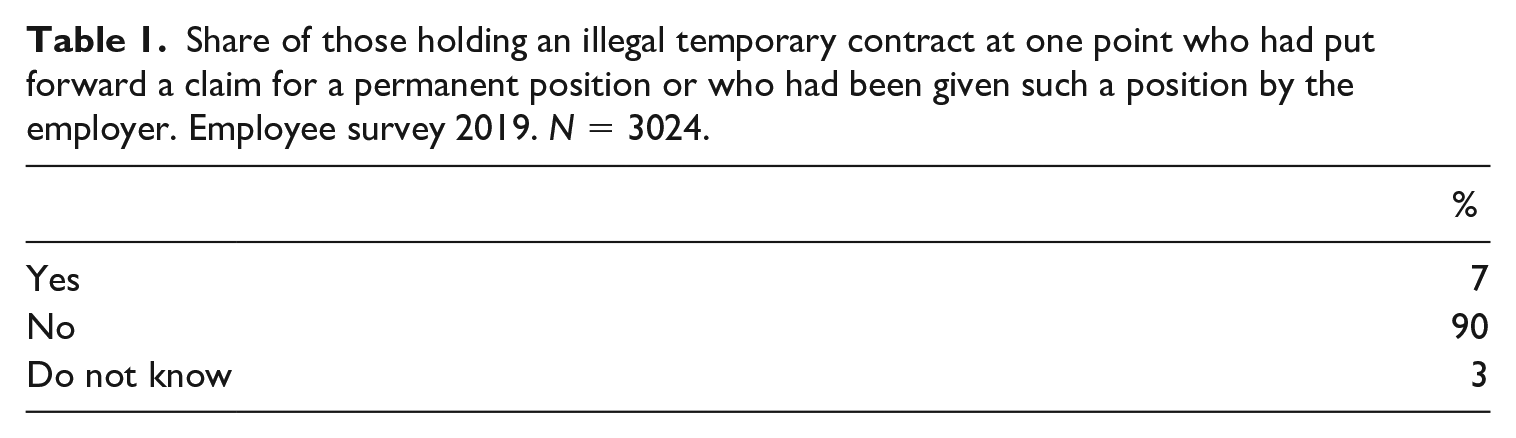
Comparing these numbers with the findings based on the LFS, which indicate that between 23 and 35% of all temporary contracts were not justified by the Working Environment Act, there seems to be a considerable gap between the possible share of illegal fixed-term contracts and the enforcement of such infringements. Noting that the LFS study covered persons with temporary contracts in the interview week, while our study was not related to a specific time period, the enforcement gap may be even larger. Thus, only a minority of persons with illegal fixed-term contracts make use of voice as a strategy.
Furthermore, in the survey conducted among Norwegian companies, managers were asked whether they had been approached by an employee, a shop steward, etc. claiming that a temporary position should have been permanent (Figure 1).
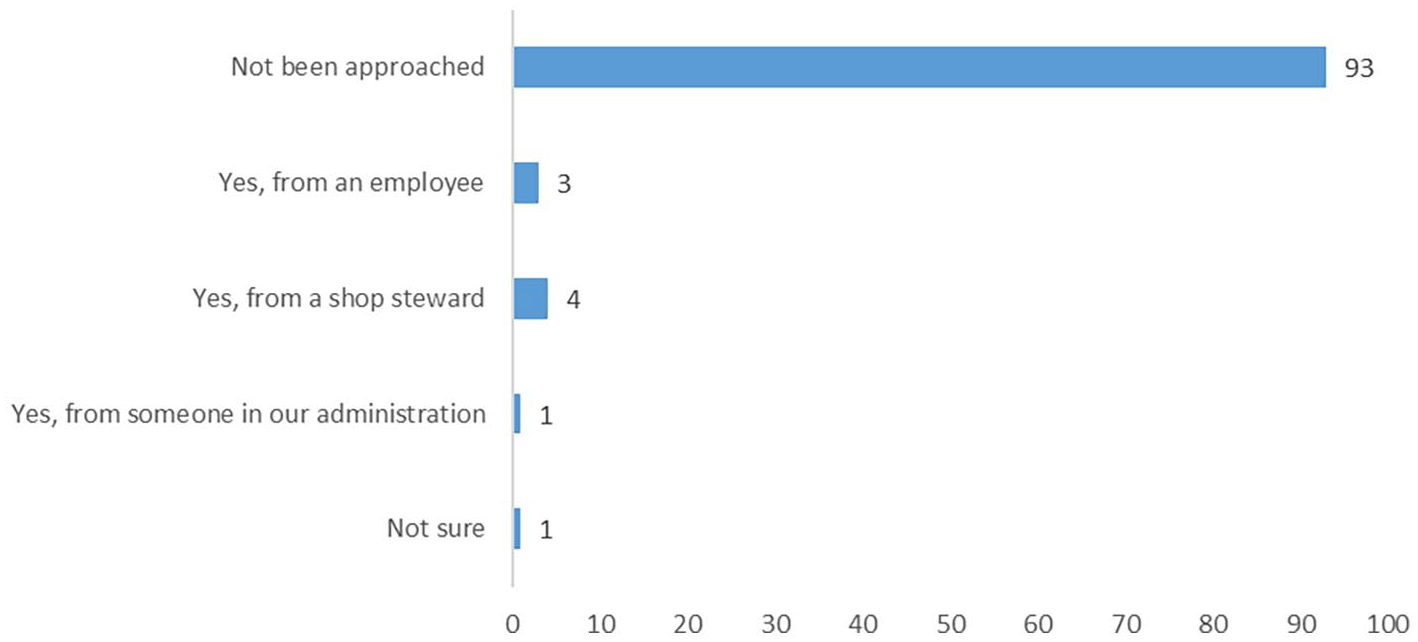
Managers having been approached the last two years with a claim that a fixed-term position should have been permanent (%). Company survey 2019. N = 909.
The survey confirms that voice is not a very common strategy: 93% of the managers had not received such claims during the last two years. Only 3% had been approached by an employee, 4% by a shop steward and 1% by colleagues in the administration. The respondents could also answer ‘from someone else in the organization’, but no one answered that. The 49 companies with managers who had been approached within the last two years were asked how many times this had happened: 45% had experienced one such case, while 20% had been approached twice, 13% had been approached four times or more, while 6% did not know how many times.
Summing up, we find it reasonable to conclude that temporary workers seldom voice their concerns on whether their contract is legal or not, indicating that exit and/or loyalty are the most common strategies.
Why is the employment protection legislation not enforced?
In the shop steward survey in 2019, participants were asked to point out the most important reasons, up to three, why agency workers seldom or never contact them with questions regarding the lawfulness of their contract (Table 2). Among those surveyed 37% said that temporary workers seldom or never contact them because the use of temporary work is legal, and thus there is no need to contact them. For some, agency work or a temporary contract represents just that, a voluntary temporary job. Thus, those workers might not be interested in a permanent job, or at least not in having their current job made permanent – 10% of the participants stated that this is the reason they are not contacted.
The main reasons why temporary agency workers seldom or never contact the shop stewards in the hiring company. Trade union panel 2019.
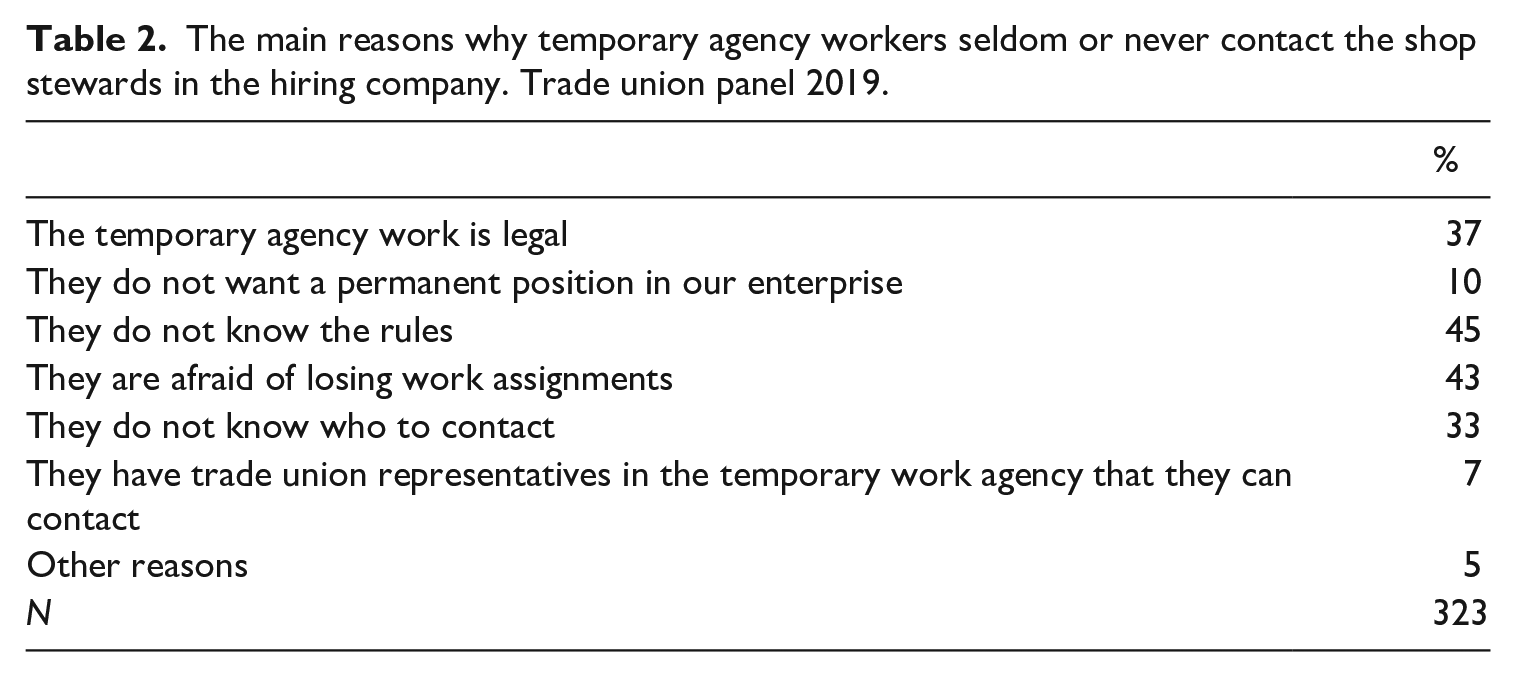
The other reasons on the list presented to the shop stewards resemble our analytical dimensions, with a focus on knowledge, resources and alternatives in the labour market. Lack of knowledge and fear of losing job assignments were the two most important reasons given by the shop stewards.
As shown in Table 2, shop stewards believe that a reason for not being contacted is knowledge: 45% of the shop stewards explain the lack of initial enforcement in terms of agency workers not being familiar with the legal regulations, which can be a sign of lack of knowledge, that the regulations are hard to understand, or that norms and practices are deviating from the actual regulation. If they know that other workers have the same contract, they might wrongfully believe that this is the way it should be and therefore refrain from reacting. In this way, lack of knowledge, unclear regulations and norms deviating from the current law may work together, making it hard for an employee to use voice. Among participants to the survey 33% answered ‘they don’t know who to contact’. Without firm knowledge, workers’ possibility to act is reduced, and thus many of the temporary agency workers lack both knowledge and resources to help them.
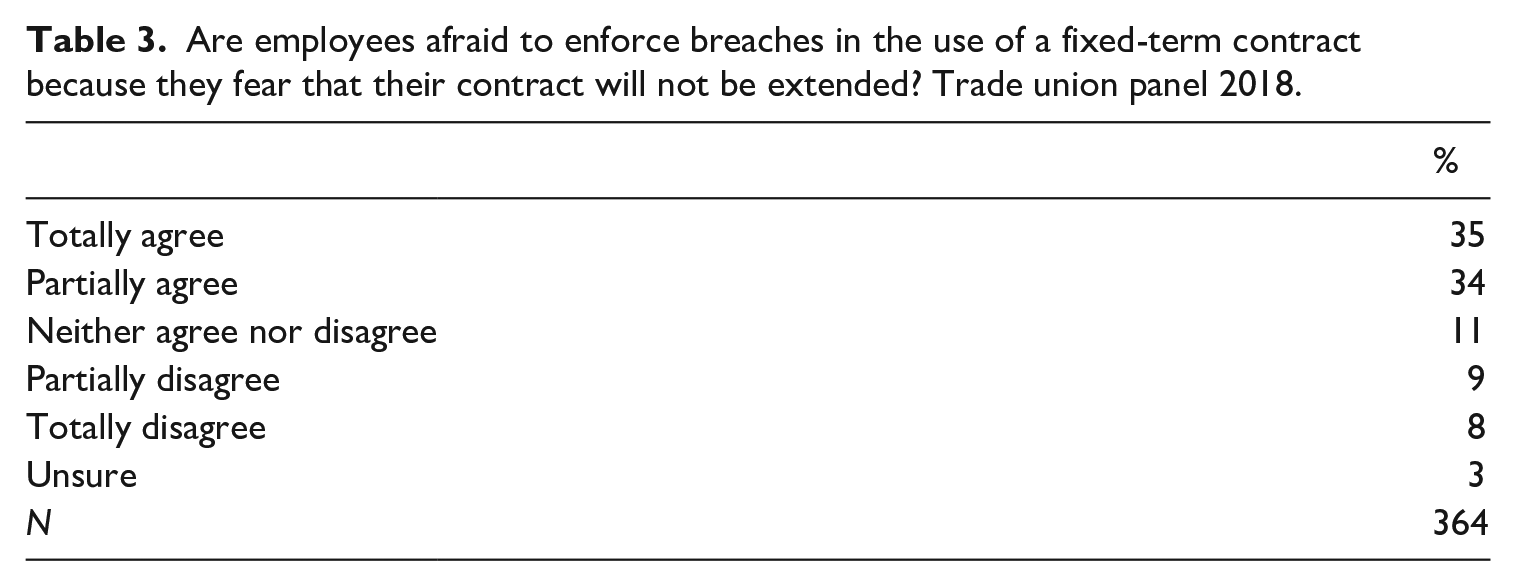
The second most important reason according to shop stewards is that the workers are afraid to lose their assignments. Agency contracts might provide only very short assignments, and further work will depend on an offer of another assignment (Svalund et al., 2019). In such cases, the workers might be wary about voicing their opinion as this might reduce the possibility of getting further assignments. The 2018 survey amongst union representatives regarding fixed-term contracts shows similar results. Here, one out of four shop stewards stated that they had often or sometimes been contacted by employees asking whether their fixed-term contract was unlawful, a finding that both could be related to lack of knowledge of the regulations and difficulties in understanding how it should be applied or how discretion should be exercised. In a follow-up question, 69% of the representatives fully or partially agreed that employees would not take the matter of unlawful use of a fixed-term contract further because they feared that their contract would not be extended (Table 3).
Are employees afraid to enforce breaches in the use of a fixed-term contract because they fear that their contract will not be extended? Trade union panel 2018.
Further input on mechanisms that stop temporary workers from reacting was given in the group interviews and the interviews with those giving legal aid.
The participants ruled out that lack of enforcement could be explained by a lack of interest in a permanent contract. They expressed that holding a permanent job would empower them vis-a-vis their employers, increase their economic security, and provide them with fewer job shifts. Especially for the agency workers, the many short assignments led to a fragmented work life with a lot of travel and a constant stream of new colleagues. A hired craftsman from Poland explains:
I would prefer to work for a permanent company, because you are placed from assignment to assignment with different people, you never have permanent colleagues at work. In the course of a month, I have changed places from the North Cape to Bergen, Trondheim and Fredrikstad. (Temporary agency worker)
Knowledge, norms and resources
Knowledge of the regulations was limited among the participants in the group interviews. For example, several participants were unsure whether the WEA applied to them, since they were not permanently employed. Especially the agency workers with a foreign background working in construction or canteens expressed poor knowledge of the regulations. Many participants were more concerned with keeping their job here and now than with familiarizing themselves with regulations and rights.
The employees with the best knowledge of the legislation were union members and employees in the public sector. However, even with the knowledge that the rules constitute a power resource, still many did not act to enforce these rules, instead choosing silence. The participants expressed powerlessness. Not only did they struggle to get a permanent job, those who had knowledge of the WEA expressed that in practice the law did not apply to them as the risk associated with requiring a permanent job was considered too great, indicating that access to resources is of vital importance in order to choose voice. A fixed-term employee put it this way:
I am very interested in the regulations and have started to study it after I started working here, because even in the public sector I see that there is abuse of the regulations. But I’m not in a situation where I can claim it to be unlawful, as I have applied for a permanent contract in this job. I have to wait until the nomination committee concludes, and then I can voice my opinion. But so far, I have only got used to smiling.
Thus, the employee does not find it appropriate, given her weak position in the workplace and her wish for further employment, to use a voice strategy. Furthermore, several participants in the group interviews thought it was useless to use their voice and try to enforce the law even if the contract was unlawful, as they believed the employer would find a way to circumvent the rules anyway.
The fear of losing their job was a recurring topic among the focus group participants, as they believed that a claim could create a conflict with the employer. They expressed concern that if they demanded a permanent job, they would be considered a ‘difficult’ employee, ruining any prospects for an extension of the temporary work relationship or a permanent position. As one of the fixed-term employees stated:
When you get a job, you get so absorbed in it that you take what you get and forget a little about what you are entitled to. And then the employer is very happy, because then they have found someone they can ‘joke with’ as much as they want. And you are very vulnerable as a casual worker or on-call worker, because the next day you may not have a job. You just try to be a kind girl and do everything as best you can, and a little more. You cling to the position you have.
Lack of time can also represent a lack of resources. As many temporary positions only last a short time, and the regulations can be unclear, it can be hard for workers to realize that their contract might be illegal. In interviews legal advisers in unions and legal aid counsellors said that the workers did not contact them until a conflict occurred with their employer, often when the contract came to an end. As one legal aid worker put it:
Often this does not happen until the end of a fixed term contract. They close their eyes as long as everything is good. You do not examine your contract if everything else is OK. If there is a major violation or the employment relationship comes to an end, then suddenly you notice that everything was not as it should be from the beginning.
If employees contact the shop steward, the shop steward will assess the case before putting forward a claim to the employer. If the employer rejects the complaint, the decision to start a legal procedure will, according to the informants, depend on whether the case is clear-cut. Most disputes are resolved within the companies; thus, few cases end up in court. A rather uniform statement from the interviews with trade unions and legal advisers was that the low number of court cases implied lack of legal clarification on how the rule is to be applied. In turn this could increase the uncertainty regarding the outcome for those considering to use their voice. If the trade unions recommended members to start a legal procedure, they often looked for good, winning cases. As stated by an informant in a trade union in construction:
Members come with a problem, we look into it, if there is a violation of the law, we forward it to [trade union] together with documentation in order to bring the issue further. . . . But it must be a good case, they [the trade union] don’t go to the court with a case they [will] lose.
Thus, we find examples that the use of voice is less likely when the rules or how they should be applied are unclear, even when the employee involves the trade union.
Alternatives on the labour market
The interviews showed that the options the temporary worker had played a role. Almost all participants in the group interviews wanted a permanent contract, but considered temporary work as a better alternative to not having a job at all. At the same time, some wanted a permanent job, but not with their current employer. This was often due to dissatisfaction with their current position, for example because the job was irrelevant to their education or because they were overqualified for their position. Others were in a life phase where a temporary job suited them, for example because they planned to study. These factors contributed to employees not taking the case further, even if they suspected or had uncovered infringements of the regulations related to their fixed-term contract or temporary agency work. The interviews thus show that some breaches of these regulations were not pursued further because the employee had no interest in pursuing them – they had other alternatives.
However, others expressed that they would refuse to use their voice, and enforce the law, because of concerns regarding their future job prospects with other employers. This was especially the case in smaller industries, where networking was important in order to get a job. One of the legal advisers in a trade union put it this way:
We have had cases like the one where I was standing on the top of the stairs of the city court to file a case, but then suddenly the member backed down. She did not dare to file a case against her employer. She was in during the preparation of the case but could not follow it through. Employees are afraid of spoiling their chances of further work within the media business.
Discussion and conclusion
The rules regulating companies’ use of fixed-term contracts and temporary agency workers in Norway are, according to the OECD, rather strict. While this may be true, these rules are private-law agreements, where enforcement is left to the individual employee. There might be considerable power asymmetry between the companies and the workers initially agreeing to these terms. Some of the regulations are unclear or involve discretion, and there might be instances where employers and employees disagree on the facts of the matter. In such instances, bringing the case out of the company and possibly into the courts might be costly and definitely time consuming, as there are no tribunals or low-level institutions that can decide the case in Norway. A main point in this article has been to examine whether infringements are voiced by the employees. Former studies of company managers as well as employees in Norway have shown that a considerable number of the temporary workers are hired on terms that are not strictly legal (Bergene et al., 2018; Nergaard and Stokke, 1996; Svalund et al., 2019). In this article, we first investigated whether those infringements are challenged. Based on the company survey, a large representative survey among (fixed-term) employees, as well as questions to local union representatives, very few (relative to the large number of illegal contracts) enforce the rules. Individuals do not address these infringements, and unions are seldom contacted. Few shop stewards report that members or employees have contacted them with questions regarding the status of the employment contract of temporary workers.
We have further looked into different explanations as to why such infringements are often not enforced to a much higher degree. There might be several reasons for this, and we find that some employees do not care; they do not want that particular job as a permanent position. In such cases, the incentive for addressing illegal contracts might be missing, considering that it might take some time and effort. Still, this was not an issue for participants in the group interviews, and it is unlikely that the large gap between the number of infringements and the number of cases that are enforced is explained by this alone. There are also many temporary workers who would prefer a permanent job. Why then the low level of enforcement?
To enforce the law, those holding an illegal contract must have knowledge of the law, about their workplace and understand that the contract they have might be illegal. Being aware of such facts, they must also know of the possibility to get a permanent contract if the breach in rules is challenged. The data indicate that many workers are not familiar with the law, and they do not know whether their terms of employment comply with the legal requirements. This particularly applies to casual part-time workers, on-call staff and other marginal workers. Many temporary workers, especially those from agencies, have short contracts at the hiring company, and initially do not know the terms of their own position. It takes some time before they suspect or know whether the contract is legal or not, and by then the contract is often near the end date. This reduces the opportunities for addressing violations of the provisions. Furthermore, regulations are not black -and-white. There is room for interpretation and exercise of discretion. This may lead to uncertainty on whether the employee has a good case or not. If in doubt, this will increase the risk involved in voicing the matter.
Several temporary workers participating in the focus groups were uncertain whether the WEA applied to them, because they were not permanent employees. Both the survey amongst union representatives in 2019 and the group interviews indicate that knowledge of the regulations was particularly poor among agency workers with foreign backgrounds. These informants expressed a low level of knowledge about the regulatory framework, which might be a consequence of poor Norwegian language skills.
Some knew their contract should have been permanent. Choosing between addressing the issues (voice), staying silent or leaving their job (exit), we find that temporary employees and agency workers often chose silence. This study shows that for some, the options were having a temporary job or no job at all. Exit was therefore not a desirable course of action for the workers, only a natural consequence of the contract expiring. Many workers did not find the voice strategy appropriate, given their weak position in the workplace and a fear of not having their contract extended. Even employees with knowledge of the legal framework expressed that in practice the law did not apply to them, as the risk associated with demanding a permanent job was considered too great. Hence, there was a felt risk attached to reporting (suspected) violations. Many fixed-term employees or agency workers were in a weak position in the workplace. These employees tended to adopt a short-term perspective due to the short-term nature of their contracts, and were more concerned with keeping their job than with acquainting themselves with the regulatory framework and their rights. If temporary employees/agency workers believed that their contracts were unlawful, the risk associated with demanding a permanent position was often considered too great.
The group interviews indicated that knowledge of the law, knowledge and understanding of the grounds for their own temporary (illegal) contract, and individuals’ resources in enforcing these issues, as well as their alternative jobs in the labour market were closely related. As such, for some marginal workers in the labour market, the possibilities to enforce private-law agreements such as the employment contract were very limited. There was an obvious risk in addressing the issue with the employer, and the cost of a trial was high and time consuming.
This article indicates that while the regulation of fixed-term contracts and agency work is rather strict in Norway, the limited bargaining power of many of the employees holding such contracts, combined with the lack of third-party sanctioning, means that the regulations in practice are much more flexible. As such, comparing regulations across countries by way of the OECD employment protection legislation index, or similar efforts, might not show the full picture of labour market flexibility. The Norwegian system relies on trade unions assisting their members in enforcing the law, and where workers are not unionized, the prospect of having the question legally decided might take a long time. In countries with stricter third-party sanctioning, and with a quicker and cheaper way to provide decisions on whether a contract is legal or not, the de jure regulations and the de facto practices might be closer, also for non-union members.
Footnotes
Declaration of conflicting interests
The authors declared no potential conflicts of interest with respect to the research, authorship, and/or publication of this article.
Funding
This article is based on research done as part of a project financed by the Norwegian Ministry of Labour and Social Affairs.
