



Abstract
This article focuses on workplace discrimination against LGBT employees in Mauritius – a multi-ethnic society in the Indian Ocean. Drawing from the insights of sociological studies that highlight how the manifestation of practices across settings is shaped by the process by which it is framed, the analysis illustrates the importance of the local context in accounting for the specific forms taken by LGBT workplace discrimination in Mauritius. Reflecting the importance of respect for different ethnic groups in the stability of the Mauritian democracy, the empirical results highlight how instances of workplace discrimination against LGBT employees are pervasive but framed to avoid inter-ethnic conflicts whilst stigmatising LGBT identities as problematic.
Introduction
The prominence of research on discrimination against LGBT employees at the workplace has increased in the last decade (DeSouza et al., 2017; Luiz and Spicer, 2021; Pichler and Ruggs, 2018; Stenger and Roulet, 2018; Tilcsik et al., 2015). Inspired by the frame of stigma theory (Goffman, 1963), scholars investigating sexual orientation/identity discrimination have focused on the occurrence of different types of workplace discrimination and on the role of antidiscrimination legislation in protecting LGBT employees. Two types of workplace discrimination against LGBT employees are particularly prominent: harassment (Bowling and Beehr, 2006; DeSouza et al., 2017) and ostracism (DeSouza et al., 2017; Robinson et al., 2013). The former refers to behaviour seeking to deliberately harm a workplace colleague while the latter constitutes the absence of a wanted behaviour. Scholars working on the role of antidiscrimination legislation, on the other hand, have distinguished between formal and informal discrimination. Empirical findings have highlighted that antidiscrimination legislation is less effective at tackling informal discrimination (Croteau, 1996; Pichler and Ruggs, 2018).
While a dense body of literature has explored workplace discrimination against LGBT employees in Western countries, far less attention has been given to the ‘Global South’. Here, we focus on workplace discrimination against LGBT employees in Mauritius – a multi-ethnic society located in the Indian Ocean – drawing from a set of in-depth, semi-structured interviews with LGBT employees, thus contributing to the growing stream of research on discrimination against LGBT individuals in the ‘Global South’ (Corrales, 2020; Encarnación, 2016; Luiz and Spicer, 2021). Our study aims to investigate the challenges faced by LGBT individuals in a multicultural setting – outside the Western sphere – characterised by formal-legal protection against direct discrimination based on sexual orientation, the preponderance of religion, the (successful) use of policies aimed at preventing inter-ethnic conflict, and the overall absence of policies designed to lessen barriers to opportunities for disadvantaged groups. Conceptually, our contribution highlights that the incorporation of practices across national settings, as well as the character taken by such practices, do not unfold in a seamless fashion. LGBT discrimination takes various shapes across different settings (see e.g. Stenger and Roulet, 2018; Tilcsik et al., 2015). Our analysis is inspired by sociological studies that illustrate how the manifestation of practices across national settings is mediated by the characteristics of the local context (Djelic, 1998; Dobbin, 1994). The specific form taken by a given practice in a context reflects the process by which it is framed, which prioritises specific aspects of the practice at the expense of others (Benford and Snow, 2000; Campbell, 2005). Framing is important, in turn, as the specific form taken by a practice requires the building of political support (Fligstein and Mara-Drita, 1996; Hall, 1993).
The case of Mauritius is insightful as it constitutes an interesting instance of a stable democracy, in the Southern hemisphere, in the context of substantial ethnic diversity. Governance in Mauritius is based on the principle that the achievement of peaceful coexistence among different ethnic groups requires their inclusion in policy-making processes and the removal of threats to one’s own identity (Carroll and Carroll, 2000; see also Lake and Rothchild, 1996). In policy terms, the successful management of inter-ethnic conflict in Mauritius has been achieved by two sets of policies: the incorporation of different ethnic groups in the political process via coalition-making during electoral contests and the promotion of different ancestral cultures by the state as perceived to be embedded within different religious traditions (Brautigam, 1997; Eisenlohr, 2006a). Explicit references seeking to build on the presence of ethnic diversity for the advancement of the position of one group at the expense of others are viewed as illegitimate. Yet, while the management of inter-ethnic conflicts in Mauritius focuses on the respect for different ethnic groups, it does not aim to structure the nature of their interactions (Eriksen, 1998). In contrast to other models of integration in ethnically diverse societies, policy-making in Mauritius does not seek to reduce barriers to participation for the integration of disadvantaged groups (Boswell, 2006; Carroll and Carroll, 2000; Couacaud et al., 2022). The formal provision of legal protection against workplace discrimination has not been accompanied by corresponding state activism to compel companies to enact diversity training programmes and implement antidiscrimination programmes (Lallmahomed-Aumeerally, 2017). LGBT employees in Mauritius experience serious difficulties in resisting occurrences of harassment and ostracism due to a legislative framework that penalises direct discrimination, but does not encourage the promotion of equal opportunity. Our research shows how instances of workplace discrimination against LGBT employees are pervasive but are very often framed in a manner that does not elicit direct confrontation between different ethnic groups.
The article is organised as follows. First, we provide an overview of the literature on LGBT discrimination at the workplace. Second, we discuss the literature on the incorporation of practices in sociology that highlights the importance of the framing process as discrimination of LGBT employees at the workplace is presented in a manner that fits the local context. Third, we highlight the specificities of the local Mauritian context with a focus on the management of inter-ethnic conflict. Fourth, we proceed to present the study’s research methodology. Fifth, we present our empirical findings. Finally, we discuss the implications of our findings for the case of LGBT discrimination in Mauritius.
Discrimination against LGBT employees at the workplace
Research on discrimination against gay men and lesbian women at the workplace has been soaring in the last decade (DeSouza et al., 2017; Pichler and Ruggs, 2018; Stenger and Roulet, 2018; Tilcsik et al., 2015). The intellectual motivation of these studies reflects the importance and relevance of stigma theory (Goffman, 1963; Stenger and Roulet, 2018). LGBT individuals are seen as deviants, possessing the attributes of a flawed social personality that, in turn, paves the way for discrimination. In other words, stigmatisation of LGBT employees translates into substantial, overt discrimination at the workplace (DeSouza et al., 2017; Pichler and Ruggs, 2018). Scholars working on sexual orientation/identity discrimination have mainly focused on two areas: (1) the different types of workplace discrimination and (2) the role of antidiscrimination legislation in protecting LGBT employees. We first turn our attention to the former.
Studies of workplace discrimination against LGBT employees have highlighted the prevalence of two types of discrimination, namely harassment (Bowling and Beehr, 2006; DeSouza et al., 2017) and ostracism (Robinson et al., 2013). Harassment is defined as ‘interpersonal behavior aimed at intentionally harming another employee in the workplace’ (Bowling and Beehr, 2006: 998). Harassment takes many forms: bullying, use of insulting/offensive remarks that are demeaning/derogatory in nature, directed rage in the form of shouting and outbursts, display of intimidating behaviours, attempts at belittling/humiliating co-worker(s) and physical/psychological abuse (O’Reilly et al., 2015: 790). For LGBT employees, the consequences of workplace harassment include depression, burnout, declining self-confidence, increased frustration, reduced job satisfaction and job commitment, and increased job termination intentions (see Bowling and Beehr, 2006 for a meta-analysis). For gay men and lesbian women, harassment is frequently encountered at the workplace. A prominent consequence of workplace harassment is the concealment of identity from colleagues to avoid discrimination (King et al., 2017; Stenger and Roulet, 2018). Yet, identity concealment leads to reduced network opportunities in the organisation that, in turn, limit career advancement opportunities, lessen self-esteem and reduce positive attitudes toward work as well as job satisfaction (DeSouza et al., 2017).
Ostracism, on the other hand, refers to the absence of a wanted behaviour, thus contrasting to the case of harassment that is generally characterised as the presence of unwanted behaviour (Ferris et al., 2008; Robinson et al., 2013). Ostracism also takes many forms: being ignored by colleagues at work, exclusion from important meetings, key information being concealed, absence of verbal communication after attempting to socialise with colleagues, and failure to get responses after submitting work-related requests (O’Reilly et al., 2015: 790). The occurrence of ostracism often reflects fears about how a work colleague with ‘deviant characteristics’ would threaten the unity of the group in a context defined by limited mechanisms of conflict resolution. While not involving direct confrontational encounters as with harassment, ostracism is negatively perceived given the natural desire of employees to belong in their organisations (Ferris et al., 2008; O’Reilly et al., 2015). Occurrences of workplace ostracism have been widely reported by LGBT employees and have been interpreted as reflecting sexual prejudice from colleagues or systematic heterosexist norms and behaviours in the organisation (DeSouza et al., 2017). As in the case of harassment, ostracism at work increases recourse to identity concealment with the above-mentioned negative consequences.
While harassment and ostracism constitute different forms of discrimination, they are both associated with a similar outcome, namely occupational segregation. Research on the employment outcomes of LGBT employees has highlighted their overrepresentation in occupations with high task independence (Tilcsik et al., 2015). The reasoning is that occupations characterised by high task independence – such as psychologists, hairdressers and university professors – require fewer interactions with co-workers, thereby enabling LGBT employees to better manage the visibility of their stigma (Lim et al., 2018). Yet, occupational segregation is clearly not a panacea as it strongly limits the range of employment opportunities of LGBT individuals and reduces the pool of talent available to firms and organisations (Kalev et al., 2006).
The second major area of enquiry in studies focusing on LGBT employees at the workplace revolves around the effectiveness of government legislation in tackling issues of discrimination (Croteau, 1996; Pichler and Ruggs, 2018). In assessing the effectiveness of legislation seeking to protect LGBT employees at the workplace, scholars have distinguished between formal and informal discrimination (Croteau, 1996; Ozeren, 2014). Formal discrimination refers to a series of negative managerial actions based on the sexual orientation of the employee: being overlooked for hiring or promotion, employment termination, and receiving lower wages in comparison to heterosexual peers. Indirect evidence based on matching studies between LGBT employees being legally covered versus those who are not shows that antidiscrimination legislation is associated with positive results. Informal discrimination, on the other hand, refers to lack of social acceptance from work colleagues. Antidiscrimination legislation for this type of discrimination is significantly less effective as formal legislation does not work well for ensuring inclusiveness at the workplace, thereby illustrating the gap between formal regulation and practices not covered by the latter (Ozeren, 2014; see also Bossler et al., 2022; Sanchez-Mira et al., 2022).
Sociology and the manifestation of practices across national settings
Our investigation focuses on the case of workplace discrimination against LGBT individuals in Mauritius. Sociological investigations of the manifestation of practices across different national contexts have uncovered a recurrent empirical phenomenon, namely that the incorporation of foreign practices is not adopted in toto in the local context, but rather involves the combination of both foreign and local elements (Djelic, 1998; Dobbin, 1994). As opposed to previous approaches emphasising large-scale, external stimuli as the basis for change, contemporary sociological studies of the translation of foreign practices in new national settings highlight how they are being modified via institutional bricolage and, as a result, blend into the local context (Campbell, 2005). The above literature on harassment and ostracism provides interesting insights on the range of potential forms of gay discrimination at the workplace, yet remains largely incomplete to account for the incorporation of these two discriminatory practices in the case of Mauritius.
Two important sociological concepts are key to understanding the specificities of sexual orientation/identity discrimination at the workplace in Mauritius: (1) the process of framing discrimination and (2) the connections of discrete forms of discrimination to context-specific, deep-seated public sentiments. First, the framing process shapes the translation of practices across settings. In the sociology literature, framing refers to ‘schemata of interpretation’ formulated by actors to present events in a particular light (Goffman, 1974: 21). The concept of framing entails substantial strategic activism, as actors selectively prioritise specific aspects of a given practice at the expense of others (Benford and Snow, 2000; Campbell, 2005). Framing involves the deliberate packaging of positioning on specific issues. Yet, framing does not constitute the mere aggregation of individual preferences into formal positioning; it provides a presentation of events in a selective manner in order to convince others that this selective presentation constitutes solutions to specific issues in a given setting (Hall, 1993; Szabo, 2022). In the specific instance of Mauritius, the presence of several, but non-hegemonic, ethnic groups has been associated with a specific form of conflict management (Eisenlohr, 2006a; Eriksen, 1998). Ethnic groups are protected against threats that would challenge their own ethnic identities and against discrimination from other groups (see e.g. Lake and Rothchild, 1996). Framing discrimination on the basis of ethnicity and religiously defined precepts for social cohesion is anathema to the Mauritian model of conflict management. At the same time, however, the regulation of inter-ethnic interactions remains underdeveloped, as we illustrate in the next section. The sustainability of the process of discrimination of LGBT employees at the workplace in Mauritius is thus contingent upon the process through which it is framed.
Second, the incorporation of practices into other settings is shaped by the extent to which framing fits with contextually acceptable norms (Benford and Snow, 2000; Fligstein and Mara-Drita, 1996). An unanswered aspect of framing relates to its content. After all, several potential frames are available to actors. What accounts for the success of one frame at the expense of others in the translation of practices in new settings? The success of a specific frame, at the expense of other frames, reflects the extent to which they are fitting with context-specific systems of social norms (Campbell, 2005). The notion of contextual resonance reflected in the need to build support is important in the success of a proposed frame. Framing events in a particular light and proposing solutions are more likely to be successful if they resonate with deep-seated public sentiments that make them politically acceptable (Hall, 1993; Szabo, 2022). As our findings reveal, instances of LGBT discrimination in Mauritius based on the purported failure of specific individuals to perform their jobs have been more prominent than those based specifically on their sexual orientation. We now turn our attention to the Mauritian context.
The specificities of the Mauritian context
An overview of the specificities of Mauritius
Mauritius, a country of about 1.26 million inhabitants, constitutes an interesting case study to investigate issues of sexual orientation/identity discrimination at the workplace. Scholarly analyses of Mauritius have positively highlighted the singularity of its ethnically diverse setting, the stability of its political regime, and its impressive economic performance in the African context (Brautigam, 1997; Carroll and Carroll, 2000; Eriksen, 1998). Ethnically, Mauritius is comprised of four groups: Hindus (52%), Muslims (16%), Chinese/Sino Mauritians (3%) and general population (29%) (Ng Tseung-Wong and Verkuyten, 2015: 681). The last category represents those who do not identify in the other three groups. They are mainly descendants of slaves (i.e. Creoles) who are members of the Catholic Church and, to a much lesser extent, descendants of colonisers (i.e. white Franco-Mauritians). Three main religions prevail: Hinduism, Islam and Roman Catholicism. Mauritius is characterised by the presence of well-developed sets of public policies that provide different ethnic/religious groups protection against ethnic/religious-based discrimination (Eriksen, 1998).
Politically, Mauritius constitutes an example of a consolidated multi-party system democracy with the presence of regular elections that are not always won by the same political party (Brautigam, 1997). Of the 12 elections that took place since independence in 1968, six involved the removal of one of the main incumbent political parties from government. Nonetheless, transitions between different administrations have been peaceful (Eriksen, 1998; Mukonoweshuro, 1991). Economically, Mauritius constitutes a success story since becoming an independent republic in 1968, effectively transitioning from a low income to an upper middle-income economy status. Economic growth indicators have been largely positive with real GDP growth averaging 5% between 1973 and 2003 (Sacerdoti et al., 2005). GDP per capita increased more than 10-fold in the period 1970–2012 (from a starting point of below $500 to above more than $9000) (Neeliah and Seetanah, 2016). Mauritius is the only African country belonging to the ‘very high’ category on the United Nations’ Human Development Index. The Mauritian case is insightful, as the presence of different ethnic groups and religions has not led to political instability and economic stagnation, as it has been the case in many other national contexts.
Yet, the success of the Mauritius story was not pre-ordained (Brautigam, 1997; Eriksen, 1998: 150–152). Mauritius was plagued by inter-ethnic riots between Creoles and Muslims at the time of independence that threatened to tear the country apart with at least 25 people killed and 100 others wounded just six weeks before the declaration of independence. In the context of high rates of unemployment (20%), ethnic riots led to the implementation of a state of emergency and reliance on British troops to restore order (Carroll and Carroll, 2000: 122). Moreover, heightened apprehensions over the Hindu-dominated government also created fears over the allocation of resources. Deep social cleavages and mistrust toward the Hindu majority materialised into only 55% of voters supporting independence from the United Kingdom with prominent support for independence recorded in the Hindu community.
How did Mauritius manage to become a success story? The singularity of the Mauritian case lies in the uniquely specific combination of policies that give high priority to the resolution and prevention of ethnic conflicts in the wake of communal riots after independence (Carroll and Carroll, 2000; Eriksen, 1998; Mukonoweshuro, 1991). The management of inter-ethnic conflicts is characterised by two components in the Mauritian context: (1) the extensive use of coalition-making in elections that has protected different groups against discrimination and (2) the recognition of differences via the promotion of the main religious traditions.
The Mauritian model of inter-ethnic conflict management: The role of coalition-making
Coalition-making among various political parties, each associated with different ethnic groups, has been a prominent feature of electoral politics in Mauritius (Couacaud et al., 2022; Mukonoweshuro, 1991). Although constituting a slight majority of the population, Hindus (52%) are divided in different castes and are represented by two main political parties with different political ideologies, thereby making it extremely difficult to translate their numerical dominance into political hegemony (Carroll and Carroll, 2000: 122; Mukonoweshuro, 1991: 200–202). Pre-election periods in Mauritius have witnessed extensive behind-the-scenes bargaining among different political parties pertaining to the contents of the political programme and the number of seats allocated to smaller (non-Hindu) political parties (Couacaud et al., 2022). Every single election, since independence, has been characterised by pre-electoral coalition deals among the major political factions. No single party has won an outright national electoral contest on its own. Each election in Mauritius has been characterised by a contest between the two main Hindu-dominated coalitions based on balanced compromises of the preferences of different ethnic groups (Mukonoweshuro, 1991: 214). Moreover, electoral laws require candidates to indicate their ethnic group affiliation for their candidacy to be valid. As a result, political parties have engaged in ‘scientific communalism’, i.e. the practice by which they seek to match the ethnic profile of local electoral districts when placing their candidates on the ticket (Couacaud et al., 2022).
The remarkable extent to which political elites from different ethnic groups have engaged in pre-election coalition-building reflects the willingness and importance of preventing communal conflicts (Brautigam, 1997: 52–54). Members of the Hindu community invariably head political coalitions but members from the different ethnic groups are represented in the executive branch via ministerial posts (Carroll and Carroll, 2000: 134–136). The political system of Mauritius is also characterised by a set of political institutions of consociational democracy designed to prevent the emergence of a hegemonic ethnic-based political party and, therefore, protects the rights of all of the different groups by encouraging coalition-making (Brautigam, 1997; see also Gourevitch, 1986; Lijphart, 1969). Its parliamentary system, although inspired by the Westminster first-past-the-post majority rule, has been structurally modified to deal with potential ethnic tensions. Eight of the 70 seats in parliament are allocated to the ‘best losers’, thereby providing representation to all major ethnic and religious groups and, more importantly, making it more difficult for one party to win a majority of seats on its own (Eriksen, 1998: 68; Ng Tseung-Wong and Verkuyten, 2015: 687). Yet, the mechanism of electoral coalition for the management of ethnic conflicts in Mauritius has also reinforced ethnic, and religious, identity. Voting in Mauritius takes place primarily along ethnic lines; although in practice inter-ethnic peace in the form of the absence of open conflict is maintained (Couacaud et al., 2022).
The Mauritian model of inter-ethnic conflicts management: The recognition of religious differences
The second mechanism of inter-ethnic conflict management in Mauritius is the state-sponsored promotion of ancestral cultures, i.e. the different religious traditions (Eisenlohr, 2006a, 2006b). The different ethnic groups have been officially incorporated into the Mauritian constitution with the goal of achieving peaceful coexistence via the promotion of ethnic and religious pluralism. As part of its strategy of conflict management via ‘unity in diversity’, the links between politics and religion are strongly institutionalised. Mauritian state institutions provide extensive financial support and recognition of ancestral cultures via the financing of private organisations and cultural centres with an explicit ethno-religious agenda. Policy-making in Mauritius is also characterised by the extensive financing for the teaching of ancestral language in state schools – such as Hindi and Urdu – based on the students’ ethnic-religious background (Ng Tseung-Wong and Verkuyten, 2015: 689–693).
The rationale for the promotion of ancestral cultures, and their associated religious traditions, lies in a specific understanding of tolerance and peaceful coexistence (Eisenlohr, 2006a). The mobilisation of religious traditions, via the promotion of ancestral cultures, is designed to promote non-violent coexistence in the Mauritian context of ethnic and religious diversity. State discourse highlights the perils stemming from the (potential) decline of religious traditions under rapid economic modernisation. Policy-makers have highlighted the importance of fighting the ills of increasing modernisation (e.g. crime, family breakups, divorce, unfettered competition for material resources) via the perpetuation of ancestral cultures and religious traditions (Eisenlohr, 2006a, 2006b). The promotion of religious traditions is seen as essential for achieving tolerance and peaceful coexistence, thus preventing ethnic-based conflicts that would otherwise occur in a secular world (Eisenlohr, 2006a). Unity in diversity involves the recognition of group differences as well as the respect for those differences (Ng Tseung-Wong and Verkuyten, 2015).
As such, Mauritius constitutes a specific case of secularism. That is, the state is neutral toward privileging one religion at the expense of others. However, the state is not neutral in the regulation of religious affairs as it draws on the supposed moral values that religious traditions claim to uphold as part of its strategy of conflict management. The implication is that ritual expressions of ethnicity are highly encouraged while use of open political communalism is to be avoided (Eriksen, 1998: 185). The respect for different religious traditions entails that different groups cannot impose their own views on others. In turn, the active promotion of the different ancestral cultures has strengthened the importance of ethnicity and religion as a source of identity in Mauritian society via two mechanisms (Eisenlohr, 2006a; Ng Tseung-Wong and Verkuyten, 2015). First, the funding model of conflict management rewards groups in civil society with a marked ethnic and religious agenda. Governments of all political affiliations have generously subsidised the activities of religious organisations based on their capacity to concretely ‘objectify’ their cultural specificities, hence marking their differences (Couacaud et al., 2022). Second, the Mauritian model of conflict management has promoted a quest for rootedness and purity whereby the affirmation of one’s own identity is celebrated as intrinsic to national identity (Eisenlohr, 2006a; Eriksen, 1994). Ethnicity and religion constitute focal points around which political activism occurs. Framing issues, therefore, becomes crucial as not to raise political conflict based on ethnic and religious cleavages.
A model with limitations
Nonetheless, the Mauritian model of seeking unity by embracing the diversity of traditions has also generated tensions (Eriksen, 1998). Policy-makers have adopted multiculturalism as a strategy for accommodating different ethnic communities. Inter-ethnic conflict management is based on the promotion of, and respect for, a strong sense of identity based on ethnic membership and religious traditions. From a policy-making perspective, Mauritius constitutes a specific instance of multiculturalism based on the ability of the different ethnic minority groups to regularly prioritise the maintenance of their sub-group identity, thereby ensuring the significance of ethnicity, and of religion, both politically and socially (Ng Tseung-Wong and Verkuyten, 2010).
The promotion of ethnic diversity and religious pluralism does not constitute an issue in itself. In several countries, the implementation of multicultural policies in the context of religious diversity (successfully) serves to protect the identity of minority groups in society (Kymlicka, 1995). Rather, the issue in Mauritius is that the recognition of multiculturalism, and the implementation of policies designed to reduce ethnic tensions, have not been matched by corresponding inclusive measures designed to mitigate impediments faced by disadvantaged groups (Lallmahomed-Aumeerally, 2017; see also Eriksen, 1994). The overall support for multicultural policies does not include the promotion of intercultural contact (Eriksen, 1998). In contrast to the experiences of several countries that have embraced multiculturalism, policy-making in Mauritius does not take the form of inclusionary policies designed to encourage the incorporation of disadvantaged groups via programmes aimed at reducing barriers to equitable participation.
The absence of inclusionary policies is best viewed from the lack of the effectiveness of antidiscrimination policies in tackling occurrences of harassment and ostracism. The Equal Opportunities Act (2008) and the Employment Rights Act (2008) include sexual orientation as a category that is awarded protection against discrimination at the workplace. This protective legal framework extends to recruitment, working conditions, the provision of training opportunities and the prohibition of unwelcoming acts of a sexual nature that would lead to humiliation, intimidation or offence. Yet, the enactment of diversity training programmes and of equal opportunity measures by companies and organisations remains largely underdeveloped (Lallmahomed-Aumeerally, 2017: 448–457). Mauritian policy-makers have refrained from using the legal framework of antidiscrimination as a mechanism for inclusiveness for disadvantaged groups by pressuring private organisations. This reluctance is particularly consequential as the implementation of equal opportunity by private organisations in other national settings is often undertaken out of fear of the (potential) negative consequences of antagonising policy-makers (Dobbin, 2009). The outcome is that cases of direct discrimination at the workplace in Mauritius, where the burden of proof rests with the plaintiff, have limited consequences for the discriminator, namely the issue of financial fines. Discrimination cases at the workplace are invariably viewed as an individual issue involving financial penalties, not as a question of systematic discrimination (Lallmahomed-Aumeerally, 2017). Moreover, policies of affirmative action and of positive discrimination are notably absent for disadvantaged groups in Mauritius (Lallmahomed-Aumeerally, 2017: 456).
Research methodology
A qualitative methodology with an interview design was used to gain a deep understanding of the experience of LGBT individuals at the workplace. The well-known acronym LGBT is used to refer to individuals who identify themselves as lesbian, gay, bisexual or transsexual. Our focus revolved around the experiences of LGBT individuals at the workplace in the Mauritian context, with a particular interest in the issues of discrimination that LGBT individuals might have been victim of.
Interview respondents were identified via the Collectif Arc-en-Ciel (CAEC) and the Young Queer Alliance (YQA), two non-governmental organisations (set up in 2005 and 2014 respectively) militating for the improvement of LGBT rights and equality in Mauritius. A range of support services are provided by these two NGOs, notably counselling, advocacy, research, safe spaces, art-therapies and job empowerment sessions. Whilst they effectively provide community support, these two organisations also face a series of challenges, notably the ability to legally set up a civil society organisation with an LGBT agenda in the case of the YQA and the increased use of restrictions by policy-makers on official public gatherings such as the gay pride march (see www.lexpress.mu/article/332649/manifestation-anti-lgbt-arrestations-prevoir). Through these associations, the first author contacted dozens of Mauritian members of the LGBT community and managed to conduct 16 in-depth interviews with individuals with working experience in various organisations, and one full-time university student (see Table 1). Interviews took place in 2019 and 2020 and were face-to-face. The first author of this article travelled to Mauritius for the interviews, which were conducted in French, Mauritian Creole and English and subsequently translated to English. Interviews were audio recorded and manually transcribed.
Overview of interviewees.
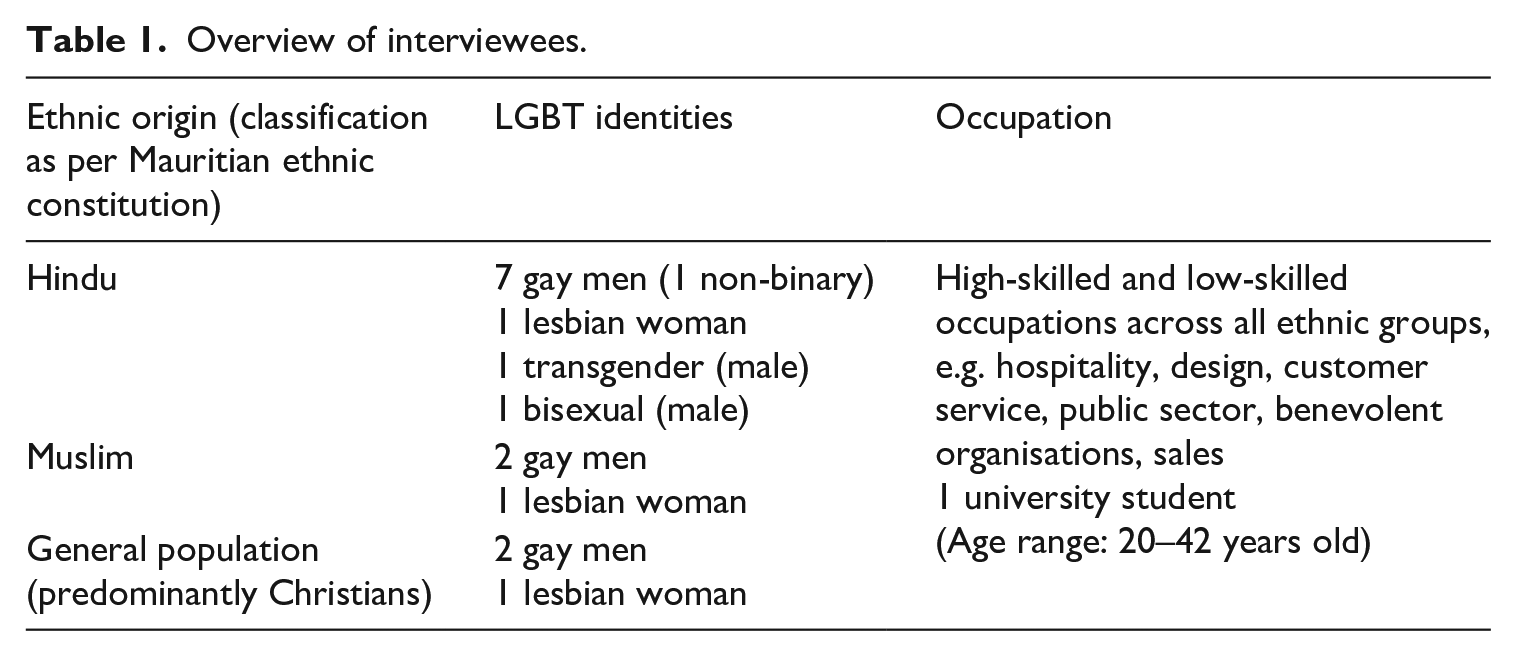
The information obtained from interviewees was contextually rich, and involved an in-depth consideration of the main patterns emerging from respondents’ workplace experiences. Most interviews lasted between one and three hours and provided a strong basis to fully understand and appreciate the iteration between the multi-ethnic context of Mauritian consociational democracy and the types of discriminations and prejudices suffered by members of the LGBT community at the workplace. Situational and circumstantial events needed to be interpreted in the specific positioning of notions of ethnicity and identity in the Mauritian context. All interviewees willingly took part in our interviews provided that their personal details would not be shared and the data would be fully anonymised. We very carefully reviewed the quotes we chose to illustrate our argument in order to ensure that they would not enable anyone to link back the information provided to one specific individual given the sensitivity of the topic. The interview process was stopped once we reached a point of ‘data saturation’ (Guest et al., 2006; Saunders and Townsend, 2016; Saunders et al., 2018), with the same concerns and problems recurrently emerging through the interviews.
Shortly after the interview, the first author of the article went through the data (interview and notes) to order and clarify them. All three researchers participated in the analysis of the data, which involved three main phases. The first phase of the process took the form of qualitative content analysis, which involved identifying, coding and categorising the ‘raw data’ collected (i.e. interview data, which had already been anonymised by the first author). During this phase, the first author ‘manually’ produced a first series of codes that sought to capture the experiences of LGBT individuals at the workplace. In the second phase of analysis, a detailed re-reading of the interview accounts in order to ensure the robustness and consistency of the codes generated was carried out amongst the author team. Themes were then identified and subsequently cross-checked by the researchers in team discussions. This method resulted in a number of direct quotations being chosen and empirical vignettes being created to explain and illustrate the experience of LGBT individuals at the workplace in Mauritius. As we worked through the data to produce themes, we engaged with concepts and debates within various areas of academic research. Key themes from the academic literature on stigmatised LGBT identities, harassment, ostracism, relationship with colleagues and discrimination outcomes, were explored with each interviewee. In the third and final phase of analysis, we sought to formalise our themes in order to articulate the main contributions of the investigation and place our findings in the context of existing research in the area. Both conceptually and empirically, our attention revolved around the complex ways in which the local context was shaping the process of discrimination and stigmatisation as experienced by LGBT individuals at the workplace.
LGBTQI discrimination at the workplace: Empirical evidence
This section presents the empirical findings from our 16 face-to-face interviews and identifies the types and patterns of employment discrimination encountered by members of the LGBT community as well as the consequences as identified by targeted respondents. We document the widespread occurrence of two main forms of discrimination: harassment and ostracism. We also present an overview of the consequences associated with discrimination for targeted employees.
Harassment
The occurrence of harassment constituted the main form of discrimination encountered in organisations by our respondents (13 cases out of 16 interviews) as compared to ostracism (8 cases out of 16 interviews). Concerning harassment, the focus of our analysis is on the main trends emerging from our data collection. Our empirical data reveal that major instances of harassment are characterised by interactions among members of the same ethnic group. Out of the cases of harassment at work, the bulk of our respondents encountered the only episode of harassment, or one main episode of harassment, from members of their own ethnic group.
The two main forms of harassment were the use of name calling/being subjected to derogatory comments by colleagues, and the use of mechanisms designed to set up respondents for failure at the workplace. We review them in turn. First, different harassment mechanisms, and specific variations, were identified during the process of data analysis. Being called names to be made fun of or belittled was common, and was reported by a majority of gay or transgender men (e.g. Respondents 1, 4, 5, 7, 8, 10, 15, 16). Lack of respect, being perceived as weak and being mocked were apparent from the interview accounts with those participants. For men, harassment predominantly took the form of being called names in a ‘humoristic’ manner – respondents reported being referred to as ‘fag’, ‘little fag’, ‘slut’ and nicknames/expressions from India used to denigrate LGBT identities. Nevertheless, those supposedly humorous, and apparently non-confrontational, tones had a strong belittling undertone against LGBT identities. One respondent mentioned being referred to as ‘slut’: ‘In a joking manner [one senior colleague] will say such words [. . .] I felt inferior.’ Being subjected to enquiries about his sexual practices was often met with little option than to ‘laugh nervously as panic-stricken’. This was then further interpreted as a sign of ‘weakness’ and encouraged those harassing him to target him even more. Another respondent stressed the recurrent pattern by which he was openly targeted in a joking manner by colleagues since joining the company. ‘They like to tease me in particular [. . .] saying for example “look at this beautiful girl”.’ Although the respondent added ‘they don’t necessarily say this in a very demeaning way [. . .] there is always a distance’, he also explained ‘this makes me shy instead’, emphasising the belittling nature of the circumstances (Respondent 7). Being called names had a definitive patronising angle. Being called ‘little fag’ in a joking way by his line manager was felt by Respondent 5 as ‘an attempt to intimidate me’. Interestingly, the non-conflictual and ‘just friendly-joking’ nature of the circumstances again came across in the respondent’s account: ‘in the beginning, it was funny, including for me’, ‘after a while though [. . .] this became my identity’, ‘a swear word as my identity’ and ‘colleagues would pick up on this [. . .] I felt like the prey of everyone’, ‘the prey of everyone’s mockeries’ (Respondent 5).
Other respondents stated being subjected to colleagues taunting gay people at their work premises or in social settings. Another respondent, who previously worked as a sales assistant, mentioned that colleagues would target customers with seemingly gay identities entering the shop with negative comments amongst themselves (unbeknownst to the customers). He overheard colleagues saying ‘look at this, look at this fag there’, which ended up in him not being comfortable to come out then: ‘I was afraid I will be treated differently [. . .] people will refer to me as [a] fag and so forth’, ‘I was not open about myself, I was someone else’. Another respondent stressed the deliberately mocking character of such actions. Referring to her line manager: ‘He was using the word “pilon” [fag] every time with me’, ‘he called me fag loud in front of my friends [re colleagues]’, ‘he was doing this on purpose for me’, ‘he felt pleased by calling me fag’ (Respondent 1). The belittling character of harassment almost invariably took an indirect form. Another respondent was the only case involving direct out bursts of anger when confronted by an annoyed colleague who questioned him in an open setting about being a ‘fag’ and acting like ‘a girl’, to which he replied ‘it’s my choice. . .’ and let it be. Even then, his interpretation was that this was done ‘to mock’ him.
Another variation we identified is that compared to gay men, harassment against women was, on top of sometimes being mocked, also being reminded about their ‘genders’. For example, a respondent overheard conversations (i.e. non-direct interactions) where she would be ‘mocked’ and referred to as a ‘sin falling on earth [. . .] as a slut who does not like men’. Moreover, offensive remarks would be overheard at work: ‘when I was making presentations in front of everybody I was hearing “dirty lesbian” and similar stuff’, ‘they were talking about me as if I was not here’ (hence non-direct), whilst the senior colleague heard these remarks most of the time and did not say anything, and acted as if he ‘were not hearing anything’. In turn, considered as ‘not liking men’ is equivalent to failing in meeting traditional expectations for women. This was a pattern confirmed by the other female respondents. During a casual discussion with her senior colleague, Respondent 11 was met with disbelief when she revealed her sexual identity and told that she could change, which she considered as ‘ignorance’. She mentioned this was intended to make her feel this ‘was not right’ even if it was not done in a ‘bullying’ way, and felt her ‘mood being spoilt’, ‘a bit sad’ and ‘I thought I could trust someone who [would] be supportive but I did not get that support’. Another informal workplace conversation about pregnancy transformed into a heated argument for Respondent 12, where she felt ‘targeted, as on an arrow tip, and there was just the arrow to be sent [. . .] in a dry dialogue’ and ‘as if [the colleague] was accusing me’ with remarks in the form of ‘all girls want to become mothers, become pregnant and have children’.
Second, a strategy we term ‘setting up for failure’ was another harassment mechanism frequently reported to have been used as a way for confronting stigmatised LGBT identities at the workplace. More generally, interview data highlight the extensive recourse to alternative and more indirect mechanisms of harassment against non-heterosexual workers by employers and co-workers to circumvent legal penalties associated with overt workplace discrimination in Mauritius. A frequent finding from our study is that LGBT workers are deliberately set up for failure in numerous instances. Discrediting employees because of their work ability makes it easier to make them feel inadequate for the position, which then leads to LGBT employees being at a higher risk of losing their employment, being given lower work responsibilities or fewer promotion opportunities. Setting up for failure was embodied in various forms of harassment. Firstly, increased work pressure and higher workloads were common, which in many cases correlated with LGBT employees being perceived as suffering from reduced work credibility. Respondent 1 mentioned having a breakdown with her supervisor after being repeatedly told to work ‘faster, faster’. A respondent had been penalised at work in numerous ways, which overall took the form of accusations about lower work performance, hence higher work pressure, becoming routine overnight, whereas before she was considered ‘the brain of the team’. For instance, criticisms by her senior colleague were sometimes levied against her physical appearance as well as work performance: ‘in front of colleagues [. . .] and clients’, e.g. having dishevelled hair, ‘which was never a problem for [the senior colleague] before as I was always well groomed’ as if she ‘just woke up in the morning’, or on her delivery/methods of working: ‘this is not how we taught you to do this [work task]’ and ‘you need to step up’ even if she ‘did my job, exceeded the target that was set’. This form of harassment is reinforced in different ways as when another respondent was made ‘also responsible’ by his senior colleague after remarks were made to the senior colleague further to a negative task outcome. The respondent was told ‘you should know what are my mistakes’, and reflected ‘I find this a bit silly as I do not know about all [of the colleague’s] deliverables and I have my task list as well [. . .] I cannot be in charge of everything, [the colleague] should not crush me in this way’. Increased work pressure was routine for the respondent: ‘it is quite a demanding work [. . .] requiring a lot of time, more skills, more knowledge [. . .] but [another senior colleague targeting him] required the work in a short period of time, and when I was doing it in short period of time it’s normal the work will not be as well performed and I will then be scolded’. Hence, being set up for failure because of perceptions of decreased work ability was highlighted, following which LGBT employees would be seen as unfit for the job or not meeting work expectations.
Being set up for failure also took the form of not being provided with the right set of instructions. Respondent 3 felt being penalised in terms of access to resources, support networks and access to information. In contrast to standard practice, she had received the details for her forthcoming presentation at very short notice, which she described as part of the numerous workplace issues she suddenly faced with her manager and co-workers after her identity was revealed. She mentioned having to ‘rehearse with my mum at home [. . .] on the eve I was learning my presentation by heart until 3 or 4 am [so as] not to have criticisms on the next day’. Moreover, respondents reported getting the blame for not executing the tasks properly, on top of not being given the right instructions. Respondent 4 experienced out bursts of anger from his senior colleagues and reflected that their tactics included not giving him the required instructions.
Being set up for failure ultimately also materialised into work deliverables not being completed as per expectations, demonstrating that this tactic needs to be understood as a form of discrimination outcome. ‘One incident I recall [. . .] where the work was not well done, because I was not given the right instructions [. . .] and the work [went ahead]’, recounted one respondent. Further, some respondents felt their superiors used the process of work evaluation to target LGBT identities: ‘this is what they did and it is so visible that everybody could see’ (Respondent 4). A respondent, who was the only case to have reported superior colleagues for making degrading jokes about his LGBT identity in the office, described how, in turn, this resulted in a combination of him being put under intense pressure for work deliverables and not being given sufficient instructions, as previously reported. This contributed to the intense pressure he reported, and led to situations of intense panic during work interactions with his senior colleagues, which was then followed by demeaning criticisms about his attitude: ‘They use terms like do you have shit in your head? You do not think enough? You act as a crazy person, you panic, your head is not here.’ This highlights the deliberate attempt to set up for failure, the instrumentalisation of the workplace/work relationships in the process and yet again the recourse to direct confrontation over work-related aspects. Being put under pressure resulted in LGBT respondents being destabilised in their work deliverables (Respondents 1, 3, 4 and 8). Threats to job security also exacerbated the intensity of the work pressure in many cases because if ‘somebody gets similar remarks several times people will have grounds to give warnings’ (Respondent 4). Respondent 10 also pointed to another dimension of employment security – he avoided complaints so as not to be responsible for colleagues’ possible job loss, but similarly to Respondent 4 added that the company can act once or twice on complaints but if this is recurrent they might start seeing him as being the problematic one instead and find a way to dismiss him.
In some cases, episodes of harassments on account of perceptions of lesser work credibility led to decreased work responsibilities over time as opposed to being deliberately pressurised with higher work demands. Respondents reported that their responsibilities at work were gradually eroding, where ‘before I was the brain [. . .], my boss was telling me “look and see if this is right”, and then he was leaving but since he learnt he stayed put, I was no longer looking after others, he got back to his place again’; in other words she was no longer being given the same responsibilities (Respondent 3). Penalties resulted in her being given only about 30% of her previous workload: before ‘my boss was putting me on all [. . .] projects, everything’ as ‘I was his best [employee]’, which stopped and resulted in lower payment and being cast aside, and no longer given ‘more opportunities’ (Respondent 3). Respondent 13 told his partner not to disclose his LGBT identity at this workplace in Mauritius so that he would not end up ‘filling boxes in the basement’, whilst Respondent 10 observed how in the hospitality industry gay men would be involved in ‘flower bouquet’ types of roles instead of managerial positions.
Ostracism
Whilst harassment was the most common form of disciplinary mechanism, ostracism was also present in a number of cases (8 out of 16) (Respondents 2, 3, 6, 8, 10, 12, 13 and 16). LGBT respondents were ostracised by members of the same ethnic group as well as by members of other ethnic groups. Respondent 6 mentioned that a colleague did not communicate important information deliberately, leading him to have ‘to work out everything again [all my workings and solutions]’. He added that his colleague was keeping her distance without making any remarks, ‘always seemed to be in a bad mood’, ‘we were in the same [room] but never really interacted [. . .] we never walked or ate together’. ‘We never greeted each other in the morning.’ ‘It’s true there was a big distance between us’ – ‘We used to have lunch in the same room [. . .] as soon as she sees me arriving she will take out her mobile and start sending texts just not to have to talk to me.’ A respondent felt ostracised during work-related social activities after coming accompanied with an LGBT friend and moreover mentioned, ‘Because they are very very religious, their parents as well, before I was going to their place so that we could work on projects for [work activities]’ and afterwards they were no longer asking her to come. Episodes of ostracism became routine: ‘I said “good morning” to everybody, everywhere I was walking I was bringing smiles to faces, but they since they learnt about it they no longer looked at me, not even to say “good morning”.’ Respondent 2 reported being ostracised particularly by employees from other departments: ‘In other departments yes [. . .] they look at me [differently], like he is gay, we should not get closer, should not talk to him, they will send me weird looks.’ He sees they make a deliberate effort to avoid him. ‘I arrived at work and they were near the stairs and smoking, I waved my head at them, nothing, they did not respond at all’ (Respondent 2). Respondent 8 stated that he was heavily ostracised after a coming out episode: ‘One girl [. . .] who is all about Jesus [. . .] since she knew I was gay completely stopped talking to me [. . .]. She was talking to me before [and now] walks straight in front of me in the corridor.’
Respondent 13 and another LGBT colleague were systematically ostracised by a group of colleagues. The group moved from behind them in a queue to go far behind to purposefully distance themselves, whilst important work matters would be fed back to other colleagues despite those colleagues being further away in the office space, who would then communicate the information instead. During face-to-face interactions, a respondent stopped participating in the conversation since a group of colleagues deliberately ignored him and only talked to his colleague instead, who would then feed back important information. In turn, ostracism experiences also underpin another dimension of being deliberately set up for failure – shrinking work networks can negatively impact upon one’s organisational sense of belonging, work commitment and productivity, as captured in the above experiences, e.g. a disadvantaged position in terms of sharing of information and full participation in organisational life.
LGBT discrimination at the workplace: Consequences of discrimination for targeted employees
Our respondents highlighted the range, and varieties, of negative consequences associated with the occurrence of discriminatory practices at the workplace: being perceived as an embarrassment for the organisation, feeling inferior and devalued, and being perceived as difficult to manage by colleagues. Being seen as an embarrassment for the organisation was an important workplace challenge that respondents had to face, but again in an indirect (non-confrontational) manner. A respondent was deliberately not included in contracts involving clients with a religious orientation for whom ‘it is inacceptable and against nature’ and ‘they are sometimes worse than Catholic families in France’: ‘I don’t know if this is [. . .] so that I am not embarrassed or for [the organisation] not to be embarrassed.’ Thinking his sexual orientation was perceived as staining the organisation, a respondent added, ‘What was funny is that then my colleagues came to ask me for advice to my office with regard to this [. . .]. It is quite striking that sometimes I was saying I was happy to be in the meeting with the client with you [. . .] Then I was told no, no, no don’t worry [. . .] this was implicit [. . .], but in Mauritius this is very rarely a coincidence [. . .] most of the time it’s well thought through.’
Our respondents also highlighted that being a member of the LGBT community resulted in being perceived as inferior, devalued and abused as a result of not fitting in. As mentioned by Respondent 4: ‘I thought that to some extent, [it was] the fact that I was gay and effeminate, [a senior colleague] was using this [. . .]; if I was a dominant male, [the colleague] would have difficulties to make those remarks.’ The link with his work being identified as inferior as well, as mentioned previously, was hence put forward in a number of ways: ‘she might have told those things without thinking things through, she perhaps thought “you are already gay, you are already au bas de l’échelle [bottom of the social ladder], what can happen to you more?”’ In another case, respondents reported feeling a direct cause and effect between not conforming to expected norms and perceived inferiority. When asked if he thought he was perceived as not being up to the game owing to his LGBT identity, one respondent (Respondent 10) said: ‘yes, definitely, it is usually the case, with the looks and the comments, they make you understand that you are not up to the level, not in the norms [. . .] I am inferior, I am not worth anything [. . .] since I don’t go out with a woman, I am not sleeping with a woman, I cannot have children, it’s not because I am gay that I cannot have children, because for them in their heads you are gay so you cannot have children which is totally false so already they make you believe you are not worth anything’. These accounts emphasise the fact that not easily fitting into one of the three ethnic-based religious categories was equivalent to being not worthy of consideration. Finally, our respondents highlighted that work colleagues found them difficult to manage. On account of being pressurised to work more by his direct reporting lines, which he already saw as a form of harassment, a respondent mentioned how he was reported as being problematic in daily interactions, which intensified systematic stigmatisation. The respondent also mentioned that they thought ‘maybe this will make me work more [increased work pressure] [. . .] but once I said to my senior colleague “I don’t think this is right” but [the colleague] thought I was not speaking well, [. . .] took it personally, had a clash with me, said that I was very problematic to my boss’.
Discussion and conclusion
Mauritius has been characterised as a success story of ‘unity in diversity’ whereby three different, non-hegemonic, groups are peacefully cohabiting. This reflects the choices of post-independence policy-makers to prioritise the management of conflict across different ethnic groups (Eriksen, 1998). Yet, the presence of discrimination aimed at LGBT employees is pervasive, as well as being context-specific, as illustrated by our empirical data. What accounts for the specific character of LGBT workplace discrimination in Mauritius?
Building on the insights of economic sociologists on the mediated incorporation of practices (Djelic, 1998; Dobbin, 1994), our analysis highlights the importance of framing and the influence of the local context. LGBT discrimination invariably takes different forms that reflect its mediation across contexts (Stenger and Roulet, 2018; Tilcsik et al., 2015). The incorporation of practices is shaped by the process by which it is framed (Benford and Snow, 2000; Campbell, 2005). Framing entails the prioritisation of specific dimensions of the practice. The incorporation of practices is also shaped by its contextual resonance, namely the extent to which framing fits with acceptable local norms (Fligstein and Mara-Drita, 1996; Hall, 1993).
Our empirical analysis highlights the ubiquitous incorporation of LGBT workplace discrimination – a process facilitated by the characteristics of the Mauritian context. The legislative framework of antidiscrimination policies is not adequate to stem occurrences of harassment and ostracism. Mauritian policy-makers have refrained to use its antidiscrimination apparatus to compel companies and organisations to implement diversity training programmes (Lallmahomed-Aumeerally, 2017). Lawsuits related to discriminatory practices, if successful given that the burden of proof is borne by the plaintiff in cases of direct discrimination, result in the circumscribed outcome of the imposition of financial penalties.
Moreover, the characteristics of the local context have been influential in two aspects of LGBT discrimination at the workplace in Mauritius: the importance of being set up for failure, and the prominence of negative consequences stemming from discrimination for targeted employees. These different aspects of discrimination stigmatise LGBT employees in a manner that does not elicit ethnic conflict. Setting up for failure constitutes an important mechanism for confronting stigmatised LGBT employees in the Mauritian context. Formal-legal protection against discrimination based on sexual orientation leads employers, and co-workers, to use alternative mechanisms of stigmatisation against non-heterosexual workers. Discrediting employees based on their work ability increases their feelings of inadequacy, thereby increasing the vulnerability of LGBT employees to employment termination without generating ethnic conflict at the workplace.
Moreover, LGBT employees face a series of negative consequences associated with discrimination (harassment and ostracism) at the workplace: being perceived as an embarrassment for the organisation, feeling inferior and being devalued, and being perceived to be difficult to manage. These negative consequences flow notably from the extensive use of mockery (harassment) and ostracism at the workplace. Reflecting on the influence of the Mauritian context, the extensive use of mockery made in a joking manner and in some indirect way trivialises the severity of the derogatory comments, minimises open confrontation, and enables the perpetrators to avoid facing penalties for legal transgressions. The common thread associated with mockery and indirect remarks is the stigmatisation attached to LGBT identities in Mauritius that do not fit the government’s focus on promoting ancestral cultures (Eisenlohr, 2006b; Ng Tseung-Wong and Verkuyten, 2015). The use of mockery illustrates the costs associated with deviations from ancestral norms and cultures. LGBT employees are targeted since their sexual orientation constitutes a form of decoupling from their own ethnic group. The recourse to ostracism, on the other hand, constitutes a strategy designed to induce strong feelings of not belonging and worthlessness against targeted employees without the fear of facing legal penalties. Overall, this strategy contributes to the stigmatisation of LGBT employees in a manner that avoids ethnic conflict, but forcefully conveys the message that gay men and lesbian women do not fit in. Setting up LGBT employees for failure illustrates the combination of the prominence of ethnicity as the main form of identity and the lack of mechanisms to regulate interactions between different groups (Eriksen, 1998; Ng Tseung-Wong and Verkuyten, 2010).
Our study contributes to sociological approaches investigating workplace discrimination patterns against the LGBT community in a multicultural setting that is non-Westernised (Corrales, 2020; Encarnación, 2016; Luiz and Spicer, 2021) and demonstrates the importance of framing in the process. Our analysis illustrates that discrimination patterns are the result of the complex causation mechanisms reinforcing each other within the set of institutional specificities and constraints in which actors are embedded. In Mauritius, discrimination patterns tend to take forms that circumvent legal protections on the ground of sexual orientation in the workplace and counter perceived threats to both ethnic identities and social cohesion amongst ethnic groups in a context of the underdevelopment of mechanisms to reduce barriers to participation for disadvantaged groups (Lallmahomed-Aumeerally, 2017; Ng-Tseung Wong and Verkuyten, 2015). This type of complexity is well captured by our research methodology based on an in-depth exploration of the workplace discrimination experiences by LGBT people, thereby providing a very rich understanding of the types of discrimination mechanisms at play within this context.
In terms of future research, our analysis would connect to studies that highlight how sexual identity is just one of many facets of personal identity; race, ethnicity or gender are key factors in understanding the unravelling of discrimination at the workplace and beyond (Nadal et al., 2015). The intersectional dimension of discrimination, while not the focus of this study, needs to be accounted for in the unfolding of discrimination.
Footnotes
Acknowledgements
We thank Jan Ottosson (Managing Editor) and two anonymous reviewers for their guidance and constructive comments. We thank Asmund Rygh as well for his insightful comments on the draft versions of the article. We are grateful to the Young Queer Alliance (YQA) and the Collectif Arc-en-Ciel (CAEC) for their collaboration with this research, and to all the respondents who took part in this study.
Declaration of conflicting interests
The authors declared no potential conflicts of interest with respect to the research, authorship, and/or publication of this article.
Funding
The first author received an internal grant (Research Support Fund) from the Alliance Manchester Business School, University of Manchester.
