




Abstract
Existing research has found heterogeneity in the implementation of Lean and its outcomes in terms of employee involvement across countries. This article explores the potential role of labour–management relations. It relies on in-depth company case studies carried out in the aerospace industry in France and Sweden. The study finds significant variations in employee involvement – higher in the Swedish than in the French cases. Managerial orientations did play a role, as the ‘technocratic’ form of Lean in France echoed a more unilateral top-down conception of management, while Swedish managers appeared more receptive to the ‘involvement-enhancing’ paradigm. But the attitudes and behaviours of unions were also a crucial factor, as Swedish unions were very effective in impinging on the implementation of Lean at workplace level, while their French counterparts, often divided, adopted a more defensive stance, lacking expertise and implication in the promotion of high-involvement work organisations.
Introduction
It has been more than 30 years since the Lean production system was introduced in the automotive industry and soon popularised by the book The Machine that Changed the World by Womack, Jones and Roos (1990). Since then, the concept has spread to a wide range of organisations in both the private and public sectors; its vagueness contributing to its success as a managerial fad. The overall idea, however, has been to optimise the whole supply chain inside companies, but also with suppliers, in order to reduce costs by waste elimination, to monitor quality with formal standards and procedures, to seek continuous improvements, as well as to be more reactive to the customer demands. In addition, Lean production systems (LPSs) also rely on a bundle of tools and procedures, such as Kanban, team organisation, orderliness, value stream mapping, visual management and quality control process charts.
A critical literature soon emerged to pinpoint the unfulfilled promises of Lean production in terms of employees’ involvement, not least in the automotive industry, where Lean was first introduced (e.g. Garrahan and Stewart, 1992; Jones et al., 2013; Rinehart et al., 1997), but also in many other industries (Bamber et al., 2014; Hasle et al., 2012). For its promoters, Lean required employee involvement, in particular for quality management and continuous improvement. According to Womack et al. (1990: 14), one important characteristic of LPSs was ‘to push responsibility far down the organisational ladder’.
However, overall empirical evidence is mixed, suggesting that employee involvement is neither a necessary component of, nor incompatible with LPSs, which may in fact be associated with different work processes (Angelis et al., 2011). While there is substantial empirical evidence on the diversity of LPSs in terms of employee involvement, a coherent and comprehensive assessment for explaining factors of this diversity is still lacking. The type of product and production process may impact on how Lean implementation translates into work processes that differ according to the level of employee involvement. Employee involvement typically tends to be higher in capital-intensive industries, when products are less amenable to standardised production, or when firms face changing environments (Boxall and Winterton, 2018). Beyond these economic and technological constraints, which may account for differences across companies and/or industries, heterogeneity in the implementation of Lean and its outcomes across countries (Boyer et al., 1998) indicate there is a need to understand how Lean implementation and its associated degree of employee involvement may be contingent on national institutions (Godard, 2004) and/or culture (Oudhuis and Olsson, 2015). Our research assumption here is that the labour–management relations are a key mediating factor between institutions and culture on the one hand, and Lean implementation and outcomes in the workplace (i.e. company and/or establishment) on the other hand. But the role of labour–management relations in different national contexts has received little attention so far (Bamber et al., 2014; Hasle et al., 2012).
Against this background, this article focuses on the impact of labour–management relations on employee involvement in Lean production systems in two countries: France and Sweden. These two countries, with comparable development levels, offer contrasting national cultural and institutional contexts. They also both display important differences with Anglo-Saxon/English-speaking countries – in particular the United Kingdom (UK) and the United States (US) – on which the great bulk of the existing literature on LPSs in manufacturing is centred. To control for technological and economic factors as much as possible, the article is based on company case studies in similar companies in a given sector, namely the aerospace industry.
The article is structured as follows. The next section sets up the framework of analysis. Then we present our methodology and case selection. The fourth section presents the main findings concerning the variations in Lean implementation and employee involvement, casting light on some significant differences across countries. The fifth section analyses the role of managerial orientations and union attitudes as well as strategies in explaining these differences across our cases. The sixth section discusses our results, and in the final section we draw the main conclusions.
Accounting for employee involvement in LPSs: An analytical framework
The variety of employee involvement in LPSs
LPSs allow for a certain variety of work processes in terms of employee involvement, which is supposed to impact positively on employee performance. According to the so-called ‘Ability-Motivation-Opportunity’ framework, widely used in the human resource management literature, employees perform well – in terms of competency and efficacy, discretionary effort and creativity and innovative behaviour – if they have the abilities to do so, if they are adequately motivated, and if their work environment provides opportunities to participate (Appelbaum et al., 2000). These are the essential dimensions of employee involvement.
The acquisition of skills is a key element of ability. This can be done by education and training, but also by discretionary learning deriving from employees’ opportunities to build competencies in their job and to mobilise and use them. Discretionary learning opportunities depend on the job scope, in particular the nature and the variety of tasks, and are positively correlated with carrying out complex tasks, solving unforeseen problems and learning new things, and can be fostered in particular by job rotation (De Spiegelaere et al., 2014a, 2014b; Gallie, 2013; Lorenz and Valeyre, 2005). Such learning opportunities also depend on the employees’ autonomy in terms of task discretion. This refers to their decision latitude over their own work activity, in particular their control over the order of tasks and the pace of work, but also, more widely, the overall decision latitude over their method of work, and therefore their ability to mobilise their own expertise to organise their daily work. However, autonomy does not mean isolation. Adequate feedback and a supportive work environment are crucial for enhancing ability and motivation (Angelis et al., 2011; Neirotti, 2020). Support is provided by co-workers, team members and supervisors to perform tasks and meet production and quality standards. The feedback and coaching of managers (in particular first-line managers such as ‘team-leaders’) is also important. Participation is also a key feature of employee involvement. It refers to the degree to which the employees, beyond their own task discretion, have their say on how work is organised more broadly – what is labelled ‘organisational participation’ in the European Working Conditions Survey. It depends on whether workers: are consulted before objectives are set for their own work; are involved in improving the work organisation or work processes of their own department or organisation; and are able to influence decisions that are important for their work (Eurofound, 2017: 80). One may distinguish direct forms of participation ‘in which employees are personally involved in influencing decisions about work’, as opposed to forms of ‘indirect participation, in which their influence is mediated by representatives’ (Gallie, 2013: 454). Empirical research has shown that, in addition to job security (which favours both the investment in learning and the intrinsic motivation), task complexity, task discretion, learning opportunities, role breadth and opportunities to participate are not only favourable to employees’ competencies and commitment, but also to creativeness and innovative behaviour (Bos-Nehles et al., 2017; Gallie, 2018; Shin et al., 2018).
The compatibility between LPSs and high-involvement work processes, however, is not straightforward (Angelis et al., 2011; Neirotti, 2020). On the one hand, LPSs require some autonomy and initiative, as employees at all levels are supposed to participate in quality management and in the continuous improvement of processes. On the other hand, LPSs rely on formalised and prescriptive standard operating procedures which tend to reduce job discretion. The value stream optimisation – often associated with ‘just-in-time’ stock management – and the pull system tend also to limit the employees’ control over their work pace, while inducing work intensification, and increasing work pressure from both the upstream and the downstream of the value chain, thus limiting workers’ real independence. The contradictory pressures on autonomy led De Treville and Antonakis (2006) to distinguish the ‘responsible autonomy’ fostered by Lean, referring to quality controls and participation in problem solving and improvement, from ‘choice autonomy’, which refers to the freedom over job procedures and timing. The authors found that Lean may reduce choice autonomy, but the potential negative impact on intrinsic motivation, and therefore worker commitment (see also Angelis et al., 2011) may be compensated, at least partially, by increased intrinsic motivation induced by higher responsible autonomy and work facilitation associated with Lean – except in the cases of ‘excessive leanness’.
The different levels of employee involvement found in LPSs also result from the fact that Lean is an umbrella concept covering different versions, with some principles as common denominators, but with some variety of tools and procedures when it comes to their implementation (Hasle et al., 2012). Vidal (2007), in his case studies of firms implementing Lean in the US manufacturing industry, found that there was a selective adoption of work practices. Some cases appeared ‘lean enough’ for managers: despite low employee involvement, they generated significant performance improvement captured by standard measures that met management goals. There could be a level of delegation of responsibilities and some consultation, but without effective authority and regular engagement in decision-making and problem-solving (Vidal, 2007: 202). Involvement remained at best ‘nominal’. Other case companies even moved towards neo-Taylorist processes. Conversely, in still others, Lean did not necessarily induce work intensification or more limited employee discretion, or impact negatively discretionary learning. There were also case companies where involvement was more ‘substantive’. Overall, a wide variety was found, echoing the distinction made by Godard (2004) in an early critical survey of high-performance work processes, between ‘Lean intensification’ and ‘Lean involvement’ types of production systems. The key issue is therefore to identify what the key variables are that may account for variations in Lean implementation and associated employee involvement.
How Lean translates into different work processes: The role of labour–management relations
The way Lean principles translate into a given work process (with its associated degree of employee involvement) depends on the organisational choices that are made at workplace level (i.e. establishment or company level). These choices may be constrained by economic and technological factors. The literature suggests that the type of product and production process may play a role. On average, involvement is higher when the product is less amenable to standardised production (Boxall and Winterton, 2018): i.e. in small batch, or continuous-processes rather than mass production, which is often associated with shorter cycle times and assembly lines with reduced job scope. Crucial features such as job content and associated discretion may also be influenced by the degree and type of automation (Heckneby et al., 2021). Furthermore, different market contexts and associated economic pressures (i.e. type and intensity of competition and position in the supply chain) are of importance for the management of the value stream and the work intensity at workplace level (in particular through ‘just-in-time’ requirements), but also for the formalisation and prescriptiveness of the operating procedures.
Given these constraints, within the framework of an LPS, there is always some room for organisational work choices that may result in lower or higher employee involvement. Managerial orientations may play a key role here. As pointed out by Vidal (2007), managers may have different views concerning the optimal level of employee involvement for achieving employee and organisational performance. An involvement-enhancing managerial orientation may contrast with a more ‘technocratic’ orientation, more focused on formalised operating procedures and tight monitoring of the work process. The technocratic orientation favours technical rationality that puts strong emphasis on standards and formalised procedures. Managers’ orientations can also depend on their position in the company. For instance, there may be differences between production managers and human resource managers (Bamber et al., 2014), or between high-level operation managers and first-line managers. The former (i.e. production managers and/or high-level operation managers) may be more prone to defend a technical rationality that may severely limit substantive involvement, in particular when the focus on standardisation undermines attempts to foster participation (see for instance Vallas, 2003).
The way Lean is implemented does not depend only on managerial orientations, it is an interactive process depending on employees’ attitudes and reactions. Vidal (2007) has noted that increased autonomy in terms of job discretion and responsibilities implied by high-involvement work processes are not always welcomed by employees. Some authors have pointed to the low ‘learning orientation’ of some employees – defined as a low desire to develop one’s competencies – as being an obstacle (Shin et al., 2018). The desire or motivation of an individual to learn (Felstead et al., 2015) may not depend only on the worker’s ‘learning orientation’ (considered as a psychological trait) but also on his/her past experience in terms of jobs, education and training. In work processes with jobs with low learning demand (in particular Taylorist processes), we may expect a higher proportion of employees with low learning motivation concerning their job tasks, because workers with low learning motivation have been selected to fill these jobs and/or because low learning demand jobs may impact negatively on learning motivation. Overall, the potential for employee involvement may display some path-dependency. The technocratic form of Lean may emerge more particularly in companies in which purer Taylorist work processes were implemented in the past.
Unions’ orientations and strategies concerning changes of work processes and their power to pursue their objectives also affect the different dimensions of employee involvement. Beyond the usual concern about pay and job security, unions may be more or less active in the promotion of other dimensions of job quality, in particular job discretion. Unions can also be key actors in the participatory dimension of employee involvement, depending on their attitudes towards managerial attempts to develop participation in a broader sense (i.e. concerning work organisation and processes of the own department or entity). Danford et al. (2014), for instance, in their study of UK companies in different industries (including the aerospace sector), contrasted two union attitudes. ‘Cooperative unionism’ nurtured informal and formal partnership, while considering that participation in management decisions could generate mutual gains. By contrast, some unions stuck to much more adversarial positions, hostile to any partnership arrangements.
Union attitudes and strategies are not only a matter of ideological orientations. They also depend on the power resources unions can rely on to pursue their objectives (Doellgast et al., 2018; Ioannou, 2020; Schmalz et al., 2018; Wright, 2000). Unions’ capacity to mobilise their members and collectively put pressure on employers – i.e. their ‘associational’ power – is a key factor that depends in particular on the solidarity among workers, but also on issues such as the unionisation rate and the union’s organisational efficiency in the workplace and at the industry level. Moreover, unions’ capacity to impinge on managerial choices results from their ‘structural’ (or positional) power, depending, at workplace or industry level, on their members’ distinctive skills and situation on the labour market (slack or tight), and on the position of their firm in the supply chain. The institutional context also contributes to shaping the power resources of unions at industry and workplace levels. Employment protection, freedom of association, the right to strike, welfare state support, collective bargaining arrangements and, for instance, laws on workplace participation concerning co-determination and health and safety, provide unions with ‘institutional’ power. This drives the attention to societal factors that may have strong national specificities.
Cross-country differences: The role of societal factors
Empirical evidence suggests that LPS features vary across countries (Bamber et al., 2014; Boyer et al., 1998; Godard, 2004; Oudhuis and Olsson, 2015; Oudhuis and Tengblad, 2020). This points towards the potential role of national contexts: i.e. societal factors, which can be defined as relatively permanent systemic features – institutional or cultural – specific to a given society. Societal factors shape not only the formalised rules that may serve as constraints or resources for the actors at company and establishment levels (managers, employees and unions), but also the representations and patterns of practices of these actors.
Formalised rules include in particular the industrial relations system and other labour market institutions. In their comparative study of the spread of different work processes across European countries, Lorenz and Valeyre (2005) found that high-involvement work processes (what they labelled ‘learning organisations’) were under-represented in countries like the UK and Ireland, suggesting that ‘the deregulated labour market context in these nations fails to provide the necessary institutional support for establishing substantial forms of autonomy in work, both at the shop floor and higher levels’ (Lorenz and Valeyre, 2005: 438). Along similar lines, Godard (2004) has even suggested that substantive employee involvement was not compatible with the nature of employment relations in so-called liberal market economies.
In addition to these institutional factors, national cultures – defined as collective ways of thinking, feeling and acting (Hofstede, 1991) – also have a role, in particular because they contribute to shaping the conception of hierarchy and social status in work relations, impinging not least on managerial orientations and induced organisational choices. For instance, the Japanese culture is biased towards collective decision-making (e.g. in the sense that it is important that decisions are sanctioned by the whole group), perfection (conceived as the respect of procedures) and obedience and valuation of hierarchy, and favours a form of Lean with highly formalised procedures (Oudhuis and Olsson, 2015). This contrasts sharply with Scandinavian culture, which is more individualistic and more oriented towards self-government and equality, and which favours higher-involvement forms of the LPSs. National culture is both a determinant and an outcome of another key societal factor, the system of education and training. The latter not only shapes values in terms of individualism and egalitarianism and contributes to the definition and diffusion of the national culture, but also has an impact through institutional channels – such as the apprenticeship system for instance – on job definition, hierarchical relations and the whole-work organisation (Bakke, 2021; Hall and Soskice, 2001; Mustosmäki, 2017; Sorge, 1991). Societal factors contribute to explaining why there may be notable cross-country differences in union attitudes and strategies concerning work organisation, with a potential impact on how LPSs translate in work processes. For instance, Gallie et al. (2004) found that in the UK, both union representation and membership were negatively correlated with task discretion at workplace level. This is a legacy of the Fordist compromise prevalent in the UK ‘in which unions traded a high degree of management control over work organisation for greater levels of pay and security’ (Boxall and Winterton, 2018: 27–47), in sharp contrast with their Scandinavian counterparts, who have been much more active in the promotion of job discretion since the late 1960s.
Method and case selection
We carried out in-depth comparative company case studies, to analyse how the attitudes and interactions between management and employees, and their representatives, shape Lean implementation, as well as employee involvement in different national contexts, in line with the analytical framework presented above.
For our choice of countries to understand better the potential role of societal factors, we chose our cases in France and Sweden. These two countries, with comparable development levels, have complete supply chains in the aerospace sector, while offering contrasting industrial relations systems. According to the OECD, Sweden has both a high union density (67% in 2016) and a high coverage of collective agreements (88% in 2018). France also has a high collective agreement coverage (even higher than Sweden, with 98% in 2018), but with a very low unionisation rate (less than 11% in 2018). 1 This is especially true in the private sector, where unionisation was about 8% in 2016 (Ministry of Labour), 2 which is in sharp contrast with about 64% in Sweden (Kjellberg, 2021). National labour law plays the dominant role in the regulation of the labour market in France. By contrast, in Sweden, collective bargaining, supported by labour laws, is a core institution regulating the relations between employers and unions at workplace and industry levels and covers a wider scope of issues. For instance, at the workplace level, collective bargaining is promoted by the Co-determination Act, which stipulates that employers are obliged to negotiate with the unions in cases of changes to working and employment conditions, such as reorganisations, the introduction of new working methods, plant closures, the termination of employment due to the shortage of work, or the relocation of staff to other work tasks (see for instance Nyström, 2020). However, employers make the final decisions, and unions have no right of veto.
Furthermore, there are key differences concerning the number of unions, their ideological orientations and membership recruitment. For instance, at workplace level, French unions are numerous and divided, having contrasting ideological orientations, while competing for both blue- and white-collar membership (Béthoux and Laroche, 2021; Rehfeldt, 2018). By contrast, in Sweden, there is most often only one union for blue-collar workers, along with one large and two smaller for white-collar unions which do not compete for the same employees (Granqvist and Regnér, 2008; Kjellberg, 2019).
Another important difference is that Swedish unions have many years of experience, and the associated accumulated expertise, concerning the negotiation of work organisation related issues, including Lean implementation, in particular in manufacturing industry. The arrangements for social dialogue are anchored in an industrial context with a long history of collaboration between management and labour concerning work organisation (Ahlstrand, 2015), not least from the beginning of the 1970s. From the 1980s, the Swedish Trade Union Confederation (LO), and in particular its affiliate union in the manufacturing industry, Metall (now IF Metall), was active in promoting the ‘socio-technical system’ (STS), a concept which originated in the Tavistock Institute in the UK and that put great emphasis on democracy at work, based on employees’ autonomy and participation (Ahlstrand, 2015; Johansson et al., 2013). Support for STS was part of a more general reflection on ideal working conditions and workplace organisation, under the catchphrase ‘good work’ (Johansson et al., 2013). IF Metall was successful in promoting STS in big companies of the manufacturing sector, starting in the automotive industry, and in particular in Volvo. The interest in STS was developed within the framework of cooperative relations between IF Metall and the Swedish Employer Association (SAF, now the Confederation of Swedish Enterprise), in a context of labour shortage and while employers were themselves searching for organisational innovations to improve quality and productivity (Agurén and Edgren, 1979). When Lean was introduced in the Swedish automotive industry at the beginning of the 1990s, unions were quite critical, as it was perceived as competing with the STS, with more limited employee autonomy and participation (Kosuge, 2014). 3 However, due to an ever-increasing employer interest for Lean, unions adapted their strategy. During its 2008 congress, IF Metall put forward the concept of ‘sustainable work’ as an attempt to defend STS principles within Lean production systems (Johansson et al., 2013).
In France, the general context of social dialogue is quite different from the Swedish one concerning working conditions, and even more, work organisation issues. The French employer organisations have always considered that the organisation of work was (and should remain) an exclusive prerogative of management. On the worker side, among the unions, the Marxian and/or revolutionary view that no real work autonomy and emancipation at workplace level is possible until capitalism is overthrown was strong up to the 2000s – and remains so among some unions (Freyssinet, 2022). In this view, being involved in the conception and/or implementation of work organisation is seen as collaborating with management and a participating in the exploitation process. The new ‘post-Taylorist’ work organisation models that emerged in the 1970s – some of which were strongly inspired by the Nordic countries’ experience – were suspected, in particular by the most powerful union at that time (the communist CGT), of just being new managerial strategies to reinforce exploitation and alienation by soliciting subjective commitment. From the 1950s onwards, French unions have focused mainly on wage and employment issues, and left the conception of work organisation to employers. The Fordist compromise which had emerged was that the employer’s role was to organise the work process to maximise productivity gains. Moreover, this was so in a context in which unions acknowledged the performance of the ‘scientific organisation of work’ based on Taylorist principles (Borzeix, 1980). For their part, the role of unions was to obtain maximum wage increases as counterparts to these productivity gains. As a consequence, there was a ‘strict division of roles’ (Linhart, 1991: 22) between employers and unions. The latter focused mainly on wage and employment issues, and did not interfere with work organisation issues, except for limiting the most negative consequences in terms of physical strain and health, but most often unions negotiated wage compensation rather than organisational changes. French unions were not proactive, unlike the Swedish ones, in the promotion of more high-involvement forms of work organisations (Linhart, 1991; Piotet, 1988; Rochefort, 2013), and therefore accumulated much lower expertise concerning work organisation issues than their Swedish counterparts. In addition to ideological factors, the institutional context also played a role. It was only after the social uprising of 1968 that union branches at firm and establishment level were legally enabled to negotiate with management. Effective (i.e. not only formal) social dialogue and collective bargaining at workplace level – where working conditions and work organisation issues can concretely be dealt with – took time to emerge (Piotet, 1988; Rochefort, 2013). Specific Committees dedicated to working conditions, involving management and workers at establishment level, were legally introduced in the beginning of the 1970s, and enabled to commission external expertise on these issues. 4 However, these Committees mainly focused on the most obvious negative aspects of working conditions (in terms of physical strain and health), without really discussing more general work organisation issues (Catla, 2012). But this overall picture leaves room for important differences across industries and workplaces in France, as the union landscape is more fragmented.
The choice of industry and case companies
Cases were chosen in the aerospace industry, where Lean systems are widespread, but where they were introduced much more recently than in the automotive industry, which has been studied extensively. The aerospace industry has long supply chains, allowing for a variety of products, production processes and market positions. This helps research to control further for both the technological and economic factors at play, by choosing companies with different characteristics.
Case selection was preceded by an in-depth industry report in each country of the overall evolution of the industry, in terms of supply-chain restructuring and the trends in workplace transformations. The reports were based on existing sources (i.e. academic literature, administrative and consulting reports, trade journals and databases), and interviews with a total of 12 industry experts (i.e. representatives of trade unions, employer organisations and research institutes). The aim was to identify economic and technological factors contributing to shaping Lean implementation and associated work process features. As expected, a firm’s position in the supply chain, as well as the nature of its product(s) and its scale of production (i.e. mass production of standardised products vs small batches of niche products) emerged as potential factors of differentiation.
Based on the industry reports, we chose cases in each country that were as similar as possible. The initial aim was to include three companies in each country: one at the top of the supply chain (an original equipment manufacturer [OEM] designing and assembling the final products); one big ‘Tier 1’ supplier of some strategic parts, with therefore higher potential market power; and lastly one smaller supplier of more standardised parts, with much lower bargaining power. Unfortunately, significant barriers to access were encountered that prevented completion of the targeted number of case studies, and this in turn limited the comparability of our study in terms of size (Table 1).
Case studies.
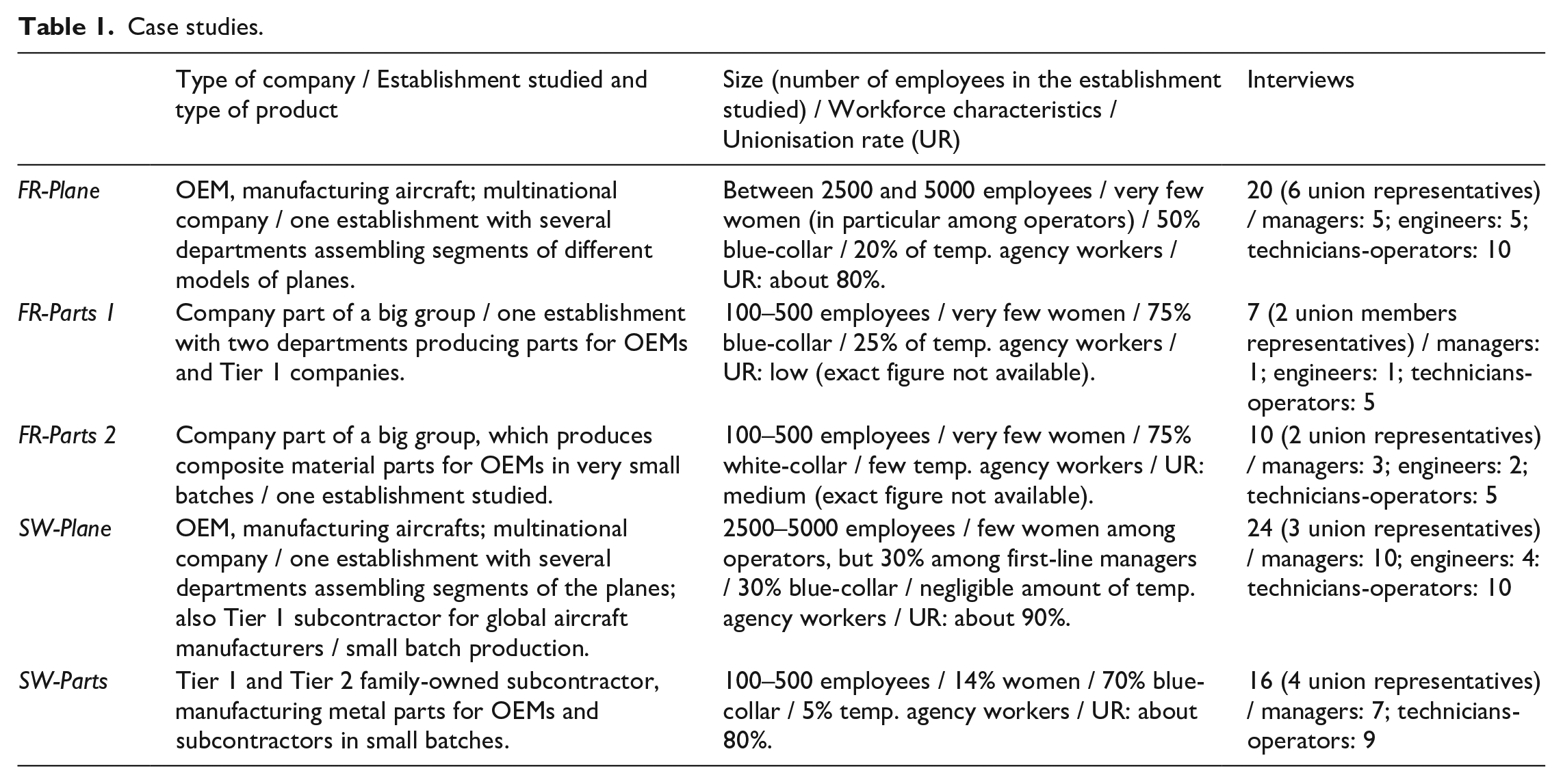
Our units of observation were establishments, but we also gathered contextual information at company level, as important decisions concerning the implementation of Lean were made at this level. All the case companies were covered by collective agreements at both industry and company level, but unionisation rates were uneven (on average much higher in the Swedish establishments). We carried out interviews with the different actors (managers, blue- and white-collar union representatives and employees). We also gathered all the documentation on the company and the establishment we could access. The interviews were mainly individual (face-to-face interviews or by telephone), but also included a small number of focus group interviews (with small panels of union representatives or managers). Overall, we were able to carry out a total of 77 semi-structured interviews during the second half of 2016 and the first half of 2017. All the interviews were recorded and transcribed. The analysis was systematically carried out in relation to our framework, to try to get the most objective picture of the work process and associated employee involvement, and to have a clear idea of the views of the protagonists (managers, employees and union representatives).
Low-involvement versus high-involvement LPSs: The tale of two countries
Lean production elements were present in all the cases, and both management and employees explicitly referred to them as ‘Lean’. Yet, there were different ways of implementing Lean, and employee involvement differed notably across cases. In each country, economic factors did play some role in accounting for differences in involvement across case companies. In particular, in each country, employees’ participation tended to be lower down the supply chain, because of greater economic pressure (in particular in FR-Parts 1 in France, in SW-Parts in Sweden). Large-scale production was associated with higher standardisation and lower discretionary learning – such as in one department of FR-Plane where an assembly-line had been introduced, in sharp contrast with FR-Parts 2 with very small-batch production. Nevertheless, a cross-country contrast clearly emerged from the overall picture.
In the French cases, there was a strong emphasis on standard operating procedures, and the implementation of Lean increased the control over the whole work process by reinforcing in particular ‘management by indicators’. For instance, in FR-Plane, the director of Department C estimated that he had to monitor around 200 indicators to manage the activity of his department, and complained about it. This induced a bureaucratic inflation due to increased reporting requirements. As a result, both managers and rank-and-file employees complained that the former (in particular first-line managers) were more and more in their offices checking indicators, and less and less on the shop floor to answer questions and listen to improvement suggestions:
Before [the new Lean-based organisation] we did not have all these formalised tools; we interacted more directly with the managers, the human dimension was much more important. (Team leader, FR-Parts 1)
Daily morning meetings on the shop floor consisted of running through a formal checklist to detect problems that had occurred, so adjustments or changes could be made as quickly as possible. In FR-Plane and FR-Parts 1, this process was formalised by using the ‘SQCDP’ board covering five issues – Safety (S), Quality (Q), Costs (C), Delivery (D) and People (P) (i.e. human resource indicators, in particular absenteeism) – with a ‘traffic-light’ visual system (green, orange and red). Morning meetings were complemented by multi-functional meetings (i.e. meetings on production, maintenance, logistics, etc.) aimed at facilitating coordination between divisions (within departments) and promoting improvement suggestions from employees. Yet, in the French cases, the operators complained that the morning meetings were mainly reduced to list checking and the top-down transmission of information, and that only team leaders participated in multi-functional meetings. Beyond the sole case of operators, employee participation in decision-making was limited. In FR-Parts 1, for instance, a technician complained bitterly:
Even us [technicians], we are often not consulted [concerning matters that are directly connected to our activity]. The message seems clear: we are not intelligent enough to understand, and we are unable to provide any valuable suggestion to the firm. (Technician, FR-Parts 1)
Concerning task discretion, reduction in the deadlines and the correlative work intensification induced a decline in the employees’ control over their work and the feeling that their professional expertise and practical skills were not important:
Nowadays, the deadlines are so short, that the worker often says ‘OK, I will sacrifice this or that in order to be able to meet the deadlines [. . .]’. And the workers are not happy with this. (Technician, union representative, FR-Parts 2)
Overall, in the French firms, the work organisation was not favourable to autonomy and discretionary learning. Several operators complained that informal daily creativity was displaced by the standardisation and degradation of work. As an operator and union representative in FR-Plane, put it:
[In the new work organisation] there is a loss in innovation [. . .] you don’t have to think anymore, you just have to follow the instructions [. . .] the autonomy of workers has been reduced, and correlatively, their capacity to innovate. [. . .] Monthly meetings have been introduced, and so have suggestion boxes [. . .]. But this does not replace good practice: making improvements by mobilising the workers’ intelligence on the job [. . .]. You need the know-how of workers. (Operator and union representative, FR-Plane)
This low level of involvement is all the more paradoxical given that French companies had invested in several tools to foster employees’ suggestions, as mentioned in the French operator’s quote above. These included a suggestion box, contests and awards for the ‘best innovation’ (of any kind) – instruments that were absent in the Swedish companies. 5 However, the arrangements for using such instruments were highly formalised: suggestions had to be validated and codified at central level. The use of what were supposed to be bottom-up initiatives was embedded in bureaucratic procedures. In some cases, these participatory arrangements were even purely formal, as illustrated clearly in FR-Parts 1: there were forms to fill in to make suggestions, and employees were required, in their personnel annual assessment, to have made at least two suggestions a year. So they filled in the forms, even if they lacked truly valuable ideas, and even if they knew it was pointless, as they rarely received feedback from management (Team leader, FR-Parts 1). This offers another good illustration of the existing gap between the ‘nominal’ and the ‘substantive’ employee involvement in the firm.
A further indication of the low level of discretionary learning in FR-Plane and FR-Parts 1 at the operator level was the high rate of temporary agency work. While in the two Swedish establishments, temporary agency work was almost absent, its rate was relatively high in FR-Plane (20% of the workforce), and even more in FR-Parts 1 (about 25%, with some peaks of up to 45% in the recent past). The reasons for this were diverse, but it is noteworthy that such workforce management was made possible by the fact that tasks were simpler and more standardised in the French companies and therefore required less investment in both general and specific human capital.
The overall picture was indeed quite different in the Swedish cases. In SW-Plane and SW-Parts, autonomy, discretionary learning and participation were significantly more developed than in their French counterparts. Lean implementation was less top-down and less formal and also more focused on learning activities and continuous improvement, associated with higher employee involvement, and accompanied by higher investments in training. In SW-Plane, the Lean implementation was referred to as the implementation of ‘Lean principles with an agile approach’, based on the idea that an individual employee may have a high degree of discretion, as long as it is exercised within the framework of the group; whether the group means the operator teams or continuous improvement teams. The latter (i.e. the continuous improvement teams) could for instance comprise three goal-oriented operator teams or a group consisting of representatives of the goal-oriented operator teams, production leaders and the support teams. In addition, a specific training body played an important role in the implementation of this ‘agile’ approach. The human resource manager had appointed an education manager and set up the so-called ‘Strategic education council’ comprising 10 representatives from different departments dealing with competence and training questions, regarding both blue- and white-collar employees. It was no longer enough that newly-recruited blue-collar production employees had completed secondary education (i.e. upper secondary school, industrial upper secondary school or industrial upper secondary school with a specialisation in aeronautics) or adequate experience from other industries. They also had to pass the company’s own 26-week full-time training course, involving 50% theory and 50% practice, and take an ability test. Two classes were operating at the time of the case studies. Each class consisted of 15 trainees. They were trained by SW-Plane’s three professional workshop teachers, working full-time with vocational training. If the trainees passed the course and the ability test, they were guaranteed job security in terms of a permanent job. The agile approach and the investments in competence development were part of the explanation why the employees were able to retain a high degree of job discretion. In sharp contrast with his French counterparts, when asked about innovative behaviour, one operator and union representative in SW-Plane stated: ‘Well here, innovation is part of daily work’.
In SW-Parts, Lean was framed and translated into the organisation with the help of a consultancy firm. The implementation was made within the framework of the national and publicly-supported development programme: the Production Leap. At shop floor level, employees were organised in teams participating in morning meetings which take decisions on production results, goals and staffing. Kanban systems and principles of orderliness were also discussed. Following on from the morning meetings, the team leaders participated in daily steering meetings (in ‘the Lean-room’) with the production manager and technicians. Through the increased involvement of employees in the production process, the aim was to introduce more standardised procedures in order to comply better with the requirements of clients, both in volume and quality. On the shop floor, there were similarities with the Lean tools implemented in the French cases. Yet, in SW-Parts, there was no evidence of an excessive increase of formalised indicators and the corresponding inflation in reporting. As in SW-Plane, no complaints emerged about the role of managers, in particular in terms of feedback and support. Quite the contrary, in SW-Parts, employees were particularly satisfied with the implementation of the team leader position (filled with former operators) and how team leaders contributed to the Lean development. For instance, an operator and blue-collar trade union representative noted that the existence of team leaders made it:
. . . easier to find the person who can answer your questions. Before, it was just one person [the production leader] for all of us. Now, you can get hold of the team leader, fast, and he can take your question further, if you don’t have time to chase somebody responsible for the thing you want to ask about. It’s really good, I think. (Operator and trade union representative, SW-Parts)
Also, in contrast with the French cases, if the decision-making process in SW-Parts was initially more centralised, it was soon decentralised to better facilitate employee involvement in decision-making concerning problem-solving and improvement activities. In particular, weekly 45-minute brainstorming improvement meetings (with all employees) were introduced to foster bottom-up suggestions and initiatives.
Managerial orientations, union strategies and employee attitudes
Managerial orientations and practices
Our findings suggest that the ‘technocratic’ managerial orientation was dominant in our French case companies, while the ‘involvement-enhancing’ orientation was dominant in the Swedish case companies. The contrast between these two dominant orientations appears clearly in the management of organisational changes. The way FR-Plane and SW-Plane introduced Lean offers a good illustration. In FR-Plane, at the end of the 2000s, at company level, top management presented Lean as a radical and unavoidable organisational innovation and hired managers from car manufacturers to implement changes in an authoritarian top-down way. The Lean tools and procedures were introduced without considering company specificities, with very limited employee consultation. Even if, in a second stage of implementation there were some adaptations, the work process remained highly standardised and formalised, as well as centralised, as noted above. In SW-Plane, the adoption of Lean was more pragmatic and interactive. It placed greater emphasis on training and a ‘process and learning mode’ of change management, based on ‘continuous learning and ongoing evaluation’. Organisational change was conceived as an open process of learning and mutual adoption between different actors, from different perspectives. It contrasted sharply with the top-down ‘planning and control’ mode of organisational change management adopted in FR-Plane.
However, some top managers in all of our French cases insisted on the importance of employee involvement. They were conscious of the failure of existing work organisations and management practices to promote substantive, and not only nominal, involvement, and thought that this was impeding the innovative capacity of their firm. In FR-Plane, this opinion was reinforced by the results from engagement and job satisfaction surveys carried out a few years before at both company and establishment level. The survey revealed that employees (including managers) felt they were not sufficiently listened to and complained they were overwhelmed by bureaucracy. Respondents also expressed how they felt their work lacked meaningfulness.
Working groups to improve the ‘quality of life at work’ were put in place after the first wave of the survey, and small changes had been carried out. Two years later, the new wave of the survey showed job satisfaction had not increased. Managers realised that changes had to be more profound. The director of Department A launched an experiment to implement the ‘liberated company’ concept. 6 The basic idea was that a high degree of decentralisation associated with a high degree of employee involvement could impact positively not only on job satisfaction, but also on employees’ capacity for innovation. From the very beginning, in 2015, working groups of operators and other employees (on their own, without involvement of managers) were in charge of making proposals on how to transform the whole work organisation. Following the suggestions of the working groups, considerable changes did take place. The number of managers was drastically reduced from 18 to 7, and the remaining first tier of management was elected by the employees. The Department was split up, according to the different stages in the work process. The result was seven ‘mini-factories’, each with its own support functions (quality, logistics, etc.). Previously, production and support functions were split into different services. Each mini-factory had now its own budget and profit and loss account, and was afforded a higher degree of operational autonomy in decision-making (e.g. concerning purchases, work, working time and the use of temporary agency work), based on democratic procedures (systematic consultation of employees). A ‘workshop for operators’ was set up to test directly suggestions of smaller process improvements.
In Department B also, managers were conscious of the need to increase employee involvement. While less radical compared to the liberated company experiment, important changes were introduced. The degree of autonomy and participation in decision-making increased. The daily kick-off SQCDP meeting (see above) was now managed by the operators themselves, and not by a manager in a top-down way as before. The new organisation was likewise based on greater multi-tasking and multi-skilling, facilitated by an increase in training. A number of separate functions merged into multi-functional teams to facilitate the coordination.
These changes made the contrast and even conflict between the two managerial orientations more visible (‘technocratic’ vs ‘involvement-enhancing’). This was illustrated by a telling anecdote concerning how a new technological device should be used. The Director of Department B – one of the promoters of the ‘involvement-enhancing’ orientation – had decided to provide operators with tablets instead of paper for both instructions and reporting. In her mind, the new tool was intended to facilitate employees’ activity and coordination at decentralised level. As employees reported all their activity in real time, she could have also used the tool to better monitor employees’ activity, but she had refused to do so because ‘if you use the tool just to monitor and to prescribe, you will lose the trust of employees, and their engagement’ (Director of Department B). In particular, she refused to calculate individual performance indicators. When she told another top manager that she was deliberately not following and using such indicators, she ran into the traditional top-down technocratic view: ‘you are not a good manager!’, the colleague reacted.
The involvement-enhancing management orientation was questioned comparatively less in our Swedish cases, and we found no evidence of such conflicting managerial orientations. In addition, this orientation was not as new as in our French cases. In SW-Plane, for instance, the management chose to implement Lean with an agile approach, based on many years of collaboration with the unions concerning ‘good work’. The choice was mirrored in the implementation of 3D drawings and computers at all workstations on the shop floor. These were appreciated by the unions, and not only increased employees’ understanding of what they were supposed to do, but also their autonomy: ‘That’s the way it is, [now] they will sort out more things on their own’ (production leader).
Employee reactions and union attitudes and strategies
To account for variations in Lean implementation and associated involvement, management orientations and practices are just part of the story. They cannot be isolated from employee reactions and union attitudes and strategies.
In our Swedish cases, unions participated in the implementation of Lean at workplace level (i.e. both at company and establishment levels) and became key actors of the ‘process and learning’ mode of organisational change. SW-Plane exemplifies such a process. In addition to their formal discussions with the employer under Sweden’s Co-determination Act, union representatives took part in numerous official meetings and were involved in many informal discussions on work organisation, in particular in integrating ‘sustainable work’ as much as possible in the implementation of Lean. With the purpose of preparing themselves for discussions with the employer, for instance, IF Metall representatives also collaborated at the regional level with union representatives from other companies:
We look at these questions, we always have, and try to come to a compromise, this is good for all. We have to deal with these issues [and take into account the employer’s concerns]. We can’t remain outside this. [. . .] You have to be involved and watch that you get a good working environment and these issues. It’s important. We have chosen to actively participate in order to have an impact – as early as possible. (Union representative IF Metall, SW-Plane)
Even in this quite favourable context, union representatives complained they were not consulted enough, and in particular wanted to ‘get into discussions on change processes earlier than today’, but they were unsure of how to do so, as they wanted also to maintain non-conflictual relations with management.
In SW-Parts, blue-collar and white-collar employees had no union branches when Lean was introduced. As they felt a degradation in their working conditions, with work intensification and higher stress they decided to unionise. In 2016, blue-collar workers created an IF Metall union branch (union density: 80%), and in 2017, white-collar employees similarly formed a union branch (union density: 75%). As soon as they were set up, the two trade union branches dedicated themselves to the improvement of working conditions. For instance, with support from the company, they planned to get their own safety officers to carry out inspections with a focus on the psychosocial working environment. Another area was the work–life balance, as employees had difficulties relaxing outside of work because of the pressure from management and work intensification. The introduction of union branches altered the relations between the employees and the company, as they became more formalised. Interestingly though, management, in the interviews, declared they were pleased about the establishment of the trade union branches as they trusted them as important partners to facilitate employee participation in production issues and as an additional channel of communication with the employees.
In our French case companies, unions were on a defensive stance, with quite limited impact on organisational choices. In spite of contrasting situations in terms of unionisation rates, FR-Parts 1 and FR-Plane offered a good illustration of this. In the former, the unionisation rate was rather low according to union representatives (we were not able to get the exact number). The unions prioritised wage increases and the limitation of temporary agency work, which was deemed all too high. Unions had very little influence on work organisation issues, not only because of their low associational power, but also because management at establishment level had limited room for manoeuvre as its clients imposed many features of the production process – the weak position of the firm in the supply chain translated therefore into weak structural power for the unions. The picture was quite different in FR-Plane. The unionisation rate was high (almost 80% – a very unusual rate in the French private sector). There were four main unions competing for both blue-collar and white-collar workers (CFDT, CGT, FO and CFTC), and one covering only white-collar employees (CGC). FO obtained the majority of votes at the last elections (i.e. elections of employee representatives to the Works Council and the Committee on Work Health and Security), and had a relatively cooperative attitude with management. Overall, both management and unions considered the social climate was rather good in the company, by French standards. Still, as they competed with unions with a more adversarial stance (like the CGT), more cooperative unions (such as FO, and even more so the CFDT and CFTC) did not want to appear to be too close to management. They were willing to maintain a high degree of formalism in social dialogue, in order also to counter management’s ‘divide and rule’ strategy. This was in particular the case concerning important organisational changes. A vicious circle would thus emerge whereby managers tried to bypass unions because they anticipated tough negotiations and negative attitudes. Yet by doing so, they at the same time increased lack of trust and reinforced unions’ negative attitudes.
The introduction of the liberated company experiment illustrated this kind of process. The human resource manager acknowledged she had not consulted the trade union representatives before launching the experiment, but also that ‘this was maybe a mistake, because the result was that unions felt very suspicious, and even opposed the process, as they were not really part of it’ (HRM, FR-Plane). Union representatives refused to participate in the working groups put in place to launch changes. They even refused to attend the weekly debriefing meetings that were set up to inform employees in the early stages of the experiment. They clearly refused to be involved in the management of change, and adopted a defensive attitude, focusing on the negative aspects of change. But this was not only because they had not been consulted in the first place. It was also because they were hostile to ‘co-management’, as they did not want to share the responsibility with managers for crucial organisational choices, by participating actively in the decision-making. This hostility was ideological – especially in the case of radical unions such as the CGT – but also tactical (in the case of moderate unions such as FO and the CFDT). The situation also was complicated because the moderate unions had very mixed feelings about the ‘liberated company’. They suspected that this work process, by promoting forms of employee direct participation, was intended to bypass unions. This negative attitude also resulted from the fact that a number of militants, in their work activity, felt uneasy with the new work organisation, because they were required to be more autonomous and to take more initiatives while they were not prepared and/or willing to do so. As noted by Vidal (2007: 262), ‘For some workers job satisfaction is much more tied to an individualized notion along the lines of “a fair day’s work for a fair day’s pay”, rather than to any possibility of expanding one’s role in problem-solving and decision-making.’ However, this negative attitude had a price. According to the FO representative, the reluctance or even opposition of the unions to the experiment had reinforced their negative image among managers but also among blue-collar workers, who accused unions of being opposed to any change, and, overall, to act as barriers to organisational innovation.
Discussion
Overall, managerial orientations did play a role in the difference between companies across our two countries. The involvement-enhancing, more friendly management attitudes in Sweden contrasted sharply with the technocratic orientation prevailing in the French cases, and which puts greater emphasis on technical rationality while favouring managerial unilateralism (an illustration of the ‘engineering-oriented model of lean’ pinpointed by Oudhuis and Tengblad, 2020). Beyond our case companies, and even beyond the aerospace industry, these traits seem widespread in France, more particularly in relatively high-tech concentrated industries, where engineers coming from elite technical schools (France’s Grandes Ecoles) held the highest managerial positions, as was particularly the case in FR-Plane and FR-Parts 2 (see Doellgast et al., 2021, for an illustration in the telecommunications industry). Comparative studies have found similar contrasts between the French and Swedish management orientations and put forward interpretations in terms of different national cultures (see for instance D’Iribarne, 1998). Nevertheless, if the ‘technocratic’ form of Lean in France echoed a more unilateral top-down form of management in one of our French companies, we also found some diversity among managers, with a group promoting high-involvement work organisations (within the Lean manufacturing system), and thus breaking with the traditional forms of organisations and their associated mode of management.
If the Swedish managers in our case companies appeared more receptive to the ‘involvement-enhancing’ paradigm, it is not only because Swedish society is based on more cooperative interactions. It is also because unions (LO and IF Metall in the first instance) have been able to impose their socio-technical (STS) inspired hegemonic view on the importance of employee involvement since the 1970s. LO and IF Metall’s expertise in work organisation through the promotion of STS has acted as an important resource that provided unions at workplace level with strong ‘communicative power’ on work organisation issues. Such power can be defined as a capacity ‘to successfully communicate [a group’s] interests and concerns both within the organisation and outside it, in a way that increases [the group’s] legitimacy within a decision-making field’ (Doellgast et al., 2021). In Sweden, the unions played a crucial role shaping the discourse on organisation issues internally, at the workplace and industry level, and externally, at the public level. The hegemonic view on STS meant that not only unions but also employers, in general, promoted it and contributed to shape the representations of both unionists and managers. Nevertheless, managers were not inoculated against considering other work processes with potential lower employee involvement than STS, such as the Lean system. However, the unions managed to develop a counter-hegemonic discourse, to maintain a high degree of employee involvement within the Lean system. Based on the unions’ accumulated expertise on work organisation issues, this discourse promoted the necessity to maintain work autonomy and participation to foster both performance and well-being at work, and therefore legitimated the strategy of adapting the implementation of Lean in order to generate comparatively high-involvement forms of Lean production systems. Our interpretation of our two Swedish case studies is that, at workplace level, this strategy was possible because unions were powerful. Even if, at national and/or industry level, unions have managed to produce a ‘counter-hegemonic’ discourse (acquiring ‘communicative power’), at workplace level, they need a favourable balance of power (relying on their capacity to mobilise, i.e. their ‘associational power’) to influence management to take decisions favourable to the model promoted by the union’s ‘counter-hegemonic’ discourse. Another way to put this is that at workplace level, union associational power preconditions to some extent the capacity of communicative power to be consequential in terms of positive outcomes for employees.
The configuration in our French cases is indeed quite different. The long legacy of the Fordist compromise that made work organisation the exclusive domain of management is both a cause and a consequence of the fact that unions (with very few exceptions) had no alternative models of management and work organisation to promote high employee involvement. 7 This contributes to explaining the spread of Taylorism, and, later, of the low-involvement forms of Lean production systems. What Daniellou (2015: 18–19) called the ‘Lean à la française’ is indeed usually associated with work intensification, highly standardised procedures impacting negatively on discretion, and low employee organisational participation. This form of Lean is widespread across sectors, and impacts all levels of organisations, including high-skilled workers – such as engineers – as well as middle management and supervisors (see Durand, 2018, for empirical evidence). The lack of a counter-hegemonic discourse by unions is an important factor. However, it is not enough to explain fully why employees at workplace level most often do not manage to avoid the implementation of a rather low-involvement form of Lean production systems, even in companies with highly-skilled workforces and relatively high unionisation rates. Our case studies provide interesting insights into the mechanisms at play. As exemplified by one of our cases, even when attempts are made to introduce more high-involvement work organisations, managerial unilateralism during the introduction phase and unions’ reluctance to become involved in the management of change – for ideological and/or tactical reasons – may be an obstacle. This kind of interaction reinforces a low-trust equilibrium between management and employees that contributes to making it difficult to move from a low- to a high-involvement work process. Another factor is the reluctance of employees who are not always sufficiently prepared in terms of skills.
Conclusion
Based on case studies of similar companies in the same industry – the aerospace sector – in two different national contexts (France and Sweden), our study confirms that employee involvement in LPSs may not only vary between companies and sectors but also across countries. Indeed, even in a high-skill and innovation-oriented industry, in two countries with highly regulated labour markets, we did find some significant variations between our French and Swedish cases. Relatively low-involvement contrasted with high-involvement work processes in terms of autonomy, discretionary learning, and participation.
Our findings show that organisational choices based on managerial, union as well as employee orientations and attitudes may be an important factor in understanding these differences.
But these factors must not be interpreted within a narrowly culturalist approach – even if the contrast between the dominant ‘technocratic’ managerial attitudes in France and the more involvement-friendly managerial attitudes in Sweden may be related to cultural traits. Attitudes and orientations must be related both to the ideological opinions and the power resources of the different actors – managers, employees and their representatives. In Sweden, unions have adopted a more reformist attitude, and have developed a ‘counter-hegemonic’ discourse on work organisation and working conditions. They have been able to influence these dimensions at workplace level, thanks to their strong associational power. The situation is quite different in France: unionisation is on average much lower, and even in workplaces where it is high, it is undermined by the division and competition between unions with different ideological orientations. Unions have not been able to develop a counter-hegemonic discourse, and, at the workplace level, have focused mainly on wage and job security issues. It is only recently that the work condition issues have emerged on the unions’ agenda. But, significantly, the 2013 National Agreement on the improvement of the ‘Quality of Working Life’ between employers and some union confederations recalled in its Article 12 that ‘work organisation is the exclusive prerogative of the employer’. 8 The unequal capacity to influence work quality in Lean production systems across the two countries remains clearly a matter of the balance of power in labour–management relations.
Footnotes
Declaration of conflicting interests
The authors declared no potential conflicts of interest with respect to the research, authorship, and/or publication of this article.
Funding
This research was part of the “Quality of jobs and innovation generated employment outcomes” (QuInnE) program, funded by the Horizon 2020 Framework Programme of the European Commission (project number 649497).
