




Abstract
The notion that self-employed individuals are more satisfied with their jobs than wage-employees has found broad empirical support. Previous research exploring the well-being effects of self-employment typically relies on direct cross-sectional comparisons between wage-employees and self-employed or on longitudinal investigations of transitions in or out of self-employment. In this study, the authors use individuals’ employment status histories in British longitudinal data to examine how accumulated self-employment experience affects job satisfaction, satisfaction with leisure and satisfaction with income. The study finds that those with past work experience only as self-employed report higher levels of job satisfaction than those with experience only as wage-employees. However, individuals with mixed work experience profiles are the most satisfied. This suggests a non-monotonic relationship between self-employment and job satisfaction. Patterns of self-employment experience and other satisfaction domains, such as satisfaction with income or leisure, are more nuanced, differing across gender lines.
Introduction
The number of individuals who enter self-employment in the United Kingdom has steadily risen since 2001, reaching almost 15% of all civilian employment (Yuen et al., 2018). This raises a question: why do people choose to follow a riskier career in self-employment over a more secure one in wage-employment? There is by now a large body of literature exploring the motives, conditions and characteristics that influence individuals’ decisions to become entrepreneurs. Empirical work looks, for example, at risk-seeking and opportunity (Ajayi-Obe and Parker, 2005; Brachert et al., 2019), work–life balance (König and Cesinger, 2015; Munkejord, 2017), genetic proclivity (Nicolaou et al., 2008) and personality (Patel and Thatcher, 2014) as the main drivers of self-employment. Similarly, individuals cite greater autonomy, flexibility and independence as the main reasons for individuals deciding to start up a business (Benz and Frey, 2008a; Hundley, 2001; Murgia and Pulignano, 2021; Shir et al., 2019). Others view self-employment as an opportunity to pursue a meaningful work experience (Frey et al., 2004; McMullen and Dimov, 2013; Nikolaev et al., 2020; Shepherd and Patzelt, 2017). Some individuals will also turn to self-employment out of necessity (Block and Koellinger, 2009; Koch et al., 2021). Studies also underline job satisfaction and well-being as the main motivating reasons for self-employment transitions (Douglas and Shepherd, 2002; Guerra and Patuelli, 2016). More recently, Nikolova (2019) highlights the beneficial effects on health for both necessity and opportunity motivated transitions.
Prior research typically finds that the self-employed report higher levels of job satisfaction compared to wage-employees (Abreu et al., 2019; Georgellis et al., 2007; Román et al., 2013). Many self-employed attribute their higher job satisfaction to both financial and nonfinancial benefits (Benz and Frey, 2004; Burke et al., 2002; Lofstrom et al., 2014). Quadrini (2000) finds that switching from wage-employment to self-employment, more often than not, leads to increased social standing. Additionally, self-employed individuals enjoy higher living standards compared to wage-employees (Carter, 2011). They also report high income satisfaction, despite income-stream uncertainty and volatility (Parker et al., 2005). Nevertheless, Guerra and Patuelli (2016) argue that those who switch from wage-employment to self-employment do so as a response to dissatisfaction with nonpecuniary benefits, such as job flexibility and independence.
There are also unwelcome, nonfinancial aspects of business ownership. Long work hours and the personal energy demands of managing a business increase stress and anxiety, which dampen job satisfaction following a self-employment transition (Bradley and Roberts, 2004; Jamal, 1997; Schonfeld and Mazzola, 2015). Recent evidence suggests that overtime, mental and physical stress are damaging entrepreneurs’ well-being (Mattes, 2016; Patel et al., 2019). Furthermore, it is sometimes difficult for the self-employed to disengage from work (Kirkwood and Tootell, 2008; Lott, 2020). Studies show that while transitions from wage-employment to self-employment result in higher job satisfaction, they impact negatively leisure satisfaction (Binder and Coad, 2016; van der Zwan et al., 2018).
Most previous empirical work relies on cross-sectional samples that examine how self-employment impacts well-being at a single point in time (Dimov, 2011; Stephan, 2018). A growing number of longitudinal studies have explored well-being following self-employment transitions. Typically, longitudinal analyses document a transitory job satisfaction boost from transitions to self-employment (Binder and Coad, 2016; Bradley and Roberts, 2004; Georgellis and Yusuf, 2016; Mattes, 2016; Stenard, 2019; van der Zwan et al., 2018). A drawback of such analyses is that they do not usually consider multiple transitions in and out of self-employment. This is despite evidence suggesting the self-employed follow more diverse employment patterns than wage-employees (Åstebro and Thompson, 2011; Lazear, 2005; Lechmann and Schnabel, 2014).
Deviating from earlier empirical work, in this article we consider self-employment as part of a career path to examine how past self-employment experience influences well-being. Specifically, we use employment status information from annual interviews in the 2009–2019 UK Household Longitudinal Survey (UKHLS), to calculate for each wave what proportion of their past working time respondents have spent in self-employment or in wage-employment. This allows us to shift emphasis away from temporal effects of self-employment transitions. Instead, we assess how accumulated self-employment experience impacts three facets of well-being that encapsulate challenges and stresses of entrepreneurship, that is, satisfaction with job, leisure and income (Ryff, 2019). Our analysis provides some answers to whether the self-employed enjoy higher well-being than those in wage-employment. It also addresses a more nuanced question on whether those with experience as both self-employed and wage-employees report higher well-being than those who were either always self-employed or always wage-employees.
Our study makes three distinct contributions. First, we introduce self-employment experience as a main driver 1 of individual well-being. Second, we consider possible non-monotonic effects of past self-employment experience on well-being. We argue that individuals with non-binary employment profiles – who have been self-employed and wage-employees – enjoy higher well-being levels than those who have only experienced one of those employment states. Third, we draw attention to the valuable insight to be gained by performing separate analyses by gender. When analysing the sub-samples by gender we identify significant differences between men and women about how accumulated self-employment experience influences well-being. Our research responds to calls to adopt a career perspective of entrepreneurship (Burton et al., 2016; Sullivan and Al Ariss, 2019) and provide further insight on how entrepreneurship influences well-being over time (Ryff, 2019; Stephan, 2018). 2
The article continues as follows. The next section reviews previous theoretical and empirical evidence. The third section describes the data and statistical methods. The fourth presents the empirical results and discusses the findings. Last, the fifth section concludes the article.
Theory and hypotheses
Scholars have recognised entrepreneurship as a mainstream career path since the mid-1990s, when they noted how often individuals were entering or exiting entrepreneurial ventures ‘as [a] normal part of their work’ (Gartner and Shane, 1995: 298). Digital technology has disrupted traditional patterns of work and the comparatively stable careers in wage-employment sought in earlier decades (Herrington et al., 2017). As a result, individuals see entrepreneurship as an appealing career choice, offering autonomy and flexibility (Nikolaev et al., 2020; Wach et al., 2016; Wiklund et al., 2019). Individuals allocate time to self-employment for various reasons. These include pursuing a business idea, adopting alternative work arrangements, or experimenting with a professional identity (Bonesso et al., 2018; Greenhaus et al., 2008; Hytti and Heinonen, 2013; Manso, 2016; Strohmeyer et al., 2017).
Compared to wage-employees, entrepreneurs have significantly higher autonomy and flexibility to follow work schedules that suit their needs (Stephan, 2018). They also have a certain determination to secure job independence and be their ‘own boss’ (Mallon and Cohen, 2001; Stenard, 2019). This idea is traced back to Weber (1947: 339) who noted: ‘The capitalistic entrepreneur is, in our society, the only type who has been able to maintain at least relative immunity from subjection to the control of rational bureaucratic knowledge.’ As Audretsch and Thurik (2009) also argue, scientists or engineers choose entrepreneurship to develop their scientific discoveries, if they feel their organisation’s decision-making is unappealingly bureaucratic. However, as Weber (1947) explains, bureaucratic independence is often temporary because successful business start-ups inevitably grow to encounter similarly complex bureaucracy structures: a ‘stable, strict, intensive, and calculable administration’ (p. 338). This suggests that any well-being gains associated with a heightened sense of autonomy or independence are likely to be temporary.
Despite its advantages, entrepreneurship often comes at a cost for business owner-managers. For example, long hours running one’s own business reduce personal leisure time, thus increasing stress and anxiety (Bradley and Roberts, 2004; Jamal, 1997; Schonfeld and Mazzola, 2015). Parker et al. (2005) note that long work hours are often unavoidable in a new business venture’s uncertain environment. Likewise, self-employed individuals feel under greater pressure than wage-employees (Hyytinen and Ruuskanen, 2007). Yet, as Shane et al. (2003) argue, motivations vary at different venture stages: ‘it is quite plausible that motivations that influence one part of the process have all of their effects at that stage in the process and have no effects on later stages in the process’ (p. 275).
Additionally, the low survival rates of start-ups imply that running a small business entails significant risks (Saridakis et al., 2008). Individuals who switch into self-employment do not always fully appreciate such risks, experiencing instead a ‘beginner’s bubble’ of confidence. Such an inflated sense of expertise and overconfidence flattens out as entrepreneurs gain more experience (Sanchez and Dunning, 2018). Carree and Verheul (2012) believe that a main reason why optimism and overconfidence dissipate over time is because of unrealised expectations. Georgellis et al. (2007) further highlight how unfulfilled expectations reduce job satisfaction, as a main reason for exiting self-employment. Such negative emotions most likely intensify with self-employment tenure, counterbalancing any start-up early enthusiasm (Guerra and Patuelli, 2016). Individuals can accumulate all their experience in self-employment, whereas others do not transition to self-employment. Some switch from wage- to self-employment once (and vice versa), while others switch between the two employment types more than once. Frequent transitions to and from self-employment magnify perceptions of unfulfilled expectations. A switch to wage-employment reimposes constraints on working time, reducing flexibility, although it could offer more earnings stability and job security. A switch back to self-employment brings about a more tempered optimism. Thus, we hypothesise:
Hypothesis 1: There is a positive, non-linear relationship between self-employment experience and well-being.
Employment decisions play a central role in people’s career paths and lives (Budig, 2006; Fölster, 2000; Jayawarna et al., 2011; Speer, 2017; Stinebrickner et al., 2019). As Shin and Johnson (1978) argue, choosing an employment that one feels enthusiastic about and keen on doing can lead to a satisfying career. Previous literature on psychological and eudaimonic well-being (Deci and Ryan, 2000; Ryan and Deci, 2001; Ryff, 2019; Ryff and Keyes, 1995; Stone et al., 2010) identifies several overlapping themes with the entrepreneurship literature. That is, factors influencing well-being also influence entrepreneurship (Benz and Frey, 2008b; McMullen and Dimov, 2013; Shane et al., 2003; Shepherd and Patzelt, 2017). For example, autonomy, task variety and task significance, which are positively associated with well-being, are more strongly associated with self-employment rather than wage-employment (Hytti et al., 2013).
Existing research has examined various facets of well-being for those who run their own businesses. These facets include: mental health (Shepherd and Patzelt, 2015; Stephan, 2018); job and life satisfaction (Abreu et al., 2019; Benz and Frey, 2008b; Binder and Coad, 2016; Johansson Sevä et al., 2016); leisure satisfaction (Carree and Verheul, 2012; van der Zwan et al., 2018); self-realisation (Carter et al., 2003; Jayawarna et al., 2011); and autonomy or independence (Annink and den Dulk, 2012; Carter et al., 2003; Shir et al., 2019; van Gelderen, 2016). However, findings are often contradictory, with some studies identifying certain well-being aspects having a positive association with entrepreneurship, whereas others identify a negative association. For instance, Nikolova (2019) finds transitions into self-employment are beneficial for mental health, whereas Wach et al. (2020) find high cognitive and emotional demands have a negative impact on entrepreneurs’ mental well-being. Nevertheless, any health effects associated with employment reflect on job satisfaction (Bradley and Roberts, 2004; Mattes, 2016).
Although self-employment impacts positively certain well-being facets, it is detrimental to other facets, depending on individual heterogeneity and circumstances. Binder and Coad (2013) argue, for example, that as the self-employed engage with their work, they neglect leisure time and its impact on their well-being. Similarly, van der Zwan et al. (2018) show that even though the transition into self-employment positively impacts the job satisfaction of men and women, it negatively impacts the leisure satisfaction only of men. The self-employed experience different satisfaction levels with different facets of well-being depending on their motivations and the type of self-employment, i.e. whether they are employing others, they are own-account workers, subcontractors, or freelancers (Earle and Sakova, 2000; VandenHeuvel and Wooden, 1997). Equally, whether self-employment income is the main household income source (Özcan, 2011) and whether self-employment leads to precarious work (Smeaton, 2003) can also influence individuals’ well-being.
However, researchers have identified several pull factors explaining higher job satisfaction levels among the self-employed. For instance, in Sweden, even self-employed individuals at lower income brackets enjoy higher living standards than wage-employees with similar incomes (Johansson Sevä and Larsson, 2015). Carter (2011) suggests that self-employment improves living standards, as evidenced by higher business-to-household consumption and effective financial management. This usually translates into greater income satisfaction.
Other studies find that it takes up to three years after self-employment transition for individuals to report significant differences in income satisfaction (Abreu et al., 2019). In contrast, Georgellis and Yusuf (2016) show that wage-employees who become self-employed enjoy a long-lasting boost in their income satisfaction compared to wage-employees who simply change jobs within wage-employment. Moreover, transitions into self-employment have been associated with significantly higher social support compared to other employment types, but also with significantly higher emotional exhaustion (Bernhard-Oettel et al., 2019). Thus, it emerges that self-employment affects various satisfaction domains differently. In this study, we argue that such differences are also attributed to more complex, non-binary employment patterns whereby individuals switch between self-employment and wage-employment. Thus, we propose:
Hypothesis 2a: Job satisfaction is positively associated with self-employment experience.
Hypothesis 2b: Leisure satisfaction is negatively associated with self-employment experience.
Hypothesis 2c: Income satisfaction is positively associated with self-employment experience.
Data and methodology
Data
We here use data from nine waves of the UKHLS, 3 covering a period from 2009 to 2019. The UKHLS is a publicly funded longitudinal survey of participants in about 40,000 households (at wave 1). Most data are collected using face-to-face interviews, supplemented with a small minority of telephone and web interviews. For a detailed description of the data see: University of Essex (2019). The UKHLS collects extensive social and economic information, such as employment status, education and industrial sector. It also includes information on three well-being facets, which we use in our analysis: overall job satisfaction, leisure satisfaction and income satisfaction.
We restrict our sample to those individuals who were wage-employees or self-employed 4 at wave 1, and remained continuously active throughout all nine waves. This allows us to control for well-being effects of unemployment to self-employment transitions, often associated with necessity self-employment (Abreu et al., 2019; Kautonen and Palmroos, 2010; McMullen et al., 2008; Millán et al., 2013; Ryff, 2019). Removing observations with missing values yields a final balanced panel of 3051 observations, of which 44.54% are men and 55.46% are women. About 43.14% of wage-employees are men and about 56.86% are women, whereas about 58.70% of the self-employed are men and 41.30% women.
Self-employment experience
Using year-on-year information on individuals’ employment status, we create a continuous variable (SELFEXP), which captures individual self-employment experience as the share of time spent in either wage- or self-employment from 2009 to 2019. Specifically, we track the employment status of participants who started their new employment status at wave 1, either as self-employed (coded 1) or as wage-employees (coded 0). We calculate at each consecutive wave the share of employment time that respondents spent in self-employment out of the total time in employment. For respondents that have not allocated any time to wage-employment, SELFEXP takes the value 1. For respondents who have not allocated any time to self-employment, SELFEXP takes the value 0. Intermediate values between 0 and 1 represent those with mixed work experience as both self-employed and wage-employees. Higher values of SELFEXP indicate a higher proportion of past work experience was spent in self-employment. For example, for a respondent who reported to be self-employed in 3 out of 9 annual interviews, SELFEXP is 3/9 = 0.33. SELFEXP for someone who reported to be self-employed in 5 out of 9 interviews is 5/9 = 0.55. Measuring self-employment experience this way does not rely on retrospective information, thus lessening potential recall bias (Block and Koellinger, 2009; Cassar and Craig, 2009; Manzoni, 2012). This method also ensures the recorded satisfaction scores correspond to the share of self-employment experience the respondents had at the time their survey interview took place.
Control variables
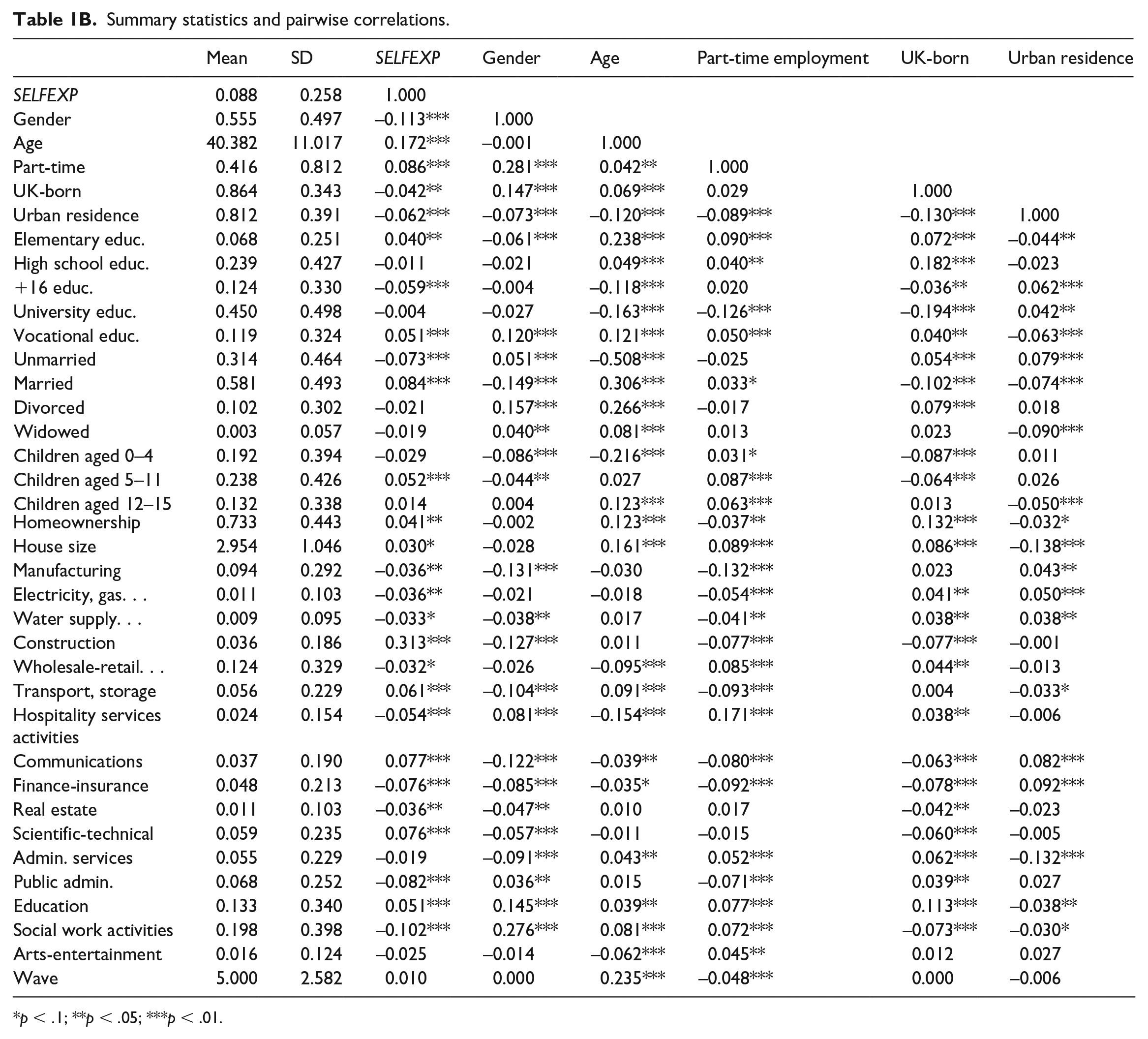
To lessen possible omitted variable bias, we control for age, education, marital status, number of children and their age group, part-time or full-time employment, rural or urban area residence, and whether individuals were born in the UK. Following previous studies, we use homeownership and house size (i.e. number of bedrooms) as proxies of individual financial standing (Guerra and Patuelli, 2016; Lofstrom et al., 2014; Rohe et al., 2002). We also control for industry, captured by a condensed 21 category Standard Industrial Classification (SIC). Finally, all estimations control for survey year effects. Appendix Table 1B presents the descriptive statistics and correlations of all variables.
Analytical technique
Our empirical analysis to examine how SELFEXP affects satisfaction with job, leisure and income is based on random effects (RE) estimation of an ordered logit model of the following form:

where β is an (L × 1) vector of coefficients to be estimated, and
We perform separate estimations for men and women because of gender differences in work and self-employment orientations (Cheraghi et al., 2019; Cromie, 1987; Patrick et al., 2016; Tegtmeier et al., 2016). Gender differences are more striking when considering self-employment well-being effects on family and children (Bender and Roche, 2016; Craig et al., 2012; Zhou, 2017). These differences are equally noticeable when examining how self-employment correlates with achievement (Block and Koellinger, 2009) and social status (Powell and Eddleston, 2008). Moreover, there are well-documented differences in the motivations of men and women to enter self-employment (Craig et al., 2012; Johansson Sevä and Öun, 2015).
Mattes (2016) identifies important differences in personal and social factors affecting men’s and women’s business resilience and their choices to exit self-employment. The positive well-being effects of self-employment for women are less surprising when considering that women often become self-employed to overcome barriers, such as ‘glass ceilings’ in wage-employment (Sullivan and Al Ariss, 2019). Self-employment offers working mothers flexibility to manage their work schedule in a way that allows them to reduce work–family conflict. Zhou (2017) concludes that when employment and motherhood are considered jointly, women experience a conflict between their economic and caregiver roles. Such results can be masked if male and female respondents are pooled together. Delmar and Davidsson (2000) remark that mixed-gender self-employment studies tend to reflect perceptions mainly about men’s entrepreneurial activities, as women entrepreneurs are underrepresented in samples.
Empirical results
Descriptive statistics
Table 1 shows the proportion of employees who switched into and out of self-employment from wave 1 to wave 9. A large number of wage-employees (about 94.21%) do not transition into self-employment, but pursue a career within wage-employment. Almost half of the self-employed individuals at wave 1 had switched to wage-employment by wave 9. Yet, overall self-employment shares at each wave remained relatively unchanged.
Employment transitions: Overall and wave-by-wave.
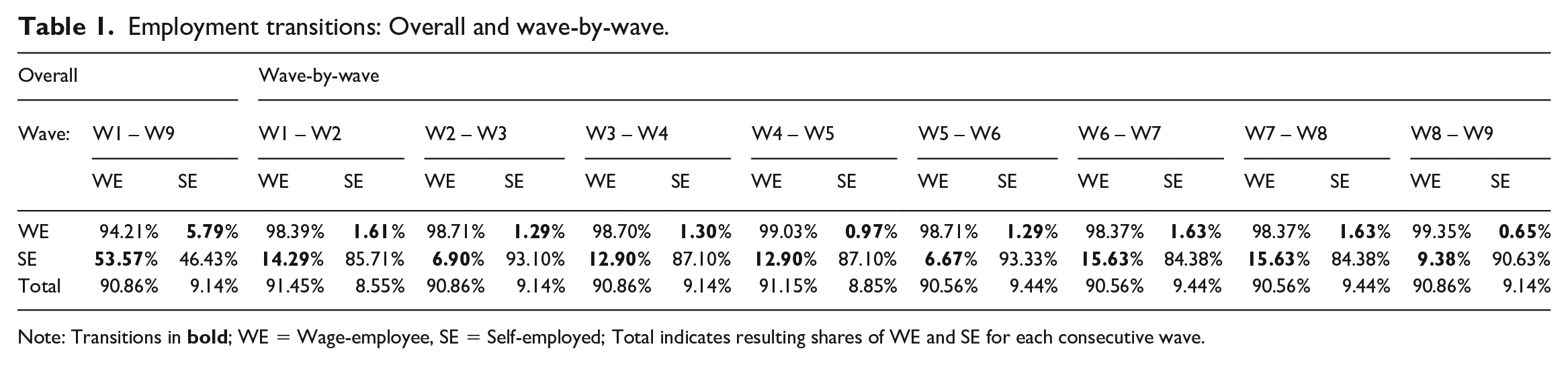
Note: Transitions in
Table 2 presents means of satisfaction with job, leisure and income. Based on simple t-tests for equality of means, job satisfaction differences between wage-employees and self-employed stand out. Differences in leisure satisfaction and income satisfaction are not statistically significant.
Measurements of satisfaction for self-employed and wage-employees.
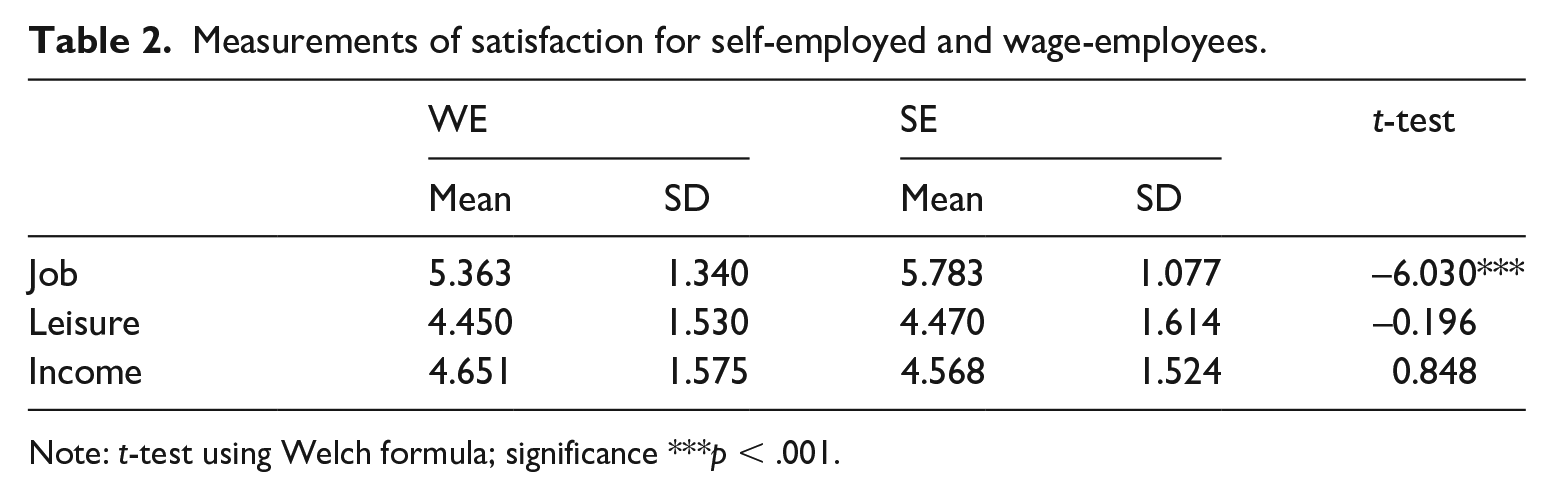
Note: t-test using Welch formula; significance ***p < .001.
Empirical analysis
We examine how accumulated self-employment experience impacts job, leisure and income satisfaction. Our results, in Tables 3 and 4, confirm that there is a significant non-linear association between self-employment experience and job satisfaction. However, the effect of self-employment experience on other elements of well-being is less evident. Hence, we find only partial empirical support for hypothesis 1. Figure 1 displays non-linear patterns emerging from FE estimation of job satisfaction. Job satisfaction follows a similar pattern for both women and men. Self-employment experience has a positive effect on job satisfaction up to a threshold point, beyond which it turns negative.
The results in Table 3 indicate that accumulated self-employment experience effects vary across different satisfaction domains. Overall, these results support hypothesis 2a. However, they do not support hypothesis 2b or hypothesis 2c.
The impact of self-employment experience on well-being (RE).
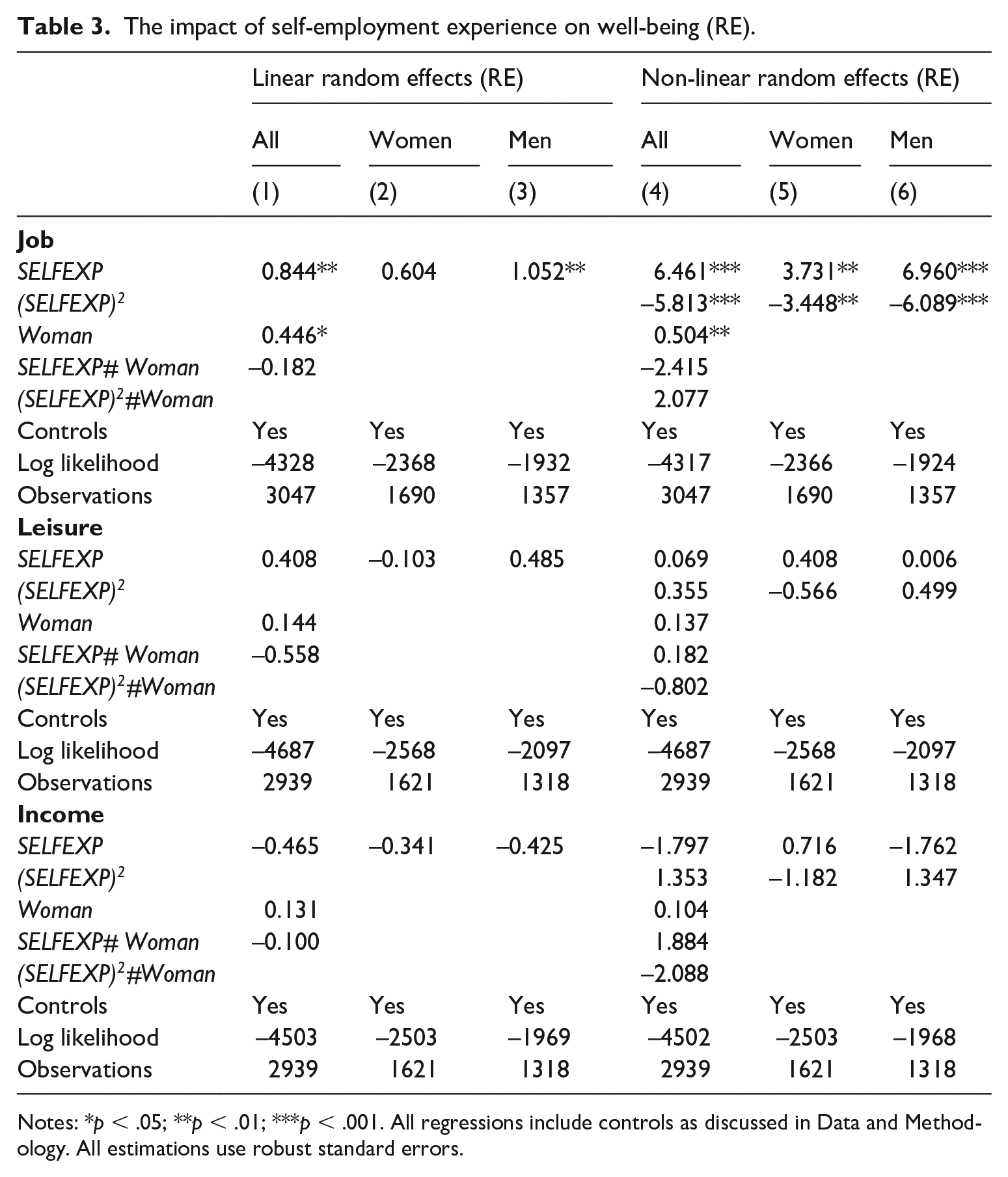
Notes: *p < .05; **p < .01; ***p < .001. All regressions include controls as discussed in Data and Methodology. All estimations use robust standard errors.
The impact of self-employment experience on well-being (FE).
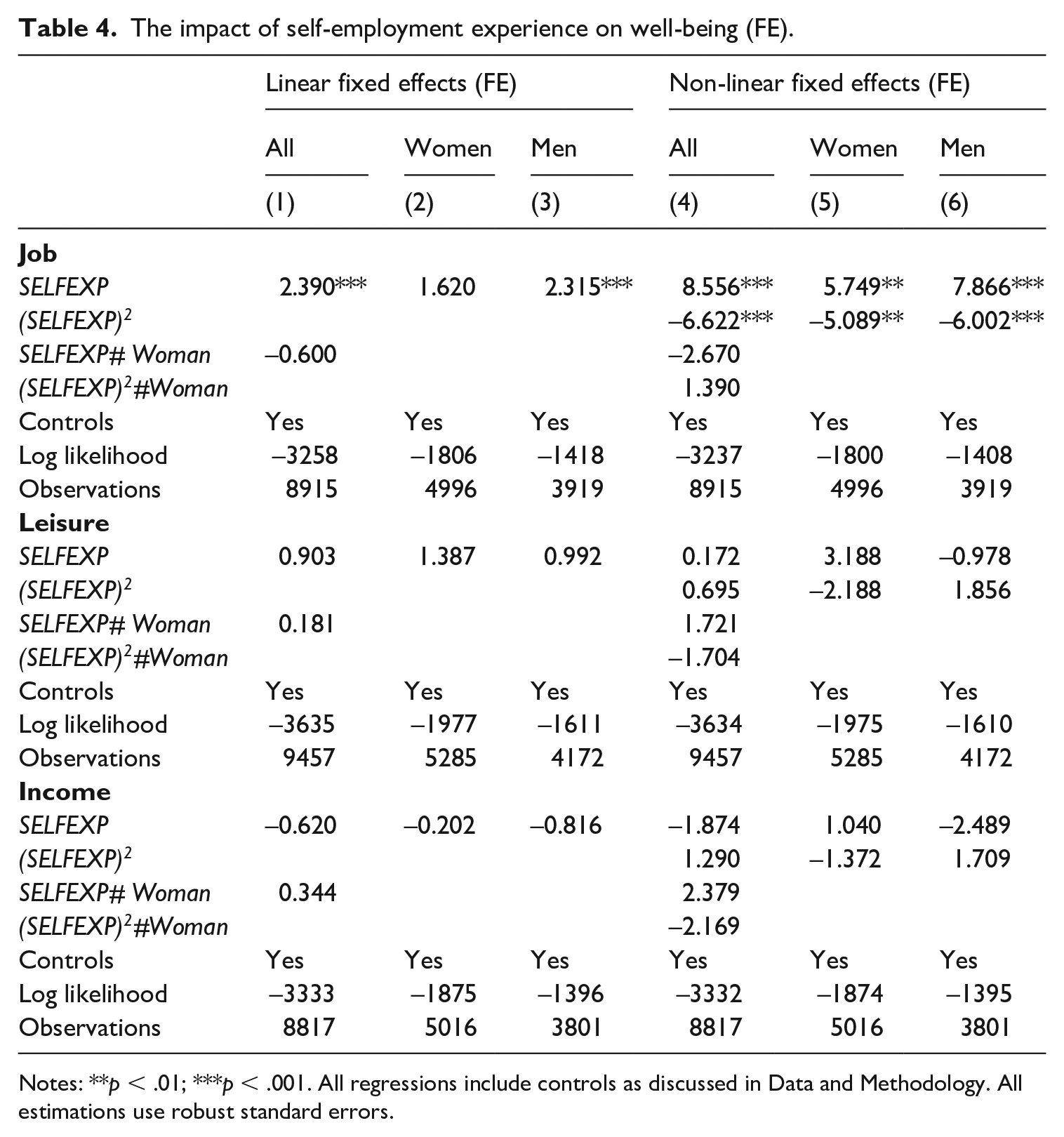
Notes: **p < .01; ***p < .001. All regressions include controls as discussed in Data and Methodology. All estimations use robust standard errors.
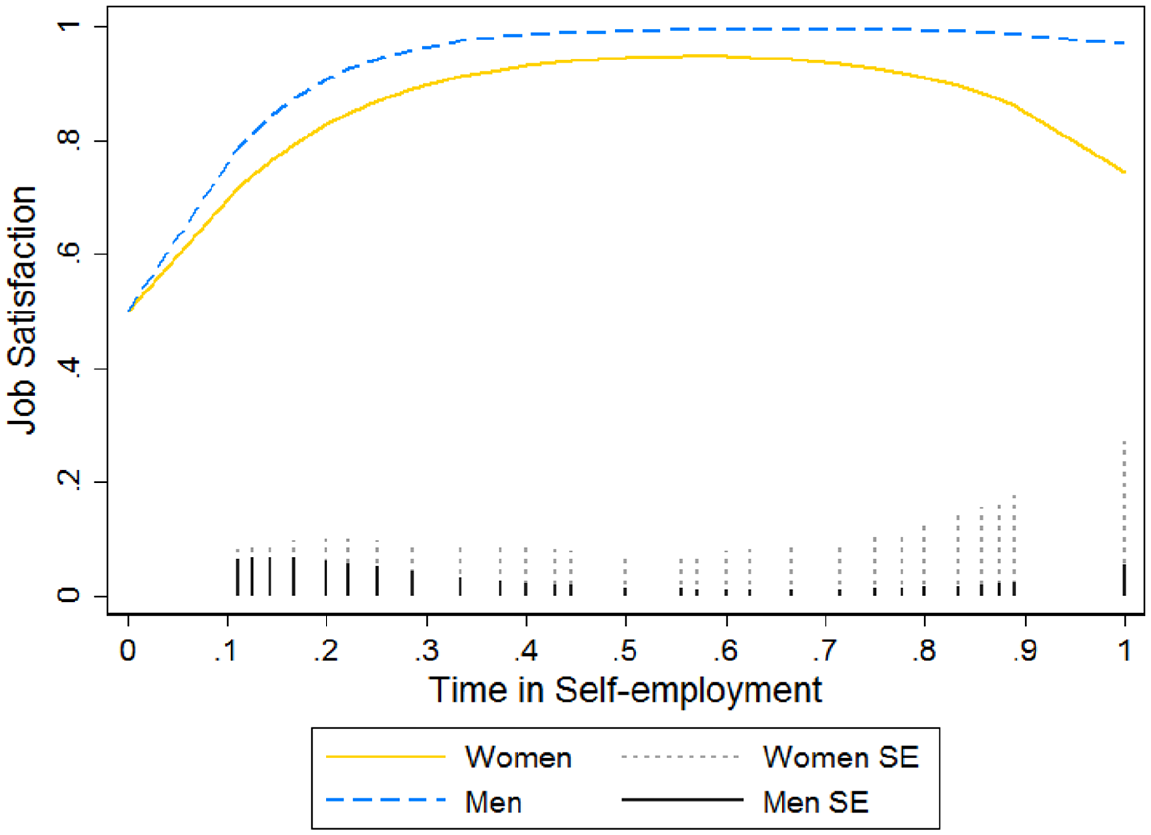
The effects of self-employment experience on job satisfaction (FE).
The RE and FE results, in columns (4)–(6) of Tables 3 and 4 respectively, show that SELFEXP exerts a positive and significant impact on job satisfaction. Similarly, the quadratic term for SELFEXP is negative and statistically significant, consistent with an inverted U-shaped relationship between accumulated self-employment experience and job satisfaction. The RE specification suggests that women report highest job satisfaction scores when they allocate about 54.1% of their work experience to self-employment, with satisfaction decreasing beyond this point. Men start reporting lower job satisfaction when they exceed 57.1% of work experience as self-employed. However, based on the FE results, the estimated turning points of women and men are 56.5 and 65.5% respectively. These turning points confirm that both men and women register a drop in their job satisfaction as their self-employment experience extends beyond a certain threshold of their total employment experience.
As Figure 1 shows, those with accumulated work experience only in self-employment report higher job satisfaction than those with experience only in wage-employment. We also observe that, compared to men, women’s standard errors increase as they accumulate additional years of self-employment experience. Noticeably, men’s job satisfaction increases faster and decreases more slowly compared to women. The job satisfaction of those with dual experience as both wage-employees and self-employed, as well as of those with experience solely as self-employed, remains higher than those with experience solely as wage-employees. Estimated coefficients in Tables 3 and 4 do not reveal any statistically significant association between accumulated self-employment experience and leisure or income satisfaction.
Further analysis and robustness checks
We estimate Hausman 5 tests for job, leisure and income satisfaction. Between-effects based on RE models significantly bias the within-effects for job and income satisfaction of women. For men, these tests fail to support that between-effects significantly bias within-effects in either job, leisure or income satisfaction estimates. Unobserved heterogeneity and idiosyncratic effects increase the complexity in explaining individual level effects for women (Bell and Jones, 2015). Additionally, we perform equivalence tests of FE and RE coefficients between men and women (Brame et al., 1998). The tests confirm there are no differences between women’s and men’s job satisfaction, leisure satisfaction or income satisfaction (z < 1.64).
Further, we estimate the model by excluding those who were solely self-employed during all nine waves. That is, we compare self-employment experience of those with dual experience in both wage-employment and self-employment to those with experience solely as wage-employed. This way we can specifically compare how accumulated self-employment experience affects well-being of individuals who switched between both employment types, to those with no self-employment experience at all. Table 5 reports these results.
The impact of self-employment experience on well-being (FE) – excluding individual observations with solely self-employment experience (SELFEXP = 1).
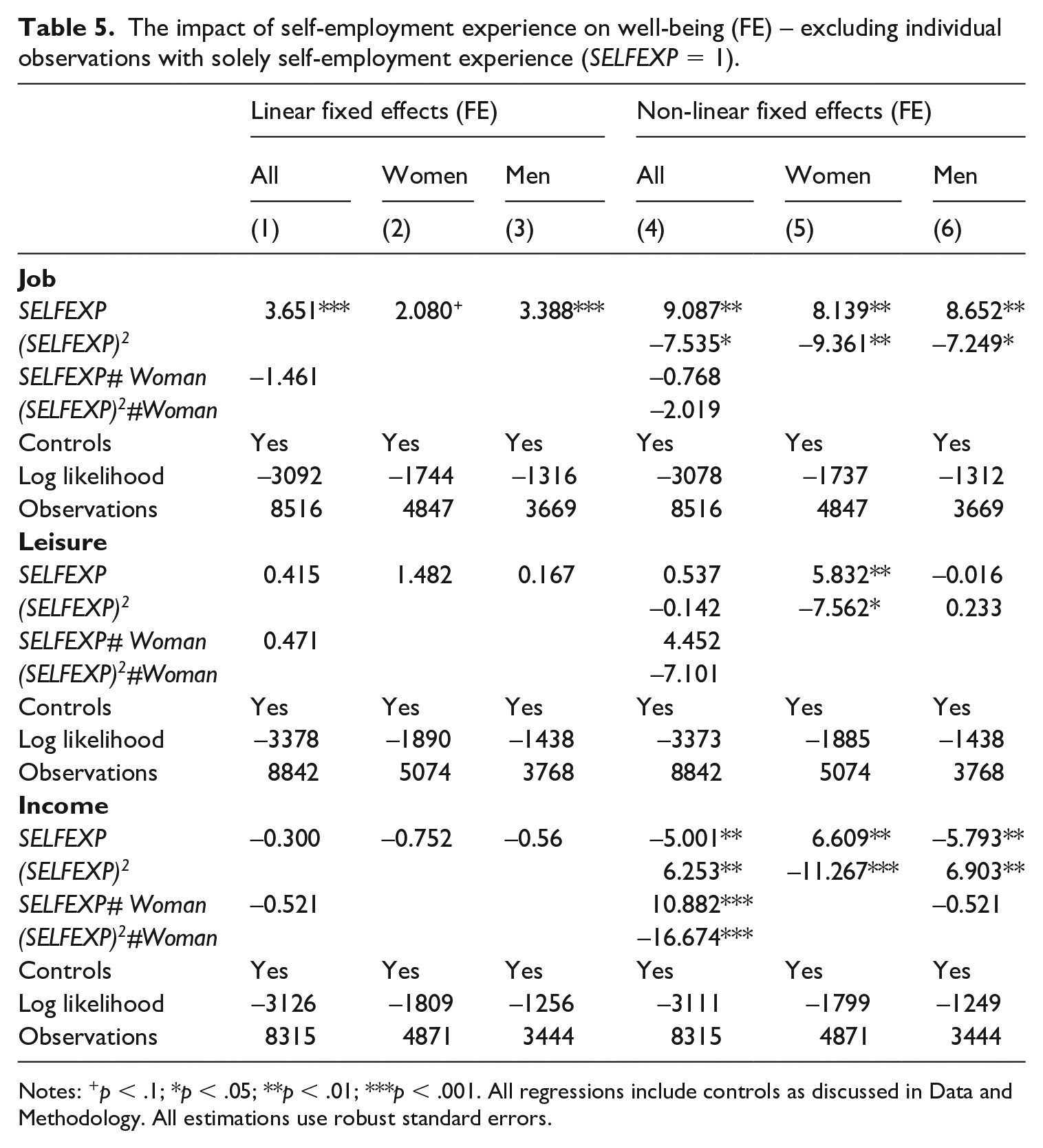
Notes: +p < .1; *p < .05; **p < .01; ***p < .001. All regressions include controls as discussed in Data and Methodology. All estimations use robust standard errors.
The FE results support our previous findings that those with experience both as wage-employees and as self-employed enjoy a job satisfaction boost as they spend more time in self-employment. However, the impact of accumulated self-employment experience on women’s job satisfaction diminishes much faster compared to men. In a similar way, accumulated self-employment experience impacts leisure satisfaction for women in a non-monotonic fashion. Leisure satisfaction increases with self-employment experience up to a point, after which it sharply decreases. Contrary to women, there is no statistically significant association between self-employment experience and leisure satisfaction for men. Figure 2 depicts non-linear patterns emerging after excluding individual observations with solely self-employment experience (SELFEXP = 1).
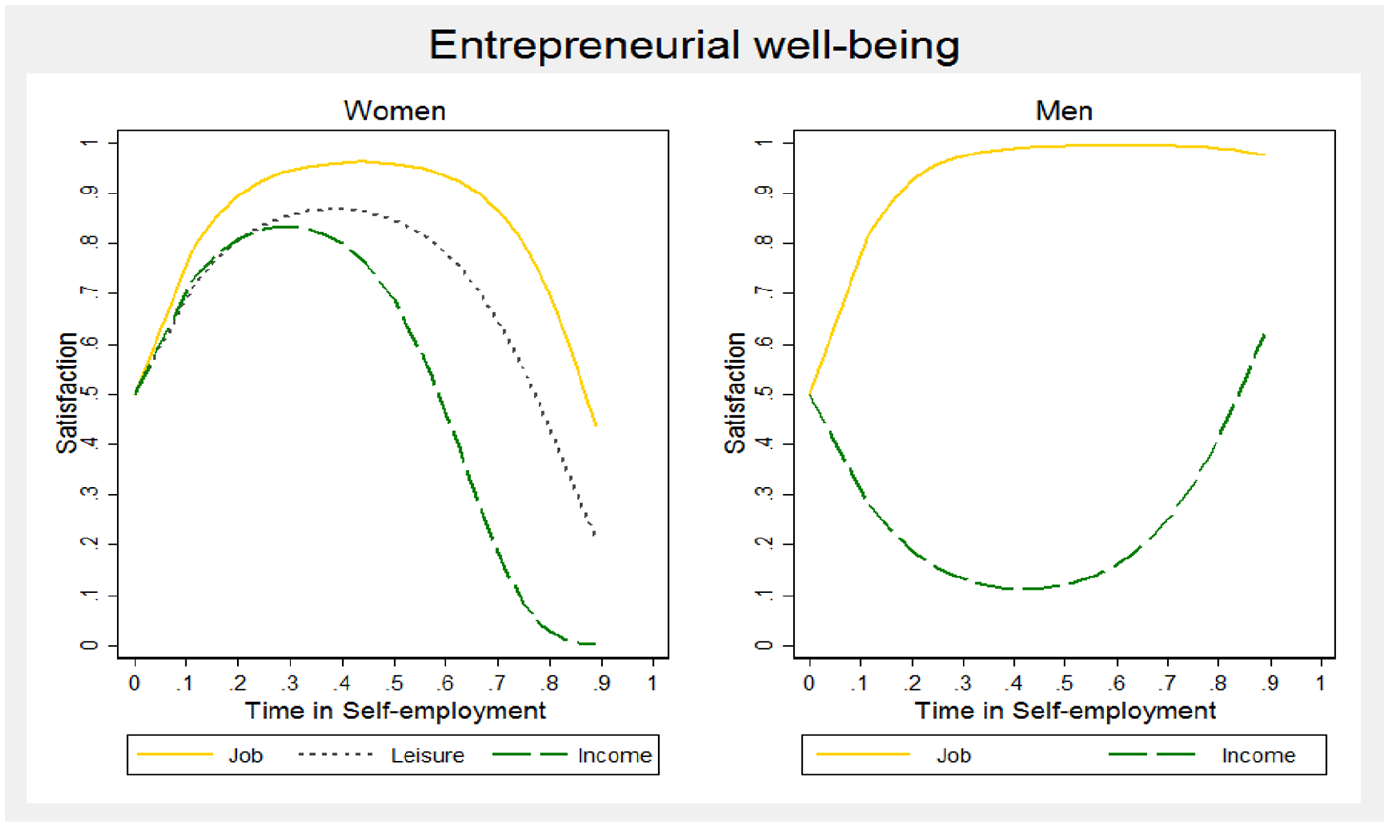
The effects of self-employment experience on well-being (FE) – excluding individual observations with solely self-employment experience (SELFEXP = 1).
Accumulated self-employment experience exerts a diverse and statistically significant influence on income satisfaction for women and men, further highlighting possible gender differences. Women’s income satisfaction and self-employment experience fits an inverted U-shaped relationship. In contrast, men’s income satisfaction is U-shaped. Excluding individuals who allocate all their past working time to self-employment has an opposite effect on women and men: pushing downwards female satisfaction, while pulling upwards male satisfaction. Therefore, comparing the results of Table 5 to those in Table 4 shows a diverse impact of self-employment experience not only between women and men, but also between different satisfaction facets. Accumulated experience only in self-employment positively smoothes out job, leisure and income satisfaction of women, whereas it negatively smoothes out men’s income satisfaction.
Benz and Frey (2008a) argue that individuals moving into self-employment from wage-employment increase their job satisfaction, whereas those moving from self-employment into wage-employment experience lower job satisfaction. In general, switches from wage-employment to self-employment are associated with upward social mobility. In contrast, self-employment to wage-employment switches imply a downward movement in socio-economic standing (Quadrini, 2000). Nevertheless, individual differences cannot be ignored. While short self-employment experience is associated with an increase in job satisfaction, switches into wage-employment can also boost job satisfaction (Mattes, 2016).
Discussion and concluding comments
In this study, we employed random effects and fixed effects ordered logit models on UK longitudinal data to examine how accumulated self-employment experience influences three facets of subjective well-being: job satisfaction, leisure satisfaction and income satisfaction. Previous empirical analyses have mostly explored contemporaneous or temporal effects around the time of self-employment transitions. In our analysis, we traced individuals’ employed status over nine consecutive, annual interviews in the UKHLS to identify whether they were wage-employees or self-employed. This enabled us to identify individuals who were either continuously wage-employees or self-employed throughout the nine waves, as well as those who switched in or out of self-employment.
Our study reaffirms previous findings on a largely positive association between entrepreneurship and well-being (Abreu et al., 2019; Binder and Coad, 2016; Marshall et al., 2020; Wach et al., 2020). Our findings are also consistent with past evidence documenting how the initial enthusiasm and optimism upon self-employment transitions dissipate when long hours, stress and business uncertainty overwhelm entrepreneurs (Bradley and Roberts, 2004; Georgellis and Yusuf, 2016; Jamal, 1997; Parker et al., 2005; Schonfeld and Mazzola, 2015; van der Zwan et al., 2018). Besides, factors affecting a venture at the start-up stage differ from those affecting its growth and survival (Shane et al., 2003; Storey, 2016). However, although at least some job satisfaction adaptation is expected following self-employment transitions, our findings suggest a positive job satisfaction effect from additional self-employment experience extends beyond the ‘honeymoon’ period. Wage-employees may be largely unaware of their low well-being prior to gaining experience in self-employment (Ryff, 2019). Our findings further show that job satisfaction effects are consistent across all model specifications for both women and men. In contrast, accumulated self-employment experience is associated differently with leisure and income satisfaction for men and women.
Our research underscores the importance of considering gender differences when examining well-being effects associated with self-employment experience. For both women and men, there is an inverted U-shaped relationship between past self-employment and job satisfaction. Moreover, women with some self-employment experience are more satisfied with their income and leisure time, when compared to those who have never been self-employed. In contrast, past self-employment does not influence men’s leisure satisfaction. Nevertheless, although men who have spent some of their past working time as self-employed are less satisfied with their income compared to wage-employees, this effect reverses as they gain more self-employment experience. Consistent with previous studies, our findings suggest that any potential self-employment benefits resonate more with women’s life course (Carree and Verheul, 2012; Marlow and Swail, 2015; Wolfe and Patel, 2018).
Goffee and Scase (1985) argue that women who are business owner-managers fall into two distinct categories. The first category includes traditional self-employed who seek to combine work and family responsibilities. The second category includes innovators who follow a business career seeking to grow their business. Therefore, initial conditions for entering self-employment and starting up a business entail different well-being outcomes (Ryff, 2019). Women in the traditional group are those with dual experience as both wage-employees and self-employed, while the innovators are those who dedicate all their time to self-employment. Contrary to women, men enjoy greater job satisfaction as self-employed, but such gains do not extend to other well-being facets. We can also see that most women in our sample run a business, whilst most men are working for themselves (Table 1A in Appendix A).
Self-employment spells are often short as self-employed individuals decide to switch to wage-employment, often enjoying a job satisfaction boost (Mattes, 2016). There is some evidence that past wage-employment does not have similar effects on the likelihood of entering self-employment for women as it has for men (Coleman, 2007; Tegtmeier et al., 2016). Additionally, regardless of characteristically low business survival rates, self-employed individuals often feel more job-secure compared to being in wage-employment. This is because they believe that their future is in their own hands rather than relying on senior executives (Hundley, 2001; Kahneman, 2011; Millán et al., 2013). Such a conviction especially influences female entrepreneurs’ motivation who feel dissatisfied with their previous wage-employment (Mallon and Cohen, 2001; Sullivan and Al Ariss, 2019).
We found evidence that self-employment experience improves women’s well-being in more ways compared to men. The reasons women transition into self-employment go beyond simple occupational choices (Sullivan and Al Ariss, 2019). They reflect work–life balance choices, which are linked to several indicators of their subjective well-being (Ryff, 2019). Gender differences associated with differences in work orientations between women and men and their motivations to pursue self-employment are well documented (Cheraghi et al., 2019; Patrick et al., 2016; Tegtmeier et al., 2016; Zou, 2015). For instance, women more than men end their self-employment spells for personal reasons associated with their social-role and gender-expectations, with single women displaying distinct attitudes from those of married women (Justo et al., 2015). Furthermore, considering various obstacles women face in wage-employment, they have a strong incentive to stay in self-employment despite possible dissatisfaction during early stages of their business venture (Mattes, 2016).
As with any study, our analysis has several limitations. First, we use self-employment as a proxy for entrepreneurship. 6 Arguably, not every self-employed individual is an innovator or actively entrepreneurial, while not all entrepreneurs are business owner-managers (e.g. intrapreneurs). Entrepreneurs can also be self-employed at an early stage of their entrepreneurial pursuit. Global Entrepreneurship Monitor (GEM) evidence suggests two grand categories of entrepreneurial motivation: necessity and opportunity entrepreneurship (Kelley et al., 2015). Commonly, it is entrepreneurial activity that stems from opportunity that is associated with internal drive, passion, risk, social change, innovation and achievement (Shane et al., 2003; Shepherd and Patzelt, 2017; Smilor, 1997). Large longitudinal surveys typically classify individuals’ employment status either as wage-employees or self-employed, making it difficult to identify opportunity entrepreneurs in a Schumpeterian or Kirznerian sense. In our analysis, we limited potential effects arising from necessity entrepreneurship by focusing on only those individuals who were either wage-employees or self-employed. As Baumol (1968: 64) famously points out, the entrepreneur is ‘one of the most elusive characters’. This is a topic that deserves more attention in future research.
Furthermore, we used homeownership and number of bedrooms as a proxy of financial standing. Income is commonly used as a direct control for financial standing. However, when comparing wage-employees and self-employed, using income as a control is problematic. This is because various financial allowances that the self-employed are entitled to often account for cross-subsidies between business and household income (Cagetti and De Nardi, 2006; Carter, 2011). Additionally, homeownership is a socially desirable good, which makes it a reasonable proxy of household wealth and financial standing for both wage-employees and self-employed (Lofstrom et al., 2014; Rohe et al., 2002).
Our analysis supports Burton et al.’s (2016: 237) view of entrepreneurship as a career, ‘both in the sense of a sequence of past states, and in the sense of an imagined future trajectory’. Our main research contribution to previous research on entrepreneurial well-being lies in its examination of self-employment as part of a broader employment choice perspective. Thus, our study offers a different perspective from that of previous analyses, which are based on a typical binary dichotomy between wage-employment and self-employment. The ease of setting up and doing business in many industrialised countries offers individuals a relatively low opportunity cost entry into self-employment. This has resulted in more frequent bidirectional transitions between wage-employment and self-employment. However, cross-sectional studies cannot account for entrepreneurs who may leave self-employment and become wage-employees because of possible stress and burden of responsibility (Stephan and Roesler, 2010). Longitudinal studies offer a way to follow individuals for several years and therefore should be used to examine how their employment choices affect their well-being beyond a single employment transition into or out of self-employment.
Footnotes
Appendix A
Large-scale longitudinal surveys, such as the UKHLS, collect self-employment data rather than entrepreneurship data. The existing UK legislation requires that those working for themselves are registered with the tax authority as sole-traders, full owner, or a partner in a business partnership (detailed information can be found at www.gov.uk/working-for-yourself). The self-employed pay annual income tax and social security contributions, whereas wage-employees pay their taxes and social security contributions through the UK paycheque deduction system known as ‘Pay-As-You-Earn’ (PAYE). Individuals are allowed to engage in multiple employment types over the same tax period, for which they pay the required annual income tax for their self-employment earnings, and their PAYE tax for their wage-employment earnings. This is the typical labour market employment identification used by the Office for National Statistics (ONS) and the HM Revenue and Customs (HMRC). Using this context, the UKHLS asks participants whether they identify themselves as being wage-employees or self-employed. The HMRC has examined issues arising from the exploitation of necessity entrepreneurs and the contemporary increase of false self-employment, and attempts to correct the imbalances have been introduced in National Insurance Contributions (NIC) legislation and the Finance Bill 2014 (HMRC, 2013). In this study, we limit the issues arising from possible necessity entrepreneurship by retaining in our analysis only the participants who were either wage-employees or self-employed. Additionally, Table 1A below presents the different self-employment types in our sample for women and men.
Appendix B
Summary statistics and pairwise correlations.
| Mean | SD | SELFEXP | Gender | Age | Part-time employment | UK-born | Urban residence | |
|---|---|---|---|---|---|---|---|---|
| SELFEXP | 0.088 | 0.258 | 1.000 | |||||
| Gender | 0.555 | 0.497 | –0.113*** | 1.000 | ||||
| Age | 40.382 | 11.017 | 0.172*** | –0.001 | 1.000 | |||
| Part-time | 0.416 | 0.812 | 0.086*** | 0.281*** | 0.042** | 1.000 | ||
| UK-born | 0.864 | 0.343 | –0.042** | 0.147*** | 0.069*** | 0.029 | 1.000 | |
| Urban residence | 0.812 | 0.391 | –0.062*** | –0.073*** | –0.120*** | –0.089*** | –0.130*** | 1.000 |
| Elementary educ. | 0.068 | 0.251 | 0.040** | –0.061*** | 0.238*** | 0.090*** | 0.072*** | –0.044** |
| High school educ. | 0.239 | 0.427 | –0.011 | –0.021 | 0.049*** | 0.040** | 0.182*** | –0.023 |
| +16 educ. | 0.124 | 0.330 | –0.059*** | –0.004 | –0.118*** | 0.020 | –0.036** | 0.062*** |
| University educ. | 0.450 | 0.498 | –0.004 | –0.027 | –0.163*** | –0.126*** | –0.194*** | 0.042** |
| Vocational educ. | 0.119 | 0.324 | 0.051*** | 0.120*** | 0.121*** | 0.050*** | 0.040** | –0.063*** |
| Unmarried | 0.314 | 0.464 | –0.073*** | 0.051*** | –0.508*** | –0.025 | 0.054*** | 0.079*** |
| Married | 0.581 | 0.493 | 0.084*** | –0.149*** | 0.306*** | 0.033* | –0.102*** | –0.074*** |
| Divorced | 0.102 | 0.302 | –0.021 | 0.157*** | 0.266*** | –0.017 | 0.079*** | 0.018 |
| Widowed | 0.003 | 0.057 | –0.019 | 0.040** | 0.081*** | 0.013 | 0.023 | –0.090*** |
| Children aged 0–4 | 0.192 | 0.394 | –0.029 | –0.086*** | –0.216*** | 0.031* | –0.087*** | 0.011 |
| Children aged 5–11 | 0.238 | 0.426 | 0.052*** | –0.044** | 0.027 | 0.087*** | –0.064*** | 0.026 |
| Children aged 12–15 | 0.132 | 0.338 | 0.014 | 0.004 | 0.123*** | 0.063*** | 0.013 | –0.050*** |
| Homeownership | 0.733 | 0.443 | 0.041** | –0.002 | 0.123*** | –0.037** | 0.132*** | –0.032* |
| House size | 2.954 | 1.046 | 0.030* | –0.028 | 0.161*** | 0.089*** | 0.086*** | –0.138*** |
| Manufacturing | 0.094 | 0.292 | –0.036** | –0.131*** | –0.030 | –0.132*** | 0.023 | 0.043** |
| Electricity, gas. . . | 0.011 | 0.103 | –0.036** | –0.021 | –0.018 | –0.054*** | 0.041** | 0.050*** |
| Water supply. . . | 0.009 | 0.095 | –0.033* | –0.038** | 0.017 | –0.041** | 0.038** | 0.038** |
| Construction | 0.036 | 0.186 | 0.313*** | –0.127*** | 0.011 | –0.077*** | –0.077*** | –0.001 |
| Wholesale-retail. . . | 0.124 | 0.329 | –0.032* | –0.026 | –0.095*** | 0.085*** | 0.044** | –0.013 |
| Transport, storage | 0.056 | 0.229 | 0.061*** | –0.104*** | 0.091*** | –0.093*** | 0.004 | –0.033* |
| Hospitality services activities | 0.024 | 0.154 | –0.054*** | 0.081*** | –0.154*** | 0.171*** | 0.038** | –0.006 |
| Communications | 0.037 | 0.190 | 0.077*** | –0.122*** | –0.039** | –0.080*** | –0.063*** | 0.082*** |
| Finance-insurance | 0.048 | 0.213 | –0.076*** | –0.085*** | –0.035* | –0.092*** | –0.078*** | 0.092*** |
| Real estate | 0.011 | 0.103 | –0.036** | –0.047** | 0.010 | 0.017 | –0.042** | –0.023 |
| Scientific-technical | 0.059 | 0.235 | 0.076*** | –0.057*** | –0.011 | –0.015 | –0.060*** | –0.005 |
| Admin. services | 0.055 | 0.229 | –0.019 | –0.091*** | 0.043** | 0.052*** | 0.062*** | –0.132*** |
| Public admin. | 0.068 | 0.252 | –0.082*** | 0.036** | 0.015 | –0.071*** | 0.039** | 0.027 |
| Education | 0.133 | 0.340 | 0.051*** | 0.145*** | 0.039** | 0.077*** | 0.113*** | –0.038** |
| Social work activities | 0.198 | 0.398 | –0.102*** | 0.276*** | 0.081*** | 0.072*** | –0.073*** | –0.030* |
| Arts-entertainment | 0.016 | 0.124 | –0.025 | –0.014 | –0.062*** | 0.045** | 0.012 | 0.027 |
| Wave | 5.000 | 2.582 | 0.010 | 0.000 | 0.235*** | –0.048*** | 0.000 | –0.006 |
p < .1; **p < .05; ***p < .01.
Declaration of conflicting interests
The authors declared no potential conflicts of interest with respect to the research, authorship, and/or publication of this article.
Funding
The authors received no financial support for the research, authorship, and/or publication of this article.
