




Abstract
This article examines relationships between trade unions and firms’ innovation activity. Drawing on nationally representative data covering 1,384 firms in the UK, the article employs probit analysis to estimate the effect of trade union representation at the workplace on different types of innovation. The findings show significant and positive correlations between trade union representation and the introduction of new processes and new methods of marketing. The study also found a positive and moderately significant indirect effect on innovation arising from union influence on training provision and employee involvement practices. In addition, when unions are associated with shaping long-term oriented staffing practices, the positive indirect effects are strengthened.
Introduction
This article focuses on the potential influence that trade unions can exert on firms’ propensity to innovate. 1 It is widely accepted that relevant and well-directed innovation can have beneficial effects on firms’ performance and competitiveness (Addison et al., 2017; Doucouliagos and Laroche, 2013; Jiménez-Jiménez and Sanz-Valle, 2011; Kizilos and Reshef, 1997; Macher and Mowery, 2009). Innovation is also regarded as an important driver of economic growth (Eurofound, 2017). Firms’ ability and willingness to innovate are subject to a variety of internal practices and external influences, including state intervention, availability of finance and the presence of supportive networks (Eurofound, 2017; Mazzucato, 2016). Internal influences are of critical importance as both transmitters of external practices and in themselves as integrated innovative models within the firm. Most obviously, firms require the resources and capabilities to enable, support and sustain innovative activities. Appropriate approaches to the management of employees are also important in order to encourage employees to behave in ways that support innovation (Addison et al., 2017; Schuler and Jackson, 1987; Teng et al., 2019).
Trade unions represent a potential influence on firms’ propensity to innovate, although the nature of their influence has been contested. Some studies have argued that trade unionism is negatively associated with business innovations (Doucouliagos and Laroche, 2003; Schnabel and Wagner, 1994), while others have found a strong positive association between trade union representation and firms’ propensity to innovate (Berton et al., 2021; Chung, 2019; Michie and Sheehan, 2005; Walsworth, 2010). It is possible that this positive influence reflects the ability of trade unions to deter employers from pursuing ‘low road’ approaches to competitiveness, thereby encouraging them to introduce new products and methods of production (Michie and Sheehan, 2003; Zhou et al., 2011).
This article has two complementary aims. The first aim is to investigate the direct association between trade unions and firms’ propensity to innovate, drawing on nationally representative survey data from the United Kingdom. The second, and more novel, aim is to examine the potential indirect means by which trade unions can influence firms’ capacity to innovate, an issue that has received little, if any attention in the research literature. The data allow us to examine three pathways through which trade unions may influence innovation: firstly, trade unions’ association with long-term oriented staffing practices, a consequence of unions’ concern to protect their members’ job security (economic security is a vital concern of working people: fear of the lack of protection from sickness, accidents at work and old age were a driving force behind their impulse for collective organisation [Hobsbawm, 1994]); secondly, trade unions’ potential influence on employers’ propensity to provide their employees with training opportunities; and, finally, the extent to which trade unions might influence innovation by encouraging employee involvement in upward problem-solving initiatives. Our findings indicate that unions can have a positive impact on innovations, particularly those that relate to changes to processes of production or service delivery.
The article comprises four main sections. The next section reviews the extant literature relating to trade unions and innovation and sets out our hypotheses. This is followed by a description of the research methods, which involved a nationally representative UK data set comprising 1,384 firms. We present the findings in the fourth section and conclude with a discussion of the findings.
Trade unions and innovation
A widely used definition of innovation is that provided by West and Farr (1990: 9), who define innovation as ‘the intentional introduction and application within an organisation of ideas, processes, products or procedures, new to the unit of adoption, designed to significantly benefit the organisation or wider society’. The notion embedded here of ‘benefit’ carries with it a positive outcome assumption which can only be verified after any such innovations have worked their way through the system. This requires a constant looking back over one’s shoulder approach in which some ‘innovations’ have fallen by the wayside while others have achieved their intended results. Within this, a distinction is sometimes made between innovations that have a ‘technological’ orientation and relate to products, services or production processes, and ‘administrative’ innovations, that relate to changes in, for example, activities or structures (Damanpour and Evan, 1984). A further division can be made between the generation of new ideas and their implementation, a distinction that emphasises the processual aspect of innovation (Axtell et al., 2000; Shipton et al., 2006). In this study, we focus on innovations relating to new products/services, new processes and new ways of marketing (Berton et al., 2021; Roberts and Piller, 2016).
Certain features of the UK economy militate against sustained and widespread investment and upgrading of products and processes and the adoption of Human Resource Management (HRM) practices that might enable the adoption of ‘high road’ business models focused on innovation. Sustainable organisational innovation requires stability and commitment (‘patient capital’; Hall and Soskice, 2001) alongside extensive employee involvement. In the UK, however, which is second to the USA in terms of the volume of inward Foreign Direct Investment (Brummer, 2012), pressure from global institutional investors has encouraged a tendency for firms in key sectors of the economy to focus on maximisation of short-term profits (Grady and Simms, 2019). To meet global investors’ expectations in relation to financial returns on their investments, senior managers are hired and assessed on the basis of restricted economic targets, which encourages and pressurises them to focus on short-term financial performance, rather than make substantial investments in staff skill sets. Senior managers in many UK private sector firms face incentives and pressures to take the ‘shortcut’ of acquiring skilled labour from the external labour market, poaching skilled workers from competitors at home and abroad (Kriechel et al., 2014; Wintersberger, 2017). The short-term profit orientation encouraged by ‘impatient’ capital has also led to the deterioration in people management regimes (Dundon and Rafferty, 2018) and increased job insecurity (Chung, 2019; Wang et al., 2021).
In principle, trade unions can counteract such short-term practices to some extent. One way in which they might do so is by deterring aggressive opportunistic investors (Krzywdzinski, 2014), which may alleviate pressures on senior managers. A further important means is through ‘policing’ management behaviour and forcing through longer term strategic investments in staff and technology. The debate on the potential positive impact of trade unions on organisational performance stretches back to the 1880s (Webb and Webb, 1894, 1902). Studies have suggested that stronger unions are in a better position than weaker unions to attain workplace cooperation (Kizilos and Reshef, 1997; Wever, 1989) by legitimising and shaping workers’ reactions to innovation. It can also create a ‘win-win’ situation through voicing worker concerns and counteracting poor management practices (Appelbaum and Batt, 1994: 153; Doucouliagos and Laroche, 2003; Reshef et al., 1993). Walsworth (2010), using data from the Canadian Workplace and Employee Survey, found that union density is positively associated with product innovation. Michie and Sheehan (2003), using UK data, have also provided evidence that trade unions are associated with product innovation and process innovation. They further suggest that unions may directly encourage employers to invest in new products and might also encourage them to do so by closing off ‘low roads’ to competitiveness based on squeezing wages. In addition, Berton et al. (2021) examined a large sample of Italian firms and found that the presence of formal workers’ representative bodies at the workplace was associated with an increased likelihood of product innovation. This leads us to the first hypothesis:
Hypothesis 1: The presence of trade unions at the workplace is positively associated with innovation (new product, new process or new ways of marketing).
As noted in the introduction, few if any previous research studies have sought to examine the indirect influences that unions might have on innovation. This article addresses this research gap by examining indirect influences that stem from the ability of unions to influence employers’ approaches to staffing, training and employee involvement. These are among the most important and commonly studied ‘human resource management’ issues that have been shown to influence firms’ capacity to innovate. Moreover, staffing, training and employee involvement are issues in which UK trade unions have a long-standing and substantial interest and over which they frequently seek to exert influence.
With regard to the first of these issues, there is evidence that staffing approaches that emphasise numerical flexibility can impede organisations’ ability to innovate, thereby damaging long-term performance (Michie and Sheehan, 2003, 2005; Teng et al., 2019). Teng et al. (2019) found that job insecurity indirectly affects creativity at the workplace. Michie and Sheehan (2003) found that the propensity of firms to innovate was negatively associated with use of short-term and temporary contracts, a practice that resulted from a lack of employer commitment to job security. By opposing management practices driven by short-termism, workplace unions can increase employees’ job security (Pohler and Luchak, 2015; Rittau and Dundon, 2009). This in turn can help to create an environment favourable to innovation as employees seek to improve firms’ competitive edge as part of their own long-term ‘survive and prosper’ strategies (Lévesque and Murray, 2013; Stewart and Lucio, 2011). Indeed, unions have a long history in the UK of providing sustainable alternative plans for the firms and sectors in which their members work. Such interventions usually provide a road map for a future based on innovation in product range and ways of working (Addison, 2005; Harry, 2017; Steward, 1979).
Job security can make workers more likely to accept changes in the organisation of work and the introduction of new technology, to the extent that they feel confident that job losses will not result (Camps and Luan-Arocas, 2009; Liu et al., 2009). There is also evidence that firms that retain workers previously employed on fixed-term contracts enjoy productivity advantages over those that do not retain them (Wang and Heyes, 2017), and that good relations between management and strong employee representation bodies are positively and significantly correlated with the propensity to retain employees (Michie and Sheehan, 1999; Moore et al., 2008). We therefore propose the second hypothesis:
Hypothesis 2: The positive influence of trade unions on innovation is mediated by staffing practices with a long-term orientation.
Several studies have found that an organisation’s ‘human capital’ influences its capacity for innovation (Bornay-Barrachina et al., 2012; Sung and Choi, 2014). Rare human capital can serve as an important source of competitive advantage, as emphasised in ‘resource based’ accounts of competitiveness and strategic HRM (Barney, 1991); furthermore, knowledgeable and experienced employees may be more likely to generate and contribute new ideas and engage in interpersonal learning (Alegre et al., 2006; Anand et al., 2007; Teece et al., 1997). Training and development activities can be of critical importance in the development of human capital. Shipton et al. (2006) found that training is associated with innovation in products and ‘technical systems’ (including processes and production technology). Their findings also suggested that employees ‘may exert a stronger influence upon innovation in technical systems than upon product innovation. This may be because shop floor workers have a deeper knowledge of the work systems and the technology that they use than about potential new products’ (Shipton et al., 2006: 20). Training, they note, tends to focus on the process of doing jobs rather than product innovation.
Low labour turnover, ceteris paribus, is likely to increase the probability that an employer will be able to secure a return on any investments in training, which can lead to an increase in the propensity to train staff. Several studies have found that trade union representation has a positive association with employers’ training activity (Arulampalam and Booth, 1998; Böheim and Booth, 2004; Osterman, 1994). Training activity appears to be further enhanced where, in addition to achieving recognition, trade unions are actively involved in training decisions, able to negotiate with managers, and able to press successfully for more and better training (Heyes and Stuart, 1998; Hoque and Bacon, 2008; Stuart and Robinson, 2007; Waddoups, 2014). This leads us to our third hypothesis:
Hypothesis 3: The positive influence of trade unions on innovation is mediated by training provision.
Employee involvement and participation represents a further mechanism through which employees might contribute ideas that can give rise to innovations. Upward problem-solving and communication channels, in particular, can provide means by which employees might suggest improvements in work-related matters. The existence of formal and agreed communication channels that enable workers to speak up is one mechanism for employee-inspired innovation (Burris, 2012). Furthermore, Clegg et al. (2002: 419) found that the implementation of new ideas depends on whether employees trust their employer to listen to them and suggested that ‘the more an individual feels they are listened to and taken seriously, the more effort they put into having their suggestions implemented’.
Trade unions, as agencies designed to protect their members’ interests now and into the future, can ensure work-related issues are on the table (Kristensen and Rocha, 2012; Rocha, 2010). The presence of effective trade unions at the workplace can lead employees to believe that their views will be taken into consideration, not just because they are worthwhile, but also because trade union support provides a powerful internal pressure to force management attention to the issues that workers raise. There is evidence that unionised workplaces tend to have more mechanisms by which employees can make their views known than non-union workplaces (Benson, 2000; Berton et al., 2021). Employees are more likely to participate in employee involvement initiatives when they believe their union will protect their employment security (Levine, 1990). On that basis, we propose the following hypothesis:
Hypothesis 4: The positive influence of trade unions on innovation is mediated by employee involvement practices at the workplace.
The direction of our argument is that workers in general are committed to a long-term view of their employment and prefer to stay put if they can. This preference for stability in employment, and the linked absence of insecurity, looms large in terms of trade union policies both at the workplace and with regard to national regulation of the employment relationship. Both training practices and employee involvement require believable promises from management, which stronger trade unions are more likely to secure (Chung, 2019). This points to an indirect impact of trade unions pressing for a strategic approach to the future of the business. We therefore propose:
Hypothesis 5: The indirect influence of trade union representation on innovation, through their influence on training practices, is strengthened when long-term oriented staffing practices are followed.
Hypothesis 6: The indirect influence of trade union representation on innovation, through their influence on employee involvement, is strengthened when long-term oriented staffing practices are followed.
Data and methods
The data were collected by the European Company Survey (ECS) in 2013 across 32 countries, including the UK. 2 The survey covered businesses and other organisations (including public sector organisations) with 10 or more employees in categories B to S of the NACE Rev. 2 ‘statistical classification of economic activities’. Establishments in categories A (agriculture, forestry and fishing), T (activities of households) and U (activities of extraterritorial organisations and bodies) were excluded from the survey. 3 The main focus of the ECS2013 was on work organisation, workplace innovation, HR practices, employee participation and social dialogue. It therefore provides key information for this study. Our analysis focuses on the private sector in the UK, drawing on 1,384 valid responses out of 1,500 establishments (including public sector, private sector and the third sector). The sample includes small firms (10–49 employees), which account for 54% of the sample, medium-sized establishments (50–249 employees), accounting for 32% of the total, and large firms (250+ employees), comprising 14% of the sample.
Industrial relations institutions and practices vary markedly across the EU and data aggregation would result in these differences being overlooked. Restricting the analysis to the UK provides a clear national context for the study. UK employment relations are predominantly enterprise focused and efforts to discern associations between trade union representation at workplace and/or company level are unlikely to be complicated by influences stemming from union–employer interactions at higher levels (e.g. sectoral level) or from fora such as works councils, where employee representation may not be trade union based.
Measures
Innovation is measured by three variables. The ECS asked respondents whether the establishment had introduced since 2010: ‘any new or significantly improved marketing methods’; ‘any new or significantly changed products or services’; or ‘any new or significantly changed processes, either for producing goods or supplying services’. 4 For our analysis, the answers to each of these questions were coded 1 = yes, 0 = no. Respondents who answered ‘don’t know’ were excluded from the analysis.
Union presence captures the influence of trade unions. This has been measured based on a question (QER1) in the ECS that asked about forms of official employee representation and a further question (ER8) that asked managers about the types of employee representation that existed at the company level and which also represented employees working at the site. On the basis of these questions, we include a variable that captures whether a workplace trade union representative/a shop steward is on site (1 = yes, 0 = no) and a further variable that captures whether there is an employee representation structure at the establishment or company (1 = yes, 0 = no). There were 214 (15.4%) private establishments with both trade union representative and an employee representation structure on site.
Training provision is measured by the percentage of employees who received paid time off to undertake off-the-job or on-the-job training during the 12 months prior to the survey (QH3 of the questionnaire).
Employee involvement practices (EIP) are measured by practices that can reflect an employer’s commitment (resource allocation) to engage employees. A series of measures with yes or no response were included in the ECS (QE1 of the questionnaire). All responses were coded 1 = yes, 0 = no. Respondents who answered ‘don’t know’ were excluded from the analysis. We created a single measure of EIP from three of these measures: (1) use of staff surveys; (2) dissemination of information through newsletters, notice boards and email; and (3) use of suggestion schemes (the collection of ideas and suggestions from employees, voluntary and at any time, traditionally by means of suggestion box). These practices are examples of direct employee involvement and participation (EIP), which is the most widely used form of EIP in the UK and several other countries (Marchington and Dundon, 2017; Marchington et al., 2021).
The results of a Principal Component Analysis (Kolenikov and Angeles, 2004) show that these three items are unidimensional, with a factor loading > 0.70 and an eigenvalue > 1.61. We then use the mean value of these three items to represent EIP (mean = 1.55, SD = 1.06)
Long-term orientation to staffing (LTOS) is measured by ratings on three statements (Question H11 in the ECS) (1 = strongly agree; 4 = strongly disagree): the majority of employees who had a temporary contract got a further contract afterwards; employees are hired with the intention to employ them for a long time; and when recruiting the management usually look first whether there are any suitable internal candidates. Responses were reverse coded. A Principal Component Analysis indicates that these three items are unidimensional (factor loading > 0.5 and eigenvalue > 2.6). We thus use the mean to create a single LTOS variable (mean = 3.28, SD = 0.45).
Control variables
Adapting external knowledge plays an important role in firms’ innovativeness, typically through a firm’s Research and Development (R&D) activity and awareness of external innovation (Zhang et al., 2019). We therefore include a variable that captures whether or not firms have R&D activities and a variable to gauge the extent to which the firm monitors external ideas or technological developments to improve its own capacity to innovate. Other important variables associated with firms’ innovation activities are also included: workforce composition, firm size (number of employees and sites of operations) and industrial activity. T-tests were conducted to examine differences in key variables between companies with a strong trade union representation and those without. As shown in Table 1, workplaces with trade union representation and employee representation structures are significantly more likely to have introduced new products (p < 0.001, |T| = 3.70), new processes (p < 0.001, |T| = 6.25) and new ways of marketing (p < 0.001, |T| = 4.21) since 2010 compared to those that have neither a union presence nor a representation structure. They are significantly more likely to invest in training (p < 0.001, |T| = 5.43), employee involvement practices (p < 0.001, |T| = 8.50) and R&D activities (p < 0.001, |T| = 6.14).
T-test of workplace practices comparing sites with trade union representation and those without.
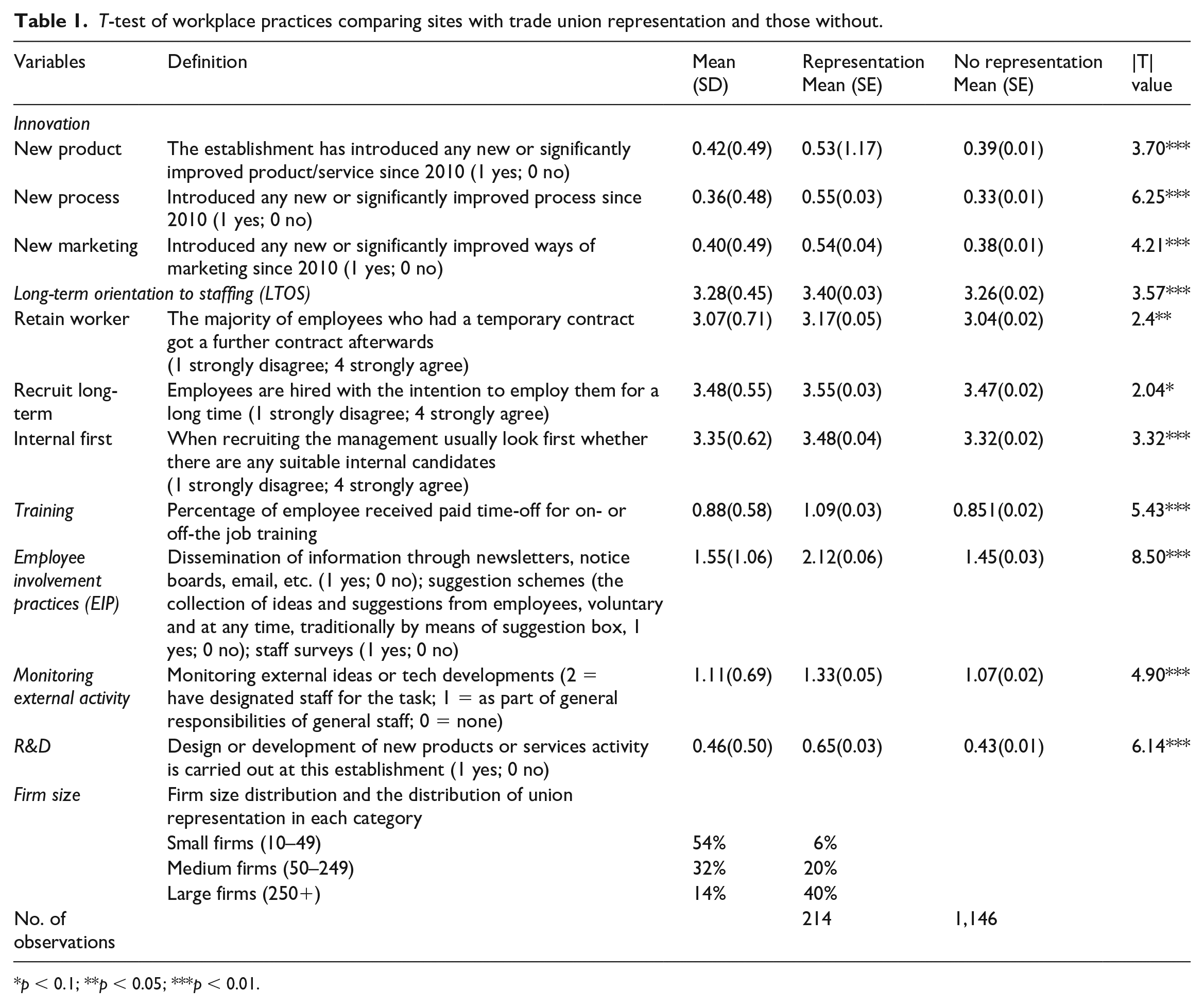
p < 0.1; **p < 0.05; ***p < 0.01.
Table 2 presents the correlations among the main variables. The three types of innovation (new product, new process and new ways of marketing) are significantly and positively correlated with each other. LTOS, training and employee involvement are positively and significantly correlated with innovation. Trade union representation is significantly and positively correlated with innovation as well as training provision, employee involvement and LTOS. Other firm practices, such as monitoring external ideas or technological developments for new or changed products, processes or services and R&D activities, are positively and significantly associated with innovation. Trade union representation is positively and significantly associated with firm size and innovation related activities, but negatively and significantly correlated with firms only having a single site. This suggests that firm size influences the likelihood of innovations occurring; thus firm size has been included as an important control variable in all regressions.
Correlations among main variables.
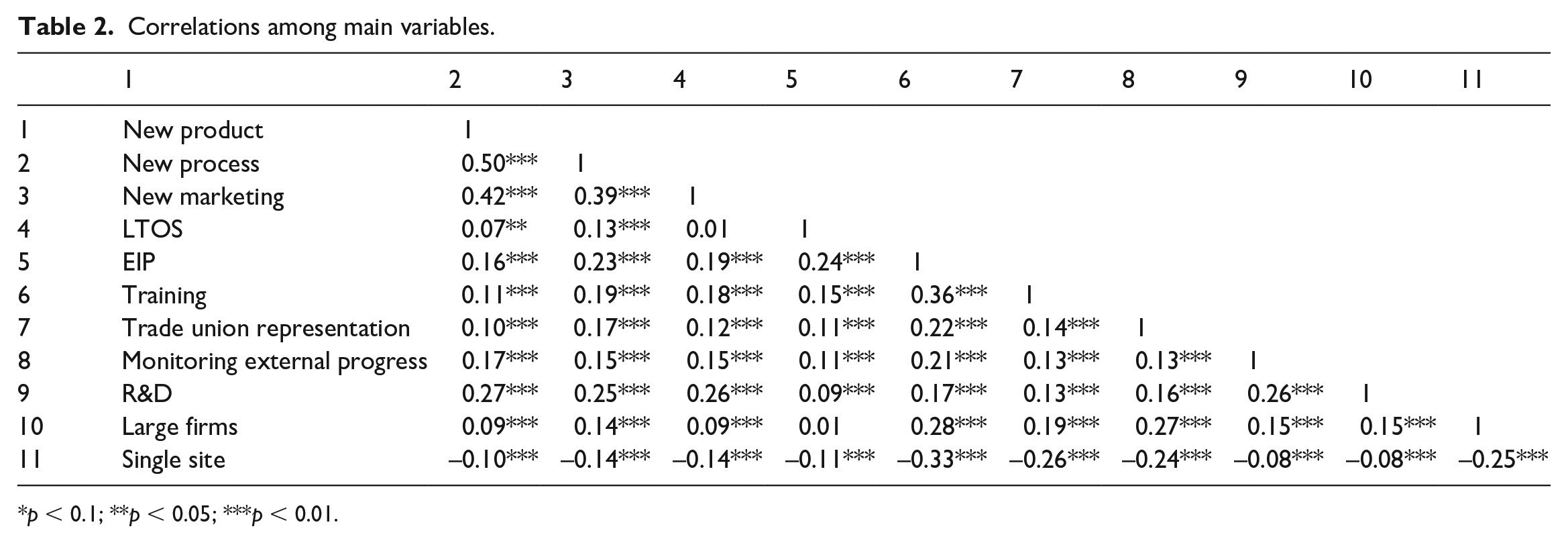
p < 0.1; **p < 0.05; ***p < 0.01.
Methods
We first employ a probit regression to determine the total and direct effects of trade union representation on different types of innovation by taking into account all relevant control variables. We then decompose the total effect into direct and indirect effects by using the Karlson–Holm–Breen (KHB) method for comparing probit coefficients in nested nonlinear probability models (Breen et al., 2013, 2018; Karlson et al., 2012; Kohler et al., 2011). As our dependent variable – innovation – is a binary measure, linear decomposing models cannot be used since the regression coefficients in nonlinear binary probability models are a function of the error standard deviation (Karlson et al., 2012; MacKinnon and Dwyer, 1993; Winship and Mare, 1983), and the error variance may differ across models. As a result, the total effect does not decompose into direct and indirect effects. The KHB method is designed for nonlinear probability models and has less restrictive assumptions; in addition, it allows the inclusion of important control variables. The method has been widely used by social scientists (for a review see Breen et al., 2018), including in the field of employment relations (Apel and Horney, 2017).
Following the guidelines for the two-path mediated model (Lau and Cheung, 2012; Macho and Ledermann, 2011) and given the distribution of innovation measures, we structured the analysis into six paths. First, we examined the total and direct effect of trade union representation on innovation. The results are shown in Table 3. Secondly, using the KHB method (Breen et al., 2013, 2018; Kohler et al., 2011), we examined how union presence indirectly affects innovation through its influence on LTOS, training and employee involvement. The results are shown in Tables 4 and 5 and the pathways of impact and empirical results are illustrated in Figure 1.
Trade union representation and innovation (probit regression).
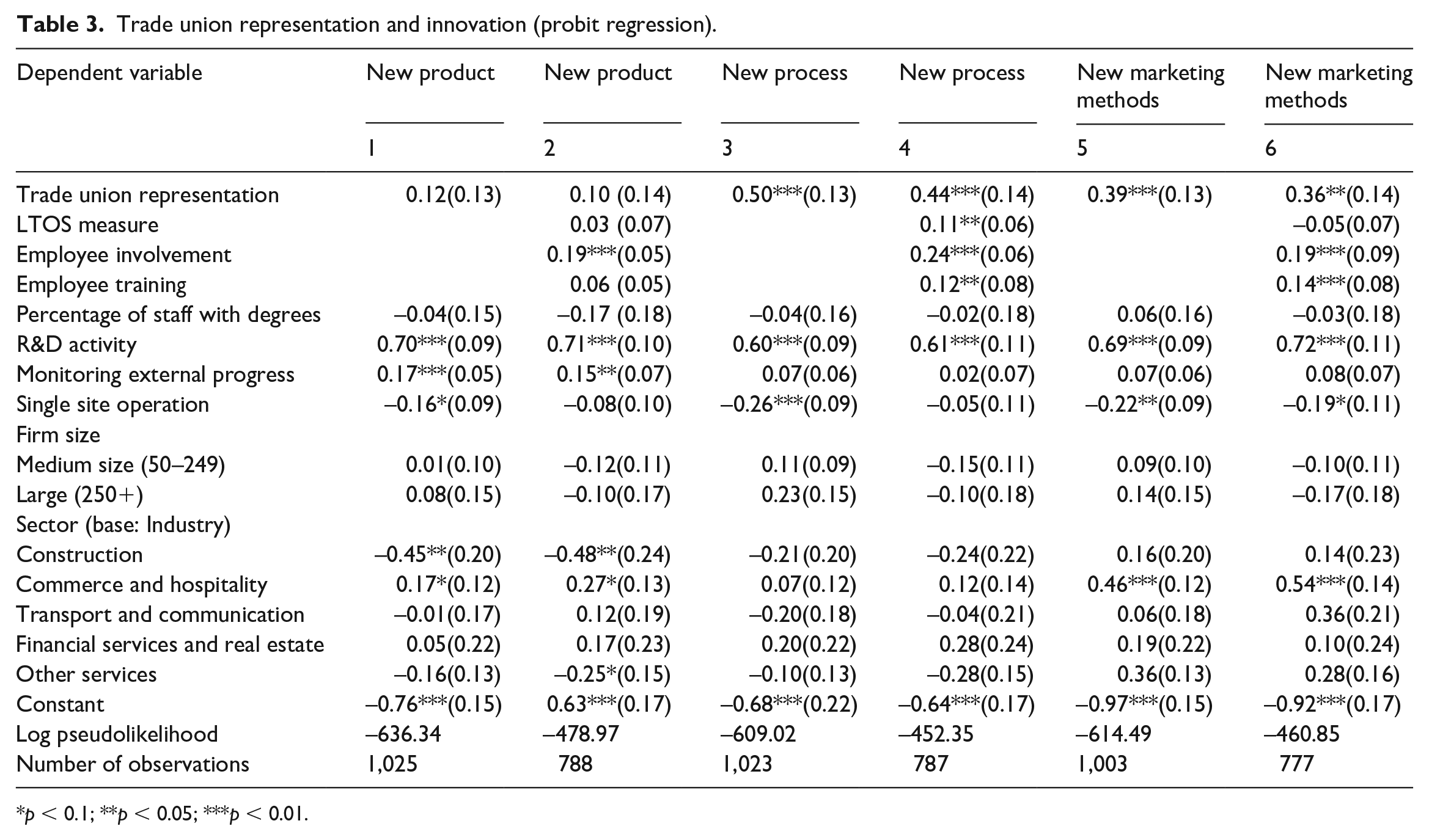
p < 0.1; **p < 0.05; ***p < 0.01.
Decomposition of trade union influence on new process via staffing, training and EEP (KHB probit model).
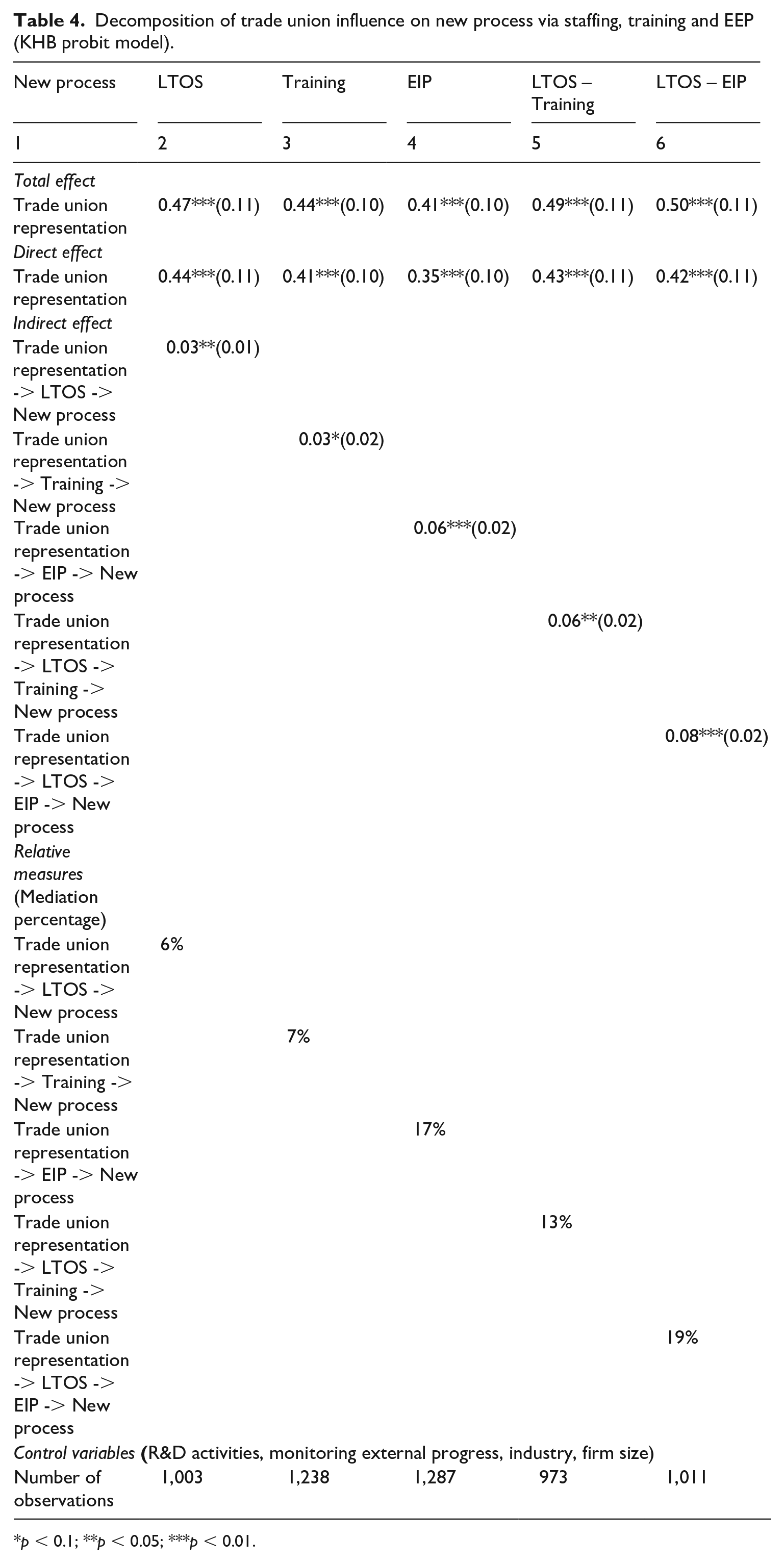
p < 0.1; **p < 0.05; ***p < 0.01.
Findings
Hypothesis 1 suggested that trade union representation at the workplace has a positive effect on firms’ propensity to innovate. The probit regression results in columns 1, 3 and 5 presented in Table 3 provide empirical support for this hypothesis, indicating a positive total effect of trade union representation on innovations after controlling for firm size, industry, workforce composition and firm level innovative activities. The coefficients are significant in relation to new processes and new ways of marketing: where trade unions are present, firms are 50% (or 39%) more likely to introduce process innovations (or new marketing methods) than where they are absent. The coefficient relating to new products, however, is not statistically significant. This provides empirical evidence to support the first hypothesis, but only in respect of new processes and new ways of marketing.
Including innovation-nurturing employment practices (LTOS, training provision, employee involvement) in the model allows for an investigation of the direct effect of trade union representation on innovation. The results are shown in steps 2, 4 and 6 in Table 3. The direct effect of trade union representation is reduced but still positive and significant with regard to new processes and new marketing methods. It is noteworthy that employee involvement practices show a significant and positive correlation with all three types of innovation, training provision is significantly correlated with process and marketing innovation, while LTOS is only significantly associated with process innovation. These results indicate mediating effects of trade union representation through LTOS, training provision and employee involvement, which will be further examined by the KHB method.
After carefully examining the significant level of control variables in the full regressions as shown in steps 2, 4 and 6 in Table 3, we included those important control variables in the KHB analysis. They are R&D activities, firm size (number of employees on the payroll), single-site operation and sectors. These variables have also been found to impact on innovation in extant studies (Zhang et al., 2019).
Since the correlation between trade union representation and the introduction of new products is positive but statistically insignificant, we employ the KHB method to decompose the effect of trade union representation on the introduction of new processes and new ways of marketing only. The proposed paths (H2–H6) shown in Figure 1 and the empirical results relating to the indirect effects of trade union representation on new processes and new marketing methods are shown in the second to sixth columns of Table 4 and Table 5 respectively. The upper part of each table shows the total, direct and indirect effects (changes in coefficient). The lower part shows relative measures (indirect or mediating effect as a percentage of the total effect) after including the individual or combined mediators.
Decomposition of trade union influence on new ways of marketing via staffing, training and EIP (KHB probit model).
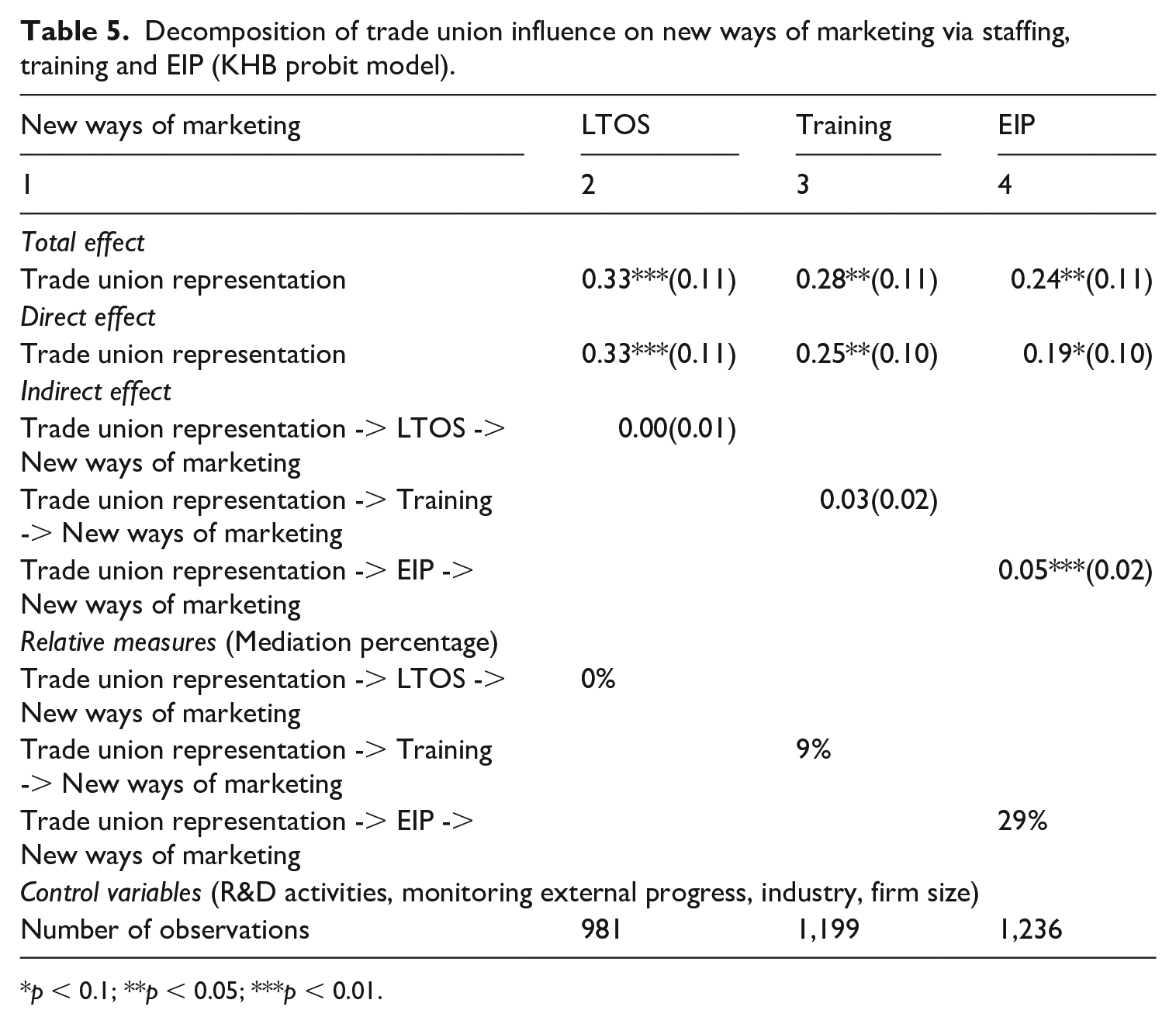
p < 0.1; **p < 0.05; ***p < 0.01.
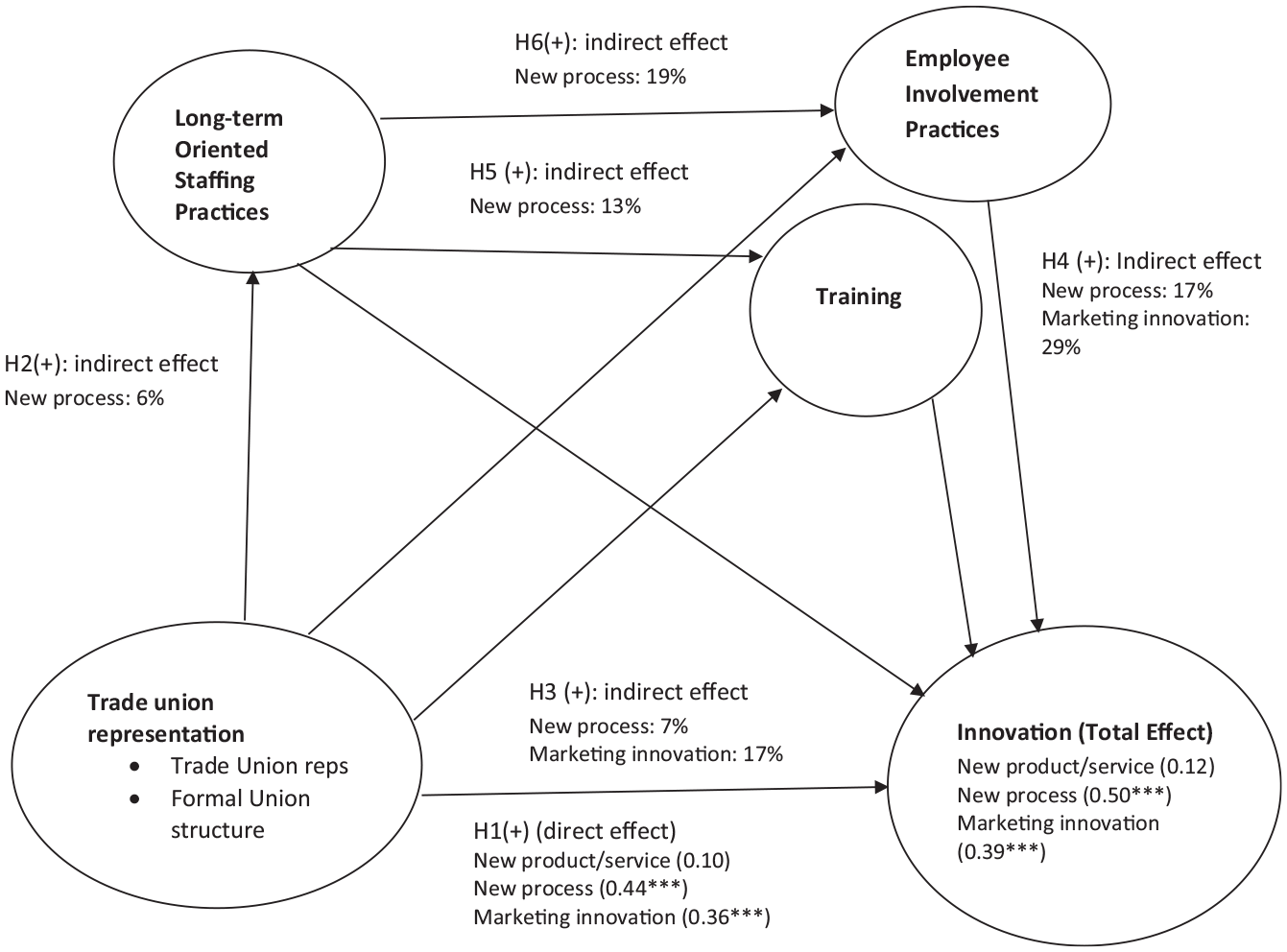
Conceptual framework with empirical results.
The second column of Table 4 shows that the indirect effect through the path ‘Trade union representation -> LTOS -> Innovation’ accounts for 6% of the total effect of trade union representation on the introduction of new processes. However, the indirect effect of trade unions through LTOS on new ways of marketing is 0% in Table 5, thus we do not further examine its paths through training and employee involvement practices. We therefore accept Hypothesis 2, but only in respect of process innovation.
The third column of Table 4 shows that the indirect effect through the path ‘Trade union representation -> Training -> Innovation’ accounts for 7% of the total effect of trade union representation on new processes, and 9% of its total effect on new ways of marketing (shown in Table 5). The corresponding coefficient changes are positive and moderately significant for process innovation, and statistically insignificant with regard to marketing innovations. This provides empirical evidence to support Hypothesis 3: training provision is an important mediating influence on the relationship between union representation and innovation, although only in relation to process innovation.
The fourth column of Table 4 shows that the indirect effect of ‘Trade union representation -> Employee involvement -> Innovation’ accounts for 17% of the total effect of trade unions on the introduction of new processes. This indirect effect is 29% of the total effect on new ways of marketing (as shown in Table 5). The corresponding coefficient changes are also positive and significant indicating that employee involvement practices are an important mediator influencing the positive contribution of union representation to new process innovation. This finding provides empirical evidence to support Hypothesis 4.
The fifth column in Table 4 examines the combined indirect effect of the path ‘Trade union representation -> LTOS -> Training -> Innovation’ on the introduction of new processes. The combined indirect effect accounts for 13% of the total effect of trade union representation on the introduction of new processes that is stronger than LTOS (6%) or training (7%) as a mediator alone. These findings suggest that trade union representation can exert a stronger indirect influence on innovation through the combined effects of long-term oriented staffing practices and training provision. However, the indirect effect through LTOS on the introduction of new ways of marketing is 0% shown in the second column of Table 5. Hypothesis 5 is therefore partially supported; this combined effect is strong in relation to process innovation, but not marketing innovation.
The last columns in Table 4 examine the combined indirect effect of ‘Trade union representation -> LTOS -> Employee involvement -> Innovation’ on the introduction of new processes. The indirect effect of ‘LTOS – Involvement’ accounts for 19% of the total effect of union presence on the introduction of new processes, which is stronger compared with employee involvement practices (17%) or staffing practices (6%) as a mediator on its own. This is to say trade union representation has a stronger indirect effect through employee involvement on process innovation when long-term oriented staff practices are in place.
However, as the indirect effect through staffing practices on the introduction of new products or new ways of marketing are insignificant, Hypothesis 6 is partially supported, that is to say, there is a strong combined mediating effect of trade union representation through long-term oriented staffing practices and employment involvement practices in relation to process innovation.
Conclusion
This article contributes to the debate on the relationship between trade unions and innovation (Berton et al., 2021; Doucouliagos and Laroche, 2013; Reshef et al., 1993; Teng et al., 2019). We examined the individual and combined effects of trade union representation on innovation through their influence on staffing, training and employee involvement practices. Our concern centred on the neglected impact of unions on long-term innovation capacity at work and the potential for unions to act as antagonistic, but constructive, co-creators of policies that safeguard training and the ‘right to know’ what is going on at the workplace. Our emphasis is on genuinely independent unions with strong workforce support and clear as to their relationship with the employer – one of constructive opposition in the interests of their members with back-up from their national associations. This position is supported by evidence from its opposite, namely ‘company’ unions and/or weak unionisation are found to have either no impact on firm innovation or a detrimental one (Foster and Woolfson, 1989). The decline in private sector unionisation in the UK and USA has likely been an important contributor to an increase in failed projects, more risk taking, and a loss of business dynamism (Calvino et al., 2020).
Our findings indicate that on-site union presence and employee representation structures are significantly and positively correlated with innovations relating to processes and marketing. This represents the article’s first contribution, which is to confirm a direct and positive association between trade union representation and innovation. Its second substantial – and particularly distinctive – contribution is that it has drawn attention to the indirect influences that trade unions can have on innovation. Our findings suggest that these indirect influences emanate from the positive impact that trade unions can have on training provision (both on- and off-job training), employee involvement practices, in particular upward problem-solving, and long-term oriented staffing practices. Studies have shown that these practices help to develop key capabilities and organisational resources that support innovation (Addison et al., 2017; Lévesque and Murray, 2005; Storey et al., 2002).
The findings further indicate that trade union representation has a particularly strong influence on the probability that firms will introduce process innovations. These are innovations that may directly affect how employees’ work is organised, the technology they use and, potentially, the intensity of their work. Shipton et al. (2006) suggest a deeper understanding in the work system commands employees a stronger influence in process innovation than new products introduced. However, although employees may possess ideas that have the potential to improve productivity through innovation rather than through work intensification, they are unlikely to articulate these ideas in the absence of a long-term employment commitment on the part of employers. Staff involvement should not be seen, therefore, as some vague psychological construct that supposedly captures a moral imperative in terms of commitment, but rather a bargained truce between workers as a collective and management rooted in the labour process of skill use. The results show that training and employee involvement practices have a stronger and significant association with new process innovation when trade unions help to shape long-term oriented staffing practices. Hence, the importance of meaningful trade union representation and the possible virtuous circle contained within a power brokerage system that allows for better training, more investment, higher productivity and a more sustainable business model for long-term profits and survival.
The limitations of the study must be acknowledged. The first limitation relates to the measures of innovation, which do not provide detailed information about new processes, products or marketing approaches and do not capture information about contexts or processes of innovation, only the outcomes. Secondly, as the article relies on cross-sectional survey data, we are unable to make any strong statements in relation to causation (for which longitudinal data would be required). Thirdly, it is important to emphasise that our findings relate solely to the UK and may not hold true in other national contexts. The institutions that provide opportunities for employee representatives to participate in decision-making and other potential influences on innovation differ between countries (Hall and Soskice, 2001). For example, employee involvement and participation are more strongly mandated and institutionalised in many other European economies. That having been said, staffing, training and employee participation are common concerns for trade unions and fora such as work councils and the processes by which they seek to influence these issues and the consequences for firms’ innovation propensity would be interesting issues for future comparative research.
A fourth limitation is that we have been unable to investigate whether and to what extent trade union influences on innovation differ according to the strength of trade union organisation and representation. Some studies (Kizilos and Reshef, 1997; Laroche, 2002; Reshef et al., 1993) have suggested that a curvilinear relationship exists between workplace unionisation and innovation, wherein unions with a strong workplace presence are more likely to support innovation than less well organised unions, which might view innovation as a means by which management might weaken the unions’ position. Conversely, Cabaleiro and Gutiérrez (2019: 27), in a study of unions and innovation in Chile, suggest that strong trade unions ‘could be interested in pursuing more radical changes at the workplace that are not necessarily favorable to management’s innovation’s plans because they have the resources to do so’. This possibility points to a final limitation of our study, which is that we are unable to analyse how trade unions engage with management in relation to innovation and whether the positive association reflects union strength or union weakness (or potentially both, but in different contexts). The positive role that trade unions can play in relation to innovation could be interpreted as evidence of the benefits of cooperative models of partnership (Terry, 2003). Our own view, however, is that strong oppositional union behaviour is more likely to result in agreements that secure sustainable benefits in relation to innovation. This does not preclude, furthermore, the usual antagonistic dialectics of collective bargaining over pay and conditions. By fighting the union corner, strong workplace union activists can force managers to innovate in the employment relations arena through long-term planning of staff development and skill formation and thus improve the management of change, productivity and, thereby, long-term profitability. In other words, this study has shown that unions can be part of the solution to low innovation and productivity and should not be seen as part of the problem.
Footnotes
Declaration of conflicting interests
The authors declared no potential conflicts of interest with respect to the research, authorship, and/or publication of this article.
Funding
The authors received no financial support for the research, authorship, and/or publication of this article.
