




Abstract
Drawing on a study of a Scottish government initiative to ensure the provision of a living wage to social care workers, the article sheds new light on the value of regulating domestic supply chains to enhance labour standards in supplier organisations, and the factors that facilitate and hinder such regulation. The study confirms that supply chains driven by monopsonistic purchasers tend to drive down employment conditions, while indicating that the studied initiative met with a good deal of success due to a combination of the government generated ‘soft’ regulation and support from care providers that reflected both value and pragmatic considerations. It also highlights the contradictory tensions that can arise between policy aspirations and business objectives and suggests that to be effective, initiatives to enhance labour standards in supply chains need to address adverse market dynamics.
Introduction
Over the last three decades or so the role of commercial supply relationships in shaping employment conditions has taken on a growing (and, in historical terms, renewed) significance as large public and private sector organisations have chosen to place a greater emphasis on management by ‘contracting’ rather than through ‘internal hierarchies’ (Williamson, 1975, 1985). At the aggregate level, evidence indicates that this trend has made an important contribution to the deterioration in employment conditions that has occurred over the last 30 years. In particular, David Weil (2011) has drawn attention to how the shift towards externalisation has led to the creation of ‘fissured’ employment relationships in a number of industries with large concentrations of low paid workers (Weil, 2011, 2014). In these industries, powerful lead firms are noted to shape product market conditions, while to a large extent being separated from the employment of the workers who produce the goods and services for them. Weil argues that this change has created situations where the direct employers of workers operate under far more competitive market conditions, with the result that they are confronted by pressures to reduce terms and conditions and incentives towards non-compliance with laid down employment standards. Furthermore, and more relevant to the present article, studies have similarly revealed how public sector procurement of services from private and voluntary sector organisations can negatively impact the terms and conditions of those delivering them (see e.g. Cunningham and James, 2009; Flecker and Hermann, 2011; Grimshaw et al., 2015; Hermann and Flecker, 2012).
The coincidence between the presence of powerful supply chain actors and employment vulnerability has raised the issue of whether the former can be used to help combat the latter (James et al., 2015). This is particularly so given evidence that such actors often, to ensure that secured cost reductions do not cause damage to brand image, already interfere in the internal management of supplier organisations, most notably through the establishment of demanding quality standards and rigorous monitoring systems to enforce them. Hence a key theme in Weil’s work is that government agencies charged with securing compliance with laid down labour standards should develop strategies to motivate powerful purchasers to use their supply chains to support supplier compliance with them.
This advocacy of using the power of purchasers to improve labour standard compliance has been echoed in policy debates internationally. At the same time, and somewhat in contrast to the extensive literature that exists on the regulation of global supply chains, detailed studies of attempts to protect and/or enhance labour standards within chains domestically located in advanced Western economies are striking by their rarity. There is consequently a dearth of empirical evidence on the factors which influence, both positively and negatively, the outcomes of such initiatives (James et al., 2015). Indeed, as Grimshaw et al. noted in their recent study of client–supplier relations in the contract cleaning sector, there is a need more generally for studies that focus attention on how the roles of supply chain actors ‘as market-makers interact with their capacity and willingness to enact institutional rules that impose social obligations’ (Grimshaw et al., 2019: 91).
The present article addresses this lack of knowledge in the current literature. It does so by drawing on a study focused on the implementation of a Scottish government policy aimed at ensuring the payment of the Scottish Living Wage (SLW) to those delivering adult social care services on behalf of local authorities. More specifically, the article uses these findings to explore three questions: (a) how far the policy had secured the payment of the SLW to adult care workers; (b) what factors facilitated and hindered the policy’s implementation; and (c) to what extent these findings support existing (limited) evidence relating to the regulation of labour conditions in domestic supply chains.
To anticipate what follows, the obtained findings confirm how purchaser–provider relationships can set in train a downward spiral in labour conditions where power is asymmetrically weighted in favour of the former. They further though lend weight to the view that domestic supply chains can be used to have the opposite effect, while indicating that their potential in this regard is contingently shaped. More specifically, in the case of the SLW policy, the findings highlight how a combination of governmental ‘soft’ regulation and support from service providers on both value and pragmatic grounds contributed to a relatively successful implementation. In addition, by raising doubts about the policy’s longer-term sustainability, they reinforce the argument that initiatives to enhance labour standards in supply chains are most likely to meet with success if they incorporate elements focused on reshaping surrounding product market price dynamics.
The analysis proceeds through four stages. First, comes a two-part literature. The first part of this examines what current evidence tells us about the potential value of supply chain regulation and the main factors that influence its impact. The second then provides an outline of the background to, and nature of, the Scottish government’s SLW policy. Following this, the study’s methodology and findings are detailed. Finally, a discussion section explores the implications of these findings for future policy.
Engendering labour standard compliance in supply chains
Forms of legally backed supply chain regulation have long existed in Britain, dating back at least to the adoption of the first Fair Wages Resolution in the nineteenth century. More recently, section 54 of the Modern Slavery Act 2014 imposes obligations on relevant commercial organisations to produce a modern slavery and human trafficking statement each financial year that sets out what they are doing to ensure that such slavery is not occurring in their supply chains. In addition, the Director of Labour Market Enforcement in his 2018 strategy recommended the adoption of measures under which ‘the brand name (at the top of the chain) bears joint responsibility for any non-compliance found further down its own supply chain’ and provisions to enable the temporary embargo of ‘hot goods’ produced in supply chains marked by non-compliance (Department for Business, Energy and Industrial Strategy, 2018). 1 Subsequently, the government has recently consulted about the desirability of introducing legislative provisions to implement these proposals (Department for Business, Energy and Industrial Strategy, 2019). These British developments have, in turn, taken place against the backcloth of similar discussions and initiatives internationally (see e.g. Johnstone and Stewart, 2015; Weil, 2014).
Such discussions and actions have been occurring against the background of some limited evidence of the benefits that can flow from domestic, national, initiatives aimed at exerting pressure on powerful supply chain actors to influence labour conditions in supplier organisations. In Britain, for example, studies have highlighted how regulatory pressures and provisions have supported the achievement of good safety performances on major construction projects through the effective management of subcontracting (Deakin and Koukiadaki, 2009; James et al., 2014). In a similar vein, the Work and Hours Division of the US Department of Labour has successfully used ‘hot goods’ provisions in the Fair Labor Standard Act to improve minimum wage compliance among apparel contractors in Southern California (Weil, 2005) and New York (Weil and Mallo, 2007).
The fact remains, however, that the current evidence base remains relatively limited regarding the outcomes of such initiatives and the factors that facilitate and hinder their operation. Some more comprehensive, but tentative, insights into these issues is though arguably provided by the much more extensive literature relating to the voluntary regulation of labour standards within global supply chains.
Overall, this broader literature paints, at best, a mixed picture and, at worst, a disappointing one concerning the use of supply chains to enhance labour standards. For example, with regard to the apparel sector, it has been argued that ‘private compliance programs appear largely unable to deliver on their promise of sustained improvements in labor standards’ (Locke, 2013: 20). A variety of explanations have been put forward to explain this situation. These point to the influence of a range of contextual and structural factors (Bartley, 2011; Trubek and Trubek, 2007) that broadly fall into three categories (James et al., 2019). The first of these emphasises the lack of support that voluntary supply chain initiatives receive from surrounding state-based legal regulation (Locke et al., 2013; Toffel et al., 2015). The second draws attention, more widely, to how compliance with initiatives is shaped, both positively and negatively, by a range of non-legal factors, such as the extent of pressures emanating from consumers and other social bodies, and the adequacy of mechanisms in place within initiatives to monitor and secure compliance with laid down requirements (see e.g. Braithwaite and Drahos, 2000; Locke, 2013; O’Rouke, 2003; Reinecke and Donaghey, 2015; Vogel, 2008). 2 Meanwhile, the third stresses the failure of initiatives to support the reconfiguring of the market dynamics embedded in supply chains that exert contradictory downward pressures on labour costs (Anner et al., 2013).
At the same time, the global supply chain literature highlights that the capacity to influence labour standards varies between issues: more positive effects, for example, being identified in relation to health and safety related requirements than with regard to less tangible and easily monitored ones focused on issues like freedom of association and limits on excessive overtime (Locke et al., 2009). It similarly highlights how the challenges facing the effective operation of these arrangements vary according to the nature of the supply chains concerned.
On the basis of an analysis of cut flower and banana global supply chains, Riisgaard and Hammer (2011) have observed that while a highly driven chain ‘opens avenues for labour (as well as other social movements) to target strategic actor(s)’, ‘such leverage is more implausible where value chain strands are characterised by relatively loose market-based, trading relationships’. Meanwhile, more widely, Lakhani et al. (2013), drawing on the varying types of global supply chains distinguished by Gereffi and colleagues (Gereffi et al., 2005), have developed a configurational framework in which they postulate a set of employment relations implications for each of them. In doing so, they similarly suggest that the influence of public campaigns, union strategies and multinational initiatives to improve labour standards will vary between different types of supply chains.
How far these findings from global supply chain research can be extrapolated to the regulation of domestic-based ones in developed market economies remains something of an open question. So does the issue, more specifically, of their application to ones in the public sector where the financial/commercial imperatives at work might be expected to be rather different.
In relation to the first of these questions, Weil, a leading advocate of domestic supply chain chain regulation, both as an academic and, for a period, Director of the Department of Labor’s Work and House Division during the Obama Presidency, has usefully highlighted four different categories of asymmetric supply relationships that prevail in monopsonistic markets associated with vulnerable forms of employment (Weil, 2009): strong buyers sourcing products in competitive supply chains; central production coordinators managing large contracting networks; small workplaces linked to large, branded, national organisations; and small workplaces and contractors linked together by common purchasers. In doing so, he has convincingly argued, in a clear echo of the global supply chain literature, that ‘Understanding how industry structures relate to the creation of vulnerable work . . . provides insight into how those same dynamics could be used as a regulatory mechanism to bring systemic compliance to an entire industry rather than on an employer-by-employer basis’ (Weil, 2009: 421).
More narrowly, the studies referred to earlier relating to large construction projects in Britain and minimum wage compliance in the United States also point to the relevance of central strands of argument found in the global supply chain literature. The latter, for example, not only demonstrates the role of supportive legal provisions but how the impact of the studied ‘hot goods’ policies was influenced by the requirement that manufacturers facing product embargos commit to monitor future compliance of suppliers and to remediate any violations so identified (Weil and Mallo, 2007). Meanwhile, in the former British case, the researchers concluded that the impressive health and safety performances achieved on the two major building projects studied stemmed from the mutual interplay of several factors (James et al., 2014). These included the way in which the regulator had, in conjunction with major firms and against the background of relevant legal requirements, established an understanding of what constituted ‘best practice’ in the management of large construction projects. They also included how this understanding had shaped major contractor perceptions of the reputational risks associated with projects and the actions they had taken to minimise them by imposing controls over the selection, monitoring and more general management of subcontractors.
There are consequently grounds to believe that the constellation of factors influencing the effectiveness of attempts to regulate domestic supply chains are likely to broadly reflect those that have been found to influence the impact of their global counterparts. There are also, though, grounds for arguing that the use of supply chains to protect and enhance labour standards is likely easier at a domestic rather than global level (Gibbons, 1998). Thus, such chains will tend to embody fewer tiers and operate against the backcloth of essentially common social and economic contexts. In addition, as the opening paragraph of this review highlighted, it is potentially feasible to develop legally based requirements on the management of supply chains. The scale of these advantages must not, however, be overstated, as the poor employment practices recently found in garment factories supplying a major British fashion brand in the city of Leicester graphically illustrate. 3
Care also needs to be exercised in advancing the view that the dynamics surrounding attempts to regulate domestic chains are likely to be fundamentally different in the case of outsourcing by public sector organisations because they are less driven by financial considerations and more by social values and objectives. As with inter-organisational trading relations in general, the procurement behaviour of public sector bodies will be influenced by surrounding social and economic contexts. This is illustrated clearly by a comparative analysis of the public service outsourcing undertaken by local authorities in five countries which revealed ‘country-specific interconnections between labour market factors and outsourcing’ (Grimshaw et al., 2015: 296). However, while clearly such contexts will exhibit differences to those of private organisations, this does not mean that the financial drivers of outsourcing will necessarily be fundamentally different. For example, in a recent study of the relations subsisting between contract cleaning companies and their public and private sector clients it was found that both types of client injected price competition into tenders for service and enacted continuous cost-reducing pressures (Grimshaw et al., 2019: 90). Such findings can therefore be seen to point to the wider applicability of an argument advanced by Bélanger and Edwards in relation to public sector nursing work that, as a result of ‘budgetary constraints and the rhetoric of rationalization and consumerism’, the need for efficiency ‘is no different in kind from that in a private sector organization’ (Bélanger and Edwards, 2013: 445).
In short, while limited research has explored the impact of domestic based supply chain initiatives focused on improving compliance with laid down employment standards, there are grounds to believe that they can generate positive results. However, evidence in the more extensive literature on global supply chains points to the likely contingent nature of their effects. In particular, there are grounds to believe that their viability and impact will be influenced by their subject foci and the structure of the supply chains concerned, and that their effectiveness will be further influenced by important features of their design: most notably, the extent to which they are backed by supporting legal requirements, the presence of facilitating non-legal factors, including pressures emanating from consumers and the arrangements put in place to monitor and secure compliance with laid down requirements, and the extent to which problematic product market dynamics are addressed.
In what follows light will be shed on the applicability of these conclusions to the policy of paying the SLW to adult social care workers. As a result, new light will also be shed on their applicability to public service, rather than private sector, supply chains operating in an outsourcing context marked by monopsonistic purchasers.
Regulating adult social care pay
Adult social care services in Scotland are delivered directly by local authorities and by independent subcontracted organisations from the private and non-profit sectors (Crouch, 2011; Martin, 2011). As a result of processes of marketisation over the past four decades, the majority of residential and domiciliary care is now, however, outsourced by local authorities to organisations in the latter sectors (Hughes et al., 2009). This pattern of delivery means that two distinct systems exist for determining the terms and conditions of social care staff. Those still employed by local authorities are covered by long-established national collective bargaining arrangements. For others pay and conditions are set at the enterprise level, either through local negotiations with unions or unilaterally by management.
Studies indicate that local authorities occupy monopsonistic market positions and consequently largely set the price for care to the detriment of providers (Rubery and Urwin, 2011). Research further shows that the increasing reliance placed on commissioning care from external providers through competitive tendering has coincided with the ongoing driving down of the terms and conditions of care staff working for them, with the result that a growing gap has developed with those of staff who continue to be employed by local authorities (Cunningham and James, 2014, 2017). Market forces and austerity have, therefore, combined to allow local authorities, in shifting from the direct delivery to the commissioning of services, to cut costs in a way that would almost certainly not have been possible with their own internal workforces given the presence of collectively bargained terms and conditions of employment.
This process of employment degradation has led to growing concerns about the ability of providers to maintain service quality in the face of recruitment and retention problems, rising workloads and growing staff discontent (Cunningham and James, 2017; Mulholland et al., 2016; Rubery et al., 2011). A study by the Office of the Chief Social Work Adviser (Mulholland et al., 2016), for example, found that the majority of providers had regularly or occasionally experienced problems in the recruitment of care and support workers, and believed these difficulties would only intensify in the future. The report further identified low pay as the main reason why organisations were unable to recruit and retain workers, with other contributory factors being the continuing shortfall in local authority funding, competition with other sectors for the same labour and increasing antisocial hours driven by the flexibility demanded from workers (Mulholland et al., 2016). These pressures on pay and recruitment were further noted to be occurring at a time of increasing demands on the skills of the workforce through the government’s system of Scottish Vocational Qualifications (Gospal and Lewis, 2011), the promulgation of ‘fitness to practice’ standards (SSSC, 2017) and policy developments in Scotland such as the personalisation of social care and health and social care integration.
The Scottish government has long exhibited an interest in utilising public procurement to advance social objectives. In 2014 it unsuccessfully attempted to add the living wage as a condition in all government contracts via the Procurement Reform Act Scotland (Prowse and Fells, 2016). More widely, under its ‘Fair Work’ principles and guidance, public commissioning authorities are expected to consider how bidders approach the reward, recognition, training and supervision of staff (Cunningham et al., 2018). These initiatives, however, have occurred against the backcloth of employment law remaining an issue within the prerogative of the UK government, with the result that the Scottish government does not have the power to legally impose minimum pay rates.
Nevertheless, in order to address these recruitment and retention problems, in February 2016 the Scottish government and the Confederation of Scottish Local Authorities (COSLA) jointly agreed that front-line care staff working on publicly funded adult social care should be paid at a minimum the Scottish Living Wage (SLW), then set at £8.25 per hour, with effect from 1 October of that year. 4 To support the achievement of this ‘soft regulation’ measure the government allocated funding to local health and social care partnerships that was to be transferred onwards via local authorities to care providers/employers. This transfer would occur through the re-negotiation of contract prices, fees and hourly rates paid for service delivery, thus enabling providers to increase staff pay in line with the commitment. When the SLW rate was increased in November 2016, the Scottish government and COSLA similarly identified funding to meet this increase.
To support the introduction of the SLW policy, implementation guidance for health and social care partnerships and providers was drafted and issued by an Implementation Group comprising provider representative organisations, such as Scottish Care and the Coalition of Care and Support Providers Scotland (CCPS) and trades unions. Among other things, this guidance made clear that: providers were expected to make a contribution towards the costs of the Living Wage commitment; contracting authorities could not under EU law make the payment of the SLW a mandatory element of the competitive tendering process but could take account of a bidder’s approach to the government’s fair work practices as they are supported by statutory guidance; and local government commissioners were responsible for ensuring that the commitment to the living wage was delivered through local contracts and agreements. More widely, the guidance stated that ‘Local authorities will need to engage care providers in negotiations to reach a voluntary agreement and this will be facilitated by a funding process that is fair, transparent and collaborative, and achieve “buy-in” from providers.’ It went on to detail four possible ways of funding providers (via their contracted hourly rates) to pay the living wage to adult social care staff:
Applying a percentage increase across the board
Applying a differing percentage increase per provider, through individual negotiation based on their particular costs
Setting a standard rate for each local authority within which the relevant hourly rate is payable
Setting a suite of such rates
In short, the Scottish government’s SLW policy offered a very apt setting to add to the existing literature on the employment-related effects of supply chain dynamics through an exploration of the following questions:
How far has the policy secured the payment of the SLW to adult care workers?
What factors have acted to facilitate and hinder the policy’s implementation?
To what extent do these findings support existing (limited) evidence relating to the regulation of labour conditions in domestic supply chains?
Methodology
The study drawn upon in this article explored, as part of a wider research project, a range of issues relating to the implementation of the Scottish government’s SLW policy. These issues included: the experiences of providers and commissioning authorities in implementing the commitment to pay the living wage; the application and usefulness of the guidance issued to support this commitment’s operationalisation; the enablers and barriers to successful implementation; and how the implementation process could be improved in the future. This study employed an inductive, qualitative approach to gather data on the above issues given its capacity to provide rich insights into respondents’ perspectives on them.
The primary source of data collection was interviews with key informants who either had responsibilities for ensuring that the SLW policy commitment was delivered to adult social care staff on the front-line or were involved in designing the implementation guidance. Interviewees were therefore selected via a purposive sampling strategy (Patton, 2002) that also sought to ensure that those selected from local authorities and care providers varied in terms of such factors as organisational size, sector, and location of care service provision.
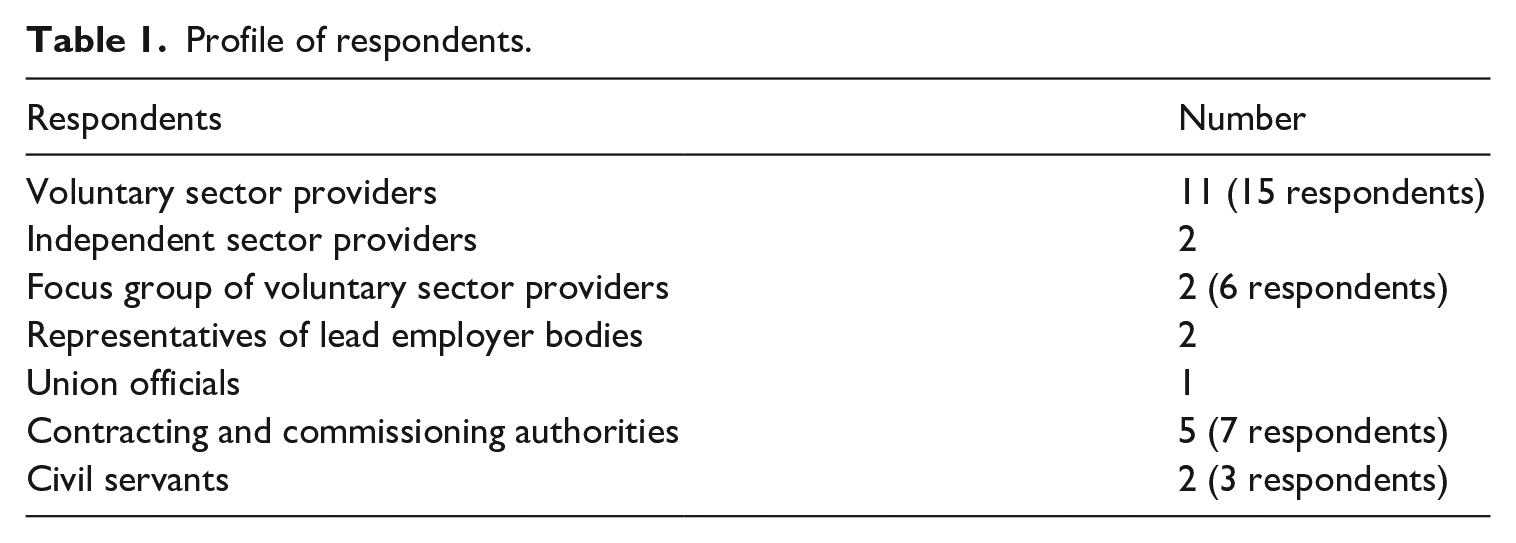
Semi-structured interviews were conducted with the directors and HR managers of 11 voluntary and two independent sector providers to explore the facilitators and barriers they faced in operationalising the SLW and its impact on employment conditions (e.g. timing of pay settlements and the impact on differentials, terms and conditions, recruitment and retention, and the provision of services). Two focus groups were also held with four and two voluntary sector providers respectively to assess the extent of shared or divergent views regarding experiences with implementing the living wage. The experiences reported through these essentially echoed those reported during the semi-structured interviews and so are not drawn upon in what follows.
Further interviews were conducted with relevant personnel in five local authorities, including Chief Officers, members of Integrated Joint Boards, and procurement and finance managers responsible for contracting and commissioning social care services in their local authority. These local authorities were purposively selected according to a stratified sampling approach to capture the variety of urban, rural and semi-rural settings in which care is delivered across Scotland. Finally, further confirmatory interviews were undertaken with civil servants, representatives from COSLA, lead bodies of employers (CCPS and Scottish Care) and a senior trade union representative that aimed at capturing their experiences as members of the Implementation Group and exploring the operational and wider regulatory and policy contexts of the SLW policy. 5
In total, as shown in Table 1, data were collected through a combination of interviews and focus groups with 36 respondents representing a range of voices from the main actors involved in the implementation of the Scottish government’s SLW policy.
Profile of respondents.
The interviews were all digitally recorded, averaging 50 minutes in length, and transcribed verbatim with any identifying information removed to preserve confidentiality. All four members of the research team analysed the interview transcripts independently. The research team began by coding the interviews for instances where respondents expressed views about the enablers and barriers to implementation, changing roles and influence in relation to pay determination and the ongoing impact of SLW implementation on employment and market relations in social care. A broad list of descriptive codes emerged from openly coding the data and these were labelled or given phrasal descriptors from the respondents where possible (Gioia et al., 2013). These codes were first grouped according to similarities and differences across the two provider groups (voluntary sector vs independent providers). These insights were then contrasted with the commonalities and dissimilarities arising from local authority respondents, central government officials and union and employer lead body representatives. Data analysis progressed by abstracting from these patterns to identify central emergent themes. Iterating back and forth between the data and literature, these themes were then analysed according to the extent to which they confirmed or challenged the existing evidence relating to the regulation of labour conditions in domestic supply chains.
Since adequacy is critical in presenting the experiences of research participants (Gioia et al., 2013), the research team sought to validate the emergent themes through respondent validation when presenting initial findings back to the key informant interviewees. Meanwhile, informant confidentiality and accurate record keeping during all phases of the research process additionally ensured the dependability of findings (Lincoln and Guba, 1985). Finally, verbatim transcription of interviews further helped to ensure the confirmability of the findings, mitigating the bias of the researchers’ personal values or theoretical inclinations (Shah and Corley, 2006).
Findings
To obtain a rounded picture of both the impact of the Scottish government’s SLW policy and the factors influencing, both positively and negatively, its implementation, attention below is first focused on exploring how local authorities implemented the government’s policy and then on the experiences of service providers. In the case of the former, particular attention is paid to the way in which local authorities approached the policy’s implementation in terms of setting hourly contract prices, engaging providers in discussions over these, and enforcing provider compliance with the policy. In the case of the latter, the focus is placed on provider experiences and responses to the policies and actions of local authority commissioners.
The living wage and local authorities
The funding provided by government to support the implementation of the SLW was negotiated with COSLA, apparently with no detailed analysis of the amount really needed to fund the provision of the living wage to all front-line adult social care workers. It was then distributed using the normal formula for disbursing central government funds to local government. As a result, as a number of respondents pointed out, it took no explicit account of the varying extent to which authorities had outsourced services and hence the scale of the costs they might face. On top of this, as already noted, from the outset it was stated that providers would have to contribute themselves to the costs involved. These features consequently meant that the funding provided was less than that required to implement the government’s policy and that the extent to which this was the case was likely to vary considerably among different authorities.
In this context, it was perhaps no surprise that providers reported considerable variation in how authorities pursued the policy’s implementation and with what degree of generosity. This variation, for example, led one respondent from the Integrated Joint Boards, the body leading the Health and Social Care Partnerships, to observe that there were ‘32 local authorities trying to implement it in 32 different ways’. In effect therefore authorities made use, in varying ways, of each of the four options put forward in the joint implementation guidance. In particular, approaches included some authorities straightforwardly giving a percentage uplift on hourly rates to all providers and others engaging in lengthy and highly detailed individual negotiations with providers. Furthermore, in some cases, this individual approach was also pursued in a narrow way in that the authority’s attention was focused exclusively on providing support to providers who were currently paying staff below the SLW, thereby excluding better paying ones – an approach that did not go down well with the providers concerned since it was perceived as penalising organisations that had ‘tried to do right’ by their staff.
These variations reflected a combination of individual preferences and differences in the financial positions of authorities, as well as the priority accorded to social care vis-a-vis other demands on resources. They also reflected differences in the extent to which commissioning authorities took the view that some of the costs of uplifting hourly rates of pay to staff should be covered by efficiency savings obtained by providers through such means as merging back office functions, stripping out layers of management, and transferring resources to the front-line, as the following quote from a local authority interviewee shows: . . . we would also start off [discussions] with providers by saying to them, you know, what can we do to try and make things easier for you, and how can we help with efficiencies. . . . So we had all these discussions . . . but they just wanted more money. Let’s not do things more efficiently, let’s just, give us more money. And we can’t.
The reference in the above quote to ‘discussions’ should not, however, give the impression that how the payment of the living wage was to be incorporated into hourly contract rates was invariably a subject of discussion. In fact, the transparency surrounding the setting of these rates varied considerably. At one extreme, there were authorities that consulted with providers on an individual and/or collective basis, with some of these being praised for their open and transparent processes. At the other, were ones that reportedly imposed methods of paying the SLW with limited or no consultation and hence on a ‘take it or leave it’ basis. More generally, it was far from clear how far authorities sought to base their hourly contract prices on a detailed understanding of those needed to cover the direct and indirect costs of providers, rather than perceptions of what they could afford. Indeed, a common perception of provider interviewees was that in general those commissioning services had limited appreciation of the real costs of providing care.
A further source of variation among commissioning authorities related to the actions they took to commit providers to paying the SLW and to monitor their payment of it. Although the SLW is not a binding contractual requirement and respondents were aware that it could not be made a legal requirement, some contracting authorities reported giving priority to providers who paid it. For example, some local authorities specified the payment of the SLW as desirable, noting that should a provider no longer pay it, then it might not qualify to receive further contracts. Regarding the monitoring of provider compliance, practices here also varied, with some authorities effectively doing nothing and others monitoring payment through visits by quality assurance officers and spot checks. Against this backcloth, however, little evidence was obtained of providers failing to pay the SLW to staff – only two cases, both from the private sector, being reported by those interviewed from local authorities. Nor, relatedly, was much evidence obtained of providers offsetting the costs of the SLW by reducing other terms and conditions. It needs to be borne in mind here, however, that many of these had, as discussed earlier, been already reduced during the gradual degradation of employment conditions that has occurred in the sector over the last four decades and references were made to increases in work intensification and the taking of steps to merge back office functions and strip out layers of management. In addition, as the following quote illustrates, future such changes were not ruled out by all provider respondents: We have looked at that and we’ve thought about it. You don’t get a lot of add on’s, so the big ones for us are maternity pay, occupational sick pay and our holidays, but we haven’t tried to cut any of them to move forward. I can’t deny it’s a discussion that we had, but at the moment we’ve not had to do it.
Finally, there were signs that the way in which the SLW policy was acting to level up pay rates across the sector was starting to affect the commissioning strategies of local authorities and so the nature of competition in the social care market. Thus, a move towards standardising hourly rates, thereby shifting the focus of tendering more on to the issue of quality rather than cost, was frequently mentioned in interviews. Several authorities, for example, mentioned the establishment of standard hourly rates: although those explicitly mentioned varied between £15.10 and £16.20. Others reported that they planned to move from individual negotiations with providers to a two-tiered framework for all domiciliary care to minimise variations in rates.
Provider experiences and responses
Those interviewed from providers were universally supportive of the government’s policy in principle, viewing it as a long overdue initiative to address the poor pay of those working in social care. At the same time, they expressed many frustrations about the policy’s operationalisation and effects.
A key complaint voiced by those working in organisations that were delivering services for a number of local authorities was the difficulties that arose in coping with the differing approaches that were being adopted towards the funding of SLW related rate increases and the timescales on which decisions on these were being made. Attention, for example, was drawn to the challenges of retaining common pay structures for all staff. Reference was also made to the issue of when it was financially viable and sensible to increase pay in line with the SLW given that local authorities varied considerably in terms of when they made decisions regarding (a) how they were going to approach the implementation of the SLW and (b) when providers were informed of what, if any, support, they were to be given to enable them to pay it. A number of the interviewees noted in this regard that they could not pay the SLW until they had been fully paid by funders or had reached a ‘critical mass’ of local authority funding decisions, but that this then led to tensions with staff as they were aware of their entitlement to an increase. The following quote usefully captures the complexity that such ‘multi-authority’ organisations were facing: If you’re working across 12 local authorities, and one of them has decided to award three percent across the board, and another one is giving you nothing . . . and another one has decided that it’s horses for courses and they’ll give you a separate negotiation for each service and another one has decided they’ll give you 1.5 percent and another one will give you twenty five pence on your hourly rate, it’s just a nightmare trying to bring all that together.
Uncertainties surrounding the size and timing of increases in turn raised frequently expressed concerns about cash flow and financial sustainability, particularly given the arrival of any supportive uplifts in contract prices was often very delayed. These concerns were voiced across all sizes of organisations. However, they were seen to be particularly challenging for smaller organisations who had limited reserves and hence were unable to incur operational deficits.
Where, as was mostly the case, SLW related pay increases for adult social care staff could not be generalised across internal pay structures, this was reported to generate further problems. Horizontally, it created problematic differences in pay between people carrying out equally valuable work, such as those engaged in supporting people coming home from hospital, providing front-line children services, and undertaking certain types of preventative services work. Vertically meanwhile, widespread worries were expressed about the impact of SLW related increases on differentials, both upwards (e.g. team leaders/supervisors) and downwards (e.g. domestics and catering staff). Respondents were particularly exercised about the way in which the squeezing of differentials could exacerbate already difficult recruitment and retention problems. In relation to this, it was observed that payments from undertaking sleepovers, in conjunction with the new hourly rates, could remove almost all differences in overall take home pay: The fact that [front-line] staff do sleepover and sleepovers at quite a high rate [means they] . . . are earning more, they’re definitely earning more than assistant managers and they’re near enough earning the same as [a] team manager.
Traditionally sleepovers have been paid in the care sector through a flat rate payment and not viewed as ‘working time’. Case law relating to compliance with the UK’s national minimum wage (NMW) now makes clear, however, that they should be treated as part of such time and hence be paid in line with the NMW. The Scottish government’s SLW policy left unclear though whether sleepovers should be paid at the level of the SLW and it appeared that local authorities – at least for the most part – were not providing funding on this basis and were increasingly refusing to pay people to sleep. The introduction of ‘waking nights’, however, was noted to be increasing staffing requirements and hence costs significantly as staff were not be able to pick up a shift after a waking night in the same way as many have previously done after sleepovers. Furthermore, this loss of shifts was likely to mean staff, somewhat ironically, losing money; a point made by one provider interviewee in the following terms: In a few years’ time we’ll have staff who say, ‘I used to earn £75 a night or £85 a night for a sleepover, and I’m doing two of them a week, that’s £600 a month I was earning, I’m not earning any more’.
When reflecting on such experiences, some interviewees raised doubts about whether their organisations would be able to continue to pay the SLW, with several indicating that it was for this reason that their organisations had not committed to being an accredited ‘Living Wage Employer’. More widely, interviewees frequently reported how low contract prices were leading to worsening relations with local authority partners, further reductions in sleepovers, and the closure of services. Indeed, several providers reported that they had already recently refused to submit a tender because the hourly rate was too low, while others had apparently threatened to withdraw from services unless additional funding was made available. One provider, when talking about maintaining wage rates at the SLW level, for example, observed that: It’ll push some services if we don’t get increases to closure. Because services are teetering on a knife edge.
Discussion
This article has drawn on a study of the implementation of a Scottish government policy of paying the SLW to adult social care workers in order to address the currently sparse literature on initiatives aimed at improving labour conditions within domestic supply chains. More specifically, it has sought to use the findings from the study to address three questions: (a) how far the policy had secured the payment of the SLW to adult care workers and (b) what factors had acted to facilitate and hinder the policy’s implementation; and (c) to what extent these findings support existing (limited) evidence relating to the regulation of labour conditions in domestic supply chains.
In relation to the first of these questions, the study’s findings not only lend support to the rationale for attempting to use the trading dynamics within supply chains to protect and enhance labour standards but also to the claimed beneficial effects of doing so. Both the background to the Scottish government’s SLW policy and the findings obtained with regard to its implementation can be seen to provide further confirmation of how processes of outsourcing, and the supply chain dynamics they encompass, can detrimentally impact on the terms and conditions of staff working within supplier organisations (see e.g. Cunningham et al., 2013; James and Lloyd, 2008; James et al., 2007, 2015; Rubery et al., 2003; Wright and Lund, 2003). Indeed, as was shown, it was to counter such effects, and more particularly their adverse consequences for the recruitment and retention of adult social care staff, that the policy was developed. Furthermore, an important feature of the study’s findings was that providers, despite being under no explicit contractual obligations to pay the SLW, had generally responded positively to the Scottish government’s policy: a positive response that, however, existed alongside concerns among them about their longer-term ability to continue to pay staff in line with it.
These somewhat contradictory findings reflected the influence of a combination of facilitating and hindering factors that simultaneously engendered support for the policy while rendering compliance with it challenging. On the positive side, the status of the SLW policy as a form of government authored ‘soft regulation’, the funding support some providers received to pay the SLW to front-line adult care workers and the variety of informal pressures exerted by local authorities on providers had all clearly encouraged compliance with the policy. The fact that providers were invariably supportive, both on value and pragmatic recruitment and retention grounds, can also be seen to have supported the policy’s effective implementation, even when local authorities were commonly failing to sufficiently compensate them for the additional costs arising from paying the SLW. Meanwhile, features of the contracting marketplace providers were operating in, and in particular, the influence that commissioning local authorities, more generally, exerted over it, largely accounted for the doubts expressed regarding ongoing compliance with the SLW policy.
What emerged strongly from the obtained findings was how the funding resources and priorities of local authorities, as a result of the monopsonistic nature of the social care market, fundamentally shaped the dynamics of the social care contracting marketplace (Cunningham and James, 2104, 2017). This is not to say that these authorities were all powerful – the way in which some providers had withdrawn from services, or refused to tender for them, demonstrates this. It is instead to observe that the decisions such authorities took, often unilaterally, regarding the implementation of the government’s SLW policy did reverberate on key elements of staff management and relations within provider organisations that in turn impacted more widely on staff motivation and morale, as well as their recruitment and retention. These included the ability of providers to maintain integrated pay structures, the differentials existing between different categories of staff, the way in which night-time care was organised, and the balance between front-line and back office staffing. They also included, more fundamentally, the financial challenges that providers reported facing in paying the SLW against the background of ongoing local authority attempts to cut contract prices: a finding that therefore echoed recent evidence of a growing incidence of voluntary sector providers either handing back contracts, or not tendering for them, on the grounds that they are not financially viable (Cunningham et al., 2019).
The findings can be seen to extend current knowledge on the regulation of domestic supply chains in several important respects.
Existing evidence regarding the use of both domestic and global supply chains to protect and enhance labour standards points to the capacity of state-based legal regulation to influence labour standards in supply chains in respect of issues such as pay and health and safety (see e.g. James et al., 2014; Weil and Mallo, 2007). The present study usefully extends this evidence by showing that, in the case of domestic supply chains, government sponsored ‘soft regulation’ can also be influential in this regard, at least in a public sector context and where its focus resonates with the values and more pragmatic business concerns of those in supplier organisations. In doing so, the study highlights how the challenges of monitoring and enforcing compliance with laid down supply chain requirements are likely to be contextually variable and also, perhaps, generally lower than is the case with more complex global supply chains (Locke, 2013). 6
The study’s findings also shed valuable new light on three other related themes within the existing literature. In highlighting the monopsonistic market positions occupied by local authority commissioners and the implications this had for the working conditions of care staff, the study offered further confirmation of the association between such market power and the existence of asymmetric supply relationships that generate forms of employment vulnerability (Weil, 2009). Secondly, in offering such confirmation, the study adds weight to the view that to be effective attempts at supply chain regulation need to take account of the market dynamics embedded in them (Weil, 2011) and seek to reconfigure them (Anner et al., 2013). Thirdly, it similarly offers support for analyses suggesting that such regulation is particularly viable in the case of ‘highly driven’ supply relationships (Lakhani et al., 2013; Risgaard and Hammer, 2011).
Finally, while confirming, in line with the findings of Grimshaw et al. (2019), that care should be taken not to exaggerate the differences between public and private sector contracting environments, the present study also points to how the contracting dynamics observed could not be fully understood without taking into account how the pricing policies of local authority commissioners reflected the influence of central government funding and the way in which, more particularly, the post-2010 austerity policies of the UK government had exerted a profound downward pressure on the funding of commissioned social care services, as well as the employment conditions of staff (Rubery et al., 2011). It consequently additionally highlights how in public sector contexts required processes of market reconfiguration are likely to raise broader, and difficult, political issues that may be difficult to adequately resolve.
Conclusion
The article has sought to address the lack of knowledge that currently exists on attempts to regulate domestic supply chains to protect and enhance labour standards in supplier organisations. It has done so by drawing on the findings of a study focused on the implementation of a Scottish government policy aimed at ensuring the payment of a living wage to workers engaged in the delivery of adult social care services on behalf of local authorities. The findings are seen to reinforce existing arguments pointing to the potential value of such regulation and the factors that both support and hinder its implementation.
The study has offered further confirmation that supply chains driven by monopsonistic purchasers tend to drive down employment conditions in supplier organisations while showing that this applies in public as well as private sector contexts. Its findings further indicate that forms of soft regulation can potentially work in such contexts, particularly in ones where there is support for them on pragmatic and/or value grounds. In doing so, they also suggest that the challenges of monitoring and enforcing compliance with supply chain initiatives are consequently likely to vary (while being generally easier in domestic rather than global ones). The findings have further pointed to the contradictory tensions that can arise between policy aspirations, on the one hand, and business objectives relating to cost and price reductions, on the other. Consequently, they are additionally seen to add weight to the argument that to be effective initiatives to enhance labour standards in supply chains need to address the product market dynamics that render current ones problematic.
It needs, however, to also be noted that the study’s insights into the role and nature of domestic supply chain regulation are subject to limitations. These most notably stem from its exclusive focus on a single public sector contracting market marked by ‘highly driven’ purchaser–provider relations and in which legal regulation was not possible. Further research could therefore be usefully undertaken to address these limitations of focus and thereby explore the wider generalisability of the findings obtained in the present study.
Footnotes
Declaration of conflicting interests
The authors declared no potential conflicts of interest with respect to the research, authorship, and/or publication of this article.
Funding
The authors received no financial support for the research, authorship, and/or publication of this article.
