




Abstract
Although flexible working practices (FWPs) have been associated with positive individual outcomes, less is known about ‘how’ and ‘why’ such associations occur. Drawing on Conservation of Resources theory, this study examines the mediating and moderating processes which underpin the relationship between FWPs and job-related anxiety. The study’s hypotheses, proposing a moderated mediation model, are tested using data from Britain’s Workplace Employment Relations Survey (WERS) 2011. The results of generalised multilevel structural equation modelling (GMSEM) reveal that FWPs increase trust in management (TIM), which, in turn, decreases job-related anxiety. Furthermore, job autonomy moderates both the positive relationship between FWPs and TIM and the indirect relationship between FWPs and job anxiety through TIM, such that the mediated relationship becomes stronger when perceived autonomy is high. Our study encourages focusing on FWPs, as these stimulate perceptions of resource gain spiral, and the integrated influence of resources accumulated through such positive gain spirals promotes well-being.
Keywords
Introduction
Due to profound changes in the workforce composition (Beauregard and Henry, 2009; Clark, 2001), commonly ascribed to the influx of women and single parents, dual-earner couples, student workers and employees with caring responsibilities into the workforce, balancing the work–family interface has evolved as a significant and complex issue in the contemporary work environment (Baltes et al., 2009; Kossek and Michel, 2011). Researchers have thus been ardently studying the influence of organisational family support interventions and their role in mitigating competing work–nonwork demands for individuals. These interventions have gradually extended to include both arrangements for child- and elderly-care, and provisions such as paid/unpaid leaves of absence for family or personal purposes (Estes and Michael, 2005; Wood et al., 2018). However, more typically, these include working arrangements, such as tele-commuting, which provide employees temporal and spatial flexibility and control over working time – frequently labelled as flexible working practices (FWPs; De Menezes and Kelliher, 2011), which will be the focus of this article.
To date, the accumulated research evidence on the influence of FWPs on employee-related outcomes is mixed. Researchers advocating a critical perspective or ‘dark side’ of flexible working suggest that the effects of such practices, albeit well intended, tend to be quite marginal (Allen, 2001) and, largely, detrimental for employees (Chung, 2017; Taskin and Edwards, 2007). From this perspective, flexible employment practices are seen to promote isolation, job insecurity, gender inequality, reduced career prospects, longer working hours and work–life imbalance among the workforce (Bone, 2006; Whittle and Mueller, 2009). Nevertheless, the mainstream view persists that since FWPs decrease the conflict between work and nonwork demands, such practices relate to lower turnover and sickness absence (Hughes and Bozionelos, 2007), greater organisational commitment, lower intentions to quit (Grover and Crooker, 1995) and improved employee well-being (ter Hoeven and Van Zoonen, 2015; Wang et al., 2011).
Although research has shown that FWPs relieve stress and anxiety (Halpern, 2005), the empirical evidence for this association remains inconclusive (De Menezes and Kelliher, 2011). Anxiety reflects an emotional state in which individuals feel ‘low pleasure with high mental arousal’ (Rothmann, 2008: 12). The focus of this article is on job-related anxiety, which is an important dimension of affective well-being at work (Warr, 2002). Job anxiety itself has many deleterious effects such as impeding social integration, productivity and participation at work (Linden and Muschalla, 2007), and motivating employee turnover intentions (Jensen et al., 2013). Given the negative outcomes associated with job anxiety, it seems apposite to determine ways to abate or minimise work-related anxiety. Previous research has highlighted several factors that may relate to anxiety at work, such as the work environment characteristics, employment status and job insecurity (Jiang and Probst, 2019; Klandermans et al., 2010; Lübke, 2019; Otto et al., 2011; Sora et al., 2019). Our study adds to this body of literature by studying the role of FWPs on anxiety, which to date have not been adequately explored as a precursor to anxiety. Since the nature of the association between FWPs and work anxiety remains elusive, understanding the process through which FWPs may reduce anxiety is topical. Particularly, articulating ‘how’ and ‘why’ flexible practices may improve employee well-being has been deemed crucial (O’Driscoll et al., 2003; Wang et al., 2011; Wood et al., 2018). Unfolding this process is also pertinent for advocating a business case for implementing FWPs and encouraging employers to fully appreciate the benefits of FWPs and cultivate organisational cultures which support such arrangements for ensuring well-being at work (Sparks et al., 2001). We extend the research on FWPs and well-being by proposing and testing hypotheses regarding the availability of FWPs and job anxiety, delineating both an underlying mechanism and a boundary condition of this association.
Following Perry-Smith and Blum (2000), we take a bundle approach to the availability of these working arrangements rather than focusing one-by-one on individual practices. Adopting a bundle approach to FWPs is deemed appropriate for this study as it allows to capture a broader and encompassing view about management’s philosophy and the process through which FWPs collectively may evoke employees’ perceptions about subjective well-being at work. Additionally, we focus on employee perceptions of FWPs rather than managers’ ratings of such practices. Employee assessments are important because FWPs represent a special type of HR practices, and HR practices are not essentially perceived as intended due to differences in interpretation and preferences (Nishii and Wright, 2008). Likewise, employees’ perceptions of HR practices are likely to be more predictive of employee-related outcomes than are the managerial ratings (Mostafa, 2016). Hence, it is deemed more useful and pertinent to capture employee perceptions of FWPs to unfold the dynamics of their association with perceived job anxiety.
Our hypotheses are derived from a basic tenet of Conservation of Resources (COR) theory described by Hobfoll (2001). Broadly speaking, COR theory is one of the resource-based theories of stress which attempts to explain how individuals encounter stress and provides a broad picture of the coping process. COR theory assumes that resources accumulate through a self-generative process (Weigl et al., 2010). According to the theory, individuals, who are resource endowed, value, maintain, generate and enrich perceptions of resources in a rather recurrent manner (Hobfoll, 2001). Following this premise, we argue that because FWPs are a significant organisational resource, their availability initiates a gain spiral amongst individuals about other significant and valuable organisational resources, trust in management being a core one, which may have profound enabling effects on employees’ affective well-being (Demerouti and Bakker, 2011; Demerouti et al., 2001; Fisher, 2010). Trust in management (TIM) signifies employees’ faith in organisational leaders (Robinson, 1996), which captures ‘the support offered by an immediate supervisor in terms of concern for his/her general welfare, and work-related interests’ (Kottke and Sharafinski, 1998, cited in McCarthy et al., 2013: 1259). The relationship-based perspective on trust also suggests that employees’ trust in their managers is influenced by their perceived support from the organisation because availability of support is likely to be a signal of care and concern for employees (Dirks and Ferrin, 2002). This perspective corroborates our initial hypothesis of a positive association between FWPs and TIM based on COR theory’s notion of resource gain spiral, which postulates the existence of a circular process by which resources progressively accrue. Any increase in TIM, in turn, is likely to decrease the perception of impaired affective well-being through reducing psychological strain.
Further, we propose a boundary condition for the FWPs–TIM–anxiety link, highlighting that the positive association between FWPs and TIM would be stronger for those individuals who have high job autonomy. As such, job autonomy or decision latitude, which reflects a ‘working individual’s potential control over his [sic] task and his conduct during the working day’ (Karasek, 1979: 289–290), seems likely to condition the way in which FWPs positively relate to TIM. Since autonomy is a pertinent job resource which enriches individuals’ work experience in many ways, it will, following the logic of gain spiral, strengthen the FWPs–TIM association and reinforce the enabling influence of FWPs for work-related anxiety through stronger TIM.
By testing the proposed hypotheses, this study contributes to the literature in four main ways. First, it extends the limited number of studies which test the existence of the resource gain perspective of COR (Weigl et al., 2010), thereby suggesting that FWPs may initiate a process by which perceptions of resources progressively accumulate. Second, it responds to calls for more research delineating the relationship between FWPs and employee well-being (Nijp et al., 2012). Third, the study overcomes a key deficiency of previous studies exploring associations between FWPs and employee well-being – that the literatures on trust, flexible working and well-being have not been adequately integrated – and in so doing adds to understanding of the seldom tested potential role of trust in management in the FWPs–anxiety link. Although a number of studies have highlighted the significance of trust in predicting several organisational- and individual-level benefits and there have been a few attempts to determine when trust in leadership will have varying influence on outcomes (Dirks and Ferrin, 2001), there are still calls for more research to specify practices that help managers establish trusting relationships in organisations and delineate processes of the dynamics of trust (Dirks and Ferrin, 2002; Nyhan, 2000). This is because, as argued by Nyhan (2000), developing trust is a critical managerial task for achieving desirable individual and workplace outcomes. Our study responds to these calls by establishing FWPs as instruments of HRM for cultivating trust within organisations to reduce work anxiety and specifying the internal dynamics of this association. Finally, the study extends the research on FWPs and well-being by highlighting job autonomy as a significant moderator of the linking mechanisms between FWP and well-being, in contrast to the view that autonomy serves as a mediator between FWPs and well-being (ter Hoeven and Van Zoonen, 2015; Wood et al., 2018). We focus on job autonomy as a potential moderator because in spite of its benefits to employees, in terms of allowing them to better schedule and actively manage the work environment, the existing work–family research has not yet tested the interplay between FWPs and job autonomy for subsequent employee-related outcomes. Therefore, by testing the interplay between FWPs and autonomy for TIM, the present study not only illustrates an alternative role that job autonomy may play in organisations, but also broadens our understanding of the notion of resource gain spirals within the FWPs research, and about amplifying mechanisms, which strengthens TIM.
Theoretical background and hypotheses
FWPs and job-related anxiety
FWPs (also referred to as family work arrangements) are ‘employer provided benefits that permit employees some level of control over when and where they work outside of the standard workday’ (Lambert et al., 2008: 107). In general, HR practices labelled as FWPs include part-time work, flexitime, compressed work week, job sharing and working from home (Beauregard and Henry, 2009; Masuda et al., 2012). Amongst these, the first four practices reflect temporal flexibility (i.e. flexitime), while the last one relates to spatial flexibility (i.e. flexiplace) (Allen et al., 2013). Such arrangements were primarily introduced as organisational resources to care for children, but increasingly their use has extended to dependent care in general, including elder care, and issues beyond caring. As noted previously, instead of analysing differential effects of FWPs individually, we focus on FWPs collectively as a bundle. According to Perry-Smith and Blum (2000), a FWPs bundle is ‘a group of complementary, highly related and, in some cases, over-lapping human resource (HR) policies that may help employees manage nonwork roles’ (p. 1107). Adopting a bundle approach is consistent with the arguments advanced in the Strategic HRM literature (Ichniowski et al., 1997; Macduffie, 1995), which suggest that HR practices ‘cannot be implemented effectively in isolation and that it is the combination of practices into a coherent package that matters’ (Marchington and Grugulis, 2000: 1112). Since a ‘bundle’ creates multiple, reinforcing conditions (Macduffie, 1995), it is particularly suitable in this study to capture a broader view and an overall perception of family friendliness in the workplace (Grover and Crooker, 1995).
FWPs are seen to evoke a spectrum of outcomes for employees ranging from negative to positive. Previous studies highlight various adverse consequences of FWPs – a phenomenon known as work–family backlash (Perrigino et al., 2018). These range from increased work intensification (Kelliher and Anderson, 2008) and stress (Gottlieb et al., 1998) to signalling low commitment, unprofessionalism and lack of desire for upward mobility amongst employees (Leslie et al., 2012). Particularly, telework and home-based work have been associated with an imbalance of domestic responsibilities for work obligations (Hyman et al., 2003). Despite these and other contradictions, the assumption remains that FWPs are focal for managing employees’ work and non-work spheres (Wood et al., 2018). The existing literature, including meta-analytic reviews (Butts et al., 2012; Gajendran and Harrison, 2007; Roehling et al., 2001), on the perceived effects of family support measures on employee outcomes, including well-being, shows that FWPs increase job satisfaction (Kossek and Ozeki, 1998), and commitment to the organisation (Wang et al., 2011), while reducing stress, absenteeism and tardiness (Amah, 2010; Rao et al., 2003). As noted earlier, we focus on job-related anxiety and its association with FWPs.
Job anxiety reflects an apprehensive mental state in which employees may feel an increased arousal and a vague fear and insecurity about their job (Spector et al., 1988; Spielberger, 1966). Margoli et al. (1974) argue that job-related anxiety is one of the five dimensions of job-related stress, which, according to Caplan et al. (1975: 3), refers to ‘any characteristics of the job environment which pose a threat to the individual’. From a psychological perspective, anxiety is a type of stress which must be abated. Since anxiety at work may be evoked by several or a combination of situational variables, organisational resources such as FWPs may play a significant role in managing this anxiety.
COR theory (Hobfoll, 2001) helps explain the saliency of FWPs as a significant organisational resource for improving employee well-being by postulating that individuals ‘strive to obtain, retain, protect, and foster those things that they value’ (Hobfoll, 2001: 341). This implies that, psychologically, availability of resources is in itself a valued element for employees because it allows them to deal with threatening conditions and prevents negative outcomes. In line with this premise, we argue that perceptions of family supportive arrangements serve as a coping resource for individuals which raises their ability to amicably deal with the potential cumulative demands of multiple roles, which may otherwise lead to role strain (Allen, 2001). Although the empirical evidence of this link is limited (Zheng et al., 2016), we suggest that access to FWPs may create sufficient temporal and spatial flexibility to reduce work anxiety. As such, discretion over time and place of work may help reduce time spent in unnecessary commutes, devise work schedules that are more conducive to personal productivity and concentrate on finishing urgent tasks, all of which will contribute to reduced anxiety (Allen et al., 2013). Illustrative of this, prior research has shown that employees who enjoy time-flexible work policies modify their work commitments around their personal requirements and thereby report less stress (Halpern, 2005). As mentioned before, the focus in this study will be on ‘how’ and ‘why’ FWPs, collectively, are related to perceived job anxiety. The next section will discuss the relationship between FWPs and the mediating variable in this study, TIM.
FWPs and trust in management
The concept of trust in management (TIM) refers to employees’ faith in organisational leaders which emanates from the belief that organisational actions will be beneficial, favourable or at least not harmful for them (Kim and Mauborgne, 1993; Robinson, 1996). In the work psychology literature, perceptions of TIM are seen as a pertinent situational workplace resource that helps involve employees in work roles and enables creating an inclusive work environment that is conducive to working effectively. Employees who exhibit a higher perceived trust in their management are seen to be less strained and anxious, and more content with and committed to their jobs (Humphrey et al., 2007).
We argue that since family support initiatives are core resources that mitigate a possible trade-off at the work–nonwork interface, their provision may accentuate employee perceptions about other important resources at work, such as TIM. This view is consistent with the concept of ‘resource caravans’ and ‘resource gain spiral’ in COR theory (Hobfoll, 2001). Hobfoll emphasises that ‘resources aggregate in resource caravans’, such that ‘having one major resource is typically linked with having others, and likewise for their absence’ (2001: 349–350). Hence, access to resources serves as a means to the achievement or protection of other valued resources (the notion of resource gain spiral) and reduces the susceptibility of any potential loss. TIM is a pertinent job resource because it safeguards employees from the extreme consequences of stressful experiences by providing functional support in accomplishing work goals (Johnson and Hall, 1988). We suggest that TIM, as an element of social support in the workplace, may be highly desired and valued by workers for two reasons. First, it contributes to a preservation of strong resource reservoirs to draw on in the future. Second, it fosters a sense in employees that they are important to others and are cared for. This feeling addresses one of the basic psychological needs that employees have at work, i.e. the need for relatedness and social attachment (Deci and Ryan, 2012).
When organisations implement FWPs as a resource to support employees better manage their work–nonwork commitments, they emit a positive symbolic effect which signals to employees that their management cares about them (Wood and de Menezes, 2010). This positive symbolic effect cultivates employees’ trust in their management. Employees acknowledge that their management has good intentions and encourages their independence in work issues. This further assures employees that they can count on their managers for help to deal with stressful situations (Rhoades and Eisenberger, 2002).
Moreover, extant literature on trust shows that trust in organisations is based on several individual, relational and structural factors (Lewicki et al., 2006), which include organisational practices and procedures (Whitener et al., 1998). Particularly, Dirks and Ferrin (2002) suggest that trust between leaders and subordinates is generally believed to arise through both character-based and relationship-based processes. According to the relationship-based perspective on trust, individuals observe their manager’s actions and practices and draw inferences about the quality of their relationship with managers based on the concern and respect shown towards them (Dirks and Ferrin, 2002). This suggests that TIM is imbued within the social context for an employee and involves an exchange relationship between employees and managers (Alfes et al., 2012). The provision of organisational support, such as FWPs, is one of the many factors that constitute the social context of employees and, therefore, is an important determinant of TIM. Previous literature confirms that employees’ trust in their leaders is influenced, inter alia, by the level of perceived support from the organisation, because support initiatives are likely to be seen as a signal of care and concern towards employees (Dirks and Ferrin, 2002). Therefore, based on the above theoretical arguments and empirical evidence, we posit a positive association between FWPs and TIM because the availability of FWPs signals to employees that management acknowledges their work–nonwork commitments and provides flexible working options to cope with those obligations.
Hypothesis 1: FWPs will have a positive relationship with trust in management.
Job autonomy as a moderator of the FWPs–trust in management relationship
Perceived job autonomy, also referred to as job control or decision latitude, is the degree to which individuals feel that they enjoy the freedom to independently make decisions related to work – reflected by control and independence over deciding the pace, order and methods of work (Peccei and Rosenthal, 2001). This implies that an autonomous employee possesses discretion about how tasks are completed, when tasks are completed and/or which tasks are completed first (Jackson, 1989). Within the psychology and occupational stress literature, perceived autonomy is considered a significant workplace resource as it lets workers make their workloads congruent with their personal circumstances and schedules (Kaldenberg and Becker, 1992). Job autonomy is seen to bring meaningful task-level changes by altering the work environment to make the impact of stressors controllable by the person who experiences it (Johnson and Hall, 1988).
The literature supports that the inherent requirements of FWPs, i.e. prioritising work, executing tasks on time, and working away from the supervisor, necessitate that employees act autonomously and independently (Wood et al., 2018). This tacit feature of FWPs enables employees to perceive that by securing the option to work flexibly they have also successfully gained an additional advantage at work – operational control over their jobs to prevent or reduce the challenges of the work–nonwork interface. Employees consider the ability to exercise autonomy and control a salient job resource and a social reward by their employers or managers and, generally, regard it relevant in coping better in their jobs (Whitener et al., 1998). Recent research provides evidence of this view by emphasising that autonomy at work functions as an intermediary mechanism between FWPs and improved well-being (e.g. Ala-Mursula et al., 2005; Thompson and Prottas, 2005). The current study, however, takes an alternative view of the enabling effects job autonomy may have in the FWPs–well-being relationship, and argues that it acts as a boundary condition of this relationship.
In addressing the moderating role of job autonomy in the FWPs–TIM link, following COR theory, we draw attention to the process by which resources are assumed to operate. This includes the notions of gain spirals and resource caravans, along with the tendency to use existing resources in such a manner that will either bring likely resource gain or strengthen perceptions of current resource reservoirs. Following these notions, we posit that job autonomy may act as a moderator of the FWPs–TIM relationship, such that it strengthens employees’ perceptions about the existing organisational resources available to them (i.e. FWPs) and fortifies any symbolic effects of having such resources with the development of more valuable resources (i.e. higher trust in management). As such, job autonomy (a task-level resource) is likely to play an important role in influencing the extent to which enabling resources (e.g. FWPs) beget others (e.g. trust their management) (Hobfoll, 2001). Along this line, we believe that job autonomy should strengthen the positive relationship between FWPs and trust in management for two main reasons.
First, job autonomy enhances the sense of power amongst individuals over work-related matters. Individuals with high autonomy may exert active control over their work environment by ‘scheduling the work and determining the procedures to be used in carrying it out’ (Hackman and Oldham, 1975: 162). In this context, autonomy, in addition to being an organisational resource, also serves as a personal resource for individuals which empowers them and boosts their self-efficacy to confidently and proactively shape their work and non-work experience in ways that are best suited for them (Weigl et al., 2010), thereby activating a process of active coping to avoid energy depletion (Wrzesniewski and Dutton, 2001). Since resources are assumed to be generative, possession of a personal coping resource such as autonomy starts a process of enrichment of other resource reservoirs for employees (Hobfoll, 2002). We argue that individuals who have a higher desire or tendency to actively control their work experience would attribute a higher value to their ability to exercise autonomy and protect and use this resource to fortify perceptions of other significant resources at work more than individuals who are control averse. Highly autonomous individuals’ preference and ability to exhibit power and control in their work therefore seem likely to strengthen the connection between FWPs and TIM for these individuals. Conversely, if the individual perceives low autonomy (i.e. low resource endowment), they may perceive themselves to be less in control of their schedules and tasks, more prone to energy depletion and the extent to which FWPs positively influence TIM would be reduced.
Second, being autonomous in jobs may in fact characterise being trusted to employees. Perceived autonomy per se reflects an organisation’s and manager’s willingness to delegate control to employees (Seppälä et al., 2011; Whitener et al., 1998) which enhances trust (Dirks and Ferrin, 2001). By delegating control the organisation or supervisor places trust in subordinates (Rosen and Jerdee, 1977), thereby believing in their ability to fulfil the tasks and their goodwill to not misuse the delegated control (Seppälä et al., 2011). The extent of delegation of control may reflect the level of trust placed in and perceived by the subordinate. Thus, autonomous employees may also possess higher perceived trust by their employers. This implicit notion of the establishment of a trusting relationship may amplify the positive relationship between FWPs and TIM, because employees who feel that their employers trust them are more likely to have a positive attribution of key organisational provisions, such as FWPs, along with an increased tendency to interpret such initiatives favourably and exhibiting more trust in their management’s intentions. Integrating this with COR theory’s premise of resource gain spiral, it is suggested that perceived autonomy is an additional organisational resource which fits in with employees’ existing caravan of resources at work and amplifies the value and development of the prevailing resources. Thus, we hypothesise that:
Hypothesis 2: The positive association between FWPs and trust in management will be moderated by job autonomy, such that higher levels of job autonomy will strengthen the positive relationship between FWPs and trust in management.
The mediating role of trust in management and moderating role of job autonomy on the FWPS–anxiety relationship
We have established how the provision of FWPs may increase perceptions about TIM. Our main consideration in this section is to further establish how TIM, in turn, relates to job anxiety and how this helps explain the intermediary mechanism between FWPs and job anxiety.
TIM can be assumed to be negatively related to job-related anxiety. The ability to place trust in one’s management in daily work life has been seen to have substantial implications in terms of employee well-being, especially in stressful work situations. The extant literature on employee well-being has demonstrated that supportive and healthy interpersonal relationships make work more satisfying for workers (Ryan and Deci, 2001). Employees who enjoy good working relations with their supervisors are seen to better cope with their burdens of work (Humphrey et al., 2007; Van der Doef and Maes, 1999), and are more resourceful in terms of making adjustments to their work, aligning with organisational requirements and exerting full operational control in demanding work contexts (Bakker and Demerouti, 2007). These ideas are consistent with the COR thesis. Since perceptions of TIM – as a salient job resource – serve to protect employees’ perceptions of existing resources, it gives them the confidence that management will not reduce their support ‘when it is needed to carry out one’s job effectively, and to deal with stressful situations’ (Rhoades and Eisenberger, 2002: 698). The perception of resource maintenance and utilisation in terms of trusting the management offsets the deleterious effects of work anxiety.
Within the HRM literature, trust between employees and management has been seen to positively stimulate employees’ responses to HR practices (Gould-Williams, 2003; Macky and Boxall, 2007; Whitener, 2001). Particularly, Guest and Conway (1999) argue that trust is an intervening variable explaining how HR practices, in general, influence employee outcomes. This argument can be extended comfortably to the bundle of FWPs, as a special case which relates to a ‘broader system of innovative HR practices’ (Perry-Smith and Blum, 2000: 1109), which are introduced as part of a workers’ rights agenda to facilitate a balance between work and nonwork commitments and help reduce the burden of childcare. Thus, employees who enjoy FWPs are likely to exhibit trust in their management which, in turn, makes them better equipped to deal with work-related anxiety. Accordingly, we propose that FWPs relate to job anxiety through its linkage with TIM.
Hypothesis 3: Trust in management will mediate the negative relationship between FWPs and job-related anxiety.
Based on Hypotheses 2 and 3 and in line with the conventional logic of moderated mediation, the study further proposes that the mediatory relationship of TIM in the FWPs–anxiety link will be contingent on the level of job autonomy. Again, consistent with COR’s logic of resource gain spiral, we posit that when job autonomy is high, the mediated relationship between FWPs and job anxiety via TIM will be stronger. Hence, we conclude by proposing:
Hypothesis 4: Job autonomy will moderate the indirect relationship between FWPs and job-related anxiety via TIM, such that the mediated relationship will be stronger when perceived autonomy is higher rather than lower.
The conceptual model of the study highlighting the associations between FWPs, autonomy, trust in management and anxiety is presented in Figure 1.
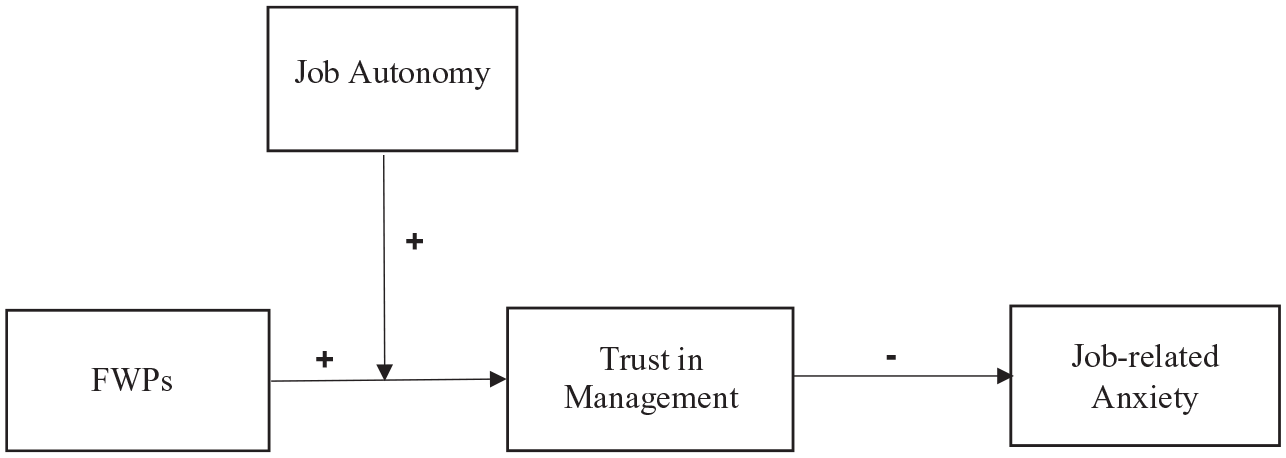
Conceptual model.
Methods
Study data
Study data are drawn from the Workplace Employment Relations Survey (WERS) 2011, which is the sixth in the series of WERS which have mapped British employment relations extensively for over three decades. The data in WERS 2011 are collected from a random sample of establishments. The data used come from one component of WERS 2011, namely the Survey of Employees Questionnaire (SEQ), which is a valuable resource of individual-level publicly available anonymised secondary data in the UK 1 on employees’ perceptions about their workplaces. It includes information on employees’ characteristics, experiences and attitudes to work (see Van Wanrooy et al., 2013). This information was collected via an eight-page, self-completion questionnaire administered to employees in the workplaces included in the core element of WERS, i.e. the management survey, in which senior managers responsible for employment relations were interviewed face to face in the workplace.
The aim was to get up to 25 randomly selected employees in each workplace where management interviews were undertaken, to complete the questionnaire. The number of employees in any workplace did not exceed the 25 employees requested by the surveyors. In workplaces where the number of employees was less than or equal to 25, questionnaires were distributed to all employees. The median number of employees per workplace completing the questionnaire was 12 and the range was 5–24. Overall, interviewers placed a total of 44,371 questionnaires in 2170 workplaces, where managers gave permission for interviewers to select a sample for the survey of employees. A total of 21,981 usable questionnaires were returned from 1923 workplaces, giving a response rate of 50% amongst all sampled employees (van Wanrooy et al., 2013).
The overall sample in WERS 2011 is based on interviews of 900 of the 2295 workplaces that participated in the WERS survey conducted in 2004 and another 1800 workplaces from the new independent sample. The overall population consists of 750,000 workplaces that employ approximately 23.3 million employees. This survey population accounts for 35% of workplaces and 90% of all employees in Britain. The sample covers all British workplaces, including the public and private sectors, except for workplaces in agriculture, forestry, fishing, mining and quarrying sectors.
Of the respondents included in this study, 30% had been working at their workplace for 10 years or more. More than half (56%) were female, and 69% were married. As regards age, 4% of respondents were aged between 16 and 21 years, 14% were between 22 and 29, 21% were between 30 and 39, 28% between 40 and 49, and the remaining 32% were 50 or above. In total, 92% of the sample had permanent contracts, 32% were working in supervisory roles and 26% had dependent children of any age. A total of 31% of the respondents held academic, vocational, or professional degrees.
Measures 2
Perceived availability of flexible work practices
In line with Wood et al. (2018) and Thompson and Prottas (2005), an index measuring the total score of availability of flexible practices was used to measure FWPs. WERS 2011 measures the FWPs options on a three-point scale, scoring (1) I have used this arrangement; (2) available to me, but I do not use; and (3) not available to me. The employees were asked, in the last 12 months, if they used or had the option to avail any of the following arrangements: (1) flexitime, (2) job sharing, (3) the chance to reduce their working hours (e.g. full-time to part-time), (4) working the same number of hours per week across fewer days (e.g. 37 hours in four days instead of five), and (5) working at or from home in normal working hours. 3 Of these, four items measure the time aspect of FWPs, whereas only one captures the spatial aspect. The scale was first reversed to ascending order and then recoded: scored 1 if employees had used these arrangements or perceived that these were available to them even if not used, and 0 if they perceived otherwise. Items were summed to create a total score of availability of FWPs ranging from 0 to 5. Following Thomas and Ganster (1995) and Thompson and Prottas (2005), we measured FWPs availability rather than usage because usage assumes availability which symbolises organisation’s care about employee well-being and is meaningful for work anxiety. Additionally, the likelihood of usage of flexible arrangements is arguably higher amongst those employees who have demanding family situations (Batt and Valcour, 2003) and may cause concerns of reverse causality in the FWPs–anxiety link (Thompson and Prottas, 2005). The majority of employees perceived that either none (37.7%) or only one (25.7%) of the FWPs were available, while only a few (3.2%) perceived that all five arrangements were offered (mode = 0 and median = 1). This reflects employees’ perceptions about the accessibility of workplace flexibility arrangements and, to some extent, their needs.
Trust in management
This was measured using four items, measured on a five-point Likert scale (5 = strongly agree to 1 = strongly disagree). Items measuring whether the managers can be relied upon, are sincere and deal with employees honestly are based on Whitener et al.’s (1998) measures of trustworthy behaviour. Cronbach’s α for the scale was 0.93.
Job-related anxiety
Anxiety was assessed using three items from Warr’s anxiety-contentment scale (Warr, 1990). Response to the three items was on a five-point Likert scale (5 = all of the time, 4 = most of the time, 3 = some of the time, 2 = occasionally or 1 = never). Cronbach’s α for this scale was 0.84.
Job autonomy
WERS 2011 measures perceived autonomy using five items adapted from Jackson et al.’s (1993) scale of job control. Each of the items was scored on a four-point scale: 4 = a lot, 3 = some, 2 = a little and 1 = none. The final scale on job autonomy excluded the item on the start and finish time of the working day, as this did not exhibit good convergent validity with other items on the scale. Cronbach’s α for the four-item scale was 0.86.
Control variables
The following control variables were included because of their potential relationship with job anxiety: gender (1 = male, 0 = female); age; tenure; marital status (1 = married or living with a partner, 0 = single, divorced, separated or widowed); job (employment) status (1
Validation of measurement scales
A series of confirmatory factor analyses (CFA), in Mplus 8.1, were run to test the psychometric properties of the scales used in the study (see Table 1). Initially, we carried out a CFA in which the indicators of autonomy, trust in management and anxiety were set to load on three hypothesised factors. FWPs being an additive index was excluded from the CFA. The fit of this three-factor model was good (χ² (41) = 2091.370, p < 0.001, CFI = 0.997, TLI = 0.996, RMSEA = 0.048). Next, to ensure that all scales used in the study were distinct, the three-factor model was compared against different variations of two-, and finally a single-factor model. Results indicated that the model fit of the three-factor model was consistently significantly better than all other models (see Table 1 for Δχ² values, all at p < 0.01). These results support the discriminant validity of the scales used in our model.
Simple measurement model (CFA) comparisons.
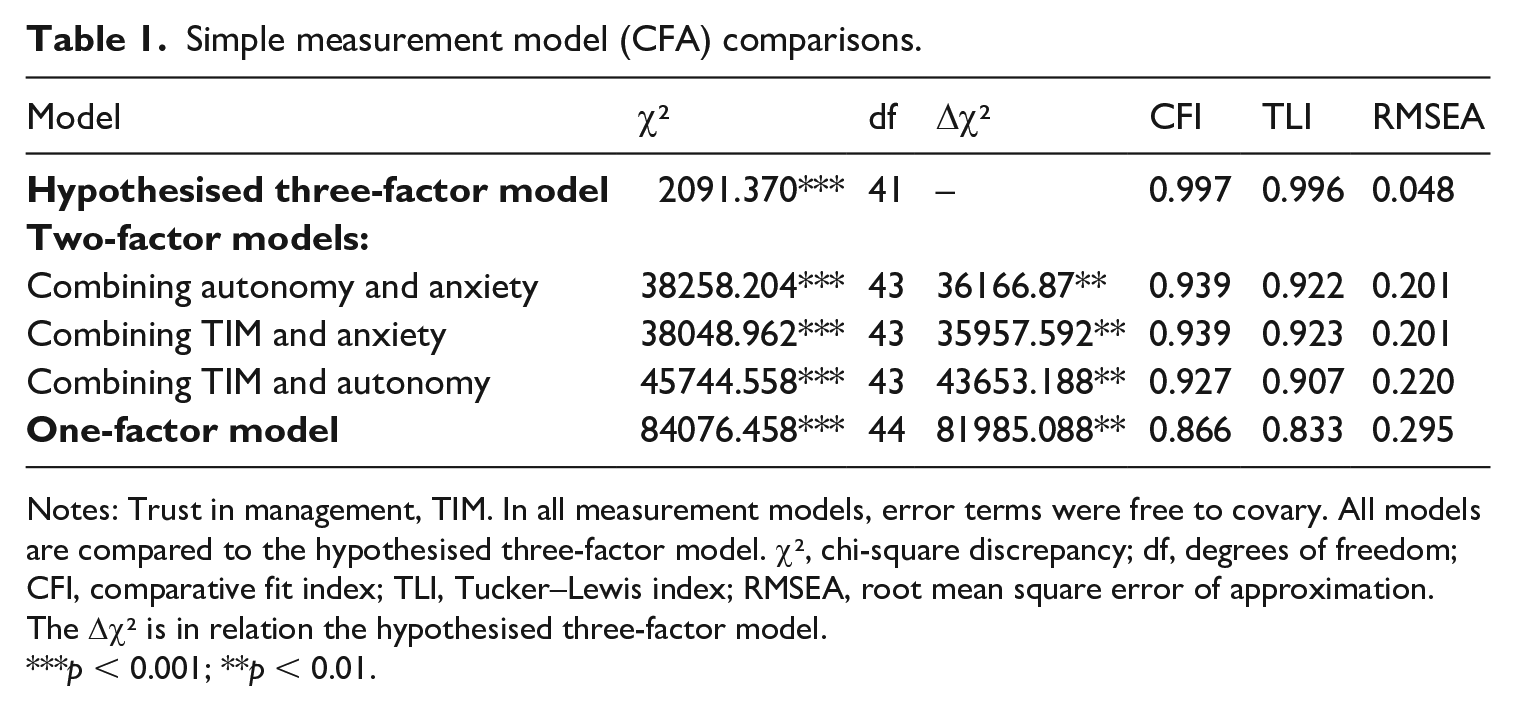
Notes: Trust in management, TIM. In all measurement models, error terms were free to covary. All models are compared to the hypothesised three-factor model. χ², chi-square discrepancy; df, degrees of freedom; CFI, comparative fit index; TLI, Tucker–Lewis index; RMSEA, root mean square error of approximation. The Δχ² is in relation the hypothesised three-factor model.
p < 0.001; **p < 0.01.
Since employees were nested within workplaces, we also checked the measurement model structure of our data using a multilevel CFA (MCFA). Conducting a MCFA is encouraged where the data are multilevel because latent variables may exist at multiple levels, e.g. at both employee and department levels in our case (Dyer et al., 2005). We started by testing the measurement model at just the employee level. Drawing on the statistics obtained from the simple CFA, initially, we hypothesised a three-factor model and compared its fit statistics to different combinations of two- and one-factor models at the employee level (see Table 2, Section B). Afterwards, we retained our best model at the employee level (i.e. the three-factor model: χ² (41) = 1295.695, p < 0.001, CFI = 0.990, TLI = 0.987, RMSEA = 0.037, SRMR within = 0.023 and SRMR between = 0.000) and specified accompanying department-level measurement models.
Multilevel CFA comparisons at both employee and department levels.
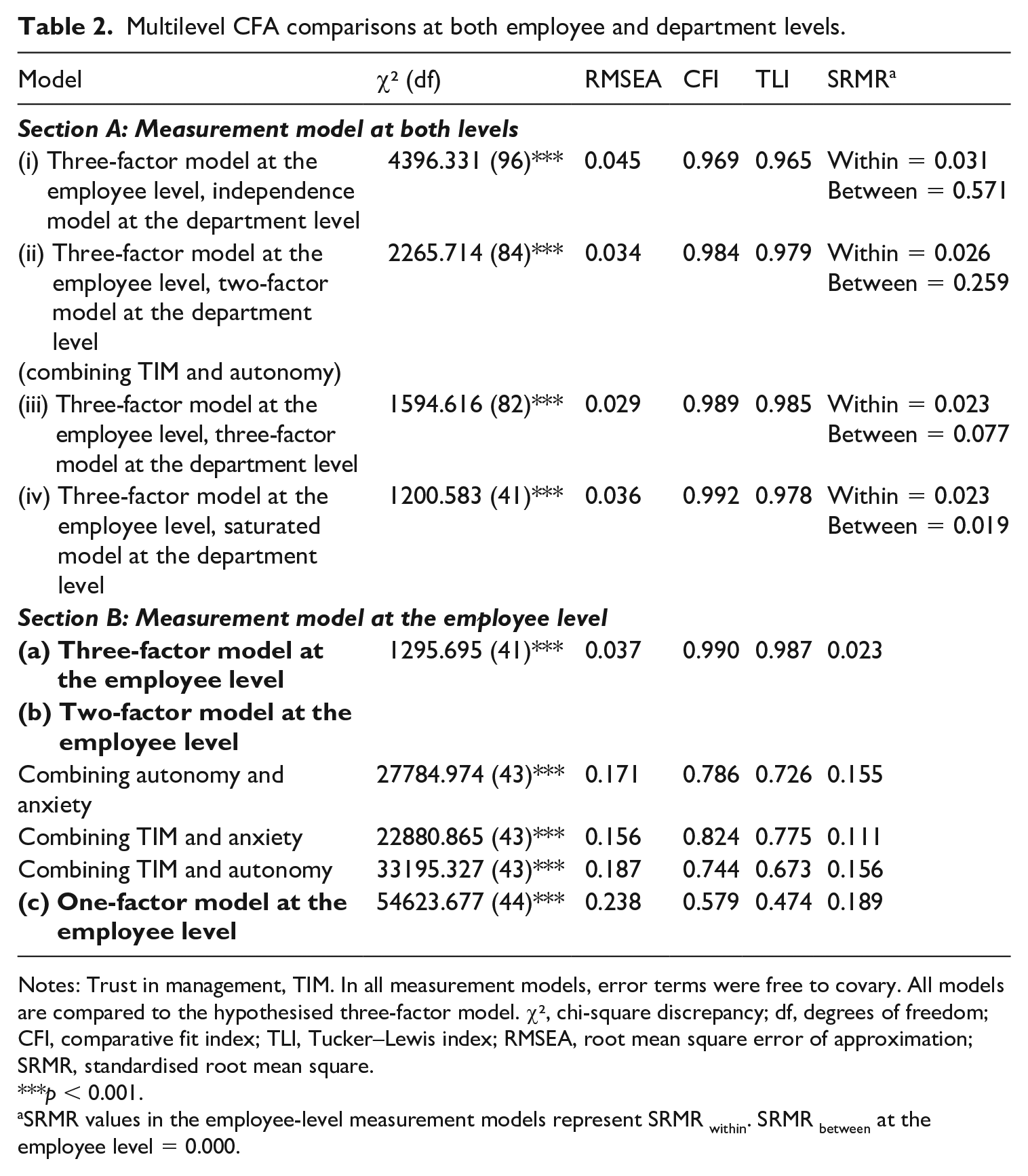
Notes: Trust in management, TIM. In all measurement models, error terms were free to covary. All models are compared to the hypothesised three-factor model. χ², chi-square discrepancy; df, degrees of freedom; CFI, comparative fit index; TLI, Tucker–Lewis index; RMSEA, root mean square error of approximation; SRMR, standardised root mean square.
p < 0.001.
SRMR values in the employee-level measurement models represent SRMR within. SRMR between at the employee level = 0.000.
Following Hox (2010), we fitted two benchmark models at the department level – the simplest and the best fit model – alongside our chosen three-factor model at the employee level (see Table 2, Section A). The simplest model was the independence model, which simply estimated the variance of each observed variable. This model had a modest fit to our data. Contrarily, the best fit model was the saturated model that specified unconstrained relationships between each pair of variables. This provided a benchmark for what could be achieved at best. Then, we compared both of these models to a three- and a two-factor model at the department level (chosen based on the simple CFA). The MCFA results supported a hypothesised three-factor structure at both employee and department levels (χ² (82) = 1594.616, p < 0.001, CFI = 0.989, TLI = 0.985, RMSEA = 0.029, SRMR within = 0.023 and SRMR between = 0.077). This suggests that our constructs are distinct and naturally operate at both levels.
To test for the influence of common method bias in the data, the common method factor approach was used (Podsakoff et al., 2012). This approach helps capture multiple sources of extraneous shared method variance and allows the modelling of the effect of common method bias at the measurement level without previously knowing the sources or causes of the bias (Williams and McGonagle, 2016). It allows estimating the potential increase in model fit when taking into account the common methods factor, as well as determining the variance extracted by this factor (Cole et al., 2011; Dulac et al., 2008). Prior simulation work has shown that the common method factor approach worked well and provided accurate parameter estimates when evaluating properly specified models (Williams and McGonagle, 2016).
The common method factor approach involves estimating a measurement model in which each indicator is allowed to load on its theoretical construct and a common factor. In this study, the model with the common factor had good fit (χ² (30) = 743.334, p < 0.001, CFI = 0.995, TLI = 0.989, RMSEA = 0.033). More importantly, the variance extracted by the common factor was 0.34, which is below the 0.50 criterion suggested by Fornell and Larcker (1981) as indicative of a meaningful construct. This suggests that common method bias is not a concern in this study.
Results
Descriptive analysis
Table 3 presents the means, standard deviations and correlations among variables. As expected, FWPs were significantly and positively related to TIM (r = 0.12, p < 0.01) and autonomy (r = 0.14, p < 0.01). TIM was also positively related to autonomy (r = 0.30, p < 0.01), and both TIM and autonomy were negatively related to anxiety (r = −0.37, p < 0.01 and r = −0.16, p < 0.01, respectively). However, contrary to our expectations, FWPs were not significantly related to anxiety (r = −0.01, ns). This may suggest that FWPs reduce anxiety at work indirectly through other intervening variables. We will return to this later in the article.
Descriptive statistics and study variable inter-correlations.
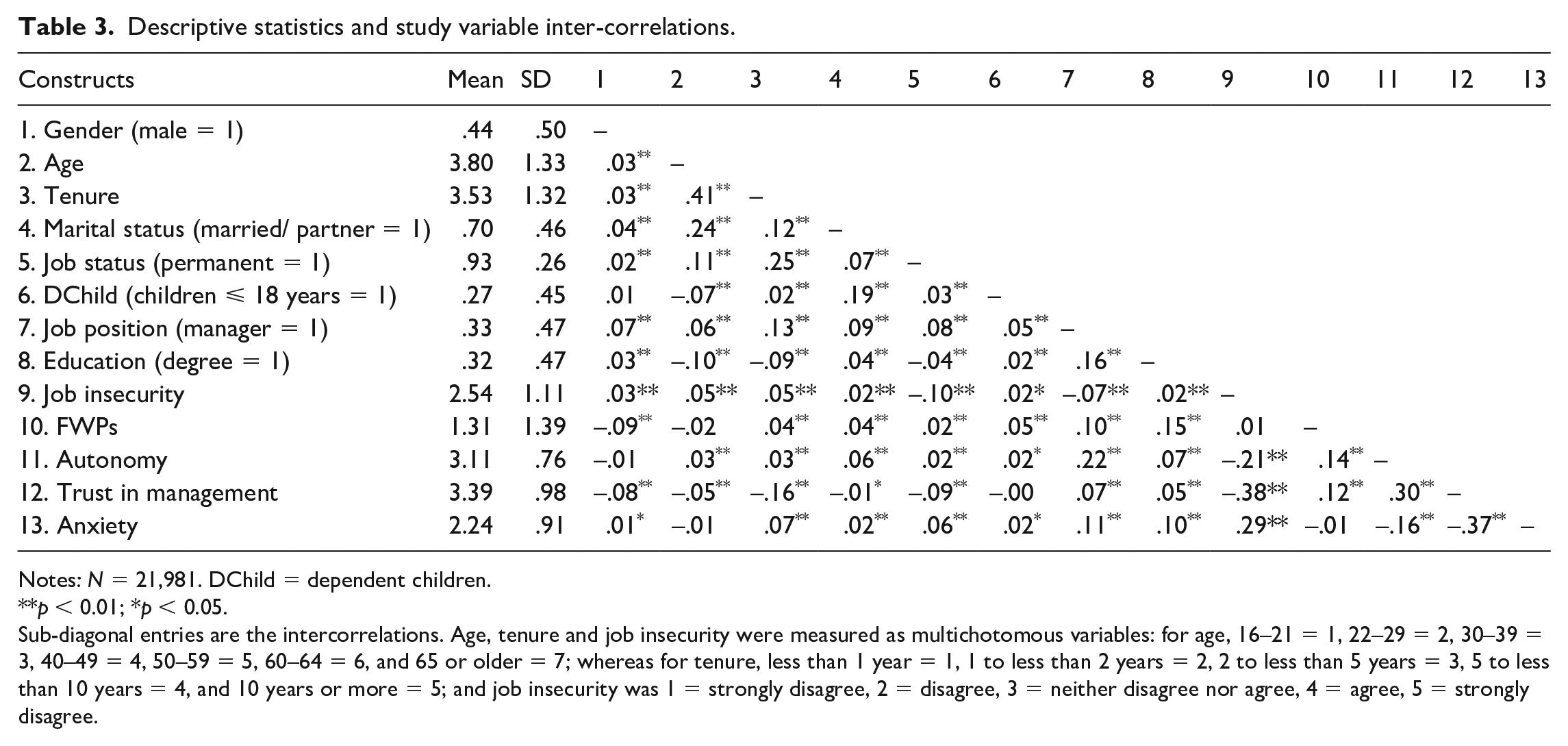
Notes: N = 21,981. DChild = dependent children.
p < 0.01; *p < 0.05.
Sub-diagonal entries are the intercorrelations. Age, tenure and job insecurity were measured as multichotomous variables: for age, 16–21 = 1, 22–29 = 2, 30–39 = 3, 40–49 = 4, 50–59 = 5, 60–64 = 6, and 65 or older = 7; whereas for tenure, less than 1 year = 1, 1 to less than 2 years = 2, 2 to less than 5 years = 3, 5 to less than 10 years = 4, and 10 years or more = 5; and job insecurity was 1 = strongly disagree, 2 = disagree, 3 = neither disagree nor agree, 4 = agree, 5 = strongly disagree.
Tests of hypotheses
As employees were nested in workplaces, their responses may not be deemed independent of each other. The intra-class correlation coefficient (ICC) value for anxiety (0.81) was also high, implying that the responses to this variable would vary significantly between workplaces. This suggests that the mediated and moderated associations of interest, which are hypothesised at the individual level, require adjustment for the hierarchically clustered data. In the methods literature, this type of mediation model is referred to as a 1-1-1 multilevel mediation model (MacKinnon, 2008; Preacher et al., 2010), in which the predictor, mediator and outcome are measured at the employee level (i.e. level 1). However, due to the clustered nature of the data, the level 1 variables can be further partitioned into a within and a between part (Snijders and Bosker, 2012) and would therefore necessitate a multilevel framework of analysis. To test the multilevel moderation, we follow what is referred to as a 1 × (1–1) design (Preacher et al., 2016), in which a level 1 moderator interacts with the association between a predictor and outcome which are also measured at the individual level. Generalised multilevel structural equation modelling (GMSEM) in STATA was used to test the study hypotheses. GMSEM is a type of structural equation modelling (SEM) which allows evaluation of multilevel generalised linear models in one analysis. Generalised linear models are an extension of standard regression models which allow the linear model to be related to the outcome variable via a statistical process, commonly referred to as the link function, and by allowing the magnitude of the variance of each measurement to be a function of its predicted value (Gill, 2000). According to Hox et al. (2018), ‘in generalized linear multilevel models, the multilevel structure appears in the linear regression equations of the generalized linear models’ (p. 107). To test for indirect relationships, we used the nonlinear combination of estimators approach of GMSEM, which estimates the magnitude of the indirect effect with respect to the standard error of the indirect effect (Hayes, 2009; Kelly and Updegraff, 2017). Following the principle of SEM (Kline, 2011), all relationships were tested simultaneously. In the model, the mediator variable, trust in management, was regressed on FWPs, job autonomy and their interaction term (FWPs × job autonomy). Job anxiety (i.e. the outcome variable) was regressed on the control variables, FWPs, job autonomy, their interaction term and trust in management (Hayes, 2013). All variables were grand-mean centred (Hofmann et al., 2000) and the model was tested using the maximum likelihood estimation method with robust standard errors (Braun and Nieberle, 2017). When fitting multilevel models, especially on cross-sectional data, there are multiple benefits of centring variables in terms of interpreting parameter estimates more clearly. Specifically, grand-mean centring allows to shift the intercept location of the variables for improved interpretability of results by, essentially, removing spurious large variances/covariances. Furthermore, grand-mean centring is particularly valuable when interaction terms are involved in multilevel settings. Centring both variables in the interaction term on their grand-mean removes unnecessary multicollinearity and makes the main effect more interpretable (Hox et al., 2018).
Table 4 presents the results of testing the study’s hypotheses. The analysis revealed that the availability of FWPs had a significant positive association with trust in management (β = 0.057, p < 0.001), confirming Hypothesis 1. The analysis also showed that the effect of the interaction between FWPs and autonomy on TIM was significant and positive (β = 0.018, p < 0.05), providing support for Hypothesis 2. Figure 2 shows the simple slope plot at one standard deviation below and one standard deviation above the mean for autonomy on the FWPs–trust in management relationship (Aiken and West, 1991). As shown in the figure, the slope of the relationship between FWPs and trust in management was relatively lower (nonetheless positive) at lower levels of job autonomy, and higher (and positive) at higher levels of job autonomy. This shows that perceptions of trust in management increase as employees perceive that they are autonomous in their daily work routines.
Path analysis results.
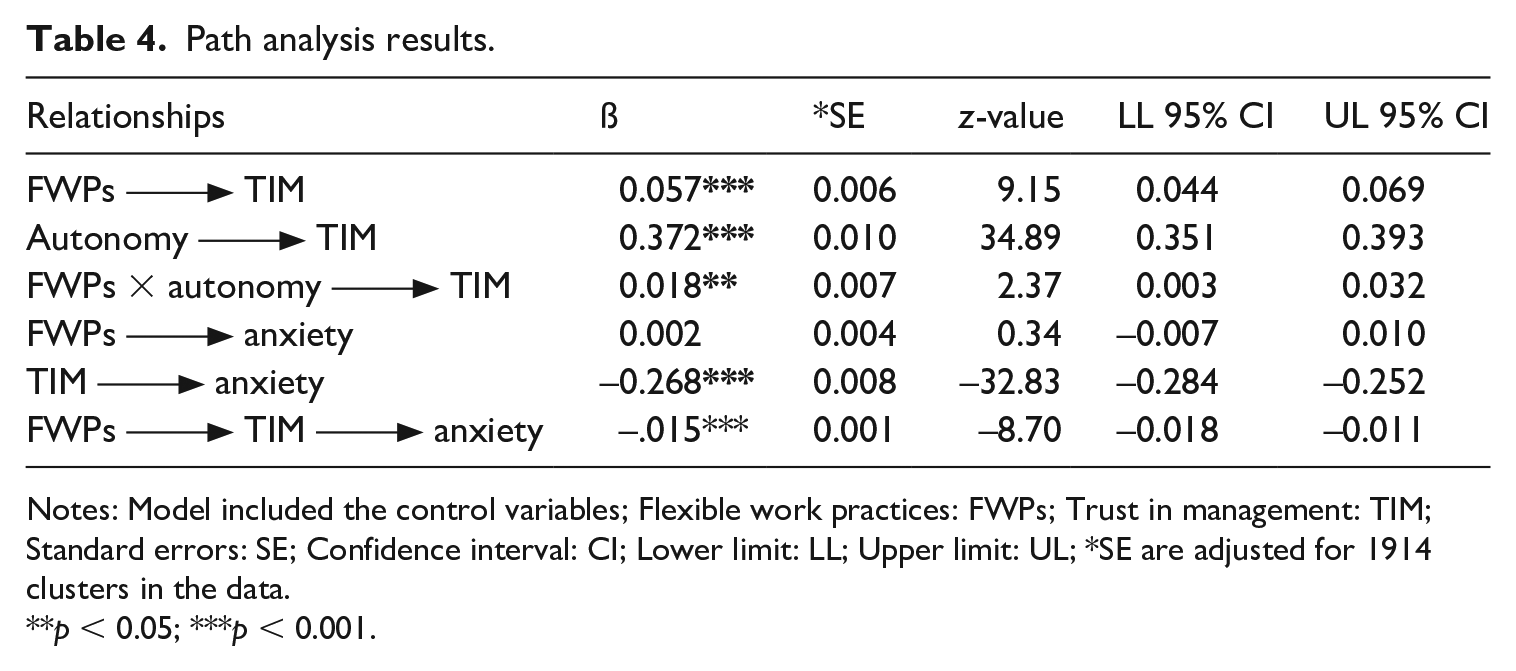
Notes: Model included the control variables; Flexible work practices: FWPs; Trust in management: TIM; Standard errors: SE; Confidence interval: CI; Lower limit: LL; Upper limit: UL; *SE are adjusted for 1914 clusters in the data.
p < 0.05; ***p < 0.001.
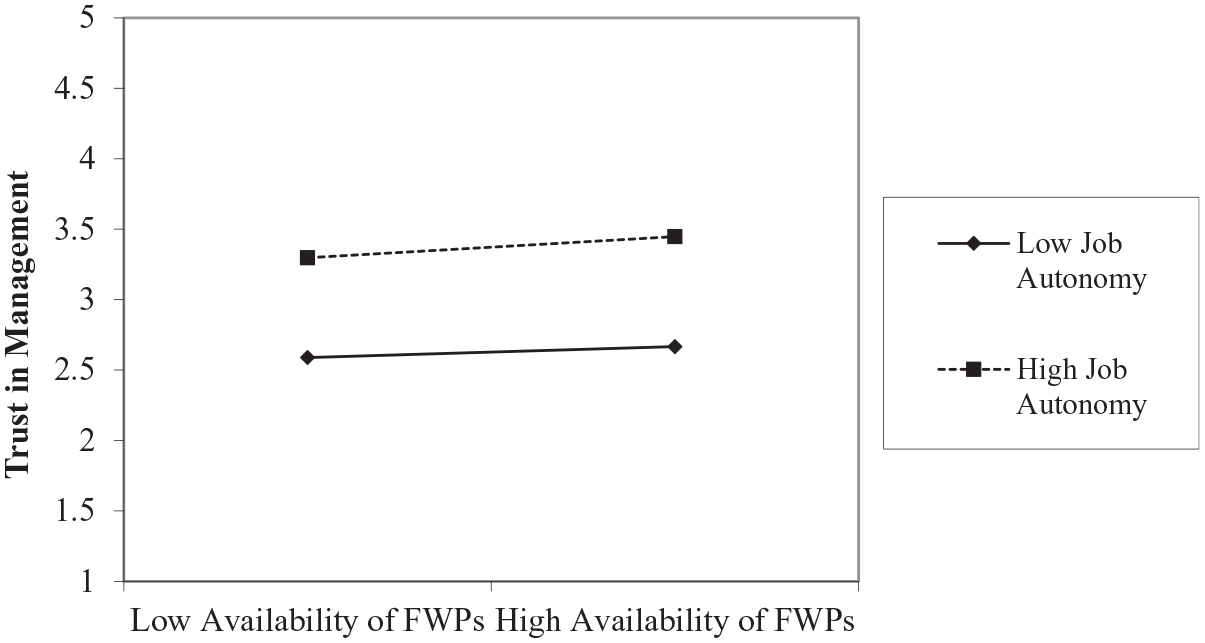
Plot of moderated relationship of job autonomy on FWPs–trust in management relationship.
Trust in management, in turn, had a significant negative association with anxiety (β = −0.268, p < 0.001). The indirect relationship between FWPs and anxiety via TIM was negative (β = −0.015, p < 0.001), which indicates that trust in management acts as a mediator between FWPs and job-related anxiety, confirming Hypothesis 3. The direct path from FWPs to job-related anxiety was non-significant (β = 0.002, ns). This implies that trust in management fully mediates the association between FWPs and job-related anxiety.
Consistent with our expectations, the results also show different magnitudes of the conditional indirect effects of FWPs on job-related anxiety via trust in management across high and low levels of job autonomy (see Table 5). For employees with high job autonomy, results revealed a significant negative conditional indirect (compared to the direct positive, although non-significant) effect of FWPs on employees’ job-related anxiety via TIM at successive levels of perceived autonomy. As mentioned before, trust in management, in turn, had a significant negative association with anxiety. Therefore, the results support that perceived job autonomy moderates the mediation influence of TIM in the FWPs–anxiety link, such that the indirect relationship between FWPs and anxiety via TIM is stronger with higher levels of job autonomy, confirming Hypothesis 4.
Moderated mediation results.
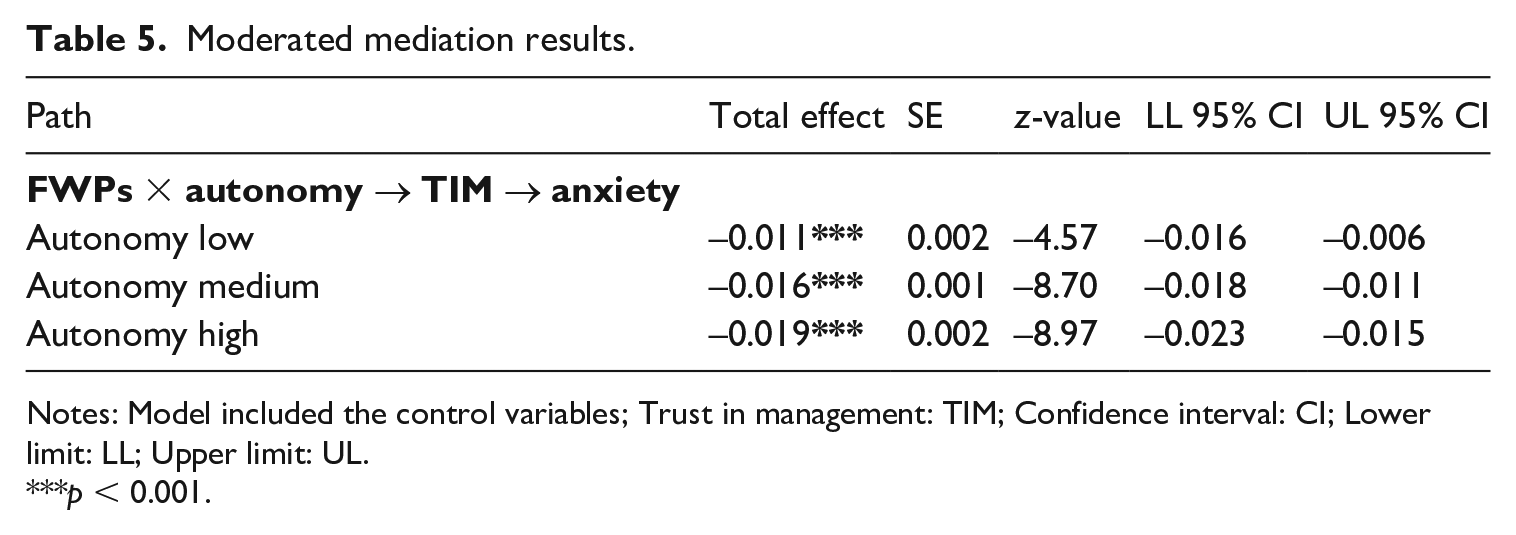
Notes: Model included the control variables; Trust in management: TIM; Confidence interval: CI; Lower limit: LL; Upper limit: UL.
p < 0.001.
Discussion
This research examined a mechanism and boundary condition of the relationship between flexible working practices and job-related anxiety, which is an important dimension of employees’ affective well-being at work. Drawing on Hobfoll’s COR theory’s postulate of resource gain spirals, which suggests that resources progressively accumulate and strengthen perceptions of further resources, the study found that the provision of FWPs – a pertinent organisational resource – positively induced employees’ perceptions of TIM – another salient job resource – which in turn reduced job anxiety. Furthermore, the strength of this mediated relationship was moderated by the extent to which employees perceived to be endowed with the ability of exercising autonomy in their jobs.
Theoretical contributions
This study contributes to the literature in several ways. The first contribution of the study is that it emphasises that FWPs mitigate job anxiety, but not directly and via a process of gain spirals arising from the availability of FWPs. This reaffirms the significance of FWPs for facilitating work-related well-being and signifies flexible arrangements as resources that may initiate a circular process by which resources progressively accumulate. In so doing, our study adds to the limited base of studies that give attention to the process of resource gain in COR theory (Weigl et al., 2010). In relation to the family-backlash literature, it seems likely that rather than FWPs itself, it is the process of positive gain spiral initiated by FWPs that ultimately reduces perceptions of anxiety at work. Second, our study responds to calls for more research delineating the processes through which FWPs relate to employee well-being (O’Driscoll et al., 2003; Wang et al., 2011). Third, allied to the first point, the study tested a mechanism of the relationship between FWPs and anxiety – highlighting that FWPs promote TIM, which, in turn, reduces job anxiety. The findings revealed a negative indirect relationship between the availability of FWPs and job anxiety through TIM. This suggests that extending spatial or temporal flexibility to employees can attain important gains in perceptions about affective well-being through a symbolic effect signifying that management understands employees’ diverse obligations. This finding extends the existing research on FWPs and well-being, which has seldom considered the role of trust in the employer as a potential underlying mechanism through which FWPs may substantiate employee well-being. Specifically, the positive relationship between FWPs and TIM is consistent with the relationship-based perspective of trust, which suggests that employees make inferences about the quality of their relationship with managers based on the concern and respect shown towards them (Dirks and Ferrin, 2002). Additionally, the logic that TIM reduces anxiety suggests that TIM, a component of social support, is a salient workplace resource that underpins positive perceptions of work-related well-being (Humphrey et al., 2007; Jones et al., 2011). Together, these findings corroborate COR theory’s notion about maintenance and fostering of resources as a result of having one major resource. The significant and modest relationship between FWPs and TIM, and moderately strong relationship between TIM and anxiety also reinforce the role of organisational factors in cultivating a conducive and trustful work environment which improves well-being at work. A result running counter to our basic expectation was the non-significant direct association between FWPs and job anxiety. As such, it appears that FWPs are indeed a mechanism for proactive coping but their role seems likely to be that of what Herzberg et al. (1959) refer to as hygiene factors. Their presence in itself may not have significant tangible effects on employees, but their absence may be disadvantageous to them. It may also be that employees regard such provisions only as elementary, reflective of management’s supportiveness, aimed at enhancing other pertinent resources (e.g. job autonomy and TIM), and it is only when such positive enabling resources integrate, that they achieve important gains in well-being.
Moreover, the study also tested a boundary condition of the relationship between FWPs and TIM – two main resources in our study. The finding that greater feeling of autonomy is a significant moderator which strengthens perceptions of TIM reinforces the significance of job control emphasised in the HRM literature and encourages organisations to ensure that jobs are designed to leverage adequate autonomy to employees (Wood and Wall, 2007). More importantly, autonomy amplifying the positive FWPs–TIM link adds to the evidence base related to the existence of resource gain spirals. Individuals who may value active operational control, may cherish, and use this resource to fortify perceptions of other enhancements at work arising from FWPs more than those who are less autonomous. Additionally, since the availability of FWPs embodies managerial trust in employees, individuals may appreciate the trust placed in them and this may amplify their positive attribution of management’s intentions for providing FWPs and their trust in management. Thus, the study has presented an alternative perspective on the enabling role that job autonomy may play in contemporary workplaces. Future research may explore job autonomy as a mediator in the FWPs–well-being link to unravel novel associations beyond the suggested linkages (see, for example, ter Hoeven and Van Zoonen, 2015; Thompson and Prottas, 2005; Wood et al., 2018). We also found a significant moderated mediation effect of FWPs on job anxiety through TIM at different levels of job autonomy. This finding further draws our attention to the propensity of resources to develop and enrich perceptions of resource reservoirs arising from FWPs and the integrative influence of these for well-being. We anticipate that the enabling influence of FWPs, TIM and job autonomy is likely to achieve positive outcomes regardless of the type of well-being measured, but this warrants further exploration.
Practical implications
Our findings offer important practical implications. The overarching policy implication of the study for employers and human resource managers is that the provision of FWPs generates perceptions of multiple organisational resources which integrate to promote well-being. Particularly, the lack of a significant direct relationship between FWPs and anxiety suggests that implementation of flexibility practices in itself may not achieve the desired gains in well-being. However, improvement in well-being manifests through multiple enabling influences that arise from the implementation of FWPs. The findings identify that FWPs not only signify care and are a means to autonomously manage the work–nonwork interface, but also help evoke and strengthen trust within organisations, which ultimately reduces anxiety. Therefore, managers should endeavour to ensure that enough resources are assigned to the implementation of FWPs, such as options of working from home, job sharing and reduced working hours or days, and that employees are aware of such facilities. This would help engender trust within organisations. Managers need to also focus on planning jobs carefully while designing FWPs, so employees can perceive more discretion over their work-related tasks. Doing so will be beneficial for strengthening perceptions of trust in the employer/manager, which, in turn, could reduce job anxiety. Generally, managers can also focus on building a climate in which employees feel supported. This can be achieved by introducing other facilitating resources in the workplace and promoting a culture that encourages the use of resources. Individuals who are well resource endowed seem to perceive better coping mechanisms and are better able to plan for future contingencies. Contrarily, workers who perceive a lack of resources may engender a sense of loss of multiple resources and persistently low appraisal of well-being (Hobfoll, 2001).
Limitations and future research directions
The study is based on a large representative data set in the UK, encompassing all major sectors of the economy excluding agriculture, mining and domestic services, which, to some extent, allows generalisability of the findings of this research to British workplaces. Nevertheless, the results should be assessed against certain limitations. First, the analysis is based on cross-sectional design data, which limits conclusions about the causal order of the studied relationships. Thus, we believe that replicating our study using longitudinal data would be beneficial. For example, it would be interesting to find out if perceptions of TIM change over time relative to FWPs, with subsequent effects on job-related anxiety. Likewise, longitudinal analysis is required to establish the temporal order between FWPs and TIM. Second, previous research has highlighted that flexible working leads to isolation, job insecurity, gender inequality, reduced career prospects, longer working hours and work–life imbalance among the workforce (Allan et al., 1998; Bone, 2006). Future research can explore the role of TIM in the relationships between FWPs and such negative outcomes. Additionally, although the study controlled for a number of potential confounding variables in the FWPs–anxiety link, it could not control for the aspect of whether individuals are sole earners in a household or a part of a dual-earning couple, due to data restrictions. This may have important implications for FWPs and hence can be accounted for in future research. Finally, the data are based on individuals’ self-reports for all variables in our model, which may raise concerns about common method bias. However, the statistical analyses for validation of measures revealed that common method bias was not a problem in this study. Nevertheless, the study acknowledges that common method bias itself deflates but does not inflate interaction effects (Siemsen et al., 2009). Moreover, since the focus of the study was on perceptions of availability of FWPs and how these relate to individuals’ subjective assessment of anxiety at work, employees’ self-report measures are deemed to be the most viable option for our variables (Kehoe and Wright, 2013).
Supplemental Material
sj-docx-1-eid-10.1177_0143831X21995259 – Supplemental material for Flexible working practices and job-related anxiety: Examining the roles of trust in management and job autonomy
Supplemental material, sj-docx-1-eid-10.1177_0143831X21995259 for Flexible working practices and job-related anxiety: Examining the roles of trust in management and job autonomy by Suhaer Yunus and Ahmed Mohammed Sayed Mostafa in Economic and Industrial Democracy
Footnotes
Acknowledgements
This study is based on data from the Workplace Employment Relations Survey (WERS 2011). The authors would like to thank UK Data Archive for providing access to the Workplace Employment Relations Survey (WERS) 2011.
Data availability statement
The data that support the findings of this study are openly available in the UK Data Service at https://ukdataservice.ac.uk/, SN: 7226, 
Declaration of conflicting interests
The authors declared no potential conflicts of interest with respect to the research, authorship, and/or publication of this article.
Funding
The authors received no financial support for the research, authorship, and/or publication of this article.
Supplemental material
Supplemental material for this article is available online.
Notes
Author biographies
References
Supplementary Material
Please find the following supplemental material available below.
For Open Access articles published under a Creative Commons License, all supplemental material carries the same license as the article it is associated with.
For non-Open Access articles published, all supplemental material carries a non-exclusive license, and permission requests for re-use of supplemental material or any part of supplemental material shall be sent directly to the copyright owner as specified in the copyright notice associated with the article.
