




Abstract
This article examines managerial ideology and identity in the nationalised British coal industry. On nationalisation in 1947, the National Coal Board (NCB) – after 1987 the British Coal Corporation – became the largest socialised industry outside of the Communist bloc. Privatised in 1994, as part of liberal market reforms, the industry was a crucible for ideological clashes amongst managers. The article responds to interest in the impact of managerial ideologies and identities on organisations and in the search for illuminating historical case studies in different organisational settings. The authors position those ideological clashes, and distinctive managerial identities, within a moral economic framework.
Introduction
On 10 March 1985, Philip Weekes, Director of the National Coal Board (NCB) South Wales Area, was tipped-off by a source in the Board’s headquarters, Hobart House, that Chairman Ian MacGregor, and his deputy Jimmy Cowan, had decided to ‘clobber those areas that had provided the main resistance during the strike’ (Weekes Diary, 11 March 1985). This took place a week after the defeat of the National Union of Mineworkers (NUM) in one of the longest and bitterest labour disputes in British history, the year-long 1984–5 miners’ strike. Later that month, Cowan issued a memo indicating that colliery closures would be imposed without the usual consultation of the mining unions (NCB memo, 27 March 1985 quoted in Polkemmet Inquiry). MacGregor and Cowan were clearly signalling that they were tearing up the NCB’s established industrial relations machinery and procedures put in place after the nationalisation of the coal industry in 1947. They were also indicating that NCB managers who disagreed with their position would not be tolerated. After breaking the news to his executive colleagues – describing MacGregor as an ‘American butcher’ – Weekes noted: ‘I had made up my mind that if I was given the extended, accelerated list [of pit closures] as an instruction, I would refuse to accept it’ (Weekes Diary, 11 March 1985).
Weekes’ clash with MacGregor in 1985 reflected competing managerial ideologies in the industry brought to a head over the suspension of the moral economic norms and practices of the NCB, in particular its social commitments to mining communities and obligation to consult the mining unions. The differences between MacGregor and Weekes were mirrored in confrontations between the NCB Chairman and the managers’ trade union, the British Association of Colliery Management (BACM) (Perchard and Gildart, 2018), from MacGregor’s appointment in 1983, when he declared an end to the NCB’s role as a ‘social security enterprise’ (Kirby, 2006).
MacGregor’s handling of the strike, and political direction from the government from the outset, increased tensions and divisions within Hobart House and amongst the coalfield area directors. By late summer–early autumn 1984, MacGregor and Cowan’s views and behaviour (bypassing the advice of experienced Hobart House staff and area directors) were, according to the observations of the NCB’s seasoned Director-General of Industrial Relations, Ned Smith, ‘bringing to a head a growing sense of fear and discontent, not to say disbelief, in the ranks of the management union BACM’ (Smith, 1997: 165). In November 1984, exasperated with MacGregor and Cowan ignoring his counsel, the NCB’s Director of Public Relations, Geoff Kirk, resigned, observing to The Times (1984b) that ‘he [MacGregor] is unaccustomed to having people questioning his decisions and pointing out consequences’. Kirk’s resignation followed MacGregor’s replacement of longstanding industry figures (including Philip Weekes) on the Board with, as Weekes put it, ‘MacGregor’s nominees, city men who are not quite as sympathetic towards the NCB’ (Weekes Diary, 13 March 1984). In a meeting with Cowan following Kirk’s resignation, BACM declared that ‘they had lost confidence in the Board, in particular . . . the Office of the Chief Executive’ (Smith, 1997: 173–174; Weekes Diary, 18 October and 19 November 1984). Following that meeting, BACM declared publicly that MacGregor’s management of the industry was a ‘disaster’ (The Times, 1984a). Just over a month later, Ned Smith resigned, frustrated like Kirk with being side-lined (The Times, 1984b), subsequently citing MacGregor’s intransigence and government interference (Smith, 1997).
The divisions within Hobart House were also reflected in the distinct approaches and views of the area directors. NCB Scottish Area Director Albert Wheeler’s discarding of longstanding consultation procedures with trade unions and replacement of managers who were more concerned with protecting the future of the collieries had already led to 50% of Scottish collieries being out on strike by the start of the national dispute (Perchard and Phillips, 2011; Phillips, 2012). Fellow area directors Ken Moses (North Derbyshire) and John Northard (North Western) were similarly uncompromising in their confrontation of the NUM and their pursuit of colliery closures without consultation (David Hart memo to PM, 7 January 1985; Howell, 1989; MacGregor, 1986). In contrast, Philip Weekes sought to pursue conciliation with the NUM and protect the future of the South Wales coalfield and its mining communities (Francis, 2009).
These divisions reflected the profoundly different ideologies of the managers concerned, informed by a combination of distinct identities and personalities. These divisions amongst NCB managers also reflected pointed ideological clashes in Britain at the time after the election of a new Conservative government in 1979, led by Prime Minister (PM) Margaret Thatcher; an administration committed to rolling back the state and reducing public sector borrowing, not least through the privatisation of nationalised industries, and confronting and defeating trade unions, particularly the NUM (Chick, 2019; Dorey, 2013; Tomlinson, 2021). The Conservative government appointed MacGregor to secure ‘the highest possible efficiency and reduce costs’ in the industry (Hansard, 28 March 1983). His appointment was deeply controversial, especially having come from the British Steel Corporation where he had halved the workforce since 1980. As the then Head of No. 10 Downing Street’s Policy Unit, Ferdinand Mount, acknowledged in advance of his appointment (Nigel Mount memo to PM, 15 December 1982): ‘MacGregor is known, to some extent rightly, as a man who will implement the strategic decisions of Ministers without much regard for the consequences for manpower. He is, in short, seen as a hatchet man. His appointment to the NCB would probably therefore make it harder to achieve even a fairly conservative rate of pit closures without aggravation.’ As Mount’s memo intimates, MacGregor had considerable appeal and utility for the PM and other Conservative ministers (including the Chancellor of Exchequer, Nigel Lawson) in pursuing their ideological ends but one not without risk.
In this article, we explore managerial ideology and identity within the nationalised British coal industry under the NCB (subsequently the British Coal Corporation [BCC]). In so doing, we respond to long running interest in managerial ideology and recognition of its importance for organisations and employee relations (Dundon et al., 2010; Fogarty, 1976; Fox, 1966; Gupta et al., 2019; Mees-Buss and Welch, 2019; Merkle, 1980). We also consider the bearing of the identity and location of managers on their ideology (Pahl and Pahl, 1971; Sveningsson and Alvesson, 2003; Watson, 2009; Wright, 1997). This is then situated within discussions of the extent of market ‘embeddedness’ in society (Polanyi, 1944) and ‘moral economy’ (Sayer, 2000; Thompson, 1971, 1993). Through a historical study of managers within this large nationalised corporation during a period of profound social change in Britain, we also respond to calls to broaden understanding within management and organisation studies of organisations operating within different socio-economic contexts and phenomena (Foster et al., 2014; Mills et al., 2015). We offer insights into contextual and institutional changes within British capitalism which provide added nuance to the rigidities often inherent in characterisations of ‘Anglo-Saxon capitalism’ (MacKenzie et al., 2021) through this study of the largest of Britain’s nationalised industries after 1945. As Lazonick and O’Sullivan (2000: 14) reminded readers in their significant review: ‘In the so-called Anglo-Saxon economies of the United States and Britain, the exclusive focus of corporations on shareholder-value is a relatively recent phenomenon, having risen to prominence in the 1980s as part and parcel of the Reaganite and Thatcherite revolutions.’
The NCB’s significance as an organisation is underlined by its size and mission as one of the largest nationalised industries created, representing a major experiment in public ownership underpinned by a comprehensive consultative system of industrial relations. Its strategic importance (as an employer and energy source) and complexity are underlined by the fact that when it was brought into public ownership by Clement Attlee’s Labour government with the Coal Industry Nationalisation Act 1946, the NCB inherited 695,000 employees and 1400 collieries from 800 different companies and individuals. As late as 1960, coal accounted for 99 and 73% respectively of UK energy production and consumption (Ashworth, 1986; DTI, 1990).
The article unfolds as follows. First, we locate this study within the relevant strands of the management and organisational studies literature on managerial ideology and identity and within the historiography of British coal and management. We next consider the context of coal nationalisation in Britain after 1945 and the social embeddedness of markets and moral economy. This is followed by an overview of the methods used. Subsequently, we examine the background and social location of managers within coalfield communities and the occupational culture of mining exploring the influence of these on social and individual aspects of managerial identity (and development of their management learning). Following this, we consider how managerial identities and ideologies were constructed within the culture of the NCB at organisational and professional levels. Next, we trace the growing divergences in ideologies and identities through decades of profound change of the dramatic contraction of the industry and the miners’ strikes of 1972 and 1974 in the face of the fluctuating fortunes of coal within the UK’s energy mix. This is then followed by an examination of the clashes between those ideologies with the replacement of a public service ethos with the social disembodiment of market-orientated priorities in the 1980s and early 1990s prior to privatisation in 1994. Finally, we consider the implications of this for the literature on managerial ideology and identity.
Managerial ideology and identity
In common with other British nationalised industries and corporations (for example, railways, electricity generation, the British Broadcasting Corporation and the National Health Service), NCB managers’ roles and behaviours were mediated by the public service mission that these organisations were initially charged with. They were also shaped by the shifting political economic context and changing strategic priorities for these organisations resulting in tensions amongst differing managerial perspectives (Carter and McKinlay, 2013; Strangleman, 2004).
Here we consider managerial ideology as informed by a combination of ‘worldviews’ and ‘ideas’ (Haase and Raufflet, 2017: 630). Significantly Alan Fox (1966: 366) noted that the complexity of managerial ideology often went unrecognised: ‘the diverse sources from which these ideas derive, and the manner in which the ideas themselves have become popularized and simplified to the level of “plain-man’s folklore”, would themselves constitute a fascinating subject of study’. Fox detected in contemporary management views the influence of the scientific management and human relations schools, ‘along with diverse fragments of so-called “common-sense” and cultural beliefs’ (p. 367). The importance of Fox’s reflections contrasts with the more instrumental contemporary and later social studies of management within nationalised corporations and indeed British industry, which delved little into managerial identity and ideology (for example, McCormick, 1960; Merkle, 1980; Scott et al., 1963). The recognition of the importance of managers’ ideologies, identities and personalities to the behaviour of top management teams, to corporate governance, and to the nature of capitalism has stimulated further recent research interest in this area (Gupta et al., 2019; Mees-Buss and Welch, 2019; Smith et al., 2019).
In exploring management ideologies in the nationalised British coal industry over time, we consider the influences that shaped managerial identities at individual, social, occupational/professional and organisational levels (Sveningsson and Alvesson, 2003), as well as through associated ‘common sense’ (Fox) and ‘ordinary belief’ (Chia and Holt, 2008). In so doing we must also recognise the distinctions between what Watson (2009: 426–427) has referred to as the ‘so-called “managerial identities” of organizational managers’, and ‘the whole lives of people who do managerial work’, especially given the notable absence of managers’ social location from this analysis, including Fox’s. In their classic study Managers and their Wives (1971), Jan and Ray Pahl presented a more rounded picture of British managers, which questioned some of the assumptions made: ‘We have certainly detected a degree of ambivalence and uncertainty towards the basic materialistic values which are often assumed to be dominant by politicians and spokesmen for British industry. That so many of the middle-class couples we studied showed such ambiguity towards the basic values of a competitive society has far-reaching implications’ (pp. 1–2). What the Pahls observed was not managers exclusively defined by their organisational roles and professional identity but shaped also by broader social values.
To further understand the personal and social, as well as occupational and professional, identities of managers, we consider Wright’s explorations of class structure (1997), specifically his concepts of the ‘contradictory locations’ occupied by, and the ‘multiple exploitations’ of, managers. Within Wright’s reappraisal of the social relations of production: ‘Professionals and technical employees . . . can be seen as capitalistically exploited but skills exploiters. They thus constitute, “contradictory locations within exploitation relations”’ (pp. 41, 66). These ‘contradictory locations’ are mediated, according to Wright, by their shared interests, kinship, family networks, as well as their ‘temporal locations’, generational differences and experiences (pp. 45–71). We consider such locations within the moral economic practices of the coalfields against the changing political economic context of Britain and the industry after 1945, preceded by the tumultuous interwar years and the development of a national narrative around the ‘commonweal’ during wartime (1939–45).
Our study forms part of a sustained call for greater understanding of British managers (Carter, 1985; Gospel, 1978; Pahl and Pahl, 1971; Roper, 1994; Savage et al., 1992); as Savage et al. (1992: 49) observed, ‘managerial workers’ have remained ‘one of the great mysteries of British history’. That has also all too often been reflected in the historiography; as Tiratsoo (1999) noted there was little interest in the historical study of postwar British production managers, who were characterised as ‘Cinderellas at the ball’, lacking much formal schooling, cultural capital and labour mobility. This was also true of contemporary assumptions made about colliery managers (McCormick, 1960), their ‘simplistic political stereotyping’, and the relative neglect of managers within the literature of the British coal industry highlighted by Howell (1987) and Bolton and Ditchburn (2012) amongst others. Zweiniger-Bargielowska noted in 1990 that: ‘One of the many myths of industrial relations in the coalmining industry conjures up the image of colliery managers as local tyrants hand-in-glove with, if not identical to, the hated owners’ (p. 341). Over 15 years later in a review in the journal Scottish Labour History, McKinlay observed (2008: 52): ‘The gap between our knowledge of the changing nature of manual work and of managerial work remains considerable. Nowhere is this gap greater than in the coalfields where our image of management owes more to Germinal than to historical research.’ With a few exceptions (Perchard, 2007; Perchard and Gildart, 2018; Perchard and Phillips, 2011; Zweiniger-Bargielowska, 1990), the neglect of managers remains an impediment to a more nuanced reading of the industry. Where the aforementioned body of work exists, it has tended to be focused on specific coalfields within a specific period or with a focus on managerial trade unionism. This article offers a British-wide study of managerial ideology and identity in coal across the duration of nationalisation.
Nationalisation, British management and moral economy
The rationale for nationalisation, and the principles and form of the nationalised corporations (and expectations upon them and their managers) was multifaceted (Chick, 2004). The miners’ union had long campaigned for the nationalisation of British coal, something that had been considered as far back as 1919 (Fishman, 1996; Taylor, 1983). The government’s experiences of industrial strife, the depression in the industry, and the obstructiveness of coal owners to attempts to modernise the industry, had led to a growing resignation amongst politicians across the spectrum that Britain’s main energy source and major employer would need to be brought under public control in the national interest.
The Labour government’s proposals for nationalising coal after 1945 were firmly grounded in a political ideal combining the interests of the commonweal with technocratic efficiency (Labour Party, 1945). As Deputy Prime Minister Herbert Morrison noted in the parliamentary debate over the coal industry nationalisation bill in May 1946, ‘a public corporation gives . . . a proper degree of public accountability’ (Hansard, 6 May 1946). The Coal Industry Nationalisation Act (CINA) 1946 charged the NCB with a duty to the welfare of those within the industry and community, as well as to consider public consumer interests (S.1a & 4a & b). Whilst the NUM was influential in shaping nationalisation, it was the wing of the Labour Party, situated around Herbert Morrison, that won out with a modification of the joint stock company managed in civil service traditions (Chester, 1975; Ritschel, 1998; Taylor, 1983; Tiratsoo and Tomlinson, 1993). The nationalisations of 1945–51 were cautiously progressive rather than radical. This also characterised Labour’s technocratic vision for modernising British management (the foundations of which endured under the following 13 years of Conservative rule), with considerable bearing on the management within the nationalised corporation (Tiratsoo and Tomlinson, 1993, 1998).
The ideas shaping the form and management ethos of Britain’s nationalised corporations were set out by Herbert Morrison in Socialisation and Transport (1933). Morrison drew on his experiences as a minister in the Labour government of 1929–31 and of establishing the London Passenger Transport Board. Morrison (1933) envisaged public corporations managed in the ‘public interest’, which ‘must be no mere capitalist business’, charged instead with a duty ‘to promote the maximum of public well-being and the status, dignity, knowledge and freedom of the workers by hand and brain employed in the undertaking’ (pp. 133, 145). This language was also reflected in Labour’s 1945 election manifesto. Part of Labour’s progressive agenda in 1945 involved the reform of British management; as another Party booklet put it, ‘socialism’ meant ‘carrying the managerial revolution to its logical conclusion’ (Vote Labour? Why? quoted in Tiratsoo and Tomlinson, 1993: 49). This struck a chord in the 1940s, especially after 1945 with the rhetoric of a social settlement of a ‘People’s Peace’ (Calder, 1969). As Tomlinson (2011: 360) notes: ‘What marked the nineteen-forties was not a new awareness of the moral issues of economic life among intellectuals and policymakers, but a new political imperative to improve the performance of the economy at a time of full employment and with a citizenry empowered and energized by the exigencies of war.’
The postwar planning of the Labour governments of 1945–51 was a moral economic vision. At a micro-level it embraced what Edward Thompson (1993: 339–340) identified in his characterisation of ‘moral economy’ as an ‘ideal model’ and ‘alternative economics’. Thompson in his original study (1971) of food riots in 18th century England originally identified ‘moral economy’ as: ‘a consistent traditional view of social norms and obligations, of the proper economic functions of several parties within the community’ (p. 79). Thompson both in his original article, and in subsequent reflections (1993), denoted that such moral priorities did not disappear in the liberal economic orthodoxy of the 19th century even if liberal economic orthodoxy dominated (see also Offer [1997] on reciprocity amongst Victorian traders). At a macro-level, Thompson (1993) recognised the endurance of such ideals in Britain between 1945 and the 1970s (despite opposition and increasing fragmentation), reflecting a ‘particular balance of class and social forces’ (pp. 339–340). Similarly, this period of the postwar Keynesian settlement reflected what Karl Polanyi (1944) identified as a period of embeddedness of the market kept in check by social and political objectives. In common with Polanyi and Thompson (and others, such as James C Scott), Andrew Sayer (2000) also sought to capture the ebb and flow of market embeddedness: ‘to some extent, moral-political values regarding economic activities and responsibilities co-evolve with economic systems’ (p. 81). More recently Bolton and Laaser (2013) have sought to further synthesise these into an understanding of the fluctuations in embeddedness in the market.
The British coal industry confronted significant challenges in the decades following nationalisation while it was seeking to establish itself. Some of these challenges stemmed from a historical legacy of underinvestment and mismanagement of the industry under private control (Supple, 1987), with certain coalfields (those of the north-east of England, Scotland and Wales) being disproportionately affected by colliery closures in the 1950s and 1960s. Between 1947 and 1964, the industry was broadly directed to maximise output, not least after coal shortages in winter 1946–7 (Ashworth, 1986). However, this was complicated by an inconsistency in UK government energy policy, pricing and increasing challenges from oil imports (and to a far less significant degree latterly, nuclear power) as an energy source (Chick, 2006, 2007). The market for coal became ever more reliant on power stations and industry. Ministers did not produce a coherent energy strategy until the Fuel Policy White Paper (1967). This was not aided by the turnover of ministers and indifference from some. This became ever more apparent during the 1950s and 1960s with growing tensions between the NCB and both Conservative and Labour governments over colliery closures and the promotion of oil and nuclear power (Ashworth, 1986; Phillips, 2015). Those tensions were heightened when it became apparent, as over announcement of nuclear power stations (the Advanced Gas-cooled Reactors) in 1967, that political support for alternatives for coal were not always based on viable alternatives for baseload power supply (Edgerton, 1996; Perchard, 2012). Nevertheless, in NCB Chairman Lord Robens (1961–71), the industry acquired a formidable champion at a difficult time. While he oversaw the peak numerically of mass closures, the decline of the industry might have been far worse were it not for his doggedness in defending the place of coal in the energy mix, incurring the wrath of his former Labour Party colleagues in the process (Ashworth, 1986) but the grudging admiration of BACM and its leader Jim Bullock (Perchard and Gildart, 2018).
As one close observer of the industry Sir Norman Chester (1952) noted, the very breadth of the NCB’s mission exacerbated these issues. The ideal was distant from the application at times. Between 1947 and 1977, the industry shed 459,000 jobs. Crucially government initiatives did seek to mitigate the effects of such closures on mining families and communities and were conducted over time in consultation with the mining unions. Whilst such measures were woefully inadequate and did not stem the anger in coalfields at the profound impact of closure, they did constitute a moral economic response, in line with the ideals enshrined in CINA 1946, with collieries acknowledged as community resources and the mining unions consulted. The combination of the shock of the OPEC crisis of 1973 – which underlined strategic risks of reliance on oil imports – and the miners’ strikes of 1972 and 1974 (in part fuelled by the anger over the closure programmes) led to a final growth-led Plan for Coal in 1974, promising an increase in industry production by 20m tonnes and investment of £600m (Ashworth, 1986; Chick, 2006; Phillips, 2008, 2019).
By the late 1970s, the political economic context had changed. This was reflected in the growing popularity of more anti-statist thinking and support for curbs on trade union power, which materialised into policy between 1979 and 1997 under the Conservative administrations of Margaret Thatcher and then John Major. In the coal industry, as in the nationalised steel industry and public utilities, privatisation was prefaced by an erosion of extant norms and practices such as the machinery of consultation with the mining unions and ultimately the ethos of the NCB, BCC after 1987. The 1984–5 miners’ strike was the watershed for this but such attacks on conciliation and consultation had already started before (as the case of Scotland demonstrates) (Perchard and Phillips, 2011; Phillips, 2012). Concurrently this was also accompanied by a wider dismantling of the Keynesian postwar settlement (Tomlinson, 2007). This saw a shift in the balance in social and political forces and a shrinking of the role of government in the economy; in Polanyian terms, the disembedding of the market from society. It is important to note that these political positions and policy measures to roll back the state, and to curb trade union power, were equally (if distinctly) morally informed (Sutcliffe-Braithwaite, 2012; Tomlinson, 2021). As for those managers who in 1947 either supported or opposed nationalisation, so in the maelstrom of the 1970s and 1980s, managers also held strong ideological positions on the future of the nationalised industry and trade union power.
The managerial ideologies and identities, and the shape of nationalisation, that we discuss in what follows were thus shaped within the broader political economy of postwar Britain that can be understood through the social embeddedness of markets at a societal level and moral norms and practices in the industry and organisations. The disputations amongst managers, in part, reflect those distinctions in ideological terms.
Methodology
For much of the nationalised industry, managers constituted no more than 10% of the total workforce (Perchard and Gildart, 2018). Managers’ autobiographies are relatively scarce; only two managers wrote extensively of their experiences in published form (Jim Bullock and Tom Ellis). To ensure as rich a picture as possible, the research informing this article is derived from a range of archival sources (see list of references) and personal testimony (autobiographies, diaries and oral histories) and professional journals. The English, Scottish and Welsh managers whose personal testimony is considered here straddled two generations: born between 1901 and 1927 and 1928 and 1945 (with Bullock the first born in 1903 and Marshall the last born in 1942; see Appendix). Across those two generations: the coal industry experienced three major national lockouts and strikes (1912, 1921, 1926) and the chronic depression of the 1930s (with unemployment reaching 34.5% in coalfield areas); and the nation, two world wars and the birth and expansion of the welfare state. All the managers featured in this article came from mining families or coalfield areas and most started out as miners in the industry. Oral history and published autobiographies have offered considerable value to sociologists of work, as well as historians, in studying work identities (Strangleman, 2001; Strangleman and Warren, 2008), with mining providing a particularly rich seam of unpublished and published autobiographies (Gildart, 2009) and substantial oral history collections (McIvor and Johnston, 2007). Capturing the power of such autobiographical sources to provide insights into identity and ideology, Alessandro Portelli (1981: 99) observed: ‘the unique and precious element which oral sources force upon the historian and which no other sources possess in equal measure (unless it be literary ones) is the speaker’s subjectivity: and therefore, if the research is broad and articulated enough, a cross-section of the subjectivity of a social group or class’.
Genealogies of coal: ‘Coal in the blood’
To understand NCB managers’ ideological positions and their foundations, we first consider how their individual and social identities were forged through their socialisation in mining communities and initiation into the coal industry. Shortly after nationalisation, Mining Institute of Scotland President David Gemmell (1950) observed of his fellow colliery managers that they were ‘colliers with a collar on’ (p. 36). His predecessor, and Chief Inspector of Mines and NCB Board member, Sir Andrew Bryan, noted in 1942 that around 90% of Scottish colliery managers at the time started as miners (Bryan, 1942: 24). Perchard’s study of Scottish mine management professionals (2007) notes that the majority into the 1970s joined the industry as miners having grown up in mining villages, with NCB professional development schemes aiding them to gain advanced mining qualifications. Similar observations were made of South Wales managers (Aberfan Inquiry, 1966–67; Zweiniger-Bargielowska, 1990, 1992). Although no systematic studies of the social backgrounds of colliery managers in all of the British coalfields exist, the recollections of managers that do exist and observations in BACM discussions suggest that the picture in Scotland and South Wales was reflected in other coalfields (Perchard and Gildart, 2018).
That socialisation into the industry in mining communities started young and ran deep. As North Wales colliery manager (and future Labour MP) Tom Ellis (born 1924) explained, he had ‘coal in the blood’: ‘My father was a miner at Hafod Colliery . . . my grandfather and for all I knew his father before him . . . its great spoil heap, or dirt-bank as we called it, dominated our lives like a brooding Vesuvius . . . The talk at home . . . always it seemed, came back to the pit’ (1971: 11–12). Ellis’s narrative is a redolent one of mining passed through the DNA and socialisation in the home and pit village with an almost inevitable route to working in coal mining. As Ellis put it: ‘Naturally there was only one industry’ (p. 12). Like Ellis, three other managers featured in this article (Gillespie, Gibb and Marshall) were all from mining families. Having ‘coal in the blood’ also established legitimacy in the industry. Mines surveyor Alistair Moore (b. 1931), who became a BACM official, observed of their National President (1956–69) Jim Bullock: ‘Bullock was the best leader that BACM have ever had . . . He came up, as you’ll know, from the pit. He was a pit family. Brother, father, uncle, Tom Cobley, and all were miners. He was from a mining village and he was a hands-on man’ (interview, Moore). For Moore, as for others, Bullock’s background as a former miner was crucial in eliciting trust amongst fellow members. Bullock understood that and traded on it.
Beyond the ties of kith and kinship, the unique occupational environment cemented bonds of loyalty and trust. As Scots miners leader, and former National Union of Mineworkers Vice President, Michael McGahey put it (interview, McGahey in Najam, 1988: 101): ‘Well, o’ course, the point aboot it is one must recognize the na’ure of the industry . . . Because they know and recognise they’re in a struggle wi’ Mother Nature, and she does nae give her treasures verra kindly. And in the struggle wi’ Mother Nature they’re dependent on one another.’ This was vividly underlined by the toll of fatalities and serious injuries in the industry. Bullock’s older brother was killed in an accident when he was eight and he witnessed the worried scenes at the pithead after an accident when he was a young pony driver underground: ‘Tragedy’, he remarked, ‘is never far from the great pulley wheels that haul coal and men from the depths’ (Bullock, 1972: 9–10). When Ellis was 10, his father led the rescue team into Gresford Colliery after an explosion in 1934, which claimed the lives of 266 men and boys (Ellis, 2004: 14–17). Moore’s narrative and position as a BACM official were shaped by his role as an underground accident investigator, as well as being a surveyor, and witnessing the devastating injuries and fatalities that arose from the high-risk nature of mining work (interview, Moore).
That working environment thus shaped occupational identities and conventions. Moore recalled witnessing summary justice being meted out by a group of miners on another miner who had brought contraband matches underground (which could have placed everyone’s life at risk) (such accounts are common; for example, Terris, 2001). Working under these exceptional conditions required an understanding of traditional practices and roles, which was reflected more broadly in communities in response to mining accidents, disasters, and to industrial action. Managers’ socialisation into this unusual occupational setting meant that those working in it learnt to adapt their bodies and develop ‘pit sense’. As Scottish manager (and former miner and junior official) Bill Marshall (b. 1942) explained: ‘They knew the dangers and eliminated them with their skills. The skill of their eyes, their hands, and to watch what was going on around them . . . It was just a culture, a feeling you have’ (interview, Bill Marshall). Marshall’s authority as a manager was linked to his demonstration of skill and physicality: ‘I was a hands-on guy. If there was a bad roof or something, I wasnae feart of getting mucked aboot ’cos I wouldnae ask anybody to do what I wouldnae do maesel’. That was ma’ culture. So I put maesel’ in harm’s way a few times’ (interview, Marshall). 1
Marshall contrasted this with managers who failed to demonstrate their physical claims and were symbolically emasculated: ‘I know other under-managers, a couple, who really got money for doing nothing . . . And there was one of them and he was reviled by the men . . . He had an office underground and the men used to go up and piss on his door.’ Marshall’s assertion of physical prowess, and demasculinising of those who failed to meet that standard, was an important part of the identity reflected in a number of managers’ narratives (see Bullock, 1972). As Ellis remarked on his experiences in the 1940s: ‘It was a time when there was a national shortage of fuel and miners were being urged to work even harder . . . Colliery managements basked in the reflected glory from the muscular exploits of their best men’ (1971: 51). This is reminiscent of the testimony of production managers interviewed by Michael Roper (1994) who contrasted their managerial authority resting on a particular view of masculinity and on their physicality and knowledge of the shopfloor as distinct from office-based, university-educated managers. It also reflected more broadly an articulation by miners of the identity of a ‘band of brothers’, frequently using military analogies and emphasising the tight bonds of kith and kin, which often also informed industrial politics (McIvor and Johnson, 2007; Perchard, 2013). These occupational identities, and the sense of belonging to the industry, also informed views of ‘outsiders’ like MacGregor who did not come up through the industry. Transgression of trust within this occupational identity, and the norms and practices, as well as ideological differences, could also elicit the deeply personal and visceral reactions that would be articulated against those managers, like Wheeler, who though an insider, was viewed to have broken the code (Perchard and Phillips, 2011).
Managers’ social identities, shaped by growing up in mining families and communities, as well as their initiation into the dangers of the industry, inculcated an appreciation of moral economic norms and practices under and above ground, as well as an awareness of social imbalance. That social imbalance was reflected in a sense of dislocation at times, or as Wright proposed of ‘contradictory locations’, visible in their managers’ narratives. Bullock titled his autobiography Them and Us, to demonstrate class divisions as well as that between the insider and outsider. His recollections are peppered with demonstrations of the ‘hidden injuries of class’ (Cobb and Sennett, 1972) – personal slights and indignities born of inequalities refracted through both demonstrations of pride in his father’s resistance to the local coal owner alongside deference. His journey to becoming a manager is marked by a number of defining episodes: his early befriending (and bettering) of the son of the colliery manager at Bower’s Row at school, as well as the marriage of another brother (also a miner) into the family of an undermanager. However, the most significant was his marriage to his first wife Anne and introduction to her family who were influential in the Labour Party. After becoming a regular speaker on party platforms and raising funds for miners’ welfare funds during the 1926 lockout, Bullock attended night school to acquire his first-class certificate of competency, the diploma required by law to practise as a colliery manager. Bullock’s personal and social experiences, his developing identity, provided the worldviews, alongside his exposure to Labour Party circles, and the ideas that forged his ideology as a manager. Much the same was true of Tom Ellis (1971, 2004), whose personal and social experiences of growing up in a mining household (and his experiences and acquired knowledge of the industry) during the 1920s and 1930s melded with his growing political consciousness as a member of the Labour Party.
The experiences of growing up in mining communities and their initiation into the mining industry shaped managers’ personal, social and occupational identities. These worldviews were coupled with ideas developed through political awakenings and industry knowledge to forge ideological positions. However, alongside this, the ‘ideal model’, embodied in the foundations of the NCB and the training and expectations of managers, would further develop their occupational and professional identities and add to the moral economic association of the industry as a collective resource. These would inform their worldviews, as would clashes over pit closures between the 1960s and 1980s, and the miners’ strikes of 1972, 1974 and 1984–5.
Constructing the NCB: Managers and professionalisation
Managers’ ideological disputations over nationalisation were evident from the dawn of public ownership. These differences also stemmed from divisions amongst colliery managers and undermanagers, on the one hand, and company agents and coal owners, on the other, over control of production, health and safety, intimidation, and job insecurity, visible in the 1930s and 1940s and aired in the pages of professional journals, as well as the Royal Commission on Safety in Coal Mines (which reported in 1938). The perceived benefits in terms of much needed capital investment, modernisation of extraction methods, and stability in industrial relations – as well as greater employment security and autonomy – also proved persuasive for some, if not all, managers and mining engineers. Colliery managers had also become increasingly vocal by the 1930s about their status in the industry and their lack of control over operations. However, there was also opposition both on profound ideological grounds and over personal conditions amongst some managers – particularly at agent and group level – who were dissatisfied with the industry’s new reporting and consultation machinery (Perchard, 2007; Zweiniger-Bargielowska, 1990). These tensions were played out in the internal politics of BACM, which was transformed from a professional association to a trade union between 1947 and the early 1960s, visible in the individual identities and politics of the two successive national presidents and general secretaries: Major Stanley Walton-Brown (National President, 1947–56) and Major Robin Anderson (General Secretary, 1947–59), on the one hand, and Jim Bullock (National President, 1956–69) and George Tyler (General Secretary, 1959–73) on the other (with the latter setting out BACM’s independence for their successors). Walton-Brown and Anderson had been shareholder-managers under the private industry. Walton-Brown was privately educated and had been a managing director of Seghill collieries, a representative of the Northumberland Coal Owners’ Association, and was a magistrate, county councillor and president of his local Conservative Association. In contrast, Bullock and Tyler came from miners’ families and left school respectively at 13 and 14 (the former joining his family as a miner in the pit and the latter training as a fitter). Both became trade unionists early on (with the latter working for the South Wales Miners’ Federation) and Labour Party members (Perchard and Gildart, 2018).
Managers’ professional identity under nationalisation, as were their ideas, were in part shaped by the foundations and culture of the NCB. Morrison’s ideas on public sector management as published in Socialisation and Transport set out that the board and managers should conduct themselves ‘in the splendid tradition of public service . . . as the high custodians of the public interest [our emphasis]’ (1933: 156–157). This was reflected in the nascent NCB’s appointment of its managers (NCB, 26 July 1946): ‘The new factor of public service must also be taken into consideration. It was the aim of the National Coal Board to inculcate into the whole industry the ideal of service to the commonweal.’ The NCB’s chief engineer continued to promote such managerial ethos in 1957, describing: ‘a community of engineers with an ideal of service to the industry’ (NCB, p. 60). The NCB was established with a demonstrable moral economic purpose and professional ethic. It was just such ‘attractive slogans’, considered Norman Chester (1952: 27), ‘which sums up most of the public support for the public corporation’. However, within the political compromises also lay future problems before nationalisation was established (Chester, 1975; Millward, 2011).
The most common stereotype of colliery managers after nationalisation amongst miners was that they were the ‘same team in different jerseys’, opposed to nationalisation and wedded to their erstwhile private employers. The nationalised industry did inherit many of the same managers at all levels. Predominantly these came from the largest former private companies: in the NCB Scottish Division, for example, former senior managers from Fife Coal Company initially took positions in the nationalised industry (Perchard, 2007). In some cases, entrenched attitudes about managerial prerogative also prevailed. As BACM National President Bullock observed in 1961, managers were ‘largely Conservative in outlook’, and ‘resented nationalization at its outset’ (BACM National News Letter, June, p. 3). George Gillespie (b. 1920) (then a young Scottish miner but subsequently NCB Scottish Area Deputy Director of Mining) recalled an exchange on Vesting Day at his colliery, when the NCB’s freshly painted signs declared that collieries were now managed ‘on behalf of the people’; when a miner shouted out that they were now the ‘people’s collieries’, the manager assigned him a wooden pit prop as his piece of property (interview, Gillespie). Similarly, Ellis (2004: 122–123) observed of his early impressions as a manager in North Wales in the 1950s: ‘During my first five years as manager . . . I regarded many senior managers as relics of the Victorian age . . . I was angry at the reactionary behaviour of management in general, especially now that the industry had been nationalised and when one could have expected a symbiotic relationship working for good between workman and manager.’ Ellis perceived this as a prevailing problem within the industry’s continuation of a hierarchical structure led by ‘practical men’ stymieing reform, which he considered to have changed little even by the 1960s. However, this was not the full picture, as his comments implicitly illustrate: Ellis and others formed a new generation of managers whose professional ideology and identity were shaped by the ideals of public ownership while contending with an ‘old-guard’ from the private industry, and the complexity of new organisational hierarchies impinging on managerial autonomy and pulling their personal and social loyalties to local communities.
Nationalisation also improved managers’ wages and contractual security and gave the young BACM an independent voice in the NCB’s industrial relations machinery. At the heart of the nationalisation programme lay the professionalisation of management (Perchard, 2007; Perchard and Gildart, 2018). The NCB introduced a comprehensive system for training and education (and advancement), all of which was crucial to fostering consensus within the industry. The formal training provided a ‘ladder scheme’ for professional development and promotion, as well as practical immersion for graduate entrants. Initially senior NCB managers were sent to the Administrative Staff College (ASC) (a former Royal Air Force staff college, now Henley Business School). As one of the ASC’s chief architects noted, they had intended it as ‘a meeting place of the two main categories of administrators – the officers of the private and of the public services’, in which they should learn that ‘they must work together’, ‘directed to the fuller service of the public interest’ (The Times, 7 November 1945 quoted in Dimock, 1956: 168). Here they were educated alongside leaders from leading traditional private firms like British Aluminium and ICI (Perchard and MacKenzie, 2020). These also hint at the early military influences on postwar British management. From 1956, NCB managers were educated at the Board’s Staff College at Chalfont. Combined with the Board’s communications through the in-house paper (first Coal and subsequently Coal News) and films made by the NCB Film Unit, this sought to forge an organisational culture and sense of esprit de corps (Ashworth, 1986; Perchard, 2007; Platt and Brodie, 1964). The Staff College inured managers in a public service ethos and organisational culture, alongside the occupational socialisation those raised in mining communities had absorbed. It was a culture that sought to elicit a feeling of the industry as a collective resource and of the social duty enshrined in the office of the manager. This would also create bonds of shared culture and interest, which, in part, explain clashes between managers like Weekes (an insider) and MacGregor (an outsider) in the 1980s. Alongside the professionalisation pathways offered by the NCB, recognition of an independent trade union voice within the industrial relations machinery, and improvement to pay and conditions, this then cultivated a strong professional and organisational identity. Ideologically, these were strongly tied to the ideals of nationalisation.
However, such ideological positions also stemmed from more personal and social influences which framed their worldview. The experiences of the risks of mining, and related considerations over investment in the industry, and working practices shaped Jim Bullock’s wish to become a manager and his ideological position on nationalisation. Bullock (1972: 105–106) recalled of his first appointment as manager at Fryston Colliery (where he had started as a pony driver at 13): I had given scores of speeches on the wickedness of the coal owners . . . I had advocated nationalization of mines . . . made constant pleas for further safety in the mines . . . and had repeatedly stressed that there was a real need for a much more human approach to labour relations by management . . . I felt I could do more for my own people as a colliery manager.
For Ellis (2004: 25), ‘like most children of mining families . . . brought up in an atmosphere of socialist rhetoric’, ‘the nationalisation of the mines had become a great banner unfurled before me . . . How could I, the son of a miner and myself an enthusiastic socialist, refrain from taking part in this great socialist experiment’ (see also Ellis, 1971). As well as being manager of Bersham Colliery, Ellis was by then vice-chairman of the Wrexham Constituency Labour Party. In 1957 he invited Jim Griffiths (former miner and then Deputy Leader of the Labour Party) along with Dai Francis (subsequently NUM South Wales Area General Secretary, 1963–76) to speak at a rally at the colliery to celebrate a decade of nationalisation (Ellis, 2004: 131). Bullock, also a Labour Party supporter, was also consciously shaped by the political ideas of his wife and her family. He considered nationalisation to be an act of political credo: ‘We all agreed ours – Fryston – was the pit to show how it could work. A Socialist Manager, had already been there over twenty years’ (Bullock, 1972: 133). His ideological commitment was coupled with practical considerations. Addressing critics of nationalisation in his memoirs, he noted: ‘It would be easy to overlook and probably forget the unsatisfactory conditions of the coal industry . . . It had been starved of capital, . . . and . . . ruined by unrest’ (1972: 136). For Philip Weekes (b. 1920), then a young manager of Wylie Colliery in South Wales, support for nationalisation made sense because: ‘The pits were run down and I felt that Government backing . . . would make a big difference. I thought that nationalisation would help industrial relations . . . but mostly I felt that we could stop the run down of the industry’ (quoted in Zweiniger-Bargielowska, 1992: 69).
However, managers also occupied ‘contradictory locations’ (Wright, 1997); they benefited from extracting value from miners’ skills and labour, as well as having their own labour exploited. This set them apart. As Moore put it (interview): ‘management, in general terms, tended to be of the family but a bit aloof . . . you would go down to the bowling green, become a member and play with brushers and faceworkers . . . you’d have a dance, entertainment of that type . . . put in an appearance . . . but went away after a short while so that he [the manager] didn’t see their indiscretions’.
NCB culture and professionalisation (underpinned by the ideals of nationalisation), coupled with the personal and social experiences, linked identity and ideology amongst many managers (especially those of these two generations) who increasingly viewed the industry as a collective resource with associated values, norms and practices. Improvements in pay and conditions, as well as professional opportunities and capital investment in the industry, encouraged loyalty to the NCB and a sense of belonging. Yet the sheer scale and challenge of the industry, intensification of production and closures created growing tensions between different layers of management. Moreover, as the political economy of energy changed, differences between those who envisaged a more paired down industry (divested of its social responsibilities) and those that viewed the industry as a collective national resource were reflected amongst managers. The tensions were vividly exposed during the 1984–5 miners’ strike but had a longer pre-history that was evident in the period of contraction during the Labour government of Harold Wilson in 1966–70 and the unofficial strike of 1970 and the miners’ strikes of 1972 and 1974.
The slow fragmentation of the moral economy of coal
If MacGregor’s appointment as NCB chairman and his policies, as well as those of some area directors’ behaviour, represented a major disruption in NCB culture, the erosion of practices around consultation and closures had a longer gestation period. Ellis and other managers were already impatient at the limitations of nationalisation and the ways in which bureaucratic centralisation undermined the culture of consensus and collective decision-making that was a feature of public ownership. Bullock was similarly critical: ‘I, along with many other managers resented the fact that a lot of the labour relations were taken out of our hands’ (1972: 138). Whilst the NCB’s industrial relations machinery sought to build consensus, it could ignore the complex history of workplace cultures at particular pits. Studies of nationalisation at a local level in the 1950s in Lancashire, South Wales and Yorkshire demonstrated the tensions that this caused amongst managers (Saxena, 1955; Scott el al., 1963). In North Wales, Ellis noted the diversity of management views in collieries such as Bersham, Llay Main and Hafod. With the mass closures of the period 1966–70 such diversity was intensified. For Ellis (2004), criticisms of the NCB began to be shaped by an anti-English rhetoric and a suggestion that area and national officials were unsympathetic to the plight of Welsh miners.
While professional development, pay and industrial relations machinery did achieve some cohesion, by the late 1950s, a combination of centrally devised coal face productivity targets and the move to concentrate production on power-loaded faces bred resentment. The introduction of the categorisation of collieries as ‘economic’ and ‘uneconomic’ pushed more collieries, especially in the north of England, Scotland and Wales, onto closure lists. Above all, faith in nationalisation was shaken by the impact of the colliery closures programmes starting from the late 1940s onwards. In the first 13 years of nationalisation, the workforce of the coalfields shrunk by 86,000. By 1960 though, the older coalfields of Scotland, Wales, as well as those of the north-east of England (Durham and Northumberland) were bearing the full brunt of the closure programme. By the late 1960s, employment in Scottish coal mining had shrunk by 74% since nationalisation (Perchard, 2007). In the South Wales coalfields, employment in coal mining fell from 114,900 in 1946 to 46,300 by 1969 (Curtis, 2013). In the Durham coalfield, the acceleration of programmes saw 50 of 109 collieries closed between 1960 and 1967 alone (Robens, 1972). The palpable anger in the coalfields was captured by future NUM Scottish Area President and NUM Vice President Michael McGahey in 1966: ‘What we are experiencing is not the normal process of life of closing down exhausted pits, but the deliberate, premeditated murder of an industry’ (quoted in Perchard, 2013: 85).
The NCB production department in Hobart House developed a centralised and capital-intensive production culture, informed by a rigid cost accounting approach, from the late 1950s into the 1970s. This drew on NCB economist Fritz Schumacher’s ideas for ‘coal face potential’ calculated using algorithms. At the forefront of this intensification was Robert Dunn, a Lancashire mining engineer, who faced considerable opposition from managers in the Scottish coalfields in the late 1950s and 1960s (Perchard, 2007). He subsequently became Area Director in North Derbyshire and finally Director General of Mining at Hobart House (1973–84). Highlighting his belief in the centralisation of production in the early 1970s, Dunn announced that ‘management is only needed when a change is required, otherwise systems could be applied to do to-day what they did yesterday’. Dunn publicly looked forward to the day when he could ‘control some coal faces from my desk in London’ (quoted in Perchard and Phillips, 2011: 395). Crucially, in terms of tracing the continuity of this vein of managerial thought, the most uncompromising area directors of the 1980s (Northard, Moses and Wheeler) all worked with Dunn in North Derbyshire.
This resentment over unrealistic centrally imposed targets, and rising capital costs, demonstrated a disjuncture with the realities of coalfield management and compounded what sometimes appeared as the indifference and intransigence of some area and divisional managers to the obstacles being confronted by local managers. This threatened consensual industrial relations at some collieries. It also embodied the challenges to the moral economic ideal and practices of nationalisation and the ‘contradictory locations’ occupied by managers. In the east of Scotland, for example, senior managers replaced an entire management team at the largest coal mine in Michael Colliery in 1957 for not meeting new productivity targets and not imposing stricter labour controls. At nearby Kinglassie Colliery in 1962, the manager was sacked after he refused a direction to enforce stricter labour management practices, intensify production through integrated faces (despite the geological difficulties) and make redundancies. Similarly, tensions over the reception of the imposition of closure lists linked to productivity and capital costs (and the intransigence of national and regional boards) mounted. In these, managers were also involved in defending moral economic values and practices. At Woodend Colliery in Lanarkshire, colliery management and miners united and fought to keep the pit open, between 1962 and 1966, against an area and divisional management resolved on imposing unrealistic productivity targets with no chance of success (NCB, Scottish Division, 1962–66 cited in Perchard, 2007). Tom Ellis recounted similar circumstances surrounding Hafod Colliery in North Wales between 1966 and 1968. Here the colliery management, NUM, the officials’ union (NACODS) and the local community campaigned to save the colliery. The area management, located in Manchester, announced the closure, despite the successful development of a new seam: ‘this seemed to people at the colliery to be no more than a churlish intransigence’ (Ellis, 1971: 105). The significance of such incidents is that they also demonstrated the oft-observed sense amongst middle managers of being ‘sandwiched’ (Gjerde and Alvesson, 2019). In this case, managers felt conflicted by personal and social identities of their mining families and communities (and those worldviews), and the occupational and professional culture (and ideals underpinning it) of the industry, within a large industry under immense political pressure.
In personal terms, managers were also feeling the effects of the closure programmes and productivity drives, especially in Durham, Northumberland, Scotland and Wales (Perchard and Gildart, 2018). The 1967 Fuel Policy White Paper increased the pressure, calling for a reduction of employment in the coal industry by more than half and reduction of coal’s contribution to the energy mix by over 20% (HMSO, 1967). BACM’s president conveyed managers’ resentment at what they detected as government short-termism in 1971: ‘As far as we in this Industry are concerned . . . there should be no more closures, with the normal exceptions of the few which will shut because of exhaustion of reserves, or unexpected problems like insurmountable geological difficulties’ (BACM National News Letter, June, p. 2). Managers, as well as mining unions, were highly critical of the further contraction of the industry throughout the national strikes of 1972 and 1974 (Perchard and Gildart, 2018).
The unofficial action of 1970, and the miners’ strikes of 1972 and 1974, however, prompted strong reactions amongst managers, informed by their professional identity and the ideals of public service (Ashworth, 1986; Ellis, 2004; Phillips, 2006). Managers often couched their arguments for safety cover during the 1972 strike in moral economic terms viewing collieries as collective resources, as these quotes from BACM officials George Tyler and Charles Alexander indicate (BACM National News Letter, March 1972): Do you really expect our members to allow a pit to be ruined and made unfit for work when the strike is over? (p. 6) Because we are management we are conscious that a large part of the national asset is being severely damaged and we accept our responsibility by our attempts to minimise that damage. (pp. 2–3)
Indeed, NUM official Dave Feickert (2021: 196) attributes John Northard’s hardening of attitudes to the strikes of 1972 and 1974: ‘John Northard as an operations director was a practical mining engineer . . . But Northard and his colleagues had become obsessed with the damage they thought the Union’s radical leadership had done to the industry.’ For Tom Ellis, by now a Labour MP, those experiences also hardened his attitudes to the exercise of trade union power (Ellis, 2004), as they did for George Gillespie (interview, Gillespie).
The changing politics of production, and mounting closures, exhibited the pressures on managers’ personal, social, professional and organisational identities informing their worldview and interpreted through the lens of the ideals of public service. It also demonstrated their ‘contested locations’ both subject to the imposition of targets (and threats and dismissal by their superiors) and as exploiters of miners’ labour. Equally, whilst all closures were subject to consultation between the NCB and the industry unions (including BACM), at a local level this was recognised as rupturing communities and networks of kith and kin to which managers also belonged. So that their managerial functions within the NCB came into conflict with the rest of their lives. Both individual managers and BACM therefore actively contested such closures while often being critical of strike action. In the threat to the values and practices – and survival of mining communities – they asserted moral economic arguments in their defence.
The 1984–5 strike, new management strategies, privatisation
The 1974 Plan for Coal (NCB, 1974) represented the last vestiges of the moral economy of the NCB. The introduction of the incentive scheme and productivity bonuses after 1977 to supplement wages encouraged divisions between collieries, coalfields, union officials and managers. Thus, by the time MacGregor arrived at the NCB in 1983, there were already noticeable fractures. However, MacGregor’s approach, and those of area directors like Moses, Northard and Wheeler, marked a significant departure and the ultimate breach of the NCB’s ethos, pitting groups of managers against one another. Crucial to this was both the dismantling of the industrial relations machinery of consultation and conciliation with the mining unions, established at the outset of nationalisation, and related to this the speed with which closures took place with no attempt made to mitigate the impacts, in contrast to previous administrations. It mimicked the wider rupture in British society with a government determined to attack the very tenets upon which the NCB was founded, representing the dismantling of the moral economic ideal and a reassertion of the power of capital over labour and of the market over social considerations. For some managers, it represented a necessarily disruptive regime that would focus on profitability and contain the power of the unions; for others it represented a gross assault on the industry and on their personal, social and occupational identity and their ideas. These positions were both informed by their worldviews often coloured by personal experiences and ideas; thus MacGregor, Northard and Wheeler’s views chimed with the moral and political position taken by the government.
In contrast Weekes’ personal animosity to MacGregor reflected his profoundly different personal, social (and geographical) and occupational identity, and worldviews to the NCB chairman. Weekes embodied the moral economy of the NCB. He was raised in the heart of the South Wales coalfield. With the exception of managing a pit briefly under private control, and a mining appointment in Nigeria, Weekes had spent his entire career in the nationalised industry. A former Deputy Director of the NCB’s Staff College (1964–7), and subsequently Chief Mining Engineer and Director-General of Mining at the Board’s headquarters, Weekes opted to return to South Wales to stem decline. As Curtis (2013) notes, Weekes was a key factor in the revival of the South Wales coalfield in the 1970s. Although criticised for his announcement (on behalf of the NCB) of the closure of six South Wales collieries in advance of the 1984–5 strike, NUM officials acknowledged that Weekes ‘had a reputation for being . . . a fair and honest man’ (Isaacs, 2010: 151; Curtis, 2013; Francis, 2009). Even before MacGregor’s appointment, over 1981–2, Weekes (with the support of MacGregor’s predecessor, Lord Ezra, and several Board members) had sought to lobby for the transfer of responsibility of the Welsh coalfields under the Welsh Office. After a meeting with Richard Lloyd-Jones, the Deputy Secretary at the Welsh Office, Weekes observed (Weekes Diary, 20 May 1981): ‘I had convinced myself, as my immediate colleagues had convinced themselves, that this coalfield would be better run by ourselves and the Welsh Office. At the very least we would get a fairer deal than we would from Whitehall & Hobart House.’ His actions in the period leading up to this reflect a genuine commitment to the Welsh coalfields and an attempt to insulate them through devolving power to Wales. During the 1984–5 strike, Weekes reduced tensions in the coalfield by negotiating with the chief constable to have it policed by local officers. A measure of the esteem in which he was held was that he later chaired the employee-owned Tower Colliery after privatisation in 1994 (accepting no salary) (Francis, 2009; The Independent, 2003; The Times, 2003).
In contrast, although he spent much of his career in the US, MacGregor had developed a confrontational approach to organised labour working for armaments manufacturer Beardmore & Company in Glasgow in the late 1930s, where he had been mentored by the notoriously anti-trade union industrialist Sir James Lithgow. MacGregor had honed his uncompromising attitude to trade unions, along with a passion for private enterprise and a disdain for public service, with 30 years in the metals industry in the US, latterly as a controversial chief executive of American Climax (Kirby, 2006; Voynick, 2014).
This was not merely a difference of personality but because, as both insider accounts (Smith; Weekes) and more recent historical analysis (Phillips, 2014) reveal of the directing of the miners’ strike, MacGregor was receiving regular directions from the government through David Hart and advertising agency Saatchi & Saatchi director (and Conservative Party funder) Tim Bell. Ned Smith confided to Weekes, after the threat of the colliery oversmen and deputies (supervisors) union (NACODS) to come out in support of the NUM, of a meeting held at MacGregor’s flat (Weekes Diary, 31 January 1985; see also Smith, 1997): He [Smith] told us that back in October when we were negotiating with NACODS, he & Kevin [Hunt] were summoned to MacGregor’s flat in Eaton Square. When they arrived they found the two creepy admirers there – Hart and Tim Bell. These gents informed Ned & Kevin that under no circumstances should the Board attempt to get a negotiated settlement with NACODS – that we should ‘grind the bastards into the dust’.
Correspondence between David Hart and Prime Minister Margaret Thatcher reveals the extent to which the government were guiding the direction of the strike and the former’s role as MacGregor’s handler (Hart memo to PM): Second danger, MacGregor. It is entirely possible that he will bumble into a dangerous compromise. He continues to swing through the whole spectrum from hoping to win on the small print to robust fortitude . . . I see him three to four times a week and speak to him every day . . . He is absolutely charming, utterly unpredictable and still has no real feel for the political dimensions of the strike. If there is an emergency I will be able to inform you. It would be sensible for you to see him again, soon. I have noted that he is much sounder after a meeting with you.
The resignations of Kirk and Smith, and the clashes between MacGregor and Weekes, therefore acknowledge something else: these long-term NCB officials had been used to dealing with chairmen who hitherto had been politically independent and ultimately supporters of the nationalised industry. In MacGregor, for the first time, they were faced with a chairman who was hostile to nationalisation and taking his everyday direction from a government who wished to contract and privatise the industry. This fundamentally contrasted with the last outsider to be NCB chairman, Lord Robens (1961–71), who though not from a mining family, had spent time as a minister at the Ministry of Fuel and Power, believed passionately in nationalisation and was fiercely independent of government as his battles over nuclear power demonstrated (Ashworth, 1986; Perchard, 2012). It also set MacGregor apart from a number of the other leaders of nationalised industries, such as Sir Peter Parker (British Rail Chairman, 1976–1983) and Sir Denis Rooke (Chairman of British Gas, 1976–1989) who publicly clashed with the Thatcher administration over attacks on the railways and gas respectively (Dingwall and Strangleman, 2005; Gourvish, 1990; The Guardian, 8 September 2008). As such, the ideological differences with MacGregor expressed by Weekes were also a reflection of his distrust in him and his professional abilities.
By 31 January 1985, Weekes observed in his diary, ‘Most of the Area Directors are conforming to the New Order’, identifying a variety of motivations: ‘Wheeler, Northard & maybe Moses, from conviction. Others, like Wood & Archibald, because they appear to enjoy crawling.’ For Feickert (2021), head of the NUM’s research department and another insider to negotiations in 1984–5, Moses, Northard and Wheeler were hardliners who rejected the ‘romantics’ at the Board (such as Kirk). Weekes and Feickert’s observations were similarly borne out in MacGregor (1986) and Smith’s recollections.
For those who approved of the new discipline, like Wheeler, this was about a fundamentally distinct vision for the industry based on the reassertion of market forces and a certain kind of managerial fiat, one which chimed with the moral beliefs of ministers (Sutcliffe-Braithwaite, 2012; Tomlinson, 2021). After becoming Scottish Area Director in 1982, Wheeler berated colliery managers for their failure to take more aggressive action – misappropriating, in much the same way as Conservative ministers of the time did, the spirit of post-Enlightenment Scottish philosophers – and set about replacing longstanding managers with those more amenable to his viewpoint and tearing up longstanding industrial relations agreements with the NUM at colliery level (Perchard and Phillips, 2011; Phillips, 2012). However, management divisions in the Scottish coalfield had been evident before Wheeler became director, with the Area’s Deputy Director of Mining, George Gillespie, declaring to the membership of the Mining Institute of Scotland in 1978: ‘if there are those in our midst who think the going is too rough and would stand aside and observe, so be it’ (quoted in Perchard and Phillips, 2011: 396). It was Wheeler’s strident approach and his rejection of extant agreements and practices that represented a rupture in the moral economy of the coalfield. In the aftermath of the 1984–5 miners’ strike, Pit Watch singled out Wheeler in its first edition: ‘Wheeler’s fanatical drive to butcher the Scottish mining industry continued: Sorn and Highouse pits in Ayrshire were finished off; the Bogside mine in Fife was sacrificed because Wheeler refused to allow managers to help in providing safety cover’ (Pit Watch, 1985: 3). The subversion of moral economic practices was echoed in one of the most controversial incidents during the 1984–5 strike over Wheeler’s direction that management withhold safety cover at one of Scotland’s largest collieries, Polkemmet, during the strike. This deliberate act meant that the pit was forced to close prematurely soon after. BACM Scottish Branch official, and mines surveyor, Alistair Moore – who described Wheeler, Moses, Northard and others as ‘enemies within our ranks’ – clashed with Wheeler over safety duties: I had a meeting with the Director [Wheeler] when I asked that we [BACM] should be allowed to go into Polkemmet . . . with a plea to allow management to go in to keep the pit open, man the pumps, ventilation, that sort of thing. No work, just keep the pit available for when the men got their strike differences settled. And I’ll never forget Bert Wheeler’s response to me was, ‘if your members . . . want to do the jobs of pump men and winding enginemen, I’ll see that’s what they’ll do when the strike ends’. (Interview, Moore)
In the inquiry held to investigate Polkemmet’s closure, NUM and NACODS officials gave evidence which corroborated Moore’s, demonstrating a deliberate direction by senior Scottish managers to stymie timeous safety cover, dooming the pit. One deputy who had made inspections throughout the dispute observed: ‘Repeatedly we sought information from the colliery manager, from the under-manager, from various specialist officials, all of whom declared that they were not being taken into the General Manager’s confidence regarding the recovery programme’ (Polkemmet Inquiry, 18–19 August 1985, evidence J Thomas). Both Thomas and the former NACODS delegate at Polkemmet detected a dramatic change in the approach of management, reflecting Wheeler’s tactics: The attitude over the last 18 months in this industry . . . of Managers towards men, had to be seen to be believed after working for an industry where managers were reasonable men . . . and yes, at times they had to do unpleasant things but most times they were human with it. (Polkemmet Inquiry, evidence W Allison) We experienced senior management in the colliery that we have never in all the time that I have been in the colliery witnessed. They were men without heart. (Polkemmet Inquiry, evidence Thomas)
For Michael Eaton, the North Yorkshire Director, who was brought in to appear on television on behalf of the NCB with Kirk gone and MacGregor considered too much of a liability, ambition became a driving force, with a National Board role on the cards for his services offered (Note to Margaret Thatcher, 1 April 1985, Margaret Thatcher Foundation Archive). This was also true of Moses, Northard and Wheeler.
MacGregor, and Northard, Moses and Wheeler’s approaches, signalled the direction in which the industry was moving, as characterised by NCB Vice Chairman Jimmy Cowan’s March 1985 memo: ‘post-strike strategy should not be regarded as action within the industry’s normal joint procedure and those procedures will be fully resumed when the detailed assessment has been made’ (quoted in Polkemmet Inquiry). This demonstrated the enforcement of unchecked managerial fiat, dispensing with NCB conventions of consultation and the wilful destruction of community resources. It represented a concerted attack on moral economic practices and obligations. This explains the vehement bitterness for area directors like Wheeler expressed by some managers and miners 30 years after the strike, especially as he was an industry insider unlike MacGregor (Perchard and Phillips, 2011).
However, MacGregor’s position had also long been directed by the government’s wishes (Hart memo). So that whilst MacGregor, and indeed Northard, Moses and Wheeler, approved of adopting an uncompromising position when it came to relations with the NUM and indeed NACODS and managers who disagreed with them, the NCB’s policy at the most senior levels was being driven by the Prime Minister and others such as her Chancellor.
After the 1984–5 strike, management strategies further eroded the moral economic practices that had underpinned public ownership. This was articulated by Wheeler, rewarded for his part in the strike with a senior NCB production job rolling out closures across the British coalfields, in a 1986 article in which he called for introduction of ‘six day working’, the reduction of miners working in particular sections of mines, a cut in the number of officials responsible for safety, and the use of further incentives and bonuses as a means of payment (Wheeler, 1986). Moses, promoted to become the NCB’s Technical Director after the strike, had earlier advocated similar measures in order to deal with the end of government subsidies. For Moses, ‘the most important thing to be achieved is a revolution in thinking – that is, despite all the pressures, new mines must pay’ (Moses, 1982: 645).
This signalled the final and irrevocable shift from moral economy to market priorities for the industry, with managers like Weekes phased out. In Weekes’ former coalfield, the South Wales Miner (1987) observed the change in management personnel and style at the headquarters in Llanishen: ‘The old guard’s slipping out quietly and making way for a dynamic new team . . . They smile a lot, look vaguely lost and try not to say anything. They nod when the area director says something which demands nodding to and shake their heads almost imperceptibly when he denounces an evil NUM deed.’ Such moves prefaced the Conservative administration’s plans for the privatisation of the industry in 1994, a move that was resisted by BACM, alongside the other industry unions and Treasury officials (Chick, 2019; Perchard and Gildart, 2018).
The appointment of MacGregor to the NCB chairmanship signalled a major disruption to values and practices within the industry, reflecting the broader assertion of the political economic priorities of the Conservative administration that appointed him. This regime change rejected the NCB’s culture of public service in its entirety. Whilst NCB policies, with the intensification of production and closures, in the preceding decades began to erode the moral economy of the coalfields, this direct assault on the practices of consultation and union recognition, and the last vestiges of the social responsibility of the industry, were designed to sweep away internal opposition to privatisation. By the end of the 1984–5 miners’ strike, most of the experienced mining engineers and industrial relations members at Hobart House had either resigned in protest or been marginalised. This resulted in a fundamental dislocation of, and disputation amongst, NCB managers, which struck at the heart of their personal, social and professional identities and their ideologies. For some, such as Weekes and Moore, this was an assault not just on an industry and organisation that they had devoted their lives to but also the very communities from which they were drawn. To others, this was the rejection of the ‘commonweal’, as Scottish manager Frank Gibb (b. 1926) noted bitterly: ‘to my mind if you’ve got a nationalised industry, it’s something which should be there for the benefit of the nation and not used as a chopping-block for politicians’ (interview, Gibb). For those directors grouped around MacGregor, such as Wheeler, Northard and Moses, this was about transforming an outdated organisation to market rigour. It represented the final rejection of the NCB’s moral economic practices.
Discussion and key findings
The ideological clashes amongst NCB managers from Hobart House to the coalfields after Ian MacGregor’s appointment and during the 1984–5 miners’ strike stemmed from profoundly different worldviews and identities. These distinct ideologies were shaped by a variety of influences – personal, social, professional and organisational – that forged particular worldviews. They were also the result of ideals. Those identities and ideologies were also shaped by context and events. Almost all coal industry managers were socialised as children in mining communities living in the shadow of the industry tied by kinship and kith and norms and practices. They were exposed to its distinctions and risks. That continued with initiation into pit work. Those norms and practices could imbue a strong sense of loyalty to coalfield communities and a moral economic view. However, their professional identities were also shaped by nationalisation and their roles and location within and the organisational culture of the NCB.
The NCB was forged of government policies and a society after 1945 that promoted public service and considered the industry an important collective resource. The NCB’s culture and practices were built around the notion of consensus and social responsibility; in Thompsonian phraseology, it represented an ‘ideal model’ seeking a balance of social forces. However, within its establishment lay the roots of discontent, especially against the shifting political economy of postwar Britain. While the politics of production, centralisation of functions, and colliery closure programmes eroded the ideal especially in the 1960s and 1970s, it was the market-orientated reforms of the 1980s and 1990s, and the rejection of traditional practices, that pitted managers against one another and introduced competing personal, social and professional loyalties. This was evidenced by clashes between managers at colliery and area levels (and in BACM’s changing national politics). The strikes of the 1970s also prompted some managers like Northard and Moses to become antagonistic to trade unions. Other managers showed frustration with the industrial action, expressing it as a breaking of the ideals of public service. The ‘contradictory locations’ occupied by managers, subject to their organisational roles in the workplace and to their lives in coal communities, became more acute in the 1980s – whether that be in defending a nationalised industry which they were fiercely loyal to and coalfield communities to which they belonged, as Gibbs, Moore and Weekes would perceive it, or promoting market rigour and confronting trade unionism, as in the case of Northard, Moses and Wheeler. Similar tensions were evident within other British public services, such as British Rail and the BBC, in the face of changes to ethos and culture (Carter and McKinlay, 2013; Strangleman, 2004) throughout the 1960s into the 1980s. Moral economy (and the social forces that shaped those norms and practices) needs to be understood, as both Thompson and Sayer aver, within its historical context. After 1945, the British economy and society witnessed just such clashes between differing ideals and social forces, which continue to resonate to this day with profound implications for the meaning of work and community. The concept of moral economy continues to provide an invaluable lens through which to understand work identities affected both by material circumstances, community cultures, contradictory class locations, as well as subjective feelings. More recently, Brook et al. (2016) have identified similar tensions within the National Health Service, something which has become ever more acute with the response to COVID-19.
More broadly this study underlines the profound importance of clashes of managerial ideology and the disruption within organisations under transition. It also highlights the importance of understanding the complex array of identities (personal, social, professional and organisational) that can inform those worldviews and ideas and indeed the broadest context in which those take place. As such the value of such studies in different historical and organisational settings allows us to consider the complex set of circumstances and conditioning that bring these into play.
Limitations
This historical study is confined to a single industry, which since 2015 has disappeared from the British landscape although it was once at the heart of its economy and society, and its scale (both as a publicly-owned industry and an idea) make it of vital importance to understandings of changes in the work identities in Britain. We have not sought to undertake a comparative analysis, partly because of the size and centrality of coal.
Future research
Future research might consider the extension of these intersections across place, time and workplaces to better understand contestations of managerial identity and behaviour. While public ownership and management of industry and services was increasingly viewed as an anachronism in Britain after the 1980s and dominant political narratives denigrated public service, nationalised industries remain a key feature of the economy and selective (re)nationalisations of services (such as railways) in recent years have occurred in the UK. As research from both labour process scholars and the Manchester School indicates (Doherty, 2009; Marks and Thompson, 2010; Thompson and Ackroyd, 1995), there is still considerable interest in recognising the agency of actors and issues of consent, creativity and resistance. History has a vital role to play in that.
Footnotes
Appendix
NCB managers’ biographies.
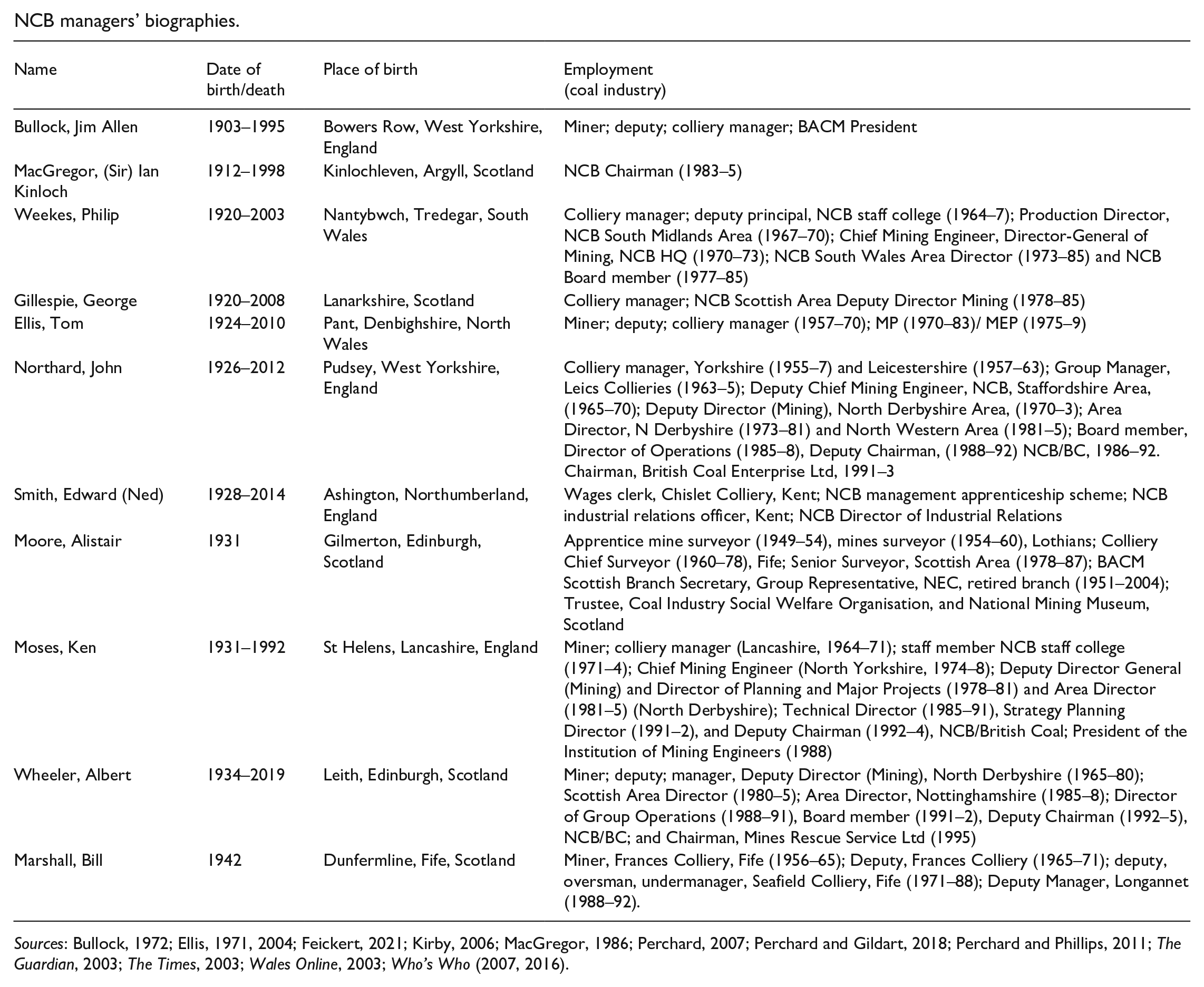
| Name | Date of birth/death | Place of birth | Employment (coal industry) |
|---|---|---|---|
| Bullock, Jim Allen | 1903–1995 | Bowers Row, West Yorkshire, England | Miner; deputy; colliery manager; BACM President |
| MacGregor, (Sir) Ian Kinloch | 1912–1998 | Kinlochleven, Argyll, Scotland | NCB Chairman (1983–5) |
| Weekes, Philip | 1920–2003 | Nantybwch, Tredegar, South Wales | Colliery manager; deputy principal, NCB staff college (1964–7); Production Director, NCB South Midlands Area (1967–70); Chief Mining Engineer, Director-General of Mining, NCB HQ (1970–73); NCB South Wales Area Director (1973–85) and NCB Board member (1977–85) |
| Gillespie, George | 1920–2008 | Lanarkshire, Scotland | Colliery manager; NCB Scottish Area Deputy Director Mining (1978–85) |
| Ellis, Tom | 1924–2010 | Pant, Denbighshire, North Wales | Miner; deputy; colliery manager (1957–70); MP (1970–83)/ MEP (1975–9) |
| Northard, John | 1926–2012 | Pudsey, West Yorkshire, England | Colliery manager, Yorkshire (1955–7) and Leicestershire (1957–63); Group Manager, Leics Collieries (1963–5); Deputy Chief Mining Engineer, NCB, Staffordshire Area, (1965–70); Deputy Director (Mining), North Derbyshire Area, (1970–3); Area Director, N Derbyshire (1973–81) and North Western Area (1981–5); Board member, Director of Operations (1985–8), Deputy Chairman, (1988–92) NCB/BC, 1986–92. Chairman, British Coal Enterprise Ltd, 1991–3 |
| Smith, Edward (Ned) | 1928–2014 | Ashington, Northumberland, England | Wages clerk, Chislet Colliery, Kent; NCB management apprenticeship scheme; NCB industrial relations officer, Kent; NCB Director of Industrial Relations |
| Moore, Alistair | 1931 | Gilmerton, Edinburgh, Scotland | Apprentice mine surveyor (1949–54), mines surveyor (1954–60), Lothians; Colliery Chief Surveyor (1960–78), Fife; Senior Surveyor, Scottish Area (1978–87); BACM Scottish Branch Secretary, Group Representative, NEC, retired branch (1951–2004); Trustee, Coal Industry Social Welfare Organisation, and National Mining Museum, Scotland |
| Moses, Ken | 1931–1992 | St Helens, Lancashire, England | Miner; colliery manager (Lancashire, 1964–71); staff member NCB staff college (1971–4); Chief Mining Engineer (North Yorkshire, 1974–8); Deputy Director General (Mining) and Director of Planning and Major Projects (1978–81) and Area Director (1981–5) (North Derbyshire); Technical Director (1985–91), Strategy Planning Director (1991–2), and Deputy Chairman (1992–4), NCB/British Coal; President of the Institution of Mining Engineers (1988) |
| Wheeler, Albert | 1934–2019 | Leith, Edinburgh, Scotland | Miner; deputy; manager, Deputy Director (Mining), North Derbyshire (1965–80); Scottish Area Director (1980–5); Area Director, Nottinghamshire (1985–8); Director of Group Operations (1988–91), Board member (1991–2), Deputy Chairman (1992–5), NCB/BC; and Chairman, Mines Rescue Service Ltd (1995) |
| Marshall, Bill | 1942 | Dunfermline, Fife, Scotland | Miner, Frances Colliery, Fife (1956–65); Deputy, Frances Colliery (1965–71); deputy, oversman, undermanager, Seafield Colliery, Fife (1971–88); Deputy Manager, Longannet (1988–92). |
Sources: Bullock, 1972; Ellis, 1971, 2004; Feickert, 2021; Kirby, 2006; MacGregor, 1986; Perchard, 2007; Perchard and Gildart, 2018; Perchard and Phillips, 2011; The Guardian, 2003; The Times, 2003; Wales Online, 2003; Who’s Who (2007, 2016).
Acknowledgements
The authors would like to thank all of the interviewees and the staff at the National Library of Wales and the National Mining Museum Scotland, as well as Gareth Weekes and Mike Meredith†. They would like to thank Jo Grady, Tim Strangleman, Paul Thompson and the anonymous reviewers for their observations on the article. Finally, they thank Jane Fricker, Ann-Britt Hellmark and Jan Ottoson for their support during the review and production process.
Declaration of conflicting interests
The authors declared no potential conflicts of interest with respect to the research, authorship, and/or publication of this article.
Funding
The authors received no financial support for the research, authorship, and/or publication of this article.
