




Abstract
This article analyses the Finnish employers’ policy preferences, strategies and success in the industrial democracy (ID) reform process of the 1960s–1970s. The article establishes the employers’ hierarchy of preferences, evaluates how successful they were in realising their objectives, and discusses the strategic choices and contextual factors behind their successes and losses. The article engages with scholarly discussions about interest groups’ policy preferences and success and emphasises the multifaceted nature and the temporal dimension of success. A sufficiently long timeframe is often necessary in order to assess the eventual winners and losers of a policy process, as well as the degrees of success attained by actors.
Introduction
This article tells the story of the industrial democracy (ID) process in Finland during the 1960s and 1970s from the employers’ perspective. The process began in the late 1960s when labour-affiliated parties and union leaders began to demand the right for workers to participate in decision-making in firms. However, the outcome of the decade-long process – the Act on Co-operation within Undertakings (1978) – was a diluted version of the radical original initiatives. Instead of introducing employee codetermination at workplaces, the Act developed into a standardised procedure preceding redundancies of employees.
In this article, we examine the development of Finnish employers’ preferences and strategies at different stages of the process while also paying attention to changes in ID demands and in the economic, political and labour market context. Despite having to concede to ID legislation, employers gained a victory through defence: they were able to avert radical reform and secure the passage of legislation that was more acceptable to them. However, they had to make several concessions to the labour unions over the course of the process. The outcome also fulfilled the employee side’s goal of enacting legislation that secured the position of trade union shop stewards as negotiators in the ID or ‘cooperation’ procedures. The fact that both sides achieved something aptly reflects the spirit of Finnish tripartite corporatism, which was marked by compromise between the labour market parties. In retrospect, the balance of the overall social and economic development of the mid- and late 1970s favoured the employers and contributed notably to their defensive victory, 1 but they could not foresee this at the beginning of the ID process, nor were they able to predict how effectively the seemingly threatening ID initiatives of the 1960s would lose their edge by the late 1970s.
Through a qualitative analysis of archival materials produced by the Confederation of Finnish Employers, branch-level employers’ associations and individual firms, we study how the various layers of the business community developed a common stance toward the demands for ID and navigated through the process. We establish the employers’ preference hierarchy, i.e. their most preferred alternatives as well as less favourable but more viable options, and evaluate how successful the employers were in realising these preferences. The Finnish ID process had parallels elsewhere in Western Europe. By synthesising earlier scholarship on industrial democracy internationally, we place our findings in a transnational context. This enables us to better understand the particularities of the Finnish process, as the end results of the ID projects in different countries were affected by their varying institutional and economic settings.
Our analysis is based on in-depth empirical historical research and primarily contributes to our understanding of the political process preceding the ID legislation of 1978. In the light of our empirical historical analysis, we also engage with scholarly discussions about interest groups’ policy success. While questions of the influence of organised interests are central to politics, conceptualising and measuring influence is notoriously difficult. Consequently, many political scientists have in recent years turned from the study of interest group influence to examining their policy success (Bernhagen et al., 2014; Pritoni, 2015).
We agree on the difficulty of studying influence and instead aim to assess the Finnish employers’ success in the ID process. However, we find that many operationalisations of success fail to recognise the complex nature of successes and losses. As Mahoney (2007: 37) notes, most policy outcomes are not zero-sum games but compromises that entail varying or mixed degrees of success. Furthermore, we argue the policy success literature tends to be rather static and does not pay sufficient attention to the temporal dimension of success (see also Mahoney, 2007: 54; Marsh and McConnell, 2010: 576). We set out to ask at what stage of a policy process success can be called. The Finnish ID case demonstrates that we cannot deduce the employers’ success in the process as a whole from looking at their ability to push through their specific demands at particular stages of the legislation process.
We argue that ‘success’ needs to be studied in a sufficient timeframe. This is particularly the case with prolonged processes but the temporal dimension of success should be acknowledged with regard to shorter-term policy processes, too. As Marsh and McConnell (2010: 576) remind, ‘a policy that appears successful at one time . . . may seem less successful after a longer period of time’ – or the other way around. The effects of a new legislation, for instance, do not end but only begin with the passing of the law. Accordingly, only a longer temporal perspective can allow for assessing the winners and losers of the legislation process, as well as the various degrees of success attained by actors.
In the next section, we provide a closer look at the theoretical discussion concerning interest group success. The following sections present our data and methods, and the international framework in which the Finnish ID process took place. The next three sections then present our empirical case, followed by the concluding section.
Theoretical considerations: Studying success
Questions of influence lie at the heart of interest group studies. However, several scholars (e.g. Bernhagen et al., 2014: 202; Dür and De Bièvre, 2007: 2–3; Mahoney, 2007: 35; Pritoni, 2015: 183–186) have lamented the lack of empirical research on the topic, referring to the notorious difficulty in conceptualising and measuring ‘influence’ as the main explanation for this paucity. (For an overview of the difficulties, see Dür and De Bièvre, 2007: 7–8.)
As an alternative to studying influence, scholars have focused on measuring lobbying success (Bernhagen et al., 2014: 203; Pritoni, 2015: 186). Success can simply be defined as the attainment of policy goals (Klüver, 2013: 65), and the advantage of the concept is that success can be assessed by comparing the objectives of an interest group with final outcomes without having to prove the existence of influence (Mahoney, 2007: 37, 44). Interest groups can be considered to have been successful when policy outputs converge with their preferences, whether this success results from interest group influence, contextual factors, or sheer luck (Klüver, 2013: 65–66; Mahoney, 2007: 44).
However, as Bernhagen et al. (2014: 203) point out, the problem of ‘determining the preferences of key actors and the extent to which these are satisfied with the policy outcome’ still remains. In this article, we carry out an empirical analysis of the preference and strategy formation within the business community and suggest that an increased understanding of how policy preferences and strategies are formulated within interest groups could serve as a step toward solving this methodological challenge.
In addition to gauging success, preferences and strategies are crucial in our analysis. 2 In a protracted decision-making process, the parties involved must keep adapting their strategies and preferences in response to changing circumstances and balances of power, for example. An understanding of these changes over time is thus essential in order to be able to assess the actors’ success. It is precisely here that historical analysis can bring invaluable insight.
In any given lobbying process, an interest group is likely to have a range of objectives extending from ideal and most preferred outcomes, through less ideal but still acceptable alternatives, to undesirable and least satisfactory results, all of which could be considered falling into a preference hierarchy. At the same time, some objectives are more critical than others. Accordingly, preferences can be arranged into an order (a) from the most to the least favoured alternative and (b) from the most crucial to the least significant objective (see Figure 1).
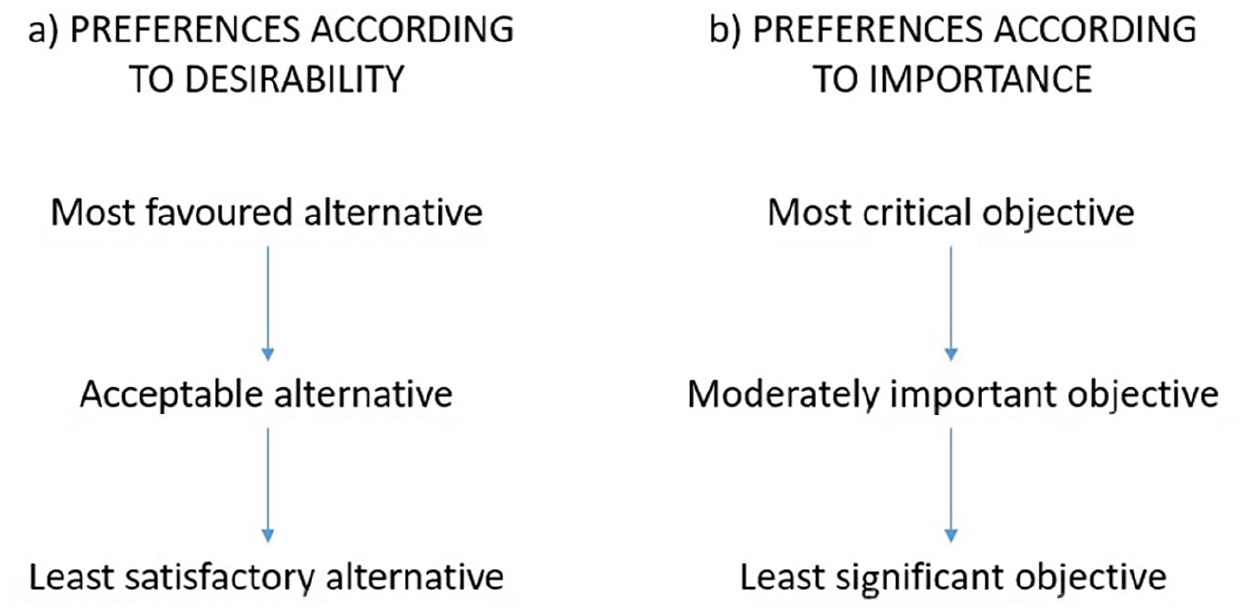
Possible ways of establishing preference hierarchies.
In this article, we propose the idea of a preference hierarchy and aim to identify the Finnish employers’ order of preferences in the ID process. We hypothesise that employers might decide to abandon their most preferred alternative if the less ideal or crucial alternatives seem more achievable. This does not necessarily mean that they changed their preference order, but just settled with the next, less ideal but still acceptable alternative if they judged that their initially most preferred target was unrealistic. Choosing the second-best alternative can also be considered to be a strategic concession in the expectation of an equivalent concession from the other side.
Data and methods
Our data consist of archival sources from: (1) Suomen Työnantajain Keskusliitto (STK, the Confederation of Finnish Employers), which was the national peak-level organisation, and Suomen Teollisuuden Keskusvaliokunta (STKV, the Central Committee of Finnish Industry), which was a discussion arena for the representatives of the STK and Finnish industry’s trade associations; (2) branch-level organisations representing the metal industry and the forestry industries’ employers; and (3) individual firms. The archival sources cover the period from the late 1960s to the late 1970s.
The data produced by the STK are the most systematic and extensive. We have examined all of the materials in the STK’s archives at Elinkeinoelämän Keskusarkisto (ELKA, the Central Archives for Finnish Business Records) under the title of ‘industrial democracy’. Our purpose has been to investigate not only the employers’ reactions to committee reports and legislative proposals, but also the more subtle process of preference formation during the quiet phases when the legislative process was in the slow lane. The STK’s material consists of memoranda and minutes from working group and board meetings. Policy formulation mainly was the responsibility of the STK, and therefore, it is possible to achieve a fairly systematic picture of the changing attitudes and the formulation – and reformulation – of employers’ responses, policy goals and strategies over time.
The material from the Finnish Metal Industry Employers’ Confederation and the Finnish Wood-processing Industries’ Employers’ Confederation is relatively fragmented but the emergence of certain attitudes, changes in preferences, and possible suggestions for strategic actions can be observed. Also the associations’ contacts with individual firms about their voluntary ID experiments reveal perceptions of what ID could and should be. Firm-level material is more extensive than branch-level material, but heterogeneous in content. This material consists primarily of firms’ experiences from ID experiments and illuminates the views of a number of firms participating in the ID debate.
Our approach is qualitative and based on the close reading of an extensive amount of archival sources. We have made a conscious effort to ensure that our qualitative analysis is as robust and systematic as possible. We have utilised data and investigator triangulation – i.e. collected multiple data from different sources and analysed the material independently (Kipping et al., 2014: 317) – before combining and discussing our findings.
While collecting our observations, we paid particular attention to how the employers perceived and defined ID, what kind of threats and opportunities they saw in the ID reform, what kind of content they included in and excluded from their preferred conception of ID, and what strategies they decided to utilise in order to push through their goals. We established a template to facilitate the identification of the following core issues from the data during our reading: threats, opportunities, no-go areas, acceptable areas for cooperation, objectives concerning implementation, and strategies/tactics regarding the reform process. The material in this template was organised in chronological order, to identify changes and the time of their occurrence.
In addition to our empirical data, we rely on earlier research on the history of Finnish labour market relations in general (e.g. Bergholm, 2009, 2018; Mansner, 1990, 2005; Wuokko, 2020) and ID in particular (e.g. Bergholm, 2014; Kettunen, 1986; Kärrylä, 2019). Our presentation of the transnational nature of ID is based on a synthesis of previous literature (e.g. Müller-Jentsch, 2016; Sassoon, 2010).
Industrial democracy as a transnational phenomenon
The concept of industrial democracy (ID) refers to increasing worker influence and participation in enterprises. 3 Earlier literature has identified several transnational waves of ID debates in Western countries: after both World War I and II, and in the 1960s to the 1980s (Mansner, 1990: 429–431; Schiller, 1988: 17–19). The roots of the concept can be traced to the first half of the 19th century, and ID has been on the agenda of the political left and trade unions ever since. From the start, the definition of the concept has varied depending on context, ranging from collective bargaining in general to worker representation within firms that gives employees influence over how enterprises are run (McGaughey, 2016: 146–150; Müller-Jentsch, 2016: 46–48).
Around the end of World War I, ID became a subject of debate in several European countries and the United States. For instance in Germany, Austria and Czechoslovakia, the debates resulted in legislation that secured employee representation through works councils. Probably the best-known of these arrangements is the system of Weimar Germany, where all companies with five or more employees had to establish a works council consisting of employee representatives. In contrast, in the Anglo-American world, the establishment of representative systems remained at the discretion of individual companies (Smith et al., 2019).
In Sweden, Sveriges Socialdemokratiska Arbetareparti (SAP, the Swedish Social Democratic Party) considered the extension of democracy to the sphere of economy and workplaces as a key objective. However, non-socialist parties prevented the establishment of consultative works councils in the early 1920s, and ID did not progress notably in interwar period Sweden (Kärrylä, 2019: 99).
In interwar Finland, the political left and trade unions viewed ID more as an ideological long-term objective than as an attainable short-term goal (Kettunen, 1986: 275, 278–279). This was because the bitter civil war of 1918 – which the socialist ‘Reds’ lost to the non-socialist ‘Whites’ – left the political left weak, fragmented, and with little opportunity to push through radical reforms.
The next wave of transnational ID debates rose in Western Europe after World War II due to the strengthening of the political left and trade unions. Works council legislation expanded to new countries such as Italy, Norway and the Netherlands. In West Germany, ID institutions were consolidated when the works councils system was renewed by the Works Constitution Act of 1952, according to which works councils were established in all private sector companies with five or more employees. In addition, the so-called Mitbeistimmung (1951) gave employees in large coal, steel and iron industry corporations the right to elect worker representatives to supervisory boards (Müller-Jentsch, 2016: 49–50; Sassoon, 2010: 200–201).
In Sweden, the post-World War II ID debates resulted in legislation sooner than in West Germany – i.e. in 1946 – but the reform took a more modest form. The ID reform was left in the hands of labour market organisations, which reached an agreement in 1946 on the establishment of consultative works councils (Simonson, 1988: 29–31).
Like elsewhere in the West, the clout of both leftist parties and trade unions increased in post-World War II Finland. The development took several forms: the leftist parties’ success at the ballot box, the conclusion of a Basic Agreement between the STK and Suomen Ammattiyhdistysten Keskusliitto (SAK, the Central Organisation of Finnish Trade Unions) in 1944, and the gradual adoption of collective bargaining, which the Finnish employers had rejected up until World War II. The manifestations also included an ID initiative by the SAK. Although a law on works councils – literally ‘production committees’ – was passed in 1946, the nature of the committees was only consultative and they did not seriously undermine managers’ and owners’ right to lead companies (Jensen-Eriksen, 2018).
The 1950s represented a hiatus in ID debates and initiatives. Unprecedented economic growth and the spread of the consumer society in Western Europe turned attention away from the objective of bringing democracy to workplaces (Kärrylä, 2019: 107–108). However, by the next decade industrial democracy made a strong comeback on the agenda as part of the leftist zeitgeist. The New Left demanded increased participation in the whole society from schools to hospitals. ID was adopted as a key goal by leftist parties and trade unions, and had bipartisan support from many centre-right parties (Gilcher-Holtey, 2018: 257–267; Sejersted, 2011: 366–369).
Once again, the same transnational trend had varying manifestations in different countries. As Sassoon (2010: 455) sums up, the West European ID reforms varied from schemes to new legislation, which advanced employees’ influence ‘whether by appointing or electing worker-directors, or by providing workers with access to information, or by establishing procedures for dealing with dismissals and working conditions’.
In West Germany, the Co-Determination Law of 1976 provided equal representation for owners and workers on all supervisory boards. In addition, the old works councils system was amended in 1972 by stipulating that the works council had to be consulted before an employee could be dismissed (Müller-Jentsch, 2016: 54; Sassoon, 2010: 528).
In Sweden, the prominence of ID in public debate increased during the late 1960s. From their strong position in the Swedish society, the leading party SAP and the trade union confederation Landsorganisationen i Sverige (LO) were able to implement employee representation in corporate governance in 1972 and the Codetermination Act in 1976. In the end, however, legislation was relatively moderate in the sense that it only increased employees’ rights to negotiate in companies without transforming power relations more radically (Schiller, 1988: 128–133; Simonson, 1988: 132–137).
ID initiatives did not realise into reforms everywhere. The most notable example was the British case. In the UK, many trade union leaders considered effective collective bargaining as a more important goal than ID. Radical unionists also believed that the workers’ task was to oppose management, not to join it. Due to the lack of any steadfast support for the reform from the left, the ID initiative was eventually dropped. Workers’ rights were however expanded by four major statutes in the mid-1970s, which strengthened their procedural rights in health, pay, dismissal and discrimination matters (Sassoon, 2010: 530–531; Williamson, 2016).
Despite national variations in the ID processes and their eventual outcomes, employers’ attitudes toward the reforms in different countries were reserved. Employers’ associations for instance in West Germany and the UK mobilised vigorous campaigns against reforms to defend managerial and property rights, shareholder sovereignty and free enterprise (McGaughey, 2016: 152; Müller-Jentsch, 2016: 54; Phillips, 2009: 809; Sassoon, 2010: 528, 530). The common European employer view – shared by the Finnish employers – since the late 19th century was that ID reforms should not extend beyond social and personnel matters and increased cooperation and communication in workplaces. For the employers, the underlying rationale behind the potential ID reforms had to be the improvement of work satisfaction, motivation, and consequently, also productivity (Kärrylä, 2019: 216–218; Plumpe, 1991).
The next three sections of the article examine in more detail how the third transnational wave of ID debates manifested itself in Finland and how the Finnish employers responded to the ID reform process.
Most favoured alternative: Blocking a radical ID reform
In the early 1960s, demands for ID resurfaced in Finland. The issue was intertwined with infighting within the Finnish political left and trade union movement. Initially, ID was advocated by Työväen ja Pienviljelijäin Sosialidemokraattinen Liitto (TPSL, Social Democratic Union of Workers and Smallholders) and Suomen Ammattijärjestö (SAJ, Finnish Trade Union Federation), which attempted to challenge the more dominant Suomen Sosialidemokraattinen Puolue (SDP, Social Democratic Party of Finland) and SAK. ID initiatives were a means for the TPSL and the SAJ to raise their profile. However, apart from the TPSL’s unsuccessful parliamentary motions to renew the existing production committee system, the discussion remained theoretical (Kärrylä, 2019: 214, 232–233).
In our data, the first references to ID date back to 1964, when it was discussed in the STK and the Central Committee of Finnish Industry (STKV) as a reaction to an SAJ initiative to establish a committee to investigate the participation of employees in the management of enterprises. The discussions reveal that blocking any potential ID reform in its infancy would have initially been the most favoured preference of the business community (STK, 1964; STKV, 1964; see also Bergholm, 2018: 22, 26; Mansner, 1990: 434). This preference soon turned out to be unviable because the ID issue was not going to go away, and the employers thus agreed to negotiate with the SAK (Mansner, 1990: 434). In negotiations between the labour market parties, it might be possible to implement flexible ID reform which would suit local needs and allow for branch or firm-level adaptations. When the employers later realised that they could not avoid ID legislation, the content of such legislation came into focus. Employers proposed alternative drafts for legislation and suggestions for compromises (e.g. STKV, 1971b). Figure 2 illustrates how the employers proceeded from their most favoured preference to the second- and third-best alternatives over the course of the ID reform process. In the following pages, we examine the development in more detail.
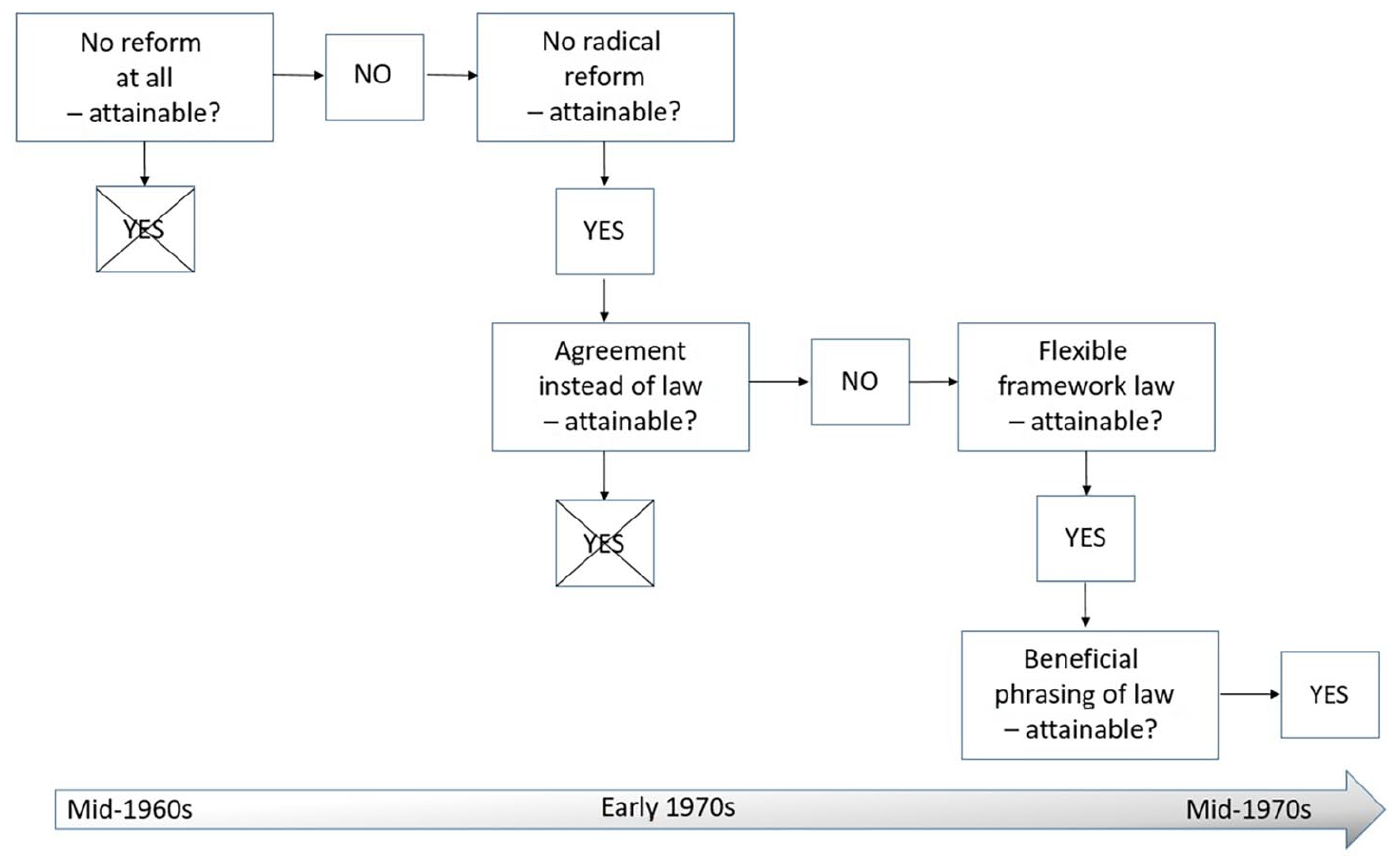
The preferences of Finnish employers over the course of the ID process and their success in attaining their preferences.
A more intense phase of the ID debate began in 1966, when the electoral victory of the Social Democrats led to a left-wing parliamentary majority and a centre-left government. Social Democratic Prime Minister Rafael Paasio set the ID process in motion by suggesting the expansion of employees’ participation rights and representation in corporate governance (Bergholm, 2014: 29). The following year, Paasio’s government appointed the Enterprise Democracy Committee to investigate opportunities to implement ID. The committee’s work (1967–1970) marked the formative phase of the debate, during which the key arguments and views concerning ID were formed.
The SAK inherited the SAJ’s role as the main proponent of ID after the trade union movement’s split ended in 1969 and most trade unions returned to the SAK. Because of the strong position of communists in the reunified SAK, the confederation’s ID rhetoric was initially relatively radical. At the turn of the 1960s and 1970s, the SAK pursued equal employee representation with employers in corporate governance, with decision-making power in personnel policy, hiring and firing, training, rationalisation, social affairs, work planning, security and determining the goals of corporate activity. The SAK argued that mere consultation would not represent ‘true’ industrial democracy but that altering prevailing power relations was necessary (Kärrylä, 2019: 241, 243–244).
The STK also became more active in the debate. In the eyes of STK leaders, ID was a dangerous initiative that could jeopardise employers’ right to manage, which in turn can be seen as a manifestation of property rights (Engelstad, 2016: 41). Accordingly, even the foundation of the market economy was potentially at risk. The employers were particularly anxious about the possibility that the left-wing parliamentary majority would pass a radical ID reform without consulting the STK (STK Board of Directors, 1969), pointing out that ‘there would be no turning back from a political [i.e. parliamentary] decision’ (STKV, 1969b).
However, the employers’ initial preference from 1964 – blocking the initiative in its early stages – seemed no longer attainable (STKV, 1971b). ‘Democratisation’ had become a popular catchword, which the centre-right parties also embraced in their contest for wage-earners’ support (Kärrylä, 2019: 261–262, 264). As STK President Erkki Partanen put it, the era was filled with ‘demands for participation’: people were increasingly interested in taking part in decisions concerning them and their everyday lives (Partanen, 1969b).
At the turn of the 1960s and 1970s, the employers thus changed their strategy from trying to prevent the reform altogether into averting or mitigating radical reform (see also Bergholm, 2018: 30). A radical ID reform would threaten their right to manage by distributing decision-making power in companies from employers to employees and entail profit-sharing. A moderate reform, on the other hand, would secure employers’ freedom of action and preserve the exclusive right of decision-making. The representatives of Finnish employers therefore strongly opposed the participation of workers in corporate management, the election of decision-making bodies and the distribution of profits (STKV, 1969b; STK Board of Directors, 1969).
Similar attitudes permeated all layers of the business community. The metal industry’s employers opposed the establishment of representative ID organs and employee participation in top management and work supervision (Suomen Metalliteollisuuden Työnantajaliitto, 1971a); forestry industry employers agreed (Suomen Puunjalostusteollisuuden Työnantajaliitto, 1973b). Representatives of individual companies spoke in a similar tone, stressing that decision-making power should not be given to employees (Rosenlew Ltd, n.d.), worker representation in corporate management should not be established (Backström, 1971), and ownership of companies was to be left out of negotiations (Wind, 1972). Moreover, recruitment was also to remain the prerogative of management, which would continue to have the right to decide who was employed and who was not. The employees could only have a say in formulating the general principles concerning personnel planning (Suomen Metalliteollisuuden Työnantajaliitto, 1971a). All in all, employers emphasised in unison that the right to manage went hand in hand with ultimate responsibility for business operations, both of which were indivisible and belonged firmly in the hands of employers (Laatunen, 1971; Stolpe, n.d.).
The strong protection of private ownership in the Finnish constitution indirectly supported the employers’ arguments. The requirement of a qualified majority for constitutional changes effectively hindered any reforms that would alter ownership relations and, consequently, also protected the employers’ right to manage (Kärrylä, 2019: 176, 287).
However, the Finnish employers were unsuccessful in frustrating the ID reform entirely. Instead, they settled for a moderate reform as their next best preference, since this was a more realistic alternative than halting the reform process altogether. Despite their reservations, they also considered the possibility that the ID reform might eventually be of some advantage. Ideally, ID could even serve as a means for turning the general atmosphere into a more industry- and business-friendly direction. This necessitated adopting a positive, proactive strategy (STKV, 1972; Suomen Metalliteollisuuden Työnantajaliitto, 1971a). But what did such a strategy mean in practice?
Second-best alternative: A negotiated pact on cooperation instead of ID legislation
When formulating the content of their proactive, positive strategy, the Finnish employers wanted to ensure that the ID reform would proceed at the discretion of the central labour market confederations (e.g. STKV, 1969a, 1971a; STK Board of Directors, 1969). The STK leadership saw that the ID reform should be realised through negotiations and agreements instead of a parliament-led legislation process (Kivekäs, 1966). The latter ran the risks of turning the whole issue into a political bone of contention and resulting in an unnecessarily radical outcome. Accordingly, the labour market confederations had to take the lead in ID development (Partanen, 1969a; STKV, 1969b, 1971b). The parliamentary majority gained by the leftist parties in 1966 only served to strengthen the employers’ strategic preference for pacts (Wuokko, 2020: 173).
Advocating a negotiated pact instead of parliament-enacted legislation can be interpreted both as a preference and a strategy. Increasingly from the 1950s onwards, the STK leadership had favoured agreements with the trade unions over ‘political’ decisions, by which they meant unilateral decisions by governments and/or the parliament without consulting the labour market confederations (Bergholm, 2009; Wuokko, 2020: 169–173).
It should be stressed that after the initial phase of the process, the employers were not vehemently against any ID legislation per se, but legislation dictated by the (leftist) parliament without broad consultation. From the employers’ point of view, an ID law could be acceptable as long as its content was defined in the SAK and STK’s negotiations. However, the content of the legislation was crucial in determining its acceptability in the eyes of the employers. A flexible framework law can therefore be defined as the employers’ next best alternative in case a pact by the confederations alone did not quell the demands for ID.
The branch-level employers’ associations willingly followed the STK’s lead. The metal industry employers argued that ID should preferably be implemented by the labour market confederations’ agreement rather than legislation. If absolutely necessary, a statutory ID system could be accepted but only as a secondary alternative in the case a satisfactory agreement was not reached (Suomen Metalliteollisuuden Työnantajaliitto, 1971a). The employers stressed the importance of firm-level flexibility in particular. As the metal industry’s representative, Tor Stolpe (n.d.) emphasised ID based on a nation-wide agreement needed to be adapted to local circumstances and forms of collaboration.
The employers were initially successful in attaining an ID agreement when the confederations drafted an ‘Agreement on promoting cooperation within companies’ in the spring of 1969. The draft mostly followed the lines drawn by the STK and proposed legislation which would have replaced old production committees with new cooperation committees, to be staffed with equal representation of blue- and white-collar employees. The committees’ mandate would have been limited to gaining information, putting forward motions and participating in matters concerning, e.g., social activities, work methods and safety. The SAK’s member unions, however, rejected the draft agreement (Mansner, 1990: 438–440).
After the rejection of the agreement, the Enterprise Democracy Committee published its own report in the spring of 1970, proposing new representative bodies called ‘cooperation committees’ in companies. Initially, the committees would participate in decisions on social and HR issues, but their mandate could be extended later. The committee also suggested the establishment of personnel councils that would consist solely of employees and have the opportunity to put forward motions and gain information (Enterprise Democracy Committee, 1970). The committee report left both the employee and employer sides dissatisfied. For the former the report was not radical enough, while for the latter the propositions were too far-reaching. The committee report did not lead to a law proposal because the government wanted to give the labour market partners a chance to reach a mutual understanding on ID. In addition, a new Enterprise Democracy Application Committee, led by Conciliator General Keijo Liinamaa and consisting exclusively of representatives of labour market organisations, was appointed to prepare plans for the implementation of ID (Kärrylä, 2019: 264–265, 268–269; Mansner, 1990: 440–443).
The decisive role given to the SAK and the STK was in line with the wider labour market policy development in Finland at the turn of the 1960s and 1970s, when tripartite, corporatist decision-making traditions were consolidated and governments cooperated with labour market parties in determining wages, prices, taxes and social policies in the form of the so-called incomes policy (tulopolitiikka). The main axis of power in this corporatist cooperation was between the STK leadership and the SAK’s social democratic leaders, who in mutual understanding held the SAK’s communists in check.
The new committee’s work proceeded slowly and lasted until 1974 (Enterprise Democracy Application Committee, 1974). In the meanwhile, the labour market confederations’ draft agreement was partially realised in the early 1970s through the SAK and STK’s separate agreements on, e.g., cooperation regarding rationalisation and improvement of internal communications in companies. These agreements can be interpreted as an attempt by the employers to consolidate their own understanding of ID as the common practice (Kärrylä, 2019: 264–265, 283; Mansner, 1990: 273–292). The interpretation is supported by a metal industry employers’ memo, which suggests ‘slicing up’ the ID reform into several, more limited agreements concerning issues such as work safety, information, training and personnel policy. These partial pacts could then serve as the foundation for implementing ID in practice (Suomen Metalliteollisuuden Työnantajaliitto, 1971a; see also Laatunen, 1971).
A parallel strategy was to portray several existing labour market practices – from collective agreements to shop stewards and production committees – as ID in action. If these arrangements were taken into account, claimed the STK, Finland could be considered as a forerunner of ID in Europe (Backström, 1971; STK, 1973). Individual employers also initiated voluntary ID experiments at workplace level to bolster their claim as pioneers of ID. The experiments seem to have originated at the company level, but they were soon encouraged and celebrated by the STK. When instructing its members about potential ID experiments, the STK emphasised that they should be limited to issues such as social matters and well-being, occupational health and safety, internal communications, and personnel policies and training (STK, 1970). By 1971, nearly 500 ID experiments were already underway in Finnish companies (Mansner, 1990: 440–443).
The objective behind the employers’ preference for a negotiated agreement, their emphasis on existing practices and the voluntary ID experiments was to mitigate the radical ID initiatives and divert the reform process to accommodate the employers’ needs more. Kärrylä (2019: 253) has characterised this strategy as the appropriation of the ID concept. To this end, employers at all levels of the business community avoided terms such as industrial democracy and (representative) codetermination, and favoured concepts such as (consultative) cooperation and participation (e.g. Backström, 1971; STK, 1973; Suomen Metalliteollisuuden Työnantajaliitto, 1971b; Suomen Puunjalostusteollisuuden Työnantajaliitto, 1973a).
In principle, the SAK – the communists in particular – rejected the employers’ definition of ID, criticised them for trying to hijack the concept, and continued to demand representative democracy. In practice, however, the social democratic SAK leadership was willing to compromise and accept piecemeal reforms. For the trade union leaders, increased employee participation in social affairs, work planning, health and safety, personnel issues and so on was seen as a necessary first step toward actual workplace democracy. Although unsatisfactory in itself, this step would create preconditions for the realisation of true employee power, which would give workers the right to participate in decisions concerning the appointment of managers, the development of companies and the distribution of profits (Kärrylä, 2019: 242–244). The SAK’s willingness to accept a moderate ID reform for the time being proved beneficial for the Finnish employers. The trade union leaders’ attitude ensured the employers’ success in realising their preference for non-radical reform, the content of which would be agreed upon in negotiations between the labour market confederations.
As the Enterprise Democracy Application Committee’s work slowly but steadily advanced in the early part of the 1970s, ID legislation began to seem inevitable. The employers thus modified their primary objective once again and started to strive for a flexible framework law (Laatunen, 1971; STK Board of Directors, 1973). In addition, they turned their attention and efforts to influencing the phrasing of the forthcoming legislation.
Third-best alternative: A flexible framework law
During the Enterprise Democracy Application Committee’s work in the early 1970s, Finnish employers already accepted the inevitability of ID legislation. Their goal now was to ensure that the eventual legislation would provide plentiful room for manoeuvre for individual employers and opportunities for variation across industries (STK Board of Directors, 1973). Representatives of individual companies as well as branch-level associations agreed with the STK on the importance of flexibility. A rigid, bureaucratic ID system was to be avoided and companies provided with maximum leeway in the implementation of employee participation at workplace level (Backström, 1971; Suomen Metalliteollisuuden Työnantajaliitto, 1971a, 1971b).
In this sense, the employers had reason to greet the committee report of 1974 with satisfaction. The committee proposed a skeleton law, which also allowed for industry- and company-level deviations in implementation (Saukkonen, 1974). As President of the STK Erkki Partanen put it, the greatest merit in the committee proposal was the considerable freedom given to arrange shop-floor ID systems differently from the ‘standard model’ (Partanen, 1974).
Following its predecessor’s recommendations, the Enterprise Democracy Application Committee suggested establishing a system of cooperation committees, which would have the right to gain information and ratify plans, and personnel councils, which would have the right to make statements and offer proposals. The employers’ representatives were dissatisfied with the suggested ID bodies, which they argued would only serve to create conflicts at workplaces. Nevertheless, the committee report took into consideration the employers’ views on several significant matters of principle. According to the committee’s proposal, the decision-making power of the new ID organs would remain limited in order to protect the constitutional right of private ownership. Furthermore, the committee defined increased employee participation and cooperation – instead of the distribution of power – as the key goals of the law proposal (Kärrylä, 2019: 284–285; Mansner, 1990: 442–443).
The trade unions criticised the committee’s proposals for being too modest and continued to pursue increased decision-making power in strategic decisions and personnel policies as a long-term goal. They were, however, willing to accept a gradual and moderate reform as a more realistic objective (Kärrylä, 2019: 285–286, 291). In the mid-1970s, the SAK took an increasingly conciliatory stance and focused more on improving wages and social benefits than pursuit of the ID reform. The social democratic trade union leaders did not wish to endanger the corporatist incomes policy system by provoking the employers with adamant ID demands. In addition, the SAK wanted to secure the position of the shop steward system and prevent the creation of parallel organs of employee representation that the SAK might be less able to control. At the same time, the SDP became less interested in the issue of ID (Bergholm, 2014; Kärrylä, 2019: 286–288). This shift went hand-in-hand with the adverse effects of the first oil crisis. The weakening state of the Finnish economy and rising unemployment figures resulted in the adoption of political consensus about the primacy of Finnish industry’s international competitiveness as the most fundamental economic and labour market policy goal.
Under these circumstances, the employers were able to concentrate on securing their second- and third-best preferences: a flexible framework law with content and phrasing that was as favourable as possible. For example, the employers’ representatives pushed hard for the exclusion of companies with fewer than 50 employees from the obligation to establish ID organs (e.g. LTK, 1977; Pellikka, 1976; STK, 1977).
In addition, the employers’ associations emphasised that white-collar employees should receive the right to participate and an equal share of seats in future ID bodies to that of the blue-collar workers (e.g. Laatunen, 1971; STK, 1977; Suomen Puunjalostusteollisuuden Työnantajaliitto, 1973a); representatives of individual companies concurred (Ehrnrooth, 1976; Löf, 1978). The basis for this demand was the employers’ faith in that the traditionally non-confrontational upper groups would identify themselves with the employers’ side. Thus, white-collar employees could serve as a balancing force between blue-collar workers and corporate management. At the same time, it was important for the employers to preserve the loyalty of white-collar employees, who were organising at an accelerating pace and could, at worst, end up on the opposite side of the negotiation table. Granting white-collar workers equal ID rights can therefore be seen as the employers’ appeasement strategy toward upper-level employees. (See Fellman, 2010; Levä, 2021; Wuokko, 2020: 214–216.)
Due to the relative paucity of research on the history of white-collar workers’ confederations (see, however, Levä, 2021) it is difficult to thoroughly assess their role in the ID reform process. However, it is clear that their significance strengthened in the 1970s at the same time as the number of their members among the workforce increased; the share of white-collar workers exceeded that of blue-collar workers at the end of the 1970s (Mansner, 1990: 108). In the ID process, however, the SAK and the STK played the main role. In principle, the employee side could have formed a united front against the employers in the ID reform process, but in reality, the wage-earners’ interests did not coincide. The white-collar workers’ representatives were more interested in preserving the existing ‘pecking order’ and the power of forepersons at workplaces (Fellman, 2010; Mansner, 2005: 313). One can speculate whether the strengthening of white-collar workers’ confederations pushed the SAK toward a compromise with the STK, but more research would be needed to confirm this.
Once the Enterprise Democracy Application Committee had published its report, the STK stated that ID legislation should not be delayed any longer (STK, 1974), and that employers should welcome its implementation (Partanen, 1974). This appears as a sudden U-turn. The STK seemed so determined to bring about the ID law that some members even raised objections, to which CEO of the STK Stig Hästö replied by referring to mounting pressures at workplace level if the ID reform was not realised (STK Board of Directors, 1976). In some companies, this threat seemed obvious, too. Chief administrative officer Jan Ehrnrooth of A. Ahlström Company warned that the failure of employers to show voluntary engagement in developing ID would only push workers to adopt new, more radical demands (Ehrnrooth, 1976).
The finishing line of the reform process was finally in sight in 1977. The SAK, the STK and the government all wanted to bring the ID discussions to a conclusion. From the employers’ point of view, the late 1970s was an opportune time for reaching an understanding on the issue, since the economic recession had notably narrowed down the scope for expensive new reforms (STK Executive Committee, 1977). For its part, the SAK was increasingly committed to reaching an understanding with the STK. This was mainly due to the fact that the Centre Party developed an interest in ID and advocated a reform that would limit the influence of the SAK by providing (non-union) employees with a new channel of influence that was independent from the trade unions (Bergholm, 2018: 41–44). A compromise thus benefitted both the SAK and the STK: the former was able to secure its influence at workplaces and the latter was able to achieve diluted, moderate ID reform.
In retrospect, governments were reluctant to enact ID legislation without an agreement between the labour market parties (Kärrylä, 2019: 290, 297). The SAK and the STK therefore played a decisive role in outlining the final shape of the reform. The confederations reached an understanding on the principles of ID legislation by late 1977. New, representative organs would not be created but participation was to be implemented by strengthening the role of shop stewards. This solution was inspired by the Swedish Codetermination Act, which had likewise based ID on shop stewards instead of new representative councils (Kärrylä, 2019: 292; Lappalainen, 2003: 160–161). In Finland, ID was replaced with the employer-favoured concept of cooperation (yhteistoiminta). The cooperation obligation would extend to several issues but, at the same time, the ultimate right of decision would remain in the hands of employers (Mansner, 1990: 445–446). The CEO of STK Pentti Somerto was content with the result of the decade-long process, and indeed feared that the result might even be too good to be true. The way he put it, the compromise reached by the SAK and the STK brought about only minor adjustments, such as an obligation to inform employees more openly than before about upcoming changes at the workplace (STK Board of Directors, 1978).
The Act on Co-operation within Undertakings was passed by the Finnish parliament in June 1978 in accordance with the proposal of the labour market parties. The law nullified existing legislation on production committees and decreed cooperative negotiations to be carried out between the employer and individual employees or trade union representatives. The Act required information-sharing and negotiations on all issues that significantly affected employees, such as changes in tasks and work methods, acquisitions of new machinery, and temporary or permanent layoffs. In the case of disagreements, the right to make the final decision remained in the hands of the employer (Kärrylä, 2019: 293; Mansner, 1990: 446–448).
The employers were unable to achieve all of their goals. For example, the law was to be applied on all companies employing 30 or more workers instead of the limit of 50 employees, which they had pursued (STK, 1978). However, this was an insignificant detail compared to the numerous defensive victories that they had gained, such as a reference to cooperation instead of democracy in the title of the law. Also white-collar employees were included in the new ID processes. Most importantly, the employers managed to secure their right to manage, to avoid employer board representation, and to limit the reform to consultation, negotiation and information-sharing instead of having to expand decision-making power to employees (STK Board of Directors, 1978).
The employers were forced to accept ID legislation and some unfavourable details in its content, and thus failed to fulfil their second- and third-best preferences completely. On the other hand, they were able to obtain a moderate, flexible framework law, turn the spirit of the law to their advantage, and thwart a radical reform. All things considered, this cannot be considered an overwhelming victory. The SAK also achieved its long-held goal of attaining ID legislation and managed to bolster the position of shop stewards, whose right to negotiate was strengthened. Accordingly, the end result can be best characterised as a victory through defence for the Finnish employers.
However, with time, the Act on Co-operation has turned increasingly to the employers’ favour. In a twist of irony, cooperation procedures have come to refer to negotiations in which employers inform employees about the need to cut down workforce. As pointed out by both scholars (e.g. Bergholm, 2018: 47; Kettunen, 2018: 166) and labour market experts (e.g. Murto and Vanhanen, 2018: 42), the statutory negotiation procedures before collective layoffs have made ‘cooperation’ a symbol of redundancies and workers’ powerlessness instead of employee participation in Finland. It is beyond the scope of this article to analyse the post-1978 development in detail. However, it should be noted that the transformation of ID legislation into a ‘layoff law’ was not a result of the employers’ conscious efforts. Instead, it was a result of the general economic and political trend of market liberalisation, the erosion of the social democrats’ interest in the issue of ID, and major labour market transformations such as decentralisation of bargaining, the end of the full employment target, and the weakening of trade union power (in more detail, see e.g. Kärrylä, 2019: 508–557).
Conclusions
In this article, we have presented an empirical analysis of the Finnish employers’ policy preferences and success in the industrial democracy (ID) reform process of the 1960s and 1970s. We have illuminated how the various layers of the business community developed a joint stance and strategy toward the demands for ID. In addition, we have examined how the employers’ preferences and strategies evolved over the course of the reform process in response to changing ID demands and proposals. Furthermore, we have paid attention to changes in the economic, political and labour market context behind the Finnish ID reform process, while also highlighting the transnational character of ID discussions and reforms.
The Finnish employers’ initial preference would have been to block the ID reform in its infancy, but the strength of the political left and trade unions forced them to modify their primary objective into averting or mitigating radical reform and thus securing their right to manage. As their main strategy to safeguard this preference, the employers pursued an ID reform negotiated and agreed on by the labour market confederations. This strategic preference was also in line with the more general development of increasing cooperation between the labour market parties and the strengthening corporatist decision-making practices.
However, reconciling the trade unions’ far-reaching demands together with the employers’ limited conception of ID was no easy task. Eventually, the trade union confederation SAK accepted the employer-endorsed version of ID as a first step toward more extensive, ‘true’ workplace democracy. The trade unions’ pragmatism was consolidated by the economic depression of the 1970s. The STK, for its part, had to accept the inevitability of ID legislation. However, the economic and political circumstances were opportune for attaining a flexible framework law with content that was as favourable for them as possible.
The Act on Co-operation within Undertakings was passed in 1978 in accordance with a draft sketched by the labour market confederations. The law fulfilled most, although not all of the employers’ objectives. Even though they could not block ID legislation and had to make concessions and modify their preferences over the course of the process, the legislation ultimately suited the employers’ interests, and can therefore be considered to be a success from their perspective (see also Bergholm, 2018: 47). Securing the right to manage was their most important achievement. Considered on the whole, the end result was undoubtedly a victory through defence for the Finnish employers. Moreover, with time and in practice, the Act has turned even more to the employers’ advantage, as ‘cooperation’ came to be considered to be a fig leaf for the statutory negotiations before predetermined collective layoffs.
The outcome of the Finnish ID reform process was mainly a result of changing conditions. A gradual shift in the political balance of power from the left to the right during the course of the process and the economic downturn of the mid-1970s gradually weakened the SAK’s position. The SDP’s diminishing interest in advocating ID further undermined the trade unions’ bargaining power in the issue. Under these circumstances, the SAK was willing to give up its radical demands and compromise with the STK in order to protect the influence provided by the incomes policy and shop steward systems. Employers were keen to compromise, too, since it helped them to stave off the threat of a radical ID reform and to ensure a diluted Act. As legislation gradually became unavoidable, the employers focused increasingly on its content. By conceding to legislation, they were able to achieve concessions from the SAK concerning the content of the reform. It is also worth noting that the 1970s was the golden era of Finnish tripartite corporatism, which was marked with labour market policy compromises between the SAK and the STK and steered both parties toward a negotiated pact.
Therefore, the end result cannot be credited to the employers’ strategic manoeuvres alone. However, our data show how the employers skilfully navigated through ever-changing circumstances and flexibly modified their goals according to the best available alternative at each stage of the process. Although historical evidence does not allow us to definitively prove causal links between the employers’ actions and the outcome of the ID reform process, we can state that they managed to make the most out of the opportunities that the unfolding development provided them over the course of the long battle that began in the 1960s as a radical threat to their right to manage.
How did the Finnish development look in a comparative perspective? Although ID was a transnational phenomenon during these decades, national implementation strategies and outcomes diverged according to economic, political and institutional factors. In Sweden, ID debates resulted in the introduction of wage-earner funds. The hegemonic position of the SAP and the support of the LO paved the way for more radical reforms than in Finland. At the other end of the spectrum in the UK, the whole project failed. In the late 1970s, Margaret Thatcher’s Conservative government came to power, and began to promote a different version of industrial democracy which entailed, for example, workers’ right to elect their union officials, to opt out of a strike and voluntary union membership (Sassoon, 2010: 531). The foreign examples most likely provided some guidance for the STK on how to act and what to expect. The mild Finnish ID reform fell somewhere between the two ends of the spectrum.
In addition to presenting an empirical analysis, this article makes an historical contribution to scholarly discussions on interest groups’ policy preferences, strategies and success. The examination of Finnish employers in the ID reform process of the 1960s and 1970s provides insights that can be relevant in other contexts, too. First, we wish to point out the multifaceted nature of policy preferences. We find that operationalisations in which success is measured by establishing an ordinal scale ranging from an interest group attaining none, some, or all of their objectives do not sufficiently capture the complex nature of successes and losses. As illustrated by our examination, we need to be able to take into consideration degrees of success, such as partial achievements, ‘non-failures’ and defensive victories (see Mahoney, 2007: 37; Marsh and McConnell, 2010: 577–578). We also show the need to address the changing political and economic context in order to understand preference and strategy formation processes and the responses and actions of employers (or other interest groups).
As suggested in the article’s section on theoretical considerations, in any particular lobbying process an interest group is likely to have a range of preferences extending from the most to the least favoured alternative and from the most crucial to the least significant objective, creating hierarchies of preferences. Following these two continua and applying the categorisation proposed in Figure 1 earlier, Table 1 presents possible ways of categorising the Finnish employers’ order of preferences in the ID process: (a) preferences according to desirability and (b) preferences according to importance.
Finnish employers’ preference hierarchies regarding the ID reform process (a) according to desirability and (b) according to importance.
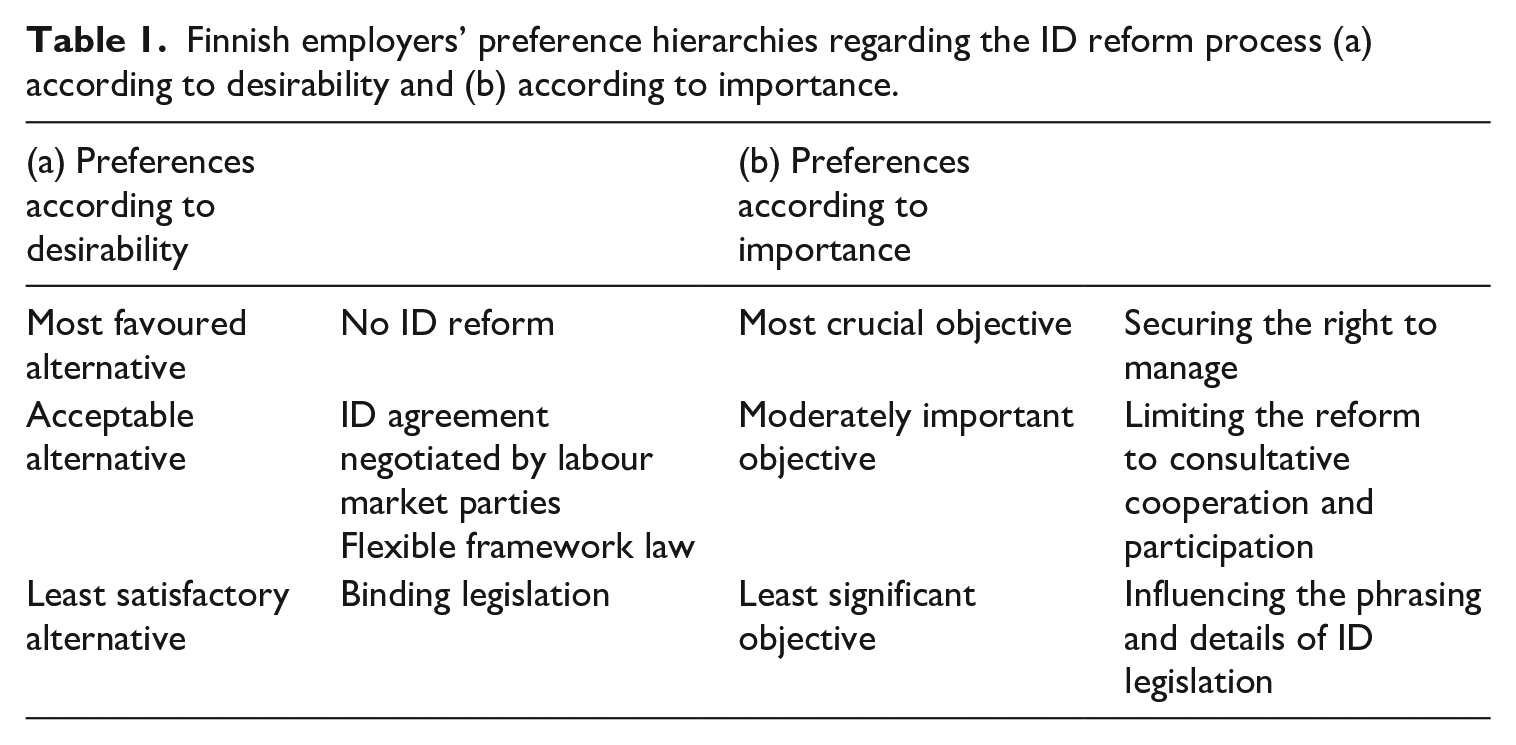
It should be noted that the table presents a simplified and stylised model which does not enable us to depict change over time. The categorisation thus cannot capture the dynamic nature of the definition and reformulation process of preferences but, instead, might make the preference order seem misleadingly static. An empirical analysis like the one presented in this article is thus invaluable in illuminating the complexity of the process in more detail. Despite this limitation, the categorisation can serve as a tool for introducing nuances to the analysis of various simultaneous preferences and their internal order. Our article invites other scholars to take up the idea of preference hierarchies and to apply and further develop the categorisation.
The challenge of capturing the dynamic and complex nature of preference formation processes only serves to add weight to our second main argument. We emphasise the temporal dimensions of both success itself and assessing success. We argue that a sufficiently long timeframe is necessary to be able to determine the eventual winners and losers and the extent of their gains and losses in the decision-making and implementation process. We should acknowledge the potential, even probable modifications of actors’ preferences, particularly in the case of prolonged processes, of which the gestation of Finnish ID legislation is a prime example. Seeming successes may also turn into disadvantages, or apparent losses into eventual victories, as long-term effects of a reform or other decision-making process unfold. The true winner may emerge only in retrospect, when we can properly assess the after-effects of a decision and its implementation.
Footnotes
Acknowledgements
We wish to thank the two anonymous reviewers and our colleagues at the Swedish Economic History Meeting / 1st Annual Conference of the Scandinavian Society for Economic and Social History (Uppsala University, 2019), at the workshop Business Influence on Policy Formation in Historical Research (University of Helsinki, 2020), and at the Council for European Studies research network Business in Politics and Society online panel (online, 2020) for their invaluable feedback on the earlier versions of this article.
Declaration of conflicting interests
The authors declared no potential conflicts of interest with respect to the research, authorship, and/or publication of this article.
Funding
This research was supported by the Helsinki University Humanities (HUH) Programme, and Neoliberalism in the Nordics Programme (funded by Riksbankens jubileumsfond).
