




Abstract
Global value chains (GVCs) have become the dominant form of industrial organization in the global economy. Although the economic outcomes of GVC restructuring have been measured and the determinants theorized, there is a lack of empirical research on the real processes of GVC restructuring and its impact on labour in the Global North. This article helps to address this gap by investigating the effect of the participation in GVCs on the lead firms’ value-capturing strategies and on workers’ ability to defend and improve their working conditions in the Swiss machinery industry. Based on a critical GVC approach and a qualitative study of two work conflicts, the study demonstrates how GVCs shape a variety of new strategies for capital and labour; enhancing forms of management strategies and weakening the possibilities for workers’ counterstrategies by eroding collectivism and solidarity and promoting individualism among workers.
Introduction
Globalization has had a conflicting impact on the employment and labour process in the Global North. On the one hand, by increasing companies’ productivity and profits (De Loecker and Eeckhout, 2018; UNCTAD, 2018), it can positively affect job creation, wages and the demand for high-skill workers (Amiti and Wei, 2005; Ando and Kimura, 2007; Feenstra and Hanson, 1996; Forte and Ribeiro, 2019; OECD, 2007). On the other hand, it has also reduced average wages, reduced semi-skilled and low-skilled jobs, and increased income inequalities as well as regional disparities in the domestic markets (Durand and Miroudot, 2015; Feenstra and Hanson, 1996, 1999; Milanović, 2016).
Previously, the economic literature has attributed these outcomes mostly to the international offshoring process. However, the features of contemporary globalization extended beyond offshoring and have more recently been theorized as the transition towards Global Value Chains (GVCs). GVCs have now become the dominant form of international industrial organization (Cattaneo et al., 2010; Levy, 2005; Milberg and Winkler, 2013; World Bank, 2019), which involve ‘a geographically – and often also legally – fragmented economic space where incomplete commodities are functionally integrated and valorized through a unified labour process’ (Carballa Smichowski et al., 2021: 272).
Thus, GVCs constitute a global reorganization of production by lead firms, typically multinationals, that implement hierarchical forms of inter-firm coordination. This has been achieved through complex and fragmented combinations of offshoring and outsourcing of production tasks, in order to capture a larger share of value-added and profit in production networks (Gereffi, 2006; Gereffi and Korzeniewicz, 1994; Gereffi et al., 2005). Today, GVCs represent over half of world trade (Milberg and Winkler, 2013; UNCTAD, 2018; World Bank, 2019), overwhelmingly coordinated by multinational companies (Baldwin, 2013; Lanz and Miroudot, 2011).
Although the global macro-economic outcomes and the determinants of GVCs have been measured and theorized, the actual processes involved in these GVC-transitions and the actions of transforming labour relations have not been empirically studied in the Global North. The GVC literature has mostly focused on inter-firm relations in GVCs, notably from a North–South perspective. In addition, little attention has been paid to labour issues, particularly the ability of workers to defend their rights and working conditions (Campling and Selwyn, 2018; Newsome et al., 2013; Selwyn, 2012).
This article aims to address this gap by investigating the consequences of management value-capture strategies in GVCs on workers in real time in the Swiss machinery industry. In doing so, it expands upon knowledge of the GVCs-transition process on employment and labour processes in advanced capitalist countries. In particular, the analysis focuses on workers’ resistance, broadly defined as workers’ ability to defend and improve their working conditions within GVCs. Three research questions are addressed: (1) How do GVCs influence the real processes and strategies of management that are driving restructuring in the sector? (2) How does this affect workers’ counterstrategies and ability to defend and improve their working conditions? (3) What opportunities do GVCs present for workers to develop new strategies, if any?
To address these issues, this article focuses on work conflicts in two Swiss lead firms that control different GVCs producing (1) railway cars and (2) machine tools. The two case studies are highly relevant to our problematic because it concerns two different types of lead firms – one multinational and one family-owned company – which have implemented broad GVC restructuring to maintain their competitiveness. As will be demonstrated, the type of lead firm, and the structure of their GVC influenced management’s strategy for transforming labour relations as part of the restructuring. Furthermore, both case studies included counterstrategies by workers to oppose the strategies of management, in order to defend their employment, wages and working conditions.
The research is based on 60 semi-structured interviews with management and workers at these firms, strategic local and foreign subcontractors, and union and employers’ association members, in order to understand the strategies of both management and labour in restructuring processes within GVCs. The case studies demonstrate how the particularities of GVCs shape a variety of new opportunities for capital and labour: enhancing forms of management value-capturing strategies and weakening the possibilities for workers’ counterstrategies.
This article begins with a literature review of the impact of GVCs on workers’ resistance. This is followed by a presentation of the research design and methods. It then analyses the main transformation in capital–labour relations in the sector, focusing on the impact of GVCs. Two case studies of work conflicts in two separate lead firms in the Swiss machinery industry are presented. This is followed by an analysis and concluding remarks.
The conflicting effect of GVCs on workers’ resistance
This section discusses the issue of workers’ resistance in the GVC literature starting from the mainstream approach, followed by more critical approaches that highlight both negative and positive effects of GVCs on the workers’ resistance.
The lack of analysis of labour in the mainstream GVC approach
The mainstream GVC literature emerged in the 1990s to analyse the determinants and implications of the international fragmentation of production (Gereffi and Korzeniewicz, 1994). 1 This literature is ‘firm-centric’, because it analyses GVCs mostly through inter-firm relations (Campling and Selwyn, 2018; Selwyn, 2012) to understand mechanisms of value capture and distribution as well as forms of control exercised by lead firms over subordinate firms (Gereffi and Korzeniewicz, 1994; Gereffi et al., 2005; Mayer and Gereffi, 2010).
This literature is also based on an implicit ‘social normative postulate’ based on the idea that increased firm-level competitiveness (so-called ‘industrial upgrading’ in the literature) automatically translates into an improvement of workers’ rights and conditions (so-called ‘social upgrading’) (Selwyn, 2013). The notion that the wages and institutional rights of workers are affected by the relative power of labour vis-a-vis capital in any particular context is largely dismissed. Under this paradigm, labour is not considered as a political agent or an object of analysis, and therefore workers are conceptualized merely as ‘passive victims’ of lead firm strategies (Hammer and Riisgaard, 2015; Smith et al., 2002).
However, subsequent studies have shown that lead firms’ operations can negatively impact social upgrading (Barrientos et al., 2011; Gereffi and Lee, 2016), thus demonstrating that the positive relationship between industrial and social upgrading is far from automatic. However, even in these approaches, it remains the case that labour is not considered as an agent or object of analysis (Campling and Selwyn, 2018).
In sum, labour issues occupy little attention in the mainstream literature. This has been remedied somewhat within critical GVC research rooted in class-relational and ‘global production networks’ approaches. Below, we briefly discuss the negative and positive effects of GVCs on labour highlighted by this literature.
The negative effect of GVCs on collectivism, individualism and solidarity
The critical literature conceptualizes GVCs as a new form of industrial organization through which capital captures the value created by a globally fragmented workforce, the dynamics of which are determined by class conflicts between capital and labour (see e.g. Baglioni, 2018; Quentin and Campling, 2018; Selwyn, 2019; Suwandi, 2019). Without denying that GVCs have generated employment opportunities, rapid income growth, and the upgrading of large first-tier suppliers in developing countries, this literature demonstrates how this positive effect is uncertain and contingent. In some contexts, GVCs have merely exacerbated poor working conditions, destructive urbanization and have affected workers’ ability to improve their conditions (Cantin and Taylor, 2008; Hale and Wills, 2005; Raworth and Kidder, 2009; Selwyn, 2019).
Moreover, the positive effect of GVCs on subordinate firms in the Global South has been limited to large first-tier suppliers whose profitability primarily benefits a small local elite, which controls access to GVCs, and a few high-skilled workers. In turn, these big suppliers rely on a network of smaller and low-margin suppliers, whose workers endure poor working conditions and have minimal bargaining power (Bair and Gereffi, 2003; Kumar, 2020; Sayeed and Balakrishnan, 2004).
‘Global labour arbitrage’ is a central mechanism driving GVCs that largely explains these negative outcomes. Suwandi (2019: 53–54) defines it as the replacement of high-wage workers in the Global North with like-quality but low-wage workers in the Global South. Suwandi outlines how labour arbitrage is a survival tactic for lead firms pressured by international competitiveness, and how they take advantage of differences in unit labour costs within GVCs to maintain and increase their profits.
This is made possible by the unequal freedom of movement between capital and labour, and various forms of labour exploitation. The search for ‘cheap labour’ often results in a repressive work environment (Anner, 2015; Mezzadri, 2016; Suwandi, 2019), ‘super exploitation’ (Cross, 2010; Gunawardana, 2016; Selwyn, 2019), and ‘adverse incorporation’ whereby participation in GVCs exacerbates workers’ poverty in the Global South (Phillips and Sakamoto, 2011). Lead firms also achieve labour arbitrage by diversifying suppliers and forcing them to compete against each other, which in turn transfers market risks down towards their workers (Lillie and Wagner, 2015; Pickels, 2012; Raworth and Kidder, 2009; Sayeed and Balakrishnan, 2004) or through divide-and-rule strategies enabling them to reduce the workers’ bargaining power (Peoples and Sudgen, 2000).
Although the critical literature focuses on the Global South, workers in the Global North are also considered. Selwyn (2016) argues that the import of cheap goods from the South reduces the costs of reproduction of labour and wages, while Pradella (2015) highlights how offshoring and outsourcing in Europe increase the number of working poor in domestic markets. Moreover, research in the automotive, electronic and telecommunication sectors also shows how management divide-and-rule strategies diminish labour standards (Cowie, 1999; Doellgast and Pannini, 2015; Greer and Hauptmeier, 2016; Lambert and Ouedraogo, 2010; Miszczynski, 2016).
The latter point is highly relevant to the impact of GVCs on workers in the Global North. In his study of the relocation of its plants by the Radio Corporation of America (RCA), Cowie (1999) shows how production was moved several times domestically before being relocated to Mexico in search of workers with the desired characteristics. These include low wages, non-unionization and a docile workforce. When conflicts with management arose over wages and the organization of work, RCA deployed various strategies to break the unions, such as sabotage, anti-union press releases, and finally the threat of shutting down plants and to move production abroad. Thus, relocation occurred when all of the divide-and-rule strategies had failed. Miszczynski (2016) identifies a similar pattern in his research on an electronics lead firm’s relocation from Germany to Romania to Southern Asia.
In this vein, other studies have shown how borders and differential citizenship are used to construct local labour regimes based on a flexible and precarious workforce, in order to maximize accumulation and divide workers. It is the case for workers in border areas such as ‘Special Economic Zones’ in the Global South (Arnold and Pickles, 2011; Cross, 2010) or migrant workforces in the Global North (Anderson, 2010; Terray, 1999). In Switzerland, for instance, the migrant workforce has historically been a structural component of the labour market and has been submitted to a particular labour regime (Barcella, 2019; Piguet, 2013). Since the second half of the nineteenth century, Swiss employers outsourced production to the Swiss border regions in order to employ cross-border workers to whom Swiss labour legislation did not fully apply (Barcella, 2019: 46). In the postwar era, cross-border workers emerged as a mass phenomenon in the Swiss border cantons and industries following the Bilateral Agreements on the Free Movement of People in 1999 2 (Barcella, 2019; Costa, 2016).
Thus, global labour arbitrage involves divisions among the global workforce in terms of status, localization, gender and origins that affect workers’ ability to improve their working conditions in at least three ways. First, GVCs have weakened collective labour organizations, notably trade unions. While offshoring and outsourcing have involved a de-unionization of the workforce in the Global North (Lehndorff et al., 2018; Visser and Checchi, 2009), the search for a non-unionized workforce in the South is crucial to reduce overall labour costs (Milberg, 2004; Mosley, 2017). Unions often remain organized at the national level, are no longer able to mobilize across borders (Altreiter et al., 2015) nor build alliances with social movements (Antunes, 2015; Bieler, 2012; Taylor and Bain, 2001).
Second, the expansion of GVCs and the weakness of labour organizations go hand in hand with the decrease in collective actions by workers, especially strikes in developed countries, and an increase in individualism (Bryson et al., 2011; Upchurch, 2000). This trend is partially due to the transformations of industrial relations under globalization, which have shifted in some countries from supporting collectivism towards individualism (Bacon and Storey, 1993; Oesch, 2007). This trend does not necessarily reduce work conflicts but it changes their forms across the Global North, encouraging individualism and individual resistances in the workplace (Bouquin, 2008; Latteur, 2013).
Third, GVCs affect the solidarity among workers (Benassi, 2015; Bieler, 2012; Bieler et al., 2008). The spatial fragmentation of production implies that workers are isolated from their ultimate employers, colleagues and consumers alike. Many workers hoping to access a better position in GVCs cannot necessarily participate in forms of resistance and have to therefore accept poor working conditions (Altreiter et al., 2015). Employers also make use of the GVC structure to threaten workers about relocation of production if they refuse to accept downsizing measures and have introduced financial incentives, and even xenophobic or gender-based strategies to sow disunity among workers (Peoples and Sudgen, 2000; Posner et al., 2010).
In sum, as a central mechanism in GVCs, global labour arbitrage produces a triple-negative impact on workers’ ability to defend or improve their working conditions in the Global North by weakening labour’s collective structures, encouraging individualism in industrial relations and the workplace, and reducing solidarity among workers.
The ‘positive’ effect of GVCs on workers’ resistance
Despite this negative effect, other researchers suggest that GVCs can increase the power of workers by encouraging new forms of workers’ action and solidarity (Alimahomed-Wilson and Ness, 2018; Herod, 2001; Mosley, 2017; Quan, 2008). As control over fragmented production becomes more difficult, the risks of delays and dysfunction in the flow of inputs can translate into significant losses for capital. Thus, workers can obtain stronger ‘positional power’, i.e. a ‘varying amount of “disruptive potential” endowed on them by virtue of their different positions in systems of economic interdependencies’ (Perrone, 1983: 231). In other words, workers’ actions in a segment of the GVC can be disruptive for employers elsewhere, enabling actions by workers in GVCs to enhance their rights (Alimahomed-Wilson and Ness, 2018; Sowers et al., 2018).
Because GVCs also affect multiple populations, institutions and territories, this provides an opportunity for labour to coordinate new actions and build alliances with other actors in order to contest lead firms’ strategies at a broader scale. While the weakening of unions has resulted in labour issues being regulated by lead firms through ethical codes of conduct or social responsiblity programmes (Barrientos and Smith, 2007; Mayer and Gereffi, 2010), social movements, non-governmental organizations and civil society have also become involved in the regulation of GVCs (Bair and Palpacuer, 2015; Herod, 2001).
In this manner, GVCs can be a strategic tool for unions and workers because they enable an overview of the labour process beyond the workplace, encouraging workers to extend their ‘scale of action’ and alliances beyond their firm (Coe, 2015; Fichter, 2015; Quan, 2008). For example, they can identify ‘choke points’ (Alimahomed-Wilson and Ness, 2018) where workers can gain the leverage necessary to disrupt lead firms’ value-capturing strategies and raise consciousness among workers about their position in the social relations of production. From this perspective, GVCs constitute not only a limit but also an opportunity to improve workers’ rights and working conditions.
To summarize, although GVCs are organized by capital to capture more value through labour arbitrage affecting labour collective organizations, individualism and solidarity, they can also be used by labour for improving their working conditions via workers’ positional power, an extended scale of action and transnational alliances. The success of workers’ resistance depends on their capacity to exploit the vulnerability of capital, which depends on their position and ‘disruption power’ in GVCs.
Although this issue has been empirically studied within the critical literature from mostly a Global South perspective, it also affects workers in the Global North. This poses some questions: How are lead firms’ GVC value-capture strategies implemented in the Global North? And what are the conflicting effects on collective labour structures, individualism and solidarity?
Research design and methods
The analysis of two work conflicts in two separate lead firms in the Swiss machinery industry allows us to address this problematic and expand knowledge of the concrete effects of GVCs on labour in the Global North. The choice of the sector is relevant: the machinery industry absorbs 8% of jobs in Switzerland (53% of industrial jobs), which is more than finance and insurance (5%) (Swissmem, 2019). It is also a broadly representative export-oriented sector of the Swiss ‘small open economy’ (Katzenstein, 1985), which is based on many small and medium-sized enterprises (often family-owned), and a limited number of multinationals that act as lead firms in GVCs. Finally, it is one of the most integrated Swiss sectors in GVCs (Morlok et al., 2014; Nathani et al., 2014).
The study is based on a total of 60 in-depth interviews with management and workers in two Swiss lead firms and two subcontractors, as well as unions and members of employers’ associations at the national and regional level. Interviews allowed for in-depth discussions on four issues linked to specific research-based questions: the mapping of the GVCs; GVC restructuring; the impact of GVCs on labour and employment at the sector and firm level; and experiences of workers’ resistance.
These interviews were conducted following three initial steps. First, explorative interviews with union and employers’ association members were conducted to understand the capital–labour relations and the dynamics of GVCs in the sector. Second, interviews with managers in the two lead firms and in subcontractors provided an understanding of lead firms’ value-capturing strategies, the structure of the GVCs, and the actors involved. Third, interviews with workers were conducted to understand the effects of the lead firms’ value-capturing strategies on labour and workers’ resistance. Only data collected from the two Swiss lead firms are drawn upon for this article.
Documentary analysis was also carried out by reference to a wide-ranging corpus of texts including press releases and email exchanges between actors involved in the conflicts, journal articles about industrial disputes and the restructuring process, annual reports, and institutional documents regarding the economic situation of the sector. This analysis helped to situate the case studies in a long-run perspective of the Swiss machinery industry as well as to analyse the two workers’ conflicts.
The two case studies are also highly relevant to our problematic because they concern two lead firms – one multinational and one small and medium-sized company – which reflect the sector’s structure in Switzerland. Furthermore, both of these firms are engaged in international outsourcing driven by global labour arbitrage, which has been typical of the industry since the 1990s and which generated worker protests. The comparison between the two types of firms, despite the difference in their structure and products, enables us to consider different variables that affect workers’ resistance in the Swiss machinery GVCs.
GVCs, employment and industrial relations in the Swiss machinery industry
This section presents the evolution of Swiss industrial relations in the machinery sector to contextualize the impact of the participation in GVCs on workers’ resistance.
An early class compromise at the origin of Swiss industrial relations
The machinery industry has played a crucial role in the Swiss industrial relations system. The latter is based on an early historical class compromise between capital and labour. The Swiss working class is fragmented into different categories of workers, linguistic and cultural regions (Masnata and Rubattel, 1995), while employers were well organized early on (Eichenberg and Mach, 2011). Thus, the power asymmetry between capital and labour is particularly marked in Switzerland (Oesch, 2011).
Facing the radicalization of the Swiss working class during industrialization, employers and the government tried to integrate the working class into a ‘social dialogue’ (Zimmermann, 2012). A system of collective agreements (CAs) based upon the negotiation of wages between employers’ associations and unions was introduced in 1911 (Aubert, 1989). In 1937, employers’ associations and unions of the machinery industry adopted the so-called ‘labour peace agreement’ – a private system of conflict resolution by conciliation and arbitration based on the prohibition of any means of assertive collective action (strike or lockout) (Humbel, 1987). This agreement provided employers with business stability in a context of international turmoil and subdued the labour movement. The strike became the ‘last resort solution’ after a process of long negotiations (Aubert, 1989). Thus, the foundations of a corporatist system of industrial relations were installed (Katzenstein, 1987).
The ‘peace of work’ in the postwar era
Corporatist labour arrangements were reinforced during the postwar era, and a neo-corporatist system of industrial relations emerged. The latter is a structure of interest representation based on the dialogue between centralized and hierarchical structures of labour and capital associations, which hold a monopoly of representation over members and make decisions on their behalf (Schmitter, 1974). Crouch (1994) distinguishes between ‘simple neo-corporatism’ based on relatively weak unions with a strategic capacity and ‘extensive neo-corporatism’ based on strong and centralized unions. 3 The Swiss model is consistent with simple neo-corporatism, which is also based on a labour law mostly governed by private law (the civil Code of Obligations) that displays a strong preference for contractual and local-level regulations, which offers only minimal protection for workers (Aubert, 2005; Bonvin and Cianferoni, 2013). For example, there are no co-determination rights in the workplace, and workers only have the right to be informed about the impact of employers’ strategies on employment.
Key issues such as the wage level or the working conditions are often negotiated at the level of the sector in which trade unions remain junior partners (Aubert, 2005; Oesch, 2011) or in the workplace in which works councils have less power. The latter is a shop-floor representative committee elected by workers, which was historically preferred by employers to avoid unions’ intrusion as more assertive contractual partners (Ziltener and Gabathuler, 2019: 221). Works councils mostly assume a consultation role on work organization but cannot influence business strategy; they can only propose amendments regarding health and safety protection in the workplace.
The system of CAs guarantees stable and non-confrontational industrial relations. Indeed, Switzerland had one of the lowest strike rates in Western Europe between 1950 and 1990 (Oesch, 2007). The general level of unionization fell steadily from 1980 (Oesch, 2008: 27), while membership of the Swiss Federation of Metal and Watch Workers (FMTH) decreased since the end of the 1970s. In this context, the finances of unions increasingly depended on the ‘solidarity contributions’ provided under CAs, i.e. fees raised by employers from non-unionized workers’ wages that are used for the management of CAs (Oesch, 2011: 86). Under this system, unions’ actions tend to aim to avoid direct mobilization of employees by giving priority to social negotiation (Widmer, 2012: 43), and to limit actions that run counter to the ‘peace of work’ (Schmitz, 2012; Varone, 2012).
The postwar economic boom allowed capital to offer additional concessions to labour. Thus, some improvements in working conditions were achieved. In the machinery industry, for instance, the 40-hour working day, the 13 month salary, the increase in vacation and child allowances, etc. were introduced in the CA (Humbel, 1987: 80–105; Widmer, 2012: 99–116).
GVCs and the further decentralization of Swiss industrial relations
The economic crises of the 1990s and 2008 resulted in decades of deep transformations. Employers promoted a neoliberal agenda based, among others, on restructuring layoffs, the intensification of work, and the growth of exports and outward foreign direct investment (FDI) (Marquis and Udry, 1996; Martinelli, 2014).
These crises accelerated the integration of the machinery industry into GVCs. The share of imported foreign inputs included in domestic and export goods increased by 18% between 1995 and 2016 (OCED, 2013, 2018). Between 1990 and 2018, the number of jobs decreased by 18% (FSO, 2019b), while the number of employees based abroad grew by almost three times from 1990 to 2018 (SNB, 2020). The domestic structure of employment changed with an increase in high-skill workers and a decrease in workers employed in basic production tasks (Widmer, 2012: 296). This sectoral trend expressed a broad value-capture strategy of Swiss lead firms based on the outsourcing or offshoring of low value-added components, and the move towards in-house production of high-value-added parts, typical of GVCs (FSO, 2008: 17–18). The global labour arbitrage played an important role in this strategy.
Economic crises and further participation in GVCs affected capital–labour relations in at least three ways. First, the adoption of some laws and reforms produced a shift from sectoral to firm-level negotiations by reinforcing works councils as contractual partners instead of unions (Ziltener and Gabathuler, 2019: 218). 4 Second, employers introduced anti-labour measures in CAs (Oesch, 2011: 89). In the machinery industry, a just-in-time work reorganization was implemented and a ‘crisis’ article’ in the CA allowed employers to increase the weekly working time without pay in the case of economic difficulties (Widmer, 2012: 281–285). Third, there was a reorganization of the employers’ and unions’ coordination and further de-unionization in the sector (Eichenberger and Ginalski, 2017; Widmer, 2010).
Despite a relative increase in mobilizations in response to layoffs and plant closures (Alleva and Rieger, 2017), unions abandoned direct action in the workplace in favour of intervention in the political arena through direct democracy tools (initiatives and referendums) and media campaigns (Oesch, 2011). Works councils became the unions’ principal channel of recruitment at the company level.
Thus, integration of the Swiss machinery industry in GVCs has tilted the labour–capital power relation further in favour of capital by eroding the gains won by workers during the postwar era as well as the power of unions. The decentralization of industrial relations reinforced the disparity between (1) the extended space of capital accumulation within GVCs, and (2) the narrowing scale of action and positional power of workers at the workplace. Although transnational forms of labour organizations, such as the European Works Councils, in Swiss firms offset this dynamic, these structures have remained very limited in the sector and have little impact on labour agency (Ziltener and Gabathuler, 2016).
In summary, the development of a neo-corporatist capital–labour settlement gradually eroded labour representation, enabling capital to effectively suppress labour’s capacity for collective action in the wake of contemporary crises and GVC integration. The next section reveals the actual process and forms that the erosion of labour representation within GVCs restructuring has taken.
Two workers’ struggles against GVCs restructuring
The following analysis of two work conflicts in two Swiss lead firms in the railway car and machine tools GVCs provides an understanding of ways in which GVC restructurings in the Swiss machinery sector has impacted workers’ resistance.
Case 1: Workers’ struggle in the railway car GVC
The first case study concerns the restructuring of the railway GVC by Alpha, a family-owned business founded in 1870 in the sector of heavy metal manufacturing, located in a Swiss border canton. After the Second World War, railway car production became the company’s most important activity. Since 1991, the firm has also handled gas turbine components. There are 85 workers employed at the firm, 65% of whom cross the border from Italy to work. The unionization rate is very low, and employment relations at the firm level are characterized by a social dialogue between the director and the works council’s members.
The transformation of the railway market since the 1990s is driven by the gradual transition from state-owned monopolies to competitive market arrangements in Europe and the break-up of the Soviet Union, leading to the entry of Eastern European firms. This transformation increased the competitiveness in the European railway market (Esposito et al., 2017). Thus, at the beginning of the 2000s, heavy metal production at Alpha was closed and 60 workers were made redundant. Since then, production has focused on railway cars and turbines.
The 2008 economic crisis and the lack of profitability led to a GVC restructuring based on a cost-saving rationalization and a redistribution of different activities and products along the chain. The railway department was significantly resized in 2015; the mass and lower-value-added production of wagons was outsourced to an East European subcontractor with whom Alpha has long-standing relations. The goal of this restructuring was to reduce unit labour costs through global labour arbitrage, to increase production capacities of large models and to focus in-house activities on licence sales and the manufacture of small high-value-added wagons (see Figure 1).
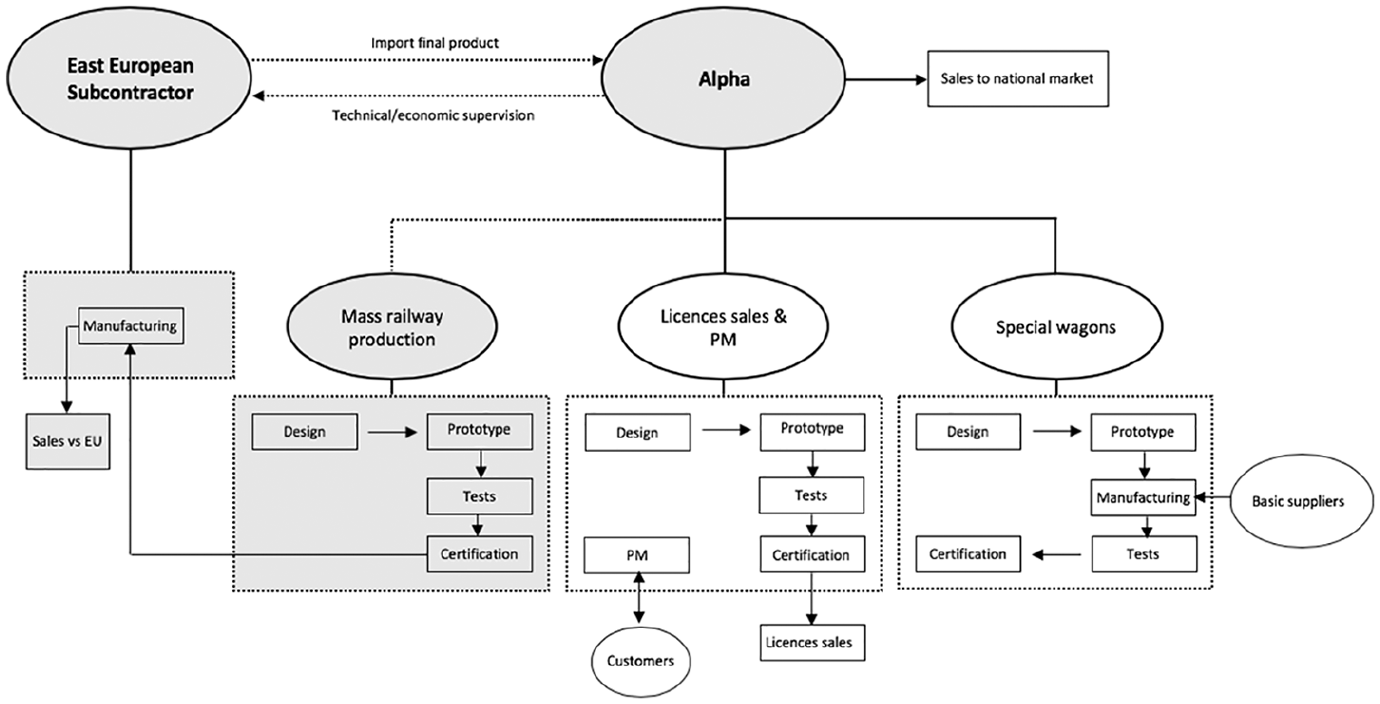
Mass railway car production GVC restructuring at Alpha (2015–2018).
To advance the restructuring, the director exploited the opportunity provided by the appreciation of the Swiss Franc 5 vis-a-vis the Euro by announcing a wage cut of 10% for cross-border workers and an increase in the daily working time by 15 minutes for all. These measures were justified as a necessary solution to preserve competitiveness, in order to maintain the same sale prices for European customers against an appreciated Swiss Franc. In reality, it represented a divide-and-rule pursued by the anti-cross-border worker sentiment that exists in this Swiss border canton.
While cross-border workers represent 8% of Switzerland’s total workforce, they make up 27% in Alpha’s region and 60% in the local Swiss machinery industry (FSO, 2019a). In this context, the traditionally hostile characterization of migrant workers promoted by far-right politics also concerns this workforce and is widespread within the population (Skenderovic, 2007). For instance, they are accused of ‘stealing’, ‘unfair competition’ vis-a-vis resident workers and of making excessive use of social insurances.
Thus, the director presented the wage cut as a ‘fair measure’ justified on the basis that cross-border workers were considered a ‘privileged workforce’ who benefit in their home country from increased purchasing power, following the Swiss Franc’s appreciation. The acceptance of this measure represented, for the director, a ‘fair deal’. The outsourcing plan was not announced at this time.
One week after the announcement, the workers organized an assembly and voted against the measures and initiated a one-month conflict. Facing workers’ opposition, the director declared the outsourcing of all mass railway production in a press release, in order to pressure workers to accept the wage cuts and the increase in the daily working time. Despite the willingness of workers to agree upon a solution, the director refused to negotiate with either them or their unions. This attracted a wave of solidarity from some local actors such as left-wing organizations, unions and workers of the Swiss Federal Railways (SBB). Solidarity letters were sent to workers, and left radical parties organized a ‘mail-bombing’ campaign that involved sending protest mails to the director’s email address.
Meanwhile, a second meeting took place between the director and the works council in which workers proposed an alternative 7% wage-cut for cross-border workers and 3% for resident workers. The works council had provided this negotiating mandate to its trade unions to explore as a potential solution. However, the director still maintained the divide-and-rule strategy by refusing to engage with the unions and refusing to provide documentary evidence that the firm was experiencing economic difficulties, as required by the CA. He attempted instead to individualize the conflict by persuading workers to accept his plan through face-to-face meetings.
In response, radical left parties organized a sit-in in front of the company building, which was also attended by some workers from the SBB. To express solidarity, a delegation of Alpha’s workers visited striking workers at another firm in the region. Left-wing parties and unions also organized a demonstration to denounce employers’ downsizing practices. These actions attracted media attention to the conflict and compelled the director to engage his employees with a revised plan. During a second workers’ assembly, he announced the withdrawal of all measures regarding wages and working time with the important exception of the implementation of the outsourcing of railway cars.
The works council and unions issued a press release in which they presented the director’s U-turn as a ‘victory’. However, the sentiment was short-lived, and the director soon issued new press releases outlining the threat of redundancy in relation to the firm’s future development.
Case 2: A collective conflict in the machine tools GVC
A second work conflict emerged at Beta, a subsidiary of a Swiss multinational leader in machine tools. Sixty people were employed at the firm at the moment of our enquiry (after the restructuring plan), half of whom were cross-border workers from France, and were mostly highly skilled workers in departments such as research and development, supply chains, and sales support. Compared to the region of Alpha, the share of cross-border workers is smaller but still significant, representing 21% of the total workforce, and 37% in the sector (FSO, 2019a, 2019b). None of the workers was unionized, and the works council no longer met regularly.
The origins of the restructuring had begun in the 1990s when the multinational that owned Beta acquired a competitor firm and created a holding company. Beta thus became affiliated with a firm that was previously a direct competitor in the production of the same range of machine tools. The financial crisis of 2008 affected affiliates of the multinational and orders at Beta fell by 35% in 2009. The group implemented a large restructuring plan with the aim of reducing labour costs through the closure of some plants in Europe and the redistribution of activities along its GVCs. The plan included 1300 worker redundancies at affiliated companies, including 280 in Switzerland and 160 at Beta. It was implemented in two steps. The first redundancy plan in winter 2009 affected 60 workers at Beta. Five months later, management announced the transfer of the production of machine tools from Beta to their Swiss holding associate, which is located in a region where unit labour costs are lower.
This plan represented the first stage of a broad cost-leveraging strategy based on a global labour arbitrage approach similar to the one studied by Miszczynski (2016) of a lead firm’s relocation strategy in the electronics industry, from Germany to Romania and then to Southern Asia. At Beta, the plan tested the possibility for a future transfer of production stages to a Chinese firm, which was already a strategic supplier to the Swiss multinational. This initial step of GVC restructuring provided two short-term advantages for capital. First, the transfer from Beta to the Swiss affiliate involves a change of certain subcontractors and suppliers, enabling management to reduce the cost of intermediate inputs. Second, the transfer enables the production of a high-value electric component in-house, which also contributes to reduced labour costs. When the second stage of this restructuring is completed, all suppliers and subcontractors will be located in East Asia, closer to the new Chinese plant. Following this international outsourcing, the design activities will remain in Beta (see Figure 2).
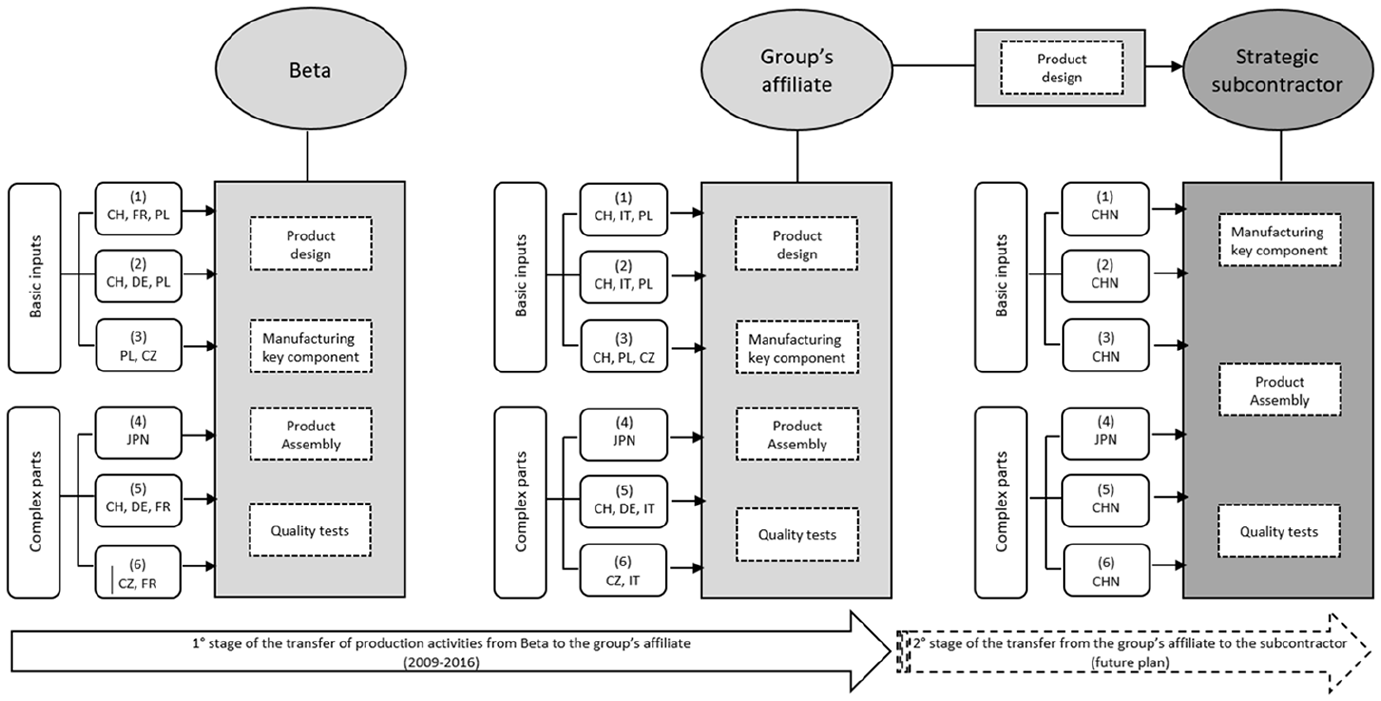
The first stage of the production tasks outsourcing of the machine tools GVC from Beta to China (2009–2016).
A large number of workers were dismissed, and a few early-retirement plans were implemented. While the first step of the restructuring project did not produce any worker resistance, a six-month collective work conflict arose against the transfer of machine tool production. Beta’s workers sought alliances with other workers in Swiss multinational affiliates also affected by the restructuring. A meeting between members of works councils of the four plants within the Swiss group took place, but the attempts by Beta’s workers to coordinate the struggle at the group level did not work. Logistical problems were invoked by workers as an explanation for the lack of solidarity along the GVC. In reality, the different effects of the restructuring – for one affiliate, this meant job creation – played a role in the lack of solidarity and expressed a long-standing successful divide-and-rule management strategy.
Instead, Beta’s workers organized protests at the local level. A first press release, in which workers demanded the safeguarding of production and the in-house development of this range of machine tools, was issued with the support of the trade union Unia. At the same time, the works council tried to negotiate with management. But, faced with management’s refusal to cooperate, workers instead organized a sit-in and a creative form of action in front of the company building. This involved hanging 168 work coats at the factory gates, corresponding to the number of announced redundancies, and planting several crosses on the lawn to symbolize the funeral of the plant.
In the meantime, a meeting between the works council and the local and central management of the machining division of the group took place on the company’s premises. Management refused to speak to workers waiting outside and asked them to leave the premises. This impasse continued for hours before the manager finally agreed to meet with workers. His speech stressed the economic difficulties of the firm and advanced a ‘no alternative’ to the closure of production. He concluded by offering what he called a ‘concession’ for workers; withdrawing the redundancy of 30 jobs.
One week later, a second worker assembly discussed management’s proposal. In the end, workers decided to accept it and to provide a mandate to the works council to attempt to negotiate a ‘good social plan’. This decision meant the acceptance of the closure of production. No other actions took place and only a few workers decided to take part in a later demonstration organized by leftist parties and unions against the critical situation in the local labour market. This action took place on the last day of the social plan negotiations, and concluded the mobilization. One week later, a letter of dismissal was sent to 141 workers, who left the company with an ‘exit bonus’, while the works council offered psychological and administrative support to dismissed workers.
In sum, the analysis demonstrates the predominant mechanism of global labour arbitrage in the two GVC restructuring projects at Alpha and Beta, which are represented by the international outsourcing of mass railway car and machine tools production respectively. In both cases, a logic of GVC-transition has unfolded because the restructuring enabled capital to redistribute productive tasks along the respective GVCs and focus on in-house high-value added tasks and products. Management’s most potent strategy was divide-and-rule among workers, which was dominant in Alpha, and less visible (but still relevant) in Beta. How did this strategy interact with the structure of GVCs and the labour arbitrage mechanism? The next section will address this question.
Three major labour issues in Swiss machinery GVCs
The analysis of the two work conflicts reveals how the three negative interconnected effects of GVCs on labour translate within the workplace by eroding workers’ collective capacity to defend and improve their working conditions. This overall negative impact is a result of: (1) the mismatch between workers’ weakened collective structures and lead firms’ GVC value-capturing strategies, (2) the contingency of solidarity, and (3) the emergence of individualism and divisions among workers.
The mismatch between workers’ collective structures and lead firms’ value-capturing strategies
In both firms, the works councils provide a limited ‘scale of action’ for workers to challenge the GVC restructurings. In Alpha, despite a long-standing relationship with the East European subcontractor to which the mass-railcar production was outsourced, unions have never attempted to develop contacts with this firm’s workers or unions. Workers cannot therefore rely on solidarity from this company, and the lack of visibility afforded to the works council meant they were not able to anticipate the restructuring. Thus, difficulties in contesting the lead firm’s strategy paved the way for management’s effective divide-and-rule strategy. This took the form of ‘whipsawing practices’ and consisted of imposing on workers a ‘fake’ trade-off between: (1) wage cuts and increases in working time, and (2) production outsourcing. As a result, the characterization of management’s U-turn as a ‘great victory’ by unions must be understood in the context of the limited scale of action available for workers as offered by the works council (at the workplace).
In Beta, despite the presence of the works council in all of the Swiss affiliates affected by the restructuring, workers’ action remained limited at the local level. As mentioned above, this suggests that a long-standing divide-and-rule practice is at work and has proven effective for management. This is similar to what Cowie (1999) observed in RCA’s case: when production relocated to another US state it had a positive impact on this community. This dynamic explains, in our case, the lack of solidarity among workers within the Swiss group affiliates. In this context, the struggle in Beta produced a form of ‘pyrrhic victory’ because it achieved the safeguarding of only around 30 jobs.
The president of the works council clearly acknowledged the limits of the works council and the system of industrial relations to challenge GVC restructurings: It is difficult to be offensive when the offensive has already started. The system in France is different; we can in France, it is often done, go on the offensive before something happens . . . In Switzerland, it is quite difficult this system. We are always in the ‘peace of work’ . . . we have to wait until [when restructuring occurs] to find ways to defend ourselves . . . we cannot strike, but we will try to get a good social plan to study practically on a case-by-case basis. (Works council president, Beta)
This quote also reveals the logic of cooperation promoted by the works council, which oriented the conflict in a consensual way and did not enable workers and unions to understand and anticipate GVC restructuring. Thus, in a context where the balance of power is strongly in favour of capital and strengthened by the dynamic of GVCs, workers’ protests are limited to putting pressure on employers to obtain certain guarantees in return for the acceptance of restructuring. Furthermore, ‘social dialogue’ involves a continuous and inexorable weakening of the ability of workers and unions to improve working conditions. Workers can act only in the downstream phase of the restructuring and tend to ‘withdraw’ their actions in the workplace by adopting a view focused on getting a ‘good social plan’.
This issue had different consequences in the two firms. While in Beta the collective struggle was limited to obtaining a ‘good social plan’ for dismissed workers, the works council in Alpha mandated unions to negotiate an alternative solution to the wage cuts and increases in working time without refusing the principle of these measures. In this case, as we have seen, it consisted of spreading the proposed 10% wage cut for cross-border workers between a reduction of 7% for cross-border and 3% for resident workers. The union’s secretary justified this strategy by referencing the traditional expectation of workers to make sacrifices in order to preserve jobs: At the time, when we made sacrifices, everyone was on the same plane without distinctions . . . workers were available to make a sacrifice to safeguard jobs . . . The workers themselves decided that, including the cross-border workers, that they were available to discuss on this basis to preserve jobs. (Union secretary, Alpha)
This strategy highlights the difficulties of acting at the downstream phase of GVC restructuring to defend working conditions. The workplace-focus of the works council does not allow workers to exploit their ‘positional power’ in the GVC, in terms of opposing a threat by management. Thus, the director could advance other restructuring plans, putting further pressure on workers.
In short, what we observe is the effect of the disconnection between the management value-capturing strategy coordinated along GVCs versus the narrower space of action promoted by the Swiss industrial relations system (the workplace). The works council system does not provide a sufficiently extended scale of action and limits workers’ positional power to effectively challenge the employers’ value-capturing strategies. Moreover, the works council orients the workers’ protests in the downstream phase of GVC restructuring in a defensive and consensual way, leaving workers in an unfavourable position to understand and predict the effect of further restructuring on employment.
From collective to individual resistance
A second issue concerns the change in forms of struggle from collective to individual resistance. Our empirical analysis confirms the negative impact of GVCs on collectivism and individualism in the sector and shows how this dynamic is articulated in the workplace. The emergence of individualism following GVC restructuring is related to: (1) the retaliatory measures against workers, (2) the end of regular works council meetings as a collective activity, and (3) job insecurity.
In both companies, individual resistance took the form of ‘exit options’. At Alpha, the director threatened to dismiss the works council’s president if he did not sign an agreement based on the company’s by-law offering a bridging pension in exchange for leaving the company. This agreement implied management’s need for the president to first resign from the works council and union to avoid a potential liability for wrongful dismissal, according to art. 336 of the Swiss civil Code of Obligations.
Therefore, under management pressure, the works council’s president agreed to an additional year of work for himself before leaving, thereby enabling him ‘to pay off the mortgage’: It was a thing between me and the company. I asked them to allow me to work a little more since I still had a year of mortgage to pay . . . I left the works council to be dismissed. It provided for the agreement I had with him [the director]. It was also necessary to leave the union to be laid off without problems . . . Afterwards, at the psychological level, I was not good at the time. I was not able to sleep at night, and my wife told me to accept. He [the director] also threatened me and told me he was not going to give me the money at the exit. (Former works council president, Alpha)
At Beta, management adopted a ‘mobbing’ strategy in order to isolate workers on a daily basis. As explained by the works council’s president, this consisted of an increase in management control over his work and the hiring and training of a new worker to replace him. Thus, this worker decided to leave the company by obtaining an ‘end-of-service grant’: I was getting more and more visits [from management]. Well, they wanted to control what I was doing . . . And one day he was [the director of the machining division of the group] coming up with a list of what I had done but which omitted what had never been recorded. And he said: ‘Yeah, sir, in three months you’ve only made these three pieces?’ I said: ‘No, I’ve made hundreds!’ So, things like that . . . He [the Beta director] hired a man who was every day at my side. I saw that it was a bad situation . . . They gave him to me to give me a hand . . . Then, I saw that he was ensconcing himself [in the workplace]. They put him there in order to take my place. Then, I got to the stage when I said: ‘well, I’m at an age now, where if I am laid off I could retire and stop working now in good conditions!’ (Works council president, Beta)
The departure of the two works council presidents in Alpha and Beta involved the end of regular meetings and a substantial weakness of this collective structure for facing labour issues. As is pointed out by a ‘survivor’ member of the works council in Alpha, ‘the director has already decided before the works council’s meeting!’
At Beta, the closure of production implied a substantial reduction of ‘blue-collar’ workers, which traditionally led the works council. In this context, as pointed out by the new president, even the advisory role of this collective structure seems now to be over: We are so small, and we have less impact than in the past. Now the group makes decisions, and our job is to relay it. I was talking about it again yesterday with colleagues. I said we are here to say: ‘well, the group has decided that and we must obey!’ . . . In the past, we could say more: ‘that, no, and that, yes!’ (Works council president, Beta)
The pressure from management and the weakness of the works councils was combined with a deterioration of the working environment and an increase in job insecurity. In Alpha, it was reinforced by the communication strategy of the director who issued press releases about future restructuring, while the closure of production in Beta unsettled workers and prevented them from sleeping soundly. Thus, in both companies, insecurity was connected to the dynamic of GVC restructurings and divide-and-rule strategies supporting it, and was reinforced by the day-to-day management pressures.
Thus, the ‘exit option’ offered a solution not only for workers involved in the works councils but also for other categories of employees. In Alpha, for instance, workers involved in the production department chose to no longer stay in the company. As a young worker explained: There were a lot of people who experienced this pressure and they left . . . They were leaving because they couldn’t handle the pressure and the voices of the company that perhaps it was going to close. That’s what they thought. People always have to think about their home. However [the manager] has never said he was going to close the company. (Worker, Alpha)
In Beta, as an employee explains, exit options are a concern for a large portion of the workforce: We hear all the time in the corridors about the past and the future [of the firm] with reference to what happened with the ‘job destruction’, people express it like that of [what happened in] production. What is going to happen? Where are we going? This is something that is present in everyday life . . . When we talk to colleagues about this we say right now: ‘But anyway we’re not going to stay here a long time and maybe we have to look elsewhere’. (Employee, Beta)
Essentially, the exit strategy can be interpreted as an individual strategy of resistance arising from the failure of collective resistance to the GVC restructuring. In this vein, it is a direct response by some workers to the increase of pressure and control from management as well as job insecurity. It expresses how workers tried to manage the everyday tensions generated by the GVC restructurings and how management controlled it. Thus, the tension between management and workers in both firms seems here to be internalized and experienced individually by employees.
In summary, the mismatch of collective structures to contest GVC restructuring paved the way for exit options at both firms as a particular form of individual resistance. Workers who have bargaining capacity, an institutional role (e.g. on the works council), and an age close to the age of retirement, are in a better position to take an exit option with lower costs. For workers with low skills and little capacity to negotiate, this is a more difficult set of circumstances.
From solidarity to divisions among workers
The third issue concerns the contingency of solidarity among workers. Solidarity emerged in the workplace (rather than across GVCs), and was initially strong. Management in both firms succeeded in stoking divisions after the conflict ended, and thereafter a switch from solidarity to divisions among workers was observed. These divisions concerned three different levels which are articulated in different ways in the two firms. First, a tension between cross-border and residential workers. Second, a tension between workers of different companies. Third, cleavages among all categories of workers.
In Alpha, solidarity was strong, considering the situation in the regional labour market and the divide-and-rule management strategy. The anti-cross-border sentiment existing, in the two regions of the firm’s activity, was used by the management of Alpha, making arguments based on the notion of a ‘privileged workforce’ to stoke divisions and implement the GVC restructuring without any opposition. In spite of this, solidarity between workers emerged. As stated by a union secretary, there was an ‘exceptional attitude of unity and solidarity’ between workers in a region where anti-cross-border worker sentiment is ‘powerful’ and ‘in which managers succeed in dividing workers through anti-cross-border arguments and imposing downsizing measures’.
The question of wages was crucial. While the difference in purchasing power between the country of origin of the residential and cross-border workers was used by the management to divide workers by promoting the ‘privileged workforce’ argument, the low wages in the region may explain solidarity. ‘You can take everything away from us, but not our wage’, stated the works council’s president in Alpha. Thus, the wage issue is central in a region where wages are among the lowest in the country, notably around 10–20% less than the national average in the machinery sector (FSO, 2019c). Furthermore, workers had always accepted downsizing measures in the past. Thus, as it was, the wage cuts represented the straw that broke the camel’s back.
In Beta, the unity of action against the closure of machine tools production in the company is related to the closure of the production department and its consequence for the majority of workers who simply lost their job. But, in both companies, while solidarity emerged during collective actions, divisions among workers reappeared once the conflict ended. The tensions between resident and cross-border workers were particularly strong, especially in Alpha, where resident workers finally accepted management’s argument characterizing cross-border workers as a ‘privileged workforce’ and a ‘disturbing factor’ threatening the smooth running of the firm.
As two workers pointed out, the works council is considered after the conflict a structure that pursues mainly the interests of cross-border workers, and their role in the conflict is now stigmatized and considered an obstacle for maintaining peaceful relationships in the workplace: I think that a resident is not as protected as a cross-border worker. In the works council, we speak only about problems of cross-borders and not yet of resident workers. It is not good if it becomes a war between poor people. (Welder 1, Alpha) The people who ‘ruined the company’ are no longer there. Fortunately, they are not here anymore! . . . I told you: it is better to discuss things face to face . . . The problem is that once you create a bad mood between workers and their employer, it is difficult to fix things after that. People are upset! (Welder 2, Alpha)
Divisions between cross-border and resident workers were, however, less marked in the case of Beta. As the former works council president stated, this can be explained ‘by the historically high level of worker organization in the workplace’ and ‘the early collaboration between cross-border and resident workers in the works council and unions’ activities since the 1960s’. But, even if the tensions were lower, in a context of job insecurity, cross-border workers still appeared to be subject to particular stigmatization based on their supposed ‘grouchy attitude’. As a worker pointed out: I am optimistic, contrary to cross-border workers who complain all the time. There have always been some and there will always be some. . . . Interviewer: I suppose there are other workers who complain about the situation and that it is not only the cross-border workers? Yes, but there are many more [cross-border workers]. They earn a lot of money but they complain anyway! (Logistics worker, Beta)
The cleavages also emerged between workers of Beta and workers of the Swiss affiliate to which the machine-tools production was transferred, when the management asked certain workers from Beta to train workers of the Swiss affiliate on some tasks related to the transfer of production. As the former works council president pointed out, this meant that Beta workers stayed on in the company two or three weeks to work alongside the affiliate’s workers. But as this worker highlighted, due to the closure of the machine production in Beta, these latter became seen as ‘competitors’ instead of allies: I was assembler at the time, I had to train the workers from the [group’s affiliate] to assemble our machines. Indeed, what created a tension here was the fact that each one trained his competitor. I would say that the goal was to teach them to work on a machine knowing that after that we were going to be dismissed . . . When our colleagues went to install the machines, they were reluctant. They went only so as not to lose their job, but they could not be seen with the workers from the [group’s affiliate]. (Works council president, Beta)
This quote expresses the extensive domination of capital. Indeed, management was able to orient the restructuring to ask laid-off workers to train their replacements. No comradery among workers could emerge during the training. On the contrary, this event exacerbated tensions and eroded solidarity among workers. 6 These new divisions created among workers make it more difficult to organize collective actions in the future, and therefore GVC restructurings imply worsening future prospects for labour.
Finally, in both companies the tension among the workforce also emerged between other categories of workers and was particularly marked in Alpha. The GVC restructuring produced job insecurity at this firm and increased the stress at work by reinforcing cleavages. Among the many examples, the testimony of a logistics worker is emblematic: Last week I was told off by the management because of a discussion with a colleague. I said f*** off! It’s because of the general context. You’re stressed and for one little thing you explode . . . It was bullshit! . . . I had my coffee break, but I wanted another coffee. I took two minutes. This colleague came in the workplace looking for me and he couldn’t find me. So, he came looking for me at the coffee machine . . . So, I asked him: ‘If you don’t see me at the workplace, why do you have to come here?’ He answered: ‘Where should you be?’ This answer pissed me off . . . I insulted him, and he insulted me too, but he told the story to his manager. [This latter], instead of coming to me to solve the thing, went to the chief of staff who gave me a telling off. (Logistics worker, Alpha)
These tensions among workers are another illustration of management’s successful divide-and-rule strategy, further reinforced after GVC restructurings. The weakness of labour collective structures and the failure of collective actions to defend against restructurings result in further cleavages among workers, assuming different forms.
To summarize, in the context of an absence of solidarity across GVCs, solidarity still emerged in the workplace at both companies, supported by some local actors such as left-wing parties. In Alpha, this was somewhat exceptional considering the typical tensions between cross-border and residential workers. In Beta, solidarity can be explained by the fact that all workers were in the same boat because of the closure of production. However, GVC restructuring still affected the relationships among workers by reinforcing divisions among them after the conflict ended.
Conclusion
This article has examined the process of GVC restructuring in the Swiss machinery industry and its impact on workers’ ability to defend and improve their working conditions, by analysing two work conflicts in two Swiss lead firms. The study reveals three connected effects of GVCs on labour. First, the limited scale of action offered by the works councils system does not provide workers and unions with strong positional power to contest GVC restructurings driven by global labour arbitrage. Second, GVCs affect forms of resistance by forcing workers to adopt individual rather than collective forms of resistance, typically in the form of exit strategies. Third, GVCs affected relations between workers: while solidarity emerged during the struggle, divisions reappeared after the conflict ended.
This triple negative effect impact affected workers at the two firms under analysis in a very similar way in the context of different forms of solidarity and cleavages. Firstly, in Alpha, the strong solidarity between cross-border workers and residential workers is exceptional and probably due to the centrality of the wage issue in the region. In contrast, solidarity in Beta was due to the closure of the whole production department. However, in both companies, solidarity was contingent. Secondly, after the work conflict, different forms of cleavages among workers emerged. In Alpha, they mostly concerned the workplace and tensions between cross-border and resident workers, while in Beta they also involved workers at various multinational affiliates. This outcome is due to the relative importance of cross-border workers in the region and the historical lack of collective organizations and unity in the workplace in Alpha and the group structure in Beta’s case.
Despite these differences, the triple negative effect of the GVC dynamic on collective labour structures, individualism and solidarity in the two lead firms may suggest that participation in GVCs produces a convergence of forces in the sector that negatively affect the ability of workers to improve their working conditions. GVCs reinforce the imbalance of power between labour and capital in favour of capital by increasing the mismatch between the extended space of capital accumulation within Swiss machinery GVCs and the limited space in which labour issues are regulated (mostly at the firm level). Additional research could explore the relevance of this negative convergent dynamic on labour at the sectoral level as well as in other advanced capitalist countries.
The findings also indicate that the regulation of GVCs in favour of workers’ well-being is an urgent matter for public authorities and trade unions. The minimalist Swiss labour law and the weakness of unions affected workers’ ability to defend their rights and working conditions in a globalized economy where GVCs have become the dominant form of industrial organization. Thus, this analysis suggests that: (1) negotiations between public authorities and Swiss lead firms, (2) unions’ engagement at an earlier stage of GVC restructuring, and (3) the search for new alliances along GVCs, may be better methods for regulating GVCs back in favour of workers’ well-being.
Footnotes
Acknowledgements
I would like to thank Dara Leyden, Jean-Michel Bonvin, and three anonymous referees for their help in preparing this article. An early version of this article was presented at the seminar of the Centre on Labour and Global Production (CLGP) at the Queen Mary University of London in June 2020 and benefited from the useful comments of Liam Campling, Elena Baglioni, and other participants.
Declaration of conflicting interests
The author declared no potential conflicts of interest with respect to the research, authorship, and/or publication of this article.
Funding
The author received no financial support for the research, authorship, and/or publication of this article.
