




Abstract
The general decline of strikes does not necessarily imply that workers are demobilised. A dormant strike potential can be present. Drawing on strikes as ‘experience goods’, this article sheds light on this point by studying pro-strike attitudes among employees in 24 countries who have never been on strike. The variation in pro-strike attitudes is explained by both contextual (collective bargaining coverage, economic conditions and freedom of rights and liberties) and individual (union membership and confidence in unions, political values and household financial situation) factors. Deeper analyses of three countries highlight the potential impact of specific repertoires of contention developed over time on the formation of pro-strike attitudes. Implications for the labour conflict literature and union strategies are discussed.
Introduction
The withering away of strikes and workers’ demobilisation have dominated the labour conflict literature since the late 1980s (Brandl and Traxler, 2010; Piazza, 2005; Wallace and O’Sullivan, 2006). While data about the global tendency of workplace strike incidence are used to support the view that workers have demobilised, this narrative has overshadowed several underlying issues and differences (Vandaele, 2016). The first issue is data reliability. Strike data are scattered: countries often codify strikes differently, and available data usually cover only a limited number of countries (Dribbusch and Vandaele, 2016; Lyddon, 2007). Second, strikes are changing in shape and complexity, and thus are becoming more difficult to capture with conventional workplace measures (Gall, 2013). Usually confined to unionised workplaces, strike actions have started to emerge in such large non-union firms as Google, Amazon and Walmart. Further, general strikes against governments have increased in some European countries (Kelly and Hamann, 2010), sometimes overlapping with social movements in fighting public sector anti-austerity protests targeted towards governments’ policies that affect labour market and employment conditions (Brandl and Traxler, 2010; Rüdig and Karyotis, 2014). Third, the prevailing withering away of strikes narrative overshadows important differences across countries, since each country has over time developed a specific repertoire of contention (Tilly, 2006) which attracts and mobilises different types of workers (Vandaele, 2016). Finally, the decline of strikes also tells us little about workers’ demobilisation (Godard, 2011). Several contingent dynamics created by globalisation hamper the execution of traditional workplace strikes but cannot exclude that there might still be a dormant strike potential, i.e. supportive attitudes towards strike that can be mobilised under specific circumstances (Godard, 2011). In this case, the rare incidence of strikes does not imply the elimination of employees’ pro-strike attitudes and their complete demobilisation.
Pro-strike attitudes have rarely been explored in the labour conflict literature, and extant research suffers from important limitations. Studies have focused largely on union members in a specific setting (e.g. industry, company, bargaining unit) or over a single bargaining issue (e.g. wages or working conditions) and in a few Western countries (Akkerman et al., 2013; Barling et al., 1992; Martin, 1986; Martin and Sinclair, 2001). A major concern has been the generalisability of findings beyond these conditions to achieve a broader understanding of pro-strike attitudes (Martin and Sinclair, 2001: 403). For example, to examine the proposition that there might be a possible displacement of labour unrest from the developed to developing countries it is necessary to include a larger set of non-Western countries (Arrighi, 1990), especially in light of the recent surge of labour conflict in some non-Western areas, such as in South Asia or Latin America (Anner and Liu, 2016; Anner and Veiga, 2020). Moreover, research shows that employees who already experienced a workplace strike tend to have more positive attitudes towards strikes (Campolieti, et al., 2005; Martin and Sinclair, 2001). However, we know little about the attitudes of employees who have never been on strike: the most common condition today among employees (Akkerman et al., 2013). To address these limitations, we study employees’ pro-strike attitudes as an encompassing phenomenon of different types of strikes and potential future action, extending the geographical scope as much as possible beyond Western countries, and focusing on employees who have never been on strike. While predicting the enactment of strikes from attitudes towards strikes is beyond our scope, drawing on strikes as an experience good, our study seeks to fill a research gap in the labour conflict literature by enhancing knowledge about the extent of employee demobilisation and factors relating to it both across and within countries.
The article is structured as follows. First, we review the literature on labour conflict and factors relating to pro-strike attitudes. Next, we analyse our data about pro-strike attitudes and explore relationships with a set of variables that help us shed light on variations across and within countries. Our main finding is that strike potential is present in many countries. However, it much varies across countries and within countries. A dormant strike potential is higher in richer countries as well as in countries with higher collective bargaining coverage and respect for freedom of rights and liberties. Individuals who express higher support for unions, are more engaged in politics and dissatisfied with their income show more support for strike actions. Based on these analyses, we take a closer look at how the national context influences individual pro-strike attitudes. We finally focus on three national cases and observe how specific repertoires of contention developed in each country help in shedding further light on the pro-strike attitudes we found. These findings open future directions in the debate about labour conflict that we highlight in the conclusion.
Factors influencing pro-strike attitudes
Strikes as an experience good
If the question ‘what do unions do?’ is difficult to answer by people who have never been union members (Gomez and Gunderson, 2004), it is even more difficult to answer the question ‘what do strikes do?’ for people who have never been on strike. This is akin to conceptualising union membership and pro-strike attitudes as experience goods (Olivier, 2010). Experience goods, as opposed to search goods, are goods and services whose characteristics are unobservable and whose utility can hardly be observed before purchase (Nelson, 1970). For instance, research shows that for employees who have never been in unions it is difficult to understand the benefits of being part of a union without joining it (Haynes et al., 2005; Vandaele, 2012). According to the same logic, employees who have never been on strike have not had the opportunity to personally gauge the benefits or costs of striking. However, this does not mean that they are unaware about strikes. For instance, often time strikes have created opportunities to involve also non-members who have never joined a strike, most of whom have then joined unions (Hyman, 1989). Employees who have never been on strike develop their attitudes towards strikes by relying on information available in the context in which they are embedded wherein strikes have developed a reputation of being beneficial or detrimental for employees (Charlwood, 2002; Gomez and Gunderson, 2004). While in the case of a strike for specific reasons in a given workplace the context is mainly the workplace, in the case of an encompassing definition of ‘strikes’ a larger context should be considered (Godard, 2011; Hyman, 1989; Kelly, 2015). National contexts are important in this analysis, since they structure employment relations institutions and a set of power resources for employees to undertake actions to change their working conditions; a specific repertoire of contention thus develops in each country (Godard, 2009). These repertoires of contention are cognitively embedded in employees’ minds (Godard, 2009) and, therefore, may affect the general levels of pro-strike attitudes. Nevertheless, while national contexts are fundamental in defining attitudes towards strikes, within each context individuals are actors that are not just framed by institutions but they can embrace conflict to change them (Peters et al., 2005). However, workers do not all embrace conflict in the same way; individual conditions and value preferences still make strikes more supported by some employees than others (Hyman, 1989; Kelly, 2015). In other words, both a macro and a micro perspective are needed to understand pro-strike attitudes.
Contextual factors affecting strike attitudes
Many studies about labour conflict have focused on strike occurrence and incidence by country (Piazza, 2005; Stokke and Thornqvist, 2001). While strikes might be nowadays rarer in some countries and employees who have never been on strike have not had the opportunity to perceive the vibrancy and the feeling of empowerment that strikes can spur, strikes remain actions that have been part of all societies (Hyman, 1989). Political powers have tried to control and institutionalise strikes in different ways and different repertoires of contention have developed across countries (McAdam et al., 2003; Tilly, 2006). Strikes remain inextricably linked with collective bargaining dynamics at workplace or higher scale (Vandaele, 2016). Where unions are active bargaining agents, strikes tend to be a common bargaining threat that is frequently used strategically (Hebdon and Noh, 2013). Strikes are part of the union narrative during bargaining dynamics. They are portrayed by unions, especially during more difficult bargaining dynamics, as the extrema ratio that can be deployed to achieve employees’ ultimate bargaining goals (Hyman, 1989). Hence, the higher the number of employees who are covered by collective bargaining, the more strikes may be part of the repertoire of contention that is cognitively embedded in the mind of employees, as a legitimate action that has a positive reputation in improving their working conditions.
Bargaining dynamics are the main driver of strikes but the perception of their possible beneficial or detrimental effects has been deeply linked to the economic conjuncture that surrounds employees (Brandl and Traxler, 2010). It is well established in the strike literature that when the economy is prosperous, employees see strikes as effective actions that can allow them to share in this prosperity (Campolieti et al., 2005; Card, 1990). Conversely, when the economic conjuncture is not prosperous and unemployment is high, employees are more fearful of undertaking strikes. Strikes are perceived as having limited effectiveness since stringent economic conditions do not allow for increasing employee salaries and working conditions (Reilly, 1996). Importantly, in a stringent economic context, joining strikes can have detrimental consequences such as triggering employer’s retaliation or putting firms in economic trouble; both consequences make employees fearful of losing their jobs (Bronfenbrenner, 1997; Hatton, 2014).
The repertoire of contention that has developed in a specific country also centrally depends on the extent to which the political power had over time favoured, constrained, or even repressed the freedom of expression, especially for more disruptive actions such as strikes (Freedom House, 2018; Tilly, 2006). Strike repression can take different forms, up to police brutality, persecution and violation of fundamental human rights. In many parts of the world, being a union activist and going on strike is still very risky (Anner, 2015; ITUC, 2018). In this case, not only do the employees have a limited set of power resources to change their working conditions but the dreadful consequences that they can incur if they go on strike can become cognitively embedded.
Individual factors affecting strike attitudes
Attitudes towards strikes held by employees who have never been on strike are not only influenced by the perceived beneficial or detrimental possible consequences of striking based on contextual information and repertoires of contention, but also by individual value preferences and conditions (Gomez and Gunderson, 2004). Collective actions such as strikes are socially constructed actions (Fantasia, 1989). The development of strikes relies on the culture of solidarity that emerges from workers’ interactions, especially from those covering lower employment positions (Fantasia, 1989). These growing interactions and bonds of solidarity, often promoted by unions, spur class consciousness about the injustice embedded in the employment relations; union leaders are those who generally galvanise these feelings to make employees join a strike (Kelly, 1998). Not surprisingly, union members have been found to hold more positive attitudes towards strikes, both for workplace and societal injustice issues (Barling et al., 1992; Martin, 1986; McClendon and Klass, 1993). Their higher exposure to union framing of labour conflict stimulates a more positive assessment of strikes than for non-members (Gahan and Pekarek, 2013; Kelly, 1998; Martin and Sinclair, 2001). However, being a non-member is not synonymous with having a negative perception of unions and their actions. Increasing contextual constraints have largely hampered employees from joining unions (Sullivan, 2010). Thus – while they remain analytically different – measures other than union membership can be a better proxy for understanding employee support for unions and, by extension, strikes (Lipset and Meltz, 2004). For instance, many employees who are not members trust unions and their actions (Frangi et al., 2017).
Employees’ values and beliefs beyond unions have been found to play an important role in the perception of strikes in Western countries (Hyman, 1989; Martin, 1986). Indeed, individual values evoke a different emotional reasoning around strikes (Glasman and Albarracín, 2006). Among several individual values, the political ones have been demonstrated as central to this reasoning (Campolieti et al., 2005; Godard, 2011). Employees’ interest in politics makes unions and their actions more salient to employees (Frangi and Barisione, 2015). Moreover, beliefs about the employer–employee relationship as one based on fundamental distributive injustice have played a major role in mobilising employees, as mainly reflected in the left–right political cleavage (Kelly, 1998).
Besides union membership and individual values, strikes have been found to resonate more among employees who are frustrated with their working conditions, especially with reference to their salaries (Godard, 1992; Hyman, 1989). The dissatisfaction with their salaries – especially in terms of the difference between the actual and those to which one can aspire (Runciman, 1966) – creates a sense of frustration that triggers aggression towards the source of that frustration (Van Stekelenburg and Klandermans, 2013). Employees who demonstrated a higher sense of frustration with their salaries have thus in general demonstrated more support for strikes, also because strikes have been shown to be actions that have positive effects for the income of lower level employees (Martin, 1986; Martin and Sinclair, 2001). However, workers who are fearful of losing their jobs might show lower support for strikes (Bronfenbrenner, 1997; Hatton, 2014).
While the positive effect of union membership, political values and satisfaction with income have been considered as central elements for distinguishing employees who are more inclined to support strikes in Western countries, their relevance in other countries still remains to be explored. We, therefore, investigate the impact of country contextual factors on the variation of pro-strike attitudes across countries and we also consider the impact of individual union support, political values and satisfaction with revenues to discern support for strikes within countries.
Data and methods
We draw on the sixth wave of the World Values Survey to empirically analyse the relationship between country and individual factors and pro-strike attitudes. Since 1981 the World Values Survey (WVS) has been asking a representative sample of adult individuals in several countries (over 50 in Wave 6, 2010–2014) about their attitudes regarding various socio-economic and political issues using a common questionnaire. 1 WVS is the only survey that includes a question addressing attitudes towards strikes in multiple countries, allowing us to extend the geographical scope of the studies about pro-strike attitudes. The data are representative of individuals in their countries and have been widely used in social sciences research. We also include country-level data from the World Bank as well as the ILO. After merging these datasets, our sample includes 9332 employees nested in 24 countries.
Dependent variable: Pro-strike attitudes
The question about strikes was not asked across all six WVS waves and, more importantly, has been inconsistently worded. Given our research objective is to analyse employee attitudes towards joining strikes (not just unlawful strikes), we are limited to the sixth wave which asked a question about joining strikes, to which employees could answer ‘have done’, ‘might do’, ‘would never do’. 2 The question refers to ‘strikes’ as an encompassing concept of possible different types of strikes. Thus, our dependent variable ‘attitudes towards strikes’ allows us to overcome a fundamental limitation of previous studies of attitudes towards strikes that were constrained to issue, workplace, or industry specificities. By focusing on employees (part-time or full-time) who have never been on strike, our dependent variable is dichotomous: ‘would never join strikes’ (0) versus ‘might join strikes’ (1).
Independent variables
Country-level/contextual variables of interest
We explore how employment relations characteristics and economic conditions prior to the survey year in each country affect individual attitudes towards joining strikes. For each country, we measure variables using five-year means preceding the WVS survey year. 3
Employment relations
Using the ILO databases and documentation, we calculate for each country the five-year mean of the collective bargaining coverage (percentage of workers covered by a collective agreement) prior to the WVS survey year.
Labour market conjuncture
We include the following country-level measures to proxy labour market conjuncture: mean approach for each country: the (log of) GDP per capita, unemployment rate (World Bank data). 4 All these variables are calculated using the aforementioned five-year means pre-WVS.
Political rights and civil liberties
We use Freedom House data, which calculate an index of political rights and civil liberties by country each year. We use the five-year pre-WVS mean approach to calculate this index per country. We sum up these two indices to create one index of political rights and civil liberties. In the end, we follow Freedom House’s classification procedure to create a three-way categorical variable: Free (sum of indices between 1.0 and 2.5), Partly Free (3–5), Not Free (>5.5).
Days lost due to work stoppages
Further, using the same five-year mean procedure at country level, we add in the number of days lost due to work stoppages. Work stoppages include strikes and lockouts. The ILO data do not separate out the two. With the exception of a few countries (such as India, Canada and New Zealand), lockouts are generally marginal today (Van der Velden, 2007). The combined measure therefore has been largely used as the best proxy to capture strike activity (Checchi and Visser, 2005; Vandaele, 2012). Regardless, we interpret the ILO measure as actual labour conflict that led to a work stoppage. This variable can be viewed as a control variable that affects workers’ knowledge of strikes.
Individual-level variables of interest
Union support
Union support is measured by two separate categorical variables. First, union membership is dichotomous (not a member or a member). Second, confidence in unions is measured in a binary way, with low or high confidence in unions.
Values
We include the individual’s self-positioning on a 10-step (left to right) ideological scale, and her/his level of interest in politics (low or high).
Economic deprivation
To measure economic deprivation, we rely on each respondent’s income level (10-step linear scale). Since theoretical attention is driven not just towards deprivation per se but also to relative and possible deprivation, we insert their best available proxies in the WVS: satisfaction with financial situation of household (10-step linear scale), and a categorical variable for the level of fear of losing or not finding a job.
Individual-level control variables
Moreover, since strikes have been higher in the public sector, we control by the sector of employment (private versus public) (Bordogna and Cella, 2002). In addition, we control by ‘part-time’ versus ‘full time’ employment, and by the nature of the employee’s job task. For the latter, we create an additive index that is a combination of two proposed 10-step scales: the first scale ranks tasks from ‘mostly manual tasks’ to ‘mostly intellectual tasks’, while the second ranks from ‘mostly routine tasks’ to ‘mostly creative tasks’ (Cronbach alpha = 0.66). Lastly, we control by gender, age and education.
Analysis procedure
Given the nested nature of our data, we estimate a mixed model per the following equation:

where the attitudes towards joining strikes of individual i in country j are a function of a country random intercept (the grand mean
Next, we estimate a reduced version of equation (1) where we exclude the country-level variable and use a simple logit model to instead produce estimates of individual factors for each of our 24 countries. The purpose of replicating 24 logistic models is to draw a clearer picture with regard to the individual factors that affect pro-strike attitudes in each of the 24 countries. We thus intend to draw some comparisons across countries and bring in extant knowledge regarding strikes and pro-strike attitudes. To this end, we delve deeper by conducting three case studies, for Sweden, Brazil and the Philippines (respectively the country with the highest, an intermediate and the lowest level of pro-strike attitudes). This closer case analysis sheds further light about the country-specific repertoire of contention and the level of strike attitudes we found.
Results
Descriptive analysis and country contextual factors
The descriptive results from 9332 employees in 24 countries show that approximately 44% of employees have pro-strike attitudes. There is a large variance in the dependent variable by country, and we will analyse this variance when we carry out a country-level analysis in the next section. Other descriptive statistics give a glimpse of the representativity of the data: union membership at an average of 22%, private-sector employment at 73%, male–female ratio slightly in favour of males and average age around 40. Descriptive statistics of the sample are presented in Table 1.
Descriptive statistics.
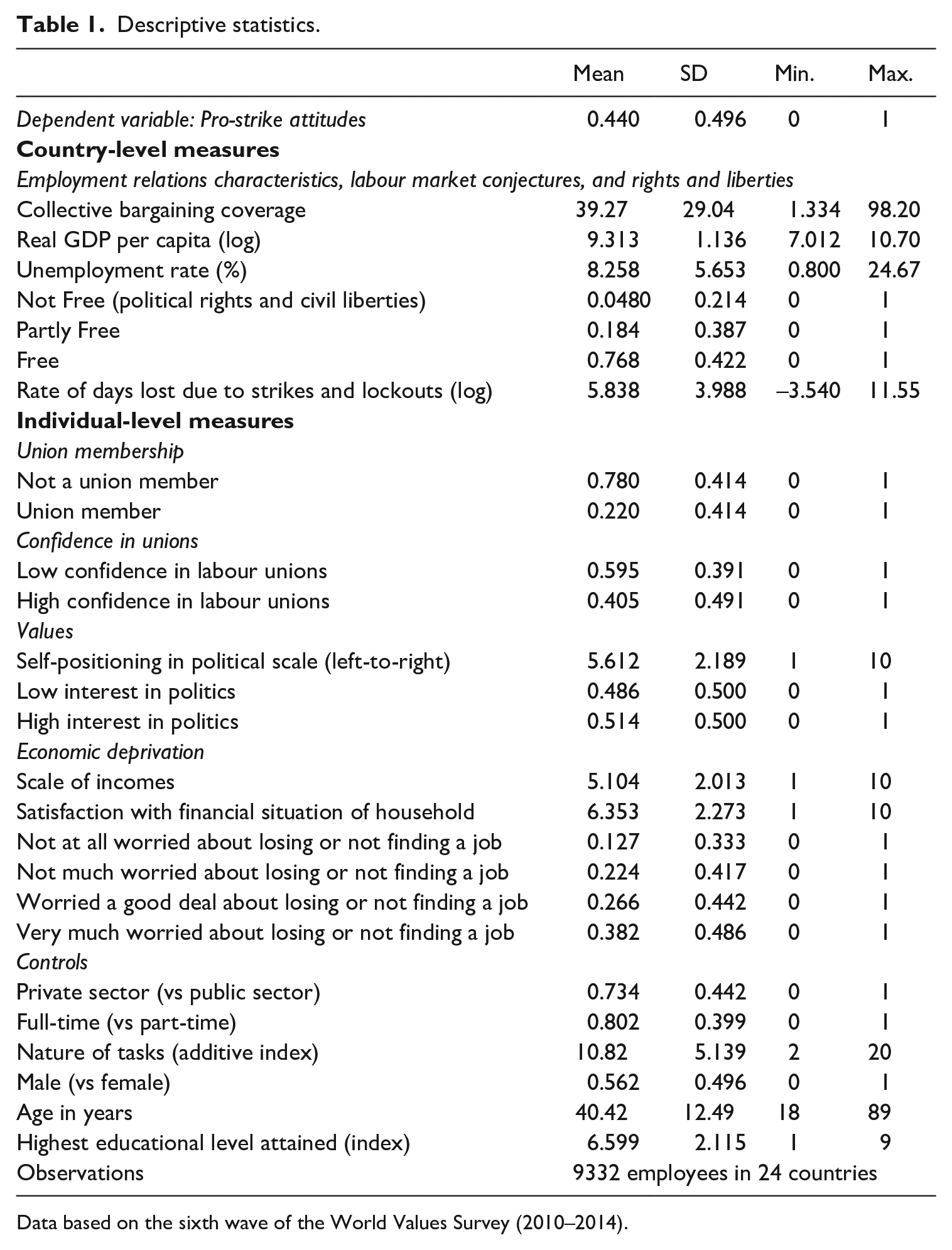
Data based on the sixth wave of the World Values Survey (2010–2014).
Regression results
Results shown in Table 2 report the log odds ratios. At country level, we find that countries with higher levels of collective bargaining coverage show greater positive attitudes towards joining strikes. A one percentage point increase in collective bargaining coverage increases positive attitudes towards joining strikes by 0.6%. GDP per capita is positively and significantly related to the dependent variable. A one-unit increase in GDP is associated with a 46% increase in the odds of showing pro-strike attitudes. Unemployment is not significantly related to positive attitudes towards strikes (and inflation as shown in the online supplementary material is also insignificant).
Estimated odds ratios of two-level nested logistic regressions for pro-strike attitudes.
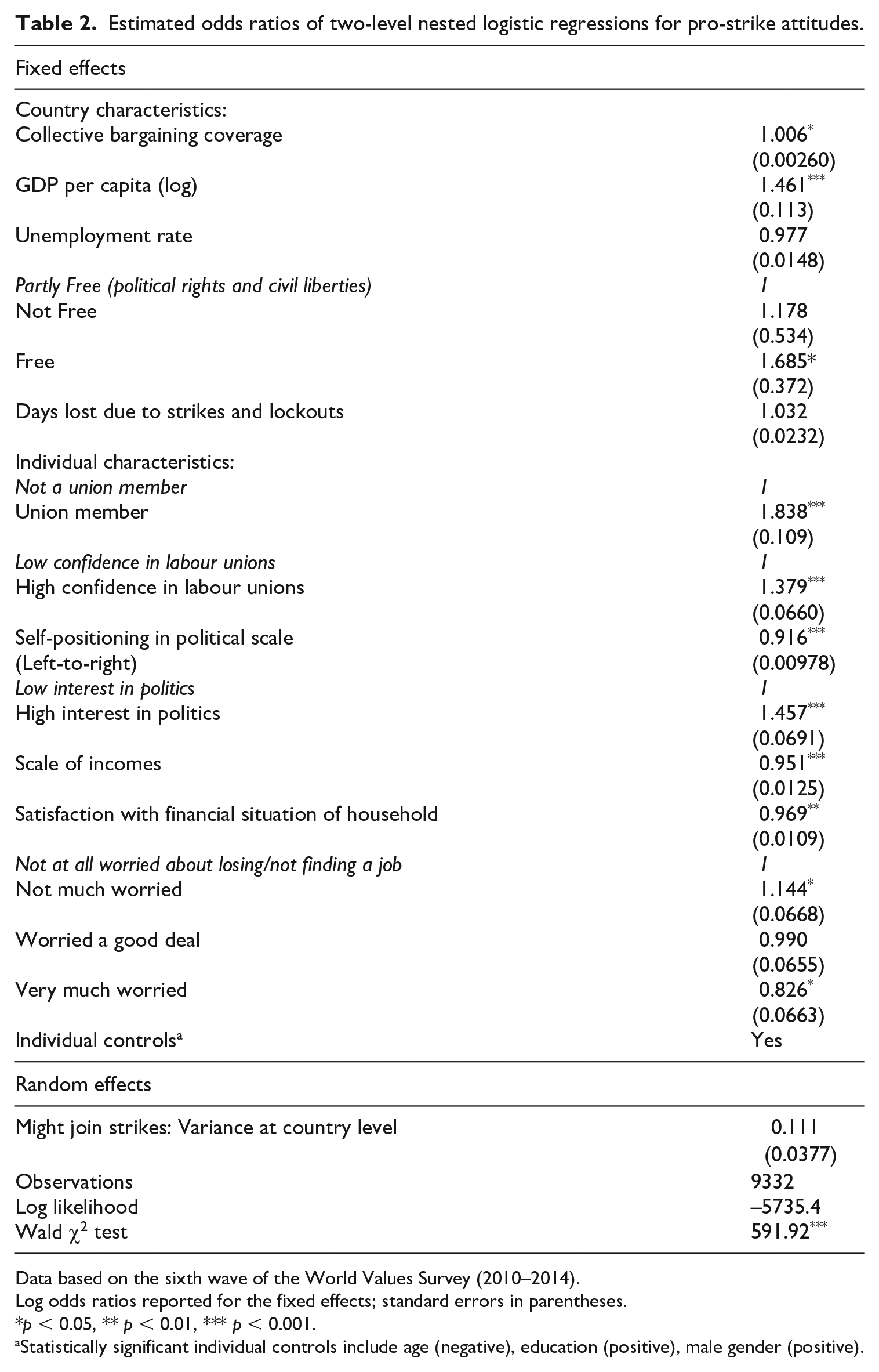
Data based on the sixth wave of the World Values Survey (2010–2014).
Log odds ratios reported for the fixed effects; standard errors in parentheses.
p < 0.05, ** p < 0.01, *** p < 0.001.
Statistically significant individual controls include age (negative), education (positive), male gender (positive).
We note also that individuals in countries which have the highest levels of political rights and civil liberties show higher pro-strike attitudes. Previous number of days lost due to work stoppages is not significant.
At the individual level, we can note that variations in union support, values and economic deprivation explain variations in our dependent variable. The larger effects are about individual value orientation and union support rather than economic deprivation. For example, moving one step higher on the income ladder reduces positive attitudes towards joining strikes by 4.9% whereas moving one step to the right of the political spectrum reduces it by 8.4%. Similarly, greater interest in politics increases positive attitudes towards joining strikes. Compared to individuals with low interest in politics, those who are highly interested in politics are 46% more likely to state that they might join strikes. In contrast, fear of losing jobs has a non-linear relationship with the dependent variable. Those with moderate fear of losing jobs are 14% more likely to show positive attitudes towards joining strikes, but those with the greatest fear are 17.4% less likely to express positive attitudes towards joining strikes relative to those individuals who report no fear.
Using these estimates, we predict each individual’s pro-strike attitude. We then use these estimated values to show the range of pro-strike attitudes within and across countries. Figure 1 shows the post-regression estimates of pro-strike attitudes by country. Each country’s box-and-whisker diagram shows the 25th percentile, median (50th percentile) and 75th percentile, as well as the minimum and maximum values. Some outliers are also shown. We see that there is variation within country, which deserves attention, along with variations across countries which seems to be the bigger driving force. We first look at the within-variation, and then proceed to compare across countries, with a subsequent focus on three countries.
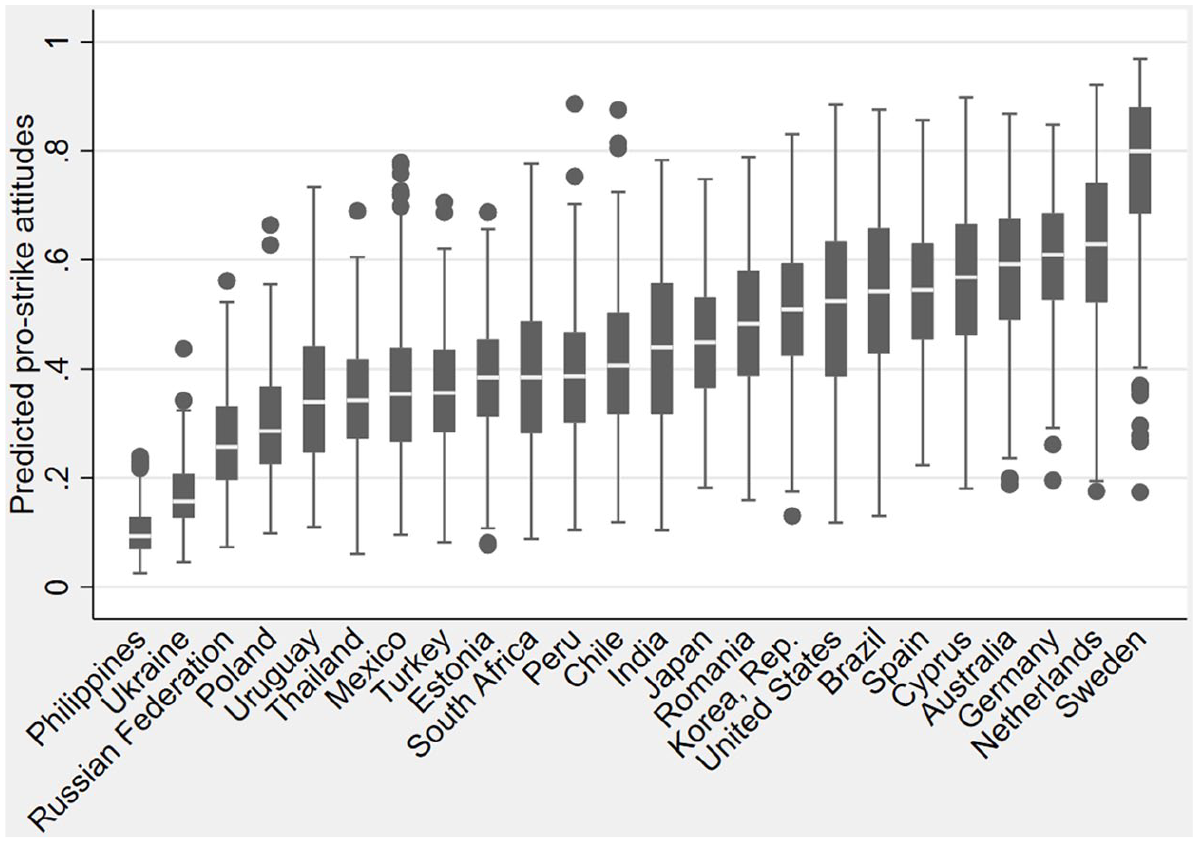
Country-by-country distribution of (post-regression-predicted) pro-strike attitudes.
Logistic regressions by country
To get a clearer picture of what is happening within each country, we estimate simple logistic regressions linking individual factors to pro-strike attitudes for each of the 24 countries. The results are shown in Table 3.
Pro-strike attitudes and individual factors.
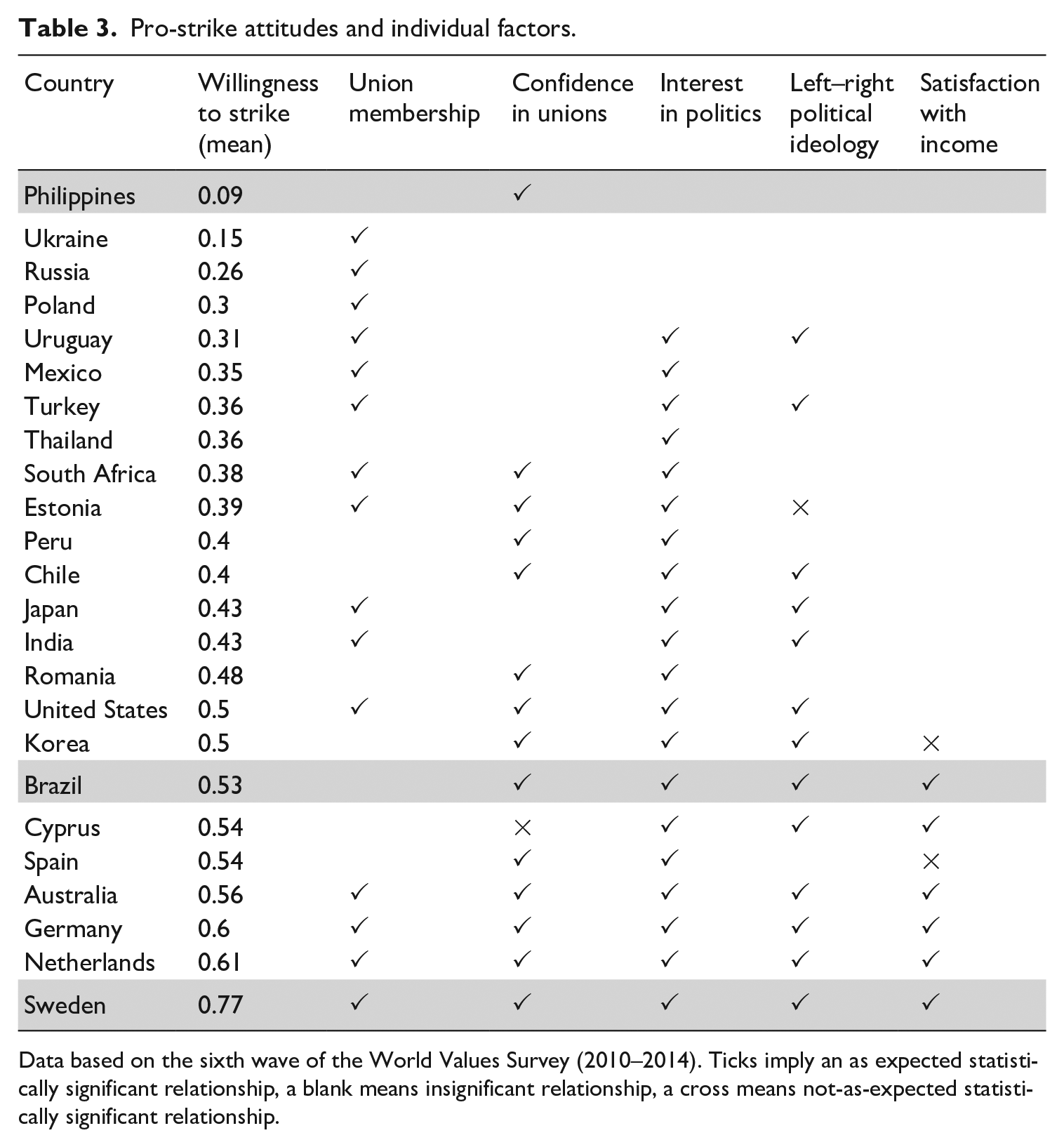
Data based on the sixth wave of the World Values Survey (2010–2014). Ticks imply an as expected statistically significant relationship, a blank means insignificant relationship, a cross means not-as-expected statistically significant relationship.
Table 3 presents the countries in ascending order of pro-strike attitudes 5 and we only show the sign of the relationship between each variable and pro-strike attitudes for individuals within each country. In particular, a tick or check mark is shown when the relationship is as expected (positive for union membership and confidence in unions, positive for interest in politics, negative for left-to-right political ideology, and negative for satisfaction with income); a blank denotes a statistically insignificant relationship; a cross denotes an unexpected relationship.
From Table 3, we note some interesting results. In the Philippines none of the mechanisms that have been found to support positive attitudes towards strikes is significant, except for confidence in unions. In Ukraine, Russia and Poland – respectively with 15%, 26% and 30% pro-strike attitudes – it is only being a union member that makes a difference for the expression of pro-strike attitudes. There is then a bigger group of countries – from Uruguay to United States, from 31% to 50% of pro-strike attitudes respectively – in which political values, mainly interest in politics and sometimes also left-leaning (Estonia being the exception), are at play in defining pro-strike attitudes. More than one of two employees who have never been on strike express pro-strike attitudes when also dissatisfaction with household financial situation makes a difference (in an unexpected direction for South Korea and Spain). Finally, union membership and confidence in unions, political values (both interest in politics and left-leaning) and dissatisfaction with household financial situation are significantly making a difference, all in the expected direction in the expression of pro-strike attitudes in Australia, Germany, the Netherlands and Sweden: the countries with the highest level of pro-strike attitudes.
Across-country contextual factors
We produced a similar summary table for the country-level variables. From the institutional literature in industrial relations, we know that analysing each contextual factor’s relationship with pro-strike attitudes in isolation will not give an adequate representation of the relationship between contextual factors and pro-strike attitudes. Rather, a more rigorous analysis would be more appropriate where complementary factors and institutions are explored together (Hall and Gingerich, 2009). To this end, we focus our analysis on all those variables that correlate significantly with pro-strike attitudes: collective bargaining coverage, GDP, and freedom of rights and liberties. We summarise this analysis in Table 4.
Comparison of contextual factors across countries (ranked in ascending order for pro-strike attitudes).
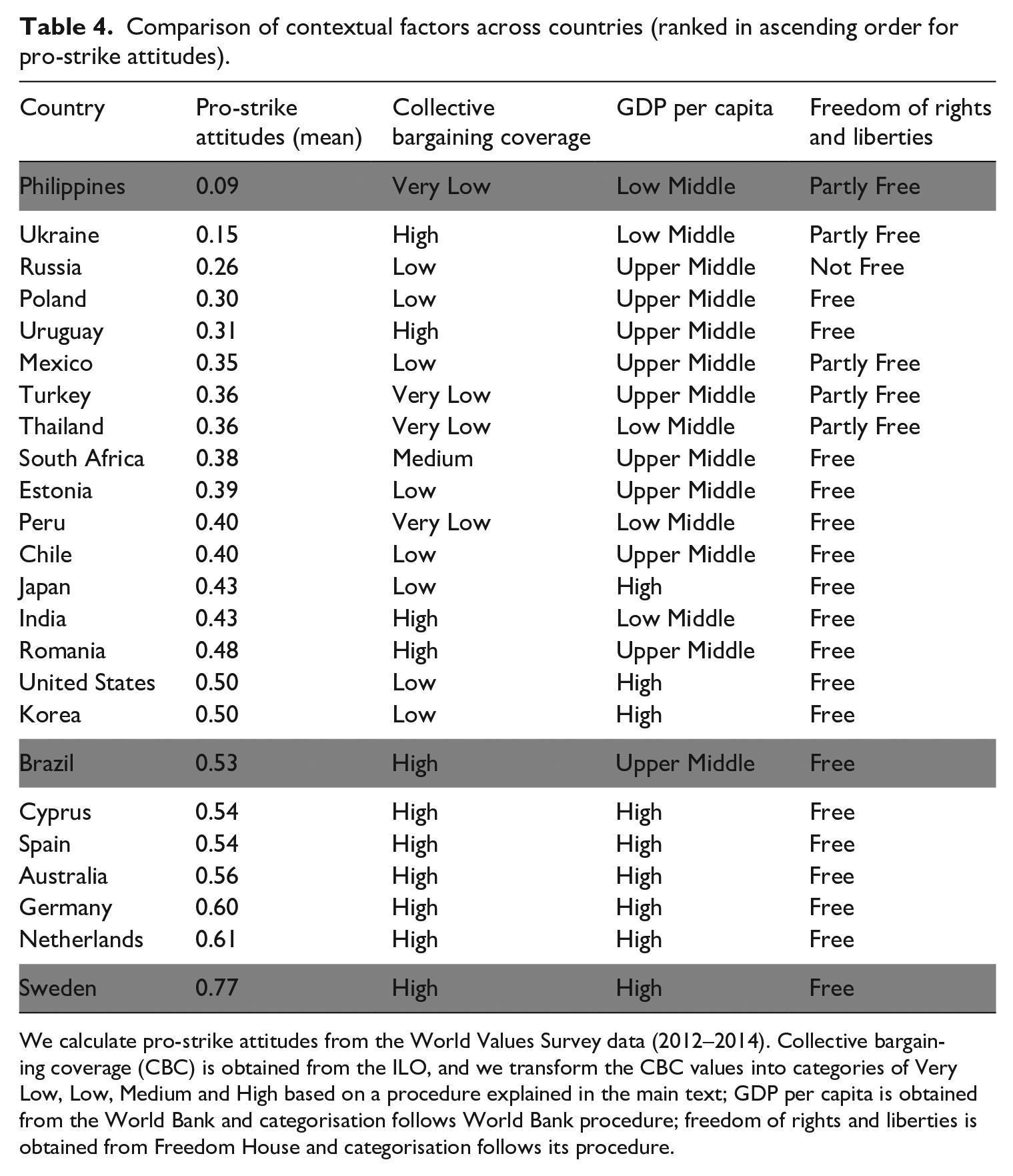
We calculate pro-strike attitudes from the World Values Survey data (2012–2014). Collective bargaining coverage (CBC) is obtained from the ILO, and we transform the CBC values into categories of Very Low, Low, Medium and High based on a procedure explained in the main text; GDP per capita is obtained from the World Bank and categorisation follows World Bank procedure; freedom of rights and liberties is obtained from Freedom House and categorisation follows its procedure.
To make the comparison easy, we categorise our measures as follows: collective bargaining – Very Low (0–10%), Low (11–30%), Medium (31–50%), High (>50%); GDP per capita – Low (<$995), Low Middle ($996–$3895), Upper Middle ($3896–12,055), High (>$12,055), as per World Bank classification; Freedom of rights and liberties – Free (1.0–2.5), Partly Free (3–5), Not Free (>5.5), as per Freedom House index partition. 6 Where all contextual measures are low, such as in the Philippines and Ukraine, pro-strike attitudes are also very low. What seems rather evident is that, except for Russia, pro-strike attitudes cross the 30% mark when a country’s GDP moves from low-middle to upper-middle income. Between the 40% mark and 50% mark for pro-strike attitudes, we notice that there are variations in collective bargaining coverage and GDP per capita, but the key commonality is ‘full’ freedom of rights and liberties. Finally, when all three measures are high, such as in Cyprus, Spain, Australia, Germany, the Netherlands and Sweden, the majority of employees who have never been on strike still perceive strikes as a legitimate and efficient action.
Case study of three countries
A closer look at the characteristics of the repertoire of contention that has been prevailing in the countries analysed can shed further light about the level of pro-strike attitudes we found. While it is beyond the goal of this research to analyse all the countries in our sample, we privilege insights about countries at the extremes of the distribution of pro-strike attitudes (the Philippines and Sweden), and one intermediate (Brazil). We explore relevant country-specific literature to provide further insights to interpret our quantitative results. In so doing, we also extend the literature about labour conflict beyond Western countries.
The Philippines
This country has the lowest pro-strike attitudes. A low GDP, bargaining coverage and freedom index are all factors that decrease pro-strike attitudes. Moreover, as we see in Table 3, barring confidence in unions, individual characteristics and values do not affect pro-strike attitudes; workers’ demobilisation affects workers at large. This result can be understood through closer insight of how the political power has put in place repressive forces towards strikes in this country. The Philippines has always privileged economic growth over the empowerment of unions, workers and their rights (Frenkel and Kuruvilla, 2002; Hutchinson, 2016). Export-oriented industrialisation in the 1960s and 1970s was then followed by a full embrace of globalisation, characterised by a high level of foreign direct investment and a number of export processing zones (Frenkel and Kuruvilla, 2002). The Philippines has long been an economy that is centrally structured around exports and the casualisation of employment relations (Bitonio, 2012). Through time, political powers have perceived organised labour and especially their unrest as a major obstacle to the accumulation priority (Frenkel and Kuruvilla, 2002). Several political actions have contributed to curtail the perception of strikes as efficient and beneficial actions. For instance, during Marcos’s authoritarian regime (1965–1986), martial law was used to undermine unions and their actions, abolishing and brutally repressing strikes in the name of national interests (Bitonio, 2012; Frenkel and Kuruvilla, 2002). While some more liberticidal measures were removed after Marcos, the state put in place heavy bureaucratic mechanisms to settle labour disputes, continuing to buffer the possible emergence of strikes (Bitonio, 2012). Employers have continued a fierce anti-union opposition, especially after the financial crisis of 1997–1998 (Frenkel and Kuruvilla, 2002). Employers’ illegal practices towards militant workers and violence against leftist promoters of labour unrest have significantly expanded to date, with impunity for the perpetrators (Hutchinson, 2016; ITUC, 2018). This climate of strong oppression of labour unrest, impeding political rights and civil liberties as outlined in Table 4, has been cognitively embedded in Filipino workers in their assessment of strikes, which are considered almost invariably as detrimental actions, being out of their repertoire of contention.
Brazil
In Brazil, slightly more than half of the employees who had never been on strike expressed pro-strike attitudes. Brazil is country with upper-middle GDP, high coverage of collective bargaining, and freedom rights are more guaranteed than in the Philippines. Strikes emerge as part of the repertoire of contention of workers who are confident in unions, left-wing, interested in politics and unsatisfied with their incomes. Brazilian strikes have been shaped by a mix of moments of labour mobilisation that contrast with others in which the political power took a conservative stance to undermine it. Labour conflict has its roots in the industrial region around São Paulo at the beginning of the 1900s, when leftist Italian and Spanish immigrants were able to organise massive strikes, including general strikes, for more than two decades (Biondi, 2012; Toledo, 2017). In reaction to this unrest, the state adopted a paternalist and centralist approach to employment relations in establishing the CLT (Consolidação das leis do Trabalho) in 1943: a consolidation of laws into a coherent legislative regime to regulate employment relations that have remained mostly untouched until recently (Cardoso, 2019; French, 2005). Two pillars of this legislation have proved to be fundamental: (1) labour peace was necessary to develop the economy of the country; (2) the state had (and still has) a major interventionist role in defining employment relations, including most aspect of salaries, leaving limited scope for collective bargaining (Cook, 2002; Schneider, 2004). These factors have pervaded the culture of Brazilian workers for generations (Cardoso, 2019). It is thus ingrained in their minds to rely on state intervention rather than unions to protect and improve working conditions (Cardoso, 2019). With this persistent cultural trait in the background, two dynamics have brought strikes closer to political dynamics. First, in the late 1970s and beginning of the 1980s massive union-organised strikes re-emerged in the automobile plants around São Paulo in collaboration with leftist parties (Sluyter-Beltrão, 2010). These strikes played a major role in the political scene to overturn the dictatorship and restore democracy in the country (Barros and Kunzman, 1999). Second, during the period that followed, especially in the late 1990s and 2000s, when Brazil had increasingly opened its economy to global competition, the union movement and strikes declined. However, at the same time Lula, the union leader of the strikes in the late 1970s and 1980s, had become a prominent political left leader and then president of the country, contributing to maintaining a link between unions, their actions and the political dynamics (Frangi and Memoli, 2014). Strike actions have not completely disappeared since the 2000s. While they have been largely concentrated among public-sector white-collar employees, unions have also lobbied the state and taken actions to improve minimum wages. This has improved conditions for the many deprived workers in the private sector, a good portion of whom still depend on the minimum wage established by the state and state welfare measures against poverty (Boito and Marcelino, 2011). Moreover, strikes have remained part of the union narrative in framing bargaining dynamics for the huge share of employees covered by a collective agreement (70.5% according to ILO data). Further, strikes, rallies and protests have been deployed by more left-wing politically engaged employees since 2013 to fight against corruption and political and economic crises (Anner and Veiga, 2020). In summary, the Brazilian repertoire of contention is shaped by two opposite forces: a state-driven corporatist regime of employment relations and union actions that have been linked to left movements and have impacted working conditions, through both a high collective bargaining coverage (as outlined in Table 4) and lobbying the state to improve minimum wages, making strikes a valuable action for around half of employees who have never been on strike. This sheds more light on the pattern of individual-level results we see for Brazil in Table 3. High confidence in unions, high interest in politics, leftist political ideology and low satisfaction with income are all associated with pro-strike attitudes.
Sweden
In Sweden, more than three out of four employees who have never been on strike express pro-strike attitudes; the highest among the countries under analysis. In this country strikes thus emerge as part of most Swedish workers’ repertoire of contention, and more strongly so for those who are union members and confident in unions, more interested in politics and left-wing, and unsatisfied with their income. Sweden has traditionally enjoyed a highly centralised bargaining system (close to 90% according to OECD data), one of the highest union densities in the world (around 66.8%, OECD data), a strong union coordination and active rank-and-file membership (Kjellberg, 2000). While these aspects partially declined in more recent years, Sweden remains comparatively one of the employment systems in the world with the strongest unions (Svensson, 2020). In contrast to countries where the state has repressed strikes, as in the Philippines, or have controlled most of the employment relations dynamics, such as in Brazil, in Sweden unions are free to take industrial action without government interference. Strikes, both official and unofficial, surged during the 1970s in Sweden and were used to lobby for greater industrial democracy and new labour laws, and they were met with some level of success (Aylott, 2003). Strike levels remained high in the 1980s, but peace prevailed in the 1990s (Edwards and Hyman, 1994: 285). Notwithstanding the prevailing peace since then, two characteristics deserve attention. First, workplace strikes are rarer and shorter but, in contrast to Brazil, they are more typical in blue-collar industries and are still present in the private sector (Stokke and Thornqvist, 2001; Teague, 2009). Second, workers know that they have an industrial action weapon in their arsenal: solidarity. Unions in Sweden can join strikes led by other unions even if their own organisation is not directly involved in the dispute (Borjesson and Gustafsson, 2016). The power of Swedish unions is among the strongest in the world. Through collective bargaining dynamics and related union-strike narratives, unions are able to ensure that employees share in the economic prosperity of the country. Individual employees even if having never been on strike include it in their repertoire of contention and are willing to support strike actions (Kjellberg, 2000; Thörnqvist, 2007).
Discussion and conclusion
Our analyses make several contributions to the labour conflict literature. First, we support Godard’s (2011) point that strikes represent a more complex phenomenon than their mere occurrences. Pro-strike attitudes are a complementary dimension of labour conflict that can provide important, and sometimes unexpected, insights to assess employee mobilisation. Second, we contribute to qualify the narration about the withering away of strikes and the demobilisation of employees (Brandl and Traxler, 2010; Piazza, 2005; Wallace and O’Sullivan, 2006). While in a few countries, such as the Philippines and Ukraine, demobilisation seems to be widespread, in many countries between 30% and 60% of employees who have never been on strike do not consider strikes as ‘outdated, unnecessary, or irrational actions’ (Hyman, 1989: 145), but instead as possible effective actions. This percentage rises above 60% in Germany, the Netherlands and Sweden. This evidence does not support the proposition that strikes have migrated from developed to developing countries, as supposed by Arrighi (1990). Third, we provide evidence that shows how the formation of pro-strike attitudes is linked to country-specific repertoires of contention as well as individual characteristics that make some individuals more than others more prone to support strike actions (Tilly, 2006). In richer countries with no limitations on freedom of expression, when collective bargaining covers many employees, such as in Sweden, strikes are perceived as effective actions to improve wages, and more generally working conditions. In these situations, union members (and supporters), employees politically engaged and left-leaning, and employees dissatisfied with their income are prone to undertake strikes. Conversely, as in the case of the Philippines with a lower GDP and a high suppression of unions and strike activities by the political powers that has reduced collective bargaining coverage to trivial levels, strikes have developed a reputation of being mostly detrimental actions, not being part of the repertoire of contention of any specific group of employees; agency seems to be largely removed by repressive institutional forces. Fourth, while we confirmed the existing literature’s finding that economic conditions and bargaining characteristics are significant factors in explaining cross-national variation in strikes (Campolieti et al., 2005; Card, 1990), we expanded the focus to include the violation of freedom of rights and liberties, an aspect that has remained underexplored in the strike literature. Finally, we provide new evidence that the three mechanisms that have been used to explain why some employees are more prone to joining strikes in a workplace (union membership and support, political engagement and financial dissatisfaction) are also important in the formation of pro-strike attitudes, when strikes are defined as a general future action. Starting from countries with low and moving to countries with medium level pro-strike attitudes, we note that politically engaged employees express stronger pro-strike attitudes besides union members and supporters. Finally, in countries with the highest pro-strike attitudes the strong support also came from financially dissatisfied employees.
Our insights have some implications for trade unions and for the new frontiers of the debate about labour conflict. Considering the relevance for trade unions, it emerges that collective bargaining coverage plays an important role for unions in maintaining positive attitudes towards joining strikes. Hence, in order to maintain at least some potential of mobilising employees, unions should wherever possible focus on maintaining or even enlarging their bargaining coverage. Moreover, unions should be aware of this dormant potential of support for strikes among employees who have never been on strike, when strikes are generally defined future actions. By framing their endeavours in terms of fighting not only against workplace-specific but also against more general social injustices (Levesque and Murray, 2002), unions could have a stronger leverage on this potential to limit the unfair ways in which employees’ work is valued at both the workplace and societal levels (Hyman, 2007). Our results might also shed some further light on the debate about the new frontiers of labour conflict, mainly represented by grassroots rather than union organising (Holgate et al., 2018). In contexts where unions are facing major organising constraints, such as in the US, the dormant potential we found can become the supportive base for the development of new non-union forms of solidarities that can aim through collective actions to change working conditions for unrepresented, oppressed, low-wage workers. For instance, it might be possible that movements such as Fight for $15 in the USA have tapped on this dormant potential we found (Frangi et al., 2020; Luce, 2017). In the same line of reasoning, the more pervasive recurrence of individual labour conflict actions, such as working slow, overtime bans, stealing and absenteeism, that have been found in many contexts (Ackroyd, 2012; Fleming and Spicer, 2007) might represent a diversion of the strike potential into individual action when employees are constrained by institutional or workplace forces in organising strikes (Frangi et al., 2018).
Our study is not without limitations. Besides the constraints of relying on a survey for this type of studies (Fantasia, 1989), the survey analysed presents specific limitations. We were restricted to a cross-sectional analysis, which does not allow for a study of pro-strike attitudes over time. Further, while our insights are interesting, the number of countries included is limited, therefore, restricting generalisability. We had to draw on the best available proxy for the operationalisation of some variables, and other variables which would have provided deeper insights were not included in the survey. For instance, job attitudes and effect of group norms, such as workplace colleagues or kinship networks, that have been shown to be important for the development of attitudes that may be transformed into actions (Martin, 1986; McClendon and Klass, 1993), were not available in our data. Neither was it possible to study the interaction between individual and possible workplace factors. Some questions, such as the self-definition as a part- or full-time worker can be very sensitive to the country context, especially with reference to the level of informality. Despite these limitations, our research demonstrated that strikes are a phenomenon more complex than the event itself. Supportive attitudes towards joining strikes are a fundamental underlying dimension of the strike phenomenon that is worthy of future research. Overall, our evidence lends some support to the possible existence of strike potential proposed by Godard (2011), especially in some countries. This, in turn, suggests future research to investigate the conditions that can transform this potential into actions. That research should also provide more refined insights favouring a more agent-centred perspective of strike actions, focusing on workers’ conflict performances besides the repertoires of contention available to them (Tilly, 2006). This agentic perspective will allow also to discover, also relying on different methods than a survey, what critical conjunctures workers might seize to mobilise the potential we found, possibly deploying innovative conflict performances besides traditional strikes, to introduce change also in more repressive countries to alter, or subvert, the current disequilibrium of social forces (Peters et al., 2005).
Supplemental Material
sj-docx-1-eid-10.1177_0143831X20980059 – Supplemental material for Demobilised or dormant? Exploring pro-strike attitudes among employees who have never joined a strike
Supplemental material, sj-docx-1-eid-10.1177_0143831X20980059 for Demobilised or dormant? Exploring pro-strike attitudes among employees who have never joined a strike by Lorenzo Frangi, Muhammad Umar Boodoo and Robert Hebdon in Economic and Industrial Democracy
Supplemental Material
sj-docx-2-eid-10.1177_0143831X20980059 – Supplemental material for Demobilised or dormant? Exploring pro-strike attitudes among employees who have never joined a strike
Supplemental material, sj-docx-2-eid-10.1177_0143831X20980059 for Demobilised or dormant? Exploring pro-strike attitudes among employees who have never joined a strike by Lorenzo Frangi, Muhammad Umar Boodoo and Robert Hebdon in Economic and Industrial Democracy
Supplemental Material
sj-pdf-3-eid-10.1177_0143831X20980059 – Supplemental material for Demobilised or dormant? Exploring pro-strike attitudes among employees who have never joined a strike
Supplemental material, sj-pdf-3-eid-10.1177_0143831X20980059 for Demobilised or dormant? Exploring pro-strike attitudes among employees who have never joined a strike by Lorenzo Frangi, Muhammad Umar Boodoo and Robert Hebdon in Economic and Industrial Democracy
Footnotes
Acknowledgements
We would like to thank the Department of Management Faculty at LSE and participants at the III International Conference Strikes and Social Conflicts for their helpful comments.
Declaration of conflicting interests
The authors declared no potential conflicts of interest with respect to the research, authorship, and/or publication of this article.
Funding
This research was supported by the Social Sciences and Humanities Research Council (SSHRC-430-2017-00442).

Supplemental material
Supplemental material for this article is available online.
Notes
Author biographies
References
Supplementary Material
Please find the following supplemental material available below.
For Open Access articles published under a Creative Commons License, all supplemental material carries the same license as the article it is associated with.
For non-Open Access articles published, all supplemental material carries a non-exclusive license, and permission requests for re-use of supplemental material or any part of supplemental material shall be sent directly to the copyright owner as specified in the copyright notice associated with the article.
