




Abstract
Factory occupations are rare and sporadic events which shed light on the processes associated with the collective mobilization of workers’ power. This article utilizes Kelly’s agential and Atzeni’s structural explanations of worker mobilization to examine two disputes which took place during Britain’s long experience of deindustrialization: the occupations of Caterpillar’s tractor factory in Uddingston, Scotland, during 1987 and Vestas’ wind turbine plant on the Isle of Wight during 2009. Each occupation shared the context of multinational divestment and collective workforce grievance based on a common perception that their plant was economically viable and vital to the local economy. However, contrasting sources of leadership mobilized this sentiment in each case: union stewards from within Caterpillar, socialist activists from outside at Vestas. The article concludes that an effective explanation of occupations must synthesize structural and agential factors, emphasizing the coalescing role of activist networks and workers’ perceptions of their labour’s social utility.
Introduction
In the British context, factory occupations are relatively rare and sporadic events. There were fewer than 30 occupations per annum between 1971 and 1981, a period of heightened labour activism, and there have been fewer than 100 since (Tuckman, forthcoming). Gall (2011) noted that seven occupations from 2007 to 2010 constituted a resurgence, but by comparison there were 476 incidents of strike action. Yet occupations are important in revealing workers’ framing of social (in)justice. This article contributes to discussions on worker mobilization which have developed in Economic and Industrial Democracy by improving the quality and depth of our understanding of occupations. It builds on the recent special edition marking 20th anniversary of John Kelly’s (1998) Rethinking Industrial Relations (Gall and Holgate, 2018). We engage with Kelly’s (1998) innovative approach to explaining the social processes associated with collective workplace mobilization.
A comparison of two factory occupations demonstrates the salience of three themes to explaining the dynamics of occupations: the macro-structural context of deindustrialization through multinational divestment and factory closure; the importance of activist leadership in translating grievances into mobilization; and finally, an understanding of the social utility of factory labour and products. The comparative cases illuminate how the shared contexts of remote management decisions to close large factories stimulated similar routines of collective action, but with distinctly different forms of leadership. In addition, workers in each occupation embraced political issues beyond the remit traditionally associated with workplace activism but which were highly related to their factories’ production (Blyton and Jenkins, 2013). This approach tests existing theories by integrating new case studies that shed light on structural and agency-centred explanations of industrial relations (Burnham et al., 2008).
The 1987 occupation at the Caterpillar tractor factory in Uddingston, Scotland, and the occupation of the Vestas wind turbine factory on the Isle of Wight in 2009 appear as isolated examples of workplace conflict. But on closer inspection, both share parallel dynamics despite the temporal and geographical distance between them. This article identifies both these similarities and the differences between each occupation. It emphasizes the shared context of deindustrialization and closure at the behest of a multinational. But it also highlights distinct sources of activist leadership as well as a tendency towards forming political coalitions around the factory’s products, which were differentiated by industrial sector and political climate. The analysis sheds light on agential and structural explanations of worker occupations. Both offer important explanatory insights to interpret factory occupations, which cannot be meaningfully understood in isolation from each other.
The first section addresses methodological considerations and contextualizes both occupations. The second section outlines a complementary theoretical framework which draws upon Atzeni’s (2009) structural and Kelly’s (1998) activist approaches to explaining collective action. A third section includes an historical overview of factory occupations. The fourth section offers a comparison of the structural macro-similarities, centring on the shared context of multinational plant closure. The fifth section considers activist mobilization factors, underlining the distinct sources of leadership and connections to activist networks that built support for each occupation. Finally, the sixth section outlines how occupiers and supporters of each occupation framed their action in terms of the socially useful nature of their labour and their factory’s products.
Method and context
Qualitative analysis can reveal the importance of economic and political contexts to industrial relations conflicts. Case studies were chosen because they: Can take a broad set of theoretical approaches into account, collect finely grained empirical evidence and understand the complexities involved in change over time by taking both individual agents and socio-political structures into account. (Vromen, 2018: 244)
A single case study approach would struggle to draw out the general from the specific. Instead, this article compares two occupations. Burnham et al. (2008: 68) argue that a comparative approach can ‘sharpen our understanding of the context in which theoretical problems occur and enables causal inferences to be drawn’. The analysis of the Caterpillar occupation draws upon 13 oral history interviews with former workers and family members conducted by the first author. Vestas is examined through an analysis of around 30 blog posts written up by a local resident who was an active supporter of the occupation. These reflect the views of the occupiers and local community. They are supplemented by articles from the left-wing press which were largely authored by activists visiting the occupation from elsewhere in the UK. Both of these sources prioritize the experience of occupation participants and allow for theory testing and explanation which is heavily implicated in ‘real world’ settings (Harvey, 1990; Vromen, 2018).
An interpretive thematic analysis was developed through ‘a creative, reflexive and subjective’ examination of the sources (Braun and Clarke, 2019: 591). There is an inherently subjective dimension to this process which was shaped by our existing knowledges and sympathy for theoretical outlooks that privilege workplace experiences and worker voices. Following Braun and Clarke’s approach (2019: 593), themes have been understood as a ‘shared meaning underpinned or united by a core concept’. Both sets of data sources were read for familiarization and loosely coded before extracts from each example were compared to assist with theme creation. Thematic categories were finalized through developing the comparison between each dispute in dialogue with both Atzeni (2009) and Kelly’s (1998) mobilization theories.
The intersubjective dialogue of oral history interviews necessitates ‘an active process of creation of meanings’ (Portelli, 2006: 37). These imperatives were also at work in the deliberations on Vestas. As Hookway (2008: 92) explains, blogs are a contemporary form of self-expression and way of recording social life which can illuminate social phenomena and historical events from a subaltern or ‘bottom-up’ perspective. The blogs from Vestas were predominantly written by a local activist, and presented access to a partisan perspective of the occupation not offered by local or national news media. They also emphasized the development of attitudes towards the closure and trade unionism over the course of the dispute.
Blogs capture ‘situated action unadulterated by the scrutiny of the researcher’ and accurately document social events. The close connection between the time of writing and the event itself avoids a reliance upon the retrospective reconstruction of memories, which is characteristic of qualitative interviews (Hookway, 2008: 95). In this sense, blogs – like diaries – serve the purpose of reflecting and documenting participants’ understanding of events, but they are also a form of news production aimed at external audiences. Blog posts publicized what the occupiers and supporters saw as the most important features of their dispute. Interviews provide a markedly different form of reflection, especially when they are conducted decades after the events in question. Unlike blogs they are not the autonomous product of the occupiers, instead the dialogue is shaped by the researchers. Narratives are determined by ‘composure’ (Summerfield, 2004): the need to tell a coherent story for posterity that can fit within available cultural framings. Yet the value of these oral history reflections lies in their removal from immediate circumstances and in the historicized understanding of the Caterpillar occupation. They reveal how the occupiers individually and collectively developed an account of their actions. The blogs and interviews have competing strengths and weaknesses which provide an effective means to identify shared features between occupations which were neither the product of the emotive instance of threatened closure nor conditioned by later rationalization alone.
We built on our previous research into each of the occupations. This led us to recognize strong parallels in both the action taken and grievances raised by the occupiers. The analysis of the narratives presented in the respective sources drew out common elements in how the stories of the disputes were constructed from a worker perspective, with attention to accounting for each occupation’s development, and workers’ sense of their role within it. These oral and written accounts from the occupations demonstrate ‘the ways that people organise and forge connections between events and the sense they make of those connections’ (Bryman, 2004: 412).
Three themes were identified across both disputes: the context of deindustrialization; the importance of sources of leadership; and worker perceptions of socially useful production. The differences between the case studies and nature of the sources strengthen the internal validity of the argument through triangulation (Dowding, 2018). Although Caterpillar and Vestas were separated by over two decades, it is notable that these similar themes characterized each dispute. Whilst the sources from Vestas were produced during the occupation, the analysis of Caterpillar largely relies on testimonies collected around 30 years after the occupation. The fact that the same themes can be elicited from each case suggests that they cannot be dismissed as opportunistic or fleeting interests of the occupiers in the heat of the dispute or that they have been retrospectively embedded in the ‘collective memory’ of former occupiers (Popular Memory Group, 2006).
Caterpillar
Caterpillar invested in Scotland due to the UK regional policy regime which steered investment towards ‘peripheral’ areas (Tomlinson and Gibbs, 2016). The factory was built during the mid-1950s atop Tannochside, a former mining village in Uddingston, Lanarkshire, which is 10 miles to the east of Glasgow (Gibbs and Phillips, 2018). Caterpillar were an anti-union employer, but the plant’s management were compelled to recognize unions in the early 1960s following a drawn-out conflict (Knox and McKinlay, 2010). The company restructured in the face of recession and Japanese competition during the 1980s. However, Tannochside appeared to have been saved following the announcement of a major investment package in 1986, with government financial support (McDermott, 1989). Following a shock closure announcement, the plant was occupied by the workforce for 103 days between January and April 1987 in an effort to retain 1200 jobs (Woolfson and Foster, 1988).
The occupation achieved significant public attention as well as receiving political support from across the UK and internationally. It also led to major tensions between trade union officials and the factory’s shop stewards who organized the occupation through a ‘Joint Occupation Committee’ (JOC) under the leadership of the Amalgamated Engineering Union (AEU) convenor John Brannan. Tensions grew as Caterpillar sought to remove the occupiers through legal mechanisms which threatened union funds. These contributed to the occupiers’ decision to return to work without saving the plant (Woolfson and Foster, 1988).
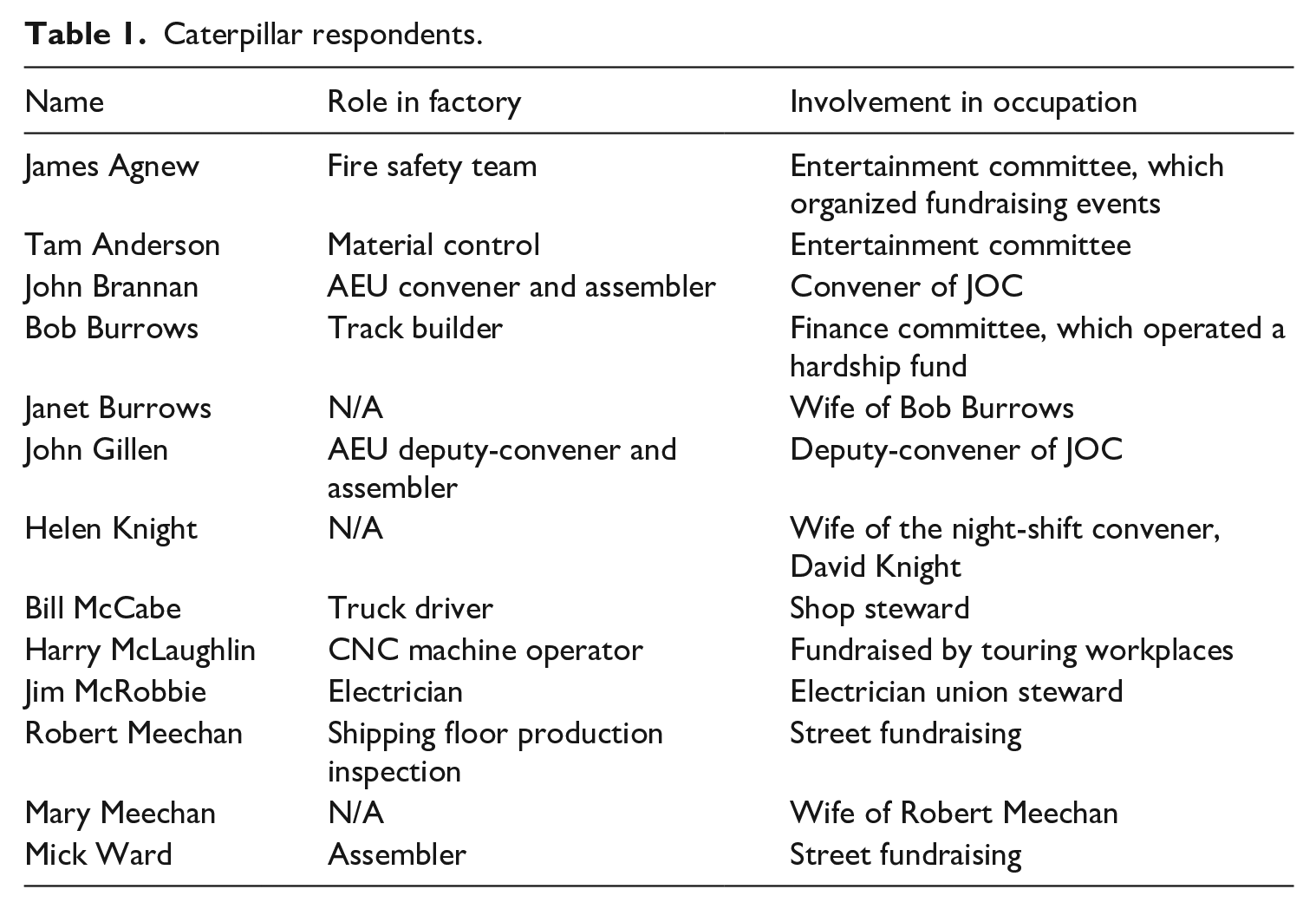
The analysis of the Caterpillar factory occupation is based on oral history interviews conducted by the first author with former occupiers and occupiers’ wives. They were recorded as part of the Caterpillar Workers Legacy Group’s (CWLG) commemoration of the occupation’s 30th anniversary during 2017 for the purpose of use in academic research and in heritage activities. Most of the interviews were recorded with former occupiers or their wives at reunion events which marked the anniversary. The interviews focused on the occupation itself but also had an orientation towards experiences of work and the long-term impact of job losses and the factory’s closure. Three longer interviews were recorded with John Gillen, John Brannan and Mick Ward, which had a life-story format. All of the interviewees who had been employed at the factory were male manual workers. As Table 1 demonstrates, they held a range of jobs within the plant. Apart from Jim McRobbie, all were members of the AEU, which was the dominant union at the factory. The wives’ perspective was valuable in illuminating the effects of closure on families and in demonstrating how the dispute reverberated around the Uddingston area.
Caterpillar respondents.
An account of the occupation was published by Charles Woolfson and John Foster (1988), who had been present during the dispute, shortly after it finished. Track Record presented the occupation as a defiant stand by Scottish workers against multinational capital. The analysis of the testimonies focused on how the dispute’s unravelling was recalled by participants. Strong elements of ‘composure’ (Summerfield, 2004) were present: respondents needed to tell a congruent life-story by affirming their past actions. Some interviewees achieved this through implicating their actions within the longer legacy of labour movement traditions and ‘militant’ class struggles (Nettleingham, 2017). But access to these framings did not lead respondents to act as crude ‘memory users’ (Selway, 2017). Differences with Woolfson and Foster’s account included an emphasis on Caterpillar’s perceived breach of a social contract with its workforce and the community that depended on the factory’s employment. The passage of time had also encouraged reflection on the significance of deindustrialization. But this had also been present during 1987 in the form of mass unemployment and the closure of other local large workplaces (Gibbs and Phillips, 2018). John Brannan and John Gillen, the convener and deputy-convener of the JOC, also emphasized international solidarity through links to other Caterpillar factories in Europe. A more dispersed appeal to the social value of the Tannochside’s factory’s production was present across all of the testimonies.
Vestas
In June 2009, the Danish wind turbine producer, Vestas, announced that it would be shutting its New Cross factory and research and development site on the Isle of Wight. Vestas provided employment for around 550 workers. They were dismayed that the company’s planned overseas expansion came at their expense (Morris, 2009b, 2009d). Divestment came despite the favourable political conditions from which the Vestas plant benefited. Gordon Brown’s Labour government was committed to increasing renewable energy production by investing in a ‘green jobs revolution’, but it did not intervene to stop the closure (AWL, 2009: 5; Gall, 2011; Morris, 2009a, 2009c; Socialist Worker, 2009; Weaver and Morris, 2009; Webb, 2009). As recorded by Hampton (2015), despite there only being a modest union presence at Vestas, a minority of workers decided to act. They were supported by left-wing activists from other parts of the country who travelled to the island having identified the closure as an opportunity to publicize demands for green jobs based upon socially useful production. Around 20 workers managed to occupy the factory before Vestas management and police secured the site, preventing others who were prepared to occupy from doing so (AWL, 2009; Morris, 2009f). The disputed ended when the occupiers were evicted 18 days into the dispute, after Vestas won a court order.
The occupation is examined using contemporary coverage of the dispute produced by supporters. Posters, leaflets and briefing materials which activists assisted the occupiers in producing were uniquely preserved in the Save Vestas Blog, which was meticulously updated throughout the occupation. These resources reveal what the participants were doing and thinking at the time. The Save Vestas Blog is a unique repository which allows the occupation to be comprehended ‘from the inside’, by ‘understanding interactions as those engaged in them understand them’ (Dowding, 2018: 181). Given the ease of accessibility, it was possible to examine 30 blog entries in relation to the main themes identified above. Following Dowding (2018), this digital archive research is approached selectively. This is closer to ‘detective work’ where a hypothesis is formulated and further evidence marshalled to confirm this. While this method is open to accusations of selection bias, the blogs are widely available for scholars to challenge the interpretation (Dowding, 2018: 183).
A selective and critical reading of the blogs offers a unique interpretation of the evolving motivations of the occupiers which ‘shed light on social processes across space and time’ (Hookway, 2008: 93). The Save Vestas Blog has been prioritized because it was maintained by a local activist and was committed to recording the voices of Vestas workers. The dispute was also reported on in the left-wing press by members of the Trotskyist organizations, the Socialist Workers Party (SWP) and the Alliance for Workers’ Liberty (AWL). These activists travelled to the island from London and were somewhat removed from the dispute’s wider social and political context. Where their reports have been used it has been because they carried out valuable interviews with occupiers which prioritized their voice.
Theoretical framework: Macro and activist mobilization factors
This section combines analytical frames to explain collective action which prioritize structural and agential factors. Atzeni and Ghigliani (2007: 657) explain mobilization through the social processes associated with contradictions in the capitalist labour process which they refer to as ‘the unseen dimension’ of occupations. Their account emphasizes that ‘structural factors’ (Atzeni and Ghigliani, 2007: 657) condition the radicalism inherent in occupations’ challenge to workplace order, but also impose limits on it through obliging workers to work through the logic of market forces and the hierarchical norms of business relations. Occupations are attempts to disrupt and challenge the ‘almost natural character of capitalist work relations’, and give space to new forms of worker activity (Atzeni, 2014: 162). Factory occupations stem from contradictions in the organization and control of the workplace which give ‘room to moments of collectivisation’ (Atzeni, 2009: 6). Taylor and Moore (2015) recently analysed industrial action as a synthesis of individual grievances and structural conflict between workers and capital. Shared experiences of a demanding labour process stimulated the collective trust that sustained British Airways cabin crew workers’ strike action. Factory occupations demand a similar approach, which emphasizes their origins within the exercise of agency in response to the collective threat of closure. Atzeni’s insights regarding the role of the capitalist labour process must therefore be complemented by greater attention to dynamics of workplace leadership.
Kelly (1998) views worker mobilization as a collective expression of individually felt injustices. Leaders mobilize grievances through placing blame for injustices on employers who are seen as a viable target for sanctions (Kelly, 1998). Mobilization theory shares clear resonance with a moral economy perspective; grievances are often based on the transgression of implicit or ‘explicit contractual . . . rights’ (Kelly, 2018: 704). Activist leadership acts to ‘stimulate this process’ and ‘channel discontent’ (Darlington, 2018: 619). As Tarrow (2011: 5) underlines, ‘contentious politics has to be learned’ from a contingent range of activist repertoires available in a particular time and place (Tilly, 1995). Familiarity with the occupation tactic is dependent on existing trade union organization, historical awareness and activist networks. Occupiers have typically been inspired by precedents (Tuckman, 2011). A structural critique of the capitalist labour process can complement the agency-centred mobilization perspective. Kelly’s perspective gives key insight into the contingent and subjective side of worker mobilization but does not pay sufficient attention to the long-term structural factors which often condition workplace mobilization. However, Kelly himself does appear to recognize this: One can accept that the capitalist system is rooted in patterns of exploitation and domination that will necessarily generate class conflict but also believe that the scale, forms, outcomes and consequences of such conflict depend, inter alia, upon a variety of contingencies, including the activities of leaders and the beliefs of protagonists themselves. (Kelly, 2018: 704)
Likewise, Atzeni finds his structurally focused perspective complements Kelly, whose contribution, ‘remains very important as it is certainly a useful tool for trade unions’ and leaders’ action’ (Atzeni, 2009: 15). Occupations demand an extraordinary effort, over and above that of conventional strike action, and incur legal risks as they transgress private property rights (Kelly, 1998). Hyman (1999) and Darlington (2014) identify exceptional forms of industrial action as appealing to a diffuse set of interests which often transcend local and particularistic identities. Such disputes can therefore go beyond particular workplace issues to incorporate a wider struggle for social justice via their conception of socially useful production.
These themes were visible at both Caterpillar and Vestas. Atzeni’s (2009) insights on experiences of the capitalist labour process illuminate shared structural circumstances which stimulated collective opposition to the adverse effects of multinational plant closure on workforces and communities. Kelly’s (1998: 50) efforts to theorize the role and function of leadership and activism in collective action demonstrate the importance of activist leadership. This was a crucial factor in shaping mobilization in each occupation where it was provided from quite different sources. In each case, as the occupation progressed, occupiers framed their struggle in terms of the social utility of their product. This both related to the long experience of production, but also to building alliances through national and international networks. As each author recognizes, a complementary approach can illuminate how occupations developed in the shared context of multinational plant closures but through quite different sources of activist leadership (Atzeni, 2009; Kelly, 2018; see also Darlington, 2018).
Factory occupations as a form of industrial action
Bluestone and Harrison’s (1982: 15) groundbreaking study contended that ‘deindustrialization does not just happen’ but results from the wilful decisions of corporations and government in the context of class conflict. In Uddingston and on the Isle of Wight relatively small settlements had their economic security threatened by decisions made in distant boardrooms. These trends ingratiate the importance of the ‘communities vs capital’ dynamics of deindustrialization (Cowie and Heathcott, 2003). This dimension was fundamental in how occupiers framed their sense of injustice.
Deindustrialization was a key factor in shaping the economic conditions within which factory occupations have occurred in the UK during the last five decades (Tomlinson, 2016). Strangleman (2017) and Linkon’s (2018) assessments of deindustrialization’s ‘half-life’ explain that socioeconomic change is a drawn out and often culturally, politically and industrially contested process. Campaigns against closure mobilize competing views of cultural worth as well as economic self-interest. Existing studies of deindustrialization in Scotland foreground the role of moral economy perspectives in shaping workers’ views of closures. Divesting employers incurred obligations towards the communities affected (Gibbs, 2018). Similar patterns are also visible in literature covering plant closures in North America which details broad coalitions disputing the right of management to dispose of its capital (High, 2003). The growing literature on deindustrialization requires a stronger explanation of how objections to closures translated into occupations given that they were relatively exceptional.
Factory occupations have implicitly radical overtones that challenge control over investment and production (Gall, 2010). They pose the prospect of ‘workers’ control’, or at least trade unionists using their hold over capital assets to bargain with employers (Coates, 1981). Occupations potentially mark a break with trade union activists’ repertoires, tending towards posing heightened questions of ‘class struggle’ (Foster and Woolfson, 1999). Occupied factories are arenas in which contemporary political issues can be integrated into the immediate interests of workers. Their transformative potential lies in their combined defence of existing rights at the workplace and the developing political consciousness of occupiers (Atzeni, 2014). Industrial relations literature requires a fuller account of how workers conceive of their product as socially useful, and how this is mobilized by activist leadership to contest divestment.
Macro and structural factors
Both occupations shared the structural context of divestment by a large multinational. The growth of capital mobility associated with globalization – concurrent with the acceleration of deindustrialization from the late 1970s onwards – placed the closure of ostensibly economically viable factories at the forefront of discussions on both sides of the Atlantic. Restructuring by multiplant firms based on rationalization or labour cost savings, rather than in response to losses or recession, has often provoked objections (McKenzie, 1984). Worker grievances often centre on ‘a breach of social contract’ (May and Morrison, 2003: 261): on a perception that their commitment to the company merits a similar obligation from the firm. Atzeni’s (2009) observations are important in understanding worker responses to closure at Caterpillar and Vestas. These were grounded in the experience of factory industrial relations, the formation of collectivities through production and the dependency of local communities upon the plants. The senses of injustice at both Caterpillar and Vestas was grounded in responses to restructuring and government inaction. The occupiers rejected the logic of neoliberal political economy and disputed the right and justice of Caterpillar’s and Vestas’ decisions to divest.
Bob Burrows was a shop steward at Caterpillar who had worked on the production lines since the early 1970s. He underlined the technical precision and competitive nature of the machines built at Tannochside: I mean Caterpillar by its name was the Rolls Royce of earthmoving equipment. And the thing that’s important is, quality’s not put in. Quality’s built in. And that’s what we did. We built in quality. And that’s why the tractors were successful, that’s why they were good. Komatsu were the new, Japanese. They couldnae compete with us. That’s products coming from Tannochside. They had no chance.
The Caterpillar closure was especially offensive to social contract sensibilities because only months earlier the plant’s future had been secured with a £62 million investment package, almost £8 million of which was public money (Woolfson and Foster, 1988). Atzeni’s insights are useful in explaining how years of workplace experience and commitment shaped objections. But Kelly’s (1998) perspective sheds light on explaining how this moment of grievance transformed into mobilization. Mary Meechan, whose husband Robert had worked at Caterpillar for over two decades, elaborated on the shock of the closure, emphasizing the impact it had on families such as hers that were entirely dependent on the factory for income: Aw, it felt as if oor world was falling apart cause we had five children at the time and oor youngest one was three. And ah didn’t work because I wis looking after ma family. So it felt as if you’re world was falling apart. We couldn’t believe it, because they said they were putting in 62 million. So everybody thought aw that’s great. Try and get sons in and grandsons. Just didnae work did it? I don’t know why they told lies like that.
At Vestas, occupiers also put forward an argument that counterpoised the viability of their factory with restructuring. Given the context of growing demand for green energy, Vestas’ large market share of the wind turbine market and healthy profits, the company was in a position to take advantage of these favourable conditions (Hampton, 2015). Workers were angered by announcements to shift production and hire an extra 5000 employees across China, the US and Spain due to apparently more attractive commercial opportunities (Webb, 2009). Employees on the Isle of Wight saw Vestas as narrowly pursuing profits at the expense of its workforce. The occupiers’ objective was to guarantee current and future job opportunities for communities on the Isle of Wight. A flyer produced by local activists during the occupation argued: At a time when the wind energy sector should be expanding, Vestas are instead just shifting production around, seeking the highest profit margin, giving no thought to the damage done to livelihoods and communities, not to mention the stupidity of closing turbine factories at a time when we desperately need alternative energy sources. (AWL, 2009)
At both Caterpillar and Vestas, occupiers made demands on the UK government and rationalized their actions as in the national interest against unscrupulous multinationals. Factory occupiers underlined their employers’ breach of social contract. Tam Anderson, an AEU member who worked in material control at Caterpillar, clearly articulated the logic of the company’s decision to close the plant during an interview in 2017. Tam emphasized both the size of the Uddingston factory and Britain’s relatively liberalized economy. Plant closure followed the dictates of market forces which overlooked the commitment the workforce had shown to the plant: We were making money. We were one of the best at doing what we done, making tractors. A skilled workforce. And then because of the size of the plant was a different size from one in other countries that they were closing. It wasnae anything to do with how good Caterpillar Glasgow was. It was the right size, the right acreage to be closed. And I believe at the time there were a place in France called Grenoble who was almost identical with oor plant. But the French had a legislation [legislative agreement] with the Americans, with Caterpillar, that if they closed a plant in France they would need to pay two years’ redundancy money. Now you would need to check this, this is just ma memory, it was thirty years ago. That was one ae the reasons they werenae entertaining closing Grenoble. That’s why Glasgow was closed. It was probably easier to do it wi the Tories. That’s ma opinions.
As Tam’s comments indicate, the Conservative government was held responsible for permitting the closure. Ill feeling towards Margaret Thatcher’s administration was demonstrated by a large banner hung outside the occupied factory which was aimed at Malcolm Rifkind, Secretary of State for Scotland, who had visited the plant to mark the investment announcement in September 1986 (Woolfson and Foster, 1988).
The Vestas occupiers struggled to reconcile the lack of state intervention during their factory’s closure with the rhetoric of the UK Labour government who claimed they were pursuing a ‘green revolution[,] powering economic recovery’ following the 2008 crash (Hampton, 2015: 172). Moreover, the occupation’s demands expanded to incorporate the democratization of industrial policy with explicit empowerment of workers and their organizations. Occupiers and local activists highlighted their opposition to ‘the short-term business decisions of private companies whose guiding principle is their bottom line’ (Morris, 2009c).
These issues fed into occupiers’ demands for the nationalization of the plant to better reflect the economic needs of the Isle of Wight and the UK as a whole. Ian Terry, a Vestas worker who participated in the occupation, stated: When industry is run for goals other than profit – when its run for the usefulness of the things it builds and the good of the people it employs and of the environment – that is much better. More money would be delivered back into the local economy. (AWL, 2009: 6)
At Caterpillar and Vestas, the closure of large factories in relatively small localities stimulated a sense of collective injustice. This built on solidarities established through experiences in the workplace, and the reliance of communities and the local economy upon the plants. Occupiers contrasted the logic of multinational restructuring with the commitment of the workforce to their respective factories. The fact that Caterpillar had been in receipt of significant public subsidies and that Vestas production was incorporated within the Labour government’s objective of environmentally friendly industrial renewal encouraged demands upon government. The UK government’s toleration of closure was interpreted as abandoning economic sovereignty to unscrupulous multinationals. These parallel macro-contexts dictated the circumstances in which different activist leaders mobilized. In each case, enduring workplace connections and collective investment in the factory site were important. As the deindustrialization literature suggests, campaigns against closure are not merely presented as a pursuit of economic security, but also defences of industrial communities. This confirms the validity of Atzeni’s (2009) perspective on the centrality of experiences of the capitalist labour process to forging solidarity which was mobilized in factory occupations. Caterpillar and Vestas indicate the importance of processes of capital accumulation and spatial realignment, specifically the contraction of industrial employment in developed economies, as a crucial factor. Nevertheless, that process of mobilization requires an explanation which Atzeni’s framework does not provide.
Activist mobilization factors
In each factory, injustice was collectivized through a perception of mistreatment by multinationals and government inaction. Here, Kelly’s (1998) insight is valuable: the central role of activists and leadership is to mobilize this latent sentiment to instigate industrial action. Although there were shared macro-contexts, in each factory, similar feelings of injustice were mobilized by quite different actors. At Caterpillar, the plant’s AEU shop steward committee provided the occupation’s leadership. Contrastingly, at Vestas, socialist activists from outside of the Isle of Wight inspired workers to collectively discuss all options open to them (AWL, 2009). When the closure was announced, most Vestas workers reported a sense of helplessness. Members of the AWL and the SWP had heard of the planned closure and arrived on the island to find an isolated and demoralized workforce with little experience of industrial disputes (AWL, 2009).
The resignation of most workers was captured by those interviewed for the Socialist Worker, and republished on the Save Vestas Blog (Morris, 2009e). Although visiting activists maintained that they were not there to ‘substitute for the workers’ own action’, or to ‘push workers into doing anything that they didn’t want to’ (AWL, 2009: 6–7), workers nevertheless met them with suspicion. Only sustained interaction between the activists and workers, and the failure of Unite to offer the workforce any method to contest the closure, encouraged workers to take interest in industrial action (Morris, 2009e). Ian Terry – a finishing shop worker and occupier – recalled how, when notified of closure, there was ‘two months where not much happened . . . People understood what was going on, but didn’t really think we could do anything about it’ (Morris, 2009e). The only union presence at the factory was a handful of relatively inactive Unite members, whose attempts at unionization had been discouraged by management and was limited to offering basic legal advice. Another worker, Mark Smith, explained: I joined Unite before the occupation, purely in order to have legal assistance. But then Unite didn’t turn up at all, for a long time, and when they did, they weren’t that interested. Unite people have been told not to get involved. (AWL, 2009: 30)
Although Unite advocated government intervention to prevent the factory’s closure, they limited their support to offering advice on accessing unemployment benefits (Hampton, 2015: 165–166). As Kelly (2018: 704) underlined when revisiting Rethinking Industrial Relations, mobilization does not need to be formal and hierarchical, or based within existing structures of the trade union movement. Instead, it can take a more rudimentary form which ‘entails a process of organising’ among activists from within and outside the workplace. This was clearly the case at Vestas, where outside activists played an important role in instigating the occupation and presenting it as a viable tactic drawing on their knowledge of labour history. This form of ‘deep organisation’ (Holgate et al., 2018: 605) was important in changing the workers’ openness to action – and in translating the grievances associated with closure into action. Tracey Yeats, another Vestas finisher, was quick to note how the workers took the initiative: ‘I suppose at the start it was because you, the activists from outside, showed us how we could do something. Then we had our own way of doing things’ (AWL, 2009: 8). Vestas employees and the community demonstrated ownership of the dispute by undertaking the occupation themselves. A ‘Magic Roundabout’ camp outside the factory became the focus of local support (Morris, 2009k), which rallied workers unable to access the occupation, local supporters and activists from elsewhere.
In contrast, the Caterpillar interviewees highlighted the longstanding presence of trade union power on the shopfloor, which was the basis for the JOC. Mick Ward, who was a 20-year-old production worker when the occupation began, recalled ‘a strong union’ which ‘had a voice in the factory’. The JOC was led by John Brannan, whilst John Gillen served as his deputy. Both men naturally progressed from their role in the plant’s AEU branch. Brannan explained in 2016 that the initial plan to occupy the factory had been considered in 1986, before Caterpillar announced the investment package. The plan was influenced by the relatively recent example of the Upper Clyde Shipbuilders (UCS) work-in (Foster and Woolfson, 1999) which had taken place not far from the factory 15 years before: It came basically from what I was talking about 9 months before it. As I said before we were a P[lant] W[ith] A F[uture] factory. . . . And I think to myself, UCS was still fresh in all oor minds as an active way to challenge a company, and successful as UCS was. And we thought that would be the best, occupation. The best, because there were a lot of good arguments put up during UCS that got you thinking. Could we claim that the factory and the plant technically was oors with the amount of money they got off the government? Maybe not aw, but maist ae it? They could take the new stuff away they got grants fir. But maist ae it had been paid for by the taxpayer. And obviously we’d paid for it wi the profit the company had made o’er the year. Because we had company’s profits, the figures. Labour Research would provide us wi how the company was doin.
Unlike Vestas, Caterpillar had the advantage of a long history of activism at the plant and local union activists willing to undertake leadership of the occupation as well as support from the institutional labour movement.
Both occupations furnished links with activists from across the UK and internationally. The disputes created an opportunity for shopfloor trade unionists to assertively take the lead and displace bureaucratic structures (Fantasia, 1989). In each case, the norms of capital accumulation were contested and arguments for social justice were put forward. These centred on the circumvention of private property through public ownership. The circumstances of occupation created an ‘opportunity cost structure’ suited to popularizing these arguments (Darlington, 2018). As Gall and Holgate (2018) note, the process of movement from grievance to social identification to mobilization may not be linear. The workers at Vestas already shared a common identification and experience of the labour process but were resigned to accepting closure until outside activists became involved. At Caterpillar, the pre-planning for occupation and existence of a strongly cohesive identity among the plant’s manual workers again questions straightforward phasing in mobilization.
During each occupation, activist networks were important to building links with the national and international labour movement. These networks blurred between official and unofficial labour movement connections, but they were principally sustained by interpersonal connections or political alignment. This underlines the importance that Darlington (2018) ascribes to activist ideological perspectives. In addition to the influence from outside activists, the Vestas workers quickly attracted attention from other unions. The Rail and Maritime Transport (RMT) union were vocal supporters of the Vestas occupiers and assisted in providing the institutional support and experience required to maintain an occupation in the face of management opposition. This reflected the RMT’s status as a major union on the island, due to the importance of ferry services, and the perceptions of the regional economic interests at stake that the occupiers mobilized.
The RMT’s solidarity is indicative of the importance of the Vestas factory to the Isle of Wight. It reveals the structural context of deindustrialization, which concurs with Atzeni’s (2009) assessment of solidarity beyond workplaces. However, agential factors identified by Kelly (1998) strongly determined these expressions of solidarity too. They were characteristic of the politics popularized by the RMT’s late President Bob Crow, who was a vocal supporter of the occupation. This was typical of Crow’s ‘militant interests, goals and means’ (Darlington, 2018: 628) and an expansive perception of what trade union activism could achieve (Gall, 2017). Nationally, it was the RMT who reminded the wider trade union movement of occupation, by moving resolutions at the TUC Congress on the occupation and taking the lead in lobbying government to nationalize the plant in the face of management opposition and Unite’s inactivity (Hampton, 2015).
The Caterpillar occupation enjoyed support from the broader Scottish and British labour movement. A localized crisis stimulated by fears of mass unemployment was given a Scottish national framing, indicating the importance of activist interpretation to shaping mobilization. The Scottish Trades Union Congress, its affiliates and the Labour Party supported the occupation through fundraising and attending demonstrations. Caterpillar was contemporaneously understood as another episode in Scotland’s socially damaging and accelerating deindustrialization during the late 1980s (Perchard, 2013). Support was actively solicited and mobilized by the JOC using existing labour movement connections. John Gillen mentioned providing ‘guided tours’ of the factory to large numbers of supporters who often provided donations from trade union branches and other organizations. The erstwhile lawyer and later SNP Scottish Justice Minister Kenny MacAskill numbered among the visitors. He was able to reassure occupiers on dealing with an interim interdict to the satisfaction of most of the occupiers. The activist mobilization of a shared grievance across a national constituency concurs with Kelly’s (1998) assessment of leadership. In late March 1987, shipyard workers, miners and engineers from other factories rallied to protect the occupiers as they narrowly voted to defy the AEU’s recommendation to adhere to a court order by abandoning the occupation (BBC, 1987). This was indicative of intra-union conflict and reliance on activist networks in both disputes.
These networks were not confined to the UK. Vestas was supported by activists involved in campaigns for a socially just transition to green energy from across the globe. Brazilian trade unions sent messages of support, which was recorded by the Save Vestas Blog: ‘Your fight is very important to maintain . . . jobs on the Isle of Wight and also very important to fight for . . . clean energy in defence of our planet and for a better quality of life’ (Morris, 2009h). Activists picketed Vestas HQ in Malmo, Sweden and Vestas workers in Copenhagen also sent messages of support and calls for worker control of the plant (Hampton, 2015: 163). Caterpillar’s plant in Uddingston was only one of several factories that the company possessed in Europe. The occupation was supported by workers in both French and Belgian plants. A delegation of CGT union representatives from Caterpillar’s plant in Grenoble, northern France, addressed a major rally that also hosted speakers from the occupation, the trade union movement and political parties on 28 February 1987 in Uddingston (Foster and Woolfson, 1988). John Brannan described with pride 30 years later how along with representatives from the Caterpillar’s factory in Gosselies, just outside Brussels, a ‘European movement’ was formed against plant closures: We called for a European movement, which I was fortunate to be at again. Elected as a chairman for lack of a better word, to make up a proposal . . . And that was the European plants would no use or do any work that came fae Glasgow if it meant Glasgow guys were getting paid off. And I thought that was a great moment in unity.
John Gillen remembered a visit to Gosselies as a major event in his account of the occupation. At Caterpillar, the resources of trade union networks facilitated a more intense international connection that incorporated face-to-face meetings but a less widespread form of physical solidarity that digital networks enabled at Vestas in 2009. After speaking to over 80 shop stewards through translators Gillen recalled ‘the remarkable thing was when that meeting ended [and] they stood to a man and sung the Internationale. It was quite a moment you know. An abiding memory let’s say.’ These links were without parallel at both plants and demonstrate how challenging multinational divestment decisions led to making connections with other workforces and communities.
Socially useful production
Another exceptional feature of each occupation was the encompassing of contemporary political issues. This involved conceptualizing production at each factory as serving socially useful needs. These developments confirm the salience of activists to mobilization. In Kelly’s (1998: 122) terms, the occupiers’ sense of collective grievance ‘fused’ with a broader political conception of social justice. However, the formation of worker-led coalitions around the social utility of factory products also suggests the value of Atzeni’s view that occupations were mounted in response to closures which put ‘life project[s] at risk’ (2009: 11). Both occupations were a challenge to the rationality of production led by profit-making and an affirmation of the centrality of industrial employment to workers’ sense of self. The Vestas occupiers feared for the Isle of Wight’s survival. They developed arguments that linked green jobs with economic sovereignty (Morris, 2009g, 2009h, 2009i). The perception that there is a trade-off between environmental protection and employment or economic prosperity came apart as workers connected their interests to environmental concerns, and conceptualized the environmental issues and campaigners in a more positive light (Rathzel and Uzzell, 2011). Mike Godly, one of the occupiers, noted the occupation was about: Renewable energy and global warming, and it’s about green jobs and the island economy . . . It’s got so many meanings this campaign, it’s taken on a life of its own . . . Before the occupation, climate change wasn’t big on my agenda. Paying bills, providing for my family – that was my motivation. But now it’s opened my eyes to the bigger picture. (Morris, 2009e)
The occupation encouraged some workers to link social and environmental goals, and work alongside environmentalists for a shared purpose. One statement released by the occupiers and reproduced by the Socialist Worker explained that ‘As workers at a wind turbine manufacturer, we were confident that as the recession took hold that green or renewable energy would be the area where many jobs could be created – not lost’ (Socialist Worker, 2009). On this basis, an occupation activist, if perhaps overstating the success of the campaign, stated that, ‘The Vestas Campaign has been so successful partly because it brought together two sets of campaigners that don’t always agree – trade unionist and environmentalists’ (Morris, 2009j). Vestas occupiers could not make any claim to originality on these intersecting issues of climate jobs or alternative, socially useful forms of production, but became recognized as strong advocates for this cause.
As with Vestas, an international consciousness shaped the Caterpillar occupiers’ understanding of their labour and the products their factory produced. The plant only had enough parts to make one tractor, which was distinctively painted pink, as opposed to Caterpillar’s traditional yellow branding, and promptly dubbed ‘the Pink Panther’. One of the most famous images of the occupation contains the Pink Panther outside the factory which had a large banner reading ‘And We Will Help to ♫ Feed the World ♫’ draped across the front. This was an ode to the influence of Bob Geldof’s ‘Live Aid’ concert, which had taken place during the summer of 1985 to raise publicity and funds to support East African countries affected by famine. The occupiers handed over the tractor to the left-wing NGO ‘War on Want’ in a high-profile ceremony that took place at George Square, in the centre of Glasgow. This was a politicized choice. War on Want wanted to ship the Pink Panther to Nicaragua, in support of the socialist Sandinista government who were battling American-backed ‘Contra’ insurgents at the time. On receipt of the tractor, George Galloway, who was then War on Want’s General Secretary, contrasted this ‘magnificent gift from the workforce to the Nicaraguan people’ with Caterpillar’s ‘already deplorable reputation’ among ‘the poor people of Nicaragua who have already suffered enough at American hands’ (War on Want, 1987).
The tractor was requisitioned by Caterpillar before it could be transported out of Glasgow, with its eventual fate unknown. As indicated by Galloway’s rhetoric, the Panther episode placed the occupiers’ fight for jobs in Tannochside within a much broader set of international conflicts during the twilight years of the Cold War. Robert Meechan worked in the shipping floor at Tannochside and had been employed at the factory for over 20 years when he joined the occupation. Robert speculated that following the company’s legal seizure of the tractor, ‘they stripped it down all together and sold the spare parts’. He affirmed the meaning of the gesture of solidarity was to make a practical contribution to the struggle against scarcity, fusing the occupation with efforts to alleviate world hunger: ‘We were really wantin the tractor to go tae the third world y’know, tae work. But it didnae work oot that way you know.’ Robert’s reflections indicate the power imbalances faced by occupiers.
The occupiers at Caterpillar and Vestas faced powerful multinationals and state obligations to enforce the right to private property as well as the challenge of sustaining themselves and their families without wages. Nevertheless, in both cases, the occupiers demonstrated commitment to conceptions of social justice that defied the norms of industrial relations by fusing or absorbing contemporary political issues into their activities. Through the course of their actions the occupations developed to include international connections that rivalled those of their multinational opponents and framed the labour of workers involved through terms of social utility.
Concluding discussion
This article has demonstrated the salience of explaining factory occupations as instances of collective action through two complementary frameworks. Atzeni (2009) has suggested that occupations are rooted in the long-term experience of the capitalist labour process. They rely on the collective bonds furnished by years of factory work, but also the shared dependency of localities upon plants. Meanwhile, following Kelly (1998), activists and leaders are central actors in factory occupations who identify and attribute responsibility for a perceived injustice or grievance. Typically, these involve instances of divestment whose rationale is contested by workers and their supporters. A thematic analysis of oral testimonies and written worker and community accounts uncovered three themes that were common to both occupations: the macro-structural context of deindustrialization through multinational divestment and factory closure; the importance of activist leadership in translating grievances into mobilization; and finally an understanding of the social utility of factory labour and products.
Both disputes were conditioned by collective workforce and community grievances over the closure of a profitable plant by a multinational, which is a standout feature in recent UK industrial closures (Gall, 2018; Jenkins, 2017). Caterpillar and Vestas were heavily contextualized by Britain’s drawn out deindustrialization which has unfolded over the last five decades (Tomlinson, 2016). As in other developed Western European economies (Clarke, 2011), industrial workers have become increasingly invisible or viewed as an anachronism (Clark and Gibbs, 2020). At both Caterpillar and Vestas, workers rejected market logic and these labels, insisting on the viability of an industrial future for their communities. The temporal and geographical distance between the disputes is important in revealing that deindustrialization is an ongoing process (Cowie and Heathcott, 2003).
Both occupations highlight the importance of understanding unions as hierarchical organizations that contain conflicting interests and perspectives (Darlington, 2018). At each factory, the major British industrial trade union, the AEU, and its successor, Unite, was the main union, but it had little effective presence at Vestas. There were conflicts between occupiers and employed union officials in each dispute. This illustrates the pressure of neoliberal capitalism, in the form of employer hostility and legal constraints on union actions. The key difference between the factories was sources of leadership. At Caterpillar, the plant’s long-established shop stewards provided leadership. Whereas at Vestas, left-wing activists and their allies in the RMT assisted from outside. These structural similarities and differences in the sources of leadership offer an opportune source of comparison between the competing explanations of collective action.
Factory occupations against closure turn the normal workings of industrial relations – and industrial disputes – on their head. Workers attempt to maintain rather than undermine production. At Caterpillar and Vestas, the occupiers articulated a sense of their labour’s value and its place in a more expansive struggle for social justice. They presented each occupation as a struggle to retain socially useful production. National and international alliances were built through shared interests in the products of each factory. On this basis, each occupation was also contextualized by contemporary political discussion. At Caterpillar it related to the contribution earthmoving equipment could make to end third world hunger. Vestas occupiers and their supporters highlighted the role that wind turbines could play in replacing fossil fuels with renewable energy.
The occupiers juxtaposed workforce and community commitment to socially useful production with the short-term financial priorities of core management. Connections based on the structural factors emphasized by Atzeni (2009) shaped the collective characterization of closure as an injustice: shared experiences of the workplace, perceptions of the factories as viable economic units and an awareness of their centrality to local and regional economies. However, as Kelly (1998) has underlined, the importance of activists and leaders in organizing and arranging a shared sense of injustice cannot be dismissed. Neither of these theories provides an adequate explanation in isolation from one another. The factory occupiers were prepared to take the bold step of collectively defying the law due to solidarity engendered by years of working alongside one another. They were also encouraged by moral economy sensibilities engendered by their community’s dependency on the factory and its record of providing it with workers. Yet whilst these objections to closure were years in the making, they did nevertheless have to be mobilized. Given the rarity of factory occupations in the British context, Kelly’s (1998) emphasis on the contingencies of activist leadership are convincing. These dimensions are further emphasized through the varieties of alliance-building that each occupation entailed. However, this was also stimulated by a sincere commitment to the products each factory produced that developed through production experiences.
Footnotes
Acknowledgements
The authors wish to acknowledge Dr Andy Clark and Professor John Kelly for their comments on drafts of this article and Dr James Bowness and Dr Tom Montgomery who advised on methods literature, as well as two anonymous reviewers.
Declaration of conflicting interests
The authors declared no potential conflicts of interest with respect to the research, authorship, and/or publication of this article.
Funding
The authors received no financial support for the research, authorship, and/or publication of this article.
