




Abstract
Informalized workplaces are a growing presence in the UK: for example, hand car washes frequently house informalized low-wage, precarious workers who are paid less than the minimum wage and who experience other forms of labour market exploitation. These ‘new’ forms of work and the related informalization of work appear to challenge the embedded interplay between formal institutions and agency. This article advances three areas of discussion. Firstly, what enables informalized workplaces to remain apparently unregulated? Secondly, in contrast to other locations why is there is no collective hybrid form of representation and resistance at car washes in the UK? Thirdly, how do licensing schemes for car washes have the potential to marginalize worker interests?
Keywords
Introduction
Informalization in work and employment refers to wage theft and the unlawful application of precarious employment strategies such as those associated with zero hours contracts. Wage theft is the denial of wages or benefits owed to an employee where workers frequently receive less pay than the statutory minimum laid down in Britain’s national minimum wage, and are denied holiday pay and rest time. Workers subject to informalization may also experience forms of labour bondage associated with job placement fees owed to intermediaries or deductions from wages for transportation to work or for accommodation tied to jobs.
The theoretical contribution of this article centres on the dynamics that enable informalization at work. These dynamics derive from an institutional void following on from deregulation and the globalization of labour supplies that has enabled casualization and informalization as a viable and preferred business model in some areas of work. The UK’s Director of Labour Market Enforcement (DLME) has conceded that informalization in sectors such as hand car washing and nail bars results from inadequate state intervention. Accordingly, the Director set in motion strategies to test the potential for licensing regimes in each area. Our empirical contribution to new knowledge aims to advance three theoretical dynamics that inform the evaluation of informalization at work. Firstly, a theorization of hand car washes as ‘hard to reach workplaces’. We suggest that this is the case because the dispersal of individual workplaces to the informal economy makes enforcement of labour market regulations very difficult, a problem reinforced by the current approach of the state. Secondly, to place our research in comparative context, in contrast to some other countries why is there is no collective hybrid form of representation and resistance at hand car washes in Britain? That is, for industrial relations analysis ‘new’ dispersed workplaces and related informalization at work may challenge the embedded interplay between established institutions in formalized regulatory spaces and worker agency. Thirdly, how do preferred approaches to licensing have the potential to marginalize consideration of worker interests at sites of informalized work? To theorize these three questions we build on the arguments of Martínez Lucio and MacKenzie (2017), McAlevey (2018) and Jessop (2016) and theorize the emergence of new forms of regulation. For example, we theorize deregulation – what we term informalization in Britain – city wide resistance and then regulation in the USA, and the incorporation of precarious migrant-dominated work into embedded union organizing in Denmark. For Britain, we follow Jessop (2106) and examine the agencies and institutions of the state as an institutional ensemble of political domination. The ensemble balances the general and specific interests of capital, both formalized and informalized, sometimes in autonomous and conflicting ways.
To move beyond assertion and make analytical and then empirical sense of these questions and provide a credible and convincing argument on the limitations of approaches to licensing in Britain, the article is divided into five parts. The first summarizes the literature on the casualization and informalization of work, both generally and more specifically in relation to hand car washes in the UK. The second part theorizes the dynamics that enable and support the informalization of work and the third provides a narrative on the approach to licensing regimes in the UK. The fourth part outlines our research methods, our empirical material on informal hand car washes and associated stakeholder approaches to regulating them by licensing arrangements. The fifth part identifies the limitations of our research and then provides a conclusion on the ways in which agencies of the state approach licensing schemes to marginalize both individual and collective worker interests.
From casualization to informalization of work
Informalization at work results from the adoption of business models that enable an employer to gain competitive advantage by exploiting labour in a way that goes beyond the casualization of employment. Casualization refers to the lawful use of zero hour contracts and the conferment of worker status on some workers where across these forms those engaged effectively become day labourers (Hopkins and Dawson, 2016; Sporton, 2013: 445). Beyond the casualization of formal employment, workers in informal employment work under business models that provide insecure, irregular working hours, underpay wages, and ignore holiday pay entitlements. Therein these workplaces often breach environmental and health and safety standards (Clark and Herman, 2017; Lewis et al., 2015). Informalization may witness vulnerable workers, that is, those who have to accept or are willing to accept informalized employment, entertaining unlawful employment practices. Accordingly, there are several empirical dimensions to informalization in employment that create the following possibilities: labour use strategies and exploitation that leave workers impoverished, indebted and subject to pay levels and associated conditions of employment less than those agreed and/or less than Britain’s national minimum wage (Davies, 2019). In addition to this exploitation, those who labour under informalized business models are less likely to have access to individual legal representation or collective representation against labour exploitation than are workers in formalized workplaces. This absence makes them vulnerable to the extremes of informalization (Raess and Bourgoon, 2015). By association, a third dimension to informalization centres on migrant status that may make a worker more vulnerable and at additional risk of exploitation. Limited access to labour market enforcement and representation by trade unions may encourage employers to engage labour that is bonded in some way (Lawthorn and Kagan, 2016). Such employers frequently go beyond casualization to deny the agreed wage or the appropriate minimum wage and evade employer social charges and associated responsibilities by reclassifying employees as self-employed contractors (Lewis et al., 2015: 582). Both within and beyond businesses that deploy informalized business and employment strategies, this exposes migrant workers to ultra-flexible forms of employment, which can become informalized (Grimshaw et al., 2014). So whilst our study looks at an area of work which tends to be populated by migrant workers, we agree with the arguments of Alberti and Però (2018: 708) that (in a new sector like hand car washing) precarious, informalized low-paid migrants are central to the reorganization of work and associated economic restructuring. We add to this though that it is exploitation and malpractice by capitalist employers, however informal, that is the main issue at hand – not the migration status of workers therein.
We now move from a general discussion of informalization to summarize what recent British studies tell us about labour exploitation at hand car washes. Haynes (2015) suggests that hand car washes represent the downside of Britain’s low-wage, low-productivity economy where cheap labour enables the rejection of technology precisely because informal labour is so cheap, in plentiful supply and is largely unregulated. Clark and Colling (2019: 760–762) demonstrate that these businesses deploy highly exploitative labour practices, entertain significant wage theft and are frequently unsafe for workers and customers in terms of environmental standards and health and safety. Parliamentary evidence (House of Commons, EAC, 2018) suggests that, in the British context at least, the vast majority of hand car washes reproduce capitalist production relations but informally where they are unregulated. Clark (2018) goes on from this to demonstrate how economic restructuring in grocery, household goods and petrol retailing combines with the aftermath of the financial crisis leading to the proliferation of roadside and suburban ‘abandoned’ business spaces. Many of these failed to find alternative legitimate uses, leading to the emergence of hand car washes in large numbers starting around 2008.
To summarize, informalization occurs along a continuum from those workplaces where a business is otherwise lawful but which condones the use of informalized employment practices, for example, in construction (Vershinina et al., 2018) and in restaurants, retailing and local supermarkets (Ram et al., 2019). Beyond these cases, businesses themselves may be unlawful and criminal in operation and in the use of labour, for example, in garment manufacturing (Hammer and Plugor, 2019) and nail bars (Silverstone and Brickell, 2017).
Data on the formal economy do identify the scale of wage theft therein, where 2017 witnessed an estimated 600,000 workers experience some aspect of informalization in that they did not receive the national minimum wage and, in addition, £1.2 billion of unpaid holiday pay is outstanding to these workers (TUC, 2017: 2). More tellingly, the Low Pay Commission suggests that in 2018 over 20% of those covered by the minimum wage experienced a five pence or more per hour underpayment. 1 It is not clear how many of these workers work in businesses that utilize informalized business and employment practices but estimates suggest that since 2010 businesses that utilize wholly informalized business and employment practices generate 12% of Britain’s gross domestic product. As a new stratification of work and employment, these businesses support 2.5 million workers (equal to 9% of the formal working population) and generated £223 billion in 2016 (ACCA, 2017; Williams and Horodnic, 2019; Williams and Schneider, 2016). The number of workers who are subject to informalization suggests much temporary ‘self-employment’ is likely to be bogus, where the boundaries of and boundaries between different employment arrangements in formalized work actually enable and facilitate the use of informalized practices by employers.
Theorizing worker repression at car washes
To address the theoretical dynamics that inform hand car washes as hard to reach workplaces and the displacement effects of licensing schemes, we draw on frameworks of regulatory space, union organizing and the institutional apparatus of the state. By doing so we are able to demonstrate how the reality of regulation now requires greater attention to be paid to informalized institutions and processes in industrial relations (for discussion of these issues see Martínez Lucio and MacKenzie, 2017: 178).
Hard to reach workplaces
Frameworks of regulatory space aim to make sense of economic, political and sociological transformations such as those associated with (what we term) informalization in hard to reach workplaces and those contexts that inform it. Accordingly, the concept of regulatory capture in regulatory space informs our empirical derivation of informalization in the previous part of the article. In the British case, dominant actors, both employers, including those who utilize informalized business and employment practices, and a deregulated state have captured and colonized regulatory spaces such as the industrial relations framework. MacKenzie and Martínez Lucio (2014) describe how deregulation captures and displaces established actors to create new roles for management and potentially new forms of management practice such as those associated with informalization. Since the early 1990s, deregulation and flexibility have dominated the regulatory space that surrounds the employment relationship to marginalize once central actors such as employer associations and trade unions and dominant processes such as collective bargaining. For example, Dundon et al. (2014) discuss how employers dominate in employee voice mechanisms such as workplace information and consultation forums. Similarly, McAlevey (2018: 2–12) theorizes and charts the reaction of many trade unions to employer and management attempts at marginalization in a move away from deep organizing towards shallow mobilization. Therein, the latter takes trade unions away from the communities that surround them where instead professionalized activists effectively remove the experience of collective workplace and community struggle from workers.
The absence of representation and resistance at hand car washes
On our second dynamic associated with the factors that deter collective resistance to labour exploitation at car washes, there are several issues of importance. Migration as a global development is associated with universal human rights that trump national statehood. The collision between global universalism and nation states sees the latter becoming less potent as a regulatory force. The arrival of new entrepreneurs sees the creation of new informalized regulatory spaces governed by informal labour market actors, intermediaries and associated social networks. These effectively challenge and supersede embedded actors in formalized regulatory spaces that now represent one of many regulatory spaces within a state (MacKenzie and Martínez Lucio, 2019: 182–186; Shamir, 2005). It is here that migrants appear as ‘internal others’ who threaten Britain’s domestic working class, a threat which deters some trade unions from actively supporting and seeking to organize migrant workers in particular sectors (Virdee and McGeever, 2018: 1803). The political profile of ‘internal others’ is a significant law and order issue that enables regulators to frame informalization as a migrant issue (Fudge, 2018). Here the labour exploitation of migrants is associated with rogue employers, in what we theorize as informalized regulatory spaces.
To diagnose the dissonance between organizing and mobilizing we draw on Holgate et al. (2018), who build an analysis that distinguishes between mobilizing and organizing by following Kelly (1998) to see mobilization as providing a focus for and deriving from existing collective grievances held by currently represented workers. Holgate et al. then contrast mobilization of currently existing collective grievances with what McAlevey (2018: 60) describes as the imperative of ‘deep organizing’ in and beyond the workplace. The depth of organizing incorporates communities around a workplace as a necessary opportunity structure to amalgamate individual grievances into a collective dynamic. A dialectic for trade unions centres on representing workers at employers utilizing formalized business and employment strategies who are now described as ‘insiders’ that entertain an ambiguous relationship with the emergence of precarious workers. (For example, the GMB and USDAW trade unions represent workers in many national brand roadside petrol stations but provide less support in relation to hand car wash workers.) This approach potentially excludes many precarious workers from shallower trade union mobilizing, suggesting that in the British case at least not all trade unions extend organizing strategies to contemporary areas of capitalist malpractice and exploitation (Hyman and Gumbrell-McCormick, 2017: 539, 547; Martínez Lucio et al., 2017: 42–44).
The dynamics that structure dispersal and exclusion in Britain are in contrast to comparative dynamics elsewhere. At car washes in Manhattan and Los Angeles, deeper organizing by ‘indie’ trade unions (washeroos) and advocacy and social movements (such as the Center for Popular Democracy 2 ) on the McAlevey (2018) model created a scalable grassroots base to mobilize and reach a majority of the dispersed workforce. From this collective workplace dynamics formed to oppose informal employment practice (Tapia et al., 2014: 25–30). However, in both cities the dynamic of deep organizing found support in a confined geographical environment (Manhattan is 13 miles by 2 miles at its widest point) and local regulation (in Los Angeles) where since 2009 city specific licensing laws enforce minimum employment and workplace standards. Similarly, evidence from Denmark suggests that institutionally embedded trade unions do organize migrant workers and do so to prevent labour market segmentation where precarious work dominated by migrants becomes casualized work and potentially what we term informalized work (Refslund, 2018).
The regulatory focus of licensing schemes
To theorize our third dynamic, we revisit the idea of regulatory space. The state’s regulatory focus is informed by a policy preference for deregulation and labour market flexibility (see Taylor’s [2017] policy prescription and vociferous academic criticism of it by Briken and Taylor [2018] and Bales et al. [2018]). Therein any legislative focus targets individual rather than collective employment rights (Koumenta and Williams, 2019: 24). Moreover, the current policy formulation arrived at by the DLME, which the UK government endorsed but marginalized in the Good Work Plan in December 2018, represents a further dilution of this policy prescription. This is the case because licensing businesses as businesses not employers and workplaces is the preferred vehicle. Options for licensing range from voluntary accreditation of car wash businesses through to licensing provided by and enforced by the state where competencies and associated workplace compliance is mandatory (DLME, 2018: 93, 100, 102). However, the more recent government proposal to consolidate all agencies and institutions responsible for labour regulation into one body has the potential to dilute licensing proposals further still (BEIS, 2019).
The dynamics that inform the formulation and potential dilution of licensing proposals illustrate what Jessop (2016) describes as the coercive territorial ensemble nature of the state. In Britain as a social relation the agencies and institutions of the state operate autonomously and distinctively but sometimes in a contradictory manner: for example, in enabling and facilitating the emergence of informalized regulatory spaces (hand car washes) that may have a detrimental effect on specific capitalist interests, such as, in this study’s context, those of the Petrol Retailers Association that represents the interests of service station providers, many of whom have invested in expensive drive through or rollover car washes.
The British state is, though, a central actor in deregulation, where business practice but also government policy approaches to labour regulation, so-called light-touch regulation, centres on deregulation and flexibility as a legal and social norm (Mayer, 2018: 131). Collier (2018: 8–17) suggests that this is one policy outcome of the corrosion of social democracy, where public choice theory and individualism dominate political dialogue, practice and public policy. That is, state intervention to further deregulation and labour market flexibility creates the material conditions that support informalization, precarious work and alternative autonomously regulated spaces – for example, by specifically enabling employers who are no longer willing to make continuous reciprocal commitments to workers – rather than mitigating the presence of these developments. In this context, it is more likely than not that the dynamics of licensing will serve the interests of businesses not workers because deregulation and flexibility also stimulate autonomous regulatory spaces associated with particular types of informalized work.
Approaches to licensing regimes in the UK
Formulated alongside the Gangmasters Licensing Authority (GLA) in 2004, labour licensing aims to prevent the exploitation of workers and improve health and safety standards in some unregulated areas of employment. The GLA licensed four areas of employment: firstly, agriculture (including horticulture); secondly, dairy farming and the use of land as grazing, meadow or pastureland; thirdly, food processing and packaging of products (food and drink) containing an agricultural component and any animal product that will enter the food chain; while the final licensing area centres on shellfish, fish products and shellfish gathering. The GLA was established by the Gangmasters (Licensing) Act 2004 to investigate four labour licensing offences: operating as an unlicensed gangmaster; possessing a false document for the purpose of deceiving others regarding whether they are licensed; entering into arrangements with an unlicensed gangmaster; and obstructing GLA officers in their duties.
In 2014, the GLAA replaced the GLA and moved to Home Office jurisdiction. The remit of the GLAA now covers the whole economy rather than the four areas covered by the GLA, to create a labour inspectorate where a new enforcement order addresses serious breaches of labour law by asking a business to undertake to eliminate breaches. Enforcement orders are available on application to a court where non-compliance with the order constitutes a criminal offence attracting a custodial sentence. The GLAA’s law and order agenda is deterrence-based, targeted and intelligence-led but does not necessarily prioritize the protection of all victims of informalization. However, whilst it is a Home Office agency, the GLAA does operate within a wider wrap-around role of the DLME, where within the DLME’s first annual strategy document published in May 2018 the Director recommended the implementation of a pilot licensing scheme for hand car washes over a geographically confined area. 3 Options for licensing include, firstly, business accreditation where individual car washes voluntarily apply for business accreditation as competent by a recognized professional body or industry association. The criteria governing accreditation and the procedures regarding enforcement are entirely the responsibility of the accrediting body rather than the state: that is, a deregulated form of best practice. The second option is business certification. There are no restrictions on setting up a hand car wash, but job holders and employers may voluntarily apply for certification as competent with a state-appointed regulatory body. The third entails business, worker and employment practice registration, where it is mandatory to register the name and address of a car wash with an appropriate state regulatory body to operate in the sector. Registration provides some barriers to entry; for example, estate agents register with the Office of Fair Trading where regulations prohibit money laundering, and similar regulations could be included in any car wash registration scheme. The fourth option is business, labour and employment practice licensing, where the state provides and enforces the licence, confirming that the licence holder meets prescribed standards of competence in business and employment practice and where compliance is mandatory for all car wash businesses.
Empirical material on car wash locations
In this part of the article we outline our research methods and our empirical material. Our findings form part of a larger project on the regulation of informalized work where we use the following components in a broader methodology. Firstly, we conducted 40 semi-structured interviews with key actors including the DLME, the CEO of the GLAA, its head of strategy and its head of crime prevention, each of whom we interviewed on four occasions. We interviewed key stakeholders in the established car wash industry including the head of the Car Wash Advisory Service and the chief executive of the downstream fuel association. We also interviewed civilian crime analysts at the East Midlands Serious and Organized Crime Unit that is part of the East Midlands Special Operations Unit. Lastly, we interviewed union officials from the GMB and USDAW trade unions. We coded these interviews across recurrent themes: for example, labour exploitation, ‘“cowboys” taking over our sector’, law and order deterrence, encouraging compliance and intelligence-led approaches through to enforcement of employment rights for all workers.
We also interviewed 70 hand car wash workers engaged at different types of car wash in the East Midlands and three car wash entrepreneurs. We interviewed 45 workers directly, and interviewed 25 via a community self-help group for migrant workers, the Romanian Society for the East Midlands (ROSOC). 4 The Romanian car wash workers we interviewed in and around their workplaces introduced us to their community where we were able to talk more informally with Romanian workers, who are the largest nationality group in the study. We recorded and transcribed our interviews with stakeholders but recording interviews conducted with car wash entrepreneurs and workers was not possible. To secure access, particularly via ROSOC, a condition of our access was that we conduct our interviews on a non-attributable basis. We did make notes during the interviews, where our approach to the interview process was to encourage our interviewees to provide as much detail on their employment at a car wash and how they secured the job. 5
The second component builds on the findings from these interviews. Our interviews with car wash entrepreneurs, workers and regulators revealed the universal presence of wage theft by employers at car washes. To examine this finding spatially and move beyond a ‘case study’ approach, we devised a typology of car types and an associated spectrum of informality. We then used Google Maps to postcode map the location and location types of hand car washes across the East Midlands and arrive at ‘official’ totals of hand car washes in a city. We exclude large national brand car wash chains, for example, IMO, Waves and auto-washes from the study. We also exclude mobile valet services and car wash businesses running out of domestic households.
Digital methods are an open access source in the public domain so they do not create any ethical practice issues, and individuals captured in photographs and any vehicle registration plates are pixelated. In addition to these features, the Street View function enables the tracking of locations over time. In turn, tracking enables the formulation of start-of-use dates as a car wash and changes of name, construction of awnings and signage, deterioration of tarmac, nearby drains, water sourcing, worker and customer health and safety and level of visibility to the public.
It is clear, though, that mapping hand car washes may raise other ethical concerns, for example, publication of the maps. However, in accordance with university ethical approval requirements, the maps remain confidential and we have not passed the original data onto regulators or stakeholders. Any published material contains aggregated data beyond individual car washes to highlight geographical and local neighbourhood characteristics. Here we use the empirical data revealed by the study in the East Midlands to predict the presence of hand car washes in other regions. (This is another element of the wider project, not reported in this article, where our aim is to enable regulators and local social movements similar to ROSOC to target their focus on labour exploitation more effectively.)
Third, once Google Map searches were completed, we cross-referenced these by manual-visual searches on foot and by car in the cities and towns under study. Manual searches are necessary as not all car washes have a Street View presence. These absences from Street View may result from location anomalies, for example, trolley washes in supermarket car parks or city centre car parks, car washes that are pop-ups, if they have recently opened for business or if they are hidden or are disguised in some way.
So what did our research reveal?
Understanding the approaches of regulators, stakeholders and trade unions
Our primary source material gathered via interviews with GLAA strategists, the leaders of the Responsible Car Wash Scheme (RCWS) and trade unions revealed a preference for a light touch regulatory framework that conflated ‘law and order’ with the protection of victims but which eschews any attempt at licensing that approximates to the DLME’s options. The derivation of this convoluted approach took some time to diagnose. The GLAA is part of the Home Office and since the date of Theresa May’s tenure there, a law and order agenda has dominated. To complicate the dominance of this approach, the Home Office abstracts exploitative migrant businesses and individualized but ‘misguided’ migrant labour from the established social relations of migrant exploitation. That is, those migrants who allegedly have followed intermediary advice in their country of origin and are now present in the UK frequently find themselves subject to significant labour exploitation. More particularly though, they are, as a matter of policy, visualized as individual actors with individual case solutions rather than being embedded in the social relations of informalization; see, for example, the 2016 Immigration Act fact sheet which regulators at the GLAA cited as informing the approach they take:
. . . illegal labour exploits workers, denies work to British workers and legal migrants and drives down wages. What we are going to do? Support working people and clamp down on illegal immigration and protect our public services.
6
The GLAA is, as a Home Office agency, compromised by a political steer that suggests they regulate in a neoliberal manner: that is, one which focuses not necessarily on the regulation by licensing of informal hand car washes as workplaces across all types but alternatively on those which can be most effectively regulated in a light-touch way. This quotation from the head of strategy illustrates the steer under which the GLAA operates:
Our approach to hand car washes does not equate to what the Director of Labour Market Enforcement wants – but that is what we are doing. (GLAA head of strategy, 2019)
To this end, the GLAA pilot study for licensing focuses on promoting best practice management of sub-contract capitalism where supermarkets guarantee the legitimacy of hand car wash providers on their premises. Sub-contract capitalism operates at a symbiotic intersection between employment in organizations deploying formalized business and employment practices and those businesses that utilize informalized business and employment practices (see Wills et al., 2009: 1–6). For example, informalized hand car washes use professionally manufactured gazebos and steel awnings and use equipment, fluids and other cleaning materials manufactured by businesses in the formal economy. Similarly, some hand car washes operate on car parks of national brand supermarkets. The GLAA has written to over 400 supermarkets who are members of the Responsible Car Wash Scheme overseen by the downstream fuel association asking them to guarantee that the washes on their premises are lawful in terms of employment protection and the minimum wage, associated health and safety and environmental regulations. As of July 2019, the GLAA/RCWS pilot evaluation report that covers the East and West Midlands audited 43 supermarket car park car washes (RCWS, 2019).
Our research suggests that the effects of approaches from the GLAA and the RCWS on high street supermarkets are revealing but not necessarily in a formative way which permits and regulates behaviour. Because trolley washes on supermarket car parks are easy to identify it is equally straightforward to meet with supermarket business owners and put it to them that as large national businesses, they are subject to the Modern Slavery Act. This legislation renders businesses with a turnover greater than £36 million responsible for ensuring that contractors down their supply chains are compliant with employment regulations. Our primary research found that following these approaches from the GLAA swift closure of a car wash followed or alternatively prompted the arrival of a formalized business franchise such as Waves, which operates on Tesco car parks. A further problematic for the GLAA is that the Responsible Car Wash Scheme competes with a second private sector initiative, the Car Wash Advisory Service
7
that aims to certificate all forms of car wash outlet wherever they are located. The Car Wash Advisory Service operates a wash-mark-approved centre system where outlets can, in return for a membership fee, secure from a one star to a five star rating. Our 2018 interview with the chief executive of the Car Wash Advisory Service revealed that since the beginning of 2018 they had signed up 42 sites, who will soon meet the compliance requirements of the Car Wash Advisory Service accreditation scheme. Another 72 awaited complete sign-up with around a further 167 outlets in the process of sign-up where the process will be completed by summer 2019. A follow-up interview in September 2019 revealed that the Car Wash Advisory Service now has 103 wash sites signed up to the scheme. Moreover, there is a clear difference of opinion between these regulator groups. For example, in interviews for this project and in a recently published discussion piece in the Financial Times, the director of strategy at the GLAA stated that the work of the Responsible Car Wash Scheme in conjunction with the largest operators and most reputable landlords would:
. . . segment the market and make clear there is no labour abuse at (so-called) ‘certified’ sites.
(However, as we point out below, the Responsible Car Wash Scheme approximates not to certification as defined by the DLME, but merely voluntary accreditation.)
We can then deploy our resources more effectively to tackle the most serious non-compliance and exploitation.
8
Nevertheless, the chief executive of the Car Wash Advisory Service suggested to us that it was more important to work with small, independent (what we term dispersed) operators. This was the case because:
Lax inspections had given many such operators the impression that poor standards in the UK were ‘fair game’. (Interview with Dawn Frazer, CEO, CWAS, autumn 2018)
Our own primary research suggests that wage theft, bogus self-employment and bogus and false labour sub-contracting operate across all forms of hand car washes (the franchise-employee model, sole trader-self-employed labour model and licensed contractors-invoiced sub-contractors model; see Clark and Colling, 2019). Therefore, in contradistinction to the claim that the scheme is driving up standards, we were unsurprised when the RCWS pilot evaluation report found the potential for the same forms of wage theft across washes in supermarket car parks (RCWS, 2019: 20–24).
Our interviews with union officials suggested to us that deep organizing or shallow mobilization are both unlikely in the short to medium term. Officials from the GMB union and USDAW suggested that it was ‘not sensible’ for them to extend their organizing practices to workers who may be subject to wage theft and modern slavery precisely because there were other agencies more effectively equipped to do so.
Our recognition drives are, in the main, confined to businesses that utilize (what you call) formalized business and employment practices because in the case of employers utilizing ‘informalized’ business and employment practice it is frequently difficult to identify an employer. (Interview with GMB national organizer, autumn 2018)
The reticence of this approach does not preclude workers themselves from approaching trade unions for representation, but in our interviews we found no workers who had done so. Similarly, workers are able to telephone the GLAA call centre and register a case for consideration; however, none of the workers we interviewed had done so. Moreover, the GLAA chief executive reported to us that in 2018–2019 72 actions on behalf of workers affected only 53 workers and only two of these were car wash workers where arrears of wage theft from the minimum wage were recovered (GLAA, 2019).
The Director of Labour Market Enforcement and the government response
The DLME’s first strategy document, published in May 2018, identifies hand car washes and nail bars as areas where consideration of licensing regimes are necessary to improve compliance with employment and environmental standards (DLME, 2018: 93, 100,102). In December 2018, the Department for Business, Energy and Industrial Strategy (BEIS) published the government response to the DLME strategy. Therein the government accepted the recommendation for two pilot licence schemes for hand car washes and nail bars to evaluate the feasibility and impact of licensing (BEIS, 2018: 112–113). It is clear that the pilot test and control studies refer to the management of sub-contract satellite hand car washes which the GLAA is currently making efforts to regulate. What is also clear is the DLME’s view that regulators, such as the GLAA, do at times concentrate too much on what is described as the ‘low hanging fruit’ of large formalized businesses at the expense of other, more numerous smaller operations which cumulatively employ large numbers of workers. 9
Primary research on hand car washes and the potential for licensing
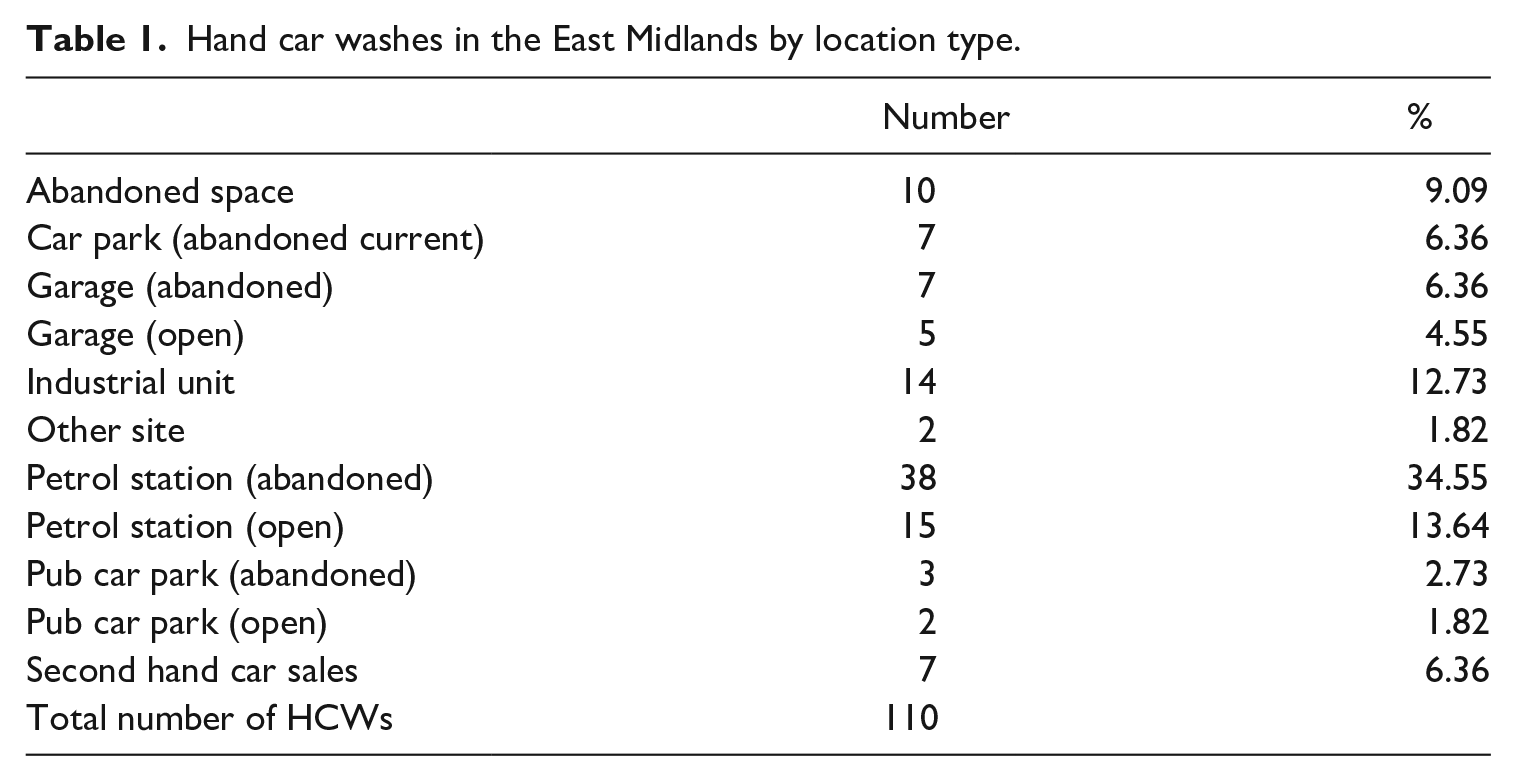
Across five cities, Derby, Leicester, Loughborough, Lincoln and Nottingham, we have mapped and tracked 110 hand car washes. We summarize this material in Table 1. We also illustrate the location of these cities in Figure 1.
Hand car washes in the East Midlands by location type.
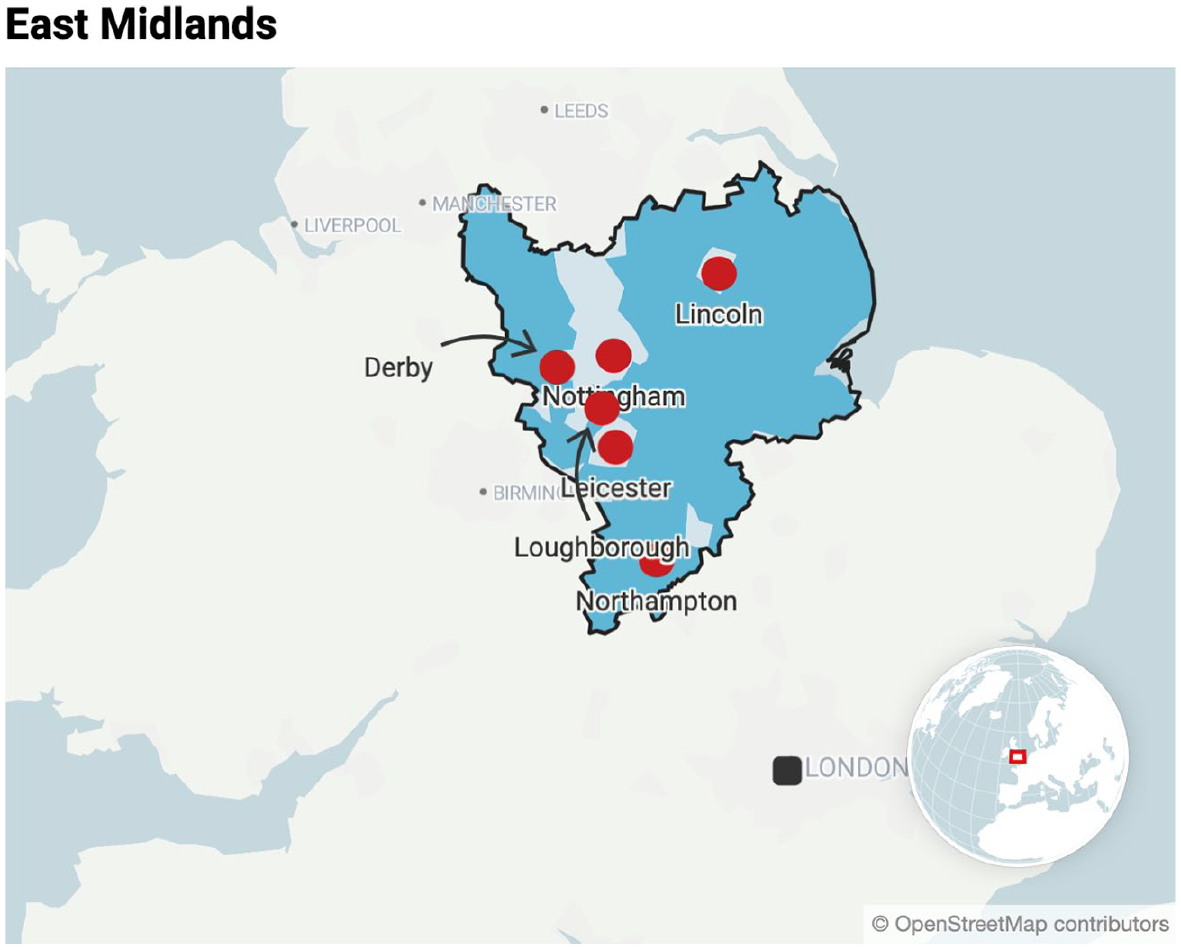
City locations where we mapped car washes in this study. Leicester is 100 miles (160 kilometres) north of London.
Our research found that the most common site for a hand car wash is an abandoned petrol station, followed by open petrol stations where car washes operate as informalized satellite businesses, followed by car washes on industrial sites such as business parks. Car washes located on car parks of any type – city centre multi-story car parks, supermarket car parks or car parks of other business premises such as gyms – accounted for only 8% of the total number that we recorded across the five cities. This finding is consistent with our wider study that incorporates the West Midlands, the South West of England and the North West of England up to the Scottish border. We also know from Google Street View time line research that the vast majority of car washes on abandoned petrol stations have an embedded presence with many going back to 2008–2009.
Discussion and conclusion
We discuss our empirical material in the light of the research dynamics that enable informalization and the associated questions we aim to answer, but before that we provide some policy suggestions.
In terms of public policy our research suggests that the best way to better protect workers is to regulate via a licensing scheme which is focused on where the majority of car washes are present: abandoned and open petrol stations and second hand car lots. These outlets tend to be on A-roads and are highly visible and they are relatively embedded, many having a 10-year history. We feel that of the four options for a licensing regime laid out by the DLME that full licensing where compliance competencies are mandatory and enforced by the state is necessary. Alternatively, a state registration scheme should be mandatory and regulated by a state body but on a city wide basis. Either form of licensing can operate on a city basis in a similar fashion to the proprietor licensing scheme for tenants in major cities such as that negotiated between Nottingham Citizens and Nottingham City Council. Such a community approach will at least bring into play issues of the real living wage, migration and inclusion and in-work poverty to the licensing mechanism. For workers at hand car washes this may not become a first stage of more formalized engagement with trade unions on the McAlevey (2018) model of deep organizing. Rather than this, we concur with the arguments presented by Virdee and McGeever (2018) and Hyman and Gumbrell-McCormick (2017) on the reticence of established trade unions to engage with informalized work in sectors where migrant workers appear to be predominant. We say this because a limitation of our work centres on the hard to reach fragmented nature of the workplaces under study. To overcome this the next stage of our research will extend to other sectors such as nail bars to address the issue of worker agency in alternative regulatory spaces in more detail.
To advance knowledge on the three dynamics that enable informalization at hand car washes, our research reveals a permissive approach to informal hand car washes and exploitation of workers therein. This approach can only encourage the ownership and rentier class to engage in businesses which whilst lawful entities may fail to employ workers lawfully. On the first research dynamic, which theorizes hand car washes as hard to reach workplaces, hand car washes reproduce capitalist production relations in small to medium sized businesses that are overwhelmingly non-unionized. However, car washes do so informally and are able to stay in business because of the cheap service they provide to customers, which rests on wage theft from mainly migrant labour.
Our second research dynamic centres on the absence of collective dynamics in and around the workplace. Rather than deep organizing (on the Center for Popular Democracy model in Manhattan) or shallow mobilization (in the model of city wide licensing in Los Angeles), we found norms of behaviour and expectations of exploitation that may or may not develop into a workplace dynamic. More theoretically, the capture of regulatory space by a neoliberal state and its alternative re-capture by informalized employers enable, promote and embed deregulation and flexibility. However, the latter re-capture externalizes these beyond the enforcement of formal labour market regulations for car wash workers. This is a key dynamic that makes these workplaces hard to reach where informalization as we describe it appears as a new form of (de-)regulation managed by employers and owners at hand car washes but beyond the reach of the state.
The third research question addresses how licensing as formulated by regulators represses worker interests. The labour process, individual worker interests and collective voice in the workplace have no visibility in an accreditation system for businesses as businesses. The accreditation of supermarket trolley washes supported by the GLAA misses the bulk of car washes that operate by the roadside. Regulators and some trade unions effectively deny that these are significant sites in terms of the spectrum of modern slavery, labour exploitation and potential union membership. Exploitation centres on informalized contractual degradation, fragmented workplace oppression and the absence of recognition for individual and or collective interests and voice where accreditation represents the interests of established car wash businesses. The GLAA endorsement of the responsible car wash scheme approximates to the weakest form of accreditation (unlike the regulatory licensing outlined by the DLME): that of voluntary business accreditation by a professional body. This approach marginalizes trade unions and collective bargaining as the institutions and processes that can ameliorate labour exploitation, and does so by effectively representing the interests of established employers in the petrol-retailing sector. Similarly, accreditation maintains labour market flexibility by eschewing a central focus on worker interests. Moreover, as a form of workplace regulation for car washing, but not necessarily worker interests, it relies on individuals bringing legal claims to enforce their rights or going through the GLAA call centre, which the evidence suggests workers do not do.
The concept of regulatory space is complex and varied, where multiple agencies and institutions disaggregate the state as a unitary body. That is, the state is central to the reproduction of the social relations of capitalism even where in so doing its agencies or institutions may condone or enable informalization of work and employment: for example, by highlighting migrants as internal others rather than promoting individual or collective worker rights and representation. Moreover, tensions between state agencies and institutions illustrate the political struggles over compliance approaches favoured by the DLME and law and order approaches favoured by BEIS, the GLAA and its sponsoring department, the Home Office.
The overriding reason for the presence of informalization at hand car washes is the status they have as hard to reach workplaces. Across these workplaces, alternative para-state groups of actors capture the boundaries between embedded and innovative regulatory spaces. This deters collective representation of workers as agencies, and institutions of the state focus on the interests of legitimate businesses not workers, while many car wash workers expect exploitation and accordingly tolerate it in the workplace. Trade unions too view unorganized informalized workers as problematic in terms of organizing drives, preferring instead to point towards specialist bodies that aim to protect exploited workers. In terms of a pattern of causation, the absence of collective representation at hand car washes follows on from a series of restructuring and agency relationships within the state, the workforce and different regulatory bodies that appear unconnected but which do, in amalgamation, enable and facilitate continued informalization at the vast majority of Britain’s hand car washes.
Footnotes
Acknowledgements
The authors are all members of the Work, Informalization and Place research group, Nottingham Trent University, UK. We are grateful for the support of Baback Yazdani, Alistair Bruce, Peter Murphy and Cillian Ryan and express our thanks to our researchers, Jack Barrett, Kelsey Brennan and Catrin Harris.
Declaration of conflicting interests
The authors declared no potential conflicts of interest with respect to the research, authorship, and/or publication of this article.
Funding
The research that this article reports on was funded by the Nottingham Trent University core research theme ‘The safety and security of citizens in society’.
