




Abstract
This article investigates the employment effect of short-time work in the Netherlands during the Great Recession (2009–2011). Short-time work was introduced during the period as a special arrangement with the aim of reducing unemployment hikes by offering firms the possibility of adjusting the working time of specialised workers rather than adjust the size of their workforce. The authors focus on the effect of short-time work at the individual level of the worker and study whether short-time programme participants in surviving firms had a lower job turnover rate and transition rate to unemployment compared to workers who did not participate in the programme. Furthermore, the authors study whether the flexibility policies of the firm had a substantial influence on the effectiveness of short-time work in protecting workers from unemployment. Specifically, they investigate whether the effect of short-time work is related to the intensiveness of its use by the firm and the extensiveness of the use of external flexibility arrangements – i.e. temporary contracts and temporary agency workers – by the firm. For this purpose, the authors apply a discrete-time survival model using a unique dataset with monthly register data from Statistics Netherlands. Participants in the short-time work programme are compared with non-participant workers from firms that used short-time work and workers from firms that did not make use of the programme. The findings indicate that, in surviving firms, short-time work had a positive effect: the risk of unemployment and job separation is, in most cases, lower for short-time work participants than non-participants. Short-time work is most effective in protecting workers from unemployment in firms that extended the use of the programme to many workers and for a relatively small number of hours, and that made either moderate use of temporary agency workers or extensive use of fixed-term contracts.
Introduction
In response to the Great Recession of 2009–2011, several countries introduced or expanded the use of short-time work programmes (STW), such as Kurzarbeit in Germany, Tijdelijke werkloosheid in Belgium and Cassa Integrazione Guadagni in Italy (Hijzen and Venn, 2011). STW is a flexibility arrangement that allows employers to reduce the working hours of their workers for a predetermined period. When this period expires, workers return to their contractual working hours. The idea behind STW is that it produces a win-win-win situation for firms, workers and the state. More specifically, firms avoid bankruptcy, excessive layoffs (Hall, 1995; Hall and Lazear, 1984) and retain the skilled workers that they need when economic growth returns, while they also keep morale high in times of hardship (Brusentsev and Vroman, 2012). Workers retain their jobs that they would otherwise lose if firms went bankrupt or if firms adjusted the size of their workforce. Finally, STW programmes help governments reduce hikes in unemployment and the corresponding hikes in unemployment benefit costs during economic crises (Burdett and Wright, 1989; Van Audenrode, 1994).
STW refers to the known concept of work sharing. The idea of reducing working hours in order to reduce unemployment has existed for many decades. Reduction of working hours to boost employment has been the aim of several policy reforms in the 1990s and early 2000s, such as the introduction of the 35-hour working week in France. Despite their popularity, there is no consensus on their effect on employment. Especially, research in economics has raised serious theoretical concerns on the effectiveness of work-sharing policies (see e.g. Askenazy, 2013; Calmfors, 1985; Freeman, 1998; Marimon and Zilibotti, 2000).
In line with the concerns on work-sharing policies, doubts have been raised on the effectiveness of STW policies especially in cases of prolonged use of STW and in cases where STW is used during an economic upturn (Mosley and Kruppe, 1996). Specifically, the way firms and workers use STW may deviate from the declared policy aims. The availability of publicly funded unemployment benefits for STW participants may introduce moral hazards relating to its use, as firms and workers may make implicit contracts for the postponement of planned layoffs (Blanchard and Tirole, 2008; Feldstein, 1976). Firms may also tend to use STW to gradually get rid of unwanted workers (Fréhaut, 2012). In these cases, STW may function more as a springboard to unemployment.
Findings on the effectiveness of STW programmes do not fully justify the original enthusiasm for the introduction of these programmes and give some credit to its critics. The effectiveness of short-time work arrangements remains controversial. For example, for Germany, while Balleer et al. (2016) suggest that, during the recent crisis, STW saved about 466,000 jobs, the firm-level analysis of Boeri and Bruecker (2011) suggests that the confidence interval of such an estimate is substantial as it lies between 34,000 and 770,000 jobs. They also suggest that STW financed some hour reductions that would have occurred anyway. The firm-level analyses of Kruppe and Scholz (2014) and Bellmann et al. (2012) are even more negative about STW, as they find no effect on unemployment. Burda and Hunt (2011) suggest that another arrangement, namely working time accounts, explains to a large extent the resilience of employment in Germany during the Great Recession.
Cross-country comparative research suggests that STW has a modest positive effect on employment when the programme is carefully designed and aligned with other employment policies (Aricò and Stein, 2012; Hijzen and Martin, 2013). More specifically, Arpaia et al. (2010) apply a difference-in-difference estimation of the effect of STW and find that drops in employment were lower in countries that used STW. Hijzen and Venn (2011) suggest that STW programmes were effective only in protecting workers with permanent contracts. Along the same lines, Cahuc and Carcillo (2011) suggest that STW was beneficial to workers, but at the same time reduced the prospects of job seekers. Boeri and Bruecker (2011) suggest that STW reduces unemployment hikes only when output falls considerably. Preliminary findings on the Netherlands support the same conclusion. Although STW was positively assessed by both employers and employees, actual findings suggest that the effect of STW, if any, is limited (de Groot et al., 2012; de Jong, 2011; OECD, 2010).
However, almost all research on STW is conducted at the national or firm level. The effect of STW on individual workers has hardly ever been investigated. To our knowledge, the only studies that address this effect are Speckesser (2010) and Calavrezo and Lodin (2012). Speckesser studies the microeconomic outcomes of STW in Germany during the recession of 1993–1994 and finds a positive employment effect of STW that only lasted 3 months. Furthermore, he finds some evidence of an increasing wage difference between the STW participants and non-participants, with lower wages for STW participants in the long run. Calavrezo and Lodin examine the effect of the French STW programme during the Great Recession. They find that the probability of unemployment is twice as high for STW participants than non-participants within 3 months after leaving STW. However, this research is very preliminary and does not give us adequate insight into whether STW has employment effects on individual workers that cannot be explained by firm effects.
The possible individual-level effects of STW are related to the personnel flexibility strategy of the firm. Firstly, this has to do with the way that the firm itself uses STW. In more detail, the firm has a spectrum of choices with regard to STW intensity according to the size of the workforce that is subjected to STW and the size of the hours reduction that STW brings. Secondly, alongside STW, firms also use several forms of external flexibility, such as fixed-term contracts and temporary agency workers, to adjust the size of their workforce during a crisis. The extent to which such contracts are available may influence the effectiveness of STW in reducing the unemployment probability of the individual worker. These issues have never been studied systematically in previous research.
This article aims to investigate the effect of STW on the probability of unemployment and job separation at the individual level. Specifically, we study whether the likelihood of becoming unemployed or changing employer differs between STW participants and non-participants in firms that survived the crisis. We use two control groups to identify the effect of STW: non-participants from firms that used STW, and non-participants from firms that did not use STW. Moreover, we investigate whether the intensity of STW use by the firm and the extent of the availability of external flexibility arrangements, i.e. fixed-term contracts and temporary agency workers, influence the effect of STW.
The article is organised as follows. In the second section, we discuss how STW was introduced in the Netherlands. In the third section, we discuss the relationship of STW to the concept of labour market flexibility. In the fourth section, we present the data and the methodology that we used. In the fifth, we discuss the results of the survival model, and in the final section, we discuss the conclusions of our research.
The Dutch STW programme
The Deeltijd-WW programme was introduced in April 2009. Under this programme, employers were able to reduce the weekly working hours of workers up to 50% for 13 consecutive weeks. Participation was compulsory for workers. However, firms needed the consensus of the works council and permission from the Institute for Employee Insurance (UVW) (Staatscourant, 2009a). It is important to mention that the firm did not have to present hard evidence of economic hardship due to the crisis in order to participate in the programme.
Firm participation in STW could be renewed for two additional consecutive periods of 26 weeks, letting STW vary in duration between 13 and 65 weeks. If the STW participant had built up entitlement to unemployment insurance, (s)he received unemployment benefits for the lost working hours. Unemployment benefits in the Netherlands replace wages by 70%. Workers employed more than 12 hours a week are entitled to 1 month of benefits for every year of employment and to a maximum of 2 years. STW participants who received unemployment benefits had no job search obligations. Firms had to sustain no extra costs – i.e. experience rating – for the use of STW. They were allowed to supplement the unemployment benefit up to the level of the full wage for these hours. If the participant worker was not eligible for unemployment benefit, the firm had to continue paying the wage for the full contractual hours (Staatscourant, 2009a). In practice, this meant that firms were very reluctant to place in STW workers with no or little accrued entitlement to unemployment benefits (typically young workers) because this would not allow them to reduce labour costs. Furthermore, the employer was obliged to make written agreements about the training and assignment of participant workers (Staatscourant, 2009a). Firms could place in STW workers who were employed under either a permanent or a fixed-term contract. If a firm laid off a worker during STW participation or 3–5 months after the end of the programme (depending on the time that the worker participated in STW), it would be liable to a fine from the Employment Office.
In July 2009 – only 3 months after the introduction of the STW scheme – more than 19,000 workers had already participated, and the available government budget was entirely used up (CBS, 2011; Staatscourant, 2009b). For this reason, the programme was extended until April 2010, and the budget was increased, while the eligibility rules were tightened. The most critical adjustment concerned the introduction of a minimum of 20% reduction in working time and a minimum duration of 26 weeks. Moreover, the duration of STW was made dependent on the number of participating workers in the company. These adjustments were introduced to ensure that only firms that had been substantially affected by the crisis could apply for STW. Some additional penalty clauses were also built in to prevent misuse. In February 2010, the number of participating workers reached its peak at 39,000. The programme was then extended for the last time until July 2011, while new applications were accepted until April 2010 (Staatscourant, 2010). In total, 7836 firms – representing 5% of all firms – and 77,430 employees – representing a moderate 1% of the workforce 1 – participated in STW. About half of the participating firms used STW for more than 6 months, while approximately 12% used the arrangement for more than a year. Participant workers stayed in STW for an average period of 28 weeks and their total working time was reduced by an average of 470 hours (de Groot et al., 2012). In their survey of participant firms and workers, de Groot et al. found that 54% of participants had a tenure longer than 10 years, 96% had a permanent contract, and 19% had a supervisory function. 2 Moreover, they found that 66% of the participants received a wage-supplement from the employer while 89% of those receiving a supplement were fully compensated for the wage loss.
Overall, the Dutch Deeltijd-WW was considered to be a carefully planned arrangement with balanced eligibility criteria for employers and employees, some flexibility in the volume of hours and workers in its use and an income supplement for participating workers (Messenger and Ghosheh, 2013).
The estimated impact of the STW programme on the unemployment rate in the Netherlands is also modest. It is estimated that STW reduced unemployment by 0.1–0.2 percentage points, saving a little more than 5000 jobs during the crisis. However, some studies challenge these meagre findings and present a more positive image of STW suggesting that 27,000 to 28,000 jobs were saved in 2009 (Messenger and Ghosheh, 2013). Flecker and Schönauer (2013) report that 4 out of 10 jobs in danger were saved by STW. However, their study is based on a small sample of companies (N = 30) originating from a survey that was carried out by de Klaver and de Ruig (2009).
Perceptions of the effectiveness of the programme differ significantly between employers and workers. Specifically, 78% of the employers but only 34% of the workers of participating companies considered that there would have been more layoffs without STW (de Groot et al., 2012). Although de Groot et al. do not provide further explanations for this discrepancy, this could be an indication of moral hazard on the side of the employers.
Short-time work and labour market flexibility
Short-time work and flexibility strategy of the firm
The role of the STW as a flexibility instrument has been somewhat neglected. Seminal work on labour market flexibility has distinguished between external and internal flexibility, while a further distinction was made between numerical and functional flexibility (Atkinson, 1984; Hunter et al., 1993; Kalleberg, 2001; Smith, 1997). External numerical flexibility refers to the adjustment of the number of workers – or otherwise labour intake – by firms from the external labour market. Internal numerical flexibility refers to the adjustment of the working hours of workers that are already employed by the firm. STW represents a form of internal numerical flexibility as it involves an adjustment of working hours without laying off workers (Calavrezo et al., 2009; Wilthagen and Tros, 2004).
The simultaneous use of external and internal flexibility arrangements by a firm is known to create interactions in their outcome (Appelbaum et al., 2000; Cappelli, 1995; Cappelli and Neumark, 2004; Kalleberg, 2001; Takeuchi et al., 2003). This is also the case for STW. In more detail, evidence suggests that firms are more likely to use STW when they lack adequate levels of external flexibility in the form of fixed-term contracts and temporary agency workers (Bellmann et al., 2012; Boeri and Bruecker, 2011; Crimmann et al., 2012; Deeke, 2005; Gonthier, 2012). 3 If the effect of an economic downturn lasts longer than expected, firms that lack an adequate share of such types of contracts would be forced to lay off workers. In this case, previous STW participants would be the obvious candidates, and the outcome would be that STW is related to an increased likelihood of unemployment.
In the Netherlands, the labour market is characterised by the extensive use of external numerical flexibility in the form of fixed-term contracts and temporary agency work. Using the availability of such flexibility arrangements to reduce labour costs (i.e. by not renewing temporary contracts) within a period of economic crisis would result in increased unemployment. Therefore, the use of an arrangement that can reduce labour costs without increasing unemployment is very relevant to the Dutch labour market.
Hypotheses
STW is an internal flexibility arrangement that reduces the probability of unemployment for all workers of the participant firm and strengthens the worker–firm relationship. However, STW is not supposed to create different career perspectives within a firm. Ceteris paribus, STW reduces the probability of unemployment for all workers of the firms – i.e. STW participants and non-participants.
Hypothesis 1a: The likelihood of becoming unemployed or changing employer is lower for workers of firms using STW than for workers of firms not using STW.
Hypothesis 1b: Within a firm using STW, the likelihood of becoming unemployed or changing employer is the same for participant workers and non-participant workers.
The effect of STW should be stronger the more workers of the firm are involved in STW. A large fraction of workers in STW would indicate that the arrangement is not misused to push less wanted workers out of the firm gradually.
Hypothesis 2: The likelihood of becoming unemployed or changing employer decreases with the intensity of use of STW by the firm. Intensity refers to the share of workers that are placed in STW and to the share of their working time that they are placed in STW.
The effectiveness of STW in reducing the probability of unemployment depends on the size of external numerical flexibility in the firm. STW has its optimal effect in firms that have some external numerical flexibility to adjust in times of crisis.
Hypothesis 3: The effect of STW in reducing the probability of unemployment and job separation increases with the share of external numerical flexibility (temporary contracts and temporary agency workers) in the firm.
External numerical flexibility arrangements differ amongst each other. In particular, in the Netherlands, firing a worker with a temporary contract before the expiration of the contract was as costly as firing a worker with a permanent contract in the period of reference. By contrast, terminating a contract with a temporary employment agency was much easier. Therefore, temporary agency work offers more immediate external flexibility than temporary contracts.
Hypothesis 4: The moderating effect of the size of temporary agency employment on the effect of STW on unemployment is larger than the moderating effect of the size of temporary contracts in the firm.
Data and identification strategy
For this study, we utilise unique register data from Statistics Netherlands (CBS). Specifically, we merged register data from the Social Statistical Database (Sociaal Statistisch Bestand – SSB) (Bakker et al., 2014), register data on STW participation from the Deeltijd-WW database, register data from the database on court decisions on bankruptcy declarations, data on firm revenue from the mixed revenue database of Statistics Netherlands 4 as well as survey data on the share of temporary agency workers and other forms of flexible contracts 5 from the Production Statistics business survey. Data from different sources were merged at the individual level by the Citizen Service Number (Burgerservicenummer – BSN) and the business unit identifier (Bedrijfseenheid identificatie – BEID). Our final dataset contains monthly records of workers between 20 and 65 years from January 2009 until December 2011.
The identification of the causal effect of STW on unemployment is not an easy task as firms that participate in STW are a selective group (Bellmann et al., 2012; Boeri and Bruecker, 2011; Cahuc and Carcillo, 2011). As firms that face economic hardship self-select themselves in STW, it is difficult to find a suitable control group, namely firms that are in the same situation but do not participate in STW. This selection issue also applies to our study, which is carried out at the individual level. Since our data do not offer much information at the firm level, we cannot apply proper instrumental variables modelling or propensity score matching. Moreover, our data construction process was restricted by the options offered by Statistics Netherlands. Therefore, our identification strategy includes two steps. First, we select two control groups of workers that did not participate in STW: non-participants from firms that used the programme (control group 1) and non-participants from firms that did not use the programme (control group 2). Second, we include all the existing information on possible spurious variables in our statistical model, i.e. revenue change, economic sector and firm size. It is certain that our approach leaves much room for improvement depending on data availability.
For our experimental group, the register data include all STW participants. For the control groups, we took samples to reduce the number of research objects and make the analysis computationally feasible. Specifically, for control group 1, we took a 20% sample of non-participant workers stratified by the firm identification number to ensure that all firms that used STW are included in the analysis. For control group 2, we used multistage stratified sampling. In more detail, we first took a 1% sample of non-participant firms stratified by firm size and industrial sector. This was followed by a random 10% sample of workers within the sampled firms. As the participation of firms and workers in STW varied over the observation period, we chose October 2009 as the moment to draw the sampled mentioned above. October 2009 was chosen as this was the peak in payments of unemployment benefits to STW participants (Chkalova, 2010).
Since we focus primarily on the effect of STW at the individual level of the worker, layoffs due to bankruptcy are not relevant for our study. Therefore, workers from firms that went bankrupt in the research period were kept in the dataset until one year before the bankruptcy.
Data on the share of flexible contracts within the firm were derived from different sources. Register data were used to measure the share of fixed-term contracts within firms. Survey data were used to measure the share of other forms of flexible contracts, such as temporary agency workers. In order to obtain a proper picture of the use of flexible employment contracts, we removed employees from firms with fewer than 50 employees. The consequence of this selection is that we can only draw conclusions for medium and large-sized firms. However, this does not introduce much bias in our analysis as small firms hardly used STW. Because the data on other forms of flexible employment originate from a survey, we encountered a 6.9% non-response rate for STW participants. Surprisingly, non-response was even more substantial in the control groups: 39% in control group 1 and 55% in control group 2. To rule out non-response bias, we compared our model with a model using the share of fixed-term contracts that is based on register data only. No significant differences were found in the coefficients of the control variables.
Our final dataset includes 110,135 workers. Of this group, 37,732 were STW participants and constituted the experimental group. Another 49,835 individuals were non-participants from the firms that used STW (control group 1) and 22,568 individuals worked in companies that did not use STW (control group 2). For every individual in these three groups, monthly employment-status indicators were constructed on whether the individual is employed and whether the individual participated in STW. In the case of multiple jobs, the firm characteristics of the job with the highest income were chosen. Subsequently, a monthly indicator for an employer change was constructed. The following background characteristics are included in the analysis: share of flexible contracts in the company by type (temporary agency workers, temporary contracts and other forms of flexible employment), the yearly revenue change of the firm between 2008 and 2009, sector of industry, firm size, gender, age, ethnic background, type of employment contract and income. Although educational attainment plays an essential role in the likelihood of unemployment, we could not control for this characteristic as it is not available in the register data. However, the group of STW participants is rather homogeneous and educational attainment is usually correlated with income. Hence, we used income as a proxy for educational attainment.
Table 1 presents descriptive statistics of workers in the research population. The typical STW participant is a middle-aged male Dutch person with a salary belonging to the third quintile of the salary distribution, employed in industry in a medium-sized firm that has suffered a large downfall in its revenue. STW participants are typically employed by firms using an average share of temporary agency workers and temporary contracts while non-participants work more often in firms that have high shares of flexibility.
Descriptive statistics for workers (in percentages).
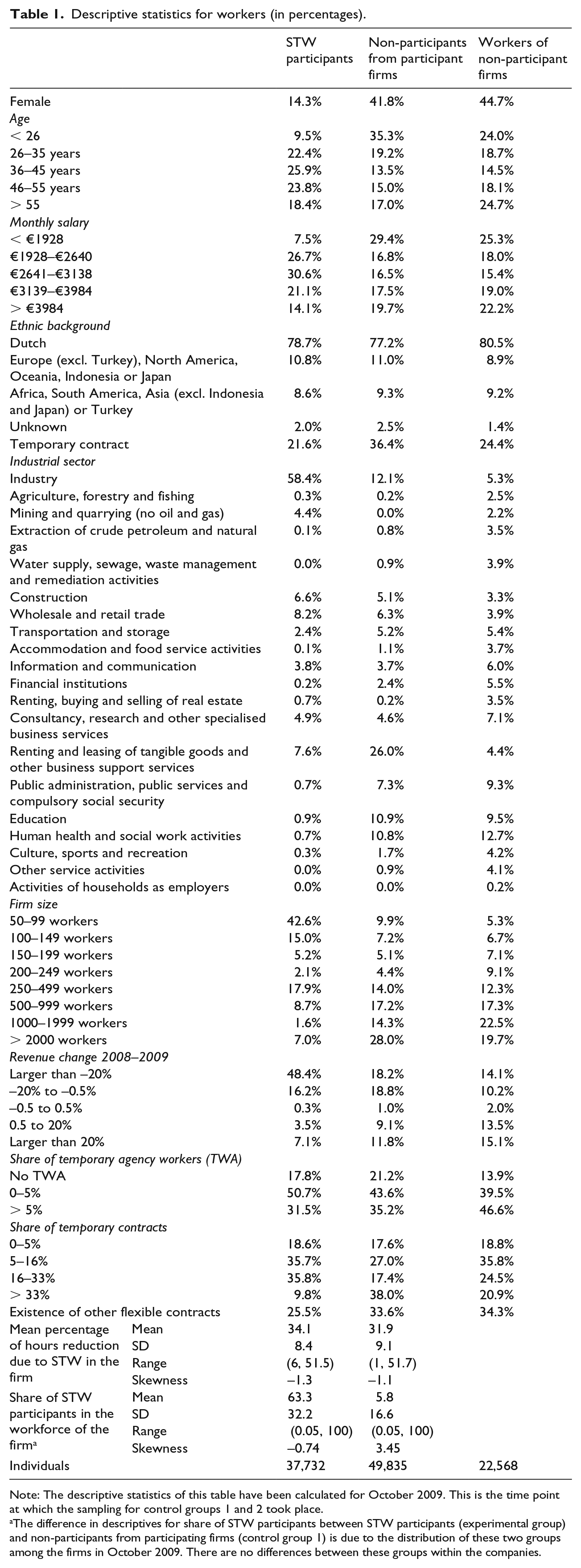
Note: The descriptive statistics of this table have been calculated for October 2009. This is the time point at which the sampling for control groups 1 and 2 took place.
The difference in descriptives for share of STW participants between STW participants (experimental group) and non-participants from participating firms (control group 1) is due to the distribution of these two groups among the firms in October 2009. There are no differences between these groups within the companies.
Gender differences between the control groups and experimental group are mainly due to gender segregation by industry. Male workers are overrepresented in construction and manufacturing, the sectors that were hit harder by the crisis in the Netherlands in 2009 and 2010 and hence used STW more often compared to other sectors with a more even gender representation. Concerning the age distribution, the overrepresentation of middle-aged workers is of little surprise considering the programme was aiming at highly specialised personnel, who are often more experienced and hence older. Moreover, middle-aged workers were more likely to have built up rights for unemployment insurance than young workers, which made them more attractive to employers as potential STW participants. The same explanation applies to the distribution of income among STW participants.
Table 1 also presents descriptives for the measures of STW intensity, the mean percentage of hours reduction due to STW participation in the firm and the share of STW participants in the workforce of the firm. The firms varied a lot in the share of workers that they placed in STW but much less in the working hours reduction that they imposed on workers due to STW. This is partly explained by legislation: the law imposed restrictions on working hours reduction (i.e. in the beginning a maximum and later also a minimum) but not on the share of workers that firms placed in STW. The descriptives show that STW participants were employed in firms that on average placed 63.3% of their workforce in STW and reduced the working time of STW participants by 34.1%.
The revenue change of the firm – which is also included in Table 1 – is based on the revenue difference between 2008 and 2009. Conceptually, this variable indicates whether the firm was affected by the economic crisis. The inclusion of this variable in the analysis is particularly crucial. Specifically, as Table 1 shows, while there is a higher representation of STW participants from firms with negative revenue change, there is still a sizable number of workers from firms that did not use STW but still had a negative revenue. Therefore including this variable in the analysis as a covariate can somehow control for a possible selection effect. However, the fact that there are a lot of missing values in this variable prevents us from claiming that it allows us to control for this selection effect fully.
The competing-risks survival model
In this article, we employ a discrete-time competing-risks survival model. The risk set refers to individuals in paid employment. As explained in the previous section, information for all individuals is available from January 2009 until December 2011. However, STW introduces a conceptual complication in our model. If a firm fired an STW participant during the time that he/she participated in STW or shortly thereafter, 6 it would have received a fine from the employment office. In practice, this means that for the period that the fine applied, STW participants were never fired. Therefore, for this period, it would be inappropriate to include them in our risk set. For this reason, STW participants were only included in the risk set when the fine was no longer applicable to them. This means that in our survival model, time refers to the number of months that elapsed until someone becomes unemployed or changes jobs as from January 2009 for workers of control groups 1 and 2 and from the moment that the fine mentioned above does not apply for STW participants.
The competing risks that we specified are unemployment and job separation. Job separation is operationalised as a change of employer. Although unemployment is our main focus, a survival model with unemployment as a single risk would be inappropriate. The reason is that workers that feel unwanted by the employer may choose to quit their job and move to another firm instead of waiting for the layoff. In cases where employers used STW to marginalise unwanted workers, the consideration mentioned above interferes severely with our research question. This means not only that job separation is an obvious candidate for a competing risk but also that unemployment and job separation could be correlated as competing risks.
The model is estimated as a multinomial logit model using the approach of Allison (1982). In this survival model, the dependent variable is the conditional probability that an individual i makes a transition into state m in time t conditional that he/she has remained employed until the previous time point t – 1. Duration dependence is specified as a covariate in the model and was modelled as logarithmic duration. The model includes a vector of covariates
Unobserved heterogeneity, i.e. the tendency of individuals to stay or to leave employment for reasons other than the predictors of the model, is an important source of potential bias in survival models. Failing to correct for it may overestimate duration dependence and overestimate the coefficients of the predictors. Moreover, correcting for it is also necessary to control for the correlation between the competing risks (Vermunt, 1997). Therefore, unobserved heterogeneity is treated in the model with a latent class approach (Vermunt, 1993, 2002). Intuitively, this approach assumes that individuals are classified in J latent classes according to the probability of being in the three states: employment, unemployment, job separation. The number of the latent classes is a priori defined, but the probability of belonging to every class is estimated by the model. The choice for the number of latent classes was made according to the model fit measures (Bayesian Information Criterion – BIC and Akaike Information Criterion – AIC). In our case, after inspecting these model fit measures, we specified a model with two latent classes. The transition probability for individual i that belongs to group j is given by:
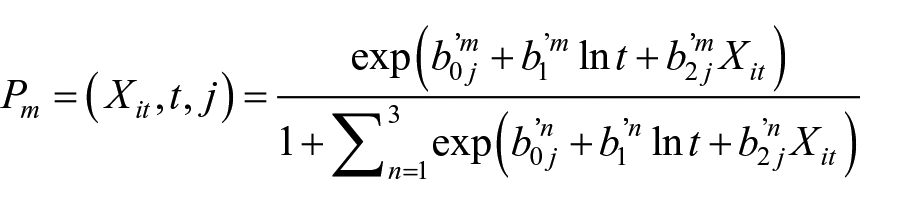
where t is the duration of employment.
Results of the survival model
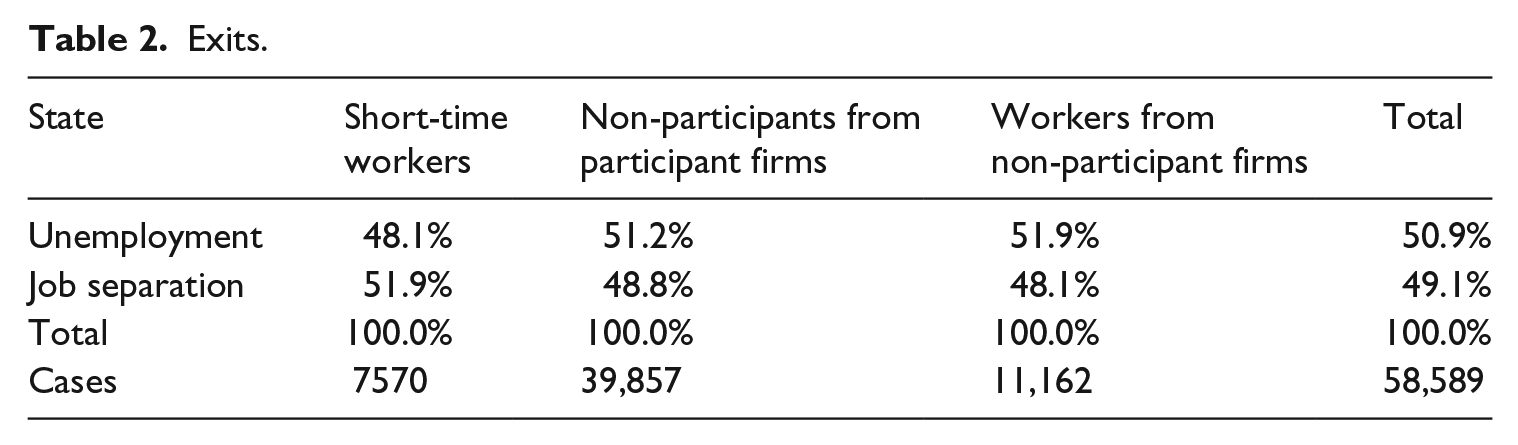
In our data, we observe in total 58,589 exits from employment. As shown in Table 2, these are roughly equally distributed between unemployment and job separation. This is also the case if we focus within groups defined by the experimental conditions (STW participants, non-participants from participant firms and workers from non-participant firms).
Exits.
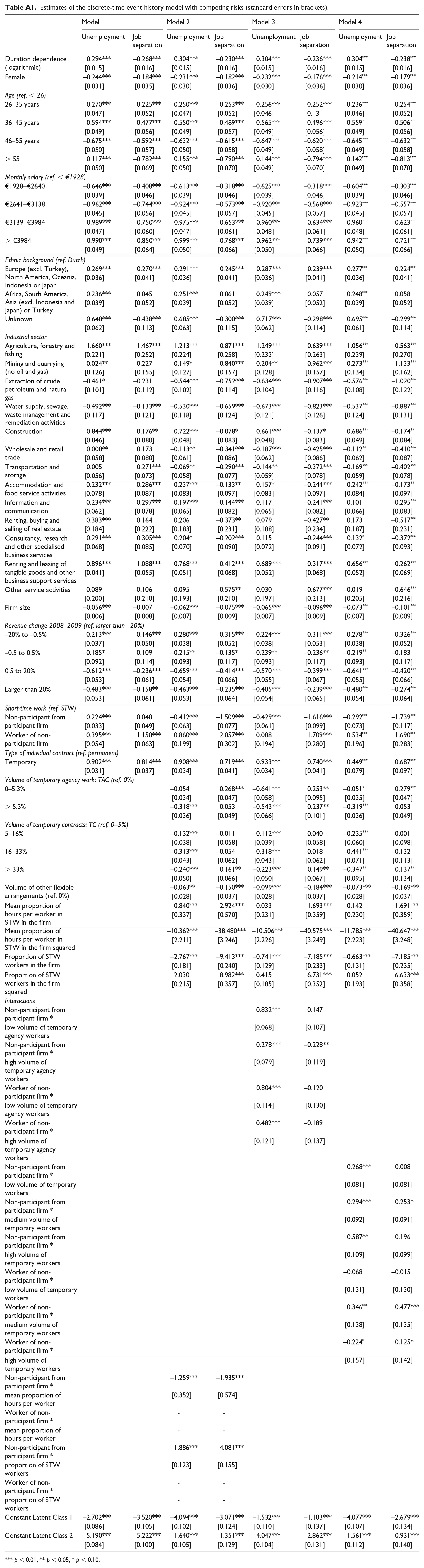
In total, we estimated four survival models (see Table A1 in the Appendix). Model 1 only includes predictors at the individual level and is used as the baseline model. In Models 2–4, we add predictors at the firm level, namely predictors concerning the intensity of the use of STW by the firm, i.e. the proportion of workers in STW in the firm and the average proportion of individual working hours reduction due to STW in the firm, as well as predictors on the use of other flexible working arrangements by the firm, i.e. the share of fixed-term contracts, the share of temporary agency workers and the share of other flexible contracts in the firm. In each of these models, we focus mainly on the interplay of one of these firm characteristics with the experimental condition. Specifically, Model 2 includes interactions of the experimental condition with the measures of intensity of STW use, Model 3 interactions of the experimental condition with the share of temporary agency workers, while Model 4 includes interactions with the share of fixed-term contracts in the firm. The list of control variables consists of gender, ethnicity, age, contract type, monthly salary, sector of employment, firm size and revenue change between 2008 and 2009. In what follows, we discuss the main results concerning our research question.
To illustrate the baseline effect of STW, Figure 1 presents the two-way graphs of the smoothed values of the predicted hazard of unemployment and job separation with the duration of employment until the transition occurs. Figure 1 shows that both the predicted hazard of unemployment and the predicted hazard of job separation are much lower for STW participants than for non-participants from firms that used STW (control group 1) and workers of the firms that did not use STW (control group 2). This finding is in accordance with Hypothesis 1a but not with Hypothesis 1b. This effect of STW reduces with the duration of the employment spell. After 25–30 months, STW participants have the same hazard of unemployment as workers from non-participant firms and the same hazard of job separation as non-participants from firms that use STW.
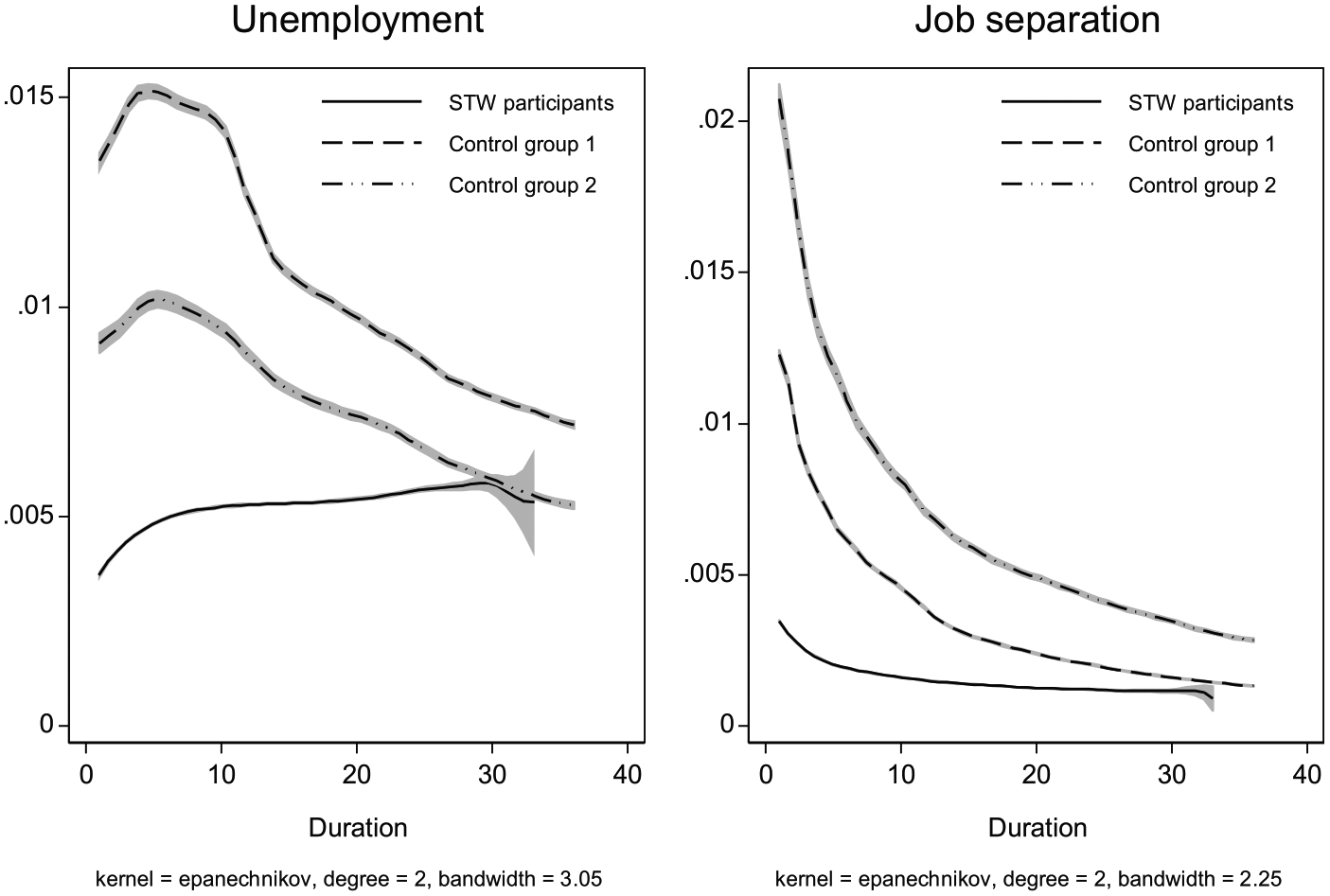
Smoothed plots of the predicted hazard of unemployment and job separation.
The findings above indicate that STW introduces differences in the careers of workers even within the firm. Probably the most surprising finding is that non-participants from firms that use STW have the highest hazard of unemployment among all three groups. It seems that STW participants are the group of workers that firms want to retain the most.
In Model 2, we include predictors for the firm and focus mainly on the role of the intensity of STW use by the firm: the mean proportion of hours in STW in the firm and the proportion of workers that are placed in STW in the firm. To visualise the effect of these measures, Figure 2 presents the four 2-way graphs of the smoothed values of the predicted hazard of unemployment (graphs on the first row) and job separation (graphs on the second row) with the two intensity measures. These hazards refer to STW participants only. The smoothing is performed with a kernel-weighted local polynomial regression of degree 2.
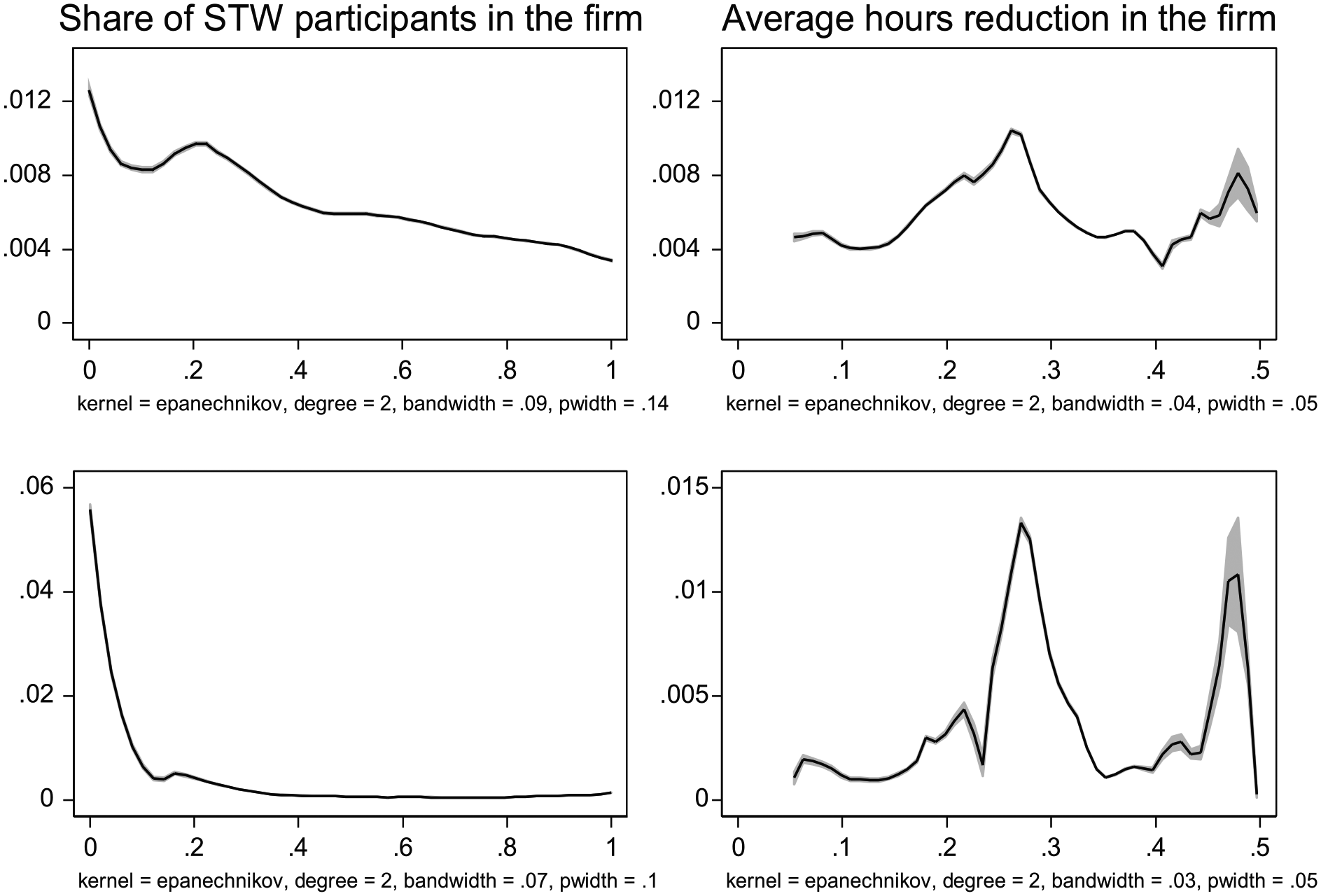
Smoothed plots of the predicted hazard of unemployment and job separation with the intensity of STW use.
Interestingly, the effect of the two measures of intensity differs considerably, and therefore no uniform conclusion can be drawn on Hypothesis 2. Specifically, both the hazard of unemployment and the hazard of job separation reduce with the share of workers in STW in the firm. The predicted hazard of unemployment is 0.012 when the share of STW workers in the firm is close to zero, while it decreases to 0.004 when this share approaches 100%. This decrease is uniform as from a share of 20%. The differences in the predicted hazard of a job separation are even more pronounced. Specifically, this hazard reduces from 0.055 when the share of STW workers in the firm is close to zero, and to 0.003 when the share approaches 100%.
The results concerning the other intensity measure, i.e. the mean proportion of working time reduction in the firm due to STW, are somewhat different. Specifically, an inverse U-shape relationship emerges between the mean proportion of working time reduction and the predicted hazard of unemployment. This hazard is 0.0048 when the mean proportion of working time reduction is close to zero, rises to 0.01 when the working hours of STW participants in the firm are reduced on average by 27% and decreases again to 0.039 when the mean proportion of working time reduction of STW participants in the firm is 41%. For higher values of working time reduction, an increase in the predicted hazard is estimated. However, this estimation is based on a very small number of cases.
For job separation, the pattern is similar to unemployment except that the rise of the hazard is much sharper when the mean proportion of hours reduction of STW participants in the firm equals roughly 40%.
All in all, it seems that STW participants experience the lowest hazard of unemployment and job separation when they are employed in a firm with most of its workforce in STW, while it reduces their working time either by less than 20% or by 35–40%.
In Models 3 and 4, we introduce interactions of the experimental condition with the shares of temporary agency workers and fixed-term contracts in the firm. These interactions make the interpretation of the results challenging. Therefore, we present the relevant predicted hazards in Figure 3. Specifically, we present the predicted hazard of unemployment and job separation according to the share of temporary agency workers (graphs on the first row) and the share of fixed-term contracts in the firm (graphs on the second row). These predicted hazards are presented separately for STW participants, non-participants from firms that use STW (control group 1) and workers of firms that do not use STW (control group 2).
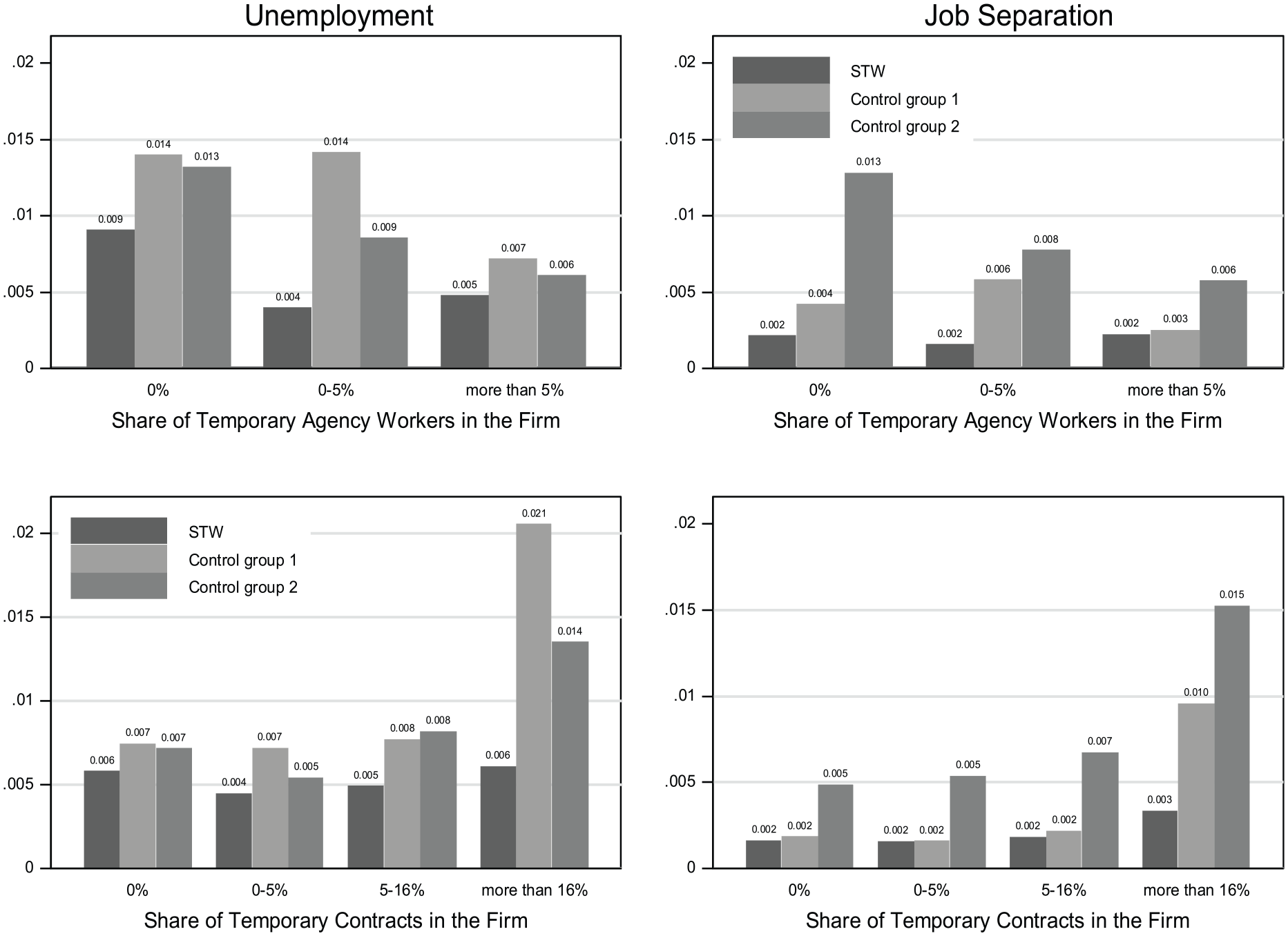
The predicted hazard of unemployment and job separation according to the measures of flexibility.
Figure 3 indicates that the predicted hazard of both unemployment and job separation is always the lowest for STW participants. However, the size of this effect differs according to the share of temporary agency workers and the share of temporary contracts in the firm. In contrast with Hypothesis 3, no indication of a linear effect of the share of temporary agency work emerges. Results reveal instead an inverse U-shaped pattern for the effect of STW. Specifically, in firms that do not use temporary agency workers, STW participants have a 35.7% lower hazard to become unemployed than workers from control group 1 (0.009 instead of 0.014) and a 31.8% lower hazard than workers from control group 2. The latter effect is not statistically significant. In firms using a moderate share of temporary agency workers (up to 5% of their workforce), differences are much larger. STW participants have a 71.8% lower hazard to become unemployed than workers from control group 1 (0.004 instead of 0.0142) and a 53.5% lower hazard than workers from control group 2. Finally, in firms using a relatively large share of temporary agency workers (more than 5%), the effect of STW is similar to firms using no temporary agency workers.
For the predicted hazard of job separation, the effect of STW seems to be larger when the worker is employed in a firm that does not use any temporary agency work or a moderate share of temporary agency workers. Specifically, in firms that do not use any temporary agency workers, STW participants have a 48.1% lower hazard to change jobs than workers from control group 1 and a 83% lower hazard than workers from control group 2. In firms using a moderate share of temporary agency work, STW participants have a 72.8% lower hazard to change jobs than workers from control group 1 and a 79.6% lower hazard than workers from control group 2. In firms using a relatively large share of temporary agency work, STW participants have a 11.3% lower hazard to change jobs than workers from control group 1 and a 61% lower hazard than workers from control group 2.
Results on the share of fixed-term contracts in the firm present a more straightforward pattern. As far as the predicted hazard for a transition to unemployment is concerned, the effect of STW is the largest in firms that use a relatively high share of fixed-term contracts. Specifically, STW participants have a 21.6% lower hazard to become unemployed than workers from control group 1 and a 18.4% lower hazard than workers from control group 2. In firms having a low share of fixed-term contracts (0–5%), STW participants have a 37.6% lower hazard to become unemployed than workers from control group 1 and a 17.5% lower hazard than workers from control group 2. In firms having a moderate share of fixed-term contracts (5–16%), STW participants have a 36.1% lower hazard to become unemployed than workers from control group 1 and a 39.9% lower hazard than workers from control group 2. In firms having a high share of fixed-term contracts (more than 16%), STW participants have a 70.3% lower hazard to become unemployed than workers from control group 1 and a 54.9% lower hazard than workers from control group 2.
When focusing on the probability of job separation, STW participants differ from non-participants in firms using STW (control group 1) only when they are employed in firms that have a high share of fixed-term contracts in their workforce. In contrast, STW participants always have a lower hazard of changing jobs from workers employed in firms that do not use STW (control group 2). However, this effect is the largest in firms that have a high share of fixed-term contracts.
Conclusion and discussion
Short-time work arrangements became particularly popular at the end of the previous decade as a measure to tackle the unwanted unemployment effects of the Great Recession. STW is supposed to produce a win-win situation for individuals, firms and the state: workers avoid unemployment, firms avoid bankruptcy and retain their high-skilled workers, while the state can reduce the unemployment hikes in a period of economic crisis. In this sense, STW was presented as an optimal policy instrument during an economic crisis. Despite the popularity of STW, its employment effects have only been investigated at the country- and the firm-level. These previous findings suggest that STW programmes had a modest effect on unemployment.
This article offers a unique contribution by studying the effect of STW at the individual level. For this purpose, we studied the effect of the Dutch STW programme – the Deeltijd-WW – which was in use from April 2009 until June 2011. STW participants from firms that avoided bankruptcy were compared to non-participants from participant firms and to workers from non-participant firms. We addressed three specific questions: first, do STW participants face a lower risk of unemployment and lower likelihood of a job separation; second, whether the intensity of STW used by the firm matters for the individual likelihood of unemployment and job separation; and third, whether the availability of external flexibility arrangements – i.e. fixed-term contracts and temporary agency contracts – matters for the employment prospects of STW participants.
For the first question, our findings reveal a positive picture for STW: in firms that survived the crisis, STW participants face a substantially lower risk of becoming unemployed after leaving STW compared to workers of non-participant firms. Surprisingly, the group with the highest risk of unemployment consists of workers that did not participate in STW but are working in firms that used STW. Concerning the second question, our results suggest that the firm strategy on STW use is also crucial in understanding the role of STW: STW protects workers from unemployment when the firm spreads its use to many workers but does not reduce their working time considerably. A valuable lesson on how to achieve the maximum effectiveness of STW programmes can be learned from this finding by policymakers, employers and trade unions.
Finally, for the third question, this article suggests that the availability of employment relations in the firm that can be terminated without costs – i.e. fixed-term contracts and temporary agency workers – is related to the effect of STW. STW is most effective in reducing the risk of unemployment in firms using a moderate share of temporary agency work or a high share of fixed-term contracts. This indicates that STW can serve its purpose best as an internal flexibility arrangement when the firm has some room to adjust its workforce during a crisis with the use of external numerical flexibility.
The findings of this article fit in the longstanding debate on the effectiveness of STW schemes but also in the theoretical debate on whether work-sharing can reduce unemployment. We show that a carefully designed STW programme that is introduced during a severe economic downturn, such as the Dutch Deeltijd-WW, is associated with longer employment spells of participant workers if their firm survives the economic downturn. The downside of our findings is that STW may have some adverse spillover effects for non-participant workers of firms that used STW.
Despite the somewhat positive image for STW that is illustrated by our study, this should not be interpreted as a recommendation to always use STW as a way to reduce unemployment. The first reason for this is that this research suffers to some extent from the same methodological issue as all research on STW: the selection effect. Finding non-participant firms or workers that are identical to participant firms of workers is almost a mission impossible. The reason is that STW is specially designed to assist the firms (and through them the workers) that face financial hardship due to an economic downturn. Therefore, it seems non-rational for such firms not to participate and be part of the control group. Therefore, further research should shed more light on the issue of causality in the role of STW.
The second reason is that the employment effects of an STW programme also depend on the institutional setup of the labour market and the set of employment policies that are implemented. If these factors vary between countries, identical STW programmes may lead to different employment outcomes (Aricò and Stein, 2012). Moreover, using STW for a long period and, especially, extending it to periods of economic recovery may lead to negative employment effects (Hijzen and Martin, 2013; Mosley and Kruppe, 1996). Finally, even if all these considerations are taken into account by policymakers, concerns have been raised that STW may lead to allocative inefficiency and output decrease (Cooper et al., 2017). These concerns and considerations should be addressed by further research.
Footnotes
Appendix: Results of the event history model
Estimates of the discrete-time event history model with competing risks (standard errors in brackets).
| Model 1 | Model 2 | Model 3 | Model 4 | |||||
|---|---|---|---|---|---|---|---|---|
| Unemployment | Job separation | Unemployment | Job separation | Unemployment | Job separation | Unemployment | Job separation | |
| Duration dependence (logarithmic) | 0.294*** | –0.268*** | 0.304*** | –0.230*** | 0.304*** | –0.236*** | 0.304 *** | –0.238 *** |
| [0.015] | [0.016] | [0.015] | [0.016] | [0.015] | [0.016] | [0.015] | [0.016] | |
| Female | –0.244*** | –0.184*** | –0.231*** | –0.182*** | –0.232*** | –0.176*** | –0.214 *** | –0.179 *** |
| [0.031] | [0.035] | [0.030] | [0.036] | [0.030] | [0.036] | [0.030] | [0.036] | |
| Age (ref. < 26) | ||||||||
| 26–35 years | –0.270*** | –0.225*** | –0.250*** | –0.253*** | –0.256*** | –0.252*** | –0.236 *** | –0.254 *** |
| [0.047] | [0.052] | [0.047] | [0.052] | [0.046] | [0.131] | [0.046] | [0.052] | |
| 36–45 years | –0.594*** | –0.477*** | –0.550*** | –0.489*** | –0.565*** | –0.496*** | –0.559 *** | –0.506 *** |
| [0.049] | [0.056] | [0.049] | [0.057] | [0.049] | [0.056] | [0.049] | [0.056] | |
| 46–55 years | –0.675*** | –0.592*** | –0.632*** | –0.615*** | –0.647*** | –0.620*** | –0.645 *** | –0.632 *** |
| [0.050] | [0.057] | [0.050] | [0.058] | [0.049] | [0.058] | [0.049] | [0.058] | |
| > 55 | 0.117*** | –0.782*** | 0.155*** | –0.790*** | 0.144*** | –0.794*** | 0.142 *** | –0.813 *** |
| [0.050] | [0.069] | [0.050] | [0.070] | [0.049] | [0.070] | [0.049] | [0.070] | |
| Monthly salary (ref. < €1928) | ||||||||
| €1928–€2640 | –0.646*** | –0.408*** | –0.613*** | –0.318*** | –0.625*** | –0.318*** | –0.604 *** | –0.303 *** |
| [0.039] | [0.046] | [0.039] | [0.046] | [0.039] | [0.046] | [0.039] | [0.046] | |
| €2641–€3138 | –0.962*** | –0.744*** | –0.924*** | –0.573*** | –0.920*** | –0.568*** | –0.923 *** | –0.557 *** |
| [0.045] | [0.056] | [0.045] | [0.057] | [0.045] | [0.057] | [0.045] | [0.057] | |
| €3139–€3984 | –0.989*** | –0.750*** | –0.975*** | –0.653*** | –0.960*** | –0.634*** | –0.960 *** | –0.623 *** |
| [0.047] | [0.060] | [0.047] | [0.061] | [0.048] | [0.061] | [0.048] | [0.061] | |
| > €3984 | –0.990*** | –0.850*** | –0.999*** | –0.768*** | –0.962*** | –0.739*** | –0.942 *** | –0.721 *** |
| [0.049] | [0.064] | [0.050] | [0.066] | [0.050] | [0.066] | [0.050] | [0.066] | |
| Ethnic background (ref. Dutch) | ||||||||
| Europe (excl. Turkey), North America, Oceania, Indonesia or Japan | 0.269*** | 0.270*** | 0.291*** | 0.245*** | 0.287*** | 0.239*** | 0.277 *** | 0.224 *** |
| [0.036] | [0.041] | [0.036] | [0.041] | [0.036] | [0.041] | [0.036] | [0.041] | |
| Africa, South America, Asia (excl. Indonesia and Japan) or Turkey | 0.236*** | 0.045 | 0.251*** | 0.061 | 0.249*** | 0.057 | 0.248 *** | 0.058 |
| [0.039] | [0.052] | [0.039] | [0.052] | [0.039] | [0.052] | [0.039] | [0.052] | |
| Unknown | 0.648*** | –0.438*** | 0.685*** | –0.300*** | 0.717*** | –0.298*** | 0.695 *** | –0.299 *** |
| [0.062] | [0.113] | [0.063] | [0.115] | [0.062] | [0.114] | [0.061] | [0.114] | |
| Industrial sector | ||||||||
| Agriculture, forestry and fishing | 1.660*** | 1.467*** | 1.213*** | 0.871*** | 1.249*** | 0.639*** | 1.056 *** | 0.563 *** |
| [0.221] | [0.252] | [0.224] | [0.258] | [0.233] | [0.263] | [0.239] | [0.270] | |
| Mining and quarrying (no oil and gas) | 0.024** | –0.227 | –0.149* | –0.840*** | –0.204** | –0.962*** | –0.273 *** | –1.133 *** |
| [0.126] | [0.155] | [0.127] | [0.157] | [0.128] | [0.157] | [0.134] | [0.162] | |
| Extraction of crude petroleum and natural gas | –0.461* | –0.231 | –0.544*** | –0.752*** | –0.634*** | –0.907*** | –0.576 *** | –1.020 *** |
| [0.101] | [0.112] | [0.102] | [0.114] | [0.104] | [0.116] | [0.108] | [0.122] | |
| Water supply, sewage, waste management and remediation activities | –0.492*** | –0.133*** | –0.530*** | –0.659*** | –0.673*** | –0.823*** | –0.537 *** | –0.887 *** |
| [0.117] | [0.121] | [0.118] | [0.124] | [0.121] | [0.126] | [0.124] | [0.131] | |
| Construction | 0.844*** | 0.176** | 0.722*** | –0.078* | 0.661*** | –0.137* | 0.686 *** | –0.174 ** |
| [0.046] | [0.080] | [0.048] | [0.083] | [0.048] | [0.083] | [0.049] | [0.084] | |
| Wholesale and retail trade | 0.008** | 0.173 | –0.113** | –0.341*** | –0.187*** | –0.425*** | –0.112 ** | –0.410 *** |
| [0.058] | [0.080] | [0.061] | [0.086] | [0.062] | [0.086] | [0.062] | [0.087] | |
| Transportation and storage | 0.005 | 0.271*** | –0.069** | –0.290*** | –0.144** | –0.372*** | –0.169 *** | –0.402 *** |
| [0.056] | [0.073] | [0.058] | [0.077] | [0.059] | [0.078] | [0.059] | [0.078] | |
| Accommodation and food service activities | 0.232*** | 0.286*** | 0.237*** | –0.133** | 0.157* | –0.244*** | 0.242 *** | –0.173 ** |
| [0.078] | [0.087] | [0.083] | [0.097] | [0.083] | [0.097] | [0.084] | [0.097] | |
| Information and communication | 0.234*** | 0.297*** | 0.197*** | –0.144*** | 0.117 | –0.241*** | 0.101 | –0.295 *** |
| [0.062] | [0.078] | [0.065] | [0.082] | [0.065] | [0.082] | [0.066] | [0.083] | |
| Renting, buying and selling of real estate | 0.383*** | 0.164 | 0.206 | –0.373** | 0.079 | –0.427** | 0.173 | –0.517 *** |
| [0.184] | [0.222] | [0.183] | [0.231] | [0.188] | [0.234] | [0.187] | [0.231] | |
| Consultancy, research and other specialised business services | 0.291*** | 0.305*** | 0.204* | –0.202*** | 0.115 | –0.244*** | 0.132 * | –0.372 *** |
| [0.068] | [0.085] | [0.070] | [0.090] | [0.072] | [0.091] | [0.072] | [0.093] | |
| Renting and leasing of tangible goods and other business support services | 0.896*** | 1.088*** | 0.768*** | 0.412*** | 0.689*** | 0.317*** | 0.656 *** | 0.262 *** |
| [0.041] | [0.055] | [0.051] | [0.068] | [0.052] | [0.068] | [0.052] | [0.069] | |
| Other service activities | 0.089 | –0.106 | 0.095 | –0.575** | 0.030 | –0.677*** | –0.019 | –0.646 *** |
| [0.200] | [0.210] | [0.193] | [0.210] | [0.197] | [0.213] | [0.205] | [0.216] | |
| Firm size | –0.056*** | –0.007 | –0.062*** | –0.075*** | –0.065*** | –0.096*** | –0.073 *** | –0.101 *** |
| [0.006] | [0.008] | [0.007] | [0.009] | [0.007] | [0.009] | [0.007] | [0.009] | |
| Revenue change 2008–2009 (ref. larger than –20%) | ||||||||
| –20% to –0.5% | –0.213*** | –0.146*** | –0.280*** | –0.315*** | –0.224*** | –0.311*** | –0.278 *** | –0.326 *** |
| [0.037] | [0.050] | [0.038] | [0.052] | [0.038] | [0.053] | [0.038] | [0.052] | |
| –0.5 to 0.5% | –0.185* | 0.109 | –0.215** | –0.135* | –0.239** | –0.236** | –0.219 ** | –0.183 |
| [0.092] | [0.114] | [0.093] | [0.117] | [0.093] | [0.117] | [0.093] | [0.117] | |
| 0.5 to 20% | –0.612*** | –0.236*** | –0.659*** | –0.414*** | –0.570*** | –0.399*** | –0.641 *** | –0.420 *** |
| [0.053] | [0.061] | [0.054] | [0.066] | [0.055] | [0.067] | [0.055] | [0.066] | |
| Larger than 20% | –0.483*** | –0.158** | –0.463*** | –0.235*** | –0.405*** | –0.239*** | –0.480 *** | –0.274 *** |
| [0.053] | [0.061] | [0.053] | [0.064] | [0.054] | [0.065] | [0.054] | [0.064] | |
| Short-time work (ref. STW) | ||||||||
| Non-participant from participant firm | 0.224*** | 0.040 | –0.412*** | –1.509*** | –0.429*** | –1.616*** | –0.292 *** | –1.739 *** |
| [0.033] | [0.049] | [0.063] | [0.077] | [0.061] | [0.099] | [0.073] | [0.117] | |
| Worker of non-participant firm | 0.395*** | 1.150*** | 0.860*** | 2.057*** | 0.088 | 1.709*** | 0.534 *** | 1.690 *** |
| [0.054] | [0.063] | [0.199] | [0.302] | [0.194] | [0.280] | [0.196] | [0.283] | |
| Type of individual contract (ref. permanent) | ||||||||
| Temporary | 0.902*** | 0.814*** | 0.908*** | 0.719*** | 0.933*** | 0.740*** | 0.449 *** | 0.687 *** |
| [0.031] | [0.037] | [0.034] | [0.041] | [0.034] | [0.041] | [0.079] | [0.097] | |
| Volume of temporary agency work: TAC (ref. 0%) | ||||||||
| 0–5.3% | –0.054 | 0.268*** | –0.641*** | 0.253** | –0.051 * | 0.279 *** | ||
| [0.034] | [0.047] | [0.058] | [0.095] | [0.035] | [0.047] | |||
| > 5.3% | –0.318*** | 0.053 | –0.543*** | 0.237** | –0.319 *** | 0.053 | ||
| [0.036] | [0.049] | [0.066] | [0.101] | [0.036] | [0.049] | |||
| Volume of temporary contracts: TC (ref. 0–5%) | ||||||||
| 5–16% | –0.132*** | –0.011 | –0.112*** | 0.040 | –0.235 *** | 0.001 | ||
| [0.038] | [0.058] | [0.039] | [0.058] | [0.060] | [0.098] | |||
| 16–33% | –0.313*** | –0.054 | –0.318*** | –0.018 | –0.441 *** | –0.132 | ||
| [0.043] | [0.062] | [0.043] | [0.062] | [0.071] | [0.113] | |||
| > 33% | –0.240*** | 0.161** | –0.223*** | 0.149** | –0.347 ** | 0.137 ** | ||
| [0.050] | [0.066] | [0.050] | [0.067] | [0.095] | [0.134] | |||
| Volume of other flexible arrangements (ref. 0%) | –0.063** | –0.150*** | –0.099*** | –0.184*** | –0.073*** | –0.169*** | ||
| [0.028] | [0.037] | [0.028] | [0.037] | [0.028] | [0.037] | |||
| Mean proportion of hours per worker in STW in the firm | 0.840*** | 2.924*** | 0.033 | 1.693*** | 0.142 | 1.691*** | ||
| [0.337] | [0.570] | [0.231] | [0.359] | [0.230] | [0.359] | |||
| Mean proportion of hours per worker in STW in the firm squared | –10.362*** | –38.480*** | –10.506*** | –40.575*** | –11.785*** | –40.647*** | ||
| [2.211] | [3.246] | [2.226] | [3.249] | [2.223] | [3.248] | |||
| Proportion of STW workers in the firm | –2.767*** | –9.413*** | –0.741*** | –7.185*** | –0.663*** | –7.185*** | ||
| [0.181] | [0.240] | [0.129] | [0.233] | [0.131] | [0.235] | |||
| Proportion of STW workers in the firm squared | 2.030 | 8.982*** | 0.415 | 6.731*** | 0.052 | 6.633*** | ||
| [0.215] | [0.357] | [0.185] | [0.352] | [0.193] | [0.358] | |||
| Interactions | ||||||||
| Non-participant from participant firm * | 0.832*** | 0.147 | ||||||
| low volume of temporary agency workers | [0.068] | [0.107] | ||||||
| Non-participant from participant firm * | 0.278*** | –0.228** | ||||||
| high volume of temporary agency workers | [0.079] | [0.119] | ||||||
| Worker of non-participant firm * | 0.804*** | –0.120 | ||||||
| low volume of temporary agency workers | [0.114] | [0.130] | ||||||
| Worker of non-participant firm * | 0.482*** | –0.189 | ||||||
| high volume of temporary agency workers | [0.121] | [0.137] | ||||||
| Non-participant from participant firm * | 0.268*** | 0.008 | ||||||
| low volume of temporary workers | [0.081] | [0.081] | ||||||
| Non-participant from participant firm * | 0.294*** | 0.253* | ||||||
| medium volume of temporary workers | [0.092] | [0.091] | ||||||
| Non-participant from participant firm * | 0.587** | 0.196 | ||||||
| high volume of temporary workers | [0.109] | [0.099] | ||||||
| Worker of non-participant firm * | –0.068 | –0.015 | ||||||
| low volume of temporary workers | [0.131] | [0.130] | ||||||
| Worker of non-participant firm * | 0.346 *** | 0.477*** | ||||||
| medium volume of temporary workers | [0.138] | [0.135] | ||||||
| Worker of non-participant firm * | –0.224 * | 0.125* | ||||||
| high volume of temporary workers | [0.157] | [0.142] | ||||||
| Non-participant from participant firm * | –1.259*** | –1.935*** | ||||||
| mean proportion of hours per worker | [0.352] | [0.574] | ||||||
| Worker of non-participant firm * | - | - | ||||||
| mean proportion of hours per worker | - | - | ||||||
| Non-participant from participant firm * | 1.886*** | 4.081*** | ||||||
| proportion of STW workers | [0.123] | [0.155] | ||||||
| Worker of non-participant firm * | - | - | ||||||
| proportion of STW workers | - | - | ||||||
| Constant Latent Class 1 | –2.702*** | –3.520*** | –4.094*** | –3.071*** | –1.532*** | –1.103*** | –4.077*** | –2.679*** |
| [0.086] | [0.105] | [0.102] | [0.124] | [0.110] | [0.137] | [0.107] | [0.134] | |
| Constant Latent Class 2 | –5.190*** | –5.222*** | –1.640*** | –1.351*** | –4.047*** | –2.862*** | –1.561*** | –0.931*** |
| [0.084] | [0.100] | [0.105] | [0.129] | [0.104] | [0.131] | [0.112] | [0.140] | |
p < 0.01, ** p < 0.05, * p < 0.10.
Acknowledgements
They authors are thankful to the participants of the SILC research group at the Vrije Universiteit Amsterdam and an anonymous reviewer for their useful comments and suggestions. This article has also benefited from the comments of participants of the RC28, SASE and ESPE conferences. The authors are also thankful to Statistics Netherlands (CBS) for providing access to the data that were used in this article.
Declaration of conflicting interests
The authors declared no potential conflicts of interest with respect to the research, authorship, and/or publication of this article.
Funding
The authors received no financial support for the research, authorship, and/or publication of this article.
