




Abstract
To date, research on how temporary workers are embedded in teams is limited to how they impact their co-workers with permanent contracts and how temporary workers impact team functioning and performance through power structures in teams. We know very little about how the perceptions of personal power of temporary and permanent workers affect their own motivation and commitment. This study aims to assess the relationship between perceived personal power, intrinsic motivation and team commitment for temporary versus permanent workers. Drawing on Conservation of Resources Theory, the authors propose that this association is non-linear for temporary workers and linear for permanent workers. They test these assumptions using a sample of 64 temporary and 275 permanent workers nested in 58 teams. Multilevel analyses show that for temporary workers, the association between personal power perceptions and intrinsic motivation and team commitment flattens at moderate to high levels of perceived personal power. For permanent workers, the study finds a linear relationship. Implications for theory are discussed.
Introduction
Temporary work is on the rise, with the past few decades experiencing a steady increase in different types of temporary employment (e.g. fixed-term contracts and temporary agency work [TAW]). Although temporary employment has had important implications in the workplace, there has been a dearth of research on the implications of temporary employment for employee attitudes and behaviour (De Cuyper et al., 2008) as well as employee health (Virtanen et al., 2005). More recently, the study of temporary employment has widened to how temporary workers impact team functioning and performance (Rink and Ellemers, 2009; Wilkin et al., 2018). Using a status perspective, these studies show that permanent workers view temporary workers differently and have difficulty accepting temporary workers in the group. Numerous scholars have also noted differences in status between temporary and permanent workers. More specifically, temporary workers are considered to have a lower status in the eyes of both permanent (Boyce et al., 2007) as well as temporary workers themselves (Von Hippel, 2006). A lower status denotes lower authority and control over one’s work, which is reflected in lower job autonomy (De Cuyper and De Witte, 2006) as well as less participation in decision making (Parker et al., 2002).
Although references to structural power differences between temporary and permanent workers are pervasive in the literature (Boyce et al., 2007; Krausz et al., 1995; Von Hippel, 2006), research has yet to examine how temporary workers perceive the extent of their power and how these perceptions affect their motivation and commitment to their team. In this study, we aim to contribute to this field of research by proposing that the transient nature of temporary work, characterized by employment retained through an agency or hired directly for a specified period of time (De Cuyper et al., 2008; Kalleberg, 2000), differently affects the impact of perceived personal power in the workplace on intrinsic motivation and team commitment for temporary and permanent workers. Perceived personal power refers to the extent to which power holders perceive that they are capable of producing their intended effects in the environment (Overbeck and Park, 2001). As such, perceptions of personal power capture the extent to which the power holder perceives he/she can make decisions about others’, as well as one’s own opportunities, resources and rewards (Overbeck and Park, 2006; Sturm and Antonakis, 2015; Thibaut and Kelley, 1959) or, more generally, his/her perceived access to and control of resources (Sachdev and Bourhis, 1991). Differences in employment contracts are likely to influence actual power (e.g. participation in decision making, training, benefits) and perceived power among temporary and permanent workers. Disparities in actual and perceived power may similarly engender status differences, providing higher status individuals with more access to resources (DiTomaso et al., 2007) and thus, further exacerbating power differences. Yet, perceived power may vary across temporary workers even if they have similar levels of actual power. For example, the occupational trajectories of temporary workers (i.e. past work experiences, current aspirations/goals and perceptions of what is possible, such as the likelihood of acquiring permanent employment) can shape a temporary worker’s perceived power and consequently, participation in the workplace (Smith, 1998).
Research has consistently shown that temporary employment is a complex phenomenon, as job characteristics may not play the same role in determining job attitudes and behaviours compared to permanent employment (Connelly and Gallagher, 2004; De Cuyper et al., 2008). For example, De Cuyper et al. (2010) found that in contrast to permanent workers, job autonomy was not associated with job involvement among temporary workers. We propose that the relationship between power and two key outcomes, intrinsic motivation and team commitment, is equally complex. More specifically, we argue that due to their short-term association with their team members, temporary workers who have some personal power (or moderate levels) will have high levels of intrinsic motivation and team commitment, but that higher levels of perceived personal power will not relate to higher intrinsic motivation and team commitment for temporary workers.
It is important to understand employees’ power perceptions so that we can glean insight as to how these perceptions of reality shape employees’ attitudes and behaviours (McLean-Parks et al., 1998) for individual and team-related outcomes. Underlying existing research is the assumption that power has monotonic effects for temporary workers based on the premise that since employment contract differences exacerbate power differences between temporary and permanent workers, scholars assume that the more power temporary workers perceive, the better attitudes and behaviours they will exhibit for organizations. Scholars have recognized that the deficiency in temporary worker power can have negative effects on their employee attitudes (Smith, 1998), but to the best of our knowledge, research has not examined how excess power can harm temporary workers’ attitudes and behaviours.
We draw on Conservation of Resources Theory (Hobfoll, 1989) to suggest that the relationship between power and attitudes in blended teams, or teams in which permanent employees work with temporary counterparts, may be non-linear. To fully understand the impact of temporary workers on permanent team members, we also compare permanent workers in blended teams to those in non-blended teams (i.e. teams with all permanent workers). This enquiry contributes to research on temporary employment, contract type and consequences of power perceptions in several ways. First, we go beyond job characteristics such as job autonomy and participation in decision making and focus on how personal power perceptions relate to employee attitudes. Power is a pervasive phenomenon in organizations (Sturm and Antonakis, 2015), and in this study, we add insights about how power impacts outcomes (i.e. intrinsic motivation and team commitment) for temporary versus permanent workers. Second, by testing non-linear associations, we further unravel the complexity surrounding the work-related attitudes of temporary workers and permanent workers (De Cuyper et al., 2008). Third, by exploring and comparing the nature of these relationships among temporary, non-blended permanent and blended permanent workers, our findings contribute by providing insight into not only the experience of temporary workers, but the possible impact on permanent workers and blended teams as a whole.
Theoretical framework
The position of temporary employees in organizations and teams
Temporary employment can be defined as ‘dependent employment of limited duration’ (De Cuyper et al., 2008: 27). It is characterized by a specific or non-specific termination date of the employment relationship, and a level of dependency as workers are employed and paid by an organization or intermediary such as a temporary employment agency. This definition includes various forms of temporary employment such as fixed-term contracts and TAW, but excludes self-employed workers, who are not dependent on the hiring organization with respect to pay. Based on this definition, statistics show that temporary employment has a large share in European labour markets, ranging from around 6% in Luxembourg and the UK, 13% in Germany, to 20% in the Netherlands and 25% in Spain (OECD, 2017). Moreover, 13% of the Canadian workforce work in temporary jobs and the share of temporary employment in South Korea is 22% (OECD, 2017).
Organizations use temporary workers to respond quickly to changes in environmental conditions, but also to support the long-term development of the organization (de Jong, 2014). These reasons include hiring temporary workers to temporarily replace permanent workers, to provide for numerical flexibility in times of peak demands, or to lower overhead costs. Despite their value for organizations, they are still considered as ‘secondary workers’ (Gebel, 2010), even after European-level and country-level legislation was implemented regulating the equal treatment of fixed-term contracts and TAW (Barbieri and Cutuli, 2016). Due to their transient nature, organizations are less willing to invest in temporary workers (Atkinson, 1984; Lepak and Snell, 1999), which translates in jobs that are, in general, of lower quality compared to permanent workers (Kalleberg, 2000; Kauhanen and Nätti, 2015; McGovern et al., 2004; Wagenaar et al., 2012). Moreover, the precarious position of temporary workers is further amplified through their treatment by permanent workers, who generally consider temporary workers to be of lower status (Boyce et al., 2007; Broschak and Davis-Blake, 2006), which is apparent by findings that temporary workers are less involved in advice and friendship networks in teams (Wilkin et al., 2018).
Despite this precarious position, however, research is mixed with respect to differences between temporary and permanent workers concerning job attitudes and behaviours. Where some results find that permanent workers score favourably compared to temporary workers, others find little difference or even favourable outcomes for temporary workers (for an overview, see De Cuyper et al., 2008). Furthermore, research has proposed that there may be differences in how temporary and permanent workers associate with and react differently to actors in organizations. For example, temporary employees may have different expectations regarding their position in the organization, as well as their employment relationship. The latter is evidenced by a more narrow psychological contract of temporary employees compared to permanent workers (de Jong et al., 2009b; Guest et al., 2010). Furthermore, as mentioned above, temporary workers react to working with permanent workers in different ways compared to how permanent workers react to working with temporary workers (Broschak and Davis-Blake, 2006; de Jong, 2014; Von Hippel and Kalokerinos, 2012). Finally, Scheel et al. (2013) found that HR practices such as pay and training have a non-linear but different relationship with psychological contract fulfilment for temporary versus permanent employees. In our study, we argue that perceptions of personal power in the workplace also have different non-linear associations with employee attitudes of temporary versus permanent workers, which we outline in greater detail below.
Perceived personal power
Many have postulated that humans have an intrinsic need and striving for power (McClelland, 1975; Van Dijke and Poppe, 2006), making power a fundamental force in organizations (Sturm and Antonakis, 2015). Having power reduces dependencies on others for important outcomes including information, status, monetary benefits and support. Power also entails the right to decide over one’s own fate (Fehr et al., 2013); by exerting power, people can overcome hurdles on the path to their goals. Personal power is impacted by various factors such as authority, respect and autonomy (Bartos et al., 2008). When employees feel that others depend on them, they feel respected by others and are allowed to make their own decisions, employees experience higher level of personal power. With respect to outcomes, research has found that power perceptions foster a broad range of cognitive, affective and behavioural outcomes including social attention for others (Overbeck and Park, 2006), group acceptance (Ibarra and Andrews, 1993), confidence (Briñol et al., 2007) and risk-taking behaviour (Anderson and Galinsky, 2006).
Considering the position of temporary workers, examining perceptions of personal power provides new insights into how being in a temporary job is associated with outcomes such as intrinsic motivation and team commitment. Power is considered an important internal motivator in the workplace (McClelland, 1967), which is why we include intrinsic motivation as an outcome variable. Moreover, power has several implications for perceptions towards others (Sturm and Antonakis, 2015) and is therefore likely associated with the extent to which employees commit to those who provide them with power.
Hypotheses
To develop predictions about the relationships between perceptions of personal power, intrinsic motivation and team commitment of temporary versus permanent workers we draw on Conservation of Resources Theory (COR) (Hobfoll, 1989). COR argues that individuals are motivated to protect or conserve their current resources, such as objects, states and conditions, and acquire new resources (Hobfoll, 1989). According to Halbesleben et al. (2014: 1338), resources are ‘anything perceived by the individual to help attain his or her goals’, which includes decision authority, control and participation in decision making. More specifically, perceived personal power can be considered a personal resource, which refers to ‘individuals’ sense of their ability to successfully control and impact their environment’ (Hobfoll et al., 2003: 632). The two basic principles of COR suggest that (a) (threat of) losing resources is psychologically more harmful compared to gaining resources and people will engage in certain behaviours to avoid losing resources, and (b) that people invest resources in order to conserve their current resources. As such, COR theory can provide explanations about responses to gaining resources such as perceived personal power, as well as responses to the potential threat of losing these resources.
Power and intrinsic motivation
Intrinsic motivation is characterized by engaging in an activity because it is enjoyable or interesting (Ryan and Deci, 2000). Power is a deep-rooted desire that has strong associations with intrinsic motivation (McClelland, 1975). Personal resources have been shown to have strong effects on outcomes including job satisfaction (Huang and Van de Vliert, 2002), and underlying this research is the assumption that the more personal resources individuals have, the better the outcomes that individuals will experience. One of the core assumptions of COR theory (Halbesleben et al., 2014) is that people with more resources will be able to avoid stressful situations better than others; and, if they do confront them, they will be better equipped to deal with them. Furthermore, when individuals have many resources, they are less stressed in the case of a loss of resources because they possess substitutes. Moreover, resources are assumed to play an intrinsic motivational role because they foster employees’ growth, learning and development (Bakker and Demerouti, 2008). The association between personal resources and positive outcomes such as intrinsic motivation is also widespread in the positive psychology movement where most theory and research assumes monotonic effects of positive emotions, traits and experiences such that, for example, the happier we are, the better we perform (Grant and Schwartz, 2011).
For temporary workers, it seems feasible that the relationship between perceived personal power and intrinsic motivation requires a more nuanced understanding because temporary workers do not get the same exposure as permanent employees to opportunities for growth, learning and development in the workplace (e.g. Boyce et al., 2007). According to Hobfoll (2002), job resources such as these become more salient and gain their motivational potential when employees are confronted with high job demands (e.g. workload, emotional demands and mental demands) because they can help goal accomplishment. Being in a position where permanent co-workers not only are less likely to help (Wilkin et al., 2018), but also consider them as an outgroup of the team (Von Hippel, 2006), perceiving themselves to have some personal power may already exceed their expectations coming into the team as a temporary worker. Given their short-term relationship with the organization, temporary workers likely focus less on socio-economic or relational rewards compared to permanent workers (McLean-Parks et al., 1998). Temporary workers who perceive having a relational reward, such as personal power, will therefore reciprocate with higher outcomes (e.g. intrinsic motivation) to preserve this level of personal power. This increased motivation from temporary workers is in contrast to permanent workers, who may feel entitled to some level of personal power due to their status in the workplace, causing moderate levels of personal power to have a limited relationship with intrinsic motivation.
However, even with high amounts of power, temporary workers typically hold a lower rank (Reimann, 2016) and often experience unjust treatment (Boyce et al., 2007). Temporary workers are typically stigmatized as being generally inferior to permanent employees because they are characterized as having a weak work ethic and lacking skills and intelligence (Boyce et al., 2007). Intensifying this problem, organizations normally invest fewer resources in temporary workers for training and career planning purposes (Kauhanen and Nätti, 2015), which further propagates this stereotype of inferior skills and abilities. Even if temporary workers desire more permanent employment, this lack of investment suggests that they are not seen as an important organizational asset, which would limit the extent to which perceived personal power positively impacts intrinsic motivation for temporary workers.
According to COR, individuals with few resources are more likely to experience resource threat, as these individuals have little to conserve their current resources (Halbesleben et al., 2014; Hobfoll, 1989). Following COR, the threat of losing resources is likely to lead to resource replacement or reappraisal of resources. Because temporary workers have few resources to replace the threat of losing perceived personal power when their contract expires, they are more likely to reappraise their resources under threat. To cope with the threat of losing personal power, temporary workers can lower the value that perceived personal power has for them. Integrating these theoretical arguments, we believe that there is a nuanced relationship between personal power and intrinsic motivation for temporary workers, such that having some personal power has a positive effect on intrinsic motivation. Temporary workers are likely to value moderate levels of perceived personal power because of their status in the workplace and because they perceive this as an opportunity to get access to other organizational resources and the potential to change their circumstances within the organization.
But contrary to their more permanent counterparts, their circumstances have not changed (e.g. higher job security, more organizational resources) from having more personal power. Temporary workers are still generally stigmatized and grapple with job insecurity despite having more personal power. In line with COR theory, their limited resources may prevent temporary workers from fully conserving, valuing and capitalizing on their increased personal resources, in this case, personal power. Accordingly, temporary workers are less likely than when they only had some power to believe that having high levels of personal power will provide them with additional resources such as growth and development. We therefore conclude that, unlike the permanent workforce whose intrinsic motivation likely increases when obtaining corresponding resources (e.g. power), the intrinsic motivation of temporary workers will strongly increase to a certain point as the result of acquiring more power, but that the effects would flatten out at high levels of power.
Hypothesis 1: Contract type moderates the association between perceived personal power and intrinsic motivation such that (a) for permanent workers, the association between perceived personal power and intrinsic motivation is positive and (b) for temporary workers, the association is positive at low to moderate levels of perceived personal power but neutral at moderate to high levels of perceived personal power.
Power and team commitment
Team members who (a) share common goals and values, (b) exert effort on behalf of their team and (c) wish to maintain their team membership are said to have team commitment (Bishop et al., 2000). Though considerably more attention has been given to identifying outcomes of team commitment such as organizational citizenship behaviours (Becker and Billings, 1993) and team performance (Bishop et al., 2000; Ellemers et al., 1998), the few studies that examine antecedents of team commitment suggest that team empowerment and team processes (i.e. different ways team members interact and work together as they accomplish goals such as cohesion and collaboration) may be important predictors of team commitment (Kukenberger et al., 2012).
Scholars also have explored the relationship between contract type and team commitment. Although scholarship in this area is scant, the few exceptions show that contingent workers such as temporary workers are less committed to their team (De Gilder, 2003). This finding is triggered by the limited duration of employment contracts, making it difficult for team development (e.g. group norms, role building), which is crucial for team commitment (Feldman, 1984). Managers notice a decline in commitment from temporary workers, particularly at the end of their employment contracts when more permanent positions do not materialize or they already have secured a contract with another organization (Redpath et al., 2009). Interestingly though, when temporary workers are asked whether their employment status affected their commitment, the majority said that it was unaffected (Redpath et al., 2009).
Similar to the association between perceived personal power and intrinsic motivation, we propose that temporary workers will already value moderate levels of perceived personal power. Given their expected lower status in the team (e.g. Boyce et al., 2007; Wilkin et al., 2018), temporary workers who perceive some level of control over their own and others’ resources will already reciprocate higher commitment to the team that provides them with that moderate level of perceived personal power. Moreover, from a COR perspective, temporary workers will commit themselves to people who provide them with control over resources in order to conserve their existing resources. However, also based on COR (Hobfoll, 1989), we suspect that temporary workers may not increase their team commitment when they hold high levels of power in the workplace because they feel less dependent on their team for access to resources. In other words, the greater access to resources that accompanies high levels of power propels temporary workers to pursue their own interests rather than serving the interests of the team. For permanent workers, loss of power can be avoided by investing in their team through psychological commitment to their fellow team members. By expressing commitment to his/her fellow team members, a permanent worker can continue to perceive he/she can make decisions about others’, as well as one’s own opportunities, resources and rewards. For temporary workers, on the other hand, whose position in the team is insecure due to their employment contract, different types of investments (e.g. seeking support from others external to the team) need to be made to conserve and possibly garner resources to prevent a loss of power. Even as temporary workers gain more power and access to resources, they will continue to focus on their own interests by engaging in activities that will help conserve their power and garner resources (e.g. use of impression management to get permanent employment, meeting task demands). For example, De Cuyper and De Witte (2010) found that temporary workers were more likely to engage in supervisor-oriented impression management activities compared to permanent workers, and that these activities were positively associated to perceived employability. Further, Rink and colleagues (Rink and Ellemers, 2009) found that, because temporary members are less accepted by permanent workers, even when they had more influence in the group, temporary members felt less pressure to assimilate with the rest of the group. Instead of being focused on developing interpersonal relationships with their fellow team members, they argue that temporary newcomers in groups are more focused on meeting specific task demands. Based on these arguments, we expect that:
Hypothesis 2: Contract type moderates the association between perceived personal power and team commitment such that (a) for permanent workers, the association between perceived personal power and team commitment is positive and (b) for temporary workers, the association is positive at low to moderate levels of perceived personal power but neutral at moderate to high levels of perceived personal power.
Methods
Procedure and sample
The data used for this study were collected from organizations in the Netherlands in 2015. In the Netherlands, temporary employment was an important instrument for organizations to cope with the financial crisis from 2007 to 2011 (Reimann, 2016). Temporary employment increased in the Netherlands by 6% of the total working population during and after the financial crisis. In Europe, on average, temporary employment only increased by about 1% of the total working population (Kösters and Smits, 2015). At the same time, the percentage of permanent employment decreased, making it more difficult for Dutch employees to acquire a permanent contract. Against this background, we collected the data in three organizations: a healthcare organization (n = 174), a housing corporation (n = 90) and a higher education organization (n = 79), because tasks are often performed in a team dynamic and the use of temporary workers is commonplace in these sectors. Because perceived power is a reflection of one’s position in a group or team and we use team commitment as a dependent variable, we focused on collecting our individual-level data in a team context. Teams were included when they fulfilled the six criteria for work teams defined by Kozlowski and Bell (2003: 334): collectives who exist to (a) perform organizationally relevant tasks, (b) share one or more common goals, (c) interact socially, (d) exhibit certain levels of task interdependency, (e) maintain and manage boundaries and (f) are embedded in an organizational context that sets boundaries, constrains the team and influences exchanges with other units in the broader entity. Teams were selected by the researchers in collaboration with the organizations based on the criteria described above.
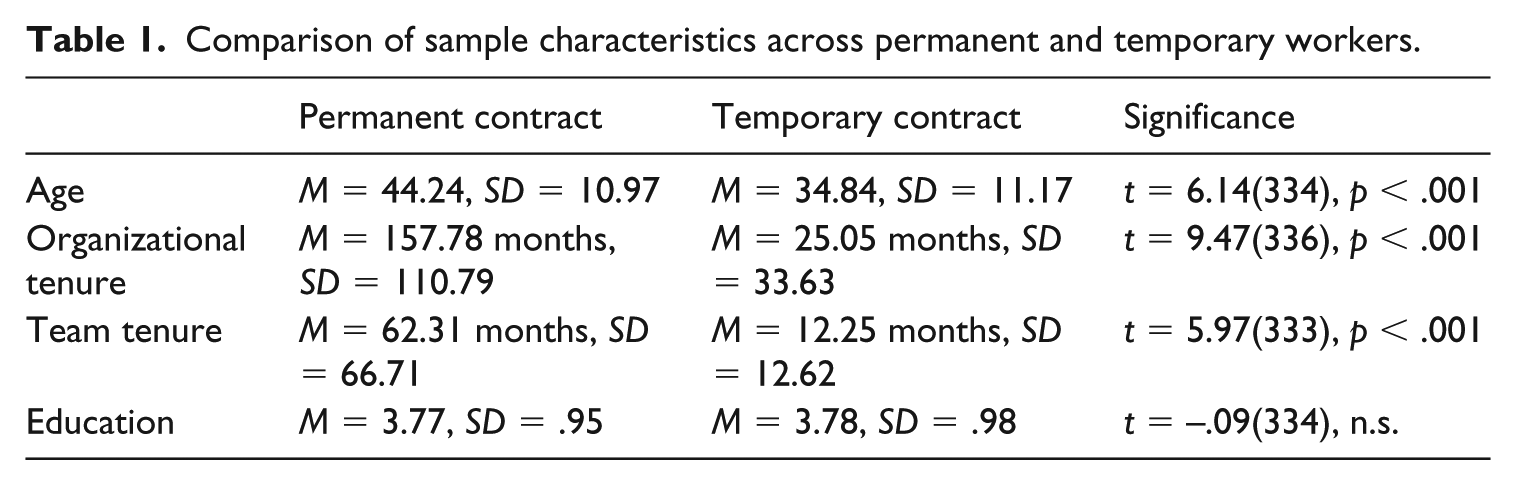
The teams included in the sample consisted of healthcare employees such as nurses and home care professionals, teams of back-office employees responsible for public housing, and teams of college teachers. Team members were asked to fill out paper-and-pencil questionnaires (in Dutch) during team meetings with a researcher present. Before completing the survey, all respondents were assured of confidentiality of the research. After the surveys were completed, all questionnaires were collected and put in a sealed envelope, which was labelled with the name of the team. In total, 598 questionnaires were distributed and 340 questionnaires from 58 teams were returned to the researcher for a response rate of 57%. Non-response was mainly caused by the absence of team members at team meetings. All teams included in our sample had a formal supervisor, who we did not include in our sample. The average number of respondents per team was 5.86. The sample consisted of 133 (39%) males and 207 (61%) females. In total, 64 (19%) respondents had temporary contracts with their organization, with the remaining 275 respondents having permanent contracts. One respondent did not want to disclose his/her contract. As shown in Table 1, temporary employees were, on average, significantly younger, had shorter tenures with their teams and organizations, and had equal amounts of education compared to permanent workers.
Comparison of sample characteristics across permanent and temporary workers.
Measures
Power
We measured power from the perspective of the employee using a semantic measure developed by Bartos et al. (2008). The Semantic Differential Power Perception (SDPP) survey uses a semantic differential methodology using bipolar word pairs to map identification and localization of attitudes in a subject’s thought process. Because of the sensitivity regarding perceptions of power, the semantic differential methodology was used because of its non-reactive nature and the ability to demotivate socially acceptable responses. The survey measures subjects’ perceptions of their power using positive and negative meanings of power by asking respondents to indicate where their attitudes lie with respect to different aspects of power. Word pairs were derived from the literature on social power and antonyms were derived from a thesaurus (Bartos et al., 2008). Examples of word pairs are Secrets/Communication, Honesty/Dishonesty and No Authority/Authority. 1 We translated the English version to Dutch using the translation/back translation procedure. Two blocks of word pairs were presented to the respondents. The first block of 12 word pairs was preceded by the question ‘At my work, I have …’ (e.g. Influence/No Say) and the second block of 8 word pairs was preceded by the question ‘At my work, I feel …’ (e.g. In Control/Supervised). Respondents were then asked to indicate which of the words best described their perception of their work. We used a five-point scale in which 0 was the midpoint. To be able to compare scores and use them in the analyses, we recoded the variable in such a way that a rating of 3 reflected a moderate level of perceived power and 5 was a high level of perceived power. The full SDPP survey with 20 items showed sufficient reliability (a = .86).
Intrinsic motivation
Intrinsic motivation was assessed using three items from the Motivation at Work Scale (Gagné et al., 2010). Respondents were asked to indicate for three statements the degree to which they presently concur with one of the reasons for which they are doing this specific job. One example of such a statement was ‘Because I have fun doing my job’. We used a five-point scale ranging from ‘1 = Not at all’ to ‘5 = Exactly’ (a = .78).
Team commitment
We used a four-item measure developed by Van der Vegt et al. (2003) to measure commitment to the team. A sample item is ‘I feel emotionally attached to this work team’. We used a scale ranging from ‘1 = Totally disagree’ to ‘5 = Totally agree’ (a = .68).
Type of contract
Contract type was measured by asking respondents if they have a permanent or temporary contract (such as fixed-term contract or a contract through a temporary work agency) with this organization (0 = temporary worker, 1 = permanent worker). Because not all teams have temporary workers, some of the permanent workers did not work with temporary workers (n = 109) while others did (n = 166). Research shows that working with temps has implications for permanent workers (Davis-Blake et al., 2003). In our sample, 33 teams have temporary and permanent workers (blended teams) and 25 teams only have permanent workers (non-blended teams). Therefore, we created two dummy variables, one comparing temporary workers (coded as 0) and permanent workers who work with temporary workers (coded as 1; blended permanent employees) and another comparing temporary workers (coded as 0) and permanent workers who do not work with temporary workers (coded as 1; non-blended permanent employees).
Control variables
We controlled for gender (0 = male), age, team tenure (in months) and educational level. 2 Individual traits and characteristics are important moderators that determine the associations of power with outcomes (Sturm and Antonakis, 2015). For example, older or more highly educated workers could find power more important, while highly tenured members of a team could feel that they are entitled to having more power compared to members with lower tenure. 3 Because of recent legislation in the Netherlands about equal treatment of temporary and permanent workers we did not control for primary working conditions such as salary.
Analyses
Because of the nested structure of the data (workers nested in teams), we used multilevel analysis to examine the hypothesized effects. We centred all main variables around the grand mean. We followed the procedure for testing moderated non-linear relationships proposed by Aiken and West (1991) to test the hypotheses. Aiken and West (1991) propose adding a squared term of the independent variable (X*X) – in our case perceived personal power – to test for non-linear associations. If this squared term is significant, this suggests that there is a non-linear association between the independent and dependent variable. To test for a moderated non-linear association, the squared term is multiplied by the moderator to test for a significant moderation effect of the moderator – in our case two dummy variables – on the non-linear association between the independent and dependent variable. Based on this procedure, we used the following equation to test our hypotheses; Y= γ00 + γ10X + γ20X2 + γ30Z + γ40XZ + γ50X2Z + μ00 + μ10(X) + r. In this equation, γ00 refers to the fixed intercept, γ10X refers to the fixed effect of power perceptions, γ20X2 refers to the fixed effect of the squared term of power perceptions, γ30Z refers to the fixed effect of the dummy variable comparing temporary workers to permanent workers who work with and without temporary workers, γ40XZ represents the fixed effect of the interaction between power perceptions and one of the dummy variables, and γ50X2Z stands for the fixed effect of the interaction between the squared term of power perceptions and one of the dummy variables. Finally, r refers to the individual-level error. We also tested models including a random intercept and slope for power perceptions, but only the intercept showed variance. The random intercept for power perceptions did not show variance for both team commitment and intrinsic motivation. Therefore, we only include a random intercept in our final model.
Results
Table 2 shows the descriptive statistics and correlations of the main variables used in this study. The correlations indicate that there is a positive association between power perceptions and both team commitment (r = .23; p < .01) and intrinsic motivation (r = .33; p < .01). Both type of contract dummies, however, are not associated with power and the outcome variables, which suggests that type of contract is not directly associated with power perceptions.
Descriptive statistics and correlations (n = 340).
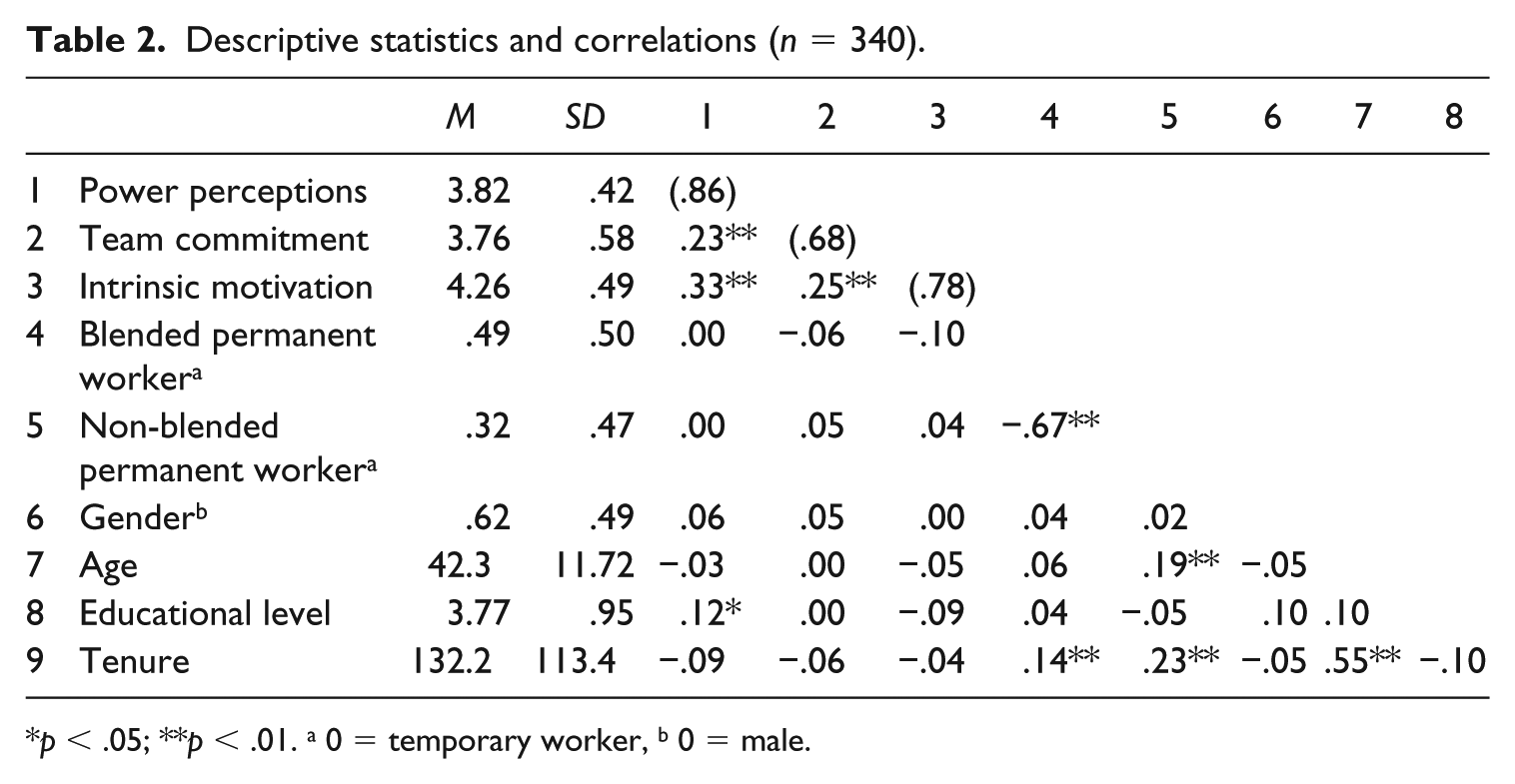
p < .05; **p < .01. a 0 = temporary worker, b 0 = male.
Table 3 displays the results of the multilevel analyses used to test our hypotheses. Hypothesis 1 proposed that there would be a curvilinear relationship between power and intrinsic motivation based on contract type such that the slope for permanent employees would continue to increase and the slope for temporary workers would flatten out at high levels of power. The results of the regressions for intrinsic motivation show that only the interaction between the squared term of personal power perceptions and the blended permanent-dummy was significant (γ = .97(.41); p < .05), suggesting a non-linear relationship. Comparing temporary and non-blended permanent workers, there does not appear to be a non-linear association between personal power perceptions and intrinsic motivation. Figure 1 shows the graphical relationship between power perceptions and intrinsic motivation for temporary versus blended permanent workers. For temporary workers, the association between power perceptions and intrinsic motivation appears to become weaker as personal power perceptions increase. For blended permanent workers, on the other hand, there seems to be an increasing pattern of intrinsic motivation at higher levels of power perceptions. Moreover, we see that at moderate levels of perceived personal power, temporary workers have a higher level of intrinsic motivation compared to blended permanent workers. At low and high levels of perceived personal power, there is little difference between the two types of workers. In conclusion, we find partial support for Hypothesis 1.
Results of multilevel analyses.
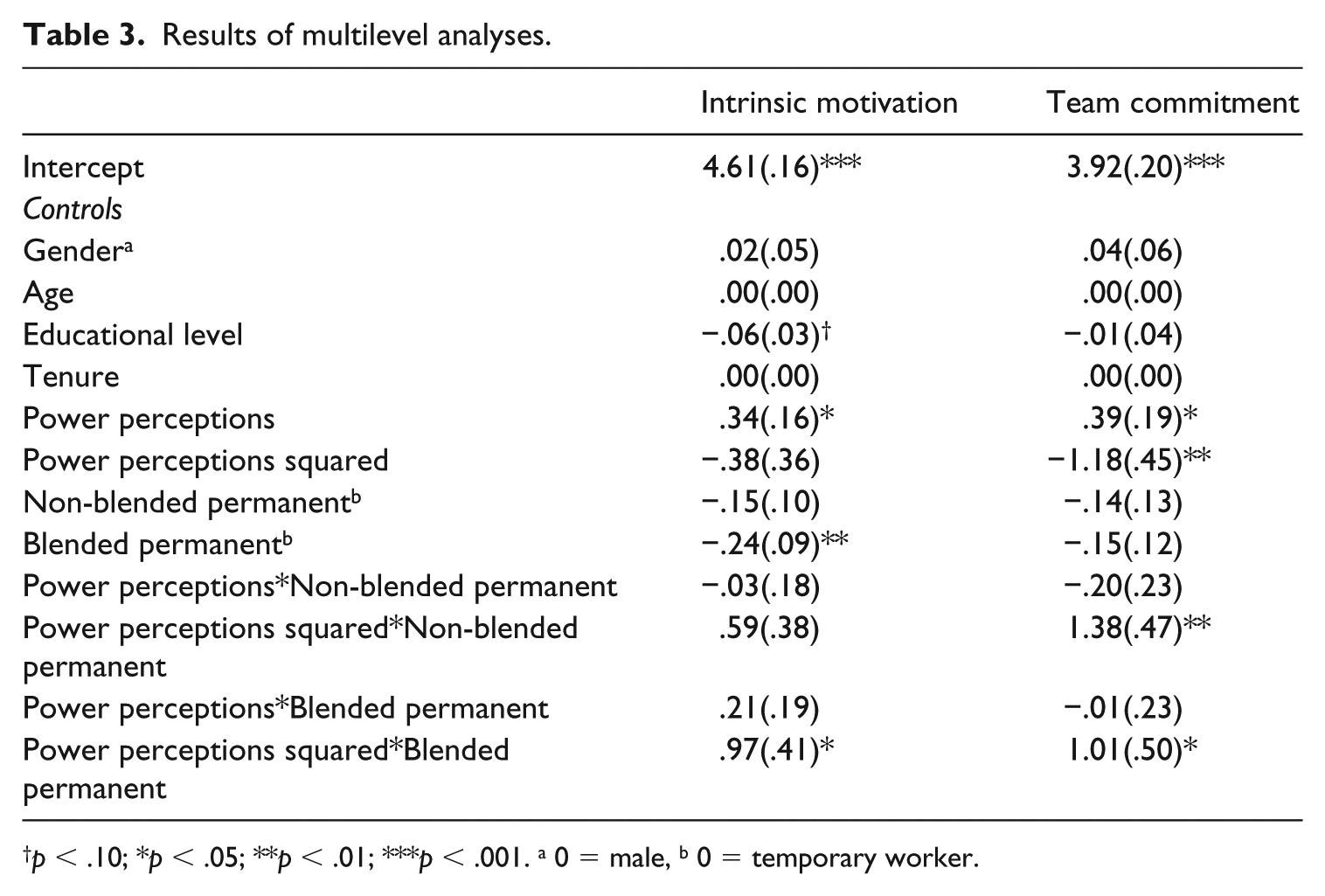
p < .10; *p < .05; **p < .01; ***p < .001. a 0 = male, b 0 = temporary worker.
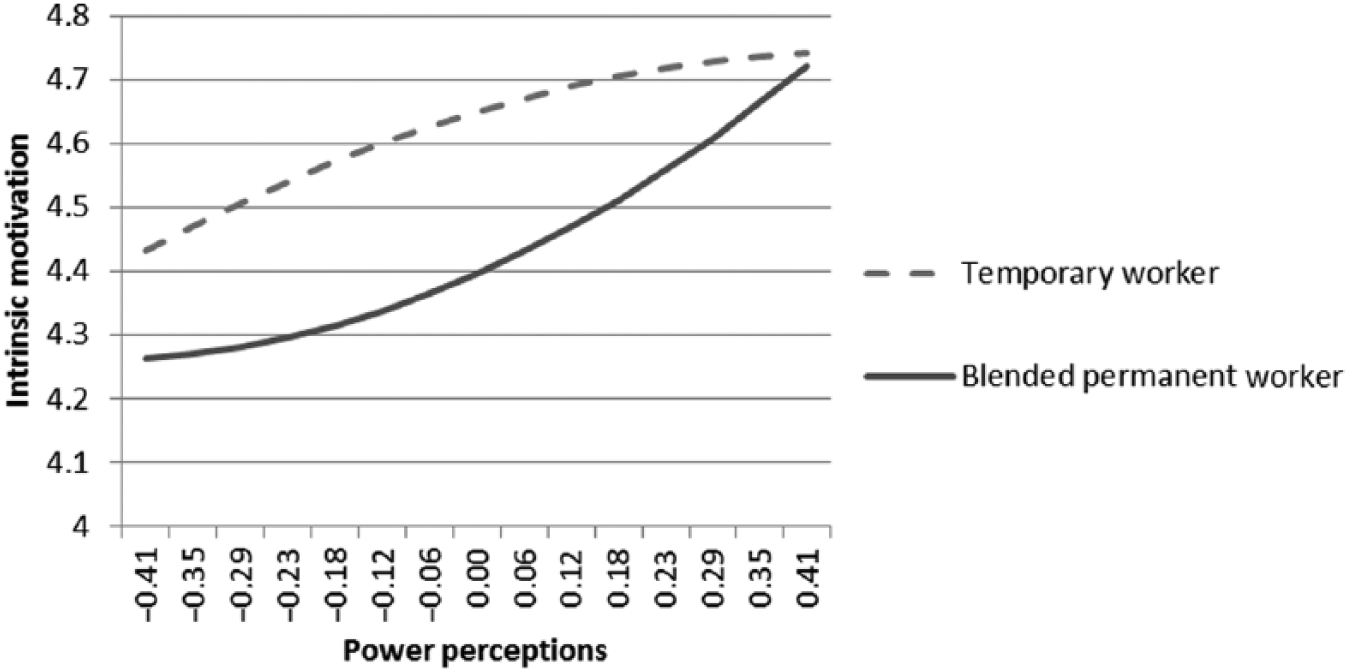
Non-linear association between power perceptions and intrinsic motivation for temporary versus blended permanent workers.
Hypothesis 2 proposed that there would be a curvilinear relationship between power and team commitment based on contract type such that the slope for permanent employees would continue to increase and the slope for temporary workers would flatten out at high levels of power. The results of the multilevel analyses show that for both dummy variables, the interaction term with the squared term of power perceptions is significant (γ = 1.38(.47); p < .01 for non-blended permanent workers, γ = 1.01(.50); p < .05 for blended permanent workers). Figure 2 provides a graphical representation of the association between power perceptions and team commitment for temporary versus non-blended permanent workers. The results suggest that the association between power perceptions and team commitment is linear for non-blended permanent workers and non-linear for temporary workers. For temporary workers, team commitment appears to increase and then slightly decrease at higher levels of power perceptions. The results comparing blended permanent workers to temporary workers indicate a similar trend (see Figure 3), which provides support for Hypothesis 2. In addition, we see that at moderate levels of perceived personal power, temporary workers have a higher level of team commitment compared to blended and non-blended permanent workers. At low and high levels of perceived personal power, there is little difference between temporary workers and the other two types of workers.
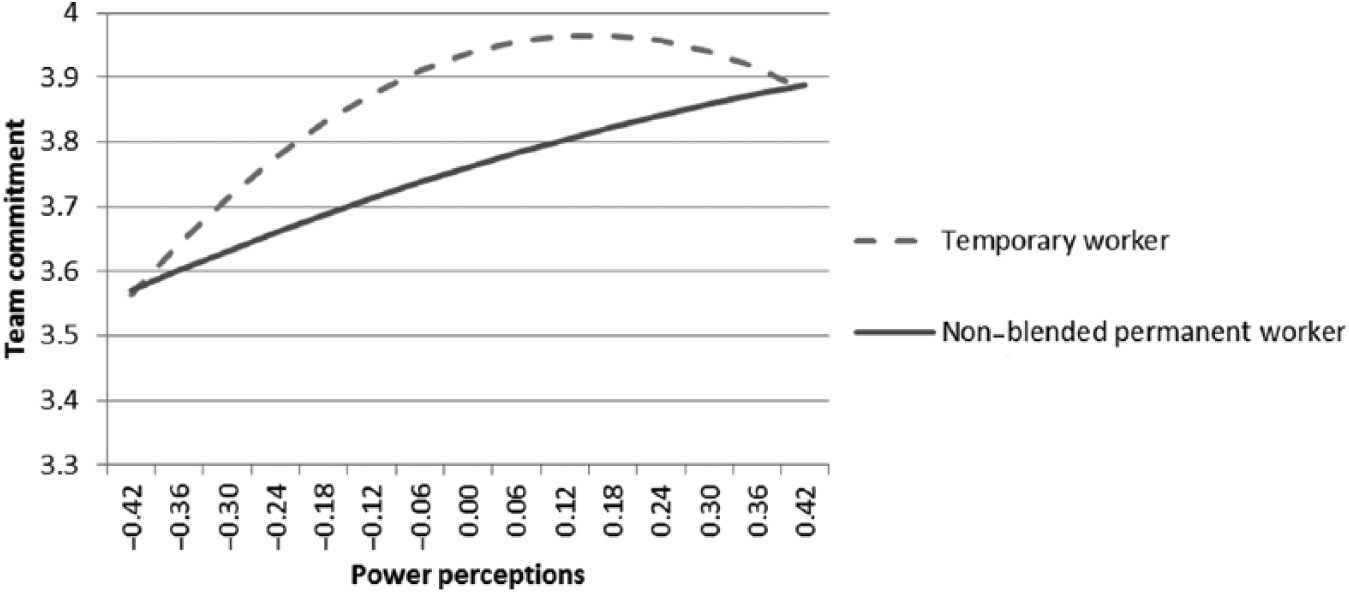
Non-linear associations between power perceptions and team commitment for temporary versus non-blended permanent workers.
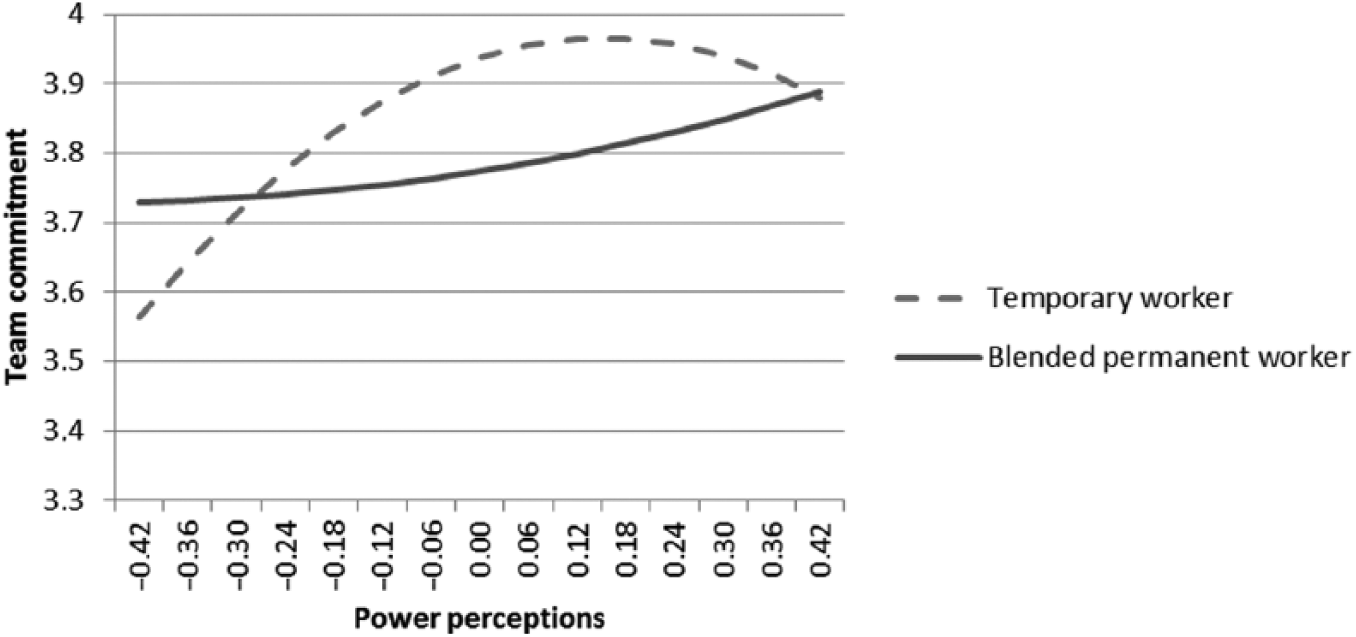
Non-linear associations between power perceptions and team commitment for temporary versus blended permanent workers.
Discussion
In this study, we aimed to assess the relationships between power perceptions and two outcomes – intrinsic motivation and team commitment – for temporary compared to permanent workers. We hypothesized that for temporary workers, these associations would be non-linear, that both intrinsic motivation and team commitment are highest at moderate levels of power. On the other hand, for permanent workers we expected a positive and linear association between power and the outcome variables. Based on a post-crisis sample of 64 temporary and 275 permanent workers nested in 58 teams, our results largely confirm our expectations. For temporary workers, there was a non-linear association between power and team commitment compared to both blended and non-blended permanent workers. For intrinsic motivation, we also see a non-linear association for temporary workers when compared to blended workers, but not when compared to non-blended workers.
Implications for theory
These results offer several implications for theory and research. Type of contract appears to be an important moderator in the relationship between power perceptions and the outcome variables that we studied (i.e. intrinsic motivation and team commitment). Past research on potential moderators of the power–outcomes relationship has primarily focused on individual-level demographic and psychological traits (Sturm and Antonakis, 2015). Type of contract and, particularly, the psychological states of temporary workers could be an interesting avenue for further research examining when and how power perceptions impact outcomes. Temporality in social relationships, inherent in temporary contracts, could impact the extent to which employees feel entitled to receive benefits from their powerful position. For example, Chen et al. (2001) found that powerful people with higher levels of exchange orientation, or individuals who are more sensitive to reciprocity in social exchange, acted in more self-serving ways. Yet, research on temporary employment has shown that temporary workers feel less entitled to balanced exchanges (de Jong et al., 2009b), suggesting that the extent to which power relates to outcomes such as self-serving behaviour could be impacted by type of contract through the psychological states of temporary and permanent workers. Because temporary workers may feel that their organization is obligated to offer them economic rewards rather than socio-economic rewards such as personal power (e.g. McLean-Parks et al., 1998), those who perceive having some level of personal power is already more than they expected. Our results show that the non-linear association is more explicit for team commitment compared to intrinsic motivation. Perceived personal power is an interpersonal concept that deals with dependencies in relationships with others. It refers to the extent to which a person perceives that he/she can make decisions about others’ as well as one’s own opportunities, resources and rewards (Sturm and Antonakis, 2015). If fellow team members encourage these perceptions in a temporary worker, in other words make temporary workers perceive they have some personal power, they likely reciprocate these perceptions by feeling stronger bonds with their fellow team members. From a COR perspective, they will likely commit themselves to people who control resources in order to preserve that position of power. Unlike team commitment, intrinsic motivation is not interpersonal, it is intrapersonal and it does not involve the external environment that provides workers with perceptions of personal power. As such, the non-linear association between perceived personal power and intrinsic motivation may be less explicit. Moreover, Magee and Smith (2013) propose that possessing power creates social distance with less powerful people, as highly powerful people are less dependent on others for goal satisfaction. Temporary workers, however, already have a certain level of social distance to permanent workers (Wilkin et al., 2018), which could be another explanation for why their commitment to the team does not further increase at higher levels of power perceptions.
This study also offers some implications for COR theory. Interestingly, COR is very rarely used to explain temporary employees’ attitudes and behaviours, despite presenting some very useful propositions for understanding their behaviour. For example, a core assumption in COR theory is that workers who possess resources are more capable of resource gain, or more conservatively, they are less vulnerable to resource loss (Hobfoll, 1989). In the case of temporary workers, resources can be possessed but are also uncertain given the insecurity of their job. Though resources can, theoretically, provide temporary workers with control and mastery over their job (Hobfoll, 1989), the transient nature of their jobs may not only put constraints on the extent to which temporary workers are capable of gaining resources (e.g. social and task support), but also result in sense of uncertainty (or fear) of losing these resources. This makes temporary workers especially vulnerable to resource loss. It is this contradiction that offers new insights to COR. Our results suggest that when temporary workers possess moderate levels of power, the potential of losing this resource is not as important to outcomes such as intrinsic motivation and team commitment. However, at high levels, they have much to lose, which limits the further development of their intrinsic motivation and commitment to the team.
Finally, our study adds to the research on the implications of temporary employment on employee attitudes (e.g. De Cuyper et al., 2008; Guest et al., 2010). The correlation between type of contract and power perceptions suggests that there is no difference between temporary and permanent workers with respect to power perceptions. At low and high levels of perceived personal power, there is little difference between intrinsic motivation and team commitment of temporary and permanent workers. However, our study shows that how power relates to our outcome variables is different. Building on COR, power can be considered a resource, and the impact of this resource is more complex (non-linear) for temporary workers compared to permanent workers. Temporary workers are more intrinsically motivated and more committed to their team at moderate levels of perceived personal power compared to permanent workers. However, due to the temporary nature of their job, losing power is very likely, leading to similar levels of intrinsic motivation and team commitment at high levels of power. In conclusion, COR theory can provide new insights into the complexity of temporary employment, which calls for more studies applying COR theory to temporary employment research.
Limitations and future research avenues
This study has a number of limitations that should be considered when interpreting its implications. First, we used three different types of organizations (healthcare, housing and higher education) that mainly employ more highly-skilled employees. Testing our hypotheses in multiple organizations and different teams is a strength of our study. However, this also calls for replication in other contexts that are known for employing temporary workers and structuring their work around teams.
Second, we used cross-sectional data to test our hypotheses, which limits the causal interpretations of our study with respect to the implications of power perceptions for our outcome variables. In the light of COR theory, a longitudinal design has benefits compared to a cross-sectional design. Also, drawing on COR theory, we proposed that temporary workers cope with the threat of losing resources by awarding less value to personal resources such as high perceived personal power. However, we did not directly measure the extent to which temporary and permanent workers value personal resources such as personal power, and we believe this should be addressed in future research. Moreover, all variables used in our study are self-reported, which makes our study susceptible to common method bias.
Third, although our response rate is strong, the effects may be somewhat tempered because non-response was largely due to absent team members at team meetings and it is possible that team members who miss meetings also have low motivation and team commitment. Power issues could also impact our ability to detect effects. Although additional power may enable us to find support for smaller, yet significant effects, it would also provide additional support for our current findings linking power perceptions to motivation and commitment.
Fourth, our low alpha for team commitment is a concern, although this variable is measured using a validated scale (Van der Vegt et al., 2003) that is frequently used in other samples and contexts. Also we used a self-reported measurement of power perceptions that is based on semantic differential methodology. Scholars have criticized this methodology in the past for being sensitive to individual differences with respect to the size and character of the semantic space and temporal variations in responses (Heise, 1969). However, perceptions of one’s own power are very sensitive to social desirability, requiring a self-reported measure that does not promote socially acceptable answers (Bartos et al., 2008). The issue with social desirability is why we chose this measure of power over other measures such as the Sense of Power measure developed by Anderson et al. (2012). Other types of measurement should be used to further explore the impact of power and status on temporary and permanent employees’ attitudes and behaviour, as well as cooperation between these two types of employees. Social network analyses (Brass et al., 2004) could be used, for example, to assess the level of interpersonal dependency among temporary and permanent workers and to measure interpersonal power in a more objective manner.
Finally, we did not distinguish between different sources of power as well as different motives for accepting a temporary job and tasks assigned to temporary and permanent workers. Unfortunately, we were unable to distinguish between different sources of perceived personal power in our data because a factor analysis of the SDPP survey did not replicate the five sources of power included in the instrument. Future research should further explore how different sources of perceived personal power relate to outcome variables for temporary and permanent workers. Moreover, research has consistently shown that temporary workers are a heterogeneous group, with different motives for accepting a temporary job (de Jong et al., 2009a), as well as different positions and tasks in teams and organizations (Kunda et al., 2002). To gain a more complete understanding of how personal power perceptions associate with employee outcomes for temporary versus permanent workers, both motives and tasks should be considered.
Conclusion
Temporary workers, by definition, are in a dependent position with respect to their employment relationship. It is therefore generally assumed in the literature that, with respect to contract type, temporary workers have a lower status compared to permanent workers (e.g. Boyce et al., 2007; Von Hippel, 2006; Wilkin et al., 2018). Our results show that temporary workers do not necessarily perceive that they have less power compared to permanent workers. In addition, power has an initially positive impact on their intrinsic motivation and commitment to the team. It is at higher levels of power where the limitations of their temporary contract becomes particularly salient for their job attitudes and behaviours. For managers, it is important to know that at moderate levels of power, temporary workers are highly intrinsically motivated and feel committed to their team, which are important conditions for job performance (Bishop et al., 2000; Cerasoli et al., 2014). The bottom line is that giving temporary workers certain levels of power is beneficial. On the other hand, our findings show permanent workers, both blended and non-blended, show higher levels of intrinsic motivation and team commitment when perceived personal power is high. The findings of this study call for a clever management of dependencies to achieve an effective distribution of power within teams.
Footnotes
Declaration of conflicting interests
The authors declared no potential conflicts of interest with respect to the research, authorship, and/or publication of this article.
Funding
The authors received no financial support for the research, authorship, and/or publication of this article.